Home » 2019 (Page 9)
Yearly Archives: 2019
Strength and Neuromuscular Coordination
2250 words
PumpkinPerson (PP) has some weird—and uneducated—views regarding strength and coordination, which, of course, implies that he has no understanding of what “coordination” truly is. He seems to have convinced himself that coordination weightlifting does not require coordination (neuromuscular coordination; hereafter NMC—the ability of the central nervous system—CNS—to control muscles). That view is patently ridiculous. In this article, I will explain the logic behind the fact that strength and power exercises, in particular, NEED a high NMC, and without a high NMC, the athlete in question cannot perform to their highest potential.
PP wrote about an “athletic g factor” to attempt to liken it to the “g factor” regarding “intelligence” tests, but I’m not worried about that comparison (IQ is boring to me now). What I am worried about are his outlandish claims regarding what he believes regarding strength and NMC. PP cited Jensen’s Bias in Mental Testing where Jensen cited a correlation matrix in which “all of [the] correlations were positive“, writing that he’s “not sure why some commenters think weight lifting requires coordination when the correlation between strength (hand grip, chinning) and coordination (Pursuit rotor tacking, Mirror star tracing) is zero” (PP; Physical Coordination).
Well, “some commenters” have actual experience in what he is talking about, so, forgive me if I don’t believe the claims that, in my opinion, he pulled out of thin air. Take chin-ups. Imagine a case of someone attempting to chin-up that does not have high NMC. Since they were not coordinated, do you think they would be able to do a controlled rep in order to complete one rep? Or would their body be all over the place, flailing around since they do not have the mind-muscle (MMC) connection required to complete the lift. Now take his other example, hand grip. On its face, one might assume that this requires no NMC. But think about the process of gripping something tightly. If the muscles in the forearm, for example, are not adequately trained, then, in all lifts involving forearm strength (a great majority of which involve at least some type of forearm strength) will not be able to be performed properly, since the individual in question does not have the NMC required to properly do the exercise in question.
PP then says that when he “lift weights, [he doesn’t] feel like [he’s] using coordination.” This proves two things to me: (1) PP does not know how to lift properly, and then (2) follows that he does not know about the MMC.
The MMC is where the mind and the body “meet.” Acetylcholine functions as a neurotransmitter. This neurotransmitter “communicates” with the muscles in the body to cause a contraction. This contraction, then, causes the action of voluntary muscle movement. (I had an A&P professor explain to me that, out of the whole textbook he taught out of, one of the only things in the textbook that we could choose to do was move the body—contract muscles and cause movement). So when acetylcholine is released, it latches onto muscle fibers and causes muscle contractions.
We can put the MMC in this way: imagine doing a movement such as a bicep curl. One is not actively attempting to use the proper levers in order to properly lift the weight. On the other hand, if one is actively thinking about the muscles being used in the movement, then they are using the connection—they are strengthing their MMC and, in turn, developing the proper NMC which is required in order to properly lift weights and get the most returns possible from your time spent lifting.
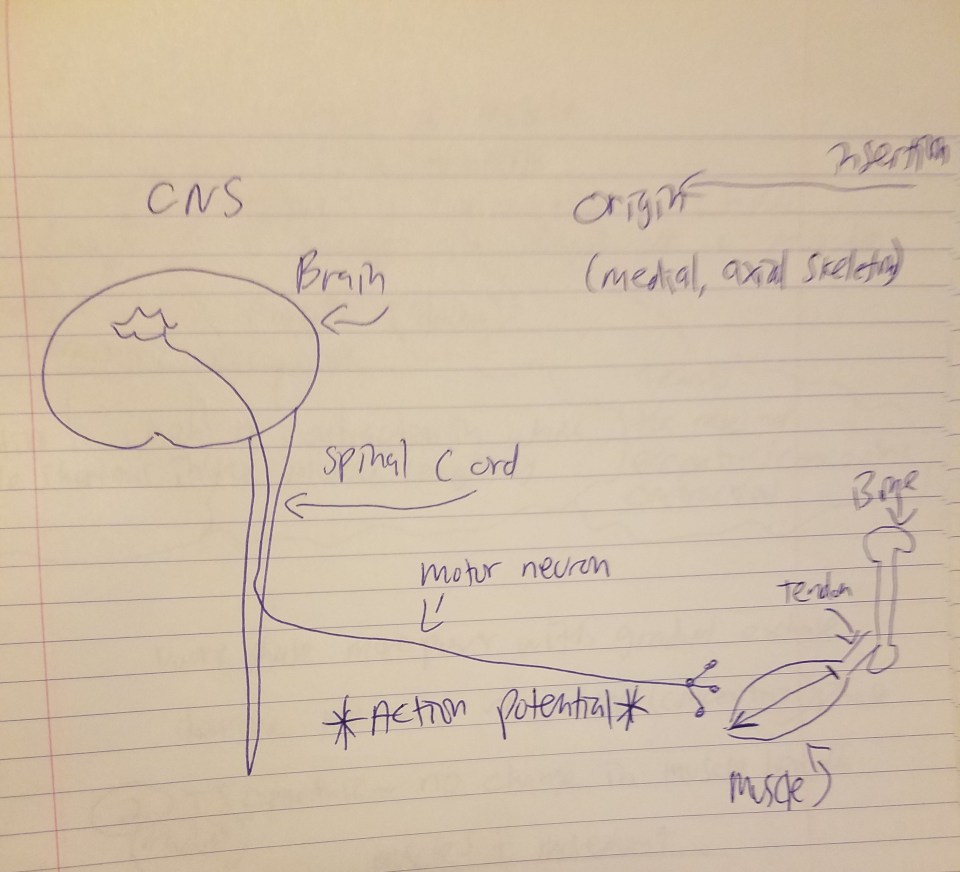
The above diagram I drew is the process by which muscle action occurs. In my recent article on fiber typing and metabolic disease, I explained the process by which muscles contract:
But the skeletal muscle will not contract unless the skeletal muscles are stimulated. The nervous system and the muscular system communicate, which is called neural activiation—defined as the contraction of muscle generated by neural stimulation. We have what are called “motor neurons”—neurons located in the CNS (central nervous system) which can send impulses to muscles to move them. This is done through a special synapse called the neuromuscular junction. A motor neuron that connects with muscle fibers is called a motor unit and the point where the muscle fiber and motor unit meet is callled the neuromuscular junction. It is a small gap between the nerve and muscle fiber called a synapse. Action potentials (electrical impulses) are sent down the axon of the motor neuron from the CNS and when the action potential reaches the end of the axon, hormones called neurotransmitters are then released. Neurotransmitters transport the electrical signal from the nerve to the muscle.
So action potentials (APs) are carried out at the junction between synapses. So, regarding acetylcholine, when it is released, it binds to the synapses (a small space which separates the muscle from the nerve) and it then binds onto the receptors of the muscle fibers. Now we know that, in order for a muscle to contract, the brain sends the chemical message (acetylcholine) across synapses which then initiates movement. So, as can be seen from the diagram above, the MMC refers to the chemo-electric connection between the motor cortex, the cortico-spinal column, peripheral nerves and the neuromuscular junction. A neuromuscular junction is a synapse formed by the contact between a motor neuron and a muscle fiber. This is why beginners in the gym get stronger in the first 8 weeks or so of training—there has not been enough time for muscle to adequately grow in that time span. Thus, when people lift weights correctly, what they are doing is training their NMC—and their mind—to be able to adequately perform these types of actions in a safe, controlled manner.
How is NMC measured? It’s not simple to measure it, and in reality, the most feasible way to “measure it” in real life situations without the use of a lab is to just see one’s progress while they progress through higher and higher weights from their starting weights and they learn to perform the exercise in question safely. But a more empirical measure used in order to measure NMC are electromyography (EMG) tests. In fact, this test is THE MEASURE used to measure NMC, since all of the relevant variables in question (some seen in the above diagram) are tested. EMGs are used for numerous reasons, mostly in order to test for types of motor diseases which affect muscle action. There is also a related measure here: a nerve conduction study. This measures the speed and strength of signals traveling between two synapses, and so, the better one’s nerve conduction is in regard to muscle action, the higher their NMC is and, therefore, the better they will be able to perform any certain lift. So, for example, we can say that one’s NMC increased and the cause was resistance training if their EMG tests increase.
Imagine an Olympic lifter going to snatch 400 pounds. Would any sane person bet that they have low NMC (i.e., a low rate of firing between synapses as measured by an EMG)? A claim such as this would be quite preposterous—individuals like Olympic lifters clearly have trained both their bodies and minds in order to lift to the best of their abilities. And if they did NOT have high NMC (i.e., a higher rate of firing between synapses), then the weight would wobble and ultimately fall, causing the lifter serious injury. But, of course, we do not see that, since strength and NMC are closely related.
I now have some examples of studies which looked into this matter (that thinking about the action one is performing activates the primary muscles used in the movement in question), which will definitely put PP’s claims to rest for good.
Neuromuscular coordination is needed, for example, to be able to “squat lift” correctly (meaning, pick up a load from a squatting start and lift it; Scholz, Millford, and McMillan, 1995). Our understanding of how this occurs has greatly increased in 30 some-odd years since our technology has improved.
Now, take the MMC. We can simply define it as “One focusing on using the muscles in question to perform the lift.” Calatayud et al (2016) studied 18 resistance-trained men on a 1RM (one-rep max) bench press. Each individual in the study participated in 2 sessions: one to determine their 1RM and another experimental session. Calatayud et al (2016) attempted to control for as many factors as possible in order to attempt to see if the baseline changed at all. For example, all measures were made by the same two investigators; all measures were taken in the same facility; all participants participated in the same warm-up mobility drills prior to performing the lift; all participants performed the lift in the exact same manner they performed the two aforementioned sessions (same technique and body position, i.e., suicide grip and powerlifting technique).
They found that (1) higher levels of EMG activity lead to moving more weight; (2) the men could “selectively activate pectoralis and triceps muscles during the
bench press when this exercise is performed at low intensities” (Calatayud et al, 2016), at moderate intensities; (3) that focusing on one muscle (i.e., triceps brachii over pec major) did not hamper activation in one over the other; and (4) a threshold exists between 60-80 percent existed for muscle activation. Thus, experienced resistance-trained men can actively increase activity in certain muscles when cued to focus on those certain muscles.
Snyder and Fry (2012) studied 11 D-III football players on the bench press while recording EMG activity. They found that, when verbal cues were given to focus on the chest muscles, EMG increased by 22 percent, but when verbally cued to focus on the triceps, the pec major returned to baseline (though this does not mean, of course, that performance was hampered), while EMG activity increased by 26 percent. However, in-line with the findings from Calatayud et al (2016), when 80% 1RM were tested, EMG activity in the triceps remained unchanged, implying that there is a threshold.
The results of this study show that trained subjects can alter the participation of muscles in both moderate and higher-intensity multijoint resistance training exercises in response to verbal instructions, because both TB and PM activities were increased selectively in response to 2 different sets of instructions at 50% 1RM and 80% 1RM. This indicates that verbal instructions from trainers, therapists, and coaches are likely to have a measurable effect on muscle involvement, although it is unclear how generalizable this effect might be to all training exercises. Previous research from our laboratory (23) indicated that untrained subjects performing a lat pull-down at 30% max isometric load could respond to verbal instructions to increase back muscle involvement by increasing latissimus dorsi activity while maintaining proper form and similar speed of movement. The subjects in that study increased latissimus dorsi activity by 17.6%, whereas in the current study, verbal instruction resulted in a 22.3% increase from baseline at 50% 1RM for PM and a 25.6% increase for TB. However, antagonist activity was not measured by Snyder and Leech (23), and it was possible that the subjects activated antagonist muscles to offset additional force produced by agonist muscles. This study addressed this possibility, but no changes were seen in antagonist muscle activity with verbal instructions. The question of the effect of higher testing loads was also addressed by this study, and it was found that at 50% 1RM, the subjects were capable of altering muscle participation of both the horizontal adductors and the elbow extensors, but at 80% 1RM, only the horizontal adductors were affected. (Snyder and Fry, 2012)
If the activity of a muscle as measured by EMG is increased, then we can say that, for all intents and purposed, that NMC is high. One who is not familiar with a lift will have low NMC, that is, the firing will be low compared to someone with high NMC. Quite clearly, verbal instruction to focus on certain muscles can better activate them, and, using EMG, we can say that they have high NMC if the firing between synapses is fast.
Rutherford and Jones (1986) write that “It is concluded that a large part of the improvement in the ability to lift weights was due to an increased ability to coordinate other muscle groups involved in the movement such as those used to stabilise the body.” How weird is that… While Kim, Lockhart, and Roberto (2009) in their sample of elderly individuals found that “Strength gain by exercise training plays a role in the improved coordination of other fixator muscles necessary for body support while performing daily tasks such as cooking, gardening, reaching for an object, and walking, and in gaining more coordinated contractions between agonist and antagonist muscle groups leading to greater net force in the imposing movements.” Finally, Dahab and McCambridge (2009) found that strength training in kids improves the number and coordination of active neurons along with the firing rate pattern. This is important because the number and coordination of active neurons along with the rate of firing pattern influences—very strongly—NMC and how coordinated they will be.
In conclusion, it is quite obvious that PP does not know what he is talking about and only writes what sounds good in his head without having an adequate understanding of anatomy and physiology, NMC, MMC, APs and the like. These types of confusions can be cleared up by having an adequate understanding of anatomy and physiology and knowing how and why muscle actions are done, where they begin and where they end. Clearly, the claim that weight lifting requires no coordination is false.
Dorothy Roberts on Race as a Political Entity
2050 words
I recently bought Dorothy Roberts’ Fatal Invention: How Science, Politics and Big Business Re-create Race in the Twenty-First Century (2011) (it was $1.99 in the nook store, couldn’t pass it up), which, how the title of the book explains, discusses how race is recreated today using methods of the past as well as methods of the future. One of her main claims is that race is a political entity. Now, while I don’t disagree here (there are of course social aspects to what we call “races”), she completely rides against biological racial realism (eg Spencer, 2014; Hardimon, 2017). Her concept, though, is similar to Hardimon’s (2017) socialrace concept, and it is already a part of Spencer’s Blumenbachian partitions (since race is both biologically and socially constructed in the American view of race). While I do not believe that you need genes to delineate race, Roberts also goes on the attack on Rosenberg et al (2002), who both Hardimon and Spencer cite to buttress their arguments on the reality of biological races.
Race is not a biological category that is politcally charged. It is a political category that has been disguised as a biological one. (Roberts, 2011: 14)
Note how this is extremely similar to Hardimon’s socialrace concept. In Hardimon’s concept, socialraces have a biological correlate: minimalist races. Hardimon’s concept says, for example, that “Hispanics/Latinos” are socialraces but they are a group that do not have a corresponding minimalist race—because “Hispanics/Latinos” are a mixture of different races. Race IS a biological category that has been politically charged: Groups look different; groups that look different share geographic ancestry; groups that look different that share geographic ancestry are derived from the same geographic location; therefore race is a biological category and is therefore politically charged (one reason) since people do not like the out-group—people that look different from themselves.
This distinction is important because many people misinterpret the phrase “race is socially constructed” to mean that the biological category of race has a social meaning, so that each society interprets differently what is means to belong to a biological race. According to this view, first we are born into a race, and then our society determines the consequences of this natural inheritance. There is, then, no contradiction between seeing race as both biological and socially constructed. (Roberts, 2011: 14)
There, actually, IS NO CONTRADICTION between seeing race as socially and biologically constructed. Racial categories pick out real kinds in nature—which is what “biological racial realism” means. Since our racial categories pick out real kinds in nature, then, when it comes to society and social construction, whatever is believed about certain races in that society will be socially constructed. You can’t, for example, call a Nigerian Caucasian (see more on this below) because it does not make any sense.
Roberts then goes on (p. 14-15) about how “human beings do not fit the zoological definition of race” since a “biological race is a population of organisms that can be distinguished from other populations in the same species based on differences in inherited traits.” And so, since no human groups have this high degree of genetic differentiation, there are no human races, but only one human race.
Though Hardimon (2017: 99) articulates the best definition of race I have come across:
A race is a subdivision of Homo sapiens—a group of populations that exhibits a distinctive pattern of genetically transmitted phenotypic characters that corresponds to the group’s geographic ancestry and belongs to a biological line of descent initiated by a geographically separated and reproductively isolated founding population.
So we know that (1) populations exhibit distinctive features; (2) these populations that exhibit these distinctive features correspond to that population’s geographic ancestry, (3) these populations that exhibit these distinctive features which correspond to geographic ancestry belong to a biological line of descent which was initiated by reproductive isolated and geographically separated founding populations; so (4) race exists.
We know race is a political grouping because it has its political roots in slavery and colonialism, it has served its political function over the four hundred years since its inceptio, and its boundary lines—how many there are and who belongs to each one—have shifted over time and across nations to suit those political purposes. Who qualifiies as white, black, and Indian has been the matter of countless rule changes and judicial decisions. These racial reclassifications did not occur in response to scientific advances in human biology, but in response to sociopolitical imperatives. They reveal that was is being defined, orgainzed, and interpreted is a political relationship and not an innate classification. (Roberts, 2011: 15)
We can take this two ways here: (1) point out that Roberts is conflating minimalist/populationist races with socialraces (which is exactly what she is describing to the tee). Yes, since race is partly social, then, based on the social attitudes of people which do change over time. Then, in that society, certain groups who were barred from being in another group may be allowed “into” the group. This does not mean that race is not biological. “Oh the Irish were considered “not white” at one point in time, therefore race doesn’t exist since groups can exit group A and become group B based on sociopolitical inclinations.” This, of course, goes over the distinctive phenotypic differences between groups with peculiar geographic ancestry. THAT is what defines race; what Roberts is discussing is important, since race is partly political, but it is not the whole story.
In addition to the grotesque lynchings that terrorized blacks throughout the South, an especially brutal form of reenslavement was the false imprisonment of thousands of black men who were then leased to white farmers, entrepreneurs, and corporations as a source of cheap labor.
It is in this accute distinction that between the political status of whites and blacks, this way of governing the power relationship between them, that we find the origins of race. Colonial landowners inherited slavery as an ancient practive, but they invented race as a modern system of power. They employed Aristotle’s concept of natural slaves and natural rulers to define permanent features of black and white people. Race separated human beings into two fundamentally distinct groups: those who were indelibly born to be lifelong servants and those who were born to be their masters. Race radically transformed not only what it meant to be enslaved, but what it meant to be free. (Roberts, 2011: 23)
Let’s accept Roberts’ argument here that the political status of whites and blacks was a way to govern the power relationship between them: so what? That group A subjugated group B and attempted to justify it with X, Y, and Z doesn’t mean that group A and group B are not biological races—it just means that group A subjugated group B and, in the future, there were social repercussions (which is also a part of the phenomenon of race as a partly social construct).
Roberts then discusses the Census (p. 31-35) and how ever-changing racial definitions undermine the claim that biological racial realism is true. In Spencer’s argument, the US meaning of “race” is just a referent, “specifically the referent of US racial discourse” (Spencer, 2014: 1027). This is because, in America, race-talk is tied to the census. We Americans are familiar with the racial groupings on the census since they are not only in use on the census but numerous other institutions. Spencer (2014) then discusses how we can use “phonetic cues alone (e.g., African American Vernacular English), surnames alone (e.g., “Chen”), first names alone (e.g., “Lakisha”), and visual cues alone (e.g., a person’s face)” (Spencer, 2014: 1027) to know someone’s race. Therefore, according to Spencer, the discourse used in the census is the discourse used nation-wide.
But the census does not set what “race” means on these forms: the OMB (Office of Management Budgeting) does. The OMB refers to race as a “set” of populations, and so this leads Spencer to believe that the “sets” of populations that the OMB is referring to are whites, blacks, Asians, Pacific Islanders, and American Indians. So race is a particular, not a kind as Hardimon argues.
Roberts then argues against the “new racial science”, most forcefully, against Rosenberg et al (2002). She brings up the usual discourse “…the number of genetic clusters is dictated by the computer user, not the computer program” (Roberts, 2011: 74). Roberts says that the clusters are “arbitrary.” Roberts says that Rosenberg et al’s (2002) study failed to verify 18th-century racial typology, but it did confirm what we have known since Lewontin’s (1972) analysis: that there is more genetic variation within races than between them. About 93-95 percent of human genetic variation was found to be within race whereas 5-7 percent of human genetic variation was found to be between groups.
Roberts says that the clusters are “arbitrary.” This is a common critique, but it is irrelevant. The five populations found by Structure are genetically structured—they are meaningfully demarcated on the basis of genetic markers (Hardimon, 2017: 88). Roberts also discusses the K = 6 run, which identified the Kalash people.
The fact that structure represents a population as genetically distinct does not entail that the population is a race. Nor is the idea that populations corresponding to the five major geographic areas are minimalist races undercut by the fact that structure picks out the Kalash as a genetically distinct group. Like the K=5 graph, the K=6 graph shows that modulo our assumption, continental-level races are genetically structured” (Hardimon, 2017: 88).
The five clusters identified by Rosenberg et al (2002) represent continental-level minimalist races so the five populations which correspond to the major geographic locations throughout the world are continental-level minimalist races. So it is, in fact, possible to place individuals into different their continental-level minimalist race without knowing anything about the race or ancestry of the individuals from which the microsatellites were drawn. Rosenberg et al (2002) studied the populations based on language, culture, and geography, not skin color or race.
It is true that Rosenberg et al (2002) found 4.3 percent of the overall human genetic variation to be between races—but this does not ride against claims from biological racial realists. The genetic variation is enough to say that we have partitions at K = 5.
“People are born with ancestry that comes from their parents but are assigned a race” is how Camara Jones, a research director at the Centers for Disease Control (CDC) explains it. (Roberts, 2011: 77)
People are assigned races based on the ethnicity/ancestry of the parents. A Nigerian would not be assigned to the Asian race, since the Nigerian has none of the features which make “Asians” Asian.
This is very simple: if both parents belong to race R, then the child will be race R as well. If parent 1 belongs to R1 and so does parent 2, then the child will belong to R1 as well (since the parents have distinct physical features which correspond with geographic ancestry and their ancestors derived from a distinct geographic location. So, since people are born with ancestry that comes from their parents, then they are assigned their PARENT’S race; they are not assigned A race, as if one can assign any individual to any race. But what if one parent belongs to R1 and the other belongs to R2? Hardimon’s minimalist concept is vague here; it only shows that races exist, it does not say which populations are races. If an individual’s parents belong to R1 and R2, then that individual is mixed race. The existence of mixed race people, of course, does not rail against the existence of biological races.
In sum, Roberts does make some good points (in what I have read of the book so far), but she gets it wrong on race. Hardimon and Spencer have both defended the methodology/concepts used by Rosenberg et al (2002) and in doing so, they successfully argued for the existence of biological races—though their two viewpoints differ. That race is, in part, socially (politically) constructed is irrelevant. What Roberts does not understand is that these socially constructed groups (“white”, “black”) still, very much so, capture biological differences between them. That they are socialraces does not mean that they DO NOT have different physical features which correspond to geographic ancestry. The socialrace concept (which Roberts espouses in her book) is separate from Hardimon’s other scientific race concepts. But it is already inherent in Spencer’s, since his Blumenbachian partitions are social constructs of a biological reality. You don’t need genes to delineate races and minimalist races exist and are biologically real.
(I will cover other things from her book as I get to them. I will discuss race and medicine at length.)
Just-So Stories: The Slavery Hypertension Hypothesis
1800 words
Blacks have higher BP on average than whites. Why? One popular explanation is the Slavery Hypertension Hypothesis (SHH). The SHH is a hypothesis which posits 2 things: (1) that those living in the African climate were subject to limited water and salt, and dehydration so, a higher sodium-retention mechanism evolved in those populations to retain salt, which also leads to hypertension; and (2) during the Middle Passage there were high amounts of vomiting, diarrhea, heat, and little salt and so surviving slaves were “selected for” salt conserving water and salt. Then, when they reached the plantations, due to low water, copious sweating, and intense work, there were additional selective pressures which “selected for” water and salt conservation.
This hypothesis is so popular, that it was even pushed by Oprah, when Dr. Mehmet Oz asked Oprah why blacks have higher BP than whites. Lujan and DiCarlo (2018) write:
During a May 2007 Oprah show, Dr. Mehmet Oz asked Oprah, “Do you know why African-Americans have high blood pressure?” Oprah promptly replied that Africans who survived the slave trade’s Middle Passage “were those who could hold more salt in their bodies.” To which Dr. Oz exclaimed, “That’s perfect!” (64, 71). According to Dr. Oz and Oprah, African-Americans today are afflicted by hypertension at higher rate than whites because of genes passed on by their ancestors, genes that favored salt retention and that, in turn, cause high blood pressure (Fig. 1) (71). [They are implying that genetic ancestry is associated with BP; see below.]
Lujan and DiCarlo (2018) state that when individuals were “salt-loaded”, normal salt-resistant individuals retained just as much sodium in their bodies as salt-sensitive individuals. Salt-resistant individuals retain as much salt as salt-sensitive individuals—but they did not develop hypertension.
Furthermore, available evidence suggests that the difference in salt-sensitivity between African-Americans and Caucasians (European-Americans) is significantly smaller than what the Slavery Hypertension Hypothesis suggests. In fact, Chrysant and colleagues (14) were unable to find differences in the blood pressure response to salt by race, age, sex, or body weight. Thus salt sensitivity is not a racial problem, but rather a human problem, and the generalization that blacks are salt sensitive and whites are not should be discarded (14). It is important to note that measurements of salt retention in humans have come into serious question (50).
The hypothesis, as explained above, explains the data it purports to explain and only the data it purports to explain and is, therefore, a just-so story. Using the definition from Sterelny and Griffiths (1999: 61), a just-so story is “an adaptive scenario, a hypothesis about what a trait’s selective history might have been and hence what its function may be.”
So, the just-so story goes, that Africans in Africa—and those who survived the Middle Passage—had genes which favored better salt retention, and so, they were “selected for” which lead to an increased chance of survival in the low-salt, low-water, high-heat environment. The hypothesis is clearly ad hoc – notice that African-descended people have higher rates of blood pressure and then work backward. What in their recent or past history, could have lead to these high rates of hypertension in today’s societies.
This method is the usual EP reverse engineering method—strongly criticized by philosophers of science Robert Richardson (2007) and David Buller (2005)—which is “the inference from function to cause” (Richardson, 2007: 51). The just-so storytellers then work backward from a data point and “reason” how the trait became fixated in a particular population. So the formulators of the SHH wanted to infer function from cause—what the function of higher African BP was.
So the just-so story in question was formulated, which leads to genetic essentialist and determinist views—that genes are “causing” and were “selected for”—to explain the data they wanted to explain. But it makes no testable predictions, so it’s a just-so story. The hypothesis is inherently ad hoc—the “justification” for the hypothesis was reasoned backward from a fact we know today—that blacks have higher BP—and the “speculation” was provided as if it were true—which has permeated into the media, as can be seen above.
There are more sensible explanations for differences in hypertension between blacks and whites (I use those terms since they are socialraces). Genetic determinists would always go to the genes as an explanation for differences in any trait X. However, there is no reason to posit genetic differences between population groups as evidence for the differences in the causes of the trait in question. There are more sensible explanations for the BP disparity between blacks and whites.
Williams (1992) cites social factors as much more important than genetic factors in the etiology of hypertension – stress, social support, coping patterns, health behavior, sodium, calcium, and potassium consumption, alcohol consumption, and obesity. Citing these environmental factors that raise BP is critical—the human body’s physiology is adaptive and so, it can adapt to differing environments based on the reactions of the individual in that environment. This, of course, holds for nutrition as well. Nutrition most definitely affects BP – nutrition also affects rates of obesity (obviously). Blacks are more likely to be lower SES. Since blacks are more likely to be lower SES, they have higher rates of obesity which lead to higher rates of BP, too.
But one of the most important factors here is education. If people don’t know something, then they won’t do it. If they are taught ways to reduce symptom X, there is a higher chance of them reducing symptom X because they are better-armed with the knowledge against it. Knowing that all of these different environmental factors influence BP, then this points to a main culprit: education. Non, Gravlee, and Mulligan (2012) argue that it’s not ancestry that explains hypertension, but differences in education.
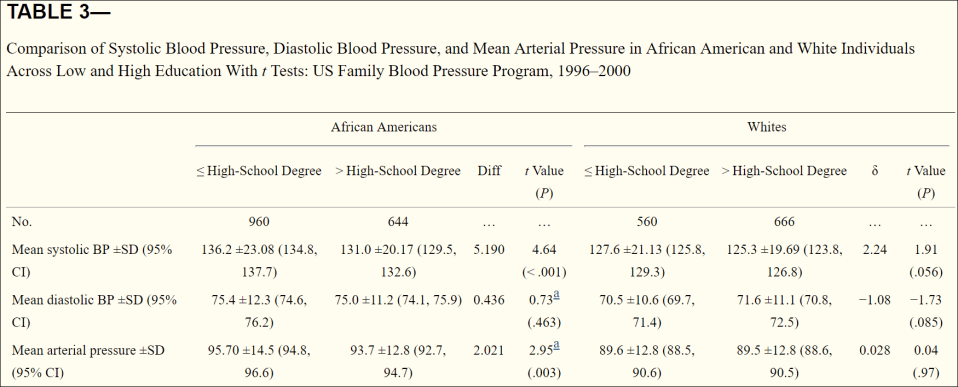
Non, Gravlee, and Mulligan (2012) analyzed both environmental and genetic factors which lead to hypertension. Thy found that in the black sample, systolic BP and mean arterial pressure (MAP) were higher among those who had a HS diploma or lower, but found no differences by education in the white sample.
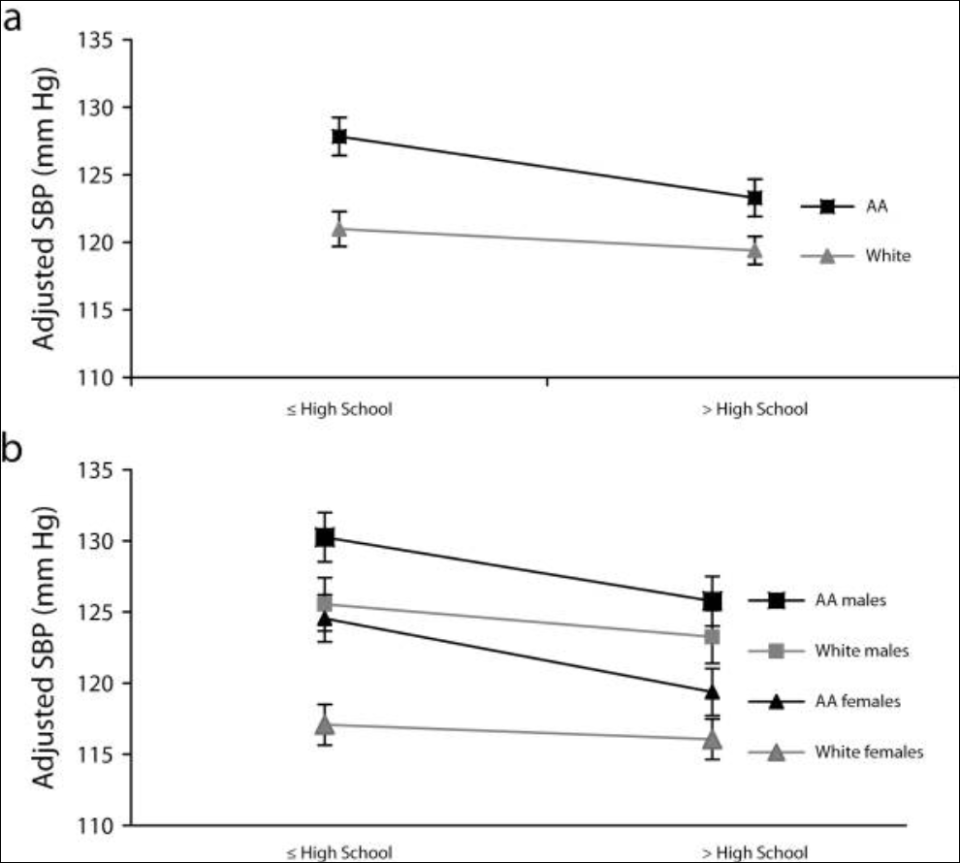
So black men were predicted to have a higher SBP, then white men, black women and finally white women, across all levels of education. SBP declined most sharply in black men and women compared to white men and women.
Genetic ancestry was not associated with BP among black Americans, but there was a significant association between education and BP. Education is, of course, not too good a measure of the social environment. Even using this measure, significant reductions in BP were found. Genetic ancestry is supposed to be associated BP in virtue of the ancestral environment of black Americans, along with supposed selection pressures which occurred on the Middle Passage. So if genetic ancestry isn’t associated, then the hypothesis is discarded.
Non, Gravlee, and Mulligan’s (2012) results support the “minority poverty hypothesis” because “the worst blood pressures were predicted for people who faced the double burden of being less educated and identifying as African American.” The minority poverty hypothesis is “The idea is that black people who live in poverty are uniquely disadvantaged in attaining good health because of the combination of poverty and race” (Hall, Humphreys, and Ruseski, 2015: 5).
Because genetic ancestry was estimated from only 294 loci, and a large set of populations across Africa, which may not be best for representing the West African ancestry of black Americans (Note how this is the population in question in the theory we are discussing). So an analysis focusing just on West African populations may change the relationship. Education was their only measure of the social environment, but other measures of the social environment, like “residential segregation, psychosocial stress, and everyday discrimination” may fully account for higher levels of BP in black Americans. Of course, further there needs to be further study to see whether it is the education per se that causes the differences in BP or if education serves only as a marker for other aspects of the social environment.
The evidence that education accounts for a lot of the variation in differences in BP between blacks and whites is strong. If it is other aspects of the social environment, and not education per se, then there is something in that environment that does not elicit the physiological response that leads to higher BP. We can also, of course, liken this to the Mazur’s (2016) honor culture hypothesis—the hypothesis “that young men’s participation in the honor culture of poor black neighborhoods has the effect of elevating T.” This is due to the adaptiveness of our physiological systems and how it adapts to the environment based on environmental cues.
There was one recent study where they found that “Among black male barbershop patrons with uncontrolled hypertension, health promotion by barbers resulted in larger blood-pressure reduction when coupled with medication management in barbershops by specialty-trained pharmacists” (Victor et al, 2018). This, of course, makes sense. If one is made aware of anything wrong with them, then they will be more likely to seek help for their ailments.
Victor et al (2018) write:
Because black men with hypertension often have multiple cardiovascular risk factors,37 marked reductions in blood pressure — if sustained with the use of our approach and then initiated more widely — might reduce the high rates of hypertension-related disability and death among black men with hypertension in the United States.11
Since three out of four black men have high blood pressure by the time they are 55, then if this can and does hold for the long-term, then this would help many individuals.
Seventy-eight barber shops enrolled in the program. The n was 319 men who had a SBP of 140 mm or higher from 52 black-owned barber shops. The intervention increased doctor visits and anti-hypertensive medications (which I disagree with). Pharmacists were placed in the shop and checked the BP of black men who entered (barbers were also trained to measure BP). Reductions of 21.6 and 14.9 SBP and DBP respectively were seen. 63 percent of those who participated achieved a normal BP whereas 12 percent of those in the control group did so. This, clearly, is another way in which education can lower BP in this population.

This is a great idea—and if further study confirms that this works, it should begin to be implemented elsewhere. The most important factor is outreach—getting the information to people and teaching them how to reduce it on their own through lifestyle modifications. And since outreach is related to educating people on a certain topic, then this, too, falls under the—somewhat large—umbrella of “education.”
In sum, the SHH is a just-so story and doesn’t explain why blacks have higher rates of BP than whites. Genetic ancestry seems to not explain hypertension rates between blacks and whites. Social environment changes and outreach can lower BP disparities between populations. If one understands the intricacies of physiology, then they would understand the physiological responses to different environmental/social stimuli.
 NotPoliticallyCorrect