Home » Evolution (Page 7)
Category Archives: Evolution
The Ape That Took Over the World
1600 words
What gave us the ability to become the apes that took over the world comes down to three things: bipedalism, tool-making, and fire use and acquisition. Those three things catapulted our evolution and brain size (number of neurons) and made it possible for us to be human. The cause of our extraordinary cognitive abilities is the number of neurons in our brain in total—16 billion in all. The only thing that could power a brain so energy-demanding is a diet of cooked meat and other foods. This acts as a predigestion outside of the body so more nutrients can get extracted more efficiently, to power a growing brain due to other selective pressures. Clearly, without cooking, our brains we wouldn’t have the cognitive capacity to take over the world.
In 2001 a huge finding was made in Africa, that of an ape with the beginnings of a bipedal pelvis. Soon after, footprints were discovered where the skeleton was found. A huge debate broke out, with researchers wondering how this new finding fit in with our evolution. Since Lucy had the beginnings of a bipedal pelvis, this conserved about 75 percent more energy than walking on all fours did (Sockol, Raichlen, and Pontzer, 2007). Since the human brain is our most costly organ, the advent of bipedalism freed up an immense amount of energy to power our soon to be big brains.
After the advent of bipedalism, we could then manipulate our environment which called for the need for tools. To have the ability to make tools—and make them efficiently—our ancestors needed to have hands and opposable thumbs. Since we are primates just like them, we just happen to have this evolutionary trait. To create a usable stone tool for the right situation, one needed a certain expertise in making that tool. There is evidence that our brain size increased since we needed the expertise to survive in our ancestral past (Skoyles, 2007).
Soon after, our ancestor Homo erectus appeared on the scene. The fossil record shows that our brain size really began to increase around 2 million years ago, (Herculano-Houzel, 2016). What could have driven such a rapid increase in brain size? The advent of cooking. Herculano-Houzel (2016) defines cooking as things cooked with fire, as well as foodstuffs mashed with the stone tools we could now create with our newly freed hands. After these two discoveries, brain size then nearly doubled in size. However, when the neuronal composition of the brain is looked at, it has the number of neurons expected for a brain its size (Herculano-Houzel, 2009). The human brain is not special in its neuronal composition.
Erectus began controlling fire between 1-1.5 mya (Berna et al, 2012). The use of fire softened food, making it easier to chew, decreasing our jaw muscles and size of our teeth which also allowed for our big brains with large amount of cerebral neurons—16 billion in all, the most out of any animal in the animal kingdom, and is the cause of our superior cognitive abilities (Herculano-Houzel, 2016).
Since the human brain is a primate brain, it has some key features that aren’t available in other brains. The most important being that we have the most neurons crowded into our cerebral cortex than other animals. That is the cause for our cognitive superiority over other animals, but not Neanderthals (Villa and Roebroeks, 2014). There is anthropological evidence that our so-called cognitive superiority over the Neanderthals may be a myth, since they discovered no data inferring that we had any ‘superiority’ over Neanderthals in terms of technology, social structure or cognitively.
Without our ability to control and create fire, starting with erectus (Berna et al, 2012), our brains wouldn’t have had the ability to power such a large brain, and thus our brains would have stayed erectus-sized. We can look at the evolution of great apes’ brains (Herculano-Houzel and Kaas, 2011) and say, with confidence, that if our hominin ancestors never would have controlled fire and passed down the useful skill down through the generations then we would not be here today. Looking at it in this way, we can thank the beginnings of cultural transference and acquisition for a large part of the reason why we are here today (mass extinctions and decimations aside). If we would have continued to eat our plant-based diet than our brains would have stayed around 600-800 cc, a size with nowhere near enough neurons for our outstanding cognitive abilities. So, Stephen Jay Gould may be on his way to vindication, as he wrote in his book Full House (1996): “We have no evidence that the modal form of human bodies or brains has changed at all in the past 100,000 years—a standard phenomenon of stasis for successful and widespread species, and not (as popularly misconceived) an odd exception to an expectation of continuous and progressive change.” There is now some evidence to corroborate his theorizing.
When talking about how we evolved to become the ape that took over the world, three things cannot be overlooked: 1) Bipedalism. We know that Lucy was the first hominin to have a pelvis close to our modern one (Harcourt-Smith and Aiello, 2004); 2) we could now stand upright, acquiring kcal was easier and more efficient (Lieberman, 2013); and 3) walking bipedally conserves 75 percent more energy compared to knuckle-walking (Sockol, Raichlen, and Pontzer, 2007). Bipedalism then freed our hands so we could use tools (Marzke, 2011). Furthermore, there are biomechanical reasons for the acquisition of bipedalism: one main factor being that every development of typical human morphology can be explained as adaptations to conserve energy walking long distances (Preuschoft, 2004). Bipedal walking may be one of the most important events in our evolution—for without that, every other great thing you see around you today would not be here since we then would not have the ability to manipulate the environment in which we live.
Just like our capacity for expertise may have increased our brain size, there is evidence that tool making increased our brain size as well (Stout et al, 2015). So this further increased our brain size, and when our brains reached around 800 cc with erectus, the ‘discovery’ of fire was able to occur due to the ability expertise capacity gained from becoming experts with creating tools and learning how to survive. This crude form of cooking (mashing/smashing foodstuffs to extract nutrients) allowed our brains to be fueled by the coming wave of nutrients. Furthermore, since the food was already ‘predigested’, so to speak, it was easier to chew. The softened foods then weakened our jaw muscles (Organ et al, 2011). So, in a way, you can say that human evolution is driven by dietary changes (Luca, Perry and Di Rienzo, 2010).
Conclusion
The advent of bipedalism allowed for the ability to make stone tools, which was one of the first cases of cultural transference. To see how important the use of fire was, one only needs to look at gorillas. Metabolic limitations resulting from the number of hours available to feed along with the low caloric yield of raw foods imposed a limitation on brain size for great apes and gorillas—imposing a tradeoff between the total neuronal amount and body size, making them the outlier in terms of body size (Fonseca-Azevedo and Herculano-Houzel, 2012). Thus, you can see the benefits of cultural transference and acquisition, which gave us the ability to have us become the ape that took over the world with our superior cognitive abilities primarily caused by the advent of cultural transference and acquisition beginning with the advent of bipedalism which allowed us to increase our foraging range, allowing us to consume higher-quality kcal to power our soon-to-be big brains, tool-making, and fire-use.
References
Berna, F., Goldberg, P., Horwitz, L. K., Brink, J., Holt, S., Bamford, M., & Chazan, M. (2012). Microstratigraphic evidence of in situ fire in the Acheulean strata of Wonderwerk Cave, Northern Cape province, South Africa. Proceedings of the National Academy of Sciences,109(20). doi:10.1073/pnas.1117620109
Dr. John R. Skoyles (1999) HUMAN EVOLUTION EXPANDED BRAINS TO INCREASE EXPERTISE CAPACITY, NOT IQ. Psycoloquy: 10(002) brain expertise
Fonseca-Azevedo, K., & Herculano-Houzel, S. (2012). Metabolic constraint imposes tradeoff between body size and number of brain neurons in human evolution. Proceedings of the National Academy of Sciences,109(45), 18571-18576. doi:10.1073/pnas.1206390109
Gould, S. J. (1996). Full house: The Spread of Excellence from Plato to Darwin. New York: Harmony Books.
Harcourt-Smith, W. E., & Aiello, L. C. (2004). Fossils, feet and the evolution of human bipedal locomotion. Journal of Anatomy,204(5), 403-416. doi:10.1111/j.0021-8782.2004.00296.x
Herculano-Houzel, S. (2013). The Remarkable, Yet Not Extraordinary, Human Brain as a Scaled-Up Primate Brain and Its Associated Cost.
Herculano-Houzel, S. (2009). The human brain in numbers: a linearly scaled-up primate brain. Frontiers in Human Neuroscience,3. doi:10.3389/neuro.09.031.2009
Herculano-Houzel, S., & Kaas, J. H. (2011). Gorilla and Orangutan Brains Conform to the Primate Cellular Scaling Rules: Implications for Human Evolution.
Herculano-Houzel, S. (2016). The Human Advantage: A New Understanding of How Our Brains Became Remarkable. doi:10.7551/mitpress/9780262034258.001.0001
Lieberman, D. (2013). The Story of the Human Body: Evolution, Health, and Disease. New York: Pantheon Books.
Luca, F., Perry, G., & Rienzo, A. D. (2010). Evolutionary Adaptations to Dietary Changes. Annual Review of Nutrition,30(1), 291-314. doi:10.1146/annurev-nutr-080508-141048
Marzke, M. W. (2013). Tool making, hand morphology and fossil hominins. Philosophical Transactions of the Royal Society B: Biological Sciences,368(1630), 20120414-20120414. doi:10.1098/rstb.2012.0414
Organ, C., Nunn, C. L., Machanda, Z., & Wrangham, R. W. (2011). Phylogenetic rate shifts in feeding time during the evolution of Homo. Proceedings of the National Academy of Sciences,108(35), 14555-14559. doi:10.1073/pnas.1107806108
Preuschoft, H. (2004). Mechanisms for the acquisition of habitual bipedality: are there biomechanical reasons for the acquisition of upright bipedal posture? Journal of Anatomy,204(5), 363-384. doi:10.1111/j.0021-8782.2004.00303.x
Sockol, M. D., Raichlen, D. A., & Pontzer, H. (2007). Chimpanzee locomotor energetics and the origin of human bipedalism. Proceedings of the National Academy of Sciences,104(30), 12265-12269. doi:10.1073/pnas.0703267104
Stout, D., Hecht, E., Khreisheh, N., Bradley, B., & Chaminade, T. (2015). Cognitive Demands of Lower Paleolithic Toolmaking. Plos One,10(4). doi:10.1371/journal.pone.0121804
Villa, P., & Roebroeks, W. (2014). Neandertal Demise: An Archaeological Analysis of the Modern Human Superiority Complex. PLoS ONE,9(4). doi:10.1371/journal.pone.0096424
Is General Intelligence Domain-Specific?
1600 words
Is the human brain ‘special’? Not according to Herculano-Houzel; our brains are just linearly scaled-up primate brains. We have the number of neurons predicted for a primate of our body size. But what does this have to do with general intelligence? Evolutionary psychologists also contend that the human brain is not ‘special’; that it is an evolved organ just like the rest of our body. Satoshi Kanazawa (2003) proposed the ‘Savanna Hypothesis‘ which states that more intelligent people are better able to deal with ‘evolutionary novel’ situations (situations that we didn’t have to deal with in our ancestral African environment, for example) whereas he purports that general intelligence does not affect an individuals’ ability to deal with evolutionarily familiar entities and situations. I don’t really have a stance on it yet, though I do find it extremely interesting, with it making (intuitive) sense.
Kanazawa (2010) suggests that general intelligence may both be an evolved adaptation and an ‘individual-difference variable’. Evolutionary psychologists contend that evolved psychological adaptations are for the ancestral environment which was evolved in, not in any modern-day environment. Kanazawa (2010) writes:
The human brain has difficulty comprehending and dealing with entities and situations that did not exist in the ancestral environment. Burnham and Johnson (2005, pp. 130–131) referred to the same observation as the evolutionary legacy hypothesis, whereas Hagen and Hammerstein (2006, pp. 341–343) called it the mismatch hypothesis.
From an evolutionary perspective, this does make sense. A perfect example is Eurasian societies vs. African ones. you can see the evolutionary novelty in Eurasian civilizations, while African societies are much closer (though obviously not fully) to our ancestral environment. Thusly, since the situations found in Africa are not evolutionarily novel, it does not take high levels of g to survive in, while Eurasian societies (which are evolutionarily novel) take much higher levels of g to live and survive in.
Kanazawa rightly states that most evolutionary psychologists and biologists contend that there have been no changes to the human brain in the last 10,000 years, in line with his Savanna Hypothesis. However, as I’m sure all readers of my blog know, there were sweeping changes in the last 10,000 years in the human genome due to the advent of agriculture, and, obviously, new alleles have appeared in our genome, however “it is not clear whether these new alleles have led to the emergence of new evolved psychological mechanisms in the last 10,000 years.”
General intelligence poses a problem for evo psych since evolutionary psychologists contend that “the human brain consists of domain-specific evolved psychological mechanisms” which evolved specifically to solve adaptive problems such as survival and fitness. Thusly, Kanazawa proposes in contrast to other evolutionary psychologists that general intelligence evolved as a domain-specific adaptation to deal with evolutionary novel problems. So, Kanazawa says, our ancestors didn’t really need to think inorder to solve recurring problems. However, he talks about three major evolutionarily novel situations that needed reasoning and higher intelligence to solve:
1. Lightning has struck a tree near the camp and set it on fire. The fire is now spreading to the dry underbrush. What should I do? How can I stop the spread of the fire? How can I and my family escape it? (Since lightning never strikes the same place twice, this is guaranteed to be a nonrecurrent problem.)
2. We are in the middle of the severest drought in a hundred years. Nuts and berries at our normal places of gathering, which are usually plentiful, are not growing at all, and animals are scarce as well. We are running out of food because none of our normal sources of food are working. What else can we eat? What else is safe to eat? How else can we procure food?
3. A flash flood has caused the river to swell to several times its normal width, and I am trapped on one side of it while my entire band is on the other side. It is imperative that I rejoin them soon. How can I cross the rapid river? Should I walk across it? Or should I construct some sort of buoyant vehicle to use to get across it? If so, what kind of material should I use? Wood? Stones?
These are great examples of ‘novel’ situations that may have arisen, in which our ancestors needed to ‘think outside of the box’ in order to survive. Situations such as this may be why general intelligence evolved as a domain-specific adaptation for ‘evolutionarily novel’ situations. Clearly, when such situations arose, our ancestors who could reason better at the time these unfamiliar events happened would survive and pass on their genes while the ones who could not die and got selected out of the gene pool. So general intelligence may have evolved to solve these new and unfamiliar problems that plagued out ancestors. What this suggests is that intelligent people are better than less intelligent people at solving problems only if they are evolutionarily novel. On the other hand, situations that are evolutionarily familiar to us do not take higher levels of g to solve.
For example, more intelligent individuals are no better than less intelligent individuals in finding and keeping mates, but they may be better at using computer dating services. Three recent studies, employing widely varied methods, have all shown that the average intelligence of a population appears to be a strong function of the evolutionary novelty of its environment (Ash & Gallup, 2007; D. H. Bailey & Geary, 2009; Kanazawa, 2008).
Who is more successful, on average, over another in modern society? I don’t even need to say it, the more intelligent person. However, if there was an evolutionarily familiar problem there would be no difference in figuring out how to solve the problem, because evolution has already ‘outfitted’ a way to deal with them, without logical reasoning.
Kanazawa then talks about evolutionary adaptations such as bipedalism (we all walk, but some of us are better runners than others); vision (we can all see, but some have better vision than others); and language (we all speak, but some people are more proficient in their language and learn it earlier than others). These are all adaptations, but there is extensive individual variation between them. Furthermore, the first evolved psychological mechanism to be discovered was cheater detection, to know if you got cheated while in a ‘social contract’ with another individual. Another evolved adaptation is theory of mind. People with Asperger’s syndrome, for instance, differ in the capacity of their theory of mind. Kanazawa asks:
If so, can such individual differences in the evolved psychological mechanism of theory of mind be heritable, since we already know that autism and Asperger’s syndrome may be heritable (A. Bailey et al., 1995; Folstein & Rutter, 1988)?
A very interesting question. Of course, since it’s #2017, we have made great strides in these fields and we know these two conditions to be highly heritable. Can the same be said for theory of mind? That is a question that I will return to in the future.
Kanazawa’s hypothesis does make a lot of sense, and there is empirical evidence to back his assertions. His hypothesis proposes that evolutionarily familair situations do noot take any higher levels of general intelligence to solve, whereas novel situations do. Think about that. Society is the ultimate evolutionary novelty. Who succeeds the most, on average, in society? The more intelligent.
Go outside. Look around you. Can you tell me which things were in our ancestral environment? Trees? Grass? Not really, as they aren’t the same exact kinds as we know from the savanna. The only thing that is constant is: men, women, boys and girls.
This can, however, be said in another way. Our current environment is an evolutionary mismatch. We are evolved for our past environments, and as we all know, evolution is non-teleological—meaning there is no direction. So we are not selected for possible future environments, as there is no knowledge for what the future holds due to contingencies of ‘just history’. Anything can happen in the future, we don’t have any knowledge of any future occurences. These can be said to be mismatches, or novelties, and those who are more intelligent reason more logically due to the fact that they are more adept at surviving evolutionary novel situations. Kanazawa’s theory provides a wealth of information and evidence to back his assertion that general intelligence is domain-specific.
This is yet another piece of evidence that our brain is not special. Why continue believing that our brain is special, even when there is evidence mounting against it? Our brains evolved and were selected for just like any other organ in our body, just like it was for every single organism on earth. Race-realists like to say “How can egalitarians believe that we stopped evolving at the neck for 50,000 years?” Well to those race-realists who contend that our brains are ‘special’, I say to them: “How can our brain be ‘special’ when it’s an evolved organ just like any other in our body and was subject to the same (or similar) evolutionary selective pressures?”
In sum, the brain has problems dealing with things that were not in its ancestral environment. However, those who are more intelligent will have an easier time dealing with evolutionarily novel situations in comparison to people with lower intelligence. Look at places in Africa where development is still low. They clearly don’t need high levels of g to survive, as it’s pretty close to the ancestral environment. Conversely, Eurasian societies are much more complex and thus, evolutionarily novel. This may be one reason that explains societal differences between these populations. It is an interesting question to consider, which I will return to in the future.
Fatty Acids and PISA Math Performance
1800 words
There are much more interesting theories of the evolution of hominin intelligence other than the tiring (yawn) cold winter theory. Last month I wrote on why men are attracted to a low waist-to-hip ratio in women. However, the relationship between gluteofemoral fat (fat in the thighs and buttocks) is only part of the story on how DHA and fatty acids (FAs) drove our brain growth and our evolution as a whole. Tonight I will talk about how fatty acids predict ‘cognitive performance’ (it’s PISA, ugh) in a sample of 28 countries, particularly the positive relationship between n-3 (Omega-3s) and intelligence and the negative relationship between n-6 and intelligence. I will then talk about the traditional Standard American Diet (the SAD diet [apt name]) and how it affects American intelligence on a nation-wide level. Finally, I will talk about the best diet to maximize cognition in growing babes and women.
Lassek and Gaulin (2013) used the 2009 PISA data to infer cognitive abilities for 28 countries (ugh, I’d like to see a study like this done with actual IQ tests). They also searched for studies that showed data providing “maternal milk DHA DHA values as percentages of total fatty acids in 50 countries”. Further, to control for SES influences on cognitive performance, they controlled for GDP/PC (gross domestic product per country) and “educational expenditures per pupil.” They further controlled for the possible effect of macronutrients on maternal milk DHA levels, they included estimates for each country of the average amount of kcal consumed from protein, fat, and carbohydrates. To explore the relationship between DHA and cognitive ability, they included foodstuffs high in n-3—fish, eggs, poultry, red meat, and milk which also contain DPA depending on the type of feed the animal is given. There is also a ‘metabolic competition’ between n-3 and n-6 fatty acids, so they also included total animal and vegetable fat as well as vegetable oils.
Lassek and Gaulin (2013) found that GDP/PC, expenditures per student and DHA were significant predictors of (PISA) math scores, whereas macronutrient content showed no correlation.
The predictive value of milk DHA on cognitive ability is only weak when either two of the SES variables are added in the multiple regression. When milk arachidonic (a type of Omega-6 fatty acid) is added to the regression, it is negatively correlated with math scores but not significantly (so it wasn’t added to the table below).
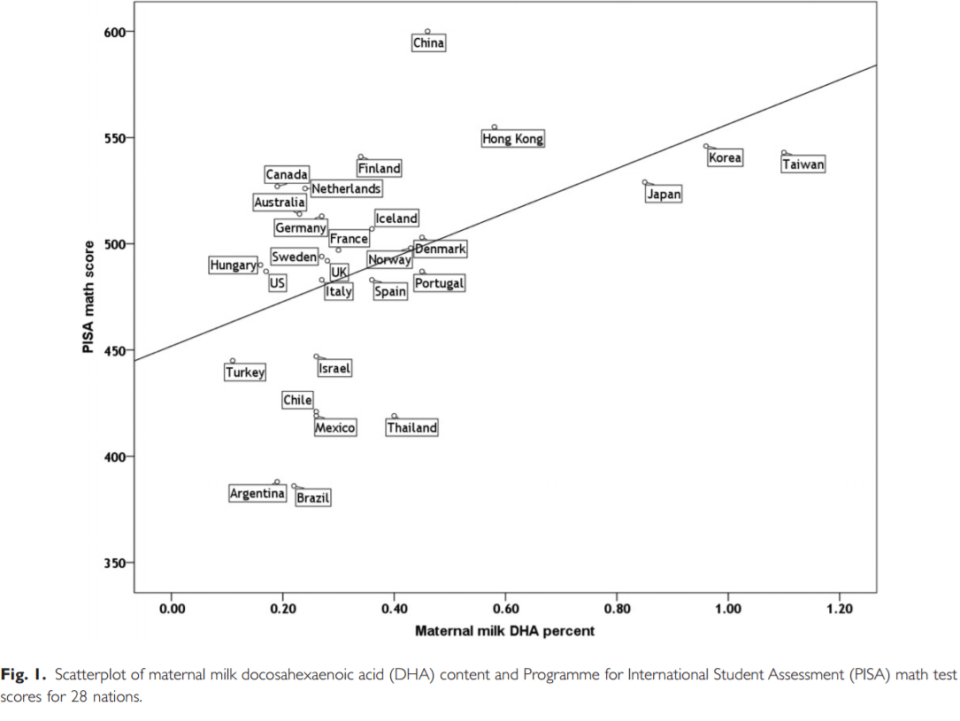
So countries with lower maternal milk levels of DHA score lower on the maths section of the PISA exam (not an IQ test, but it’s ‘good enough’). Knowing what is known about the effects of DHA on cognitive abilities, countries who have higher maternal milk levels of DPA do score higher on the maths section of the PISA exam.
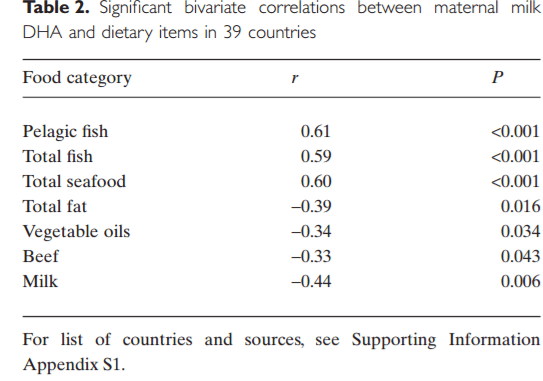
Table 2 shows the correlations between grams per capita per day of food consumption in the data set they used and maternal milk DHA. As you can see, total fish and seafood consumption are substantially correlated with total milk DHA, while foods that are high in n-6 show medium negative correlations with maternal milk DHA. The combination of foods that explain the most of the variance in maternal milk DHA is total fat consumed and total fish consumed. This explained 61 percent of the variance in maternal milk DHA across countries.
Not surprisingly, foodstuffs high in n-6 showed significant negative correlations on maternal milk DHA. “Any regression including total fish or seafood, and vegetable oils, animal fat or milk consistently explains at least half of the variance in milk DHA, with fish or seafood having positive beta coefficients and the remainder having negative beta coefficients.”
The study showed that a country’s balance of n-3 and n-6 was strongly related to the students’ math performance on the PISA. This relationship between milk DHA and cognitive performance remains sufficient even after controlling for national wealth, macro intake and investment in education. The availability of DHA in populations is a better predictor of test scores than are SES factors (which I’ve covered here on Italian IQ), though SES explains a considerable portion of the variance, it’s not as much as the overall DHA levels by country. Furthermore, maternal DHA levels are strongly correlated to per capita fish and seafood consumption while a negative correlation was noticed with the intake of more vegetable oils, fat, and beef, which suggests ‘metabolic competition’ between the n-3 and n-6 fatty acids.
There are, of course, many possible errors with the study such as maternal milk DHA values not reflecting the total DHA in that population as a whole; measures of extracting milk fatty acids differed between studies; test results being due to sampling error; and finally the per capita consumption of foods is based on food disappearance, not amount of food consumed. However, even with the faults of the study, it’s still very interesting and I hope they do further work with actual measures of cognitive ability. Despite the pitfalls of the study (the main one being the use of PISA to test ‘cognitive abilities’), this is a very interesting study. I eventually hope that a study similar to this one is undertaken with actual measures of cognitive ability and not PISA scores.
We now know that n-6 is negatively linked with brain performance, and that n-3 is positively linked. What does this say about America?
As I’m sure all of you are aware of, America is one of the fattest nations in the world. Not surprisingly, Americans consume extremely low levels of seafood (very high in DPA) and more foods high in n-6 (Papanikolaou et al, 2014). High levels of n-3 (which we do not get enough of in America) and n-6 are correlated with obesity (Simopoulos, 2016). So not only do we have a current dysgenic effect in America due to decreased fertility of the more intelligent (which is also part of the reason why we have the effect of dysgenic fertility in America), obesity is also driven by high levels of n-6 in the Western diet, which then causes obesity down the generations (Massiera et al, 2010).
I also previously wrote on agriculture and diseases of civilization. Our hunter-gatherer ancestors were all around healthier than we were. This, clearly, is due to the fact that they ate a more natural diet and not one full of processed, insulin-spiking carbohydrates, among other things. Our hunter-gatherer ancestors consumed n-3 and n-6 at equal amounts (1:1) (Kris-Etherson, et al 2000). As I documented in my article on agriculture and disease, HGs had low to nonexistent rates of the diseases that plague us in our modern societies today. However, around 140 years ago, we entered the Industrial Revolution. The paradigm shift that this caused was huge. We began consuming less n-3 (fish and other assorted seafood and nuts among other foods) while n-6 intake increased (beef, grains, carbohydrates) (Kris-Etherson, et al 2000). Moreover, the ratio of n-6 to n-3 from the years 1935 to 1939 were 8.4 to 1, whereas from the years 1935 to 1985, the ratio increased to about 10 percent (Raper et al, 2013). We Americans also consume 20 percent of our daily kcal from one ‘food’ source—soybean oil—with almost 9 percent of the total kcal coming from n-6 linoleic acids (United States Department of Agriculture, 2007). The typical American diet contains about 26 percent more n-6 than n-3, and people wonder why we are slowly getting dumber (which is, obviously, a side effect of civilization). So our n-6 consumption is about 26 percent higher than it was when we were still hunter-gatherers. Does anyone still wonder why diseases of civilization exist and why hunter-gatherers have low to nonexistent rates of the diseases that plague us?
The bioavailability of n-6 is dependent on the amount of n-3 in fatty tissue (Hibbeln et al, 2006). This goes back to the ‘metabolic competition’ mentioned earlier. N-3 also makes up 10 percent of the overall brain weight since the first neurons evolved in an environment high in n-3. N-3 fatty acids were positively related to test scores in both men and women, while n-6 showed the reverse relationship (with a stronger effect in females). Furthermore, in female children, the effect of n-3 intake were twice as strong in comparison to male children, which also exceeded the negative effects of lead exposure, suggesting that higher consumption of foods rich in n-3 while consuming fewer foods rich in n-6 will improve cognitive abilities (Lassek and Gaulin, 2011).
The preponderance of evidence suggests that if parents want to have the healthiest and smartest babes that a pregnant woman should consume a lot of seafood while avoiding vegetable oils, total fat and milk (fat, milk and beef moreso from animals that are grain-fed) Grassfed beef has higher levels of n-3, which will balance out the levels of n-6 in the beef. So if you want your family to have the highest cognition possible, eat more fish and less grain-fed beef and animal products.
In sum, if you want the healthiest, most intelligent family you can possibly have, the most important factor is…diet. Diets high in n-3 and low in n-6 are extremely solid predictors of cognitive performance. Due to the ‘meatbolic competition’ between the two fatty acids. This is because n-6 accumulates in the blood and tissue lipids exacerbating the competiiton between linolic acid (the most common form of n-6) and n-3 for metabolism and acylation into tissue lipds (Innis, 2014). Our HG ancestors had lower rates of n-6 in their diets than we do today, along with low to nonexistent disease rates. This is due to the availability of n-6 in the modern diet, which was unknown to our ancestors. Yes, seafood intake had the biggest effect on the PISA math scores, which, in my opinion (I need to look at the data), is due in part to poverty. I’m very critical of PISA, especially as a measure of cognitive abilities, but this study is solid, even though it has pitfalls. I hope a study using an actual IQ test is done (and not Richard Lynn IQ tests that use children, a robust adult sample is the only thing that will satisfy me) to see if the results will be replicated.
I also think it’d be extremely interesting to get a representative sample from each country studied and somehow make it so that all maternal DHA levels are the same and then administer the tests. This way, we can see how all groups perform with the same amounts of DHA (and to see how much of an effect that DHA really does have). Furthermore, nutritonally impoverished countries will not have access to the high-quality foods with more DHA and healthy fatty acids that lead to higher cognitive function.
It’s clear: if you want the healthiest family you could possibly have, consume more seafood.
Why Are Humans Here?
1600 words
Why are humans here? No, I’m not going to talk about any gods being responsible for our placement on this planet, though some extraterrestrial phenomena do play a part in why we are here today. The story of how and why we are here is extremely fascinating, because we are here only by chance, not by any divine purpose.
To understand why we are here, we first need to know what we evolved from and where this organism evolved. The Burgess Shale is a limestone quarry formed after the events of the Cambrian explosion. In the Shale are the remnants of an ancient sea that had more varieties of life than today’s modern oceans. The Shale is the best record we have of Cambrian fossils after the Cambrian explosion we currently have. Preserved in the Shale are a wide variety of creatures. One of these creatures is our ancestor, the first chordate. It’s name: Pikaia gracilens.
Pikaia is the only fossil from the Burgess Shale we have found that is a direct ancestor of humans. Now think about the Burgess decimation and the odds of Pikaia surviving. If this one little one and a half inch organism didn’t survive the Burgess decimation, everything you see around you today would not be here. By chance, we humans are here today due to the very unlikely survival of Pikaia. Stephen Jay Gould wrote a whole book on the Burgess Shale and ended his book Wonderful Life: The Burgess Shale and the Nature of History (1989: 323) as follows:
And so, if you wish to ask the question of the ages—why do humans exist?—a major part of that answer, touching those aspects of the issue that science can touch at all, must be: because Pikaia survived the Burgess decimation. This response does not cite a single law of nature; it embodies no statement about predictable evolutionary pathways, no calculation of probabilities based on general rules of anatomy or ecology. The survival of Pikaia was a contingency of “just history.” I do not think that any “higher” answer can be given, and I cannot imagine that any resolution could be more fascinating.
The survival of organisms during a mass extinction may be strongly predicated by chance (Mayr, 1964: 121). The Burgess decimation is but one of five mass extinction events in earth’s history. Let’s say we could wind back life’s tape to the very beginning and let it play out again, at the end of the tape would we see something familiar or completely ‘alien’? I’m betting on it being something ‘alien’, since we know that the survival of certain organisms is paramount to why Man is here today. Indeed, biochemist Nick Lane and author of the book The Vital Question: Evolution and the Origins of Complex Life (2015) agrees and writes on page 21:
Given gravity, animals that fly are more likely to be lightweight, and possess something akin to wings. In a more general sense, it may be necessary for life to be cellular, composed of small units that keep their insides different from the outside world. If such constraints are dominant, life elsewhere may closely resemble life on earth. Conversely, perhaps contingency rules – the make-up of life depends on the random survivors of global accidents such as the asteroid impact that wiped out the dinosaurs. Wind back the clock to Cambrian times, half a billion years ago, when mammals first exploded into the fossil record, and let it play forwards again. Would that parallel be similar to our own? Perhaps the hills would be crawling with giant terrestrial octopuses.
I believe contingency does rule—we are the survivors of global accidents. Even survival during asteroid impact and its ensuing effects that killed the dinosaurs 65 million years ago was based on chance. The chance that the mammalian critters were small enough and could find enough sustenance to sustain themselves and survive while the big-bodied dinosaurs died out.
Let’s say one day someone discovers how to make a perfect representation in a lab that perfectly mimicked the conditions of the early earth down to the tee. Let’s also say that 1 month is equal to 1 billion years. In close to 5 months, the experiment will be finished. Will what we see in this experiment mirror what we see today, or will it be something completely different—completely alien? Stephen Jay Gould writes on page 323 of Wonderful Life:
Wind the tape of life back again to Burgess times, and let it play again. If Pikaia does not survive in the replay, we are wiped out of future history—all of us, from shark to robin to orangutan. And I don’t think that any handicapper, given Burgess evidence known today, would have granted very favorable odds for Pikaia.
Why should life play out the exact same way if we had the ability to wind back the tape of life?
Another aspect of our evolution and why we are here is the tiktaalik, the best representative for a “transtional species between fish and land-dwelling tetrapods“. Tiktaalik had the unique ability to prop itself up out of the water to scout for food and predators. Tiktaalik had the beginnings of beginnings of arms, what it used to prop itself up out of the water. Due to the way its fins were structured, it had the ability to walk on the seabed, and eventually land. This one ancestor of ours began to gain the ability to breathe air and transition to living on land. If all tiktaaliks had died out in a mass extinction, we, again, would not be here. The exclusion of certain organisms from history then excludes us from the future.
And now, of course, with talks of the how and why we are here, I must discuss the notion of ‘evolutionary progress‘. Surely, to say that there is any type of ‘progress’ to evolution based on the knowledge of certain organisms’ chance at survival seems very ludicrous. The commonly held notion of the ‘ladder of progress’, the scala naturae, is still prominent both in evolutionary biology and modern-day life. There is an implicit assumption that there must be some linear line from single-celled organisms to Man, and that we are the eventual culmination of the evolutionary process. However, if Pikaia had not survived the Burgess decimation, a lot of the animals you see around you today—including us—would not be here.
If dinosaurs had not died out, we would not be here today. That chance survival of small shrew-like mammals during the extinction event 65 mya is another reason why we are here. Stephen Jay Gould (1989) writes on page 318:
If mammals had arisen late and helped to drive dinosaurs to their doom, then we could legitamately propose a scenario of expected progress. But dinosaurs remained domininant and probably became extinct only as a quirky result of the most unpredictable of all events—a mass dying triggered by extraterrestrial impact. If dinosaurs had not died in this event, they would probably still dominate the large-bodied vertebrates, as they had for so long with such conspicuous success, and mammals would still be small creatures in the interstices of their world. This situation prevailed for one hundred million years, why not sixty million more? Since dinosaurs were not moving towards markedly larger brains, and since such a prospect may lay outside the capability of reptilian design (Jerison, 1973; Hopson, 1977), we must assume that consciousness would not have evolved on our planet if a cosmic catastrophe had not claimed the dinosaurs as victims. In an entirely literal sense, we owe our existence, as large reasoning mammals, to our lucky stars.
He also writes on page 320:
Run the tape again, and let the tiny twig of Homo sapiens expire in Africa. Other hominids may have stood on the threshhold of what we know as human possibilities, but many sensible scenarios would never generate our level of mentality. Run the tape again, and this time Neanderthal perishes in Europe, and Homo erectus in Asia (as they did in our world). The sole surviving stock, Homo erectus in Africa, stumbles along for a while, even prospers, but does not speciate and therefore remains stable. A mutated virus then wipes Homo erectus out, or a change in climate reconverts Africa into an inhospitable forest. One little twig on the mammalian branch, a lineage with interesting possibilities that were never realized, joins the vast majority of species in extinction. So what? Most possibilities are never realized, and who will know the difference?
Arguments of this form led me to the conclusion that biology’s most profound insight to human nature, status and potential lies in the simple phrase, the embodiment of contingency: Homo sapiens is an entity, not an idea.
In any type of rewind scenario, any little nudge, any little difference in the rewind would change the fate of the planet. Thusly, contingency rules.
So the answer to the question of why humans are here doesn’t have any mystical or religious answer. It’s as simple as “No Pikaia, no us.” Why we are here is highly predicated on chance and if any of our ancestors had died in the past, Homo sapiens would not be here today. Knowing what we know about the Burgess Shale shows how the concept of ‘progress’ in biology is ridiculous. Rewinding the tape of life will not lead to our existence again, and some other organism will rule the earth but it would not be us. The answer to why we are here is “just history”. I don’t think any other answer to the question is as interesting as cosmic and terrestrial accidents. That just makes our accomplishments as a species even more special.
Neurons By Race
1100 words
With all of my recent articles on neurons and brain size, I’m now asking the following question: do neurons differ by race? The races of man differ on most all other variables, why not this one?
As we would have it, there are racial differences in total brain neurons.In 1970, an anti-hereditarian (Tobias) estimated the number of “excess neurons” available to different populations for processing bodily information, which Rushton (1988; 1997: 114) averaged to find: 8,550 for blacks, 8,660 for whites and 8,900 for Asians (in millions of excess neurons). A difference of 100-200 million neurons would be enough to explain away racial differences in achievement, for one. Two, these differences could also explain differences in intelligence. Rushton (1997: 133) writes:
This means that on this estimate, Mongoloids, who average 1,364 cm3 have 13.767 billion cortical neurons (13.767 x 10⁹ ). Caucasoids who average 1,347 cm3 have 13.665 billion such neurons, 102 million less than Mongoloids. Negroids who average 1,267 cm3 , have 13.185 billion cerebral neurons, 582 million less than Mongoloids and 480 million less than Caucasoids.
Of course, Rushton’s citation of Jerison, I will leave alone now that we know that encephilazation quotient has problems. Rushton (1997: 133) writes:
The half-billion neuron difference between Mongoloids and Negroids are probably all “excess neurons” because, as mentioned, Mongoloids are often shorter in height and lighter in weight than Negroids. The Mongoloid-Negroid difference in brain size across so many estimation procedures is striking
Of course, small differences in brain size would translate to differences differences neuronal count (in the hundreds of millions), which would then affect intelligence.
Moreover, since whites have a greater volume in their prefrontal cortex (Vint, 1934). Using Herculano-Houzel’s favorite definition for intelligence, from MIT physicist Alex Wissner-Gross:
The ability to plan for the future, a significant function of prefrontal regions of the cortex, may be key indeed. According to the best definition I have come across so far, put forward by MIT physicist Alex Wissner-Gross, intelligence is the ability to make decisions that maximize future freedom of action—that is, decisions that keep most doors open for the future. (Herculano-Houzel, 2016: 122-123)
You can see the difference in behavior and action in the races; how one race has the ability to make decisions to maximize future ability of action—and those peoples with a smaller prefrontal cortex won’t have this ability (or it will be greatly hampered due to its small size and amount of neurons it has).
With a smaller, less developed frontal lobe and less overall neurons in it than a brain belonging to a European or Asian, this may then account for overall racial differences in intelligence. The few hundred million difference in neurons may be the missing piece to the puzzle here.Neurons transmit information to other nerves and muscle cells. Neurons have cell bodies, axons and dendrites. The more neurons (that’s also packed into a smaller brain, neuron packing density) in the brain, the better connectivity you have between different areas of the brain, allowing for fast reaction times (Asians beat whites who beat blacks, Rushton and Jensen, 2005: 240).
Remember how I said that the brain uses a certain amount of watts; well I’d assume that the different races would use differing amount of power for their brain due to differing number of neurons in them. Their brain is not as metabolically expensive. Larger brains are more intelligent than smaller brains ONLY BECAUSE there is a higher chance for there to be more neurons in the larger brain than the smaller one. With the average cranial capacity (blacks: 1267 cc, 13,185 million neurons; whites: 1347 cc, 13,665 million neurons, and Asians: 1,364, 13,767 million neurons). (Rushton and Jensen, 2005: 265, table 3) So as you can see, these differences are enough to account for racial differences in achievement.
A bigger brain would mean, more likely, more neurons which would then be able to power the brain and the body more efficiently. The more neurons one has, the more likely it it that they are intelligent as they have more neuronal pathways. The average cranial capcities of the races show that there are neuronal differences between them, which these neuronal differences then are the cause for racial differences, with the brain size itself being only a proxy, not an actual indicator of intelligence. The brain size doesn’t matter as much as the amount of neurons in the brain.
A difference in the brain of 100 grams is enough to account for 550 million cortical neurons (!!) (Jensen, 1998b: 438). But that ignores sex differences and neuronal density. However, I’d assume that there will be at least small differences in neuron count, especially from Rushton’s data from Race, Evolution and Behavior. Jensen (1998) also writes on page 439:
I have not found any investigation of racial differences in neuron density that, as in the case of sex differences, would offset the racial difference in brain weight or volume.
So neuronal density by brain weight is a great proxy.
Racial differences in intelligence don’t come down to brain size; they come down to total neuron amount in the brain; differences in size in certain parts of the brain critical to intelligence and amount of neurons in those critical portions of the brain. I’ve yet to come across a source talking about the different number of neurons in the brain by race, but when I do I will update this article. From what we know, we can make the assumption that blacks have less packing density as well as a smaller number of neurons in their PFC and cerebral cortex. Psychopathy is associated with abnormalities in the PFC; maybe, along with less intelligence, blacks would be more likely to be psychopathic? This also echoes what Richard Lynn says about Race and Psychopathic Personality:
There is a difference between blacks and whites—analogous to the difference in intelligence—in psychopathic personality considered as a personality trait. Both psychopathic personality and intelligence are bell curves with different means and distributions among blacks and whites. For intelligence, the mean and distribution are both lower among blacks. For psychopathic personality, the mean and distribution are higher among blacks. The effect of this is that there are more black psychopaths and more psychopathic behavior among blacks.
Neuronal differences and size of the PFC more than account for differences in psychopathy rates as well as differences in intelligence and scholastic achievement. This could, in part, explain the black-white IQ gap. Since the total number of neurons in the brain dictates, theoretically speaking, how well an organism can process information, and blacks have a smaller PFC (related to future time preference); and since blacks have less cortical neurons than Whites or Asians, this is one large reason why black are less intelligent, on average, than the other races of Man.
Why Are Humans Cognitively Superior to Other Animals?
1550 words
The past few articles I have written touched on the fact that the human brain isn’t special and is just a scaled-up primate brain, bipedalism, tools, fire, cooking and meat eating had the largest effect on hominin brain evolution, and that, despite seeing a so-called ‘upward trend’ in the evolution of primate brain size, the reverse was occurring. So what makes us cognitively superior to other animals?
The most oft-cited reason why humans are cognitively superior to other animals is that we have the largest EQ compared to other animals. Ours is 7.5, meaning that we have a brain that’s 7.5 times larger than a mammal for our size but only 3.4 times as larger than expected for an anthropoid primate of its body mass (Azevedo et al, 2009). However, in stark contrast to the view of the people who view EQ as the reason why we are cognitively superior to other animals, what separates us in terms of cognitive ability is the difference in cortical neurons compared to other primates.
We humans have the most cortical neurons in our cerebral and prefrontal cortexes, relatively high neuron packing density (NPD), and much more cortical neurons of mammals of the same brain size (Roth and Dicke, 2012). Differences in intelligence across primate taxa best correlate with differences in number of cortical neurons, information processing speed, and synapses. Though, the human brain stands out having a “large cortical volume with a relatively NPD, high conduction velocity and high cortical parcellation.” This is why we are much more intelligent than other primates, due to the amount of cortical neurons we have as well as higher neuron packing density (keep this in mind for later). Encephalization quotient doesn’t explain intelligence differences within species, hence there being a problem with the use of encephalization to as the reason for human cognitive superiority, our Human Advantage, if you will.
Harry Jerison, the originator of the encephalization quotient, came to the conclusion that “human evolution … had been all about an advancement of encephalization quotients culminating in man.” (Herculano-Houzel, 2016: 15) What a conclusion. Just because EQ increased throughout hominin evolution, that means that it was all an advancement of EQs culminating to man. That’s circular logic.
Moreover, the “circular assumption” that higher EQ mean superior cognitive abilities in humans wasn’t founded on “tried-and-true correlations with actual measures of cognitive capacity.” (Herculano-Houzel, 2016: 15)
In second place on the EQ chart is the capuchin monkey coming in with an EQ of 2, which is more than double that of great apes who fall way below 1. That would imply that capuchin monkeys are more intelligent than great apes and outsmart great apes, right? Wrong. Great apes are. Total brain size predicts cognitive abilities in non-human primates better than EQ (Deaner et al, 2007).
Great apes significantly outperform other lineages. (Deaner, Schaik, and Johnson, 2006) Yet they have smaller EQs compared to other less intelligent primates. This is one of the largest problems with the EQ: total brain size is a better predictor of cognitive ability in non-human primates (Herculano-Houzel, 2011). She proposes that the absolute number of neurons, irrespective of brain size or body weight, is a better predictor of cognitive ability than is EQ.
Another problem with the EQ is that it assumes that all brains are made the same, and they aren’t. They scale differently between species. That’s one pretty huge flaw. Scaling is not the same across species, only within certain species. This one fatal flaw in EQ comparing different species of humans is why there is a problem with EQ in assessing cognitive abilities and why total brain size predicts cognitive abilities in non-human primates better than EQ.
Absolute brain size is a much better indicator of intelligence than the encephalization quotient.
So what exactly explains human cognitive superiority over other animals if the most often-used metric—the EQ—is flawed? An enlarged frontal cortex? No, the prefrontal areas in a human brain occupy 29 percent of the mass of the cerebral cortex. Moreover, the prefrontal cortex of humans, bonobos, chimpanzees, gorillas, and orangutans occupies the same 35-37 percent of all cortical volume (Semendeferei et al, 2002). (See also Herculano-Houzel, 2016: 119 and Gorillas Agree: Human Frontal Cortex is Nothing Special). Just because our frontal cortexes are all the same size, doesn’t mean that we don’t have a higher neuron packing density (NPD) than other primates. However, the human brain has the amount of neurons expected for its grey matter volume and total number of neurons remaining in the cerebral cortex; it has the white matter volume expected for amount of neurons; and the white matter volume and number of neurons expected for the number and volume of neurons in the “nonprefrontal subcortical white matter” (Herculano-Houzel, Watson, and Paxinos, 2013). The human prefrontal cortex is no larger than it ‘should’ be.
However, there seems to be a problem with Herculano-Houzel’s (2011) theory that absolute number of neurons predicts cognitive superiority (Mortenson et al, 2014). The long-finned pilot whale has 37,200,000 neurons in its cerebral cortex, more than double that of humans (16 billion). Does this call into question Herculano-Houzel’s (2011) theory on absolute number of neurons being the best case of human cognitive superiority over other animals?
In short, no. Neuron density is higher in humans than in the pilot whale. We have more neurons packed into our cerebral cortex. Their higher cell count is due only to their larger brains. And where it matters: pilot whales have a higher than expected amount of neocortical neurons relative to body weight, although not higher than humans. Herculano-Houzel’s (2011) theory is still in play here. They have big brains and in turn large amounts of glial cells to counter heat loss. So even then, this doesn’t counter Herculano-Houzel’s theory that the absolute amount of neurons dictates overall cognitive superiority.
Moreover, there is the same amount of cortical neurons in mice brains and human brains, with both mice and humans housing 8 percent of their total neurons in the prefrontal cortex. So what accounts for human cognitive superiority in humans compared to other primates? Most likely, the connectivity of the brain.
The connectivity in the brain of humans is not different from other species. The density of gray matter within species is fairly constant within mammalian species (Herculano-Houzel, 2016: 122). If true, then human prefrontal cortex, being nowhere near the largest, wouldn’t have the most synapses in our prefrontal cortex or anywhere else in the brain, and thus these wouldn’t be the largest. So, what does explain the cognitive superiority of humans over other animals in the animal kingdom?
All though all mammals use 8 percent of their total neurons in their prefrontal cortex, there is a differing distribution due to the amount of total neurons in each brain (remember, all brains aren’t made the same. It doesn’t hold for humans, and it especially doesn’t hold across phyla). We have 1.3 billion cortical neurons in our prefrontal cortex, baboons have 230 million, the macaque has 137 million and the marmoset has 20 million (Herculano-Houzel, 2016: 122). Prefrontal neurons are able to add complexity and flexibility, among other associative functions, to behavior while making planning for the future possible. All of these capabilities would increase with the more neurons a prefrontal cortex has (remember back to my article that the seat of intelligence (g) is the prefrontal cortex). So this seems to confirm the past studies showing the seat of intelligence to be the frontal cortex, due to the large amount of cortical neurons it has.
Herculano-Houzel writes the best definition of intelligence she’s ever heard, from MIT physicist Alex Wissner-Gross, which I believe is a great definition of intelligence:
The ability to plan for the future, a significant function of prefrontal regions of the cortex, may be key indeed. According to the best definition I have come across so far, put forward by MIT physicist Alex Wissner-Gross, intelligence is the ability to make decisions that maximize future freedom of action—that is, decisions that keep most doors open for the future. (Herculano-Houzel, 2016: 122-123)
All of the above are the direct result of more neurons in our frontal cortexes compared to other primates, which is why she finds it is the best definition of intelligence she’s ever heard.
Our ‘Human Advantage’ over other species comes down to the number of cortical neurons we have in our prefrontal cortex compared to other primates as well as the most neurons along with the highest NPD in the animal kingdom—which will be matched by no animal. The encephalization quotient has a lot of problems, with overall brain weight being a much better predictor of intelligence (Herculano-Houzel, 2011). Human cognitive superiority comes down to the total amount of neurons in our frontal cortex (1.3 billion neurons—where we will not be beaten) and our cerebral cortexes (16 billion neurons [long-finned pilot whales beat us out by more than double the amount, but we have more neurons packed into our cerebral cortex signifying our higher cognitive abilities). Within primates, total brain size predicts cognitive abilities better than EQ (Deaner et al, 2007).
Human cognitive superiority, contrary to popular belief, is not due to the EQ. It’s due to our NPD and amount of neurons in our frontal and cerebral cortexes that no other animal has–and we will not find another animal like this. This only would have been possible with the advent of bipedalism, tool-making, fire, cooking and meat eating. That’s what drives the evolution of brain size—and our evolution as a whole. Energy. Energy to reproduce, which then produce mutations which eventually coalesce new species.
Is There Progress in Hominin Brain Evolution?
2700 words
Tl;dr: The ‘trend’ in the evolution of hominin brain size is only due to diet quality and abundance. If there is any scarcity of food or a decrease in nutritional quality, there will be a subsequent decrease in brain size, as seen with H. floresiensis. Brain size, contrary to popular belief, has been decreasing for the past 20,000 years and has accelerated in the past 10,000. This trend is noticed all over the world with multiple hypotheses put out to explain the phenomenon. Despite this, people still deny that a decrease is occurring. Is it? Yes, it is. It’s due to a decrease in diet quality along with higher population density. If the human diet were to decrease in quality and caloric amount, our brains—along with our bodies—would become smaller over time.
Is there progress in hominin brain evolution? Many people may say yes. Over the past 7 million years, the human brain has tripled in size with most of this change occurring within the past 2 million years. This perfectly coincides with the advent of bipedalism, tool-making, fire, cooking and meat eating. Knowing the causal mechanisms behind the increase in hominin (primate) brain size, is there ‘progress’ to brain size in hominin evolution?
Looking at the evolution of hominin brain size in the past 7 million years, one can rightfully make the case that there is an evolutionary trend with the brain size increase. I don’t deny there is an increase, but first, before one says there is ‘progress’ to this phenomenon, you must look at it from both sides.
Montgomeroy et al (2010) reconstructed the ‘ups and downs’ of primate brain size evolution, and of course, decreases in hominin brain size can’t be talked about without bringing up H. floresiensis and his small brain and body mass, which they discuss as well. They come to the conclusion that “brain expansion began early in primate evolution”, also showing that there have been brain size increases in all clades of primates. Humans only show a bigger increase in absolute mass, with rate of proportional change in mass and relative brain size “having greater episodes of expansion elsewhere on the primate phylogeny”. Decreases in brain size also occurred in all of the major primate clades studied, they conclude that “while selection has acted to enlarge primate brains, in some lineages this trend has been reversed.” The selection can only occur in the presence of adequate kcal, keeping everyone sated and nourished enough to provide for the family, ensuring a woman gets adequate kcal and nutrients during pregnancy and finally ensuring that the baby gets the proper amount of energy for growth during infancy and childhood.
Montgomery et al write:
The branch with the highest rate of change in absolute brain mass is the terminal human branch (140,000 mg/million years). However for rate of proportional change in absolute brain mass the human branch comes only fourth, below the branches between the last common ancestor of Macaques and other Papionini, and the last common ancestor of baboons, mangabeys and mandrills (48 to 49), the ancestral primate and ancestral haplorhine (38 to 39) and the branch between the last common ancestor of Cebinae, Aotinae and Callitrichidae, and the ancestral Cebinae (58 to 60). The rate of change in relative brain mass along the human branch (0.068/million years) is also exceeded by the branch between the last common ancestor of Alouatta, Ateles and Lagothrix with the last common ancestor of Ateles and Lagothrix (branch 55 to 56; 0.73), the branch connecting the last common ancestor of Cebinae, Aotinae and Callitrichidae, and the ancestral Cebinae (branch 58 to 60; 0.074/million years) and the branch connecting the last common ancestor of the Papionini with the last common ancestor of Papio, Mandrillus and Cercocebus (branch 48 to 49; 0.084). We therefore conclude that only in terms of absolute mass and the rate of change in absolute mass has the increase in brain size been exceptional along the terminal branch leading to humans. Once scaling effects with body mass have been accounted for the rate of increase in relative brain mass remains high but is not exceptional.
“Remains high but is not exceptional”, ie, expected for a primate of our size (Azevedo et al, 2009). Of course, since evolution is not progressive, then finding any so-called ‘anomalies’ that ‘deviate’ from the ‘progress’ in brain size evolution makes sense. They conclude that floresiensis’ brain size and body mass decrease fell within the expected range of Argue et al’s (2009) proposed phylogenetic scenario. Though, only if he evolved from habilis or Dmansi hominins if the insular dwarfism hypothesis was taken into account (which is a viable explanation for the decrease).
The effects of food scarcity and its effect on hominin brain size is hardly ever spoken about. However, as I’ve been documenting here recently, caloric quality and amount dictate brain size. Montgomeory et al (2010) write:
Although many studies have investigated the possible selective advantages and disadvantages of increased brain size in primates [5, 17, 18, 19, 20, 21], few consider how frequently brain size has reduced. Periods of primate evolution which show decreases in brain size are of great interest as they may yield insights into the selective pressures and developmental constraints acting on brain size. Bauchot & Stephan [22] noted the evolution of reduced brain size in the dwarf Old World monkey Miopithecus talapoin and Martin [23] suggested relative brain size in great apes may have undergone a reduction based on the cranial capacity of the extinct hominoid Proconsul africanus. Taylor & van Schaik [24]reported a reduced cranial capacity in Pongo pygmaeus morio compared to other Orang-utan populations and hypothesise this reduction is selected for as a result of scarcity of food. Finally, Henneberg [25] has shown that during the late Pleistocene human absolute brain size has decreased by 10%, accompanied by a parallel decrease in body size.
[…]
These authors suggest this reduction is associated with an increase in periods of food scarcity resulting in selection to minimise brain tissue which is metabolically expensive [17]. Food scarcity is also believed to have played a role in the decrease in brain size in the island bovid Myotragus [12]. Taylor & van Schaik [24] therefore propose that H. floresiensis may have experienced similar selective pressures as Myotragus and Pongo p. morio.
Nice empirical vindication for me, if I don’t say so myself. This lends further credence to my scenario of an asteroid impact on earth halting food production leading to a scarcity in food. It’s hypothesized that floresiensis went from eating (if evolved from erectus) 1800 kcal per day and 2500 while nursing to 1200 per day and 1400 while nursing (Lieberman, 2013: 125). This, again, is proof that big brains need adequate energy and that cooking meat was what specifically drove this facet of our evolution.
Montgomeroy et al (2010) conclude:
Finally, our analyses add to the growing number of studies that conclude that the evolution of the human brain size has not been anomalous when compared to general primate brain evolution [59, 61, 91, 62, 63, 64, 65, 66, 67, 68, 69, 70, 71, 72, 73, 74, 75, 76, 77, 78, 79, 80, 81, 82, 83, 84, 85, 86, 87, 88, 89, 90, 91, 92, 93, 94].
In other words, humans are not ‘special’ in terms of brain size. While there is a ‘trend’ in the increase in brain size, this ‘trend’ is only possible with the advent of fire, cooking, and meat eating. Without that causal mechanism, big brains would not be metabolically viable.
A big brain (large amounts of neurons) can only evolve with enough energy, mainly the advent of cooking meat (Herculano-Houzel, 2009). Primates have much higher neuronal densities than other mammals (Herculano-Houzel, Manger, and Kaas, 2014). Since the amount of energy the brain needs per day depends on how many total neurons it has (Azevedo and Herculano-Houzel, 2012), quality calories are needed to power such a metabolically expensive organ. Only with the advent of fire could we consume enough high-quality energy to evolve such big brains.
Mammalian brains that have 100 million neurons require .6 kcal, brains with 1 billion neurons use 6 kcal per day, and brains with 100 billion neurons use 600 kcal per day (humans with 86 billion neurons use 519 kcal, coming out to 6 kcal per neuron) regardless of the volumes of the brains (Herculano-Houzel, 2011). Knowing that the amount of neurons a brain has is directly related to how much energy it needs, it doesn’t seem so crazy now that, like with the example of floresiensis, a brain could decrease in size even when noticing this ‘upward trend’ in hominin brain size. This is simply because how big a brain is directly related to amount of energy available in an area as well as the most important variable: quality of the food.
If floresiensis is descended from habilis (and there is evidence that habilis was a meat eater, so along with a low amount of energy for floresiensis on Flora as well as there being no large predators on the island, a smaller size would have been advantageous to floresiensis), then this shows that what I’ve been saying for a few months is true: the diet quality as well as amount of energy dictates whether an organism evolves to be big or small. Energy is what ‘drives’ evolution in a sense and energy comes from kcal. The highest quality energy is from meat, and that fuels our ‘big brains’ with our high neuron count.
Imagine this scenario: an asteroid hits the earth and destroys the world power grid. All throughout the world, people cannot consume enough food. The sun is blocked by dust clouds for, say, 5000 years. The humans that survive this asteroid collision would evolve a smaller brain and body as well as better eyesight to see in an environment with low light, among other traits. Natural selection can only occur on the heritable variants already in the population, so whatever traits that would increase fitness in this scenario would multiply and flourish in the population, leading to a different, smaller-brained and smaller-bodied human due to the effects of the environment.
While on the subject of the decrease in human brain size, something that’s troubling to those who champion the ‘increase in hominin brain size’ as the ‘pinnacle of evolution’: our brains have been decreasing in size for at least the past 20,000 years according to John Hawks associate professor of anthropology at the University of Wisconsin-Madison. Keep in mind, this is someone that Pumpkin Person brings up saying that our brains have been increasing for the past 10,000 years. He has also said that the increase in better nutrition has allowed us to gain back the brain size of our hunter-gatherer ancestors (with no reference), which is not true. Because what John Hawks actually wrote on his blog about this says a different story:
The available skeletal samples show a reduction in endocranial volume or vault dimensions in Europe, southern Africa, China, and Australia during the Holocene. This reduction cannot be explained as an allometric consequence of reductions of body mass or stature in these populations. The large population numbers in these Holocene populations, particularly in post-agricultural Europe and China, rule out genetic drift as an explanation for smaller endocranial volume. This is likely to be true of African and Australian populations also, although the demographic information is less secure. Therefore, smaller endocranial volume was correlated with higher fitness during the recent evolution of these populations. Several hypotheses may explain the reduction of brain size in Holocene populations, and further work will be necessary to uncover the developmental and functional consequences of smaller brains.
In fact, from the Discover article on decreasing brain size, John Hawks says:
Hawks spent last summer measuring skulls of Europeans dating from the Bronze Age, 4,000 years ago, to medieval times. Over that period the land became even more densely packed with people and, just as the Missouri team’s model predicts, the brain shrank more quickly than did overall body size, causing EQ values to fall. In short, Hawks documented the same trend as Geary and Bailey did in their older sample of fossils; in fact, the pattern he detected is even more pronounced. “Since the Bronze Age, the brain shrank a lot more than you would expect based on the decrease in body size,” Hawks reports. “For a brain as small as that found in the average European male today, the body would have to shrink to the size of a pygmy” to maintain proportional scaling.
This is in stark contrast to what PP claims he says about the evolution of human brain size over the past 10,000 years, especially Europeans who he claims Hawks has said there has been an increase in European brain size. An increase in brain size over the past 100 years doesn’t mean a trend is occurring upward, since all other data on human brain size says otherwise.
Our brains have begun to decrease in size, which is due to the effects of overnutrition and diseases of civilization brought on by processed foods and the agricultural revolution. Another proposed cause for this is that population density tracks with brain size, with brain size increasing with a smaller population and decreasing with a bigger population. In a way, this makes sense. A bigger brain should have more neurons than a smaller brain, which would aid in cognitive tasks and have that one hominin survive better giving it a better chance to pass on its genes, so if you think about it, when the population increases when social trust forms, you can piggyback off of others and they wouldn’t have to do things on their own. As population size increased from sparse to dense, brain size decreased with it.
On this notion of ‘progress’ in brain size, some people may assume that this puts us at the ‘pinnacle’ of evolution due to our superior cognitive ability (which is due to the remarkably large amount of neurons in our cerebral cortex [Hercualno-Houzel, 2016: 102]), Herculano-Houzel writes on page 91 of her book The Human Advantage: A New Understanding of How Our Brains Became Remarkable:
We have long deemed ourselves to be at the pinnacle of cognitive abilities among animals. But that is different than being at the pinnacle of evolution in a number of important ways. As Mark Twain pointed out in 1903, to presume that evolution has been a long path leading to humans as its crowning achievement is just as preposterous as presuming that the whole purpose of building the Eiffel Tower was to put the final coat of paint on its tip. Moreover, evolution is not synonmous with progress, but simply change over time. And humans aren’t even the youngest, most recently evolved species. For example, more than 500 new species of cichlid fish in Lake Victoria, the youngest of the great African Lakes, have appeared since it filled with water some 14,500 years ago.
Using PP’s logic, the cichlid fishes of Lake Victoria are ‘more highly evolved’ than we are since they’re a ‘newer species’. Using that line of logic makes no sense now, putting it in that way.
Looking at the ‘trend’ in human brain size over the past 7 million years, and its acceleration in the past 2 million, without thinking about what jumpstarted it (bipedalism, tools, fire, meat eating) is foolish. Moreover, any change to our environment that decreases our energy input would, over time, lead to a decrease in our overall brain size perhaps more rapidly, showing that this ‘trend’ in the increase in brain size is directly related to the quality and amount of food in the area. This is why floresiensis’ brain and body shrunk, and why certain primate lineages show increases in brain size: because they have a higher-quality diet. But it comes at a cost. Since primates largely eat a plant-based diet, they have to eat upwards of 10 hours a day to get enough energy to power either their brains or their bodies. If their bodies are large, their brains are small and vice versa. A plant-based diet cannot power a large brain with a high neuron count like we have, it’s only possible with meat eating (Azevedo and Herculano-Houzel, 2012). This is one reason why floresiensis’ brain shrunk along with not enough kcal to sustain their larger brain and body mass that their ancestor they evolved from previously had.
Our brains are not particularly special, and in a way, you can thank fire and cooking meat for everything that’s occurred since erectus first controlled fire. For without a quality diet in our evolution, this so-called ‘trend’ (which is based on the environment due to food quality and scarcity/abundance which fluctuate) would not have occurred. In sum, this ‘progress’ will halt and ‘reverse’ if the amount of energy consumed decreases or diet quality decreases.
What Caused Human Brain Size to Increase?
1900 words
People talk a lot about intelligence and brain size. Something that’s most always brought up is how the human brain increased in size the past 4 million years. According to PP, the trend for bigger brains in hominins is proof that evolution is “progressive”. However, people never talk about a major event in human history that caused our brains to suddenly increase: the advent of fire. When our ancestors mastered fire, it was then possible for the brain to get important nutrients that influenced growth. People say that “Intelligence is the precursor to tools”, but what if fire itself is the main cause for the increase in brain size in hominins the past 4 million or so years? If this is the case, then fire is, in effect, the ultimate cause of everything that occurred after its use.
The human brain consumes 20-25 percent of our daily caloric intake. How could such a metabolically expensive organ have evolved? The first hominin to master fire was H. erectus. There is evidence of this occurring 1-1.5 mya. Not coincidentally, brain size began to tick upward after the advent of fire by H. erectus. Erectus was now able to consume more kcal, which in turn led to a bigger brain and the beginnings of a decrease in body size. The mastery and use of fire drove our evolution as a species, keeping us warm and allowing us to cook our food, which made eating and digestion easier. Erectus’s ability to use fire allowed for the biggest, in my opinion, most important event in human history: cooking.
With control of fire, Erectus could now cook its foods. Along with pulverizing plants, it was possible for erectus to get better nutrition by ‘pre-digesting’ the food outside of the body so it’s easier to digest. The advent of cooking allowed for a bigger brain and with it, more neurons to power the brain and the body. However, looking at other primates you see that they either have brains that are bigger than their bodies, or bodies that are bigger than their brains, why is this? One reason: there is a trade-off between brain size and body size and the type of diet the primate consumes. Thinking about this from an evolutionary perspective along with what differing primates eat and how they prepare (if they do) their food will show whether or not they have big brains or big bodies. How big an organism’s brain gets is directly correlated with the amount and quality of the energy consumed.
There is a metabolic limitation that results from the number of hours available to feed and the low caloric yield of raw foods which then impose a trade-off between the body size and number of neurons which explains why great apes have small brains in comparison to their bodies. Metabolically speaking, a body can only handle one or the other: a big brain or a big body. This metabolic disadvantage is why great apes did increase their brain size, because their raw-food diet is not enough, nutritionally speaking, to cause an increase in brain size (Azevedo and Herculano-Houzel, 2016). Can you imagine spending what amounts to one work day eating just to power the brain you currently have? I can’t.
Energy availability and quality dictates brain size. A brain can only reach maximum size if adequate kcal and nutrients are available for it.
Total brain metabolism scales linearly with the number of neurons (Herculano-Houzel, 2011). The absolute number of neurons, not brain size, dictates a “metabolic constraint on human evolution”, since people with more neurons need to sustain them, which calls for eating more kcal. Mammals with more neurons need to eat more kcal per day just to power those brains. For instance, the human brain needs 519 kcal to run, which comes out to 6 kcal per neuron. The brain is hugely metabolically expensive, and only the highest quality nutrients can sustain such an organ. The advent of fire and along with it cooking is one of, if not the most important reason why our brains are large (compared to our bodies) and why we have so many neurons compared to other species. It allowed us to power the neurons we have, 86 billion in all (with 16 billion in the cerebral cortex which is why we are more intelligent than other animals, number of neurons, of course being lower for our ancestors) which power human thought.
The Expensive Tissue Hypothesis (ETA) explains the metabolic trade-off between brain and gut, showing that the stomach is dependent on body size as well as the quality of the diet (Aiello, 1996). As noted above, there is good evidence that erectus began cooking, which coincides with the increase in brain size. As Man began to consume meat around 1.5 million years ago, this allowed for the gut to get smaller in response. If you think about it, it makes sense. A large stomach would be needed if you’re eating a plant-based diet, but as a species begins to eat meat, they don’t need to eat as much to get the adequate amount of kcal to fuel bodily functions. This lead to the stomach getting smaller, and along with it so did our jaws.
So brain tissue is metabolically expensive but there is no significant correlation between brain size and BMR in humans or any other encephalized mammal, the metabolic requirements of relatively large brains are offset by a corresponding gut reduction (Aiello and Wheeler, 1995). This is the cause for the low, insignificant correlation between BMR and our (relatively large brains, which correlates to the amount of neurons we have since our brains are just linearly scaled-up primate brains).
Evidence for the ETA can be seen in nature as well. Tsuboi et al (2015) tested the hypothesis in the cichlid fished of Lake Victoria. After they controlled for the effect of shared ancestry and other ecological variables, they noted that brain size was inversely correlated with gut size. Perhaps more interestingly, they also noticed that when the fish’s’ brain size increased, increased investment and paternal care occurred. Moreover, more evidence for the ETA was found by Liao et al (2015) who found a negative correlation between brain mass and the length of the digestive tract within 30 species of Anurans. They also found, just like Tsuboi et al (2015), that brain size increase accompanied an increase in female reproductive investment into egg size.
Moreover, another cause for the increase in brain size is our jaw size decreasing. This mutation occurred around 2.4 million years ago, right around the time frame that erectus discovered fire and began cooking. This is also consistent with, of course, the rapid increase in brain size which was occurring around that time. The room has to come from somewhere, and with the advent of cooking and meat eating, the jaw was, therefore, able to get smaller along with the stomach which increased brain size due to the trade-off between gut size and brain size. Morphological changes occurred exactly at the same time changes in brain size occurred which coincides with the advent of fire, cooking, and meat eating. Coincidence? I think the evidence strongly points that this is the case, the rapid increase in brain size was driven by fire, cooking, and meat eating.
The rise of bipedalism also coincided with the brain size increase and nutritional changes. Bipedalism freed the hands so tools could be made and used which eventually led to the control of fire. Lending more credence to the hypothesis of bipedalism/tools/brain size is the fact that there is evidence that the first signs of bipedalism occurred in Lucy, our Australopithecine ancestor who had pelvic architecture that showed she was clearly on the way to bipedalism. There is more evidence for bipedalism in fossilized footprints of australopithecines around 3 mya, coinciding with Lucy, tool use and eventually the advent and use of fire as a tool to cook and ward off predators. Ancient hominids could then better protect their kin, have higher quality food to eat and use the fire to scare off predators with.
The nutritional aspect of evolution and how it co-evolved with us driving our evolution in brain size which eventually led to us is extremely interesting. Without proper nutrients, it’s not metabolically viable to have such a large brain, as whatever kcal you do eat will need to go towards other bodily functions. Moreover, diet quality is highly correlated with brain size. Great apes can never get to the brain size that we humans have, and their diet is the main cause. The discovery and control of fire, the advent of cooking and then meat eating was what mainly drove the rapid increase of brain size starting 4 mya.
In a way, you can think of the passing down of the skill of fire-making to kin as one of the first acts of cultural transference to kin. It’s one of the first means of Lamarckian cultural transference in our history. Useful skills for survival will get passed down to the next generation, and fire is arguably the most useful skill we’ve ever come across since it’s had so many future implications for our evolution. The ability to create and control fire is one of the most important skills as it can ward off predators, cook meat, be used to keep warm, etc. When you think about how much time was freed up upon the advent of cooking, you can see the huge effect the control of fire first had for our species. Then think about how we could only control fire if our hands were freed. Then human evolution begins to make a lot more sense when put into this point of view.
When thinking about brain size evolution as well as the rapid expansion of brain size evolution, nutrition should be right up there with it. People may talk about things like the cold winter hypothesis and intelligence ad nauseam (which I don’t doubt plays a part, but I believe other factors are more important), but meat-eating along with a low waist-to-hip ratio, which bipedalism is needed for all are much more interesting when talking about the evolution of brain size than cold winters. All of this wouldn’t be possible without bipedalism, without it, we’d still be monkey-like eating plant-based diets. We’d have bigger bodies but smaller brains due to the metabolic cost of the plant-based diet since we wouldn’t have fire to cook and tools to use as we would have still been quadrupeds. The evolution of hominin intelligence is much more interesting from a musculoskeletal, physiological and nutritional point of view than any simplistic cold winter theory.
What caused human brain size to increase is simple: bipedalism, tools, fire, cooking, meat eating which then led to big brains. The first sign of big brains were noticed right around the time erectus had control of fire. This is no coincidence.
Bipedalism, cooking, and food drove the evolution of the human brain. Climate only has an effect on it insofar as certain foods will be available at certain latitudes. These three events in human history were the most important for the evolution of our brains. When thinking about what was happening physiologically and nutritionally around that time, the rebuttal to the statement of “Intelligence requires tools” is tools require bipedalism and further tools require bigger brains as human brains may have evolved to increase expertise capacity and not IQ (more on that in the future), which coincides with the three events outlined here. Whatever the case may be, the evolution of human intelligence is extremely interesting and is most definitely multifaceted.
The Human Brain Is Not Particularly Special: A New Way of Looking At the Human Brain
2000 words
What if I told you that, neuronally speaking, the human brain was not particularly special? That, despite its size in comparison to our bodies, we are not particularly special in comparison to other primates or mammals. The encephalization quotient supposedly shows how “unique” and “special” humans are in terms of brain size compared to body size. We have a brain that’s seven times bigger than would be expected for our body size, and that’s what supposedly makes us unique compared to the rest of the animals kingdom.
Suzana Herculano-Houzel, the new Associate Professor of Psychology at Vanderbilt University (former Associate Professor at the Federal University of Rio de Janeiro), is a neuroscientist who challenges these notions that humans are supposedly unique in our brain size when compared to other mammals and primates. She pioneered a technique of turning brains into soup with a machine called the isotropic fractionator, which turns it into a “soup of a known volume” that contain the free cell nuclei to be colored and counted under a microscope. Using this technique, Azevedo et al (2009) showed that “with regard to numbers of neuronal and nonneuronal cells, the human brain is an isometrically scaled-up primate brain.” Every cell in the soup contains one nucleus, so counting is easy. Using this technique, they discovered that using the brain scaling of rats, a brain of 100 billion neurons would weigh 45 kg and body mass would be 109 tons. While using the primate scaling, a brain of 100 billion neurons would weigh 1.45 kg and belong to a body weighing 74 kg, suspiciously what humans are…. The human brain is constructed with the same rules as other primate’s brains. We are no different.
This is in direct opposition to brain size fetishists, who champion the fact that the human brain is some so-called ‘pinnacle of evolution’, as if all of the events that preceded us was setting the stage for our eventual arrival.
Of course, speaking in terms of body size, humans have the largest brains. However, the amount of neurons a brain has seems to be correlated to how cognitively complex the organism is. Humans have the most neurons for their brain size, however, that is one of the only things that sets us apart from other mammals/primates.
Azevedo et al (2009) write:
Our notion that the human brain is a linearly scaled-up primate brain in its cellular composition is in clear opposition to the traditional view that the human brain is 7.0 times larger than expected for a mammal and 3.4 times larger than expected for an anthropoid primate of its body mass (Marino, 1998). However, such large encephalization is found only when body-brain allometric rules that apply to nonprimates are used, as stated above, or when great apes are included in the calculation of expected brain size for a primate of a given body size.
Humans aren’t special in terms of neuronal and nonneuronal cells, our brains are just scaled-up versions of primate brains. There is nothing ‘weird’ or ‘unique’ about our brains; our brains follow the same ‘laws’ as other primates. Great apes such as the orangutans and gorillas are the ones who have brains that are smaller than their bodies. Their bodies are much larger than expected for primates of their brain size. That is where the outlier exists; not us.
The reason for our higher cognition is the 16 or so billion neurons in our cerebral cortex. For instance, the astounding human brain size in relation to body size is often touted, however, elephant’s brains are bigger, and they also have more neurons than we do. What sets us apart from elephants is that our cerebral cortex has about three times the amount of neurons compared to the elephant whose cerebral cortex is two times larger. The density of the neurons in our cerebral cortex seems to be the cause of our unique intelligence in the animal kingdom. Herculano-Houzel writes in her book The Human Advantage: A New Understanding of How Our Brains Became Remarkable (2016: 102):
The superior cognitive abilities of the human brain over the elephant brain can simply—and only—be attributed to the remarkably large number of neurons in its cerebral cortex.
Moreover, the absolute expansion of the cerebral cortex and its relative increase over the rest of the brain have been particularly fast in primate evolution (Herculano-Houzel, 2016: 110). I will return to the cause for this later.
She also noticed that in all of the papers that she read about the brain that the constant number quoted for the amount of neurons in the human brain was 100 billion. She continuously searched for the original citation and couldn’t find it. It wasn’t until she used her isotropic fractionator to get the true amount of neurons in the human brain—86 billion, which coincided with another stereological estimate.
Human brains are normally thought of as the ‘pinnacle of evolution’. Some people believe that everything preceding us was just setting the stage for the eventual Dawn of Man. This couldn’t be further from the truth. She writes on page 112:
And at the pinnacle of evolution, supposedly, is the human cerebral cortex, with the largest relative size compared to the brain. That, however, is only to be expected, both because we are primates and because, among primates, we have the largest brain and cerebral cortex, not because we are special.
Moreover, what I hardly see discussed is the fact that the brain is the most metabolically expensive organ the body has. Our brain weighs in at 2 percent of our body weight, yet takes 500 kcal—or 25 percent of our daily energy needs—to power. Further, 500 kcals per day translates to 24 watts of power, slightly more than half the amount of energy it takes to power a 40 watt light bulb and just over one-third of the power it takes to power a 60-watt laptop. Our muscles, in comparison, generate over 3 times the amount of energy (75 watts) and even more in short bursts (think Type II muscle fibers). Amazingly, the amount of energy the brain uses stays constant at 24 watts. This is attributed to some parts of the brain being more active while some are less active. However, the redistribution of blood flow from the less active to more active parts of the brain explains how the brain can use a constant amount of energy and never go above its daily requirements (Herculano-Houzel, 2016: 174).
When thinking about the overall brain size of a species, the amount of caloric energy that organ needs daily has to be taken into account. For instance, as noted previously, the human brain needs 129 grams of glucose or 519 kcal to run per day. Consuming the amount of kcal we need to keep our brains running efficiently is easy in the modern-day world: one cup of sugar contains the amount of kcal needed to power the brain all day. There is a trade-off between body size and number of neurons. Thinking about this from a metabolic point of view, there are metabolic limitations on how big a brain can get in comparison to how many kcal the primate in question consumes.
In her Ted Talk (starting at 10 minutes in), she talks about how there is a trade-off between body and brain size. She says that a primate that eats 8 hours per day would have 53 billion neurons if it weighed 25 kg, 45 billion neurons if it weighed 50 kg, if it had 30 billion neurons it would weigh 75 kg, if it had 12 billion neurons it would weigh 100 kg and the amount of neurons would not be viable if it weighed 150 kg. Keep in mind that primates eat 8-9 hours per day—which seems to be the upper limit on the amount of time they can spend eating. So you can clearly see there is a trade-off between brain size and body size—the bigger the body gets for a primate, the brain gets smaller. And, obviously, we humans got around that—but how?
Neurons are extremely expensive from a caloric point of view. Using our brains in the previous comparison, for a brain with 86 billion neurons in a body weighing g 60-70 kg, we should have to eat for over 9 hours to attain the caloric energy needed to power our huge (in terms of neurons) brains. And, obviously, eating for over 9 hours per day just to power our neurons isn’t viable. So how did we get so many neurons if they are so dependent on adequate kcal to power? The thing is, the energy availability in a raw diet never would have powered brains as big as ours (Azevedo and Herculano-Houzel, 2012).
Let’s talk about what we know so far: as detailed above, our brains cost just as much energy as it should and we can’t eat for over 9 hours a day to attain the amount of kcal in order to power and sustain our huge brains, how did our brains get so big?
There is a ‘simple’ way of getting around these energy restraints: cooking. Cooking allowed us to ‘pre-digest’ food, so to speak, before we ingested it. PumpkinPerson always talks about the ‘radical behavioral change’ that occurred, well it occurred with the advent of cooking allowing us to extract nutrients quicker from our food to power our big brain with 86 billion neurons. Without one of the most important events in human history, everything you see around you today would not exist. The best evidence we have is that our ancestors starting with the australopithecines and going to habilis and erectus, was that there was a huge increase in brain size and the only thing that could possibly explain such an increase was the advent of cooking. Our ancestors 1.5 million years ago showed the first signs of cooking, which led to the increase in brain size in our species. Fire played a huge role in our evolution and it could be argued that, without fire, we wouldn’t be here today (or, at least with our current cognitive ability). Our ancestors who were alive around that time did have the capability to make tools, so the digestion process could have begun outside the body by grinding and mashing food before it was eaten.
In sum, the human brain is not special. It follows the same laws as all other primate brains. It has the amount of neurons that are expected for a brain its size in a primate. We can either take ‘brains’ or ‘brawn’, meaning our brains will get smaller as our bodies get bigger and vice versa (in primates anyway). The size of our brains is completely predicated on the amount of caloric energy we intake. Human evolution was driven by fire when our first ancestors started to use it to cook to pre-digest food before eating it. That’s what drove the evolution of our bigger brains which started around 1-1.5 million years ago, and without the ability to consume quality calories with the right amount of nutrients for brain growth, human evolution never would have occurred how it did—especially for the evolution of our brains. Moreover, without the rise of bipedalism, our hands would have never been free to make tools, to use fire and cook food to get our bigger brains because, as shown above, the amount of hours we would need to eat would not be feasible to sustain the brain that we have.
The human brain is just a linearly scaled-up primate brain (Herculano-Houzel, 2009) and has the amount of neurons that a brain our size that an organism of our size would be expected to have. What sets us apart is the amount of neurons that are crowded into our cerebral cortex—16 billion in total—which is responsible for our cognitive superiority over other species on earth. Our overall brain size is not responsible for our domination and conquest of earth, it was the amount of neurons in our cerebral cortex that allowed for our cognitive sophistication over other animals on earth. What sustained our big brains with energy-demanding neurons was the advent of fire and cooking, which allowed us to consume the amount of kcal needed in order to carry around such big brains. The real “Human Advantage” is cooking which led to bigger brains and more cognitive sophistication due to the amount of neurons in our cerebral cortex, not our overall brain size.
Why Are Men Attracted To Low Waist-to-Hip Ratios?
3050 words
Why are men attracted to low waist-to-hip ratios (WHR)? Like with a lot of our preferences, there is an evolutionary reason why men are attracted to low WHR. I came across a paper the other day by M.D. William Lassek, “Assistant Professor of Epidemiology and Research Associate in the department of Anthropology at the University of California, Santa Barbara” and co-author P.h.D. Steven Gaulin, Professor of Anthropology with specific research interests in “evolutionary psychology, cognitive adaptations, the human voice, sexual selection, evolution of sex differences, lipid metabolism and brain evolution.” This paper fascinates me because it talks about the evolution of human intelligence through a lens of nutrition and micronutrients, something that I’m well-read on due to my career. First, I will discuss the benefits of fish oil and the main reason for taking them: omega-3 fatty acids and DHA. Then I will discuss the WHR/intelligence theory.
Fish Oils, DPA/EPA, and Omega-3 Fatty Acids
Misinformation about fish oils is rampant, specifically in the HBD-sphere, specifically with Steve Sailer’s article HBD and Diet Advice. The study he cites (with no reference) I assume is this study by Yano et al (1978) in which they found that Japanese men who ate more carbohydrates had less of a chance to die of cardiovascular heart disease (CHD). He says that the first generation ate mostly rice and no fat while the second generation “ate cheeseburgers and had higher rates of coronary disease than their parents.” He then says that these diet recommendations (low-fat, high-carb) were put onto all populations with no proven efficacy for all ethnies/racial groups. These diet recommendations began around two decades before the 80s, however.
He then quotes an article by the NYT science write, Carl Zimmer, talking about how the Inuit study has “added a new twist to the omega-3 fatty acid story”. Now, I read papers on nutrition every day due to my career, I don’t know what kind of literature they read on the subject, but fish oil, more specifically DPA/EPA and omega-3s are hugely important for optimal brain growth, health, and function.
Controlled studies clearly show that omega-3 consumption had a positive influence on n-3 (fatty acid) intake. N-3 has also been recognized as a modulator of inflammation as well as the fact that omega-3 fatty acids down-regulate genes involved in chronic inflammation, which show that n-3 is may be good for atherosclerosis.
An increase in omega-3 consumption leads to decreased damage from heart attacks.
Omega-3 may also reduce damage after a stroke.
Dietary epidemiology has also shown a link between n-3 and mental disorders such as Alzheimers and depression. N-3 intake is also linked to intelligence, vision and mood. Infants who don’t get enough n-3 prenatally are at risk for developing vision and nerve problems. Other studies have shown n-3’s effects on tumors, in particular, breast, colon and prostate cancer.
Omega-3’s are also great for muscle growth. Omega-3 intake in obese individuals along with exercise show a speed up in fat-loss for that individual.
Where do these people get their information from? Not only are omega-3’s good for damage reduction after a stroke and a heart attack, they’re also good for muscle growth, breast, colon and prostate tumor reduction, infants deficient in omega-3 prenatally are at risk for developing nerve and vision problems. Increase in omega-3 consumption is also linked to increases in cognition, reduces chronic inflammation and is linked to lower instances of depression.
Clearly, fish oils have a place in everyone’s diet, not only Inuits’.
This also reminds me of The Alternative Hypothesis’s argument that there are differing CHO metabolisms based on geographic origin (not true, to the best of my knowledge).
WHR and Intelligence
Most of the theories of the increase in brain size and intelligence have to do with climate, in one way or another, along with sexual selection. Though recently, I’ve been rethinking my position on cold winters having that big of an effect on intelligence due to some new information I’ve come across. The paper titled Waist-hip ratio and cognitive ability: is gluteofemoral fat a privileged store of neurodevelopmental resources? by Lassek and Gaudin (2008) posits a very sensible theory about the evolution of human intelligence: mainly that men prefer hour-glass figures due to an evolutionary adaptation.
Why may this be the case? One of the most important reasons I can think of is that women with high WHR have a higher chance of rate of death. The Nurses Health Study followed 44,000 women for 16 years and found that women who had waists bigger than 35 inches had a two times higher risk of dying from heart disease when compared to women with the lowest waist size of less than 28 inches. Clearly, men prefer women with low WHR since they will live longer, conceive more children and be around longer to take care of said children. So while a low WHR is not correlated with fertility per se, it is correlated with longevity, so the woman can have more children to spread more of her genes.
Lassek and Gaulin also bring up the ‘thrifty gene hypothesis’, which states that these genes evolved in populations that experienced nutritional stress, i.e., famines. I’ve read a lot of books on nutrition and human evolution (I highly recommend The Story of the Human Body: Evolution, Health, and Disease) over the years and most of them discredit the idea of the thrifty gene hypothesis. However, recent research has shown the existence of these ‘thrifty genes’ in populations such as the Samoans and ‘Native’ Americans. It’s simple, really. Stop eating carbohydrates and the problems will fade away. (Hunter-gatherers don’t have these disease rates that we do in the West; it’s clear that the only difference is our diet and lifestyle. I will cover this in a future post titled “Diseases of Civilization”.)
Lassek and Gaulin pursued the hypothesis that gluteofemoral fat (fat stored in the thighs and buttocks) was the cause for the difference in the availability of neurodevelopmental nutrients available to a fetus. If correct, this could show why men prefer women with a low WHR and could show why we underwent such rapid brain growth: due to the availability of neurodevelopmental nutrients in the mother’s fat stores. Gluteofemoral body fat is the main source of long-chain polyunsaturated fatty acids (LPUFA) for children, along with another pertinent nutrient for fetal development: DHA. Lassek and Gaulin also state that 10 to 20 percent of the fat stored by a young woman during puberty is gluteofemoral fat, obviously priming her for childbearing. Even with caloric restriction, the gluteofemoral fat is not tapped utilized until late pregnancy/lactation when the baby needs nutrients such as DPA/EPA and omega-3s.
Further, 10 to 20 percent of the dry weight of the brain is made up of LCPUFA, which shows how important this one nutrient is for proper brain development in-vitro as well as the first few years of life. Lassek and Gaulin state:
A recent meta-analysis estimates that a child’s IQ increases by 0.13 point for every 100-mg increase in daily maternal prenatal intake of DHA (Cohen, Bellinger, Connor, & Shaywitz, 2005), and a recent study in England shows a similar positive relationship between a mother’s prenatal consumption of seafood (high in DHA) and her child’s verbal IQ (Hibbeln et al., 2007).
Along with what I cited above about these nutrients and their effects on our bodies while we’re in our adolescence and even adulthood, this is yet another huge reason WHY we should be consuming more fish oils, not only for the future intelligence of our offspring, but for our own brain health as a whole. Lassek and Gaulin state on pg. 3:
Each cycle of pregnancy and lactation draws down the gluteofemoral fat store deposited in early life; in many poorly nourished populations, this fat is not replaced, and women become progressively thinner with each pregnancy, which is termed “maternal depletion” (Lassek & Gaulin, 2006). We have recently shown that even well-nourished American women experience a relative loss of gluteofemoral fat with parity (Lassek & Gaulin, 2006). In parallel, parity is inversely related to the amount of DHA in the blood of mothers and neonates (Al, van Houwelingen, & Hornstra, 1997).
That critical fatty acids are depleted with parity is also consistent with studies showing that cognitive functioning is impaired with parity. IQ is negatively correlated with birth order (Downey, 2001), and twins have decreased DHA (McFadyen, Farquharson, & Cockburn, 2001) and compromised neurodevelopment compared to singletons (Ronalds, De Stavola, & Leon, 2005). The mother’s brain also typically decreases in size during pregnancy (Oatridge et al., 2002).
This also could explain why first born children are more intelligent than their siblings: because they have first dibs on the neurodevelopmental nutrients from the gluteofemoral fat, which aids in their brain growth and intelligence. What also lends credence to the theory is how the mother’s brain size typically decreases during pregnancy, due to the neurodevelopmental nutrients going to the child. (I also can’t help but wonder if this has any effect on Chinese IQ, since they had a nice increase in intelligence due to the Flynn Effect from 1982 to 2012. I will cover that in the future.)
“This hypothesis,” the authors write, “thus unites two derived (evolutionarily novel) features of Homo sapiens: sexually dimorphic fat distributions and large brains. On this view, a low WHR signals the availability of critical brain-building resources and should therefore have consequences for cognitive performance.”
The authors put forth three predictions for their study: 1) that a woman’s WHR should be negatively correlated with the cognitive ability of her offspring, 2) a woman’s WHR should be negatively correlated with her own intelligence since a woman passes on DPA as well as her own genes for low WHR to female offspring and 3) “cognitive development should be impaired in women whose first birth occurred early as well as in her future offspring, but lower WHRs, which indicate large stores of LCPUFA should be significantly protective for both” the mother and the child.
Lassek and Gaulin used data from the NHANES (National Health and Nutrition Examination Survey) III which included over 16,000 females with a mean age of 29.9 years. Measurements were taken on waist and hip circumference, WHR, BMI, and body fat as measured from bioelectrical impedance.*
For 752 “nulligravidas” (medical term for a woman who has never been pregnant), WHR explained 23 percent of the variance in total body fat estimated from the bioelectrical impedance (ugh, such a horrible measure). Moreover, “controlling for age and race/ethnicity” showed an increase of “0.01 in WHR increases total body fat by .83 kg” (1.82 pounds in freedom units). They also discovered that WHR explains 28 percent of the variance in BMI, with an increase of .47 kg per square meter, increasing the WHR by 0.01. BMI also explained 89 percent of the variance in body fat (garbage ‘body fat measuring instrument’ aside) with an increase of 1 kg per square meter increasing fat by 1.8 kg (close to 4 pounds in freedom units), but when added to the regression model, WHR made no additional contribution.
Lassek and Gaulin’s first hypothesis was corroborated when they found that the mother’s WHR was negatively correlated with the child’s intelligence on 4 cognitive tests. WHR accounted for 2.7 percent of the variation in test scores, “with a decrease of 0.01 in the mother’s current WHR increasing the child’s mean cognitive score by 0.061 points”. In the first subsample, they controlled for mother’s age, parental education, family income and race/ethnicity. Even when these variables were controlled for, WHR was still negatively correlated with the cognitive score. When these variables were controlled for, a decrease of 0.01 in WHR increased the average score by 0.024 points.
Their second hypothesis was also confirmed: that women with lower WHR would be more intelligent than women with higher WHRs. In girls aged 14-16, the WHR accounted for 3.6 percent of the variance in the average of the four cognitive tests. Also discovered was that in women aged 18 to 49, WHR accounted for 7 percent of the variance in years of education and 6 percent of the variance in two tests of cognitive ability. Even when controlling for age, parity, family income, age at first birth, and race/ethnicity, the negative correlation was still seen in 14 to 16-year-old girls.
There is also competition neurodevelopmental resources between mother and child. As I showed earlier in this article, a woman’s brain size decreases during pregnancy. This decrease in brain size during pregnancy is due to the babe getting more of the neurodevelopmental nutrients for brain growth from the mother. Clearly, as the mother’s stores of brain-growing nutrients become depleted, so does her brain size as te nutrients from her stored fat goes to developing the fetuses’ brain.
Lassek and Gaulin confirmed their hypothesis that a woman with a lower WHR would be more intelligent as well as have more intelligent children. WHR predicts the cognitive ability of the offspring while BMI does not. However, controlling for family income and parental education decreases the effect of WHR on the child’s intelligence, the effect still remains giving strong support to the hypothesis that women with low WHR pass on genes for low WHR as well as nutrients needed for neurodevelopment. Further, controlling for parental cognitive ability may mask the effects of the WHR. It’s well known that the mother’s intelligence is the best predictor for her offspring’s intelligence, which is due to the mother and grandmother passing on genes that augment the effect of LCPUFAs, along with the genes for lower WHR.
Women with a lower WHR were found to be more intelligent, and a lower WHR helps to protect cognitive resources (neurodevelopmental nutrients) for the mother and child. The mother’s body has a dilemma, though: it has to store nutrients for the mother’s own cognition; store resources for future pregnancies; and provide nutrients for their growing fetus. Obviously, especially in young mothers, this poses a problem as there is a conflict for what the brain should do with the nutrients the mother ingests. Children born to teenaged mothers have lower cognitive test scores, but, they are protected from this fate if the mother has a low WHR. This shows, definitively, that young mothers who are still growing will show no negative effects on their growth when pregnant if they have a low WHR which signals they have a large amount of LCPUFAs and other essential neurodevelopmental nutrients for the baby’s brain growth.
LCPUFAs are scarce in human diets. Thusly, an evolutionary preference for low WHR evolved for men so their children can have optimal nutrients while growing in the mother’s womb. The study confirmed that large brains, and along with it higher intelligence, and sexually dimorphic fat distribution have a strong link. Clearly, if a mother doesn’t have adequate levels of LCPUFAs, neurodevelopment will be impeded since the babe will not be getting the optimal nutrients for brain growth. Moreover, diets low in omega-3s should have consequences for intelligence and brain size of a baby, since when a baby is in the womb that is the most important time for it to get optimal brain nutrients. Is there any type of environment we can make ourselves and lifestyle choices we can take for ourselves, spouses and children to foster higher intelligence in them? I will cover that in the future.
Men love hour-glass figures, a low WHR. As I’ve shown in this article, there is an evolutionary reason for this. Men were asked to rate women who had surgery to move fat to their buttocks. Body weight stayed the same, but the fat was redistributed. It was found in brain scans of the men that the same parts of the brain related to reward lit up, including regions associated with drugs and alcohol. (more information here)
Conclusion
I’ve long known of the tons of positive benefits of omega-3 fatty acids and fish oil on human brain development. Fish oils and the nutrients in them are imperative for a healthy and growing brain. Without it, brain development will suffer. As a man, I can say firsthand that a low WHR is the most attractive. Now I understand the evolutionary reason behind it: fostering high intelligence due to the mothers lower-body fat stores. Omega-3s and LCPUFA are extremely important for optimal fetal brain growth. Moreover, the current American diet is low in omega-3s, while high in omega-6s. There is evidence of high omega-6 intake being related to obesity, metabolic syndromes, a progressive increase in body fat over the generations. The omega-6 and -3 ratios in the body also play a role in obesity, with a lower omega-3 ratio and higher omega-6 ratio being related to obesity. This is due to adipogenesis, browning of the fat tissue, lipid homeostasis, and systemic inflammation. Clearly, as shown in this article, it’s imperative to have a balance of omega-3 and omega-6 fatty acids. This could also have to do with the hyperactivity of the cannabinoid system (which we all know what that’s involved with: eating more) and that could also be a cause for obesity with out-of-whack omega-6 to -3 fatty acid levels in the body. That’s for another day, though.
The totality of evidence is clear. If you want healthy children, choose a mate with a low WHR. She and her offspring will be more likely to be more intelligent. Clearly, if you’re reading this, you’re interested in intelligence as well as having the best possible life and life outcomes for your children. Well, choose a woman with a low WHR and you’ll be more likely to have more intelligent children!
* I have one problem with this study. They assessed body fat with bioelectrical impedance. The machine sends a light electrical current through the body and measures the degree of resistance to the flow of the current, which body fat can then be estimated. Problems with measuring body fat this way are as follows: it depends on how hydrated you are, whether you exercised that day, when you last ate, even whether your feet are calloused. Most importantly, they vary depending on the machine as well. Two differing machines will give two differing estimates. This is my only problem with the study. I would like if, in a follow-up study, they would use the DXA scan or hydrostatic weighing. These two techniques would be much better than using bioelectrical impedance, as the variables that prevent bioelectrical impedance from being a good way to measure body fat don’t exist with the DXA scan or hydrostatic weighing.
(Also see Eternal Curves by the Lassek and Gaulin and their book Why Women Need Fat for more information.)
 NotPoliticallyCorrect