Home » Posts tagged 'Evolution' (Page 6)
Tag Archives: Evolution
Why Are Humans Here?
1600 words
Why are humans here? No, I’m not going to talk about any gods being responsible for our placement on this planet, though some extraterrestrial phenomena do play a part in why we are here today. The story of how and why we are here is extremely fascinating, because we are here only by chance, not by any divine purpose.
To understand why we are here, we first need to know what we evolved from and where this organism evolved. The Burgess Shale is a limestone quarry formed after the events of the Cambrian explosion. In the Shale are the remnants of an ancient sea that had more varieties of life than today’s modern oceans. The Shale is the best record we have of Cambrian fossils after the Cambrian explosion we currently have. Preserved in the Shale are a wide variety of creatures. One of these creatures is our ancestor, the first chordate. It’s name: Pikaia gracilens.
Pikaia is the only fossil from the Burgess Shale we have found that is a direct ancestor of humans. Now think about the Burgess decimation and the odds of Pikaia surviving. If this one little one and a half inch organism didn’t survive the Burgess decimation, everything you see around you today would not be here. By chance, we humans are here today due to the very unlikely survival of Pikaia. Stephen Jay Gould wrote a whole book on the Burgess Shale and ended his book Wonderful Life: The Burgess Shale and the Nature of History (1989: 323) as follows:
And so, if you wish to ask the question of the ages—why do humans exist?—a major part of that answer, touching those aspects of the issue that science can touch at all, must be: because Pikaia survived the Burgess decimation. This response does not cite a single law of nature; it embodies no statement about predictable evolutionary pathways, no calculation of probabilities based on general rules of anatomy or ecology. The survival of Pikaia was a contingency of “just history.” I do not think that any “higher” answer can be given, and I cannot imagine that any resolution could be more fascinating.
The survival of organisms during a mass extinction may be strongly predicated by chance (Mayr, 1964: 121). The Burgess decimation is but one of five mass extinction events in earth’s history. Let’s say we could wind back life’s tape to the very beginning and let it play out again, at the end of the tape would we see something familiar or completely ‘alien’? I’m betting on it being something ‘alien’, since we know that the survival of certain organisms is paramount to why Man is here today. Indeed, biochemist Nick Lane and author of the book The Vital Question: Evolution and the Origins of Complex Life (2015) agrees and writes on page 21:
Given gravity, animals that fly are more likely to be lightweight, and possess something akin to wings. In a more general sense, it may be necessary for life to be cellular, composed of small units that keep their insides different from the outside world. If such constraints are dominant, life elsewhere may closely resemble life on earth. Conversely, perhaps contingency rules – the make-up of life depends on the random survivors of global accidents such as the asteroid impact that wiped out the dinosaurs. Wind back the clock to Cambrian times, half a billion years ago, when mammals first exploded into the fossil record, and let it play forwards again. Would that parallel be similar to our own? Perhaps the hills would be crawling with giant terrestrial octopuses.
I believe contingency does rule—we are the survivors of global accidents. Even survival during asteroid impact and its ensuing effects that killed the dinosaurs 65 million years ago was based on chance. The chance that the mammalian critters were small enough and could find enough sustenance to sustain themselves and survive while the big-bodied dinosaurs died out.
Let’s say one day someone discovers how to make a perfect representation in a lab that perfectly mimicked the conditions of the early earth down to the tee. Let’s also say that 1 month is equal to 1 billion years. In close to 5 months, the experiment will be finished. Will what we see in this experiment mirror what we see today, or will it be something completely different—completely alien? Stephen Jay Gould writes on page 323 of Wonderful Life:
Wind the tape of life back again to Burgess times, and let it play again. If Pikaia does not survive in the replay, we are wiped out of future history—all of us, from shark to robin to orangutan. And I don’t think that any handicapper, given Burgess evidence known today, would have granted very favorable odds for Pikaia.
Why should life play out the exact same way if we had the ability to wind back the tape of life?
Another aspect of our evolution and why we are here is the tiktaalik, the best representative for a “transtional species between fish and land-dwelling tetrapods“. Tiktaalik had the unique ability to prop itself up out of the water to scout for food and predators. Tiktaalik had the beginnings of beginnings of arms, what it used to prop itself up out of the water. Due to the way its fins were structured, it had the ability to walk on the seabed, and eventually land. This one ancestor of ours began to gain the ability to breathe air and transition to living on land. If all tiktaaliks had died out in a mass extinction, we, again, would not be here. The exclusion of certain organisms from history then excludes us from the future.
And now, of course, with talks of the how and why we are here, I must discuss the notion of ‘evolutionary progress‘. Surely, to say that there is any type of ‘progress’ to evolution based on the knowledge of certain organisms’ chance at survival seems very ludicrous. The commonly held notion of the ‘ladder of progress’, the scala naturae, is still prominent both in evolutionary biology and modern-day life. There is an implicit assumption that there must be some linear line from single-celled organisms to Man, and that we are the eventual culmination of the evolutionary process. However, if Pikaia had not survived the Burgess decimation, a lot of the animals you see around you today—including us—would not be here.
If dinosaurs had not died out, we would not be here today. That chance survival of small shrew-like mammals during the extinction event 65 mya is another reason why we are here. Stephen Jay Gould (1989) writes on page 318:
If mammals had arisen late and helped to drive dinosaurs to their doom, then we could legitamately propose a scenario of expected progress. But dinosaurs remained domininant and probably became extinct only as a quirky result of the most unpredictable of all events—a mass dying triggered by extraterrestrial impact. If dinosaurs had not died in this event, they would probably still dominate the large-bodied vertebrates, as they had for so long with such conspicuous success, and mammals would still be small creatures in the interstices of their world. This situation prevailed for one hundred million years, why not sixty million more? Since dinosaurs were not moving towards markedly larger brains, and since such a prospect may lay outside the capability of reptilian design (Jerison, 1973; Hopson, 1977), we must assume that consciousness would not have evolved on our planet if a cosmic catastrophe had not claimed the dinosaurs as victims. In an entirely literal sense, we owe our existence, as large reasoning mammals, to our lucky stars.
He also writes on page 320:
Run the tape again, and let the tiny twig of Homo sapiens expire in Africa. Other hominids may have stood on the threshhold of what we know as human possibilities, but many sensible scenarios would never generate our level of mentality. Run the tape again, and this time Neanderthal perishes in Europe, and Homo erectus in Asia (as they did in our world). The sole surviving stock, Homo erectus in Africa, stumbles along for a while, even prospers, but does not speciate and therefore remains stable. A mutated virus then wipes Homo erectus out, or a change in climate reconverts Africa into an inhospitable forest. One little twig on the mammalian branch, a lineage with interesting possibilities that were never realized, joins the vast majority of species in extinction. So what? Most possibilities are never realized, and who will know the difference?
Arguments of this form led me to the conclusion that biology’s most profound insight to human nature, status and potential lies in the simple phrase, the embodiment of contingency: Homo sapiens is an entity, not an idea.
In any type of rewind scenario, any little nudge, any little difference in the rewind would change the fate of the planet. Thusly, contingency rules.
So the answer to the question of why humans are here doesn’t have any mystical or religious answer. It’s as simple as “No Pikaia, no us.” Why we are here is highly predicated on chance and if any of our ancestors had died in the past, Homo sapiens would not be here today. Knowing what we know about the Burgess Shale shows how the concept of ‘progress’ in biology is ridiculous. Rewinding the tape of life will not lead to our existence again, and some other organism will rule the earth but it would not be us. The answer to why we are here is “just history”. I don’t think any other answer to the question is as interesting as cosmic and terrestrial accidents. That just makes our accomplishments as a species even more special.
Neurons By Race
1100 words
With all of my recent articles on neurons and brain size, I’m now asking the following question: do neurons differ by race? The races of man differ on most all other variables, why not this one?
As we would have it, there are racial differences in total brain neurons.In 1970, an anti-hereditarian (Tobias) estimated the number of “excess neurons” available to different populations for processing bodily information, which Rushton (1988; 1997: 114) averaged to find: 8,550 for blacks, 8,660 for whites and 8,900 for Asians (in millions of excess neurons). A difference of 100-200 million neurons would be enough to explain away racial differences in achievement, for one. Two, these differences could also explain differences in intelligence. Rushton (1997: 133) writes:
This means that on this estimate, Mongoloids, who average 1,364 cm3 have 13.767 billion cortical neurons (13.767 x 10⁹ ). Caucasoids who average 1,347 cm3 have 13.665 billion such neurons, 102 million less than Mongoloids. Negroids who average 1,267 cm3 , have 13.185 billion cerebral neurons, 582 million less than Mongoloids and 480 million less than Caucasoids.
Of course, Rushton’s citation of Jerison, I will leave alone now that we know that encephilazation quotient has problems. Rushton (1997: 133) writes:
The half-billion neuron difference between Mongoloids and Negroids are probably all “excess neurons” because, as mentioned, Mongoloids are often shorter in height and lighter in weight than Negroids. The Mongoloid-Negroid difference in brain size across so many estimation procedures is striking
Of course, small differences in brain size would translate to differences differences neuronal count (in the hundreds of millions), which would then affect intelligence.
Moreover, since whites have a greater volume in their prefrontal cortex (Vint, 1934). Using Herculano-Houzel’s favorite definition for intelligence, from MIT physicist Alex Wissner-Gross:
The ability to plan for the future, a significant function of prefrontal regions of the cortex, may be key indeed. According to the best definition I have come across so far, put forward by MIT physicist Alex Wissner-Gross, intelligence is the ability to make decisions that maximize future freedom of action—that is, decisions that keep most doors open for the future. (Herculano-Houzel, 2016: 122-123)
You can see the difference in behavior and action in the races; how one race has the ability to make decisions to maximize future ability of action—and those peoples with a smaller prefrontal cortex won’t have this ability (or it will be greatly hampered due to its small size and amount of neurons it has).
With a smaller, less developed frontal lobe and less overall neurons in it than a brain belonging to a European or Asian, this may then account for overall racial differences in intelligence. The few hundred million difference in neurons may be the missing piece to the puzzle here.Neurons transmit information to other nerves and muscle cells. Neurons have cell bodies, axons and dendrites. The more neurons (that’s also packed into a smaller brain, neuron packing density) in the brain, the better connectivity you have between different areas of the brain, allowing for fast reaction times (Asians beat whites who beat blacks, Rushton and Jensen, 2005: 240).
Remember how I said that the brain uses a certain amount of watts; well I’d assume that the different races would use differing amount of power for their brain due to differing number of neurons in them. Their brain is not as metabolically expensive. Larger brains are more intelligent than smaller brains ONLY BECAUSE there is a higher chance for there to be more neurons in the larger brain than the smaller one. With the average cranial capacity (blacks: 1267 cc, 13,185 million neurons; whites: 1347 cc, 13,665 million neurons, and Asians: 1,364, 13,767 million neurons). (Rushton and Jensen, 2005: 265, table 3) So as you can see, these differences are enough to account for racial differences in achievement.
A bigger brain would mean, more likely, more neurons which would then be able to power the brain and the body more efficiently. The more neurons one has, the more likely it it that they are intelligent as they have more neuronal pathways. The average cranial capcities of the races show that there are neuronal differences between them, which these neuronal differences then are the cause for racial differences, with the brain size itself being only a proxy, not an actual indicator of intelligence. The brain size doesn’t matter as much as the amount of neurons in the brain.
A difference in the brain of 100 grams is enough to account for 550 million cortical neurons (!!) (Jensen, 1998b: 438). But that ignores sex differences and neuronal density. However, I’d assume that there will be at least small differences in neuron count, especially from Rushton’s data from Race, Evolution and Behavior. Jensen (1998) also writes on page 439:
I have not found any investigation of racial differences in neuron density that, as in the case of sex differences, would offset the racial difference in brain weight or volume.
So neuronal density by brain weight is a great proxy.
Racial differences in intelligence don’t come down to brain size; they come down to total neuron amount in the brain; differences in size in certain parts of the brain critical to intelligence and amount of neurons in those critical portions of the brain. I’ve yet to come across a source talking about the different number of neurons in the brain by race, but when I do I will update this article. From what we know, we can make the assumption that blacks have less packing density as well as a smaller number of neurons in their PFC and cerebral cortex. Psychopathy is associated with abnormalities in the PFC; maybe, along with less intelligence, blacks would be more likely to be psychopathic? This also echoes what Richard Lynn says about Race and Psychopathic Personality:
There is a difference between blacks and whites—analogous to the difference in intelligence—in psychopathic personality considered as a personality trait. Both psychopathic personality and intelligence are bell curves with different means and distributions among blacks and whites. For intelligence, the mean and distribution are both lower among blacks. For psychopathic personality, the mean and distribution are higher among blacks. The effect of this is that there are more black psychopaths and more psychopathic behavior among blacks.
Neuronal differences and size of the PFC more than account for differences in psychopathy rates as well as differences in intelligence and scholastic achievement. This could, in part, explain the black-white IQ gap. Since the total number of neurons in the brain dictates, theoretically speaking, how well an organism can process information, and blacks have a smaller PFC (related to future time preference); and since blacks have less cortical neurons than Whites or Asians, this is one large reason why black are less intelligent, on average, than the other races of Man.
How Intelligent Were Our Hominin Ancestors?
3000 words
Tl;dr: Two of our most recent ancestors have IQs, theoretically speaking, near ours. This suggests that there were beneficial effects of cultural accumulation and transference. This also lends credence to Gould’s work in Full House, where he writes that “cultural change can vastly outstrip the maximal rate of Darwinian evolution.” Brain size may not have increased for IQ, but for expertise capacity. This is seen in the !Kung, gamblers at the horse track, chess players and musicians. There is both theoretical and empirical evidence that expertise needs large amounts of brain to store “and actively process its informational chunks.” These two studies in combination, in my opinion, shows how important the advent of ‘culture’ was for humans. Tool use got passed down as it gave us fitness advantages, then when Erectus discovered fire, that’s when the game changed. One of the first instances of cultural transference then happened, which set the stage for the rest of human evolution. Looking at it from this perspective, the importance of cultural inheritance and transference cannot be understated. It was due to that ‘behavioral change’ that allowed us all of the advantages we have over our ancestors; we have them to thank for everything we see around us today. For if not for them passing down the beginnings of culture that increased our fitness, individuals would have had to learn things for themselves which would decrease fitness. It’s due to this transference that we are here today.
My recent articles have consisted of what caused our big brains, whether or not there is ‘progress’ in hominin brain evolution, why humans are cognitively superior to other animals, and that the human brain is a linearly scaled-up primate brain (Herculano-Houzel, 2009). Knowing what we know about the human brain and the cellular scaling rules for primates (Herculano-Houzel, 2007), we can infer the amount of neurons that our ancestors Erectus, Heidelbergensis, and Neanderthals had. How intelligent were they? Does the EQ predict intelligence better for non-human primates, or does overall brain weight matter most? If our immediate ancestors had the same amount of neurons as we do, what does that mean for our supposed cognitive superiority over them?
How many neurons did our ancestors have, and what did it mean for their intelligence levels? Herculano-Houzel (2013) estimated the amount of neurons that our ancestors had: Afarensis (35 b), Paranthropus (33 b), to close to 50-60 billion neurons in our species Homo from rudolfensis to antecessor, H. Erectus (62 b), Heidelbergensis (76 b), and Neanderthals (85 b), which is within the range for modern Sapiens. From our knowledge of the average human’s IQ (say, 100) and the total number of neurons the brain has (86 billion), what can we say about the IQs of Erectus, Afarensis, Paranthropus, rudolfensis, antecessor, Heidelbergensis, and Neanderthals?
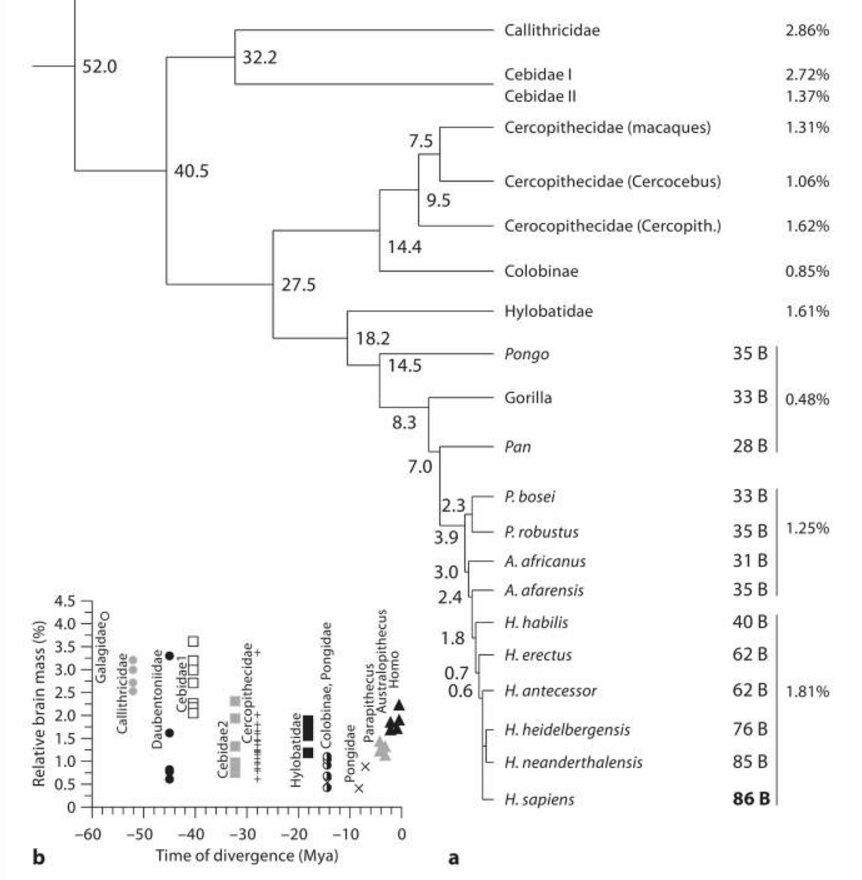
(chart from Herculano-Houzel and Kaas, 2011)
Since Afarensis had about 35 billion neurons we can infer that his IQ was about 40. Paranthropus with about 33 billion neurons had an IQ of about 38. Homo habilis had 40 billion neurons, equating to IQ 46. Erectus with 62 billion neurons comes in at IQ 72., which differs with PP’s estimate by 22 points. (You can see the brain size increase [more on that later] and total neuron increase between habilis and erectus, with an almost 20 IQ point difference. The cause of this is the advent of cooking and the tool-use by habilis, named ‘Handy Man’.) Now we come to a problem. The total number of neurons in the brain of Heidelbergensis, Neanderthals, and humans are about the same.
Heidelbergensis had 76 billion neurons which equates to IQ 88. Neanderthals had about 85 billion neurons, equating to IQ 99. Our IQs are 100 with 86 billion neurons. As you can see, the leap from habilis (who may have eaten meat) to Erectus, a jump of 22 billion neurons and along with it 22. (The rise of bipedalism and tool use, fire, cooking, and meat eating led to the huge increase in neurons in our species Homo.) Then from Erectus to Heidelbergensis was a jump of 14 billion neurons along with an increase of 16 IQ points, then from Heidelbergensis to Neanderthal is an increase of 9 billion neurons, increasing IQ about 11 points. Neanderthals to us is about 1 billion neurons showing a difference of 1 IQ point.
This leads us to a troubling question: did Neanderthals and Hheidelbergensis at least have the capacity to become as intelligent as us? Herculano-Houzel and Kaas (2011) write:
Given that cognitive abilities of non-human primates are directly correlated with absolute brain size [Deaner et al., 2007], and hence necessarily to the total number of neurons in the brain, it is interesting to consider that enlarged brain size, consequence of an increased number of neurons in the brain, may itself have contributed to shedding a dependence on body size for successful competition for resources and mates, besides contributing with larger cognitive abilities towards the success of our species [Herculano-Houzel, 2009]. In this regard, it is tempting to speculate on our prediction that the modern range of number of neurons observed in the human brain [Azevedo et al., 2009] was already found in H. heidelbergensis and H. neanderthalensis, raising the intriguing possibility that they had similar cognitive potential to our species. Compared to their societies, our outstanding accomplishments as individuals, as groups, and as a species, in this scenario, would be witnesses of the beneficial effects of cultural accumulation and transmission over the ages.
If true, this is a huge finding as it echoes what Stephen Jay Gould wrote 21 years ago in his book Full House, as I documented in my article Stephen Jay Gould and Anti-Hereditarianism:
“The most impressive contrast between natural evolution and cultural evolution lies embedded in the major fact of our history. We have no evidence that the modal form of human bodies or brains has changed at all in the past 100,000 years—a standard phenomenon of stasis for successful and widespread species, and not (as popularly misconceived) an odd exception to an expectation of continuous and progressive change. The Cro-Magnon people who painted the caves of the Lascaux and Altamira some fifteen thousand years ago are us—and one look at the incredible richness and beauty of this work convinces us, in the most immediate and visceral way, that Picasso held no edge in mental sophistication over these ancestors with identical brains. And yet, fifteen thousand years ago no human social grouping had produced anything that would conform with our standard definition of civilization. No society had yet invented agriculture; none had built permanent cities. Everything that we have accomplished in the unmeasurable geological moment of the last ten thousand years—from the origin of agriculture to the Sears building in Chicago, the entire panoply of human civilization for better or for worse—has been built upon the capacities of an unaltered brain. Clearly, cultural change can vastly outstrip the maximal rate of natural Darwinian evolution.” (Gould, 1996: 220)
But human cultural change is an entirely distinct process operating under radically different principals that do allow for the strong possibility of a driven trend for what we may legitamately call “progress” (at least in a technological sense, whether or not the changes ultimately do us any good in a practical or moral way). In this sense, I deeply regret that common usage refers to the history of our artifacts and social orginizations as “cultural evolution.” Using the same term—evolution—for both natural and cultural history obfuscates far more than it enlightens. Of course, some aspects of the two phenomena must be similar, for all processes of genealogically constrained historical change must share some features in common. But the differences far outweigh the similarities in this case. Unfortunately, when we speak of “cultural evolution,” we unwittingly imply that this process shares essential similarity with the phenomenon most widely described by the same name—natural, or Darwinian, change. The common designation of “evolution” then leads to one of the most frequent and portentious errors in our analysis of human life and history—the overly reductionist assumption that the Darwinian natural paradigm will fully encompass our social and technological history as well. I do wish that the term “cultural evolution” would drop from use. Why not speak of something more neutral and descriptive—“cultural change,” for example? (Gould, 1996: 219-220)
The implications of the findings of the neuron count in Heidelbergensis and Neanderthals, if true, is a huge finding. Because it implies, as Herculano-Houzel and Kaas say, that “our outstanding accomplishments as individuals, as groups, and as a species … would be witnesses of the beneficial effects of cultural accumulation and transmission through the ages.” I’ve been thinking about this one sentence all week, racking my brain on what it could mean, while thinking about alternate possibilities.
I came across a paper by Dr. John Skoyles titled Human Evolution Expanded Brains to Increase Expertise, Not IQ (saying that around this part of the internet is the equivalent of heresy), in which he reviews studies of people living with microcephaly, showing that a lot of people who have the average brain size of Erectus have average, and even sometimes above average/genius IQs. Yes, microcephaly is correlated with retardation and low IQ, but a significant percentage of individuals inflicted with the disease showed average IQ scores (7 percent overall, 22 percent in 1 subgroup) (Skoyles, 1999). As I’ve documented in the past few days, Erectus was the hominin that learned how to control fire and kicked off the huge spurt in our brain growth. When this increase occurred, brain growth still had to happen outside of the brain, making the baby a fetus for one year after it is born. To achieve its larger brain size, the fetus must have a larger brain before birth, with it increasing postnatally.
The solution to this was to widen the hips of women. This would allow the birth canal to be ‘just right’ in terms of size so the baby could just barely make the squeeze. Physiological differences like this are why there are such huge sex differences in sports. Skoyles (1999) writes:
Research of three kinds suggests that small brained people can have normal IQs: (i) a recent MRI survey on brain size (Giedd et al. 1996), (ii) data on individuals born with microcephaly (head circumference 2 SD below the mean; Dorman, 1991); and (iii) data on early hemispherectomy (the removal of a dysfunctional cerebral hemisphere; Smith & Sugar, 1975; Griffith & Davidson, 1966; Vining et al., 1993).
He also writes that in a sample of 1006 school children, 2 percent (19 students) were found to be microcephalic. Of the 19 microcephalics, only 12 were in districts that did intelligence testing. Of the 12, 7 of them had an average IQ, with one having an IQ of 129. Skoyler even cites a study where a woman’s cranial capacity may have possibly been 760 cc (one the lower end of the range of Erectus brains)!! Her employment was described as ‘semi-skilled’, which Skoyler notes is normal for her ability level. Skoyler also says that Medline shows 21 other studies showing that microcephalic individuals have average IQs.
There is also one incidence of a man having a smaller brain than erectus while having a normal intelligence level, showing no peculiarities or mental retardation. Upon his death, his brain was weighed and they discovered that it weighed 624 grams!
Now, of course, the studies that Skoyler brings up are outliers, but they raise very interesting questions when you think about the supposed link with IQ and brain size. More interestingly, even sudden brain damage will leave a small change, if any, in IQ (Bigler, 1995). Finally, the .35 brain size-IQ correlation needs to be talked about. Let’s be generous and say the correlation is .5, 74 percent of the variance in IQ would still be unexplained (Skoyler, 1999: 8).
Skoyler then says that IQ tests “show very moderate to zero correlations with people’s ability to acquire expertise (Ackerman, 1996; Ceci & Liker, 1986; Doll & Mayr, 1987; Ericsson & Lehmann, 1996; Shuter-Dyson & Gabriel, 1981).” So he says that one’s capacity for expertise isn’t necessarily predicated on their IQ as measured by IQ tests. Skoyler writes:
Hence, whereas nonexpert players see only chess pieces, chess masters see possible future moves and potential strategies. Such in depth perception arises from acquiring and being able to actively use a larger numbers of informational “chunks” in analyzing a problem. The number of such chunks in chess masters has been estimated at 50,000 (Gobet & Simon, 1996). Such information processing chunks take many years to acquire. After reviewing performance in sport, medicine, chess and music, Ericsson and Lehmann (1996) propose that before people can show expertise in any domain they must have performed several hours of practice a day for a minimum of 10-years
So, this ‘expertise capacity’ seems to be a trained—not inherited—trait. He then cites a study on people who’ve spent decades at the daily race track betting on horse races. Cece and Liker (1986) measured the IQs of 12 of the experts, and found that they ranged between IQ 81 and 128 (“four were between 80 and 90, three between 90 and 100, two between 100 and 110 and only three above 120 Table 6”). The authors write: “whatever it is that an IQ test measures, it is not the ability to engage in cognitively complex forms of multivariate reasoning.” Moreover, Skoyler writes, expertise in chess (see Erickson, 2000) and music (see Deutsch, 1982: 404-405) “correlates poorly, or not at all with IQ.”
Now that we know that the capacity to develop expertise isn’t needed in the modern world, what did it mean for our hunter-gatherer ancestors? Looking at some of the few hunter-gatherer tribes left today, we can make some inferences.
The !Kung bushmen use in-depth expert knowledge and reasoning. Just by looking at a few tracks in the dirt, a bushman can infer whether the animal that made the track is sick, whether it was alone, its age and sex. They are able to do this by reading the shape and depth of the track in the dirt. Such skill, obviously, is learned, and those who didn’t have the capacity for expertise would have died out. Further, expertise in hunting is more important than physical ability, with the best hunters being over the age of 39 and not those in their 20s. This can further be seen when the young men go out for hunting. The young men do the physical work while the elder reads tracks, a learned ability.
This, Skoyler writes, suggests that those who had the highest capacity for expertise would have had the best chance for survival. Expertise in hunting is not the only thing that we need expertise for, obviously. The skill of ‘expertise’ translates to most all facets of human life. And over time, the advantages conferred by success with these activities “would result in the natural selection of brains with increased capacity for expertise.” So, even possibly, the success of our expertise could have selected for bigger brains which would have further increased the capacity for our expertise.
Since expertise is linked to the number of brain chunks that a brain can “hold and actively process”, that capacity for expertise “may be related to the number of cortical columns able to specialise neural networks in representing and processing them, and through this to cerebral mass Jerison (1991).” And, in brain scans of expert violinists, they have two to three times as much of their cortical area devoted to their left fingers as nonviolinists. ” This suggests that a strong connection should exist between the capacity for acquiring expertise skills and brain mass.”
I’m, of course, not denying the usefulness of IQ tests. What I’m saying, is that IQ tests don’t test a person’s capacity to learn a skill and become an expert in something. IQ tests, as shown, do not measure expertise capacity. IQ tests, then, don’t test for what was central to our evolution as hominins: expertise capacity. Of course, it’s not only expertise in hunting that led to the selection for bigger brains, and along with it expertise capacity. Obviously, this would hold for other things in our evolution that we can become experts in, from scavenging, to gathering, to language, social relationships, tool-making, and passing on useful skills that would infer an increase in fitness.
IQs for hominins are as follows: Paranthropus: IQ 38 (33 billion neurons); Afarensis: IQ 40 (35 billion neurons); Habilis: IQ 46 (40 billion neurons); Erectus: IQ 72 (62 billion neurons); Heidelbergensis: IQ 88 (76 billion neurons); Neanderthals: IQ 99 (85 billion neurons) and Sapiens: IQ 100 (85 billion neurons). So if Heidelbergensis and Neanderthals had IQs around ours (theoretically speaking), and Erectus had an IQ around modern-day Africans today, what explains our achievements over our hominin ancestors if we have around the same IQs?
Lamarckian cultural inheritance. If you think about when brain size began to increase, it was around the time that bipedalism occurred in the fossil record, along with tool use, fire, cooking, and meat eating. I’m suggesting here today that the beginnings of cultural transference happened with Afaraensis, Habilis, and Erectus. Passing down culture (useful traits for survival back then) would have been paramount in hominin survival. One wouldn’t have to learn how to do things on their own, and could learn from and elder the crucial survival skills they needed. This would have selected for a bigger brain due to the need for a higher expertise capacity, as with a bigger brain there is more room for cortical columns and neurons which would better facilitate expertise in that hominin.
I’m still thinking about what this all means, so I haven’t taken a side on this yet. This is an extremely interesting look into hominin brain size evolution, which shows that big brains didn’t evolve for IQ, but to increase expertise capacity. Though there is an extremely strong possibility that we gained over 20 billion neurons from Erectus due to his cooking, which then capped out our intelligence in our lineage. That would then mean that Neanderthals and Heidelbergensis would have had the capacity for the same IQ as us. One thing I can think of that set us apart 70 kya was the advent of art. That was a new way of transferring information from our hugely metabolically expensive neurons. This was also, yet another way of cultural transference. But what this means in terms of Neanderthal and Heidelbergensis IQ and what it means for our accomplishments since them is another story, which I will return to in the future.
Why Are Humans Cognitively Superior to Other Animals?
1550 words
The past few articles I have written touched on the fact that the human brain isn’t special and is just a scaled-up primate brain, bipedalism, tools, fire, cooking and meat eating had the largest effect on hominin brain evolution, and that, despite seeing a so-called ‘upward trend’ in the evolution of primate brain size, the reverse was occurring. So what makes us cognitively superior to other animals?
The most oft-cited reason why humans are cognitively superior to other animals is that we have the largest EQ compared to other animals. Ours is 7.5, meaning that we have a brain that’s 7.5 times larger than a mammal for our size but only 3.4 times as larger than expected for an anthropoid primate of its body mass (Azevedo et al, 2009). However, in stark contrast to the view of the people who view EQ as the reason why we are cognitively superior to other animals, what separates us in terms of cognitive ability is the difference in cortical neurons compared to other primates.
We humans have the most cortical neurons in our cerebral and prefrontal cortexes, relatively high neuron packing density (NPD), and much more cortical neurons of mammals of the same brain size (Roth and Dicke, 2012). Differences in intelligence across primate taxa best correlate with differences in number of cortical neurons, information processing speed, and synapses. Though, the human brain stands out having a “large cortical volume with a relatively NPD, high conduction velocity and high cortical parcellation.” This is why we are much more intelligent than other primates, due to the amount of cortical neurons we have as well as higher neuron packing density (keep this in mind for later). Encephalization quotient doesn’t explain intelligence differences within species, hence there being a problem with the use of encephalization to as the reason for human cognitive superiority, our Human Advantage, if you will.
Harry Jerison, the originator of the encephalization quotient, came to the conclusion that “human evolution … had been all about an advancement of encephalization quotients culminating in man.” (Herculano-Houzel, 2016: 15) What a conclusion. Just because EQ increased throughout hominin evolution, that means that it was all an advancement of EQs culminating to man. That’s circular logic.
Moreover, the “circular assumption” that higher EQ mean superior cognitive abilities in humans wasn’t founded on “tried-and-true correlations with actual measures of cognitive capacity.” (Herculano-Houzel, 2016: 15)
In second place on the EQ chart is the capuchin monkey coming in with an EQ of 2, which is more than double that of great apes who fall way below 1. That would imply that capuchin monkeys are more intelligent than great apes and outsmart great apes, right? Wrong. Great apes are. Total brain size predicts cognitive abilities in non-human primates better than EQ (Deaner et al, 2007).
Great apes significantly outperform other lineages. (Deaner, Schaik, and Johnson, 2006) Yet they have smaller EQs compared to other less intelligent primates. This is one of the largest problems with the EQ: total brain size is a better predictor of cognitive ability in non-human primates (Herculano-Houzel, 2011). She proposes that the absolute number of neurons, irrespective of brain size or body weight, is a better predictor of cognitive ability than is EQ.
Another problem with the EQ is that it assumes that all brains are made the same, and they aren’t. They scale differently between species. That’s one pretty huge flaw. Scaling is not the same across species, only within certain species. This one fatal flaw in EQ comparing different species of humans is why there is a problem with EQ in assessing cognitive abilities and why total brain size predicts cognitive abilities in non-human primates better than EQ.
Absolute brain size is a much better indicator of intelligence than the encephalization quotient.
So what exactly explains human cognitive superiority over other animals if the most often-used metric—the EQ—is flawed? An enlarged frontal cortex? No, the prefrontal areas in a human brain occupy 29 percent of the mass of the cerebral cortex. Moreover, the prefrontal cortex of humans, bonobos, chimpanzees, gorillas, and orangutans occupies the same 35-37 percent of all cortical volume (Semendeferei et al, 2002). (See also Herculano-Houzel, 2016: 119 and Gorillas Agree: Human Frontal Cortex is Nothing Special). Just because our frontal cortexes are all the same size, doesn’t mean that we don’t have a higher neuron packing density (NPD) than other primates. However, the human brain has the amount of neurons expected for its grey matter volume and total number of neurons remaining in the cerebral cortex; it has the white matter volume expected for amount of neurons; and the white matter volume and number of neurons expected for the number and volume of neurons in the “nonprefrontal subcortical white matter” (Herculano-Houzel, Watson, and Paxinos, 2013). The human prefrontal cortex is no larger than it ‘should’ be.
However, there seems to be a problem with Herculano-Houzel’s (2011) theory that absolute number of neurons predicts cognitive superiority (Mortenson et al, 2014). The long-finned pilot whale has 37,200,000 neurons in its cerebral cortex, more than double that of humans (16 billion). Does this call into question Herculano-Houzel’s (2011) theory on absolute number of neurons being the best case of human cognitive superiority over other animals?
In short, no. Neuron density is higher in humans than in the pilot whale. We have more neurons packed into our cerebral cortex. Their higher cell count is due only to their larger brains. And where it matters: pilot whales have a higher than expected amount of neocortical neurons relative to body weight, although not higher than humans. Herculano-Houzel’s (2011) theory is still in play here. They have big brains and in turn large amounts of glial cells to counter heat loss. So even then, this doesn’t counter Herculano-Houzel’s theory that the absolute amount of neurons dictates overall cognitive superiority.
Moreover, there is the same amount of cortical neurons in mice brains and human brains, with both mice and humans housing 8 percent of their total neurons in the prefrontal cortex. So what accounts for human cognitive superiority in humans compared to other primates? Most likely, the connectivity of the brain.
The connectivity in the brain of humans is not different from other species. The density of gray matter within species is fairly constant within mammalian species (Herculano-Houzel, 2016: 122). If true, then human prefrontal cortex, being nowhere near the largest, wouldn’t have the most synapses in our prefrontal cortex or anywhere else in the brain, and thus these wouldn’t be the largest. So, what does explain the cognitive superiority of humans over other animals in the animal kingdom?
All though all mammals use 8 percent of their total neurons in their prefrontal cortex, there is a differing distribution due to the amount of total neurons in each brain (remember, all brains aren’t made the same. It doesn’t hold for humans, and it especially doesn’t hold across phyla). We have 1.3 billion cortical neurons in our prefrontal cortex, baboons have 230 million, the macaque has 137 million and the marmoset has 20 million (Herculano-Houzel, 2016: 122). Prefrontal neurons are able to add complexity and flexibility, among other associative functions, to behavior while making planning for the future possible. All of these capabilities would increase with the more neurons a prefrontal cortex has (remember back to my article that the seat of intelligence (g) is the prefrontal cortex). So this seems to confirm the past studies showing the seat of intelligence to be the frontal cortex, due to the large amount of cortical neurons it has.
Herculano-Houzel writes the best definition of intelligence she’s ever heard, from MIT physicist Alex Wissner-Gross, which I believe is a great definition of intelligence:
The ability to plan for the future, a significant function of prefrontal regions of the cortex, may be key indeed. According to the best definition I have come across so far, put forward by MIT physicist Alex Wissner-Gross, intelligence is the ability to make decisions that maximize future freedom of action—that is, decisions that keep most doors open for the future. (Herculano-Houzel, 2016: 122-123)
All of the above are the direct result of more neurons in our frontal cortexes compared to other primates, which is why she finds it is the best definition of intelligence she’s ever heard.
Our ‘Human Advantage’ over other species comes down to the number of cortical neurons we have in our prefrontal cortex compared to other primates as well as the most neurons along with the highest NPD in the animal kingdom—which will be matched by no animal. The encephalization quotient has a lot of problems, with overall brain weight being a much better predictor of intelligence (Herculano-Houzel, 2011). Human cognitive superiority comes down to the total amount of neurons in our frontal cortex (1.3 billion neurons—where we will not be beaten) and our cerebral cortexes (16 billion neurons [long-finned pilot whales beat us out by more than double the amount, but we have more neurons packed into our cerebral cortex signifying our higher cognitive abilities). Within primates, total brain size predicts cognitive abilities better than EQ (Deaner et al, 2007).
Human cognitive superiority, contrary to popular belief, is not due to the EQ. It’s due to our NPD and amount of neurons in our frontal and cerebral cortexes that no other animal has–and we will not find another animal like this. This only would have been possible with the advent of bipedalism, tool-making, fire, cooking and meat eating. That’s what drives the evolution of brain size—and our evolution as a whole. Energy. Energy to reproduce, which then produce mutations which eventually coalesce new species.
Is There Progress in Hominin Brain Evolution?
2700 words
Tl;dr: The ‘trend’ in the evolution of hominin brain size is only due to diet quality and abundance. If there is any scarcity of food or a decrease in nutritional quality, there will be a subsequent decrease in brain size, as seen with H. floresiensis. Brain size, contrary to popular belief, has been decreasing for the past 20,000 years and has accelerated in the past 10,000. This trend is noticed all over the world with multiple hypotheses put out to explain the phenomenon. Despite this, people still deny that a decrease is occurring. Is it? Yes, it is. It’s due to a decrease in diet quality along with higher population density. If the human diet were to decrease in quality and caloric amount, our brains—along with our bodies—would become smaller over time.
Is there progress in hominin brain evolution? Many people may say yes. Over the past 7 million years, the human brain has tripled in size with most of this change occurring within the past 2 million years. This perfectly coincides with the advent of bipedalism, tool-making, fire, cooking and meat eating. Knowing the causal mechanisms behind the increase in hominin (primate) brain size, is there ‘progress’ to brain size in hominin evolution?
Looking at the evolution of hominin brain size in the past 7 million years, one can rightfully make the case that there is an evolutionary trend with the brain size increase. I don’t deny there is an increase, but first, before one says there is ‘progress’ to this phenomenon, you must look at it from both sides.
Montgomeroy et al (2010) reconstructed the ‘ups and downs’ of primate brain size evolution, and of course, decreases in hominin brain size can’t be talked about without bringing up H. floresiensis and his small brain and body mass, which they discuss as well. They come to the conclusion that “brain expansion began early in primate evolution”, also showing that there have been brain size increases in all clades of primates. Humans only show a bigger increase in absolute mass, with rate of proportional change in mass and relative brain size “having greater episodes of expansion elsewhere on the primate phylogeny”. Decreases in brain size also occurred in all of the major primate clades studied, they conclude that “while selection has acted to enlarge primate brains, in some lineages this trend has been reversed.” The selection can only occur in the presence of adequate kcal, keeping everyone sated and nourished enough to provide for the family, ensuring a woman gets adequate kcal and nutrients during pregnancy and finally ensuring that the baby gets the proper amount of energy for growth during infancy and childhood.
Montgomery et al write:
The branch with the highest rate of change in absolute brain mass is the terminal human branch (140,000 mg/million years). However for rate of proportional change in absolute brain mass the human branch comes only fourth, below the branches between the last common ancestor of Macaques and other Papionini, and the last common ancestor of baboons, mangabeys and mandrills (48 to 49), the ancestral primate and ancestral haplorhine (38 to 39) and the branch between the last common ancestor of Cebinae, Aotinae and Callitrichidae, and the ancestral Cebinae (58 to 60). The rate of change in relative brain mass along the human branch (0.068/million years) is also exceeded by the branch between the last common ancestor of Alouatta, Ateles and Lagothrix with the last common ancestor of Ateles and Lagothrix (branch 55 to 56; 0.73), the branch connecting the last common ancestor of Cebinae, Aotinae and Callitrichidae, and the ancestral Cebinae (branch 58 to 60; 0.074/million years) and the branch connecting the last common ancestor of the Papionini with the last common ancestor of Papio, Mandrillus and Cercocebus (branch 48 to 49; 0.084). We therefore conclude that only in terms of absolute mass and the rate of change in absolute mass has the increase in brain size been exceptional along the terminal branch leading to humans. Once scaling effects with body mass have been accounted for the rate of increase in relative brain mass remains high but is not exceptional.
“Remains high but is not exceptional”, ie, expected for a primate of our size (Azevedo et al, 2009). Of course, since evolution is not progressive, then finding any so-called ‘anomalies’ that ‘deviate’ from the ‘progress’ in brain size evolution makes sense. They conclude that floresiensis’ brain size and body mass decrease fell within the expected range of Argue et al’s (2009) proposed phylogenetic scenario. Though, only if he evolved from habilis or Dmansi hominins if the insular dwarfism hypothesis was taken into account (which is a viable explanation for the decrease).
The effects of food scarcity and its effect on hominin brain size is hardly ever spoken about. However, as I’ve been documenting here recently, caloric quality and amount dictate brain size. Montgomeory et al (2010) write:
Although many studies have investigated the possible selective advantages and disadvantages of increased brain size in primates [5, 17, 18, 19, 20, 21], few consider how frequently brain size has reduced. Periods of primate evolution which show decreases in brain size are of great interest as they may yield insights into the selective pressures and developmental constraints acting on brain size. Bauchot & Stephan [22] noted the evolution of reduced brain size in the dwarf Old World monkey Miopithecus talapoin and Martin [23] suggested relative brain size in great apes may have undergone a reduction based on the cranial capacity of the extinct hominoid Proconsul africanus. Taylor & van Schaik [24]reported a reduced cranial capacity in Pongo pygmaeus morio compared to other Orang-utan populations and hypothesise this reduction is selected for as a result of scarcity of food. Finally, Henneberg [25] has shown that during the late Pleistocene human absolute brain size has decreased by 10%, accompanied by a parallel decrease in body size.
[…]
These authors suggest this reduction is associated with an increase in periods of food scarcity resulting in selection to minimise brain tissue which is metabolically expensive [17]. Food scarcity is also believed to have played a role in the decrease in brain size in the island bovid Myotragus [12]. Taylor & van Schaik [24] therefore propose that H. floresiensis may have experienced similar selective pressures as Myotragus and Pongo p. morio.
Nice empirical vindication for me, if I don’t say so myself. This lends further credence to my scenario of an asteroid impact on earth halting food production leading to a scarcity in food. It’s hypothesized that floresiensis went from eating (if evolved from erectus) 1800 kcal per day and 2500 while nursing to 1200 per day and 1400 while nursing (Lieberman, 2013: 125). This, again, is proof that big brains need adequate energy and that cooking meat was what specifically drove this facet of our evolution.
Montgomeroy et al (2010) conclude:
Finally, our analyses add to the growing number of studies that conclude that the evolution of the human brain size has not been anomalous when compared to general primate brain evolution [59, 61, 91, 62, 63, 64, 65, 66, 67, 68, 69, 70, 71, 72, 73, 74, 75, 76, 77, 78, 79, 80, 81, 82, 83, 84, 85, 86, 87, 88, 89, 90, 91, 92, 93, 94].
In other words, humans are not ‘special’ in terms of brain size. While there is a ‘trend’ in the increase in brain size, this ‘trend’ is only possible with the advent of fire, cooking, and meat eating. Without that causal mechanism, big brains would not be metabolically viable.
A big brain (large amounts of neurons) can only evolve with enough energy, mainly the advent of cooking meat (Herculano-Houzel, 2009). Primates have much higher neuronal densities than other mammals (Herculano-Houzel, Manger, and Kaas, 2014). Since the amount of energy the brain needs per day depends on how many total neurons it has (Azevedo and Herculano-Houzel, 2012), quality calories are needed to power such a metabolically expensive organ. Only with the advent of fire could we consume enough high-quality energy to evolve such big brains.
Mammalian brains that have 100 million neurons require .6 kcal, brains with 1 billion neurons use 6 kcal per day, and brains with 100 billion neurons use 600 kcal per day (humans with 86 billion neurons use 519 kcal, coming out to 6 kcal per neuron) regardless of the volumes of the brains (Herculano-Houzel, 2011). Knowing that the amount of neurons a brain has is directly related to how much energy it needs, it doesn’t seem so crazy now that, like with the example of floresiensis, a brain could decrease in size even when noticing this ‘upward trend’ in hominin brain size. This is simply because how big a brain is directly related to amount of energy available in an area as well as the most important variable: quality of the food.
If floresiensis is descended from habilis (and there is evidence that habilis was a meat eater, so along with a low amount of energy for floresiensis on Flora as well as there being no large predators on the island, a smaller size would have been advantageous to floresiensis), then this shows that what I’ve been saying for a few months is true: the diet quality as well as amount of energy dictates whether an organism evolves to be big or small. Energy is what ‘drives’ evolution in a sense and energy comes from kcal. The highest quality energy is from meat, and that fuels our ‘big brains’ with our high neuron count.
Imagine this scenario: an asteroid hits the earth and destroys the world power grid. All throughout the world, people cannot consume enough food. The sun is blocked by dust clouds for, say, 5000 years. The humans that survive this asteroid collision would evolve a smaller brain and body as well as better eyesight to see in an environment with low light, among other traits. Natural selection can only occur on the heritable variants already in the population, so whatever traits that would increase fitness in this scenario would multiply and flourish in the population, leading to a different, smaller-brained and smaller-bodied human due to the effects of the environment.
While on the subject of the decrease in human brain size, something that’s troubling to those who champion the ‘increase in hominin brain size’ as the ‘pinnacle of evolution’: our brains have been decreasing in size for at least the past 20,000 years according to John Hawks associate professor of anthropology at the University of Wisconsin-Madison. Keep in mind, this is someone that Pumpkin Person brings up saying that our brains have been increasing for the past 10,000 years. He has also said that the increase in better nutrition has allowed us to gain back the brain size of our hunter-gatherer ancestors (with no reference), which is not true. Because what John Hawks actually wrote on his blog about this says a different story:
The available skeletal samples show a reduction in endocranial volume or vault dimensions in Europe, southern Africa, China, and Australia during the Holocene. This reduction cannot be explained as an allometric consequence of reductions of body mass or stature in these populations. The large population numbers in these Holocene populations, particularly in post-agricultural Europe and China, rule out genetic drift as an explanation for smaller endocranial volume. This is likely to be true of African and Australian populations also, although the demographic information is less secure. Therefore, smaller endocranial volume was correlated with higher fitness during the recent evolution of these populations. Several hypotheses may explain the reduction of brain size in Holocene populations, and further work will be necessary to uncover the developmental and functional consequences of smaller brains.
In fact, from the Discover article on decreasing brain size, John Hawks says:
Hawks spent last summer measuring skulls of Europeans dating from the Bronze Age, 4,000 years ago, to medieval times. Over that period the land became even more densely packed with people and, just as the Missouri team’s model predicts, the brain shrank more quickly than did overall body size, causing EQ values to fall. In short, Hawks documented the same trend as Geary and Bailey did in their older sample of fossils; in fact, the pattern he detected is even more pronounced. “Since the Bronze Age, the brain shrank a lot more than you would expect based on the decrease in body size,” Hawks reports. “For a brain as small as that found in the average European male today, the body would have to shrink to the size of a pygmy” to maintain proportional scaling.
This is in stark contrast to what PP claims he says about the evolution of human brain size over the past 10,000 years, especially Europeans who he claims Hawks has said there has been an increase in European brain size. An increase in brain size over the past 100 years doesn’t mean a trend is occurring upward, since all other data on human brain size says otherwise.
Our brains have begun to decrease in size, which is due to the effects of overnutrition and diseases of civilization brought on by processed foods and the agricultural revolution. Another proposed cause for this is that population density tracks with brain size, with brain size increasing with a smaller population and decreasing with a bigger population. In a way, this makes sense. A bigger brain should have more neurons than a smaller brain, which would aid in cognitive tasks and have that one hominin survive better giving it a better chance to pass on its genes, so if you think about it, when the population increases when social trust forms, you can piggyback off of others and they wouldn’t have to do things on their own. As population size increased from sparse to dense, brain size decreased with it.
On this notion of ‘progress’ in brain size, some people may assume that this puts us at the ‘pinnacle’ of evolution due to our superior cognitive ability (which is due to the remarkably large amount of neurons in our cerebral cortex [Hercualno-Houzel, 2016: 102]), Herculano-Houzel writes on page 91 of her book The Human Advantage: A New Understanding of How Our Brains Became Remarkable:
We have long deemed ourselves to be at the pinnacle of cognitive abilities among animals. But that is different than being at the pinnacle of evolution in a number of important ways. As Mark Twain pointed out in 1903, to presume that evolution has been a long path leading to humans as its crowning achievement is just as preposterous as presuming that the whole purpose of building the Eiffel Tower was to put the final coat of paint on its tip. Moreover, evolution is not synonmous with progress, but simply change over time. And humans aren’t even the youngest, most recently evolved species. For example, more than 500 new species of cichlid fish in Lake Victoria, the youngest of the great African Lakes, have appeared since it filled with water some 14,500 years ago.
Using PP’s logic, the cichlid fishes of Lake Victoria are ‘more highly evolved’ than we are since they’re a ‘newer species’. Using that line of logic makes no sense now, putting it in that way.
Looking at the ‘trend’ in human brain size over the past 7 million years, and its acceleration in the past 2 million, without thinking about what jumpstarted it (bipedalism, tools, fire, meat eating) is foolish. Moreover, any change to our environment that decreases our energy input would, over time, lead to a decrease in our overall brain size perhaps more rapidly, showing that this ‘trend’ in the increase in brain size is directly related to the quality and amount of food in the area. This is why floresiensis’ brain and body shrunk, and why certain primate lineages show increases in brain size: because they have a higher-quality diet. But it comes at a cost. Since primates largely eat a plant-based diet, they have to eat upwards of 10 hours a day to get enough energy to power either their brains or their bodies. If their bodies are large, their brains are small and vice versa. A plant-based diet cannot power a large brain with a high neuron count like we have, it’s only possible with meat eating (Azevedo and Herculano-Houzel, 2012). This is one reason why floresiensis’ brain shrunk along with not enough kcal to sustain their larger brain and body mass that their ancestor they evolved from previously had.
Our brains are not particularly special, and in a way, you can thank fire and cooking meat for everything that’s occurred since erectus first controlled fire. For without a quality diet in our evolution, this so-called ‘trend’ (which is based on the environment due to food quality and scarcity/abundance which fluctuate) would not have occurred. In sum, this ‘progress’ will halt and ‘reverse’ if the amount of energy consumed decreases or diet quality decreases.
What Caused Human Brain Size to Increase?
1900 words
People talk a lot about intelligence and brain size. Something that’s most always brought up is how the human brain increased in size the past 4 million years. According to PP, the trend for bigger brains in hominins is proof that evolution is “progressive”. However, people never talk about a major event in human history that caused our brains to suddenly increase: the advent of fire. When our ancestors mastered fire, it was then possible for the brain to get important nutrients that influenced growth. People say that “Intelligence is the precursor to tools”, but what if fire itself is the main cause for the increase in brain size in hominins the past 4 million or so years? If this is the case, then fire is, in effect, the ultimate cause of everything that occurred after its use.
The human brain consumes 20-25 percent of our daily caloric intake. How could such a metabolically expensive organ have evolved? The first hominin to master fire was H. erectus. There is evidence of this occurring 1-1.5 mya. Not coincidentally, brain size began to tick upward after the advent of fire by H. erectus. Erectus was now able to consume more kcal, which in turn led to a bigger brain and the beginnings of a decrease in body size. The mastery and use of fire drove our evolution as a species, keeping us warm and allowing us to cook our food, which made eating and digestion easier. Erectus’s ability to use fire allowed for the biggest, in my opinion, most important event in human history: cooking.
With control of fire, Erectus could now cook its foods. Along with pulverizing plants, it was possible for erectus to get better nutrition by ‘pre-digesting’ the food outside of the body so it’s easier to digest. The advent of cooking allowed for a bigger brain and with it, more neurons to power the brain and the body. However, looking at other primates you see that they either have brains that are bigger than their bodies, or bodies that are bigger than their brains, why is this? One reason: there is a trade-off between brain size and body size and the type of diet the primate consumes. Thinking about this from an evolutionary perspective along with what differing primates eat and how they prepare (if they do) their food will show whether or not they have big brains or big bodies. How big an organism’s brain gets is directly correlated with the amount and quality of the energy consumed.
There is a metabolic limitation that results from the number of hours available to feed and the low caloric yield of raw foods which then impose a trade-off between the body size and number of neurons which explains why great apes have small brains in comparison to their bodies. Metabolically speaking, a body can only handle one or the other: a big brain or a big body. This metabolic disadvantage is why great apes did increase their brain size, because their raw-food diet is not enough, nutritionally speaking, to cause an increase in brain size (Azevedo and Herculano-Houzel, 2016). Can you imagine spending what amounts to one work day eating just to power the brain you currently have? I can’t.
Energy availability and quality dictates brain size. A brain can only reach maximum size if adequate kcal and nutrients are available for it.
Total brain metabolism scales linearly with the number of neurons (Herculano-Houzel, 2011). The absolute number of neurons, not brain size, dictates a “metabolic constraint on human evolution”, since people with more neurons need to sustain them, which calls for eating more kcal. Mammals with more neurons need to eat more kcal per day just to power those brains. For instance, the human brain needs 519 kcal to run, which comes out to 6 kcal per neuron. The brain is hugely metabolically expensive, and only the highest quality nutrients can sustain such an organ. The advent of fire and along with it cooking is one of, if not the most important reason why our brains are large (compared to our bodies) and why we have so many neurons compared to other species. It allowed us to power the neurons we have, 86 billion in all (with 16 billion in the cerebral cortex which is why we are more intelligent than other animals, number of neurons, of course being lower for our ancestors) which power human thought.
The Expensive Tissue Hypothesis (ETA) explains the metabolic trade-off between brain and gut, showing that the stomach is dependent on body size as well as the quality of the diet (Aiello, 1996). As noted above, there is good evidence that erectus began cooking, which coincides with the increase in brain size. As Man began to consume meat around 1.5 million years ago, this allowed for the gut to get smaller in response. If you think about it, it makes sense. A large stomach would be needed if you’re eating a plant-based diet, but as a species begins to eat meat, they don’t need to eat as much to get the adequate amount of kcal to fuel bodily functions. This lead to the stomach getting smaller, and along with it so did our jaws.
So brain tissue is metabolically expensive but there is no significant correlation between brain size and BMR in humans or any other encephalized mammal, the metabolic requirements of relatively large brains are offset by a corresponding gut reduction (Aiello and Wheeler, 1995). This is the cause for the low, insignificant correlation between BMR and our (relatively large brains, which correlates to the amount of neurons we have since our brains are just linearly scaled-up primate brains).
Evidence for the ETA can be seen in nature as well. Tsuboi et al (2015) tested the hypothesis in the cichlid fished of Lake Victoria. After they controlled for the effect of shared ancestry and other ecological variables, they noted that brain size was inversely correlated with gut size. Perhaps more interestingly, they also noticed that when the fish’s’ brain size increased, increased investment and paternal care occurred. Moreover, more evidence for the ETA was found by Liao et al (2015) who found a negative correlation between brain mass and the length of the digestive tract within 30 species of Anurans. They also found, just like Tsuboi et al (2015), that brain size increase accompanied an increase in female reproductive investment into egg size.
Moreover, another cause for the increase in brain size is our jaw size decreasing. This mutation occurred around 2.4 million years ago, right around the time frame that erectus discovered fire and began cooking. This is also consistent with, of course, the rapid increase in brain size which was occurring around that time. The room has to come from somewhere, and with the advent of cooking and meat eating, the jaw was, therefore, able to get smaller along with the stomach which increased brain size due to the trade-off between gut size and brain size. Morphological changes occurred exactly at the same time changes in brain size occurred which coincides with the advent of fire, cooking, and meat eating. Coincidence? I think the evidence strongly points that this is the case, the rapid increase in brain size was driven by fire, cooking, and meat eating.
The rise of bipedalism also coincided with the brain size increase and nutritional changes. Bipedalism freed the hands so tools could be made and used which eventually led to the control of fire. Lending more credence to the hypothesis of bipedalism/tools/brain size is the fact that there is evidence that the first signs of bipedalism occurred in Lucy, our Australopithecine ancestor who had pelvic architecture that showed she was clearly on the way to bipedalism. There is more evidence for bipedalism in fossilized footprints of australopithecines around 3 mya, coinciding with Lucy, tool use and eventually the advent and use of fire as a tool to cook and ward off predators. Ancient hominids could then better protect their kin, have higher quality food to eat and use the fire to scare off predators with.
The nutritional aspect of evolution and how it co-evolved with us driving our evolution in brain size which eventually led to us is extremely interesting. Without proper nutrients, it’s not metabolically viable to have such a large brain, as whatever kcal you do eat will need to go towards other bodily functions. Moreover, diet quality is highly correlated with brain size. Great apes can never get to the brain size that we humans have, and their diet is the main cause. The discovery and control of fire, the advent of cooking and then meat eating was what mainly drove the rapid increase of brain size starting 4 mya.
In a way, you can think of the passing down of the skill of fire-making to kin as one of the first acts of cultural transference to kin. It’s one of the first means of Lamarckian cultural transference in our history. Useful skills for survival will get passed down to the next generation, and fire is arguably the most useful skill we’ve ever come across since it’s had so many future implications for our evolution. The ability to create and control fire is one of the most important skills as it can ward off predators, cook meat, be used to keep warm, etc. When you think about how much time was freed up upon the advent of cooking, you can see the huge effect the control of fire first had for our species. Then think about how we could only control fire if our hands were freed. Then human evolution begins to make a lot more sense when put into this point of view.
When thinking about brain size evolution as well as the rapid expansion of brain size evolution, nutrition should be right up there with it. People may talk about things like the cold winter hypothesis and intelligence ad nauseam (which I don’t doubt plays a part, but I believe other factors are more important), but meat-eating along with a low waist-to-hip ratio, which bipedalism is needed for all are much more interesting when talking about the evolution of brain size than cold winters. All of this wouldn’t be possible without bipedalism, without it, we’d still be monkey-like eating plant-based diets. We’d have bigger bodies but smaller brains due to the metabolic cost of the plant-based diet since we wouldn’t have fire to cook and tools to use as we would have still been quadrupeds. The evolution of hominin intelligence is much more interesting from a musculoskeletal, physiological and nutritional point of view than any simplistic cold winter theory.
What caused human brain size to increase is simple: bipedalism, tools, fire, cooking, meat eating which then led to big brains. The first sign of big brains were noticed right around the time erectus had control of fire. This is no coincidence.
Bipedalism, cooking, and food drove the evolution of the human brain. Climate only has an effect on it insofar as certain foods will be available at certain latitudes. These three events in human history were the most important for the evolution of our brains. When thinking about what was happening physiologically and nutritionally around that time, the rebuttal to the statement of “Intelligence requires tools” is tools require bipedalism and further tools require bigger brains as human brains may have evolved to increase expertise capacity and not IQ (more on that in the future), which coincides with the three events outlined here. Whatever the case may be, the evolution of human intelligence is extremely interesting and is most definitely multifaceted.
The Human Brain Is Not Particularly Special: A New Way of Looking At the Human Brain
2000 words
What if I told you that, neuronally speaking, the human brain was not particularly special? That, despite its size in comparison to our bodies, we are not particularly special in comparison to other primates or mammals. The encephalization quotient supposedly shows how “unique” and “special” humans are in terms of brain size compared to body size. We have a brain that’s seven times bigger than would be expected for our body size, and that’s what supposedly makes us unique compared to the rest of the animals kingdom.
Suzana Herculano-Houzel, the new Associate Professor of Psychology at Vanderbilt University (former Associate Professor at the Federal University of Rio de Janeiro), is a neuroscientist who challenges these notions that humans are supposedly unique in our brain size when compared to other mammals and primates. She pioneered a technique of turning brains into soup with a machine called the isotropic fractionator, which turns it into a “soup of a known volume” that contain the free cell nuclei to be colored and counted under a microscope. Using this technique, Azevedo et al (2009) showed that “with regard to numbers of neuronal and nonneuronal cells, the human brain is an isometrically scaled-up primate brain.” Every cell in the soup contains one nucleus, so counting is easy. Using this technique, they discovered that using the brain scaling of rats, a brain of 100 billion neurons would weigh 45 kg and body mass would be 109 tons. While using the primate scaling, a brain of 100 billion neurons would weigh 1.45 kg and belong to a body weighing 74 kg, suspiciously what humans are…. The human brain is constructed with the same rules as other primate’s brains. We are no different.
This is in direct opposition to brain size fetishists, who champion the fact that the human brain is some so-called ‘pinnacle of evolution’, as if all of the events that preceded us was setting the stage for our eventual arrival.
Of course, speaking in terms of body size, humans have the largest brains. However, the amount of neurons a brain has seems to be correlated to how cognitively complex the organism is. Humans have the most neurons for their brain size, however, that is one of the only things that sets us apart from other mammals/primates.
Azevedo et al (2009) write:
Our notion that the human brain is a linearly scaled-up primate brain in its cellular composition is in clear opposition to the traditional view that the human brain is 7.0 times larger than expected for a mammal and 3.4 times larger than expected for an anthropoid primate of its body mass (Marino, 1998). However, such large encephalization is found only when body-brain allometric rules that apply to nonprimates are used, as stated above, or when great apes are included in the calculation of expected brain size for a primate of a given body size.
Humans aren’t special in terms of neuronal and nonneuronal cells, our brains are just scaled-up versions of primate brains. There is nothing ‘weird’ or ‘unique’ about our brains; our brains follow the same ‘laws’ as other primates. Great apes such as the orangutans and gorillas are the ones who have brains that are smaller than their bodies. Their bodies are much larger than expected for primates of their brain size. That is where the outlier exists; not us.
The reason for our higher cognition is the 16 or so billion neurons in our cerebral cortex. For instance, the astounding human brain size in relation to body size is often touted, however, elephant’s brains are bigger, and they also have more neurons than we do. What sets us apart from elephants is that our cerebral cortex has about three times the amount of neurons compared to the elephant whose cerebral cortex is two times larger. The density of the neurons in our cerebral cortex seems to be the cause of our unique intelligence in the animal kingdom. Herculano-Houzel writes in her book The Human Advantage: A New Understanding of How Our Brains Became Remarkable (2016: 102):
The superior cognitive abilities of the human brain over the elephant brain can simply—and only—be attributed to the remarkably large number of neurons in its cerebral cortex.
Moreover, the absolute expansion of the cerebral cortex and its relative increase over the rest of the brain have been particularly fast in primate evolution (Herculano-Houzel, 2016: 110). I will return to the cause for this later.
She also noticed that in all of the papers that she read about the brain that the constant number quoted for the amount of neurons in the human brain was 100 billion. She continuously searched for the original citation and couldn’t find it. It wasn’t until she used her isotropic fractionator to get the true amount of neurons in the human brain—86 billion, which coincided with another stereological estimate.
Human brains are normally thought of as the ‘pinnacle of evolution’. Some people believe that everything preceding us was just setting the stage for the eventual Dawn of Man. This couldn’t be further from the truth. She writes on page 112:
And at the pinnacle of evolution, supposedly, is the human cerebral cortex, with the largest relative size compared to the brain. That, however, is only to be expected, both because we are primates and because, among primates, we have the largest brain and cerebral cortex, not because we are special.
Moreover, what I hardly see discussed is the fact that the brain is the most metabolically expensive organ the body has. Our brain weighs in at 2 percent of our body weight, yet takes 500 kcal—or 25 percent of our daily energy needs—to power. Further, 500 kcals per day translates to 24 watts of power, slightly more than half the amount of energy it takes to power a 40 watt light bulb and just over one-third of the power it takes to power a 60-watt laptop. Our muscles, in comparison, generate over 3 times the amount of energy (75 watts) and even more in short bursts (think Type II muscle fibers). Amazingly, the amount of energy the brain uses stays constant at 24 watts. This is attributed to some parts of the brain being more active while some are less active. However, the redistribution of blood flow from the less active to more active parts of the brain explains how the brain can use a constant amount of energy and never go above its daily requirements (Herculano-Houzel, 2016: 174).
When thinking about the overall brain size of a species, the amount of caloric energy that organ needs daily has to be taken into account. For instance, as noted previously, the human brain needs 129 grams of glucose or 519 kcal to run per day. Consuming the amount of kcal we need to keep our brains running efficiently is easy in the modern-day world: one cup of sugar contains the amount of kcal needed to power the brain all day. There is a trade-off between body size and number of neurons. Thinking about this from a metabolic point of view, there are metabolic limitations on how big a brain can get in comparison to how many kcal the primate in question consumes.
In her Ted Talk (starting at 10 minutes in), she talks about how there is a trade-off between body and brain size. She says that a primate that eats 8 hours per day would have 53 billion neurons if it weighed 25 kg, 45 billion neurons if it weighed 50 kg, if it had 30 billion neurons it would weigh 75 kg, if it had 12 billion neurons it would weigh 100 kg and the amount of neurons would not be viable if it weighed 150 kg. Keep in mind that primates eat 8-9 hours per day—which seems to be the upper limit on the amount of time they can spend eating. So you can clearly see there is a trade-off between brain size and body size—the bigger the body gets for a primate, the brain gets smaller. And, obviously, we humans got around that—but how?
Neurons are extremely expensive from a caloric point of view. Using our brains in the previous comparison, for a brain with 86 billion neurons in a body weighing g 60-70 kg, we should have to eat for over 9 hours to attain the caloric energy needed to power our huge (in terms of neurons) brains. And, obviously, eating for over 9 hours per day just to power our neurons isn’t viable. So how did we get so many neurons if they are so dependent on adequate kcal to power? The thing is, the energy availability in a raw diet never would have powered brains as big as ours (Azevedo and Herculano-Houzel, 2012).
Let’s talk about what we know so far: as detailed above, our brains cost just as much energy as it should and we can’t eat for over 9 hours a day to attain the amount of kcal in order to power and sustain our huge brains, how did our brains get so big?
There is a ‘simple’ way of getting around these energy restraints: cooking. Cooking allowed us to ‘pre-digest’ food, so to speak, before we ingested it. PumpkinPerson always talks about the ‘radical behavioral change’ that occurred, well it occurred with the advent of cooking allowing us to extract nutrients quicker from our food to power our big brain with 86 billion neurons. Without one of the most important events in human history, everything you see around you today would not exist. The best evidence we have is that our ancestors starting with the australopithecines and going to habilis and erectus, was that there was a huge increase in brain size and the only thing that could possibly explain such an increase was the advent of cooking. Our ancestors 1.5 million years ago showed the first signs of cooking, which led to the increase in brain size in our species. Fire played a huge role in our evolution and it could be argued that, without fire, we wouldn’t be here today (or, at least with our current cognitive ability). Our ancestors who were alive around that time did have the capability to make tools, so the digestion process could have begun outside the body by grinding and mashing food before it was eaten.
In sum, the human brain is not special. It follows the same laws as all other primate brains. It has the amount of neurons that are expected for a brain its size in a primate. We can either take ‘brains’ or ‘brawn’, meaning our brains will get smaller as our bodies get bigger and vice versa (in primates anyway). The size of our brains is completely predicated on the amount of caloric energy we intake. Human evolution was driven by fire when our first ancestors started to use it to cook to pre-digest food before eating it. That’s what drove the evolution of our bigger brains which started around 1-1.5 million years ago, and without the ability to consume quality calories with the right amount of nutrients for brain growth, human evolution never would have occurred how it did—especially for the evolution of our brains. Moreover, without the rise of bipedalism, our hands would have never been free to make tools, to use fire and cook food to get our bigger brains because, as shown above, the amount of hours we would need to eat would not be feasible to sustain the brain that we have.
The human brain is just a linearly scaled-up primate brain (Herculano-Houzel, 2009) and has the amount of neurons that a brain our size that an organism of our size would be expected to have. What sets us apart is the amount of neurons that are crowded into our cerebral cortex—16 billion in total—which is responsible for our cognitive superiority over other species on earth. Our overall brain size is not responsible for our domination and conquest of earth, it was the amount of neurons in our cerebral cortex that allowed for our cognitive sophistication over other animals on earth. What sustained our big brains with energy-demanding neurons was the advent of fire and cooking, which allowed us to consume the amount of kcal needed in order to carry around such big brains. The real “Human Advantage” is cooking which led to bigger brains and more cognitive sophistication due to the amount of neurons in our cerebral cortex, not our overall brain size.
Social Sciences and the Denial of the Evolution of Human Behavior
1900 words
What causes people to deny the evolution of human behavior? The denial of evolution’s effect on human behavior got a kickstart from E.O. Wilson’s book that attempted to unify the social sciences—Sociobiology: A New Synthesis—and there was a heated debate about Wilson’s thoughts on where the study of sociobiology would go. Sociobiology was almost immediately rejected by social scientists upon its release, while Wilson and others believed that by providing a model of underlying evolutionary influences on humans, if integrated into their models, would cause a unification of the social sciences. if integrated with social scientists’ and cultural anthropologists’ study of the effects of culture on human behavior,would unify them. The social science have been seen as incompatible with sociobiology, due to focusing on how culture shapes behavior, while disregarding any evolutionary explanations in behavior. I will discuss the study in the paper The Lack of Acceptance to Evolutionary Approaches to Human Behavior, which discusses the history of sociobiology, the sociobiology wars, a questionnaire given to UK university students on the evolution of human behaviors. The main aim of the study was “to evaluate whether there is evidence that studying certain academic disciplines, specifically the social sciences and sociocultural anthropology, correlates with rejection of the relevance of evolution to human behaviour.”
Darwin’s cousin, Sir Francis Galton, coined the term eugenics in the late 1800s. Galton was interested in Darwin’s idea of heritable behavioral characteristics, but entered soon to be muddy waters when he suggested that only positive traits be selected for while attempting to weed out deleterious ones. The authors of the paper, Perry and Mace, say that Darwinian and Galtonian ideas were used to “to justify right-wing capitalist ideology and racist immigration policy (ROSE and ROSE 2000; LALAND and BROWN 2002).” This is describing what occurred in the early 1900s with the acceptance of eugenics in the West. They bring up so-called “culturally biased IQ tests” that were regarded as proof for innate differences between the races (they aren’t biased) which the lead to immigration restrictions for certain races and ethnicities in the 1924 immigration act.
They then bring up how Social Darwinists believe that evolution is progressive and whites were the “most evolved race” (yawn). They believed in evolutionary progress and a unilinear track to evolution.
They then bring up the infamous Franz Boas who stated that differences between societies were purely cultural which regarded behavior as shaped by culture, shifting the burden of proof from nurture to nature.
E.O. Wilson’s book Sociobiology was the first attempt to fuse animal and human studies “using neo-Darwinian evolutionary approaches to understanding social behaviour. . .” Why should mankind be swayed from studying himself, thought Wilson. Wilson wrote that evolutionary history has resulted in selection for certain genetic predispositions for in modern behavior. Hamilton’s kin selection and inclusive fitness theories (also the base for genetic similarity theory/ethnic genetic interests) were a backbone to Wilson’s new approach, using them to explain interactions between individuals. Other important ideas for the new synthesis was Dawkins’s selfish gene theory, which uses the metaphor of bodies being vehicles for genes (the replicator) and the idea of reciprocal altruism from Trivers, which accounted for cooperation amongst unrelated individuals (also integrated into Rushton’s genetic similarity theory). Perry and Mace write on page 109:
Behavioural traits, like physical traits, can be genetic adaptations, and genes influencing phenotypic traits which result in higher inclusive fitness for the organism will be selected for and will propagate in future generations. Using this basic principle of natural selection, WILSON (1975; 1978) claimed that many human behaviours, for example male promiscuity, incest avoidance and hostility to strangers, are genetic adaptations (BATESON 2008).
Typically enough, Sociobiology was hated by the left and had good reception from biologists. At the forfront of the discontent for the book were the usual suspects: Gould, Lewontin (these two led a “Sociobiology book club”), Rose, Kamin and others. The group accused Wilson of being a eugenicist, supposedly linking it with racism, biological determinism and Nazi policies. Wilson denied these accusations, not knowing what had occurred due research such as this. (pg 110).
On page 113, Perry and Mace write:
From an evolutionary perspective, culture has a biological basis and is expressed as socially transmitted information grounded in psychological capacities for symbolic thought, language and learning (RICHERSON and BOYD 2005; CRONK 1995; GINTIS 2007; MESOUDI, WHITEN and LALAND 2006).
Eloquently stated. Culture is passed down from generation to generation as a sort of phenotypic matching for genetically similar others. Culture survives each generation and is passed down from parents to siblings, grandparents to siblings, and so on. Whichever culture provides a society the best chance to survive and pass on its genes will be one that prospers in a society. A people (most likely) will not adopt a culture that’s the opposite of what is good for them fitness-wise. Of course culture that’s transmitted from generation to generation can be Darwinian if it has an impact on fitness. So the question is really this: What is the evolutionary basis for that people’s behaviors and their cultural norms? What happened in that people’s evolutionary history for them to pick up these customs that theoretically increased their fitness?
An online questionnaire was given to students and faculty at the UCL and UK universities over the summer of 2007. The questionnaire was made to gather information on the student’s attitudes towards science, evolution along with their application to human behavior, religious belief and education. The final sample was 7621 individuals after the removal of faculty.
Perry and Mace put forth three hypotheses:
a) A social science background will decrease acceptance of the relevance of evolution to human behaviour. Conversely, a biological / scientific background will increase acceptance.
b) Greater knowledge of evolution will increase acceptance of evolutionary approaches to human behaviour.
c) Religious belief will decrease acceptance of the relevance of evolutionary theory applied to human behaviour.
Below are some questions from the questionnaire and their factor loadings:
a) Component Variables – Acceptance of the Relevance of Evolution to Human Behaviour
The evolutionary history of humans is relevant in studying human behaviour (q. 39) .659
Human behaviour can be explained in the same way as that of other animal species (q. 32) .587
Humans are a species of animal, related to other species (q. 29) .430
I am interested in the theory of evolution (q. 20) .416
The social sciences provide a greater understanding of humans and their behaviour than evolutionary theory (reverse) (q. 40) –.727
b) Component Variables – Religiosity
Would you describe yourself as religious? (q. 12) .880 Were you brought up with religious views? (q. 13) .776
A spiritual / supernatural influence can explain the nature of life and the world (q. 19) .766
Table 2 of the study shows that current discipline is the best predictor, explaining 9.1 percent of the variance in Acceptance of the Relevance of Evolution to Human Behavior. In that particular percentage of variance, the most important significantly negative predictor of Acceptance of the Relevance of Evolution to Human Behavior ” is studying social sciences (compared to disciplines unrelated to science and human behaviour).” What this indicates is that social scientists are more likely to reject evolutionary explanations for human behavior, followed by religious studies and sociocultural anthropology. Though, of course, biological science, biological anthropology, and psychology had the strongest positive relationship with the Acceptance of the relevance of evolution to human behavior. Not too shocking.
Also discovered was that as religiosity increased, acceptance for evolutionary explanations for human behavior decreased. Those with stronger religious beliefs are more likely to reject evolutionary explanations for human behavior.
Surprisingly, Perry and Mace write:
Holding left-wing political views has a positive relationship with Acceptance of the Relevance of Evolution to Human Behaviour. This result does not support the commonly held assumption that individuals in favour of evolutionary approaches to human behaviour have a right-wing bias.
They also discovered that, within the social sciences, knowledge of evolution was the most important predictor of the acceptance of the relevance of evolution to human behavior. How much exposure one is given to evolutionary theory strongly predicts whether or not they believe if it shaped human behavior? This can be remedied by better teaching the theory of evolution to our youth.
The number of years studying social science has a significant negative relationship with accepting that evolution has shaped human behaviors. The Boasian belief that only culture dictates behavior still permeates our universities today. These results, Perry and Mace write, may show that these beliefs are culturally transmitted themselves. Bias against evolutionary beliefs in human behaviors increases the longer one studies social science.
The results of this questionnaire show that exposure to evolutionary theory needs to occur at a younger age, as knowledge of evolution is low which is one variable that leads to the non-belief of evolution on human behavior. Moreover, what the study showed was that it wasn’t the beliefs of those individuals that had them select the courses, suggesting that it was a bias towards sociobiology was transmitted to them culturally. This shows how left-wing biases run high, at least in certain UK universities, which then clouds an individual’s judgement due to getting an adequate education about evolution and growing up in an environment that explicitly denies evolution for religious reasons. Religion showed a negative relationship with believing that evolution has shaped human behavior. Religious people are very likely to deny evolution, due to being ignorant of evolution’s processes or outright denying it because it contradicts the Bible.
Sadly enough, only 62 percent of Americans believe humans evolved over time, with 33 percent of them believed that humans and other living things evolved solely due to natural processes. Twenty-five percent of US adults believe that evolution was guided by a supreme being while 34 percent of Americans reject evolution entirely and believe that humans and animals have existed in their present form since the beginning of time. Fifty-seven percent of evangelicals believe that Man has always existed in his present form with half of Mormons and about 75 percent of Jehovah’s Witnesses rejecting evolution. Fifty-eight percent of Southern Baptists and sixty-seven percent of the Seventh Day Advent Church denied that humans evolved over time. Conversely, 30 percent of protestants, 29 percent of Catholics, 16 percent of Jews and 15 percent who don’t affiliate with a religion share the same view. This Pew Poll shows that evolution denial correlates strongly with religious affiliation.
Whatever the case may be, teaching evolution at a younger age can increase knowledge of evolution among people who may choose these majors, and may even persuade them from not choosing them since they will learn that biology is a better explanation for human behavior, with human culture largely coming from biology (there is a Lamarckian aspect to human culture). Evolution clearly caused differences in human behavior, and the denial of this reality has impeded our understanding of human evolution and human nature as a whole. Once people are more educated in evolutionary theory they can stop clinging to full-on cultural explanations for behavior and embrace the reality that evolution is the cause for human behavior and sociocultural differences. The social sciences, specifically cultural anthropology, is at the forfront of the denial of evolution in human behavior, and once the public as a whole has a better understanding of evolution.
People need to stop denying scientific truths: that man is the product of natural forces. Once our societies become better educated as a whole in evolutionary theory, we will then see a reduction of religious behavior as well as enrollment in cultural anthropology and sociocultural anthropology—at the very least radically changing the base of those disciplines.
Evolution Denial
1500 words
People who deny evolution don’t understand evolution, whether due to complete ignorance or because they don’t want to believe that we ‘evolved from monkeys’ (wrong, and goes completely in line with the old and outdated “march of progress“), or that we evolved in Africa from paleo-Africans. Well, the funny thing about science is that things are true whether or not people believe in them or not. In the past ten days I’ve come across two people who’ve denied evolution (surprise surprise, both religious). Even in the year #2016 people still deny something that has tons of explanatory power behind it, it shows they do not want to believe it because ‘we came from monkeys’. Evolution deniers deny evolution due to ignorance and a need to believe the Bible, that we were created for a purpose and placed here by a Creator, however. there is no evidence for this viewpoint so I cannot personally believe it.
I was in Starbucks the other day when I was drinking my coffee working on something on the laptop when I heard someone say that evolution was wrong and that he didn’t believe in evolution. So I went over and started talking to the kid. He was no older than 18. I asked him why he denies evolution and he says because of his religion. Then I started to go through the natural selection process—how new variants are selected for in populations. I told him there is 4 ways that evolution can occur: migration, mutation, genetic drift and natural selection.
I then gave him this example: take a population of 100 wolves. They live in a temperate climate. 50 of those wolves migrates northward and stay genetically isolated for 100kya. Over time, they incur phenotypic changes and adapt to the environment. They then wouldn’t be able to interbreed when they became a new species. (Or if they did conceive, it would be sterile.) Evolution occurs through mutation, migration, genetic drift and natural selection.
Now take a species of bird with long beaks. They need long beaks to get nectar out of the flowers. Over time, the environment changes and the birds’ food source dwindles away. Now they need to find something new to eat. The way the birds’ beaks currently are, they won’t be able to crack open nuts. However, the ones with shorter and stubbier beaks will be able to crack open nuts and eat nuts. So, over time, the birds with the shorter beaks will breed and be more successful since they can eat more food. The birds with the long beaks then die out while the birds with the shorter, stubbier beaks prosper since they were more fit and able to survive better in the new ecosystem.
Natural selection can only select on what heritable variants are already in that population. So since the birds with the stubbier beaks could survive better than the birds with longer beaks, the stubby beak trait, let’s call it Gene B, gets selected for while the long beak trait, let’s call it Gene A, becomes less prevalent in the bird population because it’s not as useful.
Let’s just say that my examples didn’t sway him and he still disbelieves evolution “due to his religion”.
A woman started talking to me last week about some random things. Then we started talking about our interests. I told her of my interest in biology and evolution and she says “You don’t think we evolved from monkeys, do you?” I laughed and said no, that’s a huge misconception. I told her that we didn’t evolve from monkeys, we just share a common ancestor with chimps. This answers the oft-said “If we ‘evolved from monkeys’, why are they still around?” She then invited me to a Bible Fellowship this past Sunday, and I said yea sure, I’ll go. So I went to the Fellowship; there were a lot of nice people there. Two men gave some talks, speaking of some of their personal experiences all while citing different quotes in the Bible. The man speaking said “And I looked down at my hand and thought ‘Wow, this is amazing. How did my hand get like this? The only way possible is for it to have been designed.'” I facepalmed so hard hearing that. People who ask such simple questions like that, that can be explained by evolution, clearly have no understanding of biology, so they then make the leap that goddidit because they can’t wrap their heads around the fact that evolution is the cause for how we came into being today.
I left the event shaking my head, how can people be so willfully ignorant in #2016? We have the answers to almost all of our questions in a few seconds, how can people be so ignorant about natural processes that occurred to have us humans arise from completely different organisms?
Finally, this brings me to those who deny evolution because evolutionary theory says we “descend from chimps” and that evolutionary theory says we all share a common ancestor in Africa going back a few hundred thousand years. People deny evolution due to this because they don’t want to admit that they “descend from a monkey”. Complete ignorance, and an emotional statement at that with no factual backing.
Intelligent Designers (IDers) may say there is a lack of transitional fossils to prove human evolution. This shows more ignorance. there are plenty of these fossils. This claim was made in the 1800s, when there were hardly any available. Since then, many have been discovered. Ardipithecus ramidus, Australopithecus afarensis, Australopithecus africanus, Homo habilis, Homo erectus, and Homo heidelbergensis are all ‘transitional fossils’:
Sometimes called “the only transition which matters”, this mustn’t be thought of as a transition from chimps to humans, but rather, as a transition from the-common-ancestor-of-chimps-and-humans to humans. Chimps themselves have had time to evolve and change since we parted ways, and so “the ancestor we last shared probably differed substantially from any extant African ape” (White et al, 2009).
Another way we can see that humans and chimps/apes descend from a common ancestor is looking at our chromosomes. Chromosome 2 is currently one of the most studied chromosomes, and for good reason. Apes have 24 chromosomes while humans have 23. Why do apes have one more chromosome? This signifies a fusion event sometime in the distant past in the LCA between humans and apes/chimps. Chromosomal evidence also proves common descent between ape/chimps and humans. Fossil evidence proves it, chromosomal/genetic evidence proves it; why they denial?
“We conclude that the locus cloned in cosmids c8.1 and c29B is the relic of an ancient telomere-telomere fusion and marks the point at which two ancestral ape chromosomes fused to give rise to human chromosome 2.”
Moreover, there is evidence for universal common descent as well:
Here I provide the first, to my knowledge, formal, fundamental test of UCA, without assuming that sequence similarity implies genetic kinship. I test UCA by applying model selection theory to molecular phylogenies, focusing on a set of ubiquitously conserved proteins that are proposed to be orthologous. Among a wide range of biological models involving the independent ancestry of major taxonomic groups, the model selection tests are found to overwhelmingly support UCA irrespective of the presence of horizontal gene transfer and symbiotic fusion events. These results provide powerful statistical evidence corroborating the monophyly of all known life.
A process called allopatric speciation shows how genetically isolated organisms can become distinctly different. This occurs when biological populations of the same species are genetically isolated, no longer sharing a similar environment. If these geographic barriers are removed, the two may not be able to breed, denoting a new species. Speciation is not based on degree of morphological difference:
I analyze a number of widespread misconceptions concerning species. The species category, defined by a concept, denotes the rank of a species taxon in the Linnaean hierarchy. Biological species are reproducing isolated from each other, which protects the integrity of their genotypes. Degree of morphological difference is not an appropriate species definition. Unequal rates of evolution of different characters and lack of information on the mating potential of isolated populations are the major difficulties in the demarcation of species taxa.
When biological populations of the same species become genetically isolated with a geographic barrier, over time they will both diverge, incurring different pheno and genotypic traits and eventually, they won’t be able to breed anymore, denoting speciation. This is how macroevolution occurs.
To deny evolution because of religion or because you don’t want to believe that Man evolved from the same ancestor as apes/chimps makes no sense at all. It’s denying all of the facts we have on evolution, and human evolution. How could you willingly deny the fact of evolution and what facts you do accept you twist it into evidence for Intelligent Design? It makes no sense. People don’t understand evolution because they don’t understand biology:
Nothing in biology makes sense except in the light of evolution—Dobzhansky
Stephen Jay Gould and Anti-Hereditarianism
2000 words
Stephen Jay Gould was one of the biggest opponents of hereditarianism, one of Rushton and Jensens’s biggest opponents. He is the author of The Mismeasure of Man, which is still given to college students to read as a “definitive refutation of The Bell Curve” and an all out attack on factor analysis, IQ testing and the whole hereditarian position at large. A passage from the very end of his book Full House perfectly explains his thought process on this matter:
“The most impressive contrast between natural evolution and cultural evolution lies embedded in the major fact of our history. We have no evidence that the modal form of human bodies or brains has changed at all in the past 100,000 years—a standard phenomenon of stasis for successful and widespread species, and not (as popularly misconceived) an odd exception to an expectation of continuous and progressive change. The Cro-Magnon people who painted the caves of the Lascaux and Altamira some fifteen thousand years ago are us—and one look at the incredible richness and beauty of this work convinces us, in the most immediate and visceral way, that Picasso held no edge in mental sophistication over these ancestors with identical brains. And yet, fifteen thousand years ago no human social grouping had produced anything that would conform with our standard definition of civilization. No society had yet invented agriculture; none had built permanent cities. Everything that we have accomplished in the unmeasurable geological moment of the last ten thousand years—from the origin of agriculture to the Sears building in Chicago, the entire panoply of human civilization for better or for worse—has been built upon the capacities of an unaltered brain. Clearly, cultural change can vastly outstrip the maximal rate of natural Darwinian evolution.” (Gould, 1996: 220)
He wrote Full House as a sequel of sorts to his book Wonderful Life: The Burgess Shale and the Nature of History (currently on the way to my home which I will read in a few days of getting it), where he argues that progress is not the driver to evolution and that complexity does not rule as bacteria rule the planet. He argues that we are not in the “Age of Mammals”, but the “Age of Bacteria”. But how could you argue that there was no change in humanity from our most recent ancestors to today?
Eldredge and Gould pioneered the theory of punctuated equilibria in 1972. The theory states that species lie in a state of stasis (that is, a period of inactivity or equilibrium) and there is little morphological change before there is a rapid burst of change, which perfectly explains why there are few transitional fossils to be found. Punctuated equilibria is the missing piece to Darwin’s theory of evolution. But what does it have to do wth the evolution of Man?
As you can see, Eldredge and Gould’s theory states that all species spend an extremely long time in stasis, and for any phenotypic change to be noticed in the fossil record, the rapid burst in change had to occur.
Quoting Gould on culture and evolution (1996, page 219-20):
But human cultural change is an entirely distinct process operating under radically different principals that do allow for the strong possibility of a driven trend for what we may legitamately call “progress” (at least in a technological sense, whether or not the changes ultimately do us any good in a practical or moral way). In this sense, I deeply regret that common usage refers to the history of our artifacts and social orginizations as “cultural evolution.” Using the same term—evolution—for both natural and cultural history obfuscates far more than it enlightens. Of course, some aspects of the two phenomena must be similar, for all processes of genealogicallt constrained historical change must share some features in common. But the differences far outweigh the similarities in this case. Unfortunately, when we speak of “cultural evolution,” we unwittingly imply that this process shares essential similarity with the phenomenon most widely described by the same name—natural, or Darwinian, change. The common designation of “evolution” then leads to one of the most frequent and portentious errors in our analysis of human life and history—the overly reductionist assumption that the Darwinian natural paradigm will fully encompass our social and technological history as well. I do wish that the term “cultural evolution” would drop from use. Why not speak of something more neutral and descriptive—“cultural change,” for example?
From the two passages I cited above, to his work on punctuated equilibria, I can definitely see how and why he would believe that there has been no relevant human evolution in the past 50,000 years. These two quotes, one from Stephen Jay Gould and the other from evolutionist Ernst Mayr show the “conventional wisdom” about human evolution:
There’a been no biological changes in humans in 40,000 or 50,000 years. Everything we call culture we’ve built with the same body and brain
—Stephen Jay Gould
Something must have happened to weaken the selective pressure drastically. We cannot escape the conclusion that man’s evolution towards manness suddenly came to a halt.
—Ernst Mayr
These quotes are from page 1 of The Ten Thousand Year explosion. Many great thinkers have suggested that human evolution has halted ever since the emergence of behavioral modernity, however, this couldn’t be further from the truth. I fully understand why such great evolutionists like Gould and Mayr believe that human evolution has halted and their arguments make complete sense based on the data (punctuated equilibria for one). But to any knowledgeable race-realist, they know that these claims are bunk and that human evolution has most definitely accelerated within the last 10,000 years (due to agriculture, the advent of farming) that made it possible for a bigger population and, along with it, a higher chance for high IQ alleles and other positive traits to spread throughout the population as it increased fitness in the environment.
HOWEVER, agriculture was good and bad for us. The good increased our population size that made it possible for high IQ alleles to spread throughout the population. The bad was along with an increase in population size, living in one spot with large groups of people upped the chances for disease acquisition, that of which are not found in hunter-gatherer populations (because they’re constantly moving, not staying in one place). According to John Hawks, our brain size has decreased, going from 1500 cc on average to 1350 cc on average, and the cause is, and this is hard to believe with the advent of agriculture (and thus, supposedly better nutrition) worse nutrition due to the advent of agriculture. Another reason I can posit is that due to more group behavior and social cohesion, we could work together with others and that, over time, would shrink our brains since we wouldn’t have to “do all the thinking”, a type of “self-domestication”, if you will.
The denial of any human change over the past 50,000 years is clearly ridiculous, however it is grounded in solid science. But with the advent of The Ten Thousand Year Explosion by Cochran and Harpending, they blasted all of the misconceptions away about no genetic change in humanity over the past 50,000 years. But, to the dismay of those who believe in “progressive evolution”, the same agriculture that was responsible for this boom—this explosion—over the past ten thousand years is also the cause of our decreasing brain size and stature. I’ve documented the change of erectus or habilis into floresiensis, this is proof enough that evolution can “work backward” (whatever that means) and have an organism become “less complex” (going back to left and right walls of complexity, which I just wrote on last night). Floresiensis is the perfect example that an organism can become less complex than a predecessor and the cause, in this context, is due to less energy on the island which led to a decrease in caloric consumption and along with it a decrease in brain size since that was what was best for that environment (due to less caloric energy being available).
While Gould makes a compelling argument in arguing against the explosion of Man in the past 50,000 years, modern data tells us otherwise. This explosion was due, in part, to agriculture which led to more social cohesion (both of those variables are also leading to a decrease in brain size). With the understanding of Eldredge and Gould’s punctuated equilibria theory, you can then see how and why Gould denied the genetic change in anatomically modern humans over the last 50,000 years. He, however, is wrong here.
I fully agree with Gould that cultural change can outstrip Darwinian evolution—he is right there. But, to make the leap and then say that there is no basis for genetic change in AMH (anatomically modern humans) is clearly wrong. I know that Gould was driven by his politics, partly, to deny any change in human nature and genetics in the past 50,000 years. Though, I don’t care about that. I care about looking at one’s perspective through a scientific lens. While Gould is wrong on his views of hereditarianism, he is 100 percent correct on “progressive” evolution and that there is no so-called “drive to complexity”. It’s his views on human evolution as a whole that are wrong. We know that faster evolution gives rise to more racial differences, and, obviously, more “differences” can either be “good” or “bad” depending on the environmental context. In my tirades over the past 6 weeks on the non-progressiveness and non-linearity of evolution, I’ve shown that these differences can either go to the “left wall” or “right wall” of complexity.
To deny the speed of evolution ever since modern behavior, and even the agricultural revolution is wrong. Too much evidence has piled up for that position. I do, after reading a lot of Gould’s work recently, understand how and where he came from with that argument, all though he was clearly wrong. Culture is learned—not biologically inherited. The cultural norms we know well are learned behaviors.
Finally, and what it seems Gould didn’t realize, is that there is gene-culture coevolution. Learned social information is central to our adaptations as humans. New cultural tendencies may force a novel and new evolutionary selection pressure that may incur new phenotypic changes. In this sense, genes and culture simultaneously evolve side-by-side with each other. Again, stressing that there is no “unilateral direction” in which these changes go, they just occur based on new environmental pressures. Thusly, to say that there is any “progress” or any inherent “drive” in evolution makes no sense. Due to which cultures we “inherit” that will drive which changes occur in that population but not another, they’d be different (as we know all genetically isolated humans are), but none would be “better” than another since they have incurred new traits to better survive in that environment; each different culture will further gain a different phenotype due to the differing culture which puts a differing selective pressure on that population.
The notion of no change in humans over the last 50,000 years is wrong. It has been driven by the rise in agriculture (giving us both positive and negative traits) along with each culture that each population adopted due to the differing selection pressures and environments over the course of their evolution genetically isolated from every other human culture. These differing cultural tendencies also gave rise to slightly faster evolution and different and novel environments in comparison to other populations. With these variables working in harmony with each other, these then accelerated human evolution (for better or worse). That same advent of behavioral modernity 50,000 years ago gave rise to the Out of Africa event. Humans then spread across the planet. In time, after being differing “founding populations” for the current races/ethnies today, differing cultures were adopted due to the differing evolutionary pressures. This is the main reason why genetically isolated human populations show such stark differences between them: Because evolution has sped up since the advent of behavioral modernity, agriculture and the adoption of culture by humans that have all contributed to making Man so different compared to the rest of the Animal Kingdom.
 NotPoliticallyCorrect