
Home » Posts tagged 'Socioeconomic Status'
Tag Archives: Socioeconomic Status
Health by State and Racial Discrimination by Physicians
3000 words
I’m currently reading Health Disparities in the United States: Social Class, Race, Ethnicity and Health by medical doctor and sociologist Donald Barr. In the book, he chronicles differences in health between races and ethnies, talks about the concepts of race used and cites well-known studies to people who read this blog, and he also shows that doctors are—either conscious or not—biased against minorities in certain medical contexts.
In Chapter 1 discusses the fact that, although Americans spend the most money on health care, Americans have a lower life expectancy and higher infant mortality rate than all other developed countries, showing the association in social inequality and health across all income levels and education. In Chapter 2, he asks the question “What is health?”, discussing many concepts of what “health” is. In Chapter 3, he defines “socioeconomic status” and shows the link between poor health and poor SES. In Chapter 4, he discusses the link between inequality and poor health, introducing the concept of “allostatic load”, which is the physiologic response to being in a spot of social disadvantage.
In Chapter 5, he looks at different race concepts, since it is a main premise of the book. In Chapter 6, he shows that minorities are more likely to be in a position of low SES. He asks, if minorities of the same SES as whites are consistently found to be of lower health than whites of the same SES, is it because those with poor health tend to be minorities, that they tend to have lower SES or both? In Chapter 7, he asks the same questions while focusing on children. In Chapter 8, he examines disparities in access to healthcare, showing that even when minorities have the same insurance and doctors that minorities still face worse health outcomes (he shows that they either do not receive appropriate healthcare or receive lower-quality care). In Chapter 9, he shows that physicians treat blacks and other minorities differently, albeit unconsciously. In Chapter 10, he discusses when—if ever—a physician would be justified in using racial/ethnic categories. And in Chapter 11, he states that not all of these disparities need to be eliminated.
In Chapter 2, Barr (2014: 45) presents this table, showing rates of illness and selective rates of death between States in America. Obviously, the one to look at that is different than the others is Mississippi. Mississippi is 37.5% black. 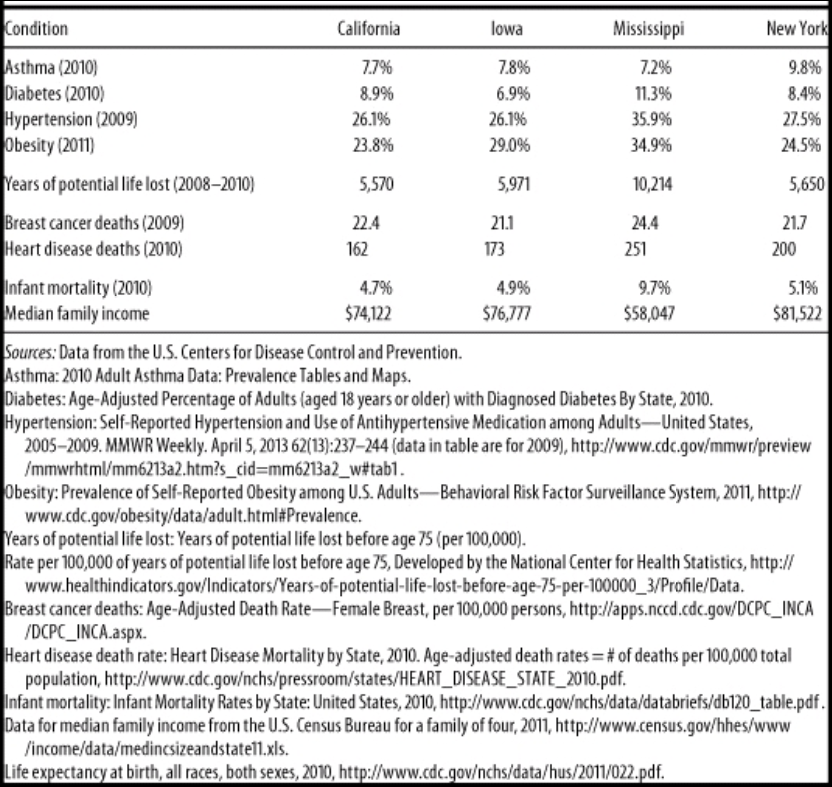
Wow, I wonder why Mississippi has such a high rate of obesity, diabetes, and hypertension (high blood pressure). Must be all of those obesity, diabetes and hypertension genes (HBDer).
Obesity and diabetes
The first thing to look at is median income. It is substantially lower in Mississippi compared to California, Iowa, and New York. About 23 million people in America live one mile from a supermarket, while black Americans are about half as likely to have access to supermarkets while “Hispanics” are about a third likely to have access to them (New York Law School Racial Justice Project, 2012). So when it comes to those who have to travel more than a mile for fresh fruit and vegetables, they have poorer health (Stack, 2015). So combine lower median income, along with food deserts and one can start to see how minorities have poorer health due in part to their SES. In short, living in a food desert can affect public health.
Blacks are the most obese ethnic group in America, and this relationship is largely driven by black women. Now, it’s not weird that women have higher levels of body fat than men, since women it is needed for physiological functioning. Though, there is something weird here: Black American men with more African ancestry are less likely to be obese (Klimentidis et al, 2016). Since black women and black men in America are in the same economic bracket, there must be something in the West African male physiology that “protects” them against central adiposity, though variation in social, environmental and cultural factors may play a role as well. In any case, the more West African ancestry American blacks have, the less likely they are to be obese. Klimentidis et al’s (2016) study “suggests that there are specific genetic variants and physiological mechanism(s) that differ among West African and European populations.”
Obesity affects more ethnies in America than others: non-Hispanic blacks and “Hispanics” are more likely to be obese than non-“Hispanic” whites and Asians (Hales et al, 2017). This could be due to, in part, to the variation in supermarket access and access to good foods—the concept of food deserts. Look at any low-income area near you. You’ll see a majority of corner stores with cheap, garbage food. The lack of ability to buy good food (along with the education to know what to buy and when to buy it) can explain differences in obesity rates—obviously not all. Obesity is related with diabetes, and sinec the relationship is so strong, the term “diabesity” was coined.
Eating cheap, processed carbohydrates spikes insulin. Repeated insulin spikes over time leads to type II diabetes and, eventually, obesity too. One can be skinny and have diabetes (a phenomenon known as thin on the outside, fat on the inside “TOFI”). However, since both diseases are co-morbid, we need to look at them in similar contexts. The higher rates of obesity can help to explain the higher rates of diabetes and hypertension—since those who are obese have higher blood pressure (Aronow, 2017).
Minorities are more likely to develop type II diabetes (Tuchman, 2011), and the cause of this is access to high-quality foods. But racial differences in obeisty and SES do not fully explain the higher rates of type II diabetes in black Americans; being a black American is a strong, independent factor for developing type II diabetes and this is compounded by low SES (Brancati et al, 1996). Zizi et al (2016) showed that both long and short black sleepers have an increased risk of developing type II diabetes. There are racial differences in sleep, with blacks having higher durations of long and short sleep compared to whites (Adenekan et al, 2013).
Hypertension
Now let’s look at hypertension (blood pressure). Blood pressure is a physiological variable. Since it is a physiological variable, it can and does respond to social/environmental contexts. So blood pressure can be affected by social contexts, too. For example, Williams (1992) cites stress, socioecologic stress, social support, coping patterns, health behavior, sodium and more for reasons why blacks have higher BP than whites. Dressler (1991) shows that the struggle to maintain a middle-class lifestyle is related to higher levels of BP. Similarly, Keith and Herring (1991) show that skin color is a strong predictor of occupational status and that darker-skinned blacks in America are twice as likely to experience racial discrimination than lighter-skinned blacks. This, too, can help to account for higher levels of BP between the races. In any case, Williams (1992) shows, definitively, that the causes of black-white differences in BP lie in the social environment.
Similarly, Non, Gravlee, and Mulligan (2012) show that racial disparities in BP are explained by education, and not genetic ancestry. They show that the association between BP and education was much stronger for blacks than for whites. Their results also support “the minority poverty hypothesis because the worst blood pressures were predicted for people who faced the double burden of being less educated and identifying as African American.” People who face discrimination could, and do, have higher levels of BP due to the stress they feel due to the discrimination. (Note that I take no sides on whether the discrimination is real or imagined, because even if it were imagined, it still leads to real physiologic consequences.)
Do note that there is a just-so story to explain how and why blacks have higher levels of blood pressure than whites: The Slavery Hypertension Hypothesis (Lujan and Dicarlo, 2018). This has all of the hallmarks of a just-so story posited by evolutionary psychologists. The story goes like this: Black slaves who were on the way to America in the Middle Passage had genes that favored better salt retention. So it is noted that black Americans have higher rates of BP than whites, and then they work backward and attempt to posit the best story possible to explain the current-day observation. This is the usual method evolutionary psychologists use—the method of reverse engineering, the inference from function to cause. So (1) note that blacks have higher levels of BP than whites; (2) infer the function to cause (blacks with genes that favored salt retention were more likely to survive; so (3) this is why blacks have higher rates of BP than whites. Though the explanation fails, since education, and not genetic ancestry, explains the difference in BP between blacks and whites (Non, Gravlee, and Mulligan, 2012). One only needs to understand the intricacies of physiology and how our physiological systems respond to what occurs in the greater environment.
So, obesity can explain both the higher rates of diabetes and higher rates of blood pressure, with differences in the immediate social environment explaining the rest of the differences in blood pressure between blacks and whites. (Note that heart disease deaths are directly related to hypertension. Heart disease affects blacks more than whites.)
Breast cancer
In Race, Medicine, and Epigenetics: How the Social Becomes Biological, I shortly discussed breast cancer in black women:
Black women are more likely to die from breast cancer, for example, and racism seems like it can explain a lot of it. They have less access to screening, treatment, care, they receive delays in diagnoses, along with lower-quality treatment than white women. But “implicit racial bias and institutional racism probably play an important role in the explanation of this difficult treatment” (Hardimon, 2017: 166). Furthermore, black women are more than twice as likely to acquire a type of breast cancer called “triple negative” breast cancer (Stark et al, 2010; Howlader et al, 2014; Kohler et al, 2015; DeSantis et al, 2019). Of course, this could be a relevant race-related genetic difference in disease.
Infant mortality
Now note the infant mortality rate between the states: the infant mortality rate in Mississippi is 9.7%. Smith et al (2018) show that black women are at a higher rate of having their infant die at birth. Pre-term births are related to low birth weights, and they both are related to infant mortality. Matoba and Collins (2017) write:
In the United States, African-American infants have significantly worse infant mortality than white infants. Individual risk factors alone do not explain this persistent gap, just as they did not explain the disparity in preterm birth and low birth weight. Recent studies in social determinants provide insight into the contribution of community and environmental factors to the racial disparity. Select community-level factors are potential, but partial, determinants of the racial disparity. Interpersonal and institutionalized racism is an important, and increasingly recognized, stressor for African-American women with damaging consequences to maternal and child health.
The Guardian ran a recent story on infant mortality and race, positing racism as a cause of the disparity. In any case, the social environment can and does play a part in everything discussed here today since the social can and does become biological. Part of the reason why Mississippi has a way higher rate of years of potential life lost (10,214 compared to 5500-5900 for Iowa, New York, and California) is that rates of infant mortality are higher in Mississippi. So the median age of death is 75. If an infant dies at one year of age, then that is 74 years of life lost. Therefore it is not surprising that the State with the highest level of infant mortalities has a higher number of years of potential life lost. Further, one 2017 review found that segregation was associated with increased risk of preterm birth and low birth weight for blacks (Mehra, Boyd, and Ickovis, 2017)
Note how Mississippi has lower rates of asthma. This is explained by the fact that Mississippi is more rural than, say New York. Rates of asthma are associated with living in a metropolitan area (Frazier et al, 2012; Malik, Kumar, and Frieri, 2012). (Note that blacks and other races have higher rates of asthma than other races.)
Physician bias
The lower one’s position is on the social hierarchy the lower their probability of staying healthy and having a high life expectancy; when people have the same type of health insurance and are treated for the same disease in the same hospital by the same doctor, that minority groups get worse health care, either not receiving it or receiving lower standards of quality in care. What could account for such disparities? I asked PumpkinPerson the question, and he said:
1) EGI: Doctors put more effort into saving coethnics: she looks like my italian grandma. I’ll make sure she gets the best medicine.
2) IQ: low IQ populations don’t understand the doctor’s advice and damage their health
3) r/K: some populations have faster life history so don’t live as long, even with good medical care
If (1), then the doctors need to be named, shamed, and have their medical licenses revoked. If (2), then they need better education (since IQ is just an index of middle-class knowledge). (3) is completely irrelevant, since it doesn’t make sense for humans and the concept is long-dead in ecology. In any case, PumpkinPerson danced around the true cause: differences in healthcare brought about by unconscious bias (of which (1) may be a cause). But positing (1) as a cause completely misses the point (and is the usual HBDer reductionism to genes causing most/if not all things). It’s the usual HBD/Rushtonian reductionism to genes. That’s all the HBD worldview reduces to: genes/IQ.
In any case, Reschovsky and O’Malley (2008: 229, 230)
Our results indicate that the minority makeup of physicians’ patient panels is associated with greater reports from physicians of difficulties providing high-quality care. At least some of this relationship appears to be explained by the lower resources flowing to high-minority practices.
The results of this study suggest that racial and ethnic disparities in primary health care are in part systemic in nature, and the lower resources flowing to physicians treating more minority patients are a contributing factor.
Thus, bias—whether conscious or unconscious—by physicians can explain how and why there are differences in health outcomes between people that have the same health insurance and doctor. Barr (2014: 168) states that “for black Americans, where a person lives sems to be associated with access to primary care, the quality of available hospital care, and the quality of available home care.” Barr shows that blacks receive a different level of care for a wide-range of diseases and illnesses compared to whites. For instance, Smedley et al (2003) write that “some evidence suggests that bias, prejudice, and stereotyping on the part of healthcare providers may contribute to differences in care.” Quite clearly, there is racial bias against minorities and it does seem to affect healthcare, whether or not it is intended or unintended (conscious or unconscious) (Williams and Rucker, 2000). Bird and Clinton (2001: 255) write:
Race and class-based structuring of the U.S. health delivery system has combined with other factors, including physicians’ attitudes—perhaps legacies conditioned by their participation in slavery and creation of the scientific myth of black biological and intellectual inferiority—to create a medical-social, health system cultural, and health delivery environment which contributes to the propagation of racial health disparities, and, ultimately, the health system’s race and class dilemma.
Blacks are more likely to take the advice of physicians, and to use the needed services, such as preventative care and are less likely to delay seeking care when the physician is of their own race (Saha et al, 2000; LaVeist, Nuru-Jeter, and Jones, 2008).
Blacks are more likely to perceive racism in healthcare and when they are able to choose their own doctors, they are more satisfied with their level of care (Chen et al, 2005). Chapman, Kaatz, and Carnes (2013) show that increasing awareness of implicit bias in healthcare can lower such disparities, stating that having more black doctors will alleviate such problems since they are less likely to be biased. Having a black doctor lead to more effective care for black men. Quite clearly, the race of the doctor matters for implicit biases and minority doctors lead to more effective healthcare for minorities, since they are less likely to be affected by racial biases. Minorities trust the healthcare system less than whites (Boulware et al, 2003). Black and white physicians even agree that race is a medically relevant data point, but do not agree on why (Bonham et al, 2009).
Conclusion
The table presented by Barr is telling. He purported to show that on certain indices of health, certain states fair worse than others. Rates of illness and rates of death between different states (with differing ethnic compositions) were compared. Using national data, he showed that Mississippi has the highest rates of death and illness (sans asthma). Social factors can and do account for the differences in hypertension between blacks and whites (and States); food deserts (lack of access to good food) can explain higher rates of obesity and diabetes and also higher rates of blood pressure between the races (and States with a higher percentage of certain racial/ethnic groups). Of course, physiological variables are affected by the social environment, so we have to look at differences in the social environment between groups to see how and why there are differences in any physiological variable we look at.
Doctors, whether consciously or not, treat minority patients differently and there is evidence that this leads to differences in health outcomes between ethnic groups in America. PP’s hypotheses don’t cut it (the only one that does it his “EGIs”, but that explanation fails; the cause is bias by the doctors but “EGIs” have nothing to do with the bias). In any case, there are social and cultural reasons why there are such health disparities between States and races/ethnies. Understanding the causes behind them can and will lead to closing the gap between them. The social can and does become biological, and this is the perfect way to show this. There are ways to lower the disparities in a medical context, and education seems to be one of them—for both patient and doctor.
Some states are healthier than others based on objective measures of health and mortality, and understanding the reasons why can and will decrease these differences.
IQ, socioeconomic status, success in life and criminality
1700 words
Lower IQ people can’t work in the same jobs, or do the jobs they can get better than lower IQ people. This is a huge part of the reason why blacks talk about ‘oppression’ because they are too dumb to see that they are the reason for their downfall so they blame it on imaginary forces such as ‘white privilege’ or ‘white supremacy’. They don’t even know that 1) whites are the majority in this country and, therefore, have a majority of the jobs and 2) lower IQ people don’t succeed as much or do as better than higher IQ people.
To begin, IQ, along with height are 2 of the most heritable things for humans. IQ is malleable in children, seeing as the heritability of IQ is 22 percent at age 5, 40 percent at age 7, and 82 percent at age 18. So IQ is malleable in children when they are younger so you can change their IQ through the environment, but as they age to adulthood, to quote Jensen, their genes ‘turn on’ and fall to the average for that racial grouping. So in effect, the environment does nothing for IQ in adulthood as it did in childhood. Some people say that IQ is 100 percent environmental, and that is a really stupid position to hold as, through sub-tests and seeing the g loading in them, we can see that the most g loaded tests are highly heritable. People who say that IQ is 100 percent environmental are intellectually dishonest and are true ideologues.
Let’s talk about IQ in relation to job potential. Job performance can be measured in a lot of different ways. Sometimes through how many units per day per hour someone produces, or structured ratings by supervisors or peers or sometimes by analyses of a work sample. With that being said, the correlation between IQ and job performance is .4, with the correlation being higher on for more complex jobs. (pg 72) It is known that the higher someone’s IQ is, the better they perform at jobs and are better than people who have a lower IQ at that same job. They may be able to memorize more things, be more productive in the workplace or just have better motivation due to being more intelligent and knowing that his skills are being applied correctly in the workplace.
With the above being said, can you think of how that relates to blacks and how they cry oppression that whites hold them down because of ‘white supremacy’? It’s completely nonsensical and sounds completely baseless to anyone with a brain. Now that we know that IQ is highly heritable and is modestly correlated with job success, let’s see what it looks like in regards to getting a job and job applications.
According to The Bell Curve by Charles Murray and Richard Herrnstein, IQ tests are a better predictor of job success than compared to a job interview. They state that, while it may be surprising to many, IQ tests are a better predictor of job performance than any other single measure. This conclusion is drawn from a meta-analysis on the different predictors of job performance which are: (pg 80 and 81):
Predictor Validity Predicting Job Performance
| Cognitive test score | .53 |
| Biographical data | .37 |
| Reference checks | .26 |
| Education | .22 |
| Interview | .14 |
| College Grades | .11 |
| Interest | .10 |
| Age | -.01 |
Source: Hunter and Hunter 1984
As you can see, the job interviews correlation is extremely low. That means that the relationship between the two are not highly correlated, meaning the relationship between them don’t have a good relationship. The cognitive test score (IQ test) is correlated at .53 with job performance. In social sciences, that is a pretty high correlation. A .6 correlation in social sciences is said to be a very high correlation. Think about how blacks act and then think about how they may act at a job interview. With that correlation, .14, being so low, it’s safe to say that they will not get a job based on that job interview. Even education has an extremely low correlation. Yes, your IQ is a great predictor of college success, but according to the table, which was found in a study of 23,000 civilian employees at 3 levels of mental ability (high, medium and low) using supervisor ratings as the measure of performance which also extended out to job tenures of 20 years or more, we see that the correlations that we believe are a good predictor of job success don’t have as high of correlations as we thought they did. We see that cognitive test scores are the best predictor of job success from that table, so with that being said, is it really ‘white supremacy’ or ‘white privilege’ being used to hold down blacks?
Now let’s get on to success in life. I pretty much covered that above, but let’s get more in-depth. According to Linda Gottfredson, the correlation for scores that are averaged has a correlation with job performance at .90. (pg 106) IQ is correlated with increased income, increased wealth, economic growth, livability in a US state, cooperation and life expectancy. IQ correlates negatively with socially undesirable outcomes such as crime, welfare dependence, and illegitimacy. Why people deny IQ having anything to do in life is crazy. All you need to do is look at your local down and out people and see how they act and how that comes to their ability to find and keep a job. You don’t even need to see these correlations and information to see this in real life, all you have to do is observe your surroundings and draw your own conclusions and if you are intellectual, you will see these things and draw the correct conclusions on the matter that don’t involve ‘white supremacy’ or ‘white privilege’.
Now let’s get to crime and how it is correlated with IQ. According to Arthur Jensen in The g FACTOR The Science of Mental Ability, IQ has a well-established correlation between a number of social variables such as poverty, crime, illegitimacy and chronic welfare status. He also states that verbal test scores are somewhat highly correlated with delinquent and criminal behavior than are nonverbal (spatial) suggests that other cognitive factors, in addition to g are most likely responsible for the correlation of IQ with the most common forms of antisocial behavior. (pg 294) Lower IQ is also known to be correlated with a lack of abstract thought and thinking into the future. Thinking of blacks, with an average IQ of 85 (Rushton and Jensen say that some data says 78) we can see how criminality is correlated with low IQ and how blacks have, on average the lowest IQ and commit the most crimes per capita in America. People may point to that data and say “Whites commit the most crime in America”, and while true, they don’t think of per capita rates as well as the population percentage in the country, which is 63 percent white and 13 percent black. That is what really matters.
The average IQ for a criminal is 84 in America right by the average IQ for blacks in America which is 85. That can not be a coincidence. We see how much crime they commit and how it has an effect on American life in regards to how the media portrays them as Saints in a crusade against ‘white supremacy’ and ‘white privilege’. We see that the problem in the black community isn’t whites “holding them down”, it’s due to their own biology, which they don’t have the average IQ to grasp that it’s them and not the people they blame for their downfalls.
A correlation is a mutual relationship between 2 things. So if the correlation was 1.00, then that would mean there is a relationship between the 2 things being tested. With that number, .92 being so close to the perfect correlation of 1.00, it’s safe to say, that the darker someone’s skin is, the less intelligent they are. You may point me to some outliers, but that is perfectly explained by the relationship not having a perfect correlation. If the correlation were perfect, then that would mean every dark-skinned person’s IQ would be low, but that’s not the case so you get some people who don’t fall into that category.
Rho is a population coefficient or the population Pearson correlation coefficient. It’s a measure of a linear correlation (dependence) between two variables, X and Y, giving a value of +1 and -1 inclusive where 1 is a total positive correlation, 0 is no correlation, and −1 is a total negative correlation. It is widely used in the sciences as a measure of the degree of linear dependence between two variables.
So we can see that the darker someone’s skin is, the more likely all of the above variables are to be seen in those with darker skin pigmentation. We can see that skin color DOES matter and anyone who says otherwise has no idea what they are talking about.
So the people harping on about how skin color doesn’t matter, it does and as you can see through this whole post, with IQ being THE best predictor of success in life, we can see how skin color matters as well.
In conclusion, what white SJWs and blacks say in regards to blacks being held down by the rich white men in America is clearly hogwash as I have shown to you in this thread. The black community will not succeed until segregation is put back into place. During segregation, they actually “succeeded” in their own lives because there was a clear separation of whites and blacks. Today, the single mother rate in the black community is 72 percent. 50 years ago it was 24 percent and in the 20s, it was 5 percent. The downfall of the black community is not white people.
 NotPoliticallyCorrect