Home » Race Realism (Page 8)
Category Archives: Race Realism
The “World’s Smartest Man” Christopher Langan on Koko the Gorilla’s IQ
1500 words
Christopher Langan is purported to have the highest IQ in the world, at 195—though comparisons to Wittgenstein (“estimated IQ” of 190), da Vinci, and Descartes on their “IQs” are unfounded. He and others are responsible for starting the high IQ society the Mega foundation for people with IQs of 164 or above. For a man with one of the highest IQs in the world, he lived on a poverty wage at less than $10,000 per year in 2001. He has also been a bouncer for the past twenty years.
Koko is one of the world’s most famous gorillas, most-known for crying when she was told her cat got hit by a car and being friends with Robin Williams, also apparently expressing sadness upon learning of his death. Koko’s IQ, as measured by an infant IQ test, was said to be on-par or higher than some of the (shoddy) national IQ scores from Richard Lynn (Richardson, 2004; Morse, 2008). This then prompted white nationalist/alt-right groups to compare Koko’s IQ scores with that of certain nationalities and proclaim that Koko was more ‘intelligent’ than those nationalities on the basis of her IQ score. But, unfortunately for them, the claims do not hold up.
The “World’s Smartest Man” Christopher Langan is one who falls prey to this kind of thinking. He was “banned from” Facebook for writing a post comparing Koko’s IQ scores to that of Somalians, asking why we don’t admit gorillas into our civilization if we are letting Somalian refugees into the West:
“According to the “30 point rule” of psychometrics (as proposed by pioneering psychometrician Leta S. Holingsworth), Koko’s elevated level of thought would have been all but incomprehensible to nearly half the population of Somalia (average IQ 68). Yet the nation’s of Europe and North America are being flooded with millions of unvetted Somalian refugees who are not (initially) kept in cages despite what appears to be the world’s highest rate of violent crime.
Obviously, this raises the question: Why is Western Civilization not admitting gorillas? They too are from Africa, and probably have a group mean IQ at least equal to that of Somalia. In addition, they have peaceful and environmentally friendly cultures, commit far less violent crime than Somalians…”
I presume that Langan is working off the assumption that Koko’s IQ is 95. I also presume that he has seen memes such as this one floating around:
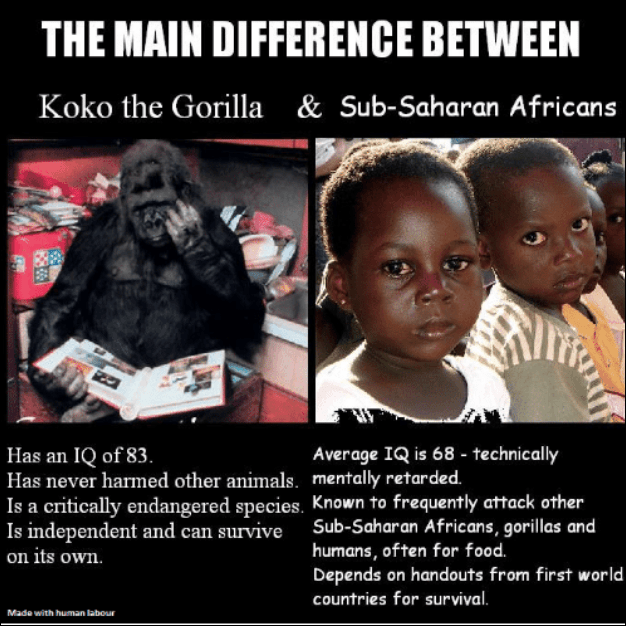
There are a few problems with Langan’s claims, however. (1) The notion of a “30-point IQ point communication” rule—that one’s own IQ, plus or minus 30 points, denotes where two people can understand each other; and (2) bringing up Koko’s IQ and the comparing it to “Somalians.”
It seems intuitive to the IQ-ist that a large, 2 SD gap in IQ between people will mean that more often than not there will be little understanding between them if they talk, as well as the kinds of interests they have. Neuroskeptic looked into the origins of the claim of the communication gap in IQ, found it to be attributed to Leta Hollingworth and elucidated by Grady Towers. Towers noted that “a leadership pattern will not form—or it will break up—when a discrepancy of more than about 30 points comes to exist between leader and lead.” Neuroskeptic comments:
This seems to me a significant logical leap. Hollingworth was writing specifically about leadership, and in childen [sic], but Towers extrapolates the point to claim that any kind of ‘genuine’ communication is impossible across a 30 IQ point gap.
It is worth noting that although Hollingworth was an academic psychologist, her remark about leadership does not seem to have been stated as a scientific conclusion from research, but simply as an ‘observation’.
[…]
So as far as I can see the ‘communication range’ is just an idea someone came up with. It’s not based on data. The reference to specific numbers (“+/- 2 standard deviations, 30 points”) gives the illusion of scientific precision, but these numbers were plucked from the air.
The notion that Koko had an “elevated level of thought [that] would have been all but incomprehensible to nearly half the population of Somalia (average IQ 68)” (Langan) is therefore laughable, not only for the reason that a so-called communication gap is false, but for the simple fact that Koko’s IQ was tested using the Cattell Infant Intelligence Scales (CIIS) (Patterson and Linden,1981: 100). It seems to me that Langan has not read the book that Koko’s handlers wrote about her—The Education of Koko (Patterson and Linden, 1981)—since they describe why Koko’s score should not be compared with human infants, so it follows that her score cannot be compared with human adults.
The CIIS was developed “to a downward extension of the Stanford-Binet” (Hooper, Conner, and Umansky, 1986), and so, it must correlate highly with the Stanford-Binet in order to be “valid” (the psychometric benchmark for validity—correlating a new test with the most up-to-date test which had assumed validity; Richardson, 1991, 2000, 2017; Howe, 1997). Hooper, Conner, and Umansky (1986: 160) note in their review of the CIIS, “Given these few strengths and numerous shortcomings, salvaging the Cattell would be a major undertaking with questionable yield. . . . Nonetheless, without more research investigating this instrument, and with the advent of psychometrically superior measures of infant development, the Cattell may be relegated to the role of an historical antecedent.” Items selected for the CIIS—like all IQ tests—“followed a quasi-statistical approach with many items being accepted and rejected subjectively.” They state that many of the items on the CIIS need to be updated with “objective” item analysis—but, as Jensen notes, items emerge arbitrarily from the heads of the test’s constructors.
Patterson—the woman who raised Koko—notes that she “tried to gauge [Koko’s] performance by every available yardstick, and this meant administering infant IQ tests” (Patterson and Linden, 1981: 96). Patterson and Linden (1981: 100) note that Koko did better than human counterparts of her age in certain tasks over others, for example “her ability to complete logical progressions like the Ravens Progressive Matrices test” since she pointed to the answer with no hesitation.
Koko generally performed worse than children when a verbal rather than a pointing response was required. When tasks involved detailed drawings, such as penciling a path through a maze, or precise coordination, such as fitting puzzle pieces together. Koko’s performance was distinctly inferior to that of children.
[…]
It is hard to draw any firm conclusions about the gorilla’s intelligence as compared to that of the human child. Because infant intelligence tests have so much to do with motor control, results tend to get skewed. Gorillas and chimps seem to gain general control over their bodies earlier than humans, although ultimately children far outpace both in the fine coordination required in drawing or writing. In problems involving more abstract reasoning, Koko, when she is willing to play the game, is capable of solving relatively complex problems. If nothing else, the increase in Koko’s mental age shows that she is capable of understanding a number of the principles that are the foundation of what we call abstract thought. (Patterson and Linden, 1981: 100-101)
They conclude that “it is specious to compare her IQ directly with that of a human infant” since gorillas develop motor skills earlier than human infants. So if it is “specious” to compare Koko’s IQ with an infant, then it is “specious” to compare Koko’s IQ with the average Somalian—as Langan does.
There have been many critics of Koko, and similar apes, of course. One criticism was that Koko was coaxed into signing the word she signed by asking Koko certain questions, to Robert Sapolsky stating that Patterson corrected Koko’s signs. She, therefore, would not actually know what she was signing, she was just doing what she was told. Of course, caregivers of primates with the supposed extraordinary ability for complex (humanlike) cognition will defend their interpretations of their observations since they are emotionally invested in the interpretations. Patterson’s Ph.D. research was on Koko and her supposed capabilities for language, too.
Perhaps the strongest criticism of these kinds of interpretations of Koko comes from Terrace et al (1979). Terrace et al (1979: 899) write:
The Nova film, which also shows Ally (Nim’s full brother) and Koko, reveals a similar tendency for the teacher to sign before the ape signs. Ninety-two percent of Ally’s, and all of Koko’s, signs were signed by the teacher immediately before Ally and Koko signed.
It seems that Langan has never done any kind of reading on Koko, the tests she was administered, nor the problems in comparing them to humans (infants). The fact that Koko seemed to be influenced by her handlers to “sign” what they wanted her to sign, too, makes interpretations of her IQ scores problematic. For if Koko were influenced what to sign, then we, therefore, cannot trust her scores on the CIIS. The false claims of Langan are laughable knowing the truth about Koko’s IQ, what her handlers said about her IQ, and knowing what critics have said about Koko and her sign language. In any case, Langan did not show his “high IQ” with such idiotic statements.
China’s Project Coast?
1250 words
Project Coast was a secret biological/chemical weapons program developed by the apartheid government in South Africa started by a cardiologist named Wouter Basson. One of the many things they attempted was to develop a bio-chemical weapon that targets blacks and only blacks.
I used to listen to the Alex Jones show in the beginning of the decade and in one of his rants, he brought up Project Coast and how they attempted to develop a weapon to only target blacks. So I looked into it, and there is some truth to it.
For instance, The Washington Times writes in their article Biotoxins Fall Into Private Hands:
More sinister were the attempts — ordered by Basson — to use science against the country’s black majority population. Daan Goosen, former director of Project Coast’s biological research division, said he was ordered by Basson to develop ways to suppress population growth among blacks, perhaps by secretly applying contraceptives to drinking water. Basson also urged scientists to search for a “black bomb,” a biological weapon that would select targets based on skin color, he said.
“Basson was very interested. He said ‘If you can do this, it would be very good,'” Goosen recalled. “But nothing came of it.”
They created novel ways to disperse the toxins: using letters and cigarettes to transmit anthrax to black communities (something those old enough to be alive during 911 know of), lacing sugar cubes with salmonella, lacing beer and peppermint candy with poison.
Project Coast was, at its heart, a eugenics program (Singh, 2008). Singh (2008: 9) writes, for example that “Project Coast also speaks for the need for those involved in scientific research and practice to be sensitized to appreciate the social circumstances and particular factors that precipitate a loss of moral perspective on one’s actions.”
Jackson (2015) states that another objective of the Project was to develop anti-fertility drugs and attempt to distribute them into the black population in South Africa to decrease birth rates. They also attempted to create vaccines to make black women sterile to decrease the black population in South Africa in a few generations—along with attempting to create weapons to only target blacks.
The head of the weapons program, Wouter Basson, is even thought to have developed HIV with help from the CIA to cull the black population (Nattrass, 2012). There are many conspiracy theories that involve HIV and its creation to cull black populations, though they are pretty farfetched. In any case, though, since they were attempting to develop new kinds of bioweapons to target certain populations, it’s not out of the realm of possibility that there is a kernel of truth to the story.
So now we come to today. So Kyle Bass said that the Chinese already have access to all of our genomes, through companies like Steve Hsu’s BGI, stating that “there’s a Chinese company called BGI that does the overwhelming majority of all the sequencing of U.S. genes. … China had the genomic sequence of every single person that’s been gene types in the U.S., and they’re developing bio weapons that only affect Caucasians.”
I have no way to verify these claims (they’re probably bullshit), but with what went on in the 80s and 90s in South Africa with Project Coast, I don’t believe it’s outside of the realm of plausibility. Though Caucasians are a broad grouping.
It’d be like if someone attempted to develop a bioweapon that only targets Ashkenazi Jews. They could let’s say, attempt to make a bioweapon to target those with Tay Sach’s disease. It’s, majorly, a Jewish disease, though it’s also prevalent in other populations, like French Canadians. It’d be like if someone attempted to develop a bioweapon that only targets those with the sickle cell trait (SCT). Certain African ethnies are more like to carry the trait, but it’s also prevalent in southern Europe and Northern Africa since the trait is prevalent in areas with many mosquitoes.
With Chinese scientists like He Jiankui CRISPR-ing two Chinese twins back in 2018 to attempt to edit their genome to make them less susceptible to HIV, I can see a scientist in China attempt to do something like this. In our increasingly technological world with all of these new tools we develop, I would be surprised if there was nothing strange like this going on.
Some claim that “China will always be bad at bioethics“:
Even when ethics boards exist, conflicts of interest are rife. While the Ministry of Health’s ethics guidelines state that ethical reviews are “based upon the principles of ethics accepted by the international community,” they lack enforcement mechanisms and provide few instructions for investigators. As a result, the ethics review process is often reduced to a formality, “a rubber stamp” in Hu’s words. The lax ethical environment has led many to consider China the “Wild East” in biomedical research. Widely criticized and rejected by Western institutions, the Italian surgeon Sergio Canavero found a home for his radical quest to perform the first human head transplant in the northern Chinese city of Harbin. Canavero’s Chinese partner, Ren Xiaoping, although specifying that human trials were a long way off, justified the controversial experiment on technological grounds, “I am a scientist, not an ethical expert.” As the Chinese government props up the pseudoscience of traditional Chinese medicine as a valid “Eastern” alternative to anatomy-based “Western” medicine, the utterly unscientific approach makes the establishment of biomedical regulations and their enforcement even more difficult.
Chinese ethicists, though, did respond to the charge of a ‘Wild East’, writing:
Some commentators consider Dr. He’s wrongdoings as evidence of a “Wild East” in scientific ethics or bioethics. This conclusion is not based on facts but on stereotypes and is not the whole story. In the era of globalization, rule-breaking is not limited to the East. Several cases of rule-breaking in research involved both the East and the West.
Henning (2006) notes that “bioethical issues in China are well covered by various national guidelines and regulations, which are clearly defined and adhere to internationally recognized standards. However, the implementation of these rules remains difficult, because they provide only limited detailed instructions for investigators.” With a large country like China, of course, it will be hard to implement guidelines on a wide-scale.
Gene-edited humans were going to come sooner or later, but the way that Jiankui went about it was all wrong. Jiankjui raised funds, dodged supervision and organized researchers in order to carry out the gene-editing on the Chinese twins. “Mad scientists” are, no doubt, in many places in many countries. “… the Chinese state is not fundamentally interested in fostering a culture of respect for human dignity. Thus, observing bioethical norms run second.”
Countries attempting to develop bioweapons to target specific groups of people have already been attempted recently, so I wouldn’t doubt that someone, somewhere, is attempting something along these lines. Maybe it is happening in China, a ‘Wild East’ of low regulations and oversight. There is a bioethical divide when it comes to East and West, which I would chalk up to differences in collectivism vs individualism (which some have claimed to be ‘genetic’ in nature; Kiaris, 2012). Since the West is more individualistic, they would care about individual embryos which eventually become a person; since the East is more collectivist, whatever is better for the group (that is, whatever can eventually make the group ‘better’) will override the individual and so, tinkering with individual genomes would be seen as less of an ethical charge to them.
A Systems View of Kenyan Success in Distance Running
1550 words
The causes of sporting success are multi-factorial, with no cause being more important than the other since the whole system needs to work in concert to produce the athletic phenotype–call this “causal parity” of athletic success determinants. For a refresher, take what Shenk (2010: 107):
As the search for athletic genes continues, therefore, the overwhelming evidence suggests that researchers will instead locate genes prone to certain types of interactions: gene variant A in combination with gene variant B, provoked into expression by X amount of training + Y altitude + Z will to win + a hundred other life variables (coaching, injuries, etc.), will produce some specific result R. What this means, of course, What this means, of course, is that we need to dispense rhetorically with thick firewall between biology (nature) and training (nurture). The reality of GxE assures that each person’s genes interacts with his climate, altitude, culture, meals, language, customs and spirituality—everything—to produce unique lifestyle trajectories. Genes play a critical role, but as dynamic instruments, not a fixed blueprint. A seven- or fourteen- or twenty-eight-year-old is not that way merely because of genetic instruction. (Shenk, 2010: 107) [Also read my article Explaining African Running Success Through a Systems View.]
This is how athletic success needs to be looked at; not reducing it to genes or a group of genes that ’cause’ athletic success. Since to be successful in the sport of the athlete’s choice takes more than being born with “the right” genes.
Recently, a Kenyan woman—Joyciline Jepkosgei—won the NYC marathon in here debut (November 3rd, 2019), while Eliud Kipchoge—another Kenyan—became the first human ever to complete a marathon (26.2 miles) in under 2 hours. I recall in the spring reading that he said he would break the 2-hour mark in October. He also attempted to break it in 2017 in Italy but, of course, he failed. His official time in Italy was 2:00:25! While he set the world record in Berlin at 2:01:39. Kipchoge’s official time was 1:59:40—twenty seconds shy of 2 hours—that means his average mile pace was about 4 minutes and 34 seconds. That is insane. (But the IAAF does not accept the time as a new world record since it was not in an open competition—Kipchoge had a slew of Olympic pacesetters following him; an electric car drove just ahead of him and pointed lasers at the ground showing him where to run; so he shaved 2 minutes off his time—2 crucial minutes—according to sport scientist Ross Tucker; and . So he did not set a world record. His feat, though, is still impressive.)
Now, Kipchoge is Kenyan—but what’s his ethnicity? Surprise surprise! He is of the Nandi tribe, more specifically, of the Talai subgroup, born in Kapsisiywa in the Nandi county. Jepkosgei, too, is Nandi, from Cheptil in Nandi county. (Jepkosgei also set the record for the half marathon in 2017. Also, see her regular training regimen and what she does throughout the day. This, of course, is how she is able to be so elite—without hard training, even without “the right genetic makeup”, one will not become an elite athlete.) What a strange coincidence that these two individuals who won recent marathons—and one who set the best time ever in the 26.2 mile race—are both Kenyan, specifically Nandi?
Both of these runners are from the same county in Kenya. Nandi county is elevated about 6,716 ft above sea level. Being born and living at a high elevation means that they have different kinds of physiological adaptations due to being born at such a higher elevation. Living and training at such high elevations means that they have greater lung capacities since they are breathing in thinner air. Those born in highlands like Kipchoge and Jepkosgei have larger lungs and thorax volumes, while oxygen intake is enhanced by increases in lung compliance, pulmonary diffusion, and ventilation (Meer, Heymans, and Zijlstra, 1995).
Those exposed to such elevation develop what is known as “high-altitude hypoxia.” Humans born at high altitudes are able to cope with such a lack of oxygen, since our physiological systems are dynamic—not static—and can respond to environmental changes within seconds of them occurring. Babes born at higher elevations have increased ventilation, and a rise in the alveolar and the pressure of arterial oxygen (Meer, Heymans, and Zjilstra, 1995).
Kenyans have 5 percent longer legs and 12 percent lighter muscles than Scandinavians (Suchy and Waic, 2017). Mooses et al (2014) notes that “upper leg length, total leg length and total leg length to body height ratio were correlated with running performance.” Kong and de Heer (2008) note that:
The slim limbs of Kenyan distance runners may positively contribute to performance by having a low moment of inertia and thus requiring less muscular effort in leg swing. The short ground contact time observed may be related to good running economy since there is less time for the braking force to decelerate forward motion of the body.
An abundance of type I muscle fibers is conducive to success in distance running (Zierath and Hawley, 2004), though Kenyans and Caucasians have no difference in type I muscle fibers (Saltin et al, 1995; Larsen and Sheel, 2015). That, then, throws a wrench in the claim that a whole slew of anatomic and physiologic variables conducive to running success is the cause for Kenyan running success—specifically the type I fibers—right? Wrong. Recall that the appearance of the athletic phenotype is due to nature and nurture—genes and environment—working together in concert. Kenyans are more likely to have slim, long limbs with lower body fat while they lived and trained over 6000 ft high. Their will to win to better themselves and their families’ socioeconomic status, too, plays a part. As I have argued in-depth for years—we cannot understand athletic success and elite athleticism without understanding individual histories, how they grew up, and what they did as a child.
For example, Wilbur and Pitsiladis (2012) espouse a systems view of Kenyan marathon success, writing:
In general, it appears that Kenyan and Ethiopian distance-running success is not based on a unique genetic or physiological characteristic. Rather, it appears to be the result of favorable somatotypical characteristics lending to exceptional biomechanical and metabolic economy/efficiency; chronic exposure to altitude in combination with moderate-volume, high-intensity training (live high + train high), and a strong psychological motivation to succeed athletically for the purpose of economic and social advancement.
Becoming a successful runner in Kenya can lead to economic opportunities not afforded to those who do not do well in running. This, too, is a factor in Kenyan running success. So, for the ignorant people who would—pushing a false dichotomy of genes and environment—state that Kenyan running success is due to “socioeconomic status”—they are right, to a point (even if they are mocking it and making their genetic determinism seem more palatable). See figure 6 for their hypothetical model:
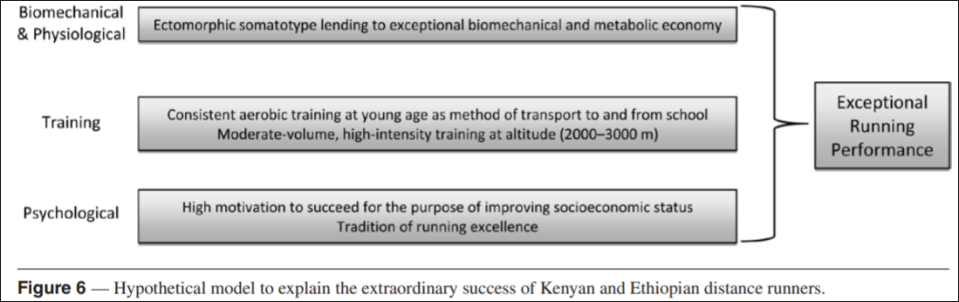
This is one of the best models I have come across explaining the success of these people. One can see that it is not reductonist; note that there is no appeal to genes (just variables that genes are implicated IN! Which is not the same as reductionism). It’s not as if one can have an endomorphic somatotype with Kenyan training and their psychological reasons for becoming runners. The ecto-dominant somatotype is a necessary factor for success; but all four of these—biomechanical & physiological, training, and psychological—factors explain the success of the running Kenyans and, in turn, the success of Kipchoge and Jepkosgei. African dominance in distance running is, also, dominated by the Nandi subtribe (Tucker, Onywera, and Santos-Concejero, 2015). Knechtle et al (2016) also note that male and female Kenyan and Ethiopian runners are the youngest and fast at the half and full marathons.
The actual environment—climate—on the day of the race, too plays a factor. El Helou et al (2012) note that “Air temperature is the most important factor influencing marathon running performance for runners of all levels.” Nikolaidis et al (2019) note that “race times in the Boston Marathon are influenced by temperature, pressure, precipitations, WBGT, wind coming from the West and wind speed.”
The success of Kenyans—and other groups—shows how the dictum “Athleticism is irreducible to biology” (St. Louis, 2004) is true. How does it make any sense to attempt to reduce athletic success down to one variable and say that that explains the overrepresentation of, say, Kenyans in distance running? A whole slew of factors needs to occur to an individual, along with actually wanting to do something, in order for them to succeed at distance running.
So, what makes Kenyans like Kipchoge and Jepkosgei so good at distance running? It’s due to an interaction with genes and environment, since we take a systems and not a reductionist view of sport success. Even though Kipchoge’s time does not count as an official world record, what he did was still impressive (though not as impressive if he would have done so without all of the help he had). Looking at the system, and not trying to reduce the system to its parts, is how we will explain why some groups are better than others. Genes, of course, play a role in the ontogeny of the athletic phenotype, but they are not the be-all-end-all that genetic reductionists seem to make it out to be. The systems view for Kenyan running success shown here is how and why Kenyans—Kipchoge and Jepkosgei—dominate distance running.
Genetic and Epigenetic Determinism
1550 words
Genetic determinism is the belief that behavior/mental abilities are ‘controlled by’ genes. Gerick et al (2017) note that “Genetic determinism can be described as the attribution of the formation of traits to genes, where genes are ascribed more causal power than what scientific consensus suggests“, which is similar to Oyama (1985) who writes “Just as traditional though placed biological forms in the mind of God, so modern thought finds ways of endowing genes with ultimate formative power.” Moore (2014: 15) notes that genetic determinism is “the idea that genes can determine the nature of our characteristics” or “the old idea that biology controls the development of characteristics like intelligence, height, and personality” (pg 39). (See my article DNA is not a Blueprint for more information.)
On the other hand, epigenetic determinism is “the belief that epigenetic mechanisms determine the expression of human traits and behaviors” (Wagoner and Uller, 2016). Both views are, of course, espoused in the scientific literature as well as usual social discourse. Both views, as well, are false. Moore (2014: 245) notes that epigenetic determinism is “the idea that an organism’s epigenetic state invariably leads to a particular phenotype.”
Genetic Determinism
The concept of genetic determinism was first proposed by Weismann in 1893 with a theory of germplasm. This, in contemporary times, is contrasted with “blank slatism” (Pinker, 2002), or the Standard Social Science Model (SSSM; Tooby and Cosmides, 1992; see Richardson, 2008 for a response). Genes, genetic determinists hold, determine the ontogeny of traits, being a sort of “director.” But this betrays modern thinking on genes, what they are, and what they “do.” Genes do nothing on their own without input from the physiological system—that is, from the environment (Noble, 2011). Thus, gene-environment interaction is the rule.
This lead to either-or thinking in regard to the origin of traits and their development—what we now call “the nature-nurture debate.” Nature (genes/biology) or nurture (experience, how one is raised), gene determinists hold, are the cause of certain traits, like, for example, IQ.
Plomin (2018) asserts that nature has won the battle over nurture—while also stating that they interact. So, which one is it? It’s obvious that they interact—if there were no genes there would still be an environment but if there were no environment there would be no genes. (See here and here for critiques of his book Blueprint.)
This belief that genes determine traits goes back to Galton—one of the first hereditarians. Indeed, Galton was the one to coin the phrase “nature vs nurture”, while being a proponent of ‘nature over nurture.’ Do genes or environment influence/cause human behavior? The obvious answer to the question is both do—and they are intertwined: they interact.
Griffiths (2002) notes that:
Genetic determinism is the idea that many significant human characteristics are rendered inevitable by the presence of certain genes; that it is futile to attempt to modify criminal behavior or obesity or alcoholism by any means other than genetic manipulation.
Griffiths then argues that genes are very unlikely to be deterministic causes of behavior. Genes are thought to have a kind of “information” in them which then determines how the organism will develop. This is what the “blueprint metaphor” for genes attempts to show. Genes contain this information for trait development. The implicit assumption here is that genes are context-independent—that the (environmental) context the organism is in does not matter. But genes are context-dependent—“the very concept of a gene requires the environment” (Schneider, 2007). This speaks to the context-dependency of genes. There is no “information”—genes are not like blueprints or recipes. So genetic determinism is false.
But even though genetic determinism is false, it still stays in the minds of our society/culture and scientists (Moore, 2008), while still being taught in schools (Jamieson and Radick, 2017).
The claim that genes determine phenotypes can be shown in the following figure from Kampourakis (2017: 187):
Figure 9.6 (a) The common representation of gene function: a single gene determines a single phenotype. It should be clear by what has been present in the book so far that is not accurate. (b) A more accurate representation of gene function that takes development and environment into account. In this case, a phenotype is produced in a particular environment by developmental processes in which genes are implicated. In a different environment the same genes might contribute to the development of a different phenotype. Note the “black box” of development.
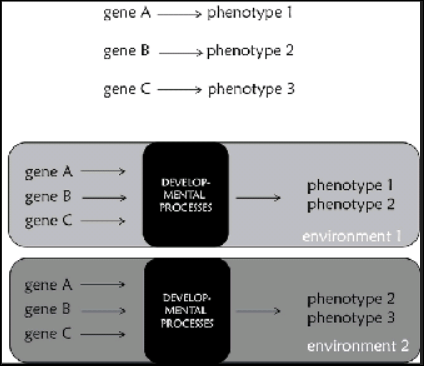
Richardson (2017: 133) notes that “There is no direct command line between environments and genes or between genes and phenotypes.” The fact of the matter is, genes do not determine an organism’s characters, they are merely implicated in the development of the character—being passive, not active templates (Noble, 2011).
Moore (2014: 199) tells us how genetic determinism fails since genes do not work in a vaccuum:
There is just one problem with the neo-Darwinian assumption that “hard” inheritance is the only good explanation for the transgenerational transmission of phenotypes: It is hopelessly simplistic. Genetic determinism is a faulty idea, because genes do not operate in a vacuum; phenotypes develop when genes interact with nongenetic factors in their local environments, factors that are affected by the broader environment.
Epigenetic Determinism
On the other hand, epigenetic determinism, the belief that epigenetic mechanisms determine the behavior of the organism, is false but in the other direction. Epigenetic determinists decry genetic determinism, but I don’t think they realize that they are just as deterministic as they are.
Dupras et al (2018) note how “overly deterministic readings of epigenetic marks could promote discriminatory attitudes, discourses and practices based on the predictive nature of epigenetic information.” While epigenetics—specifically behavioral epigenetics—refutes notions of genetic determinism, we can then fall into a similar trap, but determinism all the same. This means, though, that since genes don’t determine, epigenetics does not either, so we cannot epigenetically manipulate pre- or perinatally since what we would attempt to manipulate—‘intelligence’, contentment, happiness—all develop over the lifespan. Moore (2014: 248) continues:
Even in situations where we know that certain perinatal experiences can have very long-term effects, determinism is still an inappropriate framework for thinking about human development. For example, no one doubts that drinking alcohol during pregnancy is bad for the fetus, but in the hundreds of years before scientists established this relationship, innumerable fetuses exposed to some alcohol nonetheless grew up to be healthy, normal adults. This does not mean that pregnant women should drink alcohol freely, of course, but it does mean that developmental outcomes are not as easy to predict as we sometimes think. Therefore, it is probably always a bad idea to apply a deterministic worldview to a human being. Like DNA segments, epigenetic marks should not be considered destiny. How a given child will develop after trauma, for example, depends on a lot more than simply the experience of the trauma itself.
In an interview with The Psych Report Moore tells us that people not know enough about epigenetics for there to be epigenetic determinists (though many journalists and some scientists talk like they are :
I don’t think people know enough about epigenetics yet to be epigenetic determinists, but I foresee that as a problem. As soon as people start hearing about these kinds of data that suggest that your early experiences can have long-term effects, there’s a natural assumption we all make that those experiences are determinative. That is, we tend to assume that if you have this experience in poverty, you are going to be permanently scarred by it.
The data seem to suggest that it may work that way, but it also seems to be the case that the experiences we have later in life also have epigenetic effects. And there’s every reason to think that those later experiences can ameliorate some of the effects that happened early on. So, I don’t think we need to be overly concerned that the things that happen to us early in life necessarily fate us to certain kinds of outcomes.
While epigenetics refutes genetic determinism, we can run into the problem of epigenetic determinism, which Moore predicts. But journalists note how genes can be turned on or off by the environment, thereby dictating disease states, for example. Though, biological determinism—of any kind, epigenetic or genetic—is nonsensical as “the development of phenotypes depends on the contexts in which epigenetic marks (and other developmentally relevant factors, of course, are embedded” (Moore, 2014: 246).
What really happens?
What really happens regarding development if genetic and epigenetic determinism are false? It’s simple: causal parity (Oyama, 1985; Noble, 2012): the thesis that genes/DNA play an important role in development, but so do other variables, so there is no reason to privilege genes/DNA above other developmental variables. Genes are not special developmental resources and so, nor are they more important than other developmental resources. So the thesis is that genes and other developmental resources are developmentally ‘on par’. ALL traits develop through an interaction between genes and environment—nature and nurture. Contra ignorant pontifications (e.g., Plomin), neither has “won out”—they need each other to produce phenotypes.
So, genetic and epigenetic determinism are incoherent concepts: nature and nurture interact to produce the phenotypes we see around us today. Developmental systems theory, which integrates all factors of development, including epigenetics, is the superior framework to work with, but we should not, of course, be deterministic about organismal development.
A not uncommon reaction to DST is, ‘‘That’s completely crazy, and besides, I already knew it.” — Oyama, 2000, 195, Evolution’s Eye
Hereditarian “Reasoning” on Race
1100 words
The existence of race is important for the hereditarian paradigm. Since it is so important, there must be some theories of race that hereditarians use to ground their theories of race and IQ, right? Well, looking at the main hereditarians’ writings, they just assume the existence of race, and, along with the assumption, the existence of three races—Caucasoid, Negroid, and Mongoloid, to use Rushton’s (1997) terminology.
But just assuming race exists without a definition of what race is is troubling for the hereditarian position. Why just assume that race exists?
Fish (2002: 6) in Race and Intelligence: Separating Science from Myth critiques the usual hereditarians on what race is and their assumptions that it exists. He cites Jensen (1998: 425) who writes:
A race is one of a number of statistically distinguishable groups in which individual membership is not mutually exclusive by any single criterion, and individuals in a given group differ only statistically from one another and from the group’s central tendency on each of the many imperfectly correlated genetic characteristics that distinguish between groups as such.
Fish (2002: 6) continues:
This is an example of the kind of ethnocentric operational definition described earlier. A fair translation is, “As an American, I know that blacks and whites are races, so even though I can’t find any way of making sense of the biological facts, I’ll assign people to my cultural categories, do my statistical tests, and explain the differences in biological terms.” In essence, the process involves a kind of reasoning by converse. Instead of arguing, “If races exist there are genetic differences between them,” the argument is “Genetic differences between groups exist, therefore the groups are races.”
Fish goes on to write that if we take a group of bowlers and a group of golfers then, by chance, there may be genetic differences between them but we wouldn’t call them “golfer races” or “bowler races.” If there were differences in IQ, income and other variables, he continues, we wouldn’t argue that the differences are due to biology, we would attempt argue that the differences are social. (Though I can see behavioral geneticists try to argue that the differences are due to differences in genes between the groups.)
So the reasoning that Jensen uses is clearly fallacious. Though, it is better than Levin’s (1997) and Rushton’s (1997) assumptions that race exists, it still fails since Jensen (1998) is attempting argue that genetic differences between groups make them races. Lynn (2006: 11) uses a similar argument to the one Jensen provides above. (Nevermind Lynn conflating social and biological races in chapter 2 of Race Differences in Intelligence.)
Arguments exist for the existence of race that doesn’t, obviously, assume their existence. The two best ones I’m aware of are by Hardimon (2017) and Spencer (2014, 2019).
Hardimon has four concepts: the racialist race concept (what I take to be the hereditarian position), the minimalist/populationist race concept (they are two separate concepts, but the populationist race concept is the “scientization” of the minimalist race concept) and the socialrace concept. Specifically, Hardimon (2017: 99) defines ‘race’ as:
… a subdivision of Homo sapiens—a group of populations that exhibits a distinctive pattern of genetically transmitted phenotypic characters that corresponds to the group’s geographic ancestry and belongs to a biological line of descent initiated by a geographically separated and reproductively isolated founding population.
Spencer (2014, 2019), on the other hand, grounds his racial ontology in the Census and the OMB—what Spencer calls “the OMB race theory”—or “Blumenbachian partitions.” Take Spencer’s most recent (2019) formulation of his concept:
In this chapter, I have defended a nuanced biological racial realism as an account of how ‘race’ is used in one US race talk. I will call the theory OMB race theory, and the theory makes the following three claims:
(3.7) The set of races in OMB race talk is one meaning of ‘race’ in US race talk.
(3.8) The set of races in OMB race talk is the set of human continental populations.
(3.9) The set of human continental populations is biologically real.
I argued for (3.7) in sections 3.2 and 3.3. Here, I argued that OMB race talk is not only an ordinary race talk in the current United States, but a race talk where the meaning of ‘race’ in the race talk is just the set of races used in the race talk. I argued for (3.8) (a.k.a. ‘the identity thesis’) in sections 3.3 and 3.4. Here, I argued that the thing being referred to in OMB race talk (a.k.a. the meaning of ‘race’ in OMB race talk) is a set of biological populations in humans (Africans, East Asians, Eurasians, Native Americans, and Oceanians), which I’ve dubbed the human continental populations. Finally, I argued for (3.9) in section 3.4. Here, I argued that the set of human continental populations is biologically real because it currently occupies the K = 5 level of human population structure according to contemporary population genetics.
Whether or not one accepts Hardimon’s and Spencer’s arguments for the existence of race is not the point here, however. The point here is that these two philosophers have grounded their belief in the existence of race in a sound philosophical grounding—we cannot, though, say the same things for the hereditarians.
It should also be noted that both Spencer and Hardimon discount hereditarian theory—indeed, Spencer (2014: 1036) writes:
Nothing in Blumenbachian race theory entails that socially important differences exist among US races. This means that the theory does not entail that there are aesthetic, intellectual, or moral differences among US races. Nor does it entail that US races differ in drug metabolizing enzymes or genetic disorders. This is not political correctness either. Rather, the genetic evidence that supports the theory comes from noncoding DNA sequences. Thus, if individuals wish to make claims about one race being superior to another in some respect, they will have to look elsewhere for that evidence.
So, as can be seen, hereditarian ‘reasoning’ on race is not grounded in anything—they just assume that races exist. This stands in stark contrast to theories of race put forth by philosophers of race. Nonhereditarian theories of race exist—and, as I’ve shown, hereditarians don’t define race, nor do they have an argument for the existence of races, they just assume their existence. But, for the hereditarian paradigm to be valid, they must be biologically real. Hardimon and Spencer argue that they are, but hereditarian theories do not have any bearing on their theories of race.
There is the hereditarian ‘reasoning’ on race: either assume its existence sans argument or argue that genetic differences between groups exist so the groups are races. Hereditarians need to posit something like Hardimon or Spencer.
Jews, IQ, Genes, and Culture
1500 words
Jewish IQ is one of the most-talked-about things in the hereditarian sphere. Jews have higher IQs, Cochran, Hardy, and Harpending (2006: 2) argue due to “the unique demography and sociology of Ashkenazim in medieval Europe selected for intelligence.” To IQ-ists, IQ is influenced/caused by genetic factors—while environment accounts for only a small portion.
In The Chosen People: A Study of Jewish Intelligence, Lynn (2011) discusses one explanation for higher Jewish IQ—that of “pushy Jewish mothers” (Marjoribanks, 1972).
“Fourth, other environmentalists such as Majoribanks (1972) have argued that the high intelligence of the Ashkenazi Jews is attributable to the typical “pushy Jewish mother”. In a study carried out in Canada he compared 100 Jewish boys aged 11 years with 100 Protestant white gentile boys and 100 white French Canadians and assessed their mothers for “Press for Achievement”, i.e. the extent to which mothers put pressure on their sons to achieve. He found that the Jewish mothers scored higher on “Press for Achievement” than Protestant mothers by 5 SD units and higher than French Canadian mothers by 8 SD units and argued that this explains the high IQ of the children. But this inference does not follow. There is no general acceptance of the thesis that pushy mothers can raise the IQs of their children. Indeed, the contemporary consensus is that family environmental factors have no long term effect on the intelligence of children (Rowe, 1994).
The inference is a modus ponens:
P1 If p, then q.
P2 p.
C Therefore q.
Let p be “Jewish mothers scored higher on “Press for Achievement” by X SDs” and let q be “then this explains the high IQ of the children.”
So now we have:
Premise 1: If “Jewish mothers scored higher on “Press for Achievement” by X SDs”, then “this explains the high IQ of the children.”
Premise 2: “Jewish mothers scores higher on “Press for Achievement” by X SDs.”
Conclusion: Therefore, “Jewish mothers scoring higher on “Press for Achievement” by X SDs” so “this explains the high IQ of the children.”
Vaughn (2008: 12) notes that an inference is “reasoning from a premise or premises to … conclusions based on those premises.” The conclusion follows from the two premises, so how does the inference not follow?
IQ tests are tests of specific knowledge and skills. It, therefore, follows that, for example, if a “mother is pushy” and being pushy leads to studying more then the IQ of the child can be raised.
Looking at Lynn’s claim that “family environmental factors have no long term effect on the intelligence of children” is puzzling. Rowe relies heavily on twin and adoption studies which have false assumptions underlying them, as noted by Richardson and Norgate (2005), Moore (2006), Joseph (2014), Fosse, Joseph, and Richardson (2015), Joseph et al (2015). The EEA is false so we, therefore, cannot accept the genetic conclusions from twin studies.
Lynn and Kanazawa (2008: 807) argue that their “results clearly support the high intelligence theory of Jewish achievement while at the same time provide no support for the cultural values theory as an explanation for Jewish success.” They are positing “intelligence” as an explanatory concept, though Howe (1988) notes that “intelligence” is “a descriptive measure, not an explanatory concept.” “Intelligence, says Howe (1997: ix) “is … an outcome … not a cause.” More specifically, it is an outcome of development from infancy all the way up to adulthood and being exposed to the items on the test. Lynn has claimed for decades that high intelligence explains Jewish achievement. But whence came intelligence? Intelligence develops throughout the life cycle—from infancy to adolescence to adulthood (Moore, 2014).
Ogbu and Simon (1998: 164) notes that Jews are “autonomous minorities”—groups with a small number. They note that “Although [Jews, the Amish, and Mormons] may suffer discrimination, they are not totally dominated and oppressed, and their school achievement is no different from the dominant group (Ogbu 1978)” (Ogbu and Simon, 1998: 164). Jews are voluntary minorities, and voluntary minorities, according to Ogbu (2002: 250-251; in Race and Intelligence: Separating Science from Myth) suggests five reasons for good test performance from these types of minorities:
- Their preimmigration experience: Some do well since they were exposed to the items and structure of the tests in their native countries.
- They are cognitively acculturated: They acquired the cognitive skills of the white middle-class when they began to participate in their culture, schools, and economy.
- The history and incentive of motivation: They are motivated to score well on the tests as they have this “preimmigration expectation” in which high test scores are necessary to achieve their goals for why they emigrated along with a “positive frame of reference” in which becoming successful in America is better than becoming successful at home, and the “folk theory of getting ahead in the United States”, that their chance of success is better in the US and the key to success is a good education—which they then equate with high test scores.
So if ‘intelligence’ is a test of specific culturally-specific knowledge and skills, and if certain groups are exposed more to this knowledge, it then follows that certain groups of people are better-prepared for test-taking—specifically IQ tests.
The IQ-ists attempt to argue that differences in IQ are due, largely, to differences in ‘genes for’ IQ, and this explanation is supposed to explain Jewish IQ, and, along with it, Jewish achievement. (See also Gilman, 2008 and Ferguson, 2008 for responses to the just-so storytelling from Cochran, Hardy, and Harpending, 2006.) Lynn, purportedly, is invoking ‘genetic confounding’—he is presupposing that Jews have ‘high IQ genes’ and this is what explains the “pushiness” of Jewish mothers. The Jewish mothers then pass on their “genes for” high IQ—according to Lynn. But the evolutionary accounts (just-so stories) explaining Jewish IQ fail. Ferguson (2008) shows how “there is no good reason to believe that the argument of [Cochran, Hardy, and Harpending, 2006] is likely, or even reasonably possible.” The tall-tale explanations for Jewish IQ, too, fail.
Prinz (2014: 68) notes that Cochran et al have “a seductive story” (aren’t all just-so stories seductive since they are selected to comport with the observation? Smith, 2016), while continuing (pg 71):
The very fact that the Utah researchers use to argue for a genetic difference actually points to a cultural difference between Ashkenazim and other groups. Ashkenazi Jews may have encouraged their children to study maths because it was the only way to get ahead. The emphasis remains widespread today, and it may be the major source of performance on IQ tests. In arguing that Ashkenazim are genetically different, the Utah researchers identify a major cultural difference, and that cultural difference is sufficient to explain the pattern of academic achievement. There is no solid evidence for thinking that the Ashkenazim advantage in IQ tests is genetically, as opposed to culturally, caused.
Nisbett (2008: 146) notes other problems with the theory—most notably Sephardic over-achievement under Islam:
It is also important to the Cochran theory that Sephardic Jews not be terribly accomplished, since they did not pass through the genetic filter of occupations that demanded high intelligence. Contemporary Sephardic Jews in fact do not seem to haave unusally high IQs. But Sephardic Jews under Islam achieved at very high levels. Fifteen percent of all scientists in the period AD 1150-1300 were Jewish—far out of proportion to their presence in the world population, or even the population of the Islamic world—and these scientists were overwhelmingly Sephardic. Cochran and company are left with only a cultural explanation of this Sephardic efflorescence, and it is not congenial to their genetic theory of Jewish intelligence.
Finally, Berg and Belmont (1990: 106) note that “The purpose of the present study was to clarify a possible misinterpretation of the results of Lesser et al’s (1965) influential study that suggested that existence of a “Jewish” pattern of mental abilities. In establishing that Jewish children of different socio-cultural backgrounds display different patterns of mental abilities, which tend to cluster by socio-cultural group, this study confirms Lesser et al’s position that intellectual patterns are, in large part, culturally derived.” Cultural differences exist; cultural differences have an effect on psychological traits; if cultural differences exist and cultural differences have an effect on psychological traits (with culture influencing a population’s beliefs and values) and IQ tests are culturally-/class-specific knowledge tests, then it necessarily follows that IQ differences are cultural/social in nature, not ‘genetic.’
In sum, Lynn’s claim that the inference does not follow is ridiculous. The argument provided is a modus ponens, so the inference does follow. Similarly, Lynn’s claim that “pushy Jewish mothers” don’t explain the high IQs of Jews doesn’t follow. If IQ tests are tests of middle-class knowledge and skills and they are exposed to the structure and items on them, then it follows that being “pushy” with children—that is, getting them to study and whatnot—would explain higher IQs. Lynn’s and Kanazawa’s assertion that “high intelligence is the most promising explanation of Jewish achievement” also fails since intelligence is not an explanatory concept—a cause—it is a descriptive measure that develops across the lifespan.
Knowledge, Culture, Logic, and IQ
5050 words
… what IQ tests actually assess is not some universal scale of cognitive strength but the presence of skills and knowledge structures more likely to be acquired in some groups than in others. (Richardson, 2017: 98)
For the past 100 years, the black-white IQ gap has puzzled psychometricians. There are two camps—hereditarians (those who believe that individual and group differences in IQ are due largely to genetics) and environmentalists/interactionists (those who believe that individual and group differences in IQ are largely due to differences in learning, exposure to knowledge, culture and immediate environment).
Knowledge
However, one of the most forceful arguments for the environmentalist (i.e., that the cause for differences in IQ are due to the cultural and social environment; note that an interactionist framework can be used here, too) side is one from Fagan and Holland (2007). They show that half of the questions on IQ tests had no racial bias, whereas other problems on the test were solvable with only a specific type of knowledge – knowledge that is found specifically in the middle class. So if blacks are more likely to be lower class than whites, then what explains lower test scores for blacks is differential exposure to knowledge – specifically, the knowledge to complete the items on the test.
But some hereditarians say otherwise – they claim that since knowledge is easily accessible for everyone, then therefore, everyone who wants to learn something will learn it and thus, the access to information has nothing to do with cultural/social effects.
A hereditarian can, for instance, state that anyone who wants to can learn the types of knowledge that are on IQ tests and that they are widely available everywhere. But racial gaps in IQ stay the same, even though all racial groups have the same access to the specific types of cultural knowledge on IQ tests. Therefore, differences in IQ are not due to differences in one’s immediate environment and what they are exposed to—differences in IQ are due to some innate, genetic differences between blacks and whites. Put into premise and conclusion form, the argument goes something like this:
P1 If racial gaps in IQ were due specifically to differences in knowledge, then anyone who wants to and is able to learn the stuff on the tests can do so for free on the Internet.
P2 Anyone who wants to and is able to learn stuff can do so for free on the Internet.
P3 Blacks score lower than whites on IQ tests, even though they have the same access to information if they would like to seek it out.
C Therefore, differences in IQ between races are due to innate, genetic factors, not any environmental ones.
This argument is strange. One would have to assume that blacks and whites have the same access to knowledge—we know that lower-income people have less access to knowledge in virtue of the environments they live in. For instance, they may have libraries with low funding or bad schools with teachers who do not care enough to teach the students what they need to succeed on these standardized tests (IQ tests, the SAT, etc are all different versions of the same test). (2) One would have to assume that everyone has the same type of motivation to learn what amounts to answers for questions on a test that have no real-world implications. And (3) the type of knowledge that one is exposed to dictates what one can tap into while they are attempting to solve a problem. All three of these reasons can cascade in causing the racial performance in IQ.
Familiarity with the items on the tests influences a faster processing of information, allowing one to correctly identify an answer in a shorter period of time. If we look at IQ tests as tests of middle-class knowledge of skills, and we rightly observe that blacks are lower class than whites who are more likely to be middle class, then it logically follows that the cause of differences in IQ between blacks and whites are cultural – and not genetic – in origin. This paper – and others – solves the century-old debate on racial IQ differences – what accounts for differences in IQ scores is differential exposure to knowledge. Claiming that people have the same type of access to knowledge and, thusly, won’t learn it if they won’t seek it out does not make sense.
Differing experiences lead to differing amounts of knowledge. If differing experiences lead to differing amounts of knowledge, and IQ tests are tests of knowledge—culturally-specific knowledge—then those who are not exposed to the knowledge on the test will score lower than those who are exposed to the knowledge. Therefore, Jensen’s Default Hypothesis is false (Fagan and Holland, 2002). Fagan and Holland (2002) compared blacks and whites on for their knowledge of the meaning of words, which are highly “g”-loaded and shows black-white differences. They review research showing that blacks have lower exposure to words and are therefore unfamiliar with certain words (keep this in mind for the end). They mixed in novel words with previously-known words to see if there was a difference.
Fagan and Holland (2002) picked out random words from the dictionary, then putting them into a sentence to attempt to give the testee some context. They carried out five experiments in all, and each one showed that, when equal opportunity was given to the groups, they were “equal in knowledge” (IQ). So, whites were more likely to know the items more likely to be found on IQ tests. Thus, there were no racial differences between blacks and whites when looked at from an information-processing point of view. Therefore, to expain racial differences in IQ, we must look to differences in the cultural/social environment. Fagan (2000) for instance, states that “Cultures may differ in the types of knowledge their members have but not in how well they process. Cultures may account for racial differences in IQ.”
The results of Fagan and Holland (2002) are completely at-ends with Jensen’s Default Hypothesis—that the 15-point gap in IQ is due to the same environmental and cultural factors that underlie individual differences in the group. However, as Fagan and Holland (2002: 382) show that:
Contrary to what the default hypothesis would predict, however, the within racial group analyses in our study stand in sharp contrast to our between racial group findings. Specifically, individuals within a racial group who differed in general knowledge of word meanings also differed in performance when equal exposure to the information to be tested was provided. Thus, our results suggest that the average difference of 15 IQ points between Blacks and Whites is not due to the same genetic and environmental factors, in the same ratio, that account for differences among individuals within a racial group in IQ.
Exposure to information is critical, in fact. For instance, Ceci (1996) shows that familiarity with words dictates speed of processing to use in identifying the correct answer to the problem. In regard to differences in IQ, Ceci (1996) does not deny the role of biology—indeed, it’s a part of his bio-ecological model of IQ, which is a theory that postulates the development of intelligence as an interaction between biological dispositions and the environment in which those dispositions manifest themselves. Ceci (1996) does note that there are biological constraints on intelligence, but that “… individual differences in biological constraints on specific cognitive abilities are not necessarily (or even probably) directly responsible for producing the individual differences that have been reported in the psychometric literature.” That such potentials, though may be “genetic” in origin, of course, does not license the claim that genetic factors contribute to variance in IQ. “Everyone may possess them to the same degree, and the variance may be due to environment and/or motivations that led to their differential crystallization.” (Ceci, 1996: 171)
Ceci (1996) also further shows that people can differ in intellectual performance due to 3 things: (1) the efficiency of underlying cognitive potentials that are relevant to the cognitive ability in question; (2) the structure of knowledge relevant to the performance; and (3) contextual/motivational factors relevant to crystallize the underlying potentials gained through one’s knowledge. Thus, if one is lacking in the knowledge of the items on the test due to what they learned in school, then the test will be biased against them since they did not learn the relevant information on the tests.
Cahan and Cohen (1989) note that nine-year-olds in fourth grade had higher IQs than nine-year-olds in third grade. This is to be expected, if we take IQ scores as indices of—cultural-specific—knowledge and skills and this is because fourth-graders have been exposed to more information than third-graders. In virtue of being exposed to more information than their same-age cohort in different grades, they then score higher on IQ tests because they are exposed to more information.
Cockroft et al (2015) studied South African and British undergrads on the WAIS-III. They conclude that “the majority of the subtests in the WAIS-III hold cross-cultural biases“, while this is “most evident in tasks which tap crystallized, long-term learning, irrespective of whether the format is verbal or non-verbal” so “This challenges the view that visuo-spatial and non-verbal tests tend to be culturally fairer than verbal ones (Rosselli and Ardila, 2003)”.
IQ tests “simply reflect the different kinds of learning by children from different (sub)cultures: in other words, a measure of learning, not learning ability, and are merely a redescription of the class structure of society, not its causes … it will always be quite impossible to measure such ability with an instrument that depends on learning in one particular culture” (Richardson, 2017: 99-100). This is the logical position to hold: for if IQ tests test class-specific type of knowledge and certain classes are not exposed to said items, then they will score lower. Therefore, since IQ tests are tests of a certain kind of knowledge, IQ tests cannot be “a measure of learning ability” and so, contra Gottfredson, ‘g’ or ‘intelligence’ (IQ test scores) cannot be called “basic learning ability” since we cannot create culture—knowledge—free tests because all human cognizing takes place in a cultural context which it cannot be divorced from.
Since all human cognition takes place through the medium of cultural/psychological tools, the very idea of a culture-free test is, as Cole (1999) notes, ‘a contradiction in terms . . . by its very nature, IQ testing is culture bound’ (p. 646). Individuals are simply more or less prepared for dealing with the cognitive and linguistic structures built in to the particular items. (Richardson, 2002: 293)
Heine (2017: 187) gives some examples of the World War I Alpha Test:
1. The Percheron is a kind of
(a) goat, (b) horse, (c) cow, (d) sheep.
2. The most prominent industry of Gloucester is
(a) fishing, (b) packing, (c) brewing, (d) automobiles.
3. “There’s a reason” is an advertisement for
(a) drink, (b) revolver, (c) flour, (d) cleanser.
4. The Knight engine is used in the
(a) drink, (b) Stearns, (c) Lozier, (d) Pierce Arrow.
5. The Stanchion is used in
(a) fishing, (b) hunting, (c) farming, (d) motoring.
Such test items are similar to what are on modern-day IQ tests. See, for example, Castles (2013: 150) who writes:
One section of the WAIS-III, for example, consists of arithmetic problems that the respondent must solve in his or her head. Others require test-takers to define a series of vocabulary words (many of which would be familiar only to skilled-readers), to answer school-related factual questions (e.g., “Who was the first president of the United States?” or “Who wrote the Canterbury Tales?”), and to recognize and endorse common cultural norms and values (e.g., “What should you do it a sale clerk accidentally gives you too much change?” or “Why does our Constitution call for division of powers?”). True, respondents are also given a few opportunities to solve novel problems (e.g., copying a series of abstract designs with colored blocks). But even these supposedly culture-fair items require an understanding of social conventions, familiarity with objects specific to American culture, and/or experience working with geometric shapes or symbols. [Since this is questions found on the WAIS-III, then go back and read Cockroft et al, 2015 since they used the British version which, of course, is similar.]
If one is not exposed to the structure of the test along with the items and information on them, how, then, can we say that the test is ‘fair’ to other cultural groups (social classes included)? For, if all tests are culture-bound and different groups of people have different cultures, histories, etc, then they will score differently by virtue of what they know. This is why it is ridiculous to state so confidently that IQ tests—however imperfectly—test “intelligence.” They test certain skills and knowledge more likely to be found in certain groups/classes over others—specifically in the dominant group. So what dictates IQ scores is differential access to knowledge (i.e., cultural tools) and how to use such cultural tools (which then become psychological tools.)
Lastly, take an Amazonian people called The Pirah. They have a different counting system than we do in the West called the “one-two-many system, where quantities beyond two are not counted but are simply referred to as “many”” (Gordon, 2005: 496). A Pirah adult was shown an empty can. Then the investigator put six nuts into the can and took five out, one at a time. The investigator then asked the adult if there were any nuts remaining in the can—the man answered that he had no idea. Everett (2005: 622) notes that “Piraha is the only language known without number, numerals, or a concept of counting. It also lacks terms for quantification such as “all,” “each,” “every,” “most,” and “some.””
(hbdchick, quite stupidly, on Twitter wrote “remember when supermisdreavus suggested that the tsimane (who only count to s’thing like two and beyond that it’s “many”) maybe went down an evolutionary pathway in which they *lost* such numbers genes?” Riiiight. Surely the Tsimane “went down an evolutionary pathway in which they *lost* such numbers genes.” This is the idiocy of “HBDers” in action. Of course, I wouldn’t expect them to read the actual literature beyond knowing something basic (Tsimane numbers beyond “two” are known as “many”) and the positing a just-so story for why they don’t count above “two.”
Non-verbal tests
Take a non-verbal test, such as the Bender-Gestalt test. There are nine index cards which have different geometrical designs on them, and the testee needs to copy what he saw before the next card is shown. The testee is then scored on how accurate his recreation of the index card is. Seems culture-fair, no? It’s just shapes and other similar things, how would that be influenced by class and culture? One would, on a cursory basis, claim that such tests have no basis in knowledge structure and exposure and so would rightly be called “culture-free.” While the shapes that come on Ravens tests are novel, the rules governing them are not.
Hoffmann (1966) studied 80 children (20 Kickapoo Indians (KIs), 20 low SES blacks (LSBs), 20 low SES whites (LSWs), and 20 middle-class whites (MCWs)) on the Bender-Gestalt test. The Kickapoo were selected from 5 urban schools; 20 blacks from majority-black elementary schools in Oklahoma City; 20 whites in low SES areas of Oklahoma; and 20 whites from middle-schools in Oklahoma from majority-white schools. All of the children were aged 8-10 years of age and in the third grade, while all had IQs in the range of 90-110. They were matched on a whole slew of different variables. Hoffman (1966: 52) states “that variations in cultural and socio-economic background affect Bender Gestalt reproduction.”
Hoffman (1966: 86) writes that:
since the four groups were shown to exhibit no significant differences in motor, or perceptual discrimination ability it follows that differences among the four groups of boys in Bender Gestalt performance are assignable to interpretative factors. Furthermore, significant differences among the four groups in Bender performance illustrates that the Bender Gestalt test is indeed not a so called “culture-free” test.
Hoffman concluded that MCWs, KIs, LSBs, and LSWs did not differ in copying ability, nor did they differ significantly in discriminating in different phases in the Bender-Gestalt; there also was no bias in figures that had two of the different sexes on them. They did differ in their reproductions of Bender-Gestalt designs, and their differing performance can be, of course, interpreted differently by different people. If we start from the assumption that all IQ tests are culture-bound (Cole, 2004), then living in a different culture from the majority culture will have one score differently by virtue of having differing—culture-specific knowledge and experience. The four groups looked at the test in different ways, too. Thus, the main conclusion is that:
The Bender Gestalt test is not a “culture-free” test. Cultural and socio-economic background appear to significantly affect Bender Gestalt reproduction. (Hoffman, 1966: 88)
Drame and Ferguson (2017) and Dutton et al (2017) also show that there is bias in the Raven’s test in Mali and Sudan. This, of course, is due to the exposure to the types of problems on the items (Richardson, 2002: 291-293). Thus, their cultures do not allow exposure to the items on the test and they will, therefore, score lower in virtue of not being exposed to the items on the test. Richardson (1991) took 10 of the hardest Raven’s items and couched them in familiar terms with familiar, non-geometric, objects. Twenty eleven-year-olds performed way better with the new items than the original ones, even though they used the same exact logic in the problems that Richardson (1991) devised. This, obviously, shows that the Raven is not a “culture-free” measure of inductive and deductive logic.
The Raven is administered in a testing environment, which is a cultural device. They are then handed a paper with black and white figures ordered from left to right. Note that Abel-Kalek and Raven (2006: 171) write that Raven’s items “were transposed to read from right to left following the custom of Arabic writing.” So this is another way that the tests are biased and therefore not “culture-free.”) Richardson (2000: 164) writes that:
For example, one rule simply consists of the addition or subtraction of a figure as we move along a row or down a column; another might consist of substituting elements. My point is that these are emphatically culture-loaded, in the sense that they reflect further information-handling tools for storing and extracting information from the text, from tables of figures, from accounts or timetables, and so on, all of which are more prominent in some cultures and subcultures than others.
Richardson (1991: 83) quotes Keating and Maclean (1987: 243) who argue that tests like the Raven “tap highly formal and specific school skills related to text processing and decontextualized rule application, and are thus the most systematically acculturated tests” (their emphasis). Keating and Maclean (1987: 244) also state that the variation in scores between individuals is due to “the degree of acculturation to the mainstream school skills of Western society” (their emphasis). That’s the thing: all types of testing is biased towards a certain culture in virtue of the kinds of things they are exposed to—not being exposed to the items and structure of the test means that it is in effect biased against certain cultural/social groups.
Davis (2014) studied the Tsimane, a people from Bolivia, on the Raven. Average eleven-year-olds scored 78 percent or more of the questions correct whereas lower-performing individuals answered 47 percent correct. The eleven-year-old Tsimane, though, only answered 31 percent correct. There was another group of Tsimane who went to school and lived in villages—not living in the rainforest like the other group of Tsimane. They ended up scoring 72 percent correct, compared to the unschooled Tsimane who scored only 31 percent correct. “… the cognitive skills of the Tsimane have developed to master the challenges that their environment places on them, and the Raven’s test simply does not tap into those skills. It’s not a reflection of some kind of true universal intelligence; it just reflects how well they can answer those items” (Heine, 2017: 189). Thus, measures of “intelligence” are not an innate skill, but are learned through experience—what we learn from our environments.
Heine (2017: 190) discusses as-of-yet-to-be-published results on the Hadza who are known as “the most cognitively complex foragers on Earth.” So, “the most cognitively complex foragers on Earth” should be pretty “smart”, right? Well, the Hadza were given six-piece jigsaw puzzles to complete—the kinds of puzzles that American four-year-olds do for fun. They had never seen such puzzles before and so were stumped as to how to complete them. Even those who were able to complete them took several minutes to complete them. Is the conclusion then licensed that “Hadza are less smart than four-year-old American children?” No! As that is a specific cultural tool that the Hadza have never seen before and so, their performance mirrored their ignorance to the test.
Logic
The term “logical” comes from the Greek term logos, meaning “reason, idea, or word.” So, “logical reasoning” is based on reason and sound ideas, irrespective of bias and emotion. A simple syllogistic structure could be:
If X, then Y
X
∴ Y
We can substitute terms, too, for instance:
If it rains today, then I must bring an umbrella.
It’s raining today.
∴ I must bring an umbrella.
Richardson (2000: 161) notes how cross-cultural studies show that what is or is not logical thinking is not objective nor simple, but “comes in socially determined forms.” He notes how cross-cultural psychologist Sylvia Scribner showed some syllogisms to Kpelle farmers, which were couched in terms that were familiar to them. One syllogism given to them was:
All Kpelle men are rice farmers
Mr. Smith is not a rice farmer
Is he a Kpelle man? (Richardson, 2002: 162)
The individual then continuously replied that he did not know Mr. Smith, so how could he know whether or not he was a Kpelle man? Another example was:
All people who own a house pay a house tax
Boima does not pay a house tax
Does Boima own a house? (Richardson, 2000: 162)
The answer here was that Boima did not have any money to pay a house tax.
In regard to the first syllogism, Mr. Smith is not a rice farmer so he is not a Kpelle man. Regarding the second, Boima does not pay a house tax, so Boima does not own a house. The individual could give a syllogism that is something like:
All the deductions I can make are about individuals I know.
I do not know Mr. Smith.
Therefore I cannot make a deduction about Mr. Smith. (Richardson, 2000: 162)
They are using what are familiar terms to them, and so, they get the answer right for their culture based on the knowledge that they have. These examples, therefore, show that what can pass for “logical reasoning” is based on the time and place where it is said. The deductions the Kpelle made were perfectly valid, though they were not what the syllogism-designers had in mind. In fact, I would say that there are many—equally valid—ways of answering such syllogisms, and such answers will vary by culture and custom.
The bio-ecological framework, culture, and social class
The bio-ecological model of Ceci and Bronfenbrenner is a model of human development that relies on gene and environment interactions. The model is a Vygotskian one—in that learning is a social process where the support from parents, teachers, and all of society play an important role in the ontogeny of higher psychological functioning. (For a good primer on Vygotskian theory, see Vygotsky and the Social Formation of Mind, Wertsch, 1985.) Thus, it is a model of human development that, most hereditarians would say, that “they use too.” Though this is of course, contested by Ceci who compares his bio-ecological framework with other theories (Ceci, 1996: 220, table 10.1):
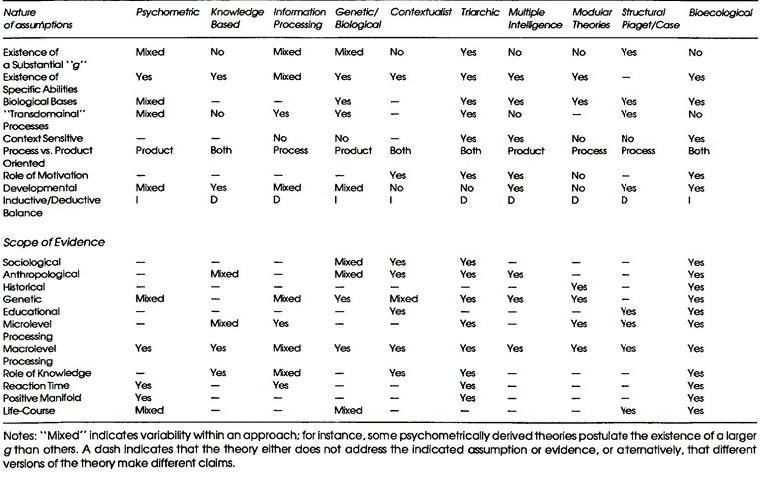
Cognition (thinking) is extremely context-sensitive. Along with many ecological influences, individual differences in cognition are understood best with the bio-ecological framework which consists of three components: (1) ‘g’ doesn’t exist, but multiple cognitive potentials do; (2) motivational forces and social/physical aspects of a task or setting, how elaborate a knowledge domain is not only important in the development of the human, but also, of course, during testing; and (3) knowledge and aptitude are inseparable “such that cognitive potentials continuously access one’s knowledge base in the cascading process of producing cognitions, which in turn alter the contents and structure of the knowledge base” (Ceci, 1996: 123).
Block (1995) notes that “Blacks and Whites are to some extent separate cultural groups.” Sternberg (2004) defines culture as “the set of attitudes, values, beliefs and behaviors shared by a group of people, communicated from one generation to the next via language or some other means of communication.” In regard to social class—blacks and whites differ in social class (a form of culture), Richardson (2002: 298) notes that “Social class is a compound of the cultural tools (knowledge and cognitive and psycholingustic structures) individuals are exposed to; and beliefs, values, academic orientations, self-efficacy beliefs, and so on.” The APA notes that “Social status isn’t just about the cars we drive, the money we make or the schools we attend — it’s also about how we feel, think and act …” And the APS notes that social class can be seen as a form of culture. Since culture is a set of attitudes, beliefs and behaviors shared by a group of people, social classes, therefore, are forms of culture as different classes have different attitudes, beliefs and behaviors.
Ceci (1996 119) notes that:
large-scale cultural differences are likely to affect cognition in important ways. One’s way of thinking about things is determined in the course of interactions with others of the same culture; that is, the meaning of a cultural context is always negotiated between people of that culture. This, in turn, modifies both culture and thought.
While Manstead (2018) argues that:
There is solid evidence that the material circumstances in which people develop and live their lives have a profound influence on the ways in which they construe themselves and their social environments. The resulting differences in the ways that working‐class and middle‐ and upper‐class people think and act serve to reinforce these influences of social class background, making it harder for working‐class individuals to benefit from the kinds of educational and employment opportunities that would increase social mobility and thereby improve their material circumstances.
In fact, the bio-ecological model of human development (and IQ) is a developmental systems-type model. The types of things that go into the model are just like Richardson’s (2002) “sociocognitive affective nexus.” Richardson (2002) posits that the sources of IQ variation are mostly non-cognitive, writing that such factors include (pg 288):
(a) the extent to which people of different social classes and cultures have acquired a specific form of intelligence (or forms of knowledge and reasoning); (b) related variation in ‘academic orientation’ and ‘self-efficacy beliefs’; and (c) related variation in test anxiety, self-confidence, and so on, which affect performance in testing situations irrespective of actual ability
Cole (2004) concludes that:
Our imagined study of cross-cultural test construction makes it clear that tests of ability are inevitably cultural devices. This conclusion must seem dreary and disappointing to people who have been working to construct valid, culture-free tests. But from the perspective of history and logic, it simply confirms the fact, stated so clearly by Franz Boas half a century ago, that “mind, independent of experience, is inconceivable.”
The role of context is huge—and most psychometricians ignore it, as Ceci (1996: 107) quotes Bronfenbrenner (1989: 207) who writes:
It is a noteworthy feature of all preceding (cognitive approaches) that they make no reference whatsoever to the environment in which the person actually lives and grows. The implicit assumption is that the attributes in question are constant across place; the person carries them with her wherever she goes. Stating the issue more theoretically, the assumption is that the nature of the attribute does not change, irrespective of the context in which one finds one’s self.
Such contextual differences can be found in the intrinsic and extrinsic motivations of the individual in question. Self-efficacy, what one learns and how they learn it, motivation instilled from parents, all form part of the context of the specific individual and how they develop which then influences IQ scores (middle-class knowledge and skills scores).
(For a primer on the bio-ecological model, see Armour-Thomas and Gopaul-Mcnicel, 1997; Papierno et al, 2005; Bronfenbrenner and Morris, 2007; and O’Toole, 2016.)
Conclusion
If blacks and whites are, to some extent, different cultural groups, then they will—by definition—have differing cultures. So “cultural differences are known to exist, and cultural differences can have an impact on psychological traits [also in the knowledge one acquires which then is one part of dictating test scores] (see Prinz, 2014: 67, Beyond Human Nature). If blacks and whites are “separate cultural groups” (Block, 1995) and if they have different experiences by virtue of being cultural groups, then they will score differently on any test of ability (including IQ; see Fagan and Holland, 2002, 2007) as all tests of ability are culture-bound (see Cole, 2004).
1 Blacks and whites are different cultural groups.
2 If (1), then they will have different experiences by virtue of being different cultural groups.
3 So blacks and whites, being different cultural groups, will score differently on tests of ability, since they are exposed to different knowledge structures due to their different cultures.
So, what accounts for the intercorrelations between tests of “cognitive ability”? They validate the new test with older, ‘more established’ tests so “based on this it is unlikely that a measure unrelated to g will emerge as a winner in current practice … [so] it is no wonder that the intelligence hierarchy for different racial/ethnic groups remains consistent across different measures. The tests are highly correlated among each other and are similar in item structure and format” (Suzuki and Aronson, 2005: 321).
Therefore, what accounts for differences in IQ is not intellectual ability, but cultural/social exposure to information—specifically the type of information used in the construction of IQ tests—along with the test constructors attempting to construct new tests that correlate with the old tests, and so, they get the foregone conclusion of their being racial differences, for example, in IQ which they trumpet as evidence for a “biological cause”—but it is anything but: such differences are built into the test (Simon, 1997). (Note that Fagan and Holland, 2002 also found evidence for test bias as well.)
Thus, we should take the logical conclusion: what explains racial IQ differences are not biological factors, but environmental ones—specifically in the exposure of knowledge—along with how new tests are created (see Suzuki and . All human cognizing takes place in specific cultural contexts—therefore “culture-free tests” (i.e., tests devoid of cultural knowledge and context) are an impossibility. IQ tests are experience-dependent so if one is not exposed to the relevant experiences to do well in a testing situation, then they will score lower than they would have if they were to have the requisite culturally-specific knowledge to perform well on the test.
Just-so Stories: The Brain Size Increase
1600 words
The increase in brain size in our species over the last 3 million years has been the subject of numerous articles and books. Over that time period, brain size increased from our ancestor Lucy, all the way to today. Many stories are proposed to explain how and why it exactly happened. The explanation is the same ol’ one: Those with bigger heads, and therefore bigger brains had more children and passed on their “brain genes” to the next generation until all that was left was bigger-brained individuals of that species. But there is a problem here, just like with all just-so stories. How do we know that selection ‘acted’ on brain size and thusly “selected-for” the ‘smarter’ individual?
Christopher Badcock, an evolutionary psychologist, as an intro to EP published in 2001, where he has a very balanced take on EP—noting its pitfalls and where, in his opinion, EP is useful. (Most may know my views on this already, see here.) In any case, Badcock cites R.D. Martin (1996: 155) who writes:
… when the effects of confounding variables such as body size and socio-economic status are excluded, no correlation is found between IQ and brain size among modern humans.
Badcock (2001: 48) also quotes George Williams—author of Adaptation and Natural Selection (1966; the precursor to Dawkins’ The Selfish Gene) where he writes:
Despite the arguments that have been advanced, I cannot readily accept the idea that advanced mental capabilities have ever been directly favored by selection. There is no reason for believing that a genius has ever been likely to leave more children than a man of somewhat below average intelligence. It has been suggested that a tribe that produces an occasional genius for its leadership is more likely to prevail in competition with tribes that lack this intellectual resource. This may well be true in the sense that a group with highly intelligent leaders is likely to gain political domination over less gifted groups, but political domination need not result in genetic domination, as indicated by the failure of many a ruling class to maintain its members.
In Adaptation and Natural Selection, Williams was much more cautious than adaptationists today, stating that adaptationism should be used only in very special cases. Too bad that adaptationists today did not get the memo. But what gives? Doesn’t it make sense that the “more intelligent” human 2 mya would be more successful when it comes to fitness than the “less intelligent” (whatever these words mean in this context) individual? Would a pre-historic Bill Gates have the most children due to his “high IQ” as PumpkinPerson has claimed in the past? I doubt it.
In any case, the increase in brain size—and therefore increase in intellectual ability in humans—has been the last stand for evolutionary progressionists. “Look at the increase in brain size”, the progressionist says “over the past 3mya. Doesn’t it look like there is a trend toward bigger, higher-quality brains in humans as our skills increased?” While it may look like that on its face, in fact, the real story is much more complicated.
Deacon (1990a) notes many fallacies that those who invoke the brain size increase across evolutionary history make, including: the evolutionary progression fallacy; the bigger-is-smarter fallacy; and the numerology fallacy. The evolutionary progression fallacy is simple enough. Deacon (1990a: 194) writes:
In theories of brain evolution, the concept of evolutionary progress finds implicit expression in the analysis of brain-size differences and presumed grade shifts in allometric brain/body size trends, in theories of comparative intelligence, in claims about the relative proportions of presumed advanced vs. primitive brain areas, in estimates of neural complexity, including the multiplication and differentiation of brain areas, and in the assessment of other species with respect to humans, as the presumed most advanced exemplar. Most of these accounts in some way or other are tied to problems of interpreting the correlates of brain size. The task that follows is to dispose of fallacious progressivist notions hidden in these analyses without ignoring the questions otherwise begged by the many enigmatic correlations of brain size in vertebrate evolution.
Of course, when it comes to the bigger-is-smarter fallacy, it’s quite obviously not true that bigger IS always better when it comes to brain size, as elephants and whales have larger brains than humans (also see Skoyles, 1999). But what they do not have more of than humans is cortical neurons (see Herculano-Houzel, 2009). Decon (1990a: 201) describes the numerology fallacy:
Numerology fallacies are apparent correlations that turn out to be artifacts of numerical oversimplification. Numerology fallacies in science, like their mystical counterparts, are likely to be committed when meaning is ascribed to some statistic merely by virtue of its numeric similarity to some other statistic, without supportive evidence from the empirical system that is being described.
While Deacon (1990a: 232) concludes that:
The idea, that there have been progressive trends of brain evolution, that include changes in the relative proportions of different structures (i.e., enlarging more “advanced” areas with respect to more primitive areas) and increased differentiation, interconnection, and overall complexity of neural circuits, is largely an artifact of misunderstanding the complex internal correlates of brain size. … Numerous statistical problems, arising from the difficulty of analyzing a system with so many interdependent scaling relationships, have served to reinforce these misconceptions, and have fostered the tacit assumption that intelligence, brain complexity, and brain size bear a simple relationship to one another.
Deacon (1990b: 255) notes how brains weren’t directly selected for, but bigger bodies (bigger bodies means bigger brains), and this does not lean near the natural selection fallacy theory for trait selection since this view is of the organism, not its trait:
I will argue that it is this remarkable parallelism, and not some progressive selection for increasing intelligence, that is responsible for many pseudoprogressive trends in mammalian brain evolution. Larger whole animals were being selected—not just larger brains—but along with the correlated brain enlargement in each lineage a multitude of parallel secondary internal adaptations followed.
Deacon (1990b: 697-698) notes that the large brain-to-body size ratio in humans compared to other primates is an illusion “a surface manifestation of a complex allometric reorganization within the brain” and that the brain itself is unlikely to be the object of selection. The correlated reorganization of the human brain, to Deacon, is what makes humans unique; not our “oversized” brains for our body. While Deacon (1990c) states that “To a great extent the apparent “progress” of mammalian brain evolution vanishes when the effects of brain size and functional specialization are taken into account.” (See also Deacon, 1997: chapter 5.)
So is there really progress in brain evolution, which would, in effect, lend credence to the idea that evolution is progressive? No, there is no progress in brain evolution; so-called size increases throughout human history are an artifact; when we take brain size and functional specialization into account (functional specialization is the claim that different areas in the brain are specialized to carry out different functions; see Mahon and Cantlon, 2014). Our brains only seem like they’ve increased; when we get down to the functional details, we can see that it’s just an artifact.
Skoyles and Sagan (2002: 240) note that erectus, for example, could have survived with much smaller brains and that the brain of erectus did not arise for the need for survival:
So how well equipped was Homo erectus? To throw some figures at you (calculations shown in the notes), easily well enough. Of Nariokotome boy’s 673 cc of cortex, 164 cc would have been prefrontal cortex, roughly the same as half-brained people. Nariokotome boy did not need the mental competence required by cotemporary hunter-gatherers. … Compared to that of our distant ancestors, Upper Paleolithic technology is high tech. And the organizational skills used in hunts greatly improved 400,000 years ago to 20,000 years ago. These skills, in terms of our species, are recent, occurring by some estimates in less than the last 1 percent of our 2.5 million year existence as people. Before then, hunting skills would have required less brain power, as they were less mentally demanding. If you do not make detailed forward plans, then you do not need as much mental planning abilities as those who do. This suggests that the brains of Homo erectus did not arise for reasons of survival. For what they did, they could have gotten away with much smaller, Daniel Lyon-sized brains.
In any case—irrespective of the problems that Deacon shows for arguments for increasing brain size—how would we be able to use the theory of natural selection to show what was selected-for, brain size or another correlated trait? The progressionist may say that it doesn’t matter which is selected-for, the brain size is still increasing even if the correlated trait—the free-rider—is being selected-for.
But, too bad for the progressionist: If the correlated non-fitness-enhancing trait is being selected-for and not brain size directly, then the progressionist cannot logically state that brain size—and along with it intelligence (as the implication always is)—is being directly selected-for. Deacon throws a wrench into such theories of evolutionary progress in regard to human brain size. Though, looking at erectus, it’s not clear that he really “needed” such a big brain for survival—it seems like he could have gotten away with a much smaller brain. And there is no reason, as George Williams notes, to attempt to argue that “high intelligence” was selected-for in our evolutionary history.
And so, Gould’s Full House argument still stands—there is no progress in evolution; bacteria occupy life’s mode; humans are insignificant to the number of bacteria on the planet, “big brains”, or not.
The Burakumin and the Koreans: The Japanese Underclass and Their Achievement
2350 words
Japan has a caste system just like India. Their lowest caste is called “the Burakumin”, a hereditary caste created in the 17th century—the descendants of tanners and butchers. (Buraku means ‘hamlet people’ in Japanese which took on a new meaning in the Meiji era.) Even though they gained “full rights” in 1871, they were still discriminated against in housing and work (only getting menial jobs). A Burakumin Liberation League has formed, to end discrimination against Buraku in 1922, protesting to end job discrimination by the dominant Ippan Japanese. Official numbers of the number of Buraku in Japan are about 1.2 million, but unofficial numbers bring it up to 6000 communities and 3 million Buraku.
Note the similarities here with black Americans. Black Americans got their freedom from American slavery in 1865. The Burakumin got theirs in 1865. Both groups get discriminated against—the things that the Burakumin face, the blacks in America have faced. De Vos (1973: 374) describes some employment statistics for Buraku and non-Buraku:
For instance, Mahara reports the employment statistics for 166 non-Buraku children and 83 Buraku children who were graduated in March 1859 from a junior high school in Kyoto. Those who were hired by small-scale enterprises employing fewer than ten workers numbered 29.8 percent of the Buraku and 13.1 percent of the non-Buraku children; 15.1 percent of non-Buraku children obtained work in large-scale industries employing more than one thousand workers, whereas only 1.5 percent of Buraku children did so.
Certain Japanese communities—in southwestern Japan—have a belief and tradition in having foxes as pets. Those who have the potential to have such foxes descends down the family line—there are “black” foxes and “white” foxes. So in this area in southwestern Japan, people are classified as either “white” or “black”, and marriage between these artificial color lines is forbidden. They believe that if someone from the “white” family marries someone from the “black” family that every other member of the “white” family becomes “black.”
Discrimination against the Buraku in Japan is so bad, that a 330 page list of Buraku names and community placements were sold to employers. Burakumin are also more likely to join the Yakuza criminal gang—most likely due to such opportunities they miss out on in their native land. (Note similarities between Buraku joining Yakuza and blacks joining their own ethnic gangs.) It was even declared that an “Eta” (the lowest of the Burakumin) was 1/7th of an ordinary person. This is eerily familiar to how blacks were treated in America with the three-fifths compromise—signifying that the population of slaves would be counted as three-fifths in total when being apportioned to votes for the Presidential electors, taxes and other representatives.
Now let’s get to the good stuff: “intelligence.” There is a gap in scores between “blacks”, “whites”, and Buraku. De Vos (1973: 377) describes score differences between “blacks”, “whites” and Buraku:
[Nomura] used two different kinds of “intelligence” tests, the nature of which are unfortunately unclear from his report. On both tests and in all three schools the results were uniform: “White” children averaged significantly higher than children from “black” families, and Buraku children, although not markedly lower than the “blacks,” averaged lowest.
According to Tojo, the results of a Tanaka-Binet Group I.Q. Test administered to 351 fifth- and sixth-grade children, including 77 Buraku children, at a school in Takatsuki City near Osaka shows that the I.Q. scores of the Buraku children are markedly lower than those of the non-Buraku children. [Here is the table from Sternberg and Grigorenko, 2001]
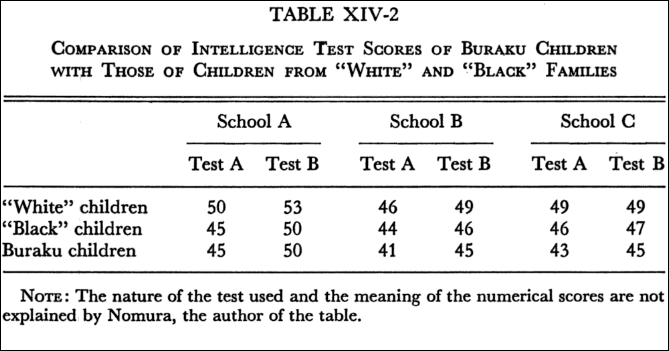
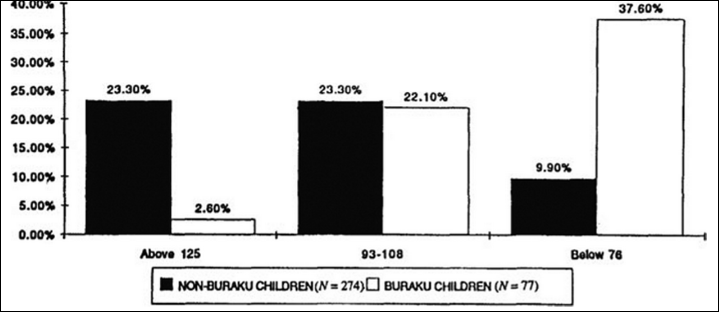
Also see the table from Hockenbury and Hockenbury’s textbook Psychology where they show IQ score differences between non-Buraku and Buraku people:
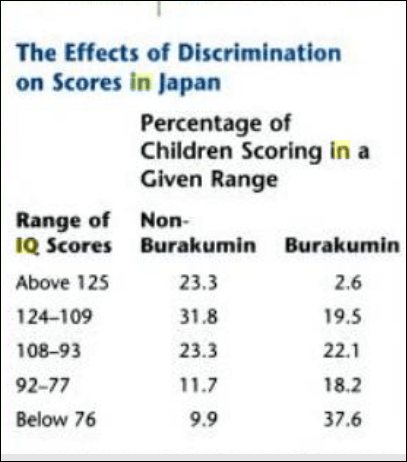
De Vos (1973: 376) also notes the similarities between Buraku and black and Mexican Americans:
Buraku school children are less successful compared with the majority group children. Their truancy rate is often high, as it is in California among black and Mexican-American minority groups. The situation in Japan also probably parallels the response to education by certain but not all minority groups in the United States.
How similar. There is another group in Japan that is an ethnic minority that is the same race as the Japanese—the Koreans. They came to Japan as forced labor during WWII—about 7.8 million Koreans were conscripted to the Japanese, men participating in the military while women were used as sex slaves. Most are born in Japan and speak no Korean, but they still face discrimination—just like the Buraku. There are no IQ test scores for Koreans in Japan, but there are standardized test scores. Koreans in America are more likely to have higher educational attainment than are native-born Americans (see the Pew data on Korean American educational attainment). But this is not the case in Japan. The following table is from Sternberg and Grigorenko (2001).
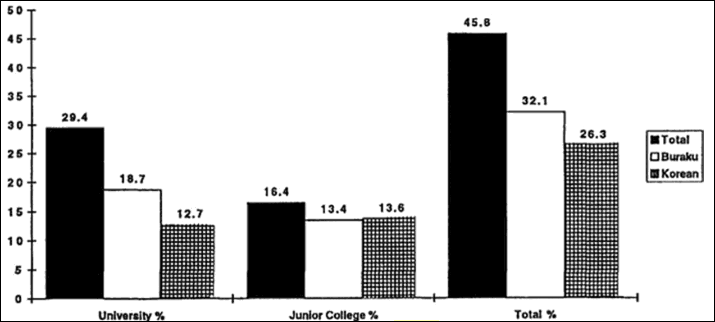
Just as Koreans do better than white Americans on standardized tests (and IQ tests), how weird is it for Koreans in Japan to score lower than ethnic Japanese and even the Burakumin? Sternberg and Grigorenko (2001) write:
Based on these cross-cultural comparison, we suggest that it is the manner in which caste and minority status combine rather than either minority position or low-caste status alone that lead to low cognitive or IQ test scores for low-status groups in complex, technological societies such as Japan and the United States. Often jobs and education require the adaptive intellectual skills of the dominant caste. In such societies, IQ tests discriminate against all minorities, but how the minority groups perform on the tests depends on whether they became minorities by immigration or choice (voluntary minorities) or were forced by the dominant group into minorities status (involuntary minorities). The evidence indicates that immigrant minority status and nonimmigrant status have different implications for IQ test performance.
The distinction between “voluntary” and “involuntary” minority is simple: voluntary minorities emigrate by choice, whereas involuntary minorities were forced against their will to be there. Black Americans, Native Hawaiians and Native Americans are involuntary minorities in America and, in the case of blacks, they face similar discrimination to the Buraku and there is a similar difference in test scores between the high and low castes (classes in America). (See the discussion in Ogbu and Simons (1998) on voluntary and involuntary minorities and also see Shimihara, (1984) for information on how the Burakumin are discriminated against.)
Ogbu and Simons (1988) explain the school performance of minorities using what Ogbu calls a “cultural-ecological theory” which considers societal and school factors along with community dynamics in minority communities. The first part of the theory is that minorities are discriminated against in terms of education, which Ogbu calls “the system.” The second part of the theory is how minorities respond to their treatment in the school system, which Ogbu calls “community forces.” See Figure 1 from Ogbu and Simons (1998: 156):
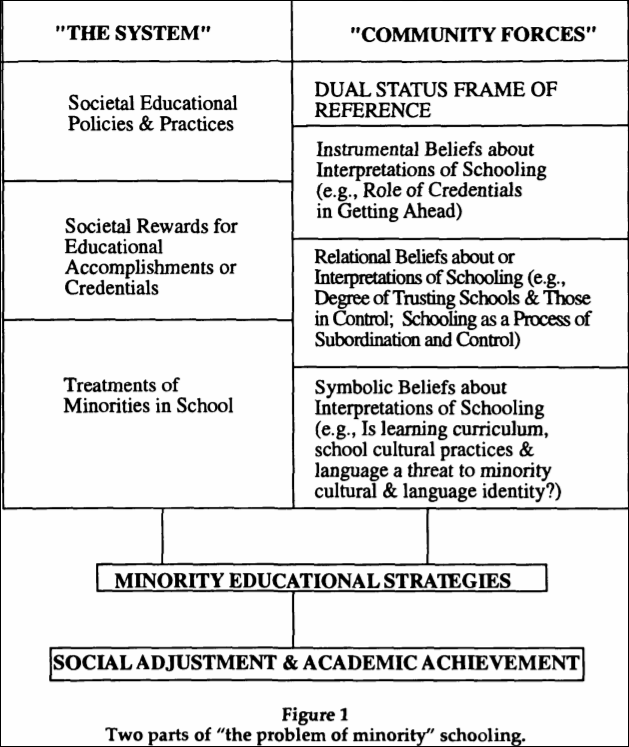
Ogbu and Simon (1998: 158) write about the Buraku and Koreans:
Consider that some minority groups, like the Buraku outcast in Japan, do poorly in school in their country of origin but do quite well in the United States, or that Koreans do well in school in China and in the United States but do poorly in Japan.
Ogbu (1981: 13) even notes that when Buraku are in America—since they do not look different from the Ippan—they are treated like regular Japanese-Americans who are not discriminated against in America as the Buraku are in Japan and, what do you know, they have similar outcomes to other Japanese:
The contrasting school experiences of the Buraku outcastes in Japan and in the United States are even more instructive. In Japan Buraku children continue massively to perform academically lower than the dominant Ippan children. But in the United States where the Buraku and the Ippan are treated alike by the American people, government and schools, the Buraku do just as well in school as the Ippan (DeVos 1973; Ito,1967; Ogbu, 1978a).
So, clearly, this gap between the Buraku and the Nippon disappears when they are not stratified in a dominant-subordinate relation. It’s because IQ testing and other tests of ability are culture-bound (Cole, 2004) and so, when Burakumin emigrate to America (as voluntary minorities), they are seen as and treated like any other Japanese since there are no physical differences between them and their educational attainment and IQs match the other non-Burakumin Japanese. The very items on these tests are biased towards the dominant (middle-)class—so when the Buraku and Koreans emigrate to America they then have the types of cultural and psychological tools (Richardson, 2002) to do well on the tests and so, their scores change from when they were in their other country.
Note the striking similarities between black Americans and Buraku and Korean-Japanese—all three groups are discriminated against in their countries, all three groups have lower levels of achievement than the majority population, two groups (the Buraku and black Americans, there is no IQ data for Koreans in Japan that I am aware of) show the same gap between them and the dominant group, the Buraku and black Americans got their freedom at around the same times but still face similar types of discrimination. However, when Buraku and Korean-Japanese people emigrate here to America, their IQ scores and educational attainment match that of other East Asian groups. To Americans, there is no difference between Buraku and non-Buraku Japanese people.
Koreans in Japan “endure a climate of hate“, according to The Japan Times. Koreans are heavily discriminated against in Japan. Korean-Japanese people, in any case, score worse than the Buraku. Though, as we all know, when Koreans emigrate to America they have higher test scores than whites do.
Note, though, IQ scores for “voluntary minorities” that came to the US in the 1920s. The Irish, Italians, and even Jews were screened as “low IQ” and were thusly barred entry into the country due to it. For example, Young (1922: 422) writes that:
Over 85 per cent. of the Italian group, more than 80 per cent. of the Polish group and 75 per cent. of the Greeks received their final letter grades from the beta or other performance examination.
While Young (1922) shows the results of an IQ test administered to Southern Europeans in certain areas (one of the studies was carried out in New York City):
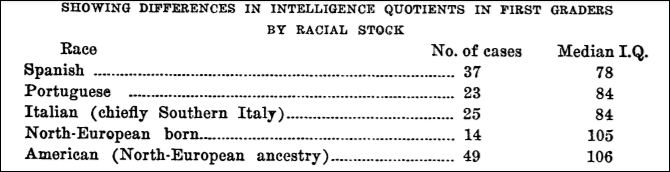
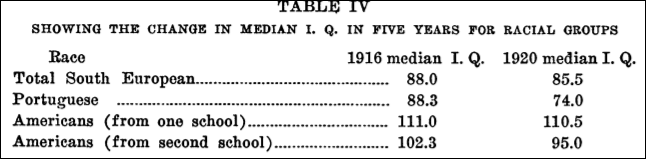
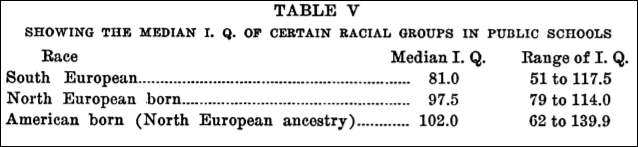
These types of score differentials are just like what these lower castes in Japan and America show today. Though, as Thomas Sowell noted in regard to the IQs of Jews, Polish, Italians, and Greeks:
Like fertility rates, IQ scores differ substantially among ethnic groups at a given time, and have changed substantially over time— reshuffling the relative standings of the groups. As of about World War I, Jews scored sufficiently low on mental tests to cause a leading “expert” of that era to claim that the test score results “disprove the popular belief that the Jew is highly intelligent.” At that time, IQ scores for many of the other more recently arrived groups—Italians, Greeks, Poles, Portuguese, and Slovaks—were virtually identical to those found today among blacks, Hispanics, and other disadvantaged groups. However, over the succeeding decades, as most of these immigrant groups became more acculturated and advanced socioeconomically, their IQ scores have risen by substantial amounts. Jewish IQs were already above the national average by the 1920s, and recent studies of Italian and Polish IQs show them to have reached or passed the national average in the post-World War II era. Polish IQs, which averaged eighty-five in the earlier studies—the same as that of blacks today—had risen to 109 by the 1970s. This twenty-four-point increase in two generations is greater than the current black-white difference (fifteen points). [See also here.]
Ron Unz notes that Sowell says about the Eastern and Southern European immigrants IQs: “Slovaks at 85.6, Greeks at 83, Poles at 85, Spaniards at 78, and Italians ranging between 78 and 85 in different studies.” And, of course, their IQs rose throughout the 20th century. Gould (1996: 227) showed that the average mental age for whites was 13.08, with anything between 8 and 12 being denoted a “moron.” Gould noted that the average Russian had a mental age of 11.34, while the Italian was at 11.01 and the Pole was at 10.74. This, of course, changed as these immigrants acclimated to American life.
For an interesting story for the creation of the term “moron”, see Dolmage’s (2018: 43) book Disabled Upon Arrival:
… Goddard’s invention of [the term moron] as a “signifier of tainted whiteness” was the “most important contribution to the concept of feeble-mindedness as a signifier of racial taint,” through the diagnosis of the menace of alien races, but also as a way to divide out the impure elements of the white race.
The Buraku are a cultural class—not a racial or ethnic group. Looking at America, the terms “black” and “white” are socialraces (Hardimon, 2017)—so could the same reasons for low Buraku educational attainment and IQ be the cause for black Americans’ low IQ and educational attainment? Time will tell, though there are no countries—to the best of my knowledge—that blacks have emigrated to and not been seen as an underclass or ‘inferior.’
The thesis by Ogbu is certainly interesting and has some explanatory power. The fact of the matter is that IQ and other tests of ability are bound by culture, and so, when the Buraku leave Japan and come to America, they are seen as regular Japanese (I’m not aware if Americans know about the Buraku/non-Buraku distinction) and they score just as well if not better than Americans and other non-Buraku Japanese. This points to discrimination and other environmental causes as the root of Buraku problems—noting that the Buraku became “full citizens” in 1871, 6 years after black slavery was ended in America. That Koreans in Japan also have similarly low educational attainment but high in America—higher than native-born Americans—is yet another point in favor of Ogbu’s thesis. The “system” and “community forces” seem to change when the two, previously low-scoring, high-crime group comes to America.
The increase in IQ of Southern and Eastern European immigrants, too, is another point in favor of Ogbu. Koreans and Buraku (indistinguishable from other native Japanese), when they leave Japan, are seen as any other Asians immigrants, and so, their outcomes are different.
In any case, the Buraku of Japan and Koreans who are Japanese citizens are an interesting look into how a group is treated can—and does—decrease test scores and social standing in Japan. Might the same hold true for blacks one day?
Rampant Adaptationism
1500 words
Adaptationism is the main school of evolutionary change, through “natural selection” (NS). That is the only way for adaptations to appear, says the adaptationist: traits that were conducive to reproductive success in past environments were selected-for their contribution to fitness and therefore became fixated in the organism in question. That’s adaptationism in a nutshell. It’s also vacuous and tells us nothing interesting. In any case, the school of thought called adaptationism has been the subject of much criticism, most importantly, Gould and Lewontin (1972), Fodor (2008) and Fodor and Piatteli-Palmarini (2010). So, I would say that adaptationism becomes “rampant” when clearly cultural changes are conflated as having an evolutionary history and are still around today due to being adaptations.
Take Bret Weinstein’s recent conversation with Richard Dawkins:
Weinstein: “Understood through the perspective of German genes, vile as these behaviors were, they were completely comprehensible at the level of fitness. It was abhorrent and unacceptable—but understandable—that Germany should have viewed its Jewish population as a source of resources if you viewed Jews as non-people. And the belief structures that cause people to step onto the battlefields and fight were clearly comprehensible as adaptations of the lineages in question.”
Dawkins: “I think nationalism may be an even greater evil than religion. And I’m not sure that it’s actually helpful to speak of it in Darwinian terms.”
I find it funny that Weinstein is more of a Dawkins-ist than Dawkins himself is (in regard to his “selfish gene theory”, see Noble, 2011). In any case, what a ridiculous claim. “Guys, the Nazis were bad because of their genes and their genes made them view Jews as non-people and resources. Their behaviors were completely understandable at the level of fitness. But, Nazis bad!”
What a ridiculous claim. I like how Dawkins quickly shot the bullshit down. This is just-so storytelling on steroids. I wonder what “belief structures that cause people to step onto battlefields” are “adaptations of the lineages in question”? Do German belief structure adaptations different from any other groups? Can one prove that there are “belief structures” that are “adaptations to the lineages in question”? Or is Weinstein just telling just-so stories—stories with little evidence and that “fit” and “make sense” with the data we have (despicable Nazi behavior towards Jews after WWI and before and during WWII).
There is a larger problem with adaptationism, though: adaptationist confuse adaptiveness with adaptation (a trait can be adaptive without being an adaptation), they overlook nonadaptationist explanations, and adaptationist hypotheses are hard to falsify since a new story can be erected to explain the feature in question if one story gets disproved. That’s the dodginess of adaptationism.
An adaptationist may look at an organism, look at its traits, then construct a story as to why they have the traits they do. They will attempt to think of its evolutionary history by thinking of the environment it is currently in and what the traits in question that it has are useful for now. But there is a danger here. We can create many stories for just one so-called adaptation. How do we distinguish between which stories explain the fixation of the trait and which do not? We can’t: there is no way for us to know which of the causal stories explains the fixation of the trait.
Gould and Lewontin (1972) fault:
the adaptationist programme for its failure to distinguish current utility from reasons for origin (male tyrannosaurs may have used their diminutive front legs to titillate female partners, but this will not explain why they got so small); for its unwillingness to consider alternatives to adaptive stories; for its reliance upon plausibility alone as a criterion for accepting speculative tales; and for its failure to consider adequately such competing themes as random fixation of alleles, production of nonadaptive structures by developmental correlation with selected features (allometry, pleiotropy, material compensation, mechanically forced correlation), the separability of adaptation and selection, multiple adaptive peaks, and current utility as an epiphenomenon of nonadaptive structures.
[…]
One must not confuse the fact that a structure is used in some way (consider again the spandrels, ceiling spaces, and Aztec bodies) with the primary evolutionary reason for its existence and conformation.
Of course, though, adaptationists (e.g., evolutionary psychologists) do confuse structure for function. This is fallacious reasoning. That a trait is useful in a current environment is in no way evidence that it is an adaptation nor is it evidence that that’s why the trait evolved (e.g., a trait being useful and adaptive in a current environment).
But there is a problem with looking to the ecology of the organism in question and attempting to construct historical narratives about the evolution of the so-called adaptation. As Fodor and Piatteli-Palmarini (2010) note, “if evolutionary problems are individuated post hoc, it’s hardly surprising that phenotypes are so good at solving them.” So of course if an organism fails to secure a niche then that means that the niche was not for that organism.
That organisms are so “fit” to their environment, like a puzzle piece to its surrounding pieces, is supposed to prove that “traits are selected-for their contribution to fitness in a given ecology”, and this is what the theory of natural selection attempts to explain. Organisms fit their ecologies because its their ecologies that “design” their traits. So it is no wonder that organisms and their environments have such a tight relationship.
Take it from Fodor and Piatelli-Palmarini (2010: 137):
You don’t, after all, need an adaptationist account of evolution in order to explain the fact that phenotypes are so often appropriate to ecologies, since, first impressions to the contrary notwithstanding, there is no such fact. It is just a tautology (if it isn’t dead) a creature’s phenotype is appropriate for its survival in the ecology that it inhabits.
So since the terms “ecology” and “phenotype” are interdefined, is it any wonder why an organism’s phenotype has such a “great fit” with its ecology? I don’t think it is. Fodor and Piatteli-Palmarini (2010) note how:
it is interesting and false that creatures are well adapted to their environments; on the other hand it’s true but not interesting that creatures are well adapted to their ecologies. What, them, is the interesting truth about the fitness of phenotypes that we require adaptationism in order to explain? We’ve tried and tried, but we haven’t been able to think of one.
So the argument here could be:
P1) Niches are individuated post hoc by reference to the phenotypes that live in said niche.
P2) If the organisms weren’t there, the niche would not be there either.
C) Therefore there is no fitness of phenotypes to lifestyles that explain said adaptation.
Fodor and Piatteli-Palmarini put it bluntly about how the organism “fits” to its ecology: “although it’s very often cited in defence of Darwinism, the ‘exquisite fit’ of phenotypes to their niches is either true but tautological or irrelevant to questions about how phenotypes evolve. In either case, it provides no evidence for adaptationism.”
The million-dollar question is this, though: what would be evidence that a trait is an adaptation? Knowing what we now know about the so-called fit to the ecology, how can we say that a trait is an adaptation for problem X when niches are individuated post hoc? That right there is the folly of adaptationism, along with the fact that it is unfalsifiable and leads to just-so storytelling (Smith, 2016).
Such stories are “plausible”, but that is only because they are selected to be so. When such adaptationism becomes entrenched in thought, many traits are looked at as adaptations and then stories are constructed as to how and why the trait became fixated in the organism. But, just like EP which uses the theory of natural selection as its basis, so too does adaptationism fail. Nevermind the problem of the fitting of species to ecologies to render evolutionary problems post hoc; nevermind the problem that there is no identifying criteria for identifying adaptations; do mind the fact that there is no possible way for natural selection to do what it does: distinguish between coextensive traits.
In sum, adaptationism is a failed paradigm and we need to dispense with it. The logical problems with it are more than enough to disregard it. Sure, the fitness of a phenotype, say, the claws of a mole do make sense in the ecology it is in. But we only claim that the claws of a mole are adaptations after the fact, obviously. One may say “It’s obvious that the claws of a mole are adaptations, look at how it lives!” But this betrays a notion that Gould and Lewontin (1972) made: do not confuse structure with an evolutionary reason for its existence, which, unfortunately, many people do (most glaringly, evolutionary psychologists). Weinstein’s ridiculous claims about Nazi actions during WWII are a great example of how rampant adaptationism has become: we can explain any and all traits as an adaptation, we just need to be creative with the stories we tell. But just because we can create a story that “makes sense” and explains the observation does not mean that the story is a likely explanation for the trait’s existence.
 NotPoliticallyCorrect