Home » Posts tagged 'Culture' (Page 4)
Tag Archives: Culture
North/South Differences in Italian IQ: Is Richard Lynn Right?
2300 words
Richard Lynn has stated that there are differences in Northern and Southern Italian IQ scores. Is he correct?
Lynn claims Italian IQ is 100 in the North and 90 in the South, with the lowest being IQ 89 in the Southern most part of Sicily.
Richard Lynn is of course, extremely controversial in his research areas of interest, mainly with his views on IQ and how it relates to the wealth of nations.
In his paper which talks about the North/South differences in IQ which predict differences in education, infant mortality, stature, and literacy.
Lynn’s methods were to take samples of the Program for International Student Assesment (PISA) which administers tests gauging the abilities of students in math, reading comprehension and science understanding. IQs were calculated by averaging science understanding, reading comprehension and mathematical ability, which the averages are expressed in SD unit deviations from the British PISA mean (n=502, SD 99). Figures are then converted to conventional IQs by multiplying them by 15. So the regional Italian IQs are expressed in comparison to the British IQ and SD (100 and 15 respectively).
His 10 data points are as follows:
First, the IQ in the northern regions of Italy measured by the PISA data is approximately 100 and therefore about the same as in Britain and other countries of northern and central Europe given in Lynn and Vanhanen (2002, 2006). This confirms the results of the standardization of the Colored Progressive Matrices in northern Italy reported by Prunetti (1985) and shows that IQs measured by the PISA data and by the Colored Progressive Matrices data are consistent. Regional IQs in Italy decline steadily through the central regions and into the south and reach a low of 89 in the most southerly region of Sicily. The first hypothesis of this study that there may be a north–south gradient of IQs in Italy is supported and quantified by the correlation of 0.963 between regional IQs and latitude.
First, the PISA data from 2013 shows Southern Italians scoring higher, and Northern Italians scoring around the same. Is that an increase in intelligence that happened in only 3 years? Did the genetics of Southern Italy change in 3 years? No.
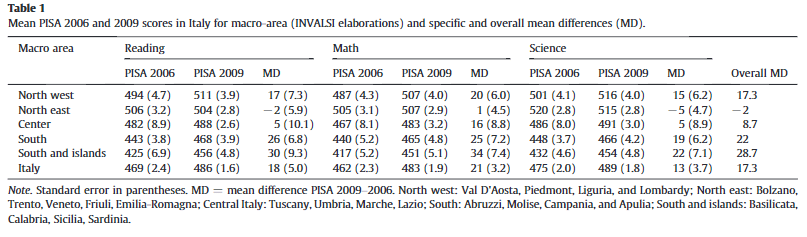
The table above shows the changes in PISA scores for Southern Italy in only 3 years for all 3 subjects tested in PISA. Southern Italy increased by 26 points in reading, and Southern Italy and islands increased by 30 points. For math, 25 for the South and 34 for South and the islands. For science, 18 for the South and 22 for the South and the islands. The presence of non-native students may also be a factor in these score differences. You can see the differences from 3 years, and how even in 3 years, there was a slight decrease in scores in Northern Italy. Migrants, after coming in from the South of the country, then continue to go into the Northern part of the country. This could also explain a huge part of the differences, seeing as they may be counted as Italian citizens, yet aren’t native to the country.
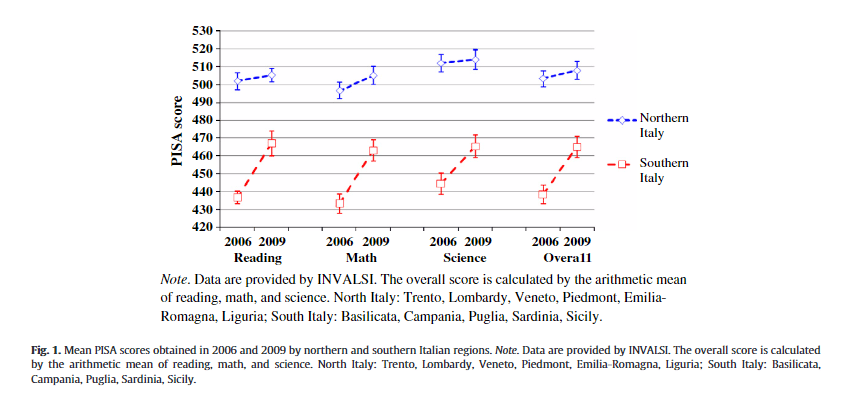
The above table shows mean PISA scores for 2006 and 2009, showing a huge increase in scores from Southern Italy, and hardly any increase in Northern Italy. Any genetic changes in 3 years to show that big of an increase?
Source: Problems in deriving Italian regional differences in intelligence from 2009 PISA data
Two, the second hypothesis of this study is that the north–south gradient of IQs in Italy may explain much of the difference in economic development between the north and south of Italy
Wrong again. Southern Italy has a huge underground economy, that isn’t noted on the books. The GDP in Southern Italy is far from accurate and employment figures do not match reality.
These raw figures require a closer look, because one economist’s analysis of Calabria found low pay, high unemployment, and a very high level of consumer spending. In 1994, the government insurance agency placed the number of business enterprises in Calabria at 23,758, while Istat, carrying out the 1996 census, found about 90,000 businesses in the same region.The economist Domenico Marino concluded, on the basis of 4,000 interviews in Calabria, that 75 percent of the Calabrian work force would refuse a fairly low-paying job, despite a very high official level of unemployment. In Calabria, with its dire employment figures, 84 percent of the families own their own home. What such anomalies must mean is that real income in Calabria is far higher than what is “on the books.” Many among the vast numbers of officially unemployed are, in fact, partly or fully employed. They are earning no social benefits, but they are earning the daily lire that keep their families afloat.
This massive sector skews all the statistics. It means that the GDP for the Italian South (and for Italy as a whole) is far from accurate. And the unemployment figures do not reflect reality.
LOOKING TO 2007: ITALY TIMES TWO
Three, the third hypothesis we set out to examine is that regional IQ differences in Italy are also manifest in variables that can be regarded as correlates or effects of IQs, including stature, infant mortality, literacy, and years of education
When historical data on those variables are used, a different picture emerges. Correlations are insignificant and in the case of infant mortality, do not the supposed link of regional differences in intelligence and socioeconomic development.
Four, per capita incomes are also highly negatively correlated with rates of infant mortality in 1954–57 (r= −0.652), and 1999–2002 (r=−0.823).
When the years 1911, 1891 and 1871 are averaged in, there is no difference.
Lynn didn’t consider the data from the 1860s to average it in with the rest of his data.
Five, the ability of populations with high IQs to give their children better nutrition makes them healthier, more resistant to disease and reduces the risk of mortality, and also improves their children’s stature
Right. But there is no mortality difference, as seen above.
Five, the ability of populations with high IQs to give their children better nutrition makes them healthier, more resistant to disease and reduces the risk of mortality, and also improves their children’s stature
There is a 1.7-inch difference between Northern and Southern Italian height. Which is explained by differences in nutrition between the regions, with the South having a more grain-based diet. Those effects are explained by a grain-based diet, and those Italians from America (which a huge majority are from the South of the country), actually show better educational attainment as well as more monetary success than their Northern counterparts.
Six, regional IQs in 2006 are highly correlated with the years of education of adults in 1951 (r=0.929), 1971 (r=0.871) and 2001 (r=0.886)
At the regional level, average IQs and current per capita GDP are highly related: for the year 2012, the correlation is 0.86. The link between IQ and regional development is, instead, much weaker when data for the years 1871, 1891 and 1911 are considered. Regional IQs and infant mortality rates in 1863–66 are positively correlated, contrarily to that which would be expected based on Lynn’s assumptions;
Two Italies? Genes, intelligence and the Italian North–South economic divide
This is explained simply. When Italy became unified in 1861, there were literacy differences in the country. 87 percent of the Southern population was illiterate in comparison to 67 percent of the Northern population.
The likely explanation for this high correlation is that the percentages of the population that were literate in 1880 was a function of IQs and therefore that the regional differences in IQs were present in 1880 and have been stable over the period 1880 to 2006.
Literacy and average years of schooling are better predictors of income levels than regional IQs.
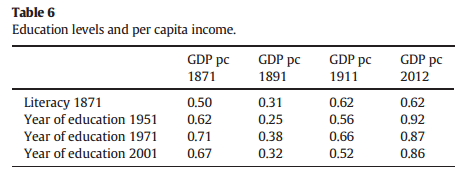
The above table shows this.
Eight, it is an interesting question whether the differences in Italian regional IQs were present in earlier historical periods. Some useful data bearing on this question have been assembled by Murray (2003, pp. 303–5) who has compiled the numbers of “significant figures” (i.e. those who have made significant contributions to science, literature, music and art) and their places of birth for the whole of Europe from the year 1400 to 1950. His figures for the north, center and south of Italy are shown in Table 3.
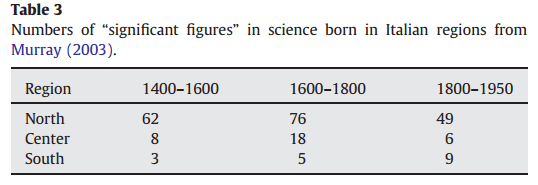
Pretty damning right? Wrong.
More than half of the country is put into the ‘North’ section of what he is talking about, and how he did the dividing, it looks like this.
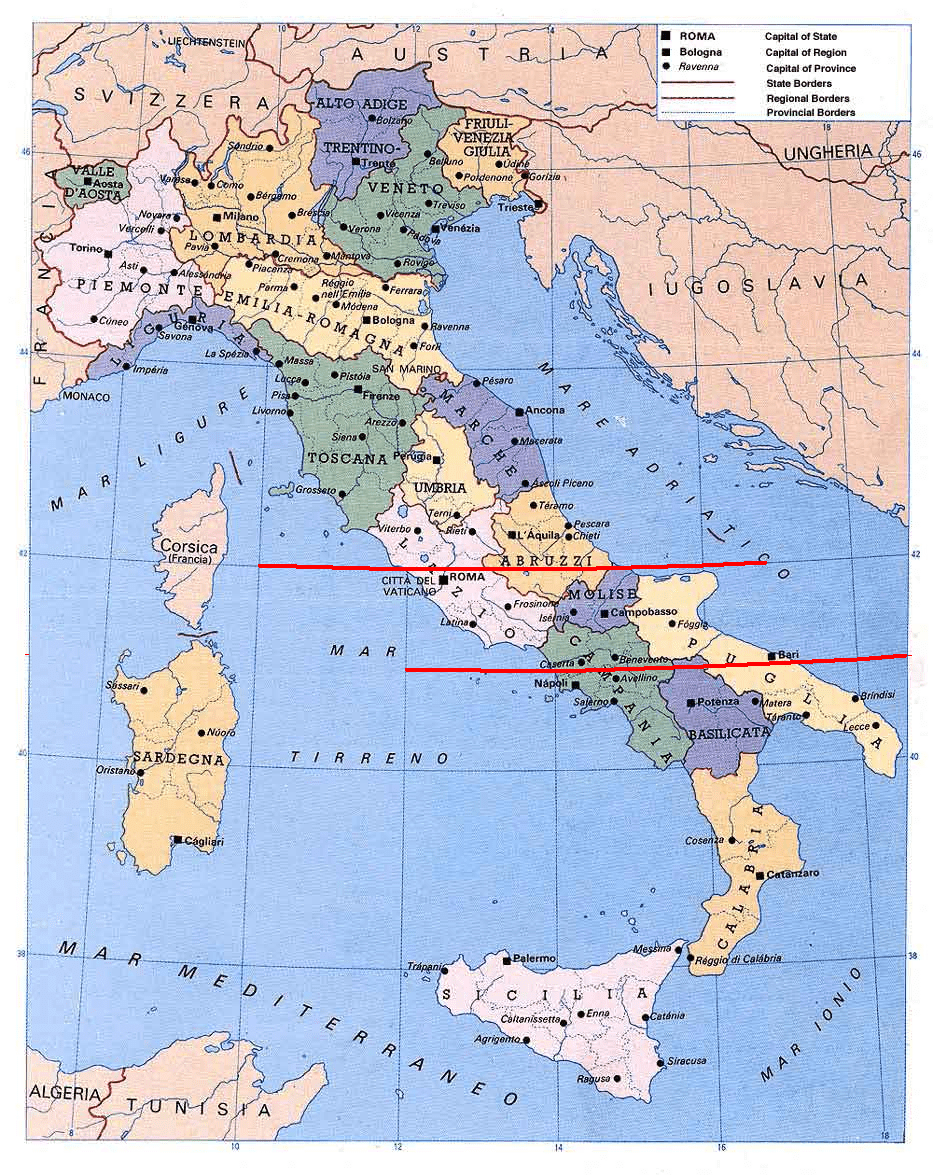
Murray also said that achievement happened in a few places in Italy, with Southern Italy being one of the many areas in Europe with ‘low achievement’, which includes a big part of Northern Italy as well. The achievements in Italy were mainly found in Tuscany, which the literacy rate wasn’t too high in 1880. Again, refuting Lynn on his thesis.
Nine, Putnam (1993, p. 159) and Tabellini (2007) have proposed that “civic trust” is a determinant of regional differences in economic development in Italy and in western Europe.
There are hardly any regional differences in economic development, as seen above.
A possible explanation for the northern regions having had higher IQs than the southern regions at least from 1880 and possibly from 1400 to 1600 is that the populations of the north and south are genetically different and these genetic differences are related to differences in intelligence.
Not at all. I touched on this in my Refuting Afrocentrism: Are Italians Black? article.
They write of the population genetics of Italy that “northern Italy shows similarities with countries of central Europe, whereas central and southern Italy are more similar to Greece and other Mediterranean countries.
See above. They are genetically the same:
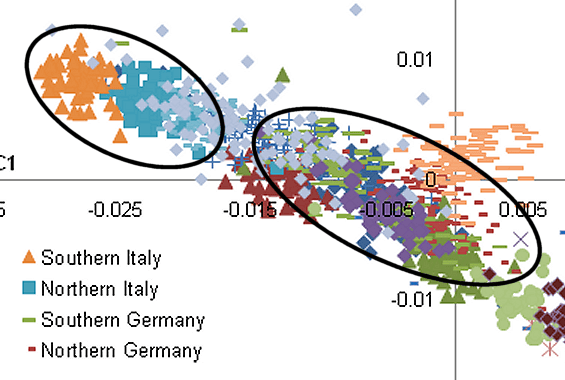
Comparison with Germany and Italy, Germans are spread out farther on the graph than are Italians, are there huge genetic differences with Germans as well?
They write of the population genetics of Italy that “northern Italy shows similarities with countries of central Europe, whereas central and southern Italy are more similar to Greece and other Mediterranean countries. This corresponds to the well-known differences in physical type (especially pigmentation and size) between the northern and north-central Italians on the one side and southern Italians on the other”.
Pigmentation is explained by getting the same UV rays as Northern Africa:

Size differences explained by slight differences in nutrition.
Subsequent studies have confirmed the genetic impact of immigration from the Near East and North Africa into southern Italy. For instance, the Taql, p1 2f2-8-kb allele has a high frequency in the Near East and North Africa (Morocco, 81.8; Lebanon, 43.7; Tunisia, 34.1). The allele is also present but at a lower frequency (26.4) in southern Italy, including Sicily.
Using a single, or small number of loci will lead to you finding the same loci in different populations? Who knew!!
The diffusion of genes from the Near East and North Africa may explain why the populations of southern Italy have IQs in the range of 89–92, intermediate between those of northern Italy and central and northern Europe (about 100) and those of the Near East and North Africa (in the range of 80–84) (these IQs are given in Lynn, 2006). This also explains the north–south gradient of IQ in Italy in which the regional IQs do not show a clear dichotomy between north and south but rather a gradient in which IQs decline steadily with more southerly latitude.
Nope. I’ve covered this in my ‘Black Italians’ article:
Combined data from two large mtDNA studies provides an estimate of non-Caucasoid maternal ancestry in Italians. The first study sampled 411 Italians from all over the country and found five South Asian M and East Asian D sequences (1.2%) and eight sub-Saharan African L sequences (1.9%). The second study sampled 465 Sicilians and detected ten M sequences (2.2%) and three L sequences (0.65%).This makes a total of 3% non-white maternal admixture (1.3% Asian and 1.7% African), which is very low and typical for European populations, since Pliss et al. 2005, e.g., observed 1.8% Asian admixture in Poles and 1.2% African admixture in Germans. (Plaza et al. 2003; Romano et al. 2003)
Similar data from the Y-chromosome reveals Italians’ even lower non-Caucasoid paternal admixture. Both studies obtained samples from all over the mainland and islands. No Asian DNA was detected anywhere, but a single sub-Saharan African E(xE3b) sequence was found in the first study’s sample of 416 (0.2%), and six were observed in the second study’s sample of 746 (0.8%). The total is therefore a minuscule 0.6%, which decreases to 0.4% if only Southern Italians are considered and 0% if only Sicilians are considered.Again, these are normal levels of admixture for European populations (e.g. Austrians were found to have 0.8% E(xE3b) by Brion et al. 2004). (Semino et al. 2004; Cruciani et al. 2004)
An analysis of 10 autosomal allele frequencies in Southern Europeans (including Italians, Sicilians and Sardinians) and various Middle Eastern/North African populations revealed a “line of sharp genetic change [that] runs from Gibraltar to Lebanon,” which has divided the Mediterranean into distinct northern and southern clusters since at least the Neolithic period. The authors conclude that “gene flow [across the sea] was more the exception than the rule,” attributing this result to “a joint product of initial geographic isolation and successive cultural divergence, leading to the origin of cultural barriers to population admixture.” (Simoni et al. 1999)
One of the most important citations is the Simoni et al. 1999 cite. Which says that gene flow across the sea was more the exception than the rule. Those 3 studies above refute any ‘racial differences’ between Northern and Southern Italians.
There are problems deriving Italian IQ from PISA test scores. You cannot take PISA data and infer a group’s IQ from it!! Moreover, on purer measures of intelligence, such as Raven’s Progressive Matrices, there is no significant difference between North and South children. These are differences in achievement, not intelligence. None of the studies cited by Lynn were aimed at comparing Italian IQ across regions and none of them used the same age groups!! This is why his data on Italian IQ is wrong.
To conclude, we don’t know the true IQs of all of the regions of Italy. Lynn used faulty measures to make his theory (which doesn’t need fluff) of north/south disparities in IQ more palatable. He’s been refuted multiple times on this matter. I may do another in the future.
Italianthro source: Refuting Richard Lynn’s IQ Study
Black Crime, Black Physical Attractiveness and Testosterone
I touched on black crime a bit a few months ago. I will now go more in depth on reasons for black crime.
First, what is the caused of all crime, no matter the race?
People have always said that parental socialization was the cause of black crime. But, genetic confounding was never considered in those studies. Kevin Beaver et al found in an analysis of adoptees that once genetic confounds were properly controlled, the effects of parenting on criminal justice measures were nonsignificant. That’s weird. I thought parental socialization was the cause of a kid turning out bad or good.
What is the cause of rape?
In a 37 year nationwide study in Sweden, it was found that sex offending runs in families. They reported strong evidence of familial clustering of sex offenses, mostly accounted for by genes and NOT shared environmental influences (ie, the same thing happening to both people in the family, therefore being the environmental cause of rape).
It’s of course genetics. We know that there is huge variation between individuals of the same race/ethnicity, how about between races? It also follows Rushton’s Rule of Three, Asians on top, whites intermediate and blacks on the bottom.
There are testosterone differences between blacks and whites. On top of those testosterone differences, men who stay and raise children have, on average, lower testosterone. This was noted in the West, but non-Western samples gave differing numbers. The study was conducted in two East African populations from Tanzania, Hadza foragers and Datoga pastoralists. They predicted that high levels of paternal care by the Hadza fathers would be associated with lower testosterone and that no difference would be found in non-fathers and fathers of Datoga men, who provide direct paternal care. The measurements in both populations confirmed the hypothesis, as well as adding further support that decreased testosterone leads to more paternal care.
What does that have to do with crime? Not having a father is detrimental to a young child, studies have shown in the UK that those from broken homes are more likely to commit crime than those from stable families. Also, seven out of ten offenders come from broken homes.
In this paper by Steven Ruggles, he says that analysis confirms that the high incidence of black Americans of single parenthood and children residing without their parents is not a recent phenomenon. Data shows that from 1880 through 1960, black children were two to three times more likely to reside without one or both children than white parents. This directly goes in the face of what liberals say is the cause of the demise of the black family structure. Ever since blacks have been free from slavery has this begun to happen.
Why did black father rates jump so much after the Civil Rights Movement?
I have my own theories.
Today, the black single mother rate is at 72 percent. In 1965, 24 percent of black infants were born without a father. What is the cause for that?
Blacks weren’t allowed to marry whites, and the CRA changed that. So with them being legally allowed to court white women, they obviously shied away from attempting to court black women. We can see that the trends show huge changes in 50 years. The cause is desegregation obviously, but what exactly is that environmental cause? Being able to court white women.
So with those men who DO stay around to raise children who show a decrease in testosterone, it’s extremely safe to say that those men who leave, regardless of race, have higher testosterone than those men who stay. This is reflected in racial single parent stats that show, again as for many more variables, Rushton’s Rule of Three.
What is wrong with black women? How come when segregation got lifted, black single motherhood rose exponentially?
Satoshi Kanazawa knows why. He noted in this study on why black women are not as attractive as other races, that women, on average are more physically attractive than men. EXCEPT BLACK WOMEN. The data shows black women as not being statistically different from the average, and far less attractive than whites, Asians and Native American women.
The cause is higher testosterone. Kanazawa says that the cause for this is due to the mean BMI of black women being 28.5 among black women and 26.1 among non-black women. Though he says that’s not the reason why black women are less physically attractive. Black women have lower levels of intellect net of BMI. Even the racial differences in intelligence don’t account for these differences. Black women are STILL less physically attractive, net of BMI and intelligence. Kanazawa says: “Net of intelligence, black men are significantly more physically attractive than nonblack men.”
Why is that? He says the reason is testosterone. He ends up concluding that testosterone differences are the only cause for these differences. With blacks having the highest testosterone out of all the races, black women obviously have higher rates of testosterone than white women. Those women with higher levels of testosterone have more masculine features, therefore making them less attractive.
Previous research has suggested that perceived attractiveness and personality are affected by the race such that White faces are more attractive but less masculine than Black faces. Such studies, however, have been based on very small stimulus sets. The current study investigated perceived attractiveness and personality for 600 Black, White and mixed-race faces. Many of the investigated personality traits were correlated with race when rated by White participants. Attractiveness specifically was greater for Black male faces than White male faces and among mixed-race faces. Blackness correlated with increased attractiveness. A reverse pattern was found for female faces with Whiteness being associated with attractiveness. The results are discussed in terms of the sexual dimorphism demonstrated in skin color. (Lewis 2010)
That’s the same as was noted in the Kanazawa paper. Darker-skinned males were more attractive, lighter-skinned women were more attractive.
Rushton wrote, in his last paper before his death, that skin color as a multi-generational adaptation to differences in climate over the past 70,000 years. He proposed life history theory (formerly known as r K selection theory) to explain the covariation found between human and non-human pigmentation and variables such as birth rate, infant mortality, longevity, the rate of HIV/AIDs and violent crime.
Dark skin is correlated with these things because of evolution.
High testosterone is linked to crimes of violence and sex. Men who gave saliva samples in prison were shown to violate more rules in prison, especially rules involving overt confrontation. Dabbs et al say: “the variety of rule violations suggests the behavior of high testosterone individuals reflects intractability, unmanageability, and lack of docility as well as aggression and violence.” Higher testosterone levels were associated with more violent crimes, parole board decisions against release, and more prison rule violations. This same thing was noticed in women, high-testosterone women had more crimes of unprovoked violence, increased number of prior charges, and decisions against parole.
For chronic adult offenders, the average IQ is 85, 1 SD below the mean of 100. Why do criminals have low IQ? Lack of abstract thought for one. Those with low IQ have a lack of ability to think of what their actions will do. Along with the lack of ability to delay gratification, paired with high testosterone and low IQ, that is the cause for higher than average crime in the black community in America.
Men with lower intelligence may be more likely to resort to evolutionarily familiar means of competition for resources and mating opportunities, and not to fully comprehend the consequences of their criminal behavior.
Even just a few points of IQ matter to criminality. There is a lot of data on the link between crime and low IQ. Who just so happens to have the lowest IQ in America on average?
It was noted in this study that states with lower IQs have more property crime and violent crime.
Increased intelligence is also linked to lower sex drive. I would reason that as shown above, those with higher IQs will be able to resist natural urges better than those with lower IQs. This shows in NLSY data with lower IQ people having more kids, higher IQ people fewer kids.
All of this data piles up, and the only thing that jumps out, is that lower IQ people have more testosterone, lower IQ people commit more crimes, therefore, high testosterone and low IQ is the cause of black criminality.
HBD and Diet Advice: Anglin Paleo Refutation Part 2
2300 words
A lot of people seem to have wrong views on nutrition. It’s not really taught in school, people think that it doesn’t matter so they do no independent research of their own and they believe anything and everything that comes out in the MSM as gospel. The thing is, the average person doesn’t read studies, or anything nutrition related for that matter, and believes most everything they read and hear in the MSM. I have talked about nutrition a bit here. I refuted Andrew Anglin’s atrocious writing and arguments for the Paleo Diet here and wrote on obesity and ethnicity including genetic and environmental causes. I also wrote on how nutrition is important prenatally as well as postnatally in developing children. I will also touch on comments in that Dailystormer article that jump out to me that need refuting.
Today I will talk about HBD and diet advice.
Steve Sailer wrote an article on HBD and Diet Advice back in September. He claims a few things that need to be disproven.
It’s common for nutrition scientists to give advice to white Americans based on studies done of what is good for nonwhites to eat. For example, in the 1980s, one of the most fashionable studies was of Japanese in Hawaii. The first generation ate mostly rice with little fat, and they had relatively few heart attacks. The next generation ate cheeseburgers and had higher rates of coronary disease than their parents.
I have covered this in the Dailystormer refutation.
Noted in this study are:
- High interpersonal variability in post-meal glucose observed in 800-person cohort
- Using personal and microbiome features enable accurate glucose response prediction
- Prediction is accurate and superior to common practice in an independent cohort
- Short-term personalized dietary interventions successfully lower post-meal glucose
You can see from the above bullet points that there is high interpersonal variability in post-meal glucose. What that means is, that between each individual in the cohort, there were different glucose spikes in each person.
They can accurately predict glucose response with certain tools. They devised a machine-learning algorithm that uses blood parameters, dietary habits, anthropometrics, physical activity, and gut microbiota measured in the cohort and showed that it accurately predicted personalized postprandial (post-meal) glycemic response to real-life meals.
They validated the prediction using a 100 person cohort.
Personalized dietary interventions showed interventions successfully lowered post-meal glucose. (Emphasis mine). This shows that each person should be on an individual diet and not on a one-size-fits-all diet.
Of course the next generation had higher rates of coronary disease than their parents. High carb, high fat diets lead to coronary blockage, leading to heart attacks and other coronary implications.
That is due to the demonization of fat starting in the 70s. We were told that fat is bad and carbs were fine. That turned out not to be the case. That’s what led to the obesity explosion. People think that eating fat “makes you fat”. Well if that’s the case, eating protein leads to kidney failure and eating carbs leads to Diabetes Mellitus. It’s stupid to think of it that way. Anything in excess is bad for you.
The RDA (Recommended Daily Values) for women is as follows:
69 grams of fat, which comes out to 585 kcal, 300 grams CHO which comes out to 1200 kcal and 53 grams of protein which comes out to 215 kcal. For men, it’s 80 grams of fat which comes out to 720 kcal, 375 grams CHO which comes out to 1500 kcal and 70 grams of protein which comes out to 280 kcal. This is data from the FDA on dietary recommendations for the average America.
Protein is nowhere near high enough. Protein is the main macronutrient you want to eat if you want to stay fuller longer as it has a higher TEF (Thermic Effect of Food). In the linked study, they come to the conclusion that TEF contributed to the satiating power of foods. Protein has the highest TEF of all of the macros, and because of this, some researchers have lobbied to have protein count as 3.2 kcal instead of 4 kcal. So if you want to stay fuller, eat more protein, fewer carbs and more fat. Carbs spike your insulin leading to insulin spikes, which lead to you feeling hungry sooner, as most people ingest fast digesting carbohydrates.
Sailer then cites this NYT article that says:
Today, at least 10 percent of Americans regularly take fish oil supplements. But recent trials have failed to confirm that the pills prevent heart attacks or stroke. And now the story has an intriguing new twist.
Wrong. So, so wrong. Controlled studies clearly show that omega-3 consumption had a positive influence on n-3 (fatty acid) intake. N-3 has also been recognized as a modulator of inflammation as well as the fact that omega-3 fatty acids down-regulate genes involved in chronic inflammation, which show that n-3 is may be good for atherosclerosis.
Studies have shown an increase in omega-3 consumption leads to decreased damage from heart attacks.
Omega-3 may also reduce damage after a stroke.
Dietary epidemiology has also shown a link between n-3 and mental disorders such as Alzheimers and depression. N-3 intake is also linked to intelligence, vision and mood. Infants who don’t get enough n-3 prenatally are at risk for developing vision and nerve problems. Other studies have shown n-3’s effects on tumors, in particular, breast, colon and prostate cancer.
Omega-3’s are also great for muscle growth. Omega-3 intake in obese individuals along with exercise show a speed up in fat-loss for that individual.
Where do these people get their information from? Not only are omega-3’s good for damage reduction after a stroke and a heart attack, they’re also good for muscle growth, breast, colon and prostate tumor reduction, infants deficient in omega-3 prenatally are at risk for developing nerve and vision problems. Increase in omega-3 consumption is also linked to increases in cognition, reduces chronic inflammation and is linked to lower instances of depression.
Omega-3’s are fine. As I said with the Anglin refutation, do not listen to those with no background in nutrition as they most likely have no idea what they are talking about.
Rasmus Nielsen, a geneticist at the University of California, Berkeley, and an author of the new study, said that the discovery raised questions about whether omega-3 fats really were protective for everyone, despite decades of health advice. “The same diet may have different effects on different people,” he said.
See above links on omega-3 intake and all of the positive/negative factors.
In the future, maybe you’ll be able to get your DNA analyzed and be given a list of diets in rank order of their likelihood that they will work for you. But, right now, you can still try different diets. In particular, ask your relatives about what has worked and not worked for them.
That doesn’t matter, as diets should be tailored to the individual, as seen in the Cell study.
Oh, wow. I just found that Anglin wrote a refutation to those who deny the Paleo Diet. Let’s see what that’s about.
And maybe these people have scientific research and/or personal experience to back up what they’re saying. I’m not insulting them for disagreeing with me on diet, that is clearly their right.
The evolutionary argument for Paleo does not line up with your statements. As I noted in my previous article, if you want to eat Paleo because it works with what you like to eat, good for you. But doing it for any magic benefits is stupid, as there are none.
I know for a fact that at least 9 out of 10 people who dare to take this challenge will report back positively if they follow it properly for a month, and this means a whole lot more than someone’s opinion about what it might or might not do, theoretically.
Want to know why people will report back positively? Any time you begin a new diet, especially one on a kcal restriction, your body will drop weight quickly. That’s what piranha personal trainers use on unknowing people. Telling them that they’re doing a “great job”, when in actuality, that happens to everyone who begins a new diet.
Instead, they are arguing theoretically, making highly debatable statements like “White people have evolved to be able to consume dairy products.”
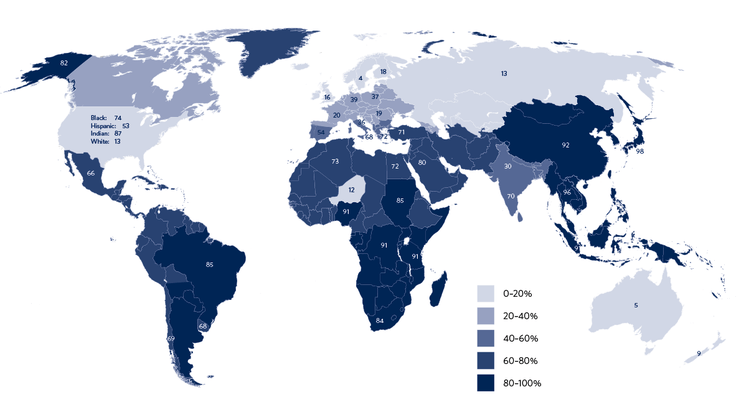
The above map shows lactose intolerance for countries around the world. Ancient Europeans began dairying around 7500 ya and were lactose intolerant when starting to drink milk. But along with faster evolution, which includes no gene flow from other parts of the world, that led to Europeans evolving to, on average, have lower rates of lactose intolerance.
People should really learn what they’re talking about before they say it.
The way to know whether or not they are beneficial is to quit them for a period and see how you feel.
Placebo effect.
Currently, because the scientific literature on these topics is so convoluted and debated on, there is no other conceivable way to prove it one way or another than through our own testing.
The science is pretty solid on this. Anecdotes don’t mean anything to studies.
Many have referred to paleo as a “fad diet.” And it may be a diet that is a fad, but it is also a diet with a thousands upon thousands of years long precedent. One might even suggest that it is the consumption of grains and dairy that are the “fad,” as it is a relatively new trend, in the scope of things.
It IS A FAD DIET ; with NO basis in science that Europeans should eat that way.
If you feel as if you are at peak physical health eating grains and dairy, and have no desire to spend time trying to improve on this, than by all means skip the challenge.
Is he implying that the Paleo Diet is the only diet that doesn’t allow grains and dairy? Not true at all. The Slow Carb Diet is the same, as well as any other high fat, high protein low-carb diet.
We should also note that the definitions of vegetarianism were different then, and Hitler did eat eggs and probably wasn’t completely meat-free.
That’s vegetarianism. Veganism is the more extreme one you’re thinking of where absolutely no animal products are consumed at all.
Vegetarian diets are shown to lead to vitamin inadequacies such as zinc, calcium, iron, manganese, selenium, and copper. Vegetarianism works, it just has to be well-planned. You need to make sure you get the right amount of essential as well as non-essential amino acids, high amounts of protein and make sure you’re not nutrient deficient.
Last time I wrote that White rice and potatoes are good carbs, but I want to be clear that they are not necessary unless you are both already at 5% body weight and you are highly active.
They are not ‘good carbs’. They are white carbs, which are bad for us if we don’t go to the gym to utilize the CHO being ingested. Five percent body-fat? That’s for competition bodybuilders and marathon and distance runners. The average person will never cut down to the level of body-fat. CHO is extremely useful if you’re highly active and go to the gym.
Even if you are not active, you need to consume a decent amount of carbs once a week in order to keep your metabolism from slowing down too much. However, it is probably preferable to use fruits for this purpose, as they contain more micronutrients.
Correct. If you eat a low-carb diet, you need a CHO refeed once a week to keep metabolism high. Though, using fruits is stupid. I know the Paleo thing, but there are many reasons why fructose (the sugar found in fruit) is bad for you. Sugar is just as addictive as cocaine. So telling the average person to ‘use fruits for this purpose’ is stupid, as the average person doesn’t know when to stop eating.
Yes, this diet will technically cost more than a processed foods and grain-based diet, all things being equal. The only reason anyone ever ate grains in the first place is because they were cheap, and processed foods were invented for the same reason. Any natural and healthy diet is going to cost more, all things being equal. However, things don’t have to be equal.
Wrong. Whole foods are not more expensive. The conclusion that was (obviously) reached is that there is expensive and non-expensive junk food as well as whole foods. I personally spend 70 dollars a week on food for myself, with all of my meals planned out. Natural diets will not cost more, all things being equal. If you know how to eat and how to buy food, you will avoid spending too much money.
I tried to answer most of the questions people had in the last thread, but it was so filled up with denialism I could have missed something. So ask here.
I hope you answer this, as well as my other refutation of your horrible nutrition article. I doubt it though.
How did we really evolve to eat?
The most common form of eating, 3 meals a day, is abnormal from an evolutionary perspective. We didn’t evolve eating 3 times a day. We evolved eating intermittently. The study says that intermittent energy restriction periods of up to 16 hours are fine. Long-term calorie restriction is highly effective in reducing the risk for atherosclerosis in humans. Again, another huge benefit for intermittent fasting. As the data comes out on human cohorts, we will be able to see all of the great effects that IF has for us, because that’s how any human population, no matter where they evolved, evolved eating.
There are beneficial effects to IF including reduced oxidative damage and increased cellular stress resistance. Rats put on an IF diet show heightened life-spans. IF is also extremely useful to keep a youthful brain as you age.
There are a mountain of studies that show how beneficial IF is to us and is the TRUE way humans evolved to eat, not any specialized diets. We evolved eating intermittently, and with our hedonistic society we live in now, along with low ability to delay gratification, as well as other factors I have covered in my previous nutrition articles, have led to the effects we see in America, and around the world today.
In conclusion, don’t listen to people who have no background in nutrition. They tell clearly wrong information, and those who aren’t privy to new information in the nutrition world, won’t know that they are being lied to and or manipulated into believing things based on shoddy evidence.
When Was Writing Invented?
Was writing first invented by the Sumerians? Before then? A lot of people seem to have misconceptions about what actually constitutes ‘writing’ and it’s predecessor ‘proto-writing’. Today I will touch on writing’s beginnings, as well as confusion of what writing is and is not.
Writing was first invented in Sumeria around 3200 B.C. What people confuse with writing is proto-writing, which is a precursor to writing. The word writing is defined as the activity of skill of marking coherent words on text. Therefor, proto-writing is not writing.
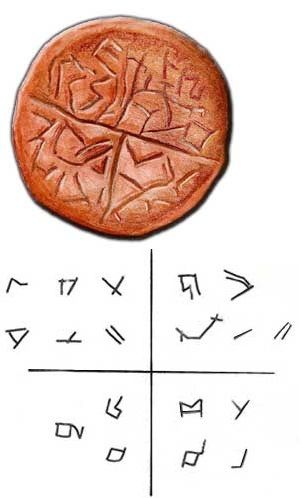
Above is a picture of the Karanovo Seal. People like to say that that denotes writing having it’s beginnings in Southeastern Europe in Romania around 7000 years ago. But that is proto-writing and not what we would call “writing” today. The Seal was made by the Vinca culture of Southeastern Europe. It is devoid of logograms, which is a written symbol representing an entire spoken word without expressing its pronunciation. The Seal is also of the Zodiac, and not any actual writing. It roughly matches up to the constellations when divided up in to four quadrants.

The Tartaria Tablets (which the Karanovo Seal is included with) were excavated in 1961 in Romania. People say that the above is writing. To quote Professor Colin Renfrew:
“To me, the comparison made between the signs on the Tărtăria tablets and those of proto-literate Sumeria carry very little weight. They are all simple pictographs, and a sign for a goat in one culture is bound to look much like the sign for a goat in another. To call these Balkan signs ‘writing’ is perhaps to imply that they had an independent significance of their own communicable to another person without oral contact. This I doubt.”
Steven Fischer writes in his book History of Writing:
The current opinion is that these earliest Balkan symbols appear to comprise a decorative or emblematic inventory with no immediate relation to articulate speech.
Proto-writing=/=writing. It doesn’t convey text and syllables and logographs. A logograph is 1 word represented by a single sign. For something to be classified as writing, it needs to have logograms and phonographs, which are signs holding purely phonetic or sound value.
The New World Encyclopedia says that those ‘writings’ cannot be called proper writing due to the fact that they are ancient traditions of symbol systems.
Now that we have a good understanding of proto-writing and what is and is not writing, lets touch on where writing was developed.
The five original writing systems were developed by the Sumerians of Mesopotamia, the Maya of Central America, the Ancient Egyptians of Egypt, the Dravidians of India and the Chinese of China. Though, the only remaining language in use is Chinese.
All five of the writing systems mentioned above use logograms, phonograms and syllables. All five of those writing systems can be spoken, which denote writing and language. The Tartaria Tablets, including the Koronovo Seal, cannot be spoken from, as the Seal is for the Zodiac and the Tablets are a form of proto-writing that cannot be spoken due to no logograms or phonograms.
Refuting Richard Nisbett
3100 words
The environmental model on IQ in the debate on not only IQ as a whole, but in racial differences in intelligence has led to horrible policies throughout the world. Thinking that we are all equal and everyone is the same and has the same potential as the next person has really hurt us as a society.
Richard Nisbett is of the egalitarian (nurture) side of the debate on the black-white IQ gap. His main research has focused primarily on how laypeople reason and make presumptions about the world. His more recent work has focused on comparing East Asians and Westerners, and how and if they think differently. He says that the arguments have been made that Westerners learn analytically, focusing on the object and its attributes, use its attributes to categorize it and apply rules based on the category to explain and predict behavior. He says that East Asians reason holistically, focusing on the object in its surrounding field. There is little concern with categories or universal rules and behavior is explained on the basis of the forces presumed to be operative for the individual case at that particular time. This goes with white’s higher verbal IQ, as well as going with East Asian’s higher visio-spatial IQ. He says that his lab has found evidence for both.
Now that there is some background on Nisbett and his research interests, let’s turn to the B-W IQ gap.
Rushton and Jensen have refuted him multiple times. In their paper Race and IQ: A Theory-Based Review of the Research in Richard Nisbett’s Intelligence and How to Get It, they provide more than sufficient evidence that the B-W IQ gap, as well as other racial differences in intelligence, are genetic in origin. They propose that the hereditarian model (50/50 genetics/culture) better explains group differences than the culture-only model (0/100 genetics environment). They review 14 topics of contention which are: (1) data to be explained; (2) malleability of IQ test scores; (3) culture-loaded versus g-loaded tests; (4) stereotype threat, caste, and “X” factors; (5) reaction-time measures; (6) within-race heritability; (7) between-race heritability; (8) subSaharan African IQ scores; (9) race differences in brain size; (10) sex differences in brain size; (11) trans-racial adoption studies; (12) racial admixture studies; (13) regression to the mean effects; and (14) human origins research and life-history traits. They conclude that the preponderance of evidence concludes that differences in intelligence, as well as other life-history traits between the races, are genetic (50 to 80 percent) in origin.
I will be quoting from this article Nisbett wrote for the New York Times, All Brains Are the Same Color.
JAMES WATSON, the 1962 Nobel laureate, recently asserted that he was “inherently gloomy about the prospect of Africa” and its citizens because “all our social policies are based on the fact that their intelligence is the same as ours — whereas all the testing says not really.”
Ah yes. What a great day that was when Watson said that. It needed to be said. The conversation on exactly why Africans are starving needs to be had. No, the answer is not colonialism. It’s intelligence. I’ve touched on how Kanazawa got attacked for stating that Africa’s woes are due to low intelligence, where the average is 70. Just as how Watson got attacked. Except since Watson is more well-known than Kanazawa, the PC crowd attempted to run him out of town. Watson is 100 percent correct with that statement.
Dr. Watson’s remarks created a huge stir because they implied that blacks were genetically inferior to whites, and the controversy resulted in his resignation as chancellor of Cold Spring Harbor Laboratory. But was he right? Is there a genetic difference between blacks and whites that condemns blacks in perpetuity to be less intelligent?
Blacks are genetically inferior to whites in intelligence, on average, just as West African blacks and their descendants are genetically superior in sprinting competitions and East Africans and their descendants are superior in distance running (the same as whites as both have the same muscle fiber type that allows for endurance running). Are we really to think that East Asians are superior nowhere? Clearly ridiculous. We know of Rushton’s Rule of Three, which holds through most all of the variables between races. Yes, there is a genetic difference in intelligence that will condemn blacks in perpetuity to be less intelligent.
The first notable public airing of the scientific question came in a 1969 article in The Harvard Educational Review by Arthur Jensen, a psychologist at the University of California, Berkeley. Dr. Jensen maintained that a 15-point difference in I.Q. between blacks and whites was mostly due to a genetic difference between the races that could never be erased. But his argument gave a misleading account of the evidence. And others who later made the same argument — Richard Herrnstein and Charles Murray in “The Bell Curve,” in 1994, for example, and just recently, William Saletan in a series of articles on Slate — have made the same mistake.
One of my favorite papers, the one that reignited the B-W IQ debate. Titled How Much Can We Boost IQ and Scholastic Achievement, he argues that scholastic achievement and IQ can’t be boosted to any meaningful level. He says prenatal effects such as nutrition, the length of pregnancy, maternal stress and environment within the uterus has an effect on IQ, whereas any postnatal (environmental) explanations have not been found to show a lowered IQ, except those kept in isolation. Let’s see what the ‘misleading account of the evidence’ he is talking about.
In fact, the evidence heavily favors the view that race differences in I.Q. are environmental in origin, not genetic.
See the Rushton and Jensen paper, as well as the Jensen paper I linked above. Any environmental explanation for racial differences in IQ can easily be explained away due to bad study design, or simply not testing the children again at adulthood, as any instances where blacks showed they had higher IQs than whites, they were never tested again at adulthood. Just so happens, that around age 10-12, where most of these tests get administered, is when the racial gap starts to become extremely noticeable. To think that race differences in IQ are environmental and not genetic is laughable.
The hereditarians begin with the assertion that 60 percent to 80 percent of variation in I.Q. is genetically determined. However, most estimates of heritability have been based almost exclusively on studies of middle-class groups. For the poor, a group that includes a substantial proportion of minorities, heritability of I.Q. is very low, in the range of 10 percent to 20 percent, according to recent research by Eric Turkheimer at the University of Virginia. This means that for the poor, improvements in environment have great potential to bring about increases in I.Q.
Rushton and Jensen state in the refutation of Nisbett I linked that non-white samples show the same heritabilities as white samples.There is little evidence of any cultural, or hardship differences, such as being raised as a visible minority, in one group and not the other. If blacks had heritabilities that were consistently lower than white heritabilities, then we could conclude that racism and poverty were responsible for a lower IQ in blacks. Though when a researcher compared black and white IQs on 3 tests, he found that heritabilities were 50 percent in each group. “The heritabilities in the Basic, Primary, and Cattell tests were, respectively: Whites—.61, .37, and .71; Blacks—.75, .42, and .19.”
On Turkheimer, they say that he was right that he did find gene x environment interactions that made genetic influences weaker and shared environment stronger for those from poorer homes in comparison to those from more affluent homes. Though most studies show no interaction effects, or interactions vary significantly.
Other studies have shown that heritabilities are the same both within as well as between white and black samples. That led Jensen to label this the ‘default hypothesis’. Researchers analyzed full and half siblings from the NLSY on three Peabody Achievement Tests. 161 black full siblings, 106 pairs of black half siblings, 314 pairs of full white siblings and 53 pairs of white half-siblings. with measures in math and reading. The best fitting model for all of the data was by which the sources of the sources of the differences between those within race and the differences between races were the same, at 50 percent genetic and environmental. The combined model (50/50) best explains it, whereas the culture-only and genetics-only models are inadequate.
In any case, the degree of heritability of a characteristic tells us nothing about how much the environment can affect it. Even when a trait is highly heritable (think of the height of corn plants), modifiability can also be great (think of the difference growing conditions can make).
Skewed perception on only working with young children. Heritabilities range from 20 percent to 90 percent from the time someone is a toddler to adulthood. He wouldn’t see the same in adult populations.
There is, for example, the evidence that brain size is correlated with intelligence, and that blacks have smaller brains than whites. But the brain size difference between men and women is substantially greater than that between blacks and whites, yet men and women score the same, on average, on I.Q. tests. Likewise, a group of people in a community in Ecuador have a genetic anomaly that produces extremely small head sizes — and hence brain sizes. Yet their intelligence is as high as that of their unaffected relatives.
Men and women don’t score the same on average. Rushton and Jackson found that on average, men had an edge on IQ tests, scoring 3.63 points higher than women. The people from Ecuador are dwarfs, encephalization quotient explains that, as well as brain size to non-fat mass being most important. Back to Rushton’s Rule of Three, East Asians have bigger brains and more neurons, whites intermediate and blacks last.
About 25 percent of the genes in the American black population are European, meaning that the genes of any individual can range from 100 percent African to mostly European. If European intelligence genes are superior, then blacks who have relatively more European genes ought to have higher I.Q.’s than those who have more African genes. But it turns out that skin color and “negroidness” of features — both measures of the degree of a black person’s European ancestry — are only weakly associated with I.Q. (even though we might well expect a moderately high association due to the social advantages of such features).
Funny. Rushton and Jensen refuted this 2 years before Nisbett wrote this article. Rushton and Jensen say that in certain areas of the Deep South, black IQ is around 70, consistent with the hereditarian explanation of effects of hybridization. An average IQ of 71 was found for all black children in one district, whereas it was 101 for whites (Jensen, 1977). Also, Lynn (2002) and Rowe (2002) analyzed IQ scores for those that are mixed black and white and found scores in between 100 and 85, around 93. Though they do say that evidence isn’t conclusive on the matter. They say Cape Coloreds and African Americans may have better nutrition, or are treated better in society. The Minnesota Study held many variables constant, and still the mixed race children had higher IQs. That supports the genetic hypothesis.
During World War II, both black and white American soldiers fathered children with German women. Thus some of these children had 100 percent European heritage and some had substantial African heritage. Tested in later childhood, the German children of the white fathers were found to have an average I.Q. of 97, and those of the black fathers had an average of 96.5, a trivial difference.
Nope. Doesn’t work that way, Nisbett.
If European genes conferred an advantage, we would expect that the smartest blacks would have substantial European heritage. But when a group of investigators sought out the very brightest black children in the Chicago school system and asked them about the race of their parents and grandparents, these children were found to have no greater degree of European ancestry than blacks in the population at large.
Strawman. No one says there aren’t any smart blacks.
Most tellingly, blood-typing tests have been used to assess the degree to which black individuals have European genes. The blood group assays show no association between degree of European heritage and I.Q. Similarly, the blood groups most closely associated with high intellectual performance among blacks are no more European in origin than other blood groups.
Correct. Though, the studies failed to choose genetic markers with large allele frequencies between Europeans and Africans (Jensen, 1998b pg 480).
A superior adoption study — and one not discussed by the hereditarians — was carried out at Arizona State University by the psychologist Elsie Moore, who looked at black and mixed-race children adopted by middle-class families, either black or white, and found no difference in I.Q. between the black and mixed-race children. Most telling is Dr. Moore’s finding that children adopted by white families had I.Q.’s 13 points higher than those of children adopted by black families. The environments that even middle-class black children grow up in are not as favorable for the development of I.Q. as those of middle-class whites.
“Superior”. I touched on Moore here in my ‘Blank Slate’ article:
Another is the Moore study, which tested 23 black adopted children and 23 black children adopted by middle class black families. Their findings indicated that blacks adopted to black families scored at 104 compared to the blacks adopted by white families who scored at 117. People may point to this and say “Well, they didn’t differ in their environment and not their genes, so therefor the B-W IQ gap is 100 percent environmental.” Ridiculous. As with the other 2 studies, they were not tested again at adulthood. To say that any of these 3 studies mentioned above prove a 100 percent environmental cause is intellectually dishonest.
Not worth talking about either.
Important recent psychological research helps to pinpoint just what factors shape differences in I.Q. scores. Joseph Fagan of Case Western Reserve University and Cynthia Holland of Cuyahoga Community College tested blacks and whites on their knowledge of, and their ability to learn and reason with, words and concepts. The whites had substantially more knowledge of the various words and concepts, but when participants were tested on their ability to learn new words, either from dictionary definitions or by learning their meaning in context, the blacks did just as well as the whites.
Nothing strange here. Blacks have a high verbal IQ in comparison to their visio-spatial. Rushton thought that black rappers and entertainers had high verbal IQs.Also, people from the same Community College would have, on average, around the same intelligence.
Whites showed better comprehension of sayings, better ability to recognize similarities and better facility with analogies — when solutions required knowledge of words and concepts that were more likely to be known to whites than to blacks. But when these kinds of reasoning were tested with words and concepts known equally well to blacks and whites, there were no differences. Within each race, prior knowledge predicted learning and reasoning, but between the races it was prior knowledge only that differed.
That environment can markedly influence I.Q. is demonstrated by the so-called Flynn Effect. James Flynn, a philosopher and I.Q. researcher in New Zealand, has established that in the Western world as a whole, I.Q. increased markedly from 1947 to 2002. In the United States alone, it went up by 18 points. Our genes could not have changed enough over such a brief period to account for the shift; it must have been the result of powerful social factors. And if such factors could produce changes over time for the population as a whole, they could also produce big differences between subpopulations at any given time.
In fact, we know that the I.Q. difference between black and white 12-year-olds has dropped to 9.5 points from 15 points in the last 30 years — a period that was more favorable for blacks in many ways than the preceding era. Black progress on the National Assessment of Educational Progress shows equivalent gains. Reading and math improvement has been modest for whites but substantial for blacks.
Nope. The data that Murray uses only shows those of the same age, which is the accurate model. Others use those from all age groups, skewing the findings due to different heritabilities at different ages.
Most important, we know that interventions at every age from infancy to college can reduce racial gaps in both I.Q. and academic achievement, sometimes by substantial amounts in surprisingly little time. This mutability is further evidence that the I.Q. difference has environmental, not genetic, causes. And it should encourage us, as a society, to see that all children receive ample opportunity to develop their minds.
Yes, interventions from infancy all the way to the end of grade school help, as genes explained only 22 percent of the variance in those at age 5, 40 percent at age 7 and 82 percent at age 18. IQ differences can be changed in younger children, as they are more malleable at younger ages as I have just noted. But as they age, to quote Jensen, their genes “turn on” and fall to the average for that racial grouping.
People like us need to refute these lies that attempt to say that we are all the same and that any and all intelligence and scholastic achievements are environmental in origin and not largely genetic, as Rushton and Jensen have argued vehemently over the years. I will close with the final paragraph of the paper that Rushton and Jensen refuted Nisbett on sums up this situation perfectly:
There is no value in denying reality. While improving opportunities and removing arbitrary barriers is a worthy ethical goal, we must realize that equal opportunity will result in equitable, though unequal outcomes. Expanding on the application of his “default hypothesis” that group differences are based on aggregated individual differences, themselves based on both genetic and environmental contributions, Jensen [59] proposed “two laws of individual differences”—(1) individual differences in learning and performance increase as task complexity increases, and (2) individual differences in performance increase with practice and experience (unless there is a low ceiling on proficiency). We must recognize that the more environmental barriers are ameliorated and everybody’s intellectual performance is improved, the greater will be the relative influence of genetic factors (because the environmental variance is being removed). This means that equal opportunity will result in unequal outcomes, within-families, between-families, and between population groups. The fact that we have learned to live with the first, and to a lesser degree the second, offers some hope we can learn to do so for the third.
People like us need to defend men who are no longer here to defend their work, in Rushton and Jensen. The environmental explanation for IQ, as well as racial differences in IQ, is preposterous. To think that a full environmental causality actually means anything to intelligence is clearly a pipe dream.
BEHAVIOR=GENES+ENVIRONMENT NEEDS TO DIE: Vindication!
1800 words
So I was at Barnes N Noble a few weeks ago and picked up this book called ‘This Idea Must Die‘. It has a ton of researchers who wrote for it. Each person writes a short, 3 to 4 page writing on what idea must die and why. it’s a great read so far. Jared Diamond, Steven Pinker and Richard Dawkins wrote for it.
Now, I just came to this section in the book where Steven Pinker talks about behavior=genes+environment. To quote Pinker from the book:
Would you say that the behavior of your computer or smartphone is determined by an interaction between its inherent design and the way it is influenced by the environment? It’s unlikely; such a statement would not be false, but it would be obtuse. Complex adaptive systems have a nonrandom organization , and they have inputs. But speaking of inputs as “shaping” the system’s behavior, or pitting its design against its input, would lead to no insight as to how the system works. The human brain is far more complex, and processes its input in more complex ways, than human-made devices, yet many people analyze it in ways that are too simplistic for our far simpler toys. Every term in the equation is suspect.
Behavior: More than half a century after the cognitive revolution, people still ask whether a behavior is genetically or environmentally determined. Yet neither the genes nor the environment can control the muscles indirectly. The cause of the behavior is the brain. While it’s sensible to ask how emotions, motives, or learning mechanisms have been influenced by genes, it makes no sense to ask this of behavior itself. (Emphasis mine.)
Genes: Molecular biologists have appropriated the term “gene” to refer to the stretches of DNA that code for a protein. Unfortunately, this sense differs from the one used in population genetics, behavioral genetics and evolutionary theory – namely, any information carried that’s transmittable across generations and has sustained effects on the phenotype. This includes any aspect of DNA that can affect gene expression, and is closer to what is meant by “innate” than genes in the molecular biologists’ narrow sense. The confusion between the two leads to innumerable red herrings in discussions of out makeup, such as the banality that the expression of genes (in the sense of protein-coding stretches of DNA) is regulated by signals from the environment. How else could it be? The alternative is that every cell synthesizes every protein all the time! The epigenetics bubble inflated by the science media is based on a similar confusion. (Emphasis mine.)
Environment: This term for the inputs to an organism is also misleading. Of all the energy impinging on an organism, only a subset, processed and transformed in complex ways, has an effect on its subsequent information processing. Which information is taken in, how it’s transformed, and how it affects the organism (that is, the way the organism learns) all depend on the organisms innate organization. To speak of the environment “determining” or “shaping” behavior is unperspicuous.(Emphasis mine.)
Even the technical sense of “environment”used in quantitative behavioral genetics is perversely confusing. Now, there’s nothing wrong with partitioning phenotypic variance into components that correlate with genetic variation (heritability) and with variation among families (“shared environment”). The problem comes from so-called “nonshared” or “unique” environmental influences. This consists of all the variance attributable to neither genetic nor familiar variation. In most studies, it’s calculated as 1 – (heritability + shared environment). Practically, you can think of it as the differences between identical twins who grow up in the same home. They share their genes, parents, older and younger siblings, school, peers, and neighborhood. So what could make them different? Under the assumption that behavior is a product of genes plus environment, it must be something in the environment of one that is not in the environment of the other.
But this category really should be called “miscellaneous/unknown,” because is has nothing necessarily to do with any measurable aspect of the environment, such as one sibling getting the top bunk and the other the bottom, or a parent unpredictably favoring one child, or one sibling getting chased by a dog, coming down with a virus, or being favored by a teacher. These influences are purely conjectural, and studies looking for them have failed to find them.The alternative is that this component actually consists of the effects of chance – new mutations, quirky prenatal effects, noise in brain development, and events in life with unpredictable effects. (Emphasis mine.)
Stochastic effects in development are increasingly being recognized by epidemiologists, frustrated by such recalcitrant phenomena such as nonagenarian pack-a-day smokers and identical twins discordant for schizophrenia, homosexuality, and disease outcomes. They’re increasingly forced to acknowledge that God plays die with our traits.(Emphasis mine.) Developmental biologists have come to similar conclusions. The bad habit of assuming that anything not classically genetic must be “environmental” has blinkered behavioral geneticists (and those who interpret their findings) into the fool’s errand of looking for environmental effects foe what may be randomness in the developmental processes. (Emphasis mine.)
A final confusion in the equation is the seemingly sophisticated add-on of “gene-environment interactions.” This is also designed to confuse. Gene-environment interactions do not refer to the fact that the environment is necessary for genes to do their thing (which is true of all genes). It refers to a flipflop effect inn which the genes affect a person one way in one environment but another way in another environment, whereas an alternative gene has a different patter. For example, if you inherit allele 1, you are vulnerable: a stressor makes you neurotic. If you inherit allele 2, you are resilient: a stressor leaves you normal. With either gene, if you are never stressed, you are normal.
Gene-environment interactions in this technical sense, confusingly, go into the “unique environmental” component, because they’re not the same (on average) in siblings growing up in the same family. Just as confusingly, “interactions” in the commonsense – namely, that a person with a given genotype is predictably affected by the environment – goes into the “heritability” component, because the quantitative genetics measures only correlations. This confound is behind the finding that the heritability of intelligence increases, and the effects of shared environment decrease, over a person’s lifetime. One explanation is that genes have effects late in life, but another is that people with a given genotype place themselves in environments that indulge their inborn tastes and talents. The “environment” increasingly depends on their genes, rather than being the cause of exogenous behavior. (Emphasis mine.) (pg 188-191 This Idea Must Die)
I’m pretty excited about this. I have said for a while, to quote Douglas Whitman:
Race is not a social construct. Society is a racial construct. Society and culture derive from race/biology
You can see the effects from race/biology anywhere in the world you look and see the majority racial/ethnic mix of a country and/or area. A place is ONLY as good as its majority population.
We can see the kinds of effects this will have on our society as a whole. The way all of these 3rd worlders are flooding in to our countries. They leave their countries, to come to ours (in the West), and they don’t realize that once they become the majority and displace the native populations of the countries, that the place they will be living in will be just as bad, or even worse than where they came from.
Now, what Pinker said about the nonshared environment was really interesting. Especially at the end where he says ‘The “environment” increasingly depends on their genes, rather than being the cause of exogenous behavior.’
What does that mean? You can see this, for the most part, whenever there are new immigrants to an area. They still act how they did back in their home countries. The native peoples of the country have a certain way they act, and so do the immigrants to that country. The native peoples environment is an expression of their genetics. The new environment that the new immigrants bring to the country is also an expression of genetics. So, we can see just with what Pinker explained above, that environment itself doesn’t dictate behavior, but GENES DICTATE BEHAVIOR AND ALSO THE ENVIRONMENT THAT GETS CREATED.
So, it seems that those with certain genes place themselves in environments that indulge their inborn tastes and talents. “Environment” INCREASINGLY DEPENDS ON THEIR GENES RATHER THAN BEING THE CAUSE OF EXOGENOUS BEHAVIOR.
We know that genes are the driving force in life, and with this new ‘epigenetic’ field of genetics, they will attempt to say that environment is the main cause of molding genetics because one may have different things happen to them in one environment and not the other. But, since we have just seen here that those with certain genes put themselves into their environments, what does this say about certain people you may know? Does this mean that their genes put them in their situation? Well, for the most part, yes.
If one chooses their environment based on their genetic makeup, wouldn’t that throw out any and all environmental interactions?
For instance, how leftists say that negros can’t help it and are ‘born in to poverty’. Negros, as well as other low IQ peoples, choose their environment based on their genetics.
THE ENVIRONMENT YOU CHOOSE IS BASED ON YOUR GENETICS. THE PEOPLE DICTATE THE ENVIRONMENT OF A PLACE.
Growing up in a bad environment does not make you a bad person, sorry to say, but your genes make you a bad person. People seem to have the wrong idea about how environment interactions work with genes. I’m glad this came out.
This is inferred from what Pinker said. This is also explicitly said in the Whitman quote.
This new “epigenetic revolution” needs to die. It is saying that gene x environment interactions matter, when it really is the opposite. What is really happening is that individuals group up, due to genetic similarity theory, the theory proposed by Rushton after noticing that each ethnic group basically stayed with each other, along with their genetics that dictates their environment to live in. By putting so many genetically similar people in the same environment, in this case, immigrants, you will, therefore, get the same situation of how the conditions in their countries were, due to genetic similarity theory having them be with peoples of similar genetics, as well as their genes dictating their environments.
BEHAVIOR=GENES+ENVIRONMENT NEEDS TO DIE!!
IQ defines culture culture doesn’t define IQ
2500 words
People seem to be confused when it comes to IQ and culture. IQ is what determines the culture, the culture does not determine IQ
The Minnesota Transracial Adoption Study: A Follow-Up of IQ Test Performance at Adolescence
Adopting parents tested when children were 7 and 17 120 115 — — —
Non adopted, with two white biological parents 116 109 3.0 64 69
Adopted, with two white biological parents 118 106 2.8 54 59
Adopted, with one white and one black biological parent 110 99 2.2 40 53
Adopted, with Asian or indigenous American parents 101 96 — — —
Adopted, with two black biological parents 95 89 2.1 36 42
The first column is age 7 IQ. Second is age 17 IQ. Third is age 17 GPA. Fourth is age 17 class rank(percentile) Fifth is age 17 school aptitude(percentile.
Levin and Lynn (1994) then disputed Weinberg et al’s conclusion with a hereditarian alternative. That the average IQ and school achievement scores of the black children directly reflected their amount of African ancestry. At both age 7 and 17, the adopted children with 2 black parents had lower average IQs and worse school achievement tests than those with one black parent and one white parent. So right here, in the MTAS, it shows that mixed-race people DO score better than just blacks, which is attributed to their white ancestry. Weinberg et al responds to their claims with this:
Waldman, Weinberg, and Scarr (1994) responded to Levin (1994) and Lynn (1994) with further regression analyses that indicated the children’s preadoptive experience was confounded with racial ancestry, and so an unambiguous interpretation of the results was not possible. [pg 259]
THIRTY YEARS OF RESEARCH ON RACE DIFFERENCES IN COGNITIVE ABILITY
Why people attempt to deny these truths is beyond me. It’s clear there are cognitive, as well as behavioral differences between races, but the egalitarians attempt to make it out to be a 100 percent environment cause, which is a ridiculous statement to make.
What this tells me is that obviously, there are differences between the races. These were children adopted by upper-middle-class white families in Minnesota. Therefore negating any leftist argument of socioeconomics and broken homes or whatever other excuses they want to come up with.
The adopting parents of 12 of the interracial children wrongly believed that their adopted children had two black parents. The average IQ of these 12 children was not significantly different from the scores of the 56 interracial children correctly classified by their adoptive parents as having one black and one white parent.
Now, this doesn’t say which parent is which race. But, let’s assume that the mother is white. As seen at the end of the study, white mothers and black fathers produce generally intelligent kids. Is it the genes from the mother giving the intelligence? Is it that white women are better caretakers for children then African-American women? I believe it is the intelligence factor from the white woman. We have tons of anecdotes where half-breeds are generally intelligent and have good success in life. Is this because of the white mother with her genes? My guess is, yes. As I said, IQ is what determines the culture, the culture does not determine IQ
IQ scores have high predictive validity for individual differences in school achievement.
IQ scores have predictive validity for adult occupational status, even when variables such as education and family background have been statistically controlled.
There is little evidence to show that childhood diet influences intelligence except in cases of severe malnutrition.
The Bell Curve is hotly debated, but IMO it is debated because they know the authors were on to something and it would have destroyed the narrative that we are all the same, just different colors. People get shunned all the time.
Like Dr. James Watson. A great man. One of the greatest scientists in of this century is shunned. He had to sell his Nobel Prize. Why? People are scared of the truth. They know that their views of egalitarianism were about to be shattered, so let’s shun the man who brings these “radical views.”
The argument of socioeconomic status is the cause for the negros low IQ has been disproven time and time again. IQ is what determines the culture, the culture does not determine IQ. Do you think if Europeans and Asians were to have the same IQ as Africans, which is 70, that we would be living in this society we are in today?
The typical leftist response to IQ tests is that the negro doesn’t know anything on the test. That they are “white IQ tests” therefore making the negro fail by default as the white man made the test to prove his superiority. But if that’s the case, why do Asians score higher?
I look at the advancements of Africans over time. Pretty much the same throughout history. Not really anything. No wheel, boat, or written language.
For instance, Africans have longer limbs, can sprint for longer distances and have higher stamina. This works out with what they had to do in Sub-Saharan Africa. They had to chase food, chuck spears etc. For the most part, African climate stayed the same pretty much all year round. They didn’t have to plan ahead. Could this be the reason that so many negros are so impulsive?
Then what would have become Europeans migrated north, they had the elements to contend with. They had to plan ahead. They had to be strategic with their food as to not be wasteful. Also, body hair came as an advantage to help keep them warm. Also, Europeans have medium length limbs.
Asians (Mongoloids) had to contend with the cold. They have shorter limbs as there is less surface area, so it’d be easier for them to get warm. Their eyes are that way from fat deposits to help keep them warm.
Last week, scientists said that modern Europeans share a number of genes involved in the build-up of certain types of fat with Neanderthals. The same genes were not seen in people from Asia and Africa, however. It is thought that ancient genes might have helped Europeans adapt better to colder climates, giving them an evolutionary advantage. This is the first time we have seen differences in lipid concentrations between populations,’ said evolutionary biologist Philipp Khaitovich the Max Planck Institute for Evolutionary Anthropology in Leipzig, Germany and the CAS-MPG Partner Institute for Computational Biology in Shanghai, China. ‘How our brains are built differently of lipids might be due to Neanderthal DNA.’
The study also uncovers a more accurate timescale for when humans and Neanderthals interbred, and finds evidence for an early contact between the European hunter-gatherers and those in the Middle East — who would later develop agriculture and disperse into Europe about 8,000 years ago, transforming the European gene pool. Scientists now believe Eurasians separated into at least three populations earlier than 36,000 years ago: Western Eurasians, East Asians and a mystery third lineage, all of whose descendants would develop the unique features of most non-African peoples — but not before some interbreeding with Neanderthals took place.
Everyone living outside of Africa today has a small amount of Neanderthal in them, carried as a living relic of these ancient encounters. A team of scientists comparing the full genomes of the two species concluded that most Europeans and Asians have between 1 to 4 percent Neanderthal DNA. Indigenous sub-Saharan Africans have no Neanderthal DNA because their ancestors did not migrate through Eurasia.
Now, how does all of this say that low IQ dictates culture and not vice versa? The fact that some people say that culture dictates IQ makes me believe that they don’t understand evolution.
Look at Europeans and Asians. They had to weather extremely cold climates. They had to plan ahead. They generally had to be on their toes all the time because of the harsh climates of Europe and Asia.
Now let’s get to the negro. They stayed in one place. Their climate allowed for basically the same food to grow year round. They didn’t have to plan ahead. Sound familiar? In my opinion, the negro is this way for 2 reasons.
Both teams found that non-African genomes have large continuous “deserts” that are totally devoid of Neanderthal DNA. These regions include genes such as FOXP2, which is involved in motor coordination and could play an important role in human language and speech.
2 No extremes in climate.
I truly believe that how Europeans and Asians had to weather such extremes in the places they lived brought us to where we are today. They had to plan ahead. The negro didn’t. This is the reason for their low IQ. They were never challenged, no Neanderthal DNA and a steady hardly ever changing climate. It is theorized that when the Europeans went north into what is now Europe, they mated with Neanderthals. The old Hominids were violent. They killed off the Neanderthals.
Now let’s think about today. Blacks have higher testosterone than every race. High testosterone is linked to aggressive behavior. Also, think about how blacks always say they didn’t do it or some variation thereof. It is because they lack abstract thought. So along with the lack abstract thought, high testosterone, low IQ, all of the cited sources about no Neanderthal DNA, their lack of being in a cold climate, among other things is the reason for the way the negro is. The low IQ drives this.
They didn’t have the high IQ that leads to the innovations that Europeans and Asians had. This can be seen even today, with how the African lives their daily life.
Now, with all this being said, does IQ determine the culture or the culture determine IQ?
My point to this essay is that IQ determines culture. Culture does not determine IQ. I see some people saying that negros are dumb because of the environment they live in. This is so far from the truth. Also that their socioeconomic status prevents them from this and that. That their schools are bad. Well, we have one common denominator: negros.
They say the schools are bad. Their area is bad. Well again, one common denominator: negros. We have mountains of evidence, both scientific and anecdotal, that say that negros are less intelligent than Europeans and Asians. Why this is still denied is beyond me.
Yes, we all know that “good blacks” exist. But, they are statistical anomalies. In any big group, you will have outliers. Where are all of these Africans with their major innovations bringing them out of the rut their in? That’s because their IQ doesn’t allow them to think in ways that Europeans and Asians do.
I hope that some of these points have changed some minds on the matter. Negros can not live in first world societies. Hell, they can’t even make their own and they live in ours when it clearly doesn’t work out? The negro is not fit to live in America. IQ is the reason why. These reasons are why they can’t live in first world countries.
IQ is what determines the culture, the culture does not determine IQ
Low IQs are Africa’s curse, says lecturer
Satoshi Kanazawa, an evolutionary psychologist, is now accused of reviving the politics of eugenics by publishing the research which concludes that low IQ levels, rather than poverty and disease, are the reason why life expectancy is low and infant mortality high. His paper, published in the British Journal of Health Psychology, compares IQ scores with indicators of ill health in 126 countries and claims that nations at the top of the ill health league also have the lowest intelligence ratings.
Having examined the effects of economic development and income inequality on health, he was ‘surprised’ to find that IQ had a much more important impact, he said. ‘Poverty, lack of sanitation, clean water, education and healthcare do not increase health and longevity, and nor does economic development.’
Kanazawa declined to comment on either War on Want or Atkinson’s allegations about reviving eugenics because, he said, other academics had come up with the national IQ scores that underpinned his analysis of 126 countries. In the paper he cites Ethiopia’s national IQ of 63, the world’s lowest, and the fact that men and women are only expected to live until their mid-40s as an example of his finding that intelligence is the main determinant of someone’s health.
Having examined the effects of economic development and income inequality on health, he was ‘surprised’ to find that IQ had a much more important impact, he said. ‘Poverty, lack of sanitation, clean water, education and healthcare do not increase health and longevity, and nor does economic development.’
The LSE declined to offer any opinion on Kanazawa’s conclusions but defended his right to publish controversial research. A spokeswoman said: ‘This is academic research by Dr Kanazawa based on empirical data and published in a peer-reviewed journal. People may agree or disagree with his findings and are at liberty to voice their opinions to him. The school does not take any institutional view on the work of individual academics.’
Kate Raworth, a senior researcher with Oxfam, said it was ‘ridiculous’ for Kanazawa to blame ill health on low IQ and ‘very irresponsible’ to reach such conclusions using questionable and ‘fragile’ international data on national IQ levels.
Rumit Shah, chairman of the LSE student union’s 52-member Kenyan Society, said lack of education was probably one reason why many Kenyans die young. Aids, tuberculosis and malaria were key factors too.
Just attacks Kanazawa and not saying anything to his findings. That person is right, not everyone in Kenya has an IQ at 72, half fall below it.
Mainstream Science on Intelligence: An Editorial With 52 Signatories, History, and Bibliography
Richard Lynn renewed his old tabulation of IQ score in a 2010 paper. The East Asians have the highest score. Singaporeans having a Chinese majority is the highest scoring country at 108. China, Korea and Japan 105, 106, 105 respectively. East Asian regions like Hong Kong is 108 and Taiwan is 105. Nevertheless, the IQ of China Shanghai is estimated to be 112, the highest among all, given that Shanghai students rank number one in academic abilities, in the world.
Western Europeans have an IQ of around 100. The IQ of a lot of black African countries ranges from 60-90.
India is 82, a very low figure. Malaysia is 92 and Indonesia is 87.
IQ correlate nicely with wealth of nations. The higher the IQ score, the more advance a nation in development. Low IQ nations often found themselves in civil war, rampant corruption or anarchy.
http://veritas-lux.blogspot.com/2013/09/racial-realism-2-iq-cock-length-and.html
Science Breaks the Taboo of Race: Dr. David Duke
Intentional homicides (per 100,000 people)
See the correlation between violence and IQ in the countries with high murder rates?
In conclusion, I’m sure that I made a great case for IQ defining culture. It’s clear, especially from all of the links I have provided in this piece, that IQ matters much more than culture, and that culture is directly related to IQ.
 NotPoliticallyCorrect