
Home » Clannishness (Page 2)
Category Archives: Clannishness
How Did Man Evolve to Eat?
1300 words
How did we evolve to eat? I’ve been through Paleo Diet two times, and briefly touched on intermittent fasting in the second Paleo refutation. That is how man, no matter where he evolved in the world, ate. We didn’t know when we would get our next meal, therefore, evolutionary mechanisms evolved in us to have intermittent fasting be beneficial to us.
Intermittent fasting is halting the consumption of food for at least 14 hours for women and 16 hours for men. We evolved gathering and eating our food intermittently. Ability to function at a high level, physically and mentally, during extended periods without food, were crucial to human evolution. Your body performs best in a fasted state.
While you’re in a fasted state, the amount of catecholamines (adrenaline and noradrenaline) increase. That is your fight or flight mechanism. Catecholamines also increase fat burning, binding to fat cells putting them out of the cell to be burned off.
With increased catecholamine production from being in a fasted state which burns off body fat, you are also more alert as well. This is another evolutionary advantage. When Man was hunting for food he was in a fasted state, as he didn’t have access to food like we do today. Due to being in a fasted state with increased catecholamine production, this was a great advantage to being better prepared to be ready in case of a surprise attack by a predator or to always be on the ready to attack prey when seen. The scientific literature, though new and growing, supports this thesis with the amount of catecholamine production increased 24 hours after a fast.
Intermittent fasting leads to a dramatic increase in neural autophagy. Autophagy deals with the destruction of cells in the body, controlled digestion of damaged organelles in the cell. The conclusion of the study is, fasting is a simple, easy way to increase neural autophagy. It’s good for keeping the brain healthy, by destroying bad cells, letting the body rejuvenate them.
In conjunction with the evolutionary advantages of intermittent fasting, along with Genetic Similarity Theory, which has those care for others more because they share more alleles in common, and are therefore more closely related, the two evolved hand in hand to better make sure humans survive extended periods of time without food.
Which brings me to ‘starvation mode’. When people bring up starvation mode, they completely misrepresent the Minnesota Starvation Experiment. When they say that metabolic slowdown occurs when food is not consumed for a certain amount of time, they are correct, but they’re only half right. It’s a process called adaptive thermogenesis. Adaptive thermogenesis is the regulated production of heat in response to environmental changes in temperature and diet, which lead to metabolic inefficiency. When they talk about ‘starvation mode’, they talk about not having consumed food within the past, say 2 or 3 hours. That is a completely ignorant statement, as there are no deleterious effects of no food consumption until around 24 hours of fasting. ‘Metabolic slow down’ is not significant enough to prevent weight loss.
Now you may be thinking “What about breakfast, isn’t that the most important meal of the day?” Yes, “breakfast” is the most important meal of the day, but it doesn’t need to be had in the morning, immediately upon waking. The average person sleeps for about 8 hours, during that time, the body enters the fasted state. The “breakfast is the most important meal of the day myth” was originally pushed by Kellog’s in the 50s. The problem with any of these studies in regards to weight loss and or any other conclusions is that they are observational studies. The actual cause cannot be quantified. The slogan was created to obviously give Kellog’s more business, which was based on observational studies. The main hormone behind post-breakfast hunger is cortisol. The term ‘breakfast’ means “break your fast”, therefor “breakfast” can be had anytime AFTER your body goes into the fasted state.
Cortisol is secreted in response to a stressor, in order to help you cope with that stressor efficiently. Exercise (hunting for our ancestors), disrupts homeostasis because of the stressors that are put on the body. The stressors then require an adaptive response, which is cortisol. Most anything our ancestors did disrupted homeostasis, causing cortisol to be secreted. Because of increased cortisol levels during times of need, you can push through certain things than if you didn’t have that cortisol increase due to the stressor that made your body secrete the extra cortisol.
The stressors that our ancestors had to survive in the past, though, had a clear-cut line in beginning and end. Therefore, the fight or flight mechanism (catecholamine production) was easily secreted to elicit the needed response in order to survive, get food, and ultimately what evolution is about, making sure your shared genes pass on to the next generation. All of these responses in regards to intermittent fasting increase Man’s success on the planet, as well as evolutionary fitness. The strong selection pressures then select for those traits which are more advantageous, which pass down through the generations, getting better or becoming obsolete through non-use, e.g. migrating to a new area where those selection pressures that had certain traits arise weren’t in the new area.
To talk about another hormone, there is a hormone called ghrelin, which is secreted by the stomach in anticipation for a meal. It decreases after meal consumption and also stimulates the release of the growth hormone.
An evolutionary advantage for ghrelin is that it let Man know when the last time he ate was, as our bodies are pretty much like clocks and tell us certain things when it needs them, e.g. releasing ghrelin when it needs nutrients and sustenance, so they can then go and hunt for food, ensuring that their genetic lineage survives.
The drive for food, the drive to make sure genes pass on to the next generation, intermittent fasting and evolution of man, all intertwine with each other to tell the story of how we got to where we are today. There are way more health benefits to restricting periods of being in a fed state, and the evolution of those adaptive processes in our bodies from thousands of years of eating intermittently which our bodies had to evolve the traits that had us succeed in order to pass our genes on to the next generation. Everything we do in life is, at the most basic level, driven by our biology and the release of certain chemicals/hormones that make us seek out or want certain things.
In summary, the release of catecholamines in response to lack of food after a certain amount of time is one such example that shows that those evolutionary processes evolved to better protect us from extended periods of time without food, as well as giving us great benefits due to how our bodies evolved in response to those adaptations. This also leads to increased altruism for those with close genetic similarity, e.g. more alleles in common than with other peoples. The increased catecholamine production leads one to be more alert of their surroundings, which is an evolutionary advantage due to the release of ghrelin making man hungry, which in turn led to searching for food. That then led to an increase in the catecholamines to increase those adrenaline hormones to make man better prepared for any attack by a predator, and to be ready for any perspective prey he saw. Intermittent fasting, including all hormonal advantages involved with it, evolved closely together with altruism for one’s own people. This led to an increase in genetic fitness, as well as having a better chance to pass your genes on to the next generation.
North/South Differences in Italian IQ: Is Richard Lynn Right?
2300 words
Richard Lynn has stated that there are differences in Northern and Southern Italian IQ scores. Is he correct?
Lynn claims Italian IQ is 100 in the North and 90 in the South, with the lowest being IQ 89 in the Southern most part of Sicily.
Richard Lynn is of course, extremely controversial in his research areas of interest, mainly with his views on IQ and how it relates to the wealth of nations.
In his paper which talks about the North/South differences in IQ which predict differences in education, infant mortality, stature, and literacy.
Lynn’s methods were to take samples of the Program for International Student Assesment (PISA) which administers tests gauging the abilities of students in math, reading comprehension and science understanding. IQs were calculated by averaging science understanding, reading comprehension and mathematical ability, which the averages are expressed in SD unit deviations from the British PISA mean (n=502, SD 99). Figures are then converted to conventional IQs by multiplying them by 15. So the regional Italian IQs are expressed in comparison to the British IQ and SD (100 and 15 respectively).
His 10 data points are as follows:
First, the IQ in the northern regions of Italy measured by the PISA data is approximately 100 and therefore about the same as in Britain and other countries of northern and central Europe given in Lynn and Vanhanen (2002, 2006). This confirms the results of the standardization of the Colored Progressive Matrices in northern Italy reported by Prunetti (1985) and shows that IQs measured by the PISA data and by the Colored Progressive Matrices data are consistent. Regional IQs in Italy decline steadily through the central regions and into the south and reach a low of 89 in the most southerly region of Sicily. The first hypothesis of this study that there may be a north–south gradient of IQs in Italy is supported and quantified by the correlation of 0.963 between regional IQs and latitude.
First, the PISA data from 2013 shows Southern Italians scoring higher, and Northern Italians scoring around the same. Is that an increase in intelligence that happened in only 3 years? Did the genetics of Southern Italy change in 3 years? No.
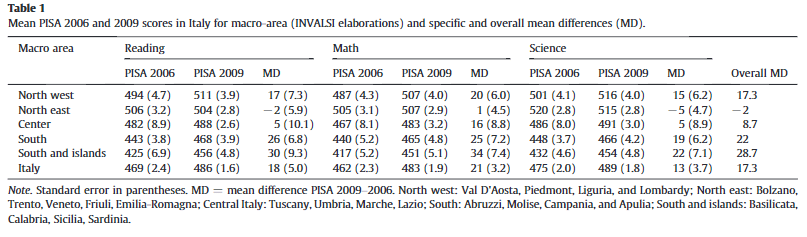
The table above shows the changes in PISA scores for Southern Italy in only 3 years for all 3 subjects tested in PISA. Southern Italy increased by 26 points in reading, and Southern Italy and islands increased by 30 points. For math, 25 for the South and 34 for South and the islands. For science, 18 for the South and 22 for the South and the islands. The presence of non-native students may also be a factor in these score differences. You can see the differences from 3 years, and how even in 3 years, there was a slight decrease in scores in Northern Italy. Migrants, after coming in from the South of the country, then continue to go into the Northern part of the country. This could also explain a huge part of the differences, seeing as they may be counted as Italian citizens, yet aren’t native to the country.
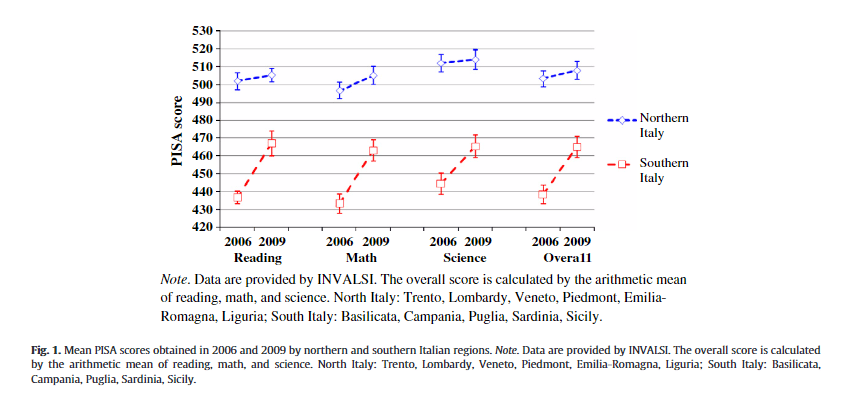
The above table shows mean PISA scores for 2006 and 2009, showing a huge increase in scores from Southern Italy, and hardly any increase in Northern Italy. Any genetic changes in 3 years to show that big of an increase?
Source: Problems in deriving Italian regional differences in intelligence from 2009 PISA data
Two, the second hypothesis of this study is that the north–south gradient of IQs in Italy may explain much of the difference in economic development between the north and south of Italy
Wrong again. Southern Italy has a huge underground economy, that isn’t noted on the books. The GDP in Southern Italy is far from accurate and employment figures do not match reality.
These raw figures require a closer look, because one economist’s analysis of Calabria found low pay, high unemployment, and a very high level of consumer spending. In 1994, the government insurance agency placed the number of business enterprises in Calabria at 23,758, while Istat, carrying out the 1996 census, found about 90,000 businesses in the same region.The economist Domenico Marino concluded, on the basis of 4,000 interviews in Calabria, that 75 percent of the Calabrian work force would refuse a fairly low-paying job, despite a very high official level of unemployment. In Calabria, with its dire employment figures, 84 percent of the families own their own home. What such anomalies must mean is that real income in Calabria is far higher than what is “on the books.” Many among the vast numbers of officially unemployed are, in fact, partly or fully employed. They are earning no social benefits, but they are earning the daily lire that keep their families afloat.
This massive sector skews all the statistics. It means that the GDP for the Italian South (and for Italy as a whole) is far from accurate. And the unemployment figures do not reflect reality.
LOOKING TO 2007: ITALY TIMES TWO
Three, the third hypothesis we set out to examine is that regional IQ differences in Italy are also manifest in variables that can be regarded as correlates or effects of IQs, including stature, infant mortality, literacy, and years of education
When historical data on those variables are used, a different picture emerges. Correlations are insignificant and in the case of infant mortality, do not the supposed link of regional differences in intelligence and socioeconomic development.
Four, per capita incomes are also highly negatively correlated with rates of infant mortality in 1954–57 (r= −0.652), and 1999–2002 (r=−0.823).
When the years 1911, 1891 and 1871 are averaged in, there is no difference.
Lynn didn’t consider the data from the 1860s to average it in with the rest of his data.
Five, the ability of populations with high IQs to give their children better nutrition makes them healthier, more resistant to disease and reduces the risk of mortality, and also improves their children’s stature
Right. But there is no mortality difference, as seen above.
Five, the ability of populations with high IQs to give their children better nutrition makes them healthier, more resistant to disease and reduces the risk of mortality, and also improves their children’s stature
There is a 1.7-inch difference between Northern and Southern Italian height. Which is explained by differences in nutrition between the regions, with the South having a more grain-based diet. Those effects are explained by a grain-based diet, and those Italians from America (which a huge majority are from the South of the country), actually show better educational attainment as well as more monetary success than their Northern counterparts.
Six, regional IQs in 2006 are highly correlated with the years of education of adults in 1951 (r=0.929), 1971 (r=0.871) and 2001 (r=0.886)
At the regional level, average IQs and current per capita GDP are highly related: for the year 2012, the correlation is 0.86. The link between IQ and regional development is, instead, much weaker when data for the years 1871, 1891 and 1911 are considered. Regional IQs and infant mortality rates in 1863–66 are positively correlated, contrarily to that which would be expected based on Lynn’s assumptions;
Two Italies? Genes, intelligence and the Italian North–South economic divide
This is explained simply. When Italy became unified in 1861, there were literacy differences in the country. 87 percent of the Southern population was illiterate in comparison to 67 percent of the Northern population.
The likely explanation for this high correlation is that the percentages of the population that were literate in 1880 was a function of IQs and therefore that the regional differences in IQs were present in 1880 and have been stable over the period 1880 to 2006.
Literacy and average years of schooling are better predictors of income levels than regional IQs.
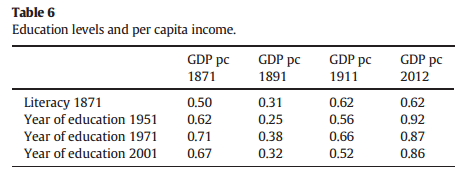
The above table shows this.
Eight, it is an interesting question whether the differences in Italian regional IQs were present in earlier historical periods. Some useful data bearing on this question have been assembled by Murray (2003, pp. 303–5) who has compiled the numbers of “significant figures” (i.e. those who have made significant contributions to science, literature, music and art) and their places of birth for the whole of Europe from the year 1400 to 1950. His figures for the north, center and south of Italy are shown in Table 3.
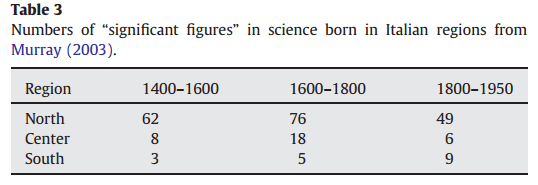
Pretty damning right? Wrong.
More than half of the country is put into the ‘North’ section of what he is talking about, and how he did the dividing, it looks like this.
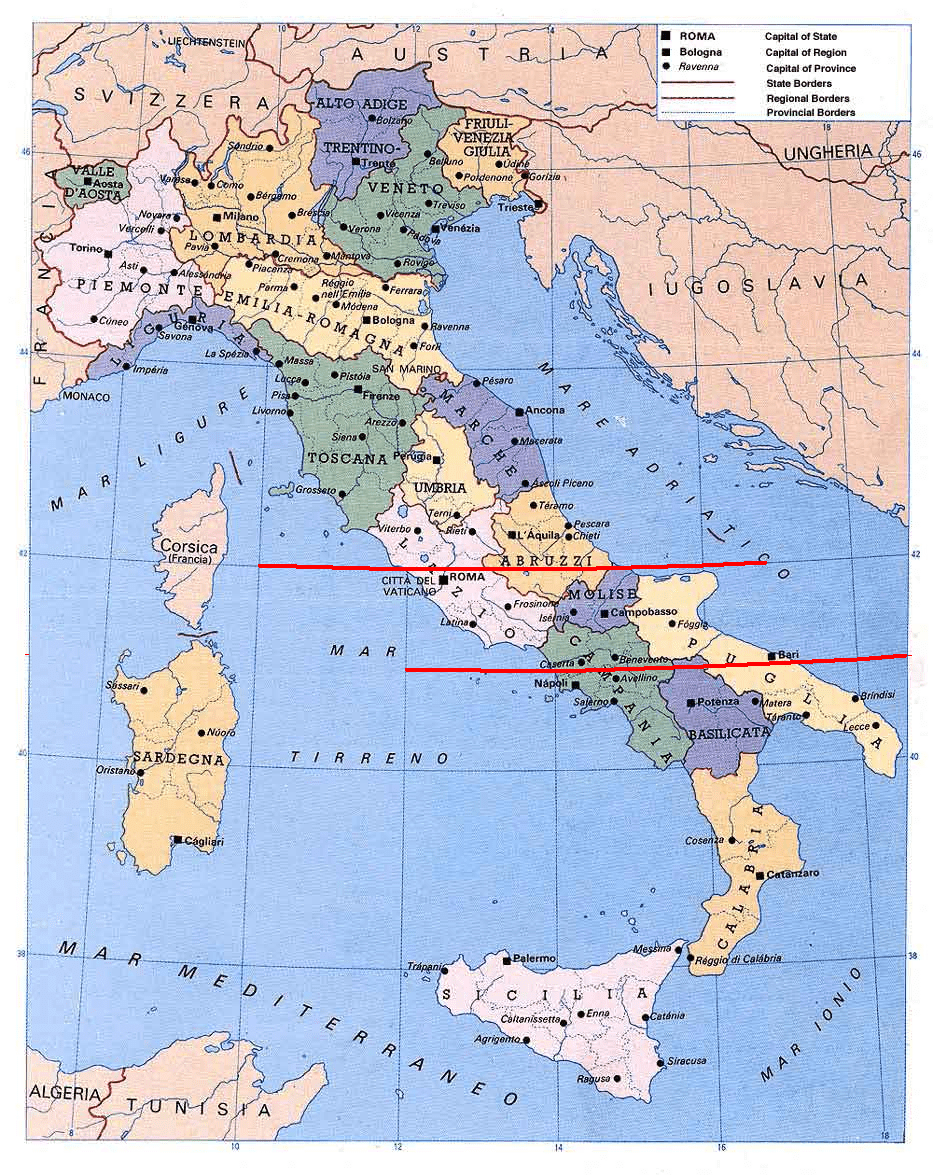
Murray also said that achievement happened in a few places in Italy, with Southern Italy being one of the many areas in Europe with ‘low achievement’, which includes a big part of Northern Italy as well. The achievements in Italy were mainly found in Tuscany, which the literacy rate wasn’t too high in 1880. Again, refuting Lynn on his thesis.
Nine, Putnam (1993, p. 159) and Tabellini (2007) have proposed that “civic trust” is a determinant of regional differences in economic development in Italy and in western Europe.
There are hardly any regional differences in economic development, as seen above.
A possible explanation for the northern regions having had higher IQs than the southern regions at least from 1880 and possibly from 1400 to 1600 is that the populations of the north and south are genetically different and these genetic differences are related to differences in intelligence.
Not at all. I touched on this in my Refuting Afrocentrism: Are Italians Black? article.
They write of the population genetics of Italy that “northern Italy shows similarities with countries of central Europe, whereas central and southern Italy are more similar to Greece and other Mediterranean countries.
See above. They are genetically the same:
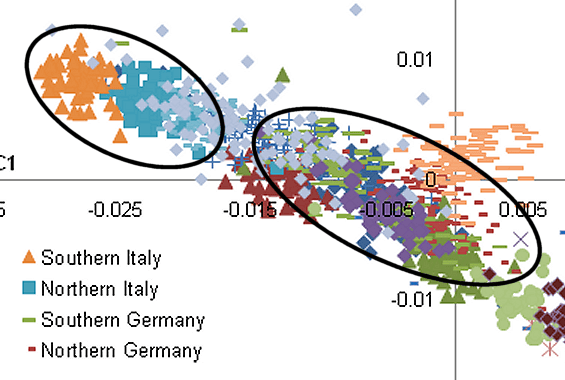
Comparison with Germany and Italy, Germans are spread out farther on the graph than are Italians, are there huge genetic differences with Germans as well?
They write of the population genetics of Italy that “northern Italy shows similarities with countries of central Europe, whereas central and southern Italy are more similar to Greece and other Mediterranean countries. This corresponds to the well-known differences in physical type (especially pigmentation and size) between the northern and north-central Italians on the one side and southern Italians on the other”.
Pigmentation is explained by getting the same UV rays as Northern Africa:
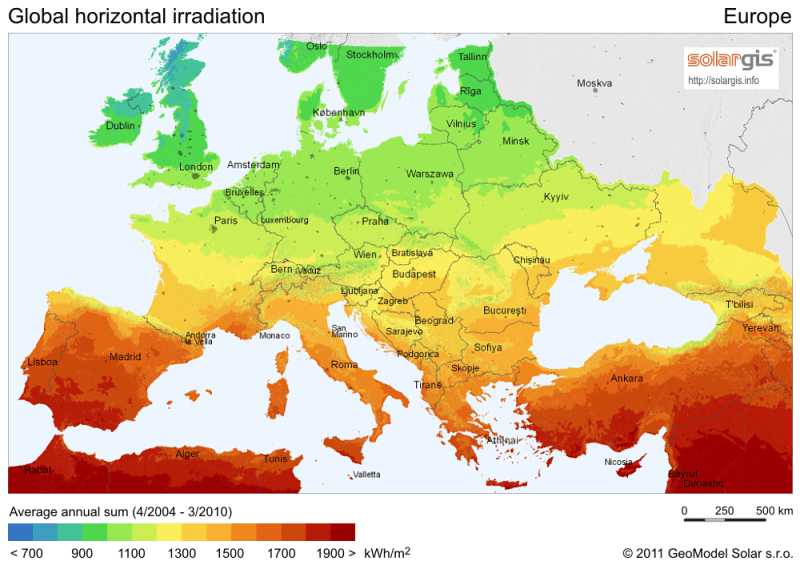
Size differences explained by slight differences in nutrition.
Subsequent studies have confirmed the genetic impact of immigration from the Near East and North Africa into southern Italy. For instance, the Taql, p1 2f2-8-kb allele has a high frequency in the Near East and North Africa (Morocco, 81.8; Lebanon, 43.7; Tunisia, 34.1). The allele is also present but at a lower frequency (26.4) in southern Italy, including Sicily.
Using a single, or small number of loci will lead to you finding the same loci in different populations? Who knew!!
The diffusion of genes from the Near East and North Africa may explain why the populations of southern Italy have IQs in the range of 89–92, intermediate between those of northern Italy and central and northern Europe (about 100) and those of the Near East and North Africa (in the range of 80–84) (these IQs are given in Lynn, 2006). This also explains the north–south gradient of IQ in Italy in which the regional IQs do not show a clear dichotomy between north and south but rather a gradient in which IQs decline steadily with more southerly latitude.
Nope. I’ve covered this in my ‘Black Italians’ article:
Combined data from two large mtDNA studies provides an estimate of non-Caucasoid maternal ancestry in Italians. The first study sampled 411 Italians from all over the country and found five South Asian M and East Asian D sequences (1.2%) and eight sub-Saharan African L sequences (1.9%). The second study sampled 465 Sicilians and detected ten M sequences (2.2%) and three L sequences (0.65%).This makes a total of 3% non-white maternal admixture (1.3% Asian and 1.7% African), which is very low and typical for European populations, since Pliss et al. 2005, e.g., observed 1.8% Asian admixture in Poles and 1.2% African admixture in Germans. (Plaza et al. 2003; Romano et al. 2003)
Similar data from the Y-chromosome reveals Italians’ even lower non-Caucasoid paternal admixture. Both studies obtained samples from all over the mainland and islands. No Asian DNA was detected anywhere, but a single sub-Saharan African E(xE3b) sequence was found in the first study’s sample of 416 (0.2%), and six were observed in the second study’s sample of 746 (0.8%). The total is therefore a minuscule 0.6%, which decreases to 0.4% if only Southern Italians are considered and 0% if only Sicilians are considered.Again, these are normal levels of admixture for European populations (e.g. Austrians were found to have 0.8% E(xE3b) by Brion et al. 2004). (Semino et al. 2004; Cruciani et al. 2004)
An analysis of 10 autosomal allele frequencies in Southern Europeans (including Italians, Sicilians and Sardinians) and various Middle Eastern/North African populations revealed a “line of sharp genetic change [that] runs from Gibraltar to Lebanon,” which has divided the Mediterranean into distinct northern and southern clusters since at least the Neolithic period. The authors conclude that “gene flow [across the sea] was more the exception than the rule,” attributing this result to “a joint product of initial geographic isolation and successive cultural divergence, leading to the origin of cultural barriers to population admixture.” (Simoni et al. 1999)
One of the most important citations is the Simoni et al. 1999 cite. Which says that gene flow across the sea was more the exception than the rule. Those 3 studies above refute any ‘racial differences’ between Northern and Southern Italians.
There are problems deriving Italian IQ from PISA test scores. You cannot take PISA data and infer a group’s IQ from it!! Moreover, on purer measures of intelligence, such as Raven’s Progressive Matrices, there is no significant difference between North and South children. These are differences in achievement, not intelligence. None of the studies cited by Lynn were aimed at comparing Italian IQ across regions and none of them used the same age groups!! This is why his data on Italian IQ is wrong.
To conclude, we don’t know the true IQs of all of the regions of Italy. Lynn used faulty measures to make his theory (which doesn’t need fluff) of north/south disparities in IQ more palatable. He’s been refuted multiple times on this matter. I may do another in the future.
Italianthro source: Refuting Richard Lynn’s IQ Study
IQ, Inbreeding and Clannishness
1300 words
The effects of inbreeding have an effect on IQ, as well as the amount of clannishness that leads to more inter-group violence.
According to one of my favorite researchers, Linda Gottfredson, in this article she wrote for the New Scientist:
Not only that, as more people travelled and married outside their local group, populations may have benefited genetically from hybrid vigour.
Inbreeding is known to lower intelligence, and outbreeding can raise it.
“Marrying outside their local population” means not marrying the immediate people in their local group, not other races.
So inbreeding (up to first and second cousins) is the cause of lower IQ. According to Razib Khan, inbreeding can lower IQ by 2.5 to 10 points. Outbreeding meaning breeding with others with less similar genes (not race-mixing). Talking about inbreeding and lowered IQ, we have to talk about Islam.
In a paper on the mean IQ of Muslims and non-Muslim countries, Donald Templer states that the Muslim world, which used to have great intellectual achievements from the 7th to 12th centuries, has seen an underrepresentation in highly creative contributions in science journals. This is because of the inbreeding effect (2.5 to 10 point drop in IQ) of close cousin marriage. He ends up saying that genetic factors are more important than social/cultural/religious values (back to the inbreeding, causing defects and lowering IQ) in regards to IQ.
In this great article by hbd chick, her definition for clannishness is:
“a set of behaviors and innate behavioral traits and predispositions which, when found in a population, result in the members of that population strongly favoring, in all areas of life, themselves, their family members — both near and extended, and even closely allied associates (esp. in clannish societies which are not arranged into clans), while at the same time strongly disfavoring those considered to be non-family and all unrelated, non-allied associates.”
Which you can obviously see in populations that are more inbred than others.
Those innate behaviors which result in the favoring in all areas of life, themselves and their family, is a result of genetic similarity because of the closely related genes they share (the father’s brother’s daughter type is the most common in the Muslim world). Also, first and second cousin marriages are more common, which also result in increased altruism for their own family because of the close genetic similarity, but also those in their own group, which is mediated by the brain hormone oxytocin. I would assume that all of these clannish/inbred groups would have higher levels of oxytocin in the brain. The same chemical is also known as the ‘love chemical’, which would make sense with ‘love for your own group or family’.
That same drop in IQ also made them more susceptible to the dominant religion (Islam) in the region. Causing more fanaticism (which is already there from the low IQ, as well as the between group strife with other ‘clans’), this also leads to more strife between groups in the region.
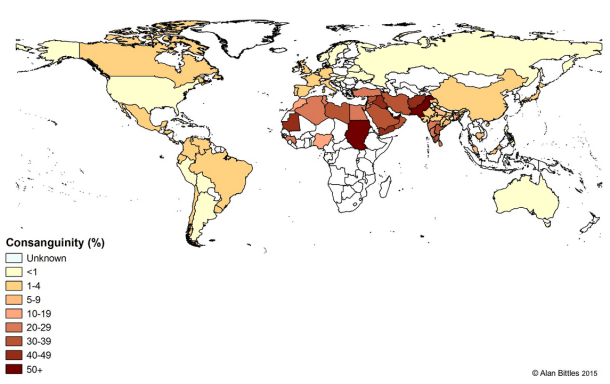
In the map seen above, you see the consanguinity rates for the world. The rates with the highest amount in the world, are in the Middle East and North Africa, as well as South East Asia, the majority Muslim parts of the world, which leads to depressed IQ, group violence, and violence against others not like themselves (as mediated through oxytocin).
That same clannishness is being brought to Europe, and with more increased cousin/brother/sister marriages, clannishness/genetic defects will increase, causing more strain (as well as violence due to that clannishness) that is already currently put on them through the ‘migration’.
Whites in Europe, as well as America, need that same clannishness. But obviously breeding too closely with those related to you (having genes that are too similar, which lead to a multitude of effects of inbreeding depression, lower IQ included) leads to a slew of negative effects.
Let’s see this article where a Muslim says “Why Ban Cousin Marriage?”.
The risk of birth defects in children born to first cousins is increased from a baseline of 3-4 percent to 4-7 percent according to the National Society of Genetic Councilors (NSGC). In this modern age, this risk could be mitigated by mandating — as the State of Maine has done — pre-marital genetic testing. The NSGC, however, considers the risk to be so insignificant that it does not recommend additional testing or screening.
31 percent of all anomalies in Pakistani children could be contributed to consanguinity. Really solid case of trying to keep first-cousin marriage alive. Also, just see how IQ drops when first-cousin marriage is done as well as the birth defects.
As you cross the scientific hurdles, you will be confronted with a mountain of taboo cloaked in words like “gross,” “icky,” “yucky.” But where do such taboo feelings originate from? Not a single verse in the Torah, Bible or Quran — books revered by three billion followers of the three Abrahamic religions — prohibits cousin marriage, which were common in Jewish, Christian and Islamic history. The Bible even mentions various accounts of cousin marriages, such as Jacob and Rachel, Milcah and Nahor, and Jacob and Leah, in the book of Genesis. And please don’t quote the incest prohibitions listed in Leviticus 18. It never mentions first cousins.
Third cousins have the greatest number of kids. Also, third cousin marriage doesn’t seem to affect IQ being that Iceland’s average IQ is 101. I don’t even think anyone brings up a religious basis for first cousin marriage, just the deleterious effects of it are the reason why not to mention it’ll be someone you’ve most likely grown up with your whole life. Your family has a unique smell, which obviously evolved to make you not want to mate with your family. This shows that nature made it so that we don’t inbreed too closely, and that for fertility, third cousin marriage is best.
This is the ultimate argument made in support of banning cousin marriages. It’s so obviously wrong that “You don’t have to be an Einstein to figure it out.” In the evidence driven societies we have a different word to describe such claims: myth. Myths are best broken by data. The fact that 20 percent of global marriages take place between first cousins and most societies, including Europe and Canada, consider cousin marriages to be legal should give us a pause.
It’s fine guys!!! Einstein did it too!! I’m sure this is a logical fallacy though it escapes me at the moment. Just because someone who is extremely intelligent does something, doesn’t mean that it’s OK to do.
To conclude, the cause for the constant strife (not even getting in to any other external factors) in the Middle East is due to constant inbreeding depression, which dropped IQ, which led to more clannishness due to more cousin marriage, and more inter-group violence.
Third cousin marriages, as seen in Iceland, are fine, it has no negative effects on IQ and they are more fertile because of it.
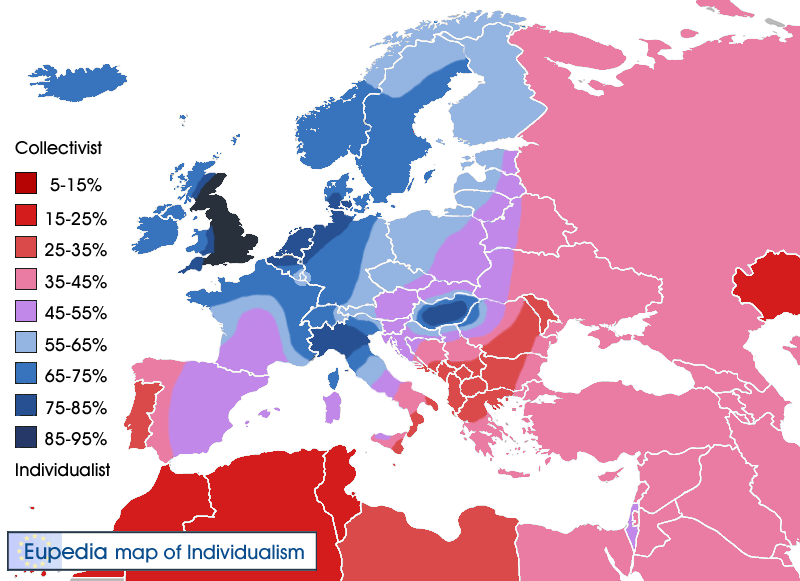
I personally think a huge part of the reason for the current situation in Europe is obviously the high European altruism and a high rate of individualism. As you can see from the map above, the countries with the highest amount of individualism have the most problem with the ‘migrants’ and are also the most liberal and atheist. The collectivist countries obviously have a stronger religious component, which in Eastern Europe you see them pushing back harder against Islam. The same in Spain, and Southern Italy (also the Mafia said they will take care of IS). Those collectivist countries (or regions) push back harder because they have something to fight for, their religion as well as people, being that they are more collectivist than the individualist countries. This map roughly matches up to this situation in Europe.
Collectivist countries are clearly more religious than the clearly atheistic, liberal, socialistic and individualist Northern European countries.
The more collectivist countries are more clannish, due to religion. Those countries will push back the hardest, even harder than the individualist countries.
 NotPoliticallyCorrect