Home » Race Realism (Page 19)
Category Archives: Race Realism
Malaria, the Sickle Cell Trait, and Fast Twitch Muscle Fibers
2550 words
West Africans and their descendants have longer limbs and a shorter trunk than Europeans, on average—as I have extensively noted. Due to where they evolved, of course, they have a different morphology and physiology. Bergmann’s rule states that peoples with recent ancestry in the tropics will have slimmer pelvic bones and be narrower overall whereas Allen’s rule states that peoples with recent ancestry in the tropics will have long limbs, these traits being good for heat dissipation (Lieberman, 2015) and is one reason why West Africans and their descendants excel in these most sports in America.
The fact that a lot of African ethnic groups have different anatomic proportions and physiologic adaptations in comparison to people who have evolved in non-tropical climates is not contested. Morrison and Cooper’s (2006) hypothesis on sick cell anemia driving elite athletic performance in West Africans and their descendants is one of the most interesting explanations I’ve heard on the biochemical differences between the races. Sickle cell anemia is caused by a gene mutation. On amino acid 6, a single nucleotide substitution from A to T (As pair it Ts, Gs pair with Cs). This substitution changes a glutamic acid codon to valine codon which then causes sickling of the blood. Sickle cell anemia, of course, is not a ‘black disease’ as is popularly believed, but it, in fact, has to do with geography and the prevalence of malaria-carrying mosquitoes in that location. “This mutation“, Morrison and Cooper (2006) write “appears to have triggered a series of physiological adjustments, which have had favourable athletic consequences.”
Now, I’m aware that those who are already skeptical of this hypothesis may say ‘so does this mean that Italians, Greeks, MENA peoples etc have more type II fibers and would excel in these competitions?’, no it does not mean that because they don’t have the requisite morphology that West Africans have.
In the 1970s, a study was carried out on the physiological and anatomical proportions of Olympic athletes who competed in the 1968 Olympic games. Anatomic and physiologic measures were taken for each athlete. They used four racial classifications: Negroid, Caucasoid, Mongoloid, and mestizo (Indian/Spanish mix). The classifications were based on “were based on identification and somatotype photographs, as well as physical characteristics including skin color; general body shape; proportions of segments of the limbs; facial structure; form of eyes, lips, and nose; and colour and texture of hair” (Morrison and Cooper, 2006). This study, of course, also confirmed the anatomic differences between blacks and other races and how it leads to superior sports performance. Though, something peculiar was noted in the black athletes. Morrison and Cooper (2006) write: “Although the study failed to link athletic capability to a single gene system, the authors expressed “surprise” that “a sizeable number of Negroid Olympic athletes manifested the sickle-cell trait.””
One interesting study looked at the sickle cell trait (SCT) in French West Indian elite sprint athletes (Marlin et al, 2005). Using the French National Team for the year 2000, Marlin et al (2005) identified 3 sprinters (2 males and 1 female) who tested positive for the SCT. They also noticed a significantly higher presence of titles for people who tested positive for the SCT (38.6 percent for males and 50 percent for females. Marlin et al (2005: 624) conclude “that male SCT carriers are able to perform sprints and brief exercises at the highest levels” and “that brief and intensive exercise performance involving mainly alactic anaerobic metabolism may be enhanced by HbS in elite male sprinters.”
Blacks had narrower hips, longer arms and legs and a shorter trunk in comparison to other races. Of course, somatype is the variable that matters here but certain races are more likely to have certain anatomic characters that lead to superior spots performance on comparison to other races. The authors also attempted to link traits with single gene networks but were unsuccessful. However, they did notice that a large number of black athletes tested positive for the sickle cell trait. There is a conundrum here, however. People with the sickle cell gene might have a greater oxygen demand which causes more in vivo cell sickling. It was hypothesized that these individuals would be at a disadvantage since the 1968 Olympic games were held in Mexico city which is a high altitude area. They theorized that their blood would sickle more at the high altitude in comparison to low altitude but this was not seen.
Then another study was carried out which showed that not only do individuals with the sickle cell trait have lower hemoglobin levels, but all blacks do (Garn, Smith, and Clark, 1975). This is how and why they can perform at high altitudes despite having the sickle cell trait. Then, to test if this was mostly ‘environmental’ or ‘genetic’ they undertook a large study where they followed individuals throughout their whole lives and the difference persisted even later in life. Of course, according to other authors, some sort of compensatory mechanism should exist to counteract black’s lower hemoglobin levels, since this deficiency even exists in athletes (Morrison and Cooper, 2006).
As I’ve written about in the past, it was established that type I and type II fibers use different metabolic pathways and that type II fibers lead to improved athletic performance (along with the certain genotype for the ACTN3 gene). Morrison and Cooper (2006) also state that, of course, not all West Africans and descendants have this trait, and that these people came from a small area of West Africa.
A study looking at pulmonary differences between blacks and whites was conducted which found that blacks compensated for smaller lungs by breathing harder than whites while engaged in physical activity. In a study of 80 Asians and Europeans, Korotzer, Ong, and Hansen (2000) also showed that Asians had lower pulmonary functioning than Europeans. Even differences in chest size has been purported to explain differences in lung functioning, though this relationship did not hold (Whittaker, Sutton, and Beardsmore, 2005). Though, in his short review on race and the history of lung functioning, Braun (2015) writes that “At the very least, the idea that people labelled ‘white’ naturally have higher lung capacity than other races throughout the world should be approached with some skepticism.” because “Most commercially available spirometers internationally ‘correct’ or ‘adjust’ for race in one of two ways: by using a scaling factor for all people not considered to be ‘white’; or by applying population-specific norms. To enable the spirometer, the operator must select the race of an individual, as well as indicate their age, sex/gender and height. How race (or population) is determined varies, with most operators either asking patients to self-identify or ‘eyeballing it’. Interviews with users of the spirometer indicate that many operators are unaware that they are automatically activating race correction when they select a patient’s race (3). Because ‘correction’ is programmed into the spirometer by the manufacturer, it can be difficult to disable.”
Braun, Wolfgang, and Dickerson (2013) and Braun (2015) critiques pulmonary studies because in a large majority of cases, possible explanatory variables for lower lung functioning in black Americans could be related to SES. Harik-Khan, Muller, and Wise (2004) used participants from the Third National Health and Nutrition Examination Survey. They chose black and white children between the ages of 8 and 17 who did not smoke (n=1462, 623 whites and 839 blacks). Blacks were taller but had lower SES, had lower levels of vitamins A and C, along with lower levels of alpha carotene. They also had lower lung functioning. When they adjusted for confounds, sitting explained 42 to 53 percent of the racial difference, SES factors and antioxidant vitamin levels accounted for 7 to 10 percent of the difference. So they could only account for 50 to 63 percent of the difference. In 752 children aged 8 to 10 years of age, low birth weight accounted for 3 to 5 percent of the differences whereas maternal smoking had no effect (Harik-Khan, Muller, and Wise, 2004). So the remaining variation, obviously, will be accounted for by other SES variables, biology, or environmental factors.
Whitrow and Harding (2004) show that, at least for Caribbean blacks living in the UK, upper body differences explained most of the variation in lung functioning than did sitting height, with social correlates having a small but significant impact.
So because blacks have more type II fibers on average, they will convert glucose into energy more rapidly than whites. The energy for these muscle contractions comes from adenosine triphosphate (ATP). Blacks and whites both convert glucose into ATP for cellular functioning but in different ratios. These differences in muscular contractions driven by the metabolic pathway differences of the fibers are one large reason why blacks dominate sports.
Fibers are broken down into two types: fast and slow twitch. Slow twitch fibers use aerobic metabolism which is how they generate ATP and greater oxidative capacity due to higher levels for myoglobin. Oxygen bound to hemoglobin is carried to the red blood cells through capillaries that then influence muscular performance. Myoglobin is also essential for the transport of oxygen to the mitochondria where it is then consumed. Conversely, fast twitch fibers use anaerobic metabolism, have less oxidative capacity, less myoglobin and due to this, they are more dependent on anaerobic metabolism. Blacks also have “significantly higher levels of activity in their phosphagenic, glycolytic, and lactate dehydrogenase marbling pathways than their Caucasian counterparts” (Morrison and Cooper, 2006). This is where the production of ATP is regenerated,and so they have a huge advantage here. So higher faster production of ATP lead to more efficient ATP production, too. However when the ATP is depleted then it’s replaced by a reaction that depletes creatine phosphate. Skeletal muscle then converts “chemical energy into mechanical work” which only 30 to 50 percent is wasted as heat, so even small physiological differences can lead to large differences in performance (Morris and Cooper, 2006).
Though that’s not the only biochemical difference (faster ATP regeneration and production) between the blacks and whites that would explain sports performance. Morrison and Cooper (2006) write: “There is also considerably greater activity in the lactate dehydrogenase pathway of people of West African descent. A primary function of this pathway is to reduce muscle fatigue by converting lactic acid back to glucose and refeeding the muscles. This cyclic set of reactions, from muscles to liver and back to muscles, is known as the Cori cycle.”
Lactic acid production is that feeling in your muscles when during extended athletic activity whereas the postponement of muscle fatigue rests on the rate at which lactic acid is covered into glucose. The rate of this removal is further increased by the lactate dehydrogenase pathway describe above by Morrison and Cooper.
Clearly, the production of lactic acid causes problems during physical activity. The production of lactic acid into glucose to refers the muscles through the lactate dehydrogenase pathway is critical, for if glycogen reserves are depleted during extended physical activity then blood glucose would become the primary source of energy for the muscles, which could lead to lowered blood glucose levels and the nervous system may become compromised. During prolonged activity, however, if glucose isn’t available for energy then the body uses fat reserves which is less efficient than carbohydrates for energy and combustion.
Morrison and Cooper conclude: “Not the least of coincidence seems to be the influence of the compensatory sickle cell gene on oxygen transport and availability to the tissues. The reduced availability pulled with reduced oxygen myoglobin in the preponderant fast-twitch muscle fibres which are adapted for rapid anaerobic energy (ATP) regeneration, all give a new outcome of muscle anatomical and biochemical advantages which proffer a superior athleticism.”
Though, at the moment, as David Epstein states in his 2014 book The Sports Gene: Inside the Science of Extraordinary Athletic Performance, in a few studies done on mice genetically altered to have low hemoglobin levels, a there was a “shift of type IIa fast-twitch muscle fibers to type IIb “super fast twitch” muscle fibers in their lower legs” (Epstein, 2014: 179). This is also a developmental effect of mice in their lifetime, not a direct effect of evolution (Epstein, 2014: 179). No compensatory mechanism yet exists for humans, which I will attempt to untangle in future articles on the matter.
At the end of the chapter on this subject (Chapter 11, Malaria and Muscle Fibers, page 179), Epstein states that he asked physiologists their thoughts on the hypothesis. A few people approved of it, whereas one stated that he had evidence for physiological differences between blacks and whites that have not been studied before but he won’t release his results:
Several scientists I spoke to about the theory insisted they woud have no interest in investigating it because of the inevitably thorny issue of race involved. On of them told me that he actually has data on ethnic differences with respect to a particular physiological trait, but that he would never publish the data because of potential controversy. Another told me he would worry about following Cooper and Morrison’s line of inquiry because any suggestion of a physical advantage among a group of people could be equated to a corresponding lack of intellect, as if athleticism and intelligence were on some kind of biological teeter-totter. With that stigman in mind, perhaps the most important writing Cooper did in Black Superman [Cooper’s book] was his methodical eviseceration of any supposed inverse link between physical and mental prowess. “The concept that physical superiority could somehow be a symptomn of intellectual inferiority only developed when physical superiority became associated with African Americans,” Cooper wrote. “That association did not begin until about 1936.” The idea that athleticism was suddenly inversely proportional to intellect was never a cause of bigotry, but rather a result of it. And Cooper implied a more serious scientific inquiry into difficult issues, not less, is the appropriate path. (Epstein, 2014: 179) [Entine (2002) also spends a considerable amount of time debunking the myth of intelligence and athletic ability being negatively correlated in his 2002 book Taboo: Why Black Athletes Dominate Sports and Why We’re Afraid to Talk About It, which was kind of popularized by Rushton (1997) with his now debunked r/K selection theory.]
Things like this piss me off. These differences are actually measurable and lead to trait differences between the races, and know the mechanisms, pathways and whatnot and people are still. Scared to share their findings. One day, I hope, science will find a way to disregard people’s feelings in regard to people’s feelings on notable, testable and replicable differences between the races, most importantly between blacks and whites. I’ve noted how type II fibers lead to metabolic changes and small tears which then cause big problems. This is due to how fast the type II fibers fire in comparison to the slow twitch fibers.
This hypothesis is extremely interesting and now that I’ve laid out Morrison and Cooper’s (2006) hypothesis, I’m going to take a deep dive into this literature to see what I can prove about this hypothesis. Of course, the somatype along with the fiber distribution matters, as does having the XX genotype and not RR, which lends to superior athletic performance when coupled with type II muscle fibers (Broos et al, 2016). The pieces of this puzzle are, in my opinion, slowly being put together for someone to come along and integrate them into a coherent theory for the sickle cell trait and superior athletic performance through type II muscle fibers. It’s very interesting to note that elite sprinters were more likely to carry the SCT and that champion sprinters were more likely to have it too.
Is Diet An IQ Test?
1350 words
Dr. James Thompson is a big proponent of ‘diet being an IQ test‘ and has written quite a few articles on this matter. Though, the one he published today is perhaps the most misinformed.
He first shortly discusses the fact that 200 kcal drinks are being marketed as ‘cures’ for type II diabetes. People ‘beat’ the disease with only 200 kcal drinks. Sure, they lost weight, lost their disease. Now what? Continue drinking the drinks or now go back to old dietary habits? Type II diabetes is a lifestyle disease, and so can be ameliorated with lifestyle interventions. Though, Big Pharma wants you to believe that you can only overcome the disease with their medicines and ‘treatments’ along with the injection of insulin from your primary care doctor. Though, this would only exacerbate the disease, not cure it. The fact of the matter is this: these ‘treatments’ only ‘cure’ the proximate causes. The ULTIMATE CAUSES are left alone and this is why people fall back into habits.
When speaking about diabetes and obesity, this is a very important distinction to make. Most doctors, when treating diabetics, only treat the proximate causes (weight, symptoms that come with weight, etc) but they never get to the root of the problem. The root of the problem is, of course, insulin. The main root is never taken care of, only the proximate causes are ‘cured’ through interventions, however, the underlying cause of diabetes, and obesity as well is not taken care of because of doctors. This, then, leads to a neverending cycle of people losing a few pounds or whatnot and then they, expectedly, gain it back and they have to re-do the regimen all over again. The patient never gets cured, Big Pharma, hospitals et al get to make money off not curing a patients illness by only treating proximate and not ultimate causes.
Dr. Thompson then talks about a drink for anorexics, called ‘Complan“, and that he and another researcher gave this drink to anorexics, giving them about 3000 kcals per day of the drink, which was full of carbs, fat and vitamins and minerals (Bhanji and Thompson, 1974).
The total daily calorific intake was 2000-3000 calories, resulting in a mean weight gain of 12.39 kilos over 53 days, a daily gain of 234 grams, or 1.64 kilos (3.6 pounds) a week. That is in fact a reasonable estimate of the weight gains made by a totally sedentary person who eats a 3000 calorie diet. For a higher amount of calories, adjust upwards. Thermodynamics.
Thermodynamics? Take the first law. The first law of thermodynamics is irrelevant to human physiology (Taubes, 2007; Taubes, 2011; Fung, 2016). (Also watch Gary Taubes explain the laws of thermodynamics.) Now take the second law of thermodynamics which “states that the total entropy can never decrease over time for an isolated system, that is, a system in which neither energy nor matter can enter nor leave.” People may say that ‘a calorie is a calorie’ therefore it doesn’t matter whether all of your calories come from, say, sugar or a balanced high fat low carb diet, all weight gain or loss will be the same. Here’s the thing about that: it is fallacious. Stating that ‘a calorie is a calorie’ violates the second law of thermodynamics (Feinman and Fine, 2004). They write:
The second law of thermodynamics says that variation of efficiency for different metabolic pathways is to be expected. Thus, ironically the dictum that a “calorie is a calorie” violates the second law of thermodynamics, as a matter of principle.
So talk of thermodynamics when talking about the human physiological system does not make sense.
He then cites a new paper from Lean et al (2017) on weight management and type II diabetes. The authors write that “Type 2 diabetes is a chronic disorder that requires lifelong treatment. We aimed to assess whether intensive weight management within routine primary care would achieve remission of type 2 diabetes.” To which Dr. Thompson asks ‘How does one catch this illness?” and ‘Is there some vaccination against this “chronic disorder”?‘ The answer to how does one ‘catch this illness’ is simple: the overconsumption of processed carbohydrates, constantly spiking insulin which leads to insulin resistance which then leads to the production of more insulin since the body is resistant which then causes a vicious cycle and eventually insulin resistance occurs along with type II diabetes.
Dr. Thompson writes:
Patients had been put on Complan, or its equivalent, to break them from the bad habits of their habitual fattening diet. This is good news, and I am in favour of it. What irritates me is the evasion contained in this story, in that it does not mention that the “illness” of type 2 diabetes is merely a consequence of eating too much and becoming fat. What should the headline have been?
Trial shows that fat people who eat less become slimmer and healthier.
I hope this wonder treatment receives lots of publicity. If you wish to avoid hurting anyone’s feelings just don’t mention fatness. In extremis, you may talk about body fat around vital organs, but keep it brief, and generally evasive.
So you ‘break bad habits’ by introducing new bad habits? It’s not sustainable to drink these low kcal drinks and expect to be healthy. I hope this ‘wonder treatment’ does not receive a lot of publicity because it’s bullshit that will just line the pockets of Big Pharma et al, while making people sicker and, the ultimate goal, having them ‘need’ Big Pharma to care for their illness—when they can just as easily care for it themselves.
‘Trial shows that fat people who eat less become slimmer and healthier’. Or how about this? Fat people that eat well and exercise, up to 35 BMI, have no higher risk of early death then someone with a normal BMI who eats well and exercises (Barry et al, 2014). Neuroscientist Dr. Sandra Aamodt also compiles a wealth of solid information on this subject in her 2016 book “Why Diets Make Us Fat: The Unintended Consequences of Our Obsession with Weight Loss“.
Dr. Thompson writes:
I see little need to update the broad conclusion: if you want to lose weight you should eat less.
This is horrible advice. Most diets fail, and they fail because the ‘cures’ (eat less, move more; Caloric Reduction as Primary: CRaP) are garbage and don’t take human physiology into account. If you want to lose weight and put your diabetes into remission, then you must eat a low-carb (low carb or ketogenic, doesn’t matter) diet (Westman et al, 2008; Azar, Beydoun, and Albadri, 2016; Noakes and Windt, 2016; Saslow et al, 2017). Combine this with an intermittent fasting plan as pushed by Dr. Jason Fung, and you have a recipe to beat diabesity (diabetes and obesity) that does not involve lining the pockets of Big Pharma, nor does it involve one sacrificing their health for ‘quick-fix’ diet plans that never work.
In sum, diets are not ‘IQ tests’. Low kcal ‘drinks’ to ‘change habits’ of type II diabetics will eventually exacerbate the problem because when the body is in extended caloric restriction, the brain panics and releases hormones to stimulate appetite while stopping hormones that cause you to be sated and stop eating. This is reality; these studies that show that eating or drinking 800 kcal per day or whatnot are based on huge flaws: the fact that this could be sustainable for a large number of the population is not true. In fact, no matter how much ‘willpower’ you have, you will eventually give in because willpower is a finite resource (Mann, 2014).
There are easier ways to lose weight and combat diabetes, and it doesn’t involve handing money over to Big Pharma/Big Food. You only need to intermittently fast, you’ll lose weight and your diabetes will not be a problem, you’ll be able to lose weight and will not have problems with diabetes any longer (Fung, 2016). Most of these papers coming out recently on this disease are garbage. Real interventions exist, they’re easier and you don’t need to line the pockets of corporations to ‘get cured’ (which never happens, they don’t want to cure you!)
IQ Test Construction
1550 words
No one really discusses how IQ tests are constructed; people just accept the numbers that are spit out and think that it shows one’s intelligence level relative to others who took the test. However, there are huge methodological flaws in regard to IQ tests—one of the largest, in my opinion, being that they are constructed to fit a normal curve and based on the ‘prior knowledge’ of who is or is not intelligent.
What people don’t understand about test construction is that the behavior genetic (BG) method must assume a normal distribution. IQ tests have been constructed to display this normal distribution, so we cannot say whether or not it exists in nature, though few human traits fall on the normal distribution. The fact of the matter is this: The normal curve is achieved through keeping more items that people get right while keeping the smaller proportion of items that people get right and wrong. This forces the normal curve and all of the assumptions that come along with this so-called IQ bell curve.
Even then, the fact that the normal distribution is forced doesn’t mean as much as the assumptions and conclusions drawn from the forced curve. It is assumed that individual test score differences arise out of ‘biology’, however with how test questions are manipulated to get the results that the test constructors want, it is then assumed that the cause for individual test score differences are ‘biological’ in nature, however we don’t know if these distributions are ‘biological’ in nature due to how the tests are constructed.
The fact of the matter is, the tests are constructed based off of the prior knowledge of who is or is not intelligent. This means that we can ‘build the test’ to fit these preconceived notions. The problem of item selection was discussed by Richardson (1998) who discussed boys scoring a few points higher than girls, and wondering whether or not these differences should be ‘allowed to persist’ or not. Richardson (1998: 114) writes (12/26/17 Edit: I’ll also provide the quote that precedes this one):
“One who would construct a test for intellectual capacity has two possible methods of handling the problem of sex differences.
1 He may assume that all the sex differences yielded by his test items are about equally indicative of sex differences in native ability.
2 He may proceed on the hypothesis that large sex differences on items of the Binet type are likely to be factitious in the sense that they reflect sex differences in experience or training. To the extent that this assumption is valid, he will be justified in eliminating from his battery test items which yield large sex differences.
The authors of the New Revision have chosen the second of these alternatives and sought to avoid using test items showing large differences in percents passing.” (McNemar 1942:56)This is, of course, a clear admission of the subjectivity of such assumptions: while ‘preferring’ to see sex differences as undesirable artefacts of test composition, other differences between groups or individuals, such as different social classes or, at various times, different ‘races’, are seen as ones ‘truly’ existing in nature. Yet these, too, could be eliminated or exaggerated by exactly the same process of assumption and manipulation of test composition.
And further writes on page 121:
Suffice it to say that investigators have simply made certain assumptions about ‘what to expect’ in the patterns of scores, and adjusted their analytical equations accordingly: not surprisingly, that pattern emerges!
The only ‘assumption’ that the test constructors have is the biases they already have on who is or is not ‘intelligent’ and then they construct the test through item selection, excising items that don’t fit their desired distribution. Is that supposed to be scientific? You can ask a group of children a bunch of questions and then construct a test to get the conclusion you want based on item selection.
The BG method needs to assume that IQ test scores lie on a normal curve and that it is a quantitative trait that exhibits a normal distribution, though Micceri (1989) showed that normal distributions for measurable traits are the exception, rather than the rule, for numerous measurable traits. Richardson (1998: 113) further writes:
The same applies to many other ‘characteristics’ of IQ. For example, the ‘normal distribution, or bell-shaped curve, reflects (misleadingly as I have suggested in Chapters 1 to 3) key biological assumptions about the nature of cognitive abilities. It is also an assumption crucial to many statistical analyses done on test scores. But it is a property built into a test by the simple device of using relatively more items on which about half the testees pass, and relatively few items on which either many or only a few of them pass. Dangers arise, of course, when we try to pass this property off as something happening in nature instead of contrived by test constructors.
So with the knowledge of test construction, then there is something very obvious here: we can construct IQ tests that, say, show blacks scoring higher than whites and women scoring higher than men. We can then make the assumption that there are genes that are responsible for this distribution and then ‘find genes’ that supposedly cause these differences in test scores (which are constructed to show the differences!). What then? Let’s say that someone did do that, would the logical conclusion be that there are genes ‘driving’ the differences in IQ test scores?
Richardson (2017: 3) writes:
In summary, either directly or indirectly, IQ and related tests are calibrated against social class background, and score differences are inevitably consequences of that social stratification to some extent. Through that calibration, they will also correlate with any genetic cline within the social strata. Whether or not, and to what degree, the tests also measure “intelligence” remains debateable because test validity has been indirect and circular. … Such circularity is also reflected in correlations between IQ and adult occupational levels, income, wealth, and so on. As education largely determines the entry level to the job market, correlations between IQ and occupation are, again, at least partly, self-fullfilling. … CA [cognitive ability], as measured by IQ-type tests, is intrinsically inter-twined with social stratification, and its associated genetic background, by the very nature of the tests.
This, again, falls back on the non-existent construct validity that IQ tests have. Construct validity “defines how well a test or experiment measures up to its claims.” No such construct validity exists for IQ tests. If breathalyzers didn’t test someone’s fitness to drive, would they still be a good measure? If they had no construct validity, if there was no biological model to calibrate the breathalyzer against, would we still accept it as a realistic model to test people against and judge their fitness to drive? Still yet another definition of construct validity comes from Strauss and Smith (2009) who write that psychological constructs are “validated by testing whether they relate to measures of other constructs as specified by theory.” No such biological model exists for IQ; why expect some type of biological model like this when there are other perfectly well-reasoned response to how and why individuals differ in IQ test scores (Richardson, 2002)?
The normal distribution is forced, which IQ-ists claim to know. Richardson (1998) notes that Jensen “noted how ‘every item is carefully edited and selected on the basis of technical procedures known as “item analysis”, based on tryouts of the items on large samples and the test’s target population’ (1980:145).” These ‘tryouts’ are what force the normal curve, and no matter how ‘technical’ the procedures are, there are still huge biases, which then make people draw huge assumptions, again, based on who is or is not intelligent.
Simon (1997: 204) writes (emphasis mine):
There is another, and completely irrefutable, reason why the bell-shaped curve proves nothing at all in the context of H-M’s book: The makers of IQ tests consciously force the test into such a form that it produces this curve, for ease of statistical analysis. The first versions of such tests invariably produce odd-shaped distributions. The test-makers then subtract and add questions to find those that discriminate well between more-successful and less-successful test-takers. For this reason alone the bell-shaped IQ curve must be considered an artifact rather than a fact, and therefore tells us nothing about human nature or human society.
Simon (1997) rightly notes, as I have numerous times, how biased (against certain classes) the excision of items during their analysis and selection (of test items). This shows that both the so-called normal curve and the outcomes they supposedly show aren’t “natural”, but are chosen and forced by the test constructors and their biased and presuppositions about what “intelligence” is. John Raven, for example, also stated in his personal notes how he used his “intuition” to rank-order items, while others further noted that there was no “underlying processing theory” to guide item difficulty and retain old items on newer versions of the test (Carpenter, Just, and Shell: 408).
In sum, IQ tests are constructed to fit a normal curve on the basis of an assumption of a normal distribution, and on the presupposed basis of who is or is not ‘intelligent’ (whatever that means). The BG method needs to assume that IQ is a quantitative trait which exhibits a normal distribution. IQ is assumed to be like height, or weight, but which physiological process in the body does it mimick? I have argued that there is no physiological basis to ‘IQ’ or what they test and that they can be explained not by biology, but through test construction. I wonder what the distributions of IQ test scores would look like without forced normal distributions? Since it is assumed that IQ tests something directly measurable—like height and weight as is normally used—then they must fall on a normal distribution, which all other measurable psychological traits do not show (Micceri, 1989; Buzsaki and Mizseki, 2014).
Some may argue that ‘they know this’ (they being psychometricians). However, ‘they’ must know that most of their assumptions and conclusions about ‘good and bad genes’ lie on the huge assumption of the normal distribution. IQ test scores do not show a normal distribution, they were designed to create it. The fact that most psychological traits show a strong skew to one side and so that’s why a normal distribution is forced is meaningless. The fact of the matter is, just through how the tests are constructed means that we should be cautious as to what these tests test with the assumptions that we currently have about them.
Race and Strength on the Big Four Lifts
2450 words
Different races have different morphology/somatype. Therefore, we can reason that different races would fare better or worse at a certain lift depending on their limb length, such as leg length, arm length, torso length and so on. How do somatypic differences lead to differences in strength between the races on the Big Four lifts? The four lifts I will cover are bench press, deadlift, squat and overhead press.
Squat
East Asians
East Asians have higher levels of body fat (for instance the Chinese, Wang et al, 2011) and have lower BMIs, yet higher levels of body fat (Wang et al, 1994). This, along with their somatype are part of the reason why they excel in some strength sports. Since East Asians have a smaller stature, averaging about 5 feet 8 inches, with shorter arms and legs. Thinking about how the ancestors of the East Asians evolved, this makes sense: they would have needed to be shorter and have shorter limbs as it is easier to warm a body with a smaller surface area. Therefore, while squatting they have a shorter path to travel with the bar on their back. East Asians would strongly excel at the squat, and if you watch these types of competitions, you’d see them strongly overrepresented—especially the Chinese.
African-Americans
African-Americans are descended from West African slaves, and so they have longer, thinner limbs with lower amounts of body fat on average (especially if they have more African ancestry), which is a classic sign of a mesomorphic phenotype. They do also skew ecto, which is useful in the running competitions they dominate (in the case of West Africans and descendants and certain tribes of Kenyans and Ethiopians). Either way, due to their long limbs and a short torso, they have to travel further with the weight therefore here they suffer and wouldn’t be as strong as people who have a long torso with shorter limbs.
European Americans
Like East Asians, Europeans have similar morphology—skewing ectomorphic, the somatype that dominates strength competitions. Having a long torso with shorter limbs and more type I than type II fibers, they would then be able to lift more, especially since these competitors keep a high body fat percentage. Again, like with East Asians, there is a biomechanical advantage here and due to their higher levels of body fat and endomorphic somatype along with shorter limbs, they would be able to move more weight on the squat, especially more than African-Americans. Biomechanics is key when it comes to evaluating different groups’ morphology when attempting to see who would be stronger on average.
Deadlift
East Asians
The deadlift is pretty straightforward: bending down and deadlifting the weight off of the ground. Key anatomic differences between the races dictate who would be better here. East Asians, with shorter limbs and a longer torso the bar has to travel a further path, compared to someone with longer limbs and shorter torso. Though, someone with short limbs and a short torso would also have a biomechanical advantage in pulling, it is nothing like if one has long arms and a short torso.
African-Americans
Here is where they would shine. Their anatomy is perfect for this lift. Since they have longer limbs and a shorter torso, the bar has a shorter path to travel to reach the endpoint of the lift. At the set-up of the lift, they already have a biomechanical advantage and they can generate more power in the lift due to their leverage advantage. The deadlift favors people with a long torso, short femurs, and long arms, and so it would favor African-Americans. (Their long arms off-sets their short torsos, though the bar would still have to travel further, they still would have the ability to move more weight.)
European Americans
European Americans would have the same biomechanical problems as East Asians, but not as much since they have a taller stature. It is well-known in the world of weightlifting that having shorter, ‘T-rex arms’ impedes strength on the lift, since speaking from an anatomic viewpoint, they are just not built for it. No style of deadlift (the sumo or conventional) suits people with short arms, and so they are already at a biomechanical disadvantage. Relative to African-Americans, European Americans have ‘T-rex arms’ and therefore they would suffer at pulling exercises—deadlift included.
Overhead press
East Asians
The overhead press is where people with shorter arms would excel. Thus, East Asians would be extremely strong pushers. Say the bar starts at the top of their chest, the path of the bar to the lockout would be shorter than if someone had longer arms. The size of the trapezius muscles also comes into play here, and people with larger trapezius muscles have a stronger press. The East Asians short stature and therefore shorter limbs is perfect for this lift and why they would excel.
African-Americans
African-Americans would suffer at the overhead press for one reason: their long limbs, mainly their arms. The bar has a further path to travel and thus strength would be impeded. Indeed, people not built for pressing have long arms, long torsos, and long legs. Performing the full range of motion, African-Americans would have less strength than East Asians and European Americans.
European Americans
Again, due to similar morphology as East Asians, they, too, would excel at this lift. Since the lift is completed when the arms lock out, those with shorter arms would be able to move more weight and so what hurts them on the deadlift helps on pressing movements like the overhead press.
Bench press
East Asians
Lastly, the bench press. East Asians would excel here as well since they have shorter arms and the bar would have a shorter path to travel. Notice anything with bar movement? That’s a key to see which group would be stronger on average: looking at the average morphology of the races and then thinking about how the lift is performed, you can estimate who would be good at which lift and why. The bench press would favor someone with a shorter stature and arms, and they’d be able to lift more weight. (I personally have long arms compared to my body and my bench press suffers compared to my deadlift.) However, Caruso et al (2012) found that body mass is a more important predictor of who would excel at the bench press. East Asians have a higher body fat percentage, and therefore would be stronger on average in the lift.
African Americans
Here, too, African-Americans will suffer. Like with the overhead press, the bar has a further path to travel. They also have less body fat on average and that would also have the bar travel more, having the individual put more exertion into the lift compared to someone who had shorter arms. The longer your arms are in a pushing exercise, the further the bar has to travel until lockout. Thus you can see that people with longer arms would suffer in the strength department compared to people with shorter arms, but this is reversed for pulling exercises like the deadlift described above. (There is also a specific longitudinal study on black-white differences in bench press which I will cover in the ‘Objections‘ section.)
European Americans
Again, like with East Asians due to similar somatype, European Americans, too, would excel at this lift. They are able to generate more pound-for-pound power in the lift. The bar also has a shorter path to travel and since the people who compete in these competitions also have higher levels of body fat, then the bar has less of a distance to travel, thus increasing the amount of force the muscle can generate. Limb size/body mass/somatype predict how races/individuals would do on specific lifts.
Objections
One of the main objections that some may have is that one longitudinal study on black and white police officers found that blacks were stronger than whites at the end of the study (Boyce et al, 2014). However, I heavily criticized this paper at the beginning of the year and for good reason: heights of the officers weren’t reported (which is not the fault of the researchers but of an ongoing lawsuit at that department since people complained that they were discriminating against people based on height). The paper is highly flawed, but looking at it on face value someone who does not have the requisite knowledge they would accept the paper’s conclusions at face value. One of the main reasons for my criticism of the paper is that the bench press was tested on a Smith machine, not a barbell bench press. Bench pressing on the Smith machine decreases stability in the biceps brachii (Saterbakken et al, 2011) but there is similar muscle recovery between different bench presses in trained men (Smith, barbell, and dumbbell) (Ferreira et al, 2016). This does not affect my overall critique of Boyce et al (2014) however, since you can move more weight than you would normally be able to, along with the machine being on one plane of motion so everyone has to attempt to get into the same position to do the lift and we know how that is ridiculous due to individual differences in morphology.
Some may point to hand-grip tests, which I have written about in the past, and state that ‘blacks are stronger’ based on hand-grip tests. Just by looking at the raw numbers you’d say that blacks had a stronger grip. However, to get an idea of the strength differences pound-for-pound there is a simple formula: weight lifted/bodyweight=how strong one is pound-for-pound on a certain exercise. So using the values from Araujo et al (2010), for blacks we have a grip strength of 89.826 with an average weight of 193 pounds. Therefore pound-for-pound strength comes out to .456. On the other hand, for Europeans, they had an average grip strength of 88.528 pounds with an average weight of 196 pounds, so their pound-for-pound grip strength is about .452, which, just like African-Americans is almost half of their body weight. One must also keep in mind that these hand-grip studies are done on older populations. I have yet to come across any studies on younger populations that use the big four lifts described in this article and seeing who is stronger, so inferences are all that we have.
Further, Thorpe et al (2016) also show how there is an association between household income and grip-strength—people who live in homes with higher incomes have a stronger grip, with blacks having a stronger grip than whites. Thorpe et al (2016) showed that black women had a stronger grip strength than white women, whereas for black men they only had a stronger grip than white men at the highest SES percentile. This could imply nutrient deficiencies driving down their ability for increases grip strength, which is a viable hypothesis. Although Thorpe et al (2016) showed that black men had a stronger grip strength, these results conflict with Haas, Krueger, and Rohlfson (2012) though the disparities can be explained by the age of both cohorts.
Nevertheless, grip strength—as well as overall strength—is related to a higher life expectancy (Ruiz et al, 2008; Volkalis, Haille, and Meisinger, 2015). If blacks were stronger—and this is being debated with studies like hand-grip—then we should expect to see black men living longer than white men, however, we see the opposite. Black men die earlier than white men, and it just so happens that the diseases that are correlated with strength and mortality are diseases that blacks are more likely to get over whites. One should think about this if they’re entertaining the idea that blacks have an inherent strength advantage over whites.
Others may argue that since chimpanzees have a higher proportion of type II fibers and that’s one reason why they are stronger than us by 1.35 times (O’Neill et al, 2017) and have the ability to rip our faces off. Of course, other factors are at play here other than the chimps’ fast twitch fiber content. Of course, one must also think of the chimpanzee’s way smaller stature when discussing their overall strength. It’s not just their type II fibers, but how much smaller they are which gives them the ability to generate more force pound-for-pound in comparison to humans. So this is a bad example to attempt to show that blacks are stronger than whites based solely on the composition of the muscle fibers.
Finally, back in July I argued that Neanderthals would be stronger than Homo sapiens due to their morphology and a wide waist. This, of course, has implications for strength differences between the races. People with a wider waist would have the ability to generate more power. Blacks have a higher center of gravity due to longer limbs whereas whites and Asians have lower centers of gravity due to a longer torso. Along with climatic conditions, the Neanderthal diet also contributed to their wide waist and thorax, which would then help with strength. Therefore, this has implications for racial differences in strength. We can replace Europeans with Neanderthals and Homo sapiens with Africans and the relationship would still hold. This is yet more proof that blacks are not stronger than whites. This article also contributes to the argument I laid out in my article on how racial differences in muscle fiber typing predict differences in elite sporting competition. Morphology/somatype is the final piece of the puzzle; without the correct morphology, it’d be really hard for someone to become an elite athlete in a certain field if they do not have the correct morphology.
Conclusion
Looking at the big four lifts, the advantage goes to European Americans and East Asians. This is due to their average somatype and morphology. The only lift that Africans would excel at is the deadlift and this is due to their morphology—mainly their long arms. People with longer arms excel at pulling exercises whereas people with shorter arms excel at pushing exercises. Hand-grip strength studies show blacks having a higher grip strength than whites, however in one study if you see who is stronger pound-for-pound, the differences are insignificant. The longitudinal bench press study is highly flawed due to numerous confounds and is therefore unacceptable to assess strength and race. The fact that chimpanzees have a higher proportion of type II fibers compared to humans is also irrelevant. Chimpanzees have a smaller stature and they can, therefore, generate way more power pound-for-pound. Attempting to replace Africans with chimpanzees in this scenario doesn’t make sense because Africans have longer limbs than Europeans and would, therefore, generate less force pound-for-pound. Overall strength is related to mortality; stronger people live longer and have fewer maladies than weaker people. This too lends credence to my argument that whites are stronger than blacks.
Thoughts On Diseases of Civilization: Romanticizing the Hunter-Gatherer’s Diet
2650 words
One of the first things that pops into people’s minds when they hear about hunter-gatherers is most likely the myth of the ‘Noble Savage’—the belief that those who do not have civilization are ‘good’, whereas civilization corrupts Man. This myth, though, has been put to bed numerous times, like in Steven Pinker’s 2003 book The Blank Slate and more recently @EvolvingMoloch’s article Romanticizing the Hunter-Gatherer. (H/t to @EvolvingMoloch for the title.) However, I’m not too worried about claims about their ‘good nature’ from anthropologists; what I find much more interesting is their low rates of so-called diseases of civilization—diseases that seemed to appear after a society reaches a certain ‘tipping point’ if you will. These diseases that are prevalent in first-world societies are low to non-existent in these types of societies. Why?
All you need to do when thinking about the why of diseases of civilization is simple: think about the introduction of processed carbohydrates along with the introduction of a lot of high sugar, highly processed, high salt food. Though, people who do not eat these types of foods—especially on a societal level—do not have the same types of diseases that we have in the first-world. Since this seems to be true—that societies don’t have what I term ‘the Western scourge’, our Western diet—then it would seem that civilization had one negative effect on our lives, and that is the reason why I romanticize the hunter-gatherers’ diet.
My two main sources on diseases of civilization are Gary Taubes’ 2008 book Good Calories, Bad Calories and Daniel Lieberman’s 2013 book The Story of the Human Body: Evolution, Health, and Disease. Taubes’ book has a singular chapter—chapter 5—on diseases of civilization whereas Lieberman’s book goes much more in-depth on the hows and whys. Though Taubes’ whole book—along with his follow-up Why We Get Fat: And What to Do About It and his new book published in December of 2016 titled The Case Against Sugar—are pretty much critiques of the Western diet and explain the biochemical and physiological processes and reasons of how and why we get fat and how our first-world lifestyles are the cause of it. There are numerous testimonies from doctors from the early 19th century that attest to the great health and non-existent diseases that plague us in our societies.
The following are quotes from Taubes’ (2008) book Good Calories, Bad Calories:
In 1914, Hoffman himself had surveyed physicians working for the Bureau of Indian Affairs. “Among some 63,000 Indians of all tribes,” he reported, “there occurred only 2 deaths from cancer as medically observed from the year 1914.” (Taubes, 2008: 92)
“There are no known reasons why cancer should not occasionally occur among any race of people, even though it be below the lowest degree of savagery and barbarism,” Hoffman wrote. (Taubes, 2008: 92)
“Granting the practical difficulties of determining with accuracy the causes of death among the non-civilized races, it is nevertheless a safe assumption that the large number of medical missionaries and other trained medical observers, living for years among native races throughout the world, would long ago have provided a substantial basis of fact regarding the frequency of malignant disease among the so-called “uncivilized” races, if cancer were met with among them to anything like the degree common to practically all civilized countries. Quite the contrary, the negative evidence is convincing that in the opinion of qualified medical observers cancer is exceptionally rare among the primitive peoples.” (Taubes, 2008: 92)
These reports, often published in the British Medical Journal, The Lancet or local journals like the East African Medical Journal, would typically include the length of service the author had undergone among the natives, the size of the local native population served by the hospital in question, the size of the local European population, and the number of cancers involved in both. F.P. Fouch, for instance, district surgeon of the Orange Free State in South Africa, reported to the BMJ in 1923 that he had spent six years at a hospital that served fourteen thousand natives. “I never saw a single case of gastric or duodenal ulcer, colitis, appendicitis, or cancer in any form in a native, although these diseases were frequently seen among the white or European population.” (Taubes, 2008: 92)
As a result of these modern processed foods, noted Hoffman, “far-reaching changes in bodily functioning and metabolism are introduced which, extending over many years, are the causes or conditions predisposing to the development of malignant new growths, and in part at least explain the observed increase in cancer death rate of practically all civilized and highly urbanized countries.” (Taubes, 2008: 96)
Is it any coincidence that these diseases are so prevalent in European populations but not hunter-gatherer’s? I think not.
The same has been noted with the Pima Indians: before the introduction of the scourge we call a ‘diet’, they had low to non-existent rates of obesity and other types of metabolic diseases. Then, when our diet made its way to their societies, their lives changed:
For perhaps two millenia, the Pima have lived as both hunter-gatherers and agriculturalists. Game was abundant in the region, as were fish and clams in the Gila River. When the Jesuit missionary Eusebio Kino arrived among the Pima in 1787, the tribe was already raising corn and beans on fields irrigated with Gila River water. In the decades that followed, they took to raising cattle, poultry, wheat, melons, and figs. They also ate mesquite beans, the fruit of the saguaro cactus and a mush of what Russell later called “unidentified worms.” In 1846, when a U. S. Army battalion passed through Pima lands, the battalion’s surgeon John Griffin describes the Pima as “sprightly” and in “fine health.” He also noted that the Pima has “the greatest abundance of food, and take care of it well, as we saw many of their storehouses full of pumpkins, melons, corn, etc.” (Taubes, 2007: 237)
Hrdlicka also noted that by 1905 the Pima diet already included “everything obtainable that enters into the dietary of the white man,” which raises the possibility that this might have been responsible for the obesity. (Taubes, 2007: 238)
Obesity and diabetes (diabesity) was low to nonexistent in the Pima and perhaps the only reason for this was that they did not live off of highly processed carbohydrates and other Western foods. When these foods were introduced to these people, then the modern diseases of civilization then appeared.
This is noticed everywhere the Western diet goes. This is even occurring in China, which had historically low rates of obesity. However with the introduction of the Western ‘diet’, this is now changing. China now has the largest overweight population in the world, along with the largest number of obese children in the world. Another coincidence?
Though these civilizational diseases weren’t noticed in ancient peoples like the Maya, the Romans, the Chinese, the Egyptians, or Indians (Betlejewski, 2007). This implies that it’s something in our immediate environments—our obesogenic environments—which we have constructed for ourselves since the industrial revolution which then gave us the ability to over-consume highly processed carbs and other things not found in our natural diets that our ancestors evolved eating. There are also “astonishing [differences] in acne incidents between nonwesternized and fully modernized societies [that] cannot be solely attributed to generic differences among populations but likely results from differing environmental factors” (Cordain et al, 2002).
This also implies that our modern diets and lifestyles—our civilization— “may be depriving us of something our bodies require if we are able to be healthy” (Oschman, 2011). In fact, one of the biggest drivers of diseases of civilization is prolonged sitting (Chau et al, 2013; Biddle et al, 2016). It is correlated with numerous negative maladies, which could be alleviated if a person becomes physically active; even 30 minutes a day 5 days a week is enough stave off negative outcomes.
All of these are caused by what is termed the ‘environmental mismatch’, which Lieberman (2013) discusses in depth. The basic line of reasoning is this: we are evolved for our past environments, not any possible future ones. Our current lifestyle diseases and diseases of civilization are caused by sedentary activities along with highly processed food which we have not evolved to process correctly. What then follows are high rates of disease and mortality due to the lifestyle that our bodies cannot cope with.
Though some people, like JayMan, state that the rise of diseases or civilization are due to just simply living longer lives than hunter gatherers who had an average life expectancy of around 45 years of age. This hypothesis, however, has been rebutted for decades. The only thing that can explain the huge uptick in these diseases, along with their appearance in other societies which did not have these diseases until the introduction of our Westernized diet, is the built food environment which is full of process carbohydrates.
JayMan even says that “we don’t know what causes heart disease” but this is bullocks. We definitely know the cause, and it’s not dietary fat which has been believed since the 70s when dietary fat was demonized and carbohydrates were championed. What causes heart disease? Carbohydrates and decreased physical activity.
JayMan writes:
Contrary to what health experts might lead you to believe, fundamentally, we have no idea what causes heart disease.
This is straight bullshit. We have a great idea of what causes heart disease along with CVD (cardiovascular disease), it’s not dietary fat that causes heart disease—which I agree with JayMan on—but, and this goes with the theme of this article, carbohydrates:
Dr. Dariush Mozaffarian, dean of the Friedman School of Nutrition Science & Policy at Tufts University, who was not involved in the research, described the work as a well-controlled interventional study confirming that dietary refined carbohydrate is the primary driver of circulating saturated fatty acids in the blood stream.
“White bread, rice, cereals, potatoes, and sugars — not saturated fat — are the real culprits in our food supply,” he Mozzafarian [sic].
JayMan then takes another jab at the Look AHEAD trial, stating that diet and exercise did nothing to decrease the incidence of heart disease and mortality in obese subjects with type II diabetes and uses the trial as evidence that dieting and exercise doesn’t work. However, as I have noted in two replies to JayMan on this matter (Diet and Exercise: Don’t Do It? and Diet and Exercise: Don’t Do It? Part II), the results of Look AHEAD don’t rail against diet and exercise interventions for obese people with type II diabetes (Annuzzi et al, 2014). Keep in mind that type II diabetes is a mismatch disease and, clearly, changing the environment will change how many people are afflicted by type II diabetes.
Nevertheless, these problems are due directly to our sedentary lifestyles which stem from civilization and the types of foods we make and consume that then drive these diseases. JayMan then goes on to say that “the health beliefs that most people today are basically religion” and while I don’t disagree since the general population is clueless on nutrition science, this doesn’t hold for people who know their stuff and the causes of diseases of civilization.
Lieberman (2013: 169) writes:
There are many mismatch diseases, but all of them are caused by environmental changes that alter how the body functions. The simplest way to classify mismatch diseases is by how a given environmental stimulus has changed. Broadly speaking, most mismatch diseases occur when a common stimulus either increases or decreases beyond levels for which the body is adapted, or when the stimulus is entirely novel and the body is not adapted for it at all. Put simply, mismatches are caused by stimuli thst are too much, too little, or too new. For example, as cultural evolution transforms people’s diets, some mismatch diseases occur from eating too much fat, others from eating too little fat, and yet others from eating new kinds of fat that the body cannot digest (such as partially hydrogenated fats).
So clearly, with this knowledge, the easiest way to acquire a mismatch disease is migration into a new location. A good example is when light-skinned people migrate to more tropical climates and then get skin cancer. Their skin isn’t adapted for the strong UV rays coming from the sun.
Though the main driver for mismatch diseases is cultural evolution. Cultural evolution has outstripped Darwinian evolution through natural selection, and since we’ve not had time to adapt to these new ways of life, deleterious consequences soon followed. Lieberman (2013: 171) further writes:
In the absence of better information we can only hypothesize that many diseases, such as multiple sclerosis, attention deficit hyperactivity disorder (ADHD), and pancreatic cancer, as well as afflictions such as generalized lower back pain, are causes of evolutionary mismatch.
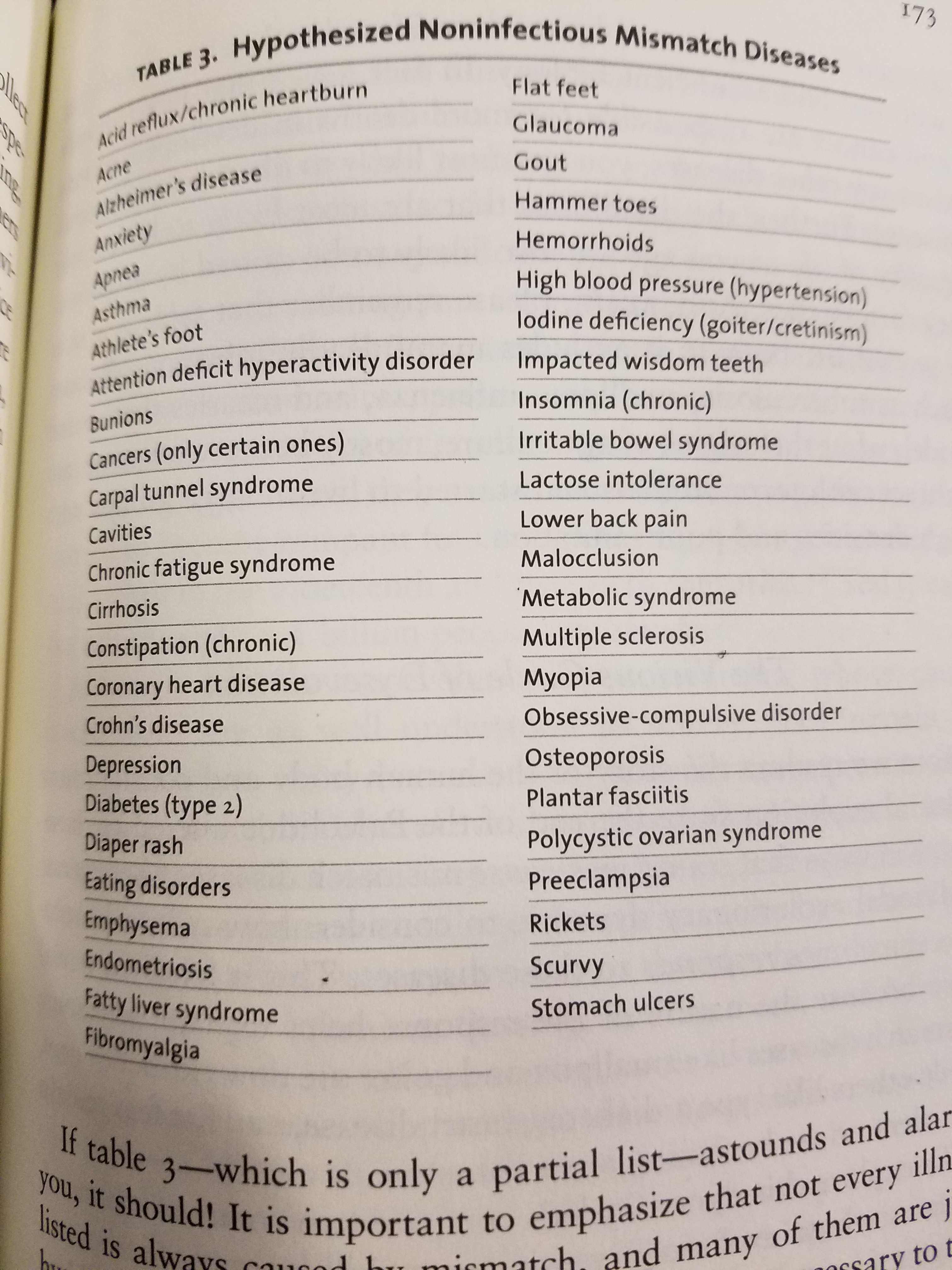
Above is table 3 from Lieberman (2013: 173). He notes hypothesized noninfectious mismatch diseases. Notice how most—if not close to all—are completely preventable with the right environmental interventions.
Though, of course, we have no idea what the health of our ancestors was like. But, as noted in the beginning of this article, since hunter-gatherers had extremely low to nonexistent cases of diseases that we have in first-world societies, that’s a huge clue that the environment we have constructed for ourselves (our obesogenic environment) directly contribute to the diseases we have today.
Finally, Jared Diamond asks an important question: “Is farming worth it?“. Of course he goes the Marxist route stating that “with agriculture came the gross social and sexual inequality, the disease of despotism, that curse our existence.” Though in my opinion what ‘curses our existence’ is the advent of farming that brought numerous mismatch diseases to humans which has decreased quality of life in first world countries.
In conclusion the advent of farming and society had good and bad things to it, though in my opinion—due to excess disease—it wasn’t really worth it. This is why I romanticize the hunter-gatherer’s diet. As shown in reports from the early 20th century, their disease burden (compared to ours) is low on nonexistent. This implies that what causes these mismatch diseases are differing environments from where our ancestors evolved and to stop these mismatches we must change our obesogenic environments and eat a more ‘natural’ diet (trying hard not to commit the naturalistic fallacy, but for this conversation it is apt). JayMan is wrong that mismatch diseases are caused by us living longer and that has been rebutted long ago. Most of what he writes in that article has to do with environmental mismatches.
The evidence that our built food environment with highly processed foods that drive these diseases is extremely compelling. Comparing hunter-gatherer societies with first-world societies leaves us a large clue that what drives these diseases are mismatches with our guilt environment. Only by changing the environment will we ameliorate these diseases and go back to living a relatively disease-free life.
This is why I romanticize the hunter-gatherer’s diet.
(12 22 17 Edit: Also see Associations of fats and carbohydrate intake with cardiovascular disease and mortality in 18 countries from five continents (PURE): a prospective cohort study by Dehghan et al, 2017 who write: “High carbohydrate intake was associated with higher risk of total mortality, whereas total fat and individual types of fat were related to lower total mortality. Total fat and types of fat were not associated with cardiovascular disease, myocardial infarction, or cardiovascular disease mortality, whereas saturated fat had an inverse association with stroke. Global dietary guidelines should be reconsidered in light of these findings.”
However, saturated fat consumption is not related to ischemic stroke. See Saturated Fat Consumption and Risk of Coronary Heart Disease and Ischemic Stroke: A Science Update by Nettleton et al, 2017 who write: “SAFA reduction had little direct effect on stroke risk. Cohort studies suggest that the food matrix and source of SAFA have important health effects.” Saturated fat consumption is also not linked to all cause mortality (de Souza et al, 2015). The PURE study buttresses my arguments that high processed carbohydrate intake have negative effects on all populations that consume them.)
Stress and Race Redux: A ‘Hispanic’ Paradox?
1500 words
American Renaissance published an article the other day titled “Is ‘Racism’ Killing Black People?” and, for the most part, I largely agree with it. However, there are a few faults in it that I need to address.
First, off, as the article rightly noted, it’s not only perceived ‘racism’ that is the cause for these health disparities, but stress from other blacks as well. Gregory Hood (the author of the AmRen article) cites a new study showing that blacks who move out of the ‘hood’ see a subsequent decrease in BP (Kershaw et al, 2017). They followed 2,290 people 974 were men and 1,306 were women. This is data collected from the CARDIA study which has helped us to understand racial disparities in all types of different health outcomes. Blacks who lived in high segregation neighborhoods had higher levels of SBP (systolic blood pressure), and saw a decrease in their SBP when they moved to less segregated neighborhoods. The authors conclude that “policies that reduce segregation may have meaningful health benefits.” What kind of policies will ‘reduce segregation’? Most races/ethnic groups group together in an area, so I don’t see how this would happen.
In regards to the argument on black maternal mortality and ‘racism’, I think it’s much more nuanced. Black women are 2 to 6 times more likely to die giving birth than white women; while the leading causes of maternal death in black women is pregnancy-induced hypertension, and embolism (Chang et al, 2003), though reasons for the mortality rate are not explainable at present (Flanders-Stepans, 2002). Further, in regards to preeclampasia, women who get pregnant at younger ages are more likely to acquire the disease while pregnant, and blacks and other non-whites are more likely to get pregnant at younger ages than whites (Main et al, 2015).
However, there are ways to reduce maternal mortality in black women. In a RCT undertaken between the years of 1990-2011 in Memphis, Tennesee, black women were followed with their live-in children and placed into one of four groups: “treatment 1 (transportation for prenatal care [n = 166]), treatment 2 (transportation plus developmental screening for infants and toddlers [n = 514]), treatment 3 (transportation plus prenatal/postpartum home visiting [n = 230]), and treatment 4 (transportation, screening, and prenatal, postpartum, and infant/toddler home visiting [n = 228])” (Olds et al, 2014). They conclude that pre- and post-natal care greatly reduces maternal/infant mortality in black women, “living in highly disadvantaged settings.”
Further, the racial disparity in post-term neonates is largely driven by “CHD among term infants with US-born mothers is driven predominately by the postneonatal survival disadvantage of African-American infants” (Collins et al, 2017). Though, as can be seen in the study by Olds et al (2014), pre- and post-natal care can greatly reduce both infant and maternal mortality.
Stress can also be measured in pregnant women by measuring the level of blood cortisol (Gillespie et al, 2017). They show that, independent of adulthood stress, stress during childhood may shape birth timing, with cortisol being the biological mediator. This may be an explanation for what Gregory Hood notes. He states in his article that there has to be an explanation for why black women birth earlier, and while I am sympathetic to biological models ala Rushton (1997), Gillespie et al (2017) drive a hard argument that stress during childhood using cortisol as a biological mediator makes a lot of sense.
There are a few studies that attest to pre- and post-natal care having a large effect on the morality of black women, and that having the carers being black women seems to have a positive effect (Guerra-Reyes and Hamilton, 2017). They conclude that “Recognition, support, and increasing the number of African-American midwives and birth assistants is vital in tackling health inequalities.” In regards to infant mortality rate (IMR), 18 states will achieve racial equality by 2050 if current trends from 1999-2013 hold (Joedrecka et al, 2017).
Now for the main reason I decided to write this: the ‘Hispanic’ paradox. This paradox is that for the past twenty years, ‘Hispanics’ with low SES have similar or better health outcomes than whites (Franzini, Ribble, and Keddie, 2001). However, more recent analyses show that the ‘Hispanic’ paradox does not exist, mostly due to methodological problems and migrant selectivity (Crimmins et al, 2007; Teruya and Bazargan-Hezeji, 2013) and was not noticed in Chile either (Cabiesies, Tunstall, and Pickett, 2013). There is no migrant selectivity in regards to smoking, however (Fenelon, 2013, 2016).
Teruya and Bazargan-Hezejie (2013) write:
Studies which advocate the validity of the Immigrant Paradox are countered by those which report specific, negative physical and mental health outcomes, and higher rates of substance use, especially among immigrant adolescents. Findings may also be compromised by fundamental methodological concerns such as migrant health selectivity, and approaches that consider only selectively healthy groups. Moreover, the Immigrant Paradox’s benefits do not appear to extend evenly and consistently to all races, ethnicities and subgroups. Similarly, the Hispanic Paradox does not protect consistently across all Latino ethnicities, age groups and genders, with Puerto Ricans and Cubans in particular found to enjoy fewer health advantages.
This is good evidence that the people who migrate to America are healthier, and that the symptoms of low SES show in their children, but not in them because they are a self-selected population. There is no ‘Hispanic’ paradox (Smith and Bradshaw, 2006; Schoenthaler, 2016). Even a new meta-analysis on this ‘paradox’ states “Immigrant children and youth suffer from an immigrant mortality disadvantage” (Shor, Roelfs, and Vamg, 2017).
Lastly, Gregory Hood brings up stress and suicide, stating that if blacks were really more stressed than whites then blacks would have higher rates of suicide, but some studies show that whites have a higher rate of suicidal ideation, while others do not show this (Perez-Rodriguez et al, 2010). Though, as Balis and Postolache (2010) show, studies show that while there is conflicting evidence in regards to racial/ethnic differences in suicide, whites still attempt it the most. However, suicide for young black Americans is on the rise. Ahmedani et al (2016) show that “Nearly 27% of White individuals made a mental health visit versus less than 20% of Asian, Hawaiian/Pacific Islander, and Black individuals in this period. Within 4 weeks, all visits and mental health visits remained most common for White individuals (67.3% and 47.4%, respectively) and least common among Asian individuals (52.8% and 31.9%, respectively). Within 52-weeks, more than 90% made any visit. Alaskan Native/Native American (81.5%) and White individuals (79.5%) made mental health visits 10–25% more often than other groups.” However, at least in Fulton County, Georgia, black suicide decedents were less likely to report depression than white suicide decedents (Abe et al, 2008).
However, for whites, as noted in this 1982 New York Times article, suicidal feelings “reflects feelings of loneliness and hopelessness, which can be greater factors as one grows older; for instance, after loved ones have died” whereas for older white men, loss of status may be a cause, which would not be that prevalent in lower SES ethnicities. The article seems to implicate loss of status as a main cause for higher rates of suicide in white Americans, and states that as other, lower SES ethnies attain higher status, that suicide rates would rise for them as well.
Another cause could be prescription drugs, for instance in the Northeast which has been hit hard by the opiate/heroin crisis which leads to more white deaths. Robert Putnam puts this on “the links between poverty, hopelessness and health” and states that the suicide rate has declined for two groups, black males and males over the age of 75. Further, “divorce, economic strain, or political repression are often characterized as suicide risks.” Cheng et al (2010) show that “A high level of identification with one’s ethnic group was associated with lower rates of suicide attempts.” So, it seems that if one keeps their status, and has a high level of identification with their ethnic group, whites would then be protected against suicidal ideation. Nonmetropolitan counties also have higher rates of suicide than metropolitan counties (Ivey-Stephenson et al, 2017). People who livee in rural counties are less likely to seek help for mental problems (Carpenter-Song and Snell-Rood, 2016). Whites are also more likely to live in rural areas. This could explain higher rates of suicide in whites, along with loss of status, depression and drug use.
In conclusion, the ‘Hispanic’ paradox doesn’t exist; whites attempt/commit suicide more due to loss of status and since most whites live in rural areas, they do not seek help for their mental health problems which then leads to suicide. In regards to black maternal mortality/infant mortality rates, if they have midwives present during and after the birth, mortality rates have decreased. If these trends continue, there will be racial equality in terms of maternal/infant mortality in 18 states. The AmRen article was good and well written, but there were a few huge flaws. The author assumed that since the ‘Hispanic paradox’ exists, that this should have one disregard the effects of, say, stress on blood pressure in black Americans, as I have discussed in the past. But since the ‘Hispanic’ paradox does not exist, then you cannot say that (perceived) discrimination and ‘racism’ is not a cause for higher rates of mortality in blacks compared to whites.
Blood Pressure, Stress, and the Social Environment: On Black-White Differences in Blood Pressure
1800 words
Blood pressure (BP) is a physiological variable. Therefore since it is a physiological variable then it can be affected by environmental and social changes. How do racial differences come into play here, for instance? Since blacks face more (perceived) discrimination, then they should, on average, have higher BP levels than whites. This is what we find—but the effect is mostly seen in low-income blacks. How do psychosocial factors come into play here in the black-white BP gap?
BP is regulated by cardiac output, vascular resistance of blood flow, blood volume, arterial stiffness, and, of course, the individual’s emotional state which can decrease or increase BP. Neural mechanisms also exist which regulate BP (Chopra, Baby, and Jacob, 2011). Knowing how and why BP increases or decreases will have us better understand the social contexts of increased BP in low SES blacks.
BP is a complex physiological trait. It can go up and down due to what occurs in the immediate environment. Values of 120/80 mmHg are cited as ‘average’ values, but we have no idea what an ‘average’ BP is. Nevertheless—like most/all physiological variables—there is a wide range of what is considered ‘normal’. Due to the variance in human physiological systems, what is ‘normal’ for one individual is not ‘normal’ for another. Variation in BP (like, say, 120 SBP (systolic blood pressure) to 140 SBP) is ‘normal’. I believe even around 110 for SBP is within that range. For DPB (diastolic blood pressure) between 75 and 90 is within normal diurnal fluctuations due to activity/eating/etc (Taylor, Wilt, and Welch, 2011). BP, like testosterone, is one of those tricky variables to measure and so must be measured upon waking to see if there are any problems. So even for a trait like BP, there seems to be a ‘normal range’.
About 33 percent of blacks have hypertension (HTN) (Peters, Arojan, and Flack, 2006). Urban blacks are more likely to have higher BP levels than whites, but “At present, there is no complete explanation for these differences and further research is required” (Lindhorst et al, 2007). Low SES is correlated with higher levels of BP in black Americans—especially those with darker skin—but not Africans in Africa (Fuchs, 2011), suggesting that this is an American phenomenon that needs to be addressed. One good explanation, in my view, is the social environment. Physiological traits are extremely malleable due to the need to be able to ‘change gears’ in an instant, for instance to either fight or flight. Though, in our modernized world, these responses—mostly—have no need and so (due to our supposed civilized behavior), one’s BP rises due to social stress and other environmental factors and it is due to the urban environment.
What is the cause of high BP in blacks?
One explanation that has been given to explain higher rates of BP in blacks when compared to whites is discrimination. However, studies show mixed evidence on whether or not so-called discrimination raises BP (Couto, Goto, and Bastos, 2012). The same American effect (American blacks having higher BP than American whites) is seen even in the UK London area (Agyemang and Bhopal, 2003). This, yet again, is more evidence that the social environment drives these differences—again, regardless of whether or not any of the discrimination is real or imagined. Say most of it were imagined: it’d be irrelevant because the imagined discrimination leads to very real physiological outcomes in BP.
The country of birth also has an effect on BP. In one study, it was noted that Africans had significantly higher BP when compared to Asians (which is identical/lower) and native French living in France (Bahous et al, 2015). Ethnic differences in BP increase due to similar sodium intake is lower than what is usually cited (Graudal and Jurgens, 2015). However, other authors have pointed out that basing conclusions off of observational studies have problems, like the estimation of sodium intake being inaccurate since it’s a one-time measure; (Gunn et al, 2013; Cobb et al, 2014)
There is also evidence—along with pathways—that show how certain social activities work to lower stress and BP, including participation at church (Livingstone, Devine, and Moore, 1991). Black Americans can make other lifestyle changes in order to decrease BP, such as exercise and other lifestyle interventions. Redman, Baer, and Hicks state that “gene-environment interactions, job-related stress, racism, and other psychosocial factors to racial/ethnic disparities” need to be explored as causes for higher rates of HTN in blacks compared to whites. And with the knowledge of how all physiological systems work in terms of stress and other factors, should be explored as causes for this disparity.
Grim et al (1990) state that factors that influence high BP in blacks compared to whites are inherited and that is the major source of variation between these populations. However, the other mounting social/physiological evidence deserves an explanation; that is not inherited, and what we know about how our physiology responds to stress and discrimination—whether real or imagined—are extremely important and lead to extremely real, and important, outcomes in these populations. It is also argued that since blacks en route to America during the slave trade died from salt-depletive diseases, that blacks with a higher genetic propensity to absorb salt survived and this is why blacks have a higher propensity to absorb salt and are more ‘salt-sensitive’, which also could explain higher rates of HTN in American blacks compared to their cousins in Africa (Wilson and Grim, 1991). However, Curtin (1992) disputes this because “There is no evidence that diet or the resulting patterns of disease and demography among slaves in the American South were significantly different from those of other poor southerners”.
However, in regards to the social environment, Williams (1992) drives one of the best arguments I have encountered in this literature so far, stating that while genetic factors play a small part in regards to the BP gap between blacks and whites, social factors are arguably more important than genetic ones (and with our homeodynamic physiology, this does make sense). Dressler (1990) for instance, argues that skin color is a proxy for both social class and discrimination and these factors explain a large amount of the variation. Psychosocial variables can also explain heightened BP (Marmot, 1985; Cuffee et al, 2014). Yan et al (2003) also note how “time urgency/impatience” and “hostility” “were associated with a dose-response increase in the long-term risk of hypertension.” Henry (1988) also argues that calcium, obesity and genetic factors cannot be the aetiology of HTN in blacks, while also proposing that high sodium intakes are due to psychosocial stress (Williams, 1992: 136).
Obesity also leads to hypertension (Re, 2009) while blacks are more likely to be obese than whites, however, black American men with more African ancestry are less likely to be obese (Klimentidis et al, 2016). This would imply that the greater amount of African ancestry in American blacks both protects against obesity and along with it HTN. Williams (1992) makes a convincing argument that environmental and social factors are the cause for the black-white BP gap. And while genetic factors are important, no doubt, environmental and social factors are arguably more important to this debate.
Kulkarni et al (1998) show that increased stress leads to subsequent BP elevations which, over time, will lead to HTN. In a 2009 meta-analysis, Gasparin et al show how “individuals who had stronger responses to stressor tasks were 21% more likely to develop blood pressure increase when compared to those with less strong responses.”
Further, in support for the ‘perceived stress’ hypothesis in regards to blacks ‘perceiving’ stress and discrimination, “stress denial in combination with abdominal obesity, alcohol consumption, and smoking may be proxy for a high stress level” (Suter et al, 1997). Carroll et al (2001) also show how there are is “modest support for the hypothesis that heightened blood pressure reactions to mental stress contribute to the development of high blood pressure.” Sparrenberger et al (2009) also did a systematic review of observational studies, finding that “Acute stress is probably not a risk factor for hypertension. Chronic stress and particularly the non-adaptive response to stress are more likely causes of sustained elevation of blood pressure.”
Lastly, Langford (1981) shows that when SES is controlled for, the black-white BP disparity vanishes, implying that social and environmental—not genetic—factors are the cause for elevated HTN levels in black Americans. Sweet et al (2007) showed that for lighter-skinned blacks, as SES rose BP decreased while for darker-skinned blacks BP increased as SES did while implicating factors like ‘racism’ as the ultimate causes. This is solid evidence that both skin color and SES are predictors of higher prevalence of BP in black populations, and since other studies show that this is not noticed in higher class blacks, nor is this noticed in blacks in Africa, then the main causes of this disparity are social and environmental in nature.
(Non, Gravlee, and Mulligan, 2012). Their study suggests that educating black Americans on the dangers and preventative measures of high BP will reduce BP disparities between the races. This is in-line with Williams (1992) in that the social environment is the cause for the higher rates of BP. One hypothesis explored to explain why this effect with education was greater in blacks than whites was that BP-related factors, such as stress, poverty and racial discrimination (remember, even if no racial discrimination occurs, any so-called discrimination is in the eye of the beholder so that will contribute to a rise in physiologic variables) and maybe social isolation may be causes for this phenomenon. Future studies also must show how higher education causes lower BP, or if it only serves as other markers for the social environment. Nevertheless, this is an important study in our understanding of how and why the races differ in BP and it will go far to increase our understanding of this malady. This is a very convincing argument that education and not genetic ancestry cause disparities in BP between blacks and whites.
WebMD states that, of course, both environmental and genetic factors are at play in regards to black’s increased propensity for acquiring HTN. Fuchs (2011) also states that “They [environmental and behavioral factors] could act directly or by triggering mechanisms of blood pressure increase that are dormant in blacks living in Africa” and explain why black Americans have higher rates of BP than Africans in Africa. Further, race and ethnicity are independent predictors of HTN (Holmes et al, 2013).
Conclusion
Blacks and whites do differ in BP, and its aetiology is both complex and hard to untangle Genetic factors probably don’t account for a lot of this variance since Africans in Africa have low levels of BP compared to their black American cousins. Numerous lines of evidence shows that social and environmental factors are the cause, and so to change this, all people—especially blacks—should be educated on how to change these problems in our society. Whether discrimination is real or imagined, the effects of it lead to real physiological outcomes that then lead to increased health disparities between these populations.
Action Video Games, Reaction Time, and Cognitive Ability
1350 words
Research into neural plasticity has been fruitful the past few decades. However, people like Steven Pinker in his book The Blank Slate attempt to undermine the effects of neural plasticity in regards to TBI and IQ, for instance. However, the plasticity of our brains is how our brains evolved (Skoyles and Sagan, 2002). So since our brains are so plastic, then doing certain tasks may help in terms of ‘processing speed’, reaction time and overall cognitive ability, right?
Science Daily reported on a new meta-analysis that took 15 years to complete that looked at how action video games affect reaction time and cognitive performance. What they found was something that I have talked about a bit: that playing these types of games increases one’s reaction time and even their cognitive ability. Unfortunately, the paper is not on Sci-Hub yet, but when it is released on Sci-Hub I will go more in depth on it.
The authors (Benoit et al, 2017) looked at 15 years of papers on action video games and cognitive performance from the year 2000-2015. They focused on war and shooting video games to gauge whether or not there was a causal effect on action video game playing and cognitive performance. They got two meta-analyses out of all of the research they did.
They studied 8,790 people between the ages of 6-40 and gave them a battery of cognitive tests. These tests included spatial attention tasks as well as testing how well one could multi-task while changing their plans in-line with the rules of the game. “It was found that the cognition of gamers was better by one-half of a standard deviation compared to non-gamers.” Though this meta-analysis failed to answer one question: do people who play games have higher cognitive ability or do people with higher cognitive ability play more games? The classic chicken-and-the-egg problem.
They then looked at other studies of 2,883 individuals and partitioned them into 2 groups: groups of people who played action games like war and shooter games whereas the second group played games like SIMS, Tetris and Puzzle (I would loosely term these strategy games as well). They found that both groups played for 8 hours per week, netting 50 hours of gameplay over 12 weeks.
What they found was that the results were overwhelmingly in favor of war and shooting games improving cognition. The interesting thing about these analyses was that it took years to get the data and it is from all over the world, so it doesn’t only hold in America, for instance. Though, in the abstract of the paper (all I have access to at the moment) Benoit et al (2017) write:
Publication bias remains, however, a threat with average effects in the published literature estimated to be 30% larger than in the full literature. As a result, we encourage the field to conduct larger cohort studies and more intervention studies, especially those with more than 30 hours of training.
This is in-line with numerous other papers on the matter of cognitive abilities and action video games. Green and Bavelier (2007) showed that video game players “could tolerate smaller target-distractor distances” whereas “similar effects were observed in non-video-game players who were trained on an action video game; this result verifies a causative relationship between video-game play and augmented spatial resolution.” They found that action video games ‘sharpened vision’ by up to 20 percent. Green and Bavelier (2012) also show that playing action video games may enhance the ability to learn new tasks and that what is learned from playing these types of games “transfers well beyond the training task.”
Green and Bavelier (2003) show that playing action video games showed better visual attention in comparison to those who did not play games. Even those who did not game saw improvement in visual attention which, again, shows that video games have an actual causal effect on these phenomena and it’s not just ‘people with higher cognitive ability choosing to play video games’. (See also Murphy and Spencer, 2009 who show that “There were no other group differences for any task suggesting a limited role for video game playing in the modification of visual attention.“)
Dye, Green, and Bavelier (2009) show that action video games increase reaction time (RT). Variables like videogame-playing when testing cognitive abilities are a huge confound, as can be seen, since people who play action video games have a quicker reaction time than those who do not—which, as I’ve shown, has a causal relationship with game playing since even the controls who did not play action games saw an increase in their RT. Achtman, Green, and Bavelier (2008) show yet again that action video game playing enhances visual attention and overall visual processing.
Green (2008: iii-iv) in an unpublished doctoral dissertation (the first link on Google should be the dissertation) showed the video game players “acquire sensory information more rapidly than NVGPs [non-videogame players]”.
Applebaum et al (2013) showed that action game playing “may be related to enhancements in the initial sensitivity to visual stimuli, but not to a greater retention of information in iconic memory buffers.” Bejjanki et al (2014) show that action video game playing “establish[es] … the development of enhanced perceptual templates following action game play.” Cardoso-Leite and Bavelier (2014) show that video games enhance “behavior in domains as varied as perception, attention, task switching, or mental rotation.”
Boot, Blakely, and Simons (2011) show that there may be a ‘file-drawer effect’ (publication bias)in terms of action video games increasing cognition, which Benoit et al (2017) acknowledge and push for more open studies.
Unsworth et al (2015) state that “nearly all of the relations between video-game experience and cognitive abilities were near zero.” So, there are numerous studies both for and against this (most of the studies for this being done by Green and Bavelier), and so this meta-analysis done by Benoit et al (2017) may finally begin to answer the question: Does playing action video games increase cognitive ability, increase visual attention and increase reaction time? The results of this new meta-analysis suggest yes, and it may have implications for IQ testing.
Richardson and Norgate (2014) in their paper Does IQ Really Predict Job Performance? state that there are numerous other reasons why some individuals may have slower RTs, one of the variables being action video game playing, along with anxiety, motivation, and familiarity with the equipment used, meaning that if one is experienced in video game playing—action games specifically—it may cause differences between individuals that do not come down to ‘processing speed’ or native ability, as is usually claimed (and with such low correlations of .2-.3 for reaction time and IQ, other factors must mediate the relationship that are not genetic in nature).
Now, let’s say the effect is as large as Benoit et al (2017) say it is at one-third of a SD. Would this mean that one would need to attempt to control for video game playing while testing, say, IQ or RT? I believe the answer is definitely pointing in that direction because it is clear—with the mounting evidence—that action video games can reduce RT and thusly confound certain tests. Action video game playing may be a pretty large confound in terms of the outcomes of IQ tests if these new meta-analyses from Benoit et al (2017) hold up. If this does hold up and playing action video games does affect both RT and cognitive ability at one-third of an SD (about 5 points), then the case can be made that this must be controlled for due to confounding the relationship.
In sum, if these effects from this new meta-analysis hold and can be replicated by other studies, then that’s a whole other variable that needs to be accounted for when testing IQ and RT. RT is a complicated variable and, according to Khodaddi et al (2014) “The relationship between reaction time and IQ is too complicated and revealing a significant correlation depends on various variables (e.g. methodology, data analysis, instrument etc.).” This, is in my view, one reason why RT should be tossed out as a ‘predictor of g‘ (whatever that is), as it is not a reliable measure and does not ‘test’ what it is purported to test.
Race and Medicine: Is Race a Useful Category?
2450 words
The New York Times published an article on December the 8th titled What Doctors Should Ignore: Science has revealed how arbitrary racial categories are. Perhaps medicine will abandon them, too. It is an interesting article and while I do not agree with all of it, I do agree with some.
It starts off by talking about sickle cell anemia (SCA) and how was once thought of as a ‘black disease’ because blacks were, it seemed, the only ones who were getting the disease. I recall back in high-school having a Sicilian friend who said he ‘was black’ because Sicilians can get SCA which is ‘a black disease’, and this indicates ‘black genes’. However, when I grew up and actually learned a bit about race I learned that it was much more nuanced than that and that whether or not a population has SCA is not based on race, but is based on the climate/environment of the area which would breed mosquitoes which carry malaria. SCA still, to this day, remains a selective factor in the evolution of humans; malaria selects for the sickle cell trait (Elguero et al, 2015).
This is a good point brought up by the article: the assumption that SCA was a ‘black disease’ had us look over numerous non-blacks who had the sickle cell trait and could get the help they needed, when they were overlooked due to their race with the assumption that they did not have this so-called ‘black disease’. Though it is understandable why it got labeled ‘a black disease’; malaria is more prevalent near to the equator and people whose ancestors evolved there are more likely to carry the trait. In regards to SCA, it should be known that blacks are more likely to get SCA, but just because someone is black does not automatically mean that it is a foregone conclusion that one has the disease.
The article then goes on to state that the push to excise race from medicine may undermine a ‘social justice concept’: that is, the want to rid the medical establishment of so-called ‘unconscious bias’ that doctors have when dealing with minorities. Of course, I will not discount that this doesn’t have some effect—however small—on racial health disparities but I do not believe that the scope of the matter is as large as it is claimed to be. This is now causing medical professionals to integrate ‘unconscious bias training’, in the hopes of ridding doctors of bias—whether conscious or not—in the hopes to ameliorate racial health disparities. Maybe it will work, maybe it will not, but what I do know is that if you know someone’s race, you can use it as a roadmap to what diseases they may or may not have, what they may or may not be susceptible to and so on. Of course, only relying on one’s race as a single data point when you’re assessing someone’s possible health risks makes no sense at all.
The author then goes on to write that the terms ‘Negroid, Caucasoid, and Mongoloid’ were revealed as ‘arbitrary’ by modern genetic science. I wouldn’t say that; I would say, though, that modern genetic science has shown us the true extent of human variation, while also showing that humans cluster into 5 distinct geographic categories, which we can call ‘race’ (Rosenberg et al, 2002; but see Wills, 2017 for alternative view that the clusters identified by Rosenberg et al, 2002 are not races. I will cover this in the future). The author then, of course, goes on to use the continuum fallacy stating that since “there are few sharp divides where one set of traits ends and another begins“. A basic rebuttal would be, can you point out where red and orange are distinct? How about violet and blue? Blue and Cyan? Yellow and orange? When people commit the continuum fallacy then the only logical conclusion is that if races don’t exist because there are “few sharp divides where one set of traits ends and another begins“, then, logically speaking, colors don’t exist either because there are ‘few [if any] sharp divides‘ where one color ends and another begins.
The author also cites geneticist Sarah Tishkoff who states that the human species is too young to have races as we define them. This is not true, as I have covered numerous times. The author then cites this study (Ng et al, 2008) in which Craig Venter’s genome was matched with the (in)famous [I love Watson] James Watson and focused on six genes that had to do with how people respond to antipsychotics, antidepressants, and other drugs. It was discovered that Venter had two of the ‘Caucasian’ variants whereas Watson carried variants more common in East Asians. Watson would have gotten the wrong medicine based on the assumption of his race and not on the predictive power of his own personal genome.
The author then talks about kidney disease and the fact that blacks are more likely to have it (Martins, Agodoa, and Norris, 2012). It was assumed that environmental factors caused the disparity of kidney disease in blacks when compared to whites, however then the APOL1 gene variant was discovered, which is related to worse kidney outcomes and is in higher frequencies in black Americans, even in blacks with well-controlled blood pressure (BP) (Parsa et al, 2013). The author then discusses that black kidneys were seen as ‘more prone to failure’ than white kidneys, but this is, so it’s said, due to that one specific gene variant and so, race shouldn’t be looked at in regards to kidney disease but individual genetic variation.
In one aspect of the medical community can using medicine based on one’s race help: prostate cancer. Black men are more likely to be afflicted with prostate cancer in comparison to whites (Odedina et al, 2009; Bhardwaj et al, 2017) with it even being proposed that black men should get separate prostate screenings to save more lives (Shenoy et al, 2016). Then he writes that we still don’t know the genes responsible, however, I have argued in the past that diet explains a large amount—if not all of the variance. (It’s not testosterone that causes it like Ross et al, 1986 believe).
The author then discusses another medical professional who argues that racial health disparities come down to the social environment. Things like BP could—most definitely—be driven by the social environment. It is assumed that the darker one’s skin is, the higher chance they have to have high BP—though this is not the case for Africans in Africa so this is clearly an American-only problem. I could conjure up one explanation: the darker the individual, the more likely he is to believe he is being ‘pre-judged’ which then affects his state of mind and has his BP rise. I discussed this shortly in my previous article Black-White Differences in Physiology. Williams (1992) reviewed evidence that social, not genetic, factors are responsible for BP differences between blacks and whites. He reviews one study showing that BP is higher in lower SES, darker-skinned blacks in comparison to higher SES blacks whereas for blacks with higher SES no effect was noticed (Klag et al, 1991). Sweet et al (2007) showed that for lighter-skinned blacks, as SES rose BP decreased while for darker-skinned blacks BP increased as SES did while implicating factors like ‘racism’ as the ultimate causes.
There is evidence for the effect of psychosocial factors and BP (Marmot, 1985). In a 2014 review of the literature, Cuffee et al (2014) identify less sleep—along with other psychosocial factors—as another cause of higher BP. It just so happens that blacks average about one hour of sleep less than whites. This could cause a lot of the variation in BP differences between the races, so clearly in the case of this variable, it is useful to know one’s race, along with their SES. Keep in mind that any actual ‘racism’ doesn’t have to occur; the person only ‘needs to perceive it’, and their blood BP will rise in response to the perceived ‘racism’ (Krieger and Sidney, 1996). Harburg et al (1978) write in regards to Detroit blacks:
For 35 blacks whose fathers were from the West Indies, pressures were higher than those with American-born fathers. These findings suggest that varied gene mixtures may be related to blood pressure levels and that skin color, an indicator of possible metabolic significance, combines with socially induced stress to induce higher blood pressures in lower class American blacks.
Langford (1981) shows that when SES differences are taken into account that the black-white BP disparity vanishes. So there seems to be good evidence for the hypothesis that psychosocial factors, sleep deprivation, diet and ‘perceived discrimination’ (whether real or imagined) can explain a lot of this gap so race and SES need to be looked at when BP is taken into account. These things are easily changeable; educate people on good diets, teach people that, in most cases, no, people are not being ‘racist’ against you. That’s really what it is. This effect holds more for darker-skinned, lower-class blacks. And while I don’t deny a small part of this could be due to genetic factors, the physiology of the heart and how BP is regulated by even perceptions is pretty powerful and could have a lot of explanatory power for numerous physiological differences between races and ethnic groups.
Krieger (1990) states that in black women—not in white women—“internalized response to unfair treatment, plus non-reporting of race and gender discrimination, may constitute risk factors for high blood pressure among black women“. This could come into play in regards to black-white female differences in BP. Thomson and Lip (2005) show that “environmental influence and psychosocial factors may play a more important role than is widely accepted” in hypertension but “There remain many uncertainties to the relative importance and contribution of environmental versus genetic influences on the development of blood pressure – there is more than likely an influence from both. However, there is now evidence to necessitate increased attention in examining the non-genetic influences on blood pressure …” With how our physiology evolved to respond to environmental stimuli and respond in real time to perceived threats, it is no wonder that these types of ‘perceived discrimination’ causes higher BP in certain groups with lower SES.
Wilson (1988) implicates salt as the reason why blacks have higher BP than whites. High salt intake could affect the body’s metabolism by causing salt retention which influences blood plasma volume, cardiac output. However, whites have a higher salt intake than blacks, but blacks still ate twice the recommended amounts from the dietary guidelines (all ethnic subgroups they analyzed from America over-consumed salt as well) (Fulgoni et al, 2014). Blacks are also more ‘salt-sensitive’ than whites (Sowers et al 1988; Schmidlin et al, 2009; Sanada, Jones, and Jose, 2014) which is also heritable in blacks (Svetke, McKeown, and Wilson, 1996). A slavery hypothesis does exist to explain higher rates of hypertension in blacks, citing salt deficiency in the parts of Africa that supplied the slaves to the Americas, to the trauma of the slave trade and slavery in America. However, historical evidence does not show this to be the case because “There is no evidence that diet or the resulting patterns of disease and demography among slaves in the American South were significantly different from those of other poor southerners” (Curtin, 1992) whereas Campese (1996) hypothesizes that blacks are more likely to get hypertension because they evolved in an area with low salt.
The NYT article concludes:
Science seeks to categorize nature, to sort it into discrete groupings to better understand it. That is one way to comprehend the race concept: as an honest scientific attempt to understand human variation. The problem is, the concept is imprecise. It has repeatedly slid toward pseudoscience and has become a major divider of humanity. Now, at a time when we desperately need ways to come together, there are scientists — intellectual descendants of the very people who helped give us the race concept — who want to retire it.
Race is a useful concept. Whether in medicine, population genetics, psychology, evolution, physiology, etc it can elucidate a lot of causes for differences between races and ethnic groups—whether or not they are genetic or psychosocial in nature. That just attests to both the power of suggestion along with psychosocial factors in regards to racial differences in physiological factors.
Finally let’s see what the literature says about race in medicine. Bonham et al (2009) showed that both black and white doctors concluded that race is medically relevant but couldn’t decide why however they did state that genetics did not explain most of the disparity in relation to race and disease aside from the obvious disorders like Tay Sachs and sickle cell anemia. Philosophers accept the usefulness of race in the biomedical sciences (Andreason, 2009; Efstathiou, 2012; Hardimon, 2013; Winther, Millstein, and Nielsen, 2015; Hardimon, 2017) whereas Risch et al (2002) and Tang et al (2002) concur that race is useful in the biomedical sciences. (See also Dorothy Roberts’ Ted Talk The problem with race-based medicine which I will cover in the future). Richard Lewontin, naturally, has hang-ups here but his contentions are taken care of above. Even if race were a ‘social construct‘, as Lewontin says, it would still be useful in a biomedical sense; but since there are differences between races/ethnic groups then they most definitely are useful in a biomedical sense, even if at the end of the day individual variation matters more than racial variation. Just knowing someone’s race and SES, for instance, can tell you a lot about possible maladies they may have, even if, utltimately, individual differences in physiology and anatomy matter more in regards to the biomedical context.
In conclusion, race is most definitely a useful concept in medicine, whether race is a ‘social construct’ or not. Just using Michael Hardimon’s race concepts, for instance, shows that race is extremely useful in the biomedical context, despite what naysayers may say. Yes, individual differences in anatomy and physiology trump racial differences, but just knowing a few things like race and SES can tell a lot about a particular person, for instance with blood pressure, resting metabolic rate, and so on. Denying that race is a useful concept in the biomedical sciences will lead to more—not less—racial health disparities, which is ironic because that’s exactly what race-deniers do not want. They will have to accept a race concept, and they would accept Hardimon’s socialrace concept because that still allows it to be a ‘social construct’ while acknowledging that race and psychosocial factors interact to cause higher physiological variables. Race is a useful concept in medicine, and if the medical establishment wants to save more lives and actually end the racial disparities in health then they should acknowledge the reality of race.
Why Do Blacks Dominate Bodybuilding?
1150 words
If you look at the winners of the Mr. Olympia contest over the past ten years you will see a trend. Although there were only three winners in this time period, 2 were black while one was white. Dexter Jackson, a black man, won in 2008, with the apt nickname “The Blade” due to his body type and how sliced and diced he is. Jay Cutler then won in 2009 and 2010, with previous wins in 2006 and 2007. Then Phil Heath came along and has dominated for the past 7 years while it looks like no one will dethrone him for a while (I personally think that Shaun Rhoden has a chance). So why do blacks dominate this sport?
A few things come into play here: somatype, fat-free body mass, grit, determination, and of course mass amounts of steroids. However, everyone uses steroids when it comes to these elite competitions so that’s a non-factor. What comes into play is how bad you want it, along with, of course, outstanding genetics.
When talking about bodybuilding, discussions on fat-free mass almost always pop up. Blacks have lower fat-free mass than whites, with thinner skin folds (Vickery, Cureton, and Collins, 1988; Wagner and Heyward, 2000). So taking an elite white and black bodybuilder at similar body fat levels, the black bodybuilder will show more cuts and thusly, in theory, place better than the white bodybuilder, all things being equal.
The reigning Mr. Olympia (seven years in a row) states that “I definitely had the genetics on my side – no question about it – because without that, you’re only gonna go so far in bodybuilding.” And he is right. He has some crazy genetics, especially to get and maintain that level of leanness he does. Of course, his training regimen comes into play here. He, for instance, trains at latitude since he lives in Denver, Colorado which is called altitude training where he gets certain physiological advantages compared to those who do not train at altitude.
You can even see this in tribes like the Kalenjin, the subgroup in Kenya that pumps out the most long-distance runners. The highest point in Kenya is 5,197 meters. You’d need certain physiological advantages to be able to live and work at that high of an altitude. These trends are noticed in America too, even. For instance, Colorado is one of the leanest states whereas near the Gulf of Mexico—basically at sea level—obesity rates are higher. Now I’m aware that correlation doesn’t equal causation, however, people that live in Colorado are more likely to be active and partake in activities such as hiking, whereas there are large amounts of physical inactivity near the Gulf.
Living and training at altitude may cause other pertinent changes in the body and how it uses energy. For instance, fatty acid oxidation may be higher while there is evidence that appetite is suppressed at altitude. In Denver, there are physiological changes that lead to fat loss:
Denver has seasonal variations that range from tolerably cold but freezing lows for five months of the year, to pleasantly warm highs in the mid-60s to upper 80s the remainder of the year. Temperatures thst for not impede outdoor activities but rouse the body to react to thermal change. The thermoneutral temperature for humans is about 82 degrees Fahrenheit, so Denver residents are forced to maintain body temperature through activity, brown fat activation (which burns fat for heat instead of energy) or wearing more insulated clothing.
This is something I touched on in my article Human Physiological Adaptations to Climate. Our physiology is homeodynamic, not homeostatic as is commonly stated (Lloyd, 2001). Due to this, our physiology can change to match the environment, and thus is due to our intelligent physiological systems which is driven by intelligent cells.
Nevertheless, altitude training is at least part of the reason why Phil Heath is the best of the best in bodybuilding. Though, what other advantages do blacks have other than thinner skin folds which gives them a more ‘3d’ look, on average?
Training is why bodybuilders look different from powerlifters. It has also been reported that bodybuilders have “unusually high values of type IIx fibers” while other studies show no difference while there may be a difference between type IIa and type IIx fibers between strength and power athletes. Nevertheless, there are somatypic differences between bodybuilders and weightlifters (I’ll provide the cite here later, I’m typing this on my phone; for the time being, the paper is titled A Comparative Study of Body Builders and Weight Lifters on Somatotypes):
The result of the study showed that there was a significant difference between body builders and weight lifters of their endomorph. Weightlifters are tend to have more fat percentage as compared to bodybuilders. There was not much difference found in the mesomorphy status of the bodybuilders and weightlifters but the bodybuilders showed slightly more musculature than the weightlifters and in the ectomorphy status bodybuilders tend to be more ectomorph than weightlifters.
…
On the basis of obtained results it is concluded that there was a statistical significant difference between body builders and weight lifters in their Endomorph and Ectomorph. Insignificant difference found in Ectomorph of Body Builders and Weight Lifters.
This makes sense. In the study, bodybuilders skewed more meso whereas weightlifters skewed more endo, with bodybuilders skewing more ecto than weightlifters. (For an overview of somatypes read my article Racial Differences in Somatype.) Champion bodybuilders skew extremely meso with little skew in endomorphy. Again, knowing about the average proportions of a somatype will tell you a lot about someone and which things, on average, they will excel at due to levers, bone density, body proportions etc. The same proportions are seen in Brazilian bodybuilders (Silva et al, 2003).
In conclusion, why do blacks dominate bodybuilding? Well, it may possibly be due to fiber type distribution, but that is contested by other studies. Their main advantage seems to be—and that is why they dominate other sports as well—their somatype. Another reason is thinner skin folds (Vickery, Cureton, and Collins, 1988; Wagner and Heyward, 2000) gives a more ‘3D look’. Look at champion bodybuilders and their levers and overall body frame. They differ widely from weightlifters and powerlifters. Some—or most—of the difference in look between bodybuilders and weightlifters is due to differences in training.
In regards to the current best in the world with seven straight wins at the Olympia, Phil Heath, he does a special type of training, but he also has ridiculous genetics. Now, I’m not saying that genetics is the be-all-end-all here because training and intensity set the men apart from the boys. But, as is the case in a lot of areas in life, if you don’t have the right genetics you won’t excel in certain areas. Phil Heath’s nickname is “The Gift”, and it’s a very apt one at that.
I will cover why whites dominate powerlifting and strength competitions later, and the same holds there: somatype (along with muscle fiber differences) is one of the main predictive variables that cause differences in these sports.
 NotPoliticallyCorrect