Home » Evolution (Page 10)
Category Archives: Evolution
Marriage, Divorce and Genetic Similarity Theory
1100 words
Genetic Similarity Theory states that we seek out similar others in order to give our genes the best chance to produce copies of themselves. As Richard Dawkins says in The Selfish Gene, it is genes that survive to the next generation with more copies being found in siblings and related co-ethnics. Therefore, the theory goes, by benefitting genetically similar others, we are benefitting copies of our genes. Speed daters match on genotype, which shows evidence for ability to detect genetically similar others. On a subconscious level, we have the ability to detect genetically similar others.
Assortative mating is a form of sexual selection in which those with similar genotypes and phenotypes mate with each other more often than in would be expected under a random breeding model. One of the numerous ways we match by genetic similarity is phenotype. If the phenotype is similar, more often than not, the genotype is as well. This is what drives friendships and marriages, as well as being the cause for ethnocentrism.
Rushton (1987) showed that humans are able to detect degrees of genetic similarity in others, and prefer those most similar to themselves for friends and spouses than less genetically similar individuals, which is the basis for ethnocentrism. A husband and wife are, on average, as close as fourth cousins. Due to matching by GST, spouses should also match on heritable traits such as IQ, body measurements and personality traits. As McCrae et al (2008) write:
Altruism, Modesty, and Tender-Mindedness are characteristics that most people desire in a spouse (cf. Buss, 1986), but people are most likely to find a mate with these characteristics if they have them themselves. This is an instance of the principle that people with desirable qualities have more options in seeking a desirable mate. At the same time, it seems likely that there is a sense in which disagreeable people may actually prefer the company of their own kind, like the haughty Duke in Robert Browning’s “My Last Duchess,” who disposed of his wife because she was too indiscriminately nice.
Everyone has the perfect spouse in their head that they dream of. However, the type of spouse we end up with will, more often than not, be genetically similar to ourselves. Even spouses who are not of the same race or ethnicity match up on heritable traits such as The Big Five, IQ and physiological measurements.
Divorce is also influenced by genetic factors. Jockin, Mcgue and Lykken (1996) found that 40 percent of the variability in the heritability of divorce comes from genetic factors that affect the personality of one spouse. Traditionalism, extraversion and neuroticism (2 of the Big 5 Personality Traits) are causes for divorce. A few reasons I can think of for neuroticism and extraversion being personality traits correlated with divorce is highly neurotic people are more likely to be stressed, anxious, have hypochondria (the worry of contracting an illness) and obsessive behavior. This can put extra strain on a marriage, leading to both of the spouses not being happy in their marriage, leading to divorce. With extraversion, more extraverted people are more open to meeting others and are more social and talkative. This will lead to feelings of jealousy, causing a strain on the marriage.
The genetic and environmental influences responsible for marriage are different from those that are responsible for divorce. Evidence exists that after mate selection, there may be some protective factors for the couple, such as religion. While other factors that place couples at risk for divorce, such as alcoholism, are also genetic in nature.
Trumbetta and Gottesman (2000) suggested endophenotypes with one being oriented to pair bonding and the other to mate diversification. Pair bonding, obviously, leads to a happier marriage as both spouses are monogamous, whereas mate diversification is associated with multiple marriages. It sounds to me like those who pair bond are more introverted whereas those who have diversity in marriage partners are more extraverted, leading to high divorce rates due to jealousy and cheating. The conclude that there are significant genetic influences on both endophenotypes with unique environmental factors accounting for the rest of the variance,
Spouses, as well as friends, sort on characterisitics such as race, socioeconomics, physical attractiveness, level of education, family size and structure, IQ and longevity. This is the Selfish Gene in action. By seeking out copies of itself (which would be in co-ethnics in higher frequencies), the gene is able to ensure its survival onto the next generation.
Even in couples who are not the same race or ethnicity match on other heritable characteristics. Rushton and Nicholson (1988), tested predictions from genetic similarity theory and found that spouses select each other on the basis of more genetically influenced cognitive tests. It’s known since The Bell Curve came out in 1994 that spouses select each other based on IQ. What Rushton and Nicholson noted in the study was that estimates of genetic influence calculated on Koreans and Canadians predicted assortative mating in European Americans in Hawaii and California. Americans of mixed ancestry made up for ethnic dissimilarity by matching up on the more heritable traits, whereas the correlation is lower for those traits that are more influenced by the environment. The observations on genetic selection were weaker but still had a positive correlation, when the g factor was taken out of the equation. This suggests that we choose mates based on the general intelligence factor. This effect is seen in, for instance, white women who date black men. They, more often than not, have lower average IQs than the mean (100).
Pan and Wang (2011) showed that spouses are similar in academic achievement as well as IQ. 6 out of the 8 traits tested (reading, spelling, arithmetic, vocabulary, verbal and full-scale IQ) showing evidence of spousal correlations.
Humans have a natural instinct to marry genetically similar others. Whether the traits are environmentally or genetically influenced, spouses will match on traits with the highest correlations (BMI, waist size, arm size). Genetic Similarity Theory proposes that these phenomena is not by chance, but was how we evolved. Sexual selection, which is natural selection arising through preference by one sex for certain traits in individuals of the other sex, is the driving factor here. Through sexual selection, we humans were able to gain higer intelligence (for men) and gain higher verbal abilties that allowed to care for children (women). These differences remained even when controlling for geographic location. Spouses and friends being as similar as 4th cousins is no accident, in fact, it is evolution in action.
Neanderthals, Inbreeding, r/K Selection Theory and Eurasian Birthrates
1100 words
(Note, 6/24/17: Rushton’s r/K selection in applications to human races is dead. It’s been dead for almost 30 years after and ecologist critiqued his method and use of ecological theory in application to human races. Now, that doesn’t meant that everything written below—or even on my whole blog—is fully wrong, just that the attempted explanation is wrong. It still holds that Eurasians have worse fitness than Africans, which is partly due to deleterious Neanderthal variants, however, r/K theory does not explain it.)
Science Daily reported last week that Neanderthals left humans a genetic burden, which is having less offspring. Of course, these deleterious alleles only introgressed into non-African populations due to Africans not leaving Africa. This manifests itself today in birth rates within countries and between them based on the ethnic/racial mix. And (not) coincidentally, the areas with the highest rate of children are in sub-Saharan Africa.
The Neanderthals existed in small bands, so inbreeding was common. Due to this inbreeding, Neanderthals were more homogenous than we are today. When humans migrated out of Africa, they encountered the inbred Neanderthals who they interbred with. Harmful genetic variants acquired from Neanderthals are shown to reduce the fitness of populations with certain deleterious alleles. There are of course tradeoffs with everything in life. Increased intelligence and being better able to weather the Ice Age, among numerous other factors, were positive things gained from interbreeding with Neanderthals. Negative effects were the acquisition of deleterious alleles which still persist today in non-African hominids. These deleterious alleles decreased biological fitness which manifests itself in the birthrate of Eurasian populations throughout the world (the Germann and Japanese birthrate is 1.3 for reference).
Harris and Nielson also hypothesize that since Neanderthals existed in small bands that natural selection was less effective, allowing for weakly harmful mutations to pass on and not get weeded out over the generations. However, when introduced back into humans these effects become lost over time due to a large population with natural selection selecting against the deleterious Neanderthal alleles. Using a computer program, Harris and Nielson quantify how much of a negative effect the Neanderthal genome had on modern populations. The conclusion of the results was that Neanderthals are 40 percent LESS genetically fit than modern humans.
The researchers’ simulations also suggest that humans and Neanderthals mated more freely, which leads more credence to the idea that Neanderthals got absorbed into the Homo Sapien population and not mostly killed off. The estimation for Neanderthal DNA in modern hominids from the simulation was around 10 percent, which then continued to drop as the Neanderthal-Homo Sapiens hybrids interbred with those who hardly had any Neanderthal DNA. More evidence also shows that the percentage of Neanderthal DNA was higher in the past in Eurasians as well. Which makes sense since Asians have on average 20 percent more Neanderthal DNA than Europeans due to a second interbreeding event.
However, Harris and Nielson end up concluding that non-Africans historically had a 1 percent loss in biological fitness due to Neanderthal genetics. Moreover, a better immune system came from Neanderthal genetics. Skin color is another trait inherited from Neanderthals as well.
Along with the acquisition of deleterious Neanderthal alleles, early Eurasians also encountered the same environment as the Neanderthals. Those selection pressures, along with interbreeding due to small bands lead to a decrease in the number of children had. Fewer children are easier to care for as well as show more attention to. All of these variables in that environment lead to fewer children produced. It’s a better evolutionary strategy to have fewer children in more northerly climes than in more southerly ones due to the differing selection pressures. Environmental effects are also one reason why birthrates are lower for populations that evolved in northerly climes (Neanderthals and post-OoA hominids). Harsh winters lead to a decreased population size, as evidenced by the Inuit and Eskimoes, which their low population size didn’t allow for selection for high IQ despite having the same brain size as East Asians.
I couldn’t help but think that, yet again, for the second time in two weeks, one of JP Rushton’s theories was confirmed. This confirms one of the many variables of Rushton’s r/K Selection Theory. Just like I covered how Piantadosi and Kidd corroborated Rushton’s theory of brain size and earlier child birth. Neanderthals had bigger brains than we do today, and knowing what we know about the correlation between IQ, brain size and early childbirth, I would assume that Neanderthals also had earlier childbirths as well,.
Along with these deleterious gene variants from Neanderthals, other variables that contribute to the decline in Eurasian populations also include higher IQ as well, as JP Rushton says, is an extreme way to have control over their environment and individuality. These traits are seen in higher IQ populations in comparison to lower IQ populations. We could also make the inference that since Eurasian children have bigger heads, that multiple childbirths would be taxing on the Eurasian woman’s birth canal while it would be less taxing on the African woman’s.
This study also shows that Neanderthals also had less offspring due to being more intelligent. They had bigger brains than we do today, and since we know that higher IQ is correlated with fewer children conceived, we can say that they were pretty damn smart (they buried their dead 50,000 years ago. There was also a recent discovery of a 176,500-year-old Neanderthal constructions in a French cave). A main cause for the current trend in birthrates in Eurasian populations is due interbreeding with Neanderthals. These events also attributed more to the decline of the Neanderthals.
Deleterious Neanderthal alleles are yet another reason for lower Eurasian birthrates, which shows = that the current trend currently happening in the world with these populations is natural and evolutionarily based. I’ve said a few times that by showing positive things to women on television will increase the white birth rate, with Rushton cites National Socialist Germany as one example. By showing women happy with children, this lead to a massive boom in the German population. To ameliorate the effects of low natural birth rates, these positive things need to be shown on television to women to start to reverse the effects of low natural childbirths.
It’s been a great month for Rushton’s theories, with two of them being corroborated in one month. It’s only a matter of time before the denial of human nature is completely discarded from modern science. As the data piles up on human genetic diversity we will not be able to deny these clearly evident factors any longer.
Chinese IQ
1100 words
The Chinese have one of the highest IQs in the world. Their 100 and 108 in Hong Kong give them an average of 104. Chinese intelligence has been increasing from the 1940s all the way to today. This is the ‘Flynn Effect’ in action. Lui and Lynn (2013) reported that IQ scores are improving for 12-year-old Chinese children. The increases are as follows: 6.19 points for full-scale IQ, 6.55 points for performance IQ, and 1.91 points for verbal IQ. The Jintan Child Study is an ongoing longitudinal study to show the effects of health and cognitive ability.
They used 1656 6th graders (55.5 percent boys and 45.5 percent girls, “consisting of 24.3% of all children in this age range in the Jintan city region born in 1999.”) who either graduated or currently were in the grade with an average age of 12.2 years. The study from 86-87 used only individuals from urban areas, so Liu and Lynn did the same. They conclude that over the 26 years from the original study, between the two data sets that increases of 2.38 points on full-scale IQ, .73 points on verbal, and 2.52 points on performance IQ per decade. They theorize that economic development is a cause of rising IQ scores due to better nutrition. The study concludes a 105.89 IQ for the 12-year-olds in the study.
Liu and Lynn (2015) also observed the same sex differences in the same magnitude in Chinese and American boys and girls. In a study of 788 children aged 12 years old, boys obtained a higher IQ by 3.75 points on average. This exactly mirrors what Rushton and Jackson (2005) say about American men and women who are college aged. They state that males score 3.63 points higher than women. Liu and Lynn state that boys obtained 4.20 points higher in performance IQ, and 2.40 points higher in verbal IQ. This is what we would expect, evolutionarily speaking. The men need to be more intelligent to provide food, whereas women need to have a higher verbal IQ to be able to talk to and take care of children. The fact that the magnitude of sex differences in IQ between men and women has been noticed in the U.S. and China shows that sex differences in the brain do exist.
Better nutrition is a definite cause for the rise in IQ for the Chinese. Richard Lynn says that better nutrition is critical for increased cognitive functioning. This is one reason why Africa’s IQ is so low. Due to more Chinese getting better jobs and making more money, they were getting higher quality foods in order to be adequately nourished. Better nutrition explains most, if not all of the Flynn Effect. It’s what to expect if this phenomenon was not on g (it’s not), it’s on the intelligence that is affected by the environment, hence, bigger increases on that type of intelligence in comparison to the intelligence highly correlated with g.
The Chinese have the largest cranial capacity at 1492 ml. The bigger one’s brain, the more cortical neurons it has which allows for better cognitive processing. Piantadosi and Kidd (2016) corroborated one of Rushton’s theories on brain size and child rearing. Mainly that r/K selection theory explains Piantadosi and Kidd’s theory of earlier births being correlated with higher intelligence due to greater necessity to care for the more vulnerable child in comparison to those with smaller brains. Moreover, since East Asians have more myelin in the brain, this too adds to their higher cognition. Since the correlation between brain size and IQ is .35, a good amount of the variance in IQ can be explained by brain size.
We can also look at Chinese outside of China. Singapore, for instance, has an IQ of 108, the highest in the world. They’re also 74.4 percent Chinese. This is then mirrored in their IQ as well as their economy. Anywhere the Chinese go they are high achievers in both IQ as well as wealth attainment.
There are other measures to show that Chinese have higher IQs. In tests of reaction times, Rushton and Jensen (2005) say that East Asians beat whites while whites beat blacks. Since faster reaction times are associated with a more efficient brain, East Asians have a higher IQ as a result of that. Though, they are weak on verbal IQ, average 99 for Chinese in America and China, they are superior in visio-spatial IQ. This is due to their ancestors evolving in the harsh winters of Siberia which lead to being more K-selected and selecting for bigger brains which lead to children being born earlier and higher intelligence evolving to better care for defenseless children. Bigger brains also evolved due to colder temperatures, which is another cause for earlier childbirth and an even bigger increase in general intelligence to adapt.
IQ in China is higher in urban areas than in rural areas, which is seen in America as well. This is due to those with higher intelligence having the ability to be able to live in the city due to a better ability to attain wealth due to higher IQ. Those in rural areas have lower IQ, some having a lower IQ genetically, while others are depressed by bad nutrition. So with better nutrition, a lot of the rural Chinese would get an IQ boost. Nutrition is critical for brain development in vitro as well as in early childhood leading into young adulthood. This ensures the brain has adequate nutrients for growth and in turn grows to its full potential.
The Chinese are the best example of Rushton’s theory of intelligence and brain size. No matter where they go, if they have adequate nutrition, they have the biggest brains and highest IQs which shows in scholastic achievement as well as wealth attainment. The increase in full-scale IQ for China in the past 30 years is due to better nutrition as well as economic growth. Singapore has one of the world’s best economies and is 74.4 percent Chinese.
This extreme K-selection, though, is causing the Chinese birth rate to drop. This is the curse for high IQ peoples. They have a lower birth rate in comparison to those with lower IQs who have a higher birth rate. The current birth rate in China is 1.66. That is devastatingly low, almost as low as Germany and Japan (both at 1.3) and they have similar IQs as well. It seems that this intelligence increase is coming with a lower birth rate. Higher intelligence is correlated with a lower sex drive so this is another cause for the lower birth rate in East Asian countries as these slight IQ increases continue to occur. The same sex differences as seen in America were also seen in China, giving more evidence to the sexual selection theory of intelligence.
Individual and Racial Differences in IQ and Allele Frequencies
1300 words
In the past 100 years since the inception of the IQ test there have been racial differences in test scores. What causes these score differences? Genetics? Environment? Both? Recently it has come out that populations do differ in allele frequencies that affect intelligence. David Piffer’s “forbidden paper on population genetics and IQ” was rejected by the new editor of the journal Intelligence. In the paper, he shows how IQ alleles vary in frequency by population. One reviewer even said it should not be put up for review, which Piffer believes there was a hidden agenda or a closed minded attitude. He even puts reviewers comments and responds to them. He says science should be transparent, which is why he’s showing the researchers’ comments on his paper.
His December, 2015 paper titled: A review of intelligence GWAS hits: Their relationship to country IQ and the issue of spatial autocorrelation shows that there are differing allele frequencies in which IQ between populations that affect IQ which are then correlated highly with average IQ by country (r=.92, factor analysis showed a correlation of .86). There was also a “positive and significant correlation between the 9 SNPs metagene and IQ”(pg. 45). However, Piffer does conclude that since the 9 alleles are present within all populations (Africans, Latin Americans, Europeans, South Asians, and East Asians) that the intelligence polymorphisms don’t appear to be race-specific, but were already present in Homo Sapiens before the migration out of Africa. He then goes on to say that it’s extremely likely that the vast majority of alleles were subject do differential selection pressure which lead increases in cognitive abilities at different rates rates in different geographical areas (pg. 49). It’s of course known that differing populations faced differing selection pressures which then lead to genotypic changes which then affected the phenotype. It’s not surprising that genes that correlate strongly with intelligence have differing frequencies in different geographical populations; it’s to be expected with what we know about evolution and natural selection. Below is the scatter plot showing the relationship between polygenic score GWAS (Genome Wide Association Studies) hits and IQ:
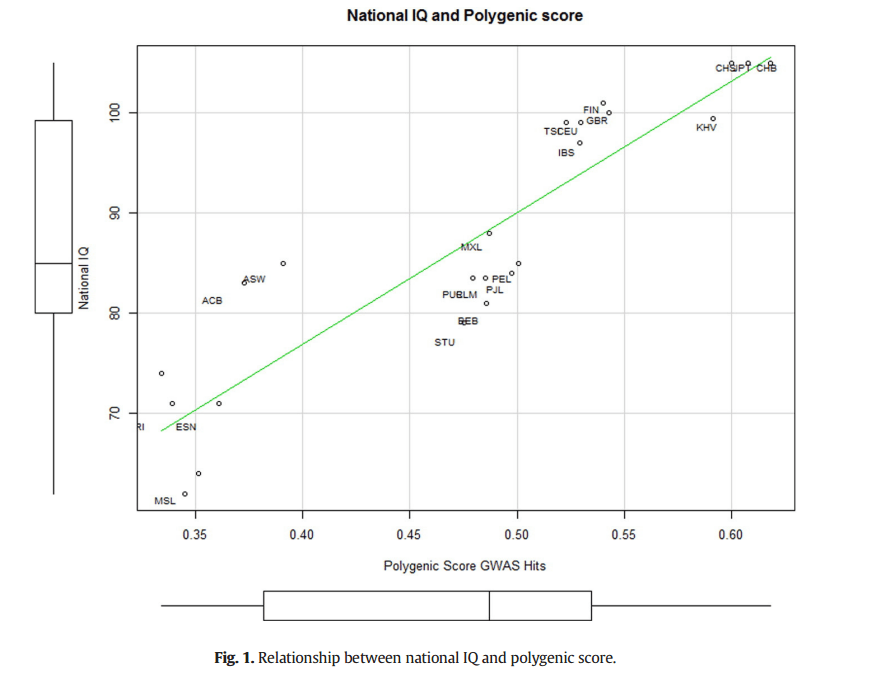
The fact that these differences exist should not come as a shock to those who want to seek the truth, but as seen with how David Piffer didn’t even get consideration for a revision, this shows the bias in science to studies such as this that show racial differences in intelligence exist.
Piffer’s data also corroborates Lynn and Meisenberg’s (2010) finding of a correlation of .907 with measured and estimated IQ. This shows that the differing allele frequencies affect IQ, which then affect a countries GDP, GNP, and over all quality of life.
With a sample with a huge n (over 100,000 subjects) cognitive abilities tests were performed on verbal-numerical reasoning, memory and reaction time (a huge correlate for IQ itself, see Rushton and Jensen, 2005). Davies et al (2016) discovered that there were significant genome-wide SNP based associations in 20 genomic regions, with significant gene-based regions on 46 loci!! Once we find definitive proof that intelligence differences vary between individuals, as well as the loci and genomic regions responsible, we can then move on to difference in allele frequency in depth (which Piffer 2015 was one of the starts to this project).
Moreover, genes that influence intelligence determine how well axons are encased in myelin, which is the fatty insulation that coats our axons, allowing for fast signaling to the brain. Thicker myelin also means faster nerve impulses. The researchers used HARDI to measure water diffusion in the brain. If the water diffuses rapidly in one direction, that shows the brain has very fast connections. Whereas a more broad diffusion would indicate slower signaling, thus lower intelligence. It basically gives us a picture of an individuals mental speed. Thinking of reaction time tests where Asians beat whites who beat blacks, this could possibly show how differing process times between populations manifest itself in reaction time. Since myelin is correlated with fast connections, we can make the inference that Asians have more than whites who have more than blacks, on average. The researchers also say that it’s a long time from now, but we may be able to increase intelligence by manipulating the genes responsible for myelin. This leads me to believe that there must be racial differences in myelin as well, following Rushton’s Rule of Three.
Since the mother’s IQ is the best predictor of the child’s IQ, this should really end the debate on its own. Sure on average, intelligent black mothers would birth intelligent children, but due to regression to the mean, the children would be less intelligent than the mother. JP Rushton also says that regression works in the opposite way. Both blacks and whites who fall below their racial means will have children who regress to the means of 85 and 100 respectively, showing the reality of the genetic mean in IQ between the races.
Why would differing allele frequencies lead to the same cognitive processes in the brain in genetically isolated populations? I’ve shown that brain circuits vary by IQ genes, and populations do differ in this aspect, like all other differing genotypic/phenotypic traits.
East Asians have bigger brains, as shown by MRI studies. Rushton and Rushton (2001) showed that the three races differ in IQ, brain size, and 37 different musculoskeletal traits. We know that West Africans and West African-descended people have genes for fast twitch muscle fibers (Type II) (Nielson and Christenson, 2001). Europeans and East Asians have slow twitch muscle fibers (Type I) for strength and endurance. (East Africans have this as well, which allows for ability to run for distance, which fast twitch fibers do not allow for. The same is true for slow twitch fibers and sprinting events.) Bengt Saltin showed that European distance runners have up to 90 percent slow twitch fibers (see Entine, 2000)! So are genetic IQ differentials really that hard to believe? With all of these differing variables in regards to intelligence that all point to a strong genetic cause for individual differences in other genes that lead to stark phenotypic differences between the races, is it really not plausible that populations differ in intelligence, which is largely inherited?
Is it really plausible that differing populations would be the same cognitvely? That they would have the same capacity for intelligence? Even when evolution occurred in differing climates? The races/ethnicities differ on so many different variables with differing genes being responsible for it. Would IQ genes really be out of the question? Evolution didn’t stop from the neck up. Different populations faced different selection pressures, so different human traits then evolved for better adaption in that environment. Different traits clearly developed in genetically isolated populations that had no gene flow with each other for tens of thousands of years. These differing evolutionary environments for the races put different pressures on them, selecting some for high IQ alleles and others for low IQ alleles.
We are coming to a time where intelligence differences between populations will become an irrefutable fact. With better technology to see how differing genes or sets of genes affect our mind as well as physiology, we will see that most all human differences will come down to differing allele frequencies along with differing gene expression. Following Rushton’s simple rule based on over 60 variables, East Asians will have the most high IQ alleles followed by Europeans and then blacks. The whole battery of different cognitive abilities tests that have been conducted over the past 100 years show us that there are differences, yet we haven’t been able to fully explain it by GWAS and other similar techniques. Charles Murray says within the next 5 to 10 years we will have definitive proof that IQ genes exist. After that, it’s only a matter of time before it comes out that racial differences in IQ are due to differing allele frequency as well as gene expression.
Islam, Suicide Bombings, IQ and Consanguinity
1650 words
A lot of people seem to confuse causes between ‘Islam’ and behavior that’s just ‘low IQ’. Whenever these attacks like shootings, sexual assaults and rapes happen, that’s due to their low IQ; not religion. I wrote about this in IQ, Inbreeding and Clannishness. All of the behavior you see is due to low IQ. 1) being in an area with a hot climate and 2) cousin marriage has been going on there ever since Jews from the Levant introduced it to them around 200 BC. To quote myself:
Those innate behaviors which result in the favoring in all areas of life, themselves and their family, is a result of genetic similarity because of the closely related genes they share (the father’s brother’s daughter type is the most common in the Muslim world). Also, first and second cousin marriages are more common, which also result in increased altruism for their own family because of the close genetic similarity, but also those in their own group, which is mediated by the brain hormone oxytocin.
In a paper on the mean IQ of Muslims and non-Muslim countries, Donald Templer states that the Muslim world, which used to be have great intellectual achievements from the 7th to 12th centuries, has seen an underrepresentation in highly creative contributions in science journals. This is because of the inbreeding effect (2.5 to 10 point drop in IQ) of close cousin marriage. He ends up saying that genetic factors are more important than social/cultural/religious values (back to the inbreeding, causing defects and lowering IQ) in regards to IQ.
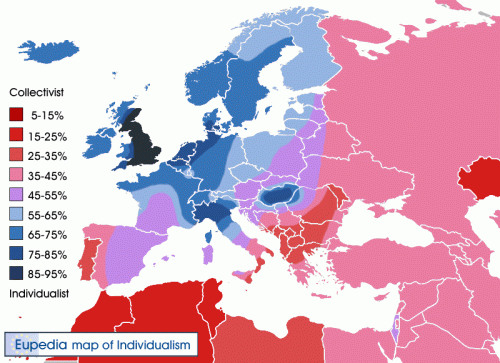
I also put a map of individualism and collectivism in Europe here. You can see that the collectivist countries are fighting back more. The countries/regions where it’s more red roughly matches up to the situation. You can see how in Central, Northern and Northwestern Europe they’re more individualistic, as well as more atheist, than those collectivist countries. So that leads to what we see with this ‘welcome refugees’ signs, as well as, I would assume, more oxytocin in the brain for Europeans, which leads to more altruism towards other peoples. Of course, 1000 years ago, the high altruism was fine due to being a mostly homogeneous society. But when others move in who are not from the area, and who do not have the same biology as you due to certain selection pressures, that’s when the ‘clash of cultures’ commences. Which it’s not really a clash of culture, more like a clash of biology, because 2 groups who shouldn’t live together are being forced to live together.
This also brings me to people who confuse the causality between Islam and blacks. As I said, it’s a low IQ religion (which I have provided enough evidence for my case). So blacks who become Muslim do so because of low IQ. Anything after that doesn’t mean that being a Muslim had them do it. Lets say that Islam never popped up and the same peoples were still there, continuing such close inbreeding, would that be Islam doing it? No. It’s their biology. **
Using environmental factors (Islam, culture) is what leftists do. In my post on behavior not equaling genes plus environment, I showed how people create their own environments based on their own genetics. The environment we put ourselves in is based on our genetics. We can clearly see that Islam is bringing their culture (genetics) to Europe and are incompatible with Europe as well as all Western societies around the world. Due to this, we can see that wherever any population goes, it will be the same from the original place they emigrated from if migration in large enough numbers occurs. A country is only as good as its majority population.
In Non-Western People are Abnormal to Our Societies, I showed how due to differing cultures (genetics), these third-world immigrants coming into our countries cannot readily assimilate due to differing average IQs and other hormones that lead to crime differentials with the native population. Though Arabs are Caucasian, evolving closer to the equator lead to higher levels of testosterone as more exposure to the sun increases vitamin D levels, which is not a vitamin but actually a steroid hormone. These differences in testosterone then lead to more sex attacks with high testosterone combined with low IQ. Lower IQ people are less likely to be virgins than higher IQ people. This shows that higher IQ people have less testosterone and can also hold back urges more than lower IQ people. This then translates over to an increase of sexual assaults by ‘migrants’ to European women. These ‘abnormalities’, though, would be abnormal anywhere. Putting differing cultures (genetics) in a place with a completely different culture will lead to strife due to genetic distance between the two populations.
I wrote in Evolutionary Reasons for Suicide Bombings that Muslims who suicide bomb do so to increase inclusive fitness. The increase in inclusive fitness comes about due to the suicide bomber having no prospects as well as no kids, so he/she is just taking up resources. By committing suicide, they are freeing resources for others who have a better chance to spread their genes. Many suicide bombers come from middle-class backgrounds, which further proves the case for genetic interests being the cause for this. The majority of Al-Qaeda members come from educated, middle-class backgrounds. Even for Palestinian suicide bombers, none of them were poor, uneducated, simple minded nor depressed.
The average IQ for a criminal is 85 adult offenders, 92 for juvenile offenders. What’s the average IQ in the Middle East? 81, around 1.3 SD lower than average, and 4 points lower for chronic adult offenders in America. The lower IQ comes from being more inbred, which then manifests itself in the crime rate. The strife in the middle east can also be traced back to IQ and consanguinity rates in those populations. How inbred a population is predicts IQ as well as how much strife occurs in those populations.
Germany has said they will begin IQ testing their ‘migrants’. If it works well (I highly doubt it will, and if it is, it won’t be implemented well) this could curb some attacks that happen. Since IQ differences between populations are one of the biggest causes for crime differentials (lower IQ is also correlated with higher testosterone) between them, screening for and only allowing high IQ ‘migrants’ in would curb some violent crime and sex attacks if implemented on a wide enough scale. IQ differences between populations are one of the biggest reasons for differences between any population you can think of.
For a comparison, we can use Christian Arabs. Christian Arabs are less inbred than Muslim Arabs, which shows in the amount of terror attacks committed by Christian Arabs, which I can’t find any data for. If anyone has found any, leave a comment. hbdchick then says this about consanguinity between Christian Arabs and Muslim Arabs:
so, the rate of cousin-marriage amongst lebanese christians was 16.5% while the rate for muslims approached double that at 29.6%.
christians married cousins more distant than first cousins at a slightly higher rate than they did first cousins: 8.6% (>1C) versus 7.9% (1C). muslims, on the other hand, favored first cousin marriage: 17.3% (1C) versus 12.3% (>1C). this is a similar pattern found elsewhere in the middle east/arab world. in egypt, for instance, copts tend to marry second cousins while muslims tend to marry first cousins (no, i can’t find the reference!).
there was also more fbd marriage amongst muslims (6.4%) versus christians (3%).
This is directly mirrored in how often we hear about Christian Arab attacks and crime (I haven’t heard of this), showing that consanguinity rates can predict crime rates. Due to this extreme inbreeding, they are more genetically similar, which leads to higher amounts of altruism for their own group, in turn leading to derogation of the out-group. Europeans are, on average, less inbred than Muslims. This is why it’s said that Muslims are incompatible with our societies. They are more clannish and altruistic for their own. Like JP Rushton said, groups will proliferate ideas that are good for their genetic interests.
Even more evidence can be shown with Chechen inbreeding. I can’t find any data on Chechen IQ, so lets use the closest country to Chechnya, which is Georgia with an average of 94. Since inbreeding can depress IQ 2.5 to 10 points, Chechnya’s average IQ should be somewhere around the mid-80s. This shows similarity with the consanguinity rate. hbdchick then concludes:
it’s no wonder, then, that they still engage in blood feuds (just like the albanians). you’d half expect them to build tower houses for protection during clan disputes like the albanians or the maniots.
oh, wait.
Muslim (Arab) populations are incompatible to Western societies due to how inbred they are. Their own societies are built on their genetics, which they then bring to the West and attempt to bring what they’re running from to their new host country.
In conclusion, whenever people say “it’s Islam doing it”, it’s low IQ behavior. Those with lower IQ are more likely to be drawn to Islam. Islam developed after 1300 years after the start of Arab inbreeding. We can draw, from IQ from American criminals, that 85 is the sweet spot for criminality, and since criminality is correlated with low IQ more so than any other variable you can think of. A good example of this is a low IQ person coaxed into committing a crime. It’s an obvious biological difference, the sociopolitical garbage is just that, garbage. The biology drives the politics. Consanguinity rates are one of the biggest factors. You should be concerned with the biology aspect.
Note: When I say “Muslim” I mean Arab. I am also not attempting to “apologize” for terror attacks. I’m simply looking at it through the lens of evolutionary psychology. Most people who read this blog know why Africans act the way they act, and African “migrants” are no different.
Polar Bears, Inuits, Evolution and Fst
1150 words
The Daily Stormer published an article today that claimed that “Polar bears are miscegenating with grizzly bears“. When polar bears and grizzly bears mate, they produce a “pizzly bear“. Due to this, the polar bear population is shrinking and the grizzly bear population is growing.
Scientists say this doesn’t look good for the polar bears; though these hybridizations are not due to ‘climate change’, as is suggested. Using a computer model, the researchers generated a prediction of the Earth’s climate from 2071 to 2100. The model analyzed how different species of birds, mammals and amphibians would need to migrate to find new territory. Birds had the highest overlap with 11.6 percent, attributed to their range from flying. Mammals and amphibians were 4.4 and 3.6 percent likely to encounter a hybridization event. Overall, about 6.4 percent of all species are expected to come into contact to even have the chance to hybridize with other compatible species. Meaning, the polar bear is not in danger of ‘dying out’ due to ‘miscegenation’.
What is missed in the article mentioned at the beginning is that polar bears and grizzly bears are even able to produce offspring at all. This is due to the two splitting around 350 kya to 6 million years ago. This article then says something vaguely familiar:
After beginning to branch off from brown bears, the polar bear’s ancestors under went a series of evolutionary changes in order to survive in the Arctic. The bears adapted to a life of hunting seals and surviving extreme cold. One of the most remarkable adaptations was the ability to thrive on a fat-rich diet withoutapparent heart damage. (sounds like the Inuit or other Eskimo tribes; emphasis theirs)
‘The bears’ could be switched to ‘the Eskimoes’ or ‘The Inuit’and make complete sense. The Inuit also live off a high-fat diet. The higher n-3 gives immunity and boosts in health to a slew of diseases as well.
The Inuit and their ancestors evolved special genetic mutations that allowed them to partly counteract the effect of a diet high in fat. Nearly 100 percent of the Inuit have these genes, while 2 percent of Europeans and 15 percent of Han Chinese do, which means that they synthesize n-3 differently than the Inuit. Over time eating a diet high in fats, the Inuit evolved these genetic adaptions to better adapt to their environment. The genes they have also lower LDL (bad) cholesterol and fasted insulin levels, which presumably has an effect on cardiovascular disease and diabetes. This used to be the case, but “exposure to a more Western lifestyle” has made Diabetes Mellitus in the Inuits comparable to that of the general population. Since growth is reliant on a person’s whole fatty acid profile, the Inuits are, as a result of these mutations, 1 inch shorter than they should be. The same mutations causing shorter height in the Inuit have also been found in Europeans. Researchers have found many genes responsible for height, but this was “one of the strongest effects ever found by geneticists”.
These genetic mutations are around 20,000 years old and originate with their Siberian ancestors. They think that the adaptation came about in the last Ice Age, but the selection is far stronger in the Inuit, due to them being one of the furthest populations away from the equator.The researchers have also found that the Inuits have another common mutation in their population that is involved in the differentiation of brown, subcutaneous fat cells and brite fat cells. Brite fat cells burn fat for more heat, showing another adaptation they had from their diet and direct environment. This helped them survive the harsh climate.
A strict Inuit diet shows evolution in action, that populations forced to subsist mostly on one type of food/macronutrient can and will adapt to their environment over time, proving that evolution exists. However, you cannot infer from the Inuits that the effect they gain from this diet will carry over to the general population.
The Science Daily article then goes on to say people have asked themselves whether they “Should be on a Stone Age diet”. My answer to that is a resounding “No” if you think the diet will do anything different from any other diet and weight training. As stated in the SD article, you cannot say that other populations, for instance, evolved to eat a certain way cannot be made as the Inuit have certain genetic mutations that no other populations have, in the frequency they do, for that matter.
The DS article, more interestingly, doesn’t bring up how two different species are interbreeding. Humans have a Fst distance of less than .5. The Fst for polar and grizzly bears is 0.2688. Two differing populations separated anywhere between 350 kya to 6 million years ago, can interbreed, and so can humans. Sewall Wright, the creator of the Fst concept, has said that if this differentiation was noticed in any other species, that they would be noted as distinct subgroups. When it comes to human genetics and science, science chooses to take the “egalitarian route” and deny the existence of race. However, when it comes to polar and grizzly bears, talking about how polar bears are a subspecies of grizzly bears and the polar bears adapted to the cold leading to physical and physiological differences, this is fine. Just like when Rushton proposed Differential-K Theory, which is the application of r/K selection theory to humans, it got shot down, despite E.O. Wilson who co-founded r/K selection theory stating “I think Phil is an honest and capable researcher. The basic reasoning by Rushton is solid evolutionary reasoning; that is, it is logically sound. If he had seen some apparent geographic variation for a non-human species – a species of sparrow or sparrow hawk, for example – no one would have batted an eye. … when it comes to [human] racial differences, especially in the inflamed situation in this country, special safeguards and conventions need to be developed.” Rushton’s main thesis has also never been refuted. No other explanation can fully explain the variables Rushton describes in Race, Evolution, and Behavior like r/K selction theory does.
Polar bears are not going away, and if they were, it’d just be evolution in action as the point of life is to breed and carry on your lineage (however, fitness is increased for the grizzly bear as he is gaining more habitat, yet decreasing for the polar bear due to a warming planet). The strongest populations get selected for, while the weakest become absorbed/wiped out. Since the planet is warming, as well as the grizzly bears looking for more environment some, not all, are mating with polar bears. This does not mean that polar bears will go extinct due to inbreeding with grizzly bears. Inuits are proof of the existence of evolution with how they adapted to their high-fat diet and cold environment, but you cannot use this information on their diet and say that the benefits from a high fat diet would be the same in other populations.
Even More Evidence for GST: Speed Daters Match on Genotype
850 words
Your success at speed-dating might be influenced by your genetic make-up and your potential partner’s ability to detect so-called ‘good genes.’ The research team found that participants who were more likely to be asked on a second date had genotypes consistent with personal traits that people often desire in a romantic partner.
Coming off of a successful refutation of JayMan (check comments too), more evidence for our claim came out the other day. Us humans can match on genotype, which we, of course, match with people with other similar heritable characteristics. Since humans match on these traits that are more heritable than the ones that are more influenced by environment, then we can say that we are seeking out partners who are like us, therefore matching on genetic similarity.
Wu, et al (2016) examined 262 Asian Americans in a speed-dating setting. The researchers predicted that there would be considerable matching by genotype between the genders. They found that the gene A118G, which is linked to submissiveness and social sensitivity, whereas for the men, the minor variant with the -1438 A/G allele, which is linked to social dominance and leadership, were shown to have greater success. They also discovered that men and women with genotypes consistent with “prevailing gender norms were more likely to receive second date offers”
The researchers say that “These results suggest that personal attributes corresponding to A118G and −1438 A/G can be detected in brief social interactions, and that having a specific genetic variant or not plays a tangible role in dating success,” Those with the A118G polymorphism had greater capacity for experiencing social pleasure and pain as well as their need to have social contact. This also shows how Men and women with the opposite of each allele (men having the A118G allele and women having the -1438 A/G allele) were seen as less desirable mates, showing good evidence that each allele is gender-specific. Wu also believes this effect could also expand to other social interactions, such as job interviews.
This study shows more evidence for Rushton’s theory of spouses matching phenotypically by genotype. Spouses are as similar as 4th cousins. Spousal genetic similarity is a significant driving force for human civilization, as it selected for certain traits over others that then lead to things such as higher IQ in Eurasian men to beauty in Eurasian women, vice versa for Africans. In Eurasian societies, men hunted and while women took care of the children. Higher intelligence then evolved in men due to needing to strategize, among other things such as surviving the frigid temperatures. Women took care of the children, and thus developed a higher verbal IQ as a result of this. In Africa, women gathered food, selecting them for slightly higher intelligence than their male counterparts. Conversely, the African males were selected for attractiveness (Fuerle, 2008).
Those K-selected have lower birth rates, and thus, must be more rigorous in choosing a mate. Choosing a mate based on intelligence showed that the male could provide food as well as protect the family against predators and other bands of humans. R selected humans have more children and show less care, so they have higher birth rates to counter this. They are less rigorous in mate selection due to need to have more children due to a higher death rate. This is mirrored still, even today in modern society. Human sexual selection is one of the reasons why human evolution progressed to the point is has, with the driver being evolution in harsher climates. Eurasian women needed to be more stringent in choosing mates due to a higher chance of death in choosing the wrong mate. Over time, this lead to a ‘genotype sensor’ if you will, which by matching by certain phenotypic traits (facial symmetry, skin color, height, health, etc), chances for intelligent children, better care and more food will come as a result of this stringent selection by women, which in turn lead to evolution of certain traits in Eurasian men and women.
This shows that these human differences in how we select our spouses to how our civilizations ultimately end up is due to a) climate, b) sexual selection and c) genetics. Passing on the best genes lead to an ultimately better society, and as a result, this lead to those genes that were more successful having a chance to produce more copies of themselves, assuring that society would be run well in the future. This is also why government systems such as monarchies have hereditary rulers.
I have said numerous times that the tendency to favor co-ethnics is the tendency to favor shared genes. Benefiting those similar to yourself ensures that you’re benefiting copies of your genes, ensuring your genetic legacy for the future. Matching with those who appear similar to us by genotype when there is such phenotypic similarity shows that this is a trait we humans have to seek out those co-ethnics genetically similar to ourselves.
Ethnic Genetic Interests and Group Selection Does Exist: A Reply to JayMan
6350 words
JayMan has said that ““Ethnic Genetic Interests” Do Not Exist (Neither Does Group Selection)“. It’s clear from what he says towards the end that he has some sort of bias to attempt to disprove Ethnic Genetic Interests and Group Selection. This will be a definitive refutation of JayMan’s belief of the non-existence of GST and GS. Along with Dr. Swaggins from the CoonU Blog, both of us today will prove that EGI and GS do in fact exist and that JayMan has an implicit bias in the denial of EGI and GS. I will also address JayMan’s comment to me in that same article that I never responded to save it for this article.
I first wrote an article, Genetic Similarity Theory, in reply to his denial of EGI. It was short, but I got my point across with the Price Equation. JayMan then comments:
Ethnic altruism can’t evolve through genetic similarity because the coefficient of relationship between co-ethnics (who aren’t close family) is pretty small. Even kin selection itself is pretty weak in general. How much time do you spend with your second and third cousins?
In-group favoritism likely evolved through individual selection for reciprocal altruism. Overall similarity simply allowed individuals to recognize likely partners for trading favors (shared language and customs may help). This may have even co-opted systems designed to act towards close kin – misfiring kin altruism, if you will.
Rebutting Jayman’s denial of the ethnic kinship coefficient requires an explanation of the concept of relatedness as a whole. How, for example, can I be 50% identical to my father if I’m 99.8% identical to all living humans? The answer is that I am not 50% identical to my father; rather, I am 50% identical to my father by comparison to the baseline level of relatedness of all living humans. If all living humans are 99.8% genetically identical then I’m 99.9% identical to my father. Jayman’s argument that two random co-ethnics aren’t related fails to factor this into account: a calculation of relation needs a baseline level of relatedness for comparison. So he’s correct in stating that two co-ethnics are not similar to one another- but only by comparison to the baseline level of relatedness of their entire population.
Since the ethnic kinship coefficient has been worked out to the equivalent of half siblings, it may be useful to frame the issue in those terms. If I am 25% identical to my half sibling by comparison to any other co-ethnic, it is because there is a quarter of my genome that I share with my half sibling due to our common descent. Specifically, our mutual descent from our mutual parent gives us a specific combination of genes that nobody else is likely to have. 25% of my genome is 100% identical to his alleles of the same genes and the other 75% is as similar to his as it is to any other co-ethnic, but taken as an average across my entire genome, any given allele is 25% more likely to be shared with him than it is everyone else in our race.
The ethnic kinship coefficient works in an uncannily similar way. Instead of inheriting those 25% identical genes from recent common ancestors, the two co-ethnics inherit the same genes due to the fact that people of their race usually have those genes (think melanin, keratin, microcephalin, EDAR, HERC2, or any other gene for which the frequency of alleles differs overpopulation). In spite of that difference in the origin of ethnic vs familial similarity, the mathematics are shockingly similar: according to Henry Harpending in his review paper Kinship and Population Subdivision, “Many studies agree that Fst [genetic distance between populations] in world samples of human populations is between ten and fifteen percent,” with “a conservative general figure” being 12.5%. What’s more, Fst “is computed for each allele at each locus, then averaged over all loci.” In other words, 1/8th of human genetic diversity is at the between-group level.
To put things into perspective, a 1/8th reduction in diversity within a family occurs when two half siblings (25% identical) have a child. There is a 1/16th chance that the common parent will pass a given allele to both children and that both children will pass that allele to their child, and a 1/16th chance for the same to occur for the other allele of the same gene; when computed allele for allele, “diversity” (odds of heterozygosity) goes down by 1/8th among a population that is 25% identical by descent.
One such calculation finds, for example, that a Frenchman is 24% identical to another Frenchman if your baseline for comparison is the genetic similarity between the French and Japanese.
This is the inevitable implication of the central tenet of HBD: that the various races of the world are genetically different from one another. It is also the inevitable implication of Lewontin’s famous finding that 15% of all human genetic variation is racial; if it were 100% then all co-ethnics would be identical and it were 0% then race wouldn’t exist at all. If it were 15%, though, then that 15% would be composed of genes whose alleles vary in frequency across populations; these are genes you share with co-ethnics much more often than you share with anyone else. If you’re more likely to share a lot of genes with co-ethnics than you are with anyone else, then you’re more genetically similar to co-ethnics than you are anyone else. When they sequence the genes of people of different races and compute the odds of similarity locus for locus, you’re much more likely to share some genes (ABCC11, MC1R, etc) with co-ethnics than you are others, but taken as an average across both copies of the entire genome, it’s about 25%. Apply those odds to the 20,000 or so genes in the human genome and the result will be consistent with the data that members of a given race are about 25% identical by comparison to members of other races.
We are not the first people to predict that these genetic differences would result in kin selection expressed as altruism towards co-ethnics and discrimination towards others; to quote an article by the late Henry Harpending posted in March 2012, “In the new diverse community the average person can find someone related as f~0.06, corresponding roughly to a great-grandchild at f=1/16. Suddenly there is a fitness payoff to discrimination.” (In this hypothetical population, an individual is 1/8th more related to a co-ethnic than to the average and 1/8th less related to some of a different race than to the average.) In an ethnically homogeneous population, discrimination of this kind will not occur because the fitness payoff of benefiting one co-ethnic or the other is the same, but in a heterogeneous population, you suddenly have people in whom you have comparatively more or less genetic interest. In December 2012, Harpending and Salter published “JP Rushton’s Theory of Ethnic Nepotism,” a paper predicting that the Fst data would support Rushton’s theory of ethnic genetic interest, by providing evidence for kin selection. Towards the end of this article, I will provide evidence for human altruistic behavior fitting the patterns predicted by kin selection, and I will present a likely animal model for subspecies competition over resources. In the meantime, however, there are more misconceptions to clear up.
JayMan says:
I suppose a key misunderstanding in the matter is the failure to realize that each individual gene contributes to fitness independently. Each gene is “out for itself”, so to speak. It just so happens that in any given organism, genes achieve success by working together (most of the time). As sucheach individual gene’s “aim” is to make more copies of itself. What’s going on in the rest of the genome is tangential to this. ((—>Each gene would be just as happy to mix with any other gene, so long as its own fitness is increased in the process.<—)) (Additions in last sentence for emphasis are mine)
Individual genes don’t always contribute to fitness independent of one another; the venerable Nicholas Wade has pointed out that there is at least one gene which confers different levels of selective disadvantage depending on the other genes they’re mixed up with: an allele that slightly increased risk of heart problems in Europeans causes big problems whenever it introgresses into Africans. Naturally, the population which has had this allele for longer has more genes elsewhere in the genome compensating for its negative effects, meaning that said allele will cause fitness problems after it introgresses into another population. Introgression is just a fancy word for race mixing, though, and there are other problems with it, as follows:
In a study of 100,000 mixed-race adolescent school children, those who identified themselves as such had higher health and behavior instances than those of one race. The effect was still observed even when SES and other factors were controlled for. A problem with an obvious genetic component.
Yet another study done on white-Asian mixes notes that they have a two times higher rate to be diagnosed with psychological problems such as anxiety, depression and substance abuse.
It was found, in agreement that black-white mixes engaged in more risky behavior than did monoracial children. They also observe that mixed-race adolescents are stark outliers in comparison to whites and blacks, which still holds true despite being raised in similar environments to monoracial children.
Fitness doesn’t look increased in that process, seeing how mulatto children show more health problems and negative behavior than monoracial children. And given the data relating to the allele mentioned above, we can’t rule out the possibility that health problems in biracial children arise because their parents’ genes don’t necessarily work together.
There is no impact on one’s fitness from the race of one’s mate (or an offspring’s mate) so long as close relatives are off the table as mates (aside from the fitness impact of the particular genes such mates were bringing in the environment in question). The fitness impact to a White man’s genes if his daughter marries a Black man is the same as if she married an unrelated White man (again, fitness from gene function notwithstanding).
Do you really believe that? As shown above, mixed-race children show more health and behavior problems than do monoracial children. Africans were not selected for resistance to the negative effects of certain European genes as Europeans were, and we have no reason to believe that any race is selected to compensate for the negative effects of genes they don’t even have.
Just the same, the inclusive fitness impact to a White American is the same whether he focuses his altruistic act on an unrelated White American or on a Namibian; it is zero in both cases. If you adopt children rather than have your own, the fitness hit to you is the same whether your adopted children are White, Black, Chinese, or Venezuelan.
Again, this assumes that there are no genetic differences between populations, but there are, so your fitness is probably higher if you adopt a co-ethnic than if you adopt someone else.
Hence, there is no human ethnic group that exhibits ethnic nepotism. This includes Ashkenazi Jews. But these have nothing to do with ethnic nepotism, didn’t arise via kin selection, and don’t depend on genetic relatedness per se. This includes Ashkenazi Jews.
Ashkenazi Jews evolved their nepotism through thousands of years of getting driven out of countries. Along with being barred from certain jobs, this led to them being only able to do banking jobs and those jobs that took more intellect, which they then evolved their higher IQ as well as more group favoritism to help them in societies where they are the minority. This is clearly evident today with Jewish overrepresentation at elite universities; their average IQ of 110 suggests that they shouldn’t be that much of the student body since they’re six times as likely to be geniuses but many more times likely to make it into the top institutions. Odds are pretty good that that’s ethnic nepotism in action. We’re talking about a group of people 38% likely to consider themselves religious but 70% likely to believe the old mythos that the omnipotent, omniscient creator of everything that ever existed prefers them to literally everyone else, and judge whether someone is worthy of this inconceivably lofty status purely on the basis of their genetics; before they had handy-dandy PCR machines and enzymes, Jews determined someone to be Jewish by matrilineal descent, not cultural custom. If the Ashkenazim lacked any ingroup preferences of any kind during their time in Europe, they would’ve literally copulated themselves to death by marrying Gentiles until their population was totally absorbed by ours. What would you call it then, JayMan, if not EGI? They’re one of the best examples FOR the existence of EGI. See, the thing is, if someone is an Ashkenazi Jew, more often than not, they will be more related to each other than some other random person from another population.
This particular fact – that co-ethnics share genes – is why they have a genetic interest in one another.
The Ethnic Kinship Coefficient has been corroborated literally every time anybody calculated Fst values between different human races, and by JayMan’s understanding of kin selection it disproves his assertion that ethnic genetic interests do not exist:
This [relatedness] is the probability that a given relative of an individual possesses a copy of an allele the individual possesses.
Co-ethnics are about 25% more likely to share the statistically average allele than people of different races are, so the Hamiltonian drive to confer benefit on co-ethnics is comparable to the drive to confer benefit on secondary relations (half siblings, grandchildren, etc). In other words, it doesn’t matter that the frequency of altruistic alleles is unaffected by the presence of outsiders, because people have a genetic imperative to assist the genes they share with their co-ethnics either way (and are therefore selected for altruism/ethnic nepotism either way); since they are related to their co-ethnics regardless of context, they are selected for the desire to confer benefit on co-ethnics regardless of context, and they only have a genetic interest in derogating an outgroup if doing so will increase the fitness of the ingroup. This is why Harpending and Salter observe, in the paper linked above, that racial solidarity “strengthens in response to attacks perceived to be aimed at group identity, especially invasion of the homeland and physical harm done to co-ethnics.” Observe Donald Trump or Marine Le Pen excoriating the bureaucrats they deem responsible for an alleged invasion, or Black Lives Matter being more enraged about a Hispanic killing a black than by thousands of blacks killing thousands of other blacks. A supposed shift in altruistic allele frequencies was never the point, and to argue against it is to battle with strawmen.
If altruism is the result of kin selection, then an organism will confer benefit on the criterion of relatedness. If a European man saves a daycare with 8 Asian babies in it from some freak accident, then he saves as much of his own genes as were shared by those babies. If he saves a daycare with 8 European babies in it, he just saved a collection of his own copies of HERC2 or ABCC11 or EDAR or some other such gene which he previously failed to save as well. If he saves 8 of his co-ethnic first cousins, the proportion again goes up, this time by 12.5%. By the same mathematical model we use to explain kin selection (Hamilton’s Rule), we predict and observe that altruism will be expressed to various degrees depending on the degree of relatedness.
The adaptation to this would have nothing to do with magical altruism genes which change in frequency when Japanese people arrive in France. Rather, the selection pressures predicted by the kin selection model would select for organisms that exhibited compassion and cooperation in proportion to relatedness.
The fact that co-ethnics share so many genes means that they do have a genetic interest in one another, if kin selection is real. I personally believe that kin selection is a clearer and more likely explanation for altruism than group selection in most cases, but due to the difficulty of determining causality in processes that occurred thousands if not millions of years ago (namely the original evolution of altruistic behavior), I doubt that the scientific community can put this one to bed yet. For the purposes of this issue, however, JayMan has already professed his belief that group selection has never occurred, meaning that one of a few different things must be true.
- Humans are not altruistic at all. Untrue.
- Humans are altruistic, but not due to kin selection or group selection. Unlikely; we can talk about mutual back-scratching all we want but the fact that people take bullets and jump on grenades for one another means that mutual benefit cannot be our only reason to confer benefit upon others.
- Humans are altruistic due to kin selection. This explanation is consistent with genetics and evolutionary theory; evolution holds that survival is a matter of passing on genes and genetics show that related organisms have many of the same genes. It also has pretty good predictive power (it predicts familial love, racism, and other real phenomena). For these reasons, I’m going to be arguing from the assumption that kin selection is a primary reason for human altruism, and that it, therefore, must exist in humans.
Due to the genetic similarity between co-ethnics, there is a genetic interest between them. Each has a Darwinian interest in the other comparable to roughly 25% of their own survival. Operating from the assumption that kin selection is the reason for human altruism, one would predict one of the following possibilities:
- Humans will prefer to confer benefit to their co-ethnics over others due to the fitness advantage gained by doing so,
- That humans cannot perceive genetic similarity and have therefore been selected to benefit one another regardless of genetic similarity in hopes that they hit the mark by accident,
- Humans do prefer those who are genetically similar but are incapable of perceiving the genetic differences between the various human subspecies, or
- Humans understand the genetic differences between themselves and others but for whatever reason will not take the 25% fitness advantage. I’m going to go ahead and throw this one out.
We know that humans prefer others on the basis of genetic similarity, and we know that nearly all human cultures have considered those of different ethnicities to be “the other,” or at least different in some significant way. We know that people can determine someone’s biological race based on their appearance, in any case, and in his 1996 book Race in the Making: Cognition, culture, and the child’s construction of human kinds, Lawrence Hirschfeld found that even children could do so. All of which means that humans can get a rough idea of genomic similarity (or difference) using phenotype and family history as a proxy, and that race is among the types of genetic difference that humans are capable of perceiving. If humans prefer one another based on the criterion of genetic similarity (they do), and race is a genetic difference that humans can perceive (it is), then we expect humans to generally prefer those of their own race (they do).
Even in studies of bereavement, Littlefield and Rushton (1986) put forth ten hypotheses (I will only bring the ones up that prove the case for EGI) to make the case for Genetic Similarity Theory:
- A mother will grieve more than the father: this is due to the mother having finite number of ova, have a more limited reproductive potential than do men and also bear the burden of bearing children, this shows that each offspring of a mother is more important to the overall success to her genes than the are to the father’s.
- Male children will be grieved for more intensely than female children. This is due to a male having a higher chance to have more children and spread his genes to more progeny.
- Similar children will be grieved for more intensely than dissimilar children. GST explains the phenomenon of assortative mating, the phenomenon that spouses will be genetically similar on those traits more influenced by genetics. One consequence of assortative mating is that one parent may be more similar to the child than the other. This can be illustrated as follows: Rushton and Littlefield: “If a father gives his child 50% of his genes, 10% of which are shared with the mother, and the mother gives the child 50% of her genes, 20% of which are shared with the father, the child would be 60% similar to the mother and 70% similar to the father (Rushton et al., 1984)”. So we can see that depending on the amount of genes a child gets from his parent will infer whether or not they are genetically similar to which parent, and in the case of a possible surprise death, the parent who believes the child looks (shares more alleles in common with) like their selves, will grieve longer and more intensely due to having a greater fitness hit due to the increased GST.
This study shows good evidence that the more genetically similar the child is to the grieving parent, the more strong and intense the grieving process will be. How mothers and fathers will risk their lives for their children, their genetic endowment, shows another truth to this phenomenon: altruism. Altruism for those who are genetically similar to yourself. We can then take this and show that since co-ethnics are closer to each other than they are to distant populations, and that since they are more genetically similar to themselves, the same kind of derogation and suspicion that parents give strangers who come around their children, co-ethnics will give to non-co-ethnics when they appear in their homeland. Robert Putnam’s research corroborates this.
Altruism/nepotism does increase when out-groups come to the land. When this occurs, the native population of the country will, in theory, become more altruistic to co-ethnics since their genetic interests are at stake. This is currently occurring in Eastern and Southern Europe in countries like Hungary, Poland, Spain, and Italy.
The model has pretty good predictive power since it predicts racism and other phenomena, which I’ll dive into now. Applying the kin selection model to humanity we expect that altruism will not only be doled out proportionally with respect to genetic similarity, but also to the number of babies the recipient is likely to have. I wouldn’t do as much for my DNA by saving the residents of a retirement home as I would by saving a daycare. And saving women is smarter than saving men. Hence, when the Titanic sinks, the rallying cry of the day is literally “save the women and children!” (Because the people who didn’t do that throughout our biological history had less of an impact on our gene pool than the ones who did.)
So you’re going to see innumerable charities for the benefit of children, and comparatively, nobody trying to solve the conundrum of how terrible life is in nursing homes for the elderly. On the Forbes list of top US charities, numbers 1-4 all frequently work with children (as do many others) and numbers 5, 6, 12, and 14 are specifically for children. None of them are specifically for the elderly; making sure that Grandpa isn’t miserable and alone registers nowhere in the top 50 items of our society’s to-do list.
And you’re going to see things like this, in spite of the fact that men are equally likely if not a hair more likely to get lung cancer and it’s a big killer in both sexes because people care more about “women” than they do about “people.” And I’m not joking or cherry-picking: Lung Force’s blog is seemingly more about women’s feelings than about lung cancer, no doubt because these people are aware that breast cancer research receives way more funding than prostate cancer research does in spite of similar death rates . In other words, it’s a well-known fact among people whose jobs are to stir up altruism that people will give more resources for the well-being of women than for the well-being of men.
All of which is just another case of altruism that “just so happens” to confer group and/or kin benefit, and does so proportionally to the expected increase in fitness, precisely as kin selection would predict. I would expect people to donate more to co-ethnics as well, were it not for the facts that:
a) It’s fashionable in our society to virtue signal niceness to swarthier folks, and
b-z) Haitian children literally eat dirt for breakfast.
In any case, you can look at where rich nonwhites send their donation dollars, be it the fitness benefit gained by JayZ when he donates to clean water causes in Africa, or by George Lopez in his “contributions to the Latino community“. This isn’t a cherry-picked trend of statistically irrelevant anecdotes: Blacks donate to other Blacks, “Identity-based giving is gaining momentum in the Latino, Asian American, Arab American, and Native American communities,” and “Latino’s motivation to give is embedded in a sense of responsibility and desire to give back to their community.” Much of the work of such people may end up benefiting Whites who happen to be there when a catastrophe hits a bunch of the donor’s co-ethnics (observe a Black donating to Hurricane Katrina; New Orleans is majority black, but not devoid of Whites), or occasionally they’ll donate to other nonwhites. But I’m not holding my breath for the day they raise awareness for the White squatter camps in South Africa.
Basically, any time that a person does a nice thing for another person, it will be proportional to any combination of three factors: genetic similarity, assumed number of offspring, and/or how bad the recipient needs help. All three of these are predicted by kin selection since all three are factors which predict the fitness gained by engaging in an altruistic act.
Importantly, virtually every culture on Earth preferred co-ethnics to others prior to the Communist subversion of the West, at which point accusations of racism became something of a social death sentence. (You don’t believe me on the Communist subversion thing- think it’s a conspiracy? Google up where all of this “social construct” ideology we keep encountering ultimately came from, and look up who’s promoting it today.) One could claim that whether a culture is “racist” or not depends on “culture” rather than biology, and point to the modern West as an example of an “anti-racist” culture, but in that case, it’s one hell of a coincidence that every race on Earth generally preferred themselves to everyone else, and did so for 10,000 years or more if you count prehistory. Considerably more likely is that populations with no ingroup preference are subsumed by other populations who gain a fitness advantage by doing so (they mounted no defense because they didn’t understand the need to do so) and that the majority of modern humans are therefore descended mostly from passionate racists.
Co-ethnics have a real genetic interest in one another due to large amounts of shared DNA, meaning that ethnic genetic interest is real. Humans do act on genetic interests in general, as the family studies show, and they are capable of perceiving racial genetic differences, as the ethnicity studies show; it is, therefore, likely that they will act on these ethnic genetic interests as they do with other genetic interests, because racism is caused by the innate preference for genetically similar people. In other words, racism is a biological phenomenon instead of a cultural one.
That, or nearly every culture ever in the history of forever was racist by pure coincidence.
To put subspecies competition into perspective, I will point out that wolves and coyotes have a Fst value between 0.056 and 0.121 and can interbreed. We can call subspecies and other taxonomic classification a social construct if we like; technically we’d be correct in the case of canids, to whom the words “species” and “subspecies” are doled out in a pretty arbitrary fashion. We can say that the admixture is proof that the wolf and coyote DNA doesn’t care about which other genes it’s combined with, if we like. But everything we say about it does absolutely nothing to change the fact that the biological fitness of coyotes massively drops when they share territory with wolves.
Understatement of the week: the implications of having to compete for the same resources is probably why canids fight for territory. Wolf packs, being direct family, would no doubt have a high Fst with other wolf packs, no different from how I’m more similar to my grandpa than I am my housemates. They fight for territory on a familial level because of genetic interest, and they have been observed fighting for territory on the level of subspecies as well, with a clear genetic interest in doing so. The only difference between them and us in this respect is that our method of acquiring resources relies on commerce rather than hunting, and so we weren’t selected for the propensity to wander around a given territory fighting off other families who intrude. That’s not good for business; in fact, I’d be willing to bet that warfare usually occurs in humans when the profit incentive for conquest is greater than the profit incentive for trade. Humans who don’t engage in a lot of commerce and belong to inbred populations, though, have fewer incentives towards peace and higher Fst values relative to others- and they aren’t above killing the guys from the next tribe over. What a surprise that these village’s conflicts had to do with territory and breeding, both of which have to do with fitness. In any case, humans from populations selected for agriculture and commerce engaging in this sort of behavior is the exception that proves the rule, because the only reason anybody knows about the interfamilial warfare of the Hatfields and McCoys is that it falls under the “man bites dog” rule.
I have this radical view that biological rules still apply to humans, and that we are therefore self-replicating bags of meat smart enough to understand that we are self-replicating bags of meat. I see little difference between wolves reclaiming their old hunting grounds and the Reconquista movement. Coyotes had taken over when the wolves kept getting killed by men; Spaniards took over when a storm of viruses killed off most of the Natives. Even after the Spanish admixture, the Fst values between Whites and the now-mestizos likely falls within the range of coyote-wolf Fst values. Wolves feed their kind with elk and we feed ours ultimately with money; the distribution of elk meat to wolves isn’t good for coyotes and I’m willing to bet that the distribution of money and jobs to other nations and their peoples explains much of our abysmal birth rates in the West (with birth control technologies being another primary factor). We had lots of kids back when there were blue collar jobs you could get fresh out of high school which instantaneously elevated you to the middle class. We could afford to have them, no different from the fact that European nobles had more kids on average than us commoners. If current economic, cultural, and political trends continue, though, then ethnic Europeans might go out roughly 50x faster than the Neanderthals did.
Biological organisms show preference of those who are similar at the level of self (me), family (the Kennedys), tribe or nation (Papuan tribes or Mexico), race or subspecies (Native Americans), and species (I eat pork and kill spiders more often than I eat aboriginal Australians and kill Sentinelese people). All are the same phenomenon (attempts to increase the odds of self-replication at the genetic level), all are predicted with Fst values and Hamilton’s Rule, all are observed in animals to whom “culture” doesn’t apply, and all are observed in mankind.
Now, the question is this: how would GST be detected? Numerous ways. Location, for one. Since up until around 50 years ago, most countries were monoracial, those in your general proximity will, more often than not, be more genetically similar to you than a group that’s 50 miles away. Culture, which is an expression of genetics, is yet another way that GST can be detected. Since culture is an expression of genetics, when that culture is expressed, this shows other genetically similar co-ethnics that this individual shares more genes in common than those who don’t share their culture. There is also matching by phenotype, which goes along with the location aspect. But, as I stated in my article Genetic Similarity Theory as a Cause for Ethnocentrism:
It’s clear that we are more altruistic to people who look more phenotypically similar to ourselves, to pass on and benefit copies of our genes. This evolved in spite of the negative impact on behalf of the altruist. The altruist is helping copies of his shared genes survive so that they may be copied into the next generation of progeny. The tendency to favor co-ethnics is the tendency to attempt to help pass on shared genes, as if the phenotype is similar, more often than not, the genotype is as well. This is the basis for ethnocentrism.
There is also what is called the “Grandmother’s hypothesis” in which the researchers theorize that women live past menopause to help take care of their grandchildren. In doing so, they can then make sure their grandchildren are well-fed and nourished. The researchers state that by using Hamilton’s relation coefficients (what we have been using in this article), that a grandmother should share 25 percent of genes with her grandchildren. Ted Sallis says:
Therefore (and this is the important point), a paternal grandmother, all else being equal, is genetically less related to a grandson than to a granddaughter, and less related to a grandson than is a maternal grandmother. Conversely, a paternal grandmother likely is more genetically related to a granddaughter than is a maternal grandmother, given the certainty that the granddaughter possesses an X chromosome from the paternal grandmother.
The researchers hypothesized that the grandmother’s investment in grandchildren will be directly mirrored by how genetically similar they are to each other. The authors conclude that women live past menopause to help care for their children’s offspring. Since they share 25 percent of their genes with their grandchildren, they too, have a genetic investment in making sure they get adequate nutrition and are well cared for. They found that in 7 previously studied populations that “separating grandchild survivorship rates by sex reveals that X-chromosome relatedness correlates with grandchild survival in the presences of MGMs and PGMs. In all seven populations, boys survive better in the presence of their MGM than PGM. In all bar one population, the PGM has a more beneficial effect on girls than on boys. Our X-linked grandmother hypothesis demonstrates how the effects of grandmothers could be sex-specific because of the unusual inheritance pattern of the X-chromosome.”
This is what this whole debate is about: ability to detect genetic similarity in co-ethnics. Matching by phenotype, culture, and general proximity will, with good chance, bring you together with someone who shares more alleles in common with you and someone who you would feel more altruistic towards since you have a genetic interest in ensuring that some of your genes survive to the next generation.
Mixed-race relationships don’t discredit the existence of EGI/GST, in fact, it helps to strengthen it. Americans of mixed ancestry made up for ethnic dissimilarity by matching up on the more heritable traits, whereas the correlation is lower for those traits that are more influenced by the environment. Since the correlation is higher for heritable traits, i.e., BMI, personality, alcoholism, aggressiveness, criminality, psychiatric disorders and so on. Since the correlations are higher than in the environmentally mediated traits and since mixed-race couples match on more heritable traits than on the traits more influenced by the environment, this shows us that even though they are marrying outside of their race/ethnicity, they still match up on the more heritable traits and not the traits more influenced by the environment.
JayMan brings up the concept of reciprocal altruism as if it negates the effect of racial/ethnic altruism as a whole. It does not. Reciprocal altruism and Genetic Similarity Theory go hand-in-hand as genetic similarity eliminates the need for the reciprocation to occur again. Since two related individuals share more genes in common with each other than two unrelated individuals, this then caused reciprocation and GST to evolve hand-in-hand with each other. To quote Rushton:
Thiessen and Gregg (1980) make the same point. Thiessen and Gregg state that “cooperation among `nonrelatives’ (`reciprocal altruism’) may be based in large part on genetic and phenotypic similarity” (p. 133).
Another reason that GST and reciprocal altruism go hand in hand is that genetic similarity at certain important loci can predict the efficacy of a reciprocal altruistic relationship; Fowler & Christakis find that close friends are as similar as 4th cousins, and Guo et al find the same for spouses. Selecting for phenotypic compatibility means selecting for genetic similarity at the loci which determine the relevant phenotypes (height, IQ, personality and so on). For example, different races of the world differ in Big Five personality traits, and the reason for these differences is likely genetic. If a statistically normal, introverted East Asian prefers to associate with fellow introverts, what are his odds of becoming best friends with a comparatively gregarious Black man? A gregarious Asian or an introverted Black may become fast friends with those of other races, but most of their kinsmen are more stereotypical.
Ultimately, however, what it comes down to is this: if a gene can better ensure its own survival by bringing about the reproduction of family members with whom it shares copies with, then it can also do so by bringing about the reproduction of any organism that it shares genes with. Meaning altruistic self-sacrifice. But, if there is a fitness gain for the altruist, then how is it altruism? Simple. The altruist is just protecting genetic interests. The altruist is just being driven by his genes to save copies of itself. This is basically what we humans are: organisms that only attempt to bring about those with similar genetics to ourselves.

There Is Such a Thing As a “Male” and “Female” Brain
2100 words
Towards the end of last year, it was said that “male and female brains don’t differ“. Male and female brains differ from the number of neurons to differences in g that affect intelligence, to differences in temperament and differences in the hormones testosterone and estrogen. Other than accounting for differences in physical appearance between the sexes, the differences between the sexes in the two hormones accounts for brain differences as well. This is yet another blank slate argument, years after cognitive neuroscience affirmed that behavior is rooted in the brain and that we are not in fact “blank slates”, these same old and outdated arguments keep being pushed, of course, in part due to the growing number of “transgenders” and an influx of non-western people who are abnormal to our societies. This attempt to have the general public to believe that we have minds of Silly Puddy (to borrow a phrase from Steven Pinker) is an attempt to have us accept all of the things that get pushed on us through the media.
You may have read that having a male brain will earn you more money.
Men do make more money than women, and this isn’t the cause of the imaginary gender pay gap. Even Thomas Sowell, the liberal icon has refuted this myth. Men make more money than women due to, which I will get to below, higher intelligence.
Or maybe that female brains are better at multitasking.
Anecdotal evidence suggests it. Evolutionary evidence suggests it. Studies suggest it. But ever since the Jewish feminist push in the 20th century, this strive for egalitarianism between the sexes became mainstream, which helps to still keep the notion of “blank slatism” alive.
The idea that people have either a “female” or “male” brain is an old one, says Daphna Joel at Tel Aviv University in Israel. “The theory goes that once a fetus develops testicles, they secrete testosterone which masculinises the brain,” she says. “If that were true, there would be two types of brain.”
Anyone else surprised that someone from Tel Aviv University is making these claims? Are we supposed to believe that testosterone doesn’t affect the brain? Are we supposed to believe that higher testosterone, higher estrogen and other biologic differences in brain structure don’t account for behavioral differences between the sexes?
We have data that this is the case, though:
Sex steroid hormones exert a profound influence on the sexual differentiation and function of the neural circuits that mediate dimorphic behaviors. Both estrogen and testosterone are essential for male typical behaviors in many species. Recent studies with genetically modified mice provide important new insights into the logic whereby these two hormones coordinate the display of sexually dimorphic behaviors: estrogen sets up the masculine repertoire of sexual and territorial behaviors, and testosterone controls the extent of these male displays.
Control of masculinization of the brain and behavior (Wu and Shah, 2010)
To believe that testosterone doesn’t cause masculinization of the brain will have to have one deny all of the literature out there. Why people believe that sex differences, as well as racial/ethnic differences, are rooted in experience and not biology is truly mind boggling.
“There are not two types of brain”
And below this, they basically say that the “gender fluid” phenomenon is ‘ok’. Differences between individual boys and girls and individual men and women are extremely evident just by casual observation, so to attempt to say that individual brains cannot be shown to have full-on male or female characteristics is insincere. The fact that, as shown above, testosterone mediates the masculinization of the brain, we can see that these differences in brain structure do exist, and are accounted for by exposure to testosterone invitro, which then cause the differences in the brains of men and women.
Although the team only looked at brain structure, and not function, their findings suggest that we all lie along a continuum of what are traditionally viewed as male and female characteristics. “The study is very helpful in providing biological support for something that we’ve known for some time – that gender isn’t binary,” says Meg John Barker, a psychologist at the Open University in Milton Keynes, UK.
Gender is binary. Female and male characteristics do exist. Males and females differ in certain structures of the brain as seen in a study reviewing over 20 years of the study of sex differences in the brain.
“Across all kinds of spatial skills, we find very, very few that are sensitive to sex,” says Hausmann. “We have also identified spatial problems where women outperform men – the black-and-white idea of a male or female brain is clearly too simple.”
The sex differences on spatial skills tests are rooted in brain structure. Researchers measured a 10 percent difference between men and women in overall amount of parietal lobe surface area. Since how we process information is obviously a result of cognitive processes in the mind, differences between the sexes in brain structure show how men and women can differ in certain cognitive tasks. Of course, some spatial problems can be women can outperform men on some spatial tasks, no one disputes that. However, what the average battery of tests shows is that men have higher visio-spatial intelligence than men.
Alexandra Kautzky-Willer, head of the Gender Medicine Unit at the Medical University of Vienna in Austria, agrees that things aren’t so simple. “There are differences between men and women when you look in large groups, and these are important for diagnosis and treatment,” she says. “But there are always more differences within genders. We always need to look at culture, environment, education and a person’s role in society,” she says.
Just like there “is more difference within race than between them”, right? Culture is a product of genetics and IQ, we put ourselves into certain environments based on our genes, education is largely heritable, a person’s worth to society is based on IQ and the Big Five personality traits, which are at least 50 percent heritable, all of which are rooted in brain processes.. Those factors don’t prove that there are no differences between the brains of the sexes because all of them can be explained, in part due to genetic factors.
These findings, they claim, say that it’s impossible to say what features a person’s brain will have based on the known sex of the brain. With differences in gray matter, brain size and other regions in the brain, we can definitively say whether or not the brain is male or female. Sure some outliers will occur, but the overall bulk, we would see that the sex would be guessed with a super majority being correct.
Joel envisions a future in which individuals are not so routinely classified based on gender alone. “We separate girls and boys, men and women all the time,” she says. “It’s wrong, not just politically, but scientifically – everyone is different.”
Here we are with the point of this article: to attempt to normalize this trend of degenerate behavior that the media pushes which begins to permeate our society. Chromosomal differences between men and women show the sex differences. X means woman, Y means man. Some may point to some anomalies, but anomalies occur in nature all the time and are not a representative of the population.
This also shows with differences in brain size, that causes a difference in IQ between men and women. The study found that men had brains that were, on average, 8 to 13 percent larger than women’s. Since we know that the IQ/brain size correlation is .35, more often than not, men will have higher IQs than women due to having slightly larger brains. And the data is consistent with the finding that men and women have slightly differing IQ scores, which shows in the difference in average brain volume between men and women.
In JP Rushton’s refutation to Steven Jay Gould’s revised edition of The Mismeasure of Man, he states that Gould claims that when accounting for body size and age that the difference in brain size drops from 182 grams to 113 grams, then invokes unspecified age and body size parameters and that accounting for these differences then the sex difference in brain size will vanish. Ankney (1992) reexamined the autopsy data of Ho et al (1980) and found that uncorrected for body size, the difference between men and women’s brains was 140 grams; After correcting for body size, the difference between men and women was 100 grams. This shows that around 30 percent of the difference between men and women in brain size is attributed to body size.
In this review, Rushton did state that men and women had the same scores on tests of intelligence and that this provided a paradox due to the differences in brain size between men and women and similar IQ scores. However, Rushton and Jackson (2006) showed that men and women differ by 3.63 IQ points on average, among a multitude of other strong correlates with the difference in IQ scores.
Men have 23 billion neocortical neurons, women with 19 percent less, at 19 billion (Pakkerson and Gunderson, 1997). Seeing as cortical neuron activity moderates perception in the brain, the differences in neocortical neurons affect other processes and mental faculties in the brain as well.
All of these brain differences then manifest themselves in cultural achievement between men and women.
Charles Murray (2003), in his book Human Accomplishment shows differing societies’ human accomplishments and how these differences in human accomplishment have shaped our society today. He gathered data on women Nobel Prize winners from 1901-2000 and found this:
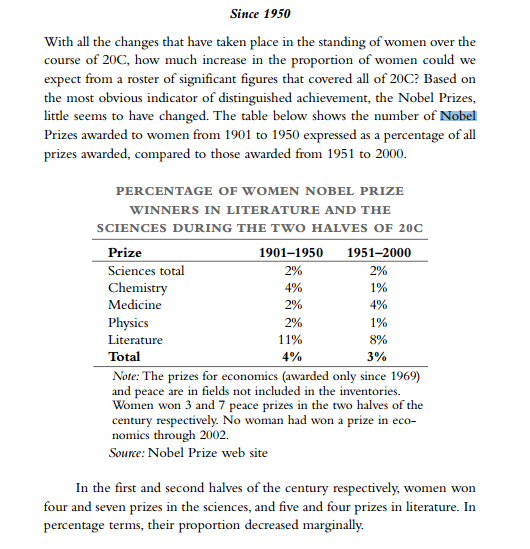
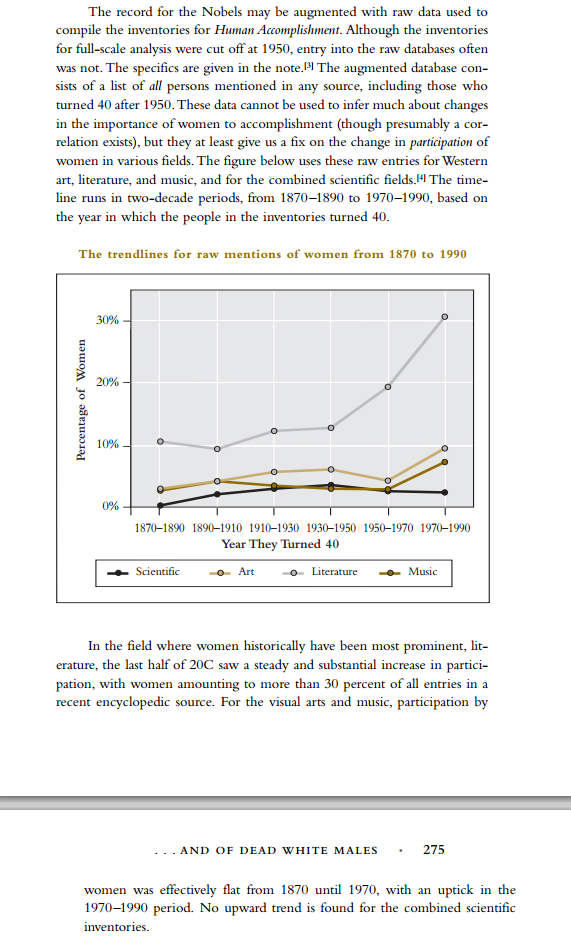
Murray states on p. 273, 274 and 275 that women have an underrepresentation in the sciences. You would figure, if this so-called “white cis male patriarchy” was out to have women be underrepresented, they wouldn’t have allowed the feminist movement to come full-swing in the early 1900s. Well, the numbers on women Nobel Prize winners from 1901-1950 is: 2 percent sciences total, 4 percent chemistry,2 percent medicine, 2 percent physics and 11 percent literature with a 4 percent representation in total. From 1951-2000, it was 2 percent sciences total, 1 percent chemistry, 4 percent medicine, 1 percent in physics and 8 percent in literature for a total of 3 percent.
Now, this does show women’s high verbal ability at play with regards to the number of literary Nobel Prizes’ they have, but this shows that after the Feminist Movement, that when they got ‘equality’, they failed to produce the same as men. This data corroborates what I noted earlier: that there is a significant amount of cortical neuronal difference between men and women, there is a 3.63 IQ point difference between men and women on average, and finally the data on Nobel Prizes corroborates this information.
The Defense Ministers of Sweden, Norway, the Netherlands, and Germany embody what is going on at the moment in these countries with the ‘migrant’ crisis. We can see with Russia’s aversion to the scenario currently happening in Europe, that with their Defense Minister, these things that are currently happening in those aforementioned countries won’t happen in Russia.
This is shown in how men and women’s overall leadership capabilities, ability to lead meetings and differing managing strategies. All of these differences, of course, are due to brain differences between men and women.
Women are more emotional than men due to biology, so in times of war with a woman Defense Minister, since men and women differ in inductive and deductive reasoning traits, women won’t be deductive, which is a logical process in which a conclusion is drawn from multiple premises that are assumed to be true, which men excel at. Women, however, excel at inductive reasoning, which is making broad generalizations from specific observations. It seems that in war time, deductive reasoning would be better, seeing as the conclusion is drawn from things that are assumed to be true. Men make better leaders than women because, since, on average, men don’t think with their emotions while women do.
Men and women’s brains differ on the individual level, of course, like all things between groups, sexes, and individuals. The push to deny human nature, and in turn, invoke a blank slate argument even in the face of science is shown in the way that our society is headed. Between differences in brain size, scholastic achievement, IQ, brain weight, Nobel Prizes, neocortical neurons and other gender-specific differences, these innate differences in brain structure manifest themselves in society and the types of jobs women want and acquire. Women cannot lead as well as men and while they ‘lead differently’, the best type of leader to have is a man as men think with logic and facts whereas women think with emotion, on average.
Ashkenazi Jews are not Khazar
1900 words
Many people in the alt-right say that “the Ashkenazi Jews are Khazar”. This is not true. This is based on an autobiography by a Jew who thought that if Europeans thought the Jews were European, they wouldn’t want to kill them. This is also based on one study, where all the rest of the literature says they derive from the Levant and the Middle East. I will go through the myth and then tell the truth of the origins of the Ashkenazi Jews.
In this research paper by Eran Elhaik, he says that the rise of European Jewry is explained by the rise of Judeo-Khazars. Though contribution of Khazar genetics can only be estimated by empirically, but the absence of genome-wide data precluded the Khazar hypothesis. The findings by Elhaik, he says, support the Khazarian hypothesis and it represents the European Jewish genome as an amalgamation of Caucasus, European and Semitic ancestry.
Razib Khan has this to say about it:
In general I have to say that the historical framework of the paper is very skeletal, verging on incoherent (at least to me).
Setting aside the historical fuzziness of the paper, the major issue I have is that though the methods are totally kosher, so to speak, the data you put into them strongly shape your outcomes. Dienekes and Maju both anticipated my own key concern. The “Middle Eastern” aspect of Ashkenazi Jewish ancestry might in fact be most well represented by populations in the zone of the northern Fertile Crescent and Eastern Anatolia; rather near or overlapping with the homelands of several of the Caucasian populations used in the above study as a proxy for Khazars. Additionally, modern Palestinians (the HGDP data set) are used as a reference to the Middle Eastern ancestors of Jews. I now believe that the Arabian contribution to the ancestry of Levantine and Iraqi Muslim population which dates to after the 7th century, and differentiates Muslim Arabs from their local non-Muslim Arab* co-ethnics, is significant. Perhaps on the same order of Germanic ancestry in modern England which dates to the 6th century and later. In plainer language the Caucasian component that is being detected in this paper may simply be a indigenous Middle Eastern ancestral element which has now been somewhat displaced northward in its modal frequency due to the expansion of the Arabs, and later the admixture of some Sub-Saharan admixture among Muslim Arabs.
Finally, despite the fact that I praise the author’s utilization of a wide array of contemporary statistical genetic methods, one can’t just do away with a thick and sturdy historical framework and reasonable questions derived from this superstructure.
And Dr. Kevin Macdonald’s thoughts on the matter:
The new findings were seen as support for the idea that there was significant admixture with non-Jews in Greco-Roman times. This is based on the clustering of the European/Syrian Jews and the fact that these groups have been separated since ancient times. The authors argue that the data are consistent with historical accounts of proselytism and large-scale conversions to Judaism in ancient times. When I reviewed the historical data in A People That Shall Dwell Alone (Ch. 4, pp. 62-78), I ended up rejecting this theory, coming down on the side of historians who doubted how important conversion really was. One thing that convinced me was that there was a lot of evidence for biases against converts. For example, once they converted they were regarded as very undesirable marriage partners and that a pure Jewish genealogy was a very big asset in the marriage market. Families keep their genealogies for generations, and there is a lot of evidence for hostility toward converts. Contrary to Atzmon et al., conversion is not required to explain the large numbers of Jews in the ancient world.
Though, this theory, before this one singular study came out, was first put forth by Arthur Koestler in his book The Thirteenth Tribe. He became interested in the founding of the Hungarian empire, and how the Khazars were at the center of that. He then makes a huge jump in logic to say that all of European Jewry are descended from those from Khazaria who then converted to Judaism.
This theory was quickly latched on to by the alt-right when it first was published and used as ammunition to say that the Jews weren’t the rightful bearers of Canaan (modern-day Israel/Palestine). However, we know that Jewish populations are more closely related to each other than to outside populations:
Livshits, Sokal and Kobylianskyt investigated the genetic affinities of Jewish populations. They concluded that Jewish populations are more like one another than they are to non-Jews and that pairs of Jewish populations from different locations are more alike than pairs of non-Jewish populations. They maintained that the most economical explanation of their findings is that the modern Jewish population throughout the world was derived from a common original gene pool which underwent few changes during the dispersion of the Jewish people. They also reported that it was highly likely that the common origin of the Jewish populations was more recent than that of the non-Jews.
Which, if Ashkenazi Jew were Khazar, we wouldn’t see this coming up in genetic testing.
Even the world’s foremost researchers on the Jews like Dr. Kevin Macdonald and Dr. David Duke say that the Khazar Hypothesis is long refuted.
In Ted Sallis’ article on the Occidental Observer, More Jewish Genetics: The “Weak Khazar Hypothesis” he cites a study which says that there may be a minute component in the Ashkenazi Jewish genome which is Khazar, which that part is from a North Caucaus population. Though, that might just be showing genetic similarity and not that some of the Ashkenazi Jewish genome derives from those populations.
David Duke even accepted the Khazar theory as true for years as he admits, however, he says that it wasn’t until he thought of the hypothesis both scientifically and logically that his doubts on the theory became aroused.
He says that Koestler, who he didn’t know was a communist Jew, bragged in a Jewish magazine that he made the hypothesis to fight anti-semitism. He believed, and cited the Gospels as evidence, that if he could get Europeans to believe they are related by blood to Jews, that anti-semitism would be lessened. Dr. Duke then goes through many studies which show that, in fact, the Khazar hypothesis is long discredited.
In my own articles on this website, I have written about the origins of Ashkenazi Jews.
A few thousand years ago, male Jews migrated from the Middle East and mated with beautiful Roman women who then converted to Judaism. The four major founders of the Ashkenazi Jew population have ancestry in prehistoric Europe, and not the Caucus or the Near East. The four minor founders share a deep European ancestry. So with genetic testing, we can see that the majority of the Ashkenazi population didn’t have its origins in the Caucus or Levant, but through assimilation of Roman women who converted to Judaism.
Male Jews migrated from the Levant to Rome during Greco-Roman times, which mass conversions led to 6 million Roman women who then began to practice Judaism. The genetic proximity of Ashkenazi Jews and Syrian Jews to Northern Italians, Sardinians and French populations suggest that there is non-Semitic ancestry in Ashkenazi Jews. The findings also say that any theories of Ashkenazi Jews having ancestry in Khazaria or from Slavs are incompatible with genetic studies. The close genetic similarity of Ashkenazi Jews and Southern Europeans has been noted in many studies.
So we have male Jews from the Levant who trekked to Rome around Greco-Roman times. They took beautiful Roman women as wives, who then converted to Judaism.
These two new studies from within the past few years again corrobarate that Ashkenazi Jews are not Khazarian, but derive from the same four founder populations; ancient European women and are not descended from Turkish populations.
Blogger Diversity is Chaos believes so. He says:
Persian Jews converted Turks to Judaism to create the rump of what would become today’s Jewish population, DNA research has revealed. The fascinating insight, which shows that most Ashkenazi Jews descend from Turkey, was made possible by state-of-the-art computer modelling and genetic techniques. The project, led by Israeli-born Dr Eran Elhaik, even pinpointed Iskenaz, Eskenaz and Ashanaz – three Turkish villages an ancient Silk Road route which still exist today – as part of the original Ashkenazi homeland.
As shown above, this is wrong. No idea why he wrote this article the other day, seeing as this debate has been put to rest for years.
He said that the word Ashkenaz likely derives from Ashguza, the ancient Assyrian and Babylonian term for Iron Age Eurasian steppeland people known as Scythians.
No. It is Biblical:
from modern Hebrew, from Ashkenaz, son of Japheth, one of the sons of Noah (Gen. 10:3).
Concurrent analysis of Yiddish suggests that it was originally a Slavic languagewhich the researchers think was developed by Jewish tradesmen travelling along the Silk Roads linking China and Europe 1,200 years ago.
…
The prevalent view claims Yiddish has a German origin, whereas the opposing view suggests a Slavic origin with strong Iranian and weak Turkic substrata,” they say. “One of the major difficulties in deciding was the unknown geographical origin of Yiddish speaking Ashkenazic Jews,” they say, but their analysis “demonstrates that Greeks, Romans, Iranians, and Turks exhibit the highest genetic similarity with Ashkenazic Jews”.
They show genetic similarity to those populations due to population migration. I have touched on and already linked to the origins of the Roman component in the Ashkenazi Jewish genome, and the same applies for those other populations. Genetic similarity does not mean that those populations were a founder population, or even that there is ancestry from those peoples.
Yiddish and modern German are both derived from the same source, which is Middle High German. Why, if they were Khazar, would it be derived from Middle High German? Why would the Ashkenazic travelers speak Old French, Hebrew and Aramaic? Yiddish is an amalgamation of languages with an extremely heavy German component. As the Jews traveled, they picked up new languages and began to integrate them into their language and eventually Yiddish formed.
To conclude, those who still believe and push the Khazar hypothesis are ideologically blinded. They let their bias cloud their judgement to the facts. Just because one singular study came out that says the Jews are Khazar is meaningless…. Since all other studies have shown that Jews, all Jews no matter where they live in the world, show affinities with the Middle East. Even the world’s foremost scholars on the Jewish people say that the Khazar hypothesis is wrong. One study on this doesn’t show that “all Jews descend from Khazars”, as we have to take a look at all studies as a whole and see where they point. All studies do not point to an origin like this, so it’s safe to say that this one study be thrown in the trash where it belongs. It’s intellectually dishonest to believe the Khazar hypothesis when it has been discredited time and time again by the newest genomic studies.
 NotPoliticallyCorrect