Home » Evolution (Page 3)
Category Archives: Evolution
Otzi Man’s Last Meal and the Diet of Neanderthals
1100 words
The debate on what type of diet in regard to macronutrient differences rages on. Should we eat high carb, low fat (HCLF)? Or low carb, high fat (LCHF) or something in between? The answer rests on, of course, the type of diets that our ancestors ate—both immediate and in the distant past. In the 1990s, a frozen human was discovered in the Otzal mountains, which gave him the name “Otzi man.” About 5,300 years ago, he was frozen in the mountains. The contents of his stomach have been analyzed in the 27 years since the discovery of Otzi, but an in-depth analysis was not possible until now.
A new paper was published recently, which analyzed the stomach contents of Otzi man (Maixner et al, 2018). There is one reason why it took so long to analyze the contents of his stomach: the authors state that, due to mummification, his stomach moved high up into his rib cage. The Iceman was “omnivorous, with a diet consisting both of wild animal and plant material” (Maixner et al, 2018: 2). They found that his stomach had a really high fat content, with “the presence of ibex and red deer” (pg 3). He also “consumed either fresh or dried wild meat“, while “a slow drying or smoking of the meat over the fire would explain the charcoal particles detected previously in the lower intestine content.“(pg 5).
The extreme alpine environment in which the Iceman lived and where he have been found (3,210 m above sea level) is particularly challenging for the human physiology and requires optimal nutrient supply to avoid rapid starvation and energy loss [31]. Therefore, the Iceman seemed to have been fully aware that fat displays an excellent energy source. On the other hand, the intake of animal adipose tissue fat has a strong correlation with increased risk of coronary artery disease [32]. A high saturated fats diet raises cholesterol levels in the blood, which in turn can lead to atherosclerosis. Importantly, computed tomography scans of the Iceman showed major calcifications in arteria and the aorta indicating an already advanced atherosclerotic disease state [33]. Both his high-fat diet and his genetic predisposition for cardiovascular disease [34] could have significantly contributed to the development of the arterial calcifications. Finally, we could show that the Iceman either consumed fresh or dried meat. Drying meat by smoking or in the open air are simple but highly effective methods for meat preservation that would have allowed the Iceman to store meat long term on journeys or in periods of food scarcity. In summary, the Iceman’s last meal was a well-balanced mix of carbohydrates, proteins, and lipids, perfectly adjusted to the energetic requirements of his high-altitude trekking. (Maixner et al, 2018: 5)
They claim that “the intake of animal adipose tissue fat has a strong correlation with increased risk of coronary artery disease“, of course, citing a paper that the AHA is involved in (Sacks et al, 2017) which says that “Randomized clinical trials showed that polyunsaturated fat from vegetable oils replacing saturated fats from dairy and meat lowers CVD.” This is nonsense, because dietary fat guidelines have no evidence (Harcombe et al, 2016; Harcombe, Baker, and Davies, 2016; Harcombe, 2017). Saturated fat consumption is not even associated with all-cause mortality, type II diabetes, ischemic stroke, CVD (cardiovascular disease) and CHD (coronary heart disease) (de Sousa et al, 2015).
Thus, if anything, what contributed to Otzi man’s arterial calcification seems to be grains/carbohydrates (see DiNicolantonio et al, 2017), not animal fat. Fats, at 9 kcal per gram, were better for Otzi to consume, as he got more kcal for his buck; eating a similar portion in carbohydrates, for example, would have meant that Otzi would have had to spend more time eating (since carbs have less than half the energy that animal fat does). Since his stomach had ibex (a type of goat) and red deer, it’s safe to say that many of his meals consisted mainly of animal fat, protein with some cereals and plants thrown in (he was an omnivore).
We can then contrast the findings of Otzi’s diet with that of Neanderthals. It has been estimated that, during glacial winters, Neanderthals would have consumed around 74-85 percent of their diet from animal fat when there were no carbohydrates around, with the rest coming from protein (Ben-Dor, Gopher, and Barkai, 2016). Furthermore, based on contemporary data from polar peoples, it is estimated that Neanderthals required around 3,360 to 4,480 kcal per day to winter foraging and cold resistance (Steegmann, Cerny, and Holliday, 2002). The upper-limit for protein intake for Homo sapiens is 4.0 g/bw/day while for erectus it is 3.9 g/bw/day (Ben-Dor et al, 2011), and so this shows that Neanderthals consumed a theoretical upper-maximum of protein due to their large body size. So we can assume that Neanderthals consumed somewhere near 3800 kcal per day. The average Neanderthal is said to have consumed about 292 grams of protein per day, or 1,170 kcal (with a lower end of 985 kcal and an upper end of 1,170 at the high end) (Ben-Dor, Gopher, and Barkai, 2016: 370).
Then if we further assume that Neanderthals consumed no carbohydrates during glacial winters, that leaves protein as the main source of energy, since the large game the Neanderthals hunted were not around. Thus, Neanderthals would have consumed between 2,812 and 3,230 kcal from animal fat with the rest coming from protein. We can also put this into perspective. The average American man consumes about 100 grams of protein per day, while consuming 2,195 kcal per day (Ford and Dietz, 2013). For these reasons, and more, I argued that Neanderthals were significantly stronger than Homo sapiens, and this does have implications for racial differences in athletic ability.
In sum, the last meal of Otzi man is now known. Of course, this is a case of n = 1, so we should not draw too large a conclusion from this, but it is interesting. I don’t see why the composition of the diets of any of Otzi’s relatives would have been any different (or that the contents of his normal diet would have been any different). He ate a diet high in animal fat like Neanderthals, but unlike Neanderthals, they ate a more cereal-based diet which may have contributed to Otzi’s CVD and arterial calcification. We can learn a lot about ourselves and our ancestors through the analysis of their stomach contents (if possible) and teeth (if possible), and maybe even genomes (Berens, Cooper, and Lachance, 2017) because if we learn what they ate then we can maybe begin to shift dietary advice to a more ‘natural’ way and avoid diseases of civilization. But, we have not had time to adapt to the new obesogenic environments we have constructed for ourselves. It’s due to this that we have an obesity epidemic, and by studying the diets of our ancestors, we can then begin to remedy our obesity and other health problems.
Mini-Review of “J. Phillipe Rushton: A Life History Perspective” by Edward Dutton
1500 words
JP Rushton was a highly controversial psychologist professor, teaching at the University of Western Ontario for his entire career. In the mid-1980s, he proposed that evolution was “progressive” and that there was a sort of “hierarchy” between the three races that he termed “Mongoloid, Caucasoid, and Negroid” (Rushton, 1985). His theory was then strongly criticized scientists from numerous disciplines (Lynn, 1989; Cain, 1990; Weizmann et al, 1990; Anderson, 1991; Graves, 2002). Rushton responded to these criticisms (Rushton, 1989; Rushton, 1991; Rushton, 1997; though it’s worth noting that Rushton never responded to Graves’ 2002 critiques). (Also see Rushton’s and Graves’ debate.) Copping, Campbell, and Muncer (2014) write that “high K scores were related to earlier sexual debut and unrelated to either pubertal onset or number of sexual partners. This suggests that the HKSS does not reflect an underlying “K dimension.”“, which directly contradicts Rushton’s racial r/K proposal.
There is a now a new critique of Rushton’s theory out now, by Edward Dutton, English anthropologist, with a doctorate in religious studies, just published at the end of last month (Dutton, 2018). I ordered the book the day after publication and it took three weeks to get to my residence since it came from the UK. I finally received it on Friday. It’s a small book, 143 pages sans acknowledgments, references and the index, and seems well-written and researched from what I’ve read so far.
Here is the plan of the book:
Accordingly, in this chapter [Chapter One], we will begin by getting to grips with the key concepts of intelligence and personality. This part is primarily aimed at non-specialist readers or those who are sceptical of the two concepts [it’s really barebones; I’m more than ‘sceptical’ and it did absolutely nothing for me]. In Chapter Two, we will explore Rushton’s theory in depth. Readers who are familiar with Life History Theory may wish to fast forward through to the section on the criticisms of Rushton’s model. I intend to be as fair to his theory as possible, in a way so few of the reviewers were when he presented it. I will respond to the many fallacious criticisms of it, all of which indicate non-scientific motives [what about Rushton? Did he have any non-scientific motives?]. However, I will show that Rushton is just as guilty of these kinds of techniques as his opponents. I will also highlight serious problems with his work, including cherry picking, confirmation bias, and simply misleading other researchers. In Chapter Three, we will explore the concept of ‘race’ and show that although Rushton’s critics were wrong to question the concept’s scientific validity, Rushton effectively misuses the concept, cherry-picking such that his concept works. In Chapter Four, we will explore the research that has verified Rushton’s model, including new measures which he didn’t examine. We will then, in Chapter Five, examine the concept of genius and look at how scientific geniuses tend to be highly intelligent r-strategists, though we will see that Rushton differed from accepted scientific geniuses in key ways.
In Chapter Six, we will find that Rushton’s theory itself is problematic, though not in the ways raised by his more prominent critics. It doesn’t work when it comes to a key measure of mental stability as well as to many other measures, specifically preference for oral sex, the desire to adopt non-related children, the desire to have pets, and positive attitudes to the genetically distant. It also doesn’t work if you try to extend it to other races, beyond the three large groups he examined [because more races exist than Rushton allows]. In Chapter Seven, with all the background, we will scrutinize Rushton’s life up until about the age of 30, while in Chapter Eight, we will follow Rushton from the age of 30 until his death. I will demonstrate the extent to which he was a highly intelligent r-strategist and a Narcissist and we will see that Rushton seemingly came from a line of highly intelligent r-strategists. In Chapter Nine, I will argue that for the good of civilization those who strongly disagree with Rushton must learn to tolerate people like Rushton. (Dutton, 2018: 12-13).
On the back of the book, he writes that Rushton had “two illegitimate children including one by a married black woman.” This is intriguing. Could this be part of Rushton’s motivation to formulate his theory (his theory has already been rebutted by numerous people, so speculating on motivations in lieu of new information seems apt)?
Some people, such as PumpkinPerson, may wonder why Dutton is attacking someone “on his team“, but he addresses people who would ask such questions, writing (pg. 15):
“But on this basis, it could be argued that my critique of Rushton simply gives ammunition to emotionally-driven scientists and their friends in the media. However, it could be countered that my critique only goes to show that it is those who are genuinely motivated by the understanding of the world — those who accept empirical evidence, such as with regard to intelligence and race — who are prepared to critique those regarded as being ‘on their side.’ And this is precisely because they are unbiased and thus do not think in terms of ‘teams.’”
Dutton argues that “many of the criticisms leveled against Rushton’s work by mainstream scientists were actually correct” (pg 13). This is a truism. One only need to read the replies to Rushton, especially Anderson (1991) to see that he completely mixed up the theory. He stated ‘Negroids’ were r-strategists and ‘Mongoloids’ were K-strategists, but this reasoning shows that he did not understand the theory—or, if anything, he knowingly attempted to obfuscate the theory in order to lend stronger credence to his own theory (and personal biases).
The fatal flaw for Rushton’s theory is that, if r/K selection theory did apply to human races, that ‘Mongoloids’ would be r-strategists while ‘Negroids’ would be K-strategists. This is because “Rushton’s own suggested agents of natural selection on African populations imply that African populations have had a strong history of K-selection, as well as the r-selection implied by “droughts”” (Anderson, 1991: 59). As for Mongoloids, “Rushton lists many traits of Mongoloid peoples that are thought to represent adaptation to cold. Cold weather acts in a density-independent fashion (adaptations to cold improve survival in cold weather regardless of population density); cold weather is normally an agent of r-selection” (Anderson, 1991: 59). Rushton’s own arguments imply that ‘Negroids’ would have had more time to approach their environmental carrying capacity and experience ‘K-selecting’ pressures.
Thus, Rushton’s claim about the empirical ordering of life history and behavioural traits in the racial groups exactly contradicts general predictions that follow from his own claims about their ancestral ecology and the r/K model (Boyce, 1984; MacArthur, 1972; MacArthur & Wilson, 1967; Pianka, 1970; Ricklefs, 1990, p. 577). (Specific predictions from the model could be made only about individual populations after careful study in their historical habitat, as I have pointed out above). (Anderson, 1991: 59) [And it is not possible, because the populations in question should be living in the environment that the selection is hypothesized to have occurred. That, of course, is not possible today.]
Though, near the end of the book, Dutton writes that (pg 148) that “Rushton was not a scientific genius. As we have discussed, unlike a scientific genius, his models had clear deficiencies, he cherry-picked data to fit his model, and he was biased in favor of his model. However, Rushton was a highly original scientist who developed an extremely original and daring theory: a kind of artistic-scientist genius combination.”
The final paragraph of the book, though, sums up the whole book up well. Dutton talks about when Jared Taylor introduces Rushton at one of his American Renaissance conferences (February 25th, 2006):
‘Well, thank you very much and . . . eh . . . and thank you Jared for . . . erm . . . putting on another wonderful conference.’ Rushton was reserved, yet friendly and avuncular. ‘Eh . . . it’s a great honor to be the after dinner speaker; to be elevated up like this.’ He was certainly elevated up. Taylor had even remarked that ‘in a sane and civilized world’ Rushton’s work would have ‘worldwide acclaim.’ Rushton’s audience admired him, trusted him . . . They weren’t familiar with him at all.
All in all, to conclude this little mini-review, I would recommend picking up this book as it’s a great look into Rushton’s life, the pitfalls of his theory (and for the new work and other variables that Dutton shows showed Rushton’s M>C>N ‘hierarchy’). Rushton’s work, while politically daring, did not hold up to scientific scrutiny, since the model was beginning to be abandoned in the late 70s (Graves, 2002), with most scientists completely dismissing the model in the early 90s. Commenting on r/K selection, Stearns (1992: 206) writes that “This explanation was suggestive and influential but incorrect” (quoted in Reznick et al, 2002), while Reznick et al (2002: 1518) write that “The r- and K-selection paradigm was replaced by new paradigm that focused on age-specific mortality (Stearns 1976, Charlesworth 1980).” Rushton’s model, while it ‘made sense with the data’, was highly flawed. And even then, it doesn’t matter that it ‘made sense’ with the data, since Rushton’s theory is one large just-so story (Gould and Lewontin, 1976; Lloyd, 1999; Richardson, 2007; Nielsen, 2009; see also Pigliucci and Kaplan, 2000 and Kaplan, 2002
Black-White Differences in Anatomy and Physiology: Black Athletic Superiority
3000 words
Due to evolving in different climates, the different races of Man have differing anatomy and physiology. This, then, leads to differences in sports performance—certain races do better than others in certain bouts of athletic prowess, and this is due to, in large part, heritable biological/physical differences between blacks and whites. Some of these differences are differences in somatotype, which bring a considerable advantage for, say, runners (an ecto-meso, for instance, would do very well in sprinting or distance running depending on fiber typing). This article will discuss differences in racial anatomy and physiology (again) and how it leads to disparities in certain sports performance.
Kerr (2010) argues that racial superiority in sport is a myth. (Read my rebuttal here.) In his article, Kerr (2010) attempts to rebut Entine’s (2000) book Taboo: Why Black Athletes Dominate Sports and Why We’re Afraid to Talk About It. In a nutshell, Kerr (2010) argues that race is not a valid category; that other, nongenetic factors play a role other than genetics (I don’t know if anyone has ever argued if it was just genetics). Race is a legitimate biological category, contrary to Kerr’s assertions. Kerr, in my view, strawman’s Entine (2002) by saying he’s a “genetic determinist”, but while he does discuss biological/genetic factors more than environmental ones, Entine is in no way a genetic determinist (at least that’s what I get from my reading of his book, other opinions may differ). Average physical differences between races are enough to delineate racial categories and then it’s only logical to infer that these average physical/physiological differences between the races (that will be reviewed below) would infer an advantage in certain sports over others, while the ultimate cause was the environment that said race’s ancestors evolved in (causing differences in somatotype and physiology).
Black athletic superiority has been discussed for decades. The reasons are numerous and of course, this has even been noticed by the general public. In 1991, half of the respondents of a poll on black vs. whites in sports “agreed with the idea that “blacks have more natural physical ability,“” (Hoberman, 1997: 207). Hoberman (1997) of course denies that there is any evidence that blacks have an advantage over whites in certain sports that come down to heritable biological factors (which he spends the whole book arguing). However, many blacks and whites do, in fact, believe in black athletic superiority and that physiologic and anatomic differences between the races do indeed cause racial differences in sporting performance (Wiggins, 1989). Though Wiggins (1989: 184) writes:
The anthropometric differences found between racial groups are usually nothing more than central tendencies and, in addition, do not take into account wide variations within these groups or the overlap among members of different races. This fact not only negates any reliable physiological comparisons of athletes along racial lines, but makes the whole notion of racially distinctive physiological abilities a moot point.
This is horribly wrong, as will be seen throughout this article.
The different races have, on average, differing somatotypes which means that they have different anatomic proportions (Malina, 1969):
| Data from Malina, (1969: 438) | n | Mesomorph | Ectomorph | Endomorph |
| Blacks | 65 | 5.14 | 2.99 | 2.92 |
| Whites | 199 | 4.29 | 2.89 | 3.86 |
| Data from Malina (1969: 438) | Blacks | Whites |
| Thin-build body type | 8.93 | 5.90 |
| Submedium fatty development | 48.31 | 29.39 |
| Medium fleshiness | 33.69 | 43.63 |
| Fat and very fat categories | 9.09 | 21.06 |
This was in blacks and whites aged 6 to 11. Even at these young ages, it is clear that there are considerable anatomic differences between blacks and whites which then lead to differences in sports performance, contra Wiggins (1989). A basic understanding of anatomy and how the human body works is needed in order to understand how and why blacks dominate certain sports over whites (and vice versa). Somatotype is, of course, predicated on lean mass, fat mass, bone density, stature, etc, which are heritable biological traits, thus, contrary to popular belief that somatotyping holds no explanatory power in sports today (see Hilliard, 2012).
One variable that makes up somatotype is fat-free body mass. There are, of course, racial differences in fat mass, too (Vickery, Cureton, and Collins, 1988; Wagner and Heyward, 2000). Lower fat mass would, of course, impede black excellence in swimming, and this is what we see (Rushton, 1997; Entine, 2000). Wagner and Heyward (2000) write:
Our review unequivocally shows that the FFB of blacks and whites differs significantly. It has been shown from cadaver and in vivo analyses that blacks have a greater BMC and BMD than do whites. These racial differences could substantially affect measures of body density and %BF. According to Lohman (63), a 2% change in the BMC of the body at a given body density could, theoretically, result in an 8% error in the estimation of %BF. Thus, the BMC and BMD of blacks must be considered when %BF is estimated.
While Vickery, Cureton, and Collins (1988) found that blacks had thinner skin folds than whites, however, in this sample, somatotype did not explain racial differences in bone density, like other studies (Malina, 1969), Vickery, Cureton, and Collins (1988) found that blacks were also more likely to be mesomorphic (which would then express itself in racial differences in sports).
Hallinan (1994) surveyed 32 sports science, exercise physiology, biomechanics, motor development, motor learning, and measurement evaluation textbooks to see what they said racial differences in sporting performance and how they explained them. Out of these 32 textbooks, according to Wikipedia, these “textbooks found that seven [textbooks] suggested that there are biophysical differences due to race that might explain differences in sports performance, one [textbook] expressed caution with the idea, and the other 24 [textbooks] did not mention the issue.” Furthermore, Strklaj and Solyali (2010), in their paper “Human Biological Variation in Anatomy Textbooks: The Role of Ancestry” write that their “results suggest that this type of human variation is either not accounted for or approached only superficially and in an outdated manner.”
It’s patently ridiculous that most textbooks on the anatomy and physiology of the human body do not talk about the anatomic and physiologic differences between racial and ethnic groups. Hoberman (1997) also argues the same, that there is no evidence to confirm the existence of black athletic superiority. Of course, many hypotheses have been proposed to explain how and why blacks are at an inherent advantage in sport. Hoberman (1997: 269) discusses one, writing (quoting world record Olympian in the 400-meter dash, Lee Evans):
“We were bred for it [athletic dominance] … Certainly the black people who survived in the slave ships must have contained the highest proportion of the strongest. Then, on the plantations, a strong black man was mated with a strong black woman. We were simply bred for physical qualities.”
While Hoberman (1997: 270-1) also notes:
Finally, by arguing for a cultural rather than a biological interpretation of “race,” Edwards proposed that black athletic superiority results from “a complex of societal conditions” that channels a disproporitionate number of talented blacks into athletic careers.
The fact that blacks were “bred for” athletic dominance is something that gets brought up often but has little (if any) empirical support (aside from just-so stories about white slavemasters breeding their best, biggest and strongest black slaves). The notion that “a complex of societal conditions” (Edwards, 1971: 39) explains black dominance in sports, while it has some explanatory power in regard to how well blacks do in sporting competition, it, of course, does not tell the whole story. Edwards (1978: 39) argues that these complex societal conditions “instill a heightened motivation among black male youths to achieve success in sports; thus, they channel a proportionately greater number of talented black people than whites into sports participation.” While this may, in fact, be true, this does nothing to rebut the point that differences in anatomic and physiologic factors are a driving force in racial differences in sporting performance. However, while these types of environmental/sociological arguments do show us why blacks are over-represented in some sports (because of course motivation to do well in the sport of choice does matter), they do not even discuss differences in anatomy or physiology which would also be affecting the relationship.
For example, one can have all of the athletic gifts in the world, one can be endowed with the best body type and physiology to do well in any type of sport you can imagine. However, if he does not have a strong mind, he will not succeed in the sport. Lippi, Favaloro, and Guidi (2008) write:
An advantageous physical genotype is not enough to build a top-class athlete, a champion capable of breaking Olympic records, if endurance elite performances (maximal rate of oxygen uptake, economy of movement, lactate/ventilatory threshold and, potentially, oxygen uptake kinetics) (Williams & Folland, 2008) are not supported by a strong mental background.
Any athlete—no matter their race—needs a strong mental background, for if they don’t, they can have all of the physical gifts in the world, they will not become top-tier athletes in the sport of their choice; advantageous physical factors are imperative for success in differing sports, though myriad variables work in concert to produce the desired effect so you cannot have one without the other. On the other side, one can have a strong mental background and not have the requisite anatomy or physiology needed to succeed in the sport in question, but if he has a stronger mind than the individual with the requisite morphology, then he probably will win in a head-to-head competition. Either way, a strong mind is needed for strong performance in anything we do in life, and sport is no different.
Echoing what Hoberman (1997) writes, that “racist” thoughts of black superiority in part cause their success in sport, Sheldon, Jayaratne, and Petty (2007) predicted that white Americans’ beliefs in black athletic superiority would coincide with prejudice and negative stereotyping of black’s “intelligence” and work ethic. They studied 600 white men and women to ascertain their beliefs on black athletic superiority and the causes for it. Sheldon, Jayaratne, and Petty (2007: 45) discuss how it was believed by many, that there is a “ perceived inverse relationship between athleticism and intelligence (and hard work).” (JP Rushton was a big proponent of this hypothesis; see Rushton, 1997. It should also be noted that both Rushton, 1997 and Entine, 2000 believe that blacks’ higher rate of testosterone—3 to 15 percent— [Ross et al, 1986; Ellis and Nyborg, 1992; see rebuttal of both papers] causes their superior athletic performance, I have convincingly shown that they do not have higher levels of testosterone than other races, and if they do the difference is negligible.) However, in his book The Sports Gene: Inside the Science of Extraordinary Athletic Performance, Epstein (2014) writes:
With that stigma in mind [that there is an inverse relationship between “intelligence” and athletic performance], perhaps the most important writing Cooper did in Black Superman was his methodological evisceration of any supposed inverse link between physical and mental prowess. “The concept that physical superiority could somehow be a symptom of intellectual superiority became associated with African Americans … That association did not begin until about 1936.”
What Cooper (2004) implied is that there was no “inverse relationship” with intelligence and athletic ability until Jesse Owens blew away the competition at the 1936 Olympics in Berlin, Germany. In fact, the relationship between “intelligence” and athletic ability is positive (Heppe et al, 2016). Cooper is also a co-author of a paper Some Bio-Medical Mechanisms in Athletic Prowess with Morrison (Morrison and Cooper, 2006) where they argue—convincingly—that the “mutation appears to have triggered a series of physiological adjustments, which have had favourable athletic consequences.”
Thus, the hypothesis claims that differences in glucose conversion rates between West African blacks and her descendants began, but did not end with the sickling of the hemoglobin molecule, where valine is substituted for glutamic acid, which is the sixth amino acid of the beta chain of the hemoglobin molecule. Marlin et al (2007: 624) showed that male athletes who were inflicted with the sickle cell trait (SCT) “are able to perform sprints and brief exercises at the highest levels.” This is more evidence for Morrison and Cooper’s (2006) hypothesis on the evolution of muscle fiber typing in West African blacks.
Bejan, Jones, and Charles (2010) explain that the phenomenon of whites being faster swimmers in comparison to blacks being faster runners can be accounted for by physics. Since locomotion is a “falling-forward cycle“, body mass falls forward and then rises again, so mass that falls from a higher altitude falls faster and forward. The altitude is set by the position of center of mass above the ground for running, while for swimming it is set by the body rising out of the water. Blacks have a center of gravity that is about 3 percent higher than whites, which implies that blacks have a 1.5 percent speed advantage in running whereas whites have a 1.5 percent speed advantage in swimming. In the case of Asians, when all races were matched for height, Asians fared even better, than whites in swimming, but they do not set world records because they are not as tall as whites (Bejan, Jones, and Charles, 2010).
It has been proposed that stereotype threat is part of the reasons for East African running success (Baker and Horton, 2003). They state that many theories have been proposed to explain black African running success—from genetic theories to environmental determinism (the notion that physiologic adaptations to climate, too, drive differences in sporting competition). Baker and Horton (2003) note that “that young athletes have internalised these stereotypes and are choosing sport participation accordingly. He speculates that this is the reason why white running times in certain events have actually decreased over the past few years; whites are opting out of some sports based on perceived genetic inferiority.” While this may be true, this wouldn’t matter, as people gravitate toward what they are naturally good at—and what dictates that is their mind, anatomy, and physiology. They pretty much argue that stereotype threat is a cause of East African running performance on the basis of two assertions: (1) that East African runners are so good that it’s pointless to attempt to win if you are not East African and (2) since East Africans are so good, fewer people will try out and will continue the illusion that East Africans would dominate in middle- and long-distance running. However, while this view is plausible, there is little data to back the arguments.
To explain African running success, we must do it through a systems view—not one of reductionism (i.e., gene-finding). We need to see how the systems in question interact with every part. So while Jamaicans, Kenyans, and Ethiopians (and American blacks) do dominate in running competitions, attempting to “find genes” that account for success n these sports seems like a moot point—since the whole system is what matters, not what we can reduce the system in question to.
However, there are some competitions that blacks do not do so well in, and it is hardly discussed—if at all—by any author that I have read on this matter. Blacks are highly under-represented in strength sports and strongman competitions. Why? My explanation is simple: the causes for their superiority in sprinting and distance running (along with what makes them successful at baseball, football, and basketball) impedes them from doing well in strength and strongman competitions. It’s worth noting that no black man has ever won the World’s Strongest Man competition (indeed the only African country to even place—Rhodesia—was won by a white man) and the causes for these disparities come down to racial differences in anatomy and physiology.
I discussed racial differences in the big four lifts and how racial differences in anatomy and physiology would contribute to how well said race performed on the lift in question. I concluded that Europeans and Asians had more of an advantage over blacks in these lifts, and the reasons were due to inherent differences in anatomy and physiology. One major cause is also the differing muscle fiber typing distribution between the races (Alma et al, 1986; Tanner et al, 2002; Caesar and Henry, 2015 while blacks’ fiber typing helps them in short-distance sprinting (Zierath and Hawley, 2003). Muscle fiber typing is a huge cause of black athletic dominance (and non-dominance). Blacks are not stronger than whites, contrary to popular belief.
I also argued that Neanderthals were stronger than Homo sapiens, which then had implications for racial differences in strength (and sports). Neanderthals had a wider pelvis than our species since they evolved in colder climes (at the time) (Gruss and Schmidt, 2016). With a wider pelvis and shorter body than Homo sapiens, they were able to generate more power. I then implied that the current differences in strength and running we see between blacks and whites can be used for Neanderthals and Homo sapiens, thusly, evolution in differing climates lead to differences in somatotype, which eventually then lead to differences in sporting competition (what Baker and Horton, 2003 term “environmental determinism” which I will discuss in the context of racial differences in sports in the future).
Finally, blacks dominate the sport of bodybuilding, with Phil Heath dominating the competition for the past 7 years. Blacks dominate bodybuilding because, as noted above, blacks have thinner skin folds than whites, so their striations in their muscles would be more prevalent, on average, at the same exact %BF. Bodybuilders and weightlifters were similar in mesomorphy, but the bodybuilders showed more musculature than the bodybuilders whereas the weightlifters showed higher levels of body fat with a significant difference observed between bodybuilders and weightlifters in regard to endomorphy and ectomorphy (weightlifters skewing endo, bodybuilders skewing ecto, as I have argued in the past; Imran et al, 2011).
To conclude, blacks do dominate American sporting competition, and while much ink has been spilled arguing that cultural and social—not genetic or biologic—factors can explain black athletic superiority, they clearly work in concert with a strong mind to produce the athletic phenotype, no one factor has prominence over the other; though, above all, if one does not have the right mindset for the sport in question, they will not succeed. A complex array of factors is the cause of black athletic dominance, including muscle fibers, the type of mindset, anatomy, overall physiology and fat mass (among other variables) explain the hows and whys of black athletic superiority. Cultural and social explanations—on their own—do not tell the whole story, just as genetic/biologic explanations on their own would not either. Every aspect—including the historical—needs to be looked at when discussing the dominance (or lack thereof) in certain sports along with genetic and nongenetic factors to see how and why certain races and ethnies excel in certain sports.
Vitamin D, Physiology, and the Cold
1200 words
I’ve been chronicling the VDH recently since it has great explanatory—and predictive—power. Light skin is a clear adaptation to low UVR, while dark skin is a clear adaptation to high UVR. Dark, highly melanized skin confers advantages in high UVR environments, such as protection against DNA damage, and also absorbs sufficient UV for vitamin D production while also protecting against folate depletion. However, when our ancestors migrated out of Africa, dark skin would not cut it in temperate environments with highly variable UV rays. This is where our highly adaptive physiology came into play, ensuring that we survived in highly variable environments. Light skin was important in low UVR environments in order to synthesize ample vitamin D, however, that synthesized vitamin D then conferred numerous other physiological advantages to the cold.
Eighty to ninety percent of the vitamin D required for humans comes from the sun, whereas ten to twenty percent comes from the diet, such as fatty fish, eggs, and dairy products (fortified with vitamin D, of course) (Ajabshir, Asif, and Nayer, 2014). Humans need to rely on high amounts of UV rays for vitamin D synthesis (Carlberg, 2014) other than Arctic peoples. Since dark skin does not synthesize vitamin D as well as light skin, skin gradually lightened as our ancestors migrated out of Africa (Juzeniene et al, 2009). This was then imperative to the physiologic adaptations that then occurred as our physiology had to adapt to novel, colder environments with fewer UV rays.
Sufficient amounts of vitamin D are highly important for the human musculoskeletal system (Wintermeyer et al, 2016), which is extremely important for birthing mothers. Along with the increased vitamin D synthesis in low UV environments, the heightened production of vitamin D conferred numerous other physiologic benefits which then helped humans adapt to colder environments with more varying UVR.
Vasoconstriction occurs when the blood vessels constrict which leads to heightened blood pressure, whereas vasodilation is the dilation of blood vessels which decreases blood pressure. So evolutionarily speaking, we had to have adaptive physiology in order to be able to “switch” back and forth between vasoconstriction and vasodilation, depending on what the current environment needed. Vasodilation, though, most likely had no advantage in high UV environments, and thus must have been an advantage in low UV environments, where it was more likely to be colder and so, when the blood vessels constrict, blood pressure increases and thus, heat loss could be considerably slowed in these environments due to these physiologic adaptations.
The races also differ, along with many other physiologic abilities, in nitric oxide-mediated vasodilation. Vasodilation is the dilation of blood vessels, which increases blood pressure. Mata-Greenwood and Chen (2008) reviewed the relevant literature regarding black/white differences in nitric oxide-dependent vasorelaxation and concluded that nitric oxide vasodilation is reduced in darker-skinned populations. Thus, we can infer that in lighter-skinned populations nitric oxide vasodilation is increased in lighter-skinned populations, which would have conferred a great physiological advantage when it came to colonizing environments with lower UV rays.
VDR and vitamin D metabolizing enzymes are present in adipose tissue. Tetrahydrobiopterin; which acts as a cofactor in the synthesis of nitric oxide and its primary function is as a vasodilator in the blood vessels (meaning that blood pressure is increased, to keep more heat in the cold) (Chalupsky and Cai, 2005). Since vasodilation is the body’s primary response to heat stress, blood flow increases which allows heat to leave the body. Therefore, the human body’s ability regarding vasodilation and vasoconstriction mechanisms were important in surviving areas with varying UVR.
One function of our adipose tissue is the storage of vitamin D, while vitamin D metabolizing enzymes and VDR are also expressed in the adipocyte (Abbas, 2017). With these known actions of vitamin D on adipose tissue, we can speculate that since vitamin D and the VDR are expressed in adipose tissue, it may have exerted a role in the adipose tissue which may have been important for surviving in cold, low UV environments (see below).
Furthermore, since these mechanisms are brought on by short-term changes, we can infer that it would hardly be of any use in high UVR environments and would be critical in temperate environments. So, vasodilation and vasoconstriction have little to no benefit in high UVR environments but seem to be imperative in temperate environments where UVR varies. It’s also likely that vitamin D influences vasodilation by influential nitric oxide synthesis (see Andrukhova et al, 2014) and vasoconstriction by influencing the renin-angiotensin system (Ajabshir, Asig, and Nayer, 2014).
This would have conferred great benefit to our ancestors as they migrated into more temperate and colder climates. You can read this for information on how adaptive our physiology is and why it’s like that. Because we went into numerous new environments and natural selection couldn’t act quickly enough, therefore the human body’s physiology is extremely adaptive.
What this suggests is that as skin lightened and adapted to low UV, the increased synthesis in vitamin D influenced vasodilation by a strong influence on nitric oxide synthase, along with vasoconstriction, implies that it would have been easier to survive in novel environments due to adaptive physiology and skin color, along with body fat reserves and the physiologic effects of vitamin D on adipose tissue. These physiologic adaptations would have been of no to little use in Africa. Thus, they must have been useful after we migrated out of Africa and experienced wildly varying environments—the whole reason why our physiology evolved (Richardson, 2017: chapter 5).
When the human body is exposed to cold, a few things occur: cutaneous vasoconstriction, shivering (Castellani and Young, 2016), “behavioral thermoregulation” (Young, Sawka, and Pandolf, 1996), while the human body can adapt physiologically to the cold (Young, 1994). The physiologic functions that vitamin D and folate in regard to vasodilation and vasoconstriction, there is a great chance that these effects were important in maintaining energy homeostasis in colder climates.
In sum, the evolution of light skin conferred a great survival advantage to our ancestors. This then upped the production of vitamin D synthesis in the body, which where then of utmost importance in regard to the adaptation of the human physiology to colder, lower-UV environments. Without our adaptive physiological systems, we would not have been able to leave Africa into novel environments. We need both behavioral thermoregulation as well as adaptive physiology to be able to survive in novel environments. Thus, the importance of skin lightening in our evolution becomes clearer:
As humans migrated out of Africa, lighter skin was needed to synthesize vitamin D. This was especially important to women, who needed higher amounts of vitamin D, in order to produce enough calcium for lactation and pregnancy—so the babe had enough calcium to grow its skeleton in the womb. With the uptake in vitamin D synthesis, this then allowed more adaptive physiologic changes that occurred due to the cold, and along with vasodilation and vasoconstriction, along with shivering and adapting behaviorally to the new environments, were our ancestors able to survive. Dark skin cannot synthesize vitamin D as well as light skin in low UV environments; this also can be seen with the lowered production of nitric oxide-dependent vasodilation in dark-skinned populations. Thus, vasoconstriction conferred no physiologic benefit in high UV environments, but almost certainly conferred a physiologic benefit in low UV environments.
Why Are Women Lighter than Men? Skin Color and Sexual Selection
1550 words
Skin color differences between the sexes are always discussed in terms of women being lighter than men, but never men being darker than women. This is seen in numerous animal studies (some reviewed by Rushton and Templer, 2012; read rebuttal here; also see Ducrest, Keller, and Roulin, 2008). Though, the colors that evolved on the animal’s fur due to whatever mate choices are irrelevant to the survival capabilities that the fur, feathers etc give to the organism in question. So, when we look at humans, we lost our protective body hair millions of years ago (Lieberman, 2015), and with that, we could then sweat. So since furlessness evolved in the lineage Homo, there was little flexibility in what could occur due to environmental pressures on skin color in Africa. It should be further noted that, as Nina Jablonski writes in her book Living Color: The Biological and Social Meaning of Skin Color (2012, pg 74)
No researchers, by the way, have explored the opposite possibility, that women deliberately selected darker men!
One hypothesis proposes that lighter skin in women first arose as a byproduct due to the actions of differing levels of hormones in the sexes—with men obviously having higher levels of testosterone, making them darker them women. So according to this hypothesis, light-skinned women evolved since men could tell high-quality from low-quality mates as well as measure hormonal status and childbearing potential, which was much easier to do with lighter- than darker-skinned women.
Another hypothesis put forth is that further from the equator, sexual competition between women would have increased for mates since mates were depleted, and so light skin evolved since men found it more beautiful. Thus, women living at higher latitudes were lighter than women living at lower latitudes because men had to go further to hunt which meant they were more likely to die which caused even greater competition between females, lightening their skin even more. And another, related, argument, proposed that light skin in women evolved due to a complex of childlike traits which includes a higher voice, smoother skin and childlike facial features, which then reduced male competition and aggressiveness. But women did not stay around waiting to be provisioned and they got out and gathered, and hunted sometimes, too.
Harris (2005) proposes that light skin evolved due to parental selection—mothers choosing the lightest daughters to survive, killing off the darker ones. All babies are born pale—or at least lacking the amount of pigment they have later in life. So how would parental—mostly maternal—selection have caused selection for lighter skin in girls as Harris (2005) proposes? It’d be a pretty large guessing game.
The role of sexual selection in regard to human skin color, though, has been tested and falsified. Madrigal and Kelly (2007a) tested the hypothesis that skin reflectance should be positively correlated with distance from the equator. It was proposed by other authors that as our ancestors migrated out of Africa, environmental selection relaxed and sexual selection took over. Their data did not lend credence to the hypothesis and falsified it.
Madrigal and Kelly (2007a: 475) write (emphasis mine):
We tested the hypothesis that human sexual dimorphism in skin color should be positively correlated with distance from the equator, a proposal generated by the sexual selection hypothesis. We found no support for that proposition. Before this paper was written, the sexual selection hypothesis was based on stated male preference data in a number of human groups. Here, we focused on the actual pattern of sexual dimorphism. We report that the distribution of human sexual dimorphism in relation to latitude is not that which is predicted by the sexual selection hypothesis. According to that hypothesis, in areas of low solar radiation, there should be greater sexual dimorphism, because sexual selection for lighter females is not counterbalanced by natural selection for dark skin. Our data analysis does not support this prediction.
Though Frost (2007) replied, stating that Madrigal and Kelly (2007a) presumed that sexual selection was equal in all areas. Madrigal and Kelly (2007b) responded, stating that they tested one specific hypothesis regarding sexual selection and found it to be false. Frost (2007) proposed two hypotheses in order to test his version, but, again, no one has proposed that women select darker men, which could be a cause of lighter-skinned women (though sexual selection does not—and cannot—explain the observed gradation in skin color between men and women).
Skin color differences between men and women first arose to ensure women enough calcium for lactation and pregnancies. Since skin pigmentation protects against UVR but also must generate vitamin D, it must be light or dark enough to ensure ample vitamin D production in that certain climate, along with protecting against the UVR in that climate. So women needed sufficient vitamin D, which meant they needed sufficient calcium to ensure a strong skeleton for the fetus, for breastfeeding and for the mother’s own overall health.
However, breastfeeding new babes is demanding on the mother’s body (calcium reserves are depleted four times quicker), and the calcium the babe needs to grow its skeleton comes directly from the mother’s bones. Even a mother deficient in vitamin D will still give calcium to the babe at the expense of her own health. But she then needs to increase her reserves of calcium in order to ensure future pregnancies aren’t fatal for her or her offspring.
Though, at the moment to the best of my knowledge, there are no studies on calcium absorption, vitamin D levels and the recovery of the female skeleton after breastfeeding. (Though n3 fatty acids are paramount as well, and so a mother must have sufficient fat stores; see Lassek and Gaulin, 2008.) Thus, light-skinned women are most likely at an advantage when it comes to vitamin D production: The lighter they are, the more vitamin D and calcium they can produce for more pregnancies. Since light skin synthesizes vitamin D more efficiently, the body could then synthesize and use calcium more efficiently. The body cannot use and absorb calcium unless vitamin D is present. Since the fetus takes calcium from the mother’s skeleton, ample amounts of vitamin D must be present. For ample amounts of vitamin D to be present, the skin must be light enough to ensure vitamin D synthesis which would be needed for calcium absorption (Cashman, 2007; Gallagher, Yalamanchili, and Smith, 2012; Aloia et al, 2013).
Nina Jablonski writes in her book (2012, 77):
Women who are chronically deficient in vitamin D because of successive pregnancies and periods of breastfeeding experience a form of bone degeneration called osteomalacia. This has serious consequences for infants born of later pregnancies and for mothers themselves, who are at greater risk of breaking bones. It makes sense that protection of female health during the reproductive years would be a top evolutionary priority, so we are now investigating whether, in fact, slightly lighter skin in women might be a fairly simple way of ensuring that women get enough vitamin D after pregnancy and breastfeeding to enable their bodies to recover quickly. The need for maintaining strong female skeletons through multiple pregnancies may have been the ultimate evolutionary reason for the origin of differences in skin color between men and women.
While Jablonski and Chaplin (2000: 78) write:
We suggest that lighter pigmentation in human females began as a trait directly tied to increased fitness and was subsequently reinforced and enhanced in many human populations by sexual selection.
It is obvious that skin color in women represents a complex balancing act between giving the body the ability to synthesize ample vitamin D and protect from UVR. Skin coloration in humans is very clearly highly adaptive to UVR, and so, with differing average levels of UVR in certain geographic locales, skin color would have evolved to accommodate the human body to whichever climate it found itself in—because human physiology is perhaps the ultimate adaptation.
Sexual selection for skin color played a secondary, not primary role (Jablonski, 2004: 609) in the evolution of skin color differences between men and women. There is a delicate balancing act between skin color, vitamin D synthesis, and UVR protection. Women need to produce enough vitamin D in order to ensure enough calcium and its absorption to the baby and then ensure there are ample amounts to replace what the baby took while in the womb in order for future pregnancies to be successful. Sexual selection cannot explain the observed gradation in skin color between the races and ethnies of the human race. In my opinion, the only explanation for the observed explanation is the fact that skin color evolved due to climatic demands, while independent justification exists for the hypothesis as a whole (Jablonski and Chaplin, 2010).
I don’t see any way that sexual selection can explain the observed gradation in skin color around the world. Skin color is very clearly an adaptation to climate, though of course, cultural customs could widen the skin color differences between the sexes, and make women lighter over time. Nevertheless, what explains the observed skin gradation is adaptation to climate to ensure vitamin D synthesis among a slew of other factors (Jones et al, 2018). Sexual selection, while it may explain small differences between the sexes, cannot explain the differences noted between the native human races.
The Vitamin D Receptor and the Updated VDH
2850 words
The relationship between vitamin D and the vitamin D receptor (VDR) has been found to be of recent importance in explaining the modulation of gene expression. The VDR helps us adapt to the climate, is epistatic with skin color genes, and so on. Due to the importance of the VDR, vitamin D, and another nutrient I’ve discussed in the past—folate—this drives the argument that the need to produce vitamin D was an important factor in the evolution of skin colors around the world as migrations out of Africa took place. It is also important to note that other competing hypotheses are not necessarily alternative hypotheses to the VDH (which is short for vitamin D-folate hypothesis), since there is significant overlap between them due to what we now know about the roles of vitamin D, folate (especially due to what we know now about how vitamin D, folate and the VDR regulate gene expression),the VDR, and skin color genes. Thus, the theories have been integrated and the updated hypothesis takes into account the other theories which has significant overlap with the VDH.
Jones et al (2018) is the most recent review of the VDH; in the review, they integrate new findings of folate, vitamin D, the VDR, and skin color genes with other supposedly competing hypotheses into a new and improved VDH model which will be discussed at the end of this article.
Vitamin D
Vitamin D is an important hormone (since it is a steroid, not a vitamin), which is the only one that is produced exogenously (from UV rays). Vitamin D is responsible for many physiologic functions including: regulating calcium levels by increasing calcium absorption, stimulates intestinal absorption of phosphate, stimulates osteoblasts which then produce receptor activator nuclear factor (RANKL) which then stimulates osteoclastogenesis which then activates osteoclasts for bone reabsorption (DeLuca, 2004). It has been further noted that around 5 percent of the human genome is under the influence of vitamin D (Jones et al, 2018).
Folate
Folate is an important water-soluble B vitamin. Since vitamin D and folate are linked by their sensitivities to UVR, then we must look at them independently and see what they do. In the case of folate, UVR causes folate degradation through the absorption of UVRs or, on the other hand, when folate oxidizes through free radicals after UVR exposure (Jones et al, 2018). So the hypothesis proposes that skin color in high UV areas evolved due to the need for protection of folate levels due to UVR degradation. On the other hand, depigmentation occurred in order for the body to produce adequate vitamin D in low UV areas.
Folate is needed to synthesize and repair DNA (Mahmood, 2014). Though common rebuttals to the VDH include supposed lack of evidence for the VDH, Jones et al (2018) write:
The potential impacts of a deficiency of these nutrients on natural selection is an ongoing debate and is a common argument raised against the vitamin D–folate hypothesis. However, these arguments often do not consider that the benefits of an adequate vitamin D and folate status on reproductive success extend far beyond their roles in maintaining reproductive health.
Vitamin D receptor
In recent years, it has been found that the VDR has had a profound influence on our adaptation to local climates our ancestors found themselves in after the trek out of Africa. Most cells and organs of the body have a vitamin D receptor (Wacker and Holick, 2013), so the importance of the VDR and certain genes involved in the production of skin color, vitamin D, and folate can be seen. Thus, evidence for the hypothesis would be differential expression of certain genes that are related to the VDR. Jones et al (2018) report on a few common VDR variants and ethnicity: FOK1 which has a lower frequency in African than European and East Asian populations, and Cdx2 which was highest in Africans and lowest in Europeans. Tiosano et al (2016) reported that multiple loci which are involved with the VDR gene display strong latitudinal clines, which is evidence for the hypothesis.
The VDR helps humans adapt to changes in UV radiation, it is “part of an evolutionary complex that adapts humans to changing UV radiation” (Hochberg and Templeton, 2010: 310). This is further corroborated by the fact that the VDR promoter and skin color genes are epistatic (Popsiech et al, 2014; Tiosano et al, 2016). Skin pigmentation levels, furthermore, determine plasma vitamin D levels and VDR autoregulation (Saccone, Asani, and Bornman, 2015).
The VDR works in concert with retinoic acid receptors (Schrader et al, 1993) which then bind to nucleotide base pairs called the vitamin D-responsive elements (VDRE) which then exert their effects on gene expression (Kato, 2000; Pike and Meyer, 2010; Janik et al, 2017).
Gene expression
Vitamin D elicits numerous functions on gene expression through the VDR, by binding elements of vitamin D to the target genes. Since the VDR works together with other receptors that bind to the VDRE, they can have strong effects on gene expression. Now, we know that vitamin D and folate are important for humans. We know that the VDR gene appears to be under strong selection, though only in the context of other genes (Tiosano et al, 2016). Thus, the VDR—along with folate and vitamin D—are extremely important for gene expression and the adaptation of the human body to differing climates.
Competing hypotheses
Skin barrier hypothesis
The skin barrier hypothesis (SBH) proposes that dark skin color arose to protect against environmental damage. This hypothesis is based on the fact that darker-pigmented peoples posess an enchanced barrier function in comparison to ligher-pigmented people, which is mainly due to the role of melanin in the scattering of UVR across the skin (Jones et al, 2018). Jones et al state that this hypothesis is “proposed as a discrete theory to the vitamin D-folate hypothesis“, but since both vitamin D and folate both have other responsibilities in the human body such as the development of skin structure, and the development of defense mechanisms that protect against UV radiation including heat and microbial stressors.
Folate may also have another important role in the human body: regulating the production, and stabilizing tetrahydrobiopterin. Melanin supports folate from UVR degradation, which then supports folate’s influence on melanin. But, as Jones et al write, tetrahydrobiopterin also acts as a cofactor in the synthesis of nitric oxide which is important in regard to vasoconstriction (blood vessel constriction). Vasoconstriction is related to increased heat flow since blood vessels are constricted, along with an increase in heart rate. As I have noted in the past, shivering revs the body’s metabolism in cold clmates in order to produce ample heat. Jones et al (2018) write:
From an evolutionary perspective, our ability to maintain vasodilation/vasoconstriction mechanisms would have been important in surviving varying UVR environments. As these mechanisms may been seen as relatively short-term responses to temperature changes, they are likely to be of greater importance in temperate UVR environments rather than environments of high UVR. This is supported by nitric oxide dependent vasodilation shown to be reduced in darkly skinned populations [59]. This suggests that vasodilation processes offer no advantage in extreme UVR environments but may be important in temperate UVR environments, where seasonal and daily temperature fluctuations are seen.
Thus, since there would be no advantage for this mechanism in equatorial climates, it must be for more colder, Arctic climates which further lends credence to the VDH. (Since vitamin D and folate play many roles in regard to human physiologic adaptation to climate, along with the VDR.)
Metabolic conservation hypothesis
This hypothesis proposes that our ancestors became depigmented after the migrations out of Africa since there was a need to draw energetic resources away from melanin production and move that energy that would have been for melanin production for other metabolic processes that a population would need in a colder environment. Thus, it is argued that the lighter skin of European and East Asian populations can be explained by the need energetic resources being moved away from pigmenting the skin to other, more important, metabolic processes that the ancestors of Europeans and East Asians experienced. But this hypothesis has numerous premises of the VDH, including the main premise: that human skin depigmented as we migrated into areas with fewer UV rays (Jones et al, 2018). Thus, vitamin D was extremely important in driving the effects of vasodilation/vasoconstriction.
Clearly, the role of vitamin D in the adipose tissue was important for human adaptation to colder climates. Since lighter skin can produce more vitamin D in low UV climates, this was another factor that helped when we left Africa: skin lightened for better vitamin D synthesis. Since vitamin D synthesis is related to gene expression and expression of about 5 percent of our genomes, the production of more vitamin D was beneficial. So depigmentation, while being primarily due to low UV radiation, can also be seen to allow for more efficient physiologic responses and adaptations to the newer, colder climates.
Skin mutagenesis hypothesis
The last competing theory is the skin mutagenesis hypothesis. This hypothesis proposes that skin pigmentation arose as a mechanism to protect against various skin cancers. The hypothesis is based on the fact that darker-pigmented individuals are at lower risk of developing skin cancers since their skin pigmentation can fight off UV radiation. Of course, knowing what we know about vitamin D and folate, these two agents would be involved regarding this hypothesis, since both agents have photoprotective effects. Vitamin D is extremely important to DNA repair (Graziano et al, 2016), as vitamin D reduces cell and DNA damage.
Though many authors dispute the claims of this hypothesis since the effects of skin cancer would occur after the reproductive years and would thusly not have an effect on natural selection for skin color. Though those who argue for the validity of the hypothesis propose that it would help in hunter-gatherer peoples whose old train their young their ways of life.
Since these interactions have between these variables have been verified at the molecular genetic level, this lends even more credence to the VDH. (The findings inclue the frequency of common VDR variants between different ethnic groups, to UVR and folate metabolism genes which were found to be significantly associated with the frequency of 16 common folate variants and skin pigmentation in a genomic analysis of 30,000 people which were novel relationships; Jones et al, 2018a). These findings discussed by Jones et al (2018b) “indicate the existence of interactions between UVR, skin type, and vitamin D and folate genes, and they provide supporting molecular evidence for the vitamin D–folate hypothesis.”
Sexual selection
Madrigal and Kelly (2007a) tested a sexual selection hypothesis proposed by a few proponents of the sexual selection hypithesis. Madrigal and Kelly (2007a) tested the hypothesis that skin color reflectance should be positively correlated with distance from the equator. They, however, showed that the pattern in skin color dimorphism seen around the globe was not consistent with the sexual selection hypothesis, and thus their data did not lend credence to the sexual selection hypothesis. The hypothesis states that in areas with low UV radiation, environmental selection for skin color should be relaxed and there should be a higher rate of sexual dimorphism in peoples from northerly climates due to sexual selection for lighter-skinned women. Nevertheless, the data compiled by Madrigal and Kelly (2007a) do not lend credence to the hypothesis.
Frost (2007) responded that Madrigal and Kelly (2007a) presumed that sexual selection was equal in all areas, but was constrained by natural selection for dark skin. Frost (2007) also states that sexual dimorphism in human skin color may not be able to be expressed in lighter-skinned populations at higher latitudes. Frost’s objections stem from the fact that Madrigal and Kelly tested a specific hypothesis proposed by proponents of the sexual selection hypothesis, though Madrigal and Kelly hope that Frost can test his hypotheses. However, I think it’s a moot issue. Sexual selection for women occurred after selection for light skin due to vitamin D synthesis which ensured more calcium for pregnancy and lactation.
Thusly, sexual selection for lighter skin would continue to ensure ample vitamins for women and their pregnancies and lactation to feed their babies. This would further be butressed by the fact that vitamin D exerts effects on the adipocites which lends even more credence to the claim that light skin evolved first for vitamin D synthesis. Vitamin D then exerted effects on the adipocite since more vitamin D could be produced in the absence of high levels of UV, which then aided in human physiologic adaptations to climate.
Integration of current skin color theories
As can be seen from the competing theories, they are not necessarily explaining different things, and each supposed competing theory has an aspect from the VDH in it. Thusly, it is possible to integrate the so-called competing theories into a larger explanatory framework.
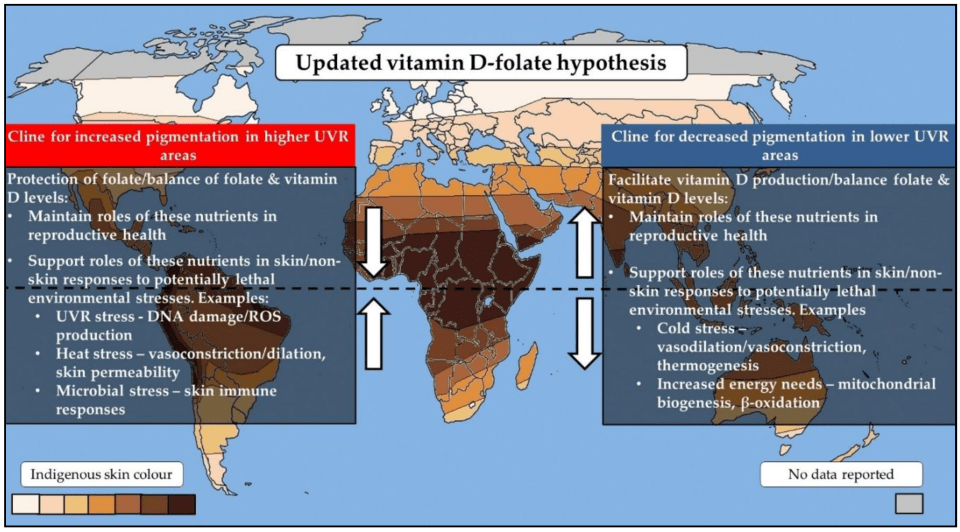
Jones et al (2018b) update the VDH by integrating the other theories into it, since they are similar and do not contradict the VDH (since aspects of each one can be used to explain different aspects of the VDH). The updated hypothesis is thus:
Vitamin D and folate have differing sensitivities to UVR. Vitamin D can be synthesized following UVR exposure, folate may be degraded. So the VDH proposes that the two differing skin colors (light and dark) evolved at differing latitudes as a “balancing mechanism” to maintain adequate levels of the two agents vitamin D and folate. Since adequate levels of vitamin D and folate were maintained, there would be no ill health effects after migrating into colder climates. Vitamin D and folate both act as photoprotectors of the skin and can decrease environmental stressors. Vitamin D also exerts important effects on adipocites—both types—which then further aid in human physiologic adaptations to the cold. Perhaps most importantly, the VDR and skin color genes are epistatic—the VDR is imperative in the human body’s adaptation to new climates.
The latest research (reviewed by Jones et al, 2018b) show strong support for the interaction between genes and folate/vitamin D processes with skin pigmentation and UVR.
Health Disparities
Health disparities due to vitamin D deficiency are well-noted in the literature. Human migrations over the recent centuries and decades have caused environmental mismatches between a population’s adapted skin type and current UV level in the location the population migrated to. Many darkly-pigmented people now live in areas with low UVR, and thusly suffer from health consequences. This leads to them either not having an adequate vitamin D-folate balance along with the risk of not having the adequate skin protections for a given environment, since UV rays influence folate and vitamin D production and so, a mismatched skin color to UV environment would cause problems for skin protection since the environment is not ancestral to that certain skin color.
As I have previously noted, it has been argued that blacks are not vitamin D deficient, and thusly not vitamin D deficient. Though, these claims rest on a slew of false arguments that have since been rebutted. It has been argued that since blacks are deficient in vitamin D, which begins in the womb, and vitamin D deficiencies cause changes in large and small arteries and arterials, that vitamin D deficiency could be the cause of higher rates of hypertension in black Americans (Rostand, 2010).
Conclusion
The role of vitamin D, folate, the VDR, and certain genes is under further invesitgation. This group of agents exert powerful effects on human physiology which then help with the adaptation of humans to differing climates. Folate and the vitamin D receptor play a crucial role in protecting the skin from environmental and microbial stressors. Vitamin D and the VDR are expressed in the adipose tissue, while vitamin D regulates adipogenesis and adipocite apoptosis (Abbas, 2017). Further evidence shows that there are multiple loci that are involved in the VDR that show latitudinal clines (Tiosano et al, 2016). One of the most things that lends credence to the VDH is the fact that the VDR and skin color genes are epistatic and help humans adapt to climates.
The VDH is in great shape, contrary to popular belief (Elias, Williams, and Bikle, 2016). The VDH is one of the only games in town to explain the skin color gradient noticed around the world, with vitamin D being the only agent that accounts for skin color differences. The VDH explains how and why human skin color is vastly different, and the main reason is adaptation to UV rays—or lack thereof.
Grant (2018) concludes that:
The UVB–vitamin D–cancer hypothesis has considerable supporting scientific evidence from a variety of study types: geographical ecological, observational, and laboratory studies of mechanisms, as well as several clinical trials.
Clearly, the VDH explains the incidence of the observed skin gradiation around the world the best out of the so-called competing hypotheses (which are similar enough to the VDH to where they can be absorbed into the VDH). Most importantly, the VDH predicted a novel fact—that molecular genetic evidence would show that light skin evolved independently numerous times in our lineage (Jablonksi and Chaplin, 2009).
Cold Winter Theory, the Vitamin D Hypothesis and the Prediction of Novel Facts
2400 words
HBDers purport that as one moves further north from Africa that IQ raises as a function of how the population in question needed to survive. The explanation is that as our species migrated out of Africa, more “intelligence” was needed and this is what explains the current IQ disparities across the world: the ancestors of populations evolving in different areas with different demands then changed their “IQs” and this then is responsible for differential national development between nations. Cold winter theory (CWT) explains these disparities.
On the other hand is the vitamin D hypothesis (VDH). The VDH purports to explain why populations have light skin at northern latitudes. As the migration north out of Africa occurred, peoples needed to get progressively lighter in order to synthesize vitamin D. The observation here is that as light skin is selected for in locations where UVB is absent, seasonal or more variable whereas dark skin is selected for where UVB is stronger. So we have two hypotheses: but there is a problem. Only one of these hypotheses makes novel predictions. Predictions of novel predictions are what science truly is. A predicted fact is a novel fact for a hypothesis if it wasn’t used in the construction of the hypothesis (Musgrave, 1988). In this article, I will cover both the CWT and VDH, predictions of facts that each made (or didn’t make) and which can be called “science”.
Cold winter theory
The cold winter theory, formulated by Lynn and Rushton, purports to give an evolutionary explanation for differences in national IQs: certain populations evolved in areas with deathly cold winters in the north, while those who lived in tropical climes had, in comparison to those who evolved in the north, an “easier time to live”. Over time as populations adapted to their environments, differences in ‘intelligence’ (whatever that is) evolved due to the different demands of each environment, or so the HBDers say.
Put simply, the CWT states that IQ differences exist due to different evolutionary pressures. Since our species migrated into cold, novel environments, this was the selective pressure needed for higher levels of ‘intelligence’. On the other hand, humans who remained in Africa and other tropical locations did experience these novel, cold environments and so their ‘intelligence’ stayed at around the same level as it was 70,000 years ago. Many authors hold this theory, including Rushton (1997), Lynn (2006), Hart, (2007) Kanazawa (2008), Rushton and Templer (2012; see my thoughts on their hypothesis here) and Wade (2014). Lynn (2013) even spoke of a “widespreadonsensus” on the CWT, writing:
“There is widespread consensus on this thesis, e.g. Kanazawa (2008), Lynn (1991, 2006), and Templer and Arikawa (2006).”
So this “consensus” seems to be a group of his friends and his own publications. We can change this sentence to ““There is widespread consensus on this thesis, including two of my publications, a paper where the author assumes that the earth is flat: “First, Kanazawa’s (2008) computations of geographic distance used Pythagoras’ theorem and so the paper assumed that the earth is flat (Gelade, 2008).” (Wicherts et al, 2012) and another publication where the authors assume hot weather leads to lower intelligence. Oh yea, they’re all PF members. Weird.” That Lynn (2013) calls this “consensus” is a joke.
What caused higher levels of ‘intelligence’ in those that migrated out of Africa? Well, according to those who push the CWT, finding food and shelter. Kanazawa, Lynn, and Rushton all argue that finding food, making shelter and hunting animals were all harder in Eurasia than in Africa.
One explanation for high IQs of people who evolved recently in northern climes is their brain size. Lynn (2006: 139) cites data showing the average brain sizes of populations, along with the temperatures in that location:
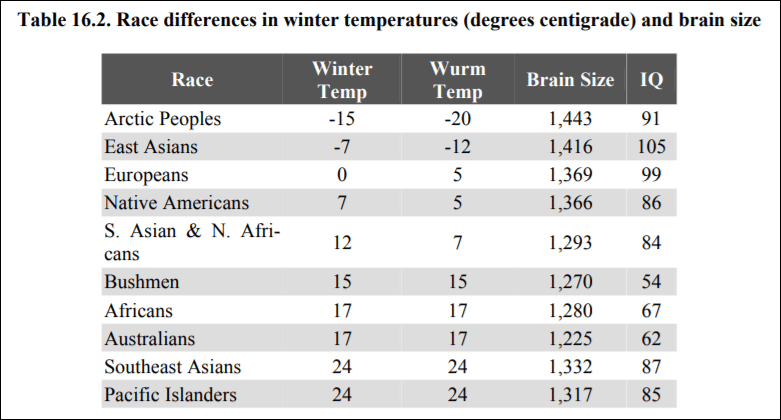
Do note the anomaly with the Arctic peoples. To explain this away in an ad-hoc manner, Lynn (2006: 156-7) writes:
These severe winters would be expected to have acted as a strong selection for increased intelligence, but this evidently failed to occur because their IQ is only 91. The explanation for this must lie in the small numbers of the Arctic Peoples whose population at the end of the twentieth century was only approximately 56,000 as compared with approximately 1.4 billion East Asians.
This is completely ad-hoc. There is no independent verifier for the claim. That the Arcitic don’t have the highest IQs but experienced the harshest temperatures and therefore have the biggest brain size is a huge anomaly, which Lynn (2006) attempts to explain away by population size.
He does not explain why natural selection among Arctic peoples would result in larger brain sizes or enhanced visual memory yet the same evolutionary pressures associated with a cold environment would not also produce higher intelligence. Arctic peoples have clear physical adaptations to the cold, such as short, stocky bodies well-suited to conserving heat.
Furthermore, the argument that Lynn attempts is on the mutations/population size is special pleading—he is ignoring anomalies in his theory that don’t fit it. However, “evolution is not necessary for temperature and IQ to co-vary across geographic space” (Pesta and Poznanski, 2014).
If high ‘intelligence’ is supposedly an adaptation to cold temperatures, then what is the observation that disconfirms a byproduct hypothesis? On the other hand, if ‘intelligence’ is a byproduct, which observation would disconfirm an adaptationist hypothesis? No possible observation can confirm or disconfirm either hypothesis, therefore they are just-so stories. Since a byproduct explanation would explain the same phenomena since byproducts are also inherited, then just saying that ‘intelligence’ is a byproduct of, say, needing larger heads to dissipate heat (Lieberman, 2015). One can make any story they want to fit the data, but if there is no prediction of novel facts then how useful is the hypothesis if it explains the data it purports to explain and only the data it purports to explain?
It is indeed possible to argue that hotter climates need higher levels of intelligence than colder climates, which has been argued in the past (see Anderson, 1991; Graves, 2002; Sternberg, Grigorenko, and Kidd, 2005). Indeed, Sternberg, Grigorenko, and Kidd (2005: 50) write: “post hoc evolutionary arguments … can have the character of ad hoc “just so” stories designed to support, in retrospect, whatever point the author wishes to make about present-day people.” One can think up any “just-so” story to explain any data. But if the “just-so” story doesn’t make any risky predictions of novel facts, then it’s not science, but pseudoscience.
Vitamin D hypothesis
The VDH is simple: those populations that evolved in areas with seasonal, absent, or more variable levels of UVB have lighter skin than populations that evolved in areas with strong UVB levels year-round (Chaplan and Jablonksi, 2009: 458). Robins (2009) is a huge critic of the VDH, though her objections to the VDH have been answered (and will be discussed below).
The VDH is similar to the CWT in that it postulates that the adaptations in question only arose due to migrations out of our ancestral lands. We can see a very strong relationship between high UVB rays and dark skin and conversely with low UVB rays and light skin. Like with the CWT, the VDH has an anomaly and, coincidentally, the anomaly has to do with the same population involved in the CWT anomaly.
Arctic people have dark-ish skin for living in the climate that they do. But since they live in very cold climates then we have a strange anomaly here that needs explaining. We only need to look at the environment around them. They are surrounded by ice. Ice reflects UVB rays. UVB rays hit the skin. Arctic people consume a diet high in vitamin D (from fish). Therefore what explains Arctic skin color is UVB rays bouncing off the ice along with their high vitamin D diet. The sun’s rays are, actually, more dangerous in the snow than on the beach, with UVB rays being 2.5 more times dangerous in the snow than beach.
Evolution in different geographic locations over tens of thousands of years caused skin color differences. Thus, we can expect that, if peoples are out of the conditions where their ancestors evolved their skin color, that there would then be expected complications. For example, if human skin pigmentation is an adaptation to UV rays (Jablonski and Chaplan, 2010), we should expect that, when populations are removed from their ancestral lands and are in new locations with differing levels of UV rays, that there would be a subsequent uptick in diseases caused by vitamin D deficiencies.
This is what we find. We find significant differences in circulating serum vitamin D levels, and these circulating serum vitamin D levels then predict health outcomes in certain populations. This would only be true if sunlight influenced vitamin D production and that skin progressively gets lighter as one moves away from Africa and other tropical locations.
Skin pigmentation regulates vitamin D production (Neer, 1975). This is due to the fact that when UVB rays strike the skin, we synthesize vitamin D, and the lighter one’s skin is, the more vitamin D can be synthesized in areas with fewer UVB rays. (Also see Daraghmeh et al, 2016 for more evidence for the vitamin D hypothesis.)
P1) UV rays generate vitamin D in human skin
P2) Human populations that migrate to climates with less sunlight get fewer UV rays
P3) To produce more vitamin D, the skin needs to get progressively lighter
C) Therefore, what explains human skin variation is climate and UV rays linked to vitamin D production in the skin.
Novel predictions
Science is the generation of novel facts from risky predictions (Musgrave, 1988; Winther, 2009). And so, hypotheses that predict novel facts from risky predictions are scientific hypotheses, whereas those hypotheses that need to continuously backtrack and think up ad-hoc hypotheses are then pseudoscientific. Pseudoscience is simple enough to define. The Stanford Encyclopedia of Philosophy defines it as:
“A pretended or spurious science; a collection of related beliefs about the world mistakenly regarded as being based on scientific method or as having the status that scientific truths now have.”
All theories have a protective belt of ad hoc hypotheses. Theories become pseudoscientific when they fail to make new predictions and must take on more and more ad-hoc hypotheses that have no predictive value. If the ad-hoc hypotheses that are added to the main hypothesis have no predictive value then the new explanations for whichever hypothesis that is in danger of being falsified are just used to save the hypothesis from being refuted and it thus becomes pseudoscience.
In the case of CWT, it makes no prediction of novel facts; it only explains the data that it purports to explain. What is so great about the CWT if it makes no predictions of novel facts and only explains what it purports to explain? One may attempt to argue that it has made some ‘novel’ predictions but the ‘predictions’ that are proposed are not risky at all.
For example, Hart (2007: 417) makes a few “predictions”, but whether or not they’re “risky” or “novel” I’ll let you decide (I think they’re neither, of course). He writes that very few accomplishments will be made by Africans, or Australian or New Guinean Aborigines; members of those groups will not be highly represented in chess; and that major advances in scientific fields will come from those of European ancestry or the “Monglids”, Koreans, Chinese or Japanese.
On the other hand, Hart (2007: 417) makes two more “predictions”: he says that IQ data for Congoid Pygmies, Andaman Islanders, and Bantu-speaking people are few and far between and he believes that when enough IQ testing is undertaken there he expects IQ values between 60 and 85. Conversely, for the Lapps, Siberians, Eskimoes, Mongols and Tibetans, he predicts that IQ values should be between 85-105. He then states that if these “predictions” turn out to be wrong then he would have to admit that his hypothesis is wrong. But the thing is, he chose “predictions” that he knew would come to pass and therefore these are not novel, risky predictions but are predictions that Hart (2007) knows would come to pass.
What novel predictions has the VDH made? This is very simple. The convergent evolution of light skin was predicted in all hominids that trekked out of Africa and into colder lands. This occurred “because of the importance of maintaining the potential for producing pre-vitamin D3 in the skin under conditions of low annual UVB (Jablonski and Chaplin, 2000; Jablonski, 2004)” while these predictions “have been borne out by recent genetic studies, which have demonstrated that depigmented skin evolved independently by different molecular mechanisms multiple times in the history of the human lineage” (Chaplan and Jablonksi, 2009: 452). This was successfully predicted by Chaplan and Jablonski (2000).
The VDH still holds explanatory scope and predictive success; no other agent other than vitamin D can explain the observation that light skin is selected for in areas where there is low, absent or seasonal UVB. Conversely, in areas where there is a strong, year-round presence of UVB rays, dark skin is selected for.
Conclusion
Scientific hypotheses predict novel facts not known before the formulation of the hypothesis. The VDT has successfully predicted novel facts, whereas I am at a loss thinking of a novel fact that the CWT predicted.
In order to push an adaptationist hypothesis for CWT and ‘intelligence’, one must propose an observation that would confirm the adaptationist hypothesis while at the same time disconfirming the byproduct hypothesis. Since byproducts are inherited to, the byproduct hypothesis would predict the same things that an adaptationist hypothesis would. Thus, the CWT is a just-so story since no observation would confirm or disconfirm either hypothesis. On the other hand, the CWT doesn’t make predictions of novel facts, it makes “predictions” that are already known and would not undermine the hypothesis if disproved (but there would always be a proponent of the CWT waiting in the wings to propose an ad-hoc hypothesis in order to save the CWT, but I have already established that it isn’t science).
On the other hand, the VDT has successfully predicted that hominins that trekked out of Africa would have light skin which was then subsequently confirmed by genomic evidence. The fact that strong UVB rays year-round predict dark skin whereas seasonal, absent, or low levels of UVB predict light skin has been proved to be true. With the advent of genomic testing, it has been shown that hominids that migrated out of Africa did indeed have lighter skin. This is independent verification for the VDH; the VDH has predicted a novel fact whereas the CWT has not.
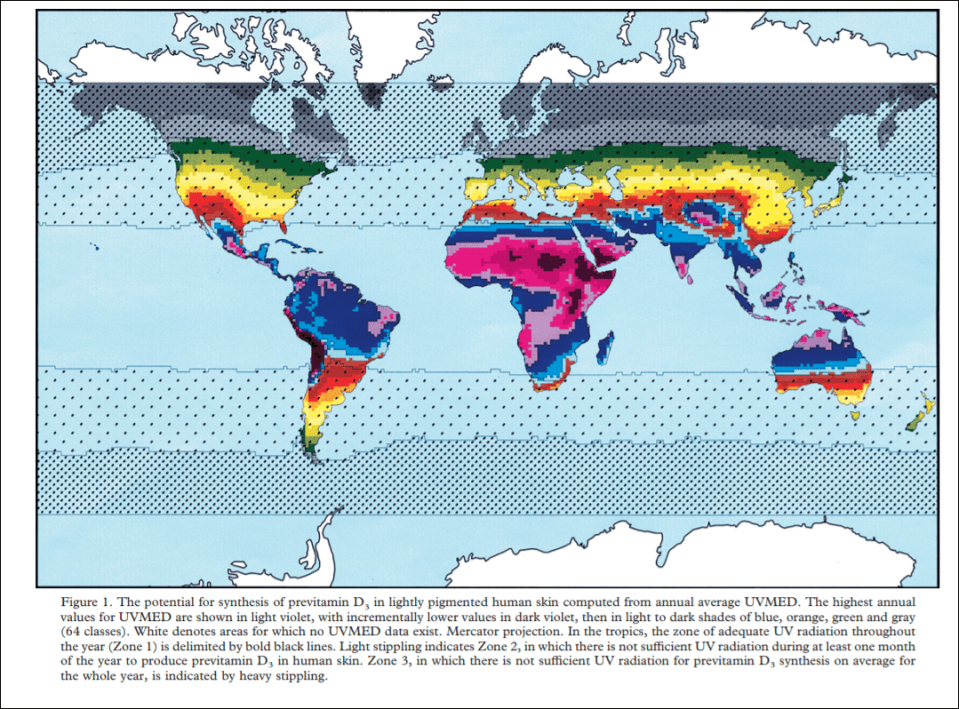
Race Differences in Penis Size Revisited: Is Rushton’s r/K Theory of Race Differences in Penis Length Confirmed?
2050 words
In 1985 JP Rushton, psychology professor at the University of Ontario, published a paper arguing that r/K selection theory (which he termed Differential K theory) explained and predicted outcomes of what he termed the three main races of humanity—Mongoloids, Negroids and Caucasoids (Rushton, 1985; 1997). Since Rushton’s three races differed on a whole suite of traits, he reasoned races that were more K-selected (Caucasoids and Mongoloids) had slower reproduction times, higher time preference, higher IQ etc in comparison to the more r-selected Negroids who had faster reproduction times, lower time preference, lower IQ etc (see Rushton, 1997 for a review; also see Van Lange, Rinderu, and Bushmen, 2017 for a replication of Rushton’s data not theory). Were Rushton’s assertions on race and penis size verified and do they lend credence to his Differential-K claims regarding human races?
Rushton’s so-called r/K continuum has a whole suite of traits on it. Ranging from brain size to speed of maturation to reaction time and IQ, these data points supposedly lend credence to Rushton’s Differential-K theory of human differences. Penis size is, of course, important for Rushton’s theory due to what he’s said about it in interviews.
Rushton’s main reasoning for penis size differences between race is “You can’t have both”, and that if you have a larger brain then you must have a smaller penis; if you have a smaller penis you must have a larger brain. He believed there was a “tradeoff” between brain size and penis size. In the book Darwin’s Athletes: How Sport Has Damaged Black America and Preserved the Myth of Race, Hoberman (1997: 312) quotes Rushton: “Even if you take something like athletic ability or sexuality—not to reinforce stereotypes or some such thing—but, you know, it’s a trade-off: more brain or more penis. You can’t have both.” This, though, is false. There is no type of evidence to imply that this so-called ‘trade-off’ exists. In my readings of Rushton’s work over the years, that’s always something I’ve wondered: was Rushton implying that large penises take more energy to have and therefore the trade-off exists due to this supposed relationship?
Andrew Joyce of the Occidental Observer published an article the other day in defense of Richard Lynn. Near the end of his article he writes:
Another tactic is to belittle an entire area of research by picking out a particularly counter-intuitive example that the public can be depended on to regard as ridiculous. A good example is J. Philippe Rushton’s claim, based on data he compiled for his classic Race, Evolution and Behavior, that average penis size varied between races in accord with the predictions of r/K theory. This claim was held up to ridicule by the likes of Richard Lewontin and other crusaders against race realism, and it is regularly presented in articles hostile to the race realist perspective. Richard Lynn’s response, as always, was to gather more data—from 113 populations. And unsurprisingly for those who keep up with this area of research, he found that indeed the data confirmedRushton’s original claim.
The claim was ridiculed because it was ridiculous. This paper by Lynn (2013) titled Rushton’s r-K life history theory of race differences in penis length and circumference examined in 113 populations is the paper that supposedly verifies Rushton’s theory regarding race differences in penis size, along with one of its correlates in Rushton’s theory (testosterone). Lynn (2013) proclaims that East Asians are the most K-evolved, then come Europeans, while Africans are the least K-evolved. This, then, is the cause of the supposed racial differences in penis size.
Lynn (2013) begins by briefly discussing Rushton’s ‘findings’ on racial differences in penis size while also giving an overview of Rushton’s debunked r/K selection theory. He then discusses some of Rushton’s studies (which I will describe briefly below) along with stories from antiquity of the supposed larger penis size of African males.
Our old friend testosterone also makes an appearance in this paper. Lynn (2013: 262) writes:
Testosterone is a determinant of aggression (Book, Starzyk, & Quinsey, 2001; Brooks & Reddon, 1996; Dabbs, 2000). Hence, a reduction of aggression and sexual competitiveness between men in the colder climates would have been achieved by a reduction of testosterone, entailing the race differences in testosterone (Negroids > Caucasoids > Mongoloids) that are given in Lynn (1990). The reduction of testosterone had the effect of reducing penis length, for which evidence is given by Widodsky and Greene (1940).
Phew, there’s a lot to unpack here. (I discuss Lynn 1990 in this article.) Testosterone does not determine aggression; see my most recent article on testosterone (aggression increases testosterone; testosterone does not increase aggression. Book, Starzyk and Quinsey, 2001 show a .14 correlation between testosterone and aggression, whereas Archer, Graham-Kevan, and Davies 2005 show the correlation is .08). This is just a correlation. Sapolsky (1997: 113) writes:
Okay, suppose you note a correlation between levels of aggression and levels of testosterone among these normal males. This could be because (a) testosterone elevates aggression; (b) aggression elevates testosterone secretion; (c) neither causes the other. There’s a huge bias to assume option a while b is the answer. Study after study has shown that when you examine testosterone when males are first placed together in the social group, testosterone levels predict nothing about who is going to be aggressive. The subsequent behavioral differences drive the hormonal changes, not the other way around.
Brooks and Reddon (1996) also only show relationships with testosterone and aggressive acts; they show no causation. This same relationship was noted by Dabbs (2000; another Lynn 2013 citation) in prisoners. More violent prisoners were seen to have higher testosterone, but there is a caveat here too: being aggressive stimulates testosterone production so of course they had higher levels of testosterone; this is not evidence for testosterone causing aggression.
Another problem with that paragraph quoted from Lynn (2013) is that it’s a just-so story. It’s an ad-hoc explanation. You notice something with data you have today and then you imagine a nice-sounding story to attempt to explain your data in an evolutionary context. Nice-sounding stories are cool and all and I’m sure everyone loves a nicely told story, but when it comes to evolutionary theory I’d like theories that can be independently verified of the data they’re trying to explain.
My last problem with that paragraph from Lynn (2013) is his final citation: he cites it as evidence that the reduction of testosterone affects penis length…..but his citation (Widodsky and Green, 1940) is a study on rats… While these studies can give us a wealth of information regarding our physiologic systems (at least showing us which types of avenues to pursue; see my previous article on myostatin), they don’t really mean anything for humans; especially this study on the application of testosterone to the penis of a rat. See, the fatal flaw in these assertions is this: would a, say, 5 percent difference in testosterone lead to a larger penis as if there is a dose-response relationship between testosterone and penis length? It doesn’t make any sense.
Lynn (2013), though, says that Rushton’s theory doesn’t propose that there is a direct causal relationship between “intelligence”‘ and penis length, but just that they co-evolved together, with testosterone reduction occurring when Homo sapiens migrated north out of Africa they needed to cooperate more so selection for lower levels of testosterone subsequently occurred which then shrunk the penises of Rushton’s Caucasian and Mongoloid races.
Lynn (2013) then discusses two “new datasets”, one of which is apparently in Donald Templer’s book Is Size Important (which is on my to-read list, so many books, so little time). Table 1 below is from Lynn reproducing Templer’s ‘work’ in his book.
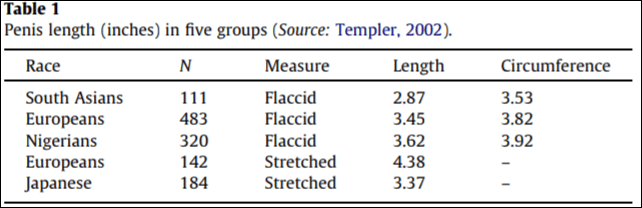
The second “dataset” is extremely dubious. Lynn (2013) attempts to dress it up, writing that “The information in this website has been collated from data obtained by research centres and reports worldwide.” Ethnicmuse has a good article on the pitfalls of Lynn’s (2013) article. (Also read Scott McGreal’s rebuttal.)
Rushton attempted to link race and penis size for 30 years. In a paper with Bogaert (Rushton and Bogaert, 1987), they attempt to show that blacks had larger penises than whites who h ad longer penises than Asians which then supposedly verified one dimension of Rushton’s theory. Rushton (1988) also discusses race differences in penis size, citing a previous paper by Rushton and Bogaert, where they use data from Alfred Kinsey, but this data is nonrepresentative and nonrandom (see Zuckermann and Brody, 1988 and Weizmann et al, 1990: 8).
Still others may attempt to use supposed differences in IGF-1 (insulin-like growth factor 1) as evidence that there is, at least, physiological evidence for the claim that black men have larger penises than white men, though I discussed that back in December of 2016 and found it strongly lacking.
Rushton (1997: 182) shows a table of racial differences in penis size which was supposedly collected by the WHO (World Health Organization). Though a closer look shows this is not true. Ethnicmuse writes:
ANALYSIS: The WHO did not study penis sizes. It relied on three separate studies, two of which were not peer-reviewed and the data was included as “Appendix III” (which should have alerted Rushton that this was not an original study). The first study references Africans in the US (not Africa!) and Europeans in the US (not Europe!), the second Europeans in Australia (not Europe!) and the third, Thais.
So it seems to be bullshit all the way down.
Ajmani et al (1985) showed that 385 healthy Nigerians had an average penile length of 3.21 inches (flaccid). Orakwe and Ebuh (2007) show that while Nigerians had longer penises than other ethnies tested, the only statistical difference was between them and Koreans. Though Veale et al (2014: 983) write that “There are no indications of differences in racial variability in our present study, e.g. the study from Nigeria was not a positive outlier.”
Lynn and Dutton have attempted to use androgen differentials between the races as evidence for racial differences in penis size (this is another attempt at a physiological argument to attempt to show the existence of racial differences in penis size). Edward Dutton attempted to revive the debate on racial differences in penis size during a 2015 presentation where he, again, showed that Negroids have higher levels of testosterone than Caucasoids who have higher levels of androgens than Mongoloids. These claims, though, have been rebutted by Scott McGreal who showed that populations differences in androgen levels are meaningless while they subsequently fail to validate Rushton and Lynn’s claims on racial differences in penis size.
Finally, it was reported the other day that condoms from China were too small in Zimbabwe, per Zimbabwe’s health minister. This led Kevin MacDonald to proclaim that this was “More corroboration of race differences in penis size which was part of the data Philippe Rushton used in his theory of r/K selection (along with brain size, maturation rates, IQ, etc.)” This isn’t “more corroboration” for Rushton’s long-dead theory; nor is this evidence that blacks have longer penises. I don’t understand why people make broad and sweeping generalizations. It’s one country in Africa that complained about smaller condoms from a country in East Asia, therefore this is more corroboration for Rushton’s r/K selection theory? The logic doesn’t follow.
Asians have small condoms. Those condoms go to Africa. They complain condoms from China are too small. Therefore Rushton’s r/K selection theory is corroborated. Flawed logic.
In sum, Lynn (2013) didn’t verify Rushton’s theory regarding racial differences in penis size and I find it even funnier that Lynn ends his article talking about “falsification’ stating that this aspect of Rushton’s theory has survived two attempts at falsification, therefore, it can be regarded as a “progressive research program“, though obviously, with the highly flawed “data” that was used, one cannot rationally make that statement. Supposed hormonal differences between the races do not cause penis size differences; even if blacks had levels of testosterone significantly higher than whites (the 19 percent that is claimed by Lynn and Rushton off of one highly flawed study in Ross et al, 1986) they still would not have longer penises.
The study of physical differences between populations is important, but sometimes, stereotypes do not tell you anything, especially in this case. Though in this instance, the claim that blacks have the longest penis lies on shaky ground, and with what evidence we do have for the claim, we cannot logically make the inference (especially not from Lynn’s (2013) flimsy data). Richard Lynn did not “confirm” anything with this paper; the only thing he “confirmed” are his own preconceived notions; he did not ‘prove’ what he set out to.
Happy Darwin Day: The Modern Synthesis Has Causation in Biology Wrong
2800 words
The first Darwin Day I started writing just for this day, I wrote about (and defended Darwin’s words) how both Creationists and evolutionists who are themselves evolutionary progressionists twist Darwin’s words for their own gain. Darwin never wrote in The Descent of Man that the ‘higher races’ would take out ‘the lower races’, but that doesn’t stop Creationists and evolutionists—who I presume have not read one sentence in Darwin’s words from one of his books—from taking what Darwin meant out of context and attributing to him beliefs he does not hold. This year, though, I am going in a different direction. The Modern Synthesis (MS) has causation in biology wrong. The MS upholds the ‘gene’ as one of the highest seats in evolutionary biology, with a sort of ‘power’ to direct. Though, as I will show, genes do nothing unless transcribed by the system. Since the MS has causation in biology wrong, then we either need to extend or replace the MS.
To begin, Darwin, without knowledge of genes or other hypothesized units of inheritance, had a theory of inheritance in which things called ‘gemmules’ (what Darwin called heritable molecules) were transmitted to offspring (Choi and Mango, 2014). It’s ironic, because Darwin’s theory of inheritance was one of the more Lamarckian theories of inheritance in his day, and Darwin himself sympathized with the Lamarckian view of evolution—he most definitely did not discard it like modern-day Darwinists do. Darwin suggested that these gemmules circulated in the body and that some were used for the regeneration of some bodily tissues, but most aggregated in the reproductive organs (Jablonka and Lamb, 2015: 23). Further, according to Darwin, gemmules were not always immediately used but could reappear later in life or even be used in future generations. Darwin even said that “inheritance must be looked at as a form of growth” (Darwin, 1883, vol 2, p. 398; quoted by Jablonka and Lamb, 2015: 24).
The crux of the MS is the selfish gene theory of Dawkins (1976). Dawkins (1976, 2006) writing “They are in you and me; they created us, body and mind; and their preservation is the ultimate rationale for our existence.” “They”, of course, being genes. The gene has been given a sort of power that it does not have, but has been placed on it by overzealous people, quick to jump to conclusions while we still have yet to understand what ‘genes’ do. The MS—with the selfish gene theory—is at the forefront of the neo-Darwinist revolution, that evolution is gene-centered, with genes playing the starring role in the evolutionary story.
Though, numerous researchers are against such simplistic and reductionist viewpoints of evolution, mainly the gene-centered view of evolution pushed by the MS. There is no privileged level of causation in biology (though I will state later in this article that I think ATP comes close to it) (Noble, 2016).
Neo-Darwinists, like Richard Dawkins, overstate natural selection’s importance regarding evolution. They elevate the gene’s overall importance. In the quote from Dawkins above, where he stated that “they” (genes) “created us, body and mind”, he is implying that genes are a sort of ‘blueprint’, like a ‘plan’ or ‘recipe’ for the form of the organism. But this was taken care of by Susan Oyama in her 1985 book The Ontogeny of Information where she writes on pages 77:
“Though a plan implies action, it does not itself act, so if the genes are a blueprint, something else is the constructor-construction worker. Though blueprints are usually contrasted with building materials, the genes are quite easily conceptualized as templates for building tools and materials; once so utilized, of course, they enter the developmental process and influence its course. The point of the blueprint analogy, though, does not seem to be to illuminate developmental processes, but rather to assume them and, in celebrating their regularity, to impute cognitive functions to genes. How these functions are exercised is left unclear in this type of metaphor, except that the genetic plan is seen in some peculiar way to carry itself out, generating all the necessary steps in the necessary sequence. No light is shed on multiple developmental possibilities, species-typical or atypical.“
The genes-as-blueprints canard is one that is heavily used by proponents of the MS. Oyama also writes on page 53 “Just as traditional thought placed biological forms in the mind of God, so modern thought finds many ways of endowing the genes with ultimate formative power, a power bestowed by Nature over countless millennia.” This same sentiment from Oyama is also echoed by developmental systems theorist and psychologist David Moore in his book The Dependent Gene: The Fallacy of “Nature VS. nurture”, where he writes:
Such contextual dependence renders untenable the simplistic belief that there are coherent, long-lived entities called “genes” that dictate instructions to cellular machinery that merely constructs the body accordingly. The common belief that genes contain context-independent “information”—and so are analogous to “blueprints” or “recipes”—is simply false. (p. 81) (Quoted from Schneider, 2007)
Environmental factors are imperative in determining which protein-coding exons get read from a cistron, when and how often. So the very concept of a gene depends on the environment and environmental inputs, and thusly gene ABC does not code for trait T on its own.
When it comes to epigenetics (defined here as inherited changes in gene expression with no genetic change to the genome), this completely changes how we view evolution.
The underlying nucleotide sequence stays the same but differences are inherited due to environmental stressors. I’ve stated in the past that these inherited marks on the genome (through histone modification, DNA methylation, which then alter the chromatin structure of the DNA. Further, this would show up on heritability estimates as ‘genetic’ when the ’cause’ was ‘environmental’ in nature (which is also yet another reason that heritability estimates are inflated).
DNA methylation, histone modification and noncoding RNA all can affect the structure of chromatin. As of now, the mechanisms of mitotic inheritance aren’t too well known, but advances in the field are coming.
If you want to talk the P and F1 generations regarding transgenerational epigenetics, then you must realize that these changes do not occur on the genome, the genome remains the same, just certain genes are expressed differently (as I’m sure you know). Though mi-MRNA signals can change the DNA methylation patterns in the F2 sperm which then is replicated in meiotic and mitotic cycles (Trerotola et al, 2015).
For another similar process on how DNA methylation persists, this (semiconservative) replication of DNA methylation occurs on both strands of the DNA which then become hemimethylated DNA which can then become fully methylated by methylase maintenance. So chromatin structure affects the genetic expression of the eukaryotic genome which then becomes the basis for epigenetic effects. Xist RNA also mediates the X-chromosome deactivation. This doesn’t even get into how and why the microbiome can also affect gene expression (which has also been called ‘the second genome’ (Zhu, Wang, and Li, 2010) with other authors calling it an ‘organ’ (Clarke et al, 2014; Brown and Hazen, 2015) this can also affect gene expression and heritable variation that becomes the target of selection (along with the other modes of selection) (Maurice, Haiser, and Turnbaug, 2014; Byrd and Segre, 2015). This shows that gene expression in the F2 and F3 generations is not so simple, and that other factors such as our gut microbiota can also affect gene expression and stressors experienced by parents and grandparents can also be passed to future generations, and may have a chance of becoming part of heritable variation that natural selection then acts on (Jablonka and Lamb, 2015).
The point of the debate with neo-Darwinists is over causation: do genes hold this ‘ultimate formative power’ as people like Dawkins contest? Or are genes nothing but ‘slaves’, passive, not active, causes as Denis Noble writes in his 2016 book Dance to the Tune of Life. (Noble, 2008 discusses genes and causation, again showing that there is no true causation, but getting technical, ATP is up there in the ‘chain’, if you want to get literal. The point is that genes do not have the ‘power’ that the neo-Darwinists think they do, they’re just slaves for the intelligent physiological system.)
When discovering the structure of DNA, Francis Crick famously announced to his drinking companions in a Cambridge tavern that he had discovered ‘the secret of life’. The director of his Institute, Max Perutz, was rather more careful than Crick when he said that DNA was the ‘score of life’. That is more correct since a musical score does nothing until it is played, DNA does nothing until activated to do so.
[…]
Recent experimental work in biological science has deconstructed the idea of a gene, and an important message of this book is that it has thereby drthroned the gene as a uniquely privileged level of causation. As we will see, genes, defined as DNA sequences, are indeed essential, but not in the way in which they are often portrayed. (Noble, 2016: 53)
A 2017 paper titled Was the Watchmaker Blind? Or Was She One-Eyed?, Noble and Noble (2017) write that organisms and their interacting populations have evolved mechanisms so that they can harness blind stochasticity, thereby generating functional changes to the phenotype as to better respond to environmental challenges. They put forth a good argument, though it really makes me think because I’ve been such a staunch critic against evolution having a ‘direction’ and against the ‘teleological view’ of evolution: “If organisms have agency and, within obvious limits, can choose their lifestyles, and if these lifestyles result in inheritable epigenetic changes, then it follows that organisms can at least partially make choices that can have long-term evolutionary impact.”
Noble and Noble (2017) argue (using Dawkins’ analogy of the Blind Watchmaker) that humans are the only Watchmakers that we know of. Humans evolved from other organisms. The ability to become a Watchmaker has evolved. Ergo, there is no surprise that there is directed agency for other organisms that directs their evolution too. There are several processes, they conclude, that could account for directed evolutionary change which are “targeted mutation, gene transposition, epigenetics, cultural change, niche construction and adaptation” (Noble and Noble, 2017). Niche construction, for instance, is heavily pushed by Kevin Laland, author of the book Darwin’s Unfinished Symphony: How Culture Made the Human Mind who has a few papers and featured it heavily in his new book. Either way, these ways in which organisms can in a way direct their own evolution are not covered by the MS.
Though I couldn’t end this article without, of course, discussing Jerry Coyne who goes absolutely crazy at people pushing to either extend or replace the MS. His most recent article is about Kevin Laland and how he is “at it again” touting “a radically different view of evolution”. It seems as Coyne has made up his mind and that the MS is all there is—he believes it is no problem for our current understanding of evolutionary theory to absorb things such as niche construction, epigenetic inheritance, stochasticity, and even (way more controversially) directed mutations. Coyne has also criticized Noble’s attacks on the MS, though Noble came back and responded to Coyne during a video presentation.
Lastly, Portin and Wilkins (2017) review the history of the gene, and go through different definitions it has been given over the decades. They conclude in this paper that they “will propose a definition that we believe comes closer to doing justice to the idea of the “gene,”
in light of current knowledge. It makes no reference to “the unit of heredity”—the long-standing sense of the term—because we feel that it is now clear that no such generic universal unit exists.” Writing on page 1361-1362:
A gene is a DNA sequence (whose component segments do not necessarily need to be physically contiguous) that specifies one or more sequence-related RNAs/proteins that are both evoked by GRNs and participate as elements in GRNs, often with indirect effects, or as outputs of GRNs, the latter yielding more direct phenotypic effects. [GRNs are genetic regulatory networks]
This is similar to what Jablonka and Lamb (2015: 17) write:
Although many psychiatrists, biochemists, and other scientists who are not geneticists (yet express themselves with remarkable facility on genetic issues) still use the language of genes as simple causal agents, and promise their audience rapid solutions to all sorts of problems, they are no more than propagandists whose knowledge or motives must be suspect. The geneticists themselves now think and talk (most of the time) in terms of genetic networks composed of tens or hundreds of genes and gene products, which interact with each other and together affect the development of a particular trait. They recognize that whether or not a trait (a sexual preference, for example) develops does not depend, in the majority of cases, on a difference in a single gene. It involves interactions among many genes, many proteins and other types of molecule, and the environment in which an individual develops.
The gene as an active causal actor has been definitively refuted. Genes on their own do nothing at all, until they are transcribed by the intelligent physiological system. Noble likens genes as slaves that are used by the system to carry out processes by and for the system. So genes are caused to give their information by and to the system that activates them (Noble, 2011). Noble’s slave metaphor makes much more sense than Dawkins’ selfish metaphor, since genes are used like slaves by the system, the genes are then caused to give their information by and to the system that activates them, which shows how they are a passive, not active, cause, completely upending the MS and how it views causation in biology. Indeed, Jablonka and Lamb state that one of their problems with Dawkins is that “Dawkins assumes that the gene is the only biological (noncultural) hereditary unit. This simply is not true. There are additional biological inheritance systems, which he does not consider, and these have properties different from those we see in the genetic system. In these systems his distinction between replicator and vehicle is not valid.”
So, both Gould and Dawkins overlooked the inheritance of acquired characters, as Jablonka and Lamb write in their book. They argue that inherited variation had a large effect on the evolution of species, but admit that evidence for the view is scant. They write on page 145 “If you accept that heritable epigenetic variation is possible, self-evidently some of the variants will have an advantage relative to other variants. Even if all epigenetic variations were blind, this would happen, and it’s very much more likely if we accept that a lot of them are induced and directed.” Not everything that is inherited is genetic.
DNA is found in the cell, and what powers the cell? ATP (adenosine triphosphate). Cells use and store ATP to carry out their functions (Khakh and Burnstock, 2016). Cells produce ATP from ADP and Pi. Cells use exergonic reactions to provide the energy needed to synthesize ATP from ADP and Pi. The hydrolysis of ATP provides the energy needed to drive endergonic actions.So the cells continuously produced more ATP from ADP and Pi to then carry out diverse functionings across the body. So, in a way, you can argue that one of the ultimate causes is ATP since it has to power the cell, then you can look at all of the other reactions that occur before ATP is created and privilege that part of the chain, but there will never be some ultimate causation, since, as Noble argues in his book Dance to the Tune of Life, there is no privileged causation in biology.
In conclusion, evolution, development, and life, in general, is extremely complex. Paradigms like the selfish gene—a largely reductionist paradigm—do not account for numerous other factors that drive the evolution of species, such as targeted mutation, niche construction etc. An extended evolutionary synthesis that integrates these phenomena will better be able to describe what occurs to drive the evolution of species, and if the directed mutation idea has any weight, then it will be interesting to see how and why certain organisms have evolved this ability. It’s ironic how the MS is being defended as if it is infallible—like it can do no wrong and that it does not need to be added to/extended or replaced by something else that incorporates the phenomena brought up in this article.
Either way, a revolution in modern biology is coming, and Darwin would have it no other way. The Modern Synthesis has causation in biology wrong: the gene is not an active agent in evolution, it only does what it is told by the intelligent physiological system, and so we must look at whole organisms and not reduce organisms down to genes, but we must look at the whole organism—a holistic view of the organism, not one that is reduced down to just ‘the genes’, because there is no privileged level of causation in biology (Noble, 2016).
Race/Ethnicity and the Microbiome
1800 words
The microbiome is the number and types of different microorganisms and viruses in the human body. Racial differences are seen everywhere, most notably in the phenotype and morphology. Though, of course, there are unseen racial differences that then effect bodily processes of different races and ethnic groups. The microbiome is one such difference, which is highly heritable (Goodrich et al, 2014; Beaumont et al, 2016; Hall, Tolonen, and Xavier, 2017) (though they use the highly flawed twin method, so heritabilities are most likely substantially lower). They also show that certain genetic variants predispose individuals to microbial dysbiosis. However, diet, antibiotics and birth mode can also influence the diversity of microbiota in your biome (Conlon and Bird, 2015; Bokulich et al, 2017; Singh et al, 2017) and so while the heritability of the microbiome is important (which is probably inflated due to the twin method), diet can and does change the diversity of the biome.
It used to be thought that our bodies contained 90 percent bacteria and only 10 percent human cells (Collen, 2014), however that has been recently debunked and the ratio is 1.3 to 1, human to microbe (Sender, Fuchs, and Milo, 2016). (Collen’s book is still an outstanding introduction to this subject despite the title of her book being incorrect.) Though the 10:1 microbe/human cell dogma is debunked, in no way does that lessen the importance of the microbiome regarding health, disease and longevity.
Lloyd-Price, Abu-Ali, and Huttenhower (2016) review definitions for the ‘healthy human microbiome’ writing “several population-scale studies have documented the ranges and diversity of both taxonomic compositions and functional potentials normally observed in the microbiomes of healthy populations, along with possible driving factors such as geography, diet, and lifestyle.” Studies comparing the biomes of North and South America, Europe and Africa, Korea and Japan, and urban and rural communities in Russia and China have identified numerous different associations that are related to differences in the microbiome between continents that include (but are not limited to) diet, genetics, lifestyle, geography, and early life exposures though none of these factors have been shown to be directly causal regarding geographic microbiome diversity.
Gupta, Paul, and Dutta (2017) question the case of a universal definition of a ‘healthy microbiome’ since it varies by geographic ancestry. Of course, ancestry and geographic location influence culture which influences diet which influences microbiome diversity between populations. This, of course, makes sense. why have a universal healthy microbiome with a reference man that doesn’t reflect the diversity of both the individual and group differences in the microbiome? This will better help different populations with different microbiomes lose weight and better manage diseases in certain populations.
The microbiome of athletes also differs, too. Athletes had enhanced microbiome diversity when compared to non-athletes (Clarke et al, 2016). In a further follow-up study, it was found that microbial diversity correlated with both protein consumption and creatine kinase levels in the body (Clarke et al, 2017) are proxies for exercise, and since they’re all associations, causality remains to be untangled. Nevertheless, these papers are good evidence that both lifestyle and diet leads to changes in the microbiome.
Fortenberry (2013: 165) notes that American racial and ethnic classifications are “social and political in origin and represent little meaningful biologic basis of between-group racial/ ethnic diversity“. It is also known that eating habits, differing lifestyles and metabolic levels also influence the diversity of the microbiome in the three ‘races’* studied (Chen et al, 2016), while deep sequencing of oral microbiota has the ability to classify “African Americans with a 100% sensitivity and 74% specificity and Caucasians with a 50% sensitivity and 91% specificity” (Mason et al, 2014). The infant microbiome, furthermore, is influenced by maternal diet and breastfeeding as well as the infant’s diet (Stearns et al, 2017). This is why differences in race/ethnicity call into question the term of ‘healthy human microbiota’ (Gupta, Paul, and Dutta, 2017). These differences in the microbiome also lead to increased risk for colorectal cancer in black Americans (Goyal et al, 2016; Kinross, 2017).
Further, the healthy vagina “contains one of the most remarkably structured microbial ecosystems, with at least five reproducible community types, or “community state types” (Lloyd-Price, Abu-Ali, and Huttenhower 2016). The diversity of the microbiome in the vagina also varies by race. It was found that 80 percent of Asian women and 90 percent of white women harbored a microbiota species named Lactobacillus, whereas only about 60 percent of ‘Hispanics’ and blacks harbored this species. The pH level, too, varied by race with blacks and ‘Hispanics’ averaging 4.7 and 5.0 and Asians and whites averaging 4.4 and 4.2. So, clearly, since Asians and whites have similar vaginal pH levels, then it is no surprise that they have similar levels of vaginal Lactobacillus, whereas blacks and ‘Hispanics’, with similar pH levels have similar vaginal levels of Lactobacillus.
White subjects also have more diverse species of microbiota than non-white subjects while also having a different microbiota structure (Chen et al, 2015). Caucasian ethnicity/race was also shown to have a lower overall microbiome diversity, but higher Bacteroidetes scores, while white babes also had lower scores of Proteobacteria than black Americans (Sordillo et al, 2017). This comes down to both diet and genetic factors (though causation remains to be untangled).
Differences in the skin microbiome also exist between the US population and South Americans (Blaser et al, 2013). They showed that Venezuelan Indians had a significantly different skin biome when compared to US populations from Colorado and New York, having more Propionibacterium than US residents. Regarding the skin microbiota in the Chinese, Leung, Wilkins, and Lee (2015) write “skin microbiomes within an individual is more similar than that of different co-habiting individuals, which is in turn more similar than individuals living in different households.” Skin microbiota also becomes similar in cohabitating couples (Ross, Doxey, and Neufeld, 2017) and even cohabitating family members and their dogs (Song et al, 2013; Cusco et al, 2017; Torres et al, 2017).
Differences between the East and West exist regarding chronic liver disease, which may come down to diet which may influence the microbiota and along with it, chronic liver disease. (Nakamoto and Schabl, 2016). The interplay between diet, the microbiome and disease is critical if we want to understand racial/ethnic differentials in disease acquisition/mortality, because the microbiome influences so many diseases (Cho and Blaser, 2012; Guinane and Cotter, 2013; Bull and Plummer, 2014; Shoemark and Allen, 2015; Zhang et al, 2015; Shreiner, Kao, and Young, 2016; Young, 2017).
The human microbiome has been called our ‘second genome’ (Zhu, Wang, and Li, 2010; Grice and Seger, 2012) with others calling it an ‘organ’ (Baquero and Nombela, 2012; Clarke et al, 2014; Brown and Hazen, 2015). This ‘organ’, our ‘second genome’ can also influence gene expression (Masotti, 2012; Maurice, Haiser, and Turnbaugh, 2013; Byrd and Seger, 2015) which could also have implications for racial differences in disease acquisition and mortality. This is why the study of the microbiome is so important; since the microbiome can up- and down-regulate gene expression—effectively, turning genes ‘on’ and ‘off’—then understanding the intricacies that influence the microbiome diversity along with the diet that one consumes will help us better understand racial differences in disease acquisition. Diet is a huge factor not only regarding obesity and diabetes differences within and between populations, but a ‘healthy microbiome’ also staves off obesity. This is important. The fact that the diversity of microbiota in our gut can effectively up- and down-regulate genes shows that we can, in effect, influence some of this ourselves by changing our diets, which would then, theoretically, lower disease acquisition and mortality once certain microbiome/diet/disease associations are untangled and shown to be causative.
Finally, the Hadza have some of the best-studied microbiota, and since they still largely live a hunter-gatherer lifestyle, this is an important look at what the diversity of microbiota may have looked like in our hunter-gatherer ancestors (Samuel et al, 2017). The fact that they noticed such diverse changes in the microbiome—some species effectively disappearing during the dry season and reappearing during the wet season—is good proof that what drives these changes in the diversity of the microbiota in the Hadza are seasonal changes in diet which are driven by the wet and dry seasons.
Gut microbiota may also influence our mood and behavior, and it would be interesting to see which types of microbiota differ between populations and how they would be associated with certain behaviors. The microbes are a part of the unconscious system which regulates behavior, which may have causal effects regarding cognition, behavioral patterns, and social interaction and stress management; this too makes up our ‘collective unconscious’ (Dinan et al, 2015). It is clear that the microbes in our gut influence our behavior, and it even may be possible to ‘shape our second genome’ (Foster, 2013). Endocrine and neurocrine pathways may also be involved in gut-microbiota-to-brain-signaling, which can then alter the composition of the microbiome and along with it behavior (Mayer, Tillisch, and Gupta, 2015). Gut microbiota also plays a role in the acquisition of eating disorders, and identifying the specific microbiotal profiles linked to eating disorders, why it occurs and what happens while the microbiome is out of whack is important in understanding our behavior, because the gut microbiome also influences our behavior to a great degree.
The debate on whether or not racial/ethnic differences in microbiome diversity differs due to ‘nature’ or ‘nurture’ (a false dichotomy in the view of developmental systems theory) remains to be settled (Gupta, Paul, and Dutta, 2017). However, like with all traits/variations in traits, it is due to a complex interaction of the developmental system in question along with how it interacts with its environment. Understanding these complex disease/gene/environment/microbiotal pathways will be a challenge, as will untangling direct causation and what role diet plays regarding the disease/microbiota/dysbiosis factor. As we better understand our ‘second genome’, our ‘other organ’, and individual differences in the genome and how those genomic differences interact with different environments, we will then be able to give better care to both races/ethnies along with individuals. Just like with race and medicine—although there is good correlative data—we should not jump to quick conclusions based on these studies on disease, diet, and microbiotal diversity.
The study of ethnic/racial/geographic/cultural/SES differences in the diversity of the microbiome and how it influences disease, behaviors and gene expression will be interesting to follow in the next couple of years. I think that there will be considerable ‘genetic’ (i.e., differences out of the womb; I am aware that untangling ‘genetic’ and ‘environmental’ in utero factors is hard, next to impossible) differences between populations regarding newborn children, and I am sure that even the microbiota will be found to influence our food choices in the seas of our obesogenic environments. The fact that our microbiota is changeable with diet means that, in effect, we can have small control over certain parts of our gene expression which may then have consequences for future generations of our offspring. Nevertheless, things such as that remain to be uncovered but I bet more interesting things never dreamed of will be found as we look into the hows and whys of both individual and populational differences in the microbiome.
 NotPoliticallyCorrect