Home » Race Realism (Page 16)
Category Archives: Race Realism
Defending Minimalist Races: A Response to Joshua Glasgow
2000 words
Michael Hardimon published Rethinking Race: The Case for Deflationary Realism last year (Hardimon, 2017). I was awaiting some critical assessment of the book, and it seems that at the end of March, some criticism finally came. The criticism came from another philosopher, Joshua Glasgow, in the journal Mind (Glasgow, 2018). The article is pretty much just arguing against his minimalist race concept and one thing he brings up in his book, the case of a twin earth and what we would call out-and-out clones of ourselves on this twin earth. Glasgow makes some good points, but I think he is largely misguided on Hardimon’s view of race.
Hardimon (2017) is the latest defense for the existence of race—all the while denying the existence of “racialist races”—that there are differences in mores, “intelligence” etc—and taking the racialist view and “stripping it down to its barebones” and shows that race exists, in a minimal way. This is what Hardimon calls “social constructivism” in the pernicious sense—racialist races, in Hardimon’s eyes, are socially constructed in a pernicious sense, arguing that racialist races do not represent any “facts of the matter” and “supports and legalizes domination” (pg 62). The minimalist concept, on the other hand, does not “support and legalize domination”, nor does it assume that there are differences in “intelligence”, mores and other mental characters; it’s only on the basis of superficial physical features. These superficial physical features are distributed across the globe geographically and these groups are real and exist who show these superficial physical features across the globe. Thus, race, in a minimal sense, exists. However, people like Glasgow have a few things to say about that.
Glasgow (2018) begins by praising Hardimon (2017) for “dispatching racialism” in his first chapter, also claiming that “academic writings have decisively shown why racialism is a bad theory” (pg 2). Hardimon argues that to believe in race, on not need believe what the racialist concept pushes; one must only acknowledge and accept that there are:
1) differences in visible physical features which correspond to geographic ancestry; 2) these differences in visible features which correspond to geographic ancestry are exhibited between real groups; 3) these real groups that exhibit these differences in physical features which correspond to geographic ancestry satisfy the conditions of minimalist race; C) therefore race exists.
This is a simple enough argument, but Glasgow disagrees. As a counter, Glasgow brings up the “twin earth” argument. Imagine a twin earth was created. On Twin Earth, everything is exactly the same; there are copies of you, me, copies of companies, animals, history mirrored down to exact minutiae, etc. The main contention here is that Hardimon claims that ancestry is important for our conception of race. But with the twin earth argument, since everything, down to everything, is the same, then the people who live on twin earth look just like us but! do not share ancestry with us, they look like us (share patterns of visible physical features), so what race would we call them? Glasgow thusly states that “sharing ancestry is not necessary for a group to count as a race” (pg 3). But, clearly, sharing ancestry is important for our conception of race. While the thought experiment is a good one it fails since ancestry is very clearly necessary for a group to count as a race, as Hardimon has argued.
Hardimon (2017: 52) addresses this, writing:
Racial Twin Americans might share our concept of race and deny that races have different geographical origins. This is because they might fail to understand that this is a component of their race concept. If, however, their belief that races do not have different geographical origins did not reflect a misunderstanding of their “race concept,” then their “race concept” would not be the same concept as the concept that is the ordinary race concept in our world. Their use of ‘race’ would pick out a different subject matter entirely from ours.
and on page 45 writes:
Glasgow envisages Racial Twin Earth in such a way that, from an empirical (that is, human) point of view, these groups would have distinctive ancestries, even if they did not have distinctive ancestries an sich. But if this is so, the groups [Racial Twin Earthings] do not provide a good example of races that lack distinctive ancestries and so do not constitute a clear counterexample to C(2) [that members of a race are “linked by a common ancestry peculiar to members of that group”].
C(2) (P2 in the simple argument for the existence of race) is fine, and the objections from Glasgow do not show that P(C)2 is false at all. The Racial Twin Earth argument is a good one, it is sound. However, as Hardimon had already noted in his book, Glasgow’s objection to C(2) does not rebut the fact that races share peculiar ancestry unique to them.
Next, Glasgow criticizes Hardimon’s viewpoints on “Hispanics” and Brazilians. These two groups, says Glasgow, shows that two siblings with the same ancestry, though they have different skin colors, would be different races in Brazil. He uses this example to state that “This suggests that race and ancestry can be disconnected” (pg 4). He criticizes Hardimon’s solution to the problem of race and Brazilians, stating that our term “race” and the term in Brazil do not track the same things. “This is jarring. All that anthropological and sociological work done to compare Brazil with the rest of the world (including the USA) would be premised on a translation error” (pg 4). Since Americans and Brazilians, in Glasgow’s eyes, can have a serious conversation about race, this suggests to Glasgow that “our concept of race must not require that races have distinct ancestral groups” (pg 5).
I did cover Brazilians and “Hispanics” as regards the minimalist race concept. Some argue that the “color system” in Brazil is actually a “racial system” (Guimaraes 2012: 1160). While they do denote race as ‘COR’ (Brazilian for ‘color), one can argue that the term used for ‘color’ is ‘race’ and that we would have no problem discussing ‘race’ with Brazilians, since Brazilians and Americans have similar views on what ‘race’ really is. Hardimon (2017: 49) writes:
On the other hand, it is not clear that the Brazilian concept of COR is altogether independent of the phenomenon we Americans designate using ‘race.’ The color that ‘COR’ picks out is racial skin color. The well-known, widespread preference for lighter (whiter) skin in Brazil is at least arguably a racial preference. It seems likely that white skin color is preferred because of its association with the white race. This provides a reason for thinking that the minimalist concept of race may be lurking in the background of Brazilian thinking about race.
Since ‘COR’ picks out racial skin color, it can be safely argued that Brazilians and Americans at least are generally speaking about the same things. Since the color system in Brazil pretty much mirrors what we know as racial systems, demarcating races on the basis of physical features, we are, it can be argued, talking about the same (or similar) things.
Further, the fact that “Latinos” do not fit into Hardimon’s minimalist race concepts is not a problem with Hardimon’s arguments about race, but is a problem with how “Latinos” see themselves and racialize themselves as a group. “Latinos” can count as a socialrace, but they do not—can not—count as a minimalist race (such as the Caucasian minimalist race; the African minimalist race; the Asian minimalist race etc), since they do not share visible physical patterns which correspond to differences in geographic ancestry. Since they do not exhibit characters that demarcate minimalist races, they are not minimalist races. Looking at Cubans compared to, say, Mexicans (on average) is enough to buttress this point.
Glasgow then argues that there are similar problems when you make the claim “that having a distinct geographical origin is required for a group to be a race” (pg 5). He says that we can create “Twin Trump” and “Twin Clinton” might be created from “whole cloth” on two different continents, but we would still call them both “white.” Glasgow then claims that “I worry that visible trait groups are not biological objects because the lines between them are biologically arbitrary” (pg 5). He argues that we need a “dividing line”, for example, to show that skin color is an arbitrary trait to divide races. But if we look at skin color as an adaptation to the climate of the people in question (Jones et al, 2018), then this trait is not “arbitrary”, and the trait is then linked to geographic ancestry.
Glasgow then goes down the old and tired route that “There is no biological reason to mark out one line as dividing the races rather than another, simply based on visible traits” (pg 5). He then goes on to discuss the fact that Hardimon invokes Rosenberg et al (2002) who show that our genes cluster in specific geographic ancestries and that this is biological evidence for the existence of race. Glasgow brings up two objections to the demarcation of races on both physical appearance and genetic analyses: picture the color spectrum, “Now thicken the orange part, and thin out the light red and yellow parts on either side of orange. You’ve just created an orange ‘cluster’” (pg 6), while asking the question:
Does the fact that there are more bits in the orange part mean that drawing a line somewhere to create the categories orange and yellow now marks a scientifically principled line, whereas it didn’t when all three zones on the spectrum were equally sized?
I admit this is a good question, and that this objection would indeed go with the visible trait of skin color in regard to race; but as I said above, since skin color can be conceptualized as a physical adaptation to climate, then that is a good proxy for geographic ancestry, whether or not there is a “smooth variation” of skin colors as you move away from the equator or not, it is evidence that “races” have biological differences and these differences start on the biggest organ in the human body. This is just the classic continuum fallacy in action: that X and Y are two different parts of an extreme; there is no definable point where X becomes Y, therefore there is no difference between X and Y.
As for Glasgow’s other objection, he writes (pg 6):
if we find a large number of individuals in the band below 62.3 inches, and another large grouping in the band above 68.7 inches, with a thinner population in between, does that mean that we have a biological reason for adopting the categories ‘short’ and ‘tall’?
It really depends on what the average height is in regard to “adopting the categories ‘short’ and ‘tall’” (pg 6). The first question was better than the second, alas, they do not do a good job of objecting to Hardimon’s race concept.
In sum, Glasgow’s (2018) review of Hardimon’s (2017) book Rethinking Race: The Case for Deflationary Realism is an alright review; though Glasgow leaves a lot to be desired and I do think that his critique could have been more strongly argued. Minimalist races do exist and are biologically real.
I am of the opinion that what matters regarding the existence of race is not biological science, i.e., testing to see which populations have which differing allele frequencies etc; what matters is the philosophical aspects to race. The debates in the philosophical literature regarding race are extremely interesting (which I will cover in the future), and are based on racial naturalism and racial eliminativism.
(Racial naturalism “signifies the old, biological conception of race“; racial eliminativism “recommends discarding the concept of race entirely“; racial constructivism “races have come into existence and continue to exist through “human culture and human decisions” (Mallon 2007, 94)“; thin constructivism “depicts race as a grouping of humans according to ancestry and genetically insignificant, “superficial properties that are prototypically linked with race,” such as skin tone, hair color and hair texture (Mallon 2006, 534); and racial skepticism “holds that because racial naturalism is false, races of any type do not exist“.) (Also note that Spencer (2018) critiques Hardimon’s viewpoints in his book as well, which will also be covered in the future, along with the back-and-forth debate in the philosophical literature between Quayshawn Spencer (e.g., 2015) and Adam Hochman (e.g., 2014).)
Black-White Differences in Anatomy and Physiology: Black Athletic Superiority
3000 words
Due to evolving in different climates, the different races of Man have differing anatomy and physiology. This, then, leads to differences in sports performance—certain races do better than others in certain bouts of athletic prowess, and this is due to, in large part, heritable biological/physical differences between blacks and whites. Some of these differences are differences in somatotype, which bring a considerable advantage for, say, runners (an ecto-meso, for instance, would do very well in sprinting or distance running depending on fiber typing). This article will discuss differences in racial anatomy and physiology (again) and how it leads to disparities in certain sports performance.
Kerr (2010) argues that racial superiority in sport is a myth. (Read my rebuttal here.) In his article, Kerr (2010) attempts to rebut Entine’s (2000) book Taboo: Why Black Athletes Dominate Sports and Why We’re Afraid to Talk About It. In a nutshell, Kerr (2010) argues that race is not a valid category; that other, nongenetic factors play a role other than genetics (I don’t know if anyone has ever argued if it was just genetics). Race is a legitimate biological category, contrary to Kerr’s assertions. Kerr, in my view, strawman’s Entine (2002) by saying he’s a “genetic determinist”, but while he does discuss biological/genetic factors more than environmental ones, Entine is in no way a genetic determinist (at least that’s what I get from my reading of his book, other opinions may differ). Average physical differences between races are enough to delineate racial categories and then it’s only logical to infer that these average physical/physiological differences between the races (that will be reviewed below) would infer an advantage in certain sports over others, while the ultimate cause was the environment that said race’s ancestors evolved in (causing differences in somatotype and physiology).
Black athletic superiority has been discussed for decades. The reasons are numerous and of course, this has even been noticed by the general public. In 1991, half of the respondents of a poll on black vs. whites in sports “agreed with the idea that “blacks have more natural physical ability,“” (Hoberman, 1997: 207). Hoberman (1997) of course denies that there is any evidence that blacks have an advantage over whites in certain sports that come down to heritable biological factors (which he spends the whole book arguing). However, many blacks and whites do, in fact, believe in black athletic superiority and that physiologic and anatomic differences between the races do indeed cause racial differences in sporting performance (Wiggins, 1989). Though Wiggins (1989: 184) writes:
The anthropometric differences found between racial groups are usually nothing more than central tendencies and, in addition, do not take into account wide variations within these groups or the overlap among members of different races. This fact not only negates any reliable physiological comparisons of athletes along racial lines, but makes the whole notion of racially distinctive physiological abilities a moot point.
This is horribly wrong, as will be seen throughout this article.
The different races have, on average, differing somatotypes which means that they have different anatomic proportions (Malina, 1969):
| Data from Malina, (1969: 438) | n | Mesomorph | Ectomorph | Endomorph |
| Blacks | 65 | 5.14 | 2.99 | 2.92 |
| Whites | 199 | 4.29 | 2.89 | 3.86 |
| Data from Malina (1969: 438) | Blacks | Whites |
| Thin-build body type | 8.93 | 5.90 |
| Submedium fatty development | 48.31 | 29.39 |
| Medium fleshiness | 33.69 | 43.63 |
| Fat and very fat categories | 9.09 | 21.06 |
This was in blacks and whites aged 6 to 11. Even at these young ages, it is clear that there are considerable anatomic differences between blacks and whites which then lead to differences in sports performance, contra Wiggins (1989). A basic understanding of anatomy and how the human body works is needed in order to understand how and why blacks dominate certain sports over whites (and vice versa). Somatotype is, of course, predicated on lean mass, fat mass, bone density, stature, etc, which are heritable biological traits, thus, contrary to popular belief that somatotyping holds no explanatory power in sports today (see Hilliard, 2012).
One variable that makes up somatotype is fat-free body mass. There are, of course, racial differences in fat mass, too (Vickery, Cureton, and Collins, 1988; Wagner and Heyward, 2000). Lower fat mass would, of course, impede black excellence in swimming, and this is what we see (Rushton, 1997; Entine, 2000). Wagner and Heyward (2000) write:
Our review unequivocally shows that the FFB of blacks and whites differs significantly. It has been shown from cadaver and in vivo analyses that blacks have a greater BMC and BMD than do whites. These racial differences could substantially affect measures of body density and %BF. According to Lohman (63), a 2% change in the BMC of the body at a given body density could, theoretically, result in an 8% error in the estimation of %BF. Thus, the BMC and BMD of blacks must be considered when %BF is estimated.
While Vickery, Cureton, and Collins (1988) found that blacks had thinner skin folds than whites, however, in this sample, somatotype did not explain racial differences in bone density, like other studies (Malina, 1969), Vickery, Cureton, and Collins (1988) found that blacks were also more likely to be mesomorphic (which would then express itself in racial differences in sports).
Hallinan (1994) surveyed 32 sports science, exercise physiology, biomechanics, motor development, motor learning, and measurement evaluation textbooks to see what they said racial differences in sporting performance and how they explained them. Out of these 32 textbooks, according to Wikipedia, these “textbooks found that seven [textbooks] suggested that there are biophysical differences due to race that might explain differences in sports performance, one [textbook] expressed caution with the idea, and the other 24 [textbooks] did not mention the issue.” Furthermore, Strklaj and Solyali (2010), in their paper “Human Biological Variation in Anatomy Textbooks: The Role of Ancestry” write that their “results suggest that this type of human variation is either not accounted for or approached only superficially and in an outdated manner.”
It’s patently ridiculous that most textbooks on the anatomy and physiology of the human body do not talk about the anatomic and physiologic differences between racial and ethnic groups. Hoberman (1997) also argues the same, that there is no evidence to confirm the existence of black athletic superiority. Of course, many hypotheses have been proposed to explain how and why blacks are at an inherent advantage in sport. Hoberman (1997: 269) discusses one, writing (quoting world record Olympian in the 400-meter dash, Lee Evans):
“We were bred for it [athletic dominance] … Certainly the black people who survived in the slave ships must have contained the highest proportion of the strongest. Then, on the plantations, a strong black man was mated with a strong black woman. We were simply bred for physical qualities.”
While Hoberman (1997: 270-1) also notes:
Finally, by arguing for a cultural rather than a biological interpretation of “race,” Edwards proposed that black athletic superiority results from “a complex of societal conditions” that channels a disproporitionate number of talented blacks into athletic careers.
The fact that blacks were “bred for” athletic dominance is something that gets brought up often but has little (if any) empirical support (aside from just-so stories about white slavemasters breeding their best, biggest and strongest black slaves). The notion that “a complex of societal conditions” (Edwards, 1971: 39) explains black dominance in sports, while it has some explanatory power in regard to how well blacks do in sporting competition, it, of course, does not tell the whole story. Edwards (1978: 39) argues that these complex societal conditions “instill a heightened motivation among black male youths to achieve success in sports; thus, they channel a proportionately greater number of talented black people than whites into sports participation.” While this may, in fact, be true, this does nothing to rebut the point that differences in anatomic and physiologic factors are a driving force in racial differences in sporting performance. However, while these types of environmental/sociological arguments do show us why blacks are over-represented in some sports (because of course motivation to do well in the sport of choice does matter), they do not even discuss differences in anatomy or physiology which would also be affecting the relationship.
For example, one can have all of the athletic gifts in the world, one can be endowed with the best body type and physiology to do well in any type of sport you can imagine. However, if he does not have a strong mind, he will not succeed in the sport. Lippi, Favaloro, and Guidi (2008) write:
An advantageous physical genotype is not enough to build a top-class athlete, a champion capable of breaking Olympic records, if endurance elite performances (maximal rate of oxygen uptake, economy of movement, lactate/ventilatory threshold and, potentially, oxygen uptake kinetics) (Williams & Folland, 2008) are not supported by a strong mental background.
Any athlete—no matter their race—needs a strong mental background, for if they don’t, they can have all of the physical gifts in the world, they will not become top-tier athletes in the sport of their choice; advantageous physical factors are imperative for success in differing sports, though myriad variables work in concert to produce the desired effect so you cannot have one without the other. On the other side, one can have a strong mental background and not have the requisite anatomy or physiology needed to succeed in the sport in question, but if he has a stronger mind than the individual with the requisite morphology, then he probably will win in a head-to-head competition. Either way, a strong mind is needed for strong performance in anything we do in life, and sport is no different.
Echoing what Hoberman (1997) writes, that “racist” thoughts of black superiority in part cause their success in sport, Sheldon, Jayaratne, and Petty (2007) predicted that white Americans’ beliefs in black athletic superiority would coincide with prejudice and negative stereotyping of black’s “intelligence” and work ethic. They studied 600 white men and women to ascertain their beliefs on black athletic superiority and the causes for it. Sheldon, Jayaratne, and Petty (2007: 45) discuss how it was believed by many, that there is a “ perceived inverse relationship between athleticism and intelligence (and hard work).” (JP Rushton was a big proponent of this hypothesis; see Rushton, 1997. It should also be noted that both Rushton, 1997 and Entine, 2000 believe that blacks’ higher rate of testosterone—3 to 15 percent— [Ross et al, 1986; Ellis and Nyborg, 1992; see rebuttal of both papers] causes their superior athletic performance, I have convincingly shown that they do not have higher levels of testosterone than other races, and if they do the difference is negligible.) However, in his book The Sports Gene: Inside the Science of Extraordinary Athletic Performance, Epstein (2014) writes:
With that stigma in mind [that there is an inverse relationship between “intelligence” and athletic performance], perhaps the most important writing Cooper did in Black Superman was his methodological evisceration of any supposed inverse link between physical and mental prowess. “The concept that physical superiority could somehow be a symptom of intellectual superiority became associated with African Americans … That association did not begin until about 1936.”
What Cooper (2004) implied is that there was no “inverse relationship” with intelligence and athletic ability until Jesse Owens blew away the competition at the 1936 Olympics in Berlin, Germany. In fact, the relationship between “intelligence” and athletic ability is positive (Heppe et al, 2016). Cooper is also a co-author of a paper Some Bio-Medical Mechanisms in Athletic Prowess with Morrison (Morrison and Cooper, 2006) where they argue—convincingly—that the “mutation appears to have triggered a series of physiological adjustments, which have had favourable athletic consequences.”
Thus, the hypothesis claims that differences in glucose conversion rates between West African blacks and her descendants began, but did not end with the sickling of the hemoglobin molecule, where valine is substituted for glutamic acid, which is the sixth amino acid of the beta chain of the hemoglobin molecule. Marlin et al (2007: 624) showed that male athletes who were inflicted with the sickle cell trait (SCT) “are able to perform sprints and brief exercises at the highest levels.” This is more evidence for Morrison and Cooper’s (2006) hypothesis on the evolution of muscle fiber typing in West African blacks.
Bejan, Jones, and Charles (2010) explain that the phenomenon of whites being faster swimmers in comparison to blacks being faster runners can be accounted for by physics. Since locomotion is a “falling-forward cycle“, body mass falls forward and then rises again, so mass that falls from a higher altitude falls faster and forward. The altitude is set by the position of center of mass above the ground for running, while for swimming it is set by the body rising out of the water. Blacks have a center of gravity that is about 3 percent higher than whites, which implies that blacks have a 1.5 percent speed advantage in running whereas whites have a 1.5 percent speed advantage in swimming. In the case of Asians, when all races were matched for height, Asians fared even better, than whites in swimming, but they do not set world records because they are not as tall as whites (Bejan, Jones, and Charles, 2010).
It has been proposed that stereotype threat is part of the reasons for East African running success (Baker and Horton, 2003). They state that many theories have been proposed to explain black African running success—from genetic theories to environmental determinism (the notion that physiologic adaptations to climate, too, drive differences in sporting competition). Baker and Horton (2003) note that “that young athletes have internalised these stereotypes and are choosing sport participation accordingly. He speculates that this is the reason why white running times in certain events have actually decreased over the past few years; whites are opting out of some sports based on perceived genetic inferiority.” While this may be true, this wouldn’t matter, as people gravitate toward what they are naturally good at—and what dictates that is their mind, anatomy, and physiology. They pretty much argue that stereotype threat is a cause of East African running performance on the basis of two assertions: (1) that East African runners are so good that it’s pointless to attempt to win if you are not East African and (2) since East Africans are so good, fewer people will try out and will continue the illusion that East Africans would dominate in middle- and long-distance running. However, while this view is plausible, there is little data to back the arguments.
To explain African running success, we must do it through a systems view—not one of reductionism (i.e., gene-finding). We need to see how the systems in question interact with every part. So while Jamaicans, Kenyans, and Ethiopians (and American blacks) do dominate in running competitions, attempting to “find genes” that account for success n these sports seems like a moot point—since the whole system is what matters, not what we can reduce the system in question to.
However, there are some competitions that blacks do not do so well in, and it is hardly discussed—if at all—by any author that I have read on this matter. Blacks are highly under-represented in strength sports and strongman competitions. Why? My explanation is simple: the causes for their superiority in sprinting and distance running (along with what makes them successful at baseball, football, and basketball) impedes them from doing well in strength and strongman competitions. It’s worth noting that no black man has ever won the World’s Strongest Man competition (indeed the only African country to even place—Rhodesia—was won by a white man) and the causes for these disparities come down to racial differences in anatomy and physiology.
I discussed racial differences in the big four lifts and how racial differences in anatomy and physiology would contribute to how well said race performed on the lift in question. I concluded that Europeans and Asians had more of an advantage over blacks in these lifts, and the reasons were due to inherent differences in anatomy and physiology. One major cause is also the differing muscle fiber typing distribution between the races (Alma et al, 1986; Tanner et al, 2002; Caesar and Henry, 2015 while blacks’ fiber typing helps them in short-distance sprinting (Zierath and Hawley, 2003). Muscle fiber typing is a huge cause of black athletic dominance (and non-dominance). Blacks are not stronger than whites, contrary to popular belief.
I also argued that Neanderthals were stronger than Homo sapiens, which then had implications for racial differences in strength (and sports). Neanderthals had a wider pelvis than our species since they evolved in colder climes (at the time) (Gruss and Schmidt, 2016). With a wider pelvis and shorter body than Homo sapiens, they were able to generate more power. I then implied that the current differences in strength and running we see between blacks and whites can be used for Neanderthals and Homo sapiens, thusly, evolution in differing climates lead to differences in somatotype, which eventually then lead to differences in sporting competition (what Baker and Horton, 2003 term “environmental determinism” which I will discuss in the context of racial differences in sports in the future).
Finally, blacks dominate the sport of bodybuilding, with Phil Heath dominating the competition for the past 7 years. Blacks dominate bodybuilding because, as noted above, blacks have thinner skin folds than whites, so their striations in their muscles would be more prevalent, on average, at the same exact %BF. Bodybuilders and weightlifters were similar in mesomorphy, but the bodybuilders showed more musculature than the bodybuilders whereas the weightlifters showed higher levels of body fat with a significant difference observed between bodybuilders and weightlifters in regard to endomorphy and ectomorphy (weightlifters skewing endo, bodybuilders skewing ecto, as I have argued in the past; Imran et al, 2011).
To conclude, blacks do dominate American sporting competition, and while much ink has been spilled arguing that cultural and social—not genetic or biologic—factors can explain black athletic superiority, they clearly work in concert with a strong mind to produce the athletic phenotype, no one factor has prominence over the other; though, above all, if one does not have the right mindset for the sport in question, they will not succeed. A complex array of factors is the cause of black athletic dominance, including muscle fibers, the type of mindset, anatomy, overall physiology and fat mass (among other variables) explain the hows and whys of black athletic superiority. Cultural and social explanations—on their own—do not tell the whole story, just as genetic/biologic explanations on their own would not either. Every aspect—including the historical—needs to be looked at when discussing the dominance (or lack thereof) in certain sports along with genetic and nongenetic factors to see how and why certain races and ethnies excel in certain sports.
Nina Jablonski on Race
1550 words
Nina Jablonski’s work on vitamin D and the implications that lighter skin had not only on our evolution but our health are extremely important for understanding how we evolved after the out of Africa migration. However, Jablonski then takes what she has written about skin color over the past few decades and concludes that race doesn’t exist. Jablonski believes that the term “race” should be discontinued from our lexicon, but as most may know, the term “race” does not need to disappear from our lexicon. (Watch her TED Talk Skin Color is an Illusion.)
In 2014, Nina Jablonski stated that the term “race” was ready for scientific retirement. In the article—and her book (Jablonski, 2012: chapters 9 and 10)—she states that race was a “vague and slippery concept”, eschewing the views of Kant and Hume as “racist”. She talks about how Kant was really one of the first people to recognize and categorize groups of people as “races”, stating that skin color, hair type, skull type etc—along with differing mores, aptitudes, and capacity for civilization—arranged in a hierarchical manner with Europeans at the top. A climatic theory was held, which stated that the original humans were light and became darker since “the transformation from light to dark was a form of degeneration, a departure from the norm” (Jablonski, 2012: 143).
She then discusses how, in Biblical history, skin color was meaningful, meaningful because it was believed that darker-skinned races were descendants of Ham:
And the sons of Noah, that went forth of the ark, were Shem, and Ham, and Japheth: and Ham is the father of Canaan. These are the three sons of Noah: and of them was the whole earth overspread. And Noah began to be an husbandman, and he planted a vineyard: And he drank of the wine, and was drunken; and he was uncovered within his tent. And Ham, the father of Canaan, saw the nakedness of his father, and told his two brethren without. And Shem and Japheth took a garment, and laid it upon both their shoulders, and went backward, and covered the nakedness of their father; and their faces were backward, and they saw not their father’s nakedness. And Noah awoke from his wine, and knew what his younger son had done unto him. And he said, Cursed be Canaan; a servant of servants shall he be unto his brethren. And he said, Blessed be the Lord God of Shem; and Canaan shall be his servant. (Genesis, 9: 18-26)
So Noah’s three sons—Ham, Japheth and Shem—were seen to be the three modern-day races of man—Africans, Europeans, and Asians, respectively. The term “servant of servants” was taken to mean that the descendants of Ham would serve the descendants of Shem and Japheth. This, according to those who believed the authority of the Bible, was enough to justify chattel slavery.
Jablonski—in an interview with the magazine Nautilus—stated that there “are no clean breaks between human populations. Individuals have different groups of genes” and that “Only a tiny fraction of alleles, and a small fraction of allelic combinations, is restricted to a single geographic region, and even less to a single population” which “is why attempts to identify races in humans have failed.” She commits the continuum fallacy, and the argument form is thus: “One extreme is X, at another is Y. There is no definable point where X becomes Y. Therefore, there is no difference between X and Y.” This has also been called the “Argument of the Beard”: at what point does a man not become clean shaven?
The use of the continuum fallacy, that there “are no clean breaks between human populations” shows how far the “race is a social construct” line has come (it is, but that race is a social construct does not also mean that it cannot also be a significant biological reality). The continuum fallacy is one of the most-used fallacies by those who deny race. Though, those who use the continuum fallacy are only attempting to argue that the claim is “too vague” because it is not as precise as they would like it to be. It does not matter that there “are no clean breaks between human populations“; what matters is that patterns of visible physical features correspond to geographic ancestry, and this is what we find.
Her second problem arises when she says that “Only a tiny fraction of alleles, and a small fraction od allelic combinations, is restricted to a single geographic region, and even less to s single population“. That there are no “race genes” or “genes for race” does not mean that race does not exist as a biological reality; these rigid “either this or that” definitions that some people have for race, such as race-specific genes are strawmen: people who believe that race is a significant biological reality do not believe in race-specific genes. That there are no race-specific genes does not mean that race doesn’t exist, as we know that genes are expressed differently in different races.
Finally, she claims that this “is why attempts to identify races in humans have failed“, though these attempts have not failed, of course. So-called races are distinguished by patterns of visible physical features; these patterns are observed between real, existing groups; these real existing groups that share these patterns of visible physical features satisfy the requisites of minimalist race; therefore race exists. Of course, Jablonski has reservations about acknowledging the reality of race due to how the transatlantic slave trade was promogulated through so-called differences that stemmed from Noah and Ham’s curse, but I fail to see why she would discard the argument just provided for the existence of race since differences in mores, intelligence, physical and mental abilities, are not discussed in the argument. ONLY the observable differences between populations are observed, with no value-judgment put onto each race, such as having lower “intelligence” or differing mores compared to another race.
She also states, in an interview with the New York Times, that skin color is not about race, “it’s about sun and how close our ancestors lived to the Equator. Skin color is what regulates our body’s reaction to the sun and its rays. … That shows that color is not a permanent trait.” That the differences in skin color observed in human populations can change over time does not mean that skin color “is not about race” as Jablonski claims. Skin color is one physical trait to delineate races, along with hair type, physiognomy, and anatomy, that groups peoples into groups we call “races”. This is not a good argument against the existence of race; of course anatomy, physiology, and physiognomy can change over time: but this does not mean that race does not exist!
Michael Hardimon’s race concepts (Hardimon, 2017) show that one does not need to believe that races differ in “intelligence”, mores, etc to believe in the existence of race. The concept takes everything from the racialist concept and “minimizes it”, taking the aspect of visible differences in physical features, while leaving the so-called mental differences (“intelligence”, mores) alone. This is enough to recognize that race exists and, as Jablonski has noted for decades in her career, being displaced from the environment where your skin color evolved causes an environmental mismatch which then—in the case of black Americans—may lead to vitamin D deficiency. This is one significant aspect that shows that race has an impact on health policy.
The minimalist concept of race is “deflationary” in that it does not discuss what we “can’t see” with our own eyes; it only discusses physical traits which should be enough for Jablonski to say that race is real and exists as a biological reality. Combined with the known health effects of, for instance, living in differing climates with differing amounts of UV radiation that is not “for” your skin color has further consequences and is why, in some cases, race-based medicine should stick around (though I am aware that, first and foremost, the individual matters first in a medical context, racial membership is secondary).
In sum, Jablonski refers to old and outdated individuals when speaking about the biological reality of race. She does a good job chronicling how and why the concept of race arose, especially through Biblical history and the curse of Ham. However, she takes it too far and claims that race does not exist, nor is it a significant biological reality since there are no “race-specific genes” (also remember that you do not need genes to delineate race, using differences in physical traits and then correlating them to geography is sufficient) and there “are no clean breaks between human populations“. These fallacies aside, it is possible, as I have noted before, to denote racial classifications sans the use of “intelligence” or “mores” in the concept. Skin color is just one of many observable traits that differ by geography that make the basis for separating groups on the basis of race.
The minimalist race concept from Hardimon is non-hierarchical: meaning that it doesn’t discuss anything that would put races in a hierarchy like the racialist concept does (with mores and “intelligence”). If anything, this strictly physical definition of races (and the simple argument for it) should be enough to sway race-deniers to become race-believers.
The Vitamin D Receptor and the Updated VDH
2850 words
The relationship between vitamin D and the vitamin D receptor (VDR) has been found to be of recent importance in explaining the modulation of gene expression. The VDR helps us adapt to the climate, is epistatic with skin color genes, and so on. Due to the importance of the VDR, vitamin D, and another nutrient I’ve discussed in the past—folate—this drives the argument that the need to produce vitamin D was an important factor in the evolution of skin colors around the world as migrations out of Africa took place. It is also important to note that other competing hypotheses are not necessarily alternative hypotheses to the VDH (which is short for vitamin D-folate hypothesis), since there is significant overlap between them due to what we now know about the roles of vitamin D, folate (especially due to what we know now about how vitamin D, folate and the VDR regulate gene expression),the VDR, and skin color genes. Thus, the theories have been integrated and the updated hypothesis takes into account the other theories which has significant overlap with the VDH.
Jones et al (2018) is the most recent review of the VDH; in the review, they integrate new findings of folate, vitamin D, the VDR, and skin color genes with other supposedly competing hypotheses into a new and improved VDH model which will be discussed at the end of this article.
Vitamin D
Vitamin D is an important hormone (since it is a steroid, not a vitamin), which is the only one that is produced exogenously (from UV rays). Vitamin D is responsible for many physiologic functions including: regulating calcium levels by increasing calcium absorption, stimulates intestinal absorption of phosphate, stimulates osteoblasts which then produce receptor activator nuclear factor (RANKL) which then stimulates osteoclastogenesis which then activates osteoclasts for bone reabsorption (DeLuca, 2004). It has been further noted that around 5 percent of the human genome is under the influence of vitamin D (Jones et al, 2018).
Folate
Folate is an important water-soluble B vitamin. Since vitamin D and folate are linked by their sensitivities to UVR, then we must look at them independently and see what they do. In the case of folate, UVR causes folate degradation through the absorption of UVRs or, on the other hand, when folate oxidizes through free radicals after UVR exposure (Jones et al, 2018). So the hypothesis proposes that skin color in high UV areas evolved due to the need for protection of folate levels due to UVR degradation. On the other hand, depigmentation occurred in order for the body to produce adequate vitamin D in low UV areas.
Folate is needed to synthesize and repair DNA (Mahmood, 2014). Though common rebuttals to the VDH include supposed lack of evidence for the VDH, Jones et al (2018) write:
The potential impacts of a deficiency of these nutrients on natural selection is an ongoing debate and is a common argument raised against the vitamin D–folate hypothesis. However, these arguments often do not consider that the benefits of an adequate vitamin D and folate status on reproductive success extend far beyond their roles in maintaining reproductive health.
Vitamin D receptor
In recent years, it has been found that the VDR has had a profound influence on our adaptation to local climates our ancestors found themselves in after the trek out of Africa. Most cells and organs of the body have a vitamin D receptor (Wacker and Holick, 2013), so the importance of the VDR and certain genes involved in the production of skin color, vitamin D, and folate can be seen. Thus, evidence for the hypothesis would be differential expression of certain genes that are related to the VDR. Jones et al (2018) report on a few common VDR variants and ethnicity: FOK1 which has a lower frequency in African than European and East Asian populations, and Cdx2 which was highest in Africans and lowest in Europeans. Tiosano et al (2016) reported that multiple loci which are involved with the VDR gene display strong latitudinal clines, which is evidence for the hypothesis.
The VDR helps humans adapt to changes in UV radiation, it is “part of an evolutionary complex that adapts humans to changing UV radiation” (Hochberg and Templeton, 2010: 310). This is further corroborated by the fact that the VDR promoter and skin color genes are epistatic (Popsiech et al, 2014; Tiosano et al, 2016). Skin pigmentation levels, furthermore, determine plasma vitamin D levels and VDR autoregulation (Saccone, Asani, and Bornman, 2015).
The VDR works in concert with retinoic acid receptors (Schrader et al, 1993) which then bind to nucleotide base pairs called the vitamin D-responsive elements (VDRE) which then exert their effects on gene expression (Kato, 2000; Pike and Meyer, 2010; Janik et al, 2017).
Gene expression
Vitamin D elicits numerous functions on gene expression through the VDR, by binding elements of vitamin D to the target genes. Since the VDR works together with other receptors that bind to the VDRE, they can have strong effects on gene expression. Now, we know that vitamin D and folate are important for humans. We know that the VDR gene appears to be under strong selection, though only in the context of other genes (Tiosano et al, 2016). Thus, the VDR—along with folate and vitamin D—are extremely important for gene expression and the adaptation of the human body to differing climates.
Competing hypotheses
Skin barrier hypothesis
The skin barrier hypothesis (SBH) proposes that dark skin color arose to protect against environmental damage. This hypothesis is based on the fact that darker-pigmented peoples posess an enchanced barrier function in comparison to ligher-pigmented people, which is mainly due to the role of melanin in the scattering of UVR across the skin (Jones et al, 2018). Jones et al state that this hypothesis is “proposed as a discrete theory to the vitamin D-folate hypothesis“, but since both vitamin D and folate both have other responsibilities in the human body such as the development of skin structure, and the development of defense mechanisms that protect against UV radiation including heat and microbial stressors.
Folate may also have another important role in the human body: regulating the production, and stabilizing tetrahydrobiopterin. Melanin supports folate from UVR degradation, which then supports folate’s influence on melanin. But, as Jones et al write, tetrahydrobiopterin also acts as a cofactor in the synthesis of nitric oxide which is important in regard to vasoconstriction (blood vessel constriction). Vasoconstriction is related to increased heat flow since blood vessels are constricted, along with an increase in heart rate. As I have noted in the past, shivering revs the body’s metabolism in cold clmates in order to produce ample heat. Jones et al (2018) write:
From an evolutionary perspective, our ability to maintain vasodilation/vasoconstriction mechanisms would have been important in surviving varying UVR environments. As these mechanisms may been seen as relatively short-term responses to temperature changes, they are likely to be of greater importance in temperate UVR environments rather than environments of high UVR. This is supported by nitric oxide dependent vasodilation shown to be reduced in darkly skinned populations [59]. This suggests that vasodilation processes offer no advantage in extreme UVR environments but may be important in temperate UVR environments, where seasonal and daily temperature fluctuations are seen.
Thus, since there would be no advantage for this mechanism in equatorial climates, it must be for more colder, Arctic climates which further lends credence to the VDH. (Since vitamin D and folate play many roles in regard to human physiologic adaptation to climate, along with the VDR.)
Metabolic conservation hypothesis
This hypothesis proposes that our ancestors became depigmented after the migrations out of Africa since there was a need to draw energetic resources away from melanin production and move that energy that would have been for melanin production for other metabolic processes that a population would need in a colder environment. Thus, it is argued that the lighter skin of European and East Asian populations can be explained by the need energetic resources being moved away from pigmenting the skin to other, more important, metabolic processes that the ancestors of Europeans and East Asians experienced. But this hypothesis has numerous premises of the VDH, including the main premise: that human skin depigmented as we migrated into areas with fewer UV rays (Jones et al, 2018). Thus, vitamin D was extremely important in driving the effects of vasodilation/vasoconstriction.
Clearly, the role of vitamin D in the adipose tissue was important for human adaptation to colder climates. Since lighter skin can produce more vitamin D in low UV climates, this was another factor that helped when we left Africa: skin lightened for better vitamin D synthesis. Since vitamin D synthesis is related to gene expression and expression of about 5 percent of our genomes, the production of more vitamin D was beneficial. So depigmentation, while being primarily due to low UV radiation, can also be seen to allow for more efficient physiologic responses and adaptations to the newer, colder climates.
Skin mutagenesis hypothesis
The last competing theory is the skin mutagenesis hypothesis. This hypothesis proposes that skin pigmentation arose as a mechanism to protect against various skin cancers. The hypothesis is based on the fact that darker-pigmented individuals are at lower risk of developing skin cancers since their skin pigmentation can fight off UV radiation. Of course, knowing what we know about vitamin D and folate, these two agents would be involved regarding this hypothesis, since both agents have photoprotective effects. Vitamin D is extremely important to DNA repair (Graziano et al, 2016), as vitamin D reduces cell and DNA damage.
Though many authors dispute the claims of this hypothesis since the effects of skin cancer would occur after the reproductive years and would thusly not have an effect on natural selection for skin color. Though those who argue for the validity of the hypothesis propose that it would help in hunter-gatherer peoples whose old train their young their ways of life.
Since these interactions have between these variables have been verified at the molecular genetic level, this lends even more credence to the VDH. (The findings inclue the frequency of common VDR variants between different ethnic groups, to UVR and folate metabolism genes which were found to be significantly associated with the frequency of 16 common folate variants and skin pigmentation in a genomic analysis of 30,000 people which were novel relationships; Jones et al, 2018a). These findings discussed by Jones et al (2018b) “indicate the existence of interactions between UVR, skin type, and vitamin D and folate genes, and they provide supporting molecular evidence for the vitamin D–folate hypothesis.”
Sexual selection
Madrigal and Kelly (2007a) tested a sexual selection hypothesis proposed by a few proponents of the sexual selection hypithesis. Madrigal and Kelly (2007a) tested the hypothesis that skin color reflectance should be positively correlated with distance from the equator. They, however, showed that the pattern in skin color dimorphism seen around the globe was not consistent with the sexual selection hypothesis, and thus their data did not lend credence to the sexual selection hypothesis. The hypothesis states that in areas with low UV radiation, environmental selection for skin color should be relaxed and there should be a higher rate of sexual dimorphism in peoples from northerly climates due to sexual selection for lighter-skinned women. Nevertheless, the data compiled by Madrigal and Kelly (2007a) do not lend credence to the hypothesis.
Frost (2007) responded that Madrigal and Kelly (2007a) presumed that sexual selection was equal in all areas, but was constrained by natural selection for dark skin. Frost (2007) also states that sexual dimorphism in human skin color may not be able to be expressed in lighter-skinned populations at higher latitudes. Frost’s objections stem from the fact that Madrigal and Kelly tested a specific hypothesis proposed by proponents of the sexual selection hypothesis, though Madrigal and Kelly hope that Frost can test his hypotheses. However, I think it’s a moot issue. Sexual selection for women occurred after selection for light skin due to vitamin D synthesis which ensured more calcium for pregnancy and lactation.
Thusly, sexual selection for lighter skin would continue to ensure ample vitamins for women and their pregnancies and lactation to feed their babies. This would further be butressed by the fact that vitamin D exerts effects on the adipocites which lends even more credence to the claim that light skin evolved first for vitamin D synthesis. Vitamin D then exerted effects on the adipocite since more vitamin D could be produced in the absence of high levels of UV, which then aided in human physiologic adaptations to climate.
Integration of current skin color theories
As can be seen from the competing theories, they are not necessarily explaining different things, and each supposed competing theory has an aspect from the VDH in it. Thusly, it is possible to integrate the so-called competing theories into a larger explanatory framework.
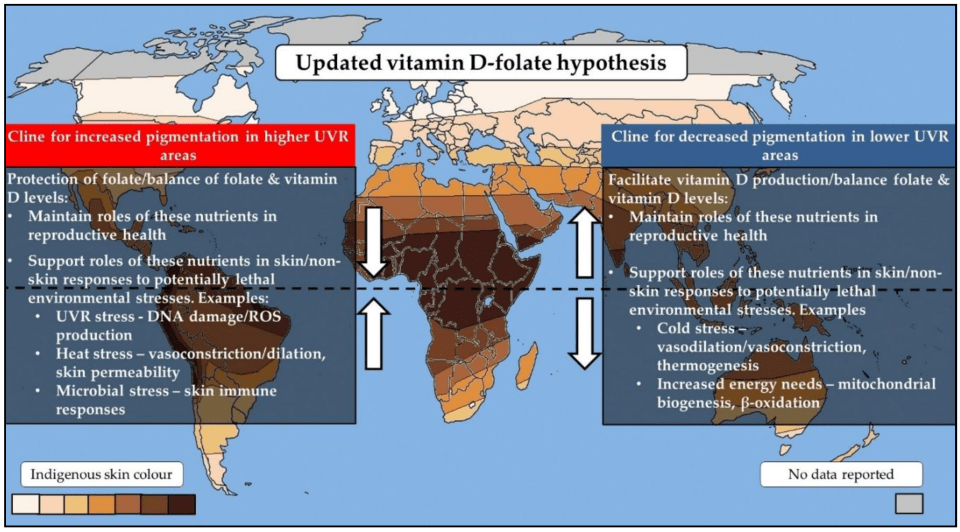
Jones et al (2018b) update the VDH by integrating the other theories into it, since they are similar and do not contradict the VDH (since aspects of each one can be used to explain different aspects of the VDH). The updated hypothesis is thus:
Vitamin D and folate have differing sensitivities to UVR. Vitamin D can be synthesized following UVR exposure, folate may be degraded. So the VDH proposes that the two differing skin colors (light and dark) evolved at differing latitudes as a “balancing mechanism” to maintain adequate levels of the two agents vitamin D and folate. Since adequate levels of vitamin D and folate were maintained, there would be no ill health effects after migrating into colder climates. Vitamin D and folate both act as photoprotectors of the skin and can decrease environmental stressors. Vitamin D also exerts important effects on adipocites—both types—which then further aid in human physiologic adaptations to the cold. Perhaps most importantly, the VDR and skin color genes are epistatic—the VDR is imperative in the human body’s adaptation to new climates.
The latest research (reviewed by Jones et al, 2018b) show strong support for the interaction between genes and folate/vitamin D processes with skin pigmentation and UVR.
Health Disparities
Health disparities due to vitamin D deficiency are well-noted in the literature. Human migrations over the recent centuries and decades have caused environmental mismatches between a population’s adapted skin type and current UV level in the location the population migrated to. Many darkly-pigmented people now live in areas with low UVR, and thusly suffer from health consequences. This leads to them either not having an adequate vitamin D-folate balance along with the risk of not having the adequate skin protections for a given environment, since UV rays influence folate and vitamin D production and so, a mismatched skin color to UV environment would cause problems for skin protection since the environment is not ancestral to that certain skin color.
As I have previously noted, it has been argued that blacks are not vitamin D deficient, and thusly not vitamin D deficient. Though, these claims rest on a slew of false arguments that have since been rebutted. It has been argued that since blacks are deficient in vitamin D, which begins in the womb, and vitamin D deficiencies cause changes in large and small arteries and arterials, that vitamin D deficiency could be the cause of higher rates of hypertension in black Americans (Rostand, 2010).
Conclusion
The role of vitamin D, folate, the VDR, and certain genes is under further invesitgation. This group of agents exert powerful effects on human physiology which then help with the adaptation of humans to differing climates. Folate and the vitamin D receptor play a crucial role in protecting the skin from environmental and microbial stressors. Vitamin D and the VDR are expressed in the adipose tissue, while vitamin D regulates adipogenesis and adipocite apoptosis (Abbas, 2017). Further evidence shows that there are multiple loci that are involved in the VDR that show latitudinal clines (Tiosano et al, 2016). One of the most things that lends credence to the VDH is the fact that the VDR and skin color genes are epistatic and help humans adapt to climates.
The VDH is in great shape, contrary to popular belief (Elias, Williams, and Bikle, 2016). The VDH is one of the only games in town to explain the skin color gradient noticed around the world, with vitamin D being the only agent that accounts for skin color differences. The VDH explains how and why human skin color is vastly different, and the main reason is adaptation to UV rays—or lack thereof.
Grant (2018) concludes that:
The UVB–vitamin D–cancer hypothesis has considerable supporting scientific evidence from a variety of study types: geographical ecological, observational, and laboratory studies of mechanisms, as well as several clinical trials.
Clearly, the VDH explains the incidence of the observed skin gradiation around the world the best out of the so-called competing hypotheses (which are similar enough to the VDH to where they can be absorbed into the VDH). Most importantly, the VDH predicted a novel fact—that molecular genetic evidence would show that light skin evolved independently numerous times in our lineage (Jablonksi and Chaplin, 2009).
On Asian Body Fat and Diabetes
2000 words
Within-group differences in body fat and diabetes tell a lot about the diet and susceptibility of the diseases to that group. What the ethny does (or does not do) affects how high their body fat will be and whether or not they become diabetic. Since body fat levels are related to diabetes, then looking at both variables together should tell a lot about the diet and lifestyles of the ethnies studied. The ethnies I will look at are Chinese, Japanese, Filipinos, Koreans, Mongolians, and Filipinos.
Chinese
The Chinese have high levels of body fat (Wang et al, 2004) but have a lower BMI yet higher level of body fat than whites (Wang et al, 1994). BMI correlates with body fat percentage in the Chinese, while BMI and body fat percentage were related to DM (diabetes mellitus). Though BMI has its limits in people ranging from 24 to 27.9 BMI (Wang et al, 2011). New findings have shown that obesity in China may be underestimated (Gangqiang et al, 2017). That Chinese males have higher levels of body fat than white males held even after adjusting for age and BMI (Wang et al, 2011). The reality is that body fat percentage and diabetes, along with other diseases like prostate cancer (PCa) are increasing at an alarming rate in China (Tomlinson, Deng, and Thomas, 2008), so what is the cause?
The cause is very simple: The introduction of the Western diet. As I have written in the past, wherever the Western diet goes, diseases of civilization follow in high numbers in populations that previously did not eat that type of food. One analysis of the Chinese diet (compared with the Meditteranean, Japanese, and American diets) showed that “the Chinese diet has been shifting away from the traditional diet toward high-fat, low-carbohydrate and low-fiber diets, and nutrients intakes in Chinese people have been changing even worse than those in American people” (Zhang et al, 2015).
One study showed differences in dietary expectations between Americans (in Honolulu, Hawaii, so probably ethnically mixed) and Chinese in Changsha Hunan, China (Banna et al, 2016). The Chinese students mentioned physical outcomes such as “ such as maintaining immunity and digestive health” while American students state that they “balanced food groups” and balanced consumption with exercise (implying you can outrun a bad diet when you can’t…) while also stating that physical activity should be essential. American students stated that they needed to avoid foods high in fat. In that same manner, one Chinese student said “”Eat smaller amounts of meat, fish and vegetarian alternatives, choosing lower fat options whenever possible.” Meat, specifically beef and pork, was often cited as a food that should be limited” (Banna et al, 2016). Both groups of students in both countries erroneously assume that high-fat diets are bad for you—on the contrary, it’s high carb low-fat diets that are bad, which lead to DM.
The number of obese Chinese has surpassed the US; China is on its way to top the world in childhood obesity; and the incidence of diabetes is exploding in China. All due to the introduction of a Western diet. Something else worth noting: All Asian ethnies—at the same BMI—have higher levels of body fat and central adiposity, a risk-factor for diabetes (Deurenberg, Deurenberg-Yap, and Guricci, 2002).
Mongolians
Everywhere the Western Diet goes, obesity, diabetes, and disease soon follow and Mongolia is no different. Otgontuya et al (2009) showed that 6 percent of their study population were underweight, while 50.7 percent were in the normal range, 32.8 percent were overweight and 10.5 percent were obese, with women being slightly more likely to be overweight and obese. Rural people were more likely to be overweight and obese than urban people. Men had significantly lower body fat percent levels than women (26 and 34 percent respectively), women in the lowest age group had the lowest body fat percentage.
Mongolians living in China had impaired fasting glucose (IFG); those who had diabetes and IFG were more likely to be overweight and have higher central adiposity (Zhang et al, 2009). Mongolians eat an estimated 2,525 kcal per day, along with a fat/kcal ratio of 33.7—1.3 times higher than the Japanese and this is associated with their lower mortality (Komatsu et al, 2008).
Koreans
As with other Asian nations, Korea has the same problems. Hong et al (2011) showed that in Korean men, muscle mass decreases and body fat increases with age while for women fat mass and obesity increased with age. I particularly like this study since they assessed percent body fat (and other variables) with the DXA scan—one of the gold-standard of assessing body fat. Another Korean study showed that high birthweight leads to obesity and higher levels of body fat but not muscle mass (Kang et al, 2018), and with the advent of the Western diet in Asia, we can expect higher rates of obesity. (Note that this is an observational study and thusly causation is not certain, future studies will tease out causation and I bet the Western diet plays a role.) Another study even showed that eating frequency is related to obesity when diet quality is high, but not low in Korean adults (Kim, Yang, and Park, 2018).
There is one more risk-factor in regard to Korean obesity—study time after school is associated with habitual eating which leads to becoming overweight and obese. In this sample, Korean children who reported studying after school and eating when they were not hungry during studying were at increased risk for developing obesity in later years (Lee et al, 2018).
There is one interesting thing to note in regard to Koreans and diabetes, though: High leg fat mass, along with lower leg muscle mass, significantly lowered the risk for DM, while those who had lower leg body fat but higher leg muscle mass had a higher risk for developing diabetes (Choi et al, 2017). Shin, Hong, and Shin (2017) show that “… BAI is less useful than BMI and other adiposity indices, such as the WHtR, the WHR, and WC. These indices may be better candidates for clinical use and to evaluate metabolic syndrome risk factors.” One mouse study showed that the traditional Korean diet prevented obesity and ameliorated insulin resistance (Choi et al, 2017) which implies that a shift back to the traditional Korean diet for Koreans would show positive health benefits.
Japanese
Japan is similar to China as regards body fat percentage and BMI. They have a culture of fat-shaming (do note that it does not work but in fact makes the problem worse due to biochemical stress) and when one of their peers becomes overweight, they begin to shame in hopes that they will lower their weight. Though, despite their culture of thinness, in Japan, diabetes is a “hidden scourge“. This is due to, again, the Western diet reaching Japanese shores.
Rice is a major food staple in Japan. Since rice is a carbohydrate, then it follows that, if eaten in large amounts, one who eats more rice than another would have a higher chance of becoming a diabetic. Rice intake is associated with the onset of diabetes in Japanese women, with a significant increase in diabetes if the woman ate more than 420 grams of rice (3 bowls) per day; the association was pronounced in women who were physically-inactive, and nonobese (Nanri et al, 2010). The same was seen in Chinese women (Villegas et al, 2007).
However, Nanri et al (2010) state that “The mechanism by which increased rice consumption increases risk of type 2 diabetes remains unclear. … the association between rice intake and type 2 diabetes risk remained significant even after adjustment for these food factors, which suggested an independent role of white rice in the pathogenesis of type 2 diabetes.” The cause is very simple: White rice, as Nanri et al note, is high on the glycemic index scale. If a food is high on the glycemic index scale, then it will spike one’s blood sugar high, which eventually would lead to DM. It’s also worth noting that a low-carb diet was associated with a decrease in diabetes, most likely due to a decrease in white rice consumption (Nanri et al, 2015).
The Japanese, in comparison to other Asian countries, have low levels of obesity, though the maladies they acquire are in-line with their diet and what they eat. However, some have noted the fact that Japanese diabetes rates are low. (Notwithstanding their hidden scourge.) This is easily explainable: The percent of carbohydrate intake is nowhere as important as the absolute amount of carbohydrate consumed. Though their diabetic population has increased to over 10 million recently. This is, of course, due to the introduction of the Western diet in Japan.
Filipinos
The last ethny I will discuss are Filipinos. Body-shaming is, as it is in other Asian countries, prevalent. At a fixed BMI, in spite of both groups living in similar conditions and eating a similar diet, “Malay and Thai boys had a significantly higher %BF than Filipino boys and Thai girls had a significantly higher %BF than Malay and Filipino girls” (Liu et al, 2011).
Choi et al (2013) showed that Filipino men living in California with DM were more likely to be overweight and obese, and Filipino men without DM were still more likely to be overweight and obese (even when adjusting for age and other lifestyle factors, Filipinos still had a higher chance of acquiring DM. Though Korean women had the highest rates of DM, followed by Filipinas.
Filipino and Korean emigrants to America had higher rates of weight gain than Chinese emigrants (Oakkert et al, 2015). This could be due to cultural values back home, which then obviously change when they emigrate to America. Furthermore, they find themselves in obesogenic environments (See Lake and Townshend,2006; Townshend and Lake, 2017). The cause is the difference in the built food environment; this is why Filipino men and women have high rates of DM and CVD (cardiovascular disease).
Further, in Filipinas, increased socioeconomic status, urban residence, fewer pregnancies and lactations and spending more time away from home is positively associated with weight gain. Though a high waist-to-hip ratio and being overweight and obese was independently related to hypertension in Filipinas (Adair, 2012). This study documented weight changes in a 16-year period in Filipina women as they moved higher up the SES ladder. Adair (2012) does note that obesity is increasing in lower-income households, too, but not as quickly when compared to more affluent households.
Comparing body fat percentages amongst Asian-American groups indicates that not all Asian-American populations are not equal in body fatness (Alpert and Thomason, 2016). However, one study shows that Asian Indians and Filipinos had higher prevalences of being overweight (35-37 percent and 35-47 percent respectively; Oza-Frank et al, 2009). This analysis, along with many others, shows that Asians—no matter the ethny—have higher levels of body fat than non-Hispanic white populations. It’s also worth noting that Filipina women had higher levels of VAT (visceral adipose tissue) than whites of a similar BMI and WC (waist circumference; Araneta and Barrett-Connor, 2012).
Conclusion
Asian ethnies have differing levels of body fat at the same BMI. This implies that what works for whites regarding BMI won’t work for Asians, since these ethnies, when compares with whites of a similar BMI and WC, had higher rates of body fat. The relationship between BMI and body fat levels is ethny-specific (Deurenberg, Deurenberg-Yap, and Guricci, 2002), though Filipinos and Asian Indians have higher levels of body fat regardless of the BMI standard used (Oza-Frank et al, 2009), which is one of the most important tells in ascertaining whether one is at-risk for DM and other maladies. It is not particularly interesting that Asian emigrants to America see their weight increase, as this is noted when the scourge called the Western diet crosses the Pacific. But what is interesting here is the rates between each Asian ethny, what they eat, and what causes the relationship.
Asian ethnies, when matched at similar BMIs, had differing levels of body fat, which implies that there should be ethny-specific BMI, though no matter which BMI standard was used, Filipinos and Asian Indians still had higher rates of body fat.
Arctic Skin Color and the Vitamin D Hypothesis
1400 words
The Vitamin D Hypothesis (VDH) purports to explain the range of skin colors observed between races/ethnies around the world. Since there are little UVR and even less vitamin-D-producing UVB in the northern hemisphere, other ways of producing/getting ample amounts of vitamin D were imperative for survival. Locations such as the far north were uninhabited up until 12,000 years ago—the explanation being that populations didn’t have the culture to survive such harsh conditions (see Goebel, 1999; Bergman et al, 2004). However, a more likely reason was that there were biological limits on the production of vitamin D due to the lack of UVB rays for most of the year. In this article, I will discuss the skin color of Arctic peoples and why it does not follow the simple gradient of UVB around the world.
To overcome the biological limitations of little to no UVB throughout the year, they needed to supplement with foods to get ample amounts of vitamin D—to cover what they did not get from the weak UVB rays. To overcome the limitation of their environment and vitamin D production, they had to consume fatty animals who had ample stores of vitamin D in their systems. The types of foods allowed peoples to live so far north, since there were little vitamin-D-producing UVB rays, lifestyle and culture is how we conquered the unforgiving far north.
Peoples like the Inuit and Saami eat a diet that is high in vitamin D. Inuits, for example, eat a diet high in vitamin D and n-3 fatty acids (Schaebel et al, 2015). Due to the high vitamin D intake from their diet, they were able to supplement what they did not get from the sun in their diet and thusly were able to live in the unforgiving cold north due to their diet high in vitamin D (Deng and Xu, 2018). Their dark skin color can be explained in a few ways: their diet (high in vitamin-D-rich marine mammals), UVB rays bouncing off ice, snow, and water, and they are recent migrants to those climes, which would explain their darker skin color compared to other populations that have evolved for a longer time in these climates (Jablonski and Chaplin, 2002).
When people look at Arctic people such as the Inuit, they look at their skin color and see the amount of UVB rays they receive during the year and presume that the VDH is wrong because, according to the VDH, Arctic peoples should have the lightest skin but have dark skin—compared to others who evolved recently in those latitudes—but they have dark-ish skin for that latitude. The answer is simple: they were able to consume enough vitamin D in their diet—a lack of vitamin D production/consumption was one barrier to living in the far north which was then overcome with culture and the foods peoples eat.
The environment of the Arctic is dim and dark for most of the year, though during the summer, of course—when they are most active—they are bathed in solar radiation which is then reflected by the snow, ice, and water. Fresh white snow reflects 94 percent UVA rays and 88 percent of UVB rays. Chadysiene and Girgzdys (2008; 87) write:
The average data of experimental measurements show that maximum albedo of UVA radiation (of about 94%) was at 1 p.m. in comparison with albedo of UVB radiation of about 88% at 2 p.m. The measurements of albedo were performed on fresh snow with big crystals.”
For example, Inuit populations in northern Greenland report spending up to 16 hours outdoors in the spring and summer months, and would be exposed to UV rays bouncing from ice, snow, and water (Andersen, Jakobsen, and Laurberg, 2012). Exposure to UV rays for this extended period of time—along with eating a diet high in vitamin D—is enough to explain their skin color.
Clearly, Arctic people get bathed in UVB and UVA rays from being reflected off the snow and ice, which gives them their darker skin color. They have the ability to tan (which is distinct from the American term “tanning”) and their tanning ability protects them from high doses of UVR that are reflected from the snow whereas their diet high in vitamin D gives them their darkish skin color and allows them to remain healthy in such a harsh, unforgiving environment.
Nina Jablonski has been writing about the VDH for about 30 years. Jablonski writes in her book Living Color: The Biological and Social Meaning of Skin Color (2012: 68):
Traditional cultures of the Inuit and the Saami center on harvesting vitamin-D-rich foods. The dietary focus for both groups has compensated for the vitamin D they cannot produce in their skin. Both peoples remain healthy when they stick to their traditional diets but suffer badly from vitamin D deficiencies when they switch to Western diets that are lower in vitamin D.
Here’s the thing: when these populations move away from their natural, vitamin-D-rich diet, they suffer from many deficiencies regarding vitamin D, even today many Inuit populations suffer from vitamin D deficiency, both children, and adults (Hayek, 2011). So the change in the Inuit diet is the cause of these deficiencies—their traditional diet was high in vitamin D, but their new diet (the Western diet) is low in vitamin D; since they have dark skin and the UVB is so variable throughout the year, they then suffer from vitamin D deficiencies (Sharma et al, 2011). Sharma et al (2011: 475) conclude that Arctic people are at-risk for vitamin D deficiency due to lack of UVB exposure, moving away from a traditional diet high in vitamin D to a Western diet low in vitamin D, combined with their dark skin.
Frost (2012) claims that while the explosion of rickets in Arctic populations is due to a change in diet (shifting away from a high meat diet) and “increased consumption of certain reactive substances: phytic acids in commercially processed cereals; sodium bicarbonate in baking soda; and aluminum hydroxide in antacids” (Frost, 2012). The dominant source of vitamin D for the Inuit is their diet (Schaebel et al, 2015), and so, due to their shift away from their natural diet high in fatty fish and vitamin D, once they began eating a diet not ancestral to them, then the maladies began. We can see this with every country/population that begins to eat a new diet full of processed foods.
Since the frequency of rickets has exploded in populations that eat a Western-like diet and not their traditional diet, this implies that the traditional diet provided enough vitamin D, and when they began eating a new diet with less vitamin D, then these problems such as rickets occurred.
To end these implications, the Inuit need to return to consuming a traditional diet, since their traditional diets have the adequate vitamins and minerals needed to survive in the environment they are currently in (Koladhooz et al, 2013). Higher BMI (body mass index), their skin color, and the latitude of where they live contribute to low vitamin D production. Inuits who consumed a low number of traditional food items were more likely to be deficient in vitamin D (Anderson et al, 2013) while this deficiency is seen even in Inuit school children (Hayek, Egeland, and Weiler, 2010; Singleton et al, 2015).
In sum, there is no anomaly regarding the skin color of Arctic peoples; the hypothesis is called “the vitamin D hypothesis”, and so they get ample vitamin D from the reflection of UV rays from the snow, ice, and water. Reasons for the darkness of their skin include the fact that they are recent migrants to those locations, they consume a diet high in vitamin D, and the reflection of UV rays from albedo surfaces.
The hypothesis that UVB exposure explains the observed skin gradients predicted a novel fact—that populations that migrated out of Africa would be seen to have light skin. This occurred multiple times through three different molecular pathways, in the Neanderthals (Lalueza-Fox et al, 2007) and Europeans and East Asians (different molecular mechanisms for them; Norton et al, 2007). This was a risky, successful and novel prediction made by Jablonski and Chaplin (2000). That this does not hold for Arctic people is not a blow to the hypothesis; it is perfectly explained by the bouncing of UVR off of albedo surfaces and a high vitamin D diet. Skin color is an adaptation to UV rays.
Cold Winter Theory, the Vitamin D Hypothesis and the Prediction of Novel Facts
2400 words
HBDers purport that as one moves further north from Africa that IQ raises as a function of how the population in question needed to survive. The explanation is that as our species migrated out of Africa, more “intelligence” was needed and this is what explains the current IQ disparities across the world: the ancestors of populations evolving in different areas with different demands then changed their “IQs” and this then is responsible for differential national development between nations. Cold winter theory (CWT) explains these disparities.
On the other hand is the vitamin D hypothesis (VDH). The VDH purports to explain why populations have light skin at northern latitudes. As the migration north out of Africa occurred, peoples needed to get progressively lighter in order to synthesize vitamin D. The observation here is that as light skin is selected for in locations where UVB is absent, seasonal or more variable whereas dark skin is selected for where UVB is stronger. So we have two hypotheses: but there is a problem. Only one of these hypotheses makes novel predictions. Predictions of novel predictions are what science truly is. A predicted fact is a novel fact for a hypothesis if it wasn’t used in the construction of the hypothesis (Musgrave, 1988). In this article, I will cover both the CWT and VDH, predictions of facts that each made (or didn’t make) and which can be called “science”.
Cold winter theory
The cold winter theory, formulated by Lynn and Rushton, purports to give an evolutionary explanation for differences in national IQs: certain populations evolved in areas with deathly cold winters in the north, while those who lived in tropical climes had, in comparison to those who evolved in the north, an “easier time to live”. Over time as populations adapted to their environments, differences in ‘intelligence’ (whatever that is) evolved due to the different demands of each environment, or so the HBDers say.
Put simply, the CWT states that IQ differences exist due to different evolutionary pressures. Since our species migrated into cold, novel environments, this was the selective pressure needed for higher levels of ‘intelligence’. On the other hand, humans who remained in Africa and other tropical locations did experience these novel, cold environments and so their ‘intelligence’ stayed at around the same level as it was 70,000 years ago. Many authors hold this theory, including Rushton (1997), Lynn (2006), Hart, (2007) Kanazawa (2008), Rushton and Templer (2012; see my thoughts on their hypothesis here) and Wade (2014). Lynn (2013) even spoke of a “widespreadonsensus” on the CWT, writing:
“There is widespread consensus on this thesis, e.g. Kanazawa (2008), Lynn (1991, 2006), and Templer and Arikawa (2006).”
So this “consensus” seems to be a group of his friends and his own publications. We can change this sentence to ““There is widespread consensus on this thesis, including two of my publications, a paper where the author assumes that the earth is flat: “First, Kanazawa’s (2008) computations of geographic distance used Pythagoras’ theorem and so the paper assumed that the earth is flat (Gelade, 2008).” (Wicherts et al, 2012) and another publication where the authors assume hot weather leads to lower intelligence. Oh yea, they’re all PF members. Weird.” That Lynn (2013) calls this “consensus” is a joke.
What caused higher levels of ‘intelligence’ in those that migrated out of Africa? Well, according to those who push the CWT, finding food and shelter. Kanazawa, Lynn, and Rushton all argue that finding food, making shelter and hunting animals were all harder in Eurasia than in Africa.
One explanation for high IQs of people who evolved recently in northern climes is their brain size. Lynn (2006: 139) cites data showing the average brain sizes of populations, along with the temperatures in that location:
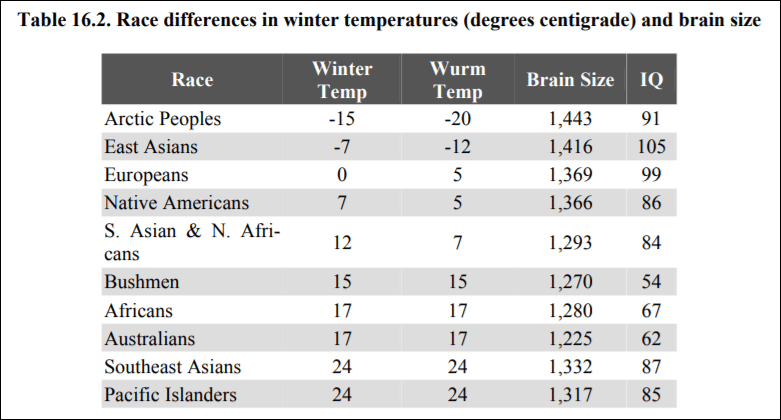
Do note the anomaly with the Arctic peoples. To explain this away in an ad-hoc manner, Lynn (2006: 156-7) writes:
These severe winters would be expected to have acted as a strong selection for increased intelligence, but this evidently failed to occur because their IQ is only 91. The explanation for this must lie in the small numbers of the Arctic Peoples whose population at the end of the twentieth century was only approximately 56,000 as compared with approximately 1.4 billion East Asians.
This is completely ad-hoc. There is no independent verifier for the claim. That the Arcitic don’t have the highest IQs but experienced the harshest temperatures and therefore have the biggest brain size is a huge anomaly, which Lynn (2006) attempts to explain away by population size.
He does not explain why natural selection among Arctic peoples would result in larger brain sizes or enhanced visual memory yet the same evolutionary pressures associated with a cold environment would not also produce higher intelligence. Arctic peoples have clear physical adaptations to the cold, such as short, stocky bodies well-suited to conserving heat.
Furthermore, the argument that Lynn attempts is on the mutations/population size is special pleading—he is ignoring anomalies in his theory that don’t fit it. However, “evolution is not necessary for temperature and IQ to co-vary across geographic space” (Pesta and Poznanski, 2014).
If high ‘intelligence’ is supposedly an adaptation to cold temperatures, then what is the observation that disconfirms a byproduct hypothesis? On the other hand, if ‘intelligence’ is a byproduct, which observation would disconfirm an adaptationist hypothesis? No possible observation can confirm or disconfirm either hypothesis, therefore they are just-so stories. Since a byproduct explanation would explain the same phenomena since byproducts are also inherited, then just saying that ‘intelligence’ is a byproduct of, say, needing larger heads to dissipate heat (Lieberman, 2015). One can make any story they want to fit the data, but if there is no prediction of novel facts then how useful is the hypothesis if it explains the data it purports to explain and only the data it purports to explain?
It is indeed possible to argue that hotter climates need higher levels of intelligence than colder climates, which has been argued in the past (see Anderson, 1991; Graves, 2002; Sternberg, Grigorenko, and Kidd, 2005). Indeed, Sternberg, Grigorenko, and Kidd (2005: 50) write: “post hoc evolutionary arguments … can have the character of ad hoc “just so” stories designed to support, in retrospect, whatever point the author wishes to make about present-day people.” One can think up any “just-so” story to explain any data. But if the “just-so” story doesn’t make any risky predictions of novel facts, then it’s not science, but pseudoscience.
Vitamin D hypothesis
The VDH is simple: those populations that evolved in areas with seasonal, absent, or more variable levels of UVB have lighter skin than populations that evolved in areas with strong UVB levels year-round (Chaplan and Jablonksi, 2009: 458). Robins (2009) is a huge critic of the VDH, though her objections to the VDH have been answered (and will be discussed below).
The VDH is similar to the CWT in that it postulates that the adaptations in question only arose due to migrations out of our ancestral lands. We can see a very strong relationship between high UVB rays and dark skin and conversely with low UVB rays and light skin. Like with the CWT, the VDH has an anomaly and, coincidentally, the anomaly has to do with the same population involved in the CWT anomaly.
Arctic people have dark-ish skin for living in the climate that they do. But since they live in very cold climates then we have a strange anomaly here that needs explaining. We only need to look at the environment around them. They are surrounded by ice. Ice reflects UVB rays. UVB rays hit the skin. Arctic people consume a diet high in vitamin D (from fish). Therefore what explains Arctic skin color is UVB rays bouncing off the ice along with their high vitamin D diet. The sun’s rays are, actually, more dangerous in the snow than on the beach, with UVB rays being 2.5 more times dangerous in the snow than beach.
Evolution in different geographic locations over tens of thousands of years caused skin color differences. Thus, we can expect that, if peoples are out of the conditions where their ancestors evolved their skin color, that there would then be expected complications. For example, if human skin pigmentation is an adaptation to UV rays (Jablonski and Chaplan, 2010), we should expect that, when populations are removed from their ancestral lands and are in new locations with differing levels of UV rays, that there would be a subsequent uptick in diseases caused by vitamin D deficiencies.
This is what we find. We find significant differences in circulating serum vitamin D levels, and these circulating serum vitamin D levels then predict health outcomes in certain populations. This would only be true if sunlight influenced vitamin D production and that skin progressively gets lighter as one moves away from Africa and other tropical locations.
Skin pigmentation regulates vitamin D production (Neer, 1975). This is due to the fact that when UVB rays strike the skin, we synthesize vitamin D, and the lighter one’s skin is, the more vitamin D can be synthesized in areas with fewer UVB rays. (Also see Daraghmeh et al, 2016 for more evidence for the vitamin D hypothesis.)
P1) UV rays generate vitamin D in human skin
P2) Human populations that migrate to climates with less sunlight get fewer UV rays
P3) To produce more vitamin D, the skin needs to get progressively lighter
C) Therefore, what explains human skin variation is climate and UV rays linked to vitamin D production in the skin.
Novel predictions
Science is the generation of novel facts from risky predictions (Musgrave, 1988; Winther, 2009). And so, hypotheses that predict novel facts from risky predictions are scientific hypotheses, whereas those hypotheses that need to continuously backtrack and think up ad-hoc hypotheses are then pseudoscientific. Pseudoscience is simple enough to define. The Stanford Encyclopedia of Philosophy defines it as:
“A pretended or spurious science; a collection of related beliefs about the world mistakenly regarded as being based on scientific method or as having the status that scientific truths now have.”
All theories have a protective belt of ad hoc hypotheses. Theories become pseudoscientific when they fail to make new predictions and must take on more and more ad-hoc hypotheses that have no predictive value. If the ad-hoc hypotheses that are added to the main hypothesis have no predictive value then the new explanations for whichever hypothesis that is in danger of being falsified are just used to save the hypothesis from being refuted and it thus becomes pseudoscience.
In the case of CWT, it makes no prediction of novel facts; it only explains the data that it purports to explain. What is so great about the CWT if it makes no predictions of novel facts and only explains what it purports to explain? One may attempt to argue that it has made some ‘novel’ predictions but the ‘predictions’ that are proposed are not risky at all.
For example, Hart (2007: 417) makes a few “predictions”, but whether or not they’re “risky” or “novel” I’ll let you decide (I think they’re neither, of course). He writes that very few accomplishments will be made by Africans, or Australian or New Guinean Aborigines; members of those groups will not be highly represented in chess; and that major advances in scientific fields will come from those of European ancestry or the “Monglids”, Koreans, Chinese or Japanese.
On the other hand, Hart (2007: 417) makes two more “predictions”: he says that IQ data for Congoid Pygmies, Andaman Islanders, and Bantu-speaking people are few and far between and he believes that when enough IQ testing is undertaken there he expects IQ values between 60 and 85. Conversely, for the Lapps, Siberians, Eskimoes, Mongols and Tibetans, he predicts that IQ values should be between 85-105. He then states that if these “predictions” turn out to be wrong then he would have to admit that his hypothesis is wrong. But the thing is, he chose “predictions” that he knew would come to pass and therefore these are not novel, risky predictions but are predictions that Hart (2007) knows would come to pass.
What novel predictions has the VDH made? This is very simple. The convergent evolution of light skin was predicted in all hominids that trekked out of Africa and into colder lands. This occurred “because of the importance of maintaining the potential for producing pre-vitamin D3 in the skin under conditions of low annual UVB (Jablonski and Chaplin, 2000; Jablonski, 2004)” while these predictions “have been borne out by recent genetic studies, which have demonstrated that depigmented skin evolved independently by different molecular mechanisms multiple times in the history of the human lineage” (Chaplan and Jablonksi, 2009: 452). This was successfully predicted by Chaplan and Jablonski (2000).
The VDH still holds explanatory scope and predictive success; no other agent other than vitamin D can explain the observation that light skin is selected for in areas where there is low, absent or seasonal UVB. Conversely, in areas where there is a strong, year-round presence of UVB rays, dark skin is selected for.
Conclusion
Scientific hypotheses predict novel facts not known before the formulation of the hypothesis. The VDT has successfully predicted novel facts, whereas I am at a loss thinking of a novel fact that the CWT predicted.
In order to push an adaptationist hypothesis for CWT and ‘intelligence’, one must propose an observation that would confirm the adaptationist hypothesis while at the same time disconfirming the byproduct hypothesis. Since byproducts are inherited to, the byproduct hypothesis would predict the same things that an adaptationist hypothesis would. Thus, the CWT is a just-so story since no observation would confirm or disconfirm either hypothesis. On the other hand, the CWT doesn’t make predictions of novel facts, it makes “predictions” that are already known and would not undermine the hypothesis if disproved (but there would always be a proponent of the CWT waiting in the wings to propose an ad-hoc hypothesis in order to save the CWT, but I have already established that it isn’t science).
On the other hand, the VDT has successfully predicted that hominins that trekked out of Africa would have light skin which was then subsequently confirmed by genomic evidence. The fact that strong UVB rays year-round predict dark skin whereas seasonal, absent, or low levels of UVB predict light skin has been proved to be true. With the advent of genomic testing, it has been shown that hominids that migrated out of Africa did indeed have lighter skin. This is independent verification for the VDH; the VDH has predicted a novel fact whereas the CWT has not.
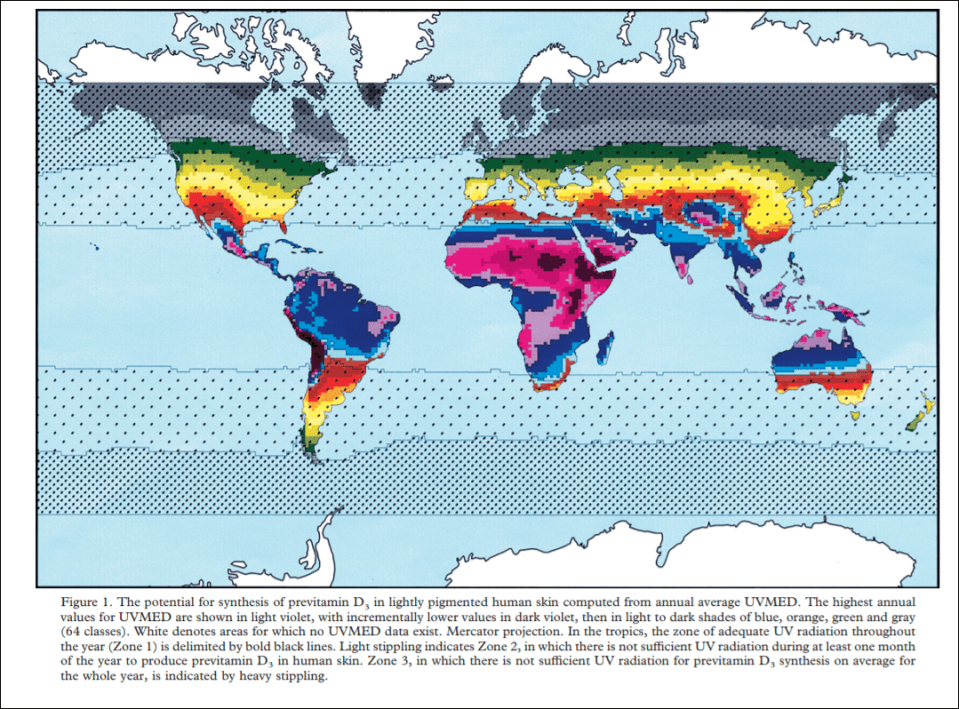
Race and Vitamin D Deficiency
1600 words
Vitamin D is an important “vitamin” (it is really a steroid hormone). It is produced when the skin (the largest organ in the body) is exposed to the sun’s UVB rays (Nair and Maseeh, 2012). So this is one of the only ways to get natural levels of UVB. We can then think that, if a population is outside of its natural evolutionary habitat (the habitat where that skin color evolved), then we should note numerous problems caused by the lack of vitamin D in whichever population is studied outside of a location that doesn’t get the correct amount of UVB rays from the sun.
Black Americans are more likely than other ethnies to be deficient in vitamin D (Harris, 2006; Cosman et al, 2007; Nair, 2012; Forest and Stuhldreher, 2014; Taksler et al, 2014). But, paradoxically, low vitamin D levels don’t cause weaker bones in black Americans (O’Conner et al, 2014). However, like with all hypotheses, there are naysayers. For example. Powe et al (2013) argue that vitamin D tests misdiagnose blacks, that blacks have a form of the vitamin that cells can use called 25-hydroxyvitamin D. They conclude: “Community-dwelling black Americans, as compared with whites, had low levels of total 25-hydroxyvitamin D and vitamin D–binding protein, resulting in similar concentrations of estimated bioavailable 25-hydroxyvitamin D. Racial differences in the prevalence of common genetic polymorphisms provide a likely explanation for this observation.” Though there are a whole host of problems here.
The limitations of Powe et al (2013) striking: it was cross-sectional and observational (like most nutrition studies) so they were unable to predict effects of vitamin-D binding protein on bone fractures; no data on the consumption of vitamin D supplements; measurement of bone turnover markers, urinary calcium excretion and levels of 1,25-dihydroxyvitamin D may explain the effect of VDBP (vitamin D-binding protein) on mineral metabolism; and they relied on a calculation, rather than a measurement of 25-hydroxyvitamin D levels.
Powe et al’s (2013) findings, though, have been disputed. Using different measurement tools from Powe et al (2013), Henderson et al (2015) conclude that “Counter to prior observations by immunoassay, VDBG concentrations did not vary by race.” While Bouillon (2014) writes: In our view, black Americans, as compared with white Americans, have lower levels of not only total 25-hydroxyvitamin D but also free or bioavailable 25-hydroxyvitamin D.” And finally, Hollis and Bikle (2014) write: “Specifically, for any given physically measured level of bio-available 25-hydroxyvitamin D, the authors are overestimating bio-available 25-hydroxyvitamin D by 2 to 2.5 times owing to underestimation of vitamin D–binding protein in blacks.”
Either way, even if what Powe et al (2013) conclude is true, that would not mean that black Americans should not supplement with vitamin D, since many diseases and health problems are associated with low vitamin D intake in blacks, including osteoporosis, cardiovascular disease, cancer, diabetes, and other serious conditions (Harris, 2006). An indirect relationship between low levels of vitamin D and hypertension is also noted (Mehta and Agarwal, 2017). Since there is an indirect relationship between vitamin D levels and hypertension, then we should keep an eye on this because black Americans have some of the highest levels of hypertension in the world (Ferdinand and Armani, 2007; see also Fuchs, 2011).
Vitamin D is, of course, important for skeletal and nonskeletal health (Kennel et al, 2010). So if vitamin D is important for skeletal and nonskeletal health, we should see more diseases in black Americans that imply a lack of this steroid in the body. Although blacks have stronger bones even when deficient in vitamin D, it is still observed that black children who break their forearms have less vitamin D circulating in their blood (Ryan et al, 2011). This observation is borne out by the data, since black children are more likely to be deficient in vitamin D compared to other ethnies (Moore, Murphy, and Hollick, 2005). Since black skin predicts vitamin D deficiency (Thomas and Demay, 2000), it seems logical to give vitamin D supplements to children, especially black children, on the basis that it would help lower incidences of bone fractures, even though blacks have stronger bones than whites.
Furthermore, physiologically “normal” levels of vitamin D differ in blacks compared to whites (Wright et al, 2012). They showed that it is indeed a strong possibility that both whites and blacks have different levels of optimum vitamin D. Wright et al (2012) showed that there is a relationship between 25(OH)D levels and intact parathyroid hormone (iPth); for blacks, the threshold in which there was no change was 20 ng/ml whereas for whites it was 30 ng/ml which suggests that there are different levels of optimal vitamin D for each race, and the cause is due to skin color. Thus, physiologically “normal” levels of vitamin D differ for blacks and whites.
There is also a high prevalence of vitamin D deficiency/insufficiency and asthma in black inner-city youth in Washington DC (Freishtat et al, 2010). We can clearly see that, even though black Americans have stronger bones than white Americans and vitamin D predicts bone strength, the fact that blacks have stronger bones than whites even while being deficient in vitamin D on average does not mean that black Americans should not supplement with vitamin D, since it would ameliorate many other problems they have that are related to vitamin D deficiency.
There are also racial differences in prostate cancer (PCa) acquisition too, and vitamin D deficiency may also explain this disparity (Khan and Partin, 2004; Bhardwaj et al, 2017). I have heavily criticized the explanations that testosterone influences PCa, while having indicated that environmental factors such as diet and vitamin D deficiency may explain a large amount of the gap (Batai et al, 2017; but see Stranaland et al, 2017 for a contrary view). Since low vitamin D is related to prostate cancer, by supplementing with vitamin D, it is possible that levels of PCa may decrease. Kristal et al (2014) show that both high and low levels of vitamin D are associated with PCa.
Evidence also exists that vitamin D levels and hypertension are related. Rostand (2010) proposes a unified hypothesis: an important role exists in vitamin D deficiency and the pathogenesis and maintenance of hypertension in blacks (Rostand, 2010).
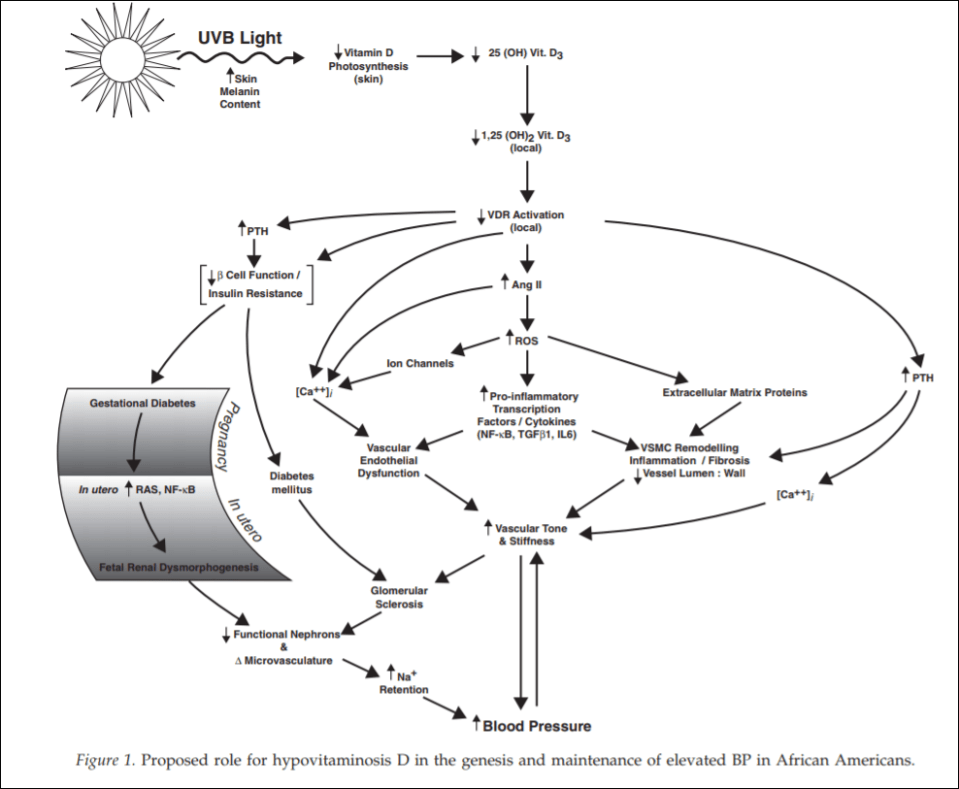
(From Rostand, 2010)
Since black Americans are no longer near the equator, their ability to synthesize vitamin D from UVB rays is diminished. This then probably leads the RAS (renin-angiotensin system) and inflammatory cytokine activation which then leads to vascular endothelial dysfunction along with structural changes to the microvasculature, which have been linked to vascular (arterial) stiffness along with increased vascular resistance, and these changes are shown to precede hypertension, which also occurs early in life. So since blacks are deficient in vitamin D, which even starts in the womb (Bodnar et al, 2007; Dawodu and Wagner, 2007; Lee et al, 2007; Khalessi et al, 2015; Seto et al, 2016), and this vitamin D deficiency most likely produces changes in large and small arteries and arterials, this could be the explanation for higher hypertension in black Americans (Rostand, 2010: 1701).
This would be a large environmental mismatch: since the population is displaced from its ancestral homeland, then this causes problems since it is not the environment where their ancestors evolved. So in this case, since black Americans are concentrated in the southeast corner of the United States, this may explain the high rates of vitamin D deficiency and hypertension in the black American community.
People whose ancestors evolved in locations with fewer UVB rays have lighter skin, whereas people whose ancestors evolved in locations with more UVB rays have darker skin. Thus, by placing populations in their opposite evolutionary environment, we can see how and why deleterious effects would occur in the population that is in the mismatched environment. For whites, skin cancer would occur, whereas for blacks, higher rates of hypertension and low birth weights occur.
Looking at levels of vitamin D deficiency in races is a great way to understand the evolution of certain populations. Because if the vitamin D hypothesis is correct, if skin color is an adaptation to UVB rays, with light skin being an adaptation to low UVB while dark skin is an adaptation to high UVB, then we can safely hypothesize about certain problems that would arise in races that are outside of their natural habitats. We have confirmed these hypotheses—black Americans who are outside of the location that their ancestors evolved in are more likely to have deleterious symptoms, and the symptoms are due to differences in vitamin D production, which come down to differences in skin color and how the skin synthesizes vitamin D in low-light environments.
Even though blacks have stronger bones than whites, this does not mean that they do not experience fractures at a high rate—especially children—and since the association was noticed, then by supplementing with vitamin D, this may lower the disparity of these types of injuries.
Since black Americans, compared to their evolutionary history, live in low-light environments, this then explains the how and why of vitamin D deficiency and why blacks need to supplement with vitamin D; no matter if certain studies show that blacks are ‘healthy’ even though they have low levels of vitamin D. If true (which I strongly doubt), that does not mean that black Americans should not supplement with vitamin D, because numerous other maladies are associated with vitamin D intake. This is one aspect where understanding the evolution of our species and the different races in it would lead to better medical care for individuals and ancestral groups that may need special treatment.
It is clear that race and geography should inform vitamin D intake, for if we do this, many diseases that arise can be ameliorated and quality of life can increase for everyone.
“Latinos”, Brazilians, Mixed-Race Individuals and Race Concepts
2050 words
How do “Latinos”, Brazilians, and mixed-race individuals fit into Hardimon’s (2017) differing race concepts (racialist, minimalist, populationist, and socialrace)? It’s easier explaining how “Latinos” fit into this, but mixed-race individuals are a bit trickier (for instance, the minimalist concept of race does not say anything about it and is therefore vague in that respect). This article will discuss these two populations and see where they fit into these categories.
Mixed-race individuals
Mixed-race individuals are tricky to place in these conceptions of race that Hardimon (2017) lays out and defends. For example, minimalist race itself is vague; it does not say which populations/individuals with populational characteristics would be placed, the argument just establishes the biological reality and significance of race. The concept of the “one drop rule” (was a legal) is a social standard in that anyone with “one drop” of “black blood” was deemed black (which, it seems, did well for so-called conceptions of “racial purity” since most white Americans have low amounts of black ancestry; Bryc et al, 2015).
The one drop rule was an attempt to limit racial miscegenation (racial mixing), and it seems to have, for the most part, worked since many white Americans have low to no African ancestry (since 95 percent of white Americans have no African ancestry; Bryc et al, 2015).
Though, as Hardimon (2017: 49) writes, the fact that individuals must have a race is a holdover from the racialist concept; minimalist race, as I’ve covered, is not defined by the features of an individual but is defined by the features of the group said individual belongs to. It is defined in terms of group—not individual—characteristics. So just because individual I doesn’t look like their R but instead looks like an R2, for example, doesn’t make individual I an R2; individual I is still an R even though they look like an R2 since the concept is based on shared group characteristics.
Hardimon doesn’t really discuss mixed-race individuals in his book; there’s only really one note on the subject (and it’s about social race, pg. 209, note 54):
People who are members of more than one socialrace in a socialrace regime that does not recognize mixed race as a racial position will be in the anomalous situation of not having an established socialrace position in society. Having such a position is one way of being a “normal” member of society organized around the institution of socialrace. Not to have such a position is to have no place in the social world along the dimension of socialrace. Hence, perhaps, the pathos of mixed-race individuals seeking social recognition for their distinctive mixed race identity.
Though, in certain (racialist/socialrace) societies, a mixed-race individual would become what the “lower” race is in that society. For instance, if an individual were half white and half black—like the former President of the United States Barack Obama—he would be designated as “black”, as we all know (since he’s the first black President of the United States). This is known as the concept of “hypodescent” and has its basis in Hardimon’s socialrace concept since racial status of the offspring is designated to the parent who has lower “standing” than the majority in said country. So, therefore, the concept of hypodescent is the concept of socialrace in action.
Mixed-race individuals are seen as members of their “lower-status parent group“, which shows how racial constructivism is alive today. One is designated the lower-status of their parent in a hierarchical manner—one way in which the socialrace concept borrows from the racialist race concept in that it is hierarchical.
The researchers found, for example, that one-quarter-Asian individuals are consistently considered more white than one-quarter-black individuals, despite the fact that African Americans and European Americans share a substantial degree of genetic heritage. One Drop Rule Persists—Harvard
Brazil
How does this work in Brazil? Surely this makes problems for racial concepts, right?
Brazilians don’t use the term “race” (raca), but the term “color” (cor). “The reason the word Color (capitalized to call attention to this particular meaning) is preferred to race in Brazil is probably because it captures the continuous aspects of phenotypes” (Parra et al, 2003). Clearly, the conception of “race” (raca) in Brazil comes down to what “color” (cor) one is; and so we should state that Brazilian society is stratified into “colors” and not true “races”. The 1872 Brazilian census created four “color” groups “white, caboclo, black and brown (branco, caboclo (mixed indigenous-European), negro and pardo). These groups were always defined by the same formula: Colour group = members of a pure race + phenotypes of this race in the process of reversion (Guimaraes 1999)” (Guimaraes, 2012: 1157).
Though, distinct from Hardimon (2017), Guimaraes (2012: 1160) argues that the Brazilian color system is, in fact, a racial system:
What makes colour in Brazil a racial term is precisely the fact that the physiognomic traits used by racialists to distinguish different human races became convoluted with the original European system of classification based on shades of skin colour.
Hardimon (2017: 49) writes:
On the other hand, it is not clear that the Brazilian concept of COR is altogether independent of the phenomenon we Americans designate using ‘race.’ The color that ‘COR’ picks out is racial skin color. The well-known, widespread preference for lighter (whiter) skin in Brazil is at least arguably a racial preference. It seems likely that white skin color is preferred because of its association with the white race. This provides a reason for thinking that the minimalist concept of race may be lurking in the background of Brazilian thinking about race.
Someone who is “white” (identifies as white) in Brazil will (most likely) not be white in America; this is due to their differing classification system based on color, which is loosely tied with the minimalist concept, but is distinct from it in that it’s just based largely on the color of one’s skin (one of many requisites for minimalist racehood).
The role of race and color in regard to Brazilian society is complex, biologically, sociologically, and psychologically; but it’s clear that some concept of what we could call a “classical” race concept—however crude—could be said to be in use in Brazil today.
Latinos/Hispanics
The US Census Bureau states that “People who identify their origin as Hispanic, Latino, or Spanish may be of any race.” This is true; just because one derives from a Latin American country does not mean that they are some kind of “Latino” or “Hispanic” race.
Take, as an example, the case of Alberto Fujimori. Alberto Fujimori is the son of Japanese immigrants to Peru, and he eventually ended up becoming the President of Peru. His parents emigrated to Peru and he was born in Lima. Now here’s where things get tricky: is he all of a sudden some new type of “race” called “Hispanic” or “Latino”, all because he was born across the ocean? Is Pope Francis all of a sudden not Italian by ancestry since he was born in Argentina? Are people who are born in Argentina, Chile, and Paraguay with direct ancestry to Germany and Italy all of a sudden no longer German or Italian but some new “Hispanic” or “Latino” race? No! Just because you’re born not in your ancestral home does not mean you “become” whatever society designates that part of the world (in this case “Latin America”). Their race does not change on the basis of where they are born; their individual ancestries can still be traced back to their countries of origin, therefore attempting to “racialize” the terms “Hispanic” or “Latino” do not make any sense.
“Hispanics” do not—and cannot—count as a minimalist race on the basis of one condition: they do not share a single pattern of visible physical features. No one pattern of hair, skin color, lip shape, eye shape etc. They do not share a single geographic origin; they have a mixture of Ancestry from Africa, Europe, and Asia. “Hispanics” can be seen, obviously, as a mixture of minimalist races. “Hispanics” are denied minimalist racehood since they do not exhibit characteristics of minimalist races, which is even echoed, as shown above, by the US Census Bureau.
Hardimon (2017: 39) writes:
To deny that Latinos constitute a race is not to deny that individual Latinos or Latinos as a group can be the targets of racism (for example, owing to skin color). Nor is it to deny that Latinos are often regarded as “racially other” (as differing in some essential humanly important way corresponding to skin color) by members of other racialized groups (for example, Anglos). … Nor is it to deny that they constitute a socialrace in my sense of the term. Still less does it imply that Latinos ought not to aspire to a degree of solidarity connoted by the Spanish word raza.
So “Latinos” can be designated as a socialrace (though socialraces do not always have a mirrored minimalist race), but not as a minimalist race since they do not fit the criteria for minimalist racehood. Many “Latinos” can be said to be mestizos, which are half European (normally of Spanish descent) and half Indian. Still, further, they can be castizos, about three-quarters European and one-quarter Indian. Then you have the “Latino” Carribean countries (Dominican Republic, Cuba, Puerto Rico) with differing amounts of admixture from all over, from different minimalist races. Though, in America, most Dominicans would be counted as “black” under the concept of “hypodescent”—the one drop rule. Many Cubans can be seen to have majority Spanish ancestry, and its the same for Puerto Ricans.
“Latinos/Hispanics” do not constitute a major race (in the minimalist and populationist sense) because they are a mixture of different minimalist races. This does not mean, however, that one designated as “Latino” in America does not have full ancestry to a European country; this is how the concept of “Latino” in America uses the concept of socialrace—it’s only based on the perceived race of the individual (that they derive from a “Latino” country) and that therefore makes them “Latino”, all the while ignoring their actual racial ancestry.
There is even a phrase in Latin America “Mejorar la raza” or “improve the race” by having children with lighter-skinned people since light skin is seen as beautiful in Latin America. They want to better “their race” (even though they—as “Latinos”—don’t have a race), and so they will attempt to have children with lighter and lighter people (i.e., people who have more and more European ancestry) to “improve their race” (i.e., their socialrace) since European features are seen as more beautiful in Latin America.
Most of the ruling class in Latin America is of European descent, while the lower classes are of admixed/unadmixed Indians (coming from differing tribes). This, one can say, is one way that socialrace is used in Latin America.
Conclusion
Brazilians and “Latinos/Hispanics” clearly could have been grouped in the mixed-race category, but each of these subjects has distinct concepts it needed to discuss. The Brazilian concept of “cor” and “raca” are loosely intertwined; they can be said to use aspects of mimimalist races. On the other hand, “Latinos/Hispanics” are not designated minimalist racehood on the basis that they do not share a single pattern of physical features, nor do they share a geographic origin, since the groups that make up “Latinos” (which are minimalist races) are the geographic locations in question. “Latinos/Hispanics” are not minimalist races because they do not exhibit the features of minimalist races.
Mixed-race individuals, regarding the socialrace concept, can be seen to be the “lower” of the races they are admixed with on the social ladder—which is how it is in America (the concept of hypodescent). The existence of mixed-race individuals does not invalidate the concept of race; minimalist racehood is not defined on the basis of individual characters, but on the basis of the characters of the group. Therefore this does not go against the concept of minimalist race.
The concepts of race can definitely survive these anomalies when describing the biological realities of race; some of them can be said to be socialraces for one respect, whereas in reality, they are mixtures of minimalist races. Races exist and the existence of Brazilians (even with their own categorization of races/colors) and “Latinos/Hispanics” and other mixed-race groups/individuals do not rail against any concepts that purport to argue for the existence and biological reality of race.
A Simple Argument for the Existence of Race
1550 words
Race deniers say that there is too small of a genetic distance between races to call the so-called races “races”. They latch on to Lewontin’s 1974 analysis, trumpeting that genetic distance is too small for there to be true “races”. There is, however, a simple way to bypass the useless discussions that would ensue if one cites genetic evidence for the existence of race: just use this simple argument:
P1) There are differences in patterns of visible physical features which correspond to geographic ancestry
P2) These patterns are exhibited between real groups, existing groups (i.e., individuals who share common ancestry)
P3) These real, existing groups that exhibit these physical patterns by geographic ancestry satisfy conditions of minimalist race
C) Therefore race exists and is a biological reality
This argument is simple; anyone who denies this needs to provide a good enough counter-argument, and I’m not aware of any that exist to counter the argument.
P1 shows that there are patterns of visible physical features which correspond to geographic ancestry. This is due to the climates said race evolved in over evolutionary history. Since these phenotypes are not randomly distributed across the globe, but show distinct patterning based on geographic ancestry, we can say that P1 is true; different populations show patterns of different physical features which are not randomly distributed across the globe. Further, since P1 establishes that races are populations that look different from each other, it guarantees that groups like the Amish, social classes etc are not counted as races. P1 further allows a member of a given race to not show the normative physical characters that are characteristic of that race. It further allows for the possibility that individuals from two different races may not differ in their physical characters. These visible physical characters that differ by populations we then call races also need to be heritable to be biological. “Because the visible physical features of race are heritable, the skin color, hair type, and eye shape of children of Rs tend to resemble the skin color, hair type, and eye shape of their parents” (Hardimon, 2017: 35). P1 is true.
P2 shows that these patterns of visible physical features are exhibited between real, existing groups. That is, the groups that exhibit these patterns exist in reality. No one denies this either. Differences in physical features that these real, existing groups exhibit can then be used as proxies for factors in P1. Though, like with which populations figure into this concept, the minimalist race concept doesn’t say—it only establishes the biological existence of races. “In recent years the concept of the continent has come under fire for not being well defined. 59 It is of interest that the formation of the concepts CONTINENT and RACE are roughly coeval. One wonders if the geneses of the two ideas are mutually entwined. Could it be that our idea of continent derives in part from the idea of the habitat of a racial group? Could it be that the idea of a racial group gets part of its content from the idea of a group whose aboriginal home is a distinctive continent? Perhaps the concepts should be thought of as having formed in tandem, each helping to fix the other’s reference” (Hardimon, 2017: 51). Since these real, existing populations that were geographically separated for thousands of years show these visible physical patterns, P2 is true.
P3 follows from the specification of the concept of minimalist race. If these populations that exhibit these distinct visible characters and if they are non-randomly distributed across the globe then this satisfied the argument for the concept of minimalist race. The specification of the minimalist concept of race states that groups satisfy the requisites for the concept by being distinguishable by patterns of visible physical features (P1) and that individuals who share a common ancestry peculiar to them which derive from a distinct geographic location (P2) exist as real groups. Since P1 and P2 are true, P3 follows logically from P1 and P2, which then leads us to the conclusion which is true and establishes the argument for the minimalist concept of race as a sound and valid argument.
C is then the logical conclusion of the three premises: race exists and is a biological reality since the patterns of visible physical features are non-randomly distributed across the globe and are exhibited by real, existing groups. Since all three premises are true and the conclusion is true, it is a valid argument; since the premises are true the argument is sound. No one can—logically—deny the existence of race when presented with this logical proof.
Though notice the argument doesn’t identify which populations are designated as “races” (that’s for another article), the argument just establishes that race exists and it exists as a biological reality. Notice also how this conception of race is sort of like the “racialist concept”, but it takes it down to its barest bones—only taking the normatively important, superficial biological physical features (these features establish minimalist races as biologically existing).
Notice, too, that I did not appeal to any genetic differences between the races, indeed, in my opinion, they are not needed when discussing race. All that is needed when discussing race and whether or not it is a biological reality is asking three simple questions:
1) Are there differences in patterns of visible physical features that correspond to geographic ancestry? Yes.
2) Are these patterns exhibited by real, existing groups? Yes.
3) Do these real, existing groups satisfy conditions of minimalist race? Yes
Therefore race exists.
These three simple questions (just take the premises and ask them as questions) will have one—knowingly or not—admit to the biological reality and existence of race.
Do note, though, nothing in this argument brings up anything about what we “can’t see”, meaning things like “intelligence” or mores of these races. This concept is distinct from the racialist concept in that it does not mention normatively important characters; it does not posit a relationship between visible physical characters and normatively important characters; and it does not “rank” populations on some type of scale. “Also, the conjoint fact that a group is characterized by a distinctive pattern of visible physical characteristics and consists of members who are linked by a common ancestry and originates from a distinctive geographic location is of no intrinsic normative significance. The status of being a minimalist race has no intrinsic normative significance“ (Hardimon, 2017: 32).
Clearly, one does not need to invoke genetic differences to show that race exists as a biological reality. That races differ in patterns of visible physical features which are inherited from the parents and are heritable establishes the biological reality of minimalist race. I really see no way that one could, logically, deny the existence of race given the argument provided in this article. Race exists and is a biological reality and the argument for the existence of minimalist race establishes this fact. Races differ in physiognomy and morphology; these physical differences are non-randomly distributed by geographic ancestry/at the continental level. These populations that show these physical differences share a peculiar ancestry. Knowing these facts, we can safely infer the existence of race. It is the only logical conclusion to come to. Note that the minimalist concept is deflationist—meaning that racialist races do not exist and that this concept enjoys what the racialist concept was supposed to, it is deflationary in the aspect that it takes the normative physical differences from the racialist concept. It is realist since it acknowledges the existence of minimalist race as genetically grounded and relatively superficial but still very significant biological reality of race.
Races can exist as minimalist races and socialraces—no contradiction exists. minimalist race, and its “scientific” companion populationist race (which I will cover in the future) show that there is a well-formulated argument for the existence of race (minimalist race concept) whereas the other concept shows how it is grounded in science and partitions populations to races (populationist concept; both are deflationary). (Read the descriptions of racialist race, minimalist race, populationist race, and socialrace.) You don’t need genes to delineate race; you only need a sound, valid argument based on biological principles. Minimalist races exist.
Race exists and is a biological reality, even if it is ‘socially constructed’ (what isn’t?), our social constructs still correspond to differing breeding populations who share peculiar ancestry and show patterns of visible physical features establish the existence of race.
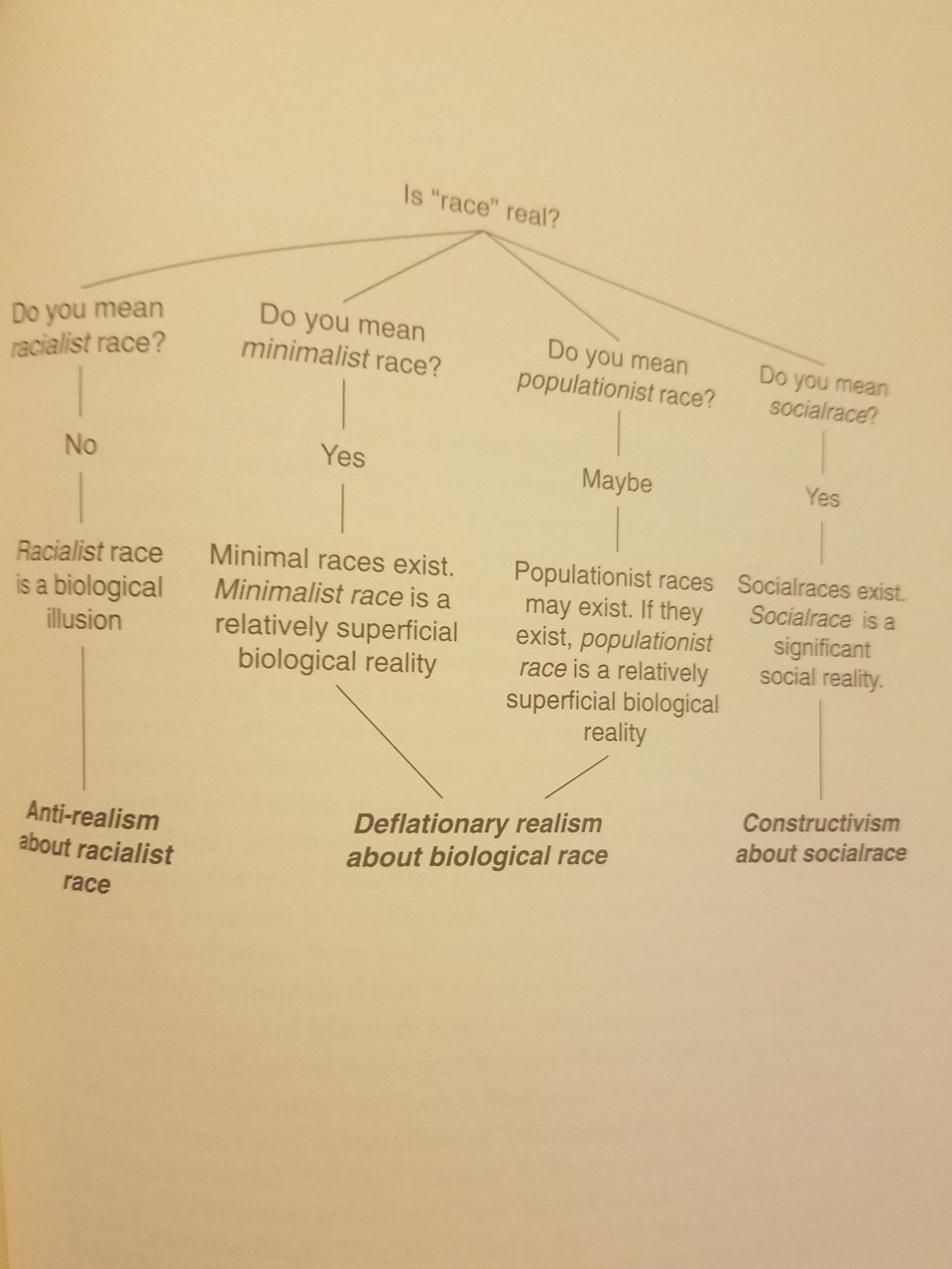
From Hardimon (2017: 177)
(I also came across a book review from philosopher Joshua Glasgow (Book Review Rethinking Race: The Case for Deflationary Realism, by Michael O. Hardimon. Harvard University Press, 2017. Pp. 240.), author of A Theory of Race (2009) who has some pretty good critiques against Hardimon’s theses in his book, but not good enough. I am going to cover a bit more about these concepts then discuss his article. I will also cover “Latinos” and mixed race people as regards these concepts as well.)
4/19/2018 edit: Two more simple arguments:
(Where P is population, C is continent and T is trait(s)
Population P that evolved in continent C have physical traits T which correspond to C.
 NotPoliticallyCorrect