Home » Race Realism (Page 21)
Category Archives: Race Realism
Differing Race Concepts and the Existence of Race: Biologically Scientific Definitions of Race
2700 words
Do you need to look at genetic differences between races to see if race is real? Some may argue that you do, and when you do you’ll see that genetic variation is too small to say that race exists. However, other arguments exist that do not look at genetic differences between races, but look at geographic ancestry, reproductive isolation between races, and morphologic differences. Those three variables are enough to prove the existence of race without looking at genetic differences between races. They do correspond to genetic differences between races. The four concepts I will briefly lay out are from Michael Hardimon, professor of philosophy at University of California, San Diego. The concepts are the racialist concept of race, minimalist concept of race concept, populationist concept of race, and the socialrace concept of race. One doesn’t need to look at the racialist concept of race to prove the existence of race, which I will prove below.
Michael Hardimon published Rethinking Race: The Case for Deflationary Realism earlier this year. In the book, he makes the case that race exists if minimalist race exists (I will get into what minimalist race entails below). Nevertheless, race deniers will say that even by looking at variables such as morphology, reproductive isolation, and geographic ancestry, race as a concept is scientifically invalid. This is patently false.
Concepts of race
The racialist concept of race
Hardimon’s first race concept is the racialist concept. The racialist concept (keep in mind, this is, as Hardimon writes on page 17 of his book Rethinking Race “the specific concept I have dubbed “the racialist concept” which “is hierarchal“) as defined by Hardimon holds that “racialist race is the idea of a fundamental division between groups and individuals” (Hardimon, 2017: 17). I think that Hardimon strawmans the racialist concept as he as defined it, but that’s for another day.
He also says that the racialist concept “is closely associated with racism” while the terms racialism and racism are “sometimes used interchangeably” (Hardimon, 2017: 17).
His argument against the racialist concept of race (as he defines it) is as follows (Hardimon, 2017: 21):
A third line of argument starts from the idea that in order for racialist races to exist, certain things must be true of human genetics, namely the following:
(a) The fraction of human genetic diversity between populations must exceed the fraction of diversity between them.
(b) The fraction of human genetic diversity within populations must be small.
(c) The fraction of diversity between populations must be large.
(d) Most genes must be highly differentiated by race.
(e) The variation in genes that underlie obvious physical differences must be typical of the genome in general.
(f) There must be several important genetic differences between races apart from the genetic differences that underlie obvious physical differences.
Note: (b) says that racialist races are genetically racially homogeneous groups; (c)-(f) say that racialist races are distinguised by major biological differences.
Call (a)-(f) the racialist concept of race’s genetic profile.
Now that his argument against the racialist concept (as he defines it) is laid out, you can see why I said that I think he strawmans the racialist concept. But I’ll get into that another day.
He then cites Lewontin’s (1972) analysis of blood groups by race as evidence against the racialist concept. Lewontin found that 85.4 percent of total human variation fell within populations. He also found that populations that populations classically defined as human races (Caucasians, Africans, Mongoloids, South Asian Aborigines, American Indians, and Oceanians) accounted for 8.3 percent of total human variation. Total variation between the classically defined races accounted for 6.3 percent of the variance.
It’s worth noting that the numbers given by Lewontin are true; where he goes wrong is assuming that there is no taxonomic significance for race based on the data he got from his analysis. “Call this Lewontin’s cleaver,” writes Hardimon on page 22.
Then in 2002, 31 years after Lewontin published his analysis, A.W.F. Edwards published his paper Human Genetic Diversity: Lewontin’s Fallacy. (Edwards, 2003). In the paper, Edwards argues that Lewontin’s conclusion is incorrect. Edwards (2003: 800-801) writes in his conclusion (emphasis mine):
There is nothing wrong with Lewontin’s statistical analysis of variation, only with the belief that it is relevant to classification. It is not true that ‘‘racial classification is … of virtually no genetic or taxonomic significance’’. It is not true, as Nature claimed, that ‘‘two random individuals from any one group are almost as different as any two random individuals from the entire world’’, and it is not true, as the New Scientist claimed, that ‘‘two individuals are different because they are individuals, not because they belong to different races’’ and that ‘‘you can’t predict someone’s race by their genes’’. Such statements might only be true if all the characters studied were independent, which they are not.
Of course, Lewontin’s conclusion is fallacious because small genetic differences do not entail that racial classification that race has no taxonomic significance (Richard Dawkins accepts the taxonomic existence of race). As you can see from the quote from Edwards, he does not object to Lewontin’s analysis of the races, he objects to his conclusion—namely that races do not exist based on the within-race variation being greater than between-race variation.
On page 22-23, Hardimon writes about Edwards’ objection to Lewontin’s conclusion:
Lewontin’s locus-by-locus analysis (which does not consider the possibility of a correlation between individual loci) does not preclude the possibility that individual loci might be correlated in such a way that people could be grouped into traditional racial categories. The underlying thought is that racial classification would have “taxonomic significance” were it possible to group people into traditional racial categories by making use of correlations between individual loci. However, Lewontin’s argument that there are no racialist races because the component of within-race genetic variation is larger than the component of between-race variation is untouched by Edwards’s objection.
In 2002, Rosenberg et al, in their paper Genetic Structure of Human Populations confirmed Lewontin’s analysis. They looked at 377 autosomal loci in 1,056 individuals from 52 populations and found that within-population differences between major groups (Africa, Europe, Asia, the Middle East, Central and South Asia, East Asia, Oceania, and America) accounted for 3-5 percent of genetic variation while genetic differences between individuals accounted for 93-95 percent of genetic variation. So Rosenberg et al (2002) confirmed Lewontin’s (1972) analysis—though do recall that Lewontin’s conclusion is incorrect. According to Hardimon’s interpretation of the racialist concept of race, both Lewontin’s and Rosenberg et al’s analysis disprove the racialist concept of race, but that doesn’t mean that there is no scientific basis for the biological reality of race (Hardimon, 2012).
The minimalist concept of race
The minimalist concept of race is similar to the racialist concept, though there are some stark differences. It does not say that there are intrinsic differences between races—call them essences if you will), but it does say that you can distinguish races by patterns of different physical features such as skin color, hair type, nose shape, morphology, etc, which then correspond to differences in geographic ancestry in geographically, genetically isolated breeding populations.
The minimalist concept of race further states that (i) races are distinguised from other races by patterns of visible physical features; (ii) the members are linked by a common ancestry which is peculiar to members of the group; and (iii) this group must originate from a distinct location.
The minimalist concept of race does not require: that the fraction of human genetic diversity between minimalist races is larger than the fraction of diversity within them; it is compatible with within-race diversity being large and between-race diversity being small; it does not require most genes to be highly differentiated by race; it does not require the existence of a lot genetic differences between races that underlie more than the phenotypic differences already noticed; the concept does not imply that there can be predictions made from yet unstudied characteristics; it finally does not require any genetic differences between races other than those found in the genes that underlie differences in physical appearance between race. This is called the minimalist concept of biological race (Hardimon, 2017: 66) and it survives all objections from Lewontin’s and Rosenberg et al’s analysis of between-race genetic variation.
This is my favorite race concept, personally, because it covers any and all objections from the race-denialist crowd—people who deny any genetic differences between races—because the only genetic differences it counts on are those physical traits that are already noticed.
Hardimon (2017: 29) writes:
Such readers should feel free to regard the minimalist concept of race, that is, as a concept that, though in many respects similar to the ordinary concept, is nonetheless distinct from it. What I would insist on is that minimalist races (groups satisfying the minimalist concept of race) are *races* (that is races so properly called)—either because the minimalist concept of race just is the ordinary concept of race or because it captures enough of the ordinary concept of race for minimalist races to be counted as races. My view is that if it can be shown that minimalist races exist, races exist. And if it can be shown that *minimalist race* is real, race is real.
The populatonist concept of race
The populationist concept of race is a nonessentialist, non-hierarchical concept of race that slightly differs from the minimalist concept of race. The populationist concept of race can be said to be a scientific concept of race (as can the minimalist concept) because it characterizes races as groups belonging to different groups of biological descent, they are distinguished by patterns of phenotypic differences, and these phenotypic differences trace back to geographically separated and genetically isolated founding populations.
The populationist concept of race also holds that “A race is a subdivision of Homo sapiens—a group or population that exhibits a distinctive pattern of genetically transmitted phenotypic characters that corresponds to the group’s geographical ancestry and belongs to a biological line of descent initiated by a geographically separated and reproductively isolated founding population” (Hardimon, 2017: 99). So with these criteria, you can see that even if you do not accept the racialist concept of race (as Hardimon defines it), you can still be a race realist. The populationist concept is likely to exist, and if the populationist concept of race exists then race is real.
Defining race as geographically and reproductively isolated breeding populations that share a common line of biological descent with similar phenotypic characters is as barebones a concept of race as you can get—and it is perfectly in line with how most people view races on the basis of phenotypic characterization. The populationist concept of race supposes that numerous concepts from the racialist concept of race are true—but do not presuppose any to-be-studied differences between those races. The strength of the populationist argument, as you can see, is very strong and it holds up to numerous lines of criticism very well. Although both the populationist and minimalist race concepts do not presupposed any to-be-studied differences between races, this still is not good enough for race deniers.
It is clear that without even looking at the brain and physiological differences between races, that race does indeed exist and it does—contrary to popular belief—have implications for people’s health of certain races.
The socialrace concept of race
Finally, the last concept of race laid out by Hardimon is the concept of socialrace. The concept of socialrace takes a race to be a racialist race, it refers to a position that is occupied by a social group that is a socialrace, and the socialrace concept refers to the system of social positions that are socialraces. This concept of race is, clearly, different from the minimalist and populationist race concepts but does indeed correlate with popular notions of race (and would correlate with the minimalist and populationist concept of race very well). The socialrace concept is, basically, what is believed to be racialist races.
The concept of socialrace is a concept of race as a social group (Hardimon, The Ontology of Race: 31)
The socialrace concept differs from the minimalist and populationist concept of race in that it looks at so-called social—not biological—correlates of race. Though, still, the socialrace concept can be said to show the reality of race since how one socially defines themselves correlates almost perfectly with geographic ancestry (which is a prerequisite for the existence of the minimalist concept of race and the populationist concept of race) (Tang et al, 2005). They showed that self-identified racial categories lined up almost perfectly with geographic ancestry (99.86 percent of the time). So, as you can see, the concept of socialrace also gives credence to the existence of the minimalist and populationist concepts of race.
This concept of race—as its name implies—does not talk race is a biological manner, but a social one, as its name implies. However, due to the extremely high chance that one’s self-identified race (their socialrace) lines up with the geographic ancestry of the classical races, we can see that the socialrace concept further buttresses the argument for the existence for the reality of the minimalist concept of race and the populationist concept of race.
The socialrace concept is kind of like Templeton (2014) defines race: that human races exist in a cultural sense, but not biologic sense. I have shown, though, that races exist in a cultural, social, and biological sense with the arguments presented in this article. Socialrace, culturalrace, whatever you want to call it, it is evidence for the existence of race.
Conclusion
Race exists whether or not the racialist position of race (as Hardimon defines it) is true or not. The minimalist concept of race and populationist concept of race show that race is real while the concept of socialrace further lends credence to the biological models of the minimalist and populationist concept of race. Even still, people who deny race because the genetic distance between races is too small for their to be any meaningful differences between them do not accept that three arguments above (sans the racialist concept) for the existence of race. They’ll still talk about the genetic differences between them and, say, morphology, but the minimalist concept of race and the populationist concept of race define race in enough of a way that genetic differences do not need to be looked at—we can only look at reproductive isolation, morphology, geographic ancestry and physical differences between minimalist and populationist races such as hair, nose, and skin color along with morphological differences.
Minimalist and populationist races exist and are a biological reality. We can take those two concepts to be a scientific basis for race. While we can take the concept of socialrace not as a biological concept, but as a social concept and we can then say that socialrace is socially real while being a significant social reality. That social reality is manifested by noticing different racial phenotypes, along with differences in SES, educational attainment, etc, and placing different races in different average social positions, which would correlate with the concepts of race mentioned above. This also correlated nearly perfectly with geographic ancestry. So, I’m saying it again, the existence of race as a social reality is real; the existence of socialrace buttresses the arguments for both the existence of the minimalist concept of race and the populationist concept of race—both of which are scientific concepts of race.
Minimalist races exist, and is a superficial biological reality, populations races may exist and if they exist, they are a relatively superficial biological reality. Socialraces exist and are a social reality which also lend credence to the minimalist and populationist concepts. I personally am privy to the minimalist race concept because it is shown to be real, so race is real.
In sum, race exists whether you look at genetic differences between races or not, morphology, geographic ancestry, reproductive and genetic isolation are all you need to prove the existence of race. There is a scientific concept of race, and the minimalist and populationist race concepts provide the existence for it, while the socialrace concept does as well. It is clear that for a scientific concept of race, you only need phenotypic variation, morphologic variation between races,
(Also read the American Rennaisance review for the book, A Tactical Retreat for Race Denial. I think it is balanced and fairly written, though a bit biased and doesn’t account for Hardimon’s views well enough in my opinion.)
Open Thread
Talk about anything (reasonable).
In honor of Movember, I’m going to take some time this month to write about prostate cancer, it’s causes and how to prevent it (doctor supervision, etc). Since ‘charities’ like the Susan G. Komen Foundation are very shady and all eyes go to them Movember gets looked over. Movember is to raise awareness for prostate cancer and other diseases that plague men. Also read I Will Not Be Pinkwashed: Komen’s Race is for Money, Not the Cure.
See also my articles on race and prostate cancer:
Race, Testosterone, and Prostate Cancer
Explaining the Black-White Prostate Cancer Gap
Racial Differences in Prostate Cancer: Part II
Also on prostate cancer, one meta-analysis show there is no B-W PCa gap:
This meta-analysis concludes that there are no racial differences in the overall and prostate cancer–specific survival between African American and White men.
While another study shows the same:
Although African-American patients tend to have higher pretreatment PSA levels than white patients, the outcome for the disease is similar in the two groups when stratified by known pretreatment prognostic factors. Our data provide no evidence for the hypothesis that prostate cancer in African-Americans is intrinsically more virulent than in whites.
Most Human Performance Traits Do Not Lie On a Bell Curve
1050 words
Steve Sailer published an article the other day titled Wieseltier vs. “The Bell Curve” and I left a comment saying that psychological traits are not normally distributed. Two people responded to me, and I replied back but Sailer didn’t approve my two comments. I have a blog, so I can post it here.
“We revisit a long-held assumption in human resource management, organizational behavior, and industrial and organizational psychology”
Maybe instead debunking allegedly long-held assumptions they should Notice that none of those disciplines actually exists.
They do actually exist.
“Human resource management: Human Resource Management (HRM) is the term used to describe formal systems devised for the management of people within an organization. The responsibilities of a human resource manager fall into three major areas: staffing, employee compensation and benefits, and defining/designing work.”
Organizational behavior: “the study of the way people interact within groups. Normally this study is applied in an attempt to create more efficient business organizations. The central idea of the study of organizational behavior is that a scientific approach can be applied to the management of workers.”
Industrial and organizational psychology: “This branch of psychology is the study of the workplace environment, organizations, and their employees. Technically, industrial and organizational psychology – sometimes referred to as I/O psychology or work psychology – actually focuses on two separate areas that are closely related.”
O’Boyle Jr and Aguinis (2012) write:
We conducted 5 studies involving 198 samples including 633,263 researchers, entertainers, politicians, and amateur and professional athletes. Results are remarkably consistent across industries, types of jobs, types of performance measures, and time frames and indicate that individual performance is not normally distributed—instead, it follows a Paretian (power law) distribution. Assuming normality of individual performance can lead to misspecified theories and misleading practices. Thus, our results have implications for all theories and applications that directly or indirectly address the performance of individual workers including performance measurement and management, utility analysis in preemployment testing and training and development, personnel selection, leadership, and the prediction of performance, among others.
Even most types of job performance and performance measures don’t fit a normal curve.
You say, “…psychological traits aren’t normally distributed.”
But the abstract you linked says,
…individual performance is not normally distributed.
Yes, those of us who have had the misfortune to manage work groups know all about 80/20. This is performance, not “psychological traits.”
Psychological tests aren’t a measure of performance? Traits like IQ only show a normal distribution because the normal distribution is built into the tests (see below).
The other one linked says,
… at many physiological and anatomical levels in the brain, the distribution of numerous parameters is in fact strongly skewed . . .
Okay. The cylinders in the straight-six engine of my BMW lean over to one side, but that doesn’t seem to effect the horsepower. This is a physical trait.
So, what of those “psychological traits”? Like IQ? Granted, it is a kind of performance, one of taking IQ tests, but the results have a normal distribution, and it’s not the kind of performance being measured in the study referenced anyway. IQ, by definition, is a “psychological trait,” and it has a normal distribution.
IQ tests have been constructed so that the scores will exhibit a bell curve distribution. That is, the tests themselves are constructed to reveal differences that are already presumed. IQ tests are constructed with the assumption that the scores are normally distributed, however, the normal distribution is built into the test. Items that 50 percent of the testees get right are kept, along with the smaller proportion of items that many testees get right. (See Richardson, 2002 for more information.) Even most psychological constructs are not normally distributed. This is like g being supposedly physiological when—if it were—it wouldn’t mimic any known physiologic process in the body.
Buzsaki and Muzuseki (2014) review data that sensory acuity, reaction time, memory word usage and sentence lengths are not normally distributed. Basic physiologic processes, too, are not normally distributed, like visual acuity, resting heart rate, metabolic rate, etc. And this makes sense, because those traits are crucial to human survival and therefore need to be malleable. Hormones raise, for instance, during a life-or-death situation, and that is what is needed for survival. So, therefore, few physiological traits are normally distributed.
Honestly, I don’t know what your point is, but I don’t disagree with what you have shown me. I know it’s true, but I’m just too far left on your ski jump curve of losers to grasp why you responded to me that way.
Wieseltier was referring to The Bell Curve, in which results have a normal distribution.
Rigbt, the IQ book. But tests are constructed with the assumption of a normal distribution, but psychological traits are not normally distributed. Read Mizsukei and Buzsaki’s work.
Burt (1967) writes:
A detailed analysis of test results obtained from a large sample of English children (4,665 in all), supplemented by a study of the meagre data already available, demonstrates beyond reasonable doubt that the distribution of individual differences in general intelligence by no means conforms with strict exactitude to the so-called normal curve.
In sum, IQ tests are constructed with the assumption that whatever is being tested lies on a bell curve. Clearly, since they are constructed in such a way, the results are forced to fit a normal distribution. But, as seen above, most traits that are critical to survival are not normally distributed, so why should intelligence/IQ be the same? The data from Buzsaki and Mizuseki (2014) show that “skewed … distributions are fundamental to structural and functional brain organization.”
(Also read The Myth of the Bell Curve and The Unicorn, The Normal Curve, and Other Improbable Creatures. where Micceri shows that achievement measures in “language arts, quantitative arts/logic, sciences, social studies/history, and skills such as study skills grammar, and punctuation” are not normally distributed. Human performance does not follow a bell curve. Also read The Bell Curve Is A Myth — Most People Are Actually Underperformers. The Bell Curve in Psychological Research and Practice: Myth or Reality?: “If IQ scores distribute normally, this does not mean that intelligence equally distribute normally in the population.” … “ In this way, a normal distribution in summated test scores, for example, would be seen as the sign of the presence of an error sufficient to give scores the characteristic bell shape, not as the proof of a good measurement.“)
My Response to Jared Taylor’s Article “Breakthroughs in Intelligence”
1300 words
Here is my reply to Jared Taylor’s new article over at AmRen Breakthroughs in Intelligence:
“The human mind is not a blank slate; intelligence is biological”
The mind is not a ‘blank slate’, though there is no ‘biological’ basis for intelligence (at least in the way that hereditarians believe). They’re just correlations. (Whatever ‘intelligence’ is.)
“there is no known environmental intervention—including breast feeding”
There is a causal effect of breast feeding on IQ:
While reported associations of breastfeeding with child BP and BMI are likely to reflect residual confounding, breastfeeding may have causal effects on IQ. Comparing associations between populations with differing confounding structures can be used to improve causal inference in observational studies.
Brion, M. A., Lawlor, D. A., Matijasevich, A., Horta, B., Anselmi, L., Araújo, C. L., . . . Smith, G. D. (2011). What are the causal effects of breastfeeding on IQ, obesity and blood pressure? Evidence from comparing high-income with middle-income cohorts. International Journal of Epidemiology, 40(3), 670-680. doi:10.1093/ije/dyr020
Breastfeeding is related to improved performance in intelligence tests. A positive effect of breastfeeding on cognition was also observed in a randomised trial. This suggests that the association is causal.
Horta, B. L., Mola, C. L., & Victora, C. G. (2015). Breastfeeding and intelligence: a systematic review and meta-analysis. Acta Paediatrica, 104, 14-19. doi:10.1111/apa.13139
“before long we should be able to change genes and the brain itself in order to raise intelligence.“
Which genes? 84 percent of genes are expressed in the brain. Good luck ‘finding’ them…
These results corroborate with the results from previous studies, which have shown 84% of genes to be expressed in the adult human brain …
Negi, S. K., & Guda, C. (2017). Global gene expression profiling of healthy human brain and its application in studying neurological disorders. Scientific Reports, 7(1). doi:10.1038/s41598-017-00952-9
“Normal people can have extraordinary abilities. Prof. Haier writes about a non-savant who used memory techniques to memorize 67,890 digits of π! He also notes that chess grandmasters have an average IQ of 100; they seem to have a highly specialized ability that is different from normal intelligence. Prof. Haier asks whether we will eventually understand the brain well enough to endow anyone with special abilities of that kind.”
Evidence that intelligence is not related to expertise.
“It is only after a weight of evidence has been established that we should have any degree of confidence in a finding, and Prof. Haier issues another warning: “If the weight of evidence changes for any of the topics covered, I will change my mind, and so should you.” It is refreshing when scientists do science rather than sociology.”
Even with the “weight of evidence”, most people will not change their views on this matter.
“Once it became possible to take static and then real-time pictures of what is going on in the brain, a number of findings emerged. One is that intelligence appears to be related to both brain efficiency and structure”
Patterns of activation in response to various fluid reasoning tasks are diverse, and brain regions activated in response to ostensibly similar types of reasoning (inductive, deductive) appear to be closely associated with task content and context. The evidence is not consistent with the view that there is a unitary reasoning neural substrate. (p. 145)
Nisbett R. E., Aronson J., Blair C., Dickens W., Flynn J., Halpern D. F., Turkheimer E. Intelligence: New findings and theoretical developments. American Psychologist. 2012;67:130–159. doi: 10.1037/a0026699.
“Early findings suggested that smart people’s brains require less glucose—the main fuel for brain activity—than those of dullards.”
Cause and correlation aren’t untangled; they could be answering questions in a familiar format, for instance, and this could be why their brains show less glucose consumption.
“It now appears that grey matter is where “thinking” takes place, and white matter provides connections between different areas of grey matter. Some brains seem to be organized with shorter white-matter connections, which appear to allow more efficient communication, and there seem to be sex differences in the ways the part of the brain are connected. One of the effects of aging is deterioration of the white-matter connections, which reduces intelligence.”
Read this commentary (pg. 162): Norgate, S., & Richardson, K. (2007). On images from correlations. Behavioral and Brain Sciences, 30(02), 162. doi:10.1017/s0140525x07001379
“Brain damage never makes people smarter”
This is wrong:
You would think that cutting out one-half of people’s brains would kill them, or at least leave them vegetables needing care for the rest of their lives. But it does not. Consider this striking story. A boy starts having seizures at 10 years of age when his right cerebral hemisphere atrophies. By the time he is 12, the left side of his body is paralyzed. When he is 19, surgeons decide to operate and remove the right side of his brain, as it is causing gits in his intact left one. You might think this would lower his IQ or leave him severely retarded, but no. His IQ shoots up 14 points, to 142! The mystery is not so great when you realize that the operation has gotten rid of the source of his fits, which had previously hampered his intelligence. When doctors saw him 15 years later, they described him as “having obtained a university diploma . . . [and now holding] a responsible administrative position with a local authority.”
Skoyles, J. R., & Sagan, D. (2002). Up from dragons: the evolution of human intelligence. New York: McGraw-Hill (pg. 282)
“Prof. Haier wants a concerted effort: “What if a country ignored space exploration and announced its major scientific goal was to achieve the capability to increase every citizen’s g-factor [general intelligence] by a standard deviation?””
Don’t make me laugh. You need to prove that ‘g’ exists first. Glad to see some commentary on epigenetics that isn’t bashing it (it is a real phenomenon, though the scope of it in regards to health, disease and evolution remains to be discovered).
As most readers may know, I’m skeptical here and a huge contrarian. I do not believe that g is physiological and if it were then they better start defining it/talking about it differently because I’ve shown that if it were physiological then it would not mimick any known physiological process in the body. I eagerly await some good neuroscience studies on IQ that are robust, with large ns, their conclusions show the arrow of causality, and they’re not just making large sweeping claims that they found X “just because they want to” and are emotionally invested in their work. That’s my opinion about a lot of intelligence research; like everyone, they are invested in their own theories and will do whatever it takes to save face no matter the results. The recent Amy Cuddy fiasco is the perfect example of someone not giving up when it’s clear they’re incorrect.
I wish that Mr. Taylor would actually read some of the literature out there on TBI and IQ along with how people with chunks of their brains missing can have IQs in the normal range, showing evidence that most a lot of our brain mass is redundant. How can someone survive with a brain that weighs 1.5 pounds (680 gms) and not need care for the rest of his life? That, in my opinion, shows how incredible of an organ the human brain is and how plastic it is—especially in young age. People with IQs in the normal range need to be studied by neuroscientists because anomalies need explaining.
If large brains are needed for high IQs, then how do these people function in day-to-day life? Shouldn’t they be ‘as dumb as an erectus’, since they have erectus-sized brains living in the modern world? Well, the human body and brain are two amazing aspects of evolution, so even sudden brain damage and brain removal (up to half the brain) does not show deleterious effects in a lot of people. This is a clue, a clue that most of our brain mass after erectus is useless for our ‘intelligence’ and that our brains must have expanded for another reason—family structure, sociality, expertise, etc. I will cover this at length in the future.
Racial Differences in Physical Activity and Acquisition of Coronary Artery Calcification
1200 words
Last week a study was published stating that white men who exercised 3 times the recommendation of 1.5 hours (450 minutes, 7.5 hours) had a higher chance of getting coronary artery calcification (CAC), which is the accumulation of plaque and calcium in the arteries of the heart. You, of course see news headlines such as: “Physically active white men at high risk for plaque buildup in arteries“; “White Men Who Exercise Every Day Have 86 Per Cent Higher Risk of Heart Disease Than Black Men, Study Claims“; “Excessive Exercise May Harm The Heart, Study Suggests “; “Excessive exercise increases risk of arterial plaque buildup in white men“; (and my personal favorite headline about this study): “You can exercise yourself to death, says new study“. People just passing by and reading the title (like most do) may then conclude that “they’re saying not to exercise because of CAC.” No, this is not what they are saying at all.
The Coronary Artery Risk Development in Young Adults (CARDIA) study is one of the most important studies in the study of coronary heart disease that have been undertaken. It is a sample of men and women, about equal numbers of each race, from Birmingham, Alabama; Chicago, Illinois; Minneapolis, Minnesota; and Oakland, California. The study began in 1985-86 and there were follow-up examinations at “1987-1988 (Year 2), 1990-1991 (Year 5), 1992-1993 (Year 7), 1995-1996 (Year 10), 2000-2001 (Year 15), 2005-2006 (Year 20), 2010-2011 (Year 25), and 2015-2016 (Year 30).” The CARDIA website writes:
Data have also been collected on physical measurements such as weight and body composition as well as lifestyle factors such as dietary and exercise patterns, substance use (tobacco and alcohol), behavioral and psychological variables, medical and family history, and other chemistries (e.g., insulin).
So there is a goldmine of information to be gleaned from this data. The study that is getting press in the news uses data from this cohort.
The study
The study is titled 25-Year Physical Activity Trajectories and Development of Subclinical Coronary Artery Disease as Measured by Coronary Artery Calcium by Laddu et al (2017). They studied three cohorts by the amount of time they exercised per week: below requirement, at requirements, or above requirements. It is recommended to exercise at least 150 minutes per week.
There were 3,175 men and women who participated in the CARDIA study between 1985 and 2011 who had CAC data available for 25 years. About 47.4 percent of the sample was black, with 56.6 being women. The cohort “consisted of 18.9% black men, 24.6% white men, 28.6% black women, and 28.0% white women” (Laddu et al, 2017).
Of the three activity levels they studies (below 150 minutes, 150 minutes, and over 150 minutes), they observed that white men who exercised 3 times the weekly recommendation (150 minutes(3)= 450 minutes=7.5 hours) had a higher chance of developing CAC. It’s worth noting that exercise time was self-reported (which is the only way I can see how something like this would work, are you supposed to follow people with a camera every day to see how long they engage in physical activity?).
In regards to the physical activity measurement, Laddu et al (2017) write:
At each of the 8 examinations, self-reported leisure-time PA was ascertained by the interviewer-administered CARDIA Physical Activity History Questionnaire.17 Participants were asked about the frequency of participation in 13 specific categories (8 vigorous intensity and 5 moderate intensity) of recreational sports, exercise, home maintenance, and occupational activities during the previous 12 months. Intensity for each activity was expressed as metabolic equivalents (METs), in which 1 MET is defined as the energy expended at rest, which is approximately equivalent to an oxygen consumption of 3.5 mL per 1 kg of body weight per minute.18Vigorous activities (≥6 METs) included running or jogging; racquet sports; biking; swimming; exercise or dance class; job lifting, carrying, or digging; shoveling or lifting during leisure; and strenuous sports. Moderate-intensity activities (3-5 METs) included nonstrenuous sports, walking and hiking, golfing and bowling, home exercises or calisthenics, and home maintenance or gardening.19 Each activity was scored according to whether it was performed for 1 hour or longer during any 1 month during the past year, the number of months it was performed at that level, and the number of months the activity was performed frequently. Each activity was then assigned an intensity score, ranging from 3 to 8 METs, and a duration threshold (ranging from 2-5 hours per week), above which participation was considered to be frequent.20
This is a good metric; though I would like to see a study that looks at just gym-going activity and death, time spent in the gym strength training/moderate to intense cardio. Nevertheless, white men who reported more physical activity had a higher chance of acquiring CAC. Though I can see people’s recall being hazy, people over/under reporting, etc etc.
White men who exercised 7.5 hours per week were 27 percent more likely to get CAC, whereas blacks who exercised that much were at no greater risk to acquire CAC when compared to whites (7.5 hours of exercise compared to less than 2.5 hours per week). Black women who exercised less than the recommendations had a higher chance of acquiring CAC. The researchers couldn’t ascertain why white men who exercised three times the recommendations had such a higher chance of acquiring CAC by the time they reached middle age, but Dr. Jamal Rana says “however this plaque buildup may well be of the more stable kind, and thus less likely to rupture and causes heart attack, which was not evaluated in this study.” The head author, Dr. Deepika Laddu also reiterated: “it does not suggest that anyone should stop exercising.” So people who just read these click bait headlines who say “They’re telling whites not to exercise!”, you’re wrong and you should read papers and not news articles.
This is the perfect example of people reading click baity, fear-mongering headlines and running with it. I saw some people saying “They’re telling us not to exercise!” No. If you were to read the paper and any serious news articles on the matter, you’d see that they do not recommend that people do not exercise. Now the question is, why do whites who exercise more than 7.5 hours per week have a higher chance of acquiring heart disease? I can think of a few explanations (though they are not satisfactory): 1) genes: which genes? Why? How do they interact with the body over time to lead to arterial calcification?; 2) dietary habits: I’d like to know what their diet was like and see their macro composition, carbohydrates, not saturated fat, causes heart disease (Siri-Tirino et al, 2010; de Souza et al, 2015) so that may be a huge contributing factor.
Nevertheless, this is yet another physiological race difference. Oddly enough, black men are more likely than white men to have hypertension (Hicken et al, 2013).
Even though black men, on average, have higher rates of hypertension than white men, white men who are physically active for 7.5 had a higher chance of acquiring CAC than those who exercised less than 2.5 hours per week. This effect wasn’t seen in black men who had physical activity at that level, which, of course, implies that differences in genes and SES underlie this difference. I await more papers into this matter into the mechanisms of how and why this occurs and will ruminate on this myself in the future. No, this study does not tell white men not to exercise.
More Than A Few Teeth Are Needed to Rewrite Human Evolutionary History
1700 words
10/26/17 update:
Dr. Julian Benoit (who also commented on the previous findings on Graecopithecus back in May) has now commented on this finding, writing in his article The theory that humans emerged in Africa is often questioned. That’s good for science:
The most recent piece of research that seeks to stake Europe’s claim as human ancestors’ birthplace centres on two teeth: a canine and a molar. This find was greeted with some excitement outside expert circles.
But scientists have responded sceptically. Palaeoprimatologists around the world have shown that the molar is not from a representative of the human family. Teeth in mammals, including humans, are very distinctive between species. The molar from Germany is simply too dissimilar from those of the earliest African hominins. It looks more like a molar belonging to Anapithecus, a typically European species of fossil primates. These scientists have also argued that the “canine” is actually a fragment of a tooth from an antelope-like herbivorous animal.
In all three cases, the new evidence raised questions about the African origin of hominins and was critically evaluated. For now, these studies can’t be considered convincing enough to “rewrite human history” – as some excited press releases claimed. But there is no doubt that more studies of the nature will follow, again and again.
A few days ago it was announced that a few teeth were discovered in Germany which were about 9.7 million years old—about 4 million years older than the oldest hominin teeth discovered in Africa. Of course, you get click-baity mainstream news titles like Archaeology fossil teeth discovery in Germany could re-write human history. Who was the one who said that this finding ‘could rewrite human history’? The mayor of the town it was discovered in:
In the press conference announcing the find, Mainz Mayor Michael Ebling claimed the find would force scientists to reconsider the history of early mankind.
“I don’t want to over-dramatize it, but I would hypothesize that we shall have to start rewriting the history of mankind after today,” Ebling was quoted as saying.
That a mayor’s statement, who I presume has no scientific background, is being put into news titles that human history may need revision shows the low-quality of mainstream news articles when they report on new scientific findings.
There are a few problems with these claims that ‘human history needs to be rewritten’ due to a few teeth. Back in May, I covered how the finding that Graecopithicus Freybergi had a 4th molar ‘similar’ to us and was, therefore, a part of our species was incorrect and that we needed way more evidence than a few teeth and a jawbone. The same holds for these findings.
The researchers stated that they hesitated a year to publish the findings. I don’t see why; the only reason I can think of is because they believed that the finding was not ‘PC’ and therefore waited to publish their results (kind of like when Robert Putnam waited to publish his findings on diversity and social trust). However, this does not mean that the OoA hypothesis is debunked and that Europe is the home of Mankind.
However, other experts in the field say that this ‘hardly’ has us rethinking our view of human evolution. Only two teeth were discovered, and as National Geographic reported paleoanthropologist Ben Viola said by e-mail:
“I think this is much ado about nothing,” he says by email. “The second tooth (the molar), which they say clearly comes from the same individual, is absolutely not a hominin, [and] I would say also not a hominoid.”
Most of the experts contacted by National Geographic stated that the teeth looked like they belonged to pliopithecids, with Luntz’s team acknowledging that the tooth looked like it belonged to anapithecus, which is a primate that lived in Hungary and Austria around 10 million years ago. The molar is important, not because it shows that human ancestors evolved in Europe but because it would validate the fact that a femur found in the 1820s in Eppelsheim belonged to a pliopithecid and not a hominoid, says paleoanthropologist David Begun:
“The ‘canine’ looks to me like a piece of a ruminant tooth,” Begun says by email. Ruminants are cud-chewing, plant-eating mammals such as cows and sheep. “It has a funny break that makes it look a bit like a canine, but it is definitely not a canine, nor is it [from] a primate.”
David Begun also writes:
“The molar is important, because it validates an idea proposed by several researchers that a femur known from Eppelsheim since the 1820s actually does most likely belong to a pliopithecoid and not a hominoid,” says Begun.
Begun also says that the tooth looks like a ‘ruminant tooth’ (ruminant teeth being used to chew cud) and that “It has a funny break that makes it look a bit like a canine, but it is definitely not a canine, nor is it [from] a primate.”
So, as usual, such weak evidence being touted such as this has huge problems and the evidence that is being touted to rewrite human evolutionary history actually shows something completely opposite.
There are a few problems for the claim that human evolution needs to be rewritten based off of these findings:
- The paper is not peer-reviewed yet: Some may say that this shouldn’t matter, however, as I’ve shown from the few bits of peer commentary that I am able to find about this, a lot of people in the field have a few hangups about who the teeth belonged to and whether or not they belonged to members of our genus.
- You need more than two teeth to rewrite human evolutionary history: Since when are two teeth enough to say that human evolution needs a rewrite? Just like the findings back in May, this does not mean that we need to rethink human evolutionary history. You would need more than a few teeth to prove that Man began outside of Africa, just like you would need more than a few teeth to prove that man began IN Africa.
- The head researcher Herman Luntz was interviewed by Research Gate and he said:
RG: Can you say already what this find will mean for our understanding of human history?
Lutz: We want to hold back on speculation. What these finds definitely show us is that the holes in our knowledge and in the fossil record are much bigger than previously thought. So we’ve got the puzzle of having finds that, in terms of the expected timeline, don’t fit the region we found them in. We’ve got two teeth from a single individual. That means there must have been a whole population. It wouldn’t have been just one, all alone like Robinson Crusoe. So the question is, if we’re finding primate species all around the Mediterranean area, why not any like this? It’s a complete mystery where this individual came from, and why nobody’s ever found a tooth like this somewhere before.
So, of course, he wants to hold back on speculation, because he knows that you cannot make these great proclamations that human history needs to be rewritten due to two teeth—contrary to what the mayor of Mainz, Germany Michael Ebling claimed (a non-scientist). News outlets then take that statement and run with it, despite the caution from Luntz the head researcher of the study, the fact that it’s yet to pass peer review, and the fact that other researchers in the field have other things to say about it other than the fact that it may be a hominoid.
In the paper, Luntz et al (2017) write:
The relative size of the canine, i.e. the ratio of the buccal heights of C and M1, is similar to those of e.g. Dryopithecus sp., Ankarapithecus meteai but also Ardipethcus ramidus. Both, reduced size and shape of the canine likely largely indicate that the new species from Eppelsheim had lost a honing (C/p3) complex already ca. 9.7 Ma ago. From all information gathered up to now, the question arises, if the newly discovered Eppelsheim species may be related to members of the African hominin tribe.
Well the answer, according to others in the field, is that it belongs to a pliopithecid species, not a hominin. They, of course, claim that it bears a close resemblance to hominin teeth.
Of course, the two primates could have faced similar evolutionary pressure leading to convergence of traits. If the climate in one area is the same as in another area, then convergence of traits between two similar species is possible. This could also account for the similarities in teeth between this species (whatever it is) and hominins.
We’re going to need more than two teeth to rewrite human evolution. We’re going to need more than a jawbone to rewrite human evolution. The teeth that were discovered last year in Germany will need to go through a longer process to be shown to belong to a hominin species—because all of the evidence that we currently have about it points to it being a part of a priopithecus species—not a hominin species.
I recommend people wait and see/do some digging into claims from news articles that purport to show that human evolution needs ‘rewriting’, because, as you can see, this time the claim came from a governor of the town the teeth were found in. The teeth discovered look like they may be similar to species from early in our genus, however other experts in the field urge extreme caution in any interpretation of what they mean and who they belong to. Just like with the Graecopithcus case back in May, it seems to belong to another species of ape—though this one could be more closely related to us. No, this finding does not show that human evolution needs rewriting. I wish news agencies would set a higher standard of quality for their titles; but they are just trying to get clicks and will publish the most click-baity title possible. You’ll need more than a few teeth and jawbone to say that Man did not evolve in Africa, when all of the evidence we currently have points to Africa as the origin of Mankind.
Evidence for Natural Selection in Humans: East Asians Have Higher Frequency of CASC5 Brain Size Regulating Gene
1500 words
Brain size is one physical difference that the races differ on. East Asians have bigger brains than Europeans who have bigger brains than Africans (Beals et al, 1984; Rushton, 1997). What caused these average differences and the ultimate causes for them have been subject to huge debate. Is it drift? Natural/sexual selection? Mutation? Gene flow? Epigenetic? One reason why brains would need to be large in colder climates is due to heat retention, while in tropical climates heads need to be smaller to dissipate heat. One of the biggest criticisms of HBD is that there is no/little evidence of recent natural selection between human races. Well, that has changed.
CASC5 “performs two crucial functions during mitosis, being required for correct attachment of chromosome centromeres to the microtubule apparatus, and also essential for spindle-assembly checkpoint (SAC) signaling” (Shi et al, 2016). The gene has been found to be important in recent human evolution along with neurogenesis.
Shi et al (2016) genotyped 278 Han Chinese (174 females and 104 males with a mean age of 36) who were free of maladies or genetic defects. They had the coding sequences of CASC5 for humans, chimpanzees, gorillas, baboons, gibbons, orangutans, tarsiers, Denisovans, and Neanderthals. They downloaded genotypes from the Human Genome Project for their analysis.
They compared CASC5 among three human species: humans, Neanderthals, and Denisovans. Using chimpanzees as an outgroup, they discovered 45 human-specific mutations, 48 Neanderthal-specific mutations, and 41 Neanderthal-specific mutations. Further, when one exon region was aligned among modern humans, non-human primates and other mammalian species, 12 amino acid sites showed divergence between modern humans, Neanderthals, and Denisovans with 8 occurring in modern humans. Of the 8 sites in humans, 6 are preserved which implies that they were important in our evolutionary history.
Shi et al (2016) write:
At the population level, among the 8 modern human amino acid changes, two (H159R and G1086S) are fixed in current human populations, and the other six are polymorphic Fig. 1). Surprisingly, 5 of the 6 amino acid polymorphic sites showed deep between-population divergence in allele frequencies. East Asians possess much higher frequencies of the derived alleles at four sites (T43R-rs7177192, A113T-rs12911738, S486A-rs2412541 and G936R-rs8040502) as compared to either Europeans or Africans (Fig. 1), while E1285K-rs17747633 is relatively enriched in Europeans (46%), and rare in East Asians (10%) and Africans (3%). No between-population divergence was observed for T598 M-rs11858113 (Fig. 1).
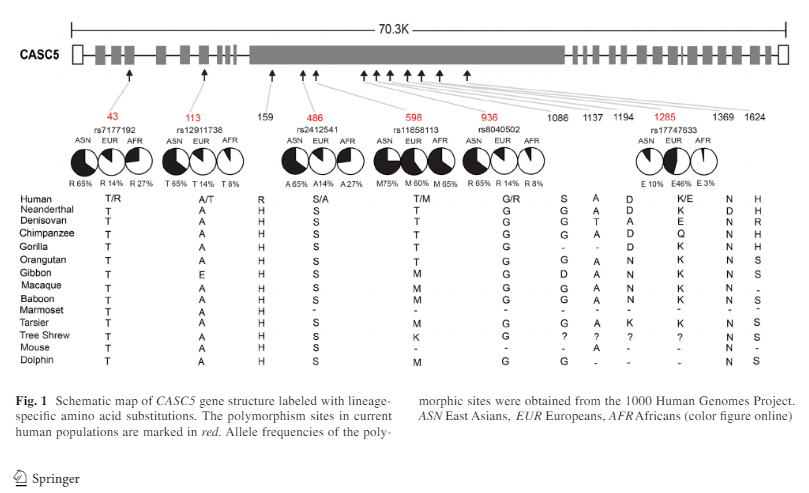
So East Asians have a much higher frequency of this derived trait. This is direct evidence for natural selection in recent human evolution in regards to the physical structure of the brain.
Since most of the amino acid polymorphic sites showed between-population divergence, they decided to analyze the three classical races using 1000 genomes. The variation between the races could be due to either genetic drift or natural selection. When they analyzed certain gene regions, they observed a signal of positive selection for East Asians but not Europeans or Africans. They further tested this selection signal using “the standardized integrated haplotype score (iHS) which is used for detecting recent positive selection with incomplete sweep (i.e. the selected allele is not yet fixed)” (Shi et al, 2016). Using this method, they discovered a few SNPs with large iHS values in Europeans (7 SNPs at 4.2 percent) and none in Africans.
They also conducted a genome-wide scan of Fst, iHS, and “XPCLR (searching for highly differentiated genomimc regions as targets of selective sweeps)” (Shi et al, 2016). Several SNPs had high Fst, iHS and XPCLR scores, which indicate that these alleles have been under positive selection in East Asians. Among the fixed amino acid sites in human populations, East Asians showed 5, Europeans showed 1, and Africans showed 0 which, the authors write, “[imply] that these amino acid changes may have functional effects” (Shi et al, 2016). Furthermore, using the HDGP, they obtained the frequency of the 6 amino acid sites in 53 populations. This analysis showed that 4 of the 6 amino acid sites are “regionally enriched in East Asia .. in line with the suggested signal of population-specific selection in this area” (Shi et al, 2016).
Then, since CASC5 is a brain size regulating gene, they looked for phenotypic effects. They recruited 167 Han Chinese (89 men, 178 women) who were free of maladies. They genotyped 11 SNPs and all of the frequencies followed Harvey-Weinberg Equilibrium (which states that allele and genotype frequencies will remain constant in a population from generation to generation in the absence of evolutionary pressures; Andrews, 2010). In the female sample, 5 regions were related to gray matter volume and four were on the amino acid polymorphic sites. Interestingly, the four alleles which showed such a stark difference between East Asians and Europeans and Africans showed more significant associations in Han Chinese females than males. Those carrying the derived alleles had larger brain volumes in comparison with those who had the ancestral alleles, implying recent natural selection in East Asia for brain size.
Shi et al (2015) also attempted two replications on this allele writing:
We further conducted a replication analysis of the five significant CAC5 SNPs in two other independent Han Chinese samples (Li et al. 2015; Xu et al. 2015). The results showed that three SNPs (rs 7177192, rs11858113 and rs8040502) remained significant in Replication-1 for total brain volume and gray matter volume (Xu et al. 2015), but no association was detected in Replication-2 (Li et al. 2015) (Table S4).
It is very plausible that the genes that have regulated brain growth in our species further aid differences in brain morphology within and between races. This effect is seen mostly in Han Chinese girls. Shi et al (2016) write in the Discussion:
If this finding is accurate and can be further verified, it suggests that that [sic] after modern humans migrated out of Africa less than 100,000 years ago, the brain size may still be subject to selection.
I do believe it is accurate. Of course, the brain size could still be subject to selection; there is no magic field shielding the brain against selection pressure. Evolution does not stop at the neck.
So Shi et al (2016) showed that there were brain genes under recent selection in East Asians. What could the cause be? There are a few:
- Climate: In colder climates you need a smaller body size and big brain to survive the cold to better thermoregulate. A smaller body means there is less surface area to cover, while a larger head retains heat. It, obviously, would have been advantageous for these populations to have large brains and thus get selected for them—whether by natural or sexual selection. This could also have to do with the fact that one needs bigger eyes in colder environments, which would cause an increase in the size of the brain for the larger eyes, as well as being sharper visio-spatially.
- Intelligence: East Asians in this study showed that they had high levels of gray matter in the skull. Further, large brains are favored by an intermediately challenging environment (Gonzalez-Forero, Faulwasser, and Lehmann, 2017).
- Expertise: I used Skoyle’s (1999) theory on expertise and human evolution and applied it to racial differences in brain size and relating it to the number of tools they had to use which differed based on climate. Now, of course, if one group uses more tools then, by effect, they would need more expertise with which to learn how to make those tools so large brains would be selected for expertise—especially in novel areas.
- Vision: Large brains mean large eyes, and people from cold climates have large eyes and large brains (Pearce and Dunbar, 2011). Decreasing light levels select for larger eye size and visual cortex size in order to “increase sensitivity and maintain acuity“. Large eyeballs mean enlarged visual cortices. Therefore, in low light, large brains and eyes get selected for so one can see better in a low light environment.
Of course, all four of the examples below could (and probably do) work in tandem. However, before jumping to conclusions I want to see more data on this and how the whole of the system interacts with these alleles and these amino acid polymorphic sites.
In sum, there is now evidence for natural selection on East Asians (and not Africans or Europeans) that favored large brains, particularly gray matter, in East Asians with considerable sexual dimorphism favoring women. Four of the genes tested (MCPH1, ASPM, CDK5RAP2, and WDR62) are regulated by estradiol and contribute to sexual dimorphism in human and non-human primates (Shi et al, 2016). Though it still needs to be tested if this holds true for CASC5.
This is some of the first evidence that I have come across for natural selection on genes that are implicated in brain evolution/structural development between and within populations. It does show the old “Rushton’s Rule of Three“, that is, Mongoloids on top, Caucasians in the middle, and Negroids on bottom, though Caucasians were significantly closer to Africans than Mongoloids in the frequency of these derived alleles. I can see a HBDer going “They must be related to IQ”, I doubt it. They don’t ‘have’ to be related to IQ. It just infers a survival advantage in low light, cold environments and therefore it gets selected for until it reaches a high frequency in that population due to its adaptive value—whether spreading by natural or sexual selection.
The Harmattan season.
By Afrosapiens, 555 words.
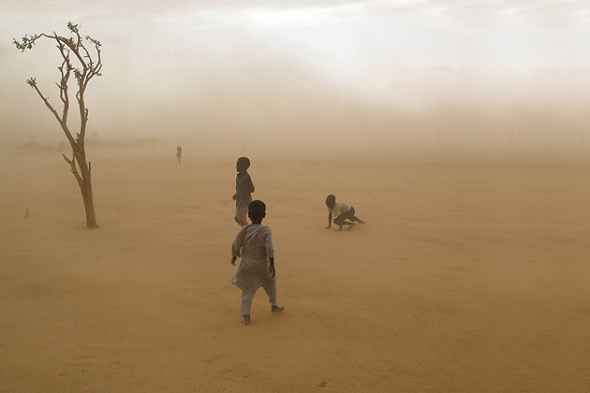
Harmattan haze in Niger.
The Harmattan season is a little known feature of the climatic characteristics of the West African subcontinent. Similarly to a temperate climate winter, it occurs between November and March, 5 months during which the region experiences dry, hazy, and colder conditions due to Saharan dust particles brought by the Harmattan trade wind.
Although the Harmattan season is sometimes referred to as a West African winter with temperature commonly dropping to a low 7°C (45°F) during the night and in the morning, typical tropical temperatures ranging from 25°C to 35°C (77°F – 95°C) are experienced during the afternoon. The humidity rate is below 15% and the region experiences no rainfall during the season. More than the drought, the colder temperature and occasional dust storms and wildfires, the dusty Harmattan haze is what makes the West African winter challenging by significantly reducing visibility and causing several health problems such as asthma, meningitis, skin and eye conditions. From an evolutionary standpoint, it is possible that the Harmattan season has caused various anatomical adaptations affecting brain characteristics.

Despite the common hereditarian claim that Sub-Saharan Africans average smaller cranial capacities than Eurasians due to the warmer climates of tropical Africa, the few studies that I’ve come across regarding West Africa paint a significantly different picture. In a 2011 sample of North-Eastern Nigerian adults likely of Kanuri ethnicity, the reported average cranial capacity was 1424cc for males and 1331cc for females, which makes a total average of 1378cc. In a 2013 sample of 527 Igbos aged 14-20 from Anambra State (Southeastern Nigeria), the reported cranial capacities were 1411cc for males and 1443cc for females and a combined average of 1427cc. In another study of Southeastern Nigerians (year 2011), the reported values were closer to those usually claimed with an average of 1310cc among Edos, 1273cc among Igbos and 1256cc among Urhobos.
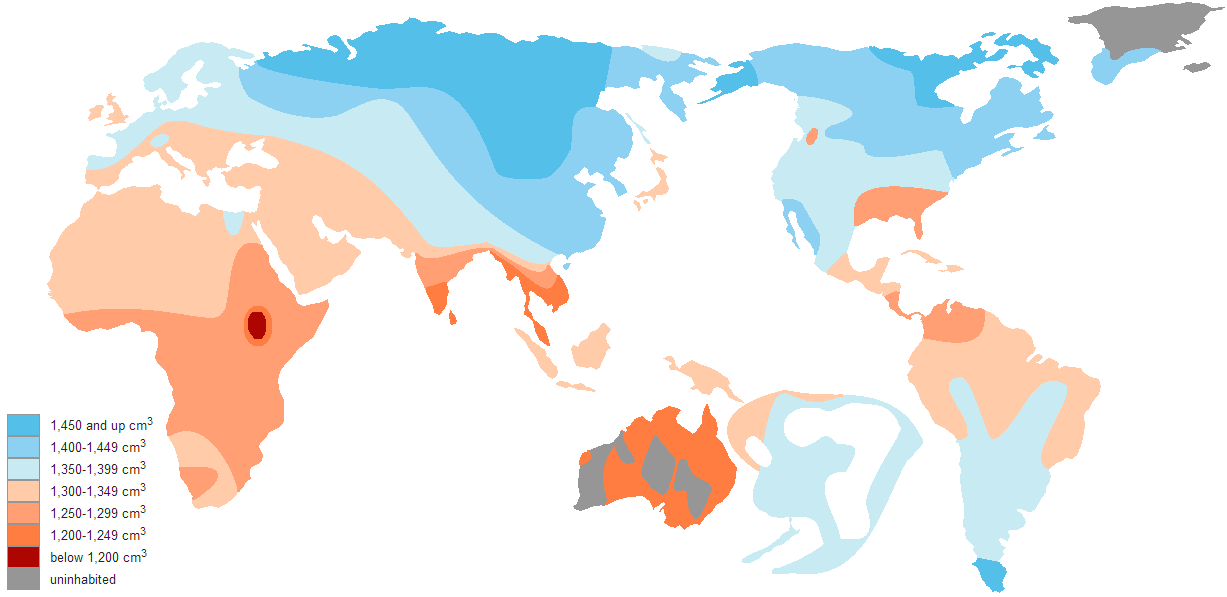
Beals et al.’s (1984) estimated distribution of cranial capacity.
Although these are only a few studies on West African cranial characteristics, they at least have the merit of being recent (less than 10 years old) and drawn from actual measurements on living persons contrary to Beals et al.’s 1984 reference study in which the West African values are inferred from simplistic climatic variables in the absence of actual skulls from the region. I have often shown these high cranial capacity West African samples as a refutation of the cold winter theory of brain size differences. And whereas hereditarian debaters have commonly dismissed them as meaningless exceptions to the rule, there is no scientific rule with unexplainable exceptions.

Harmattan haze in the Ghanaian countryside
In fact, judging from the competing and more generally accepted theory that brain size and eyeballs grow in adaptation to low light environments, the high cranial capacity, especially in Northern Nigerian samples, makes perfect sense if seen as an adaptation to the low visibility caused by the Harmattan haze from November to March. Unfortunately I wasn’t able to find any data on West African eye characteristics, I can only anecdotally mention a higher frequency of epicanthic fold among West Africans relative to other non-Mongoloid populations. I acknowledge that this post is somewhat speculative and based on poor data. Nevertheless, I write it as a warning to all the bloggers and “scholars” making up theories and inferences based on a poor understanding of the complexity of the world’s current and past climatic conditions.

Dakar, Senegal under the Harmattan Haze.
MAOA, Race, and Crime: A Simple Relationship?
2400 words
When I first got into HBD back in 2012, one of the first things I came across—along with the research on racial IQs from Rushton, Lynn, Jensen et al—was that the races differed in a gene called MAOA-L, which has a frequency in Caucasians at .1 percent (Beaver et al, 2013), 54 percent in Chinese people (Lu et al, 2013; 56 percent in Maoris (Lea and Chambers 2007) while about 60-65 percent of Japanese people have the low-frequency version of this gene (Way and Lieberman, 2007).
So if these ethnies have a higher rate of this polymorphism and it is true that this gene causes crime, then the Chinese and Japanese should have the highest rates of crime in the world, since even apparently the effect of MAOA and violence and antisocial behavior is seen even without child abuse (Ficks and Waldman, 2014). Except East Asian countries have lower rates of crime (Rushton, 1995; Rushton and Whytney, 2002). Though, Japan’s low crime rate is relatively recent, and when compared with other countries on certain measures “Japan fares the same or worse when compared to other nations” (Barberet 2009, 198). This goes against a lot of HBD theory, and I will save that for another day. (Japan has a 99 percent prosecution rate, which could be due to low prosecutorial budgets; Ramseyer and Rasmusen, 2001. I will cover this in the future.)
The media fervor—as usual—gave the MAOA gene the nickname “the warrior gene“, which is extremely simplistic (I will have much more to say on ‘genes for’ any trait towards the end of the article). I will show how this is a very simplistic view.
The MAOA gene was first discovered in 1993 in a Dutch family who had a history of extreme violence going as far back as the 1890s. Since the discovery of this gene, it has been invoked as an ultimate cause of crime. However, as some hereditarians do note, MAOA only ’causes’ violence if one has a specific MAOA genotype and if they have been abused as a child (Caspi et al, 2002; Cohen et al, 2006; Beaver et al, 2009; Ferguson et al, 2011; Cicchetti, Rogosch, Thibodeau, 2012;). People have invoked these gene variants as ultimate causes of crime—that is, people who have the low-expressing MAOA variants are more likely to commit more crime—but the relationship is not so simple.
Maoris are more four times more likely to have the low-expressing gene variant than Europeans, the same holding for African Americans and Europeans (Lea and Chambers, 2007).
There is, however, a protective effect that protects whites (and not non-whites in certain cases) against antisocial behavior/violent attitudes if one has a certain genotype (Widom and Brzustowicz, 2006), though the authors write on page 688: “For non-whites, the effect of child abuse and neglect on the juvenile VASB was not significant (beta .08, SE .11, t 1.19, ns), whereas the effect of child maltreatment on lifetime VASB composite approached significance (beta .13, SE .12, t 1.86, p .06). For non-whites (see Figure 2), neither gene (MAOA) environment (child abuse and neglect) interaction was significant: juvenile VASB (beta .06, SE .28, t .67, ns) and lifetime VASB (beta .01, SE .29, t .14, ns).” So as you can see, there are mixed results. Whites seem to be protected against the effect of antisocial behavior and violence but only if they have a certain genotype (which implies that if they have the other genotype, then if abused they will show violent and antisocial behavior). So, we can see that the relationship between MAOA and criminal behavior is not as simple as some would make it out to be.
MAOA, like other genetic variants, of course, has been linked to numerous other traits. Steven J. Heine, author of the book DNA is Not Destiny: The Remarkable and Completely Misunderstood Relationship Between You and Your Genes:
However, any labels like “the warrior gene” are highly problematic because they suggest that the this gene is specifically associated with violence. It’s not, just as alleles from other genes do not only have one outcome. Pleiotropy is the term for how a single genetic variant can influence multiple different phenotypes. MAOA is highly pleiotropic: the traits and conditions potientially connected to the MAOA gene invlude Alzheimer’s. anoerxia, autism, body mass index, bone mineral density, chronic fatigue syndrome, depression, extraversion, hypertension, individualism, insomnia, intelligence, memory, neuroticism, obesity, openness to experience, persistence, restless leg syndrome, schizophrenia, social phobia, sudden infant death syndrome, time perception and voting behavior. (59) Perhaps it would be more fitting to call MAOA “the everything but the kitchen sink gene. (Heine, 2017: 195)
Something that I have not seen brought up when discussions of race, crime, and MAOA come up is that Japanese people have the highest chance—even higher than blacks, Maoris, and whites—to have the low repeat MAOA variant (Way and Lieberman) yet have lower rates of crime. So MAOA cannot possibly be a ‘main cause’ of crime. It is way more complex than that. “However intuitively satisfying it may be to explain cultural differences in violence in terms of genes“, Heine writes, “as of yet there is no direct evidence for this” (Heine, 2017: 196).
Numerous people have used ‘their genes’ in an attempt to get out of criminal acts that they have committed. A judge even knocked off one year off of a murder’s sentence since he found the evidence for the MAOA gene’s link to violence “particularly compelling.” I find it “particularly ridiculous” that the man got less time in jail than someone who ‘had a choice’ in his actions to murder someone. Doesn’t it seem ridiculous to you that someone gets less time in jail than someone else, all because he may have the ‘crime/warrior gene’?
Aspinwall, Brown, and Tabery (2012) showed that when evidence of a ‘biomechanic’ cause of violence/psychopathy was shown to the judges (n=191), that they reduced their sentences by almost one year if they were reading a story in which the accused was found to have the low-repeat MAOA allele (13.93 to 12.83 years). So, as you can see, this can sway judges’ perception into giving one a lighter sentence since they believe that the evidence shows that one ‘can not control themselves’, which results in the judge giving assailants lighter sentences because ‘it’s in their genes’.
Further, people would be more lenient on sentences for criminals who are found to have these ‘criminal genes’ than those who were found to not have them (Cheung and Heine, 2015). Monterosso, Royzman, and Schwartz (2010) also write: “Physiologically explained behavior was more likely to be characterized as “automatic,” and willpower and character were less likely to be cited as relevant to the behavior. Physiological explanations of undesirable behavior may mitigate blame by inviting nonteleological causal attributions.” So, clearly, most college students would give a lighter sentence if the individual in question were found to have ‘criminal genes’. But, if these genes really did ’cause’ crime, shouldn’t they be given heavier sentences to keep them on the inside more so those with the ‘non-criminal genes’ don’t have to suffer from the ‘genetically induced’ crime?
Heine (2017: 198-199) also writes:
But is someone really less any responsible for their actions if his or her genes are implicated? A problem with this argument is that we would be hard-pressed to find any actions that we engage in where our genes are not involved—our behaviors do not occur in any gene-free zones. Or, consider this: there actually is a particular genetic variant that, if you possess it, makes you about 40 times more likely to engage in same-sex homicides than those who possess a different variant. (66) It’s known as the Y chromosome—that is, people who possess it are biologically male. Given this, should we infer that Y chromosomes cause murders, and thus give a reduced sentence to anyone who is the carrier of such a chromosome because he is really not responsible for his actions? The philosopher Stephen Morse calls the tendency to excuse a crime because of a biological basis the “fundamental psycholegal error.” (67) The problem with this tendency is that it involves separating yout genes from yourself. Saying “my genes made me do it” doesn’t make sense because there is no “I” that is independent of your genetic makeup. But curiously, once genes are implicaed, people see, to feel that the accused is no longer fully in control of his or her actions.
Further, in the case of a child pornographer, one named Gary Cossey, the court said:
The court predicted that some fifty years from now Cossey’s offense conduct would likely be discovered to be caused by “a gene you were born with. And it’s not a gene you can get rid of.” The court expressed its belief that although Cossey was in therapy, it “can only lead, in my view, to a sincere effort on your part to control, but you can’t get rid of it. You are what you’re born with. And that’s the only explanation for what I see here.”
However, this judge punished Cossey more severely due to the ‘possibility’ that scientists may find ‘genes for’ child pornography use in 50 years. Cossey was then given another, unbiased judge, and was given a ‘more lenient’ sentence than the genetic determinist judge did.
Sean Last over at The Alternative Hypothesis is also a big believer in this so-called MAOA-race difference that explains racial differences in crime. However, as reviewed above (and as he writes), MAOA can be called the “everything but the kitchen sink gene” (Heine, 2017: 195), as I will touch on briefly below, to attribute ’causes’ to genes is not the right way to look at them. It’s not so easy to say that since one ‘has the warrior gene’ that they’d automatically be violent. Last cites a study saying that even those who have the MAOA allele who were not abused showed higher rates of violent behavior (Ficks and Waldman, 2014). They write (pg. 429):
The frequency of the ‘‘risk’’ allele in nonclinical samples of European ancestry ranges from 0.3 to 0.4, although the frequency of this allele in individuals of Asian and African ancestry appears to be substantially higher (*0.6 in both groups; Sabol et al. 1998).
So, why don’t Asians have higher rates of crime—along with blacks—if MAOA on its own causes violent and antisocial behavior? Next I know that someone would claim that “AHA! TESTOSTERONE ALSO MEDIATES THIS RELATIONSHIP!!” However, as I’ve talked about countless times (until I’m blue in the face), blacks do not have/have lower levels of testosterone than whites (Richards et al, 1992; Gapstur et al, 2002; Rohrmann et al, 2007; Mazur, 2009; Lopez et al, 2013; Hu et al, 2014; Richard et al, 2014). Though young black males have higher levels of testosterone due to the environment (honor culture) (Mazur, 2016). So that canard cannot be trotted out.
All in all, these simplistic and reductionist approaches to ‘figuring out’ the ’causes’ of crime do not make any sense. To point at one gene and say that this is ‘the cause’ of that do not make sense.
One last point on ‘genes as causes’ for behavior. This is something that deserves a piece of its own, but I will just provide a quote from Eva Jablonska and Marion Lamb’s book Evolution in Four Dimensions: Genetic, Epigenetic, Behavioral, and Symbolic Variation in the History of Life (Jablonska and Lamb, 2014: 17; read chapter one of the book here; I have the nook version so the page number may be different):
Although many psychiatrists, biochemists, and other scientists who are not geneticists (yet express themselves with remarkable facility on genetic issues) still use the language of genes as simple causal agents, and promise their audience rapid solutions to all sorts of problems, they are no more than propagandists whose knowledge or motives must be suspect. The geneticists themselves now think and talk (most of the time) in terms of genetic networks composed of tens or hundreds of genes and gene products, which interact with each other and together affect the development of a particular trait. They recognize that whether or not a trait (a sexual preference, for example) develops does not depend, in the majority of cases, on a difference in a single gene. It involves interactions among many genes, many proteins and other types of molecule, and the environment in which an individual develops.
So to say that those who have low-functioning MAOA variants have an ‘excuse’ as to why they commit crime is incorrect. I know that most people know this, but when you read some people’s writings on things like this it’s like they think that these singular genes/polymorphisms/etc cause these things on their own. In actuality, you need to look at how the whole system interacts with these things, and not reduce whole complex physiological systems to a sum of its parts. This is why implicating singular genes/polymorphisms as explanations for racial differences in crime does not make sense (as can be seen with the Japanese example).
To reduce behaviors simply to gene X and not look at the whole system does not make any sense. There are no ‘genes for’ anything, except a few Mendelian diseases (Ropers, 2010). Stating that certain genes ’cause’ X, as I have shown does not make sense and, wrongly, in my opinion, gives criminals less of a sentencing since judges find stuff like this ‘very compelling’. If that’s the case, why implicate any murderer? ‘Their genes made them do it’, right? Though, things are not that simple to implicate one gene as a cause for crime or any other complex behavior; in this sense—like for most things to do with the human body—holism makes way more sense and not reductionism. We need to look at how these genes that are ‘implicated’ in criminal behavior interact with the whole system. Only then can we understand the causes of criminal behavior. Looking at singular genes impedes us from figuring out the true underlying reasons why people commit crime.
Remember: we can’t blame “warrior genes” for violent crime. If someone does have a ‘genetic predisposition to crime’ from the MAOA gene, then wouldn’t it make more sense to give them more time? Though, the relationship is not so simple as I have covered. So to close, there is no ‘simple relationship’ between race, crime and MAOA. Not in the way that other hereditarians would like you to believe. Because if this relationship were so simple, then East Asians (Chinese, Japanese) would have the highest rates of crime, and they do not.
There is No ‘Marching Up the Evolutionary Tree’
2000 words
The notion that there is any ‘progress’ to evolution is something that I have rebutted countless times on this blog. My most recent entry being Marching Up the ‘Evolutionary Tree’? which was a response to Pumpkin Person’s article Marching up the evolutionary tree. Of course, people never ever change their views in a discussion (I have seen it, albeit it is rare) due, mainly to, in my opinion, ideology. People have so much time invested in their little pet theories that they cannot possibly fathom at the thought of being wrong or being led astray by shoddy hypotheses/theories that confirm their pre-existing beliefs. I will quote a few comments from Pumpkin Person’s blog where he just spews his ‘correlations with brain size and ‘splits’ on the ‘evolutionary tree” that ‘proves that evolution is progressive’, then I will touch on two papers (I will cover both in great depth in the future) that directly rebut his idiotic notion that so-called brain size increases across our evolutionary history (and even before we became humans) are due to ‘progress in evolution’
One of my co-bloggers Phil wrote:
I think you mistyped that, but i see your point. Problem, however, most of your used phylogenies were unbalanced.
Based on the definition you provided, but not based on any meaningful definition. To me, an unbalanced tree is . . .
This is literally meaningless. Keep showing that you’ve never taken a biology class in your life, it really shows.
All it is is ignorance to basic biological thinking, along with an ideology to prove his ridiculous Rushtonian notion that ‘brain size increases prove that evolution is progressive’.
You have yet to present ANY scientific logic, and my argument about taxonomic specificity is clearly beyond you.
Scientific logic?! Scientific logic?! Please. Berkely has a whole page on misconceptions on evolution that directly rebut his idiotic, uneducated views on evolution. It doesn’t help that his evolution education most likely comes from psychologists. Nevertheless, PP’s ‘argument’ is straight garbage. Taxonomic specificity’ is meaningless when you don’t have an understanding of basic biological concepts and evolution. (I will have much more to say on his ‘taxonomic specificity’ below.)
PP writes:
Was every tree perfect? No, but most were pretty close, and keep in mind that any flawed trees would have the effect of REDUCING the correlation between brain size/encephalization and branching, because random error is a source of statistical noise which obscures any underlying relationship. So the fact that I repeatedly found such robust correlation in spite of alleged problems with my trees, makes my conclusions stronger, not weaker.
The fact that you ‘repeatedly’ found ‘correlations’ in spite of the ‘problems’ with your trees makes your ‘conclusions’ weaker. Comparing organisms over evolutionary time and you notice a ‘trend’ in brain size. Must mean that evolution is progressive and brain size is its calling card!!
PP writes:
I’m right and all the skeptics you cite are wrong.
Said like a true idealogue.
Here is where PP’s biggest blunder comes in:
It’s not how many splits they have that I’ve been measuring, it’s how many splits occur on the tree before they branch off. Here’s a source from 2017:
Eukaryotes represent a domain of life, but within this domain there are multiple kingdoms. The most common classification creates four kingdoms in this domain: Protista, Fungi, Plantae, and Animalia.
So you needed ‘a source from 2017’ to tell you something that is literally taught on the first day of biology 101? Keep showing how uneducated you are here.
Nothing fallacious about a correlation between number of splits and brain size/encephalization.
Post hoc, ergo propter hoc is a Latin phrase for “after this, therefore, because of this.” The term refers to a logical fallacy that because two events occurred in succession, the former event caused the latter event.[1][2]
…
Magical thinking is a form of post hoc, ergo propter hoc fallacy, in which superstitions are formed based on seeing patterns in a series of coincidences. For example, “these are my lucky trousers. Sometimes good things happen to me when I wear them.”
P1: X happened before Y.
P2: (unstated) Y was caused by something (that happened before Y).
C1: Therefore, X caused Y.
Here is PP’s (fallacious) logic:
P1: splits (X) happened before Y (brain size increase)
P2: (unstated) brain size increase was caused by something (that happened before brain size increaes [splits on the tree])
C1: therefore, splits caused brain size increase
Now, I know that PP will argue that ‘splits on the evolutionary tree’ denote speciation which, in turn, denotes environmental change. This is meaningless. You’re still stating that Y was caused by something (that happened before Y) and therefore inferring that X caused Y. That is the fallacy (which a lot of HBD theories rest on).
PP writes:
You don’t get it. Even statistically insignificant correlations become significant when you get them FIVE TIMES IN A ROW. If you want to believe it was all a coincidence, then fine.
Phylogenies are created from shared derived factors. Berkely is the go-to authority here on this matter. (No that’s not appeal to authority.) Biologists collect information about a given animal and then infer the evolutionary relationship. Furthermore, PP’s logic is, again, fallacious. Berkely also has tips for tree reading, which they write:
Trees depict evolutionary relationships, not evolutionary progress. It’s easy to think that taxa that appear near one side of a phylogenetic tree are more advanced than other organisms on the tree, but this is simply not the case. First, the idea of evolutionary “advancement” is not a particularly scientific idea. There is no unbiased, universal scale for “advancement.” Second, taxa with extreme versions of traits (which might be perceived as more “advanced”) may occur on any terminal branch. The position of a terminal taxon is not an indication of how adaptive, specialized, or extreme its traits are.
He may emphatically argue (as I know he will) that he’s not doing this. But, as can be seen from his article, X is ‘less advanced’ than Y, therefore splits, brain size, correlation=progress. This is dumb.
For anyone who wants to know how (and how not to) read phylogenies, read Gregory (2008). These idotic notions that PP espouses are what Freshman in college believe due to ‘intuitiveness’ about evolution. It’s so rampant that biologists have writen numerous papers on the matter. But some guy with a blog and no science background (and an ideology to hammer) must know more than people who do this for a living (educate people on phylogenies).
On Phil’s response to see the Deacon paper that I will discuss below, PP writes:
That’s not a rebuttal.
Yes it is, as I will show shortly.
The first paper I will discuss is Deacon’s (1990) paper Fallacies of Progression in Theories of Brain-Size Evolution. This is a meaty paper with a ton of great ideas about phylogenies, along with numerous fallacies that people go to when reading trees (my favorite being the Numerology fallacy, which PP uses, see below).
Deacon argues that since people fail to analyze allometry, this anatomists have mistaken artifacts for evolutionary trends. He also argues that many structural’brain size increases’ from ‘primitive to advanced forms’ (take note here, because this is what PP did and this is what discredits his idiotic ideology) are the result of allometric processes.
Source: Evolution of consciousness: Phylogeny, ontogeny, and emergence from general anesthesia Mashour and Alkire (2013)
This paper (and picture) show it all. This notion of scala naturae (which Rushton (2004) attempted to revive with r/K selection theory has been rebutted by me) was first proposed by Aristotle. We now know how the brain structure evolved, so the old ‘simple scala naturae‘ is, obviously, out of date in the study of brain evolution.
This paper is pretty long and I don’t have time to discuss all of it so I will just provide one quote that disproves PP’s ‘study’:
Whenever a method is discovered for simplifying the representation of a complex or apparently nonsystematic numerical relationship, the method of simplification itself provides new insight into the phenomenon under study. But reduction of a complex relationship to a simple statistic makes it far easier to find spurious relationships with other simple statistics. Numerology fallacies are apparent correlations that turn out to be artifacts of numerical oversimplification. Numerology fallacies in science, like their mystical counterparts, are likely to be committed when meaning is ascribed to some statistic merely by virtue of its numeric similarity to some other statistic, without supportive evidence from the empirical system that is being described.
Deacon also writes in another 1990 article titled Commentary on Ilya I. Glezer, Myron So Jacobs, and Peter J Morgane (1988) Implications of the “initial brain’9 concept for brain evolution in Cetacea:
The study of brain evolution is one of the last refuges for theories of progressive evolution in biology, but in this field its influence is still pervasive. To a great extent the apparent “progress” of mammalian brain evolution vanishes when the effects of brain size and functional specialization are taken into account.
(It’s worth noting that in the author’s response to Deacon, he did not have any qualms about ‘progressive brain-size’.)
In regards to PP’s final ‘correlation’ on human races and brain-size, this is a perfect quote from McShea (1994: 1761):
If such a trend [increase in brain size leading to ‘intelligence’] in primates exists and it is driven, that is, if the trend is a direct result of concerted forces acting on most lineages across the intelligence spectrum, then the inference is justified. But if it is passive, that is, forces act only on lineages at the low-intelligence end, then most lineages will have no increasing tendency. In that case, most primate species—especially those out on the right tail of the distribution like ours—would be just as likely to lose intelligence as to gain it in subsequent evolution (if they change at all).
The ‘trend’ is passive. Homo floresiensis is the best example. We are just as likely to lose our ‘intellect’ and our ‘big brains’ as we are to ‘get more intelligent’ and ‘smaller brains’. The fact of the matter is this: environment dictates brain size/whatever other traits an organism has. Imagine a future environment that is a barren wasteland. Kilocalories are scarce; do you think that humans would keep their big brains—which are two percent of their body weight accounting for a whopping 25 percent of total daily energy needs—without enough high-quality energy? When brain size supposedly began to increase in our taxa is when erectus learned to control fire and cook meat (Hlublik et al, 2017).
All in all, there is no ‘progress’ to evolution and, as Deacon argues, so-called brain-size increases across evolutionary time disappear after adjustments for body size and functional specialties are taken into account. However, for the idealogue who looks for everything they can to push their ideology/worldview, things like this are never enough. “No, that wasn’t a rebuttal! YOU’RE WRONG!!” Those are not scientific arguments. If one believes in ‘evolutionary progress’ and that brain-size increases are the proof in the pudding that evolution is ‘progressive’ (re has a ‘direction’), then they must rebut Deacon’s arguments on allometry and his fallacies in his 1990 paper. Stop equating evolution with ‘progress’. Though, I can’t fault laymen for believing that. I can, however, fault someone who supposedly enjoys the study of evolution. You’re wrong. The people you cite (who are out of their field of expertise) are wrong.
Evolution is an amazing process. To equate it with ‘progress’ does not allow one to appreciate the beauty of the process. Evolution does carry baggage with it, and if I weren’t so used to the term I would use Descent by Modification (DbM, which is what Darwin used). Nevertheless, progressionists will hide out in whatever safehold they can to attempt to push their idealogy that is not based on science.
(Also read Rethinking Mammalian Brain Evolution by Terrence Deacon. I go more in depth on these three articles in the future.)
 NotPoliticallyCorrect