Home » Race Realism (Page 27)
Category Archives: Race Realism
Racial Differences in Prostate Cancer: Part II
1050 words
I showed in part I, that the oft-cited reason for racial differences in prostate cancer acquisition and mortality are not due to higher levels of circulating testosterone when comparing blacks to whites (Richard et al, 2014). I posited (and provided sufficient evidence) that the disparity could come down to differences in vitamin D between the races. Black Americans are far removed from their ancestral environment, living in a cooler area. Their pigmentation reduces vitamin D production in the skin, since blacks need a lot more sunlight to synthesize the hormone than whites do, and the main culprit is the environment: not getting enough sunlight (Harris, 2006). I will provide further evidence for the theory.
The etiology of prostate cancer is not known (ACA, 2016; Bashir, 2015). The cause for the disparity in racial differences in prostate cancer may possibly come down to circulating vitamin D levels, with sunlight playing a large role in the variance. Racial differences in prostate cancer were larger in areas with less sunshine (Taksler et al, 2013). However, it is not known whether getting more sunlight (though the problem would still be getting enough in places with low levels of sunlight) or supplementing with vitamin D will help close the gap. Vitamin D is relevant for lethal prostate cancer (Shui et al 2012), whereas Li et al (2007) showed that supplementing with higher rates of vitamin D, especially during the winter months, may be particularly beneficial to men with low levels of circulating vitamin D. A study on veterans showed that men who had prostate cancer AND the lowest levels of vitamin D were more likely to die than veterans who had higher levels of the hormone (Der et al, 2014). Murphy et al (2014) showed in a biopsy, that in black Americans, low levels of vitamin D were associated with increased the odds of prostate cancer acquisition during the biopsy.
Black Americans are significantly more likely than European Americans to suffer from and die from prostate cancer (Hardiman et al, 2016). A difference of over 8,000 genes were found to be expressed differently. Blacks also have higher rates of prostate tumors and higher grade tumors than do European men. The racial disparity in prostate cancer mirrors circulating levels of vitamin D in the blood between the races (Nelson et 2016). Prostate cells become less sensitive to vitamin D through loss of receptors or signaling molecules “that mediate vitamin D’s actions, or through changes in metabolic enzymes that synthesize or degrade vitamin D compounds” (Peehl and Feldman, 2013). Hardiman et al (2016) showed that there were over 3,000 genes that differed between blacks and whites. Due to the fact that blacks are living outside of their ancestral climes, this is a large mediator of the prostate cancer gap. Vitamin D deficiency can also explain a large variation of the black-white prostate cancer gap (Grant and Peiris 2011).
Along with direct measurement of circulating vitamin D in the bloodstream, we also have correlates. Hypertension is correlated with prostate cancer: blacks have higher rates of hypertension; obesity further exacerbates the problem. Blacks males are more likely to be obese (though barely, which is where the other environmental factors come in). Men suffering from two or more health problems linked to metabolic syndrome are more likely to get prostate cancer. Blacks are more likely to get metabolic syndrome.
Clearly, a large portion of the variation in prostate cancer acquisition and mortality can be attributed to environmental factors (vitamin D intake specifically). We can also look to East Asia and their increasing rates of prostate cancer as well (Chen et al, 2014; Zhu et al, 2014). There are no genetic changes in the past ten years to account for this, so the only culprit is diet. Our Americanized diets have been making it to East Asia recently and it’s having a negative effect on them. China’s obesity rate is dramatically increasing, along with their rates of prostate cancer acquisition. It seems that the Western diet could also play a part in racial differences in prostate cancer acquisition.
To be fair the non-significance of this result might be attributable to the small number (only four) of African nations in the analysis. A number of previous studies have actually found that people of African descent on average do have shorter CAG repeats than other peoples (Ackerman et al., 2012; Esteban et al., 2005; Kittles et al., 2001; Lange et al., 2008). However, whether this actually indicates anything about the life history strategy of different populations remains questionable. The two other androgen indicators for which African data was available follow a completely different pattern. For androgenic hair, Caucasians have the highest rate, followed by Asians, then Africans. For prostate cancer, Caucasians have the highest rate, followed by Asians and Africans, who do not significantly differ.
The difference comes down, mostly in my opinion, due to diet. You can see this by looking at rates of prostate cancer in populations that have adopted, or are current adopting our Western diet.
There is a good chance that environmental factors explain a large part of the variance in prostate cancer acquisition and mortality. I, of course, do not deny intrinsic genetic explanations or other hormonal imbalances, however this is the best explanation I’ve come across. The fact that sunlight dictates prostate cancer acquisition is a huge tell and should be further researched.
I used to be a proponent of the testosterone theory, however, Richard et al (2014) shows a 2.5 to 4.9 percent difference in free testosterone between blacks and whites, which they conclude, does not explain the disparity between the races. Hormones do matter, and hormones can and do vary individually and by group, which are mediated by diet. Once we find out which foods either hurt or help prostate cancer growth, then we can have better treatments for this disease for men of all races.
There are numerous ways in which prostate cancer can be mitigated, with diet obviously playing a large factor (Son, Aronson, and Litwin, 2005; Lin, 2015; Nelson, Demarzo, and Yegnasubramanian, 2014). Future studies researching the racial disparities in prostate cancer should take into account UV radiation from the sun, circulating vitamin D in the blood, and diet amongst a myriad of other variables (these three just stand out to me). Moreover, large-scalre cohorts should be undertaken to see what effects diet can have on the mortality of those suffering from prostate cancer, as possibly supplementing vitamin D to attempt to fight the disease
Is General Intelligence Domain-Specific?
1600 words
Is the human brain ‘special’? Not according to Herculano-Houzel; our brains are just linearly scaled-up primate brains. We have the number of neurons predicted for a primate of our body size. But what does this have to do with general intelligence? Evolutionary psychologists also contend that the human brain is not ‘special’; that it is an evolved organ just like the rest of our body. Satoshi Kanazawa (2003) proposed the ‘Savanna Hypothesis‘ which states that more intelligent people are better able to deal with ‘evolutionary novel’ situations (situations that we didn’t have to deal with in our ancestral African environment, for example) whereas he purports that general intelligence does not affect an individuals’ ability to deal with evolutionarily familiar entities and situations. I don’t really have a stance on it yet, though I do find it extremely interesting, with it making (intuitive) sense.
Kanazawa (2010) suggests that general intelligence may both be an evolved adaptation and an ‘individual-difference variable’. Evolutionary psychologists contend that evolved psychological adaptations are for the ancestral environment which was evolved in, not in any modern-day environment. Kanazawa (2010) writes:
The human brain has difficulty comprehending and dealing with entities and situations that did not exist in the ancestral environment. Burnham and Johnson (2005, pp. 130–131) referred to the same observation as the evolutionary legacy hypothesis, whereas Hagen and Hammerstein (2006, pp. 341–343) called it the mismatch hypothesis.
From an evolutionary perspective, this does make sense. A perfect example is Eurasian societies vs. African ones. you can see the evolutionary novelty in Eurasian civilizations, while African societies are much closer (though obviously not fully) to our ancestral environment. Thusly, since the situations found in Africa are not evolutionarily novel, it does not take high levels of g to survive in, while Eurasian societies (which are evolutionarily novel) take much higher levels of g to live and survive in.
Kanazawa rightly states that most evolutionary psychologists and biologists contend that there have been no changes to the human brain in the last 10,000 years, in line with his Savanna Hypothesis. However, as I’m sure all readers of my blog know, there were sweeping changes in the last 10,000 years in the human genome due to the advent of agriculture, and, obviously, new alleles have appeared in our genome, however “it is not clear whether these new alleles have led to the emergence of new evolved psychological mechanisms in the last 10,000 years.”
General intelligence poses a problem for evo psych since evolutionary psychologists contend that “the human brain consists of domain-specific evolved psychological mechanisms” which evolved specifically to solve adaptive problems such as survival and fitness. Thusly, Kanazawa proposes in contrast to other evolutionary psychologists that general intelligence evolved as a domain-specific adaptation to deal with evolutionary novel problems. So, Kanazawa says, our ancestors didn’t really need to think inorder to solve recurring problems. However, he talks about three major evolutionarily novel situations that needed reasoning and higher intelligence to solve:
1. Lightning has struck a tree near the camp and set it on fire. The fire is now spreading to the dry underbrush. What should I do? How can I stop the spread of the fire? How can I and my family escape it? (Since lightning never strikes the same place twice, this is guaranteed to be a nonrecurrent problem.)
2. We are in the middle of the severest drought in a hundred years. Nuts and berries at our normal places of gathering, which are usually plentiful, are not growing at all, and animals are scarce as well. We are running out of food because none of our normal sources of food are working. What else can we eat? What else is safe to eat? How else can we procure food?
3. A flash flood has caused the river to swell to several times its normal width, and I am trapped on one side of it while my entire band is on the other side. It is imperative that I rejoin them soon. How can I cross the rapid river? Should I walk across it? Or should I construct some sort of buoyant vehicle to use to get across it? If so, what kind of material should I use? Wood? Stones?
These are great examples of ‘novel’ situations that may have arisen, in which our ancestors needed to ‘think outside of the box’ in order to survive. Situations such as this may be why general intelligence evolved as a domain-specific adaptation for ‘evolutionarily novel’ situations. Clearly, when such situations arose, our ancestors who could reason better at the time these unfamiliar events happened would survive and pass on their genes while the ones who could not die and got selected out of the gene pool. So general intelligence may have evolved to solve these new and unfamiliar problems that plagued out ancestors. What this suggests is that intelligent people are better than less intelligent people at solving problems only if they are evolutionarily novel. On the other hand, situations that are evolutionarily familiar to us do not take higher levels of g to solve.
For example, more intelligent individuals are no better than less intelligent individuals in finding and keeping mates, but they may be better at using computer dating services. Three recent studies, employing widely varied methods, have all shown that the average intelligence of a population appears to be a strong function of the evolutionary novelty of its environment (Ash & Gallup, 2007; D. H. Bailey & Geary, 2009; Kanazawa, 2008).
Who is more successful, on average, over another in modern society? I don’t even need to say it, the more intelligent person. However, if there was an evolutionarily familiar problem there would be no difference in figuring out how to solve the problem, because evolution has already ‘outfitted’ a way to deal with them, without logical reasoning.
Kanazawa then talks about evolutionary adaptations such as bipedalism (we all walk, but some of us are better runners than others); vision (we can all see, but some have better vision than others); and language (we all speak, but some people are more proficient in their language and learn it earlier than others). These are all adaptations, but there is extensive individual variation between them. Furthermore, the first evolved psychological mechanism to be discovered was cheater detection, to know if you got cheated while in a ‘social contract’ with another individual. Another evolved adaptation is theory of mind. People with Asperger’s syndrome, for instance, differ in the capacity of their theory of mind. Kanazawa asks:
If so, can such individual differences in the evolved psychological mechanism of theory of mind be heritable, since we already know that autism and Asperger’s syndrome may be heritable (A. Bailey et al., 1995; Folstein & Rutter, 1988)?
A very interesting question. Of course, since it’s #2017, we have made great strides in these fields and we know these two conditions to be highly heritable. Can the same be said for theory of mind? That is a question that I will return to in the future.
Kanazawa’s hypothesis does make a lot of sense, and there is empirical evidence to back his assertions. His hypothesis proposes that evolutionarily familair situations do noot take any higher levels of general intelligence to solve, whereas novel situations do. Think about that. Society is the ultimate evolutionary novelty. Who succeeds the most, on average, in society? The more intelligent.
Go outside. Look around you. Can you tell me which things were in our ancestral environment? Trees? Grass? Not really, as they aren’t the same exact kinds as we know from the savanna. The only thing that is constant is: men, women, boys and girls.
This can, however, be said in another way. Our current environment is an evolutionary mismatch. We are evolved for our past environments, and as we all know, evolution is non-teleological—meaning there is no direction. So we are not selected for possible future environments, as there is no knowledge for what the future holds due to contingencies of ‘just history’. Anything can happen in the future, we don’t have any knowledge of any future occurences. These can be said to be mismatches, or novelties, and those who are more intelligent reason more logically due to the fact that they are more adept at surviving evolutionary novel situations. Kanazawa’s theory provides a wealth of information and evidence to back his assertion that general intelligence is domain-specific.
This is yet another piece of evidence that our brain is not special. Why continue believing that our brain is special, even when there is evidence mounting against it? Our brains evolved and were selected for just like any other organ in our body, just like it was for every single organism on earth. Race-realists like to say “How can egalitarians believe that we stopped evolving at the neck for 50,000 years?” Well to those race-realists who contend that our brains are ‘special’, I say to them: “How can our brain be ‘special’ when it’s an evolved organ just like any other in our body and was subject to the same (or similar) evolutionary selective pressures?”
In sum, the brain has problems dealing with things that were not in its ancestral environment. However, those who are more intelligent will have an easier time dealing with evolutionarily novel situations in comparison to people with lower intelligence. Look at places in Africa where development is still low. They clearly don’t need high levels of g to survive, as it’s pretty close to the ancestral environment. Conversely, Eurasian societies are much more complex and thus, evolutionarily novel. This may be one reason that explains societal differences between these populations. It is an interesting question to consider, which I will return to in the future.
Expounding On My Theory for Racial Differences In Sports
2300 words
In the past, I’ve talked about why the races differ—at the extremes—(and the general population, but the extremes put the picture into focus) in terms of what sports they compete and do best in. These differences come down to morphology somatype, physiology. People readily admit racial differences in sports and—rightly say—that these differences are largely genetic in nature. Why is it easier for people to accept racial differences in sports and not accept other truisms, like racial IQ differences?
I’ve muscle fiber typing and how the variances in fiber typing dictate which race/ethny performs best at which sport. I’ve also further evidence that blacks have type II fibers (responsible for explosive power), which leads to a reduced Vo2 max. This lends yet more credence to my theory of racial differences in sports—black Americans (West African descendants) have the fiber typing that is associated with explosive power, less so with endurance activities. Since I’ve documented evidence on the differences in sports such as baseball, football, swimming and jumping, bodybuilding, and finally strength sports, tonight I will talk about the evolutionary reasons for muscle fiber and somatype differences that will have us better understand the evolutionary conditions in which these traits evolved and why they got selected for.
Most WSM winners are from Nordic countries or have Nordic ancestry. There’s a higher amount of slow twitch fibers in Nordics and East Asians (and Kenyans) which is more conducive to strength and less conducive to ‘explosive’ sports. West Africans and their descendants dominate in sprinting competitions. Yea yea yea white guy won in 1960. So they will be less likely to be in strength comps and more likely to win BBing and physique comps. This is what we see.
Only three African countries have placed in the top ten in the WSM (Kenya, Namibia, and Nigeria, however, one competitor from Namibia I was able to find has European ancestry). Here is a video of a Nigerian Strongest Man competition (notice how his chest isn’t up and his hips rise before the bar reaches his knees, horrible form). Fadesere Oluwatofunmi is Nigeria’s Strongest Man, competing in the prestigious Arnold Classic, representing Nigeria. However, men such as Fadesere Olutaofunmi are outliers.
Now for a brief primer on muscle fibers and which pathways they fire through. Understanding this aspect of the human body is paramount to understanding how and why the races differ in elite competition.
Life history and muscle fiber typing
Slow twitch fibers fire through aerobic pathways. Breaking down fats and proteins takes longer through aerobic respiration. Moreover, in cold temperatures, the body switches from burning fat to burning carbohydrates for energy, which will be broken down slower due to the aerobic perspiration. Slow twitch (Type I) fibers fire through aerobic pathways and don’t tire nearly as quickly as type II fibers. Also, CHO reserves will be used more in cold weather. The body’s ability to use oxygen decreases in cold weather as well, so having slow twitch fibers is ideal (think about evolution thousands of years ago). Type I fibers fire off slower so they’ll be able to be more active for a longer period of time (studies have shown that Africans with Type II fibers hit a ‘wall’ after 40 seconds of explosive activity, which is why there are so few West-African descended marathon runners, powerlifters, Strongmen, etc). Those who possess these traits will have a higher chance to survive in these environments. Those with slow twitch fibers also have to use more oxygen. They have larger blood vessels, more mitochondria and higher concentrations of myoglobin which gives the muscles its reddish color.
Each fiber fires off through different pathways, whether they be anaerobic or aerobic. The body uses two types of energy systems, aerobic or anaerobic, which then generate Adenosine Triphosphate, better known as ATP, which causes the muscles to contract or relax. Depending on the type of fibers an individual has dictates which pathway muscles use to contract which then, ultimately, dictate if there is high muscular endurance or if the fibers will fire off faster for more speed.
Type I fibers lead to more strength and muscular endurance as they are slow to fire off, while Type II fibers fire quicker and tire faster. Slow twitch fibers use oxygen more efficiently, while fast twitch fibers do not burn oxygen to create energy. Slow twitch muscles delay firing which is why the endurance is so high in individuals with these fibers whereas for those with fast twitch fibers have their muscles fire more explosively. Slow twitch fibers don’t tire as easily while fast twitch fibers tire quickly. This is why West Africans and their descendants dominate in sprinting and other competitions where fast twitch muscle fibers dominate in comparison to slow twitch.
Paleolithic Europeans who had more stamina spread more of their genes to the next generation as their genotype was conducive to reproductive success in Ice Age Europe. Conversely in Africa, those who could get away from predators and could hunt prey more efficiently survived. Over time, frequencies of genes related to what needed to be done to survive in those environments increased, along with the frequencies of muscle fibers in the races.
Racial differences in anatomy and physiology
Along with muscle fiber differences, blacks and whites also have differences in fat-free body mass, bone density, distribution of subcutaneous fat, length of limbs relative to the trunk, and body protein contents (Wagner and Heyward, 2000). These differences are noticed and talked about in the scientific literature, even in University biology and anatomy textbooks. However, in terms of University textbooks, authors who recognize the concept of race do so in spite of what other authors write (Hallinan, 1994). Furthermore, Strkalj and Solyali (2010) analyzed 18 English textbooks on anatomy and concluded that discussion of race was ‘superficial’ and the content ‘outdated’, i.e., using the ‘Mongoloid, Caucasoid, Negroid terminology (I still do out of habit). They conclude that most mentions of race are either not mentioned in anatomy textbooks or are only ‘superficially accounted for in textbooks’. Clearly, though they are outdated, some textbooks do talk about human biological diversity, though the information needs to be updated (especially now). The center of mass in blacks is 3 percent higher than in whites, meaning whites have a 1.5 percent speed advantage in swimming while blacks have a 1.5 percent speed difference in sprinting. East Asians that are the same height as whites are even more favored in swimming, however, they are shorter on average so that’s why they do not set world records (Bejan, Jones, and Charles, 2010).
For another hand grip strength (HGP) test, see Leong et al (2016). Most studies on HGS are done on Caucasian populations with little data for non-Caucasoid populations. They found that HGS values were higher for North America and Europe, intermediate in China, South America and the Middle East, and the lowest in South Asia, Southeast Asia, and Africa. These are, most likely, average Joes and not elite BBers or strength trainers. This is one of the best papers I’ve come across on this matter (though I would kill to have a nice study done on the three classical races and their performance on the Big 3 lifts: squat, bench press and deadlift; I’m positive it would be Asian/white and blacks as the tail end).
Among other physical differences is brain size and hip width. Blacks have narrower hips than whites who have narrower hips than Asians (Rushton, 1997: 163). Bigger-brained babes are more than likely born to women who have wider hips. If you think about athletic competition, one with wide hips will get decimated by one with narrower hips as he will be better able to move. People with big crania, in turn, have the hip structure to birth big brains. This causes further division between racial groupings in sports competition.
Some people may dispute a genetic causation and attribute the success of, say, Kenyan marathoners (the Kalenjin people) and attribute the effects to the immediate environment (not ancestral), training and willpower (see here for discussion). This Kenyan subpopulation also has the morphology conducive to success in marathons (tall and lengthy), as well as type II muscle fibers (which is why Kenya placed in the WSM).
I would also like to see a study of men in their prime (age 21 to 24) from European, Africans, and East Asian backgrounds with a high n (for a study like this it’d be 20 to 30 participants for each race), with good controls. You’d see, in my opinion, East Asians slightly nudge out whites who destroy blacks. The opposite would occur in sports that use type II fibers. West Africans also have the gene variant ACTN3 which is associated with explosive sports.
For a better (less ethical study) we can use a thought experiment.
We take two babes fresh out of the womb (one European, the other West African) and keep them locked in a metabolic chamber for their whole entire lives. We keep them in the chamber until they die and monitor them, feeding them the same exact diet and giving them the same amount of attention. They start training at age 15. Who will be stronger in their prime (the European man)? Who will have more explosive power (the West African man)? A simple thought experiment can have one thinking about intrinsic racial differences in things the average American watches in their everyday lives. The subject of racial differences in sports is a non-taboo subject, however, the subject of racial differences in intelligence is a big no-no.
Think about that for a second. People obviously accept racial differences in sports, yet they have some kind of emotional attachment to the blank slate narrative. We don’t hear that you can nurture athletic success. We do, however, hear that ‘we can succeed at anything we put out minds to’. That’s not in dispute; that’s a fact. But it’s twisted in a way that genetics and ancestry has no bearing on it, when it explains a lot of the variance. People accept racial differences when they’re cheering on their favorite football team or basketball team. For instance, NFL announcer Gus Johnson said during a broadcast of a Titans and Jaguars game “He’s [Chris Johnson] got gettin’ away from the cops speed!”
Pro-sports announcers, as well as college recruiters, know what the average person doesn’t who is not exposed to these differences daily for decades on end. People in these types of professions, especially collegiate sports recruiters, must get the low-down on average racial differences and then use what they know to make their choices on who to draft for their team.
For more (anecdotal) evidence, you can look up the race/ethnicity of the winners in competitions where peoples from all over the world compete in. More West African descendants place higher in physique, BBing comps, etc; more Caucasians and East Asians (and Kenyans) place higher in strength comps. A white man has won the WSM every year since its inception. West African descended blacks dominate BBing and physique comps. Eurasians (and Kenyans) dominate in marathon running.
All of this talk of racial differences in sports (which largely has to do with whites vs. blacks, though Asians are included in my overall analysis), I’ve hardly cited anything on East Asians directly. In regards to sports that take extreme dexterity or flexibility (and high reaction), East Asians shine. They shine in diving, ping-pong, skating and gymnastics events. They usually have long torsos and small limbs. I theorize that this was an evolutionary adaptation for the East Asians, as shorter people have less surface area to keep warm. Taller people would have died out quicker than one who’s smaller and can cover up and get warmer faster. They also have quicker reaction times (Rushton and Jensen, 2005) and it has been hypothesized that this is why they dominate in ping pong.
Conclusion
We don’t need any tests to show that there are racial differences in sports; the test is the competition itself. On average, A white will be stronger than an Asian who will be stronger than a black. Conversely, a Kenyan will be a better marathoner than a West African, European or Asian. West Africans will be more likely to beat all three groups in a sprint. These differences come down to morphology, but they start inside the muscles with the muscle fibers. Some anatomy textbooks acknowledge the existence of race, however, they have old and outdated information. It’s a good thing that anatomy textbooks talk about racial differences in physiology and anatomy, now we need to start doing heavy research into racial differences in the brain. The races evolved their fiber typing depending on what they had to do to survive along with their immediate environment, i.e., high elevation like the Kalenjin people.
The evolution of differing muscle fiber types in different races is easily explainable: Europeans have slow twitch fibers. In cold temperatures, the body switches from burning fat to burning carbs for energy. Furthermore, the average person would need to have a higher lung capacity and not tire out during long hunts on megafauna. Over time, selection occurred on the individuals with more type I fibers. Conversely, West Africans and their descendants have the ACTN3 gene, which is associated with elite human athletic performance (Yang et al, 2003). Africans who could get away from predators survived and passed on the genes and fiber typing for elite athletic performance.
In sum, the races differ in terms of entrants to elite athletic competition. These differences are largely genetic in nature. Evolutionary processes explain racial differences in sports. These same selection processes that explain racial differences in elite sports competitions also explain racial differences in intelligence. I await the day that we can freely speak about racial differences in intelligence just like we speak about racial differences in sports. Denying human variation makes no sense, especially in today’s world where we have state of the art testing.
Agriculture and Diseases of Civilization
2350 words
It is assumed that since the advent of agriculture that we’ve been better nourished than our hunter-gatherer ancestors. This assumption stems from the past 130 years since the advent of the Industrial Revolution and the increase in the quality of life of those who had the benefit of the Revolution. However, over a longer period of time, the advent of agriculture is linked to poorer health, vectors of disease and lower quality of life (in terms of intractable disease). Despite what I have claimed in the past about hunter-gatherer societies, they do have lower or nonexistent rates of the diseases that currently plague our first-world societies. Why do we have such extremely high rates of disease that they don’t?
Contrary to popular belief, agriculture has caused decreases in many facets of our lives. These diseases, more aptly termed ‘diseases of civilization‘ are directly caused by agricultural and societal ways of living. This increases disease rates as it’s easier for diseases to spread faster through bigger populations. Moreover, we haven’t had time to evolve to the current diet we now eat in first-world countries which has lead to what is termed an ‘evolutionary mismatch‘ between genes and environment. We evolved to eat a certain diet and the introduction of easily digestible carbohydrates which spike insulin the highest. Since insulin causes weight gain, and carbohydrate intake has dramatically increased since the 70s, obesity has increased as a result as countries begin to industrialize and more processed foods are available to the populace.
However, since the Industrial Revolution, height has increased along with IQ. Researchers argue that in first-world countries, high rates of obesity are not preventable due to the excess amounts of highly refined and processed foods. There is data for this theory. In first-world countries, the heritability of BMI is between .76 and .85. Since first-world countries are industrialized, we would expect them to hit their ‘genetic height and weight’ along with having the ability to reach their IQ potential. However, with the excess amount of highly processed and refined foods, this would also, in theory, have the population hit their ‘genetic weights’. This is what we see in first-world countries.
To see how first-world, industrialized societies cause these gene-environment mismatches, we can compare the disease acquisition rate—or lack thereof—to that of Europeans eating an industrialized, first-world diet (high in carbohydrates).
In his 2013 book The Story of the Human Body: Evolution, Health, and Disease, Paleoanthropologist Daniel Lieberman talks at length about evolutionary mismatches. The easiest way to think about this is to think about how one evolved to their environment and think how the processes that alter the environment. A perfect example is African farmers. They may dig a trench to divert water to better irrigate their crops, but this then would cause a higher rate of mosquitoes due to the increase in still water and then selection for genes that protect against malaria would be selected for. This is one example of an evolutionary mismatch turning into an advantage for a population. Most mismatch diseases are caused by changes in the environment which change how the body functions. In other words, the current first-world diet is correlated very highly with diseases of civilization and drive most of the mismatch diseases. Most likely, you will die from one of these mismatch diseases.
If you’re born in a hotter environment, you will have more sweat glands than if you were born in a cooler environment. If you grow up eating soft, processed food, your face will be smaller than if you ate harder foods. These are two ways in which ‘cultural evolution’ (cultural change) have an effect on how the human body grows and adapts to certain stimuli based on the environment around it.
The largest cause of the higher disease rate between industrialized peoples and those in hunter-gatherer societies is shifts in life history. As our life spans increased through modernization, so to did our chance of acquiring more diseases. Of course living longer affects how many children you have but it also raises your chances of acquiring an evolutionary mismatch and your chances of dying from one.
Daniel Lieberman writes on page 190 of his book The Story of the Human Body:
A typical hunter-gatherer adult female will manage to collect 2,000 calories a day and a male can hunt between 3,000 and 6,000 calories a day. (24) A hunter-gatherer groups combined efforts yield just enough food to feed small families. In contrast, a household of early Neolithic farmers from Europe using solely manual labor before the invention of the plow could produce an average if 12,800 calories per day over the course of a year, enough to feed families of six. (25) In other words, the first farmers could double their family size.
Thusly, you can see how evolutionary mismatches would occur with the advent of an agricultural diet that we didn’t evolve to be accustomed to. This is one of the biggest examples of the negative effects of agriculture, our inability to adapt quickly to our new diets which then accelerated after the Industrial Revolution. Further, hunter-gatherers will eat anything edible while agricultural societies will largely eat only what they grow. This would have huge implications for farmers if a few pests ruined their crops since they relied on a few crops to survive.
The thing about farming is that as the Agricultural Revolution began, this increased the population size as well as making that population pretty much stable in terms of migrating. This, then, led to higher rates of disease as larger populations foster new kinds of infectious diseases. Large populations didn’t happen until the advent of farming, and with it came the first plagues. The first farming villages were small, but “as the Reverend Malthus pointed out in 1798, even modest increases in a population’s birthrate will cause rapid increases in overall population size in just a few generations.” (Lieberman, 2013: 197) So as even small increases in population size would cause a boom in future generations, which along with it would drive disease acquisition and plagues in that new and stationary society.
Lieberman further writes on pages 199-200:
Not surprisingly, farming ushered in an era of epidemics, including tuberculosis, leprosy, syphilis, plague, smallpox and influenza. (44) This is not to say that hunter-gatherers did not get sick, but before farming, human societies primarily suffered from parasites such as lice, pinworms they acquired from contaminated food, and viruses or bacteria, such as herpes simplex, which they got from contact with mammals. (45) Diseases such as malaria and yaws (the nonvenereal precursor of syphilis) were probably also present among hunter-gatherers, but at much lower rates than in farmers. In fact, epidemics could not exist prior to the Neolithic because hunter-gatherer populations are below one person per square kilometer, which is below the threshold necessary for virulent diseases to spread. Smallpox, for example, is an ancient viral disease that humans apparently acquired from monkeys or rodents (the disease’s origins are unresolved) that was able to spread appreciably until the growth of large, dense settlements. (46)
Moreover, another evolutionary mismatch is the lack of sanitation that comes with stationary societies. Hunter-gatherers could just go and defecate in a bush, whereas with the advent of civilization, waste and refuse began to pile up in the area. As noted above, when farmers clear space for irrigation to plant crops, this introduces mosquitoes into the area which then causes more disease. Furthermore, we have also acquired about 50 diseases from living near animals (Lieberman, 2013: 201). There are more than 100 evolutionary mismatch diseases that agriculture has brought to humanity.
We can compare disease rates of people in industrialized societies and people in modern-day hunter-gatherer societies. In his 2008 book Good Calories, Bad Calories, Gary Taubes documents numerous instances of hunter-gatherer societies that have no to low rates of the same modern diseases that we have:
In 1914, Hoffman himself had surveyed physicians working for the Bureau of Indian Affairs. “Among some 63,000 Indians of all tribes,” he reported, “there occurred only 2 deaths from cancer as medically observed from the year 1914.” (Taubes, 2008: 92)
“There are no known reasons why cancer should not occasionally occur among any race of people, even though it be below the lowest degree of savagery and barbarism,” Hoffman wrote. (Taubes, 2008: 92)
“Granting the practical difficulties of determining with accuracy the causes of death among the non-civilized races, it is nevertheless a safe assumption that the large number of medical missionaries and other trained medical observers, living for years among native races throughout the world, would long ago have provided a substantial basis of fact regarding the frequency of malignant disease among the so-called “uncivilized” races, if cancer were met with among them to anything like the degree common to practically all civilized countries. Quite the contrary, the negative evidence is convincing that in the opinion of qualified medical observers cancer is exceptionally rare among the primitive peoples.” (Taubes, 2008: 92)
These reports, often published in the British Medical Journal, The Lancet or local journals like the East African Medical Journal, would typically include the length of service the author had undergone among the natives, the size of the local native population served by the hospital in question, the size of the local European population, and the number of cancers involved in both. F.P. Fouch, for instance, district surgeon of the Orange Free State in South Africa, reported to the BMJ in 1923 that he had spent six years at a hospital that served fourteen thousand natives. “I never saw a single case of gastric or duodenal ulcer, colitis, appendicitis, or cancer in any form in a native, although these diseases were frequently seen among the white or European population.” (Taubes, 2008: 92)
As a result of these modern processed foods, noted Hoffman, “far-reaching changes in bodily functioning and metabolism are introduced which, extending over many years, are the causes or conditions predisposing to the development of malignant new growths, and in part at least explain the observed increase in cancer death rate of practically all civilized and highly urbanized countries.” (Taubes, 2008: 96)
The preponderance of evidence shows that these people have low rates of disease that are endemic to our societies due to the advent of agriculture. There is one large difference between hunter-gatherer societies and industrialized ones: the type and amount of food we eat.
Along with the boom of agriculture, we see a slight decrease in height the longer people live in these types of societies. As the Neolithic began 11,500 years ago, height increased about 1.5 inches for males and slightly less for females. But around 7,500 years ago, stature began to decrease and we began noticing evidence of nutritional stress and skeletal markers of disease. There is evidence that as maize was introduced into eastern Tennessee about 1,000 years ago, a decrease of .87 inches in men and 2.4 inches in women were seen. Further, the height of early farmers in China and Japan decreased by 3.1 inches as rice farming progressed, with similar height decreases being seen in Mesoamerica in men (2.2 inches) and women (3.1 inches).
Anti-hereditarian Jared Diamond asks the question “Was farming worth it?” in which he writes:
With agriculture came the gross social and sexual inequality, the disease and despotism, that curse our existence.
The first two things he brings up are pretty Marxist in nature, though they are true. He implies that agriculture causes so-called ‘sexual inequalities’ in which women are made ‘beasts of burden’, made to do the work while men walk by ’empty handed’. This seems to be one negative to a society that is, supposedly, smarter than Europeans.
Regular readers may remember me criticizing Andrew Anglin and his stance on the paleo diet—with how it’s ‘how European man evolved to eat’. However, I am a data-driven person and I try to not let any bias get involved in my thought processes. I know do believe that we should eat a diet that closely mimics our hunter-gatherer ancestors, though we shouldn’t go overboard like certain people in the paleo community, we should be mindful of the quality of food we do it as we will greatly increase our life expectancy along with our quality of life. Indeed, researchers have proposed that we should adopt diets that are close in composition to what our hunter-gatherer ancestors ate in order to battle diseases of civilization. Based on what I’ve read over the past few months, I am inclined to agree. Indeed, evidence for this is seen in a sample of ten Australian Aborigines who were introduced back to their traditional lifestyle (O’Dea, 1984). In a 7 week period, they showed improvement in carbohydrate and lipid metabolism, effectively becoming diabetes-free in almost 2 months.
In sum, there were obviously both positive and negative effects on human life due to the advent of agriculture (leaning more towards negative). These range from diseases to increased population size, to ‘social inequalities’ to higher rates of obesity (this evolutionary mismatch will be extensively covered in the future) to a whole myriad of other diseases. These then lower the quality of life of the individual inflicted. However, the rates of these diseases are low to non-existent in hunter-gatherer societies due to them being nomadic and eating more plentiful foods. Agricultural societies become dependent on a few staple crops so when an endemic occurs, there is mass death since they do not know how to subsist on anything but what they have become accustomed to. The advent of agriculture leads to a decrease in stature as well as brain size. Further, agriculture and the processed foods that came with it caused us to become more susceptible to obesity, which was further exacerbated by the industrial revolutions and the ‘nutritional guidelines’ of the 60s and 70s that led to higher rates of coronary heart disease. It is the lifestyle change from agriculture that we have not adapted to yet that causes disease these diseases of civilization that shorten our life expectancies. I do now believe that all people should eat a diet as close to hunter-gatherer diet as possible, as that’s what the preponderance of evidence shows.
By the way, to my knowledge, contrary to what The Alternative Hypothesis says, there are no differences in carbohydrate metabolism between races (save for a few populations such as the Pima).
How Does the Increasingly Diverse American Landscape Affect White Americans’ Racial Attitudes?
1700 words
Last month I wrote about how Trump won the election due to white Americans’ exposure to diversity caused them to support Trump and his anti-immigration policies over Clinton and Sanders. That is, whites high in racial/ethnic identification exposed to more diversity irrespective of political leaning would vote for Trump for President and not Clinton or Sanders. It is commonly said that more diversity will increase tolerance for the out-group, and all will be well. But is this true?
Craig and Richeson (2014) explored how the changing racial shift in America affects whites’ feelings towards the peoples replacing whites (‘Hispanic’/Latino populations) as well as the feelings of whites towards other minority groups that are not replacing them in the country. Interestingly, whites exposed to the racial shift group showed more pro-white, anti-minority violence as well as preferring spaces and interactions with their own kind over others. Moreover, negative feelings towards blacks and Asians were seen, two groups that are not replacing white Americans.
White Canadians who were exposed to a graph showing that whites would be a projected minority “perceived greater in-group threat” leading to the expression of “somewhat more anger toward and fear of racial minorities.” East Asians are showing the most population growth in Canada. Relaying this information to whites has them express less warmth towards East Asian Canadians.
In their first study (n=86, 44 shown the racial shift and 42 shown current U.S. demographics), participants who read the title of a newspaper provided to them. One paper was titled “In a Generation, Ethnic Minorities May Be the U.S. Majority”, whereas the other was titled “U.S. Census Bureau Releases New Estimates of the US Population by Ethnicity.” They were asked questions such as “I would rather work alongside people of my same ethnic origin,” and “It would bother me if my child married someone from a different ethnic background.” Whites who read the newspaper article showing ethnic replacement showed more racial bias than those who read about current U.S. demographics. Whites exposed to projected demographics were more likely to prefer settings and interactions with other whites compared to the group who read current demographics.
In study 2 a (n=28, 14 Dutch participants and 14 American participants, 14 exposed to the U.S. racial shift, 14 exposed to the Dutch racial shift), those in the U.S. racial shift category showed more pro-white/anti-Asian bias than participants in the Dutch racial shift category. Those who were exposed to the changing U.S. ethnic landscape were more likely to show pro-white/anti-black bias than participants exposed to the Dutch racial shift (study 2b, n=25, 14 U.S. racial shift, 11 Dutch racial shift). In other words, making the U.S changing racial/ethnic population important, whites showed that whites were, again, more likely to be pro-white and anti-minority, even while exposed to an important racial demographic shift in a foreign country (the Netherlands). Whites, then, exposed to more racial diversity will show more automatic bias towards minorities, especially whites who live around a lot of blacks and ‘Hispanics’. Making whites aware of the changing racial demographics in America had them express automatic racial bias towards all minority groups—even minority groups not responsible for the racial shift.
In study 3 (n=620, 317 women, 76.3% White, 9.0% Black, 10.0% Latino, 4.7% other race) whether attitudes toward different minority groups may be affected by the exposure to the racial shift. Study 3 specifically focused on whites (n=415, 212 women, median age 48.8, a nationally representative sample of white Americans). Half of the participants were shown information about the projected ethnic shift in America while the other half were given a news article on the geographic mobility in America (individuals who move in a given year). They were asked their feelings on the following statements:
“the American way of life is seriously threatened” and were asked to indicate their view of the trajectory of American society (1 = American society is getting much worse every year, 5 = American society is getting much better every year); these two items were standardized and averaged to create an index of system threat (r = .64). To assess system justification, we asked participants to indicate their agreement (1 = strongly agree, 7 = strongly disagree) to the statement “American society is set up so that people usually get what they deserve.”
They were also asked the following questions on how certain they were of America’s social future:
“If they increase in status, racial minorities are likely to reduce the influence of White Americans in society.” The racial identification question asked participants to indicate their agreement (1 = strongly agree, 7 = strongly disagree) with the following statement, “My opportunities in life are tied to those of my racial group as a whole.”
The researchers had the participants read the article about the impending racial shift in America and had them fill out “feeling thermometers” on how they felt about differing racial groups in America (blacks, whites, Asians and ‘Hispanics’) with 1 being cold and 100 being hot. Whites reported the most positivity towards their own group, followed by Asians, blacks and showing the least positivity towards ‘Hispanics’ (the group projected to replace whites in 25 years). Figure 2 also shows that whites don’t show the same negative biases they would towards other minorities in America, most likely due to the ‘model minority‘ status.
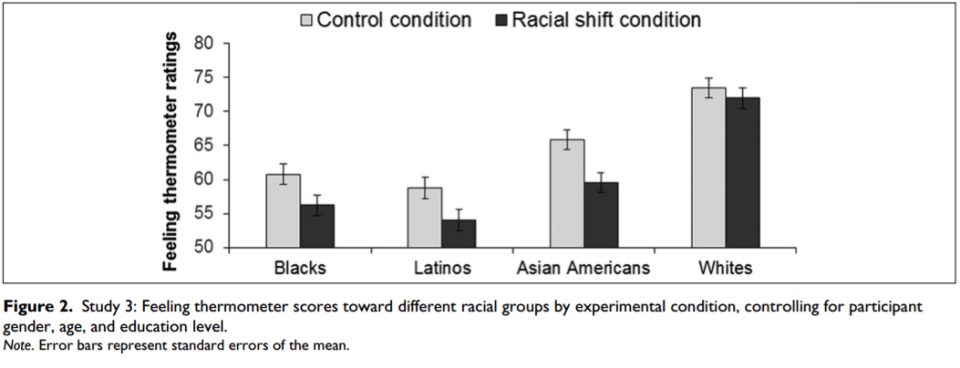
So the researchers showed that by making the racial shift important, that led to more white Americans showing negative attitudes towards minorities—specifically ‘Hispanics’. This was brought about by whites’ “concerns of lose of societal status.” When whites begin to notice demographic changes, the attitudes towards minorities will change—most notable the attitudes towards blacks and ‘Hispanics’ (which is due to the amount of crime committed by both groups, and is why whites show favoritism towards Asians, in my opinion). Overall, it was shown in a nationally representative sample of whites that showing the changing demographics in the country leads to more negative responses towards minority groups. This is due to the perceived threat on whites’ group status, which leads to more out-group bias.
These four studies report empirical evidence that contrary to the belief of liberals et al—that an increasingly diverse America will lead to more acceptance—more exposure to diversity and the changing racial demographics will have whites show more negative attitudes towards minority groups, most notably ‘Hispanics’, the group projected to become the majority by 2042. The authors write:
Consistent with this prior work, the present research offers compelling evidence that the impending so-called “majority-minority” U.S. population is construed by White Americans as a threat to their group’s position in society and increases their expression of racial bias on both automatically activated and selfreport attitude measures.
Interestingly, the authors also write:
That is, the article in the U.S. racial shift condition accurately attributed a large percentage of the population shift to increases in the Latino/Hispanic population, yet, participants in this condition expressed more negative attitudes toward Black Americans and Asian Americans (Study 3) as well as greater automatic bias on both a White-Asian and a White-Black IAT (Studies 2a and 2b). These findings suggest that the information often reported regarding the changing U.S. racial demographics may lead White Americans to perceive all racial minority groups as part of a monolithic non-White group.
You can see this from the rise of the alt-right. Whites, when exposed to the reality of the demographic shift in America, will begin to show more pro-white attitudes while derogating minority out-groups. It is important to note the implications of these studies. One could look at these studies, and rightly say, that as America becomes more diverse that ethnic tensions will increase. Indeed, this is what we are now currently seeing. Contrary to what people say about diversity “being our strength“, it will actually increase ethnic hostility in America and lead towards evermore increasing strife between ethnic groups in America (that is ever-rising due to the current political and social climate in the country). Diversity is not our “strength”—it is, in fact, the opposite. It is our weakness. As the country becomes more diverse we can expect more ethnic strife between groups, which will lower the quality of life for all ethnies, while making whites show more negative attitudes towards all minority groups (including Asians and blacks, but less so than ‘Hispanics’) due to group status threat. The authors write in the discussion:
That is, these studies revealed that White Americans for whom the U.S. racial demographic shift was made salient preferred interactions/settings with their own racial group over minority racial groups, expressed more automatic pro-White/antiminority bias, and expressed more negative attitudes toward Latinos, Blacks, and Asian Americans. The results of these latter studies also revealed that intergroup bias in response to the U.S. racial shift emerges toward racial/ethnic minority groups that are not primary contributors to the dramatic increases in the non-White (i.e., racial minority) population, namely, Blacks and Asian Americans. Moreover, this research provides the first evidence that automatic evaluations are affected by the perceived racial shift. Taken together, these findings suggest that rather than ushering in a more tolerant future, the increasing diversity of the nation may actually yield more intergroup hostility.
Thinking back to Rushton’s Genetic Similarity Theory, we can see why this occurs. Our genes are selfish and want to replicate with out similar genes. Thus, whites would become less tolerant of minority groups since they are less genetically similar to them. This would then be expressed in their attitudes towards minority groups—specifically, ‘Hispanics’ as that ethny will most likely to become the majority and overtake the white majority in 25 years. This is GST on steroids. Once whites realize the reality of the situation of increasing diversity in America—along with their status in the country as a whole—they will then show more negative bias towards minority out-groups.
All in all, the more whites are exposed to diversity in the social context as well as the reality of the ethnic demographic shift in 25 years will be more likely to show negative attitudes towards all American ethnies (though less negative attitudes towards Asians, dude to being less criminal, in my opinion). As the country becomes less white, so to will the whites in America become less tolerant of all minorities and start banding together for pro-white interests—showing that diversity is not our strength. This, in reality, is exactly what liberals do not want—whites banding together showing less favoritism towards the out-group. However, this is what occurs in countries that increasingly become diverse.
Neurons By Race
1100 words
With all of my recent articles on neurons and brain size, I’m now asking the following question: do neurons differ by race? The races of man differ on most all other variables, why not this one?
As we would have it, there are racial differences in total brain neurons.In 1970, an anti-hereditarian (Tobias) estimated the number of “excess neurons” available to different populations for processing bodily information, which Rushton (1988; 1997: 114) averaged to find: 8,550 for blacks, 8,660 for whites and 8,900 for Asians (in millions of excess neurons). A difference of 100-200 million neurons would be enough to explain away racial differences in achievement, for one. Two, these differences could also explain differences in intelligence. Rushton (1997: 133) writes:
This means that on this estimate, Mongoloids, who average 1,364 cm3 have 13.767 billion cortical neurons (13.767 x 10⁹ ). Caucasoids who average 1,347 cm3 have 13.665 billion such neurons, 102 million less than Mongoloids. Negroids who average 1,267 cm3 , have 13.185 billion cerebral neurons, 582 million less than Mongoloids and 480 million less than Caucasoids.
Of course, Rushton’s citation of Jerison, I will leave alone now that we know that encephilazation quotient has problems. Rushton (1997: 133) writes:
The half-billion neuron difference between Mongoloids and Negroids are probably all “excess neurons” because, as mentioned, Mongoloids are often shorter in height and lighter in weight than Negroids. The Mongoloid-Negroid difference in brain size across so many estimation procedures is striking
Of course, small differences in brain size would translate to differences differences neuronal count (in the hundreds of millions), which would then affect intelligence.
Moreover, since whites have a greater volume in their prefrontal cortex (Vint, 1934). Using Herculano-Houzel’s favorite definition for intelligence, from MIT physicist Alex Wissner-Gross:
The ability to plan for the future, a significant function of prefrontal regions of the cortex, may be key indeed. According to the best definition I have come across so far, put forward by MIT physicist Alex Wissner-Gross, intelligence is the ability to make decisions that maximize future freedom of action—that is, decisions that keep most doors open for the future. (Herculano-Houzel, 2016: 122-123)
You can see the difference in behavior and action in the races; how one race has the ability to make decisions to maximize future ability of action—and those peoples with a smaller prefrontal cortex won’t have this ability (or it will be greatly hampered due to its small size and amount of neurons it has).
With a smaller, less developed frontal lobe and less overall neurons in it than a brain belonging to a European or Asian, this may then account for overall racial differences in intelligence. The few hundred million difference in neurons may be the missing piece to the puzzle here.Neurons transmit information to other nerves and muscle cells. Neurons have cell bodies, axons and dendrites. The more neurons (that’s also packed into a smaller brain, neuron packing density) in the brain, the better connectivity you have between different areas of the brain, allowing for fast reaction times (Asians beat whites who beat blacks, Rushton and Jensen, 2005: 240).
Remember how I said that the brain uses a certain amount of watts; well I’d assume that the different races would use differing amount of power for their brain due to differing number of neurons in them. Their brain is not as metabolically expensive. Larger brains are more intelligent than smaller brains ONLY BECAUSE there is a higher chance for there to be more neurons in the larger brain than the smaller one. With the average cranial capacity (blacks: 1267 cc, 13,185 million neurons; whites: 1347 cc, 13,665 million neurons, and Asians: 1,364, 13,767 million neurons). (Rushton and Jensen, 2005: 265, table 3) So as you can see, these differences are enough to account for racial differences in achievement.
A bigger brain would mean, more likely, more neurons which would then be able to power the brain and the body more efficiently. The more neurons one has, the more likely it it that they are intelligent as they have more neuronal pathways. The average cranial capcities of the races show that there are neuronal differences between them, which these neuronal differences then are the cause for racial differences, with the brain size itself being only a proxy, not an actual indicator of intelligence. The brain size doesn’t matter as much as the amount of neurons in the brain.
A difference in the brain of 100 grams is enough to account for 550 million cortical neurons (!!) (Jensen, 1998b: 438). But that ignores sex differences and neuronal density. However, I’d assume that there will be at least small differences in neuron count, especially from Rushton’s data from Race, Evolution and Behavior. Jensen (1998) also writes on page 439:
I have not found any investigation of racial differences in neuron density that, as in the case of sex differences, would offset the racial difference in brain weight or volume.
So neuronal density by brain weight is a great proxy.
Racial differences in intelligence don’t come down to brain size; they come down to total neuron amount in the brain; differences in size in certain parts of the brain critical to intelligence and amount of neurons in those critical portions of the brain. I’ve yet to come across a source talking about the different number of neurons in the brain by race, but when I do I will update this article. From what we know, we can make the assumption that blacks have less packing density as well as a smaller number of neurons in their PFC and cerebral cortex. Psychopathy is associated with abnormalities in the PFC; maybe, along with less intelligence, blacks would be more likely to be psychopathic? This also echoes what Richard Lynn says about Race and Psychopathic Personality:
There is a difference between blacks and whites—analogous to the difference in intelligence—in psychopathic personality considered as a personality trait. Both psychopathic personality and intelligence are bell curves with different means and distributions among blacks and whites. For intelligence, the mean and distribution are both lower among blacks. For psychopathic personality, the mean and distribution are higher among blacks. The effect of this is that there are more black psychopaths and more psychopathic behavior among blacks.
Neuronal differences and size of the PFC more than account for differences in psychopathy rates as well as differences in intelligence and scholastic achievement. This could, in part, explain the black-white IQ gap. Since the total number of neurons in the brain dictates, theoretically speaking, how well an organism can process information, and blacks have a smaller PFC (related to future time preference); and since blacks have less cortical neurons than Whites or Asians, this is one large reason why black are less intelligent, on average, than the other races of Man.
How Intelligent Were Our Hominin Ancestors?
3000 words
Tl;dr: Two of our most recent ancestors have IQs, theoretically speaking, near ours. This suggests that there were beneficial effects of cultural accumulation and transference. This also lends credence to Gould’s work in Full House, where he writes that “cultural change can vastly outstrip the maximal rate of Darwinian evolution.” Brain size may not have increased for IQ, but for expertise capacity. This is seen in the !Kung, gamblers at the horse track, chess players and musicians. There is both theoretical and empirical evidence that expertise needs large amounts of brain to store “and actively process its informational chunks.” These two studies in combination, in my opinion, shows how important the advent of ‘culture’ was for humans. Tool use got passed down as it gave us fitness advantages, then when Erectus discovered fire, that’s when the game changed. One of the first instances of cultural transference then happened, which set the stage for the rest of human evolution. Looking at it from this perspective, the importance of cultural inheritance and transference cannot be understated. It was due to that ‘behavioral change’ that allowed us all of the advantages we have over our ancestors; we have them to thank for everything we see around us today. For if not for them passing down the beginnings of culture that increased our fitness, individuals would have had to learn things for themselves which would decrease fitness. It’s due to this transference that we are here today.
My recent articles have consisted of what caused our big brains, whether or not there is ‘progress’ in hominin brain evolution, why humans are cognitively superior to other animals, and that the human brain is a linearly scaled-up primate brain (Herculano-Houzel, 2009). Knowing what we know about the human brain and the cellular scaling rules for primates (Herculano-Houzel, 2007), we can infer the amount of neurons that our ancestors Erectus, Heidelbergensis, and Neanderthals had. How intelligent were they? Does the EQ predict intelligence better for non-human primates, or does overall brain weight matter most? If our immediate ancestors had the same amount of neurons as we do, what does that mean for our supposed cognitive superiority over them?
How many neurons did our ancestors have, and what did it mean for their intelligence levels? Herculano-Houzel (2013) estimated the amount of neurons that our ancestors had: Afarensis (35 b), Paranthropus (33 b), to close to 50-60 billion neurons in our species Homo from rudolfensis to antecessor, H. Erectus (62 b), Heidelbergensis (76 b), and Neanderthals (85 b), which is within the range for modern Sapiens. From our knowledge of the average human’s IQ (say, 100) and the total number of neurons the brain has (86 billion), what can we say about the IQs of Erectus, Afarensis, Paranthropus, rudolfensis, antecessor, Heidelbergensis, and Neanderthals?
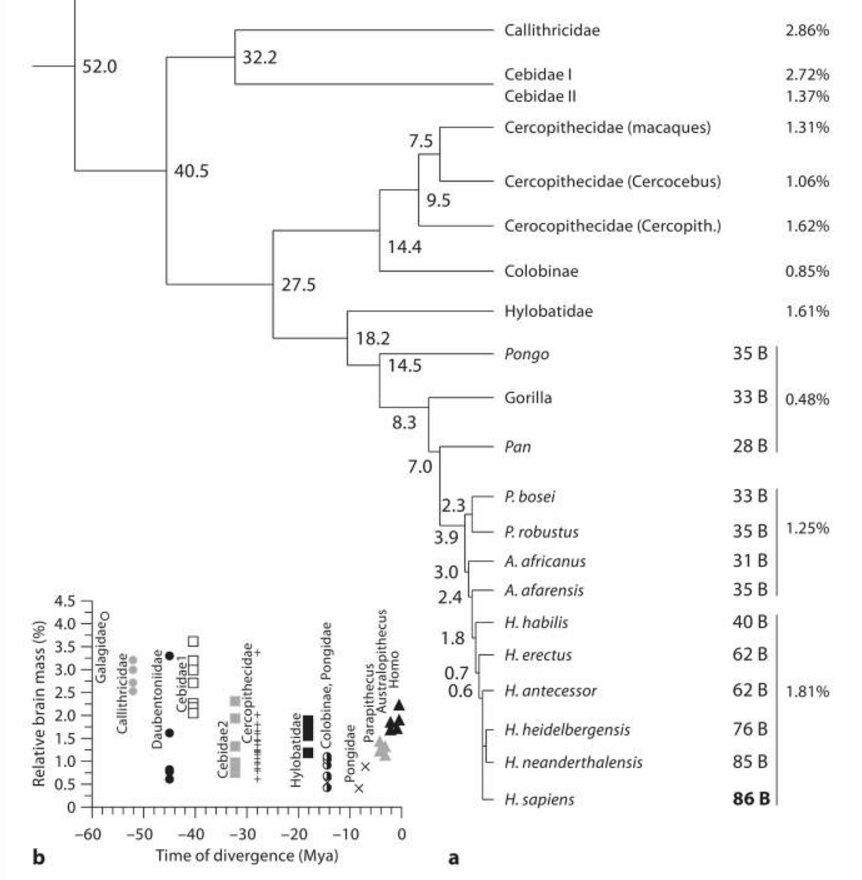
(chart from Herculano-Houzel and Kaas, 2011)
Since Afarensis had about 35 billion neurons we can infer that his IQ was about 40. Paranthropus with about 33 billion neurons had an IQ of about 38. Homo habilis had 40 billion neurons, equating to IQ 46. Erectus with 62 billion neurons comes in at IQ 72., which differs with PP’s estimate by 22 points. (You can see the brain size increase [more on that later] and total neuron increase between habilis and erectus, with an almost 20 IQ point difference. The cause of this is the advent of cooking and the tool-use by habilis, named ‘Handy Man’.) Now we come to a problem. The total number of neurons in the brain of Heidelbergensis, Neanderthals, and humans are about the same.
Heidelbergensis had 76 billion neurons which equates to IQ 88. Neanderthals had about 85 billion neurons, equating to IQ 99. Our IQs are 100 with 86 billion neurons. As you can see, the leap from habilis (who may have eaten meat) to Erectus, a jump of 22 billion neurons and along with it 22. (The rise of bipedalism and tool use, fire, cooking, and meat eating led to the huge increase in neurons in our species Homo.) Then from Erectus to Heidelbergensis was a jump of 14 billion neurons along with an increase of 16 IQ points, then from Heidelbergensis to Neanderthal is an increase of 9 billion neurons, increasing IQ about 11 points. Neanderthals to us is about 1 billion neurons showing a difference of 1 IQ point.
This leads us to a troubling question: did Neanderthals and Hheidelbergensis at least have the capacity to become as intelligent as us? Herculano-Houzel and Kaas (2011) write:
Given that cognitive abilities of non-human primates are directly correlated with absolute brain size [Deaner et al., 2007], and hence necessarily to the total number of neurons in the brain, it is interesting to consider that enlarged brain size, consequence of an increased number of neurons in the brain, may itself have contributed to shedding a dependence on body size for successful competition for resources and mates, besides contributing with larger cognitive abilities towards the success of our species [Herculano-Houzel, 2009]. In this regard, it is tempting to speculate on our prediction that the modern range of number of neurons observed in the human brain [Azevedo et al., 2009] was already found in H. heidelbergensis and H. neanderthalensis, raising the intriguing possibility that they had similar cognitive potential to our species. Compared to their societies, our outstanding accomplishments as individuals, as groups, and as a species, in this scenario, would be witnesses of the beneficial effects of cultural accumulation and transmission over the ages.
If true, this is a huge finding as it echoes what Stephen Jay Gould wrote 21 years ago in his book Full House, as I documented in my article Stephen Jay Gould and Anti-Hereditarianism:
“The most impressive contrast between natural evolution and cultural evolution lies embedded in the major fact of our history. We have no evidence that the modal form of human bodies or brains has changed at all in the past 100,000 years—a standard phenomenon of stasis for successful and widespread species, and not (as popularly misconceived) an odd exception to an expectation of continuous and progressive change. The Cro-Magnon people who painted the caves of the Lascaux and Altamira some fifteen thousand years ago are us—and one look at the incredible richness and beauty of this work convinces us, in the most immediate and visceral way, that Picasso held no edge in mental sophistication over these ancestors with identical brains. And yet, fifteen thousand years ago no human social grouping had produced anything that would conform with our standard definition of civilization. No society had yet invented agriculture; none had built permanent cities. Everything that we have accomplished in the unmeasurable geological moment of the last ten thousand years—from the origin of agriculture to the Sears building in Chicago, the entire panoply of human civilization for better or for worse—has been built upon the capacities of an unaltered brain. Clearly, cultural change can vastly outstrip the maximal rate of natural Darwinian evolution.” (Gould, 1996: 220)
But human cultural change is an entirely distinct process operating under radically different principals that do allow for the strong possibility of a driven trend for what we may legitamately call “progress” (at least in a technological sense, whether or not the changes ultimately do us any good in a practical or moral way). In this sense, I deeply regret that common usage refers to the history of our artifacts and social orginizations as “cultural evolution.” Using the same term—evolution—for both natural and cultural history obfuscates far more than it enlightens. Of course, some aspects of the two phenomena must be similar, for all processes of genealogically constrained historical change must share some features in common. But the differences far outweigh the similarities in this case. Unfortunately, when we speak of “cultural evolution,” we unwittingly imply that this process shares essential similarity with the phenomenon most widely described by the same name—natural, or Darwinian, change. The common designation of “evolution” then leads to one of the most frequent and portentious errors in our analysis of human life and history—the overly reductionist assumption that the Darwinian natural paradigm will fully encompass our social and technological history as well. I do wish that the term “cultural evolution” would drop from use. Why not speak of something more neutral and descriptive—“cultural change,” for example? (Gould, 1996: 219-220)
The implications of the findings of the neuron count in Heidelbergensis and Neanderthals, if true, is a huge finding. Because it implies, as Herculano-Houzel and Kaas say, that “our outstanding accomplishments as individuals, as groups, and as a species … would be witnesses of the beneficial effects of cultural accumulation and transmission through the ages.” I’ve been thinking about this one sentence all week, racking my brain on what it could mean, while thinking about alternate possibilities.
I came across a paper by Dr. John Skoyles titled Human Evolution Expanded Brains to Increase Expertise, Not IQ (saying that around this part of the internet is the equivalent of heresy), in which he reviews studies of people living with microcephaly, showing that a lot of people who have the average brain size of Erectus have average, and even sometimes above average/genius IQs. Yes, microcephaly is correlated with retardation and low IQ, but a significant percentage of individuals inflicted with the disease showed average IQ scores (7 percent overall, 22 percent in 1 subgroup) (Skoyles, 1999). As I’ve documented in the past few days, Erectus was the hominin that learned how to control fire and kicked off the huge spurt in our brain growth. When this increase occurred, brain growth still had to happen outside of the brain, making the baby a fetus for one year after it is born. To achieve its larger brain size, the fetus must have a larger brain before birth, with it increasing postnatally.
The solution to this was to widen the hips of women. This would allow the birth canal to be ‘just right’ in terms of size so the baby could just barely make the squeeze. Physiological differences like this are why there are such huge sex differences in sports. Skoyles (1999) writes:
Research of three kinds suggests that small brained people can have normal IQs: (i) a recent MRI survey on brain size (Giedd et al. 1996), (ii) data on individuals born with microcephaly (head circumference 2 SD below the mean; Dorman, 1991); and (iii) data on early hemispherectomy (the removal of a dysfunctional cerebral hemisphere; Smith & Sugar, 1975; Griffith & Davidson, 1966; Vining et al., 1993).
He also writes that in a sample of 1006 school children, 2 percent (19 students) were found to be microcephalic. Of the 19 microcephalics, only 12 were in districts that did intelligence testing. Of the 12, 7 of them had an average IQ, with one having an IQ of 129. Skoyler even cites a study where a woman’s cranial capacity may have possibly been 760 cc (one the lower end of the range of Erectus brains)!! Her employment was described as ‘semi-skilled’, which Skoyler notes is normal for her ability level. Skoyler also says that Medline shows 21 other studies showing that microcephalic individuals have average IQs.
There is also one incidence of a man having a smaller brain than erectus while having a normal intelligence level, showing no peculiarities or mental retardation. Upon his death, his brain was weighed and they discovered that it weighed 624 grams!
Now, of course, the studies that Skoyler brings up are outliers, but they raise very interesting questions when you think about the supposed link with IQ and brain size. More interestingly, even sudden brain damage will leave a small change, if any, in IQ (Bigler, 1995). Finally, the .35 brain size-IQ correlation needs to be talked about. Let’s be generous and say the correlation is .5, 74 percent of the variance in IQ would still be unexplained (Skoyler, 1999: 8).
Skoyler then says that IQ tests “show very moderate to zero correlations with people’s ability to acquire expertise (Ackerman, 1996; Ceci & Liker, 1986; Doll & Mayr, 1987; Ericsson & Lehmann, 1996; Shuter-Dyson & Gabriel, 1981).” So he says that one’s capacity for expertise isn’t necessarily predicated on their IQ as measured by IQ tests. Skoyler writes:
Hence, whereas nonexpert players see only chess pieces, chess masters see possible future moves and potential strategies. Such in depth perception arises from acquiring and being able to actively use a larger numbers of informational “chunks” in analyzing a problem. The number of such chunks in chess masters has been estimated at 50,000 (Gobet & Simon, 1996). Such information processing chunks take many years to acquire. After reviewing performance in sport, medicine, chess and music, Ericsson and Lehmann (1996) propose that before people can show expertise in any domain they must have performed several hours of practice a day for a minimum of 10-years
So, this ‘expertise capacity’ seems to be a trained—not inherited—trait. He then cites a study on people who’ve spent decades at the daily race track betting on horse races. Cece and Liker (1986) measured the IQs of 12 of the experts, and found that they ranged between IQ 81 and 128 (“four were between 80 and 90, three between 90 and 100, two between 100 and 110 and only three above 120 Table 6”). The authors write: “whatever it is that an IQ test measures, it is not the ability to engage in cognitively complex forms of multivariate reasoning.” Moreover, Skoyler writes, expertise in chess (see Erickson, 2000) and music (see Deutsch, 1982: 404-405) “correlates poorly, or not at all with IQ.”
Now that we know that the capacity to develop expertise isn’t needed in the modern world, what did it mean for our hunter-gatherer ancestors? Looking at some of the few hunter-gatherer tribes left today, we can make some inferences.
The !Kung bushmen use in-depth expert knowledge and reasoning. Just by looking at a few tracks in the dirt, a bushman can infer whether the animal that made the track is sick, whether it was alone, its age and sex. They are able to do this by reading the shape and depth of the track in the dirt. Such skill, obviously, is learned, and those who didn’t have the capacity for expertise would have died out. Further, expertise in hunting is more important than physical ability, with the best hunters being over the age of 39 and not those in their 20s. This can further be seen when the young men go out for hunting. The young men do the physical work while the elder reads tracks, a learned ability.
This, Skoyler writes, suggests that those who had the highest capacity for expertise would have had the best chance for survival. Expertise in hunting is not the only thing that we need expertise for, obviously. The skill of ‘expertise’ translates to most all facets of human life. And over time, the advantages conferred by success with these activities “would result in the natural selection of brains with increased capacity for expertise.” So, even possibly, the success of our expertise could have selected for bigger brains which would have further increased the capacity for our expertise.
Since expertise is linked to the number of brain chunks that a brain can “hold and actively process”, that capacity for expertise “may be related to the number of cortical columns able to specialise neural networks in representing and processing them, and through this to cerebral mass Jerison (1991).” And, in brain scans of expert violinists, they have two to three times as much of their cortical area devoted to their left fingers as nonviolinists. ” This suggests that a strong connection should exist between the capacity for acquiring expertise skills and brain mass.”
I’m, of course, not denying the usefulness of IQ tests. What I’m saying, is that IQ tests don’t test a person’s capacity to learn a skill and become an expert in something. IQ tests, as shown, do not measure expertise capacity. IQ tests, then, don’t test for what was central to our evolution as hominins: expertise capacity. Of course, it’s not only expertise in hunting that led to the selection for bigger brains, and along with it expertise capacity. Obviously, this would hold for other things in our evolution that we can become experts in, from scavenging, to gathering, to language, social relationships, tool-making, and passing on useful skills that would infer an increase in fitness.
IQs for hominins are as follows: Paranthropus: IQ 38 (33 billion neurons); Afarensis: IQ 40 (35 billion neurons); Habilis: IQ 46 (40 billion neurons); Erectus: IQ 72 (62 billion neurons); Heidelbergensis: IQ 88 (76 billion neurons); Neanderthals: IQ 99 (85 billion neurons) and Sapiens: IQ 100 (85 billion neurons). So if Heidelbergensis and Neanderthals had IQs around ours (theoretically speaking), and Erectus had an IQ around modern-day Africans today, what explains our achievements over our hominin ancestors if we have around the same IQs?
Lamarckian cultural inheritance. If you think about when brain size began to increase, it was around the time that bipedalism occurred in the fossil record, along with tool use, fire, cooking, and meat eating. I’m suggesting here today that the beginnings of cultural transference happened with Afaraensis, Habilis, and Erectus. Passing down culture (useful traits for survival back then) would have been paramount in hominin survival. One wouldn’t have to learn how to do things on their own, and could learn from and elder the crucial survival skills they needed. This would have selected for a bigger brain due to the need for a higher expertise capacity, as with a bigger brain there is more room for cortical columns and neurons which would better facilitate expertise in that hominin.
I’m still thinking about what this all means, so I haven’t taken a side on this yet. This is an extremely interesting look into hominin brain size evolution, which shows that big brains didn’t evolve for IQ, but to increase expertise capacity. Though there is an extremely strong possibility that we gained over 20 billion neurons from Erectus due to his cooking, which then capped out our intelligence in our lineage. That would then mean that Neanderthals and Heidelbergensis would have had the capacity for the same IQ as us. One thing I can think of that set us apart 70 kya was the advent of art. That was a new way of transferring information from our hugely metabolically expensive neurons. This was also, yet another way of cultural transference. But what this means in terms of Neanderthal and Heidelbergensis IQ and what it means for our accomplishments since them is another story, which I will return to in the future.
What Caused Human Brain Size to Increase?
1900 words
People talk a lot about intelligence and brain size. Something that’s most always brought up is how the human brain increased in size the past 4 million years. According to PP, the trend for bigger brains in hominins is proof that evolution is “progressive”. However, people never talk about a major event in human history that caused our brains to suddenly increase: the advent of fire. When our ancestors mastered fire, it was then possible for the brain to get important nutrients that influenced growth. People say that “Intelligence is the precursor to tools”, but what if fire itself is the main cause for the increase in brain size in hominins the past 4 million or so years? If this is the case, then fire is, in effect, the ultimate cause of everything that occurred after its use.
The human brain consumes 20-25 percent of our daily caloric intake. How could such a metabolically expensive organ have evolved? The first hominin to master fire was H. erectus. There is evidence of this occurring 1-1.5 mya. Not coincidentally, brain size began to tick upward after the advent of fire by H. erectus. Erectus was now able to consume more kcal, which in turn led to a bigger brain and the beginnings of a decrease in body size. The mastery and use of fire drove our evolution as a species, keeping us warm and allowing us to cook our food, which made eating and digestion easier. Erectus’s ability to use fire allowed for the biggest, in my opinion, most important event in human history: cooking.
With control of fire, Erectus could now cook its foods. Along with pulverizing plants, it was possible for erectus to get better nutrition by ‘pre-digesting’ the food outside of the body so it’s easier to digest. The advent of cooking allowed for a bigger brain and with it, more neurons to power the brain and the body. However, looking at other primates you see that they either have brains that are bigger than their bodies, or bodies that are bigger than their brains, why is this? One reason: there is a trade-off between brain size and body size and the type of diet the primate consumes. Thinking about this from an evolutionary perspective along with what differing primates eat and how they prepare (if they do) their food will show whether or not they have big brains or big bodies. How big an organism’s brain gets is directly correlated with the amount and quality of the energy consumed.
There is a metabolic limitation that results from the number of hours available to feed and the low caloric yield of raw foods which then impose a trade-off between the body size and number of neurons which explains why great apes have small brains in comparison to their bodies. Metabolically speaking, a body can only handle one or the other: a big brain or a big body. This metabolic disadvantage is why great apes did increase their brain size, because their raw-food diet is not enough, nutritionally speaking, to cause an increase in brain size (Azevedo and Herculano-Houzel, 2016). Can you imagine spending what amounts to one work day eating just to power the brain you currently have? I can’t.
Energy availability and quality dictates brain size. A brain can only reach maximum size if adequate kcal and nutrients are available for it.
Total brain metabolism scales linearly with the number of neurons (Herculano-Houzel, 2011). The absolute number of neurons, not brain size, dictates a “metabolic constraint on human evolution”, since people with more neurons need to sustain them, which calls for eating more kcal. Mammals with more neurons need to eat more kcal per day just to power those brains. For instance, the human brain needs 519 kcal to run, which comes out to 6 kcal per neuron. The brain is hugely metabolically expensive, and only the highest quality nutrients can sustain such an organ. The advent of fire and along with it cooking is one of, if not the most important reason why our brains are large (compared to our bodies) and why we have so many neurons compared to other species. It allowed us to power the neurons we have, 86 billion in all (with 16 billion in the cerebral cortex which is why we are more intelligent than other animals, number of neurons, of course being lower for our ancestors) which power human thought.
The Expensive Tissue Hypothesis (ETA) explains the metabolic trade-off between brain and gut, showing that the stomach is dependent on body size as well as the quality of the diet (Aiello, 1996). As noted above, there is good evidence that erectus began cooking, which coincides with the increase in brain size. As Man began to consume meat around 1.5 million years ago, this allowed for the gut to get smaller in response. If you think about it, it makes sense. A large stomach would be needed if you’re eating a plant-based diet, but as a species begins to eat meat, they don’t need to eat as much to get the adequate amount of kcal to fuel bodily functions. This lead to the stomach getting smaller, and along with it so did our jaws.
So brain tissue is metabolically expensive but there is no significant correlation between brain size and BMR in humans or any other encephalized mammal, the metabolic requirements of relatively large brains are offset by a corresponding gut reduction (Aiello and Wheeler, 1995). This is the cause for the low, insignificant correlation between BMR and our (relatively large brains, which correlates to the amount of neurons we have since our brains are just linearly scaled-up primate brains).
Evidence for the ETA can be seen in nature as well. Tsuboi et al (2015) tested the hypothesis in the cichlid fished of Lake Victoria. After they controlled for the effect of shared ancestry and other ecological variables, they noted that brain size was inversely correlated with gut size. Perhaps more interestingly, they also noticed that when the fish’s’ brain size increased, increased investment and paternal care occurred. Moreover, more evidence for the ETA was found by Liao et al (2015) who found a negative correlation between brain mass and the length of the digestive tract within 30 species of Anurans. They also found, just like Tsuboi et al (2015), that brain size increase accompanied an increase in female reproductive investment into egg size.
Moreover, another cause for the increase in brain size is our jaw size decreasing. This mutation occurred around 2.4 million years ago, right around the time frame that erectus discovered fire and began cooking. This is also consistent with, of course, the rapid increase in brain size which was occurring around that time. The room has to come from somewhere, and with the advent of cooking and meat eating, the jaw was, therefore, able to get smaller along with the stomach which increased brain size due to the trade-off between gut size and brain size. Morphological changes occurred exactly at the same time changes in brain size occurred which coincides with the advent of fire, cooking, and meat eating. Coincidence? I think the evidence strongly points that this is the case, the rapid increase in brain size was driven by fire, cooking, and meat eating.
The rise of bipedalism also coincided with the brain size increase and nutritional changes. Bipedalism freed the hands so tools could be made and used which eventually led to the control of fire. Lending more credence to the hypothesis of bipedalism/tools/brain size is the fact that there is evidence that the first signs of bipedalism occurred in Lucy, our Australopithecine ancestor who had pelvic architecture that showed she was clearly on the way to bipedalism. There is more evidence for bipedalism in fossilized footprints of australopithecines around 3 mya, coinciding with Lucy, tool use and eventually the advent and use of fire as a tool to cook and ward off predators. Ancient hominids could then better protect their kin, have higher quality food to eat and use the fire to scare off predators with.
The nutritional aspect of evolution and how it co-evolved with us driving our evolution in brain size which eventually led to us is extremely interesting. Without proper nutrients, it’s not metabolically viable to have such a large brain, as whatever kcal you do eat will need to go towards other bodily functions. Moreover, diet quality is highly correlated with brain size. Great apes can never get to the brain size that we humans have, and their diet is the main cause. The discovery and control of fire, the advent of cooking and then meat eating was what mainly drove the rapid increase of brain size starting 4 mya.
In a way, you can think of the passing down of the skill of fire-making to kin as one of the first acts of cultural transference to kin. It’s one of the first means of Lamarckian cultural transference in our history. Useful skills for survival will get passed down to the next generation, and fire is arguably the most useful skill we’ve ever come across since it’s had so many future implications for our evolution. The ability to create and control fire is one of the most important skills as it can ward off predators, cook meat, be used to keep warm, etc. When you think about how much time was freed up upon the advent of cooking, you can see the huge effect the control of fire first had for our species. Then think about how we could only control fire if our hands were freed. Then human evolution begins to make a lot more sense when put into this point of view.
When thinking about brain size evolution as well as the rapid expansion of brain size evolution, nutrition should be right up there with it. People may talk about things like the cold winter hypothesis and intelligence ad nauseam (which I don’t doubt plays a part, but I believe other factors are more important), but meat-eating along with a low waist-to-hip ratio, which bipedalism is needed for all are much more interesting when talking about the evolution of brain size than cold winters. All of this wouldn’t be possible without bipedalism, without it, we’d still be monkey-like eating plant-based diets. We’d have bigger bodies but smaller brains due to the metabolic cost of the plant-based diet since we wouldn’t have fire to cook and tools to use as we would have still been quadrupeds. The evolution of hominin intelligence is much more interesting from a musculoskeletal, physiological and nutritional point of view than any simplistic cold winter theory.
What caused human brain size to increase is simple: bipedalism, tools, fire, cooking, meat eating which then led to big brains. The first sign of big brains were noticed right around the time erectus had control of fire. This is no coincidence.
Bipedalism, cooking, and food drove the evolution of the human brain. Climate only has an effect on it insofar as certain foods will be available at certain latitudes. These three events in human history were the most important for the evolution of our brains. When thinking about what was happening physiologically and nutritionally around that time, the rebuttal to the statement of “Intelligence requires tools” is tools require bipedalism and further tools require bigger brains as human brains may have evolved to increase expertise capacity and not IQ (more on that in the future), which coincides with the three events outlined here. Whatever the case may be, the evolution of human intelligence is extremely interesting and is most definitely multifaceted.
The Human Brain Is Not Particularly Special: A New Way of Looking At the Human Brain
2000 words
What if I told you that, neuronally speaking, the human brain was not particularly special? That, despite its size in comparison to our bodies, we are not particularly special in comparison to other primates or mammals. The encephalization quotient supposedly shows how “unique” and “special” humans are in terms of brain size compared to body size. We have a brain that’s seven times bigger than would be expected for our body size, and that’s what supposedly makes us unique compared to the rest of the animals kingdom.
Suzana Herculano-Houzel, the new Associate Professor of Psychology at Vanderbilt University (former Associate Professor at the Federal University of Rio de Janeiro), is a neuroscientist who challenges these notions that humans are supposedly unique in our brain size when compared to other mammals and primates. She pioneered a technique of turning brains into soup with a machine called the isotropic fractionator, which turns it into a “soup of a known volume” that contain the free cell nuclei to be colored and counted under a microscope. Using this technique, Azevedo et al (2009) showed that “with regard to numbers of neuronal and nonneuronal cells, the human brain is an isometrically scaled-up primate brain.” Every cell in the soup contains one nucleus, so counting is easy. Using this technique, they discovered that using the brain scaling of rats, a brain of 100 billion neurons would weigh 45 kg and body mass would be 109 tons. While using the primate scaling, a brain of 100 billion neurons would weigh 1.45 kg and belong to a body weighing 74 kg, suspiciously what humans are…. The human brain is constructed with the same rules as other primate’s brains. We are no different.
This is in direct opposition to brain size fetishists, who champion the fact that the human brain is some so-called ‘pinnacle of evolution’, as if all of the events that preceded us was setting the stage for our eventual arrival.
Of course, speaking in terms of body size, humans have the largest brains. However, the amount of neurons a brain has seems to be correlated to how cognitively complex the organism is. Humans have the most neurons for their brain size, however, that is one of the only things that sets us apart from other mammals/primates.
Azevedo et al (2009) write:
Our notion that the human brain is a linearly scaled-up primate brain in its cellular composition is in clear opposition to the traditional view that the human brain is 7.0 times larger than expected for a mammal and 3.4 times larger than expected for an anthropoid primate of its body mass (Marino, 1998). However, such large encephalization is found only when body-brain allometric rules that apply to nonprimates are used, as stated above, or when great apes are included in the calculation of expected brain size for a primate of a given body size.
Humans aren’t special in terms of neuronal and nonneuronal cells, our brains are just scaled-up versions of primate brains. There is nothing ‘weird’ or ‘unique’ about our brains; our brains follow the same ‘laws’ as other primates. Great apes such as the orangutans and gorillas are the ones who have brains that are smaller than their bodies. Their bodies are much larger than expected for primates of their brain size. That is where the outlier exists; not us.
The reason for our higher cognition is the 16 or so billion neurons in our cerebral cortex. For instance, the astounding human brain size in relation to body size is often touted, however, elephant’s brains are bigger, and they also have more neurons than we do. What sets us apart from elephants is that our cerebral cortex has about three times the amount of neurons compared to the elephant whose cerebral cortex is two times larger. The density of the neurons in our cerebral cortex seems to be the cause of our unique intelligence in the animal kingdom. Herculano-Houzel writes in her book The Human Advantage: A New Understanding of How Our Brains Became Remarkable (2016: 102):
The superior cognitive abilities of the human brain over the elephant brain can simply—and only—be attributed to the remarkably large number of neurons in its cerebral cortex.
Moreover, the absolute expansion of the cerebral cortex and its relative increase over the rest of the brain have been particularly fast in primate evolution (Herculano-Houzel, 2016: 110). I will return to the cause for this later.
She also noticed that in all of the papers that she read about the brain that the constant number quoted for the amount of neurons in the human brain was 100 billion. She continuously searched for the original citation and couldn’t find it. It wasn’t until she used her isotropic fractionator to get the true amount of neurons in the human brain—86 billion, which coincided with another stereological estimate.
Human brains are normally thought of as the ‘pinnacle of evolution’. Some people believe that everything preceding us was just setting the stage for the eventual Dawn of Man. This couldn’t be further from the truth. She writes on page 112:
And at the pinnacle of evolution, supposedly, is the human cerebral cortex, with the largest relative size compared to the brain. That, however, is only to be expected, both because we are primates and because, among primates, we have the largest brain and cerebral cortex, not because we are special.
Moreover, what I hardly see discussed is the fact that the brain is the most metabolically expensive organ the body has. Our brain weighs in at 2 percent of our body weight, yet takes 500 kcal—or 25 percent of our daily energy needs—to power. Further, 500 kcals per day translates to 24 watts of power, slightly more than half the amount of energy it takes to power a 40 watt light bulb and just over one-third of the power it takes to power a 60-watt laptop. Our muscles, in comparison, generate over 3 times the amount of energy (75 watts) and even more in short bursts (think Type II muscle fibers). Amazingly, the amount of energy the brain uses stays constant at 24 watts. This is attributed to some parts of the brain being more active while some are less active. However, the redistribution of blood flow from the less active to more active parts of the brain explains how the brain can use a constant amount of energy and never go above its daily requirements (Herculano-Houzel, 2016: 174).
When thinking about the overall brain size of a species, the amount of caloric energy that organ needs daily has to be taken into account. For instance, as noted previously, the human brain needs 129 grams of glucose or 519 kcal to run per day. Consuming the amount of kcal we need to keep our brains running efficiently is easy in the modern-day world: one cup of sugar contains the amount of kcal needed to power the brain all day. There is a trade-off between body size and number of neurons. Thinking about this from a metabolic point of view, there are metabolic limitations on how big a brain can get in comparison to how many kcal the primate in question consumes.
In her Ted Talk (starting at 10 minutes in), she talks about how there is a trade-off between body and brain size. She says that a primate that eats 8 hours per day would have 53 billion neurons if it weighed 25 kg, 45 billion neurons if it weighed 50 kg, if it had 30 billion neurons it would weigh 75 kg, if it had 12 billion neurons it would weigh 100 kg and the amount of neurons would not be viable if it weighed 150 kg. Keep in mind that primates eat 8-9 hours per day—which seems to be the upper limit on the amount of time they can spend eating. So you can clearly see there is a trade-off between brain size and body size—the bigger the body gets for a primate, the brain gets smaller. And, obviously, we humans got around that—but how?
Neurons are extremely expensive from a caloric point of view. Using our brains in the previous comparison, for a brain with 86 billion neurons in a body weighing g 60-70 kg, we should have to eat for over 9 hours to attain the caloric energy needed to power our huge (in terms of neurons) brains. And, obviously, eating for over 9 hours per day just to power our neurons isn’t viable. So how did we get so many neurons if they are so dependent on adequate kcal to power? The thing is, the energy availability in a raw diet never would have powered brains as big as ours (Azevedo and Herculano-Houzel, 2012).
Let’s talk about what we know so far: as detailed above, our brains cost just as much energy as it should and we can’t eat for over 9 hours a day to attain the amount of kcal in order to power and sustain our huge brains, how did our brains get so big?
There is a ‘simple’ way of getting around these energy restraints: cooking. Cooking allowed us to ‘pre-digest’ food, so to speak, before we ingested it. PumpkinPerson always talks about the ‘radical behavioral change’ that occurred, well it occurred with the advent of cooking allowing us to extract nutrients quicker from our food to power our big brain with 86 billion neurons. Without one of the most important events in human history, everything you see around you today would not exist. The best evidence we have is that our ancestors starting with the australopithecines and going to habilis and erectus, was that there was a huge increase in brain size and the only thing that could possibly explain such an increase was the advent of cooking. Our ancestors 1.5 million years ago showed the first signs of cooking, which led to the increase in brain size in our species. Fire played a huge role in our evolution and it could be argued that, without fire, we wouldn’t be here today (or, at least with our current cognitive ability). Our ancestors who were alive around that time did have the capability to make tools, so the digestion process could have begun outside the body by grinding and mashing food before it was eaten.
In sum, the human brain is not special. It follows the same laws as all other primate brains. It has the amount of neurons that are expected for a brain its size in a primate. We can either take ‘brains’ or ‘brawn’, meaning our brains will get smaller as our bodies get bigger and vice versa (in primates anyway). The size of our brains is completely predicated on the amount of caloric energy we intake. Human evolution was driven by fire when our first ancestors started to use it to cook to pre-digest food before eating it. That’s what drove the evolution of our bigger brains which started around 1-1.5 million years ago, and without the ability to consume quality calories with the right amount of nutrients for brain growth, human evolution never would have occurred how it did—especially for the evolution of our brains. Moreover, without the rise of bipedalism, our hands would have never been free to make tools, to use fire and cook food to get our bigger brains because, as shown above, the amount of hours we would need to eat would not be feasible to sustain the brain that we have.
The human brain is just a linearly scaled-up primate brain (Herculano-Houzel, 2009) and has the amount of neurons that a brain our size that an organism of our size would be expected to have. What sets us apart is the amount of neurons that are crowded into our cerebral cortex—16 billion in total—which is responsible for our cognitive superiority over other species on earth. Our overall brain size is not responsible for our domination and conquest of earth, it was the amount of neurons in our cerebral cortex that allowed for our cognitive sophistication over other animals on earth. What sustained our big brains with energy-demanding neurons was the advent of fire and cooking, which allowed us to consume the amount of kcal needed in order to carry around such big brains. The real “Human Advantage” is cooking which led to bigger brains and more cognitive sophistication due to the amount of neurons in our cerebral cortex, not our overall brain size.
The Threat of Increasing Diversity: Why Many White Americans Supported Trump in the 2016 Presidential Election
3250 words
Tl;dr: White Americans exposed to more diversity are more likely to support Trump, anti-PC speech and anti-immigration policies while showing less support and positivity towards Democratic candidates. In the racial shift group, whites with low racial identity, ethnic replacement didn’t seem to care about ethnic replacement and showed stronger support for Democratic candidates. To wake up more whites to anti-immigration sentiments and white identity politics, you need to show them the effects of diversity in the social context as well as what a demographic replacement will mean in the next two decades.
Why did so many white Americans support Donald Trump’s Presidency? The reasons are numerous, though there are some key reasons why he won. To look at the exact reasons why, we need to look at some evolutionary psychology as well as political psychology. I came across a paper today titled The threat of increasing diversity: Why many White Americans support Trump in the 2016 presidential election, it has many thought provoking things in it and pretty much confirms what the altright says about an increase in white identity occurring. An ‘ethnic awakening’ if you will. The authors state that white Americans high in racial identity will be more likely to derogate out-groups when white Americans realize they are becoming replaced in their own country.
Major, Blojorn and Blascovich (2016) state that reminding white Americans who are ‘high in ethnic identification’ (i.e., a white identitarian, an altrighters) that non-white populations will soon outnumber whites caused them to be more concerned about the future of whites in America, pushing them towards Trump and his anti-immigration policies. This also led to an increase in being politically incorrect. Moreover, whites low in ethnic identification (say, a progressive leftist) showed no greater chance in voting for Trump nor his anti-immigration policies. This did, however, decrease positivity towards Trump as well as decreased their opposition towards political correctness. The authors write:
The U.S. Census Bureau (2012) projects that the national population of non-White racial groups will exceed that of Whites before the middle of this century. Many White Americans in the US view race relations as “zero-sum,” in which status gains for minorities means status loss for Whites (Wilkins & Kaiser, 2014) and less bias against minorities means more bias against Whites (Norton & Sommers, 2011). The belief that Whites are losing out to ethnic minorities is particularly prevalent among Trump supporters (De Jonge, 2016).
This is noticed, anecdotally speaking and you can follow the citations to get more information. From an evolutionary perspective, this does make sense. Competition for resources between groups trigger evolutionary instincts. More non-whites in America will decrease the white population who has the lowest birth rate by ethnicity in the country and this will trigger more anti-immigration sentiments in whites high in ethnic identification. This ‘zero-sum game’, the ‘if your ethnic group has more than mine has less’ game will start to take hold in America in the next coming years if this paper is any indication of the future. The one particularly interesting point the authors bring up is that if there is “less ‘bias against minorities, there will be more minorities against whites”, and that, in turn, increased anti-immigration sentiments as well as drove people towards Trump and his anti-immigration views.
The more minorities that come into the country, the more whites in America will start to band together for their own ethnic genetic interests, move towards more conservative policies and begin to show more derogation towards the out-group.
The authors use the term ‘group status threat’, which is when one “worries that his group’s status, influence, and position in the hierarchy is under threat.” This threat then predicts out-group derogation. I wonder if oxytocin (a brain peptide that increases out-group derogation) increases when diversity occurs in the social context. I’d like to see that looked into one day.
There is also ‘integrated threat theory’ where increased diversity poses a threat to white Americans’ resources and American values. They also state, using social cognition theory, that increases in diversity will be ‘frightening’ and ‘confusing’ to whites, causing “uncertainty and fear”, which then drove whites towards more conservative anti-immigration policies.
When whites high in ethnic identification were shown a newspaper article stating that whites would be a minority by 2042, it led whites to be more concerned about whites’ social status in the country, leading them towards more conservative views and policies. It’s important to note that their views changed along with their policy recommendations.
In this study, the authors tested experimentally whether reminding white Americans that of the increasing diversity in the US affects their political leanings, whether or not group status is the cause of the political leanings when one hears about ethnic replacements, and whether or not ethnic identification or political alignment moderated the effects. They expected that reminding whites of ethnic replacement will cause them to lean towards conservative views and politicians (Trump, Kasich, Cruz) while decreasing support for Democrats (Clinton and Sanders).
People who experience ‘group status threat’ will be more likely to vote for Trump since he has more anti-immigration, antidiversity views than all politicians who ran for President. This, the researchers hypothesized, would come to fruition in their study. They also predicted that reminding white Americans of ethnic replacement would cause them to support more anti-immigration policies and be more resistant to political correctness, i.e., they would be more likely to be against positive policies for the out-group. They would become intolerant towards the out-group upon exposure to the reality of ethnic replacement in the country.
We also tested ethnic identification and political affiliation as potential moderators of the predicted effect of condition.1 Drawing on social identity theory (Tajfel & Turner, 1986), we expected that reminders of increasing ethnic diversity would be especially threatening to Whites whose race/ethnicity is a central aspect of their identity. Thus we expected them to report greater support for Republican candidates, anti-immigrant policies, and opposition to political correctness in response to reminders of the racial shift compared to Whites low in ethnic identification. In contrast, based on Craig and Richeson’s (2014b) finding that reminders of the racial shift increased support for conservative ideology irrespective of political leanings, we did not expect political affiliation to moderate effects.
Whites whose ‘race/ethnicity is a central aspect of their identity’, i.e. altrighters were predicted to be especially threatened at the reminder of ethnic replacement in their country of birth. However, as expected and what is seen in anecdotal accounts, whites low in ethnic identification, i.e., progressive leftists, antifas, etc, showed the opposite.
The researchers had a sample consisting of 450 white Americans with the following political beliefs: 262 Democrats, 114 Republicans, 50 Independents and 24 ‘other’. After removing the Independents and ‘others’ from the sample they had 376 white American participants (51.1 percent female).
They were given articles and were given two minutes to read them. One was an article talking about the ethnic replacement of whites and whites’ minority status in America that’s projected to occur by 2042 (aptly called ‘racial shift’) while the other article used “similar language to indicate geographic mobility is increasing (control condition).” It’s interesting to note that it seems like the only difference between the two articles is the wording. After reading the articles, they then completed tasks assessing group status threat, support for the current candidates running for office, anti-immigration sentiments, ethnic identification, and opposition to political correctness. After the completion of the tasks, they were then told the reason for the study and compensated their one dollar.
White Americans exposed to ‘racial shift condition’ reported greater group status threat than those in the control condition. This shows that white Americans who live in a diverse neighborhood will be more likely to be affected by the ‘racial shift condition’, leading them towards anti-immigration sentiment, a strong feeling towards white identity, and be more likely to hold more right-wing views. Whites high in ethnic identification showed greater group status threat than the control (.29) in the racial shift condition while whites low in ethnic identification did not. So, white identitarians showed a greater feeling of threat towards the group than did progressive leftists and antifas. Can’t say I’m too surprised. I did theorize in my article on the rise of the altright that either leftists have less oxytocin and altrighters have more, or that since political beliefs are heritable that high amounts of oxytocin will have one gravitate towards using their altruistic tendencies for the out-group or the in-group. This seems to be some evidence for my theory. For both right-wingers and left-wingers, ethnic identification was positively related to group status threat, but it was stronger in right-wingers. Even more evidence for my oxytocin/political beliefs theory.
White identitarians (whites high in ethnic identification) reported moderately greater positivity towards Trump as well as an even greater chance of voting for him in the racial shift scenario compared to the geographic movement scenario. Conversely, whites low in ethnic identification (progressive leftists, antifas, etc) showed less positivity towards Trump in the racial shift condition than in the geographic movement (control) condition,. However, in the racial shift condition, when one had high ethnic identification it led to increased positivity and a higher chance of voting for Trump. However, in the geographic condition, ethnic identification was unrelated to positivity towards Trump as well as voting for him.
Whites who showed less identification showed somewhat less support towards Sanders, being somewhat less likely to vote for him in the racial shift condition than in the geographic movement condition. In whites low in ethnic identity, neither condition (racial shift or geographic movement) had any effect on voting for Sanders or positivity towards him. Now here’s the good part: in the racial shift condition, whites high in ethnic identity showed somewhat less support and positivity towards Sanders in the racial shift condition compared to the geographic shift condition. Moreover, in the racial shift condition, ethnic identification was negatively correlated with positivity and chance of voting for Sanders, whereas in the control condition ethnic identification showed no effect.
In the racial shift condition, white identitarians were more supportive of anti-immigration policies than progressive leftists, while whites low in ethnic identification showed no difference, regardless of the condition. Ethnic identification was related to anti-immigration policies in both the racial shift and geographic movement conditions, but it was stronger in the racial shift condition.
White identitarians did not differ in outlook on political correctness by condition, while whites who show less ethnic identity reported less opposition to political correctness. Ethnic identification and anti-PC views were positively related in the racial shift condition but unrelated in the geographic shift condition.
Exposure to the racial shift condition vs. the geographic movement condition elicits different responses based on one’s political alignment and ethnic identification. Exposure to the racial shift condition increased group status threat, support for Trump and support for anti-immigration policies while somewhat decreasing support for Sanders, but only among whites high in ethnic identification. Conversely, for whites low in ethnic identification in exposure to the racial shift, there was no effect on group status threat, support for Sanders or anti-immigration sentiments and actually led to a decrease in positivity for Trump. That’s pretty powerful right there.
The support and election of Donald Trump is showing a paradigm shift in this country as ethnies in America start voting on racial lines. As diversity continues to increase and as more white Americans begin to realize the ethnic replacement will begin to impede on how many resources they have access to as well as the ‘racism being flipped on them’ with ‘less bias on minorities being more bias towards whites’, more and more whites will start voting not on party lines, but ethnic lines like all other ethnies in this country do. In the racial shift group, whites high in ethnic identification showed increased support for Trump and anti-immigration policies, increased opposition towards political correctness and decreased Sanders support through group status threat. Conversely, in the racial shift group, reminders of ethnic replacement in whites low in ethnic identification showed decreased Trump support and his policies and did not lead to group status threat. This can be termed ‘ethnic suicide’. Clearly, increased diversity is a threat to some but not all white Americans.
What boggles my mind is that when whites low in ethnic identification were reminded of the projected ethnic replacement by 2042, they decreased support for Trump and increased support for anti-immigration policies and their support for norms that prohibit bias in hate speech, which was not mediated by the group status threat. The authors put forth one theory why this may be the case. They say that whites low in ethnic identification were thinking of the changing racial demographics on the country as a whole, not just on their own ethnic group which may have led them to support a candidate who is tolerant of diversity and antibias norms. Reminding Americans high in racial identity of ethnic replacement increasingly shifted support to Trump and away from Sanders. Though this effect was not seen in relation to other candidates, the authors attributed this to Trump’s stance on immigration and political correctness relative to the other Republican candidates. To those white Americans with a high racial identity who experience group status threat, they would be drawn to Trump and his anti-immigration, anti-PC speech. The authors state:
Of all of the candidates, Trump has been most vocal in his opposition to “outsiders” such as Muslims and illegal immigrants from Latin America, and most openly critical of “political correctness” in both his rhetoric and his behavior. Trump’s rhetoric and policies thus appear to hold special appeal for White Americans highly in racial/ethnic identification who are concerned about the declining position of Whites in American society and who often perceive reverse discrimination as prevalent. In contrast, Sanders may have been perceived as the most inclusive candidate and thus most likely to exacerbate threats to White’s status as a group.
This sums up the 2016 election in one paragraph. White Americans high in racial identity showed a greater chance to vote for Trump, greater opposition to political correctness and were more likely to espouse anti-immigration sentiments.
Political leaning affiliation had a large and expected effect on candidate choice as well as policy preferences. Compared to Dems, Republicans reported much stronger support for Republican candidates than Democratic candidates while being more supportive of anti-immigration and “more un-PC attitudes”. However, when reminded of ethnic replacement, both Democrats and Republicans who showed high racial identification were more likely to lean right and vote Trump. This study shows important implications about group identity and intergroup process to voting preferences. In whites high in racial identity, increased racial diversity affects voting preferences amongst whites, with the strength of the racial/ethnic identity moderating the effect. I.e., the stronger a racial identity one has the more likely they are to support Trump and anti-immigration policies, irrespective of political leaning. Due to this study, psychologists and political scientists need to begin to pay attention to the increasing concerns of whites high in racial identification, while traditionally thinking that white Americans’ politics weren’t driven by white identity, deeming them to be unimportant to whites’ political outlooks. For example, one study showed that “racial identification, perceptions of discrimination, and linked fate were only weak predictors of White Americans’ attitudes on policies related to race and immigration. This led them to conclude that “Whites’ whiteness is usually likely to be no more noteworthy to them than is breathing the air around them” (Sears and Savelli, 2006, p. 901).
However, the current political climate shows that this no longer is the case. As more non-whites immigrate into America, whites who have high racial identity, irrespective of political leaning, will become more open to supporting Trump (or people like him) as well as anti-immigration policies. As the white majority in America shrinks, more and more white Americans will be open to white identity politics to get back their rightful resources in the country as well as the demographic majority. Eventually, with more and more unchecked immigration, white identity will start to become a central part in white American politics and voting blocks. White Americans who regard their identity as ‘white’ and an important part of their identity, future white American political preferences will be molded by group status threat as well as opposition to diversity. Trump has ‘tapped into’ the demographic of white Americans who feel looked down on in their own home country from mass immigration from the South (and soon from MENA countries). White Americans who feel that their numerical advantage is threatened are more likely to vote for Trump and support anti-immigration policies that will begin to benefit American whites.
It is, however, important to note that Trump may not be who he says he is (like most politicians). On election night last month I blogged on Donald Trump and Ethnic Genetic Interests. I showed that contrary to the average perception of him, his interests lie with Israel, not with his own racial group (due to his children marrying Jews). Moreover, he has already reneged on his wall, deporting illegals and his supposed moratorium on Muslim immigration into the US from threat countries. If anything, Trump is just a stepping stone towards more nationalistic attitudes in the US for whites. With the increased diversity, whites will start to see that they are becoming replaced by other ethnies and in whites with high racial identity, it will trigger nationalistic attitudes and responses to the impending threat on their unique genetic code. This will help to foster the awakening of more whites to identity politics, voting in their own ethnic interests and not for the interest of other ethnies.
I personally hope this leads to a renaissance of race-realism in America, but I may be aiming the bar too high. The conclusion of this study is hopeful for the status of whites in America, however. The more whites that get exposed to diversity AND have high racial identity will then lean more towards Trumpian policies. As whites decrease in number in the US, more and more whites will begin to vote for themselves and, in my opinion, once these nationalistic attitudes appear in the white consciousness in America, this demographic replacement can begin to be reversed. If it were not for the increased immigration, however, this would not have happened. The increased immigration is a main driver of these feelings towards political correctness and anti-immigration. The more anti-white sentiment that is heard in America, the more whites high in racial identity will move towards the right while leftists will continue to commit ‘ethnic suicide’.
The takeaway from this paper is this: Whites exposed to the racial shift high in racial identity were more likely to support Trump, anti-immigration policies and be anti-PC. Whites in the racial shift condition who showed low racial identity showed the opposite and were more likely to vote for Democratic candidates. This paper shows good news in the future for whites in America and voting in their interests. Whites in America are beginning to vote for their ethnic genetic interests and this is largely due to genetic similarity theory as immigration from MENA countries and South of the border increase into America. Moreover, with Trump’s allegiance to Israel, Trump is just a man to awaken more people to the realities of immigration. So Trump himself won’t do anything, but his anti-immigration rhetoric is having people notice the realities of immigration and ethnic replacement in America.
 NotPoliticallyCorrect