Home » Posts tagged 'HBD' (Page 6)
Tag Archives: HBD
Racial Differences in Jock Behavior: Implications for STI Prevalence and Deviance
1350 words
The Merriam-Webster dictionary defines jock as “a school or college athlete” and “a person devoted to a single pursuit or interest“. This term, as I previously wrote about, holds a lot of predictive power in terms of life success. What kind of racial differences can be found here? Like with a lot of life outcomes/predictors, there are racial differences and they are robust.
Male jocks get more sex, after controlling for age, race, SES and family cohesion. Being involved in sports is known to decrease sexual promiscuity, however, this effect did not hold for black American jocks, with the jock label being associated with higher levels of sexual promiscuity (Miller et al, 2005). Black American jocks reported significantly higher levels of sexual activity than non-black jocks, but they did not find that white jocks too fewer risks than their non-jock counterparts.
Black Americans do have a higher rate of STDs compathe average population (Laumann et al, 1999; Cavanaugh et al, 2010; CDC, 2015). Black females who are enrolled in, or have graduated from college had a higher STI (sexually transmitted infection) rate (12.4 percent self-reported; 13.4 percent assayed) than white women with less than a high school diploma (6.4 percent self-reported; 2.3 percent assayed) (Annang et al, 2010). I would assume that these black women would be more attracted to black male jocks and thusly would be more likely to acquire STIs since black males who self-identify as jocks are more sexually promiscuous. It seems that since black male jocks—both in high school and college—are more likely to be sexually promiscuous, this then has an effect on even the college-educated black females, since higher educational status has one less likely to acquire STIs.
Whites use the ‘jock identity’ in a sports context whereas blacks use the identity in terms of the body. Black jocks are more promiscuous and have more sex than white jocks, and I’d bet that black jocks have more STDs than white jocks since they are more likely to have sex than white jocks. Jock identity—but not athletic activity and school athlete status—was a better predictor of juvenile delinquency in a sample of 600 Western New York students, which was robust across gender and race (Miller et al, 2007a). Though, surprisingly, the ‘jock effect’ on crime was not as you would expect it: “The hypothesis that effects would be stronger for black adolescents than for their white counterparts, derived from the work of Stark et al. 1987 and Hughes and Coakley (1991), was not supported. In fact, the only clear race difference that did emerge showed a stronger effect of jock identity on major deviance for whites than for blacks” (Miller et al, 2007a).
Miller et al (2007b) found that the term jock means something different to black and white athletes. For whites, the term was associated with athletic ability and competition, whereas for blacks the term was associated with physical qualities. Whites, though, were more likely to self-identify with the label of jock than blacks (37 percent and 22 percent respectively). They also found that binge drinking predicted violence amongst family members, but in non-jocks only. The jock identity, for whites and not blacks, was also associated with more non-family violence while whites were more likely to use the aggression from sports in a non-sport context in comparison to blacks.
For black American boys, the jock label was a predictor of promiscuity but not for dating. For white American jocks, dating meant more than the jock label. Miller et al (2005) write:
We suggest that White male jocks may be more likely to be involved in a range of extracurricular status-building activities that translate into greater popularity overall, as indicated by more frequent dating; whereas African American male jocks may be “jocks” in a more narrow sense that does not translate as directly into overall dating popularity. Furthermore, it may be that White teens interpret being a “jock” in a sport context, whereas African American teens see it more in terms of relation to body (being strong, fit, or able to handle oneself physically). If so, then for Whites, being a jock would involve a degree of commitment to the “jock” risk-taking ethos, but also a degree of commitment to the conventionally approved norms with sanctioned sports involvement; whereas for African Americans, the latter commitment need not be adjunct to a jock identity.
It’s interesting to speculate on why whites would be more prone to risk-taking behavior than blacks. I would guess that it has something to do with their perception of themselves as athletes, leading to more aggressive behavior. Though certain personalities would be more likely to be athletic and thusly refer to themselves as a jock. The same would hold true for somatype as well.
So the term jock seems to mean different things for whites and blacks, and for whites, leads to more aggressive behavior in a non-sport context.
Black and females who self-identified as jocks reported lower grades whereas white females who self-identified as jocks reported higher grades than white females who did not self-report as jocks (Miller et al, 2006). Jocks also reported more misconduct such as skipping school, cutting class, being sent to the principals office, and parents having to go to the school for a disciplinary manner compared to non-jocks. Boys were more likely to engage in actions that required disciplinary intervention in comparison to girls, while boys were also more likely to skip school, have someone called from home and be sent to the principal’s office. Blacks, of course, reported lower grades than whites but there was no significant difference in misconduct by race. However, blacks reported fewer absences but more disciplinary action than whites, while blacks were less likely to cut class, but more likely to have someone called from home and slightly more likely to be sent to the principal’s office (Miller et al, 2006).
This study shows that the relationship between athletic ability and good outcomes is not as robust as believed. Athletes and jocks are also different; athletes are held in high regard in the eyes of the general public while jocks are seen as dumb and slow while also only being good at a particular sport and nothing else. Miller et al (2006) also state that this so-called ‘toxic jock effect‘ (Miller, 2009; Miller, 2011) is strongest for white boys. Some of these ‘effects’ are binge drinking and heavy drinking, bullying and violence, and sexual risk-taking. Though Miller et al (2006) say that, for this sample at least, “It may be that where academic performance is concerned, the jock label constitutes less of a departure from the norm for white boys than it does for female or black adolescents, thus weakening its negative impact on their educational outcomes.”
The correlation between athletic ability and jock identity was only .31, but significant for whites and not blacks (Miller et al, 2007b). They also found, contrary to other studies, that involvement in athletic programs did not deter minor and major adolescent crime. They also falsified the hypothesis that the ‘toxic jock effect’ (Miller, 2009; Miller, 2011) would be stronger for blacks than whites, since whites who self-identified as jocks were more likely to engage in delinquent behavior.
In sum, there are racial differences in ‘jock’ behavior, with blacks being more likely to be promiscuous while whites are more likely to engage in deviant behavior. Black women are more likely to have higher rates of STIs, and part of the reason is sexual activity with black males who self-identify as jocks, as they are more promiscuous than non-jocks. This could explain part of the difference in STI acquisition between blacks and whites. Miller et al argue to discontinue the use of the term ‘jock’ and they believe that if this occurs, deviant behavior will be curbed in white male populations that refer to themselves as ‘jocks’. I don’t know if that will be the case, but I don’t think there should be ‘word policing’, since people will end up using the term more anyway. Nevertheless, there are differences between race in terms of those that self-identify as jocks which will be explored more in the future.
Why Are People Afraid of Testosterone?
1100 words
The answer to the question of why people are afraid of testosterone is very simple: they do not understand the hormone. People complain about birth rates and spermatogenesis, yet they believe that having high testosterone makes one a ‘savage’ who ‘cannot control their impulses’. However, if you knew anything about the hormone and how it’s vital to normal functioning then you would not say that.
I’ve covered why testosterone does not cause crime by looking at the diurnal variation in the hormone, showing that testosterone levels are highest at 8 am and lowest at 8 pm, while children commit the most crimes at 3 pm and adults at 10 pm. The diurnal variation is key: if testosterone truly did cause crime then rates of crime would be higher in both children and adults in the morning; yet, as can be seen with children, there are increases in amounts of violence committed when they enter school, go to recess, and exit school. This shows why those times are related to the spike in crime in children.
I have wrote a previous article citing a paper by Book et al (2001) in which they meta-analyzed testosterone studies and found that the correlation between testosterone and aggression was .14. However, that estimate is too high since they included 15 studies that should have not been included in the analysis. The true correlation is .08 (Archer, Graham-Kevan, and Davies, 2004). So, clearly, along with the fact that the diurnal variation in testosterone does not correlate with crime spikes, it shows that testosterone has no relationship to the cause of crime; it’s just always at the scene because it prepares the body to deal with a threat. That does not mean that testosterone itself causes crime.
One main reason people fear testosterone and believe that it causes crime and by extension aggressive behavior is because of racial crime disparities. According to the FBI, black Americans by and large commit the most crime, despite being 13 percent of the US population. And since it has been reported that blacks have higher levels of testosterone (Ross et al, 1986; Lynn, 1992; Rushton, 1997; Ellis, 2017), people believe that the supposed higher levels of testosterone that blacks, on average, have circulating in their blood is the ultimate cause of the crime disparities in America between races. Though see above to see why this is not the ultimate cause.
Blacks, contrary to popular belief, don’t have higher levels of testosterone (Gasper et al, 2006; Rohrrman et al, 2007; Lopez et al, 2013; Richard et al, 2014). Even if they did have higher levels, say the 13 percent that is often cited, it would not be the cause of higher rates of crime, nor the cause of higher rates of prostate cancer in blacks compared to whites. What does cause part of the crime differential, in my opinion, is honor culture (Mazur, 2016). The blacks-have-higher-testosterone canard was pushed by Rushton and Lynn to explain both higher rates of prostate cancer and crime in black Americans, however I have shown that high levels of testosterone do not cause prostate cancer (Stattin et al, 2003; Michaud, Billups, and Partin, 2015). Looking to testosterone as a ‘master switch’ as Rushton called it is the wrong thing to research because, clearly, the theories of Lynn, Rushton, and Ellis have been rebutted.
People are scared of testosterone because they do not understand the hormone. Indeed, people complain about lower birth rates and lower sperm counts, yet believe that having high testosterone will cause one to be a high T savage. This is seen in the misconception that injecting anabolic steroids causes higher levels of aggression. One study looked at the criminal histories of men who self-reported drug use and steroid use Lundholm et al (2014) who conclude: “We found a strong association between self-reported lifetime AAS use and violent offending in a population-based sample of more than 10,000 men aged 20-47 years. However, the association decreased substantially and lost statistical significance after adjusting for other substance abuse. This supports the notion that AAS use in the general population occurs as a component of polysubstance abuse, but argues against its purported role as a primary risk factor for interpersonal violence. Further, adjusting for potential individual-level confounders initially attenuated the association, but did not contribute to any substantial change after controlling for polysubstance abuse.“
The National Institute of Health (NIH) writes: “In summary, the extent to which steroid abuse contributes to violence and behavioral disorders is unknown. As with the health complications of steroid abuse, the prevalence of extreme cases of violence and behavioral disorders seems to be low, but it may be underreported or underrecognized.” We don’t know whether steroids cause aggression or more aggressive athletes are more likely to use the substance (Freberg, 2009: 424). Clearly, the claims of steroids causing aggressive behavior and crime are overblown and there has yet to be a scientific consensus on the matter. A great documentary on the matter is Bigger, Stronger, Faster, which goes through the myths of testosterone while chronicling the use of illicit drugs in bodybuilding and powerlifting.
People are scared of the hormone testosterone—and by extent anabolic steroids—because they believe the myths of the hulking, high T aggressive man that will fight at the drop of the hat. However, reality is much more nuanced than this simple view and psychosocial factors must also be taken into account. Testosterone is not the ‘master switch’ for crime, nor prostate cancer. This is very simply seen with the diurnal variation of the hormone as well as the peak hours for crime in adolescent and adult populations. The extremely low correlation with aggression and testosterone (.08) shows that aggression is mediated by numerous other variables other than testosterone, and that testosterone alone does not cause aggression, and by extension crime.
People fear things they don’t understand and if people were to truly understand the hormone, I’m sure that these myths pushed by people who are scared of the hormone will no longer persist. Low levels of testosterone are part of the cause of our fertility problems in the West. So does it seem logical to imply that high testosterone is for ‘savages’, when, clearly, high levels of testosterone are needed for spermatogenesis which, in turn, would mean a higher birth rate? Anyone who believes that testosterone causes aggression and crime and that the injection of anabolic steroids causes ‘roid rage’ should do some reading on how the production of the hormone in the body as well as the literature on anabolic steroids. If one wants birth rates to increase in the West, then they must also want testosterone levels to increase as well, since they are intimately linked.
Testosterone does not cause crime and there is no reason to fear the hormone.
The West’s Testosterone Decline
1850 words
The tone of this article may be slightly different than the rest. I hate when people make idiotic, rash judgments on things that they really do not understand.
People are dumb. There is nothing wrong with that, but when those dumb people discover some science, they then misinterpret the article and twist and turn it to fit a political agenda, all the while having absolutely no idea at all about the actual study nor knowing anything about the hormone testosterone! Due to this, you get some cringey articles from the alt-right because they are too ignorant to actually read something without their ideological blinders on.
The study I will be reviewing was on testosterone, which established new levels for nonobese American and European men. The problem is that the new levels are lower than the previous levels; uneducated and biased morons think that means that they (the government) are trying to feminize men and thus they—on their own—lowered testosterone levels themselves. …this is dumb. Like, really really dumb.
Over 9,000 nonobese American and European men were assayed for a harmonized normal range in males; Travison et al, (2017) used the results from a local assay which was sent to the CDC where “testosterone concentrations were measured using a higher order liquid chromatography tandem mass spectrometry method.” Then, Travison et al (2017) used the results from both tests (the local sample and CDC sample) to create a ‘harmonized reference range’ which were then used to generate the age-specific reference ranges across the whole cohort. Using this method, they discovered that the range for testosterone for nonobese males aged 19-39 was between 264-916 ng/ml.
Now, people who don’t understand why this study was done (to see the range of testosterone in men to see the actual range) would say ‘aha! They are trying to lower testosterone and feminize men!”, like the retards Chateau Heartiste and ‘Zeiger‘ from the Daily Stormer. I won’t cover the article from Heartiste (because there’s nothing of substance there to talk about, just some inane drivel), so I’ll cover ‘Zeiger’s’ main points.
The feds have started a process to lower the official “standard” levels of testosterone in men, presumably in an effort to solve the grave “toxic masculinity” problem we’ve got going on here in America.
No. No one has ‘started a process to lower’ the levels of testosterone in America. You do not understand science, so why the hell are you talking about it?
The problem here is that it’s basically a hoax study.
….is this guy a retard? How is this a ‘hoax study’?
The blood samples were obtained not from healthy, athletic males, but from males who were already the subjects of other medical studies. In other words, they were largely composed of ordinary people who ate crappy standard diets, lived sedentary lifestyles, drank water loaded with chemicals, and who are exposed to a whole bunch of estrogen-mimicking chemicals.
….you mean the average man in America? You think they should control for weight, when the average man in America is obese/overweight? Why control for all of those variables when you’re attempting to see what the range is in a large cohort to get a better idea of what the actual range is in men so that they could better diagnose low testosterone and any other maladies involved with it? This study was done to establish the range for the average American and European male, not one who is athletic, low body fat, etc. You’d need to actually understand why the study was undertaken to get that, though.
Now, this new, much lower range of what is considered “normal” testosterone levels is becoming the standard pushed by the CDC (Center for Disease Control) and applied by the various private testing organizations.
You don’t even understand why this ‘new, much lower range’ is considered ‘normal’ and why it’s ‘becoming the standard pushed by the CDC’ and ‘applied by the various private testing corporations’. Because that is the new range for nonobese American and European males aged 19-39!
The old reference range comes from the Framingham Heart Study in which men aged 19-40 were assayed (Bhalin et al, 2011; assays were done in the morning after an overnight fast so I have no problem with this). ‘Zeiger’ writes:
The old standard was based on actual healthy males. Now they’ve dropped the standard to “non-obese.” As a rule, the fatter someone is, the lower their testosterone. This means that the broadening of the criteria for “healthy” to include men who are pretty fat, but short of “obese” will certainly lead to a lower average testosterone level.
Did you know that in the old reference sample (Bhalin et al, 2011), the average BMI of the whole cohort aged 19-39 was 25.2 (average age 32.7)? For men with an average age of 33.3, they had a BMI of 27.4 and men aged 40 had BMI 28 (see table 1; Bhalin et al, 2011). I don’t take BMI as a predictor of health (indeed men with a 27 BMI had a lower risk of mortality than men in other BMI categories), but it is a predictor of testosterone levels. ‘Lean males’ are not between BMI 25 and 28; unless they were testing some IFBB pros, which I know they did not. So they values were similar. He wouldn’t know that though because he’s clueless to the literature.
For one, it makes it a lot harder to get testosterone hormones prescribed to you by a doctor, since your T levels need to be absolutely rock bottom in order to be considered “deficient.”
No, retard. If you’re feeling lethargic, have low energy, low sex drive, etc, then you will be assayed and compared against the new harmonized values. If you’re teetering on the low-end of the normal range variation, then you will get some TRT (testosterone replacement therapy). You’ve never worked with people with low testosterone, so shut the fuck up.
In addition, if this process continues, you could start seeing men with healthy testosterone begin to be seen as “pathological” because their levels are “too high” compared with the new standard. So power-lifters who watch their diets could start being prescribed drugs to lower their T levels.
This is dumb. If I get prescribed drugs to lower my testosterone levels, I’ll be sure to let my readers know (I compete and watch my diet) and my levels are above average for my age.
All of this is based on an obviously flawed methodology.
No, it isn’t. You don’t understand the methodology because you don’t understand science and you don’t understand testosterone.
It’s a transparent push to feminize men and normalize being a low-T faggot.
Nice appeal to emotion at the end there. You don’t understand science so you don’t understand the methodology so this lets you use the new study to support your biases. I strongly recommend that you do some heavy reading into this because you don’t know shit about this matter.
Ten years ago, Travison et al (2007) observed that there was a substantial “and as yet unrecognized, age-independent population-level decrease in T in American men, potentially attributable to birth cohort differences or to health or environmental effects not captured in observed data.” Testosterone levels have declined in America, independent of chronological aging. (See Nyante et al, 2007 for contrary view, they state that there is no decrease in testosterone, also see table 4 which shows that blacks had higher levels than whites, with whites having 5.28 ng/ml and blacks having 5.9 ng/ml for an 11 percent difference. Using previous NHANES data, Nyante et al, 2007 showed that the levels in whites were 5.38 while in blacks it was 5.28 for a .05 percent difference. Nevertheless, this is more evidence for the honor culture hypothesis (Mazur, 2016) which shows why low-income blacks have higher levels of testosterone than better-educated blacks of the same age range.)
Further, a substantial proportion of the intercohort variation was due to assay differences, i.e., saliva, blood, etc (Travison et al, 2017). Further, Travison et al (2017) tested men with BMIs less than 30, the same as Bhalin et al (2011) which was the old reference. But people need to read the actual studies cited to get the truth, and not just speak from emotion (ironic…) about something that they literally have no clue about. Also, read the LabCorp statement on this matter.
Yes, we do have a testosterone decline in the West, and no, it is not due to any nefarious plot to lower testosterone levels or feminize men; if people knew how to read scientific papers then I wouldn’t have to write this article in the tone that I did, but alas you can’t have everything you want in life.
I did write in the past that the testosterone decline in the West is the cause of our fertility problems (this article compliments the linked article), and to higher fertility rates in the West, testosterone levels must also be raised. People who have no idea about how and why studies are carried out shouldn’t talk about them. People who do not understand what they are talking about should not talk about them. Recall that I blasted Heartiste’s Big Food Shilling a few months back, and I also did the same last month rebutting the article that ‘Man ‘originated’ in Europe‘. These people clearly have no understanding of science and quickly latch on to anything that will affirm their worldviews without having the actual knowledge to assess what they are talking about.
I hope that Heartiste and Zeiger actually educate themselves on the matters they write about, because this is just embarrassing and shows no understanding of science or of the hormone testosterone. There is a lot of bullshit floating around out there, mostly from uneducated morons who don’t know a thing about what they are writing about, it just conforms to their worldview and they will thusly write about it all the while being ignorant to the reality of the matter. I wish ideologues would stop writing about things that are not educated in. Alas, I don’t think that will happen anytime soon because people have an agenda to push, science be damned (which is ironic because these same people get on the Left for doing the same. . .).
This is a serious problem, as I have noted before, so to change this, change diet to whole foods, get more exercise, stop drinking from plastic water bottles; you need to shape your own environment in order to have higher testosterone levels; I have extensively documented that testosterone increases or decreases based on a ton of environmental factors. That we are experiencing a large decline in testosterone here in the West shows that we are not as active, we are eating shitty food, and men are not being as dominant as they were in the past.
So yes, in two days time the testosterone reference range for men in America and Europe will be between 264 to 916 ng/ml, and no it is not due to them, this is the actual level in nonobese men. People need to stop the fear mongering bullshit and people need to stop talking about shit that they literally have no understanding of.
Homo Neanderthalis vs. Homo Sapiens Sapiens: Who is Stronger? Implications for Racial Strength Differences
1300 words
Unfortunately, soft tissue does not fossilize (which is a problem for facial reconstructions of hominins; Stephan and Henneberg, 2001; I will cover the recent ‘reconstructions’ of Neanderthals and Nariokotome boy soon). So saying that Neanderthals had X percent of Y fiber type is only conjecture. However, to make inferences on who was stronger, I do not need such data. I only need to look at the morphology of the Neanderthals and Homo sapiens, and from there, inferences can be made as to who was stronger. I will argue that Neanderthals were stronger which is, of course, backed by solid data.
Neanderthals had wider pelves than Homo sapiens. Wider pelves in colder climes are due to adaptations. Although Neanderthals had wider pelves than ours, they had infants around the same size as Homo sapiens, which implies that Neanderthals had the same obstetric difficulties that we do. Neanderthals also had a pelvis that was similar to Heidelbergensis, however, most of the pelvic differences Neanderthals had that were thought to be derived traits are, in fact, ancestral traits—except for the cross-sectional shape of the pubic ramus (Gruss and Schmidt, 2015). Since Neanderthals had wider pelves and most of their pelvis were ancestral traits, then wide pelves may have been a trait of ancestral Homo (Trinkaus, Holliday, and Aurbach, 2014).
Hominins do need wider pelves in colder climates, as it is good for heat retention, however (see East Asians and Northern Europeans). Also, keep in mind that Neanderthals were shorter than us—with the men averaging around 5 feet five inches, and the women averaging about 5 feet, about 5.1 inches shorter than post-WW II Europeans (Helmuth, 1998).
So what does a wider pelvis mean? Since the Neanderthals were shorter than us and also had a wider pelvis, they had a lower center of gravity in comparison to us. Homo sapiens who came Out of Africa, had a narrower pelvis since narrow pelves are better to dissipate heat (Gruss and Schmidt, 2015). Homo sapiens would have been better adapted to endurance running and athleticism, in comparison to the wide-pelved Neanderthals.
People from tropical climates have longer limbs, and are tall and narrow (which is also good for endurance running/sprinting) while people from colder climates are shorter and more ‘compact’ (Lieberman, 2015: 113-114) with a wide pelvis for heat retention (Gruss and Schmidt, 2015). So, clearly, due to the differences in pelvic anatomy between Homo sapiens and Neanderthals,
Furthermore, due to the length of Neanderthal clavicles, it was thought that they had long clavicles which would have impeded strength. However, when the clavicles were reanalyzed it was discovered that when the clavicles were adjusted with the body size of Neanderthals—and not compared with the humeral lengths—Neanderthals had a similar clavicular length, which implies a similar shoulder breadth as well, to Homo sapiens (Trinkaus, Holliday, and Aurbach, 2014). This is another clue that Neanderthals were stronger.
Yet more evidence comes from comparing the bone density of Neanderthal bones to that of Homo sapiens. Denser bones would imply that the body would be able to handle a heavier load, and thusly generate more power. In adolescent humans, muscle power predicts bone strength (Janz et al, 2016). So if the same holds true for Neanderthals—and I don’t see why not—then Neanderthals would have higher muscle power since it predicts bone strength.
Given the “heavy musculature” of Neanderthals, along with high bone robusticity, then they must have had denser bones than Homo sapiens (Friedlander and Jordan, 1994). So since Neanderthals had denser bones, then they had higher muscle power; they had a lower center of gravity due to having a wider pelvis and being shorter than Homo sapiens whose body was heat-adapted. Putting this all together, the picture is now becoming clearer that Neanderthals were, in fact, way stronger than Homo sapiens.
Another cause for these anatomical differences between Neanderthals and Homo sapiens is completely independent of cold weather. Neanderthals had an enlarged thorax (rib cage), which evolved to hold an enlarged liver, which is responsible for metabolizing large amounts of protein. Since protein has the highest thermic effect of food (TEF), then they would have had a higher metabolism due to a higher protein diet which would also have resulted in an enlarged bladder and kidneys which are necessary to remove urea, which possibly would have also contributed to a wider pelvis for Neanderthals (Ben-Dor, Gopher, and Barkai, 2016).
During glacial winters, Neanderthals would have consumed 74-85 percent of their calories from fat, with the rest coming from protein (Ben-Dor, Gopher, and Barkai, 2016). Neanderthals also consumed around 3,360-4,480 kcal per day (Steegman, Cerny, and Holliday, 2002). Let’s assume that Neanderthals averaged 3800 kcal per day. Since the upper limit of protein intake is 3.9 g/bw/day (erectus) and 4.0 g/bw/day for Homo sapiens (Ben-Dor et al, 2011), then Neanderthals would have had a theoretical higher upper limit due to having larger organs, which are useful in processing large amounts of protein. The protein intake for a Neanderthal male was between estimated to be between 985 kcal (low end) to 1170 kcal (high end). It was estimated that Neanderthal males had a protein intake of about 292 grams per day, or 1,170 kcal (Ben-Dor, Gopher, and Holliday, 2016: 370).
Assuming that Neanderthals did not eat carbohydrates during glacial winters (and even if a small amount were eaten, the model would not be affected) and an upper limit of protein intake of 300 grams per day for Neanderthal males, this implies that 74-85 percent of their diet came from animal fat—the rest being protein. Protein is the most thermogenic macro (Corvelli et al, 1997; Eisenstein et al, 2002; Buchholz and Schoeller, 2004; Halton and Hu, 2004; Gillingham et al, 2007; Binns, Grey, and Di Brezzo, 2014). So since Neanderthals ate a large amount of protein, along with their daily activities, they had to have had a high metabolic rate.
To put into perspective how much protein Neanderthals ate, the average American man eats about 100 grams of protein per day. In an analysis of the protein intake of Americans from 2003-2004, it was found that young children ate about 56 grams of protein per day, adults aged 19-30 ate about 91 grams of protein per day, and the elderly ate about 56 grams of protein per day (Fulgoni, 2008). Neanderthals ate about 3 times the amount of protein than we do, which would lead to organ enlargement since larger organs are needed to metabolize said protein as well. Another factor in the increase of metabolism for Neanderthals was the fact that it was, largely, extremely cold. Shivering increases metabolism (Tikuisis, Bell, and Jacobs, 1985; van Ooijen et al, 2005). So the Neanderthal metabolism would have been revved up close to a theoretical maximum capacity.
The high protein intake of Neanderthals is important because high amounts of protein are needed to build muscle. Neanderthals consumed a sufficient amount of kcal, along with 300 grams of protein per day on average for a Neanderthal male, which would have given Neanderthals yet another strength advantage.
I am also assuming that Neanderthals had slow twitch muscle fibers since they have wider pelves, along with evolving in higher latitudes (see Kenyans, East Asians, European muscle fiber distribution), they would have an abundance of type slow twitch muscle fibers, in comparison to fast twitch muscle fibers, however, they also have more slow twitch fibers which Europeans have, while African-Americans (West-African descendants) have a higher amount of fast twitch fibers. (Caesar and Henry, 2015). So now, thinking of everything I explained above and replacing Neanderthals with Europeans and Homo sapiens with Africans, who do you think would be stronger? Clearly, Europeans, which is what I have argued for extensively. African morphology (tall, lanky, high limb ratio) is not conducive to strength; whereas European morphology (wide pelvis, low limb ratio, an abundance of slow twitch fibers) is.
The implications for these anatomic differences between Neanderthals and Homo sapiens and how it translates into racial differences will be explored more in the future. This was just to lay the anatomic and morphologic groundwork in regards to strength and cold weather adaptations. Nevertheless, the evidence that Neanderthals were stronger/more powerful than Europeans stands on solid ground, and the same does hold for the differences in strength between Africans and Europeans. The evolution of racial pelvic variation is extremely important to understand if you want to understand racial differences in sports.
r/K Selection Theory: A Response to Anonymous Conservative
2800 words
I knew the article about r/K selection would stir a bit of debate. Anonymous Conservative has replied to both articles that were published the other day. However, he seems confused. He doesn’t talk about r/K selection theory in terms of density-dependence/independence. That’s what r/K theory was based on before it was discredited for age-specific mortality (Reznick et al, 2002). The theory was discredited decades ago. This article will be a response to him. How can you use age-specific mortality for your theory?
Combining all African and all European populations probably dulls the degree to which certain populations are r and K.
Combining the ethnies of all three populations makes no sense if you’re attempting to infer how behavior X evolved in ecosystem Y using r/K selection theory. To conduct such a study, you would need to study the races in the ecosystem that the selection was hypothesized to have occurred. r/K selection is—as I’ve already brought up—proven false. I will get to that below.
If r/K selection did apply to humans, then since Africans have been in their habitat—according to Rushton—for 140ky and Mongoloids have been in their habitat for 40ky, then Africans would have had more opportunity to approach the environmental carrying capacity while Mongoloids who migrated into novel environments (cold weather, as mentioned above) would experience r-selected traits since they are in a novel environment (r pressure) and facing cold weather (another r pressure). Per Rushton’s own arguments—along with how r/K theory was really used—Africans are K and Mongoloids are r.
Take the most r populations in Africa and you would also see highly obvious differences deviating from normal human behavior.
Which populations in Africa are ‘the most r’? What is ‘normal human behavior’?
Goal number one should be to get people forced to acknowledge that some humans are exhibiting the r-strategy compared to others.
If this were the case, then Mongoloids would be r while Africans would be K—if r/K selection theory weren’t discredited and if human races qualified as local populations. This, of course, comes from Rushton own words, who asserts that Mongoloids have cold-weather adaptations. So if Mongoloids have cold-weather adaptations and cold weather is an agent of r-selection as described previously, then Mongoloids are r-selected. This argument comes straight from Rushton’s own theory. Furthermore, Africans would be K-selected since endemic disease is an agent of K-selection. This is simple enough to understand, especially if you read a few papers on r/K selection.
I get the impression the author is a pot-stirrer ginning up debate, which I can respect. But I would counter that I think this argument requires a slightly more complex view on a few points, and it seeks to cite the established literature on r/K a little too much.
Citing papers is what’s needed when discussing scientific matters. If your arguments are not backed by scientific papers then your argument is pretty much moot.
Most of the literature on r/K is incredibly shallow in its analyses. I suspect nobody really cared about the theory on an emotional level, so nobody really bothered to look too closely at it, or tried to understand why some arguments would seemingly violate simple common sense. One person would assert things that would make no sense in certain contexts, and nobody would ever try to highlight the complexity required for a fuller understanding of the issue. It is either that, or the more powerful minds gravitated somewhere else in the sciences with more practical application.
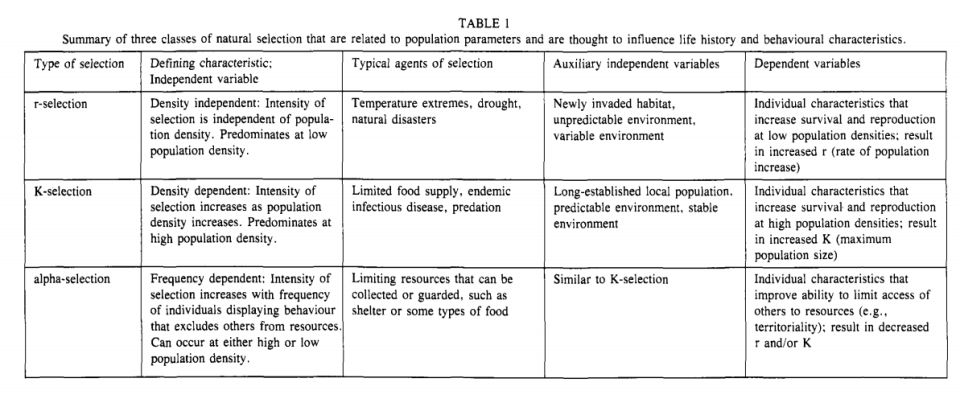
This looks pretty clear-cut to me. r/K selection theory has been extensively tested and falsified. Of course people cared about it, it dominated biology and ecology literature for about twenty years after Pianka’s (1970) paper where he proposed his now debunked ‘r/K continuum’. As I have said, Pianka gave no experimental rationale on why he chose the traits he did for the continuum (Graves, 2002: 135). This is simple enough to understand on its own.
As an example, the author cites papers that say drought is an r-selective pressure. Drought can be r or K, depending on the abilities of the organisms confronted with it. Mice will die in a drought, and have short enough life cycles to reproduce in the wet periods following it. So with mice, after the drought, there will be free resources and that makes drought a huge r-selection pressure.
But suppose you have an organism with the intelligence to envision how to survive the drought, and which thinks in terms of long time frames. Now that drought will cull the relatively r-selected individuals who are designed to exploit a glut with no thought of the future, while favoring those who planned for the drought and stockpiled water, or organized a way to acquire it. Is the drought still an r-selective pressure? Being human, with a high IQ and an ability to plan for the future changes a lot of these rules.
Drought is an agent of r-selection. How about earthquakes and volcanic eruptions? Are those agents of K-selection as well if you can ‘plan for the future changes’? Provide references for your assertion or your claim is unfounded.
On the issue of colder climates being K, the author cites research which makes the case that cold climates kill back the population in the winter, and then allow explosive growth in the summer, and thus are r-selecting.
This will be true in things like insects with short lifespans and no ability to plan for the winter. But in humans, this will favor those who can defer pleasures in the summer, looking forward to the winter and sacrificing by setting aside resources to get themselves through the colder period. It will also favor groups which can work together in pursuit of common goals.
You don’t get it. Mongoloids being r-selected is straight from Rushton. He asserts that they have cold-adaptations. Cold adaptations are due to cold weather. Cold weather is an agent of r-selection (temperature extreme). If cold weather is an agent of r-selection and Mongoloids further migrated into a novel environment (another agent of r-selection), then, per Rushton’s own words, Mongoloids are r-selected. Conversely, Rushton describes endemic disease and drought in Africa (without references), but let’s assume it’s true. As described above, drought is an agent of r (see the table from Anderson above) while endemic disease is an agent of K-selection.
Endemic (native) disease is an agent of K-selection. Since the disease is constant, then the population under that agent of K-selection can prepare ahead for disease. Indeed, in Africa, measures can be taken to reduce the number of those infected with malaria, such as mothers shielding their babies from mosquitoes, to even herbal remedies which have been in use for thousands of years (Wilcox and Bodecker, 2004). If endemic disease is constant (and it is) and Africans are under that constant pressure, then they will be K-selected.
Do groups not work together in Africa to reach common goals? In the Pleistocene as well? Citations? Think before you write (and cite), because hunting bands in our species began with Homo erectus. The capacity for endurance running evolved in erectus which can be seen with the beginnings of our modern pelvis as well as the evolution of the gluteus maximus (Lieberman et al, 2006). So how can you assert that working together to reach common goals only occurred where it was cold—as if tropical environments don’t have their own challenges which require foresight and planning? Think about human evolution and how modern human cognition evolved in Africa.
This will be true of most hardships to some degree. Where they kill back the population massively and randomly, and then allow explosive regrowth, they are r-pressures. But where they are challenges that select for those who can prepare and overcome them, they will tend to favor K, even if they may, strictly by the numbers, appear to be r.
How can you prepare and overcome a violent winter storm, volcanic eruption, earthquake, and drought (which vary wildly)? At a certain point, you can be the smartest one around but one would still succumb to the elements.
He also speaks of aggression. There the question is, is aggression borne of a competitive psychology that embraces risk innately because it evolved to embrace risk in a competitive environment where resources are scarce, or is aggression an opportunistic seizure of free resources from the weak and helpless.
A criminal who sees an old lady and pushes her to the ground to steal her purse is not the same as a Marine who proceeds to selflessly storm enemy lines and kill fifteen men with his bare hands simply to try and save his fellow Marines in battle. The criminal will seek out the weak and vulnerable to victimize safely for personal gain, while the Marine would find that in conflict with his nature. The Marine will sacrifice himself for his group and nothing more, while the criminal would view that as pointless and stupid. Those are two vastly different forms of aggression.
Aggression and violence can be principled and daring, or opportunistic and cowardly. Each is driven by a different psychology, and you can see this difference extend to sexual drive, promiscuity, and even rearing investments. I think there needs to be a difference cited there. One aggressive psychology is r and one is K. One is designed to take free resources in a world with no consequences, while the other is programmed to fight with anyone to try and get a share of scarce resources, because if they didn’t they would starve.
I speak of aggression in regards to testosterone and Richard Lynn’s claims that gonadotropin levels and testosterone lend further support for Rushton’s theory. However, I’ve falsified Ross et al (1986) numerous times. Further, the correlation between testosterone and physical aggression is a pitiful .08 (Archer, Graham-Kevan, and Lowe 2005). The point is that testosterone is not related to aggression, nor crime. Furthermore, the time of day that crime is committed at the highest rates for teens (3 pm) and adults (10 pm) discredit the testosterone-causing-crime theory since testosterone levels are highest at 8 am and lower at 8 pm. You did not address my arguments on testosterone—try again.
Then there is disease. Disease can be r or K, depending on epidemiology. If a disease is sexually transmitted, it is going to take out those with a high sex drive, promiscuity, and reduced disgust. That doesn’t means the disease is K-selecting, so much as it preferentially kills those with an r-selected psychology, and fosters the rise of K.
What about if a disease is endemic? Endemic disease (Rushton’s assertion) is an agent of K, this is not up for discussion. Endemic disease reduces carrying capacity and thusly is an agent of K-selection.
This is simple enough to understand, especially if you understand r/K selection theory.
On the other hand, if a disease infects and kills randomly, such as one transmitted by mosquito, then it will open up free resources by killing the population back below the carrying capacity. That will favor the rise of the r-selected psychologies.
Nope.
I have found the vast majority are written by individuals looking to create quick rules of thumb for much more complex variables that can only be looked at in the context of the mechanisms they are a part of. In many cases, I see authors claiming something is always r or K, when the truth is they are more often the opposite for reasons which the authors seem strangely blind to.
The vast majority of what was written about r/K in its heyday was written by biologists and ecologists. Why reduce a complex biological system interacting with its almost equally complex environment down to a discredited theory? It doesn’t make sense to reduce what organisms do to some ‘simple model’ when the real world—and by proxy ecological theories—are much more complex than a ‘simple model’.
r and K are simple adaptation to either free or limited resource availabilities. To understand how the environment affects the evolution of r and K psychologies, you have to understand that those adaptations to free or limited resources imbue certain psychological predispositions. Once imbued, all other selective pressures have to be examined with an eye to how they either confer advantage or disadvantage on those who express those psychological traits.
r/K selection theory is based on density-dependence and density-independence. As a matter of fact, searching for ‘density-dependent‘ brings up no hits and for ‘density-independent‘, the only hit is for your response to my article. Which makes me believe that you don’t understand r/K selection theory since it’s based on density-dependence and density-independence. It’s also impossible to predict which life history traits will be favored by selection unless you know which particular ecological factors influence life history traits as well as needing a model as to how they function (Anderson, 1991). Rushton did neither, and so he was wrong with his application of r/K to human races.
A sexually transmitted disease that savages a population will open up resource availability and reduce the population well below the carrying capacity, and thus could be mistaken for an r-selecting pressure. But if it wipes out every promiscuous r-strategist, and leaves behind only the monogamous K-strategists, then it is not an r-selective pressure at all. It is favoring the K-psychology, even as from a raw numerical standpoint it would appear an r-pressure.
Which STD? Which population(s)? Source? Even then, STDs such as chancroid (in the US and Europe) were endemic in the early 20th century (Aral, Fenton, and Holmes, 2007). Which populations are you describing? An event like that would be part of the density-dependence aspect of what r/K described. The population would dip and then go right back to environmental carrying capacity (K).
It is necessary—for a K-selected history—to have some sort of density-dependent pressure. Density-dependent pressures are things such as endemic disease in Africa—which is necessary for a K-selected history since density-dependent natural selection occurs at or close to the environmental carrying capacity (Anderson, 1991: 58). If you truly understood r/K selection theory, you’d understand how it’s based on density dependence. You’d understand that ‘r’ and ‘K’ are not adjectives.
(Indeed, I suspect a golden age in the context of human history will be found to often be such an unusual circumstance, where a population is K-ified, even as it is placed in an r-selected environment of free resource availability. The opposite, an r-ified population placed in a grossly overpopulated environment of shortage will be found to reliably be Hell on earth. Guess which one we have coming.)
You should learn about what r/K selection really is (it is density-dependent selection).
The complete absence of that type of detailed understanding of the effects of selective pressures in the literature about r/K Selection Theory is why I don’t waste extensive time here quoting the source texts on the subject. Most seem strangely shallow in their analyses.
It is detailed, see the table above. Where does alpha-selection fit into your theory? Are conservatives alpha-selected? Not speaking about alpha-selection throws a wrench into the theory. The r/K continuum doesn’t even exist!
I am amused to see the author mention r/K Selection Theory has been linked to ideology, without any mention of where. My greatest hope has always been that r/K Theory would become so ever present in the dialog that nobody would remember where it first arose. When that happens, r/K will be everywhere, and nobody will have any idea who to blame.
Well, the ‘one’s to blame’ would be the originators of the theory, MacArthur and Wilson. But r/K selection is a dead concept in biology and population ecology. Don’t worry, r/K selection is dead and isn’t coming back. I’ve shown how it’s a discredited model.
In regards to r/K being falsified, when the theory was tested, key life history variables did not conform to the predictions of the theory (Graves, 2002: 137). People should stop pushing discredited theories.
By the way, in regards to the one comment that was left, why breakdown complex biological interactions with the environment into something so simple? Can you explain to me how and why complex biological systems interacting with their environment can be broken down ‘simply’? You, as well, have no idea what r/K selection is either.
Anonymous Conservative should try to be aware of his political biases. That much is clear. Although, now I know what will happen. We will see a case of the backfire effect where these corrections will increase his misconceptions of r/K selection theory (Nyhan and Reifler, 2012). Everyone should try keep this quote in mind at all times:
When you are studying any matter, or considering any philosophy, ask yourself only what are the facts and what is the truth that the facts bear out. Never let yourself be diverted either by what you wish to believe, or by what you think would have beneficent social effects if it were believed. But look only, and solely, at what are the facts. That is the intellectual thing that I should wish to say. —Bertrand Russel, 1959
E.O. Wilson on Rushton’s r/K Theory and More on Endemic Disease
1300 words
I thought I’d address what E.O. Wilson’s thoughts on Rushton’s theory and clarify some things on endemic disease and cold winter and how they relate to this r/K paradigm. Proponents of Rushton may look to it and say ‘Well, E.O. Wilson said X, so therefore the reason why it’s not accepted is Y!” However, this comes from a faulty misunderstanding of what Wilson said.
I think Phil is an honest and capable researcher. The basic reasoning by Rushton is solid evolutionary reasoning; that is, it is logically sound. If he had seen some apparent geographic variation for a non-human species – a species of sparrow or sparrow hawk, for example – no one would have batted an eye. … when it comes to [human] racial differences, especially in the inflamed situation in this country, special safeguards and conventions need to be developed.
This little blurb does not address anything, really. Yes, it does address the fact that people attacked Rushton for his research on human racial differences. What it does not address is Rushton’s incorrect application of the theory, as covered yesterday. So, bringing up Wilson’s thoughts on Rushton and the controversy surrounding his theory is a moot point.
I don’t understand why people cannot just accept that Rushton was wrong with his misuse of the theory. Notice how I never said anything about his data—I only talked about his misuse of the theory. People act as if both his data and theory need to be correct, well, why can’t one be right and the other wrong (the data and the theory)? Because that’s how it is in reality.
Rushton’s data was largely correct, however, his misapplication of r/K theory shows that he just saw, for instance, current TFRs (total fertility rates) and just arbitrarily placed Africans as r and Eurasians as K, when looking at what Rushton said about both environments—tropical and cold—would lead to K selection for the tropics, since Rushton asserts that endemic and infectious disease is a selective agent (with no references) while Asia was ‘unbearably cold (also with no reference). This characterization of Pleiositicine environments as ‘hot and endemic disease’ and ‘unbearably cold’ has literally no basis in reality.
Tropical environments are more challenging than cold/temperate ones (Dobzhansky, 1950: 221). Knowing this, Rushton’s assertion of cold winters selecting for higher levels of intelligence in Eurasians compared to Africans is wrong since life is easy nowhere. This characterization of life being ‘easy’ in tropical environments has no basis in reality. It’s like people assume that in the tropics you can just laze around all day while fruits fall onto your lap and you have to do nothing that’s cognitively demanding. This is not true at all. Just look at how a savanna looks, does that look ‘easy’ to live in?
There are also a few more things I’d like to talk about in regards to Rushton’s theory, mainly on endemic disease and why it is an agent of K-selection; not r. Even then, r characteristics probably wouldn’t be able to evolve in the savanna (Miller, 1991: 670). The thing is, populations that evolve in disease-ridden places are expected to select for high population growth—increasing r. However, populations in other areas would increase K as they would be selected for survival and not disease resistance. So if disease was a main difference in so-called r/K differences between populations, r-selected people would be more disease resistant AND they would live longer lives (Miller, 1991: 672).
Case closed, right? Wrong. Miller (1991) writes: “If differences in disease rates do prove to be part of the explanation, the theory would not be an r vs K selection theory, because resistance to disease and a long life span are considered K characteristics, rather than r characteristics” (pg: 672). It is also doubtful that conditions in Africa are much more variable in comparison to other continents.
Furthermore, if an alien observed us with no prior knowledge of our species and only had Pianka’s (1970) paper to go off of, he would conclude that Mongoloids would be r-selected due to the cold winter temperatures which bring a high mortality rate. This is the direct opposite of what Rushton claimed.
Miller states at the end of the article that these differences between populations clearly need explaining. However, the explanation is not r vs. K selection, as Afrosapiens and I showed yesterday, Rushton reversed r and K for the three races, making Africans r when they really would be K and making Mongoloids K, when in reality they would be r. Miller addresses other possibilities, such as testosterone, citing Ellis and Nyborg (1992) for racial differences in testosterone, however, he notes that the difference is only 3 percent which wouldn’t account for racial differences in behavior. (Also recall my critique of having no measure of central adiposity.) I’ve definitively shown that even if the races did differ largely in testosterone that it would not account for disease acquisition nor higher rates of crime.

from Anderson (1991: 53)
Above are the agents of selection, their defining characteristics, and independent and dependent variables. Notice how for r-selection the typical agents of selection are temperature extremes, drought, and natural disaster. For K-selection, the usual agents of selection are limited food supply, endemic infectious disease, and predation. Alpha-selection selects for competitive ability and is thus closer to K than r. Limited resources that can be collected or guarded such as shelter or food are agents of selection.
Clearly, as you can see, if this theory did apply to the human races, Mongoloids would be r and Africans would be K. Endemic disease is an agent of K-selection, not r. This is because endemic disease usually imposes density-dependent selection while cold winters impose density-independent selection. Furthermore, and perhaps most importantly, intelligence can be selected for due to agents of r- or K-selection! Rushton had no reason to add intelligence as a ‘K trait’, as Pianka did not even add it to his continuum. Further, Pianka gave no experimental rationale as to why he placed those traits on r or K (Graves, 2002: 135)! So due to this, Rushton’s claims are wrong and people should stop pushing his r/K theory.
Clearly, Rushton reversed r and K selection and wrongly applied them to the races of man. The three races he describes are NOT local populations, so any inferences made off of any so-called evolutionary environment are not warranted because he did not use the right variable (r or K) for Africans or Eurasians. However, some people may not want to admit that Rushton—and by extension, them—were wrong so they will attempt whatever kind of mental gymnastics possible to attempt to prove that Rushton was ‘right’. As I’ve already said, I don’t have a problem with Rushton’s data; I have a problem with his misapplication of r/K to humans—which I’ve made a strong case that he was wrong and didn’t know what he was talking about in terms of ecology and evolution.
Rushton’s theory was no longer viable 3 years after it was proposed when Judith Anderson got her hands on it, writing the paper Rushton’s Racial Comparisons: An Ecological Critique of Theory and Method. There is literally no saving his application of r and K to humans because he used it wrong! I don’t care what E.O. Wilson said, because he didn’t address Rushton’s application of r/K to human races. He only said if he noticed this variation between another species that no one would have batted an eye. That says absolutely nothing about Rushton’s erroneous application of r/K selection to the races of man.
I hope any HBDers reading this will stop and think for a moment before stating that Eurasians are K and Africans are r. This canard needs to stop in this sphere and I hope I set the wheels in motion to end it.
The ENA Theory: On Testosterone and Aggressive Behavior by Race/Ethnicity
3250 words
A commenter by the name of bbloggz alerted me to a new paper by Lee Ellis published this year titled Race/ethnicity and criminal behavior: Neurohormonal influences in which Ellis (2017) proposed his theory of ENA (evolutionary neuroandrogenic theory) and applied it to racial/ethnic differences in crime. On the face, his theory is solid and it has great explanatory power for the differences in crime rates between men and women, however, there are numerous holes in the application of the theory in regards to racial/ethnic differences in crime.
In part I, he talks about racial differences in crime. No one denies that, so on to part II.
In part II he talks about environmental causes for the racial discrepancies, that include economic racial disparities, racism and societal discrimination and subordination, a subculture of violence (I’ve been entertaining the honor culture hypothesis for a few months; Mazur (2016) drives a hard argument showing that similarly aged blacks with some college had lower levels of testosterone than blacks with less than high school education which fits the hypothesis of honor culture. Though Ellis’ ENA theory may account for this, I will address this below). However, if the environment that increases testosterone is ameliorated (i.e., honor culture environments), then there should be a subsequent decrease in testosterone and crime, although I do believe that testosterone has an extremely weak association with crime, nowhere near high enough to account for racial differences in crime, the culture of honor could explain a good amount of the crime gap between blacks and whites.
Ellis also speaks about the general stress/strain explanation, stating that blacks have higher rates of self-esteem and Asians the lowest, with that mirroring their crime rates. This could be seen as yet another case for the culture of honor in that blacks with a high self-esteem would feel the need to protect their ‘name’ or whatever the case may be and feel the need for physical altercation based on their culture.
In part III, Ellis then describes his ENA theory, which I don’t disagree with on its face as it’s a great theory with good explanatory power but there are some pretty large holes that he rightly addresses. He states that, as I have argued in the past, females selected men for higher rates of testosterone and that high rates of testosterone masculinize the brain, changing it from its ‘default feminine state’ and that the more androgens the brain is exposed to, the more likely it is for that individual to commit crime.
Strength
Ellis cites a study by Goodpaster et al (2006) in which he measured the races on the isokinetic dynamometry, pretty much a leg extension. However, one huge confound is that participants who did not return for follow-up were more likely to be black, obese and had more chronic disease (something that I have noted before in an article on racial grip strength). I really hate these study designs, but alas, it’s the best we have to go off of and there are a lot of holes in them that must be addressed. Though I applaud the researchers’ use of the DXA scan (regular readers may recall my criticisms on using calipers to assess body fat in the bench press study, which was highly flawed itself; Boyce et al, 2014) to assess body fat as it is the gold standard in the field.
Ellis (2017: 40) writes: “as brain exposure to testosterone surges at puberty, the prenatally-programmed motivation to strive for resources, status, and mating opportunities will begin to fully activate.” This is true on the face, however as I have noted the correlation between physical aggression and testosterone although positive is low at .14 (Archer, 1991; Book et al, 2001). Testosterone, as I have extensively documented, does cause social dominance and confidence which do not lead to aggression. However, when other factors are coupled with high testosterone (as noted by Mazur, 2016), high rates of crime may occur and this may explain why blacks commit crime; a mix of low IQ, high testosterone and low educational achievement making a life of crime ‘the smart way’ to live seeing as, as Ellis points out, and that intelligent individuals find legal ways to get resources while less intelligent individuals use illegal ways.
ENA theory may explain racial differences in crime
In part IV he attempts to show how his ENA theory may explain racial differences in crime—with testosterone sitting at the top of his pyramid. However, there are numerous erroneous assumptions and he does rightly point out that more research needs to be done on most of these variables and does not draw any conclusions that are not warranted based on the data he does cite. He cites one study in which testosterone levels were measured in the amniotic fluid of the fetus. The sample was 59 percent white and due to this, the researchers lumped blacks, ‘Hispanics’ and Native Americans together which showed no significant difference in prenatal testosterone levels (Martel and Roberts, 2014).
Umbilical cord and testosterone exposure
Ellis then talks about testosterone in the umbilical cord, and if the babe is exposed to higher levels of testosterone in vitro, then this should account for racial/ethnic differences in crime. However, the study he cited (Argus-Collins et al, 2012) showed no difference in testosterone in the umbilical cord while Rohrmann et al (2009) found no difference in testosterone between blacks and whites but found higher rates of SHBG (sex hormone-binding globulin) which binds to testosterone and makes it unable to leave the blood which largely makes testosterone unable to affect organ development. Thusly, if the finding of higher levels of SHBG in black babes is true, then they would be exposed to less androgenic hormones such as testosterone which, again, goes against the ENA theory.
He also cites two more studies showing that Asian babes have higher levels of umbilical cord testosterone than whites (Chinese babes were tested) (Lagiou et al, 2011; Troisi et al, 2008). This, again, goes against his theory as he rightly noted.
Circulating testosterone
Next he talks about circulating differences in testosterone between blacks and whites. He rightly notes that testosterone must be assayed in the morning within an hour after waking as that’s when levels will be highest, yet cites Ross et al (1986) where assay times were all over the place and thusly testosterone cannot be said to be higher in blacks and whites based on that study and should be discarded when talking about racial differences in testosterone due to assay time being between 10 am and 3 pm. He also cites his study on testosterone differences (Eliss and Nyborg, 1993), but, however, just as Ross et al (1986) did not have a control for WC (waist circumference) Ellis and Nyborg (1993) did not either, so just like the other study that gets cited to show that there is a racial difference in testosterone, they are pretty hugely flawed and should not be used in discussion when discussing racial differences in testosterone. Why do I not see these types of critiques for Ross et al (1986) in major papers? It troubles me…
He also seems to complain that Lopez et al (2013) controlled for physical activity (which increases testosterone) and percent body fat (which, at high levels, decreases testosterone). These variables, as I have noted, need to be controlled for. Testosterone varies and fluctuated by age; WC and BMI vary and fluctuate by age. So how does it make sense to control for one variable that has hormone levels fluctuate by age and not another? Ellis also cites studies showing that older East Asian men had higher levels of testosterone (Wu et al, 1995). Nevertheless, there is no consensus; some studies show Chinese babes have higher levels of testosterone than whites and some studies show that whites babes have higher levels of testosterone than Chinese babes. Indeed, this meta-analysis by Ethnicmuse shows that Asians have the highest levels, followed by Africans then Europeans, so this needs to be explained to save the theory that testosterone is the cause of black overrepresentation of violence (as well as what I showed that testosterone is important for vital functioning and is not the boogeyman the media makes it out to be).
Bone density and crime
Nevertheless, the next variable Ellis talks about is bone density and its relationship to crime. Some studies find that blacks are taller than whites while other show no difference. Whites are also substantially taller than Asian males. Blacks have greater bone density than the other three races, but according to Ellis, this measure has not been shown to have a relationship to crime as of yet.
Penis size, race and crime
Now on to penis size. In two articles, I have shown that there is no evidence for the assertion that blacks have larger penises than whites. However, states that penis length was associated with higher levels of testosterone in Egyptian babes. He states that self-reported penis size correlates with self-reports of violent delinquency (Ellis and Das, 2012). Ellis’ main citations for the claim that blacks have larger penises than other races comes from Nobile (1982), the Kinsey report, and Rushton and Boagert (1987) (see here for a critique of Rushton and Boagert, 1987), though he does cite a study stating that blacks had a longer penis than whites (blacks averaging 5.77 inches while whites averaged 5.53 inches). An HBDer may go “Ahah! Evidence for Rushton’s theory!”, yet they should note that the difference is not statistically significant; just because there is a small difference in one study also doesn’t mean anything for the totality of evidence on penis size and race—that there is no statistical difference!
He then cites Lynn’s (2013) paper which was based on an Internet survey and thus, self-reports are over-measured. He also cites Templer’s (2002) book Is Size Important?, which, of course, is on my list of books to read. Nevertheless, the ‘evidence’ that blacks average larger penises than whites is extremely dubious, it’s pretty conclusive that the races don’t differ in penis size. For further reading, read The Pseudoscience of Race Differences in Penis Size, and read all of Ethnicmuses’ posts on penis size here. It’s conclusive that there is no statistical difference—if that—and any studies showing a difference are horribly flawed.
2d/4d ratio and race
Then he talks about 2d/4d ratio, which supposedly signifies higher levels of androgen exposure in vitro (Manning et al, 2008) however these results have been challenged and have not been replicated (Koehler, Simmons, and Rhodes, 2004; Yan et al, 2008, Medland et al, 2010). Even then, Ellis states that in a large analysis of 250,000 respondents, Asians had the lowest 2d/4d ratio, which if the hypothesis of in vitro hormones affecting digit length is to be believed, they have higher levels of testosterone than whites (the other samples had small ns, around 100).
Prostate-specific antigens, race, and prostate cancer
He then talks about PSA (prostate-specific antigen) rates between the races. Blacks are two times more likely to get prostate cancer, which has been blamed on testosterone. However, I’ve compiled good evidence that the difference comes down to the environment, i.e., diet. Even then, there is no evidence that testosterone causes prostate cancer as seen in two large meta-analyses (Stattin et al, 2003; Michaud, Billups, and Partin, 2015). Even then, rates of PCa (prostate cancer) are on the rise in East Asia (Kimura, 2012; Chen et al, 2015; Zhu et al, 2015) which is due to the introduction of our Western diet. I will cover the increases in PCa rates in East Asia in a future article.
CAG repeats
He then reviews the evidence of CAG repeats. There is, however, no evidence that the number of CAG repeats influences sensitivity to testosterone. However, intra-racially, lower amounts of CAG repeats are associated with higher spermatozoa counts—but blacks don’t have higher levels of spermatozoa (Mendiola et al, 2011; Redmon et al, 2013). Blacks do have shorter CAG repeats, and this is consistent with the racial crime gap of blacks > whites > Asians. However, looking at the whole of the evidence, there is no good reason to assume that this has an effect on racial crime rates.
Intelligence and education
Next he talks about racial differences in intelligence and education, which have been well-established. Blacks did have higher rates of learning disabilities than whites who had higher levels of learning disabilities then Asians in a few studies, but other studies show whites and South Asians having different rates, for instance. He then talks about brain size and criminality, stating that the head size of males convicted for violent crimes did not differ from males who committed non-violent crimes (Ikaheimo et al, 2007). I won’t bore anyone with talking about what we know already: that the races differ in average brain size. However, a link between brain size and criminality—to the best of my knowledge—has yet to been discovered. IQ is implicated in crime, so I do assume that brain size is as well (no matter if the correlation is .24 or not; Pietschnig et al, 2015).
Prenatal androgen exposure
Now to wrap things up, the races don’t differ in prenatal androgen exposure, which is critical to the ENA theory; there is a small difference in the umbilical cord favoring blacks, and apparently, that predicts a high rate of crime. However, as noted, blacks have higher levels of SHBG at birth which inhibits the production of testosterone on the organs. Differences in post-pubertal testosterone are small/nonexistent and one should not talk about them when talking about differences in crime or disease acquisition such as PCa. DHT only shows a weak positive correlation with aggression—the same as testosterone (Christiansen and Winkler, 1992; however other studies show that DHT is negatively correlated with measures of physical aggression; Christiansen and Krussmann, 1987; further, DHT is not so evil after all).
Summing it all up
Blacks are not stronger than whites, indeed evidence from the races’ differing somatype, grip strength and leverages all have to do with muscular strength. Furthermore, the study that Ellis cites as ‘proof’ that blacks are stronger than whites is on one measure; an isokinetic dynamometry machine which is pretty much a leg extension. In true tests of strength, whites blow blacks away, which is seen in all major professional competitions all around the world. Blacks do have denser bones which is due to androgen production in vitro, but as of yet, there has been no research done into bone density and criminality.
The races don’t differ on penis size—and if they do it’s by tenths of an inch which is not statisitcally significant and I won’t waste my time addressing it. It seems that most HBDers will see a racial difference of .01 and say “SEE! Rushton’s Rule!” even when it’s just that, a small non-significant difference in said variable. That’s something I’ve encountered a lot in the past and it’s, frankly, a waste of time to converse about things that are not statistically significant. I’ve also rebutted the theory on 2d/4d ration as well. Finally, Asians had a similar level of androgen levels compared to blacks, with whites having the least amount. Along with a hole in the theory for racial differences in androgen causing crime, it’s yet another hole in the theory for racial differences in androgens causing racial differences in penis size and prostate cancer.
On intelligence scores, no one denies that blacks have scored about 1 SD lower than whites for 100 years, no one denies that blacks have a lower educational attainment. In regards to learning disabilities, blacks seem to have the highest rates, followed by Native Americans, than non-Hispanic whites, East Asians and the lowest rates found in South Asians. He states only one study links brain size to criminal behavior and it showed a significant inverse relationship with crime but not other types of offenses.
This is a really good article and I like the theory, but it’s full of huge holes. Most of the variables described by Ellis have been shown to not vary at all or much between the races (re: penis size, testosterone, strength [whites are stronger] prostate cancer caused mainly by diet, 2d/4d ratio [no evidence of it showing a digit ratio difference], and bone density not being studied). Nevertheless, a few of his statements do await testing so I await future studies on the matter. He says that androgen exposure ‘differs by race and ethnicity’, yet the totality of evidence shows ‘not really’ so that cannot be the cause of higher amounts of crime. Ellis talks about a lot of correlates with testosterone, but they do not pass the smell test. Most of it has been rebutted. In fact, one of the central tenets of the ENA theory is that the races should differ in 2d/4d ratio due to exposure of differing levels of the hormone in vitro. Alas, the evidence to date has not shown this—it has in fact shown the opposite.
ENA theory is good in thought, but it really leaves a lot to be desired in regards to explaining racial differences in crime. More research needs to be looked into in regards to intelligence and education and its effect on crime. We can say that low IQ people are more likely to drop out of school and that is why education is related to crime. However, in Mazur (2016) shows that blacks matched for age had lower levels of testosterone if they had some college under their belt. This seems to point in the direction of the ENA theory, however then all of the above problems with the theory still need to be explained away—and they can’t! Furthermore, one of the nails in the coffin should be this: East Asian males are found to have higher levels of testosterone than white males, often enough, and East Asian males actually have the lowest rate of crime in the worle!
This seems to point in the direction of the ENA theory, however then all of the above problems with the theory still need to be explained away—and they can’t! Furthermore, one of the nails in the coffin should be this: East Asian males are found to have higher levels of testosterone than white males, often enough, and East Asian males actually have some of the lowest rate of crime in the world (Rushton, 1995)! So this is something that needs to be explained if it is to be shown that testosterone facilitates aggression and therefore, crime.
Conclusion
I’ve shown—extensively—that there is a low positive correlation between testosterone and physical aggression, why testosterone does not cause crime, and have definitively shown that, by showing how flawed the other studies are that purport to show blacks have higher testosterone levels than whites, along with citing large-scale meta-analyses, that whites and blacks either do not differ or the differences is small to explain any so-called differences in disease acquisition or crime. One final statement on the CAG repeats, they are effect by obesity, men who had shorter CAG repeats were more likely to be overweight, which would skew readings (Gustafsen, Wen, and Koppanati, 2003). So depending on the study—and in most of the studies I cite whites have a higher BMI than blacks—BMI and WC should be controlled for due to the depression of testosterone.
It’s pretty conclusive that testosterone itself does not cause crime. Most of the examples cited by Ellis have been definitively refuted, and his other claims lack evidence at the moment. Even then, his theory rests on the 2d/4d ratio and how blacks may have a lower 2d/4d ratio than whites. However, I’ve shown that there is no significant relationship between 2d/4d ratio and traits mediated by testosterone (Kohler, Simmons, and Rhodes, 2004) so that should be enough to put the theory to bed for good.
Why Testosterone Does Not Cause Crime
1900 words
Edit: (The correlation between aggression and testosterone isn’t .14 as Book et al (2001) state; the true correlation is .08 (Archer, Graham-Kevan and Davies, 2005) So it’s even lower than I thought. This is one of the many reasons why testosterone does not cause crime. It’s just feminist bullshit and fear mongering from people who do not understand the hormone and what it does in the body. The misconceptions come from Rushton’s r/K selection bullshit which has been summarily refuted.)
Recently, I’ve written at length on racial differences in testosterone and how the correlation between testosterone and physical aggression is .14. Pitifully low to account for the cause of crime and any overall differences in racial crime (that will be touched on at length in the future). Tonight I will show, yet again, why testosterone does not cause crime by looking at what times most crimes are committed by both adults and children under the age of 18. This will definitively put the ‘testosterone causes crime’ myth to bed for good.
Before I get into the time of day that most crimes are committed, I must talk about the production of testosterone in the body. There are no ‘genes for’ testosterone (although men who had three certain alleles had a 6.5 fold higher risk of having low testosterone; Ohlsson et al, 2011, I am unaware of there being a variation by race; over 10,000 Caucasian men were studied). There is, however, an indirect control of testosterone synthesis by DNA. DNA regulates the production of testosterone by coding for enzymes that convert cholesterol to testosterone (testosterone is a cholesterol-based hormone).
There are five simple steps to the production of testosterone: 1) DNA codes for mRNA; 2) mRNA codes for the synthesis of an enzyme in the cytoplasm; 3) luteinizing hormone stimulates the production of another messenger in the cell when testosterone is needed; 4) this second messenger activates the enzyme; 5) the enzyme then converts cholesterol to testosterone (Leydig cells produce testosterone in the presence of luteinizing hormone). That’s how testosterone is produced in the body. It is indirectly controlled by DNA.
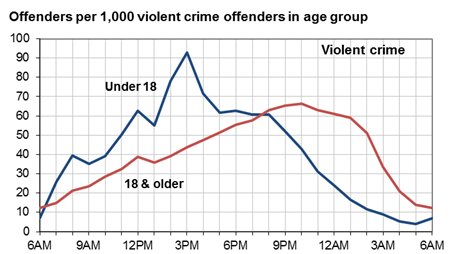
Above is a graph from the Office of Juvenile Justice and Delinquency Prevention which shows the time of day that most crimes are committed. Notice how crime goes up as the time of day goes on and since kids are at school, they’re more likely to fight. This then peaks at 3 pm when kids are getting out of school.
Now look at rates of crime for adults. At its peak of 10 pm, it’s vastly lower than that of people under the age of 18, which is important to keep in mind. You can see how at 8 am that rates of crime are low for adults and high for kids, right when they would be entering school so there would be a lot of other kids around and the chance for violence goes up. Keep the times of 8 am (kids when they enter school), 12 pm (when most kids go on lunch) and 3 pm (when most kids get out of school) along with the hours of 12 pm to 8 pm for adults (when 74 percent of crimes are committed by adults).
- In general, the number of violent crimes committed by adults increases hourly from 6 a.m. through the afternoon and evening hours, peaks at 10 p.m., and then drops to a low point at 6 a.m. In contrast, violent crimes by juveniles peak in the afternoon between 3 p.m. and 4 p.m., the hour at the end of the school day.
- Nearly one-third (29%) of all violent crime committed by juvenile offenders occurs between 3 p.m. and 7 p.m. In comparison, 26% of all violent committed by adult offenders occurs between 8 p.m. and 12 p.m.
So since testosterone varies by day and levels are highest at 8 am and lowest at 8 pm (Brambilla et al, 2009; however testing men aged 45 years of age and older is fine before 2 pm due to a blunted circadian rhythm; Long, Nguyen, and Stevermer, 2015), then how could testosterone account for why men commit most of their crimes at night and why the crime that children commit spikes when they go to school, go to lunch and get out of school? The answer is that it doesn’t because testosterone does not cause crime. What testosterone does cause, however, are feelings of confidence and dominance, which does not—surprisingly—lead to increased aggression and assault on others (Booth et al, 2006).
What testosterone does cause, however, is social dominance and success, not physical aggression and maladjustment (Shcaal et al, 1996). The effects of environment are also more notable on testosterone than are genetics at 5 months of age (Carmaschi et al, 2010). Furthermore, aggressive behavior is first noticed in infancy and reaches its peak before school age (Tremblay et al, 2004; Cote et al, 2006). Though testosterone does seem to have an effect on aggression in preschool boys, however genetic and environmental causality has not been established (Sanchez-Martin et al, 2000).
Nevertheless, the meta-analyses I cited last week show that testosterone has an extremely low correlation of .14, so other factors must be at play. However, Sanchez-Martin et al (2000:778-779) also note that “Tremblay et al (1998) suggested that associations between testosterone titer and physical aggression are likely to be observed in contexts where such attack leads to social dominance. This may be true of the preschool boys in the present study. The data generated in the present study generally support Scerbo and Kolko (1994), who studied older children (7 to 14 years of age). They found a significant relationship between testosterone levels and aggression (as assessed by clinical staff).”
It’s interesting to note that in the case of Scerbo and Kolko (1994) that after controlling for age and size, testosterone correlated with aggression when rated by staff but not parents or teachers. ‘Staff’ refers to clinic staff at a facility where the children were assessed for hyperactivity disorders. Of course, the staff would rate higher levels of aggression compared to parents of teachers—people who are around the children every day—since they would want a higher chance for diagnosis for certain drugs to ‘cure’ the hyperactivity, but I digress. Testosterone does not induce aggression in children, but it does induce social dominance and confidence which does not lead to aggression (Rowe et al, 2004; Booth et al, 2006).
There was also little difference in testosterone between socially dominant prisoners and aggressive prisoners (Ehrenkraz, Bliss, and Sheard, 1974). Furthermore, the testosterone increase leading to pubertal development in boys is not associated with increased aggression (Tremblay et al, 1998; Booth et al, 2006: 171). Indeed, increased body size is a marker for physical aggression in children, and I doubt these children have high muscle mass so, I assume, they have high levels of body fat and thusly lower levels of testosterone than they would have if they were leaner. Yet another strike against the ‘testosterone causes crime/physical aggression’ hypothesis.
Indeed, this has some implications for the honor culture hypothesis of why low-income blacks have higher levels of testosterone than similarly aged blacks with some college (Mazur, 2016). The patterns for crime as shown by the OOJDP shows that crime rises as the day progresses from the morning until its peak at 3 pm for children and then sharply declines while for adults it peaks at 10 pm.
Testosterone does increase when a challenge is issued; when one man feels his reputation is threatened, the propensity for violence is increased, but this was most notably seen in Southern men (Cohen et al, 1996). So the same would be said for this ‘culture of honor’ found in low-income black neighborhoods, the so-called ‘code of the street’ as stated by Anderson (1994: 88): “Moreover, if a person is assaulted, it is important, not only in the eyes of his opponent but in the eyes of his “running buddies,” for him to avenge himself. Otherwise, he risks being “tried” (challenged) or “moved on” by any number of others. To maintain his honor, he must show he is not someone to be “messed with” or “dissed.””
This culture of honor is found all over the world, including Brazil where homicide can be explained by the need to maintain honor and can be understood by taking into account cultural factors; biological, psychological and socioeconomic factors do not explain murder in Northeast Brazil as well as honor and culture (de Souza et al, 2015). People in honor cultures also have a higher chance of self-harm (Osterman and Brown, 2011) as well as a higher chance of committing violence in school (Brown, Osterman, and Barnes, 2009).
Testosterone does not cause crime; it does not cause aggression. Increases in testosterone before, during and after events are a physiologic process to prime the body for competition. As cited above, dominant behavior does not necessarily lead to violence in most cases, which may be surprising for some. Indeed, honor and culture may explain a nice amount of the homicide and violence rate in the South. Since testosterone is highest at 8 am and lowest at 8 pm and the rates of crime committed by adults and children are vastly different than the diurnal variance in the day, then testosterone does not cause crime and its increase is not associated with crime, but social dominance and confidence which does not lead to crime.
Hopefully—if anyone still believes testosterone to be the boogeyman its made out to be—I’ve put those misconceptions to rest. Racial differences in testosterone cannot be the cause of racial differences in crime—because there is either no statistical difference in testosterone between the races or the difference is non-existent. Testosterone is clearly a beneficial hormone—as I have extensively documented. Misunderstandings of the hormone are abound—especially in the HBD sphere—only due to literally a few paragraphs in a book (Rushton, 1997) and one study that showed blacks have higher testosterone than whites which was the cause of their higher rates of prostate cancer (Ross et al, 1986). The study is hard to find so I had to buy access to it. I will cover this in the future, but I discovered that they assayed the subjects when it was convenient for them—between the hours of 10 am and 3 pm—which is unacceptable. You cannot gauge racial differences in testosterone from a small study (n=50) and a non-representative sample (college students). For these reasons, the study should be thrown in the trash—especially when formulating evolutionary hypotheses.
Testosterone is one of the most important hormones for vital functioning. By knowing how it is processed in the body and that there are no ‘genes for’ testosterone (‘low testosterone genes’ notwithstanding) along with how testosterone has a low relationship with physical aggression one should not be scared of having high levels, on the contrary, one should be scared of having low levels. I have once again proven my case that testosterone is not related to violence in showing the diurnal variation in testosterone levels in adults, as well as the time of day that crimes are committed by both adults and children. High testosterone means high confidence and high dominance—and those two traits have a lot to do with masculinity—which do not lead to violence.
I know why testosterone does not cause crime—because I have an understanding of the hormone, how its produced in the body and what its effects on the body are. The most important thing to note here, is that even if blacks had 15 percent higher testosterone than whites, it still wouldn’t explain higher rates of crime or disease such as prostate cancer. So those who try so hard to prove that blacks have higher levels of the hormone do so in vain, because even if they did it wouldn’t mean anything for any theories they may have. The myth of testosterone causing aggression and crime need to be put to bed for good.
Testosterone and Aggressive Behavior
1200 words
Testosterone gets a bad rep. People assume that if one has higher testosterone than average, that they will be a savage, bloodthirsty beast with an insatiable thirst for blood. This, however, is not the case. I’ve documented how testosterone is vital for male functioning, and how higher levels don’t lead to maladies such as prostate cancer. Testosterone is feared for no reason at all. The reason that people are scared of it is that of the anecdotal reports that individual A had higher testosterone when he committed crime B so, therefore, anyone who commits a crime has higher testosterone and that is the ultimate—not proximate—cause of crime. This is erroneous. There is a positive—albeit extremely low—correlation between physical aggression and violence at .14. That’s it. Furthermore, most of these claims of higher levels of testosterone causing violence is extrapolated from animal studies to humans.
Testosterone has been shown to lead to violent and aggressive behavior, largely only in animal studies (Archer, 1991; Book et al, 2001). For years, the relationship between the two variables was thought to be causal, i.e., high levels of testosterone cause violent crimes, which has been called into question over recent years. This is due to how the environment can raise testosterone levels. I have documented how these environmental factors can raise testosterone—and after these events, testosterone stays elevated.
Largely, animal studies are used to infer that high levels of testosterone in and of themselves lead to higher rates of aggression and therefore crime. However, two important meta-analyses show this is not necessarily the case (Archer, 1991; Book et al, 2001). Book et al, 2001 showed that two variables were important in seeing the relationship between aggression and crime—the time of day that the assay was taken and the age of the participant. This effect was seen to be largest in, not unexpectedly, males aged 13-20 (Book et al, 2001: 594). So since age confounds the relationship between aggression and testosterone in males, that is a variable that must also be controlled for (which, in the meta-analyses and other papers I cite on black and white testosterone is controlled for).
More interestingly, Book et al (2001) showed that the nature of the measure of aggression (self-reported or behavioral) did not have any effect on the relationship between testosterone and aggression. Since there is no difference between the two measures, then a pencil-and-paper test is a good enough index of measure of aggression, comparable to observing the behavior of the individual studied.
Archer (1991) also showed the same low—but positive—correlations between aggression and testosterone. Of course, as I’ve extensively documented since there is a positive relationship between the two variables does not necessarily mean that high-testosterone men commit more crime—since the outcome of certain situations can increase and decrease testosterone, no causal factors have been detangled. Book et al (2001) confirmed Archer’s (1991) finding that the correlation between violent and aggressive behavior was positive and low at .14.
Valois et al (2017) showed there was a relationship between emotional self-efficacy (ESE) and aggressive and violent behaviors in a statewide sample of high school children in South Carolina (n=3,386). Their results suggested that there was a relationship between carrying a weapon to school within the past 30 days along with being injured with a club, knife or gun in the past 12 months was significantly associated with ESE for specific race and sex groups.
Black girls who reported a low ESE reported carrying a weapon to school 30 days prior to the survey were 3.22 times more than black girls with a high ESE who did not report carrying a weapon to school within the past 30 days prior to the questionnaire. For black boys with low ESE, they were 3.07 times more likely to carry a weapon to school within the past 30 days in comparison to black boys with high ESE who did not carry a weapon to school in the past 30 days. White girls who reported low ESE had the highest chance of bringing a weapon to school in comparison to white girls with low ESE—they were 5.87 times more likely to carry a weapon to school 30 days prior to the survey. Finally, white boys with low ESE were slightly more than 2 times more likely than white boys with high ESE to carry a weapon to school 30 days prior to the survey.
Low ESE in white and black girls is associated with carrying a weapon to school, whereas low ESE for white and black boys is associated with being threatened. Further, their results suggested that carrying a weapon to school was associated with low ESE in black and white girls suggesting that low ESE is both situation-specific and specific to the female sex. The mediator between these things is low ESE—it is different for both black boys and black girls, and when it occurs different courses of action are taken, whether it’s through bringing a weapon to school or being threatened. What this tells me is that black and white boys with low ESE are more likely to be threatened because they are perceived to be more meek, while black and white girls with low ESE that get provoked at school are more likely to bring weapons. So it seems that girls bring weapons when provoked and boys fight.
The two meta-analyses reviewed above show that there is a low positive (.14) correlation between testosterone and aggression (Archer, 1991; Book et al, 2001). Thusly, high levels of testosterone on their own are not sufficient enough to explain high levels of aggression/violence. Further, there are race- and sex-specific differences when one is threatened at high school with black and white boys being more likely to report being threatened more (which implies a higher rate of physical fighting) while black and white girls when threatened brought weapons to school. These race- and sex-specific differences in the course of action taken when they are physically threatened needs to be looked into more.
I’d like to see the difference in testosterone levels for a matched sample of black and white boys from two neighboring districts with different murder rates as a proxy for the amount of violence in the area. I’d bet that the places with a higher murder rate would have children 1) report more violence and instances of bringing weapons to school and 2) report more harm from these encounters—especially if they have low ESE as seen in Valois (2017) and 3) the children in the high schools along with the residents of the area would have higher testosterone than the place with less violence. I would expect these differences to be magnified in the direction of Valois (2017) in that areas with higher murder rates would have black and white girls report bringing weapons to school when threatened whereas black and white boys would report more physical violence.
High testosterone itself is not sufficient enough to explain violence as the correlation is extremely low at .14. Testosterone levels fluctuate depending on the time of day (Brambilla et al, 2009; Long, Nguyen, and Stevermer, 2015) to the time of year (Stanton, Mullette-Gillman, and Huettel, 2011; Demur, Uslu, and Arslun, 2016). How the genders/races react differently when threatened in adolescence is interesting and deserves further study.
The “N” Word
1300 words
Numerous academics have been looked at as pariahs for uttering this word. This word has a pretty long history offending people. The word I’m talking about is natural. This “N” word—especially today—is extremely divisive in today’s society. If you say that something is ‘natural‘, are you taking away any accomplishments that one has done, all because it’s ‘natural‘?
Take what I’ve been writing about for the past three weeks: athletics. If you say that one is a “natural” at athletic competition, are you taking away the hard work it took for that specific athlete to accomplish his goal? No way. You’re acknowledging that that specific individual has something special that sets him apart from the average person. That’s not to say that hard work, determination, and confidence don’t matter; on the contrary. They DO matter. However, like I said with the Kalenjin Kenyan distance runners (who do have anatomical/physiologic advantages in regards to sprinting): you can take someone with elite genetics who has done elite training and put him up against someone who has subpar genetics (in terms of the athletic event) with elite training—the same training as the athlete with elite genetics—and the athlete with elite genetics/muscle fibers/physiology will constantly blow away the individual who is less genetically gifted.
People readily admit that certain races excel at certain physical activities whereas other races don’t fare as well. As I’ve extensively covered (and provided more than enough evidence/arguments for), the races differ in the number of muscle fibers which cause higher rates of obesity in blacks; this causes strength differences which then correlate with mortality. Finally, somatype is extremely important when speaking about athletics. Blacks have a mesomorphic somatype, which, along with their fiber typing and physiologic differences on average compared to whites, cause blacks to dominate most sporting events. However, when you say that certain races are “naturally more intelligent than others“, people all of a sudden have a bone to pick.
This “N” word when it comes to athletics is perfectly fine to use in our vocabulary, yet when we begin talking about intelligence differences—between races and individuals—all of a sudden we think that everyone is the same and that all brains are made the same. We believe that, although humans evolved genetically isolated for thousands of years and have incurred anatomic/physiologic differences, that one organ—the brain—is somehow exempt from the forces of natural selection. I can think of no traits that WON’T get selected for/against, and so I can think of no reason why the brain wouldn’t be under different selective pressures in Siberia/Northern Europe/the Americas/Africa/PNG/Australia.
However, as far as I can tell, we have not found any alleles that differ between populations. It was proposed in 2005 that the genes ASPM and Microcephalin influenced brain growth (Evans et al, 2005; Mekel-Brobov et al, 2005). However, two years later, Rushton, Vernon and Ann Bons (2007) showed that there was no evidence that Microcephalin and ASPM were associated with general mental ability (GMA), head circumference or altruism. Peter Frost cites Woodley et al, (2014) showing that the correlation between microcephalin and IQ is .79, whereas the correlation with ASPM and IQ was .254. Woodley et al (2014) also show there is a correlation between Disability Adjusted Life Years (DALY) and Microcephalin. The reasoning is that Microcephalin may improve the body’s immune response to viral infections, enabling humans to live in larger societies and thus get selected for higher IQ. Since the allele seems to give better disease resistance, then, over time, selection for higher intelligence can be selected for since fewer people are dying from disease due to increased resistance.
Nevertheless, the debate is still out on this allele. However, the data does look good in that we may have found certain polymorphisms that differ between populations which may explain some racial differences in intelligence. (For more information on IQ alleles, see Race and IQ: the Case for Genes).
Now, we are beginning to have some good evidence pile up showing that there are population differences in these alleles, and that they do predict intelligence. Racial differences in intelligence aren’t accepted by mainstream science and the public at large (obviously) like physiologic/anatomic differences are between human populations. Populations are split for thousands of years. They evolve different anatomy/physiology based on the environment. So, then, why wouldn’t psychological differences appear between the races of Man, when other, physical changes occurred from the OoA migration? It literally makes no sense.
People readily admit that athleticism is largely “natural“, yet when someone says that differences in intelligence are largely due to genes they get shouted down and called a ‘racist’, as if that adds anything to the dialogue. People readily admit that individuals/races are “naturally” leaner/stronger/faster/have quicker reflexes. But if one just even hints at thinking about “natural” differences between populations when it comes to general mental ability, they will be shouted down and their careers will be ruined.
Why? Why are people so scared of the “N” word? Because people want to believe that what they do or do not accomplish comes down to them as an individual and only them. They don’t want to think about the complex interaction between genes x environment and how that shapes an individual’s life path. They only think about environment, and not any possible genetic factors. Certain people—mostly social science majors—deny that evolution had ANY impact on human behavior. The “N” word, especially in today’s society, is a completely divisive word. State that you hold hereditarian views (in terms of mental ability) in regards to differences between populations and athletic events and no one will bat an eye.
“Didn’t you see Usain Bolt blow away the competition and set a new world record in the 100m dash at 9.58 seconds?!”
“He’s naturally good, he was born a gifted athlete.”
No one will bat an eye if you say this. This is where the tables will be flipped if you say:
“Don’t you know that differences in intelligence are largely genetic in nature and no matter how much you ‘train the brain’ you’ll stay at that intelligence level?”
“Man, that’s racist. That shouldn’t be looked at. We are all the same and equal. Except when it comes to certain athletic events, then we are not equal and some populations have natural predispositions that help them win. Evolution stopped at the neck 100kya; the only parts of the body under selective pressure over the past 100kya is below the neck!”
People who say this need to explain exactly what shields the brain from selection pressures. Man originated in Africa, the descendants of the soon-to-be coalesced races spent tens of thousands of years in differing environments. You need to do different things to survive in different environments. Just as the races differ physically, they differ mentally as well. Evolution did not stop at the neck. Significant changes in the brain have occurred in the past 10,000 years. There was a trade-off with agriculture, in that it was responsible for the population explosion which was responsible for mutations that affect intelligence and thus get selected for.
The “N” word is not a scary word. It is, in fact, it’s just common sense. People need to realize that by accepting genetic explanations for black domination in sports, that they would then, logically, have to accept racial differences in intelligence. It makes no sense to accept evolutionary theories (even if you don’t know it) in regards to athletics and not accept the same evolutionary theories for racial differences in the brain. There are real differences between populations, in both anatomy/physiology and our mental faculties and brain organization. If you accept one, you have to accept the other.
 NotPoliticallyCorrect