Home » Posts tagged 'physiology' (Page 3)
Tag Archives: physiology
The West’s Sperm Decline: Is It True?
2200 words
Another day, another slew of articles full of fear mongering. This one is on sperm decline in the West. Is it true? I have recently covered on this blog that as of July 17th, 2017, the testosterone range for men decreased (more on that when I get access to the paper). I have also covered the obesity epidemic a bit, and that also factors in to lowered testosterone and, of course, low spermatoza count. Due to these environmental factors, we can logically deduce that sperm counts have fallen as well. However, as I will cover, it may not be so cut and dry due to analyzing numerous studies with different counting methodologies among numerous other confounds that will be addressed below. First I will cover the physiology of sperm production and what may cause decreases in production. Next, I will cover the new study that is being passed around. Finally, I will talk about why you should worry about this.
Physiology of sperm production
The accumulation of testosterone by ABP leads to the onset and rising rate of sperm production. So if testosterone production ceases or decreases, then subsequent decreases in sperm count and spermatogenesis should follow. If this change is drastic, infertility will soon follow. The process of sperm production is called spermatogenesis. It occurs in the seminiforous tubules and involves three main events: 1) remodeling relatively large germ cells into smaller mobile cells with flagella, 2) reducing the chromosome number by half, and 3) shuffling the genes so that each chromosome in the sperm carries novel gene combinations that differ from the parents. This is what ensures that a child will differ from their parents but still, at the same time, will be similar to them. The process by which this occurs is called meiosis, in which four daughter cells split which subsequently differentiate sperm (Saladin, 2010: 1063).
After the conclusion of meiosis I, each chromosome is still double stranded, except each daughter cell only has 23 chromosomes becoming a haploid while at the end of meiosis II, there are four haploid cells with 23 single-stranded chromosomes. Fertilization then combined the 23 chromosomes from the father and mother, which “reestablishes the diploid number of 46 chromosomes in the zygote“(Saladin, 2010: 1063-1064).
Spermatogonia divide by mitosis and then enlarge to become primary spermatocyte. The cell is then protected from the immune system since it is going to become genetically different from the rest of the cells in the body. Since the cells are guarded from the body’s immune system, the main spermatocyte undergoes meiosis I, giving rise to equal size haploid and genetically unique secondary spermatocytes. Then, each secondary spermatocyte undergoes meiosis II dividing into two spermatids with a total of four spermatogoniom. Lastly, the spermatozoa undergo no further division but undergoes spermiogenesis in which it differentiates into a single spermatozoon (Saladin, 2010: 1065-1066). Young men produce about 300,000 sperm per minute, about 400 million per day.
Sperm decrease?
The new study was published on July 25, 2017, in the journal Human Reproduction Update titled Temporal trends in sperm count: a systematic review and meta-regression analysis. Levine et al (2017) used 185 studies (n=42,935) and showed a sperm count (SC) decline of .75 percent per year, coming out to a 28.5 percent decrease between 1975 and 2011. Similar declines were seen in total sperm count (TSC) while 156 estimates of serum volume showed little change.
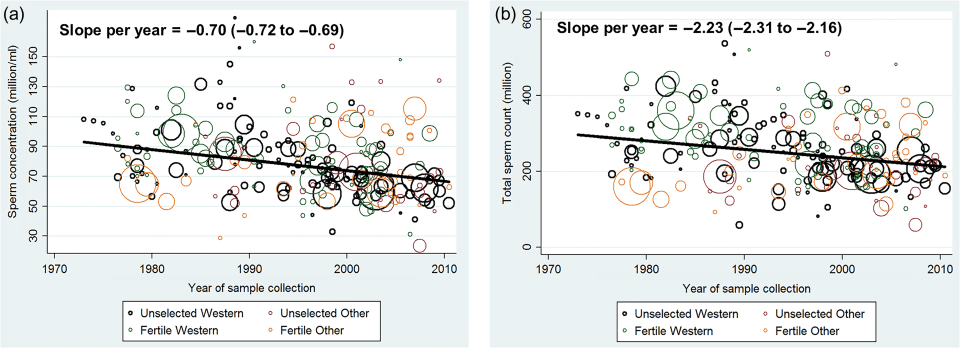
Figure 2a shows the mean sperm concentration between the years 1973 and 2011. Figure 2b shows the mean total sperm count between those same years.
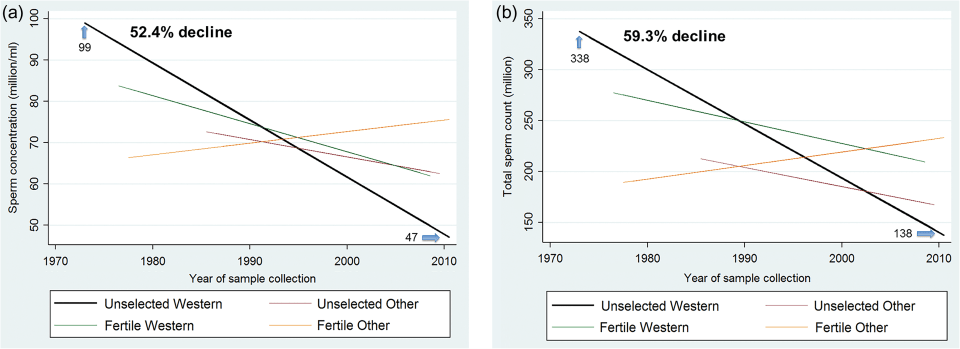
Figure 3a shows sperm concentration for the West (North America, Australia, Europe and New Zealand) vs Other (South America, Asia, and Africa), adjusted for potential confounders such as BMI, smoking etc. Figure 3b shows total sperm count by fertility and the West and Other. You can see that Fertile Other had a sharp increase, but the increase may be due to limited statistical power and a lack of studies of unselected men from those countries before 1985. There is a sharp increase for Other, however and so the data does not support as sharp of a decline as observed in Western countries.
If this is true, why is this happening? Factors that decrease spermatogenesis include (but are not limited to): obesity, smoking, exposure to traffic exhaust fumes, and combustion products. Though there is no data (except animal models) that lend credence to the idea that pesticides, food additives, etc decrease spermatogenesis (Sharpe, 2010). Other factors are known to cause lower SC which includes maternal smoking, alcohol, stress, endocrine disruptors, persistent and nonpersistent chemicals, and, perhaps most importantly today, the use of mobile phones and the wireless Internet (Virtanen, Jorgansen, and Toparri, 2017). Radiation exposure due to constant mobile phone use may cause DNA fragmentation and decreased sperm mobility (Gorpinchenko et al, 2014). Clearly, most of this decrease can largely be ameliorated. Exercise, eating right, and not smoking seem to be the most immediate changes that can and will contribute to an increase in SC in Western men. This will also increase testosterone levels. The cause is largely immobility due to the comfortable lifestyles that we in the West have. So by becoming more active and putting down smartphones, we can then begin to reverse this downward trend.
Saladin (2010: 1067) also states that pollution has deleterious effects on reproduction—and by proxy, sperm production. He states that the evidence is mounting that we are showing declining fertility due to “anatomical abnormalities” in water, meat, vegetables, breast milk and the uterus. He brings up that sperm production decreased in 15,000 men in 1990, decreasing from 113 million/ml in 1940 to 66 million/ml in 1990. Sperm production decreased more, he says, since “the average volume of semen per ejaculate has dropped 19% over this period” (Saladin, 2010: 1067).
Saladin (2010: 1067) further writes:
The pollutants implicated in this trend include a wide array of common herbicides, inseciticides, industrial chemicals, and breakdown products of materials ranging from plastics to dishwashing detergents. Some authorities think these chemicals act by mimicking estrogens by blocking the action of testosterone by binding to its receptors. Other scientists, however, question the data and feel the issue may be overstated. While the debate continues, the U.S. Environmental Protection Agency is screening thousands of industrial chemicals for endocrine effects.
Is it really true?
As seen above, the EPA is investigating whether thousands of industrial chemicals of effects on our endocrine system. If this is true, it occurs due to the binding of these chemicals to androgen receptors, blocking the production of testosterone and thusly sperm production. However, some commentators have contested the results of studies that purport to show a decrease in SC in men over the decades.
Sherins and Delbes are critical of such studies. They rightly state that most of these studies have numerous confounds such as:
1) lack of standardized counting measures, 2) bias introduced by using different counting methodologies, 3) inadequate within-individual semen sampling in the analysis, 4) failure to account for variable abstinence intervals and ejaculatory frequency, 5) failure to assess total sperm output rather than concentration, 6) failure to assess semen parameteres other than the number of sperm, 7) failure to account for age of subject, 8) subject selection bias among comparitive studies, 9) inappropriate statistical analysis, 10) ignoring major geographic differences in sperm counts, and 11) the causal equating of male ferility with sperm count per se.
Levine et al (2017) write:
We controlled for a pre-determined set of potential confounders: fertility group, geographic group, age, abstinence time, whether semen collection and counting methods were reported, number of samples per man and indicators for exclusion criteria (Supplementary Table S1).
So they covered points 1, 2, 4, 5, 6, 7, 8, 9, and 10. This study is very robust. Levine et al (2017) replicate numerous other studies showing that sperm count has decreased in Western men (Centola et al, 2015; Senputa et al, 2017; Virtanen, Jorgensen, and Toparri, 2017). Men Southern Spain show normal levels (Fernandez et al, 2010), while Southern Spanish University students showed a decrease (Mendiola et al, 2013). The same SC decrease has been noted in Brazil in the last ten years (Borges Jr. et al, 2015).
However, te Velde and Bonde (2013) in their paper Misconceptions about falling sperm counts and fertility in Europe contest the results of studies that argue that SC has decreased within the last 50 years stating that, for instance in Denmark, the median values remained between 40-45 million sperm per ml in the 15 years analyzed. They also state that declining birth rates can be explained by cultural and social factors, such as contraception, the female emancipation, and the second demographic transition. Clearly, ferility rates are correlated with the human development index (HDI) meaning that more developed countries have a lower birth rate in comparison to less developed countries. I believe that part of the reason why we in the West have lower birth rates is because there are too many things to for us to do to occupy our time, time that could be used to have children, like going to school to pursue Masters degrees and PhDs, to just wanting more ‘me time’.
Te Velde and Bonde (2013) conclude:
‘Whether the sperm concentration and human fecundity have declined during the past 50 years is a question we will probably never be able to answer’. This statement by Olsen and Rachootin in 200348 still holds for sperm concentration despite the report in 1992. In the meantime, we know that the results of oft-repeated studies from Copenhagen and Malmö do not indicate any notable change in sperm count during the last 10–15 years. Moreover, none of the available evidence points to a decline in couple fecundity during the last 30–40 years, including Denmark.28 Moreover, birth rates and TFRs instead of declining are on the increase in many EU countries, including the spectacular rise in Denmark.34
Echoing the same sentiments, Cocuzza and Esteves (2014) conclude “that there is no enough evidence to confirm a worldwide decline in sperm counts or other semen parameters. Also, there is no scientific truth of a causative role for endocrine disruptors in the temporal decline of sperm production as observed in some studies. We conjecture that a definite conclusion would only be achieved if good quality collaborative long-term research was carried out, including aspects such as semen quality, reproductive hormones, and xenobiotics, as well as a strict definition of fecundity.” Merzenich, Zeeb, and Blettner (2010) also caution that “The observed time trend in semen quality might be an artefact, since the methodological differences between studies might be time dependent as well. Intensive research will be necessary in both clinical and epidemiological domains. More studies are needed with strict methodological standards that investigate semen quality obtained from large samples of healthy men representative for the normal male population.”
Clearly, this debate is long and ongoing, and I doubt that even Levine et al (2017) will be good enough for some researchers.
Conclusion
There are various papers for and against a decrease in sperm production in the West, just like with testosterone. However, there are ways we can deduce that SC has fallen in the West, since we have definitive data that testosterone levels have decreased. This, then, would lead to a decrease in sperm production and then fecundity and number of children conceived by couples. Of course, sociocultural factors are involved, as well as immediate environmental ones that are immediately changeable. Even if there is no scientific consensus on industrial chemicals and effects on the endocrine system, you should stay away from those too. One major reason for the decrease in sperm production—if the decrease is true—is increased mobile phone usage. Mobile phone usage has increased and so this would lower SC over time.
Whether or not the decrease in SC is true or not, every man should take steps to lead a healthier lifestyle without their cell phone. Because if this decrease is true (and Other doesn’t show a decrease as well) then it would be due to the effects of our First World societies, which would mean that we need to change how we live our lives to get back on the right track. Clearly, we must change our diets and our lifestyles. I’ve written numerous articles about how testosterone is strongly mediated by the environment, and that testosterone production in men has decreased since Western men have been, in a way, feminized and not been as dominant. This can and does decrease testosterone production which would, in turn, decrease sperm production and decrease fertility rates.
Nevertheless, taking steps to leading a healthier lifestyle will ameliorate a ton of the problems that we have in the West, which are mainly due to low birth rates, and by ameliorating these problems, the quality of life will the increase in the West. I am skeptical of the decrease due to what was brought up above, but nevertheless I assume that it is true and I hope my readers do too—if only to get some fire under you to lead a healthier lifestyle if you do not do so already as to prevent these problems before they occur and lead to serious deleterious health consequences.
(I am undecided leaning towards yes. There are too many behaviors linked to lower SC which Western men partake in. There are numerous confounds which may have not been controlled for, however knowing the main reasons why men have lower sperm count and the increased prevalence in these behaviors, we can logically deduce that sperm count has fallen too. Look to the testosterone decrease, that causes both low sperm count and lower fertility.)
Microbial Intelligence and Intelligent Physiology
1100 words
When organisms that we don’t normally signify as ‘intelligent’ do, indeed, show ‘intelligent’ behavior, our definition of the word—what we call ‘intelligent’ behavior—needs to be reevaluated. Bacteria and other microbes can certainly respond to cues from their environments and communicate with each other. So if bacteria can respond to environmental stimulus by having plastic behavior, then they do show a semblance of ‘intelligence’. Just because bacteria don’t talk doesn’t mean that they are not ‘intelligent’ in their own right.
Bacteria respond to cues from their environment, just like any other intelligent organism. That means that they have behavioral plasticity, the ability to change their behavior based on what occurs in their environments. Bacteria have been shown to exhibit behaviors we would call ‘intelligent’, i.e., acquiring information, storage, processing, use of information, perception, learning, memory, and decision-making (Lyon, 2015). It is proposed that “bacteria use their intracellular flexibility, involving signal transduction networks and genomic plasticity, to collectively maintain linguistic communication: self and shared interpretations of chemical cues, exchange of chemical messages (semantic) and dialogues (pragmatic)” (Jacob et al, 2004).
Clearly, bacteria can and do adapt at the phenotypic level, not only the genotypic level as some have asserted in the past. Using this definition of intelligence, that is, being able to perceive, process and integrate information about the state of the environment to change the organism’s behavior is intelligent behavior (Pinto and Mascher, 2016), all organisms, from bacteria to humans and in between are intelligent. If bacteria do show evidence of behavioral plasticity—and they do—then we must look at them as intelligent creatures, as well as come to the realization that all biological organisms are, in their own right, intelligent. Intelligence is not only for any ‘higher’ organisms; so-called ‘lower’ organisms do show behavioral plasticity, meaning they know what is occurring in their environment. Is that not intelligent?
Any organism that can immediately act in a different way when its environment changes can, in my opinion, be said to be intelligent. All biological organisms have this ability to ‘go off of their genetic coding’, if you will, and change their behavior to match what is currently going on in their environment. Furthermore, the number and fraction of single transduction genes can be used as a measure of ‘bacterial IQ’ (Sirota-Mahdi et al, 2010).
This, of course, has implications for our intelligent physiology. Since our physiological systems incorporate the intelligent processes of the intelligent cell, then, on a larger scale, our physiology is also intelligent. Our physiology is constantly responding to cues from the environment, attempting to maintain homeostasis. Since our body has a need to stay in homeostasis, then our physiological systems are indeed intelligent in their own right. They incorporate the processes of the intelligent cell; looking at our physiology in this way, we can see how and why these systems are intelligent.
Further, physiologists have been referring to physiological systems as “homeodynamic”, rather than “homeostatic”, seeing chaotic states as healthy “allowing organisms to respond to circumstances that vary rapidly and unpredictably, again balancing variation and optimization of order with impressive harmony” (Richardson, 2012). If our physiological systems can do this, are they not intelligent? Further, according to physiologist Dennis Noble, “Genes … are purely passive. DNA on its own does absolutely nothing until activated by the rest of the system through transcription factors, markers of one kind or another, interactions with the proteins. So on its own, DNA is not a cause in an active sense. I think it is better described as a passive data base which is used by the organism to enable it to make the proteins that it requires.” So, as you can see, genes are nothing without the intelligent physiology guiding then. This is only possible with physiological systems, and this begins with the intelligent cell—intelligent microbes.
Some people misunderstand what genes are for and what they do in the body. The gene has long been misunderstood. People don’t understand that genes direct the production of proteins. Since physiological systems—at their core—are run by microbes, then the overall physiological system is itself intelligent. Genes, on their own, are not the masters but the servants. Genes do code for proteins that code for traits, but not under their own direction; they are directed by intelligent systems.
Think of how our gut microbiome co-evolved with us. Knowing what we now know about intelligent cells, we can also say that, by proxy, our microbiome is intelligent as well.
Understanding intelligent cells will lead us to understand intelligent physiology then, in turn, lead us to understand how genes are the servants—not the masters as is commonly asserted—of our traits. Physiology is an intelligent system, and since it is intelligent it can then react to cues from the environment, since it is made up of smaller cells, which make up the larger whole of the intelligent physiological system. These intelligent systems that we have evolved are due to the changeability of our environments in our ancestral past. Our physiology then evolved to be homeodynamic, attempting to maintain certain processes. The ever-changing environment that our genus evolved in is the cause for our homeodynamic intelligent physiology, which begins at the smallest levels of the cell.
The intelligent microbes are the smaller part of the larger whole of the intelligent physiological system. Due to this, we can say that at the smallest levels, we are driven by infinitesimally small microbes, which, in a way, guide our behavior. This can definitely be said for our gut microbiome which evolved with us throughout our evolutionary history. Our microbiome, for instance, had to be intelligent and communicate with each other to maintain our normal functioning. Without these intelligent cells, intelligent physiology would not be possible. Without ever-changing dynamic environments, our intelligent physiology and intelligent cells would have never evolved.
Intelligent physiology evolved due to the constant changeability of the new environments that our ancestors found themselves in. If we would have evolved in, say, more stable, unchanging environments, our physiological systems would have never evolved how they did. These intelligent physiological systems can buffer large ranges of physiological deficiencies. The evolvability of these systems due to the changeability of our ancestral environments is the cause of our amazing physiological intelligence, developmental plasticity, and microbial intelligence.
When you think about conception, when a baby is forming in the womb, it becomes easier to see how our physiological systems are intelligent, and how genes are the slaves—not masters—of our development. Intelligence is already in those little cells, it just needs an intelligent physiology for things to be set into motion. This all goes back to the intelligent cells which make up the larger part of intelligent physiology.
Do Physiologists Study General Intelligence?
1100 words
The general factor of intelligence (g) is said to be physiological. Jensen (1998: xii) states that “Students in all branches of the behavioral and social sciences, as well as students of human biology and evolution, need to grasp the essential psychometric meaning of g, its basis in genetics and brain physiology, and its broad social significance.” There are, furthermore, “a number of suggestive neurological correlates of g, but as yet these have not been integrated into a coherent neurophysiological theory of g” (Jensen, 1998: 257). I personally don’t care for correlations too much anymore, I’m interested in actual causes. Jensen (1998: 578) also states “Although correlated with g [size of the brain, metabolic rate, nerve conduction velocity, and latency and amplitude of evoked electrical potentials], these physiological variables have not yet provided an integrated explanatory theory.”
This seems suspiciously like Dreary’s (2001: 14) statement that there “is no such thing as a theory of human intelligence differences – not in the way that grown-up sciences like physics or chemistry have theories.” If g is physiological, then where is the explanatory theory? On that same matter, where is the explanatory theory for individual intelligence differences? That’s one thing that needs to be explained, in my opinion. I could muster something up off the top of my head, such as individual differences in glucose metabolism in the brain, comparing both high and low IQ people (Cochran et al, 2006; Jensen, 1998: 137), however, that is still not good enough.
In physiology there is sliding filament theory which explains the mechanism of muscle contraction (Cooke, 2004). Why is there no such theory of why individuals differ in intelligence and why have these “suggestive neurological correlates of g” not been formulated into a coherent neurophysiological theory? There are numerous theories in physiology, but a theory of g or why individuals differ in intelligence is not one of them.
It’s like Darwin only saying “Species change“, and that’s it; no theory of how or why. He’s just stating something obvious. Similarly, saying “Person A is smarter or has a higher IQ than person B” is just an observation; there is no theory of how or why for why individuals differ in intelligence. There are theories for group differences (garbage cold winter theory), but no individual differences in intelligence? Hmmm… Sure it’d be a ‘fact that species change over time’, but without a theory of how or why, how useful is that observation? Similarly, it is true that some people are more intelligent than others (score higher on IQ tests), yet there is no explanatory theory as to why? I believe this ties back to the physiological basis for g: are physiologists studying it, and if not, why?
Reaction time (RT) is one of the most talked about physiological correlates in regards to IQ. However, as a fitness professional, I know that exercise can increase reaction time, especially in those with intellectual disabilities (Yildirim et al, 2001). I am now rethinking the correlate between reaction time and IQ, since it can be trained in children, especially those with intellectual disabilities. Clearly, RT can be trained by exercise, participating in sports, and even by playing video games (Green, 2008). So since RT can be trained, I don’t think it’s a good physiological measure for g.
Individuals do differ in individual physiology, however, I have never heard of a physiologist attempting to rank individuals on different traits, nevermind attempting to say that a higher level of one variable is better than a lower variable, say blood pressure or metabolic rate. In fact, individuals with high blood pressure and metabolic rates would need immediate medical attention.
There are also wide variations in how immune systems act when faced with pathogens, bacteria and viruses. Though, “no one dreams of ranking individual differences on a general scale of immunocompetence” (Richardson, 2017: 166). So if g is physiological then why don’t other physiological traits get placed on a rank order, with physiologists praising certain physiological functions as “better”?
Richardson (2017: 166-167) writes:
In sum, no physiologist would suggest the following:
(a) that within the normal range of physiological differences, a higher level is better than any others (as is supposed in the construction of IQ tests);
(b) that there is a general index or “quotient” (a la IQ) that could meaningfully describe levels of physiological sufficiency or ability and individual differences in it;
(c) that “normal” variation is associated with genetic variation (except in rare deleterious conditions; and
(d) the genetic causation of such variation can be meaningfully separated from the environmental causes of the variation.
…
A preoccupation with ranking variations, assuming normal distributions, and estimating their heritabilities simply does not figure in the field of physiology in the way that it does in the field of human intelligence. This is in stark contrast with the intensity of the nature-nurture debate in the human cognitive domain. But perhaps ideology has not infiltrated the subject of physiology as much as it has that of human intelligence.
This is all true. I know of no physiologist who would suggest such a thing. So does it make sense to compare g with physiological variables—even when classic physiological variables do not have some kind of rank order? Heritabilities for BMR are between .4 and .8, which is in the same range as the heritability of IQ. Can you imagine any physiologist on earth suggesting a rank order for physiological traits such as BMR or stroke volume? I can’t, and if you knew anything about physiological variables then you wouldn’t either.
In sum, I believe that conflating g with physiology is erroneous; mostly because physiologists don’t rank physiological traits in the same ways that human intelligence researchers do. Our physiology is intelligent in and of itself, and this process begins in the cell—the intelligent cell. Our physiological systems are intelligent—in our bodies are dynamic systems that keenly respond to whatever is going on in the environment (think of how the body always attempts to maintain homeostasis). Physiology deals with the study of living organisms—more to the point, how the systems that run the organisms work.
Looking at physiological variables and attempting to detangle environmental and genetic effects is a daunting task—especially the way our physiological systems run (responding to cues from the environment, attempting to maintain homeostasis). So if general intelligence—g—had a true biological underpinning in the body, and if physiologists did study it, then they would not have a rank ordering for g like psychologists do; it’d just be another human trait to study.
So the answer to the question “Do physiologists study g?” is no, and if they did they would not have the variable on a rank order because physiologists don’t study traits in that manner—if a true biological underpinning for g exists. Physiology is an intelligent and dynamic system in and of itself, and the process begins in the intelligent cell, except it is on a larger scale, with numerous physiological variables working in concert, constantly attempting to stay in homeostasis.
Expounding On My Theory for Racial Differences In Sports
2300 words
In the past, I’ve talked about why the races differ—at the extremes—(and the general population, but the extremes put the picture into focus) in terms of what sports they compete and do best in. These differences come down to morphology somatype, physiology. People readily admit racial differences in sports and—rightly say—that these differences are largely genetic in nature. Why is it easier for people to accept racial differences in sports and not accept other truisms, like racial IQ differences?
I’ve muscle fiber typing and how the variances in fiber typing dictate which race/ethny performs best at which sport. I’ve also further evidence that blacks have type II fibers (responsible for explosive power), which leads to a reduced Vo2 max. This lends yet more credence to my theory of racial differences in sports—black Americans (West African descendants) have the fiber typing that is associated with explosive power, less so with endurance activities. Since I’ve documented evidence on the differences in sports such as baseball, football, swimming and jumping, bodybuilding, and finally strength sports, tonight I will talk about the evolutionary reasons for muscle fiber and somatype differences that will have us better understand the evolutionary conditions in which these traits evolved and why they got selected for.
Most WSM winners are from Nordic countries or have Nordic ancestry. There’s a higher amount of slow twitch fibers in Nordics and East Asians (and Kenyans) which is more conducive to strength and less conducive to ‘explosive’ sports. West Africans and their descendants dominate in sprinting competitions. Yea yea yea white guy won in 1960. So they will be less likely to be in strength comps and more likely to win BBing and physique comps. This is what we see.
Only three African countries have placed in the top ten in the WSM (Kenya, Namibia, and Nigeria, however, one competitor from Namibia I was able to find has European ancestry). Here is a video of a Nigerian Strongest Man competition (notice how his chest isn’t up and his hips rise before the bar reaches his knees, horrible form). Fadesere Oluwatofunmi is Nigeria’s Strongest Man, competing in the prestigious Arnold Classic, representing Nigeria. However, men such as Fadesere Olutaofunmi are outliers.
Now for a brief primer on muscle fibers and which pathways they fire through. Understanding this aspect of the human body is paramount to understanding how and why the races differ in elite competition.
Life history and muscle fiber typing
Slow twitch fibers fire through aerobic pathways. Breaking down fats and proteins takes longer through aerobic respiration. Moreover, in cold temperatures, the body switches from burning fat to burning carbohydrates for energy, which will be broken down slower due to the aerobic perspiration. Slow twitch (Type I) fibers fire through aerobic pathways and don’t tire nearly as quickly as type II fibers. Also, CHO reserves will be used more in cold weather. The body’s ability to use oxygen decreases in cold weather as well, so having slow twitch fibers is ideal (think about evolution thousands of years ago). Type I fibers fire off slower so they’ll be able to be more active for a longer period of time (studies have shown that Africans with Type II fibers hit a ‘wall’ after 40 seconds of explosive activity, which is why there are so few West-African descended marathon runners, powerlifters, Strongmen, etc). Those who possess these traits will have a higher chance to survive in these environments. Those with slow twitch fibers also have to use more oxygen. They have larger blood vessels, more mitochondria and higher concentrations of myoglobin which gives the muscles its reddish color.
Each fiber fires off through different pathways, whether they be anaerobic or aerobic. The body uses two types of energy systems, aerobic or anaerobic, which then generate Adenosine Triphosphate, better known as ATP, which causes the muscles to contract or relax. Depending on the type of fibers an individual has dictates which pathway muscles use to contract which then, ultimately, dictate if there is high muscular endurance or if the fibers will fire off faster for more speed.
Type I fibers lead to more strength and muscular endurance as they are slow to fire off, while Type II fibers fire quicker and tire faster. Slow twitch fibers use oxygen more efficiently, while fast twitch fibers do not burn oxygen to create energy. Slow twitch muscles delay firing which is why the endurance is so high in individuals with these fibers whereas for those with fast twitch fibers have their muscles fire more explosively. Slow twitch fibers don’t tire as easily while fast twitch fibers tire quickly. This is why West Africans and their descendants dominate in sprinting and other competitions where fast twitch muscle fibers dominate in comparison to slow twitch.
Paleolithic Europeans who had more stamina spread more of their genes to the next generation as their genotype was conducive to reproductive success in Ice Age Europe. Conversely in Africa, those who could get away from predators and could hunt prey more efficiently survived. Over time, frequencies of genes related to what needed to be done to survive in those environments increased, along with the frequencies of muscle fibers in the races.
Racial differences in anatomy and physiology
Along with muscle fiber differences, blacks and whites also have differences in fat-free body mass, bone density, distribution of subcutaneous fat, length of limbs relative to the trunk, and body protein contents (Wagner and Heyward, 2000). These differences are noticed and talked about in the scientific literature, even in University biology and anatomy textbooks. However, in terms of University textbooks, authors who recognize the concept of race do so in spite of what other authors write (Hallinan, 1994). Furthermore, Strkalj and Solyali (2010) analyzed 18 English textbooks on anatomy and concluded that discussion of race was ‘superficial’ and the content ‘outdated’, i.e., using the ‘Mongoloid, Caucasoid, Negroid terminology (I still do out of habit). They conclude that most mentions of race are either not mentioned in anatomy textbooks or are only ‘superficially accounted for in textbooks’. Clearly, though they are outdated, some textbooks do talk about human biological diversity, though the information needs to be updated (especially now). The center of mass in blacks is 3 percent higher than in whites, meaning whites have a 1.5 percent speed advantage in swimming while blacks have a 1.5 percent speed difference in sprinting. East Asians that are the same height as whites are even more favored in swimming, however, they are shorter on average so that’s why they do not set world records (Bejan, Jones, and Charles, 2010).
For another hand grip strength (HGP) test, see Leong et al (2016). Most studies on HGS are done on Caucasian populations with little data for non-Caucasoid populations. They found that HGS values were higher for North America and Europe, intermediate in China, South America and the Middle East, and the lowest in South Asia, Southeast Asia, and Africa. These are, most likely, average Joes and not elite BBers or strength trainers. This is one of the best papers I’ve come across on this matter (though I would kill to have a nice study done on the three classical races and their performance on the Big 3 lifts: squat, bench press and deadlift; I’m positive it would be Asian/white and blacks as the tail end).
Among other physical differences is brain size and hip width. Blacks have narrower hips than whites who have narrower hips than Asians (Rushton, 1997: 163). Bigger-brained babes are more than likely born to women who have wider hips. If you think about athletic competition, one with wide hips will get decimated by one with narrower hips as he will be better able to move. People with big crania, in turn, have the hip structure to birth big brains. This causes further division between racial groupings in sports competition.
Some people may dispute a genetic causation and attribute the success of, say, Kenyan marathoners (the Kalenjin people) and attribute the effects to the immediate environment (not ancestral), training and willpower (see here for discussion). This Kenyan subpopulation also has the morphology conducive to success in marathons (tall and lengthy), as well as type II muscle fibers (which is why Kenya placed in the WSM).
I would also like to see a study of men in their prime (age 21 to 24) from European, Africans, and East Asian backgrounds with a high n (for a study like this it’d be 20 to 30 participants for each race), with good controls. You’d see, in my opinion, East Asians slightly nudge out whites who destroy blacks. The opposite would occur in sports that use type II fibers. West Africans also have the gene variant ACTN3 which is associated with explosive sports.
For a better (less ethical study) we can use a thought experiment.
We take two babes fresh out of the womb (one European, the other West African) and keep them locked in a metabolic chamber for their whole entire lives. We keep them in the chamber until they die and monitor them, feeding them the same exact diet and giving them the same amount of attention. They start training at age 15. Who will be stronger in their prime (the European man)? Who will have more explosive power (the West African man)? A simple thought experiment can have one thinking about intrinsic racial differences in things the average American watches in their everyday lives. The subject of racial differences in sports is a non-taboo subject, however, the subject of racial differences in intelligence is a big no-no.
Think about that for a second. People obviously accept racial differences in sports, yet they have some kind of emotional attachment to the blank slate narrative. We don’t hear that you can nurture athletic success. We do, however, hear that ‘we can succeed at anything we put out minds to’. That’s not in dispute; that’s a fact. But it’s twisted in a way that genetics and ancestry has no bearing on it, when it explains a lot of the variance. People accept racial differences when they’re cheering on their favorite football team or basketball team. For instance, NFL announcer Gus Johnson said during a broadcast of a Titans and Jaguars game “He’s [Chris Johnson] got gettin’ away from the cops speed!”
Pro-sports announcers, as well as college recruiters, know what the average person doesn’t who is not exposed to these differences daily for decades on end. People in these types of professions, especially collegiate sports recruiters, must get the low-down on average racial differences and then use what they know to make their choices on who to draft for their team.
For more (anecdotal) evidence, you can look up the race/ethnicity of the winners in competitions where peoples from all over the world compete in. More West African descendants place higher in physique, BBing comps, etc; more Caucasians and East Asians (and Kenyans) place higher in strength comps. A white man has won the WSM every year since its inception. West African descended blacks dominate BBing and physique comps. Eurasians (and Kenyans) dominate in marathon running.
All of this talk of racial differences in sports (which largely has to do with whites vs. blacks, though Asians are included in my overall analysis), I’ve hardly cited anything on East Asians directly. In regards to sports that take extreme dexterity or flexibility (and high reaction), East Asians shine. They shine in diving, ping-pong, skating and gymnastics events. They usually have long torsos and small limbs. I theorize that this was an evolutionary adaptation for the East Asians, as shorter people have less surface area to keep warm. Taller people would have died out quicker than one who’s smaller and can cover up and get warmer faster. They also have quicker reaction times (Rushton and Jensen, 2005) and it has been hypothesized that this is why they dominate in ping pong.
Conclusion
We don’t need any tests to show that there are racial differences in sports; the test is the competition itself. On average, A white will be stronger than an Asian who will be stronger than a black. Conversely, a Kenyan will be a better marathoner than a West African, European or Asian. West Africans will be more likely to beat all three groups in a sprint. These differences come down to morphology, but they start inside the muscles with the muscle fibers. Some anatomy textbooks acknowledge the existence of race, however, they have old and outdated information. It’s a good thing that anatomy textbooks talk about racial differences in physiology and anatomy, now we need to start doing heavy research into racial differences in the brain. The races evolved their fiber typing depending on what they had to do to survive along with their immediate environment, i.e., high elevation like the Kalenjin people.
The evolution of differing muscle fiber types in different races is easily explainable: Europeans have slow twitch fibers. In cold temperatures, the body switches from burning fat to burning carbs for energy. Furthermore, the average person would need to have a higher lung capacity and not tire out during long hunts on megafauna. Over time, selection occurred on the individuals with more type I fibers. Conversely, West Africans and their descendants have the ACTN3 gene, which is associated with elite human athletic performance (Yang et al, 2003). Africans who could get away from predators survived and passed on the genes and fiber typing for elite athletic performance.
In sum, the races differ in terms of entrants to elite athletic competition. These differences are largely genetic in nature. Evolutionary processes explain racial differences in sports. These same selection processes that explain racial differences in elite sports competitions also explain racial differences in intelligence. I await the day that we can freely speak about racial differences in intelligence just like we speak about racial differences in sports. Denying human variation makes no sense, especially in today’s world where we have state of the art testing.
 NotPoliticallyCorrect