Home » Posts tagged 'Race Realism' (Page 5)
Tag Archives: Race Realism
Psychology, Anti-Hereditarianism, and HBD
3800 words
Abstract
The denial of human nature is extremely prevalent, most noticeably in our institutions of higher learning. To most academics, the fact that there could be population differences that are genetic in nature is troubling for many people. However, denying genetic/biological causes for racial differences is 1) intellectually dishonest; 2) will lead to negative health outcomes for populations due to the assumption that all human populations are the same; and 3) the ‘lie of equality’ will not allow all human populations to reach their ‘potential’ to be as good as they can be due to the fact that implicit assumption that all human populations are the same. Anti-hereditarians fully deny any and all genetic explanations for human differences, believing that human brain evolution somehow halted around 50-100 kya. Numerous studies show that race is a biological reality; it doesn’t matter what we call the clusters as those are the social constructs. The contention is that ‘all brains are the same color’ (Nisbett, 2007; for comment see my article Refuting Richard Nisbett), and that evolution in differing parts of the world for the past 50,000 years was not enough for any meaningful population differences between people. But to accept that means you must accept the fact that the brain is the only organ that is immune to natural selection. Does that make any sense? I will show that these differences do exist and should be studied, as free of any bias as possible, with every possible hypothesis being looked at and not discarded.
Evolution is true. It’s not ‘only a theory’ (as some anti-evolutionists contend). Anti-evolutionists do not understand the definition of the word ‘theory’. Richard Dawkins (2009) wrote that a theory is a scheme or system of ideas or statements held as an explanation or account of a group of facts or phenomena. This is in stark contrast to the layperson’s definition of the word theory, which means ‘just a guess’. Evolution is a fact. What biologists argue with each other about is the mechanisms behind evolution, for any quote-mining Creationists out there.
We know that evolution is a fact and it is the only game in town (Dawkins, 2009) to explain the wide diversity and variation we see on our planet. However, numerous scholars deny the effect of evolution on human behavior (most residing in the social sciences, but other prominent biologists have denied (or implied there were no differences between us and our ancestors) the effect of human evolution on behavior and cognition; Gould 1981, 1996, for a review of Gould 1996, see my article Complexity, Walls, 0.400 Hitting and Evolutionary “Progress” and Stephen Jay Gould and Anti-Hereditarianism; Mayr 1963; see Cochran and Harpending 2009). A prominent neuroscientist, who I have written about here, Herculano-Houzel, implied that Neanderthals and Antecessor may have been just as intelligent as we are due to a neuronal count in a similar range to ours (Herculano-Houzel 2013). This raises an interesting question (which I have tackled here and will return to in the future): did our recent hominin ancestors at least have the capacity for similar intellect to ours (Villa and Roebroeks, 2014; Herculano-Houzel and Kaas, 2011)? It is interesting that neuronal scaling rules hold for our extinct ancestors, and this question is most definitely worth looking into.
Whatever the case may be in regards to recent human evolution and our extinct hominin ancestors, human evolution has increased in the past 10,000 years (Cochran and Harpending, 2009; Wade, 2014). This is due to the dispersal of Anatomical Modern Humans (AMH) OoA around 70 kya; and with this geographical isolation, populations began to diverge with no interbreeding with each other. However, this is noticed most in ‘Native’ Americans, who show no gene flow with other populations due to being genetically isolated (Villena et al, 2000). Who’s to say that evolution stops at the neck, and no further evolution occurs on the brain? Is the brain itself exempt from the laws of natural selection? We know that there is no/hardly any gene flow between populations before the advent of modern-day technology and vehicles; we know that humans differ on morphological and anatomical traits, why are genetic differences out of the question, especially when genetic differences may explain, in part, some of the variation between populations?
We know that evolution is true, without a reasonable doubt. So why, do some researchers contend, is the human brain exempt from such selective pressures?
A theoretical article by Winegard, Winegard, and Boutwell (2017) was just released on January 17th. In the article, they argue that social scientists should integrate HBD into their models. Social scientists do not integrate genetics into their models, and the longer one studies social sciences, the more likely it is they will deny human nature, regardless of political leaning (Perry and Mace, 2010). This poses a problem. By completely ignoring a huge variable (possible genetic differences), this has the potential to harm people’s health, as race is a very informative marker when discussing diseases acquisition as well as whether certain drugs will work on two individuals of different races (Risch et al, 2002; Tang et al, 2005; Wade, 2014). People who deny the usefulness of race, even in a medical context, endanger the lives of individuals from different races/ethnies since they assume that all humans are the same inside, despite ‘superficial differences’ between populations.
The notion that all human populations—genetic isolation and evolution in differing ecosystems/climates/geographic locales be damned—is preposterous to anyone who has a true understanding of evolution. Why should man’s brain be the only organ on earth exempt from the forces of natural selection? Why do egalitarians assume that all humans are the same and have the same psychological faculties compared to other humans, despite the fact that rapid evolution has occurred within the human species within the last 10,000 years?
To see some of the most obvious ways to see natural selection in action in human populations, one should look to the Inuits (Fumagalli, 2015; Daanen and Lichtenbelt, 2016; NIH, 2015; Cardona et al, 2014; Tishkoff, 2015; Ford, McDowell, and Pierce, 2015; Galloway, Young, and Bjerregaard, 2012; Harper, 2015). Global warming is troubling to some researchers, with many researchers suggesting that global warming will have negative effects on the health and food security of the Inuit (Ford et al, 2014, 2016; Ford, 2012, 2009; Wesche, 2010; Furgal and Seguin, 2006; McClymont and Myers, 2012; Petrasek et al, 2015; Rosol, Powell-Hellyer, and Chan, 2016; Petrasek, 2014; WHO, 2003). I could go on and on citing journal articles for both claims, but you get the point already. The main point is this: we know the Inuit have evolved for their climate, and a (possible) climate change would then have a negative effect on their quality of life due to their adaptations to the cold weather climate. However, egalitarians still contend, with these examples and numerous others I could cite, that any and all differences within and between human populations can be explained by socio-cultural factors and not any genetic ones.
One of the best examples of genetic isolation in a geographic locale that is the complete opposite from the environment of evolutionary adaptedness (EEA; Kanazawa, 2004), the African savanna in which we evolved in. I did entertain the idea of the Savanna hypothesis, and while I do believe that it could explain a lot of the variance in IQ between countries (Kanazawa, 2007), his hypothesis doesn’t make sense with what we know about human evolution over the past 10,000 years.
The most obvious differences we can see between populations is differences in skin color. Skin color does not signify race, per se, but it is a good indicator. Skin color is an adaptation to UV radiation (Jablonski and Chaplin, 2010, 2000; Juzenienne et al, 2009; Jeong and Rienzo, 2015; Hancock, et al, 2010; Kita and Fraser, 2016; Scheinfeldt and Tishkoff, 2013), and is therefor and adaptation based on climate. Dark skin is a protectant from skin cancer (Brenner and Hearing, 2008; D’Orazio et al, 2010; Bradford, 2009). Skin cancer is a possible selective force in black pigmentation of the skin in early hominin evolution (Greaves, 2014). With these adaptations in skin color between genetically and geographically isolated populations, are changes in the brain, however small, really out of the question?
A better population to bring up in regards to geographic isolation having an effect on human evolution is the Tibetans. For instance, Tibetans have higher total lung capacities in comparison to the Han Chinese (Droma et al, 1991). There are even differences in lung capacity between Tibetans and Han Chinese who live at the same altitude (Yangzong et al, 2013), with the same thing noticed for peoples living in the Andean mountains (Beall, 2007). Tibetans evolved in a higher elevation than the Han Chinese who lived closer to sea level, so it makes sense that they would be selected for the ability to take deeper inhales They also have a larger chest circumference and greater capacity than the Han Chinese who live at lower altitudes (Gilbert-Kawai et al, 2014).
Admittedly, the acceptance of the usefulness of race in regards to human differences is a touchy subject. So much so, that social scientists do not take genetics into account in their models. However, researchers in the relevant fields accept the usefulness of race (Risch et al, 2002; Tang et al, 2005; Wade, 2014; Sesardic, 2010), so the fact that social scientists do not is to be ignored. Race is a social construct, yes. But no matter what we call these clusters, clines, demes, races, ethnies—whatever name you want to use to describe them—this does not change the fact that race is a useful category in biomedical research. Race is an issue when talking about bone marrow transplants, so by treating all populations as the same with no variation between them, people are pretty much saying that differences between people in a biomedical context do not exist, with there being other explanatory factors behind population differences, in this case, bone marrow transplants. Ignoring heritable human variation will lead to disparate health outcomes for all human populations with the assumption that all humans are the same. Is that what we want? Is that what race-deniers want?
So there are anatomical and physiological differences between human populations (Wagner and Hayward, 2000), with black Americans having a different morphology and lower fat-free body mass on average in comparison to white Americans. This, then, is one of the variables that dictates racial differences in sports, along with muscle fiber explaining a large portion of the variance, in my opinion. No one denies that blacks and whites differ at elite levels in baseball, football, swimming and jumping, and bodybuilding and strength sports. Though, accepting the fact that these morphological and anatomical differences between the races come down to evolution, one would then have to accept the fact that different races/ethnies differ in the brain, thusly destroying their egalitarian fantasy in their head of all genetically isolated human populations being the same in the brain. Wade (2014) writes on page 106:
“… brain genes do not lie in some special category exempt from natural selection. They are as much under evolutionary pressure as any other category of gene”
This is a hard pill to swallow for race-deniers, especially those who emphatically deny any type of selection pressure on the human brain within the past 10,000 to 100,000 years.
Winegard, Winegard, and Boutwell (2017) write:
Consider an analogy that might make this clear while simultaneously illuminating the explanatory importance of population differences. Most cars are designed from the same basic blueprint and consist of similar parts—an internal combustion engine, a gas tank, a chassis, tires, bearings, spark plugs, et cetera. Cars as distinct as a Honda Civic and a Subaru Outback are built from the same basic blueprint and comprised of the same parts; so, in this sense, there is a “universal car nature” (Newton 1999). However, precise, correlated changes in these parts can dramatically change the characteristics of a car.
Humans, like cars, are built from the same basic body plan. They all have livers, lungs, kidneys, brains, arms, and legs. And these structures are built from the same basic building blocks, tissues, which are built of proteins, which are built of amino acids, et cetera. However, small changes in the structures of these building blocks can lead to important and scientifically meaningful differences in function.
Put in this context, yes, there is a ‘universal human nature’, but the application of that human nature will differ depending on what a population has to do to survive in that climate/ecosystem. And, over time, populations will diverge away from each other, both physically and mentally. The authors also argue that societal differences between Eurasians (Europeans and East Asian) can be explained partly by genetic differences. Indeed, the races do differ on the Big Five Personality traits, with heritable components explaining 40 to 60 percent of the variation (Power and Pluess, 2015). So some of the cultural differences between European and East Asians must come down to some biological variation.
One of the easiest ways to see the effects of cultural/environmental selective pressures in humans is to look at Ashkenazi Jews (Cochran et al, 2006). Due to Ashkenazi Jews being barred from numerous occupations, they were confined to a few cognitively demanding occupations. Over time, only the Jews that could handle these occupations would prosper, further selecting for higher intelligence due to the cognitive demands of the jobs they were able to acquire. Thus, Ashkenazi Jews who could handle the few occupations they were allowed to do would breed more and pass on variants for higher intelligence to their offspring, whereas those Jews who couldn’t handle the cognitive demands of the occupation were selected out of the gene pool. This is one situation in which natural selection worked swiftly, and is why Ashkenazi Jews are so overrepresented in the fields of academia today—along with nepotism.
Winegard, Winegard, and Boutwell (2017) lay out six basic principles for a new Darwinian paradigm, as follows:
- Variation is the grist for the mill of natural selection and is ubiquitous within and among human populations.
- Evolution by natural selection has not stopped acting on human traits and has significantly shaped at least some human traits in the past 50,000 years.
- Current hunter-gatherer groups might be slightly different from other modern human populations because of culture and evolution by natural selection acting to influence the relative presence, or absence, of trait-relevant alleles in those groups. Therefore, using extant hunter-gatherers as a template for a panhuman nature is problematic.
- It is probably more accurate to say that, while much of human nature is universal, there may have been selective tuning on various aspects of human nature as our species left Africa and settled various regions of the planet (Frost 2011).
- The human brain is subject to selective forces in the same way that other organ systems are. Natural selection does not discriminate between genes for the body and genes for the brain (Wade 2014).
- The concept of a Pleistocene-based environment of evolutionary adaptedness (EEA) is likely unhelpful (Zuk 2013). Individual traits should be explored phylogenetically and historically. Some human traits were sculpted in the Pleistocene (or before) and have remained substantially unaltered; some, however, have been further shaped in the past 10,000 years, and some probably quite recently (Clark 2007). It remains imperative to describe what selection pressures might have been actively shaping human nature moving forward from the Pleistocene epoch, and how those ecological pressures might have differed for different human populations.
No stone should be left unturned when attempting to explain population differences between geographically isolated peoples, and these six principles are a great start, which all social scientists should introduce into their models.
As I brought up earlier, Kanazawa’s (2004b) hypothesis doesn’t make sense in regards to what we know about the evolution of human psychology. Thus, any type of proposed evolutionary mismatch in regards to our societies do not make much sense. However, one mismatch that does need to be looked into is the negative mismatch we have with our modern-day Western diets. Agriculture was both a gift and a negative event in human history. Yes, without the advent of agriculture 10,000 years ago we would not have the societies we have today. However, on the other hand, we have higher rates of disease compared to our hunter-gatherer ancestors. This is one evolutionary mismatch that cannot and should not go ignored as it has devastating effects on our populations that consume a Western diet—which we did not evolve to eat.
Winegart, Winegart, and Boutwell (2017) then discuss how their new Darwinian paradigm could be used by researchers: 1) look for differences among human populations; 2) after population differences are found, causal analyses should be approached neutrally; 3) researchers should consider a broad range of data to consider whether or not the trait or traits in question are heritable; and 4) researchers should test the posited biological cause more indepth. Without understanding—and using—biological differences between human populations, the quality of life for some populations will be diminished, all for the false notion of ‘equality’ between human races.
There are huge barriers in place to studying human differences, however. Hayden (2013) documents differing taboos in genetics, with intelligence having a high taboo rating. Of course, we HBDers know that intelligence is a highly heritable trait, largely genetic in nature, and so studying these differences between human populations may lead to some uncomfortable truths for some people. On the 200th anniversary of Darwin’s On the Origin of Species, Ceci and Williams (2009) said that “the scientific truth must be pursued” and that researchers must study race and IQ, much to the chagrin of anti-hereditarians (Horgan, 2013). He does write something very troubling in regards to this research, and free speech in our country as a whole:
Some readers may wonder what I mean by “ban,” so let me spell it out. I envision a federal prohibition against speech or publications supporting racial theories of intelligence. All papers, books and other documents advocating such theories will be burned, deleted or otherwise destroyed. Those who continue espousing such theories either publicly or privately (as determined by monitoring of email, phone calls or other communications) will be detained indefinitely in Guantanamo until or unless a secret tribunal overseen by me says they have expressed sufficient remorse and can be released.
Whether he’s joking or not, that’s besides the point. The point is, is that these topics are extremely sensitive to the lay public, and with these articles being printed in popular publications, the reader will get an extremely biased look into the debate and their mind will already be made up for them. This is the definition of intellectual dishonesty, attempting to sway a lay-readers’ opinion on a subject they are ignorant of with an appeal to emotion. Shouldn’t all things be studied scientifically, without any ideological biases?
Speaking about the ethics of putting this information out to the general public, Winegard, Winegard, and Boutwell (2017) write:
If researchers do not responsibly study and discuss population differences, then they leave an abyss that is likely to be filled by the most extreme and hateful writings on population differences. So, although it is understandable to have concerns about the dangers of speaking and writing frankly about potential population differences, it is also important to understand the likely dangers of not doing so. It is not possible to hide the reality of human variation from the world, not possible to propagate a noble lie about human equality, and the attempt to do so leaves a vacancy for extremists to fill.
This is my favorite quote in the whole paper. It is NOT possible to hide the reality of HBD from the world; anyone with eyes can see that humans do differ. Attempting to continue the feel-good liberal lie of human equality will lead to devastating effects in all countries/populations due to the implicit assumption that all human groups are the same in their cognitive and mental faculties.
The denial of genetic human differences, could, as brought up earlier in this article, lead to negative effects in regards to health outcomes between populations. Black Americans have higher rates of hypertension than white Americans (Fuchs, 2011; Ferdinand, 2007; Ortega, Sedki, and Nayer, 2015; Nesbitt, 2009; Wright et al, 2005). To overlook possible genetic differences as a causal factor in regards to racial differences will mean the deaths of many people since people truly believe that people are the same and that all differences come down to the environment. This, however, is not true and believing so is extremely dangerous to the health of all populations in the world.
Epigenetic signatures of ethnicity may be biomarkers for shared cultural experiences. Seventy-six percent of the genetic alteration between Mexicans and Puerto Ricans in this study was due to DNA methylation—which is an epigenetic mechanism used by cells to control gene expression. Therefore, 24 percent of the effect is due to an unknown factor, probably regarding environmental, social, and cultural differences between the two ethnies (Galanter et al, 2017). This is but one of many effects that culture can have on the genome, leading to differences between two populations, and is good evidence for the contention that the different races/ethnies evolved different psychological mechanisms due to genetic isolation in different environments.
We must now ask the question: what if the hereditarian hypothesis is true (Gottfredson, 2005)? If the hereditarian hypothesis is true, Gottfredson argues, special consideration should be given to those found to have a lower IQ, with better training and schooling that specifically target those individuals at risk to be less able due to their lower intelligence. This is one way the hereditarian hypothesis can help race relations in the country: people will (hopefully) accept intrinsic differences between the races. What Gottfredson argues in her paper will hopefully then pacify anti-hereditarians, as less able people of all races/ethnicities will still get the extra help they need in regards to finding work and getting schooling/training/jobs that accommodate their intelligence.
Conclusion
People accept genetic causes for racial differences in sports, yet emphatically deny that human races/ethnies differ in the brain. The denial of human nature—racially and ethnically—is the next hurdle for us to jump over. Once we accept that these differences in populations can, in part, be explained by genetic factors, we can then look to other avenues to see how and why these differences exist between populations occur and if anything can be done to ameliorate them. However, ironically, anti-hereditarians do not realize that their policies and philosophy is actively hindering their goals, and by accepting biological causes—if only to see them researched and held against other explanations—will lead to further inequality, while they scratch their heads without realizing that the cause is the one variable that they have discarded: genetics. Still, however, I see this won’t happen in the future and the same non-answers will be given in response to findings on how the human races differ psychologically (Gottfredson, 2012). The races do differ in biologically meaningful ways, and denying or disregarding the truth will not make these differences disappear. Social scientists must take these differences into account in their models, and seriously entertain them like any other hypothesis, or else they will never fully understand human nature.
Racial Differences in Prostate Cancer: Part II
1050 words
I showed in part I, that the oft-cited reason for racial differences in prostate cancer acquisition and mortality are not due to higher levels of circulating testosterone when comparing blacks to whites (Richard et al, 2014). I posited (and provided sufficient evidence) that the disparity could come down to differences in vitamin D between the races. Black Americans are far removed from their ancestral environment, living in a cooler area. Their pigmentation reduces vitamin D production in the skin, since blacks need a lot more sunlight to synthesize the hormone than whites do, and the main culprit is the environment: not getting enough sunlight (Harris, 2006). I will provide further evidence for the theory.
The etiology of prostate cancer is not known (ACA, 2016; Bashir, 2015). The cause for the disparity in racial differences in prostate cancer may possibly come down to circulating vitamin D levels, with sunlight playing a large role in the variance. Racial differences in prostate cancer were larger in areas with less sunshine (Taksler et al, 2013). However, it is not known whether getting more sunlight (though the problem would still be getting enough in places with low levels of sunlight) or supplementing with vitamin D will help close the gap. Vitamin D is relevant for lethal prostate cancer (Shui et al 2012), whereas Li et al (2007) showed that supplementing with higher rates of vitamin D, especially during the winter months, may be particularly beneficial to men with low levels of circulating vitamin D. A study on veterans showed that men who had prostate cancer AND the lowest levels of vitamin D were more likely to die than veterans who had higher levels of the hormone (Der et al, 2014). Murphy et al (2014) showed in a biopsy, that in black Americans, low levels of vitamin D were associated with increased the odds of prostate cancer acquisition during the biopsy.
Black Americans are significantly more likely than European Americans to suffer from and die from prostate cancer (Hardiman et al, 2016). A difference of over 8,000 genes were found to be expressed differently. Blacks also have higher rates of prostate tumors and higher grade tumors than do European men. The racial disparity in prostate cancer mirrors circulating levels of vitamin D in the blood between the races (Nelson et 2016). Prostate cells become less sensitive to vitamin D through loss of receptors or signaling molecules “that mediate vitamin D’s actions, or through changes in metabolic enzymes that synthesize or degrade vitamin D compounds” (Peehl and Feldman, 2013). Hardiman et al (2016) showed that there were over 3,000 genes that differed between blacks and whites. Due to the fact that blacks are living outside of their ancestral climes, this is a large mediator of the prostate cancer gap. Vitamin D deficiency can also explain a large variation of the black-white prostate cancer gap (Grant and Peiris 2011).
Along with direct measurement of circulating vitamin D in the bloodstream, we also have correlates. Hypertension is correlated with prostate cancer: blacks have higher rates of hypertension; obesity further exacerbates the problem. Blacks males are more likely to be obese (though barely, which is where the other environmental factors come in). Men suffering from two or more health problems linked to metabolic syndrome are more likely to get prostate cancer. Blacks are more likely to get metabolic syndrome.
Clearly, a large portion of the variation in prostate cancer acquisition and mortality can be attributed to environmental factors (vitamin D intake specifically). We can also look to East Asia and their increasing rates of prostate cancer as well (Chen et al, 2014; Zhu et al, 2014). There are no genetic changes in the past ten years to account for this, so the only culprit is diet. Our Americanized diets have been making it to East Asia recently and it’s having a negative effect on them. China’s obesity rate is dramatically increasing, along with their rates of prostate cancer acquisition. It seems that the Western diet could also play a part in racial differences in prostate cancer acquisition.
To be fair the non-significance of this result might be attributable to the small number (only four) of African nations in the analysis. A number of previous studies have actually found that people of African descent on average do have shorter CAG repeats than other peoples (Ackerman et al., 2012; Esteban et al., 2005; Kittles et al., 2001; Lange et al., 2008). However, whether this actually indicates anything about the life history strategy of different populations remains questionable. The two other androgen indicators for which African data was available follow a completely different pattern. For androgenic hair, Caucasians have the highest rate, followed by Asians, then Africans. For prostate cancer, Caucasians have the highest rate, followed by Asians and Africans, who do not significantly differ.
The difference comes down, mostly in my opinion, due to diet. You can see this by looking at rates of prostate cancer in populations that have adopted, or are current adopting our Western diet.
There is a good chance that environmental factors explain a large part of the variance in prostate cancer acquisition and mortality. I, of course, do not deny intrinsic genetic explanations or other hormonal imbalances, however this is the best explanation I’ve come across. The fact that sunlight dictates prostate cancer acquisition is a huge tell and should be further researched.
I used to be a proponent of the testosterone theory, however, Richard et al (2014) shows a 2.5 to 4.9 percent difference in free testosterone between blacks and whites, which they conclude, does not explain the disparity between the races. Hormones do matter, and hormones can and do vary individually and by group, which are mediated by diet. Once we find out which foods either hurt or help prostate cancer growth, then we can have better treatments for this disease for men of all races.
There are numerous ways in which prostate cancer can be mitigated, with diet obviously playing a large factor (Son, Aronson, and Litwin, 2005; Lin, 2015; Nelson, Demarzo, and Yegnasubramanian, 2014). Future studies researching the racial disparities in prostate cancer should take into account UV radiation from the sun, circulating vitamin D in the blood, and diet amongst a myriad of other variables (these three just stand out to me). Moreover, large-scalre cohorts should be undertaken to see what effects diet can have on the mortality of those suffering from prostate cancer, as possibly supplementing vitamin D to attempt to fight the disease
Is General Intelligence Domain-Specific?
1600 words
Is the human brain ‘special’? Not according to Herculano-Houzel; our brains are just linearly scaled-up primate brains. We have the number of neurons predicted for a primate of our body size. But what does this have to do with general intelligence? Evolutionary psychologists also contend that the human brain is not ‘special’; that it is an evolved organ just like the rest of our body. Satoshi Kanazawa (2003) proposed the ‘Savanna Hypothesis‘ which states that more intelligent people are better able to deal with ‘evolutionary novel’ situations (situations that we didn’t have to deal with in our ancestral African environment, for example) whereas he purports that general intelligence does not affect an individuals’ ability to deal with evolutionarily familiar entities and situations. I don’t really have a stance on it yet, though I do find it extremely interesting, with it making (intuitive) sense.
Kanazawa (2010) suggests that general intelligence may both be an evolved adaptation and an ‘individual-difference variable’. Evolutionary psychologists contend that evolved psychological adaptations are for the ancestral environment which was evolved in, not in any modern-day environment. Kanazawa (2010) writes:
The human brain has difficulty comprehending and dealing with entities and situations that did not exist in the ancestral environment. Burnham and Johnson (2005, pp. 130–131) referred to the same observation as the evolutionary legacy hypothesis, whereas Hagen and Hammerstein (2006, pp. 341–343) called it the mismatch hypothesis.
From an evolutionary perspective, this does make sense. A perfect example is Eurasian societies vs. African ones. you can see the evolutionary novelty in Eurasian civilizations, while African societies are much closer (though obviously not fully) to our ancestral environment. Thusly, since the situations found in Africa are not evolutionarily novel, it does not take high levels of g to survive in, while Eurasian societies (which are evolutionarily novel) take much higher levels of g to live and survive in.
Kanazawa rightly states that most evolutionary psychologists and biologists contend that there have been no changes to the human brain in the last 10,000 years, in line with his Savanna Hypothesis. However, as I’m sure all readers of my blog know, there were sweeping changes in the last 10,000 years in the human genome due to the advent of agriculture, and, obviously, new alleles have appeared in our genome, however “it is not clear whether these new alleles have led to the emergence of new evolved psychological mechanisms in the last 10,000 years.”
General intelligence poses a problem for evo psych since evolutionary psychologists contend that “the human brain consists of domain-specific evolved psychological mechanisms” which evolved specifically to solve adaptive problems such as survival and fitness. Thusly, Kanazawa proposes in contrast to other evolutionary psychologists that general intelligence evolved as a domain-specific adaptation to deal with evolutionary novel problems. So, Kanazawa says, our ancestors didn’t really need to think inorder to solve recurring problems. However, he talks about three major evolutionarily novel situations that needed reasoning and higher intelligence to solve:
1. Lightning has struck a tree near the camp and set it on fire. The fire is now spreading to the dry underbrush. What should I do? How can I stop the spread of the fire? How can I and my family escape it? (Since lightning never strikes the same place twice, this is guaranteed to be a nonrecurrent problem.)
2. We are in the middle of the severest drought in a hundred years. Nuts and berries at our normal places of gathering, which are usually plentiful, are not growing at all, and animals are scarce as well. We are running out of food because none of our normal sources of food are working. What else can we eat? What else is safe to eat? How else can we procure food?
3. A flash flood has caused the river to swell to several times its normal width, and I am trapped on one side of it while my entire band is on the other side. It is imperative that I rejoin them soon. How can I cross the rapid river? Should I walk across it? Or should I construct some sort of buoyant vehicle to use to get across it? If so, what kind of material should I use? Wood? Stones?
These are great examples of ‘novel’ situations that may have arisen, in which our ancestors needed to ‘think outside of the box’ in order to survive. Situations such as this may be why general intelligence evolved as a domain-specific adaptation for ‘evolutionarily novel’ situations. Clearly, when such situations arose, our ancestors who could reason better at the time these unfamiliar events happened would survive and pass on their genes while the ones who could not die and got selected out of the gene pool. So general intelligence may have evolved to solve these new and unfamiliar problems that plagued out ancestors. What this suggests is that intelligent people are better than less intelligent people at solving problems only if they are evolutionarily novel. On the other hand, situations that are evolutionarily familiar to us do not take higher levels of g to solve.
For example, more intelligent individuals are no better than less intelligent individuals in finding and keeping mates, but they may be better at using computer dating services. Three recent studies, employing widely varied methods, have all shown that the average intelligence of a population appears to be a strong function of the evolutionary novelty of its environment (Ash & Gallup, 2007; D. H. Bailey & Geary, 2009; Kanazawa, 2008).
Who is more successful, on average, over another in modern society? I don’t even need to say it, the more intelligent person. However, if there was an evolutionarily familiar problem there would be no difference in figuring out how to solve the problem, because evolution has already ‘outfitted’ a way to deal with them, without logical reasoning.
Kanazawa then talks about evolutionary adaptations such as bipedalism (we all walk, but some of us are better runners than others); vision (we can all see, but some have better vision than others); and language (we all speak, but some people are more proficient in their language and learn it earlier than others). These are all adaptations, but there is extensive individual variation between them. Furthermore, the first evolved psychological mechanism to be discovered was cheater detection, to know if you got cheated while in a ‘social contract’ with another individual. Another evolved adaptation is theory of mind. People with Asperger’s syndrome, for instance, differ in the capacity of their theory of mind. Kanazawa asks:
If so, can such individual differences in the evolved psychological mechanism of theory of mind be heritable, since we already know that autism and Asperger’s syndrome may be heritable (A. Bailey et al., 1995; Folstein & Rutter, 1988)?
A very interesting question. Of course, since it’s #2017, we have made great strides in these fields and we know these two conditions to be highly heritable. Can the same be said for theory of mind? That is a question that I will return to in the future.
Kanazawa’s hypothesis does make a lot of sense, and there is empirical evidence to back his assertions. His hypothesis proposes that evolutionarily familair situations do noot take any higher levels of general intelligence to solve, whereas novel situations do. Think about that. Society is the ultimate evolutionary novelty. Who succeeds the most, on average, in society? The more intelligent.
Go outside. Look around you. Can you tell me which things were in our ancestral environment? Trees? Grass? Not really, as they aren’t the same exact kinds as we know from the savanna. The only thing that is constant is: men, women, boys and girls.
This can, however, be said in another way. Our current environment is an evolutionary mismatch. We are evolved for our past environments, and as we all know, evolution is non-teleological—meaning there is no direction. So we are not selected for possible future environments, as there is no knowledge for what the future holds due to contingencies of ‘just history’. Anything can happen in the future, we don’t have any knowledge of any future occurences. These can be said to be mismatches, or novelties, and those who are more intelligent reason more logically due to the fact that they are more adept at surviving evolutionary novel situations. Kanazawa’s theory provides a wealth of information and evidence to back his assertion that general intelligence is domain-specific.
This is yet another piece of evidence that our brain is not special. Why continue believing that our brain is special, even when there is evidence mounting against it? Our brains evolved and were selected for just like any other organ in our body, just like it was for every single organism on earth. Race-realists like to say “How can egalitarians believe that we stopped evolving at the neck for 50,000 years?” Well to those race-realists who contend that our brains are ‘special’, I say to them: “How can our brain be ‘special’ when it’s an evolved organ just like any other in our body and was subject to the same (or similar) evolutionary selective pressures?”
In sum, the brain has problems dealing with things that were not in its ancestral environment. However, those who are more intelligent will have an easier time dealing with evolutionarily novel situations in comparison to people with lower intelligence. Look at places in Africa where development is still low. They clearly don’t need high levels of g to survive, as it’s pretty close to the ancestral environment. Conversely, Eurasian societies are much more complex and thus, evolutionarily novel. This may be one reason that explains societal differences between these populations. It is an interesting question to consider, which I will return to in the future.
How Does the Increasingly Diverse American Landscape Affect White Americans’ Racial Attitudes?
1700 words
Last month I wrote about how Trump won the election due to white Americans’ exposure to diversity caused them to support Trump and his anti-immigration policies over Clinton and Sanders. That is, whites high in racial/ethnic identification exposed to more diversity irrespective of political leaning would vote for Trump for President and not Clinton or Sanders. It is commonly said that more diversity will increase tolerance for the out-group, and all will be well. But is this true?
Craig and Richeson (2014) explored how the changing racial shift in America affects whites’ feelings towards the peoples replacing whites (‘Hispanic’/Latino populations) as well as the feelings of whites towards other minority groups that are not replacing them in the country. Interestingly, whites exposed to the racial shift group showed more pro-white, anti-minority violence as well as preferring spaces and interactions with their own kind over others. Moreover, negative feelings towards blacks and Asians were seen, two groups that are not replacing white Americans.
White Canadians who were exposed to a graph showing that whites would be a projected minority “perceived greater in-group threat” leading to the expression of “somewhat more anger toward and fear of racial minorities.” East Asians are showing the most population growth in Canada. Relaying this information to whites has them express less warmth towards East Asian Canadians.
In their first study (n=86, 44 shown the racial shift and 42 shown current U.S. demographics), participants who read the title of a newspaper provided to them. One paper was titled “In a Generation, Ethnic Minorities May Be the U.S. Majority”, whereas the other was titled “U.S. Census Bureau Releases New Estimates of the US Population by Ethnicity.” They were asked questions such as “I would rather work alongside people of my same ethnic origin,” and “It would bother me if my child married someone from a different ethnic background.” Whites who read the newspaper article showing ethnic replacement showed more racial bias than those who read about current U.S. demographics. Whites exposed to projected demographics were more likely to prefer settings and interactions with other whites compared to the group who read current demographics.
In study 2 a (n=28, 14 Dutch participants and 14 American participants, 14 exposed to the U.S. racial shift, 14 exposed to the Dutch racial shift), those in the U.S. racial shift category showed more pro-white/anti-Asian bias than participants in the Dutch racial shift category. Those who were exposed to the changing U.S. ethnic landscape were more likely to show pro-white/anti-black bias than participants exposed to the Dutch racial shift (study 2b, n=25, 14 U.S. racial shift, 11 Dutch racial shift). In other words, making the U.S changing racial/ethnic population important, whites showed that whites were, again, more likely to be pro-white and anti-minority, even while exposed to an important racial demographic shift in a foreign country (the Netherlands). Whites, then, exposed to more racial diversity will show more automatic bias towards minorities, especially whites who live around a lot of blacks and ‘Hispanics’. Making whites aware of the changing racial demographics in America had them express automatic racial bias towards all minority groups—even minority groups not responsible for the racial shift.
In study 3 (n=620, 317 women, 76.3% White, 9.0% Black, 10.0% Latino, 4.7% other race) whether attitudes toward different minority groups may be affected by the exposure to the racial shift. Study 3 specifically focused on whites (n=415, 212 women, median age 48.8, a nationally representative sample of white Americans). Half of the participants were shown information about the projected ethnic shift in America while the other half were given a news article on the geographic mobility in America (individuals who move in a given year). They were asked their feelings on the following statements:
“the American way of life is seriously threatened” and were asked to indicate their view of the trajectory of American society (1 = American society is getting much worse every year, 5 = American society is getting much better every year); these two items were standardized and averaged to create an index of system threat (r = .64). To assess system justification, we asked participants to indicate their agreement (1 = strongly agree, 7 = strongly disagree) to the statement “American society is set up so that people usually get what they deserve.”
They were also asked the following questions on how certain they were of America’s social future:
“If they increase in status, racial minorities are likely to reduce the influence of White Americans in society.” The racial identification question asked participants to indicate their agreement (1 = strongly agree, 7 = strongly disagree) with the following statement, “My opportunities in life are tied to those of my racial group as a whole.”
The researchers had the participants read the article about the impending racial shift in America and had them fill out “feeling thermometers” on how they felt about differing racial groups in America (blacks, whites, Asians and ‘Hispanics’) with 1 being cold and 100 being hot. Whites reported the most positivity towards their own group, followed by Asians, blacks and showing the least positivity towards ‘Hispanics’ (the group projected to replace whites in 25 years). Figure 2 also shows that whites don’t show the same negative biases they would towards other minorities in America, most likely due to the ‘model minority‘ status.
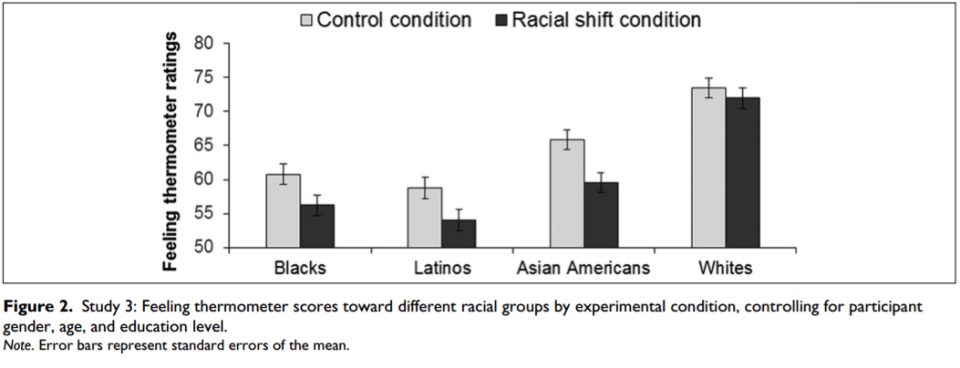
So the researchers showed that by making the racial shift important, that led to more white Americans showing negative attitudes towards minorities—specifically ‘Hispanics’. This was brought about by whites’ “concerns of lose of societal status.” When whites begin to notice demographic changes, the attitudes towards minorities will change—most notable the attitudes towards blacks and ‘Hispanics’ (which is due to the amount of crime committed by both groups, and is why whites show favoritism towards Asians, in my opinion). Overall, it was shown in a nationally representative sample of whites that showing the changing demographics in the country leads to more negative responses towards minority groups. This is due to the perceived threat on whites’ group status, which leads to more out-group bias.
These four studies report empirical evidence that contrary to the belief of liberals et al—that an increasingly diverse America will lead to more acceptance—more exposure to diversity and the changing racial demographics will have whites show more negative attitudes towards minority groups, most notably ‘Hispanics’, the group projected to become the majority by 2042. The authors write:
Consistent with this prior work, the present research offers compelling evidence that the impending so-called “majority-minority” U.S. population is construed by White Americans as a threat to their group’s position in society and increases their expression of racial bias on both automatically activated and selfreport attitude measures.
Interestingly, the authors also write:
That is, the article in the U.S. racial shift condition accurately attributed a large percentage of the population shift to increases in the Latino/Hispanic population, yet, participants in this condition expressed more negative attitudes toward Black Americans and Asian Americans (Study 3) as well as greater automatic bias on both a White-Asian and a White-Black IAT (Studies 2a and 2b). These findings suggest that the information often reported regarding the changing U.S. racial demographics may lead White Americans to perceive all racial minority groups as part of a monolithic non-White group.
You can see this from the rise of the alt-right. Whites, when exposed to the reality of the demographic shift in America, will begin to show more pro-white attitudes while derogating minority out-groups. It is important to note the implications of these studies. One could look at these studies, and rightly say, that as America becomes more diverse that ethnic tensions will increase. Indeed, this is what we are now currently seeing. Contrary to what people say about diversity “being our strength“, it will actually increase ethnic hostility in America and lead towards evermore increasing strife between ethnic groups in America (that is ever-rising due to the current political and social climate in the country). Diversity is not our “strength”—it is, in fact, the opposite. It is our weakness. As the country becomes more diverse we can expect more ethnic strife between groups, which will lower the quality of life for all ethnies, while making whites show more negative attitudes towards all minority groups (including Asians and blacks, but less so than ‘Hispanics’) due to group status threat. The authors write in the discussion:
That is, these studies revealed that White Americans for whom the U.S. racial demographic shift was made salient preferred interactions/settings with their own racial group over minority racial groups, expressed more automatic pro-White/antiminority bias, and expressed more negative attitudes toward Latinos, Blacks, and Asian Americans. The results of these latter studies also revealed that intergroup bias in response to the U.S. racial shift emerges toward racial/ethnic minority groups that are not primary contributors to the dramatic increases in the non-White (i.e., racial minority) population, namely, Blacks and Asian Americans. Moreover, this research provides the first evidence that automatic evaluations are affected by the perceived racial shift. Taken together, these findings suggest that rather than ushering in a more tolerant future, the increasing diversity of the nation may actually yield more intergroup hostility.
Thinking back to Rushton’s Genetic Similarity Theory, we can see why this occurs. Our genes are selfish and want to replicate with out similar genes. Thus, whites would become less tolerant of minority groups since they are less genetically similar to them. This would then be expressed in their attitudes towards minority groups—specifically, ‘Hispanics’ as that ethny will most likely to become the majority and overtake the white majority in 25 years. This is GST on steroids. Once whites realize the reality of the situation of increasing diversity in America—along with their status in the country as a whole—they will then show more negative bias towards minority out-groups.
All in all, the more whites are exposed to diversity in the social context as well as the reality of the ethnic demographic shift in 25 years will be more likely to show negative attitudes towards all American ethnies (though less negative attitudes towards Asians, dude to being less criminal, in my opinion). As the country becomes less white, so to will the whites in America become less tolerant of all minorities and start banding together for pro-white interests—showing that diversity is not our strength. This, in reality, is exactly what liberals do not want—whites banding together showing less favoritism towards the out-group. However, this is what occurs in countries that increasingly become diverse.
Are Caesarian Sections Affecting Human Evolution?
1100 words
Our brains are the most metabolically demanding organ we have, sapping 5-600 kcal per day (25 percent of our daily energy needs). Due to how cost-efficient the brain is, it only would have evolved if it gave us a bigger fitness advantage (which it obviously did). In the news a couple of days ago, it broke that C-sections may be affecting our evolution. But in all of the articles I read about it I didn’t see any one of them talking about how C-sections may affect human evolution in America between race. Clearly, if C-sections are having this effect on the country as a whole, there must be racial differences as well. Could this have an effect on brain size between race in America?
C-sections have increased in frequency since 1996. Clearly, if there is any selection it’s for more narrow-hipped women and bigger-brained babies. The regular use of C-sections has led to an evolutionary increase of fetopelvic disproportion rates by 10 to 20%. (Mitteroecker et al, 2016) Fetopelvic disproportion is the inability of a babe’s head to pass through the mother’s birth canal. This is because the head—and along with it the brain—is too big, leading to emergency C-sections. Mitteroecker et al (2016) also say (which slightly amused me):
Mitteroecker et al (2016) also say (which slightly amused me):
Neonatal size and maternal pelvic dimensions influence fitness (i.e., reproductive success) of the newborn and the mother in multiple ways. Undoubtedly, relative brain size had increased during human evolution in response to directional selection. Recently, it has also been suggested that the large human brain may be the result of runaway selection for the childcare of infants that are born prematurely because of their large brain (12). It is unclear whether any of this selection still persists after the slight decrease of brain size in the late Pleistocene. However, birth weight, which correlates with brain size at birth, is strongly positively associated with infant survival rate (13) and has also been reported to correlate negatively with the risk of multiple diseases (14). Reducing neonatal brain size by shortening gestation length seems to be equally disadvantageous: Delivery before term clearly increases the likelihood of impaired cognitive function in later life (15, 16).
Brain size is decreasing. Associate professor of anthropology at the University of Wisconsin John Hawks also states in his blog post, Selection for smaller brains in Holocene human evolution, where he says (contrary to Pumpkin Person’s assertion) that human brain size has gotten smaller in the past 10,000 years:
The available skeletal samples show a reduction in endocranial volume or vault dimensions in Europe, southern Africa, China, and Australia during the Holocene. This reduction cannot be explained as an allometric consequence of reductions of body mass or stature in these populations. The large population numbers in these Holocene populations, particularly in post-agricultural Europe and China, rule out genetic drift as an explanation for smaller endocranial volume. This is likely to be true of African and Australian populations also, although the demographic information is less secure. Therefore, smaller endocranial volume was correlated with higher fitness during the recent evolution of these populations. Several hypotheses may explain the reduction of brain size in Holocene populations, and further work will be necessary to uncover the developmental and functional consequences of smaller brains.
The reduction in brain size began around 28 kya and accelerated around 10 kya after the dawn of agriculture. The planet getting warmer also played a part in the decrease in brain size, which also allowed for the beginning of agriculture. Anyway, I’m sidetracking, I will return to this point in the future.
Large brains were also selected for since we needed to care for helpless babies. Natural selection for large brains led to more premature births which itself selected for even larger brains.
One-hundred years ago, a narrow-hipped mother who was pregnant with a big-headed baby would have died. Narrow-hipped women with big-headed babies can now survive, transmitting genes for both big brains and narrower pelvises. This is natural selection currently at work as we speak.
One thing that I obviously didn’t see in any article I’ve read on this matter is how will this affect racial differences in brain size? Which race has the most C-sections and will that select for bigger heads and smaller pelvises in that population?
Black women are substantially more likely to deliver by C-section than are white women (pg. 4). Though, one reason that C-sections occur is due to obesity. Black women are the most likely to be obese, which is part of the reason why they have more C-sections. If this trend continues, I could see a slight uptick in black brain size, as even smaller hips get selected for in black women, along with an increase in brain size. That’s one reason why Africans have smaller heads and brains than East Asians and Europeans: they have narrower hips which allows for better athleticism. Conversely, Europeans and East Asians have wider hips which allows for bigger-brained children but hampers athletic ability.
While on the topic of race and C-sections, Asian female-European Male couples have higher rates of C-sections. The obvious explanation is that the Asian woman’s pelvis is too narrow to birth bigger babies. In the study, Asian female-white male couples had babies that had a median weight of 8 pounds, while Asian-Asian couples had babies that had a median weight of 7.1 pounds and finally Asian male-white female couples’ babies had a median weight of 7.3 pounds. However, Asian female-white male couples had an increased rate of C-section deliveries, proving that a significant differences exist between sex of the parent (whether the father or mother is Asian or white influences birth weight) which leads to increased C-section rates due to the white father passing clearly influencing the birth weight more, thusly making it difficult for his Asian partner to birth the baby. There are 100 deaths per 100,000 live births per year in the U.S., a rate of .1 percent. Clearly, though the death rate is low, C-sections lead to maternal mortality and since Asian females are more likely to have a C-section when the father is white due to the baby being bigger, the mortality rate is slightly increased when this interracial pairing occurs.
C-sections are causing natural selection, favoring for bigger heads and narrower hips. This helped us, evolutionarily speaking, as human bipedalism is promoted by a narrow pelvis. C-sections could possibly select for bigger-brained African Americans. Though brain size has decreased in the past 10,000 years, our brain size will slightly increase over time due to this selection pressure. Asian women and white male couples have C-sections more often. Pretty good case against race-mixing, if I don’t say so myself.
Social Sciences and the Denial of the Evolution of Human Behavior
1900 words
What causes people to deny the evolution of human behavior? The denial of evolution’s effect on human behavior got a kickstart from E.O. Wilson’s book that attempted to unify the social sciences—Sociobiology: A New Synthesis—and there was a heated debate about Wilson’s thoughts on where the study of sociobiology would go. Sociobiology was almost immediately rejected by social scientists upon its release, while Wilson and others believed that by providing a model of underlying evolutionary influences on humans, if integrated into their models, would cause a unification of the social sciences. if integrated with social scientists’ and cultural anthropologists’ study of the effects of culture on human behavior,would unify them. The social science have been seen as incompatible with sociobiology, due to focusing on how culture shapes behavior, while disregarding any evolutionary explanations in behavior. I will discuss the study in the paper The Lack of Acceptance to Evolutionary Approaches to Human Behavior, which discusses the history of sociobiology, the sociobiology wars, a questionnaire given to UK university students on the evolution of human behaviors. The main aim of the study was “to evaluate whether there is evidence that studying certain academic disciplines, specifically the social sciences and sociocultural anthropology, correlates with rejection of the relevance of evolution to human behaviour.”
Darwin’s cousin, Sir Francis Galton, coined the term eugenics in the late 1800s. Galton was interested in Darwin’s idea of heritable behavioral characteristics, but entered soon to be muddy waters when he suggested that only positive traits be selected for while attempting to weed out deleterious ones. The authors of the paper, Perry and Mace, say that Darwinian and Galtonian ideas were used to “to justify right-wing capitalist ideology and racist immigration policy (ROSE and ROSE 2000; LALAND and BROWN 2002).” This is describing what occurred in the early 1900s with the acceptance of eugenics in the West. They bring up so-called “culturally biased IQ tests” that were regarded as proof for innate differences between the races (they aren’t biased) which the lead to immigration restrictions for certain races and ethnicities in the 1924 immigration act.
They then bring up how Social Darwinists believe that evolution is progressive and whites were the “most evolved race” (yawn). They believed in evolutionary progress and a unilinear track to evolution.
They then bring up the infamous Franz Boas who stated that differences between societies were purely cultural which regarded behavior as shaped by culture, shifting the burden of proof from nurture to nature.
E.O. Wilson’s book Sociobiology was the first attempt to fuse animal and human studies “using neo-Darwinian evolutionary approaches to understanding social behaviour. . .” Why should mankind be swayed from studying himself, thought Wilson. Wilson wrote that evolutionary history has resulted in selection for certain genetic predispositions for in modern behavior. Hamilton’s kin selection and inclusive fitness theories (also the base for genetic similarity theory/ethnic genetic interests) were a backbone to Wilson’s new approach, using them to explain interactions between individuals. Other important ideas for the new synthesis was Dawkins’s selfish gene theory, which uses the metaphor of bodies being vehicles for genes (the replicator) and the idea of reciprocal altruism from Trivers, which accounted for cooperation amongst unrelated individuals (also integrated into Rushton’s genetic similarity theory). Perry and Mace write on page 109:
Behavioural traits, like physical traits, can be genetic adaptations, and genes influencing phenotypic traits which result in higher inclusive fitness for the organism will be selected for and will propagate in future generations. Using this basic principle of natural selection, WILSON (1975; 1978) claimed that many human behaviours, for example male promiscuity, incest avoidance and hostility to strangers, are genetic adaptations (BATESON 2008).
Typically enough, Sociobiology was hated by the left and had good reception from biologists. At the forfront of the discontent for the book were the usual suspects: Gould, Lewontin (these two led a “Sociobiology book club”), Rose, Kamin and others. The group accused Wilson of being a eugenicist, supposedly linking it with racism, biological determinism and Nazi policies. Wilson denied these accusations, not knowing what had occurred due research such as this. (pg 110).
On page 113, Perry and Mace write:
From an evolutionary perspective, culture has a biological basis and is expressed as socially transmitted information grounded in psychological capacities for symbolic thought, language and learning (RICHERSON and BOYD 2005; CRONK 1995; GINTIS 2007; MESOUDI, WHITEN and LALAND 2006).
Eloquently stated. Culture is passed down from generation to generation as a sort of phenotypic matching for genetically similar others. Culture survives each generation and is passed down from parents to siblings, grandparents to siblings, and so on. Whichever culture provides a society the best chance to survive and pass on its genes will be one that prospers in a society. A people (most likely) will not adopt a culture that’s the opposite of what is good for them fitness-wise. Of course culture that’s transmitted from generation to generation can be Darwinian if it has an impact on fitness. So the question is really this: What is the evolutionary basis for that people’s behaviors and their cultural norms? What happened in that people’s evolutionary history for them to pick up these customs that theoretically increased their fitness?
An online questionnaire was given to students and faculty at the UCL and UK universities over the summer of 2007. The questionnaire was made to gather information on the student’s attitudes towards science, evolution along with their application to human behavior, religious belief and education. The final sample was 7621 individuals after the removal of faculty.
Perry and Mace put forth three hypotheses:
a) A social science background will decrease acceptance of the relevance of evolution to human behaviour. Conversely, a biological / scientific background will increase acceptance.
b) Greater knowledge of evolution will increase acceptance of evolutionary approaches to human behaviour.
c) Religious belief will decrease acceptance of the relevance of evolutionary theory applied to human behaviour.
Below are some questions from the questionnaire and their factor loadings:
a) Component Variables – Acceptance of the Relevance of Evolution to Human Behaviour
The evolutionary history of humans is relevant in studying human behaviour (q. 39) .659
Human behaviour can be explained in the same way as that of other animal species (q. 32) .587
Humans are a species of animal, related to other species (q. 29) .430
I am interested in the theory of evolution (q. 20) .416
The social sciences provide a greater understanding of humans and their behaviour than evolutionary theory (reverse) (q. 40) –.727
b) Component Variables – Religiosity
Would you describe yourself as religious? (q. 12) .880 Were you brought up with religious views? (q. 13) .776
A spiritual / supernatural influence can explain the nature of life and the world (q. 19) .766
Table 2 of the study shows that current discipline is the best predictor, explaining 9.1 percent of the variance in Acceptance of the Relevance of Evolution to Human Behavior. In that particular percentage of variance, the most important significantly negative predictor of Acceptance of the Relevance of Evolution to Human Behavior ” is studying social sciences (compared to disciplines unrelated to science and human behaviour).” What this indicates is that social scientists are more likely to reject evolutionary explanations for human behavior, followed by religious studies and sociocultural anthropology. Though, of course, biological science, biological anthropology, and psychology had the strongest positive relationship with the Acceptance of the relevance of evolution to human behavior. Not too shocking.
Also discovered was that as religiosity increased, acceptance for evolutionary explanations for human behavior decreased. Those with stronger religious beliefs are more likely to reject evolutionary explanations for human behavior.
Surprisingly, Perry and Mace write:
Holding left-wing political views has a positive relationship with Acceptance of the Relevance of Evolution to Human Behaviour. This result does not support the commonly held assumption that individuals in favour of evolutionary approaches to human behaviour have a right-wing bias.
They also discovered that, within the social sciences, knowledge of evolution was the most important predictor of the acceptance of the relevance of evolution to human behavior. How much exposure one is given to evolutionary theory strongly predicts whether or not they believe if it shaped human behavior? This can be remedied by better teaching the theory of evolution to our youth.
The number of years studying social science has a significant negative relationship with accepting that evolution has shaped human behaviors. The Boasian belief that only culture dictates behavior still permeates our universities today. These results, Perry and Mace write, may show that these beliefs are culturally transmitted themselves. Bias against evolutionary beliefs in human behaviors increases the longer one studies social science.
The results of this questionnaire show that exposure to evolutionary theory needs to occur at a younger age, as knowledge of evolution is low which is one variable that leads to the non-belief of evolution on human behavior. Moreover, what the study showed was that it wasn’t the beliefs of those individuals that had them select the courses, suggesting that it was a bias towards sociobiology was transmitted to them culturally. This shows how left-wing biases run high, at least in certain UK universities, which then clouds an individual’s judgement due to getting an adequate education about evolution and growing up in an environment that explicitly denies evolution for religious reasons. Religion showed a negative relationship with believing that evolution has shaped human behavior. Religious people are very likely to deny evolution, due to being ignorant of evolution’s processes or outright denying it because it contradicts the Bible.
Sadly enough, only 62 percent of Americans believe humans evolved over time, with 33 percent of them believed that humans and other living things evolved solely due to natural processes. Twenty-five percent of US adults believe that evolution was guided by a supreme being while 34 percent of Americans reject evolution entirely and believe that humans and animals have existed in their present form since the beginning of time. Fifty-seven percent of evangelicals believe that Man has always existed in his present form with half of Mormons and about 75 percent of Jehovah’s Witnesses rejecting evolution. Fifty-eight percent of Southern Baptists and sixty-seven percent of the Seventh Day Advent Church denied that humans evolved over time. Conversely, 30 percent of protestants, 29 percent of Catholics, 16 percent of Jews and 15 percent who don’t affiliate with a religion share the same view. This Pew Poll shows that evolution denial correlates strongly with religious affiliation.
Whatever the case may be, teaching evolution at a younger age can increase knowledge of evolution among people who may choose these majors, and may even persuade them from not choosing them since they will learn that biology is a better explanation for human behavior, with human culture largely coming from biology (there is a Lamarckian aspect to human culture). Evolution clearly caused differences in human behavior, and the denial of this reality has impeded our understanding of human evolution and human nature as a whole. Once people are more educated in evolutionary theory they can stop clinging to full-on cultural explanations for behavior and embrace the reality that evolution is the cause for human behavior and sociocultural differences. The social sciences, specifically cultural anthropology, is at the forfront of the denial of evolution in human behavior, and once the public as a whole has a better understanding of evolution.
People need to stop denying scientific truths: that man is the product of natural forces. Once our societies become better educated as a whole in evolutionary theory, we will then see a reduction of religious behavior as well as enrollment in cultural anthropology and sociocultural anthropology—at the very least radically changing the base of those disciplines.
Explaining the Black-White Prostate Cancer Gap
800 words
The black-white prostate cancer gap: genetic? Environmental? Both? Over the years, countless studies have been carried out—mostly on testosterone—to find the cause of the disparity between American blacks and whites. Numerous research has shown that black Americans’ test is substantially higher than white Americans (Ross et al, 1986; Winters et al, 2001; etc). However, studies with larger samples showed this was not the case. In a sample of 3,654 whites and 585 black Vietnam veterans shows there is a 3 percent difference favoring blacks (Ellis and Nyborg, 1992). The gold standard—a meta-analysis on 14 relevant studies (which I will discuss tonight) shows that the difference in (free) testosterone is nowhere near what Ross et al (1986) say, but was substantially lower at 2.5 to 4.9 percent (Richard et al, 2014). The meta-analysis, which was done due to the conflicting figures in each study showed that the gap in testosterone.
Obviously these people weren’t genotyped for racial ancestry, so the authors included studies that only included racial descriptors:
If races/ethnicities included in the study were referred to as ‘black’, ‘African-American’, ‘non-Hispanic black’, ‘white’, ‘non-Hispanic white’ or ‘Caucasian’. We did not include men of Hispanic or Asian origin.
Since we know that self-identified race is an almost perfect predictor of genetic ancestry, and the meta-analysis included studies that used the only the descriptors for race/ethnicity then the fact that this is done on American sample shows that testosterone is not as high as commonly thought in blacks when compared to whites (13 percent higher free testosterone).
In this sphere, one of the most common things said is that testosterone is one of the biggest causes of the black-white crime gap. High levels of testosterone ARE linked to higher crime rates, and blacks commit the most crimes, therefore blacks MUST have substantially higher levels of testosterone to account for the difference, right? Wrong. As I’ve shown above, Richard et al (2014) show that even after controlling for age, the difference in free testosterone was 2.5 to 4.9 percent. Black American males have an annual death rate from prostate cancer 2.4 times higher than whites (Taksler, Keating, and Cutler, 2012). If testosterone—one of the main possible culprits—does not explain the higher rate of prostate cancer mortality in American blacks in comparison to whites, what does?
Diet/environment and smaller genetic effects. People who have lower income cannot afford high-quality food, so they, therefore, have to buy low-quality, high carb, highly processed foods which lead to nutrient deficiencies. Drewnowski and Specter (2004) showed that 1) the highest rates of obesity are found in populations with the lowest incomes and education (correlated with IQ); 2) an inverse relationship between energy density and energy cost; 3) sweets and fats have higher energy density and are more palatable; and 4) poverty and food insecurity are associated with lower food expenditures, lower fruit and vegetable intake, and lower-quality diet. All of these data points show that those who are poor are more likely to be obese due to more energy-dense food being cheaper and fats and sugars being more palatable.
One important nutrient that people are often deficient in is vitamin D. Due to the name, people assume it’s a vitamin. It’s really not. It’s a steroid hormone. Vitamin D promotes calcium absorption, maintains normal calcium and phosphate levels, promotes bone and cell growth, and reduces imflamation. Black Americans have numerous ailments that are associated with low vitamin D intake.
Black Americans have a lower intake of vitamin D in comparison to white Americans. This is due to low dietary intake of vitamin D and less sun exposure. Dark skin pigmentation reduces vitamin D production in the skin, as dark skin requires more sunlight in order to produce vitamin D. Rickets is a common a common problem for blacks as when the mother is pregnant, she doesn’t get sufficient vitamin D so when the baby is born, it is deficient.
One variable that Dr. Joseph Mercola brings up is that black women don’t breastfeed as much as white women (though the gap is beginning to close a bit) causing rickets (as well as the lack of availability of vitamin D for the baby due to darker skin needing more sunlight to acquire adequate vitamin D).
Pretty much a great case for why race and geography should inform vitamin D intake. This is pivotal for our understanding for racial/ethnic differences in disease acquisition, why these differences occur and what can be done to prevent them.
Elevated levels of testosterone in black men comparison to white men are supposed to explain the higher rate of mortality in black men compared to white men. Except Richard et al (2014) showed that the testosterone gap wasn’t as high as previously thought (at 2.4 to 5.9 percent higher). The deficiency in vitamin D explains this phenomenon. Low vitamin D is linked to aggressive prostate cancer. This is the cause for the disparity, not higher rates of testosterone.
Are There Racial Differences in Penis Size?
1800 words
Do racial differences in penis size exist? The average person may say yes, due to viewing porn and hearing ‘stories’ from their friends, ie anecdotal accounts. But is this true? JP Rushton was at the helm of this resurrected idea, stating that an inverse relationship existed between penis size and brain size. He cites a WHO study on condom size showing that African countries get the biggest condoms, yet I cannot find the paper discussing it. PP wrote an article, Non-black men are so jealous of black penis size, citing the same study Rushton (1997) cited in his book Race, Evolution, and Behavior. I will discuss PP’s musings on racial differences in penis size.
A pet peeve of mine is that a lot of non-black men in the HBD blogosphere believe everything that professor J. Philippe Rushton said about ethnic differences in IQ and brain size, but when it comes to black men having the largest penis size, they suddenly turn into HBD deniers, ranting and raving about how the research is wrong. Well, I’m sorry but HBD is not here to serve your racist supremacy, HBD is here to celebrate ALL RACES, NOT YOURS ONLY!!!! If the data shows that black men have the largest penis size, then shut up and get over it. What kind of man gets jealous over another man’s penis size anyway? A sick, twisted, perverted sinful one. Healthy well adjusted normal guys don’t even know how large their penis is, and couldn’t care less, because they have other things going for them like a girlfriend, a career, and sports, and their mind’s not in the gutter. The only legitimate reason to care is for science, so here are the FACTS:
Exactly, the only reason to care is for science. And the science shows no differences. What data shows differences in penis size? Something you can directly access right now without relying on a secondhand source to prove your claim?
According to data from the World Health Organization Global Programme on AIDS Specification and Guidelines for Condom Procurement (1991, p 33, Table 5), assuming a normal distribution, I estimate the average white American man has a penis length of 162 mm (SD = 19) , and the average African American man has a penis length of 170 mm (SD = 19). (since 5% of black men are longer that 200 mm, and 2% of white men are, while 27% of white men have penises shorter than 151 mm, while 15% of black men do).
No hyperlink to the study? Why do you rely on a secondhand account? Why didn’t you show the table?
Just found some information on the WHO study he cited. The information from which the WHO data is derived is derived from American blacks and Caucasians, not any subjects from Europe or Africa. He also asked 150 people on a Toronto shopping mall what their penis size was (back to garbage self-reports), and finally, who is this French army surgeon he brings up? So many questions.
Also, PP, asking the questions and questioning his data and what he wrote isn’t “disagreeing on him on this and agreeing with him on everything else”, as you of all people know how critical o am of Lyn and Rushton. Yet you seem to eat up everything they write, thinking they can never be wrong. Why is that?
Rushton (1997) writes on pg 169 of Race, Evolution, and Behavior:
Data provided by the Kinsey Institute have confirmed the black-white difference in penis size (Table 8.2, and items 70-72 of Table 8.4). Alfred Kinsey and his colleagues instructed their respondents on how to measure their penis along the top surface, from belly to tip. The respondents were given cards to fill out and return in preaddressed stamped envelopes. Nobile (1982) published the first averages of these data finding the length and circumferences of the penis for the white samples was smaller than for the black sample. (Flaccid length = 3.86 inches [9.80 cm] vs. 4.34 inches [11.02 cm]; erect length = 6.15 inches [15.62 cm] vs. 6.44 inches [16.36 cm]; erect circumference = 4.83 inches [12.27 cm] vs. 4.96 inches [12.60 cm] respectively.)
Self-reports? Please. Self-reports are notoriously embellished. Moreover, the amount of black Americans in the Kinsey study was in double digits.
I can never find certain papers online, so that really hinders any further discussion on this.
If anyone can find any of these papers, leave a comment.
Harvey, P. H., & May, R. M. (1989). Out for the sperm count. Nature, 337, 508-9.
Short, R. V. (1979). Sexual selection and its component parts, somatic and genital selection, as illustrated by man and the great apes. In J. S. Rosenblatt, R. A. Hinde, C. Beer, & M-C Busnel (Eds.), Advances in the Study of Behavior, Vol. 9. New York: Academic
When it comes to scrotal circumference, I don’t have exact figures, but Rushton cites scholars showing that Africans exceed Europeans: Short, 1979; Ajmani, Jain & Saxena, 1985.
I found Ajmani et al (1985), they state that in 320 healthy Nigerians, average penile length was 3.21 inches, while scrotal circumference was 8.37 inches. PP says he didn’t have exact figures, but they were in Rushton’s references (which I see he didn’t check). Rushton doesn’t cite data on European scrotal circumference so how is that saying that ‘Africans exceed Europeans’ when only Nigerians were examined? Remember: studies are only applicable to the demographic tested. Extrapolating that data on to the whole of Africa makes no sense. Moreover, any data on Europeans is only for that specific ethny tested. Unless the whole of the European continent is averaged out, you cannot say that these differences exist.
This doesn’t even touch on Lynn’s “data” on penis size:
Lynn attempts to justify his belief that there are differences between races in penis length on the basis that European and Asian males have lower levels of testosterone than Africans and that the “reduction of testosterone had the effect of reducing penis length, for which evidence is given by Widodsky and Greene (1940).” Widodsky and Greene (1940) is actually a study of the effects of sex hormones on the penises of rats. This is hardly convincing evidence that there are racial differences in testosterone levels or that a reduction in penis length ever occurred in human history.
Lynn’s claims about differences in penis length between races build on earlier claims by Rushton and Bogaert (1987). The Rushton and Boagert paper is striking for its use of non-scholarly sources (Weizmann, Wiener, Wiesenthal, & Ziegler, 1991). These include a book of semi-pornographic “tall tales” by an anonymous nineteenth century French surgeon that makes wildly inconsistent claims about genital sizes in people of different races. Lynn also refers to this book without mentioning any problems with this as a source of information. Another odd data source cited by Rushton and Bogaert is an article authored by a certain “P. Nobile” published in Forum: International Journal of Human Relations. This publication is better known to the public as “The Penthouse Forum”, a popular men’s magazine. [This is pretty well known and embarrassing that Rushton did that.]
The data sources that Lynn uses in his recent paper are hardly much better. One of them is a book by Donald Templer (another self-professed race realist[1]) called Is Size Important? Templer is not a urologist but a psychologist so why he would claim to be an authority on this subject is unclear.[2] Lynn’s other source is the world penis size website. These are both self-published sources that have not been independently verified. A blogger named Ethnic Muse has carefully examined this site’s references and found that a number of articles listed on the site either do not exist under the name given or do not discuss penis size at all. There are also numerous discrepancies between the values provided by the website and the actual values given by the references.[3] Therefore, the information on this website cannot be trusted and no conclusions should be drawn from it.
Pretty embarrassing for race-realism, to be honest. Looks like the data from “P. Nobile” is from a Penthouse webforum that he ‘published’ his ‘results’ in, instead of a scholarly journal. Rushton did state ‘forum’ (not stating it was the ‘Penthouse forum’, though), but why should we take this as proof of anything?
The sadder one is multiple ‘references’ of Lynn’s that either don’t exist or don’t discuss penis size. Why trust these ‘sources’, when they aren’t controlled scientific studies?
Veale et al (2014) write:
It is not possible from the present meta-analysis to draw any conclusions about any differences in penile size across different races. Lynn [31] suggest that penis length and girth are greatest in Negroids (sub-Saharan Africans), intermediate in Caucasoids (Europeans, South Asians and North African), and smallest in Mongoloids (East Asians), but this is based upon studies that did not meet our present inclusion and
The greatest proportion of the participants in the present meta-analysis were Caucasoids. There was only one study of 320 men in Negroids and two studies of 445 men in Mongoloids. There are no indications of differences in
racial variability in our present study, e.g. the study from Nigeria was not a positive outlier. The question of racial variability can only be resolved by the measurements with large enough population being made by practitioners following the same method with other variables that may influence penis size (such as height) being kept constant. Future studies should also ensure they accurately report the race of their participants and conduct inter-rater reliability.
This meta-analysis was only done on Caucasians, but from the previous study on 320 Nigerians cited from Rushton (Ajmani et al, 1985) and 445 Mongoloids, no racial differences were found. When an actual study gets carried out on this, I doubt that there would be any differences between races.
Orakwe and Ebuh (2007) again test Nigerians (5.2 inches), then compare them with Italians (4.92 inches), Greeks (4.79 inches), Koreans (3.78), British (5.11 inches), and American Caucasians (4.9 inches). The only statistical difference was between Nigerians and Koreans. They conclude:
There is the possibility of racial differences in penile sizes, but there is no convincing scientific background to support the ascription of bigger penile dimensions to people of the Black race.
I wouldn’t say there is a ‘possibility’ that it’s true, based on a population of Nigerians. We can say that ethnic differences may exist between Koreans and Nigerians, but to extrapolate that to all five races and say that racial differences exist and that it fits neatly into Rushton’s outdated 3-way racial model is incorrect. It wasn’t a representative sample of Nigerians (and I obviously don’t have access to the methods of the other papers, I will update this in the future when I find more data), and the bigger sample of the two samples that I cited showed a smaller size.
Do racial differences in penis size exist? We can’t really come to a conclusion based on the data we currently have. Using “””data””” from the Penthouse webforum and a self-reported survey online is embarrassing and the data shouldn’t be used in the discussion of whether these differences exist. The only reliable data on Africans, as far as I know, is on Nigerians; the study with the higher n showed a smaller length. The data so far, shows that no difference exist exists (Veale et al, 2014: 983).
Race Is a Social Construct of a Biological Reality
2050 words
Race: social construct or biological reality? Why can’t it be both? When the Left (let’s use Liberal Creationists, LC for short) says that “race is a social construct”, what do they mean? They mean, obviously, that race is not a biological reality and that most ‘racists’ assume that race is only what we can physically see—the phenotype. However, genotypic differences give rise to phenotypic differences between humans. We can then say, with 100 percent certainty, that even ‘small genotypic differences’ can make ‘big differences in phenotype’ between two almost genetically similar organisms.
The thing that LCs don’t understand is that race is a ‘social construct’, but not in the way that they believe. They believe that since what we call ‘white’ and ‘black’ are genetically different depending on which geographic location you look at, that race must be something constructed by the mind based on the ‘small genotypic differences’ which lead to the ‘large differences in phenotype’. This couldn’t be further from the truth.
See, what we call the ‘races’ are arbitrary. Instead of ‘white’ we can say ‘hulina’, instead of ‘black’ we can say ‘lorux’ (two random ‘words’ I made up on the fly). What we call these biological realities is arbitrary, replacing the common usages of ‘white’ and ‘black’ WILL NOT change biology. This is what they don’t understand. They are correct that ‘race is a social construct’, but the ‘social constructions’ that we have chosen describe genotypic differences between geographically isolated populations. What we call races, ethnies, or anything for that matter, is arbitrary as the genetic underpinnings we are describing will not change if we call them another (arbitrary) name.
We have this article from The New York Times (which I have already responded to) which says:
Race is not biological. It is a social construct. There is no gene or cluster of genes common to all blacks or all whites. Were race “real” in the genetic sense, racialclassifications for individuals would remain constant across boundaries. Yet, a person who could be categorized as black in the United States might be considered white in Brazil or colored in South Africa.
This goes back to my point about using different ‘constructs’ for these biological realities (though mixed is a better ‘construct’ to use than ‘white’ or ‘black’. ‘Colored’ is a good term as that denotes a white/black mix). Call someone ‘black’ in America and he’ll be ‘white’ in Brazil or ‘colored’ in South Africa. OK? And? Does this change any type of underlying biology that is being described? I do admit that using the term ‘mixed’ is better than the ‘straight terms’ of ‘white’ and ‘black’, however, these ‘constructed terms’ are shockingly correct in describing the biological underpinnings of ‘race’.
I define ‘race’ as a genetically isolated breeding population. Sure, we can still conceive children between racial groups, that, however, doesn’t change any underlying biologic underpinnings. That should be obvious, though.
You have people like Richard Lewontin, of ‘Lewontin’s Fallacy’ fame who say that “because there is more variation within racial groups that the smaller variation between racial groups is insignificant, stating:
“Since such racial classification is now seen to be of virtually no genetic or taxonomic significance either, no justification can be offered for its continuance.”
There IS a genetic significance, and there IS taxonomic significance, to quote Dawkins:
It is genuinely true that, if you measure the total variation in the human species and then partition it into a between-race component and a within-race component, the between-race component is a very small fraction of the total. Most of the variation among humans can be found within races as well as between them. Only a small admixture of extra variation distinguishes races from each other. That is all correct. What is not correct is the inferene that race is therefore a meaningless concept. This point has been clearly made by the distinguished Cambridge geneticist A.W.F. Edwards in a recent paper “Human genetic diversity: Lewontin’s fallacy.” R.C. Lewontin is an equally distinguished Cambridge (Mass.) geneticist, known for the strength of his political convictions and his weakness for dragging them into science at every possibile opportunity. Lewontin’s view of race has become near-universal orthodoxy in scientific circles.
…
We can all happily agree that human racial classification is of no social value and is positively destructive of social and human relations. That is one reason why I object to ticking boxes on forms and why I object to positive discrimination in job selection. But that doesn’t mean that race is of “virtually no genetic or taxonomic significance.” This is Edwards’s point, and he reasons as follows. However small the racial partition of total variation may be, if such racial characteristics as there are highly correlated with other racial characteristics, they are by definition informative, and therefore of taxonomic significance.
Strike out. Lewontin, like his colleague Gould and other ideological brother in Marxism Diamond all deny race, first and foremost, for ideological reasons, not scientific ones. Though, this doesn’t mean their arguments should be discarded. On the contrary. They should be deconstructed and shown how and why they are wrong.
In 2002, Risch, et al published a paper that confirms the existence of five racial categories (not three [as is commonly though] as ‘Natives’ cluster on their own due to genetic isolation and Melanesians and Australoids are NOT NEGROID; saying so makes race a true ‘social construct’. Sorry PP), writing:
The African branch included three sub-Saharan populations, CAR pygmies, Zaire pygmies, and the Lisongo; the Caucasian branch included Northern Europeans and Northern Italians; the Pacific Islander branch included Melanesians, New Guineans and Australians; the East Asian branch included Chinese, Japanese and Cambodians; and the Native American branch included Mayans from Mexico and the Surui and Karitiana from the Amazon basin. The identical diagram has since been derived by others, using a similar or greater number of microsatellite markers and individuals [8,9]. More recently, a survey of 3,899 SNPs in 313 genes based on US populations (Caucasians, African-Americans, Asians and Hispanics) once again provided distinct and non-overlapping clustering of the Caucasian, African-American and Asian samples [12]: “The results confirmed the integrity of the self-described ancestry of these individuals”. Hispanics, who represent a recently admixed group between Native American, Caucasian and African, did not form a distinct subgroup, but clustered variously with the other groups. A previous cluster analysis based on a much smaller number of SNPs led to a similar conclusion: “A tree relating 144 individuals from 12 human groups of Africa, Asia, Europe and Oceania, inferred from an average of 75 DNA polymorphisms/individual, is remarkable in that most individuals cluster with other members of their regional group” [13]. Effectively, these population genetic studies have recapitulated the classical definition of races based on continental ancestry – namely African, Caucasian (Europe and Middle East), Asian, Pacific Islander (for example, Australian, New Guinean and Melanesian), and Native American.
Pretty damn good for a ‘social construct’, right? Unless the computer somehow consciously knows the result we want and then allocates the clusters according to our desires, but I doubt it. These studies show, definitively, that race as we know it is a biological reality.
They then state in the conclusion:
As we enter this new millennium with an advancing arsenal of molecular genetic tools and strategies, the view of genes as immutable is too simplistic. Every race and even ethnic group within the races has its own collection of clinical priorities based on differing prevalence of diseases. It is a reflection of the diversity of our species – genetic, cultural and sociological. Taking advantage of this diversity in the scientific study of disease to gain understanding helps all of those afflicted. We need to value our diversity rather than fear it. Ignoring our differences, even if with the best of intentions, will ultimately lead to the disservice of those who are in the minority.
One of the best conclusions one can write after an article as ‘controversial’ as that one. We need to embrace our diversity, not destroy it. We need to study it and see how and why we are so diverse, not ruin the diversity making it impossible to study. This also has implications for disease acquisition as well as whether or not one responds to certain drugs (blacks and the drug Bidil, for instance). These inherent differences between races/ethnies need to be studied so we can get everyone the best care they need based on their genetic makeup, without pretending that it doesn’t exist. Pretending that these differences don’t exist does not make them go away.
If race were ‘fake’ and ‘socially constructed’, would there be a success rate of 99.86 percent between self-identified race/ethnicity and genetic structure? Tang et al (2005) write:
We have analyzed genetic data for 326 microsatellite markers that were typed uniformly in a large multiethnic population-based sample of individuals as part of a study of the genetics of hypertension (Family Blood Pressure Program). Subjects identified themselves as belonging to one of four major racial/ethnic groups (white, African American, East Asian, and Hispanic) and were recruited from 15 different geographic locales within the United States and Taiwan. Genetic cluster analysis of the microsatellite markers produced four major clusters, which showed near-perfect correspondence with the four self-reported race/ethnicity categories. Of 3,636 subjects of varying race/ethnicity, only 5 (0.14%) showed genetic cluster membership different from their self-identified race/ethnicity. On the other hand, we detected only modest genetic differentiation between different current geographic locales within each race/ethnicity group. Thus, ancient geographic ancestry, which is highly correlated with self-identified race/ethnicity—as opposed to current residence—is the major determinant of genetic structure in the U.S. population. Implications of this genetic structure for case-control association studies are discussed.
These ‘social constructs’ have some pretty damn good predictive power to guess geographic ancestry (race) 99.86 percent of the time. But isn’t it weird that this so-called ‘social construct’ fits neatly into 4 categories (‘Hispanic’ is not a race, but I assume it would cluster between ‘Natives’ and Europeans, showing that fourth cluster. There hasn’t been enough time for ‘Hispanics’ to cluster into a distinct race, so they cluster in between ‘Natives’ and Europeans)?
If race is a ‘social construct’ as LCs would want you to believe, how do we have these clusters showing this variation? Because they’re genetically similar others. We can then start to wonder about things such as genetic similarity theory and ethnic genetic interests, as they then become a direct result of these genetically similar individuals. Yes we humans are 99.9 percent identical, but what matters is not how genetically distant humans are when being compared with one another, what matters is gene expression. We share over 90 percent of the same genes with dogs, cats, mice, and other great apes. Must mean we are almost all the same and any genetic differences ‘are meaningless’, then!
Think of it this way. People in the same family differ both genotypically and phenotypically. Hereditary traits get passed down through the generations and they stay in that family. If you broaden that to ethnic and the bigger racial groups, you can then see how genetically isolated human populations (key phrase here) do differ, on average, in hereditary traits.
We see racial in sports from swimming, baseball, football, bodybuilding, sprinting, and Strongman. We (somewhat) openly discuss racial differences being the cause for this, yet discussing racial differences in intelligence is taboo.
Liberal Creationists and their denial of race in the modern genomics age is absurd. It’s like people who deny evolution because they don’t understand basic evolutionary theory. Liberal Creationists, too, don’t understand basic evolutionary theory. Race-denialism, when the facts are right in front of you showing how these so-called ‘social constructs’ exist and outright denying them, is very telling. Ideology is the name of the game, not science.
It doesn’t matter how many people believe race doesn’t exist, the underlying realities are still there. LCs can say talk all about changing definitions of race in other countries and the past few hundred years, but this doesn’t address the fact that what we call ‘race’ and ‘ethnicity’ have real biological underpinnings. What we call ‘race’ and ‘ethnicity’ is meaningless. ‘Race’ is a social construct, but a ‘social construct’ of a biological reality. Even if we changed, or even eliminated the words from use, actual genetic differences between races will not go away.
What If the Hereditarian Hypothesis Is True?
1800 words
In 2005, Linda Gottfredson published What If the Hereditarian Hypothesis Is True? in the journal Psychology, Public Policy, and Law defending Rushton and Jensen’s (2005) conclusions on the black-white IQ gap. This gap in intelligence between the races has been noticed since the IQ test’s inception 100 years ago. What if the hereditarian hypothesis is true—what if there are genetic differences in intelligence between races? How should society handle such a ‘discovery’ if one were to occur?
In Rushton and Jensen’s opus paper, they didn’t set out to prove that the hereditarian hypothesis is true, rather they set out to prove that the hereditarian hypothesis—which states that 50 percent of racial differences in intelligence come down to genetic factors with environment dictating the other 50 percent—is more tenable the culture-only hypothesis—0 percent genetics 100 percent environment. Gottfredson states that the hereditarian hypothesis becomes scientifically plausible “only after five evidentiary requisites have been met”: “IQ differences among same-race individuals represent (a) real, (b) functionally important, and (c) substantially genetic differences in general intelligence (the g factor), and mean IQ differences between the races likewise reflect (d) real and (e) functionally important differences on the same g factor.” (Gottfredson, 2005: 311) The past one hundred years of intelligence testing has proven all of this. The black-white differences in intelligence are on subtests that are more heritable, proving a genetic component.
The hereditarian hypothesis has been proven by adoption studies such as the Minnesota Transracial Adoption Study, to differences overall in IQ tests, to differences in life success etc. Environmentalists believe it’s ‘racism’ or ‘classism’ that’s the cause for racial/ethnic/class differences in achievement, when a genetic explanation makes a lot more sense.
The Denial of the Hereditarian Hypothesis
The denial of the hereditarian hypothesis has greatly harmed American society. Before the push for multiculturalism in the 60s, a genetic reason for racial/class differences was widely accepted. Minorities couldn’t perform well in school in comparison to whites because they had lower innate g. The difference in g causes differences in wealth attainment, salary, mortality, fitness, educational attainment, and other pertinent achievements. This then leads to programs with an abysmal ‘success rate’, such as Head Start. Head Start does not work, its gains fade away in a few years after the program. It’s time to stop Head Start, because it makes people believe that parental intervention can have any kind of effect on a young child, when it’s shown that these so-called gains fade away in a few years as the heritability of intelligence increases. Individuals differ on g, races differ on g, there are differences in achievement and more people in one SES bracket and other people in another SES bracket and it’s down to g. Denying the hereditarian hypothesis wastes taxpayer money as more and more money goes towards programs like Head Start that don’t do anything to close any of the gaps they promise to close.
Academic achievement in math, science, art, humanities, and second language were all shared by the same genes. They found that 60 percent of the results in GCSE scores were attributed to genetic factors. Genes and not upbringing had more of an effect on the scores one receives on the GCSE.
Moreover, other behavioral traits such as psychopathology and personality also account for genetic influence on GCSE scores beyond that predicted by intelligence. This shows that ‘nature’ wins out in the nature-nurture debate. If individual differences in test scores are largely determined by genetics, why not the black-white difference?
Individuals nor groups are ever ‘equal’ in terms of any capacity. One will be better at something than someone else, and that will largely be determined by genetic factors. Training and repetition brings out the best in one that’s genetically inclined to excel. We accept genetic differences for differences in sports, such as sprinting and distance running. They are genetically inclined to excel at those competitions due to fast and slow twitch muscle fibers. Take Usain Bolt. Do you think anyone can train to get to that level? Do you think random Joe can just wake up one day and decide to try to be the fastest man in the world? If you say no, you’re a hereditarian. Of course Bolt’s training makes him better, but without his genetics, he wouldn’t be the fastest man in the world.
Now take the genetic differences from sports (that any sane person would recognize), and think about that in regards to brain power. We are talking about 2 groups that have been genetically isolated for tens of thousands of years. They had to do different things to survive and both faced different selective pressures that would have an effect on intelligence.
The worldwide differences in IQ between East Asians, Europeans and Africans; an inverse correlation between the race differences and brain attributes and black-white-East Asian differences in body maturation; . 2 and .4 correlations with skull size and in vivo brain volume, moderately high correlation of .6 to .7 of different IQ test’s g loadings on the magnitude of the black-white-East Asian differences as well as the measures of the subtests being rooted in biological and genetic processes; rising heritability of IQ; differences in crime, gestation, and sex ratio at birth, law-abidingness, marital stability; and a genetic divergence of world population groups during evolution. The most telling one is the last one, genetic divergence of world population groups during evolution. These differences in the brain are rooted in genetic factors. The hereditarian hypothesis fully explains within and between group differences in achievement and intelligence. No “culture-only” hypothesis could ever convince me otherwise.
Richard Nisbett has attempted to say that the hereditarian hypothesis is wrong and that culture-only theory is the only game in town. He couldn’t be more wrong. Citing studies like Moore and Eyferth to make your case against the hereditarian hypothesis won’t get you anywhere. They had a smaller sample size, and some of the subjects were extremely young. Environmentalists use these studies to say that the difference in IQ comes down to a type of ‘ghetto’ environment that saps American blacks’ intellect and that raised away from that type of environment, they’d be able to score on par with whites. Except that’s not what was found in the Minnesota Transracial Adoption Study. This is the only study to test the children again at age 17, when genetics would be taking its full effect. The racial gap in intelligence still stayed the same (Rushton and Jensen, 2005: 258). I’ve written about the strong evidence for the hereditarian hypothesis in regards to adoption studies and how they support the hypothesis that genetics, and not culture, are the cause for differences in intelligence.
If the Hereditarian Hypothesis is Accepted What Policies Should Change?
If the general public were to ever accept a genetic hypothesis for individual and group differences as a whole, then affirmative action and other such programs that shoehorn kids with lower ability into schools should be abolished and these spots should be filled on merit. Sure there would be fewer blacks and more whites, Jews, Asians, than blacks, ‘Hispanics’ and others but that’s how a merit-based society looks, not one based on feelings and imaginary causes of racism as the culprit for any types of intellectual downfalls. When we come to our senses with genetics and educational achievement and intelligence—which should be coming soon due to the advent of CRISPR—then America can start to become less polarized, in my opinion, on the so-called ‘racist system’ ‘holding down’ minorities. Maybe if people/groups accepted they were less intelligent and it was due majorly to genetic factors, then some of this racial animosity between groups in America will die down. That’s an extremely far reach, though, and I can see them then arguing that accepting by accepting the hereditarian hypothesis then we should continue these programs.
That’s an extremely far reach, though, and I can see them then arguing that accepting by accepting the hereditarian hypothesis then we should continue these programs due to genetic differences. They would say “Well, as a group, we are less inclined to make it into higher areas of learning so we, therefore, should continue to receive these benefits.” To that I would say you’ve been taking advantage of these benefits for 50 years and what’s changed? Billions of dollars have been spent on affirmative action and related cases since the 60s and what has changed? These groups still complain and talk about being oppressed by ‘the man’ not getting what they want. Yet there is an ongoing racial preference for blacks and ‘Hispanics’ over whites and Asians in US medical schools. This is all an effect of affirmative action and the policies it brings to American institutions. Admission into places of higher learning should be completely merit-based, not based on what racial/ethnic group you belong to. That in and of itself is continuing the so-called ‘racism’ and ‘prejudiced attitudes’ that people complain about since they insist on having special privileges based on their ancestral background.
If we were to accept the hereditarian hypothesis as a country, I’d hope to see an abolishment of affirmative action, Head Start, and related programs that do not work. The acceptance of the hereditarian hypothesis would only be a net gain over time, as people would learn to not blame ‘the man’ on their problems, but would look to better themselves in ways that accentuate their strengths. Since any attempt at raising scholastic achievement has failed due to the heritability of intelligence and how it increases as one ages (which is why Head Start doesn’t work and should be abolished) once this is accepted then other avenues can be taken to address these issues that don’t focus on attempting to raise scores. Gottfredson states at the end of her paper that we should have targeted intellectual support for those with an IQ below 80. She also says we should make some jobs less complex, ie “inadequate or overly complex labeling, instructions, and forms”, target training and education towards people with that level of intelligence, and provide more assistance in daily living matters, This can increase their QoL and ability to attain meaningful employment.
She sees a more positive outlook in the future than I do. I see things become more stratified as automation rolls out. This will have the lower IQ people out of work, while the higher IQ people still are sitting well at the top due to the increasingly complex society that we make for ourselves. Accepting the hereditarian hypothesis can ease this slightly by targeting programs at the less intellectually inclined as well as attempt to soften the claims of ‘racism’ when this starts to really become noticeable. The only way to explain such a disparity is with a genetic hypothesis, at least 50/50 genetics culture. The culture-only theory has no leg to stand on. Once we accept that individual and group differences are due to genetics, then we can begin to accept some of the differences in our society in terms of class and race.
 NotPoliticallyCorrect