Home » 2018 (Page 4)
Yearly Archives: 2018
Somatotyping, Constitutional Psychology, and Sports
1600 words
In the 1940s, psychologist William Sheldon created a system of body measures known as “somatotyping”, then took his somatotypes and attempted to classify each soma (endomorph, ectomorph, or mesomorph) to differing personality types. It was even said that “constitutional psychology can guide a eugenics program and save the modern world from itself.”
Sheldon attempted to correlate different personality dimensions to different somas. But his somas fell out of favor before being revived by two of his disciples—without the “we-can-guess-your-personality-from-your-body-type” canard that Sheldon used. Somatotyping, while of course being put to use in a different way today compared to what it was originally created for, it gives us reliable dimensions for human appendages and from there we can ascertain what a given individual would excel at in regard to sporting events (obviously this is just on the basis of physical measures and does not measure the mind one needs to excel in sports).
The somatotyping system is straightforward: You have three values, say at 1-1-7; the first refers to endomorphy, the second refers to mesomorphy and the third refers to ectomorphy, therefore a 1-1-7 would be an extreme ectomorph. However, few people are at the extreme end of each soma, and most people have a combination of two or even all three of the somas.
According to Carter (2002): “The somatotype is defined as the quantification of the present shape and composition of the human body.” So, obviously, somas can change over time. However, it should be noted that the somatotype is, largely, based on one’s musculoskeletal system. This is where the appendages come in, along with body fat, wide and narrow clavicles and chest etc. This is why the typing system, although it began as a now-discredited method, should still be used today since we do not use the pseudoscientific personality measures with somatotyping.
Ectomorphs are long and lean, lanky, you could say. They have a smaller, narrower chest and shoulders, along with longer arms and legs, and have a hard time gaining weight, and a short upper body (I’d say they have a harder time gaining weight due to a slightly faster metabolism, in the variation of the normal range of metabolism, of course). Put simply, ectomorphs are just skinny and lanky with less body fat than mesos and endos. Human races that fit this soma are East Africans and South Asians (see Dutton and Lynn, 2015; one of my favorite papers from Lynn for obvious reasons).
Endomorphs are stockier, shorter and have wider hips, along with short limbs, a wider trunk, more body fat and can gain muscular strength easier than the other somas. Thus, endos, being shorter than ectos and mesos, have a lower center of gravity, along with shorter arms. Thus, we should see that these somas dominate strongman competitions and this is what we see. Pure strength competitions are perfect for this type, such as Strongman competitions and powerlifting. Races that generally conform to this type are East Asians, Europeans, and Pacific Islanders (see Dutton and Lynn, 2015).
Finally, we have mesomorphs (the “king” of all of the types). Mesos are more muscular on average than the two others, they have less body fat than endos but more body fat than ectos; they have wider shoulders, chest and hips, a short trunk and long limbs. The most mesomorphic races are West Africans (Malina, 1969), and due to their somatotype they can dominate sprinting competitions; they also have thinner skin folds (Vickery, Cureton, and Collins, 1988; Wagner and Heyward, 2000), and so they would have an easier time excelling at running competitions but not at weightlifting, powerlifting, or Strongman (see Dutton and Lynn, 2015).
These anatomic differences between the races of man are due to climatic adaptations. The somatypic differences Neanderthals and Homo sapiens mirror the somatotype difference between blacks and whites; since Neanderthals were cold-adapted, they were shorter, had wider pelves and could thusly generate more power than the heat-adapted Homo sapiens who had long limbs and narrow pelvis to better dissipate heat. Either way, we can look at the differences in somatotype between races that evolved in Europe and Africa to ascertain the somatotype of Neanderthals—and we also have fossil evidence for these claims, too (see e.g., Weaver and Hublin, 2009; Gruss and Schmitt, 2016)
Now, just because somatotyping, during its conception, was mixed with pseudoscientific views about differing somas having differing psychological types, does not mean that these differences in body type do not have any bearing on sporting performance. We can chuck the “constitutional psychology” aspect of somatotyping and just keep the anthropometric measures, and, along with the knowledge of human biomechanics, we can then discuss, in a scientific manner, why one soma would excel in sport X or why one soma would not excel in sport X. Attempting to argue that since somatotyping began as some crank psuedoscience does not mean that it is not useful today, since we do not ascribe inherent psychological differences to these somas (I’d claim that saying that this soma has a harder time gaining weight compared to that soma is not ascribing a psychological difference to the soma; it is taking physiologically and on average we can see that different somas have different propensities for weight gain).
In her book Straightening the Bell Curve: How Stereotypes about Black Masculinity Drive Research about Race and Intelligence, Hilliard (2012: 21) discusses the pitfalls of somatotyping and how Sheldon attempted to correlate personality measures with his newfound somatotypes:
As a young graduate student, he [Richard Herrnstein] had fallen under the spell of Harvard professor S. S. Stevens, who had coauthored with William Sheldon a book called The Varieties of Temperament: A Psychology of Constitutional Differences, which popularized the concept of “somatotyping,” first articulated by William Sheldon. This theory sought, through the precise measurement and analysis of human body types, to establish correlations comparing intelligence, temperament, sexual proclivities, and the moral worth of individuals. Thus, criminals were perceived to be shorter and heavier and more muscular than morally upstanding citizens. Black males were reported to rank higher on the “masculine component” scale than white males did, but lower in intelligence. Somatotyping lured the impressionable young Herrnstein into a world promising precision and human predictability based on the measuring of body parts.
Though constitutional psychology is now discredited, there may have been something to some of Sheldon’s theories. Ikeda et al (2018: 3) conclude in their paper, Re-evaluating classical body type theories: genetic correlation between psychiatric disorders and body mass index, that “a trans-ancestry meta-analysis of the genetic correlation between psychiatric disorders and BMI indicated that the negative correlation with SCZ supported classical body type theories proposed in the last century, but found a negative correlation between BD and BMI, opposite to what would have been predicted.” (Though it should be noted that SCZ is a, largely if not fully, environmentally-induced disorder, see Joseph, 2017.)
These different types (i.e., the differing limb lengths/body proportions) have implications for sporting performance. Asfaw and A (2018) found that Ethiopian women high jumpers had the highest ectomorph values whereas long and triple jumpers were found to be more mesomorphic. Sports good for ectos are distance running due to their light frame, tennis etc—anything that the individual can use their light frame as an advantage. Since they have longer limbs and a lighter frame, they can gain more speed in the run up to the jump, compared to endos and mesos (who are heavier). This shows why ectos have a biomechanical advantage when it comes to high jumping.
As for mesomorphs, the sports they excel at are weightlifting, powerlifting, strongman, football, rugby etc. Any sport where the individual can use their power and heavier bone mass will they excel in. Gutnik et al (2017) even concluded that “These results suggest with high probability that there is a developmental tendency of change in different aspects of morphometric phenotypes of selected kinds of sport athletes. These phenomena may be explained by the effects of continuous intensive training and achievement of highly sport-defined shapes.” While also writing that mesomorphy could be used to predict sporting ability.
Finally, for endomorphs, they too would excel in weightlifting, powerlifting, and strongman, but do on average better since they have different levers (i.e., shorter appendages so they can more weight and a shorter amount of time in comparison to those with longer limbs like ectos).
Thus, different somatotypes excel in different sports. Different races and ethnies have differing somatotypes (Dutton and Lynn, 2015), so these different bodies that the races have, on average, is part of the cause for differences in sporting ability. That somatotyping began as a pseudoscientific endeavor 70 years ago does not mean that it does not have a use in today’s world—because it clearly does due to the sheer amount of papers on the usefulness of somatotyping and relating differences in sporting performance due to somatotyping. For example, blacks have thinner skin folds (Vickery, Cureton, and Collins, 1988; Wagner and Heyward, 2000) which is due to their somatotype, which is then due to the climate their ancestors evolved in.
Somatotyping can show us the anthropometric reasons for how and why certain individuals, ethnies, and races far-and-away dominate certain sporting events. It is completely irrelevant that somatotyping began as a psychological pseudoscience (what isn’t in psychology, am I right?). Understanding anthropometric differences between individuals and groups will help us better understand the evolution of these somas along with how and why these somas lead to increased sporting performance in certain domains. Somatotyping has absolutely nothing to do with “intelligence” nor how morally upstanding one is. I would claim that somatotyping does have an effect on one’s perception of masculinity, and thus more masculine people/races would tend to be more mesomorphic, which would explain what Hilliard (2012) discussed when talking about somatotyping and the attempts to correlate differing psychological tendencies to each type.
Blumenbachian Partitions and Mimimalist Races
2100 words
Race in the US is tricky. On one hand, we socially construct races. On the other, these socially constructed races have biological underpinnings. Racial constructivists, though, argue that even though biological races are false, races have come into existence—and continue to exist—due to human culture and human decisions (see the SEP). Sound arguments exist for the existence of biological races. Biological races exist, and they are real. One extremely strong view is from philosopher of science Quayshawn Spencer. In his paper A Radical Solution to the Race Problem, Spencer (2014) argues that biological races are real; that the term “race” directly refers; that race denotes proper names, not kinds; and these sets of human populations denoted by Americans can be denoted as a partition of human populations which Spencer (2014) calls “the Blumenbach partition”.
To begin, Spencer (2014) defines “referent”: “If, by using appropriate evidential methods (e.g., controlled experiments), one finds that a term t has a logically inconsistent set of identifying conditions but a robust extension, then it is appropriate to identify the meaning
of t as just its referent.” What he means is that the word “race” is just a referent, which means that the term “race” lies in what points out in the world. So, what “race” points out in the world becomes clear if we look at how Americans define “race”.
Spencer (2014) assumes that “race” in America is the “national meaning” of race. That is, the US meaning of race is just the referent to the Census definitions of race, since race-talk in America is tied to the US Census. But the US Census Bureau defers to the Office of Management and Budget (OMB). Therefore, since the US Census Bureau defers to the OMB on matters of race, and since Americans defer to the US Census Bureau, then Americans use the OMB definitions of race.
The OMB describes a “comprehensive set” of categories (according to the OMB) which lead Spencer (2014) to believe that the OMB statements on race are pinpointing Caucasians, Africans, Pacific Islanders, East Asians, and Amerindians. Spencer (2014: 1028-29) thusly claims that race in America “is a term that rigidly designates a particular set of “population groups.” Now, of course, the question is this: are these population groups socially constructed? Do they really exist? Are the populations identified arbitrary? Of course, the answer is that they identify a biologically real set of population groups.
To prove the existence of his Blumenbachian populations, Spencer (2014) invokes populational genetic analyses. Population geneticists first must make the assumption at how many local populations exist in the target species. According to Spencer, “The current estimate for humans is 7,105 ethnic groups, half of which are in Africa and New Guinea.” After the assumptions are made, the next step is to sample the species’ estimated local populations. Then they must test noncoding DNA sequences. Finally, they must attempt to partition the sample so that each partition at each level is unique which then minimizes genetic differences in parts and maximizes genetic differences among parts. There are two ways of doing this: using structure and PCA. For the purposes of this argument, Spencer (2014) chooses structure, invoking a 5-population racial model, (see e.g., Rosenberg et al, 2002).
K = 5 corresponds to 5 populational clusters which denote Africans, Oceanians, East Asians, Amerindians, and Caucasians (Spencer, 2014; Hardimon, 2017b). K = 5 shows that the populations in question are genetically structured—that is, meaningfully demarcated on the basis of genetic markers and only genetic markers. Thus, that the populations in question are meaningfully demarcated on the basis of genetic markers, this is evidence that Hardimon’s (2017b) minimalist races are a biological reality. Furthermore, since Rosenberg et al (2002) used microsatellite markers in their analysis, this is a nonarbitrary way of constructing genetic clusters which then demarcate the continental-level minimalist races (Hardimon, 2017b: 90).
Thus, Spencer (2014) argues to call the partition identified in K = 5 “the Blumenbachian partition” in honor of Johann Blumenbach, anthropologist, physician, physiologist, and naturalist. (Though it should be noted that one of his races “Malays” was not a race, but Oceaninans are, so he “roughly discovered” the population partition.) So we can say that “the Blumenbach partition” is just the US meaning of “race”, the partitions identified by K = 5 (Rosenberg et al, 2002).
Furthermore, like Lewontin (1972), Rosenberg et al (2002) found that a majority of human genetic variation is between individuals, not races. That is, Rosenberg et al (2002) found that only 4.3 percent of human genetic variation was found to lie between the continental-level minimalist races. Thus, minimalist races are a biological kind, “if only a modest one” (Hardimon, 2017b: 91). Thus, Rosenberg et al (2002) support the contention that minimalist races exist and are a biological reality since a fraction of human population variation is due to differences among continental-level minimalist races (Africans, Caucasians, East Asians, Oceanians, and Amerindians). The old canard is true, there really is more genetic variation within races than between them, but, as can be seen, that does not rail against the reality of race, since that small amount of genetic variation shows that humanity is meaningfully clustered in a genetic sense.
Spencer (2014: 1032) then argues why Blumenbachian populations are “race” in the American sense:
It is not hard to generate accessible possible worlds that support the claim that US race terms are just aliases for Blumenbachian populations. For example, imagine a possible world τ where human history unfolded exactly how it did in our world except that every Caucasian in τ was killed by an infectious disease in the year 2013. Presumably, we have access to τ, since it violates no logical, metaphysical, or scientific principles. Then, given that we use ‘white’ in its national American meaning in our world, and given that we use ‘Caucasian’ in its Blumenbachian meaning in our world, it is fair to say that both ‘Caucasian’ and ‘white’ are empty terms in τ in 2014—which makes perfect sense if ‘white’ is just an alias for Caucasians. It is counterfactual evidence like this that strongly suggests that the US meaning of ‘race’ is just the Blumenbach partition.
Contrary to critics, this partition is biologically real and demarcates the five genetically structured populations of the human race. Rosenberg et al (2005) found that if sufficient data are used, “the geographic distribution of the sampled individuals has little effect on the analysis“, while their results verify that genetic clusters “arise from genuine features of the underlying pattern of human genetic variation, rather than as artifacts of uneven sampling along continuous gradients of allele frequencies.”
Some may claim that K = 5 is “arbitrary”, however, constructing genetic clusters using microsatellites is nonarbitrary (Hardimon, 2017b: 90):
Constructing genetic clusters using microsatellites constitutes a nonarbitrary way of demarcating the boundaries of continental-level minimalist races. And the fact that it is possible to construct genetic clusters corresponding to continental-level minimalist races in a nonarbitrary way is itself a reason for thinking that minimalist race is biologically real 62.
It should also be noted that Hardimon writes in note 62 (2017b: 197):
Just to be perfectly clear, I don’t think that the results of the 2002 Rosenberg article bear on the question: Do minimalist races exist? That’s a question that has to be answered separately. In my view, the fundamental question in the philosophy of race on which the results of this study bear is whether minimalist race is biologically real. My contention is that they indicate that minimalist race (or more precisely, continental-level minimalist race) is biologically real if sub-Saharan Africans, Caucasians, East Asians, Amerindians, and Oceanians constitute minimalist races.
Sub-Saharan Africans, Caucasians, East Asians, Amerindians, and Oceanians constitute minimalist races, therefore race is a biological reality. We can pinpoint them on the basis of patterns of visible physical features; these visible physical features correspond to geographic ancestry; this satisfies the criteria for minimalist races; therefore race exists. Race exists as a biological kind.
Furthermore, if these five populations that Rosenberg et al (2002) identified (the Blumenbachian populations) are minimalist races, then minimalist race is “a minor principle of human genetic structure” (Hardimon, 2017b: 92). Since minimalist races constitute a dimension within the small amount of human genetic variation that is captured between the continental-level minimalist races (4.3 percent), then it is completely possible to talk meaningfully about the racial structure of human genetic variation which consists of the human genetic variation which corresponds to continental-level minimalist races.
Thus, the US meaning of race is just a referent; the US meaning of race refers to a particular set of human populations; races in the US are classically-defined races (Amerindian, Caucasian, African, East Asian, and Oceanians; the Blumenbach partition); and race is both a biological reality as well as socially constructed. These populations are biologically real; if these populations are biologically real, then it stands to reason that biological racial realism is true (Hardimon, 2012 2013, 2017a; 2017b; Spencer, 2014, 2015).
Human races exist, in a minimalist biological sense, and there are 5 human races. Defenders of Rushton’s work—who believed there are only 3 primary races: Caucasoids, Mongoloids, and Negroids (while Amerindians and others were thrown into the “Mongoloid race” and Pacific Islanders being grouped with the “Negroid race” (Rushton, 1988, 1997; see also Liberman, 2001 for a critique of Rushton’s tri-racial views)—are forced into a tri-racial theory, since he used this tri-racial theory as the basis for his, now defunct, r/K selection theory. The tri-racial theory, that there are three primary races of man—Caucasoid, Mongoloid, and Negroid—has fallen out of favor with anthropologists for decades. But what we can see from new findings in population genetics since the sequencing of the human genome, however, is that human populations cluster into five populations and these five populations are races, therefore biological racial realism is true.
Biological racial realism (the fact that race exists as a biological reality) is true, however, just like with Hardimon’s minimalist races, they do not denote “superiority”, “inferiority” for one race over another. Most importantly, Blumenbachian populations do not denote those terms because the genetic evidence that is used to support the Blumenbachian partition use noncoding DNA. (It should also be noted that the terms “superior” and “inferior” are nonsensical, when used outside of their anatomic contexts. The head is the most superior part of the human body, the feet are the most inferior part of the human body. This is the only time these terms make sense, thus, using the terms outside of this context makes no sense.)
It is worth noting that, while Hardimon’s and Spencer’s views on race are similar, there are some differences between their views. Spencer sees “race” as a referent, while Hardimon argues that race has a set descriptive meaning on the basis of C (1)-(3); (C1) that, as a group, is distinguished from other groups of human beings by patterns of visible physical features, (C2) whose members are linked be a common ancestry peculiar to members of that group, and (C3) that originates from a distinctive geographic location” (Hardimon, 2017b: 31). Whether or not one prefers Blumenbachian partitions or minimalist races depends on whether or not one prefers race in a descriptive sense (i.e., Hardimon’s minimalist races) or if the term race in America is a referent to the US Census discourse, which means that “race” refers to the OMB definitions which then denote Blumenbachian partitions.
Hardimon also takes minimalist races to be a biological kind, while Spencer takes them to be a proper name for a set of population groups. Both of these differing viewpoints regarding race, while similar, are different in that one is describing a kind, while the other describes a proper name for a population group; these two views regarding population genetics from these two philosophers are similar, they are talking about the same things and hold the same deflationary views regarding race. They are talking about how race is seen in everyday life and where people get their definitions of “race” from and how they then integrate it into their everyday lives.
“Race” in America is a proper name for a set of human population groups, the five population groups identified by K = 5. Americans defer to the US Census Bureau on race, who defers to the Office of Management and Budget to define race. They hold that races are a “set”, and these “sets” are Oceanians, Caucasians, East Asians, Amerindians, and Africans. Race, thusly, refers to a set of population groups; “race” is not a “kind”, but a proper name for known populational groups. K = 5 then shows us that the demarcated clusters correspond to continental-level minimalist races, what is termed “the Blumenbach partition.” This partition is “race” in the US sense of the term, and it is a biological reality, therefore, like Hardimon’s minimalist races, the Blumenbach partition identifies what we in America know to be race. (It’s worth noting that, obviously, the Blumenbach partition/minimalist races are one in the same, Spencer is a deflationary realist regarding race, just like Hardimon.)
Defending Minimalist Races: A Response to Joshua Glasgow
2000 words
Michael Hardimon published Rethinking Race: The Case for Deflationary Realism last year (Hardimon, 2017). I was awaiting some critical assessment of the book, and it seems that at the end of March, some criticism finally came. The criticism came from another philosopher, Joshua Glasgow, in the journal Mind (Glasgow, 2018). The article is pretty much just arguing against his minimalist race concept and one thing he brings up in his book, the case of a twin earth and what we would call out-and-out clones of ourselves on this twin earth. Glasgow makes some good points, but I think he is largely misguided on Hardimon’s view of race.
Hardimon (2017) is the latest defense for the existence of race—all the while denying the existence of “racialist races”—that there are differences in mores, “intelligence” etc—and taking the racialist view and “stripping it down to its barebones” and shows that race exists, in a minimal way. This is what Hardimon calls “social constructivism” in the pernicious sense—racialist races, in Hardimon’s eyes, are socially constructed in a pernicious sense, arguing that racialist races do not represent any “facts of the matter” and “supports and legalizes domination” (pg 62). The minimalist concept, on the other hand, does not “support and legalize domination”, nor does it assume that there are differences in “intelligence”, mores and other mental characters; it’s only on the basis of superficial physical features. These superficial physical features are distributed across the globe geographically and these groups are real and exist who show these superficial physical features across the globe. Thus, race, in a minimal sense, exists. However, people like Glasgow have a few things to say about that.
Glasgow (2018) begins by praising Hardimon (2017) for “dispatching racialism” in his first chapter, also claiming that “academic writings have decisively shown why racialism is a bad theory” (pg 2). Hardimon argues that to believe in race, on not need believe what the racialist concept pushes; one must only acknowledge and accept that there are:
1) differences in visible physical features which correspond to geographic ancestry; 2) these differences in visible features which correspond to geographic ancestry are exhibited between real groups; 3) these real groups that exhibit these differences in physical features which correspond to geographic ancestry satisfy the conditions of minimalist race; C) therefore race exists.
This is a simple enough argument, but Glasgow disagrees. As a counter, Glasgow brings up the “twin earth” argument. Imagine a twin earth was created. On Twin Earth, everything is exactly the same; there are copies of you, me, copies of companies, animals, history mirrored down to exact minutiae, etc. The main contention here is that Hardimon claims that ancestry is important for our conception of race. But with the twin earth argument, since everything, down to everything, is the same, then the people who live on twin earth look just like us but! do not share ancestry with us, they look like us (share patterns of visible physical features), so what race would we call them? Glasgow thusly states that “sharing ancestry is not necessary for a group to count as a race” (pg 3). But, clearly, sharing ancestry is important for our conception of race. While the thought experiment is a good one it fails since ancestry is very clearly necessary for a group to count as a race, as Hardimon has argued.
Hardimon (2017: 52) addresses this, writing:
Racial Twin Americans might share our concept of race and deny that races have different geographical origins. This is because they might fail to understand that this is a component of their race concept. If, however, their belief that races do not have different geographical origins did not reflect a misunderstanding of their “race concept,” then their “race concept” would not be the same concept as the concept that is the ordinary race concept in our world. Their use of ‘race’ would pick out a different subject matter entirely from ours.
and on page 45 writes:
Glasgow envisages Racial Twin Earth in such a way that, from an empirical (that is, human) point of view, these groups would have distinctive ancestries, even if they did not have distinctive ancestries an sich. But if this is so, the groups [Racial Twin Earthings] do not provide a good example of races that lack distinctive ancestries and so do not constitute a clear counterexample to C(2) [that members of a race are “linked by a common ancestry peculiar to members of that group”].
C(2) (P2 in the simple argument for the existence of race) is fine, and the objections from Glasgow do not show that P(C)2 is false at all. The Racial Twin Earth argument is a good one, it is sound. However, as Hardimon had already noted in his book, Glasgow’s objection to C(2) does not rebut the fact that races share peculiar ancestry unique to them.
Next, Glasgow criticizes Hardimon’s viewpoints on “Hispanics” and Brazilians. These two groups, says Glasgow, shows that two siblings with the same ancestry, though they have different skin colors, would be different races in Brazil. He uses this example to state that “This suggests that race and ancestry can be disconnected” (pg 4). He criticizes Hardimon’s solution to the problem of race and Brazilians, stating that our term “race” and the term in Brazil do not track the same things. “This is jarring. All that anthropological and sociological work done to compare Brazil with the rest of the world (including the USA) would be premised on a translation error” (pg 4). Since Americans and Brazilians, in Glasgow’s eyes, can have a serious conversation about race, this suggests to Glasgow that “our concept of race must not require that races have distinct ancestral groups” (pg 5).
I did cover Brazilians and “Hispanics” as regards the minimalist race concept. Some argue that the “color system” in Brazil is actually a “racial system” (Guimaraes 2012: 1160). While they do denote race as ‘COR’ (Brazilian for ‘color), one can argue that the term used for ‘color’ is ‘race’ and that we would have no problem discussing ‘race’ with Brazilians, since Brazilians and Americans have similar views on what ‘race’ really is. Hardimon (2017: 49) writes:
On the other hand, it is not clear that the Brazilian concept of COR is altogether independent of the phenomenon we Americans designate using ‘race.’ The color that ‘COR’ picks out is racial skin color. The well-known, widespread preference for lighter (whiter) skin in Brazil is at least arguably a racial preference. It seems likely that white skin color is preferred because of its association with the white race. This provides a reason for thinking that the minimalist concept of race may be lurking in the background of Brazilian thinking about race.
Since ‘COR’ picks out racial skin color, it can be safely argued that Brazilians and Americans at least are generally speaking about the same things. Since the color system in Brazil pretty much mirrors what we know as racial systems, demarcating races on the basis of physical features, we are, it can be argued, talking about the same (or similar) things.
Further, the fact that “Latinos” do not fit into Hardimon’s minimalist race concepts is not a problem with Hardimon’s arguments about race, but is a problem with how “Latinos” see themselves and racialize themselves as a group. “Latinos” can count as a socialrace, but they do not—can not—count as a minimalist race (such as the Caucasian minimalist race; the African minimalist race; the Asian minimalist race etc), since they do not share visible physical patterns which correspond to differences in geographic ancestry. Since they do not exhibit characters that demarcate minimalist races, they are not minimalist races. Looking at Cubans compared to, say, Mexicans (on average) is enough to buttress this point.
Glasgow then argues that there are similar problems when you make the claim “that having a distinct geographical origin is required for a group to be a race” (pg 5). He says that we can create “Twin Trump” and “Twin Clinton” might be created from “whole cloth” on two different continents, but we would still call them both “white.” Glasgow then claims that “I worry that visible trait groups are not biological objects because the lines between them are biologically arbitrary” (pg 5). He argues that we need a “dividing line”, for example, to show that skin color is an arbitrary trait to divide races. But if we look at skin color as an adaptation to the climate of the people in question (Jones et al, 2018), then this trait is not “arbitrary”, and the trait is then linked to geographic ancestry.
Glasgow then goes down the old and tired route that “There is no biological reason to mark out one line as dividing the races rather than another, simply based on visible traits” (pg 5). He then goes on to discuss the fact that Hardimon invokes Rosenberg et al (2002) who show that our genes cluster in specific geographic ancestries and that this is biological evidence for the existence of race. Glasgow brings up two objections to the demarcation of races on both physical appearance and genetic analyses: picture the color spectrum, “Now thicken the orange part, and thin out the light red and yellow parts on either side of orange. You’ve just created an orange ‘cluster’” (pg 6), while asking the question:
Does the fact that there are more bits in the orange part mean that drawing a line somewhere to create the categories orange and yellow now marks a scientifically principled line, whereas it didn’t when all three zones on the spectrum were equally sized?
I admit this is a good question, and that this objection would indeed go with the visible trait of skin color in regard to race; but as I said above, since skin color can be conceptualized as a physical adaptation to climate, then that is a good proxy for geographic ancestry, whether or not there is a “smooth variation” of skin colors as you move away from the equator or not, it is evidence that “races” have biological differences and these differences start on the biggest organ in the human body. This is just the classic continuum fallacy in action: that X and Y are two different parts of an extreme; there is no definable point where X becomes Y, therefore there is no difference between X and Y.
As for Glasgow’s other objection, he writes (pg 6):
if we find a large number of individuals in the band below 62.3 inches, and another large grouping in the band above 68.7 inches, with a thinner population in between, does that mean that we have a biological reason for adopting the categories ‘short’ and ‘tall’?
It really depends on what the average height is in regard to “adopting the categories ‘short’ and ‘tall’” (pg 6). The first question was better than the second, alas, they do not do a good job of objecting to Hardimon’s race concept.
In sum, Glasgow’s (2018) review of Hardimon’s (2017) book Rethinking Race: The Case for Deflationary Realism is an alright review; though Glasgow leaves a lot to be desired and I do think that his critique could have been more strongly argued. Minimalist races do exist and are biologically real.
I am of the opinion that what matters regarding the existence of race is not biological science, i.e., testing to see which populations have which differing allele frequencies etc; what matters is the philosophical aspects to race. The debates in the philosophical literature regarding race are extremely interesting (which I will cover in the future), and are based on racial naturalism and racial eliminativism.
(Racial naturalism “signifies the old, biological conception of race“; racial eliminativism “recommends discarding the concept of race entirely“; racial constructivism “races have come into existence and continue to exist through “human culture and human decisions” (Mallon 2007, 94)“; thin constructivism “depicts race as a grouping of humans according to ancestry and genetically insignificant, “superficial properties that are prototypically linked with race,” such as skin tone, hair color and hair texture (Mallon 2006, 534); and racial skepticism “holds that because racial naturalism is false, races of any type do not exist“.) (Also note that Spencer (2018) critiques Hardimon’s viewpoints in his book as well, which will also be covered in the future, along with the back-and-forth debate in the philosophical literature between Quayshawn Spencer (e.g., 2015) and Adam Hochman (e.g., 2014).)
Black-White Differences in Anatomy and Physiology: Black Athletic Superiority
3000 words
Due to evolving in different climates, the different races of Man have differing anatomy and physiology. This, then, leads to differences in sports performance—certain races do better than others in certain bouts of athletic prowess, and this is due to, in large part, heritable biological/physical differences between blacks and whites. Some of these differences are differences in somatotype, which bring a considerable advantage for, say, runners (an ecto-meso, for instance, would do very well in sprinting or distance running depending on fiber typing). This article will discuss differences in racial anatomy and physiology (again) and how it leads to disparities in certain sports performance.
Kerr (2010) argues that racial superiority in sport is a myth. (Read my rebuttal here.) In his article, Kerr (2010) attempts to rebut Entine’s (2000) book Taboo: Why Black Athletes Dominate Sports and Why We’re Afraid to Talk About It. In a nutshell, Kerr (2010) argues that race is not a valid category; that other, nongenetic factors play a role other than genetics (I don’t know if anyone has ever argued if it was just genetics). Race is a legitimate biological category, contrary to Kerr’s assertions. Kerr, in my view, strawman’s Entine (2002) by saying he’s a “genetic determinist”, but while he does discuss biological/genetic factors more than environmental ones, Entine is in no way a genetic determinist (at least that’s what I get from my reading of his book, other opinions may differ). Average physical differences between races are enough to delineate racial categories and then it’s only logical to infer that these average physical/physiological differences between the races (that will be reviewed below) would infer an advantage in certain sports over others, while the ultimate cause was the environment that said race’s ancestors evolved in (causing differences in somatotype and physiology).
Black athletic superiority has been discussed for decades. The reasons are numerous and of course, this has even been noticed by the general public. In 1991, half of the respondents of a poll on black vs. whites in sports “agreed with the idea that “blacks have more natural physical ability,“” (Hoberman, 1997: 207). Hoberman (1997) of course denies that there is any evidence that blacks have an advantage over whites in certain sports that come down to heritable biological factors (which he spends the whole book arguing). However, many blacks and whites do, in fact, believe in black athletic superiority and that physiologic and anatomic differences between the races do indeed cause racial differences in sporting performance (Wiggins, 1989). Though Wiggins (1989: 184) writes:
The anthropometric differences found between racial groups are usually nothing more than central tendencies and, in addition, do not take into account wide variations within these groups or the overlap among members of different races. This fact not only negates any reliable physiological comparisons of athletes along racial lines, but makes the whole notion of racially distinctive physiological abilities a moot point.
This is horribly wrong, as will be seen throughout this article.
The different races have, on average, differing somatotypes which means that they have different anatomic proportions (Malina, 1969):
| Data from Malina, (1969: 438) | n | Mesomorph | Ectomorph | Endomorph |
| Blacks | 65 | 5.14 | 2.99 | 2.92 |
| Whites | 199 | 4.29 | 2.89 | 3.86 |
| Data from Malina (1969: 438) | Blacks | Whites |
| Thin-build body type | 8.93 | 5.90 |
| Submedium fatty development | 48.31 | 29.39 |
| Medium fleshiness | 33.69 | 43.63 |
| Fat and very fat categories | 9.09 | 21.06 |
This was in blacks and whites aged 6 to 11. Even at these young ages, it is clear that there are considerable anatomic differences between blacks and whites which then lead to differences in sports performance, contra Wiggins (1989). A basic understanding of anatomy and how the human body works is needed in order to understand how and why blacks dominate certain sports over whites (and vice versa). Somatotype is, of course, predicated on lean mass, fat mass, bone density, stature, etc, which are heritable biological traits, thus, contrary to popular belief that somatotyping holds no explanatory power in sports today (see Hilliard, 2012).
One variable that makes up somatotype is fat-free body mass. There are, of course, racial differences in fat mass, too (Vickery, Cureton, and Collins, 1988; Wagner and Heyward, 2000). Lower fat mass would, of course, impede black excellence in swimming, and this is what we see (Rushton, 1997; Entine, 2000). Wagner and Heyward (2000) write:
Our review unequivocally shows that the FFB of blacks and whites differs significantly. It has been shown from cadaver and in vivo analyses that blacks have a greater BMC and BMD than do whites. These racial differences could substantially affect measures of body density and %BF. According to Lohman (63), a 2% change in the BMC of the body at a given body density could, theoretically, result in an 8% error in the estimation of %BF. Thus, the BMC and BMD of blacks must be considered when %BF is estimated.
While Vickery, Cureton, and Collins (1988) found that blacks had thinner skin folds than whites, however, in this sample, somatotype did not explain racial differences in bone density, like other studies (Malina, 1969), Vickery, Cureton, and Collins (1988) found that blacks were also more likely to be mesomorphic (which would then express itself in racial differences in sports).
Hallinan (1994) surveyed 32 sports science, exercise physiology, biomechanics, motor development, motor learning, and measurement evaluation textbooks to see what they said racial differences in sporting performance and how they explained them. Out of these 32 textbooks, according to Wikipedia, these “textbooks found that seven [textbooks] suggested that there are biophysical differences due to race that might explain differences in sports performance, one [textbook] expressed caution with the idea, and the other 24 [textbooks] did not mention the issue.” Furthermore, Strklaj and Solyali (2010), in their paper “Human Biological Variation in Anatomy Textbooks: The Role of Ancestry” write that their “results suggest that this type of human variation is either not accounted for or approached only superficially and in an outdated manner.”
It’s patently ridiculous that most textbooks on the anatomy and physiology of the human body do not talk about the anatomic and physiologic differences between racial and ethnic groups. Hoberman (1997) also argues the same, that there is no evidence to confirm the existence of black athletic superiority. Of course, many hypotheses have been proposed to explain how and why blacks are at an inherent advantage in sport. Hoberman (1997: 269) discusses one, writing (quoting world record Olympian in the 400-meter dash, Lee Evans):
“We were bred for it [athletic dominance] … Certainly the black people who survived in the slave ships must have contained the highest proportion of the strongest. Then, on the plantations, a strong black man was mated with a strong black woman. We were simply bred for physical qualities.”
While Hoberman (1997: 270-1) also notes:
Finally, by arguing for a cultural rather than a biological interpretation of “race,” Edwards proposed that black athletic superiority results from “a complex of societal conditions” that channels a disproporitionate number of talented blacks into athletic careers.
The fact that blacks were “bred for” athletic dominance is something that gets brought up often but has little (if any) empirical support (aside from just-so stories about white slavemasters breeding their best, biggest and strongest black slaves). The notion that “a complex of societal conditions” (Edwards, 1971: 39) explains black dominance in sports, while it has some explanatory power in regard to how well blacks do in sporting competition, it, of course, does not tell the whole story. Edwards (1978: 39) argues that these complex societal conditions “instill a heightened motivation among black male youths to achieve success in sports; thus, they channel a proportionately greater number of talented black people than whites into sports participation.” While this may, in fact, be true, this does nothing to rebut the point that differences in anatomic and physiologic factors are a driving force in racial differences in sporting performance. However, while these types of environmental/sociological arguments do show us why blacks are over-represented in some sports (because of course motivation to do well in the sport of choice does matter), they do not even discuss differences in anatomy or physiology which would also be affecting the relationship.
For example, one can have all of the athletic gifts in the world, one can be endowed with the best body type and physiology to do well in any type of sport you can imagine. However, if he does not have a strong mind, he will not succeed in the sport. Lippi, Favaloro, and Guidi (2008) write:
An advantageous physical genotype is not enough to build a top-class athlete, a champion capable of breaking Olympic records, if endurance elite performances (maximal rate of oxygen uptake, economy of movement, lactate/ventilatory threshold and, potentially, oxygen uptake kinetics) (Williams & Folland, 2008) are not supported by a strong mental background.
Any athlete—no matter their race—needs a strong mental background, for if they don’t, they can have all of the physical gifts in the world, they will not become top-tier athletes in the sport of their choice; advantageous physical factors are imperative for success in differing sports, though myriad variables work in concert to produce the desired effect so you cannot have one without the other. On the other side, one can have a strong mental background and not have the requisite anatomy or physiology needed to succeed in the sport in question, but if he has a stronger mind than the individual with the requisite morphology, then he probably will win in a head-to-head competition. Either way, a strong mind is needed for strong performance in anything we do in life, and sport is no different.
Echoing what Hoberman (1997) writes, that “racist” thoughts of black superiority in part cause their success in sport, Sheldon, Jayaratne, and Petty (2007) predicted that white Americans’ beliefs in black athletic superiority would coincide with prejudice and negative stereotyping of black’s “intelligence” and work ethic. They studied 600 white men and women to ascertain their beliefs on black athletic superiority and the causes for it. Sheldon, Jayaratne, and Petty (2007: 45) discuss how it was believed by many, that there is a “ perceived inverse relationship between athleticism and intelligence (and hard work).” (JP Rushton was a big proponent of this hypothesis; see Rushton, 1997. It should also be noted that both Rushton, 1997 and Entine, 2000 believe that blacks’ higher rate of testosterone—3 to 15 percent— [Ross et al, 1986; Ellis and Nyborg, 1992; see rebuttal of both papers] causes their superior athletic performance, I have convincingly shown that they do not have higher levels of testosterone than other races, and if they do the difference is negligible.) However, in his book The Sports Gene: Inside the Science of Extraordinary Athletic Performance, Epstein (2014) writes:
With that stigma in mind [that there is an inverse relationship between “intelligence” and athletic performance], perhaps the most important writing Cooper did in Black Superman was his methodological evisceration of any supposed inverse link between physical and mental prowess. “The concept that physical superiority could somehow be a symptom of intellectual superiority became associated with African Americans … That association did not begin until about 1936.”
What Cooper (2004) implied is that there was no “inverse relationship” with intelligence and athletic ability until Jesse Owens blew away the competition at the 1936 Olympics in Berlin, Germany. In fact, the relationship between “intelligence” and athletic ability is positive (Heppe et al, 2016). Cooper is also a co-author of a paper Some Bio-Medical Mechanisms in Athletic Prowess with Morrison (Morrison and Cooper, 2006) where they argue—convincingly—that the “mutation appears to have triggered a series of physiological adjustments, which have had favourable athletic consequences.”
Thus, the hypothesis claims that differences in glucose conversion rates between West African blacks and her descendants began, but did not end with the sickling of the hemoglobin molecule, where valine is substituted for glutamic acid, which is the sixth amino acid of the beta chain of the hemoglobin molecule. Marlin et al (2007: 624) showed that male athletes who were inflicted with the sickle cell trait (SCT) “are able to perform sprints and brief exercises at the highest levels.” This is more evidence for Morrison and Cooper’s (2006) hypothesis on the evolution of muscle fiber typing in West African blacks.
Bejan, Jones, and Charles (2010) explain that the phenomenon of whites being faster swimmers in comparison to blacks being faster runners can be accounted for by physics. Since locomotion is a “falling-forward cycle“, body mass falls forward and then rises again, so mass that falls from a higher altitude falls faster and forward. The altitude is set by the position of center of mass above the ground for running, while for swimming it is set by the body rising out of the water. Blacks have a center of gravity that is about 3 percent higher than whites, which implies that blacks have a 1.5 percent speed advantage in running whereas whites have a 1.5 percent speed advantage in swimming. In the case of Asians, when all races were matched for height, Asians fared even better, than whites in swimming, but they do not set world records because they are not as tall as whites (Bejan, Jones, and Charles, 2010).
It has been proposed that stereotype threat is part of the reasons for East African running success (Baker and Horton, 2003). They state that many theories have been proposed to explain black African running success—from genetic theories to environmental determinism (the notion that physiologic adaptations to climate, too, drive differences in sporting competition). Baker and Horton (2003) note that “that young athletes have internalised these stereotypes and are choosing sport participation accordingly. He speculates that this is the reason why white running times in certain events have actually decreased over the past few years; whites are opting out of some sports based on perceived genetic inferiority.” While this may be true, this wouldn’t matter, as people gravitate toward what they are naturally good at—and what dictates that is their mind, anatomy, and physiology. They pretty much argue that stereotype threat is a cause of East African running performance on the basis of two assertions: (1) that East African runners are so good that it’s pointless to attempt to win if you are not East African and (2) since East Africans are so good, fewer people will try out and will continue the illusion that East Africans would dominate in middle- and long-distance running. However, while this view is plausible, there is little data to back the arguments.
To explain African running success, we must do it through a systems view—not one of reductionism (i.e., gene-finding). We need to see how the systems in question interact with every part. So while Jamaicans, Kenyans, and Ethiopians (and American blacks) do dominate in running competitions, attempting to “find genes” that account for success n these sports seems like a moot point—since the whole system is what matters, not what we can reduce the system in question to.
However, there are some competitions that blacks do not do so well in, and it is hardly discussed—if at all—by any author that I have read on this matter. Blacks are highly under-represented in strength sports and strongman competitions. Why? My explanation is simple: the causes for their superiority in sprinting and distance running (along with what makes them successful at baseball, football, and basketball) impedes them from doing well in strength and strongman competitions. It’s worth noting that no black man has ever won the World’s Strongest Man competition (indeed the only African country to even place—Rhodesia—was won by a white man) and the causes for these disparities come down to racial differences in anatomy and physiology.
I discussed racial differences in the big four lifts and how racial differences in anatomy and physiology would contribute to how well said race performed on the lift in question. I concluded that Europeans and Asians had more of an advantage over blacks in these lifts, and the reasons were due to inherent differences in anatomy and physiology. One major cause is also the differing muscle fiber typing distribution between the races (Alma et al, 1986; Tanner et al, 2002; Caesar and Henry, 2015 while blacks’ fiber typing helps them in short-distance sprinting (Zierath and Hawley, 2003). Muscle fiber typing is a huge cause of black athletic dominance (and non-dominance). Blacks are not stronger than whites, contrary to popular belief.
I also argued that Neanderthals were stronger than Homo sapiens, which then had implications for racial differences in strength (and sports). Neanderthals had a wider pelvis than our species since they evolved in colder climes (at the time) (Gruss and Schmidt, 2016). With a wider pelvis and shorter body than Homo sapiens, they were able to generate more power. I then implied that the current differences in strength and running we see between blacks and whites can be used for Neanderthals and Homo sapiens, thusly, evolution in differing climates lead to differences in somatotype, which eventually then lead to differences in sporting competition (what Baker and Horton, 2003 term “environmental determinism” which I will discuss in the context of racial differences in sports in the future).
Finally, blacks dominate the sport of bodybuilding, with Phil Heath dominating the competition for the past 7 years. Blacks dominate bodybuilding because, as noted above, blacks have thinner skin folds than whites, so their striations in their muscles would be more prevalent, on average, at the same exact %BF. Bodybuilders and weightlifters were similar in mesomorphy, but the bodybuilders showed more musculature than the bodybuilders whereas the weightlifters showed higher levels of body fat with a significant difference observed between bodybuilders and weightlifters in regard to endomorphy and ectomorphy (weightlifters skewing endo, bodybuilders skewing ecto, as I have argued in the past; Imran et al, 2011).
To conclude, blacks do dominate American sporting competition, and while much ink has been spilled arguing that cultural and social—not genetic or biologic—factors can explain black athletic superiority, they clearly work in concert with a strong mind to produce the athletic phenotype, no one factor has prominence over the other; though, above all, if one does not have the right mindset for the sport in question, they will not succeed. A complex array of factors is the cause of black athletic dominance, including muscle fibers, the type of mindset, anatomy, overall physiology and fat mass (among other variables) explain the hows and whys of black athletic superiority. Cultural and social explanations—on their own—do not tell the whole story, just as genetic/biologic explanations on their own would not either. Every aspect—including the historical—needs to be looked at when discussing the dominance (or lack thereof) in certain sports along with genetic and nongenetic factors to see how and why certain races and ethnies excel in certain sports.
Twin Studies, Adoption Studies, and Fallacious Reasoning
2350 words
Twin and adoption studies have been used for decades on the basis that genetic and environmental causes of traits and their variation in the population could be easily partitioned by two ways: one way is to adopt twins into separate environments, the other to study reared-together or reared-apart twins. Both methods rest on a large number of (invalid) assumptions. These assumptions are highly flawed and there is no evidential basis to believe these assumptions, since the assumptions have been violated which invalidates said assumptions.
Plomin et al write (2013) write: For nearly a century, twin and adoption studies have yielded substantial estimates of heritability for cognitive abilities.
But the validity of the “substantial estimates of heritability for cognitive abilities” is strongly questioned due to unverified (and false) assumptions that these researchers make.
Adoption studies
The problem with adoption studies are numerous, not least: restricted range of adoptive families; selective placement; late separation; parent-child attachment disturbance; problems with the tests (on personality, ‘IQ’); the non-representativeness of adoptees compared to non-adoptees; and the reliability of the characteristic in question.
In selective placement, the authorities attempt to place children in homes close to their biological parents. They gage how “intelligent” they believe they are (on the basis of parental SES and the child’s parent’s perceived ‘intelligence’), thusly this is a pretty huge confound for adoption studies.
According to adoption researcher Harry Munsinger, a “possible source of bias in adoption studies is selective placement of adopted children in adopting homes that are similar to their biological parents’ social and educational backgrounds.” He recognized that “‘fitting the home to the child’ has been the standard practice in most adoption agencies, and this selective placement can confound genetic endowment with environmental influence to invalidate the basic logic of an adoptive study (Munsinger, 1975, p. 627). Clearly, agency policies of “fitting the home to the child” are a far cry from random placement of adoptees into a wide range of adoptive homes. (Joseph, 2015: 30-1)
Richardson and Norgate (2005) argue that simple additive effects for both genetic and environmental effects are false; that IQ is not a quantitative trait; while other interactive effects could explain the IQ correlation.
1) Assignment is nonrandom. 2) They look for adoptive homes that reflect the social class of the biological mother. 3) This range restriction reduces the correlation estimates between adopted children and adopted parents. 4) Adoptive mothers come from a narrow social class. 5) Their average age at testing will be closet to their biological parents than adopted parents. 6) They experience the womb of their mothers. 7) Stress in the womb can alter gene expression. 8) Adoptive parents are given information about the birth family which may bias their treatment. 9) Biological mothers and adopted children show reduced self-esteem and are more vulnerable to changing environments which means they basically share environment. 10) Conscious or unconscious aspects of family treatment may make adopted children different from other adopted family members. 11) Adopted children also look more like their biological parents than their adoptive parents which means they’ll be treated accordingly.
Twin studies
Personally, my favorite thing to discuss. Twin studies rest on the erroneous assumption that DZ and MZ environments are equal; that they get treated equally the same. This is false, MZ twins get treated more similarly than DZ twins, which twin researchers have conceded decades ago. But in order to save their field, they attempt to use circular argumentation, known as Argument A. Argument A states that MZTs (monozygotic twins reared together) are more genetically similar than DZTs (dizygotic twins reared together) and thusly this causes greater behavioral similarity. But this is based on circular reasoning: the researchers already implicitly assumed that genes played a role in their premise and, not surprisingly, in their conclusion genes are the cause for the similarities of the MZTs. So Argument A is used, twin researchers circularly assume that MZTs greater behavioral similarity is due to genetic similarity, while their argument that genetic factors explain the greater behavioral similarity of MZTs is a premise and conclusion of their argument. “X is true because Y is true; Y is true because X is true.” (Also see Joseph et al, 2015.)
We have seen that circular reasoning is “empty reasoning in which the conclusion rests on an assumption whose validity is dependent on the conclusion” (Reber, 1985, p. 123). … A circular argument consists of “using as evidence a fact which is authenticated by the very conclusion it supports,” which “gives us two unknowns so busy chasing each other’s tails that neither has time to attach itself to reality” (Pirie, 2006, p. 27) (Joseph, 2016: 164).
Even if Argument A is accepted, the causes of behavioral similarities between MZ/DZ twins could still come down to environment. Think of any type of condition that is environmentally caused but is due to people liking what causes the condition. There are no “genes for” that condition, but their liking the thing that caused the condition caused an environmental difference.
Argument B also exists. Those that use Argument B also concede that MZs experience more similar environments, but then argue that in order to show that twin studies, and the EEA, are false, critics must show that MZT and DZT environments differ in the aspects that are relevant to the behavior in question (IQ, schizophrenia, etc).
An example of an Argument B environmental factor relevant to a characteristic or disorder is the relationship between exposure to trauma and post-traumatic stress disorder (PTSD). Because trauma exposure is (by definition) an environmental factor known to contribute to the development of PTSD, a finding that MZT pairs are more similarly exposed to trauma than DZT pairs means that MZT pairs experience more similar “trait-relevant” environments than DZTs. Many twin researchers using Argument B would conclude that the EEA is violated in this case. (Joseph, 2016: 165)
So twin researchers need to rule out and identify “trait-relevant factors” which contribute to the cause of said trait, along with experiencing more similar environments, invalidates genetic interpretations made using Argument B. But Argument A renders Argument B irrelevant because even if critics can show that MZTs experience more similar “trait-relevant environments”, they could still argue that the twin method is valid by stating that (in Argument A fashion) MZTs create and elicit more similar trait-relevant environments.
One more problem with Argument A is that it shows that twins behave accordingly to “inherited environment-creating blueprint” (Joseph, 2016: 164) but at the same time shows that parents and other adults are easily able to change their behaviors to match that of the behaviors that the twins show, which in effect, allows them to “create” or “elicit” their own environments. But the adults’ “environment-creating behavior and personality” should be way more unchangeable than the twins’ since along with the presumed genetic similarity, adults have “experienced decades of behavior-molding peer, family, religious, and other socialization influences” (Joseph, 2016: 165).
Whether or not circular arguments are “useful” or not has been debated in the philosophical literature for some time (Hahn, Oaksford, and Corner, 2005). However, assuming, in your premise, that your conclusion is valid is circular and therefore While circular arguments are deductively valid, “it falls short of the ultimate goal of argumentative discourse: Whatever evaluation is attached to the premise is transmitted to the conclusion, where it remains the same; no increase in degree of belief takes place” (Hahn, 2011: 173).
However, Hahn (2011: 180) concludes that “the existence of benign circularities makes clear that merely labeling something as circular is not enough to dismiss it; an argument for why the thing in question is bad still needs to be made.” This can be simply shown: The premise that twin researchers use (that genes cause similar environments to be constructed) is in their conclusion. They state in their premise that MZT behavioral similarity is due to greater MZT genetic similarity in comparison to DZTs (100 vs. 50 percent). Then, in the conclusion, they re-state that the behavioral similarities of MZTs is due to their genetic similarity compared to DZTs (100 vs. 50 percent). Thus, a convincing argument for conclusion C (that genetic similarity explains MZT behavioral similarity) cannot rest on the assumption that conclusion C is correct. Thus, Argument A is fallacious due to its circularity.
What causes MZT behavioral similarities is their more similar environment: they get treated the same by peers and parents, and have higher rates of identity confusion and had a closer emotional bond compared to DZTs. The twin method is based on the (erroneous) assumption that MZT and DZT pairs experience roughly equal environments, which twin researchers conceded was false decades ago.
Richardson and Norgate (2005: 347) conclude (emphasis mine):
We have shown, first, that the EEA may not hold, and that well-demonstrated treatment effects can, therefore, explain part of the classic MZ–DZ differences. Using published correlations, we have also shown how sociocognitive interactions, in which DZ twins strive for a relative ‘apartness’, could further depress DZ correlations, thereby possibly explaining another part of the differences. We conclude that further conclusions about genetic or environmental sources of variance from MZ–DZ twin data should include thorough attempts to validate the EEA with the hope that these interactions and their implications will be more thoroughly understood.
Of course, even if twin studies were valid and the EEA was true/ the auxiliary arguments used were true, this would still not mean that heritability estimates would be of any use to humans, since we cannot control environments as we do in animal breeding studies (Schonemann, 1997; Moore and Shenk, 2016). I have chronicled how 1) the EEA is false and how flawed twin studies are; 2) how flawed heritability estimates are; 3) how heritability does not (and cannot) show causation; and 4) the genetic reductionist model that behavioral geneticists rely on is flawed (Lerner and Overton, 2017).
So we can (1) accept the EEA, that the greater behavioral resemblance indicates the importance of genetic factors underlying most human behavioral differences and behavioral disorders or we can (2) reject the EEA and state that the greater behavioral resemblance is due to nongenetic (environmental) factors, which means that all genetic interpretations of MZT/DZT studies must be rejected. Thus, using (2), we can infer that all twin studies measure is similarity of the environment of DZTs, and it is, in fact, not measuring genetic factors. Accepting explanation 2 does not mean that “twin studies overestimate heritability, or that researchers should assess the EEA on a study-by-study basis, but instead indicates that the twin method is no more able than a family study to disentangle the potential influences of genes and environment” (Joseph, 2016: 181).
What it does mean, however, is that we can, logically, discard all past, future, and present MZT and DZT comparisons and these genetic interpretations must be outright rejected, due to the falsity of the EEA and the fallaciousness of the auxiliary arguments made in order to save the EEA and the twin method overall.
There are further problems with twin studies and heritability estimates. Epigenetic supersimilarity (ESS) also confounds the relationship. Due to the existence of ESS “human MZ twins clearly cannot be viewed as the epigenetic equivalent of isogenic inbred mice, which originate from separate zygotes. To the extent that epigenetic variation at ESS loci influences human phenotype, as our data indicate, the existence of ESS establishes a link between early embryonic epigenetic development and adult disease and may call into question heritability estimates based on twin studies” (Van Baak et al, 2018). In other words, ESS is an unrecognized phenomenon that contributes to the phenotypic similarity of MZs, which calls into question the usefulness of heritability studies using twins. The uterine environment has been noted to be a confound by numerous authors (Devlin, Daniels, and Roeder, 1997; Charney, 2012; Ho, 2013; Moore and Shenk, 2016).
Conclusion
Adoption studies fall prey to numerous pitfalls, most importantly, that children are adopted into similar homes compared to their birth parents, which restricts the range of environments for adoptees. Adoption placement is also non-random, the children are placed into homes that are similar to their biological parents. Due to these confounds (and a whole slew of other invalidating problems), adoption studies cannot be said to show genetic causation, nor can they separate genetic from environmental factors.
Twin studies suffer from the biggest flaw of all: the falsity of the EEA. Since the EEA is false—which has been recognized by both critics and supporters of the assumption—the supporters of the assumption have attempted to redefine the EEA in two ways: (1) that MZTs experience more similar environments due to genetic similarity (Argument A) and (2) that it is not whether MZTs experience more similar environments, but whether or not they share more similar trait-relevant environments. Thus, unless these twin researchers are able to identify trait-relevant factors that contribute to the trait in question, we must conclude that (along with the admission from twin researchers that the EEA is false; that MZTs experience more similar environments than DZTs) genetic interpretations made using Argument B are thusly invalidated. Fallacious reasoning (“X causes Y; Y causes X) does not help any twin argument. Because their conclusion is already implicitly assumed in their premise.
The existence of ESS (epigenetic supersimilarity) further shows how invalid the twin method truly is, because the confounding starts in the womb. Attempts can be made (however bad) to control for shared environment by adopting different twins into different homes, but they still shared a uterine environment which means they shared an environment, which means it is a confound and it cannot be controlled for (Charney, 2012).
Adoption and twin studies are highly flawed. Like family studies, twin studies are no more able to disentangle genetic from environmental effects than a family study, and thus twin studies cannot separate genes from environment. Last, and surely not least, it is fallacious to assume that genes can be separated so neatly into “heritability estimates” as I have noted in the past. Heritability estimates cannot show genetic causation, nor can it show how malleable a trait is. They’re just (due to how we measure) flawed measures that we cannot fully control so we must make a number of (false) assumptions that then invalidate the whole paradigm. The EEA is false, all auxiliary arguments made to save the EEA are fallacious; adoption studies are hugely confounded; twin studies are confounded due to numerous reasons, most importantly the uterine environment (Van Baak et al, 2018).
Nina Jablonski on Race
1550 words
Nina Jablonski’s work on vitamin D and the implications that lighter skin had not only on our evolution but our health are extremely important for understanding how we evolved after the out of Africa migration. However, Jablonski then takes what she has written about skin color over the past few decades and concludes that race doesn’t exist. Jablonski believes that the term “race” should be discontinued from our lexicon, but as most may know, the term “race” does not need to disappear from our lexicon. (Watch her TED Talk Skin Color is an Illusion.)
In 2014, Nina Jablonski stated that the term “race” was ready for scientific retirement. In the article—and her book (Jablonski, 2012: chapters 9 and 10)—she states that race was a “vague and slippery concept”, eschewing the views of Kant and Hume as “racist”. She talks about how Kant was really one of the first people to recognize and categorize groups of people as “races”, stating that skin color, hair type, skull type etc—along with differing mores, aptitudes, and capacity for civilization—arranged in a hierarchical manner with Europeans at the top. A climatic theory was held, which stated that the original humans were light and became darker since “the transformation from light to dark was a form of degeneration, a departure from the norm” (Jablonski, 2012: 143).
She then discusses how, in Biblical history, skin color was meaningful, meaningful because it was believed that darker-skinned races were descendants of Ham:
And the sons of Noah, that went forth of the ark, were Shem, and Ham, and Japheth: and Ham is the father of Canaan. These are the three sons of Noah: and of them was the whole earth overspread. And Noah began to be an husbandman, and he planted a vineyard: And he drank of the wine, and was drunken; and he was uncovered within his tent. And Ham, the father of Canaan, saw the nakedness of his father, and told his two brethren without. And Shem and Japheth took a garment, and laid it upon both their shoulders, and went backward, and covered the nakedness of their father; and their faces were backward, and they saw not their father’s nakedness. And Noah awoke from his wine, and knew what his younger son had done unto him. And he said, Cursed be Canaan; a servant of servants shall he be unto his brethren. And he said, Blessed be the Lord God of Shem; and Canaan shall be his servant. (Genesis, 9: 18-26)
So Noah’s three sons—Ham, Japheth and Shem—were seen to be the three modern-day races of man—Africans, Europeans, and Asians, respectively. The term “servant of servants” was taken to mean that the descendants of Ham would serve the descendants of Shem and Japheth. This, according to those who believed the authority of the Bible, was enough to justify chattel slavery.
Jablonski—in an interview with the magazine Nautilus—stated that there “are no clean breaks between human populations. Individuals have different groups of genes” and that “Only a tiny fraction of alleles, and a small fraction of allelic combinations, is restricted to a single geographic region, and even less to a single population” which “is why attempts to identify races in humans have failed.” She commits the continuum fallacy, and the argument form is thus: “One extreme is X, at another is Y. There is no definable point where X becomes Y. Therefore, there is no difference between X and Y.” This has also been called the “Argument of the Beard”: at what point does a man not become clean shaven?
The use of the continuum fallacy, that there “are no clean breaks between human populations” shows how far the “race is a social construct” line has come (it is, but that race is a social construct does not also mean that it cannot also be a significant biological reality). The continuum fallacy is one of the most-used fallacies by those who deny race. Though, those who use the continuum fallacy are only attempting to argue that the claim is “too vague” because it is not as precise as they would like it to be. It does not matter that there “are no clean breaks between human populations“; what matters is that patterns of visible physical features correspond to geographic ancestry, and this is what we find.
Her second problem arises when she says that “Only a tiny fraction of alleles, and a small fraction od allelic combinations, is restricted to a single geographic region, and even less to s single population“. That there are no “race genes” or “genes for race” does not mean that race does not exist as a biological reality; these rigid “either this or that” definitions that some people have for race, such as race-specific genes are strawmen: people who believe that race is a significant biological reality do not believe in race-specific genes. That there are no race-specific genes does not mean that race doesn’t exist, as we know that genes are expressed differently in different races.
Finally, she claims that this “is why attempts to identify races in humans have failed“, though these attempts have not failed, of course. So-called races are distinguished by patterns of visible physical features; these patterns are observed between real, existing groups; these real existing groups that share these patterns of visible physical features satisfy the requisites of minimalist race; therefore race exists. Of course, Jablonski has reservations about acknowledging the reality of race due to how the transatlantic slave trade was promogulated through so-called differences that stemmed from Noah and Ham’s curse, but I fail to see why she would discard the argument just provided for the existence of race since differences in mores, intelligence, physical and mental abilities, are not discussed in the argument. ONLY the observable differences between populations are observed, with no value-judgment put onto each race, such as having lower “intelligence” or differing mores compared to another race.
She also states, in an interview with the New York Times, that skin color is not about race, “it’s about sun and how close our ancestors lived to the Equator. Skin color is what regulates our body’s reaction to the sun and its rays. … That shows that color is not a permanent trait.” That the differences in skin color observed in human populations can change over time does not mean that skin color “is not about race” as Jablonski claims. Skin color is one physical trait to delineate races, along with hair type, physiognomy, and anatomy, that groups peoples into groups we call “races”. This is not a good argument against the existence of race; of course anatomy, physiology, and physiognomy can change over time: but this does not mean that race does not exist!
Michael Hardimon’s race concepts (Hardimon, 2017) show that one does not need to believe that races differ in “intelligence”, mores, etc to believe in the existence of race. The concept takes everything from the racialist concept and “minimizes it”, taking the aspect of visible differences in physical features, while leaving the so-called mental differences (“intelligence”, mores) alone. This is enough to recognize that race exists and, as Jablonski has noted for decades in her career, being displaced from the environment where your skin color evolved causes an environmental mismatch which then—in the case of black Americans—may lead to vitamin D deficiency. This is one significant aspect that shows that race has an impact on health policy.
The minimalist concept of race is “deflationary” in that it does not discuss what we “can’t see” with our own eyes; it only discusses physical traits which should be enough for Jablonski to say that race is real and exists as a biological reality. Combined with the known health effects of, for instance, living in differing climates with differing amounts of UV radiation that is not “for” your skin color has further consequences and is why, in some cases, race-based medicine should stick around (though I am aware that, first and foremost, the individual matters first in a medical context, racial membership is secondary).
In sum, Jablonski refers to old and outdated individuals when speaking about the biological reality of race. She does a good job chronicling how and why the concept of race arose, especially through Biblical history and the curse of Ham. However, she takes it too far and claims that race does not exist, nor is it a significant biological reality since there are no “race-specific genes” (also remember that you do not need genes to delineate race, using differences in physical traits and then correlating them to geography is sufficient) and there “are no clean breaks between human populations“. These fallacies aside, it is possible, as I have noted before, to denote racial classifications sans the use of “intelligence” or “mores” in the concept. Skin color is just one of many observable traits that differ by geography that make the basis for separating groups on the basis of race.
The minimalist race concept from Hardimon is non-hierarchical: meaning that it doesn’t discuss anything that would put races in a hierarchy like the racialist concept does (with mores and “intelligence”). If anything, this strictly physical definition of races (and the simple argument for it) should be enough to sway race-deniers to become race-believers.
Vitamin D, Physiology, and the Cold
1200 words
I’ve been chronicling the VDH recently since it has great explanatory—and predictive—power. Light skin is a clear adaptation to low UVR, while dark skin is a clear adaptation to high UVR. Dark, highly melanized skin confers advantages in high UVR environments, such as protection against DNA damage, and also absorbs sufficient UV for vitamin D production while also protecting against folate depletion. However, when our ancestors migrated out of Africa, dark skin would not cut it in temperate environments with highly variable UV rays. This is where our highly adaptive physiology came into play, ensuring that we survived in highly variable environments. Light skin was important in low UVR environments in order to synthesize ample vitamin D, however, that synthesized vitamin D then conferred numerous other physiological advantages to the cold.
Eighty to ninety percent of the vitamin D required for humans comes from the sun, whereas ten to twenty percent comes from the diet, such as fatty fish, eggs, and dairy products (fortified with vitamin D, of course) (Ajabshir, Asif, and Nayer, 2014). Humans need to rely on high amounts of UV rays for vitamin D synthesis (Carlberg, 2014) other than Arctic peoples. Since dark skin does not synthesize vitamin D as well as light skin, skin gradually lightened as our ancestors migrated out of Africa (Juzeniene et al, 2009). This was then imperative to the physiologic adaptations that then occurred as our physiology had to adapt to novel, colder environments with fewer UV rays.
Sufficient amounts of vitamin D are highly important for the human musculoskeletal system (Wintermeyer et al, 2016), which is extremely important for birthing mothers. Along with the increased vitamin D synthesis in low UV environments, the heightened production of vitamin D conferred numerous other physiologic benefits which then helped humans adapt to colder environments with more varying UVR.
Vasoconstriction occurs when the blood vessels constrict which leads to heightened blood pressure, whereas vasodilation is the dilation of blood vessels which decreases blood pressure. So evolutionarily speaking, we had to have adaptive physiology in order to be able to “switch” back and forth between vasoconstriction and vasodilation, depending on what the current environment needed. Vasodilation, though, most likely had no advantage in high UV environments, and thus must have been an advantage in low UV environments, where it was more likely to be colder and so, when the blood vessels constrict, blood pressure increases and thus, heat loss could be considerably slowed in these environments due to these physiologic adaptations.
The races also differ, along with many other physiologic abilities, in nitric oxide-mediated vasodilation. Vasodilation is the dilation of blood vessels, which increases blood pressure. Mata-Greenwood and Chen (2008) reviewed the relevant literature regarding black/white differences in nitric oxide-dependent vasorelaxation and concluded that nitric oxide vasodilation is reduced in darker-skinned populations. Thus, we can infer that in lighter-skinned populations nitric oxide vasodilation is increased in lighter-skinned populations, which would have conferred a great physiological advantage when it came to colonizing environments with lower UV rays.
VDR and vitamin D metabolizing enzymes are present in adipose tissue. Tetrahydrobiopterin; which acts as a cofactor in the synthesis of nitric oxide and its primary function is as a vasodilator in the blood vessels (meaning that blood pressure is increased, to keep more heat in the cold) (Chalupsky and Cai, 2005). Since vasodilation is the body’s primary response to heat stress, blood flow increases which allows heat to leave the body. Therefore, the human body’s ability regarding vasodilation and vasoconstriction mechanisms were important in surviving areas with varying UVR.
One function of our adipose tissue is the storage of vitamin D, while vitamin D metabolizing enzymes and VDR are also expressed in the adipocyte (Abbas, 2017). With these known actions of vitamin D on adipose tissue, we can speculate that since vitamin D and the VDR are expressed in adipose tissue, it may have exerted a role in the adipose tissue which may have been important for surviving in cold, low UV environments (see below).
Furthermore, since these mechanisms are brought on by short-term changes, we can infer that it would hardly be of any use in high UVR environments and would be critical in temperate environments. So, vasodilation and vasoconstriction have little to no benefit in high UVR environments but seem to be imperative in temperate environments where UVR varies. It’s also likely that vitamin D influences vasodilation by influential nitric oxide synthesis (see Andrukhova et al, 2014) and vasoconstriction by influencing the renin-angiotensin system (Ajabshir, Asig, and Nayer, 2014).
This would have conferred great benefit to our ancestors as they migrated into more temperate and colder climates. You can read this for information on how adaptive our physiology is and why it’s like that. Because we went into numerous new environments and natural selection couldn’t act quickly enough, therefore the human body’s physiology is extremely adaptive.
What this suggests is that as skin lightened and adapted to low UV, the increased synthesis in vitamin D influenced vasodilation by a strong influence on nitric oxide synthase, along with vasoconstriction, implies that it would have been easier to survive in novel environments due to adaptive physiology and skin color, along with body fat reserves and the physiologic effects of vitamin D on adipose tissue. These physiologic adaptations would have been of no to little use in Africa. Thus, they must have been useful after we migrated out of Africa and experienced wildly varying environments—the whole reason why our physiology evolved (Richardson, 2017: chapter 5).
When the human body is exposed to cold, a few things occur: cutaneous vasoconstriction, shivering (Castellani and Young, 2016), “behavioral thermoregulation” (Young, Sawka, and Pandolf, 1996), while the human body can adapt physiologically to the cold (Young, 1994). The physiologic functions that vitamin D and folate in regard to vasodilation and vasoconstriction, there is a great chance that these effects were important in maintaining energy homeostasis in colder climates.
In sum, the evolution of light skin conferred a great survival advantage to our ancestors. This then upped the production of vitamin D synthesis in the body, which where then of utmost importance in regard to the adaptation of the human physiology to colder, lower-UV environments. Without our adaptive physiological systems, we would not have been able to leave Africa into novel environments. We need both behavioral thermoregulation as well as adaptive physiology to be able to survive in novel environments. Thus, the importance of skin lightening in our evolution becomes clearer:
As humans migrated out of Africa, lighter skin was needed to synthesize vitamin D. This was especially important to women, who needed higher amounts of vitamin D, in order to produce enough calcium for lactation and pregnancy—so the babe had enough calcium to grow its skeleton in the womb. With the uptake in vitamin D synthesis, this then allowed more adaptive physiologic changes that occurred due to the cold, and along with vasodilation and vasoconstriction, along with shivering and adapting behaviorally to the new environments, were our ancestors able to survive. Dark skin cannot synthesize vitamin D as well as light skin in low UV environments; this also can be seen with the lowered production of nitric oxide-dependent vasodilation in dark-skinned populations. Thus, vasoconstriction conferred no physiologic benefit in high UV environments, but almost certainly conferred a physiologic benefit in low UV environments.
Why Are Women Lighter than Men? Skin Color and Sexual Selection
1550 words
Skin color differences between the sexes are always discussed in terms of women being lighter than men, but never men being darker than women. This is seen in numerous animal studies (some reviewed by Rushton and Templer, 2012; read rebuttal here; also see Ducrest, Keller, and Roulin, 2008). Though, the colors that evolved on the animal’s fur due to whatever mate choices are irrelevant to the survival capabilities that the fur, feathers etc give to the organism in question. So, when we look at humans, we lost our protective body hair millions of years ago (Lieberman, 2015), and with that, we could then sweat. So since furlessness evolved in the lineage Homo, there was little flexibility in what could occur due to environmental pressures on skin color in Africa. It should be further noted that, as Nina Jablonski writes in her book Living Color: The Biological and Social Meaning of Skin Color (2012, pg 74)
No researchers, by the way, have explored the opposite possibility, that women deliberately selected darker men!
One hypothesis proposes that lighter skin in women first arose as a byproduct due to the actions of differing levels of hormones in the sexes—with men obviously having higher levels of testosterone, making them darker them women. So according to this hypothesis, light-skinned women evolved since men could tell high-quality from low-quality mates as well as measure hormonal status and childbearing potential, which was much easier to do with lighter- than darker-skinned women.
Another hypothesis put forth is that further from the equator, sexual competition between women would have increased for mates since mates were depleted, and so light skin evolved since men found it more beautiful. Thus, women living at higher latitudes were lighter than women living at lower latitudes because men had to go further to hunt which meant they were more likely to die which caused even greater competition between females, lightening their skin even more. And another, related, argument, proposed that light skin in women evolved due to a complex of childlike traits which includes a higher voice, smoother skin and childlike facial features, which then reduced male competition and aggressiveness. But women did not stay around waiting to be provisioned and they got out and gathered, and hunted sometimes, too.
Harris (2005) proposes that light skin evolved due to parental selection—mothers choosing the lightest daughters to survive, killing off the darker ones. All babies are born pale—or at least lacking the amount of pigment they have later in life. So how would parental—mostly maternal—selection have caused selection for lighter skin in girls as Harris (2005) proposes? It’d be a pretty large guessing game.
The role of sexual selection in regard to human skin color, though, has been tested and falsified. Madrigal and Kelly (2007a) tested the hypothesis that skin reflectance should be positively correlated with distance from the equator. It was proposed by other authors that as our ancestors migrated out of Africa, environmental selection relaxed and sexual selection took over. Their data did not lend credence to the hypothesis and falsified it.
Madrigal and Kelly (2007a: 475) write (emphasis mine):
We tested the hypothesis that human sexual dimorphism in skin color should be positively correlated with distance from the equator, a proposal generated by the sexual selection hypothesis. We found no support for that proposition. Before this paper was written, the sexual selection hypothesis was based on stated male preference data in a number of human groups. Here, we focused on the actual pattern of sexual dimorphism. We report that the distribution of human sexual dimorphism in relation to latitude is not that which is predicted by the sexual selection hypothesis. According to that hypothesis, in areas of low solar radiation, there should be greater sexual dimorphism, because sexual selection for lighter females is not counterbalanced by natural selection for dark skin. Our data analysis does not support this prediction.
Though Frost (2007) replied, stating that Madrigal and Kelly (2007a) presumed that sexual selection was equal in all areas. Madrigal and Kelly (2007b) responded, stating that they tested one specific hypothesis regarding sexual selection and found it to be false. Frost (2007) proposed two hypotheses in order to test his version, but, again, no one has proposed that women select darker men, which could be a cause of lighter-skinned women (though sexual selection does not—and cannot—explain the observed gradation in skin color between men and women).
Skin color differences between men and women first arose to ensure women enough calcium for lactation and pregnancies. Since skin pigmentation protects against UVR but also must generate vitamin D, it must be light or dark enough to ensure ample vitamin D production in that certain climate, along with protecting against the UVR in that climate. So women needed sufficient vitamin D, which meant they needed sufficient calcium to ensure a strong skeleton for the fetus, for breastfeeding and for the mother’s own overall health.
However, breastfeeding new babes is demanding on the mother’s body (calcium reserves are depleted four times quicker), and the calcium the babe needs to grow its skeleton comes directly from the mother’s bones. Even a mother deficient in vitamin D will still give calcium to the babe at the expense of her own health. But she then needs to increase her reserves of calcium in order to ensure future pregnancies aren’t fatal for her or her offspring.
Though, at the moment to the best of my knowledge, there are no studies on calcium absorption, vitamin D levels and the recovery of the female skeleton after breastfeeding. (Though n3 fatty acids are paramount as well, and so a mother must have sufficient fat stores; see Lassek and Gaulin, 2008.) Thus, light-skinned women are most likely at an advantage when it comes to vitamin D production: The lighter they are, the more vitamin D and calcium they can produce for more pregnancies. Since light skin synthesizes vitamin D more efficiently, the body could then synthesize and use calcium more efficiently. The body cannot use and absorb calcium unless vitamin D is present. Since the fetus takes calcium from the mother’s skeleton, ample amounts of vitamin D must be present. For ample amounts of vitamin D to be present, the skin must be light enough to ensure vitamin D synthesis which would be needed for calcium absorption (Cashman, 2007; Gallagher, Yalamanchili, and Smith, 2012; Aloia et al, 2013).
Nina Jablonski writes in her book (2012, 77):
Women who are chronically deficient in vitamin D because of successive pregnancies and periods of breastfeeding experience a form of bone degeneration called osteomalacia. This has serious consequences for infants born of later pregnancies and for mothers themselves, who are at greater risk of breaking bones. It makes sense that protection of female health during the reproductive years would be a top evolutionary priority, so we are now investigating whether, in fact, slightly lighter skin in women might be a fairly simple way of ensuring that women get enough vitamin D after pregnancy and breastfeeding to enable their bodies to recover quickly. The need for maintaining strong female skeletons through multiple pregnancies may have been the ultimate evolutionary reason for the origin of differences in skin color between men and women.
While Jablonski and Chaplin (2000: 78) write:
We suggest that lighter pigmentation in human females began as a trait directly tied to increased fitness and was subsequently reinforced and enhanced in many human populations by sexual selection.
It is obvious that skin color in women represents a complex balancing act between giving the body the ability to synthesize ample vitamin D and protect from UVR. Skin coloration in humans is very clearly highly adaptive to UVR, and so, with differing average levels of UVR in certain geographic locales, skin color would have evolved to accommodate the human body to whichever climate it found itself in—because human physiology is perhaps the ultimate adaptation.
Sexual selection for skin color played a secondary, not primary role (Jablonski, 2004: 609) in the evolution of skin color differences between men and women. There is a delicate balancing act between skin color, vitamin D synthesis, and UVR protection. Women need to produce enough vitamin D in order to ensure enough calcium and its absorption to the baby and then ensure there are ample amounts to replace what the baby took while in the womb in order for future pregnancies to be successful. Sexual selection cannot explain the observed gradation in skin color between the races and ethnies of the human race. In my opinion, the only explanation for the observed explanation is the fact that skin color evolved due to climatic demands, while independent justification exists for the hypothesis as a whole (Jablonski and Chaplin, 2010).
I don’t see any way that sexual selection can explain the observed gradation in skin color around the world. Skin color is very clearly an adaptation to climate, though of course, cultural customs could widen the skin color differences between the sexes, and make women lighter over time. Nevertheless, what explains the observed skin gradation is adaptation to climate to ensure vitamin D synthesis among a slew of other factors (Jones et al, 2018). Sexual selection, while it may explain small differences between the sexes, cannot explain the differences noted between the native human races.
The Vitamin D Receptor and the Updated VDH
2850 words
The relationship between vitamin D and the vitamin D receptor (VDR) has been found to be of recent importance in explaining the modulation of gene expression. The VDR helps us adapt to the climate, is epistatic with skin color genes, and so on. Due to the importance of the VDR, vitamin D, and another nutrient I’ve discussed in the past—folate—this drives the argument that the need to produce vitamin D was an important factor in the evolution of skin colors around the world as migrations out of Africa took place. It is also important to note that other competing hypotheses are not necessarily alternative hypotheses to the VDH (which is short for vitamin D-folate hypothesis), since there is significant overlap between them due to what we now know about the roles of vitamin D, folate (especially due to what we know now about how vitamin D, folate and the VDR regulate gene expression),the VDR, and skin color genes. Thus, the theories have been integrated and the updated hypothesis takes into account the other theories which has significant overlap with the VDH.
Jones et al (2018) is the most recent review of the VDH; in the review, they integrate new findings of folate, vitamin D, the VDR, and skin color genes with other supposedly competing hypotheses into a new and improved VDH model which will be discussed at the end of this article.
Vitamin D
Vitamin D is an important hormone (since it is a steroid, not a vitamin), which is the only one that is produced exogenously (from UV rays). Vitamin D is responsible for many physiologic functions including: regulating calcium levels by increasing calcium absorption, stimulates intestinal absorption of phosphate, stimulates osteoblasts which then produce receptor activator nuclear factor (RANKL) which then stimulates osteoclastogenesis which then activates osteoclasts for bone reabsorption (DeLuca, 2004). It has been further noted that around 5 percent of the human genome is under the influence of vitamin D (Jones et al, 2018).
Folate
Folate is an important water-soluble B vitamin. Since vitamin D and folate are linked by their sensitivities to UVR, then we must look at them independently and see what they do. In the case of folate, UVR causes folate degradation through the absorption of UVRs or, on the other hand, when folate oxidizes through free radicals after UVR exposure (Jones et al, 2018). So the hypothesis proposes that skin color in high UV areas evolved due to the need for protection of folate levels due to UVR degradation. On the other hand, depigmentation occurred in order for the body to produce adequate vitamin D in low UV areas.
Folate is needed to synthesize and repair DNA (Mahmood, 2014). Though common rebuttals to the VDH include supposed lack of evidence for the VDH, Jones et al (2018) write:
The potential impacts of a deficiency of these nutrients on natural selection is an ongoing debate and is a common argument raised against the vitamin D–folate hypothesis. However, these arguments often do not consider that the benefits of an adequate vitamin D and folate status on reproductive success extend far beyond their roles in maintaining reproductive health.
Vitamin D receptor
In recent years, it has been found that the VDR has had a profound influence on our adaptation to local climates our ancestors found themselves in after the trek out of Africa. Most cells and organs of the body have a vitamin D receptor (Wacker and Holick, 2013), so the importance of the VDR and certain genes involved in the production of skin color, vitamin D, and folate can be seen. Thus, evidence for the hypothesis would be differential expression of certain genes that are related to the VDR. Jones et al (2018) report on a few common VDR variants and ethnicity: FOK1 which has a lower frequency in African than European and East Asian populations, and Cdx2 which was highest in Africans and lowest in Europeans. Tiosano et al (2016) reported that multiple loci which are involved with the VDR gene display strong latitudinal clines, which is evidence for the hypothesis.
The VDR helps humans adapt to changes in UV radiation, it is “part of an evolutionary complex that adapts humans to changing UV radiation” (Hochberg and Templeton, 2010: 310). This is further corroborated by the fact that the VDR promoter and skin color genes are epistatic (Popsiech et al, 2014; Tiosano et al, 2016). Skin pigmentation levels, furthermore, determine plasma vitamin D levels and VDR autoregulation (Saccone, Asani, and Bornman, 2015).
The VDR works in concert with retinoic acid receptors (Schrader et al, 1993) which then bind to nucleotide base pairs called the vitamin D-responsive elements (VDRE) which then exert their effects on gene expression (Kato, 2000; Pike and Meyer, 2010; Janik et al, 2017).
Gene expression
Vitamin D elicits numerous functions on gene expression through the VDR, by binding elements of vitamin D to the target genes. Since the VDR works together with other receptors that bind to the VDRE, they can have strong effects on gene expression. Now, we know that vitamin D and folate are important for humans. We know that the VDR gene appears to be under strong selection, though only in the context of other genes (Tiosano et al, 2016). Thus, the VDR—along with folate and vitamin D—are extremely important for gene expression and the adaptation of the human body to differing climates.
Competing hypotheses
Skin barrier hypothesis
The skin barrier hypothesis (SBH) proposes that dark skin color arose to protect against environmental damage. This hypothesis is based on the fact that darker-pigmented peoples posess an enchanced barrier function in comparison to ligher-pigmented people, which is mainly due to the role of melanin in the scattering of UVR across the skin (Jones et al, 2018). Jones et al state that this hypothesis is “proposed as a discrete theory to the vitamin D-folate hypothesis“, but since both vitamin D and folate both have other responsibilities in the human body such as the development of skin structure, and the development of defense mechanisms that protect against UV radiation including heat and microbial stressors.
Folate may also have another important role in the human body: regulating the production, and stabilizing tetrahydrobiopterin. Melanin supports folate from UVR degradation, which then supports folate’s influence on melanin. But, as Jones et al write, tetrahydrobiopterin also acts as a cofactor in the synthesis of nitric oxide which is important in regard to vasoconstriction (blood vessel constriction). Vasoconstriction is related to increased heat flow since blood vessels are constricted, along with an increase in heart rate. As I have noted in the past, shivering revs the body’s metabolism in cold clmates in order to produce ample heat. Jones et al (2018) write:
From an evolutionary perspective, our ability to maintain vasodilation/vasoconstriction mechanisms would have been important in surviving varying UVR environments. As these mechanisms may been seen as relatively short-term responses to temperature changes, they are likely to be of greater importance in temperate UVR environments rather than environments of high UVR. This is supported by nitric oxide dependent vasodilation shown to be reduced in darkly skinned populations [59]. This suggests that vasodilation processes offer no advantage in extreme UVR environments but may be important in temperate UVR environments, where seasonal and daily temperature fluctuations are seen.
Thus, since there would be no advantage for this mechanism in equatorial climates, it must be for more colder, Arctic climates which further lends credence to the VDH. (Since vitamin D and folate play many roles in regard to human physiologic adaptation to climate, along with the VDR.)
Metabolic conservation hypothesis
This hypothesis proposes that our ancestors became depigmented after the migrations out of Africa since there was a need to draw energetic resources away from melanin production and move that energy that would have been for melanin production for other metabolic processes that a population would need in a colder environment. Thus, it is argued that the lighter skin of European and East Asian populations can be explained by the need energetic resources being moved away from pigmenting the skin to other, more important, metabolic processes that the ancestors of Europeans and East Asians experienced. But this hypothesis has numerous premises of the VDH, including the main premise: that human skin depigmented as we migrated into areas with fewer UV rays (Jones et al, 2018). Thus, vitamin D was extremely important in driving the effects of vasodilation/vasoconstriction.
Clearly, the role of vitamin D in the adipose tissue was important for human adaptation to colder climates. Since lighter skin can produce more vitamin D in low UV climates, this was another factor that helped when we left Africa: skin lightened for better vitamin D synthesis. Since vitamin D synthesis is related to gene expression and expression of about 5 percent of our genomes, the production of more vitamin D was beneficial. So depigmentation, while being primarily due to low UV radiation, can also be seen to allow for more efficient physiologic responses and adaptations to the newer, colder climates.
Skin mutagenesis hypothesis
The last competing theory is the skin mutagenesis hypothesis. This hypothesis proposes that skin pigmentation arose as a mechanism to protect against various skin cancers. The hypothesis is based on the fact that darker-pigmented individuals are at lower risk of developing skin cancers since their skin pigmentation can fight off UV radiation. Of course, knowing what we know about vitamin D and folate, these two agents would be involved regarding this hypothesis, since both agents have photoprotective effects. Vitamin D is extremely important to DNA repair (Graziano et al, 2016), as vitamin D reduces cell and DNA damage.
Though many authors dispute the claims of this hypothesis since the effects of skin cancer would occur after the reproductive years and would thusly not have an effect on natural selection for skin color. Though those who argue for the validity of the hypothesis propose that it would help in hunter-gatherer peoples whose old train their young their ways of life.
Since these interactions have between these variables have been verified at the molecular genetic level, this lends even more credence to the VDH. (The findings inclue the frequency of common VDR variants between different ethnic groups, to UVR and folate metabolism genes which were found to be significantly associated with the frequency of 16 common folate variants and skin pigmentation in a genomic analysis of 30,000 people which were novel relationships; Jones et al, 2018a). These findings discussed by Jones et al (2018b) “indicate the existence of interactions between UVR, skin type, and vitamin D and folate genes, and they provide supporting molecular evidence for the vitamin D–folate hypothesis.”
Sexual selection
Madrigal and Kelly (2007a) tested a sexual selection hypothesis proposed by a few proponents of the sexual selection hypithesis. Madrigal and Kelly (2007a) tested the hypothesis that skin color reflectance should be positively correlated with distance from the equator. They, however, showed that the pattern in skin color dimorphism seen around the globe was not consistent with the sexual selection hypothesis, and thus their data did not lend credence to the sexual selection hypothesis. The hypothesis states that in areas with low UV radiation, environmental selection for skin color should be relaxed and there should be a higher rate of sexual dimorphism in peoples from northerly climates due to sexual selection for lighter-skinned women. Nevertheless, the data compiled by Madrigal and Kelly (2007a) do not lend credence to the hypothesis.
Frost (2007) responded that Madrigal and Kelly (2007a) presumed that sexual selection was equal in all areas, but was constrained by natural selection for dark skin. Frost (2007) also states that sexual dimorphism in human skin color may not be able to be expressed in lighter-skinned populations at higher latitudes. Frost’s objections stem from the fact that Madrigal and Kelly tested a specific hypothesis proposed by proponents of the sexual selection hypothesis, though Madrigal and Kelly hope that Frost can test his hypotheses. However, I think it’s a moot issue. Sexual selection for women occurred after selection for light skin due to vitamin D synthesis which ensured more calcium for pregnancy and lactation.
Thusly, sexual selection for lighter skin would continue to ensure ample vitamins for women and their pregnancies and lactation to feed their babies. This would further be butressed by the fact that vitamin D exerts effects on the adipocites which lends even more credence to the claim that light skin evolved first for vitamin D synthesis. Vitamin D then exerted effects on the adipocite since more vitamin D could be produced in the absence of high levels of UV, which then aided in human physiologic adaptations to climate.
Integration of current skin color theories
As can be seen from the competing theories, they are not necessarily explaining different things, and each supposed competing theory has an aspect from the VDH in it. Thusly, it is possible to integrate the so-called competing theories into a larger explanatory framework.
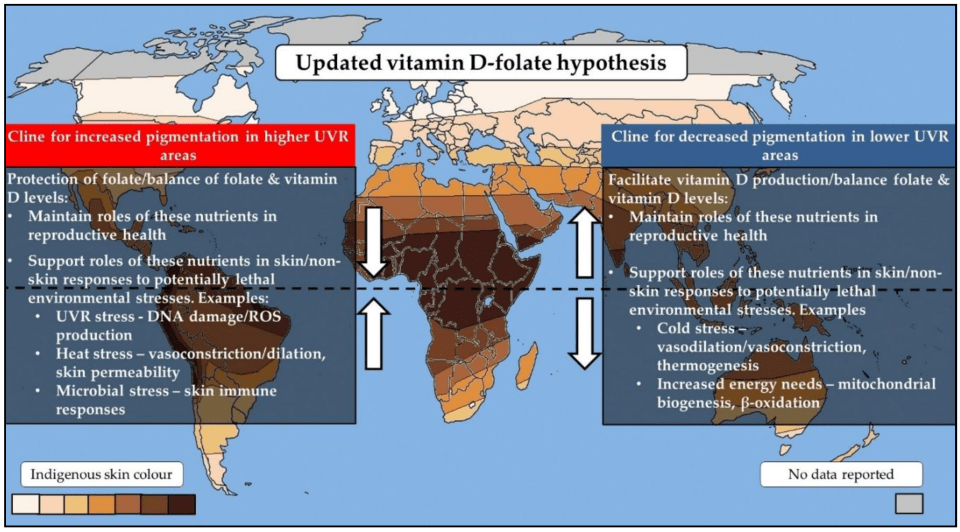
Jones et al (2018b) update the VDH by integrating the other theories into it, since they are similar and do not contradict the VDH (since aspects of each one can be used to explain different aspects of the VDH). The updated hypothesis is thus:
Vitamin D and folate have differing sensitivities to UVR. Vitamin D can be synthesized following UVR exposure, folate may be degraded. So the VDH proposes that the two differing skin colors (light and dark) evolved at differing latitudes as a “balancing mechanism” to maintain adequate levels of the two agents vitamin D and folate. Since adequate levels of vitamin D and folate were maintained, there would be no ill health effects after migrating into colder climates. Vitamin D and folate both act as photoprotectors of the skin and can decrease environmental stressors. Vitamin D also exerts important effects on adipocites—both types—which then further aid in human physiologic adaptations to the cold. Perhaps most importantly, the VDR and skin color genes are epistatic—the VDR is imperative in the human body’s adaptation to new climates.
The latest research (reviewed by Jones et al, 2018b) show strong support for the interaction between genes and folate/vitamin D processes with skin pigmentation and UVR.
Health Disparities
Health disparities due to vitamin D deficiency are well-noted in the literature. Human migrations over the recent centuries and decades have caused environmental mismatches between a population’s adapted skin type and current UV level in the location the population migrated to. Many darkly-pigmented people now live in areas with low UVR, and thusly suffer from health consequences. This leads to them either not having an adequate vitamin D-folate balance along with the risk of not having the adequate skin protections for a given environment, since UV rays influence folate and vitamin D production and so, a mismatched skin color to UV environment would cause problems for skin protection since the environment is not ancestral to that certain skin color.
As I have previously noted, it has been argued that blacks are not vitamin D deficient, and thusly not vitamin D deficient. Though, these claims rest on a slew of false arguments that have since been rebutted. It has been argued that since blacks are deficient in vitamin D, which begins in the womb, and vitamin D deficiencies cause changes in large and small arteries and arterials, that vitamin D deficiency could be the cause of higher rates of hypertension in black Americans (Rostand, 2010).
Conclusion
The role of vitamin D, folate, the VDR, and certain genes is under further invesitgation. This group of agents exert powerful effects on human physiology which then help with the adaptation of humans to differing climates. Folate and the vitamin D receptor play a crucial role in protecting the skin from environmental and microbial stressors. Vitamin D and the VDR are expressed in the adipose tissue, while vitamin D regulates adipogenesis and adipocite apoptosis (Abbas, 2017). Further evidence shows that there are multiple loci that are involved in the VDR that show latitudinal clines (Tiosano et al, 2016). One of the most things that lends credence to the VDH is the fact that the VDR and skin color genes are epistatic and help humans adapt to climates.
The VDH is in great shape, contrary to popular belief (Elias, Williams, and Bikle, 2016). The VDH is one of the only games in town to explain the skin color gradient noticed around the world, with vitamin D being the only agent that accounts for skin color differences. The VDH explains how and why human skin color is vastly different, and the main reason is adaptation to UV rays—or lack thereof.
Grant (2018) concludes that:
The UVB–vitamin D–cancer hypothesis has considerable supporting scientific evidence from a variety of study types: geographical ecological, observational, and laboratory studies of mechanisms, as well as several clinical trials.
Clearly, the VDH explains the incidence of the observed skin gradiation around the world the best out of the so-called competing hypotheses (which are similar enough to the VDH to where they can be absorbed into the VDH). Most importantly, the VDH predicted a novel fact—that molecular genetic evidence would show that light skin evolved independently numerous times in our lineage (Jablonksi and Chaplin, 2009).
On Asian Body Fat and Diabetes
2000 words
Within-group differences in body fat and diabetes tell a lot about the diet and susceptibility of the diseases to that group. What the ethny does (or does not do) affects how high their body fat will be and whether or not they become diabetic. Since body fat levels are related to diabetes, then looking at both variables together should tell a lot about the diet and lifestyles of the ethnies studied. The ethnies I will look at are Chinese, Japanese, Filipinos, Koreans, Mongolians, and Filipinos.
Chinese
The Chinese have high levels of body fat (Wang et al, 2004) but have a lower BMI yet higher level of body fat than whites (Wang et al, 1994). BMI correlates with body fat percentage in the Chinese, while BMI and body fat percentage were related to DM (diabetes mellitus). Though BMI has its limits in people ranging from 24 to 27.9 BMI (Wang et al, 2011). New findings have shown that obesity in China may be underestimated (Gangqiang et al, 2017). That Chinese males have higher levels of body fat than white males held even after adjusting for age and BMI (Wang et al, 2011). The reality is that body fat percentage and diabetes, along with other diseases like prostate cancer (PCa) are increasing at an alarming rate in China (Tomlinson, Deng, and Thomas, 2008), so what is the cause?
The cause is very simple: The introduction of the Western diet. As I have written in the past, wherever the Western diet goes, diseases of civilization follow in high numbers in populations that previously did not eat that type of food. One analysis of the Chinese diet (compared with the Meditteranean, Japanese, and American diets) showed that “the Chinese diet has been shifting away from the traditional diet toward high-fat, low-carbohydrate and low-fiber diets, and nutrients intakes in Chinese people have been changing even worse than those in American people” (Zhang et al, 2015).
One study showed differences in dietary expectations between Americans (in Honolulu, Hawaii, so probably ethnically mixed) and Chinese in Changsha Hunan, China (Banna et al, 2016). The Chinese students mentioned physical outcomes such as “ such as maintaining immunity and digestive health” while American students state that they “balanced food groups” and balanced consumption with exercise (implying you can outrun a bad diet when you can’t…) while also stating that physical activity should be essential. American students stated that they needed to avoid foods high in fat. In that same manner, one Chinese student said “”Eat smaller amounts of meat, fish and vegetarian alternatives, choosing lower fat options whenever possible.” Meat, specifically beef and pork, was often cited as a food that should be limited” (Banna et al, 2016). Both groups of students in both countries erroneously assume that high-fat diets are bad for you—on the contrary, it’s high carb low-fat diets that are bad, which lead to DM.
The number of obese Chinese has surpassed the US; China is on its way to top the world in childhood obesity; and the incidence of diabetes is exploding in China. All due to the introduction of a Western diet. Something else worth noting: All Asian ethnies—at the same BMI—have higher levels of body fat and central adiposity, a risk-factor for diabetes (Deurenberg, Deurenberg-Yap, and Guricci, 2002).
Mongolians
Everywhere the Western Diet goes, obesity, diabetes, and disease soon follow and Mongolia is no different. Otgontuya et al (2009) showed that 6 percent of their study population were underweight, while 50.7 percent were in the normal range, 32.8 percent were overweight and 10.5 percent were obese, with women being slightly more likely to be overweight and obese. Rural people were more likely to be overweight and obese than urban people. Men had significantly lower body fat percent levels than women (26 and 34 percent respectively), women in the lowest age group had the lowest body fat percentage.
Mongolians living in China had impaired fasting glucose (IFG); those who had diabetes and IFG were more likely to be overweight and have higher central adiposity (Zhang et al, 2009). Mongolians eat an estimated 2,525 kcal per day, along with a fat/kcal ratio of 33.7—1.3 times higher than the Japanese and this is associated with their lower mortality (Komatsu et al, 2008).
Koreans
As with other Asian nations, Korea has the same problems. Hong et al (2011) showed that in Korean men, muscle mass decreases and body fat increases with age while for women fat mass and obesity increased with age. I particularly like this study since they assessed percent body fat (and other variables) with the DXA scan—one of the gold-standard of assessing body fat. Another Korean study showed that high birthweight leads to obesity and higher levels of body fat but not muscle mass (Kang et al, 2018), and with the advent of the Western diet in Asia, we can expect higher rates of obesity. (Note that this is an observational study and thusly causation is not certain, future studies will tease out causation and I bet the Western diet plays a role.) Another study even showed that eating frequency is related to obesity when diet quality is high, but not low in Korean adults (Kim, Yang, and Park, 2018).
There is one more risk-factor in regard to Korean obesity—study time after school is associated with habitual eating which leads to becoming overweight and obese. In this sample, Korean children who reported studying after school and eating when they were not hungry during studying were at increased risk for developing obesity in later years (Lee et al, 2018).
There is one interesting thing to note in regard to Koreans and diabetes, though: High leg fat mass, along with lower leg muscle mass, significantly lowered the risk for DM, while those who had lower leg body fat but higher leg muscle mass had a higher risk for developing diabetes (Choi et al, 2017). Shin, Hong, and Shin (2017) show that “… BAI is less useful than BMI and other adiposity indices, such as the WHtR, the WHR, and WC. These indices may be better candidates for clinical use and to evaluate metabolic syndrome risk factors.” One mouse study showed that the traditional Korean diet prevented obesity and ameliorated insulin resistance (Choi et al, 2017) which implies that a shift back to the traditional Korean diet for Koreans would show positive health benefits.
Japanese
Japan is similar to China as regards body fat percentage and BMI. They have a culture of fat-shaming (do note that it does not work but in fact makes the problem worse due to biochemical stress) and when one of their peers becomes overweight, they begin to shame in hopes that they will lower their weight. Though, despite their culture of thinness, in Japan, diabetes is a “hidden scourge“. This is due to, again, the Western diet reaching Japanese shores.
Rice is a major food staple in Japan. Since rice is a carbohydrate, then it follows that, if eaten in large amounts, one who eats more rice than another would have a higher chance of becoming a diabetic. Rice intake is associated with the onset of diabetes in Japanese women, with a significant increase in diabetes if the woman ate more than 420 grams of rice (3 bowls) per day; the association was pronounced in women who were physically-inactive, and nonobese (Nanri et al, 2010). The same was seen in Chinese women (Villegas et al, 2007).
However, Nanri et al (2010) state that “The mechanism by which increased rice consumption increases risk of type 2 diabetes remains unclear. … the association between rice intake and type 2 diabetes risk remained significant even after adjustment for these food factors, which suggested an independent role of white rice in the pathogenesis of type 2 diabetes.” The cause is very simple: White rice, as Nanri et al note, is high on the glycemic index scale. If a food is high on the glycemic index scale, then it will spike one’s blood sugar high, which eventually would lead to DM. It’s also worth noting that a low-carb diet was associated with a decrease in diabetes, most likely due to a decrease in white rice consumption (Nanri et al, 2015).
The Japanese, in comparison to other Asian countries, have low levels of obesity, though the maladies they acquire are in-line with their diet and what they eat. However, some have noted the fact that Japanese diabetes rates are low. (Notwithstanding their hidden scourge.) This is easily explainable: The percent of carbohydrate intake is nowhere as important as the absolute amount of carbohydrate consumed. Though their diabetic population has increased to over 10 million recently. This is, of course, due to the introduction of the Western diet in Japan.
Filipinos
The last ethny I will discuss are Filipinos. Body-shaming is, as it is in other Asian countries, prevalent. At a fixed BMI, in spite of both groups living in similar conditions and eating a similar diet, “Malay and Thai boys had a significantly higher %BF than Filipino boys and Thai girls had a significantly higher %BF than Malay and Filipino girls” (Liu et al, 2011).
Choi et al (2013) showed that Filipino men living in California with DM were more likely to be overweight and obese, and Filipino men without DM were still more likely to be overweight and obese (even when adjusting for age and other lifestyle factors, Filipinos still had a higher chance of acquiring DM. Though Korean women had the highest rates of DM, followed by Filipinas.
Filipino and Korean emigrants to America had higher rates of weight gain than Chinese emigrants (Oakkert et al, 2015). This could be due to cultural values back home, which then obviously change when they emigrate to America. Furthermore, they find themselves in obesogenic environments (See Lake and Townshend,2006; Townshend and Lake, 2017). The cause is the difference in the built food environment; this is why Filipino men and women have high rates of DM and CVD (cardiovascular disease).
Further, in Filipinas, increased socioeconomic status, urban residence, fewer pregnancies and lactations and spending more time away from home is positively associated with weight gain. Though a high waist-to-hip ratio and being overweight and obese was independently related to hypertension in Filipinas (Adair, 2012). This study documented weight changes in a 16-year period in Filipina women as they moved higher up the SES ladder. Adair (2012) does note that obesity is increasing in lower-income households, too, but not as quickly when compared to more affluent households.
Comparing body fat percentages amongst Asian-American groups indicates that not all Asian-American populations are not equal in body fatness (Alpert and Thomason, 2016). However, one study shows that Asian Indians and Filipinos had higher prevalences of being overweight (35-37 percent and 35-47 percent respectively; Oza-Frank et al, 2009). This analysis, along with many others, shows that Asians—no matter the ethny—have higher levels of body fat than non-Hispanic white populations. It’s also worth noting that Filipina women had higher levels of VAT (visceral adipose tissue) than whites of a similar BMI and WC (waist circumference; Araneta and Barrett-Connor, 2012).
Conclusion
Asian ethnies have differing levels of body fat at the same BMI. This implies that what works for whites regarding BMI won’t work for Asians, since these ethnies, when compares with whites of a similar BMI and WC, had higher rates of body fat. The relationship between BMI and body fat levels is ethny-specific (Deurenberg, Deurenberg-Yap, and Guricci, 2002), though Filipinos and Asian Indians have higher levels of body fat regardless of the BMI standard used (Oza-Frank et al, 2009), which is one of the most important tells in ascertaining whether one is at-risk for DM and other maladies. It is not particularly interesting that Asian emigrants to America see their weight increase, as this is noted when the scourge called the Western diet crosses the Pacific. But what is interesting here is the rates between each Asian ethny, what they eat, and what causes the relationship.
Asian ethnies, when matched at similar BMIs, had differing levels of body fat, which implies that there should be ethny-specific BMI, though no matter which BMI standard was used, Filipinos and Asian Indians still had higher rates of body fat.
 NotPoliticallyCorrect