Home » Evolution (Page 4)
Category Archives: Evolution
You Don’t Need Genes to Delineate Race
2100 words
Most race deniers say that race isn’t real because, as Lewontin (1972) and Rosenberg (2002) state, the within-group variation is larger than the between-group variation. Though, you can circumvent this claim by not even looking at genes/allele frequencies between races, you can show that race is real by looking at morphology, phenotype and geographic ancestry. This is one of Michael Hardimon’s race categories, the minimalist concept of race. This concept does not entail anything that we cannot physically ‘see’ with our eyes (e.g., mental and psychological traits are off the table). Using these concepts laid out by Hardimon can and does prove that race is real and useful without even arguing about any potential mental and psychological differences between human races.
Morphology
Morphology is one of the most simple tells for racial classification. Just by looking at average morphology between the races we can use attempt to use this data point as a premise in the argument that races exist.
East Asians are shorter with shorter limbs and have an endomorphic somatype. This is due to evolving in cold climate, as a smaller body and less surface area can be warmer much quicker than a larger body. This is a great example of Allen’s rule: that animals in colder climates will be smaller than animals in warmer climates. Using average morphology, of course, can show how the population in question evolved and where they evolved.
Regarding Europeans, they have an endomorphic somatype as well. This, again, is due to where they evolved. Morphology can tell us a lot about the evolution of a species. Though, East Asians and Europeans have similar morphologies due to evolving in similar climates. Like East Asians, Europeans have a wider pelvis in comparison to Africans, so this is yet another morphological variable we can use to show that race exists.
Finally, the largest group is ‘Africans’ who have the largest phenotypic and genetic diversity on earth. Generally, you can say that they’re tall, have long limbs and a short torso, which is due to evolving in the tropics. Furthermore, and perhaps most important, Africans have narrower pelves than East Asians and Europeans. This character is one of the most important regarding the reality of race because it’s one of the most noticeable, and we do notice in when it comes to sports competition because that certain type of morphology is conducive to athletic success. (Also read my recent article on strength and race and my article on somatype and race for more information on morphologic racial differences.)
Phenotype
Morphology is a part of the phenotype too, obviously, but there is a reason why it’s separated. As is true with morphology, different characters evolved due to cultural evolution (whether or not they adopted farming early) or evolution through natural selection, drift and mutation. Though, of course, favorable mutations in a certain environment will be passed on and eventually become a part of the characteristics of the population in question.
East Asians have the epicanthic fold, which probably evolved to protect the eye from the elements and UV rays on the Mongolian steppes. They also have softer features than Europeans and Africans, but this is not due to lower testosterone as is popularly stated. (Amusingly enough, there is a paper that stated that East Asians have Down Syndrome-like qualities due to their epicanthic folds to bring up one reason.) Even then, what some races find attractive or not can show how and why certain facial phenotypes evolved. To quote Gau et al (2018):
Compared with White women, East Asian women prefer a small, delicate and less robust face, lower position of double eyelid, more obtuse nasofrontal angle, rounder nose tip, smaller tip projection and slightly more protruded mandibular profile.
And they conclude:
The average faces are different from the attractive faces, while attractive faces differ according to race. In other words, the average facial and aesthetic criteria are different. We should use the attractive faces of a race to study that races aesthetic criteria.
We can use studies such as this to discern different facial phenotypes, which, again, proves that race exists.
The climate one’s ancestors evolved in dictates nose shape. In areas where it is extremely dry and also has a lot of heat, a larger mucous area is required to moisten inspired (inhaled) air, which is why a more flat and narrow nose is needed.
Zaidi et al (2017) write:
We find that width of the nares is correlated with temperature and absolute humidity, but not with relative humidity. We conclude that some aspects of nose shape may have indeed been driven by local adaptation to climate.
Though climate, of course, isn’t the only reason for differences in nose shape; sexual selection plays a part too, as seen in the above citation on facial preferences in East Asian and European women.
There are also differences in hirsutism between the races. Racial differences exist regarding upper lip hair, along with within-race differences (Javorsky et al, 2014). The self-reported races of African American, East Asian, Asian Indian, and ‘Hispanic’ predicted facial hair differences in women, but not how light their skin was. The women were from Los Angeles, USA; Rome, Italy; Akita, Japan; and London, England. Indian women had more hair than any other race, while European women had the least. Regarding within-race variation, Italian women had more hair on their upper lip than American and British women. Skin lightness was related to hair on the upper lip. (Also read my article The Evolution of Human Skin Variation for more information on racial differences in skin color.)
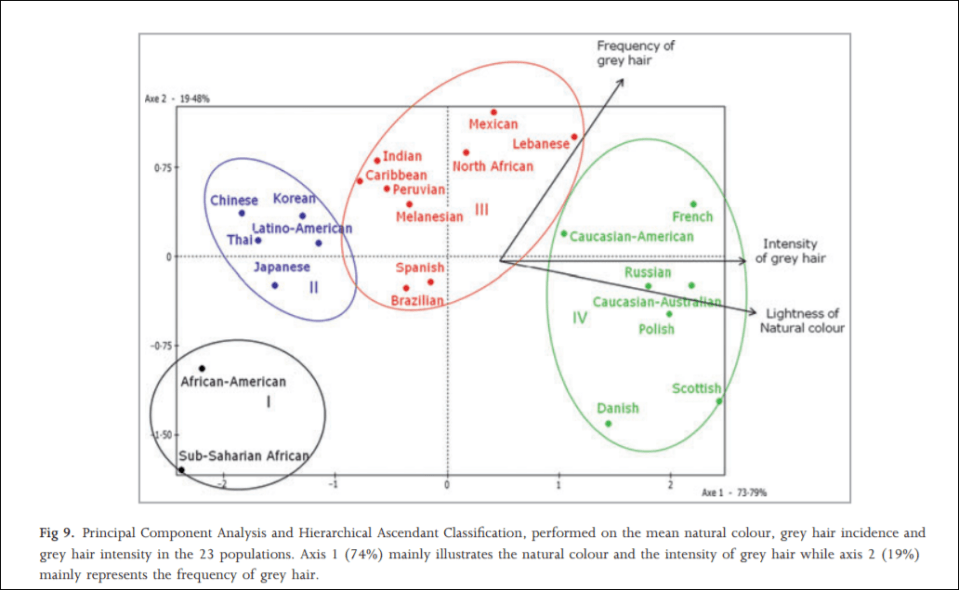
In 2012, an interesting study was carried out on hair greying on a sample population of a large number of the world’s ethnies titled Greying of the human hair: a worldwide survey, revisiting the ‘50’ rule of thumb. The objective of the study was to test the ’50-50-50′ rule; that at age 50, 50 percent of the population has at least 50 percent of their hair grey. Africans and Asians showed fewer grey hairs than whites who showed the most. The results imply that hair greyness varies by ethnicity/geographic origin, which is perfect for the argument laid out in this article. The global range for people over 50 with 50 percent or more of their hair grey was between 6 and 23 percent, far lower than what was originally hypothesized (Panhard, Lozano, and Loussouarn, 2012). They write on page 870:
With regard to the intensity of hair greying, the lowest values were found among African and Asian groups, especially Thai and Chinese, whereas the highest values were in subjects with the blondest hair (Polish, Scottish, Russian, Danish, CaucasianAustralian and French).
…
Altogether, these analyses clearly illustrate that the lowest incidences and intensities of grey hair are found in populations of the darkest hair whereas the highest intensities are found in populations with the lightest hair tones.
Actual hair diversity is much more concentrated in Europeans, however (Frost, 2005). (See Peter Frost’s article Why Do Europeans Have So Many Hair and Eye Colors?) It is largely due to sexual selection, with a few climatic factors thrown in. Dark hair, on the other hand, is a dominant trait, which is found all over the world.
Zhuang et al (2010) found significant differences in facial morphology between the races, writing:
African-Americans have statistically shorter, wider, and shallower noses than Caucasians. Hispanic workers have 14 facial features that are significantly larger than Caucasians, while their nose protrusion, height, and head length are significantly shorter. The other ethnic group was composed primarily of Asian subjects and has statistically different dimensions from Caucasians for 16 anthropometric values.
…
Statistically significant differences in facial anthropometric dimensions (P < 0.05) were noted between males and females, all racial/ethnic groups, and the subjects who were at least 45 years old when compared to workers between 18 and 29 years of age.
Blacks had statistically significant differences in lip and face length when compared to whites (whites had shorted lips than blacks who had longer lips than whites).
Brain size and cranial morphology, too, differs by geographic ancestry which is directly related to the climate where that population evolved (Beals, Smith, and Dodd, 1984). Most every trait that humans have—on average of course—differs by geographic location and the cause of this is evolution in these locations along with being a geographically isolated breeding population.
Geographic ancestry
The final piece to this argument is using where one’s recent ancestors came from. There are five major populations from a few geographic locales: Oceania, the Americas (‘Native Americans), Europe, Africa and East Asia. These geographic locales have peoples that evolved there and underwent different selective pressures due to their environment and their bodies evolved to better suit their environment, and so racial differences in morphology and phenotype occurred so the peoples could survive better in that location. No one part of this argument is more important than any other, though geographic ancestry is the final piece of the puzzle that brings everything together. Because race is correlated with morphology and phenotype, the geographic ancestry dictates what these characteristics look like.
Conclusion
Thus, this is the basic argument:
P1: Differing populations have differing phenotypes, including (but not limited to) facial structure, hair type/color, lip structure, skull size, brain size etc.
P2: Differing populations have differing morphology which, along with this population’s phenotype, evolved in response to climatic demands along with sexual selection.
P3: This population must originate from a distinct geographic location.
C: If all three of the above premises are true, then race—in the minimalist sense—exists and is biologically real.
This argument is extremely simple, and along with the papers cited above in support of the three premises and the ultimate conclusion, it will be extremely hard for race deniers to counter. We can say that P1 is logically sound because geographically isolated populations differ in the above-mentioned criteria. We can say that P2 is logically sound since differing populations have differing morphology (as I have discussed numerous times which leads to racial differences in sporting competition) such as differing trunk lengths, leg lengths, arm lengths and heights which are largely due to evolution in differing climates. We can say that P3 is logically sound because the populations that would satisfy P1 and P2 do come from geographically distinct locations; that is, they have a peculiar ancestry that they only share.
This concept of minimalist race from Michael Hardimon is (his) the racialist concept of race “stripped down to its barest bones” (Hardimon, 2017: 3). The minimalist concept of race, then, does not discuss any differences between populations that cannot be directly discerned with the naked eye. (Note: You can also use the above arguments/data laid out for the populationist concept of race, which, according to Hardimon (2017: 3) is: “A nonracialist (nonessentialist, nonhierarchical) candidate scientific concept that characterizes races as groups of populations belonging to biological lines of descent, distinguished by patterns of phenotypic differences, that trace back to geographically separated and extrinsically reproductively isolated founder populations.)
Minimalist race is biologically sound, grounded in genetics (though I have argued here that you don’t need genetics to define race), and is grounded in biology. Minimalist race is defined as characteristics of the group, not of the individual. Minimalist race are biologically real. Minimalist races exist because, as shown with the data presented in this article, phenotypic and morphologic traits are unevenly distributed throughout the world which then correlates with geographic ancestry. It cannot get any more simpler than that: race exists because differences in phenotype and morphology exist which then corresponds with geographic ancestry.
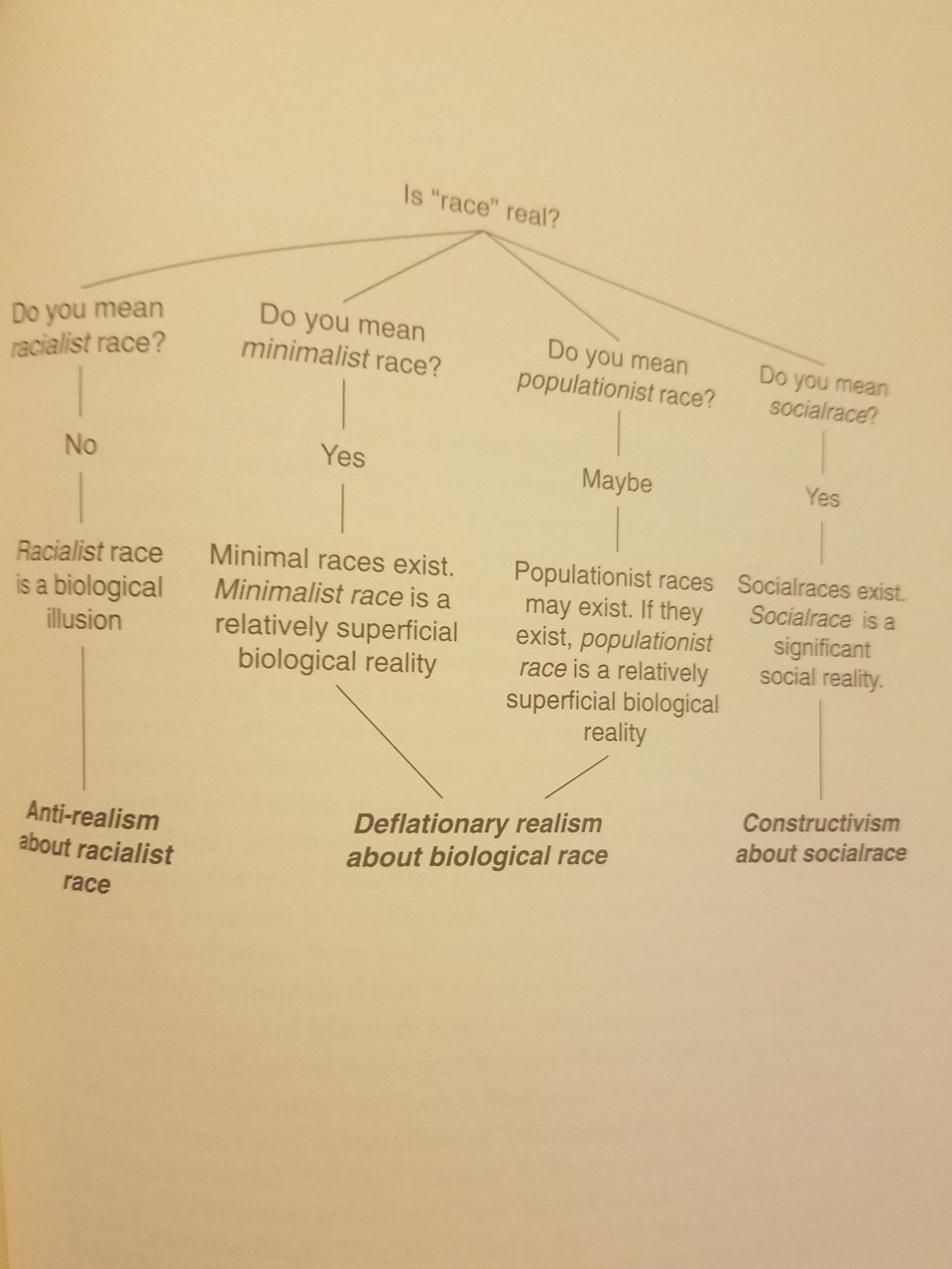
From Hardimon (2017: 177)\
No sane or logical person would deny the existence of race based on the criteria laid out in this article. We can also make another leap in logic and state that since minimalist races exist and are biologically real then geographic ancestry should be a guide when dealing with medicine and different minimalist races.
It is clear that race exists in the minimal sense; you do not need genes to show that race is real, nor that race has any utility in a medical context. This is important for race deniers to understand: genes are irrelevant when talking about the reality of race; you only need to just use your eyes and you’ll see that certain morphologies and phenotypes are distributed across geographic locations. It is also very easy to get someone to admit that races exist in this minimalist-biological sense. No one denies the existence of Africans, Europeans, ‘Native’ Indians, East Asians and Pacific Islanders. These populations differ in morphology and other physical characters which are unevenly distributed by geographic ancestry, so, therefore: minimialist races exist and are a biological reality.
Explaining African Running Success Through a Systems View
2100 words
Last year I bought The Genius in All of Us: New Insights Into Genetics, Talent, and IQ (Shenk, 2010) and while the book is interesting and I agree with a few things he says, he gets it horribly wrong on athleticism and ethnicity. Some of it I may be able to forgive since the book was written in 2010, but he does make some glaring errors. Chapter 6—pages 100-111—is titled Can White Men Jump? Ethnicity, Genes, Culture, and Success.
In the beginning of the chapter, Shenk writes that after the 2008 Beijing Summer Olympics, many articles were written about the Jamaican women who took the top three spots in the 100 and 200m races, with the emergence of Usain Bolt and his record-setting performance. Shenk (2010: 101) writes:
The powerful protein [alpha-actinin-3] is produced by a special gene variant called ACTN3, at least one copy of which is found in 98 percent of Jamaicans—far higher than in many other ethnic populations.
An impressive fact, but no one stopped to do the math. Eighty percent of Americans also had at least one copy of ACTN3—that amounts to 240 million people. Eighty-two percent of Europeans have it as well—that tacks on another 597 million potential sprinters. “There’s simply no clear relationship between the frequency of this variant in a population and its capacity to produce sprinting superstars,” concluded geneticist Daniel MacArthur.
I have written about MacArthur’s thoughts on the ACTN3 variant—that he helped discover, no less—in an article on Jamaicans, Kenyans, and Ethiopians and the explanatory factors in regard to their success in running competitions. Though, the article from MacArthur was written in 2008 and Shenk’s book was written in 2010, considerable advances have been made in this field. It was found that “combined effects of morphological and contractile properties of individual fast muscle fibers attribute to the enhanced performance observed in RR genotypes during explosive contractions” (Broos et al, 2016). Of course when talking about sprinting and morphology, you must think of the somatype. The somatype that is conducive to running success is a tall, lanky body with long limbs, as longer limbs can cover more distance. So European runners don’t have the right somatype, nor are the XX genotype for the ACTN3 variant high in Jamaicans (this genotype is present in ~2 percent of the Jamaican population; Scott et al, 2010). This—among other reasons I have laid out in the past—are why Jamaicans excel in sprinting competitions compared to other ethnic groups.
Shenk (2014: 10) further writes that sports success seem to come in ‘geographic clusters’, and the field of sports geography has been developed to understand it. “What they’ve discovered is that there’s never a single cause for a single cluster,” Shenk writes. “Rather, the success comes from many contributions of climate, media, demographics, politics, training, spirituality, education, economics and folklore. In short, athletic clusters are not genetic, but systemic.” Shenk then discusses the fact that these explanations are not good enough and that some ‘sports geographers’ have transformed themselves into ‘sports geneticists’ and then cites Jon Entine’s 2002 book Taboo: Why Black Athletes Dominate Sports and Why We’re Afraid to Talk About It where Shenk quotes Entine who quotes geneticist and physiologist Claude Bouchard who says that “these biological characteristics are not unique to West or East African blacks. These populations are seen in all populations, including whites” (Shenk, 2010: 102). Of course they’re not unique to one population and I don’t think that anyone has ever claimed that. Though the frequencies of these biological, morphological and physiological characteristics are not distributed evenly amongst populations and this explains how and why certain populations excel in certain sports when compared to others.
Shenk (2010: 102) also quotes Entine (2002), writing: “Entine also acknowledges that we haven’t actually found the actual genes he’s alluding to. “These genes will likely be identified early in the [twenty-first century],” he predicts.” We have ‘found some genes’ that aid in athletic performance, the ACTN3 genotype combined with type II fibers and the right morphology, as mentioned above for one. (Though a systems view—one of holism—makes much more sense here than a reducionist view. You must look at the whole system, not reduce things down, but that’s for another day.) That, in my opnion, is a large driver for ethnic differences in sports like this, because you need certain traits if you want to excel in these types of competitions.
He then discusses the success of the Kenyans in distance running—stating that 90 percent of Kenyan runners come from a small subset of Kenyans called the Kalenjin. He cites a few stories of some Kalenjin who talk about their experiences with no running water in their homes and that they had to “run to the river, to take your shower, run home, change, [run] to school . . . Everything is running” (Keino, a Kalenjin boy, quoted from Shenk, 2010: 104). Of course this is attributed to a multitude of factors, all of which have to work in concert to get the desired effect. For instance, sports psychologists have found that strong cultural achievement and the ability to work hard, compete, outdo others and seek new challenges drives their running dominance.
Shenk (2010: 106-107) then writes:
1.DESPITE APPEARANCES TO THE CONTRARY, RACIAL AND ETHNIC GROUPS ARE NOT GENETICALLY DISCRETE.
Skin color is a great deceiver; actual genetic differences between ethnic and geographic groups are very, very limited. All human beings are descended from the same African ancestors … [blah blah blah] … By no stretch of the imagination, then, does any ethnicity or region have an exclusive lock on a particular body type or secret high-performance gene. Body shapes, muscle fiber types, etc., are actually quite varied and scattered, and true athletic potential is widespread and plentiful.
Of course, I don’t think I have ever read anyone who denies this. However, as I’ve noted too many times to count, certain body types and muscle fiber distributions are more likely to be found in certain populations due to where their ancestors evolved recently, and so the fact that ‘actual genetic differences between ethnic and geographic groups are very, very, limited’ does not mean much when talking about dominance by a few populations in elite sporting competition. It just so happens to be the case that the somatypes and muscle fiber distributions that are conducive to running success are more likely to be found in populations of West and East African descent. This is an undeniable fact. (Also note how these ‘appearances to the contrary’ show how race is real.)
2.GENES DON’T DIRECTLY CAUSE TRAITS; THEY ONLY INFLUENCE THE SYSTEM.
Consistent with other lessons of GxE [Genes x Environment], the surprising finding of the $3 billion Human Genome Project is that only in rare instances do specific gene variants directly cause specific traits or diseases. …
As the search for athletic genes continues, therefore, the overwhelming evidence suggests that researchers will instead locate genes prone to certain types of interactions: gene variant A in combination with gene variant B, provoked into expression by X amount of training + Y altitude + Z will to win + a hundred other life variables (coaching, injuries, etc.), will produce some specific result R. What this means, of course, What this means, of course, is that we need to dispense rhetorically with thick firewall between biology (nature) and training (nurture). The reality of GxE assures that each persons genes interacts with his climate, altitude, culture, meals, language, customs and spirituality—everything—to produce unique lifestyle trajectories. Genes play a critical role, but as dynamic instruments, not a fixed blueprint. A seven- or fourteen- or twenty-eight-year-old is not that way merely because of genetic instruction. (Shenk, 2010: 107)
Nothing really wrong here. He is correct, which is why you need to look at the whole biological system, which also includes the culture, climate, environment and so on that the biological, developmental system finds itself in. However, Shenk then gets it wrong again writing that Jamaicans are a ‘quite heterogenous genetic group’ due to being a transport between North and South America. He states—correctly—that Jamaicans ancestry is about equal to that of African-Americans, but the individual variation in ancestry varies by “46.8 to 97.0 percent” (Shenk, 2010: 108).
Shenk gets a lot wrong here. For example. African-American and Jamaicans—despite both being descended from slave populations—have differing maternal ancestry which somehow influences athletic success. Deason (2017) found that 1) modern Jamaicans are descended from slaves and, who had considerable selective pressure on the population; 2) maternal ancestry could either influence sports success or be a false positive; 3) maternal lineages were different in Jamaicans and African-Americans, implying that the same maternal lineage is not distributed evenly between both sprinting populations; 4) some evidence exists that the genetic histories of Jamaicans and African-Americans are different based on their maternal haplotypes; 5) low SES and low access to healthcare—classic indicators of high African ancestry—were not directly linked to elite athletic success; 6) comparisons of the genomes of African-Americans and Jamaicans did not significantly differ since the estimated number of generations since admixture occurred, which implies that controls were not more likely to have more recent European ancestry than athletes; and 7) the regions of the genome that influence sprinting performance may be different in both populations. This is the best evidence to date against Shenk’s simplistic notions of the genetics between Jamaicans and African-Americans.
Differences in fast twitch fibers between Europeans and West Africans explain a large amount of the variance between Europeans and West African descendants in regard to sprinting success, while those with more symmetrical knees and ankles tend to run faster in the 100m dash (Trivers et al, 2014). This would also imply that Jamaicans have more symmetry in their knees and ankles than Europeans, though I am not aware of data that makes this comparison.
Shenk finally discusses the psycho-social-cultural aspects behind the phenomenon, stating that Roger Bannister, the first person to break the four minute mile, stated that while “biology sets limits to performance, it is the mind that plainly determines how close individuals come to those absolute limits” (Shenk, 2010: 110-111). Numerous psychological factors do, indeed, need to combine in order for the individual in question to excel in sports—along with the requisite anatomical/physiological/morphological traits too. Sasaki and Sekiya note that “changes in physiological arousal and movement velocuty induced by mild psychological pressure played a significant role in the sprint performance.” (See also Bali, 2015.)
Lippi, Favaloro, and Guidi, (2008) note how “An advantageous physical genotype is not enough to build a top-class athlete, a champion capable of breaking Olympic records, if endurance elite performances (maximal rate of oxygen uptake, economy of movement, lactate/ventilatory threshold and, potentially, oxygen uptake kinetics) (Williams & Folland, 2008) are not supported by a strong mental background.” I have argued this for months, even if the beneficial somatype is there in the athlete in question, if he/she does not have the will to win they will not succeed in their goals. Psychosocial factors, of course, matter just as much as the physical but all of these factors work in concert to get the outcomes that occur in these sports.
Attempting to pinpoint one or a few traits—while it may help us to understand better physilogic and anatomic processes—tells us nothing about the entire system. This is why, for instance, the whole athletes system needs to be looked at—call it the ‘systems view of the athlete’, where all of these aforementioned variables work in concert to express elite athletic performance, with no one variable being higher than another as an explanatory factor in sports success. Though Shenk gets a few things right (like his point on genes not causing traits on their own, they just influence the system, and I’d take it a step further to note that genes are passive in their relationship to the physiological system as a whole and are only activated by the system as needed, not being ’causes’ on their own; Noble, 2008), he’s largely misguided on how certain aspects of Jamaican ancestry and morphology help propel them to running success in comparison to other ethnies.
When explaining elite athletic performance in certain areas of sports, you must take a view of the whole system, with each known variable influencing the next in the chain, if you want to explain why certain ethnies or racial groups do better in a given sport than other groups. A systems view is the only view to take when comparing populations in different athletic competitions. So the influence of culture, psychology, social effects, morphology, ancestry, anatomy, physiology, muscle fibers, etc all work in concert to produce elite athletic phenotypes that then excel in these sports, and reducing this down to certain variables—while it may help us understand some of the inner mechanics—it does nothing to help advance the hows and whys of elite success in sports competition when comparing different populations.
More r/K Selection Theory Rebuttals
2000 words
I was alerted to a response to my article r/K Selection Theory Rebuttals on Twitter. I enjoy when people write responses to my pieces as I can better build my arguments. It’s also fun defending what I wrote.
This Pastebin is where the response is. He states that he disagrees with AC (Anonymous Conservative) on two things: calling them liberals when he would call then progressives and his clear conservative bias.
First it refers to a criticism of Ruston’s application of r/K to humans:
https://notpoliticallycorrect.me/2017/06/24/rk-selection-theory-a-response-to rushton/
This article applies r/K selection to differences between races, I don’t see how this is relevant. AC never discusses race and I’m only interested in how r/K selection applies to individuals within a civilization too.
It is very apt when rebutting AC’s ‘theory’. Human races are not local populations therefore it doesn’t apply to human races. To then bring this wrong theory to individual differences is stupid. Hell, I agree more with Rushton’s application than AC’s application and that’s saying something. The point of bringing up Rushton’s r/K theory is that he was the one who repopularized the theory and you have to give credit where it is due (I’m certain he heard of r/K from Rushton; the fact that he doesn’t give him credit there is dishonest, but AC is a dishonest guy so this is no surprise to me).
r/K selection applies to almost all life forms, next to other selection mechanisms. So it goes much deeper than the specific situation a specific race may have lived in. Even if people in races now commonly express more r-selected or K-selected behavior, I’d expect that to change if their children grew up in a different environment.
You only say that because organisms have offspring and at different rates. I won’t even go through the different cites that show that r/K theory is bunk, but I will cite one that shows that it’s been dead for years. Reznick et al, (2002: 1518) write: “The distinguishing feature of the r- and K-selection paradigm was the focus on density-dependent selection as the important agent of selection on organisms’ life histories. This paradigm was challenged as it became clear that other factors, such as age-specific mortality, could provide a more mechanistic causative link between an environment and an optimal life history (Wilbur et al. 1974, Stearns 1976, 1977). The r- and K-selection paradigm was replaced by new paradigm that focused on age-specific mortality (Stearns 1976, Charlesworth 1980).” This is simple. Age-specific mortality replaced r/K theory. People like AC attempt to ‘show’ their ‘hypothesis’ is true. They notice something in this snapshot in time then say oh this this and that make sense therefore this! It doesn’t work like that.
On his point that ‘he’d expect that to change if their children grew up in a different environment’, to say that one race is ‘r’ or ‘K’ over another, you must study the population in question in the location where the adaptations were hypothesized to have occurred (Anderson, 1991).
RR: “It is erroneously assumed that living in colder temperatures is somehow ‘harder’ than it is in Africa”
Yes, there is much less biomass available in colder temperatures. Of course Africans would still compete with each other for resources. The idea is also that there’s more requirement to think ahead, in order to prepare for the winter. Requiring more deferral of gratification.
The idea is dumb. Africa is harsher than Eurasia (Dobzhansky, 1950: 221). Did people in Africa not have to plan ahead? This is the same old rebutted cold winter garbage in terms of ‘selection for higher IQ;.
The article generally asserts that r/K selection is a simple model:
RR: “One of the main reasons that Rushton’s r/K continuum gets pushed is because it’s a ‘simple model’ that so ‘parsimoniously’ explains racial differences … But ecological systems are never simple”:
Where was an implication that any ecological system is simple? I’d say the tropics are way more complicated than cold area’s. The relevant aspect here is that a cold area is more difficult to live in, has less resources and thus supports fewer individuals. Which is a K-selected pressure.
It is a simple model. “Simple models will be successful only if their simplifying assumptions either match reality or are unimportant” (Anderson, 1991: 57). This does neither. It is surely not easy to live in the tropics. This canard that those in Africa had an easy life in comparison to the people who migrated out of Africa doesn’t make any sense. It’s like people think that food just dropped on their laps from the trees, they didn’t have to deal with predators or heat, etc. It’s an extremely simple model which is why it doesn’t work. Africans are ‘K-selected’ if Rushton is to be believed, not r-selected (Anderson, 1991).
AC’s book is for the public, not to be the bleeding edge of science. Most people have no idea about these theories. I think it would greatly improve their understanding of reality if they knew about it, it did mine. This seems like the situation with Newton’s theory of gravity. It’s been proven wrong, but we still use it when useful.
I get that, but his premises are wrong which means his theory is false. What ‘reality’? It’s just stories, fables. Whatever sounds good to AC, whatever he thinks will buttress his theory he’ll write. Anything about the ‘rabbits’ or ‘wolves’ (so-called r- and K-selected organisms respectively). r/K has been proven wrong and it’s still not useful so we should not use it.
RR: ‘So “the actual adaptation they have” is to “wear thick clothing“? This is bullshit and you know it’
No it’s not. The clothing is far thicker and thus harder to make with a higher required investment. It requires more quality of the individuals. The writer assumes a binary difference here, where none was asserted. Of course these things are on a spectrum.
Yes it is. Sorry, you didn’t understand what I meant here. The actual adaptation is not ‘to wear thick clothing’. What is ‘more quality’, is that a scientific term? What does that even mean?
RR: “The preparation does work.” (Preparation of anti-malarial remedies as seen in Wilcox and Bodecker, 2004)
Maybe it helps, much of traditional remedy use is based in tradition and superstition. Europeans where slaughtered by all kinds of diseases. It probably depends on the situation. If you can find a cure for the disease, then maybe it is a K-selected pressure.
It’s irrelevant that ‘much of the traditional remedy use is based in tradition and superstition‘, because these remedies are proven to work (Wilcox and Bodecker, 2004). “If you can find a cure for disease, then maybe it is a K-selected pressure“, you’re clueless and don’t know what you’re talking about.
RR: “Here is what people like Samuel Skinner and AC don’t get: r/K selection theory WAS discarded; it is no longer in use. Age-specific mortality better explains these trends than r/K selection”
But age-specific mortality doesn’t apply to humans and doesn’t explain differences between individuals within a species or population.
Are you saying that we can’t apply this theory to humans at all?
Yes it does apply to humans. Why talk about something when you don’t know about it? Should I care that it doesn’t explain differences between individuals within a species or population? Not everything needs to be some grand, overarching theory to explain everything so perfectly.
RR: “We found that high K scores were related to earlier sexual debut and unrelated to either pubertal onset or number of sexual partners.”
In humans that correlation is broken because of advanced society. However, we can still find that correlation in progressive or conservative politics.
Yet Rushton et al assert that Africans are r, for instance, and have more children but as you can see from Copping, Campbell and Muncer, (2014), earlier sexual debuts were seen in the so-called K dimension, completely against Rushtonian r/K theory and against whatever theory AC cooked up in his head.
There are several links to scientific papers, several of which are no longer working, but fails to summarize how they support his position.
They don’t work because sci-hub is down. I need to fix the broken links and I did summarize how they support me which is why I did “claim then (citation)”.
RR: “Individuals WITHIN A SPECIES are not R OR K”
Since environments can change, why would species not be able to adapt to the new situation?
That’s not even what the original theory spoke about. If the liberals environment changed, would they become K (according to AC)? You’re completely missing the r/K dynamic.
A Jelly fish has several reproductive strategies available and chooses based on available resources.
Humans are much more complicated, but we could still have that ability.
This doesn’t mean that r/K selection has any utility.
RR: “Something AC doesn’t get is that using the discredited r/K continuum, conservatives would be r”
I don’t get that either.
Because the continuum comes from Pianka (1970) and Rushton adapted it to show that lower IQ peoples who had more children were r-selected. Therefore, if this did apply to individuals within the human species then conservatives would be r while liberals would be K (they have fewer children and higher IQs).
RR: “women who reported being religious stated that having children was more important to them”
And are in favor of investing in those children through their mother staying home to take care of them. Where progressives are more likely to be in favor of the mother working and putting the children in day-care. Progressives are also in favor of birth control and abortion. Allowing them to maintain the r-selected sexual life style, without having the burden of a child. r/K selection is about the underlying psychology, not surface level attributes like total number of children.
Liberals still have fewer children than conservatives who have more. What you’re saying is largely irrelevant. “r-selected sexual lifestyle”, this is dumb. r/K selection is predicated on number of children which conceived, supposedly, differs on the basis of differential psychology, supposedly, between two human groups. It doesn’t, it’s wrong.
“I’ve already covered that libs are more intelligent than cons (Kanazawa, 2010; Kanazawa, 2014), and that conservative countries have lower IQs”
I don’t think we should expect a correlation between IQ and r or K in modern human societies. What happens is that high IQ people raise their children in abundance, which makes them more likely to be r-selected. Availability of resources is a trigger for r-selected psychology.
Riiiiight. But you would expect a correlation between other so-called r/K measures in modern societies? You don’t even make sense.
“Conservatives are more likely to be religious”
Yes because religions like Christianity are viewed as tradition. And progressives oppose tradition where conservatives favor it.
Right, and they have more children than liberals, which is r-selected behavior (supposedly).
This guy tried, but clearly, this wasn’t good enough. r/K is dead when speaking about race and the differences between human individuals. For anyone who believes AC’s bullshit, where did liberals and conservatives evolve these different behaviors? Are they local populations? People like AC ignoring the continuum by Pianka, yet use that same hierarchy are dishonest. They’re using a discredited continuum and attempt to prove their political biases. “The other team has X, Y, and Z bad while we have A, B, and C good! The other side does X and Y while we do A and B, therefore, we are better!” AC has a huge bias; he will never admit he’s wrong because he has a book to sell that pushes this discredited garbage. (Don’t worry, I’ll review it and pick it apart soon enough.)
To conclude, people really need to stop letting their biases get in the way of rational thought. If they did, they’d be able to look at these dumb theories for what they are: pseudoscience, cherry-picking and pigeon-holing the other group, the “enemy” with all of the bad qualities while their side has all of the good ones. However, as I’ve shown countless times, real life is completely different from the fantasy world AC and his followers live in.
Race and Nutrition
2600 words
What we eat is important. What we eat can increase or decrease our lifespan. But do different races digest and metabolize different macro and micronutrients differently? On a racial level in terms of individual diet, would one individual benefit from adopting the diet of their ancestors over another diet? Many claims have been made like this in the past few years, such as Europeans evolving to eat plants and grains. This, some people would presume, implies that if you have a certain ancestry then you must eat a certain diet or take different steps in regard to nutrition. I will show this is wrong and that, at least in regard to health and nutrition, individual variation matters more than racial variation (don’t call Lewontin’s fallacy on me. This is not a fallacy).
Different genetically isolated breeding populations evolved eating different diets based on what they had in their environment. Over time, humans eventually developed agriculture and then changed the course of human evolution forever (Cochran and Harpending, 2009). This then leads to large changes in how our genes are expressed and how our microbiome metabolizes nutrients and food we ingest. The advent of farming was, obviously, pivotal to human evolution (Cochran and Harpending, 2009). This then lead to heritable changes in the genome brought on by new foods the farmers ate. This also started the environmental mismatches we now have in our modern world, which is the cause for rising obesity rates and a large part of the cause of so-called diseases of civilization (for a discussion of these matters, see Taubes, 2008, chapter 5; see also page 8 in this summary of his book on diseases of civilization and also see Burkitt, 1973; Cordain, Eades, and Eades, 2003; Sharma and Majumdar, 2009; Sikter, Rihmer, and Guevara, 2017. For an outstanding review on the subject, read Daniel Lieberman’s 2013 book The Story of the Human Body: Evolution, Health, and Disease for in-depth discussions on this point and more in regard to nutrition and our evolutionary history).
Studies come out all the time saying that X population evolved eating Y food therefore Z. Then, people not privy to nutrition science, jump to large sweeping conclusions (mostly laymen and journalists, who are also laymen). These assumptions imply that people’s metabolic systems aren’t, first and foremost, based on an individual level with individual variation in physiologic and metabolic traits. This, I will show, is the reason why these studies don’t mean you should change your diet to what your ancestors supposedly ate based on these studies (though as I have argued in the past, high consumption of processed foods lead to obesity, insulin resistance, diabetes etc which is the cause of a lot of the modern-day maladies currently present in our population today). This assumption is wrong on numerous levels.
Buckley et al (2017), using data from the 1000 Genomes Project (see also Via, Gignoux, and Burchard, 2010), identified novel potential selections in the FADs region. The 1000 Genomes Project tested the genomes of 101 Bronze Age Europeans. They show that SNPs which are associated with arachidonic acid and eicosapentaenoic acid has been favored in Europeans since the Bronze Age (the selection for arachidonic acid being due to milk consumption which is a form of niche construction; see Laland, Odling-Smee, and Feldman, 1999; Laland, Odling-Smee, and Feldman, 2001; Laland and Brown, 2006; Rendell, Fogarty, and Laland, 2011; Laland, et al, 2016; but see Gupta et al, 2017 for a different view which will be covered in the future). They also hypothesize that differences in the selection of these regions is different in different population, implying different epigenetic changes brought on by diet (more on this later).
The FADS1 gene codes for an enzyme called fatty acid desaturase 1 which desaturates n3 and n6 which then catalyzes eicosapentaenoic and Arachidonic acid (Park et al, 2009). These genes code for enzymes that then aid in the breakdown of fatty acids. So, by testing Bronze Age Europeans and comparing their genomes with modern-day Europeans, researchers can see how the expression of genes changed and then work backward and hypothesize how and why the differing gene expression occurred.
The regions selected for are involved in processing n3 and n6 fatty acids. We need a certain ratio of them, and if either is thrown out of whack then deleterious effects occur. This, of course, can be seen by comparing our ratio of n3 to n6 fatty acid consumption with our ancestors’, who ate a 1:1 ratio of n3 to n6 (Kris-Etherson et al, 2000) which you can then compare to our n3 to n6 ratio, which is 14 to 25 times higher than it should be. The authors state that n6 is important, but it’s only important to have the correct ratio, having too much n6 is not a good thing (as I have covered here).
Twenty percent of the dry weight of the brain is made up of long-chain polyunsaturated fatty acids (Lassek and Gaulin, 2009). Therefore it is pivotal we get the correct amount of n3 fatty acids for brain development both in vitro and during infancy, the best bet being to breastfeed the babe as the mother packs on fat during pregnancy so the babe can have PUfAs during its time on the womb as well as during infancy through breastfeeding.
About 85kya selective sweeping occurred in Africa on the FADs genes. Buckley et al (2017) write: “Humans migrating out of Africa putatively carried mostly the ancestral haplotype, which remained in high frequency in non-African populations, while the derived haplotype came close to fixation in Africa. It is unclear why positive selection for the derived haplotype appears to be restricted to Africa. Mathias et al. (2012) suggested that the emergence of regular hunting of large animals, dated to ∼50 kya, might have diminished the pressure for humans to endogenously synthesize LC-PUFAs.” This is true. There is a wealth of important fatty acids in the fatty and muscle tissue of animals, which we need for proper brain functioning and development.
They also write about a study on the Inuit that proves that certain alleles have been selected for that have to do with fatty acid metabolism, which I have also covered in the past in a response to Steve Sailer. Nevertheless, on a population level, this is worth it, but individual variation in metabolism matters more than population. In the article, Sailer implied—with a quote from New York Times science editor Carl Zimmer—that the Inuit have certain gene variants that influence fatty acid metabolism in that population. Sailer goes on to write “So maybe you should try different diets and see if one works better for you.” Of course, you should. However individual variation is more important than racial variation. (It’s also interesting to note that these genes that are expressed on the Inuit are also related to height.)
Nevertheless, it is true that selection occurred on these parts of the genome in these populations studied by Buckley et al (2017), but to claim that all populations wouldn’t benefit from a low carb, high fat diet is not true. I do agree with Sailer on, in the future, the scanning of individual genomes to see which diet would have a better effect. Though I would insist that most, if not all, humans should eat a higher fat lower carb diet.
Buckley et al (2017) cite a study (Mathieson et al, 2015) which “provides strong evidence of selection in the FADSregion in Europe over the past 4,000 years, in addition to the patterns of selection already reported in Africans, South Asians, and the Inuit.” Buckley et al (2017) also cite a study (Pan et al, 2017) which shows an SNP, rs174557, regulates FADS1.
In their analysis, they showed that “this variation is largely attributable to high differentiation between two haplotype clusters: a cluster widespread in Africa, largely containing derived alleles and possibly subject to a selective sweep (Mathias et al. 2011,, 2012), and an ancestral cluster, which is present across Eurasia.” They also showed that Neanderthal genomes cluster with the derived cluster, which is present in Africans, while Denisovans cluster with the ancestral cluster, which Eurasians also have.
Buckley et al (2017) write: “Thus the derived alleles appear to promote expression of FADS1 while simultaneously abating the expression of FADS2.” This is important to keep in mind for the end of this article when I talk about nutrition and how it affects the epigenome which can then become heritable in a certain population.
Buckley et al (2017) also confirm the results of the European sample using the Nurses Health Study and the Health Professionals follow-up study GWASs: “These results reinforce the associations with cholesterol from the GLGC GWAS. This confirms the hypothesized phenotypic effect of the selected variants in terms of increased EPA and ARA levels of the putatively positively selected variants in the European population.”
Selective (dietary) pressures on the three populations tested (Africans, Europeans and South Asians) have “have driven allele frequency changes in different FADS SNPs that are only in weak LD with each other [LD is linkage disequilibrium which is the nonrandom associations of alleles at different loci in a given population]” (Buckley et al, 2017). Further, the alleles (FADS1 and FADS2) that were under selection in Europeans were strongly associated with lipid metabolism, specifically reduced linoleic acid levels. An opposite pattern was noticed in the Inuit, where selection acted to “decrease conversion of SC-PUFAs to LC-PUFAs to compensate for the relative high dietary intake of LC-PUFAs.” The allele under selection was associated with a decrease in linoleic acid levels and an increase in eicosapentaenoic acid, which may possibly be due to improved metabolism in converting LC-PUFAs from SC-PUFAs.
Buckley et al (2017) hypothesize that the cause is eating a more plant-based diet which is rich in fatty acids (n6 and n3) while a subsequent decrease in fatty animal meats occurred. Of course, relative to hunter-gatherer populations, the increased plant consumption brought on by agriculture caused different methylation on the genome which then eventually became part of the heritable variation. So, of course, farmers would have eaten more plants and the like, which one then select for the production of SC-PUFAs to LC-PUFAs. This of course began at the dawn of agriculture (Cochran and Harpending, 2009).
Of course, this can help guide individual diets as we better map the human genome. These studies, for instance, can be used as guides for individual diets based on ancestral evolution. More studies, of course, are needed.
Also, in an email with correspondence with Arstechnica, one of the authors, Nelson Rasmussen, stated: “Of course, within the last century there have been drastic changes in the diets in many areas of Europe. Diets have typically become more caloric with a higher intake of simple sugars, and perhaps also more rich in proteins and fat from animals. So selection is unlikely to be working in exactly the same way now.”
Though the strong claim from Arstechnica that “This is another nail in the coffin for the scientific validity of paleo diets” is a strong claim which needs much more evidence because low carb high-fat diets are mostly best for people since their insulin levels aren’t spiked too much which then leads to obesity, diabetes and along with it hyperinsulinemia.
Now I need to talk about how epigenetics is involved here. Nutrition can alter the genome and epigenome (Niculescu and Lupu, 2011; Niculescu, 2012; Anderson, Sant, and Dolinoy, 2012) and cause permanent heritable variation in a population if a certain allele reaches fixation, since there is evidence that maternal and paternal dietary changes possibly affecting multiple generations (Rosenfeld, 2017; though see Burggren, 2016 for the view that there is no evidence for heritable epigenetic phenotype in the genome. I will return to this in the future; see also the Dutch Famine Study showing heritable epigenetic change from famine; Lumey et al, 1993; Heijmans, 2008; Stein et al, 2009; Tobi et al, 2009; Schulz, 2010; Lumey, Stein, and Susser, 2011; Hajj et al, 2014; Jang and Serra, 2014; Tobi et al, 2014). Of course, based on what a population eats (or does not eat), epigenetic changes can and will occur. This not only affects the expression of genes in the body, but also the trillions of gut microbiota in our microbiome that partly drive our metabolic functions. Diet can change the composition of the microbiome, diet can change the epigenome and gene expression, and the microbiome can also up- and down-regulate genes (Hullar and Fu, 2014) Lipid metabolism is also related to developmental epigenetic programming (Marchlewicz et al, 2016). They showed that circulating fatty lipids in the mother during pregnancy are associated with DNA methylation in the genomes of the child. This can also, of course, contribute to health and disease risk in the future for the affected infant. FADS1 is also involved here.
Nutritional factors also come into play in regards to epigenetic inheritance (Alam et al, 2015). The n3 PUFAs also affect gene expression and DNA methylation (Hussey, Lindley, and Mastana, 2017). Further, DNA methylation is also associated with FADS1 and, to a lesser extent, FADS2 (Howard et al, 2014). This is strong evidence that, of course, that what was reviewed above in regards to selection for certain alleles for fatty acid metabolism in certain populations was strongly driven by the consumption of certain foods. Epigenetic changes that occur both in the womb and previous generations like the grandparents’, for instance, also have an effect in regard to which genes are expressed in the baby in vitro as well as consequences for future generations. The study of epigenetics, along with transgenerational epigenetic inheritance, of course, will be very important for our future understanding of both the evolution of humans and the evolution of the human diet.
Finally, I need to touch on why this doesn’t really matter in terms of individual diet choice. The fact of the matter is, anatomic, physiologic, and metabolic variation within race trumps variation between it. Two different randomly selected individuals will have different anatomy, along with different organs missing (Saladin, 2010). This implies that the individual differences in these traits trump whatever racial selection occurred since the dawn of agriculture 10kya. This is why, in my opinion, one should not look to just their ancestry when choosing a diet and should always choose a diet based that’s good for them, individually. Now, I’m not saying that this research is useless in regards to healthy diets, however, increased consumption of processed foods is the cause of obesity since processed foods (high in carbs) spike insulin which lead to obesity and diabetes (insulin causes weight gain). So, obviously, full-on plant-based diets will lead to these maladies. Contrary to the Alternative Hypothesis’ thesis on race and nutrition, this doesn’t really matter, not at the individual level, anyway. This could have small implications in regard to the population as a whole, but as an effect on the diet of individuals? No. Individual variation in traits matters much more than racial variation here (again, don’t call Lewontin’s fallacy because I’ve explained my reasoning which is logically sound).
In sum, the SNPs associated with the increased expression of FADs1 and increased the production of eicosapentaenoic and Arachidonic acid in Europeans occurred around 5kya. These studies are interesting to see how diet and how we construct our niches leads to changes in the genome based on those changes that we enact ourselves. However, laypersons who read these popular science articles on the evolution of diet in human populations will then assume that since they have X ancestry then they must eat how their immediate ancestors ate. The Arstechnica article makes some strong claims that Buckley et al (2017) prove that the paleo diet is not a viable solution for diseases of civilization. Do not make sweeping claims about eating X and Y because your ancestors evolved in Z environment, because individual variation in metabolic and physiologic functioning is greater and matters way more than racial variation
[Note: Diet changes under Doctor’s supervision only.]
Black-White Differences in Physiology
2050 words
Black-white differences in physiology can tell a lot about how the two groups have evolved over time. On traits like resting metabolic rate (RMR), basal metabolic rate (BMR), adiposity, heart rate, Vo2 max, etc. These differences in physiological variables between groups, then, explain part of the reason why there are different outcomes in terms of life quality/mortality between the two groups.
Right away, by looking at the average black and average white, you can see that there are differences in somatype. So if there are differences in somatype, then there must be differences in physiological variables, and so, this may be a part of the cause of, say, differing obesity rates between black and white women (Albu et al, 1997) and even PCOS (Wang and Alvero, 2013).
Resting metabolic rate
Resting metabolic rate is your body’s metabolism at rest, and is the largest component of the daily energy budget in modern human societies (Speakman and Selman, 2003). So if two groups, on average, differ in RMR, then one with the lower RMR may have a higher risk of obesity than the group with the higher RMR. And this is what we see.
Black women do, without a shadow of a doubt, have a lower BMR, lower PAEE (physical activity energy expenditure) and TDEE (total daily expenditure) (Gannon, DiPietro, and Poehlman, 2000). Knowing this, then it is not surprising to learn that black women are also the most obese demographic in the United States. This could partly explain why black women have such a hard time losing weight. Metabolic differences between ethnic groups in America—despite living in similar environments—show that a genetic component is responsible for this.
There are even predictors of obesity in post-menopausal black and white women (Nicklas et al, 1999). They controlled for age, body weight and body composition (variables that would influence the results—no one tell me that “They shouldn’t have controlled for those because it’s a racial confound!”) and found that despite having a similar waist-to-hip ratio (WHR) and subcutaneous fat area, black women had lower visceral fat than white women, while fasting glucose, insulin levels, and resting blood pressure did not differ between the groups. White women also had a higher Vo2 max, which remained when lean mass was controlled for. White women could also oxidize fat at a higher rate than black women (15.4 g/day, which is 17% higher than black women). When this is expressed as percent of total kcal burned in a resting state, white women burned more fat than black women (50% vs 43%). I will cover the cause for this later in the article (one physiologic variable is a large cause of these differences).
We even see this in black American men with more African ancestry—they’re less likely to be obese (Klimentidis et al 2016). This, too, goes back to metabolic rate. Black American men have lower levels of body fat than white men (Vickery et al, 1988; Wagner and Heyward, 2000). All in all, there are specific genetic variants and physiologic effects, which cause West African men to have lower central (abdominal) adiposity than European men and black women who live in the same environment as black men—implying that genetic and physiologic differences between the sexes are the cause for this disparity. Whatever the case may be, it’s interesting and more studies need to be taken out so we can see how whatever gene variants are *identified* as protecting against central adiposity work in concert with the system to produce the protective effect. Black American men have lower body fat, therefore they would have, in theory, a higher metabolic rate and be less likely to be obese—while black women have the reverse compared to white women—a lower metabolic rate.
Skeletal muscle fiber
Skeletal muscle fibers are the how and why of black domination in explosive sports. This is something I’ve covered in depth. Type II fibers contract faster than type I. This has important implications for certain diseases that black men are more susceptible to. Though the continuous contraction of the fibers during physical activity leads to a higher disease susceptibility in black men—but not white men (Tanner et al, 2001). If you’re aware of fiber type differences between the races (Ama et al, 1986; Entine, 2000; Caeser and Henry, 2015); though see Kerr (2010’s) article The Myth of Racial Superiority in Sports for another view. That will be covered here in the future.
Nevertheless, fiber typing explains racial differences in sports, with somatype being another important variable in explaining racial disparities in sports. Two main variables that work in concert are the somatype (pretty much body measurements, length) and the fiber type. This explains why blacks dominate baseball and football; this explains why ‘white men can’t jump and black men can’t swim’. Physiological variables—not only ‘motivation’ or whatever else people who deny these innate differences say—largely explain why there are huge disparities in these sports. Physiology is important to our understanding of how and why certain groups dominate certain sports.
This is further compounded by differing African ethnies excelling in different running sports depending on where their ancestors evolved. Kenyans have an abundance of type I fibers whereas West Africans have an abundance of type II fibers. (Genetically speaking, ‘Jamaicans’ don’t exist; genetic testing shows them to come from a few different West African countries.) Lower body symmetry—knees and ankles—show that they’re more symmetrical than age-matched controls (Trivers et al, 2014). This also goes to show that you can’t teach speed (Lombardo and Deander, 2014). Though, of course, training and the will to want to do your best matter as well—you just cannot excel in these competitions without first and foremost having the right physiologic and genetic make-up.
Further, although it’s only one gene variant, ACTN3 and ACE explain a substantial percentage of sprint time variance, which could be the difference between breaking a world record and making a final (Papadimitriou et al, 2016). So, clearly, certain genetic variants matter more than others—and the two best studied are ACTN3 and ACE. Some authors, though, may deny the contribution of ACTN3 to elite athletic performance—like one researcher who has written numerous papers on ACTN3, Daniel MacArthur. However, elite sprinters are more likely to carry the RR ACTN3 genotype compared to the XX ACTN3 genotype, and the RR ACTN3 genotype—when combined with type II fibers and morphology—lead to increased athletic performance (Broos et al, 2016). It’s also worth noting that 2 percent of Jamaicans carry the XX ACTN3 genotype (Scott et al, 2010), so this is another well-studied variable that lends to superior running performance in Jamaicans.
In regards to Kenyans, of course when you are talking about genetic reasons for performance, some people don’t like it. Some may say that certain countries dominate in X, and that for instance, North Africa is starting to churn out elite athletes, should we begin looking for genetic advantages that they possess (Hamilton, 2000)? Though people like Hamilton are a minority view in this field, I have read a few papers that there is no evidence that Kenyans possess a pulmonary system that infers a physiologic advantage over whites (Larsen and Sheel, 2015).
People like these three authors, however, are in the minority here and there is a robust amount of research that attests to East African running dominance being genetic/physiologic in nature—though you can’t discredit SES and other motivating variables (Tucker, Onywera, and Santos-Concejero, 2015). Of course, a complex interaction between SES, genes, and environment are the cause of the success of the Kalenjin people of Kenya, because they live and train in such high altitudes (Larsen, 2003), though the venerable Bengt Saltin states that the higher Vo2 max in Kenyan boys is due to higher physical activity during childhood (Saltin et al, 1995).
Blood pressure
The last variable I will focus on (I will cover more in the future) is blood pressure. It’s well known that blacks have higher blood pressure than whites—with black women having a higher BP than all groups—which then leads to other health implications. Some reasons for the cause are high sodium intake in blacks (Jones and Hall, 2006); salt (Lackland, 2014; blacks had a similar sensitivity than whites, but had a higher blood pressure increase); while race and ethnicity was a single independent predictor of hypertension (Holmes et al, 2013). Put simply, when it comes to BP, ethnicity matters (Lane and Lip, 2001).
While genetic factors are important in showing how and why certain ethnies have higher BP than others, social factors are arguably more important (Williams, 1992). He cites stress, socioecologic stress, social support, coping patterns, health behavior, sodium, calcium, and potassium consumption, alcohol consumption, and obesity. SES factors, of course, lead to higher rates of obesity (Sobal and Stunkard, 1989; Franklin et al, 2015). So, of course, environmental/social factors have an effect on BP—no matter if the discrimination or whatnot is imagined by the one who is supposedly discriminated against, this still causes physiologic changes in the body which then lead to higher rates of BP in certain populations.
Poverty does affect a whole slew of variables, but what I’m worried about here is its effect on blood pressure. People who are in poverty can only afford certain foods, which would then cause certain physiologic variables to increase, exacerbating the problem (Gupta, de Wit, and McKeown, 2007). Whereas diets high in protein predicted lower BP in adults (Beundia et al, 2015). So this is good evidence that the diets of blacks in America do increase BP, since they eat high amounts of salt, low protein and high carb diets.
Still, others argue that differences in BP between blacks and whites may not be explained by ancestry, but by differences in education, rather than genetic factors (Non, Gravlee, and Mulligan, 2012). Their study suggests that educating black Americans on the dangers and preventative measures of high BP will reduce BP disparities between the races. This is in-line with Williams (1992) in that the social environment is the cause for the higher rates of BP. One hypothesis explored to explain why this effect with education was greater in blacks than whites was that BP-related factors, such as stress, poverty and racial discrimination (remember, even if no racial discrimination occurs, any so-called discrimination is in the eye of the beholder so that will contribute to a rise in physiologic variables) and maybe social isolation may be causes for this phenomenon. Future studies also must show how higher education causes lower BP, or if it only serves as other markers for the social environment. Nevertheless, this is an important study in our understanding of how and why the races differ in BP and it will go far to increase our understanding of this malady.
Conclusion
This is not an exhaustive list—I could continue writing about other variables—but these three are some of the most important as they are a cause for higher mortality rates in America. Understanding the hows and whys of these variables will have us better equipped to help those who suffer from diseases brought on by these differences in physiological factors.
The cause for some of these physiologic differences come down to evolution, but still others may come down to the immediate obesogenic environment (Lake and Townshend, 2006) which is compounded by lower SES. Since high carbs diets increase BP, this explains part of the reason why blacks have higher BP, along with social and genetic factors. Muscle fiber typing is set by the second trimester, and no change is seen after age 6 (Bell, 1980). Resting metabolic rate gap differences between black and white women can be closed, but not completely, if black women were to engage in exercise that use their higher amounts of type II muscle fibers (Tanner et al, 2001). This research is important to understand differences in racial mortality; because when we understand them then we can begin to theorize on how and why we see these disparities.
Physiologic differences between the races are interesting, they’re easily measurable and they explain both disparities in sports and mortality by different diseases. Once we study these variables more, we will be better able to help people with these variables—race be dammed. Race is a predictor here, only because race is correlated with other variables that lead to negative health outcomes. So once we understand how and why these differences occur, then we can help others with similar problems—no matter their race.
Small Brain, Normal IQ
1650 words
Emil Kirkegaard left a short commentary on John Skoyles’ 1999 paper Human Evolution Expanded Brains to Increase Expertise Capacity, not IQ, in which Emil writes in his article Evolution and imperfect mediators:
If we condense the argument, it becomes a little clearer:
John Skoyles (1999) [Condensed argument from Emil; paragraph 2] Brain expansion causes problems. Thus, whatever selected for increased brain size must have offered compensating benefits. People can have below average size brains yet exhibit normal intelligence. Thus, the compensating benefit offered by large brains is unlikely to be intelligence. Why should evolution have increased brain size with its associated problems for something smaller sized brains could have without expansion?
I merely edited out the unnecessary parts. Now try substituting some other trait, say fighting ability and some mediator of it.
Muscle size increases causes problems. Thus, whatever selected for increased muscle size must have offered compensating benefits. People can have below average size muscles yet exhibit normal fighting ability. Thus, the compensating benefit offered by large muscles is unlikely to be fighting ability. Why should evolution have increased muscle size with its associated problems for something smaller sized muscles could have without increase?
See the issue? This argument works for any imperfect physical underpinning of a trait, which is to say, basically all of them. Longer legs didn’t evolve for running well for some people with short legs run well. Bigger/stronger hears didn’t evolve for better cardio, because some people smaller/weaker hearts have good cardio. Longer arms didn’t evolve for fighting because some short armed people fight well. Darker skin didn’t evolve as a protection against sun exposure for some relative light skinned people don’t get skin cancer or sunburns. Larger eyes didn’t evolve for seeing better for some people with smaller eyes see well. Bigger ears… Bigger noses… Stronger hands… …
I don’t agree. Our brains sap about 20 percent of our daily energy needs while being 2 percent of our overall body mass whereas, in other primates, their brains cost about 9 percent of their daily energy needs (Fonseca-Azevedo and Herculano-Houzel, 2012).
In regards to Emil’s counterarguments, I’ll address them one by one:
Long legs: People with longer legs were better runners and could escape from predators and chase prey. People with shorter legs were killed.
Bigger/stronger hearts: Those with a larger heart (sans cardiomegaly) could run for longer distance (remember, we are distance runners; Carrier, 1984; Skoyles and Sagan, 2002; Bramble and Lieberman, 2004; Mattson, 2012) and so long legs and bigger/stronger hearts tie in with each other.
Long arms: This, again, goes back to our morphology in Africa. Long limbs are more conducive to heat dissipation (Lieberman, 2015). So those who had the right body plan for distance running could survive better during our evolutionary history.
Dark skin: A light-skinned person who spends enough time without protection in a tropical climate will develop skin cancer. (It is hypothesized that skin cancer is what caused the evolution of dark skin; Greaves, 2014, though this was contested by Jablonksi and Chaplin, 2014.)
Large eyes: Bigger eyes don’t mean better eyesight in comparison to smaller ones.
All in all, the brain size argument is 100 percent different from these arguments: large brains come with large problems. Further, there is evidence (which will be reviewed below) that people can live long, normal lives with half of their brain missing
The brain-size/IQ puzzle
The oft-repeated wisdom is that our brains evolved to such a large size so we could become more intelligent. And looking at when our brains began to increase (starting with erectus, which had to do with the advent of cooking/fire use), we can see that that’s when our modern body plan appeared. We can ascertain this by looking at Nariokotome boy, an erectus that lived about 1.6 mya.
Further, in regards to brain size, there was a man named Daniel Lyon. What was so extraordinary about this man is that, at the time of his death, had a brain that weighed 1.5 pounds (see Wilder, 1911)! Skoyles and Sagan (2002: 239) write:
Upon examination, anatomists could find no difference between it [Lyon’s brain] and other human brains apart from its size with one exception: The part of his brain attached to the brainstem, the cerebellum, was near normal size. Thus, the total size of Lyon’s cerebral hemisphere was smaller than would be suggested by a total brain weight of 1.5 lb. We do not know how bright he was—being a watchman is not particularly intellectually demanding—but he clearly was not retarded. A pound and a half brain may not be enough to manage a career as an attorney, a professor of theology, or a composer, but it was sufficient to let Lyon survive for 20 years in New York City.
Skoyles and Sagan (2002) review numerous lines of evidence of individuals with small brains/people with severe TBI living full lives, even having IQs in the average/above average range. They write (pg 238):
You would think that cutting out one-half of people’s brains would kill them, or at least leave them vegetables needing care for the rest of their lives. But it does not. Consider this striking story. A boy starts having seizures at 10 years of age when his right cerebral hemisphere atrophies. By the time he is 12, the left side of his body is paralyzed. When he is 19, surgeons decide to operate and remove the right side of his brain, as it is causing gits in his intact left one. You might think this would lower his IQ or leave him severely retarded, but no. His IQ shoots up 14 points, to 142! The mystery is not so great when you realize that the operation has gotten rid of the source of his fits, which had previously hampered his intelligence. When doctors saw him 15 years later, they described him as “having obtained a university doploma . . . [and now holding] a responsible administrative position with a local authority.” (18)
They also write about the story of an Argentinian boy who had a right hemispherectomy when he was 3-years-old who was notable for “the richness of his vocabulary and syntax” and also “attends English classes at school, in which he attains a high level of success (20; quote from Skoyles and Sagan, 2002: 238).
It is also a “medical myth that microcephaly (having a head smaller than two standard deviations (SD) below average circumference) is invariably linked to retardation.” (Skoyles and Sagan, 2002: 239).
There are some important things to be noted in regards to the study of Nariokotome boy’s skeleton and skull size. Skoyles and Sagan (2002: 240) write (emphasis mine):
So how well equipped was Homo erectus? To throw some figures at you (calculations shown in the notes), easily well enough. Of Nariokotome boy’s 673 cc of cortex, 164 cc would have been prefrontal cortex, roughly the same as half-brained people. Nariokotome boy did not need the mental competence required by cotemporary hunter-gatherers. … Compared to that of our distant ancestors, Upper Paleolithic technology is high tech. And the organizational skills used in hunts greatly improved 400,000 years ago to 20,000 years ago. These skills, in terms of our species, are recent, occurring by some estimates in less than the last 1 percent of our 2.5 million year existence as people. Before then, hunting skills would have required less brain power, as they were less mentally demanding. If you do not make detailed forward plans, then you do not need as much mental planning abilities as those who do. This suggests that the brains of Homo erectus did not arise for reasons of survival. For what they did, they could have gotten away with much smaller, Daniel Lyon-sized brains.
Lastly, I will touch on the fact that since we are running apes, that we need a narrow pelvis. As I stated above, our modern body plan came to be around 1.6 mya with the advent of erectus, which could be inferred from footprints (Steudel-Numbers, 2006; Bennett et al, 2009). Now the picture is beginning to become clearer: if people with brains the size of erectus could have intelligence in the modern range, and if our modern body plans evolved 1.6 mya (which is when our brains began to really increase in size due to metabolic constraints being unlocked due to erectus’ cooking ability), then you can see that it’d be perfectly possible for modern Homo sapiens to have brains the size of erectus while still having an IQ in the normal range.
Lastly, Skoyles and Sagan (2002: 245) write (emphasis mine):
Kanzi seems to do remarkably well with a chimp-sized brain. And while we tend to link retardation with small brains, we have seen that people can live completely normal lives while missing pieces of their brains. Brain size may enhance intelligence, but it seems we can get away without 3 pounders. Kanzi shows there is much potential in even 13 oz.
So Skoyles and Sagan do concede that brain size may enhance intelligence, however, as they have argued (and as Skoyles does in his 1999 paper), it is perfectly possible to live a normal life with half a brain, as well as have an average/above average IQ (as reviewed in Skoyles, 1999). So if people with erectus-sized brains can have IQs in the normal range and live normal lives, then brains must have increased for another reason, which Skoyles has argued is expertise capacity.
Large brains are, clearly, not needed for high IQs.
(Also search for this paper: Reiss, A. L., Abrams, M. T., Singer, H. S., Ross, J. L. & Denckla, M. B. (1996). Brain development, gender and IQ in children: A volumetric imaging study. Brain, 119, 1763-1774. where they show that there is a plateau, and a decrease in IQ in the largest brains; see table 2. I also reviewed some studies on TBI and IQ and how even those with severe TBI can have IQs in the normal range (Bigler, 1995; Wood and Rutterford, 2006; Crowe et al, 2012). Yet more evidence that people with half of their brains missing can lead normal lives and have IQs in the modern range.)
More Than A Few Teeth Are Needed to Rewrite Human Evolutionary History
1700 words
10/26/17 update:
Dr. Julian Benoit (who also commented on the previous findings on Graecopithecus back in May) has now commented on this finding, writing in his article The theory that humans emerged in Africa is often questioned. That’s good for science:
The most recent piece of research that seeks to stake Europe’s claim as human ancestors’ birthplace centres on two teeth: a canine and a molar. This find was greeted with some excitement outside expert circles.
But scientists have responded sceptically. Palaeoprimatologists around the world have shown that the molar is not from a representative of the human family. Teeth in mammals, including humans, are very distinctive between species. The molar from Germany is simply too dissimilar from those of the earliest African hominins. It looks more like a molar belonging to Anapithecus, a typically European species of fossil primates. These scientists have also argued that the “canine” is actually a fragment of a tooth from an antelope-like herbivorous animal.
In all three cases, the new evidence raised questions about the African origin of hominins and was critically evaluated. For now, these studies can’t be considered convincing enough to “rewrite human history” – as some excited press releases claimed. But there is no doubt that more studies of the nature will follow, again and again.
A few days ago it was announced that a few teeth were discovered in Germany which were about 9.7 million years old—about 4 million years older than the oldest hominin teeth discovered in Africa. Of course, you get click-baity mainstream news titles like Archaeology fossil teeth discovery in Germany could re-write human history. Who was the one who said that this finding ‘could rewrite human history’? The mayor of the town it was discovered in:
In the press conference announcing the find, Mainz Mayor Michael Ebling claimed the find would force scientists to reconsider the history of early mankind.
“I don’t want to over-dramatize it, but I would hypothesize that we shall have to start rewriting the history of mankind after today,” Ebling was quoted as saying.
That a mayor’s statement, who I presume has no scientific background, is being put into news titles that human history may need revision shows the low-quality of mainstream news articles when they report on new scientific findings.
There are a few problems with these claims that ‘human history needs to be rewritten’ due to a few teeth. Back in May, I covered how the finding that Graecopithicus Freybergi had a 4th molar ‘similar’ to us and was, therefore, a part of our species was incorrect and that we needed way more evidence than a few teeth and a jawbone. The same holds for these findings.
The researchers stated that they hesitated a year to publish the findings. I don’t see why; the only reason I can think of is because they believed that the finding was not ‘PC’ and therefore waited to publish their results (kind of like when Robert Putnam waited to publish his findings on diversity and social trust). However, this does not mean that the OoA hypothesis is debunked and that Europe is the home of Mankind.
However, other experts in the field say that this ‘hardly’ has us rethinking our view of human evolution. Only two teeth were discovered, and as National Geographic reported paleoanthropologist Ben Viola said by e-mail:
“I think this is much ado about nothing,” he says by email. “The second tooth (the molar), which they say clearly comes from the same individual, is absolutely not a hominin, [and] I would say also not a hominoid.”
Most of the experts contacted by National Geographic stated that the teeth looked like they belonged to pliopithecids, with Luntz’s team acknowledging that the tooth looked like it belonged to anapithecus, which is a primate that lived in Hungary and Austria around 10 million years ago. The molar is important, not because it shows that human ancestors evolved in Europe but because it would validate the fact that a femur found in the 1820s in Eppelsheim belonged to a pliopithecid and not a hominoid, says paleoanthropologist David Begun:
“The ‘canine’ looks to me like a piece of a ruminant tooth,” Begun says by email. Ruminants are cud-chewing, plant-eating mammals such as cows and sheep. “It has a funny break that makes it look a bit like a canine, but it is definitely not a canine, nor is it [from] a primate.”
David Begun also writes:
“The molar is important, because it validates an idea proposed by several researchers that a femur known from Eppelsheim since the 1820s actually does most likely belong to a pliopithecoid and not a hominoid,” says Begun.
Begun also says that the tooth looks like a ‘ruminant tooth’ (ruminant teeth being used to chew cud) and that “It has a funny break that makes it look a bit like a canine, but it is definitely not a canine, nor is it [from] a primate.”
So, as usual, such weak evidence being touted such as this has huge problems and the evidence that is being touted to rewrite human evolutionary history actually shows something completely opposite.
There are a few problems for the claim that human evolution needs to be rewritten based off of these findings:
- The paper is not peer-reviewed yet: Some may say that this shouldn’t matter, however, as I’ve shown from the few bits of peer commentary that I am able to find about this, a lot of people in the field have a few hangups about who the teeth belonged to and whether or not they belonged to members of our genus.
- You need more than two teeth to rewrite human evolutionary history: Since when are two teeth enough to say that human evolution needs a rewrite? Just like the findings back in May, this does not mean that we need to rethink human evolutionary history. You would need more than a few teeth to prove that Man began outside of Africa, just like you would need more than a few teeth to prove that man began IN Africa.
- The head researcher Herman Luntz was interviewed by Research Gate and he said:
RG: Can you say already what this find will mean for our understanding of human history?
Lutz: We want to hold back on speculation. What these finds definitely show us is that the holes in our knowledge and in the fossil record are much bigger than previously thought. So we’ve got the puzzle of having finds that, in terms of the expected timeline, don’t fit the region we found them in. We’ve got two teeth from a single individual. That means there must have been a whole population. It wouldn’t have been just one, all alone like Robinson Crusoe. So the question is, if we’re finding primate species all around the Mediterranean area, why not any like this? It’s a complete mystery where this individual came from, and why nobody’s ever found a tooth like this somewhere before.
So, of course, he wants to hold back on speculation, because he knows that you cannot make these great proclamations that human history needs to be rewritten due to two teeth—contrary to what the mayor of Mainz, Germany Michael Ebling claimed (a non-scientist). News outlets then take that statement and run with it, despite the caution from Luntz the head researcher of the study, the fact that it’s yet to pass peer review, and the fact that other researchers in the field have other things to say about it other than the fact that it may be a hominoid.
In the paper, Luntz et al (2017) write:
The relative size of the canine, i.e. the ratio of the buccal heights of C and M1, is similar to those of e.g. Dryopithecus sp., Ankarapithecus meteai but also Ardipethcus ramidus. Both, reduced size and shape of the canine likely largely indicate that the new species from Eppelsheim had lost a honing (C/p3) complex already ca. 9.7 Ma ago. From all information gathered up to now, the question arises, if the newly discovered Eppelsheim species may be related to members of the African hominin tribe.
Well the answer, according to others in the field, is that it belongs to a pliopithecid species, not a hominin. They, of course, claim that it bears a close resemblance to hominin teeth.
Of course, the two primates could have faced similar evolutionary pressure leading to convergence of traits. If the climate in one area is the same as in another area, then convergence of traits between two similar species is possible. This could also account for the similarities in teeth between this species (whatever it is) and hominins.
We’re going to need more than two teeth to rewrite human evolution. We’re going to need more than a jawbone to rewrite human evolution. The teeth that were discovered last year in Germany will need to go through a longer process to be shown to belong to a hominin species—because all of the evidence that we currently have about it points to it being a part of a priopithecus species—not a hominin species.
I recommend people wait and see/do some digging into claims from news articles that purport to show that human evolution needs ‘rewriting’, because, as you can see, this time the claim came from a governor of the town the teeth were found in. The teeth discovered look like they may be similar to species from early in our genus, however other experts in the field urge extreme caution in any interpretation of what they mean and who they belong to. Just like with the Graecopithcus case back in May, it seems to belong to another species of ape—though this one could be more closely related to us. No, this finding does not show that human evolution needs rewriting. I wish news agencies would set a higher standard of quality for their titles; but they are just trying to get clicks and will publish the most click-baity title possible. You’ll need more than a few teeth and jawbone to say that Man did not evolve in Africa, when all of the evidence we currently have points to Africa as the origin of Mankind.
Evidence for Natural Selection in Humans: East Asians Have Higher Frequency of CASC5 Brain Size Regulating Gene
1500 words
Brain size is one physical difference that the races differ on. East Asians have bigger brains than Europeans who have bigger brains than Africans (Beals et al, 1984; Rushton, 1997). What caused these average differences and the ultimate causes for them have been subject to huge debate. Is it drift? Natural/sexual selection? Mutation? Gene flow? Epigenetic? One reason why brains would need to be large in colder climates is due to heat retention, while in tropical climates heads need to be smaller to dissipate heat. One of the biggest criticisms of HBD is that there is no/little evidence of recent natural selection between human races. Well, that has changed.
CASC5 “performs two crucial functions during mitosis, being required for correct attachment of chromosome centromeres to the microtubule apparatus, and also essential for spindle-assembly checkpoint (SAC) signaling” (Shi et al, 2016). The gene has been found to be important in recent human evolution along with neurogenesis.
Shi et al (2016) genotyped 278 Han Chinese (174 females and 104 males with a mean age of 36) who were free of maladies or genetic defects. They had the coding sequences of CASC5 for humans, chimpanzees, gorillas, baboons, gibbons, orangutans, tarsiers, Denisovans, and Neanderthals. They downloaded genotypes from the Human Genome Project for their analysis.
They compared CASC5 among three human species: humans, Neanderthals, and Denisovans. Using chimpanzees as an outgroup, they discovered 45 human-specific mutations, 48 Neanderthal-specific mutations, and 41 Neanderthal-specific mutations. Further, when one exon region was aligned among modern humans, non-human primates and other mammalian species, 12 amino acid sites showed divergence between modern humans, Neanderthals, and Denisovans with 8 occurring in modern humans. Of the 8 sites in humans, 6 are preserved which implies that they were important in our evolutionary history.
Shi et al (2016) write:
At the population level, among the 8 modern human amino acid changes, two (H159R and G1086S) are fixed in current human populations, and the other six are polymorphic Fig. 1). Surprisingly, 5 of the 6 amino acid polymorphic sites showed deep between-population divergence in allele frequencies. East Asians possess much higher frequencies of the derived alleles at four sites (T43R-rs7177192, A113T-rs12911738, S486A-rs2412541 and G936R-rs8040502) as compared to either Europeans or Africans (Fig. 1), while E1285K-rs17747633 is relatively enriched in Europeans (46%), and rare in East Asians (10%) and Africans (3%). No between-population divergence was observed for T598 M-rs11858113 (Fig. 1).
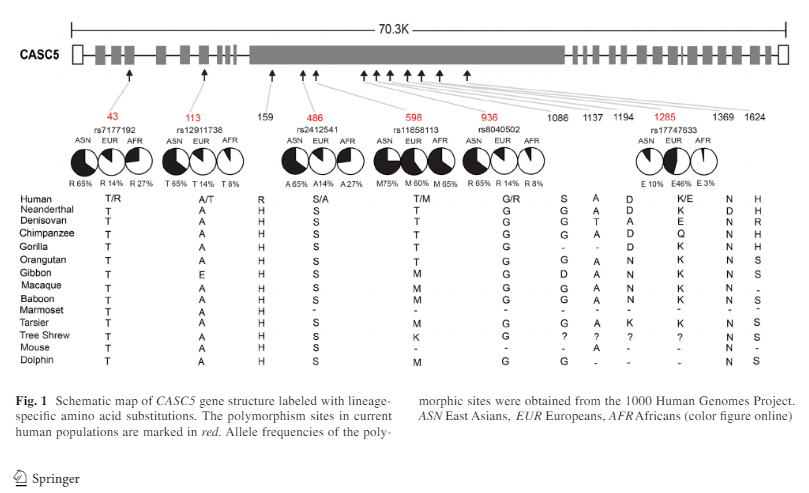
So East Asians have a much higher frequency of this derived trait. This is direct evidence for natural selection in recent human evolution in regards to the physical structure of the brain.
Since most of the amino acid polymorphic sites showed between-population divergence, they decided to analyze the three classical races using 1000 genomes. The variation between the races could be due to either genetic drift or natural selection. When they analyzed certain gene regions, they observed a signal of positive selection for East Asians but not Europeans or Africans. They further tested this selection signal using “the standardized integrated haplotype score (iHS) which is used for detecting recent positive selection with incomplete sweep (i.e. the selected allele is not yet fixed)” (Shi et al, 2016). Using this method, they discovered a few SNPs with large iHS values in Europeans (7 SNPs at 4.2 percent) and none in Africans.
They also conducted a genome-wide scan of Fst, iHS, and “XPCLR (searching for highly differentiated genomimc regions as targets of selective sweeps)” (Shi et al, 2016). Several SNPs had high Fst, iHS and XPCLR scores, which indicate that these alleles have been under positive selection in East Asians. Among the fixed amino acid sites in human populations, East Asians showed 5, Europeans showed 1, and Africans showed 0 which, the authors write, “[imply] that these amino acid changes may have functional effects” (Shi et al, 2016). Furthermore, using the HDGP, they obtained the frequency of the 6 amino acid sites in 53 populations. This analysis showed that 4 of the 6 amino acid sites are “regionally enriched in East Asia .. in line with the suggested signal of population-specific selection in this area” (Shi et al, 2016).
Then, since CASC5 is a brain size regulating gene, they looked for phenotypic effects. They recruited 167 Han Chinese (89 men, 178 women) who were free of maladies. They genotyped 11 SNPs and all of the frequencies followed Harvey-Weinberg Equilibrium (which states that allele and genotype frequencies will remain constant in a population from generation to generation in the absence of evolutionary pressures; Andrews, 2010). In the female sample, 5 regions were related to gray matter volume and four were on the amino acid polymorphic sites. Interestingly, the four alleles which showed such a stark difference between East Asians and Europeans and Africans showed more significant associations in Han Chinese females than males. Those carrying the derived alleles had larger brain volumes in comparison with those who had the ancestral alleles, implying recent natural selection in East Asia for brain size.
Shi et al (2015) also attempted two replications on this allele writing:
We further conducted a replication analysis of the five significant CAC5 SNPs in two other independent Han Chinese samples (Li et al. 2015; Xu et al. 2015). The results showed that three SNPs (rs 7177192, rs11858113 and rs8040502) remained significant in Replication-1 for total brain volume and gray matter volume (Xu et al. 2015), but no association was detected in Replication-2 (Li et al. 2015) (Table S4).
It is very plausible that the genes that have regulated brain growth in our species further aid differences in brain morphology within and between races. This effect is seen mostly in Han Chinese girls. Shi et al (2016) write in the Discussion:
If this finding is accurate and can be further verified, it suggests that that [sic] after modern humans migrated out of Africa less than 100,000 years ago, the brain size may still be subject to selection.
I do believe it is accurate. Of course, the brain size could still be subject to selection; there is no magic field shielding the brain against selection pressure. Evolution does not stop at the neck.
So Shi et al (2016) showed that there were brain genes under recent selection in East Asians. What could the cause be? There are a few:
- Climate: In colder climates you need a smaller body size and big brain to survive the cold to better thermoregulate. A smaller body means there is less surface area to cover, while a larger head retains heat. It, obviously, would have been advantageous for these populations to have large brains and thus get selected for them—whether by natural or sexual selection. This could also have to do with the fact that one needs bigger eyes in colder environments, which would cause an increase in the size of the brain for the larger eyes, as well as being sharper visio-spatially.
- Intelligence: East Asians in this study showed that they had high levels of gray matter in the skull. Further, large brains are favored by an intermediately challenging environment (Gonzalez-Forero, Faulwasser, and Lehmann, 2017).
- Expertise: I used Skoyle’s (1999) theory on expertise and human evolution and applied it to racial differences in brain size and relating it to the number of tools they had to use which differed based on climate. Now, of course, if one group uses more tools then, by effect, they would need more expertise with which to learn how to make those tools so large brains would be selected for expertise—especially in novel areas.
- Vision: Large brains mean large eyes, and people from cold climates have large eyes and large brains (Pearce and Dunbar, 2011). Decreasing light levels select for larger eye size and visual cortex size in order to “increase sensitivity and maintain acuity“. Large eyeballs mean enlarged visual cortices. Therefore, in low light, large brains and eyes get selected for so one can see better in a low light environment.
Of course, all four of the examples below could (and probably do) work in tandem. However, before jumping to conclusions I want to see more data on this and how the whole of the system interacts with these alleles and these amino acid polymorphic sites.
In sum, there is now evidence for natural selection on East Asians (and not Africans or Europeans) that favored large brains, particularly gray matter, in East Asians with considerable sexual dimorphism favoring women. Four of the genes tested (MCPH1, ASPM, CDK5RAP2, and WDR62) are regulated by estradiol and contribute to sexual dimorphism in human and non-human primates (Shi et al, 2016). Though it still needs to be tested if this holds true for CASC5.
This is some of the first evidence that I have come across for natural selection on genes that are implicated in brain evolution/structural development between and within populations. It does show the old “Rushton’s Rule of Three“, that is, Mongoloids on top, Caucasians in the middle, and Negroids on bottom, though Caucasians were significantly closer to Africans than Mongoloids in the frequency of these derived alleles. I can see a HBDer going “They must be related to IQ”, I doubt it. They don’t ‘have’ to be related to IQ. It just infers a survival advantage in low light, cold environments and therefore it gets selected for until it reaches a high frequency in that population due to its adaptive value—whether spreading by natural or sexual selection.
There is No ‘Marching Up the Evolutionary Tree’
2000 words
The notion that there is any ‘progress’ to evolution is something that I have rebutted countless times on this blog. My most recent entry being Marching Up the ‘Evolutionary Tree’? which was a response to Pumpkin Person’s article Marching up the evolutionary tree. Of course, people never ever change their views in a discussion (I have seen it, albeit it is rare) due, mainly to, in my opinion, ideology. People have so much time invested in their little pet theories that they cannot possibly fathom at the thought of being wrong or being led astray by shoddy hypotheses/theories that confirm their pre-existing beliefs. I will quote a few comments from Pumpkin Person’s blog where he just spews his ‘correlations with brain size and ‘splits’ on the ‘evolutionary tree” that ‘proves that evolution is progressive’, then I will touch on two papers (I will cover both in great depth in the future) that directly rebut his idiotic notion that so-called brain size increases across our evolutionary history (and even before we became humans) are due to ‘progress in evolution’
One of my co-bloggers Phil wrote:
I think you mistyped that, but i see your point. Problem, however, most of your used phylogenies were unbalanced.
Based on the definition you provided, but not based on any meaningful definition. To me, an unbalanced tree is . . .
This is literally meaningless. Keep showing that you’ve never taken a biology class in your life, it really shows.
All it is is ignorance to basic biological thinking, along with an ideology to prove his ridiculous Rushtonian notion that ‘brain size increases prove that evolution is progressive’.
You have yet to present ANY scientific logic, and my argument about taxonomic specificity is clearly beyond you.
Scientific logic?! Scientific logic?! Please. Berkely has a whole page on misconceptions on evolution that directly rebut his idiotic, uneducated views on evolution. It doesn’t help that his evolution education most likely comes from psychologists. Nevertheless, PP’s ‘argument’ is straight garbage. Taxonomic specificity’ is meaningless when you don’t have an understanding of basic biological concepts and evolution. (I will have much more to say on his ‘taxonomic specificity’ below.)
PP writes:
Was every tree perfect? No, but most were pretty close, and keep in mind that any flawed trees would have the effect of REDUCING the correlation between brain size/encephalization and branching, because random error is a source of statistical noise which obscures any underlying relationship. So the fact that I repeatedly found such robust correlation in spite of alleged problems with my trees, makes my conclusions stronger, not weaker.
The fact that you ‘repeatedly’ found ‘correlations’ in spite of the ‘problems’ with your trees makes your ‘conclusions’ weaker. Comparing organisms over evolutionary time and you notice a ‘trend’ in brain size. Must mean that evolution is progressive and brain size is its calling card!!
PP writes:
I’m right and all the skeptics you cite are wrong.
Said like a true idealogue.
Here is where PP’s biggest blunder comes in:
It’s not how many splits they have that I’ve been measuring, it’s how many splits occur on the tree before they branch off. Here’s a source from 2017:
Eukaryotes represent a domain of life, but within this domain there are multiple kingdoms. The most common classification creates four kingdoms in this domain: Protista, Fungi, Plantae, and Animalia.
So you needed ‘a source from 2017’ to tell you something that is literally taught on the first day of biology 101? Keep showing how uneducated you are here.
Nothing fallacious about a correlation between number of splits and brain size/encephalization.
Post hoc, ergo propter hoc is a Latin phrase for “after this, therefore, because of this.” The term refers to a logical fallacy that because two events occurred in succession, the former event caused the latter event.[1][2]
…
Magical thinking is a form of post hoc, ergo propter hoc fallacy, in which superstitions are formed based on seeing patterns in a series of coincidences. For example, “these are my lucky trousers. Sometimes good things happen to me when I wear them.”
P1: X happened before Y.
P2: (unstated) Y was caused by something (that happened before Y).
C1: Therefore, X caused Y.
Here is PP’s (fallacious) logic:
P1: splits (X) happened before Y (brain size increase)
P2: (unstated) brain size increase was caused by something (that happened before brain size increaes [splits on the tree])
C1: therefore, splits caused brain size increase
Now, I know that PP will argue that ‘splits on the evolutionary tree’ denote speciation which, in turn, denotes environmental change. This is meaningless. You’re still stating that Y was caused by something (that happened before Y) and therefore inferring that X caused Y. That is the fallacy (which a lot of HBD theories rest on).
PP writes:
You don’t get it. Even statistically insignificant correlations become significant when you get them FIVE TIMES IN A ROW. If you want to believe it was all a coincidence, then fine.
Phylogenies are created from shared derived factors. Berkely is the go-to authority here on this matter. (No that’s not appeal to authority.) Biologists collect information about a given animal and then infer the evolutionary relationship. Furthermore, PP’s logic is, again, fallacious. Berkely also has tips for tree reading, which they write:
Trees depict evolutionary relationships, not evolutionary progress. It’s easy to think that taxa that appear near one side of a phylogenetic tree are more advanced than other organisms on the tree, but this is simply not the case. First, the idea of evolutionary “advancement” is not a particularly scientific idea. There is no unbiased, universal scale for “advancement.” Second, taxa with extreme versions of traits (which might be perceived as more “advanced”) may occur on any terminal branch. The position of a terminal taxon is not an indication of how adaptive, specialized, or extreme its traits are.
He may emphatically argue (as I know he will) that he’s not doing this. But, as can be seen from his article, X is ‘less advanced’ than Y, therefore splits, brain size, correlation=progress. This is dumb.
For anyone who wants to know how (and how not to) read phylogenies, read Gregory (2008). These idotic notions that PP espouses are what Freshman in college believe due to ‘intuitiveness’ about evolution. It’s so rampant that biologists have writen numerous papers on the matter. But some guy with a blog and no science background (and an ideology to hammer) must know more than people who do this for a living (educate people on phylogenies).
On Phil’s response to see the Deacon paper that I will discuss below, PP writes:
That’s not a rebuttal.
Yes it is, as I will show shortly.
The first paper I will discuss is Deacon’s (1990) paper Fallacies of Progression in Theories of Brain-Size Evolution. This is a meaty paper with a ton of great ideas about phylogenies, along with numerous fallacies that people go to when reading trees (my favorite being the Numerology fallacy, which PP uses, see below).
Deacon argues that since people fail to analyze allometry, this anatomists have mistaken artifacts for evolutionary trends. He also argues that many structural’brain size increases’ from ‘primitive to advanced forms’ (take note here, because this is what PP did and this is what discredits his idiotic ideology) are the result of allometric processes.
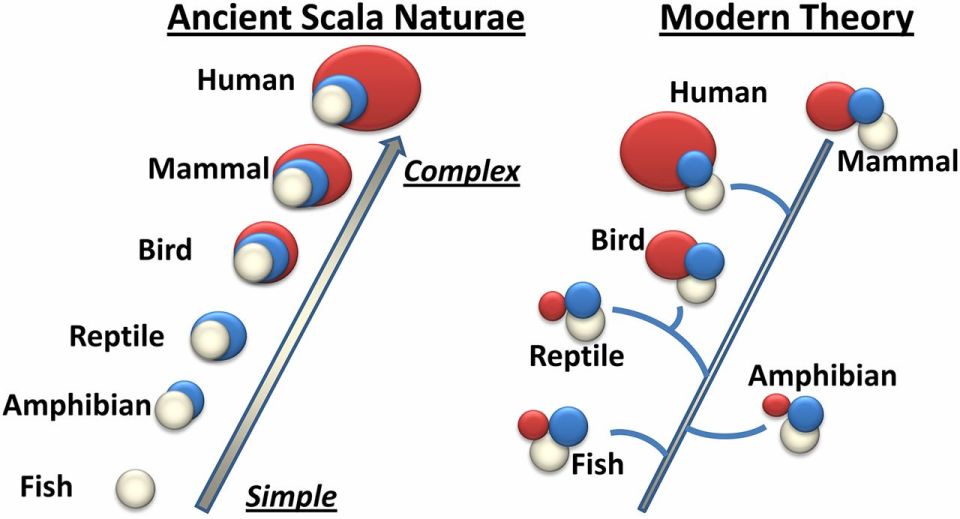
Source: Evolution of consciousness: Phylogeny, ontogeny, and emergence from general anesthesia Mashour and Alkire (2013)
This paper (and picture) show it all. This notion of scala naturae (which Rushton (2004) attempted to revive with r/K selection theory has been rebutted by me) was first proposed by Aristotle. We now know how the brain structure evolved, so the old ‘simple scala naturae‘ is, obviously, out of date in the study of brain evolution.
This paper is pretty long and I don’t have time to discuss all of it so I will just provide one quote that disproves PP’s ‘study’:
Whenever a method is discovered for simplifying the representation of a complex or apparently nonsystematic numerical relationship, the method of simplification itself provides new insight into the phenomenon under study. But reduction of a complex relationship to a simple statistic makes it far easier to find spurious relationships with other simple statistics. Numerology fallacies are apparent correlations that turn out to be artifacts of numerical oversimplification. Numerology fallacies in science, like their mystical counterparts, are likely to be committed when meaning is ascribed to some statistic merely by virtue of its numeric similarity to some other statistic, without supportive evidence from the empirical system that is being described.
Deacon also writes in another 1990 article titled Commentary on Ilya I. Glezer, Myron So Jacobs, and Peter J Morgane (1988) Implications of the “initial brain’9 concept for brain evolution in Cetacea:
The study of brain evolution is one of the last refuges for theories of progressive evolution in biology, but in this field its influence is still pervasive. To a great extent the apparent “progress” of mammalian brain evolution vanishes when the effects of brain size and functional specialization are taken into account.
(It’s worth noting that in the author’s response to Deacon, he did not have any qualms about ‘progressive brain-size’.)
In regards to PP’s final ‘correlation’ on human races and brain-size, this is a perfect quote from McShea (1994: 1761):
If such a trend [increase in brain size leading to ‘intelligence’] in primates exists and it is driven, that is, if the trend is a direct result of concerted forces acting on most lineages across the intelligence spectrum, then the inference is justified. But if it is passive, that is, forces act only on lineages at the low-intelligence end, then most lineages will have no increasing tendency. In that case, most primate species—especially those out on the right tail of the distribution like ours—would be just as likely to lose intelligence as to gain it in subsequent evolution (if they change at all).
The ‘trend’ is passive. Homo floresiensis is the best example. We are just as likely to lose our ‘intellect’ and our ‘big brains’ as we are to ‘get more intelligent’ and ‘smaller brains’. The fact of the matter is this: environment dictates brain size/whatever other traits an organism has. Imagine a future environment that is a barren wasteland. Kilocalories are scarce; do you think that humans would keep their big brains—which are two percent of their body weight accounting for a whopping 25 percent of total daily energy needs—without enough high-quality energy? When brain size supposedly began to increase in our taxa is when erectus learned to control fire and cook meat (Hlublik et al, 2017).
All in all, there is no ‘progress’ to evolution and, as Deacon argues, so-called brain-size increases across evolutionary time disappear after adjustments for body size and functional specialties are taken into account. However, for the idealogue who looks for everything they can to push their ideology/worldview, things like this are never enough. “No, that wasn’t a rebuttal! YOU’RE WRONG!!” Those are not scientific arguments. If one believes in ‘evolutionary progress’ and that brain-size increases are the proof in the pudding that evolution is ‘progressive’ (re has a ‘direction’), then they must rebut Deacon’s arguments on allometry and his fallacies in his 1990 paper. Stop equating evolution with ‘progress’. Though, I can’t fault laymen for believing that. I can, however, fault someone who supposedly enjoys the study of evolution. You’re wrong. The people you cite (who are out of their field of expertise) are wrong.
Evolution is an amazing process. To equate it with ‘progress’ does not allow one to appreciate the beauty of the process. Evolution does carry baggage with it, and if I weren’t so used to the term I would use Descent by Modification (DbM, which is what Darwin used). Nevertheless, progressionists will hide out in whatever safehold they can to attempt to push their idealogy that is not based on science.
(Also read Rethinking Mammalian Brain Evolution by Terrence Deacon. I go more in depth on these three articles in the future.)
r/K Selection Theory Rebuttals
2100 words
The other day Anonymous Conservative (AC) published an article titled Criticism Of r/K Theory In The Comments. I’m not too worried about what he wrote in the main article (I may tackle that later if I feel up to it), but what I am worried about is someone’s critique of my article r/K Selection Theory: A Response to Anonymous Conservative. Since this guy uses AC’s writings who, of course, is influenced by Rushton’s application of r/K to humans, it shows that he’s pretty clueless about 1) the theory as a whole and 2) the theory’s ultimate status in biology. (Also check out Phil’s comments in the AC thread.)
The individual in question, one ‘Samuel Skinner’ calls my critique of AC “genuinely bad” and that he would “cover the most obvious mistakes“, well let’s take a look at my ‘genuinely bad‘ critique to AC.
RR: You don’t get it. Mongoloids being r-selected is straight from Rushton. He asserts that they have cold-adaptations. Cold adaptations are due to cold weather. Cold weather is an agent of r-selection (temperature extreme).
Samuel Skinner: Mongoloids have a variety of genetic adaptions to cold. If you drop one buck naked in the winter, they will still freeze to death. The actual adaption they have is wearing thick clothing covering the entire body, something that is both K and not existent in Africa. Needless to say knowing how to gather materials, make clothing and maintain it is a K selective pressure.
So “the actual adaptation they have” is to “wear thick clothing“? This is bullshit and you know it. I covered human physiological adaptations to the cold last month: Human Physiological Adaptations to Climate. Clothes weren’t made in Africa? “Knowing how to gather materials, make clothing and maintaining it” is not a “K selective pressure“.
RR: Endemic (native) disease is an agent of K-selection. Since the disease is constant, then the population under that agent of K-selection can prepare ahead for disease.
Samuel Skinner: That requires the preparation to actually work; if preparation has less effect on genetic pay offs then having children faster, having children faster wins.
The preparation does work. In the case of malaria (an endemic disease), one-fifth of patients use traditional malarial remedies in malaria-stricken countries (Wilcox and Bodecker, 2004).
Endemic and infectious disease is an agent of K-selection:
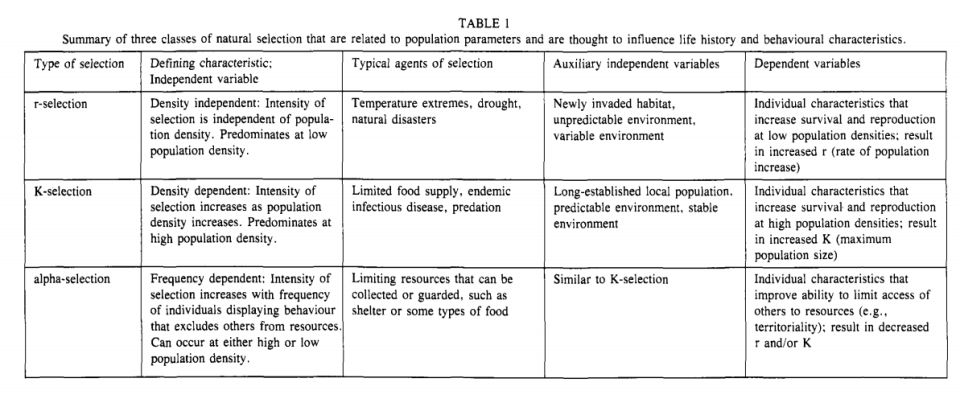
(From Anderson, 1991: 53)
RR: Do groups not work together in Africa to reach common goals? In the Pleistocene as well? Citations? Think before you write (and cite), because hunting bands in our species began with Homo erectus.
Samuel Skinner: NPC talks about clannishness and IQ difference in other posts. So he does believe that groups in Africa do not work together to reach common goals. I’m honestly not sure what he is thinking here.
Yes I do. But to say that ‘Africans don’t work together’ is stupid because Africa is a huge continent. Which African ethnies? Etc. And that’s also an incorrect claim.
RR: Density-dependent pressures are things such as endemic disease in Africa—which is necessary for a K-selected history since density-dependent natural selection occurs at or close to the environmental carrying capacity
Samuel Skinner: Yes, if a disease is transmitted through person to person contact and non-discriminatory. Malaria is transmitted through mosquitoes; the amount adding additional people increases its rate is negligible.
“This therefore provides empirical confirmation that sex ratio has an immediate impact on transmission success and that it is density-dependent” (Mitri et al, 2009). Endemic disease (like malaria) work in a density-dependent fashion (Anderson, 1991: 51).
Here is what people like Samuel Skinner and AC don’t get: r/K selection theory WAS discarded; it is no longer in use. Age-specific mortality better explains these trends than r/K selection (Reznick et al, 2002: 1518). I’ve also covered how the so-called ‘unidimensional construct’ or r on one end and K at another is wrong: “It appears that the original HKSS items are best represented as four distinct but related dimensions, and do not represent a unidimensional construct. This conclusion is reinforced by relationships between HKSS total scores and life history measures: The significant correlations that were found were contrary to the predictions made by the Differential K literature (Figueredo et al., 2013; Rushton, 1985). We found that high K scores were related to earlier sexual debut and unrelated to either pubertal onset or number of sexual partners. This suggests that the HKSS does not reflect an underlying “K dimension” (Copping, Campbell and Muncer, 2014).
It truly is tiring rebutting the same old bullshit arguments on r/K theory. I see AC’s bullshit on Twitter when I search ‘r/K Selection Theory’, but the individual who pushes the bullshit will not accept my invitation to come to this blog and discuss it with me.
The most important thing to know here is that the unidimensional construct that Pianka (1970) formulated is wrong. Joseph Graves (2002) reviews some of the literature on the theory, showing that Pianka’s (1970) verbal theory is wrong, and that r/K selection fell out of favor in the late 70s. It’s worth noting that Pianka gave NO experimental rationale (Graves, 2002: 135) to his unidimensional construct (which Copping, Campbell and Muncer, 2014). Do you see how this theory holds no weight in evolutionary biology anymore?
Samuel Skinner also says: “So they changed the name and kept some of the components. If the components they dropped are ones AC is using, say so.”
Here is what Reznick et al (2002) write:
Although life-history theory has shifted away from a focus on r- and K-selection, the themes of density-dependent regulation, resource availability, and environmental fluctuations are integral to current demographic theory and are potentially important in any natural system
I see the term density-dependent regulation, which I do not see on AC’s blog (the only thing that comes up if you search that term on his blog are the responses to me… that should tell you something). In regards to resource availability Reznick et al (2002: 1517) write: We have also found a potential role of resource availability, either as a consequence of environmental factors that are correlated with, but otherwise independent of predators, or as a consequence of indirect effects of predation (Reznick et al. 2001)”. If I were you I’d read some of the literature on this before writing more bullshit.
Skinner also writes: “Again, not following. The link between fertility and disease is pretty clear- after a die off the population rebounds. If a population is near carrying capacity and suffers a die off, the growth rate of the survivors increases.” Except African populations have had much more time to reach their environmental carrying capacity and to experience the K-selected agents of natural selection, like endemic disease (Anderson, 1991: 59).
Then AC jumps in and writes: “You cannot take a Biology 101 class without learning about r/K. It is in the textbooks, and it is seen as an excellent theory, akin to Newtonian Physics. Sure relativity and Quantum Mechanics came along and showed that Newtonian physics wasn’t the entire ball of wax. But you still learn Newtonian Physics, because it is fundamental to understanding everything else.” This, again, is bullshit. AC, have you taken a Bio 101 class? I took one. Not one mention of this discredited theory, I have an in use biology textbook (Understanding Biology, 2nd edition, Mason et al, 2017; check pages 905-908 in the textbook to verify this) and in the section on reproductive strategies (which is what r/K selection theory is, at its core) r/K selection is not mentioned once. Why make claims that you know you cannot verify?
AC: “What we are doing here is not something where you can point to a single old study, and say, here it all is, in one place. Bringing all this together is new, even if what is being brought together is well established.“
That doesn’t mean it’s right.
AC: The issue is, you have one area of study of humans (political science) where it is long established that humans spontaneously diverge into two groups, which the literature has recognized are so divergent that they call them Left and Right, as in each points in the opposite direction.
So stop dodging me and answer this question: Are liberals and conservatives local populations? If so, where did they evolve?
AC: “Now I know you didn’t read the book because you are hung up on the use of the phrase “r/K Theory.” In the book there is a chapter devoted to that. I use the meme of r/K Theory for the same reason it is taught in biology – it is a quick way to bring people up to speed on the purposes of these traits, and how they affect reproduction/survival under different conditions.”
Don’t worry; I’ll read your book soon enough and will probably have tons of material to rebut. Anyway, using discredited bio theories isn’t a good way to push something.
AC: “If it is done right, this will ultimately be a massive field of study with thousands of biologists and political scientists taking it apart and trying to figure how aggressive stimuli affect people’s r/K traits, vs sexual stimuli, vs pleasureable things like food, vs quick blips of K followed by long periods of r, vs long constant K, vs disease mortality that is totally random, and on and on.”
You have some strange dreams. It won’t happen. Individuals WITHIN A SPECIES are not R OR K. R AND K ARE NOT ADJECTIVES (Anderson, 1991: 57).
AC: “On Rushton, unless he ever mentioned politics (he didn’t),“
That’s meaningless though. You’re using the continuum he grabbed from Pianka (1970). THEREFORE, you’re wrong with your application since Pianka (1970) was rebutted decades ago (Graves, 2002)!
AC: “You have married black conservatives and married white conservatives and married Asian conservatives. They all have more in common psychologically than the leftists of their fellow races. Mixing them along racial lines only muddies the waters, and hides that all races have been exposed to harshness and ease, and have adapted the requisite psychologies to function and persist under either.“
No it doesn’t ‘muddy the waters’. I believe now you’ll point to black Trump supporters going against BLM or white Leftists going against their interests. SO WHAT. You can create any just-so story you’d like, you won’t be right.
Something AC doesn’t get is that using the discredited r/K continuum, conservatives would be r (lower IQ, more children; women who reported being religious stated that having children was more important to them; Hayford and Morgan, 2008) in comparison to liberals who would be K (fewer children, higher IQs). Of course, he just immediately states that cons are K and libs are r, since the verbal theory from Pianka (1970) had the ‘good traits’ on K and ‘bad traits’ on r. (Read r/K theory: Conservatives = r, liberals = K (reminder to the ignorant)). I’ve already covered that libs are more intelligent than cons (Kanazawa, 2010; Kanazawa, 2014), and that conservative countries have lower IQs (and are non-white and third world) in comparison to liberal countries (which are majority white…). Conservatives are more likely to be religious (Morrison, Duncan, and Parton, 2015; McAdams et al, 2015), and religious people have lower IQs (Zuckerman, Silberman, and Hall, 2013; Ritchie, Gow, and Deary, 2014; Pennycook et al, 2016; Dutton and Linden, 2017). Intelligence is also associated with social and economic liberal views (Carl, 2014). Lastly, research into the psychology of continents shows that liberal continents are more intelligent than conservative continents (African countries conservative, European countries liberal… what’s that tell you?) (Stankov and Lee, 2016). So, using Rushton’s/Pianka’s continuum, who looks r and K now?
This, as usual, is the perfect example of implicit bias. My team is best and has the good traits, the other team is worse and has the bad traits. It’s dumb, it doesn’t make sense. AC will try to get ‘the truth’ about this theory out to people, well he has a foil in myself. I enjoy talking about this and debating it, but it seems like most people don’t understand the ecology behind the theory. They have their biases and will search for anything to confirm them. That’s not science.
Stop pushing r/K theory. It’s long dead. Just because some non-specialist idealogue pushes something and warps studies to fit his views while ignoring contrary evidence, DOES NOT mean that the theory is ‘back’ in style or anything to that effect. One biased person picked up the dead body of the (discredited) r/K continuum and attempted to revive it. Well I’ve shot it back down. It’s dead. Let it rest in peace and stop attempting to revive it.
Also see my other articles on r/K Selection Theory
r/K Selection Theory: A Response to Truth-Justice
r/K Selection Theory: A Response to Anonymous Conservative
E.O. Wilson on Rushton’s r/K Theory and More on Endemic Disease
r/K Selection Theory: A Response to Rushton
Also read: r/k selection political theory is rubbish
 NotPoliticallyCorrect