Home » 2016 (Page 4)
Yearly Archives: 2016
The Final Nail in the Coffin for “More Evolved” and “Progressive” Evolution
900 words
I’ve been on a recent tangent against this ridiculous notion of “more evolved” and “progressive” evolution. The two statements go hand-in-hand; mainly that if one organism is “more evolved” than another that they must have “progressed” further than a previous ancestor. But “progressing” where? A lion is adapted to African woodlands and grasslands, a penguin is adapted to life in the polar regions. Now imagine comparing two other organisms and what they need to do to pass their genes in that habitat, can you really infer if one organism is “more evolved” than another? The ultimate cause of these adaptations between these two species are migration, natural selection, mutation and genetic drift. Over time, an organism evolves traits (both phenotypic and genotypic) to better survive in that habitat. Knowing that evolution is a random process and that changes happen based on environment, can we really say that one organism is “more evolved” or “progressed” more than the organism in question? Tonight, I’ll put the final nail in the coffin for this hypothesis using Homo floresiensis as an example.
Homo floresiensis is an extinct hominid that lived on the island of Flores in Indonesia. He stood around 3 feet 6 inches tall and weight about 75 pounds, on average. Just this year, researchers from the journal Nature went to look for the oldest hominin occupation in Indonesia on an island between the Asian mainland and the island Flores, where H. floresiensis lived. Van den bergh et al found that the oldest evidence for stone tools on the island was between 118 and 194 kya, showing that there was a hominid on the island which predated H. floresiensis.
One possibility is that the older hominid was Homo erectus got to Flores around 800 kya and, over time, evolved into H. floresiensis. Though many researchers argue against this, saying that if H. floresiensis were a dwarfed erectus, then the expected brain size would have been between 500 to 600 cc (Lieberman, 2013: 124). Nevertheless, with careful examination between H. sapiens (African pygmies and Andaman islanders), Australopithecus and Paranthropus, Argue et al (2006) showed that diseases such as microcephaly are not the cause for their smaller brain, it is attributed to being a new species, Homo floresiensis. In 2009, Falk et al showed that the LB1 specimen did not have Laron syndrome, which is a rare form of dwarfism that occurs due to the body’s inability to use growth hormones (GH). The GH is secreted by the brain’s pituitary gland that promotes growth. So it was hypothesized that these diseases were the cause for their smaller stature, and in turn, smaller brains. But it seems that the cause for their smaller brains (around 400 cc) is due to the environment they evolved in, specifically a hot climate with low amounts of food.
There is amazing evidence for dwarfism and gigantism on islands. This is also shown to be effect hunter-gatherers. What is known is that H. floriensis’s skull and brain most closely resemble H. erectus, even after correcting for size (Falk et al, 2005; Baab and McNulty 2009; and Gordon, Neville and Wood 2008). (Lieberman, 2013: 123) Knowing that H. floresiensis didn’t suffer from any diseases that shrank both its body and brain, the only other explanation is that he evolved from either H. erectus, or as posited by primitive hand bones discovered on Flores, that Homo habilis, (literally handy man) somehow made it to Indonesia and swam to Flores. Either way, what we’re worried about here is how the selection for smaller body size occurred from whatever species of hominid predated floriensis, whether it be habilis or erectus.
As shown in the previous paragraph, there is evidence for island gigantism and dwarfism. So a plausible hypothesis is that either habilis or erectus swam or somehow rafted to Flores and over time due to less kcal on the island combined with the hotter climate and the dwarfism effect from the island, over time floresiensis evolved. Weston and Lister (2009) showed that island dwarfism could more than account for the depressed brain size in floresiensis. They showed that it was mechanistically possible for mammals to evolve smaller brains when compared to a mainland ancestor. This is huge. This makes the hypothesis that floresiensis is either habilis or erectus that evolved isolated on Flores.
Floresiensis shows how important energy was in human evolution. It’s thought that they survived on around 1200 kcal a day and 1400 when nursing, in comparison to erectus who survived on 1800 kcal per day and 2500 when nursing (Lieberman, 2013: 125). This is definitive proof that adequate calories are needed to drive brain growth as well as other bodily systems. Based on the energy requirements of floresiensis and erectus, it is 100 percent likely that fewer kcal was part of the reason why floresiensis evolved a smaller stature, along with island dwarfism and the climate as a whole.
The study of floresiensis and its possible precursors shows how and why the terms of “more evolved“, “progressive” evolution and “superiority” should be discontinued from evolutionary biology. Evolution acts to have an organism to be fit enough for its environment. Gauging any so-called “progressive” evolution and who’s “more evolved” than who has no basis in evolutionary biology. People who use these terms should stop saying it, as it’s been debunked. The final nail in the coffin has been put into this hypothesis. The evolution of H. florensiensis proves that selection occurs based on environment (which doesn’t even need any more proving). The final nails in the coffin have been put into the hypotheses of “more evolved“, superiority, and “progressive” evolution.
More On Evolutionary “Progress” and “More Evolved”
2700 words
Another reply to PumpkinPerson on evolution:
Wrong! Agriculture caused malnutrition:
Following the recession of the ice age people evolved a new life style living in permanent village settlements with domestic animals and cereal agriculture. But although the new life style was more convenient the quality of nutrition fell and many skeletal remains show signs of rickets and other malformations caused by suboptimal nutrition (Festinger, 1983).
I just ordered the book Lynn cited and will return to this after I finish it. I can’t really infer anything from one sentence.
It’s a combination of warming + malnutrition caused by agriculture.
The agriculture theory makes sense when you think that it’ll mostly be a grain based diet–however most anthropologists reject the theory because the Agricultural Revolution didn’t reach South Africa and Australia until modern times and brain size has been steadily decreasing since the Stone Age.
Rushton hinted at it, but I’ve developed the theory much further. Scientists avoid the term “more evolved” but they use terms like more primitive and more advanced which mean the exact same thing.
Lynn was the one who said it; he’s wrong. Brain size shrinking runs exactly parallel to any so-called ‘evolutionary progress’. Primitive=old. Not ‘less evolved’. Could humans survive on early Earth? Or could only organisms that evolved to survive on early Earth do so?
And what do you know? Brain size was in stasis from 1.8 million to 600,000 ya. It increased a bit then started to decrease again.
This shows how evolution isn’t progressive either, ironically enough.
But the point is race realist, if the environment doesn’t change, the organism wont evolve, causing some organisms to be less evolved than others. Some organisms haven’t evolved for 2 billion years according to the following:
That proves my point. Organisms only change phenotypically if there is a corresponding environmental pressure. The article says that this is an extreme act of stasis, because the environment hasn’t changed for it so it doesn’t have any reason to change. Evolution only occurs when it needs to, when the environment consistently/constantly changed. More complex=/=more evolved. Organisms are fit enough for that environment to reproduce. That’s it.
This is an extreme example of stasis, and obviously, if the environment changes they will change. That doesn’t mean they’re ‘less evolved’.
But the AVERAGE organism today is more complex than the AVERAGE organism 2 billion years ago. So overall, there is a progressive trend.
McShea (1996) says saying “humans are more complex than other organisms” is not warranted by the data. Of course, evolutionary theorists agree about local changes in brain size, but what is not agreed upon is whether or not this is constant. The evidence is not decisive on whether or not there is complexity in metazoans, I lean towards there being none. Because the so-called ‘direction’ will change in response to environmental pressures, therefore, making ‘progress’ not quantifiable.
Greater complexity occurs when NS is weak or nonexistent. But more complex doesn’t equal ‘more evolved’. This proves the mutation and genetic drift cause for phenotypic and genotypic differences between species.
Again, it’s a branch and you can’t say that one organism is more evolved.
Primate brain size tripled in Africa. Then when we left Africa for the totally opposite environment of Norther ice age Europe, brain size increased again. Only in the last 20,000 years has brain size shrunk, but it’s not clear intelligence has. Further, the average encephalization of all mammals has tripled in the last 65 million years, showing a long-term progress trend across a huge number of changing environments. Not only that, but the trend of increased encephalization is replicated in the dinosaurs over their 140 million year span. If there were no long-term progressive trends in evolution, this wouldn’t happen.
Brain size has tripled in the past 7 million years you’re right about that. Intelligence is seeing a downward trend as the less intelligent have more children. Average IQ for the planet is 90 I believe. It’s only going to get lower. With this a decrease in head size and brain size.
“Because of the frequency of environmental change, the multiplicity of factors underlying fitness, the possibility of frequency-dependent and epistatic interactions among features, and the consequent possibility of nontransitive fitness relations between phenotypes, selection acting within populations frequently, though not inevitably, fails to produce unidirectional trends. The extent to which unidirectional trends dominate, or fail to dominate, the fossil record is therefore not a measure of the adequacy of neo-Darwinian mechanisms as causes of large-scale patterns in evolution.”
Different environments cause different variables that need to be overcome so an organism is able to survive in that particular ecosystem. Hence needing a bigger brain is not always key to survival. You of all people know that higher intelligence isn’t needed in the equatorial parts of the world, this is evolution at work. It occurs due to the environment. Brain size for humans has gotten smaller in the past 7000 years:
“A recent study carried out by Chinese researchers looked at 500 endocasts from the past 7,000 years. They also confirmed that our brains are getting smaller. However, they found that while the whole brain has been getting smaller, the frontal lobe, the region of the brain responsible for speaking, comprehending others’ speech, reading and writing is actually increasing in size as we do more of that now compared to our ancient past.”
This is in line with what Herculano-Houzel says in her book, that the frontal lobes increased in size, which gave us an intelligence advantage over other hominids due to meat eating. The advent of cooking in Africa by H. erectus was the cause of the increase in brain size in Africa, as well as grinding down plants which allowed more nutrients to be extracted by the body upon ingestion.
You just admitted there are traits that are good for all environments, which means natural selection would tend to favour them in all environments. Of course there are always exceptions, but over billions of years of trial and error, evolution will progress towards the most universally useful traits
There are numerous blind and semi-blind species. Why? Because of their environment. They don’t need to see well, or even to see, to survive to pass their genes, When the environment changes, traits change. That’s not ‘progress’.
I’m not confused about a FUCKING thing. There’s no question that some Australoid types have genetically preserved the phenotype of the Negroids in Africa from which all humans evolved. Papua New Guineans for example.
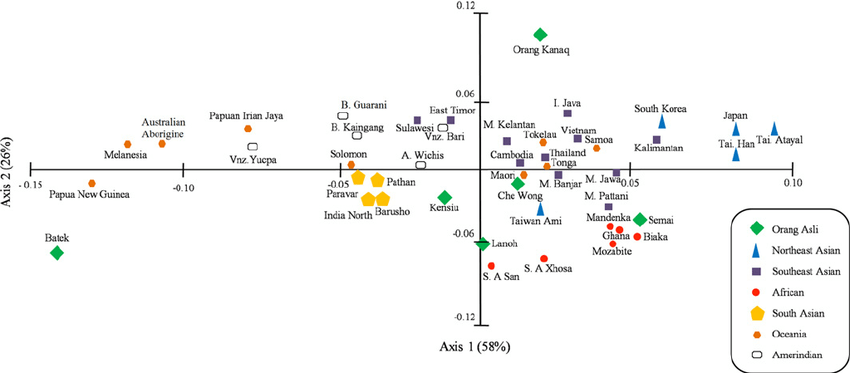
Australasians are Not Negroid So Stop Saying It!!
They aren’t Negroid.
Whether you want to call them Negroid or not is just semantics.
Saying that it’s “just semantics” is treating race just as a social construct. It’s a biological reality and biologically, they are not near Africans. Just because they ‘look African’ doesn’t mean they are.
Humans can’t survive everywhere, but scientists like Rick Potts believe we’re the single most adaptable species on Earth because unlike most other living things, we can live in rainforests, deserts, high mountains, ice, outer space, and underwater. We’re certainly one of the most adaptable and we’re certainly one of the most evolved, suggesting more evolved organisms are more adaptable.
Bone loss for astronauts is real. We can live in those areas because of natural selection as well as mutations that allow us to survive there. It’s nothing special; it’s just evolution in action.
“More evolved” organisms are not ‘more adaptable’. Each organism is suited well enough for its environment, any organism will adapt to its surroundings to better survive. That’s it.
Brain size in humans has been shrinking for 10,000 years. It was increasing for 2 million. Across the entire mammal class it’s been increasing, relative to body size for 65 million years. So the overall trend is progressive.
Brain size will continue to decrease for humans. It’s been increasing (for humans and for our ancestors it remained in stasis as I’ve shown above) due to environmental changes. When the environment changes, things can and will change. So you can’t say one organism is ‘more evolved’ than another.
IQ is increasing: the Flynn effect. Of course that’s an environmental effect and is largely spurious but perhaps you mean genetic IQ is decreasing. That theory is far from proven, and even if it’s true, it’s only a small exception to the overall trend of rising mammal intelligence over 65 million years and rising dinosaur intelligence over 140 million years.
It’s decreasing in France; it’s part environmental mostly dysgenic.
Dysgenics is occurring. This is what happens when peoples IQ drops: they can’t adequately nourish themselves because they lack the mental faculties. Combined with lower earning power due to their low IQ, they can only afford refined trash making nutrient deficiencies more common.
Human adaptability has been verified by all the environments we’ve lived in. Evolutionary progress has been verified by increased encephalization for tens of millions of years in both mammals and dinosaurs.
You know a good comparison? The polar bear. The polar bear diverged from the common ancestor with the brown bear 350 kya to 6 mya.
It evolved for its environment, the same as the brown bear. The white fur occurred due to the environment, proving (what is obvious) that selection for traits to have an organism better survive occur, and with changing environments over time traits will continue to change from common ancestors and previous organisms in that lineage. This is where PE has great explanatory power.
Humans evolve based on their environment. There is no ‘progress’ there. There is no overarching trend of ‘progress’ nor complexity for metazoans.
Encephalization and metabolic rate are the primary determinants in directing mammalian longevity and may explain other life history traits. Obviously, bigger organisms have slower metabolic rates and bigger brains. But that doesn’t mean ‘more evolved’ It’s from long-term evolution in any given environment.
Humans evolved in Africa by growing bigger brains. They then left Africa for Europe and evolved even bigger brains. Some whites have since returned to their ancestral Africa and had no trouble adapting, indeed colonizing, their ancestral land. That answers your question.
That doesn’t mean that they have resistance to malaria that Africans have from constant exposure to malaria-infected mosquitoes (Sickle Cell Anemia protects against malaria and is related to climate, not race but it’s most prevalent in Africans for obvous reasons). My question was as follows:
“Are you saying that if an organism survives somewhere and incurs phenotypic changes to have it bigger survive in that environment for 10 K years then moves on to another environment for 10 K years and incurs other phenotypic changes that 1) they’d be able to go back to the original environment and survive the same way they did before and 2) that the phenotypic changes incurred in the previous environment wouldn’t go away when they migrated to the new environment and stayed and evolved there for 10 k years?
Clearly, the answer is no. Moreover, as I said above, Europeans don’t have the disease resistance that Africans have due to evolving in that environment, which proves my point.
Bigger brains occurred due to cooking and acquiring more nutrients out of the meat. Other than that, tropical climes negatively correlate with brain size due to parasitic load, worse nutrition and more diseases that affect brain size (among the obvious ancestral component).
Yes you can. If you have one population that splits into three, and population A evolves into a different race from the parent population, while population B evolves into a different species from the parent population, and population C evolves into a different genus from the parent species, then C is more evolved than B who is more evolved than A, because a new genus is a higher taxonomical level, thus represents more evolutionary change, then a new species, which represents more evolutionary change than a new race.
No all that means is that differing selective pressures in the differing environment forced different phenotypic changes. Just because there are branches off of a parent population and LCA doesn’t mean that later organisms are ‘more evolved’, it just means that different environments call for different phenotypic traits so that organism can better survive in that environment. Just because one organism becomes a new genus from a parent population doesn’t mean that organism is ‘more evolved’. More evolutionary change does not equal ‘more evolved‘ or ‘superior’ nor does it mean that ‘evolution is progressive‘. All that means is that different selection pressures occurred to incur differing phenotypic traits to that organism. Anything else he says is just conjecture.
But if the environment doesn’t change, then the organism doesn’t have to evolve much to survive, hence those bacteria that didn’t evolve for 2 billion years.
That’s the point. This shows that evolution is not progressive. Moreover, there is no unidirectional line that evolution is going in. I’ve shown countless times that evolution is just as likely to make organisms less complex as it is to make organisms more complex. We may even find that organisms become less complex more than they become more complex through evolution, natural selection, mutation and genetic drift. That will prove definitively that evolution is not progressive nor are different organisms ‘more evolved’ than others. Those bacteria didn’t have to change much as their environment hardly changed, so they remained in stasis for 2 billion years (however with a change in environment will come evolutionary change, no organism is resistant to this).
Although interesting and portentous events have occurred since, from the flowering of dinosaurs to the origin of human consciousness, we do not exaggerate greatly in stating that the subsequent history of animal life amounts to little more than variations on anatomical themes established during the Cambrian explosion within five million years. Three billion years of unicellularity, followed by five million years of intense creativity and then capped by more than 500 million years of variation on set anatomical themes can scarcely be read as a predictable, inexorable or continuous trend toward progress or increasing complexity.
PP is wrong on evolutionary progress. Organisms evolve based on pressures in their environment and will continue to evolve based on any changes in environmental pressures to continue their genetic lineage. It’s that simple. It’s not a scientifically testable hypothesis. Here’s yet another article on ‘evolutionary progress’ that echoes the same sentiments as me:
The two main components that lead to the process of evolution—random variation and differential reproductive success—do not combine to create an ordered progression that improves with change. The former depends on randomness, and the latter on the environment, which is constantly in flux. Hence evolutionary change leads to continual difference, but no variation is better than any other one. The words “progress” and “better” should be abandoned in evolutionary discourse, because they refer to processes that do not occur in nature.
Scientifically, no species can be viewed as “better” than any other. Each species adapts to fit into a certain niche, and its success depends on a variety of factors, such as environmental conditions, relations to other species, and so on, many of which have little to do with whether the species is “better” than others
Words like “progress,” “improvement” and “better” are carried over from the old notions of the Great Chain of Being and the idea that evolution strives for perfection. These ideas are no longer accepted by evolutionists, so the terms associated with them should be removed from evolutionary discourse. This old terminology hinders our understanding of the randomness of evolutionary processes. Darwin’s theory itself did not deal specifically with the idea of evolutionary progress (Taylor) and I don’t believe that it should be part of the story of evolution that is told today. Even when limited and qualified, progress is not an appropriate or useful term to use in the discussion of evolution. Evolution is constant change, not improvement.
Evolution is not progressive, and saying it is is ignoring how amazing the evolutionary process is, which is constant and ongoing change. THAT is what evolution is, not ‘progress’.
RIP Rushton and Jensen
2050 words
Today is the 4th anniversary of Jensen’s death, with the 4th anniversary of Rushton’s being three weeks ago on October 2nd. The fact that two of the biggest names in the IQ game, and race science game died in a 3-week span was crushing to the truth. When they were pushing their theories on racial differences in intelligence, they had their classes stormed in on and they pretty much couldn’t teach. All of this, in a country where so-called ‘freedom of speech exists’, we can have people shout others down when they speak uncomfortable truths when they don’t like what they’re hearing. BUT, just because those truths don’t want to be heard does not change the reality of them. Rushton and Jensen were pretty much explaining why black Americans have less academic achievement over whites. But when a genetic explanation is brought up instead of the Left’s want for there to be a fully environmental, ‘racism’ explanation they storm classrooms and protest against the so-called ‘fascists’ who are just reporting what they find.
In Rushton’s article The New Enemies of Evolutionary Science, he extensively talks about the derision he faced from students while he gave his lectures. It was so bad that he couldn’t teach:
Behind the scenes, however, I became the target of a witch hunt by some of the administrators. Dismayingly, my dean, a physical anthropologist, publicly declared that I had lost my scientific credibility and spearheaded an attack on me in the newspapers. She issued a series of preemptive statements making plain her negative opinion of me and my work. “What evidence is there for this ranked ordering of the evolution of the human races?” she wrote. “None.” Claiming that her views represented only her academic opinion she emphasized that she was not speaking in any administrative capacity. Her letter was nonetheless widely interpreted in the media as a refutation by my “boss.” Henceforth, in order to support me, a person would now have to go up against the dean in addition to prevailing opinion. Next, the chair of my department gave me an annual performance rating of “unsatisfactory” citing my “insensitivity.” This was a remarkable turnaround because it occurred for the same year in which I had been made a Fellow of the prestigious John Simon Guggenheim Foundation. My previous twelve years of annual ratings had been “good” or “excellent.” Indeed, my earlier non-controversial work had made me one of the most cited scholars at my university.
…
Some radical and black students mobilized and held rallies, even bringing in a member of the African National Congress to denounce me. In one demonstration, a mob of 40 people stormed through the psychology department, banging on walls and doors, bellowing slogans through bull horns, drawing swastikas on the walls, and writing on my door “Racists Pig Live Here.”
The administration responded by barring me from the classroom and ordering me to lecture by videotape on the pretext that they could not protect me from the lawlessness of students. Again I launched formal grievances. After a term of enforced teaching by videotape, I won the right to resume teaching in person, though then I was required to run a gauntlet of demonstrators shouting protests and threats. Only after several forced cancellations of my classes did the administration warn the demonstrators that further action would lead to suspension and legal action. That brought the protests to a halt.
This sounds just like today huh? Seems like much hasn’t changed in the past 30 years. The amount of derision that Rushton faced just for his areas of research interest speaks volumes. Clearly, people are scared of the truth about human nature, whether individually or racially/ethnically. The fact that Rushton couldn’t teach because his classes kept getting interrupted shows that people don’t care about factual data, especially when it hurts their feelings or conflicts with any type of egalitarian nonsense they have in their heads. Once challenged, they get mad, scream ‘racist’ and simply do anything in their power to make life a living hell for the person who dares to speak non-politically correct things. But, and a huge but, just because one stops, for the time being, this from being spoken of, DOES NOT make the racial differences between groups go away. People look for any and all types of environmental explanations to attempt to explain away racial IQ gaps and other racial differences both physically and mentally, but they don’t hold up to the genetic explanation, which was shouted down by people who don’t want their fragile reality broken.
The same thing, of course, happened to Arthur Jensen:
In the 1990s protesters in London pelted him with tomatoes at a lecture hall. “Jensenism” became a term of rebuke, used against those who championed theories about whites’ superiority. “Jensenism,” evolutionary biologist Stephen Jay Gould once declared, rested “on a rotten edifice.”
Arthur Jensen recalls some of these ‘protests’ with AmRen’s Jared Taylor back in 1992:
AR: Well, the sorts of things that you’ve been telling me, the sorts of things you’ve been doing research about, can you and do you freely teach these things in your classes?
Jensen: I sure do. I soft-pedaled things 20 years ago, and even then, there were great protests. I had students who would drop the course if these things were brought up even in a very mild way, in a hypothetical way. Students today wonder what all the shouting was about.
AR: Is that so?
Jensen: Yes, it’s rather hard to get students to believe that there were these protests and so on. They take a lot of this for granted. Oh, there’s been a great change in the students in that respect … But even in 1969-1970, I never saw a black in any of these demonstrations.
AR: Is that right?
Jensen: Not a one.
AR: They were SDS [Students for a Democratic Society]-types?
Jensen: All SDS and Progressive Labor Party, mainly. I tried to put them out when they tried to audit my course, because they were hecklers, and so some of the SDS people would sign up for the course. Of course, then they’d have to do the assignments and take the exams.
Interestingly enough, they usually were the top students in the course because they did so much outside reading to try and give me a bad time. They would go out and read everything Galton wrote! They were bright students. They just happened to be political radicals. “
Years ago, if I gave talks at the APA or the American Educational Research Association, the least little thing you’d say, people would get up on the floor and start denouncing you. I haven’t run into that for a long time, except in Canada and Australia. There’s about a ten year cultural lag in those places, I think, on this topic.
AR: I guess nowadays, as compared to fifteen or twenty years ago, you’re not a notorious presence on campus? People don’t say, “There goes Jensen!” You just don’t get that anymore?
Jensen: No, no. I used to. I used to have to be accompanied around campus by two campus policemen. In fact, they told me not to leave my office and go to the library, or any place, except to go to the men’s room around the corner, but not anywhere else without calling the campus police. They’d whiz across campus in a car and they’d be here in just a couple of minutes and walk with me wherever I wanted to go. One year I had two campus policemen, plain clothes men, in all my classes. They audited my courses.
He had to be escorted around campus by two campus police, all because of his research areas of interest. Why did Jensen have to be protected by two men in plain clothes just for talking about his scientific research? There is a clue in what he said: the Students for a Democratic Society (SDS) and the Labor Party, not coincidentally, leftists who like to censor free, true speech when it doesn’t match to their false views of egalitarianism. But as we know, just because the causes for racial differences aren’t spoken of, that doesn’t mean that they go away. Is race a causal factor in intelligence? Yes, it is. ‘Discrimination’, a so-called ‘stereotype threat’ is not the cause for lower black intelligence. Rushton and Jensen showed that the races differ by 1.2 SDs at the most, and that it was 80 percent genetic in nature (Rushton and Jensen, 2005: 279). Were the public to accept truths such as this and not any false ‘truths’ such as what the left puts out, Rushton and Jensen would not have received the derision they did when they were publishing and pushing their theories decades ago. I recall a specific poster that I saw on AmRen a few years back talking about how Jensen was a ‘racist’ and along with Shockley, both needed to be fired and lose their jobs because they just so happened to speak these uncomfortable truths.
Here is a Satoshi Kanazawa article he published a week after Rushton’s death:
When I met Phil in person for the first time the following year, I could not believe that a man so intensely hated in public (nearly always by idiots who did not know him personally and who did not know anything about science) could be so gentle, genial, and generous in person. His very kind and mild manners always impressed me, especially in stark contrast to how people thought and assumed he was.
…
There is one very small consolation in Phil’s tragically early death: Phil was not an artist, he was a scientist. When an artist dies, his art dies with him, which is why there has not been (and will never be) Beethoven’s 10th Symphony or Guernica II. Unlike art, however, science is cumulative. The rest of us can honor his memory and his scientific legacy by continuing his work. Phil was simultaneously a tremendous role model and a very tough act to follow. He was a model of scientific integrity. Unlike Galileo, he never recanted.
Science is cumulative. He, Jensen, Murray, Herrnstein, Gottfredson, Lynn et al are Modern Day Galileos. They spoke out against this leftist paradigm that has persisted in universities for decades, and even while shown extreme derision, they never recant their statements because they know they are just speaking the truth. Any allegations of so-called ‘racism’ are just that: allegations with no factual backing behind them. The fact that they need to be called childish words such as ‘racist’ and they need to have their lectures and classes interrupted by ‘protests’ speaks volumes on the research they were doing. The fact that the left has nothing to say except untrue vitriol shows who was right. When you have to attempt to silence someone because you don’t like what they’re saying or it ‘offends you’, that says volumes about your character than the one’s character you’re trying to spew vitriol at.
The fact of the matter is, no matter what anyone or any entity does to attempt to hide racial differences in intelligence, or any other trait for that matter, the truth will always come out. When answers one receives don’t line up to what one sees in his day-to-day life, one goes and looks for the truth. And that truth is that some races aren’t as intelligent as others which leads to differences in scholastic achievement and life success. These differences persist through the generations and when a downtrodden individual (no matter the race) realizes that those have a better social standing then they, they make mental leaps in their head that ‘they’re being held down’ or ‘the man is out to get them’ not even thinking that it’s their own innate ability that’s holding them down in comparison to the other group.
Rushton and Jensen will be fully vindicated one day. It’s only a matter of time. David Piffer showed that IQ alleles differ in frequency between races, meaning that a FULL vindication of Rushton, Jensen, Gottfredson, Murray, Herrnstein, Lynn, Kanazawa et al are going to come soon.
RIP to two great men who had a huge effect on my worldview and the reasons for differences around the world. I only hope that others rise up to continue their work and prove, once and for all, that they were right.
Punctuated Equilibria
1000 words
I am Rushtonian and Jensenist on many, if not most things. However, when it comes to whether or not evolution is progressive or not, I believe it’s not progressive. It makes no evolutionary sense for evolution to be ‘progressing’ anywhere. As I’ve said millions of times previously and I will still need to say millions of times more, each organism is suited for its environment with Darwin’s Finches being the perfect example of the non-linear, non-progressiveness of evolution. I’ve also had some choice words for Gould and his theories on race, race and IQ and IQ in general. However, just because someone is monumentally wrong on most things, doesn’t mean they are wrong on all things. Punctuated Equilibrium (PE) is a great theory and explains, in my opinion, why there are so few transitional fossils in the fossil record.
Eldredge and Gould (1972) put forth a new theory of evolution called “Punctuated Equilibrium”. In this theory, species are generally stable and only go through swift speciation changes in bursts of time. Since species changed very little, if at all, over millions of years this would leave behind fewer fossils of phenotypic changes in the species.
Charles Darwin understood that evolution was a slow and gradual process. By gradual, Darwin did not mean “perfectly smooth,” but rather, “stepwise,” with a species evolving and accumulating small variations over long periods of time until a new species was born. He did not assume that the pace of change was constant, however, and recognized that many species retained the same form for long periods.
But if evolution were gradual then there would still be transitional fossils. This is one notion that troubled Darwin; if there were no–or hardly any–transitional fossils, is evolution falsified?
The answer is clearly no. This is where Eldredge and Gould’s Punctuated Equilibrium comes in. PE states that species are generally in stasis and hardly go through any phenotypic change over a large amount of time. Species go through little change, according to Gould and Eldredge, over millions of years. “This leisurely pace is “punctuated” by a rapid burst of change that results in a new species and that leaves few fossils behind.” Gould and Eldredge propose that Darwin’s gradualism is nonexistent in the fossil record with stasis dominating the history of most fossils.
This is, in my opinion, one of the best theories for explaining why there are hardly any transitional fossils in the fossil record. Since most species remain in stasis for a long while, phenotypic changes won’t occur and thus we won’t be able to see the speciation in the fossil record because of the long time in stasis. Basically, one an organism appears in the fossil record it remains in stasis for millions of years until it goes through a quick, gradual change. Benton and Pearson (2001) in their paper Speciation in the fossil record state:
An analysis of the results of 58 studies on speciation patterns in the fossil record, published between 1972 and 1995, demonstrates the widespread occurrence of stasis in the fossil record25. Organisms ranged from radiolaria and foraminifera to ammonites and mammals, and stratigraphic ages ranged from the Cambrian to the Neogene, with the majority concentrating in the Neogene, the past 25 million years (My) of the history of the earth. Of the 58 studies, 41 (71%) showed stasis, associated either with anagenesis (15 cases; 37%) or with punctuated patterns (26 cases; 63%). It therefore seems clear that stasis is common and had not been predicted from modern genetic studies. (pg. 408)
That’s pretty amazing. 63 percent of the studies showed punctuated patterns. Clearly, stasis is common in the fossil record. This, in my opinion, answers Darwin’s question as to why there are hardly any transitional fossils. For an example showing the PE in pictures, see Berkely.
Scientists think that species with a shorter evolution evolved mostly by PE while those with a longer evolution evolved by mostly phyletic gradualism. On page 96 of their paper, Eldredge and Gould write:
“In summary, we contrast the tenets and predictions of allopatric speciation with the corresponding statements of phyletic gradualism previously given:
(1) New species arise by the splitting of lineages.
(2) New species develop rapidly.
(3) A small sub-population of the ancestral form gives rise to the new species.
(4) The new species originates in a very small part of the ancestral species’ geographic extent – in an isolated area at the periphery of the range.
These four statements again entail two important consequences:
(1) In any local section containing ancestral species, the fossil record for the descendant’s origin should consist of a sharp morphological break between the two forms. …. we will rarely discover the actual event in the fossil record.
(2) Many breaks in the fossil record are real; they express the way in which evolution occurs, not the fragments of an imperfect record.”
Most of the claims put forth by Eldredge and Gould were controversial to evolutionary biologists when they put their paper forth. However, PE is 100 percent Darwinian and does not contradict Darwinism at all.
The 3 conclusions Eldredge and Gould came to are as follows:
- Species generally remain in stasis.
- All adaptive changes usually correspond with speciation
- NS at the species level has important macroevolutionary changes
In sum, PE was formulated to explain discontinuities between species and not major taxa. This also answers Darwin’s question on why there were hardly any transitional fossils.
Here is a nice picture to show how PE works in contrast to phyletic gradualism (PG):
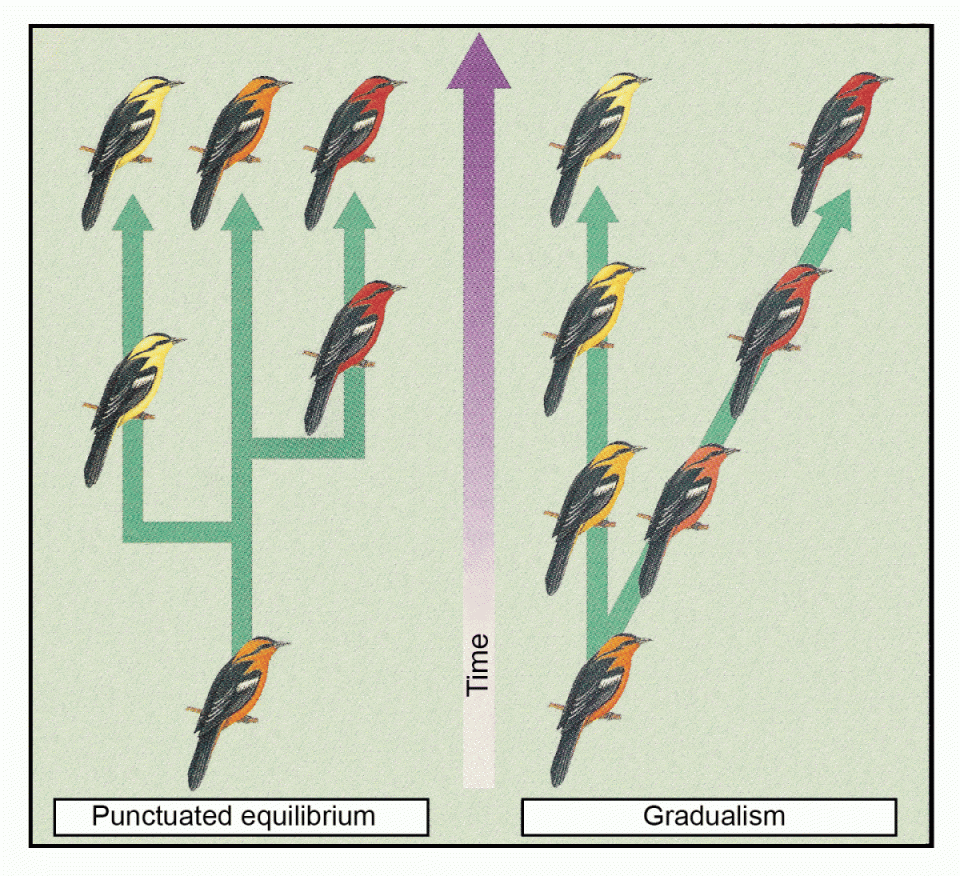
PE vs PG
You can see that in the PE model, a species remains in stasis while in the PG model a species is constantly changing. Looking at the fossil record, as I’ve shown previously, we will see that a great majority of species remained in stasis before a sudden phenotypic change (probably a change in environment forcing this). This is why, in my opinion, there are hardly any transitional fossils. This is the best theory to answer Darwin’s question.
Blacks Are Not Stronger Than Whites
1950 words
Blacks being stronger than whites (on average) is one of the most common misconceptions around. People assume that since blacks are, on average, more muscular and have less fat mass they are stronger than whites and East Asians. However, when looked at physiologically, the frequency of muscle fiber types (Type I, Type II and Type II A) differ between the races. The differing somatypes (mesomorph, ectomorph and endomorph) also show how there are differences in strength between races due to leverage.
Some people, like PumpkinPerson, fall prey to this simplistic, yet with great explanatory power for a lot of things, Rushton’s Rule. Rushton’s rule dictates that there is a gradient of traits that some races perform statistically better or worse on with Mongoloids at the top, whites in the middle and blacks on the bottom. PP assumes that blacks should be stronger than whites who would be stronger than East Asians due to this rule. He also assumes that since blacks have slightly more testosterone on average that they would be the physically strongest race. This, however, is not true.
PP says:
One reason they believe this is because of Allen’s Rule, a theory claiming that body types evolve to become more linear in warm climates and more rounded and compact in cold climates. Round forms, having smaller surface area to volume ratios, are thought to freeze less easily. There’s also Bergmann’s Rule which asserts, for similar reasons, that body size evolves to be large in cold climates and small in warm climates.
Somatype has more to do with it than Allen’s Rule. Blacks are more mesomorphic whereas whites are more endo.
One reason Allen’s rule makes sense to people is their image of black physiques comes from Third World African countries where malnutrition is rampant. Of course people in those countries are especially skinny, but when you compare blacks and whites reared in the same country, blacks are heavier, despite being a bit shorter.
On the contrary. As I’ve covered here before, black American men with more African ancestry are less likely to be obese. Still, racial differences in strength come down to leverage as well as muscle fiber typings which I’ve discussed a few times here.
Of course weight and strength are not the same thing. In order to compare the races in strength, I found a study of police officers which compared the bench pressing ability of black and white officers, both at the time they were recruited, and after years on the job. The study found that upon recruitment, the average white man could bench press 84.2 kg (standard deviation = 21.2), the average black could bench press 95.1 kg (SD = 24.6). In other words, black men are 0.51 SD stronger than white men. If we convert strength to farmilliar IQ scale, where the white mean is set at 100 and the white SD is set at 15, then white men have a (sex adjusted) SQ (Strength Quotient) of 100, and black men have an SQ of 108.
Both races improved after years of on the job training, but the gap remained. Black women could also bench press more than white women, both at recruitment, and especially after training in both groups.
From the discussion of the study:
“The literature suggests that increases in body mass correspond with increases in
lean mass by as much as 44% (11). The officers in this study gained a significant amount of body mass and correspondingly, a significant amount of lean mass. Lean mass is associated with increases in strength (11, 25, 27). Therefore, we would expect to see an increase in absolute bench press strength related to lean mass gain alone. However, the strength gains were negated when dividing the body mass of the officers into their bench press scores. This pattern was not seen in the black males, where they actually decreased in the bench press/body mass ratio. Even though the bench press/body mass measure did not increase over the 12.5 years for black males, it also did not decline as indicated in cross-sectional research (42).”
It seems this is anomalous. The researchers say this is the only study looking at this, and from what I can tell, they didn’t ask about dietary and or exercise habits, correct me if I’m wrong. They also say that blacks were heavier in BMI at the onset, but not in the follow-up.
I’d like to see another study like this before any conclusions are drawn. Because what I see in actual powerlifting competitions from people who go above and beyond their genetic potential when everyone is using, Caucasians (whites, MENA people) and East Asians are consistently always stronger than blacks.
Moreover, it seems PP didn’t read the full paper because they say in the discussion that blacks had a greater weight gain over the ten-year period. They had a greater body mass gain which corresponded to a loss in bench press as well as a loss in lean mass. However, even with these losses in the black subjects in this cohort, they were still stronger than whites, but the difference was not significant. Further, blacks decreased in strength in the 12.5 year period while the whites increased in strength. Blacks were STILL stronger than whites at the end of the study, but this difference was not statistically significant.
This study was anomalous and goes against everything I’ve personally seen in my time lifting and my career as a PT. Caucasians and East Asians are stronger than blacks. The differences come down to muscle fiber typing as I’ve said numerous times.
There is a correlation between strength and mortality. With a sample of 8762 men between the ages of 20 and 80, it was found that muscular strength was inversely and independently associated with death from all causes and cancer in men even after adjusting for cardiorespiratory fitness and other possible confounders. From the discussion of the paper:
The analysis on the combined effects of muscular strength and cardiorespiratory fitness with all cause mortality showed that the age adjusted death rate in men with high levels of both muscular strength and cardiorespiratory fitness was 60% lower (P<0.001) than the death rate in the group of unfit men with the lowest levels of muscular strength. These results highlight the importance of having at least moderate levels of both muscular strength and cardiorespiratory fitness to reduce risk of death from all causes and cancer in this population of men.
The point of bringing this paper up is that Caucasians and Asians are stronger than blacks, and also live longer. This is just like the correlation between IQ and life expectancy. Since men with higher levels of strength live longer than men with lower levels of strength, this strengthens my hypothesis for strength-based competitions and the racial mix of the competitions. Caucasians and East Asians, who have higher IQs than blacks, are also stronger than them on average, which also correlates with life expectancy.
I already covered the above here.
PP says:
2) The average white is weaker than the average black, but there might be certain white ethnic groups that are especially strong
Northern Europeans dominate in Strongman. Blacks are more lanky, yet they are also more mesomorphic which correlates with strength so it cancels out. From what I see at my own gym I go to, which is a powerlifting/bodybuilding gym, Caucasians and East Asians are consistently stronger than blacks. I’ve been lifting going on ten years and this is my personal observation. I’ll see the outlier here and there, but the whites and East Asians are consistently stronger. Southern Europe does do bad in Strongman, so it may be that only Central and Northern Europe are more strength oriented, probably coinciding with Rushton’s Rule.
3) whites have lower mean strength but might have a greater standard deviation; however the police study above did not find this, and it fails to explain why black dominate body building
No way do whites have a lower mean strength. From what we can see from the genetic freaks of nature, the best of the best, Caucasians and East Asians dominate in these types of competitions.
Strength doesn’t matter in bodybuilding, PP.
This is the perfect example of one who thinks that blacks are stronger because of their domination in bodybuilding. BUT, actual strength competitions tell us the opposite.
4) whites dominate strongest man competitions because they’re not athletic enough to do anything else, while the strongest blacks play lucrative sports like boxing, football and basketball instead.
You’re right; whites dominate Strongman because of a genetic predisposition, Type I muscle fibers. This is why whites aren’t as athletic as blacks, muscle fiber typing and the fact the whites, on average, hold more body fat than blacks, as seen above in the article of mine that I linked.
It’s not about blacks playing the more lucrative sports. Blacks gravitate towards sports where they can showcase their athleticism and people pay to see that.
Here’s a BB.com thread. Of course ‘da socialization!!’ trots out and at least one person says genes and another says ‘speed’. Which is the correct answer. You didn’t bring up muscle fibers either PP. For instance, as I said, Type I fibers lead to more strength and muscular endurance as they are slow to fire off, while Type II fibers fire quicker and tire faster. This is why West African blacks and their descendants dominate in sprinting and other competitions where fast twitch muscle fibers dominate in comparison to slow twitch. The two fibers also fire through different pathways (aerobic and anaerobic) which also dictate the rate of force production, muscle contraction, and whether or not the muscles fire off fast or slow.
Araujo et al (2010) analyzed “racial/ethnic differences and racial/ethnic group-specific cross-sectional age differences in measures of muscle mass, muscle strength, and physical function among men.” They obtained the data from the Boston Area Health and Bone survey. There were 1,157 subjects in the cohort between the ages of 30-79, and a mix of blacks, whites and ‘Hispanic’ men from Boston who were randomly selected. They measured upper body strength with a hand dynamometer while lower extremity functioning was measured with walking and chair tests. The only thing, however, was that there was no statistical difference between whites and blacks in the grip strength test, however whites edged out blacks slightly.
The authors state:
In contrast, grip strength/arms lean mass differed significantly by race/ethnicity, with higher estimates observed among white compared to black and Hispanic subjects (p < .01). However, further adjustment for composite physical function score and LMI confounded this association (p = .15).
This proves my point (along with my years of anecdotal experience) that whites are stronger than blacks.
Finally, the authors state in the conclusion:
Further exploration of why higher lean mass in non-white subjects do not appear to translate into higher strength and physical function is warranted.
The difference is muscle fiber typing!!! This, PP, shows that blacks are not stronger than whites, despite blacks ‘looking stronger’.
In conclusion, blacks aren’t stronger than whites. Check out any strength competition or and WSM competition and you’ll see exactly what I’m describing here. The people in those competitions are genetic freaks of nature, the best of the best. If there is a difference between races in these competitions, it would come out at the elite level. Like with football, baseball, and swimming, there are racial differences in strength which clearly come down to genetics and muscle fiber typing. Everything doesn’t fit into Rushton’s Rule as there are more complicated differences between the races that need more complicated explanations. Strength is one of them. This is just like how the Alternative Hypothesis thinks they “solved Gary Taubes’s race problem in regards to diet“. However, both PP and the guys at TAH don’t know enough about nutrition nor strength training to make these judgements.
Evolution is *NOT* Progressive
4200 words
PumpkinPerson still believes that evolution is progressive. What exactly is evolution through natural selection ‘progressing towards’? Some, like PP, may say it’s progressing towards a better organism for that specific environment. However, there is no end game. That organism will still continue to change based on whatever changes in its environment. One of the most common misconceptions about evolution is that it’s progressive. One assumes that by looking at the progression from the earliest forms of life to today, that humans must be at the top of this ‘evolutionary ladder’ so to speak. However, evolution has no end game, nor is it conscious to be able to have humans be at the top of this ‘evolutionary ladder’. I’ll take the last thing that PP said to me on his blog and reply to it here as well.
Evolution can happen in four ways: migration, mutation, genetic drift, and natural selection (NS). Evolution is a non-conscious, non-linear event that occurs to make an organism more fit for its environment. Progressive evolution assumes that it’s linear and so evolution is a straight line from ‘more evolved to less evolved’. Would that make sense? For evolution to be in a straight line? Or would a branching tree make more sense? PP knows this fact, yet still attempts to say that the ‘newest species are the “most evolved”‘. We can take 2 genetically similar organisms and put them into one cold environment and the other a hotter environment. Will one of them be “more evolved” than the other in a few generations? Or does evolution dictate what changes occur and there is no “more evolved” because each organism is suited to its environment?
PP says:
No that’s not the point. If two populations are both descended from a common ancestor, and population A remains more similar to that common ancestor than population B, then population A is less evolved, because it’s done less evolving from the common ancestor. Why can’t you grasp this concept, RR?
I do grasp it, it just makes no sense. Because even that organism that “stayed close to the common ancestor” is still markedly different than the common ancestor.
Actually that’s not true. Humans are close to reaching the point where we no longer evolving in the conventional sense. Any further genetic change will be self-directed, via genetic engineering, and not the product of natural selection and genetic drift. And progress needn’t imply an end point, it only implies more recent forms will on average be more adaptable than life from millions of years ago.
This was in response to me saying that evolution would continue until all organisms die out or the Sun explodes. Even the with the genetic change we bring about ourself with CRISPR, we would still be evolving genetically. Umm progress DOES imply an end point. Progress means progression, what is an organism progressing towards? Being more efficient? No. Progression denotes an end game. There IS NO endgame with evolution. Evolution just happens to increase fitness for an organism and population.
I don’t have any misconceptions when it comes to evolution RR. It’s you who is confused. And I’ve seen Dawkins talk about evolutionary progress. He shows some understanding of the concept, but it’s not complete.
Yes you do have misconceptions when it comes to evolution, PP. There is no way to quantify progress in regards to evolution. You can choose some arbitrary traits, but that’s just our perception of it. You cannot objectively say that one organism is “more evolved” than another based on those traits.
I forgot that Dawkins believes in evolutionary progress. That doesn’t change my mind on this matter. I’m sure that Dawkins of all people knows that each organism is suited for its environment, not perfectly, but good enough. Evolution makes organisms good enough in order to transmit its genes to the next generation. How can you say that there is progress when each organism is fit for its environment? How can you believe in this notion when evolution through NS, migration, mutation and genetic drift make each organism unique in order to survive in its own specialized niche? As I will say below, Darwin’s Finches are the perfect example of how evolution is not progressive. They are fit for each environment. The tree finch has a blunt beak for tearing vegetation, the ground finch has a broad beak for crushing seeds, and Warbler finch’s small beak makes it good for eating insects. Each bird evolved from the same ancestor, each evolved in different ecosystems on the same island, but they evolved to do different things based on what they had to do to survive in that ecosystem. This very simple example shows that evolution is not progressive, and that these mutations occur to better help an organism in that niche in the ecosystem.
Next PP quotes Rushton from Race, Evolution, and Behavior where he says:
In their reviews, Lynn (1996a) and Peters (1995) both referred to my ranking of species on evolutionary scales. For Peters, this was a highly contentious idea but in Lynn’s positive review, he described me as proposing that the K-strategy was “evolutionarily more advanced” and that the Oriental race was “the most evolved.” In fact, I did not use either of these phrases in the book, although I had alluded to similar ideas in previous writing. Regardless, the topic of evolutionary progress provides an intellectual challenge of the first order and needs to be addressed. Figure 10.2 (p. 202) does imply a move from simple r-type animals producing thousands of eggs but providing no parental care to more complex K-type animals producing very few offspring.
In his book Sociobiology (1975), E. O. Wilson also promoted the idea of biological progression, outlining four pinnacles in the history of life on Earth: first, the beginning of life itself in the form of primitive prokaryotes, with no nucleus; then the origin of eukaryotes, with nucleus and mitochondria; next the evolution of large, multicellular organisms, which could evolve complex organs such as eyes and brains; and finally the beginnings of the human mind. (Rushton, 1997: 292-3)
I still don’t see how it’s “progressive and more evolved”. Each organism is suited for its environment to make sure that it breeds and continues its genetic lineage. I see how one could say that newer organisms are “more evolved”, however, each organism is suited for its environment.
You have no idea what you’re talking about. Humans who left Africa 60,000 years ago looked like Andaman islanders who clearly look like modern Africans today. Further, facial reconstructions of the African Eve from 125,000 years ago also looks like modern Africans. The notion that modern looking Africans are only 10,000 years old is INSANE. Did they look EXACTLY like Africans today? No. Were they close enough that no one would think twice if they walked down the street in modern clothing? Yes.
I HAVE NO IDEA WHAT I’M TALKING ABOUT, yet PP thinks that damn reconstructions mean ANYTHING!! Forensic facial reconstruction is one of the most subjective techniques in forensic anthropology. The skin thickness is subjective to the forensic artist, but I’m sure that that means that the facial reconstruction of Mitochondrial Eve is even a close representation of what she actually looked like. The fact of the matter is, facial reconstructions are highly subjective to the individual forensics artist. There is a great example in the link about how facial reconstruction isn’t anywhere near perfect:
A second problem is the lack of a methodological standardization in approximating facial features. A single, official method for reconstructing the face has yet to be recognized. This also presents major setback in facial approximation because facial features like the eyes and nose and individuating characteristics like hairstyle – the features most likely to be recalled by witnesses – lack a standard way of being reconstructed. Recent research on computer-assisted methods, which take advantage of digital image processing, pattern recognition, promises to overcome current limitations in facial reconstruction and linkage.
Keep in mind that PP believes that Australasians are Negroid, despite the fact that I’ve shown him wrong on that time and time again. Phenotype does not always equal genotype. Just because one group is phenotypically similar to another DOES NOT MEAN that they are genetically similar. It’s PP that doesn’t know what he’s talking about.
How is the notion that modern-looking Africans are 10k years old insane? I see PP doesn’t keep up with the latest studies. Is the notion that modern-day Europeans are 6500 years old insane as well?
It shows that there are lineages that become very adaptable despite not being very evolved, and some that don’t need to be adaptable because they lucked into a fixed ecological niche. But generally speaking, across all lineages, more recent forms of life are more adaptable than more ancient forms of life.
This was in response to what I said to him about there being mosses and fungi who’ve stayed pretty similar. This SHOWS that evolution is not progressive. More recent forms of life are more adaptable? You mean that more recent forms of life incurred more mutations to be more adaptable.** Evolution through NS is about being good enough to pass on your genes, that’s it. Whether or not one species is “more evolved” (whatever that means) over another is meaningless as all that’s occurring is genes passing to the next generation. Break down all of these processes to the simplest possible level and this is what we are left with.
Then I cited two links which said:
“There is no ‘progress’ in evolution. No living thing is trying to get anywhere,” Zuk said. “And humans are not at the pinnacle of the evolutionary ladder.”
…
Evolution, she said, is no engineer, building the perfect organism from scratch every time the environment changes. Rather, evolution is the ultimate tinkerer, always having to make do with the parts on hand. Its creations tend to be imperfect, just fit enough to survive.
To which PP replied:
WRONG! Humans are the highest branch within the homo evolutionary tree which is the highest branch within the primate evolutionary tree which is perhaps the highest branch of the mammal evolutionary tree, which is perhaps the highest branch within the animal evolutionary tree etc. This can be seen in phylogenetic diagrams.
PP, it specifically said evolutionary ladder. Phylogenetic diagrams prove that evolution is non-linear and does NOT go in a straight line. Phylogenetic diagrams prove that evolution is a tree and not just a straight line of ‘progress’.
And yet evolution has created the human brain, the most complex known object in the universe.
That doesn’t say anything to the fact that evolution is not an engineer making perfect organisms for their environment. All an organism needs is to be “good enough”. It’s not survival of the fittest as much as survival of the good enough. Sure evolution ‘created’ the human brain. But that doesn’t make evolution, a non-conscious event, an engineer. Why do so many atheists have so much faith in evolution, putting human qualities into it when evolution through natural selection is just a process of making sure that an organism passes its genes on? It is one hundred percent correct that evolution is the “ultimate tinkerer”, making organisms “just fit enough to survive”.
And the other link I cited, which uses Darwin’s finches as an example of the non-linearity of evolution says:
A study of the DNA of Darwin’s finches on the Galapagos Islands (Petren et al. 1999) provides a good example of why the idea of progress makes no sense in evolution. The study’s findings suggest that the first finches to arrive on the islands were the Warbler finches (Certhidea olivacea), whose pointy beaks made them good insect eaters. A number of other finches evolved later from the Warbler finches. One of these is the Geospiza ground finch, whose broad beak is good for crushing seeds, and another is the Camarhynchus tree finch with its blunt beak which is well adapted for tearing vegetation.
..
Even though biologists reject the Great Chain of Being or any similar ladder-of-progress explanation of evolution, the idea still persists in popular culture. A more accurate analogy would be that of a bush that branches in many directions. If we think of evolution over time in this way, we’re less likely to be confused by notions of progress because the branches of a bush can grow in various directions in three dimensions, and new branches can sprout off of older branches without implying that those farther from the trunk are better or more advanced than those closer to the trunk. A more recent branch that has split off from an earlier branch-like a species that has evolved from an ancestral species-does not indicate greater progress or advancement. Rather, it is simply a new and different growth on the bush, or more specifically, a new species that is sufficiently adapted to its environment to survive.
To which PP replied:
The idea of progress makes sense when you look at the grand sweep of evolution across BILLIONS OF YEARS. We’ve gone from simple, restricted life forms that could only survive in the ocean, to complex adaptable GOd-like life-forms like humans, that can live in virtually any environment, and travel to space.
This doesn’t say anything to what was quoted, PP. The fact that Darwin’s Finches each evolved on the same island, yet have completely different phenotypes depending on what they have to do to survive shows that evolution is not progressive and that there is no “more evolved” life form, just life forms surviving. Love how you sidestepped that quote.
This is the same tired nonsense. In evolution, almost every time one branch splits into two, it means evolutionary growth has occurred. So if you’re the first branch, and you don’t do anymore branching, you’re less evolved, and typically less complex and versatile than branches that split off after much branching occurred.
Yes PP. Keep repeating the “if you’re the first branch and you don’t do any more branching than you’re less evolved” canard. PP is confusing “more evolved” for more complex.
Let me repeat this quote again because it’s perfect for this discussion:
If we think of evolution over time in this way, we’re less likely to be confused by notions of progress because the branches of a bush can grow in various directions in three dimensions, and new branches can sprout off of older branches without implying that those farther from the trunk are better or more advanced than those closer to the trunk.
But I’M the one who doesn’t get it. Just because changes occur to make new species does not mean that the common ancestor is “less evolved”, it just means that there were different selection pressures that forced these changes to happen!! That’s it!
Just because your teacher told you something years ago doesn’t make it true, PP. It doesn’t mean that your teacher “got it” while everyone else is blinded to the fact of “organisms being more evolved than others”.
Level 1: People who don’t believe in evolution
Level 2: People who think evolution is progressive because they don’t understand the random nature of natural selection (most secular non-scientists fit in this category)
Level 3: People who think evolution is NOT progressive because they understand natural selection is random and geared to specific environments(most scientists and science writers and bloggers fit in this category)
Level 4: People who realize that even random processes will eventually show progress through billions of years of trial and error, and no environment is 100% specific (many of the greatest minds in history reached this stage: E.O. Wilson, Darwin, Rushton)
You’re stuck on Level 3, RR, and so are all the people you quote. I hope your mind can one day make the leap to Level 4.
This is hilarious. The fact that NS is random SHOWS that evolution is not progressive. PP may say “over billions of years through trial and error it made ‘more evolved’ organisms”. I love how PP’s speculations are the final word and what I say and who I quote are conveniently a level below his little hierarchy.
On PP’s “Level 4”:
NS, migration, mutation and genetic drift are how organisms evolve. Changing the mix of the 4 will lead to different outcomes each time. What PP is trying to say here is that I’m conveniently below the level that he’s at because he recognizes evolution as being “progressive” “progressing to be the ultimate organism in that environment”.
On the non-linearity of evolution:
“The idea of sharing a common ancestor leads to the second major misunderstanding inherent in the question,” says Dr Willis, “that evolution is a linear process where one species evolves into another.”
Evolution is really a branching process where one species can give rise to two or more species.
“The fallacy of linear evolution is most clearly illustrated by the analogy of asking; how can I share common grandparents with my cousins if my cousins and my grandparents are still alive?,” says Dr Willis.
“The answer is of course that your grandparents had more than one child and they each went off and started their own families creating new branches of your own family tree.”
The same thing happens in evolutionary families. A species can split into two or more descendant species and they can split again and again across the generations.
But PP would say that the organism who branched into the new one that stayed the same is “less evolved” than the other, when the only difference is that the newer organism faced different pressures which led to different changes!
Let me repeat: evolution is not progressive. Each organism is suited for its environment so that it can pass its genetic code to the next generation. Even an earlier organism is not “less evolved” than one that came after it, because it still has to survive in that ecosystem. The process of evolution leads to a branching pattern of relationships amongst similar organisms.
Ever since Aristotle, people have had an inclination to rank living things in a single dimension of “lower to higher” or “primitive to advanced”. Such rankings have a name, “the Great Chain of Being” or “the Ladder of Life”. But such rankings have no basis in evolutionary biology. All living organisms occupy equivalent positions on the tips of the latest twigs in phylogeny. The “lowliest” worm or microbe is just as “advanced” (i.e., has been just as successful at adaptation and reproduction throughout its lineage) as is the ‘highest” primate or social insect. “Progress” was an essential feature of some pre-Darwinian evolutionary theories, notably Lamarck’s believe in evolution driven by inward striving toward improvement. But modern evolutionary theory supports no clear expectation of progress, at least not in any dimension that has yet been explored.
Isn’t there an obvious sense in which evolution MUST be progressive? Doesn’t natural selection assure that species are always becoming better adapted, so that degree of adaptedness must be increasing over time? Doesn’t the fossil record document continuing advancement toward improved design and complexity? Doesn’t the process of adaptative radiation (continuing speciation with adaptation) guarantee that the ecological world will be ever more precisely subdivided into niches occupied by ever-increasing numbers of species?
In short, no. No one has yet demonstrated any measureable parameter that shows a consistent, reliable increase over time as evolution proceeds. This is an important point. Belief that evolution is always necessarily “improving” something can interfere with clear appreciation of the actual mechanism of evolution, which is simply the replacement of one heritable variant by another because, in specific conditions which include the presence of both variants, one does better than the other.
Concepts and Questions in Evolutionary Biology. Is evolution progressive?
As I keep saying to PP, each organism is fit for its environment. You can use some arbitrary things to say “this more evolved than that”, but evolutionarily speaking it doesn’t make sense, as I keep saying, because each organism is perfectly suited to its environment.
Yes, bacteria is simpler than a hawk, but that doesn’t mean that it’s any less adapted to its environment than a hawk is.
Evolution arises from mutation, genetic drift, migration and finally natural selection. This leads to large random variations amongst individual organisms. Natural selection then acts upon those random variations and over time this leads to differences between organisms which lead to them eventually becoming different species. How one can then make the leap in logic to say that evolution is progressive due to that is beyond me.
We only ASSUME that evolution is progressive because we look at traits that have been selected for and we don’t look at the traits that have been made negative due to the positive selection. Another point that PP likes to bring up is that the increasing complexity and increase in brain size shows how it’s progressive. However, our brains are shrinking. So if evolution was ONLY PROGRESS, why is the “most complex thing in the known universe” getting smaller? And with a decrease in brain size comes a decrease in intelligence. Such progress PP!!! Evolutions has no direction so it CANNOT be progressive. Most people want to assume that evolution is linear and thusly we were here BECAUSE we’d have been here regardless of what happened. This is not true. The fact of the matter is, evolution is a random process. The only reason there is a belief that evolution is progressive is because we strive to make meaning in everything in our lives even when there is nothing there.
Now with the thought that evolution is progressive, comes the thought of more evolved and less evolved races. As I have shown early in this article, Rushton believed that Mongoloids were “more evolved” because they came last. This then assumes that Africans are “less evolved” because they came first. This, however, makes no evolutionary sense. I love Rushton and all he did to bring racial differences to the mainstream, but evolutionary biologist he was not. The assumption here is that East Asians and Caucasians are the newest races, and thusly would have to be more advanced than the Africans. However, these notions are baseless. They are extremely subjective and one cannot say that one race is “more evolved” or “more superior” than another.
As the story is untangled, it will also become obvious how inappropriate it is to talk in terms of the “inferiority” or “superiority” of groups. Consider, for example, the Big Five personality traits: openness, conscientiousness, extraversion, agreeableness and neuroticism. What are the ideal points on these continua? They will differ depending on whether you’re looking for the paragon of, say, a parent or an entrepreneur.
Nicholas Wade says:
From an evolutionary perspective, African populations were just as well adapted to their environment as were those of Europe and Asia to theirs. Small. loosely organized populations were the appropriate response to the difficult conditions of the African continent. But they were not necessarily well suited to high efficiency economies to which European and East Asian populations had become adapted. From this perspective, if valid, it would be unsurprising that African countries should take longer to make the transition into modern economies. (Wade, 2015: 181-2)
And finally I asked Razib Khan what he thought about this back in August. He said:
people who talk in those terms about population genetics are inferior and less evolved. sabine’s statement in my other posts applies: you’re not a serious thinker and label yourself as stupid or ignorant.
This notion of “superiority” when discussing human races, or even organisms as a whole is baseless. When looking at subjective traits then we can say that. BUT objectively, there is no way to quantify this.
Some people in the HBD-sphere, as well as the Alt-right, may say that Eurasians are ‘superior’ to Africans. On what traits? Because looking at a completely different set of traits would have you come to the opposite conclusion. Like with r/K Selection Theory (now known as the CLASH model). People assume that Africans and others who live nearer to the equator are inferior due to how many children they conceive. However, from an evolutionary perspective, the ultimate measure of human success is not production, but reproduction (van den Berghe, 1981). When that single variable is looked at, they are “more evolved” and if PP were to be believed, evolution is going backward for Eurasians since they have fewer children than Africans.
In sum, evolution is NOT progressive. Mutation, migration, and genetic drift set the stage for differences between organisms, then natural selection selects for those advantageous alleles which then get passed on to the next generation. This notion of progressive evolution is ridiculous. Evolution is a branching tree, not a straight line as is commonly thought. Progressive evolution assumes that we are progressing towards something. This is not the case. Evolution just happens, it’s not attempting to “progress” anywhere as these differences between organisms just happen and thusly you cannot say that one organism is “more evolved” than another nor can you say that this organism showed more “evolutionary progress” over another as changes are random.
More Thoughts on Bipedalism
1050 words
I wrote about bipedalism last week, however, in a conversation with a commented on PumpkinPerson’s blog, I came to a slightly different conclusion than I did in my previous article on the matter.
I quoted Daniel Liberman, author of the book The Story of the Human Body: Evolution, Health, and Disease:
As one might expect, other selective pressures are hypothesized to have favored bipedalism in the first hominins. Additional suggested advantages of being upright include improved abilities to make and use tools, to see over tall grass, to wade across streams, and even to swim. None of these hypotheses bear up under scrutiny. The oldest stone tools appear millions of years after bipedalism evolved.(Lieberman, 2013: 43)
However, after being linked to this journal article Shallow-water habitats as sources of fallback foods for hominins, I began to rethink my position on this matter.
Now, the climate change when humans and chimps diverged is still the primary cause of bipedalism, but after reading this abstract, I came to think that the climate change (getting warmer) rose the sea levels which then drove Man to walk on two legs, gather food, and, eventually, wade in water to find more food which led to some selection for bipedalism in our ancestors. Humans needed to become bipedal to find more food as the climate change made their primary food more scarce. This then drove early Man into shallow waters to look for food.
As the climate was getting warmer, the same foodstuffs we ate were not as readily available. So what drove us to be bipedal was 1) the need for immediate food, i.e., looking for food on the forest floors and 2) when adequate food could not be found on the floors of the forests, Man then had to go into the water. This had multiple advantages. One could escape from predators, find more food with adequate nutrients which, in turn, had as evolve bigger brains, and the most important aspect, it’s much easier to be bipedal in water as it’s easier to stand in water.
This paper, The evolution of the upright posture and gait—a review and a new synthesis, concludes:
Wading was an appropriate trigger not only to stand up but also forced the primate to walk on. It seems likely that habitual bipedalism began not long after the separation from the gorilla and chimpanzee clade(s). From that time onwards, throwing could be evolved with free upper extremities much more successfully than before. Selective factors related to the reduction of incoming solar radiation became effective. Endurance running and adaptations to carry tools (like weapons) started their evolutionary improvements. If these processes took about 4 Ma, the wading hypothesis is consistent with a rather perfect bipedal anatomy as shown, e.g., in Homo ergaster (WT 15000), about 1.6 Ma ago. In this way, many of the hypotheses competing in the past may be harmonised, as some of them have yielded important contributions to the understanding of the evolution of the human habitual upright gait.
The first sentence corroborates what Lieberman says in The Story of the Human Body. The final sentence brings together all of the theories that drove bipedalism in humans into a ‘new synthesis’.
Now, climate change (the earth getting warmer) is still the ultimate cause, but a proximate cause of bipedalism is wading in the water to 1) find more food and 2) escape predators.
This ‘new synthesis’ of how Man became bipedal is a great way to unify a lot of theories of bipedalism that gave us great understanding of human evolution in regards to bipedalism. In that vain, it’s like E.O. Wilson’s Sociobiology: A New Synthesis in which he sought to unify the evolutionary mechanics of altruism, aggression, and nurturance– our main social behaviors. This ‘new synthesis’ in the study of how we became bipedal unifies competing theories into a more understandable theory.
Moreover, bipedalism made it easier to consume more kcal which led to bigger brains. To quote Suzana Herculano-Houzel from her book The Human Advantage: A New Understanding of How Our Brain Became Remarkable:
“The remaining way to work around an energetic constraint to the number of neurons in the brain involves dietary changes that would allow for more calories to be obtained in the same amount of time, or even less. Some first changes in that direction probably took place 4 million years ago when our australopithecine ancestors stood upright and became habitual bipeds. As Daniel Lieberman explores in detail in The Story of the Human Body, bipedality potentially increases the amount of calories that can be amassed in a day by extending the range of food picking, for it is much easier and costs four times fewer kilocalories to walk on two feet, as humans do, than on all fours, as modern great apes do and the ancestor from which australopithecines originated must have done. Roaming away from home to find food, is the definition of a food gatherer, as opposed to a food picker, which is what great apes remain to this day. Bipedality made food gatherers of our ancestors.” (Herculano-Houzel, 2016: 189)
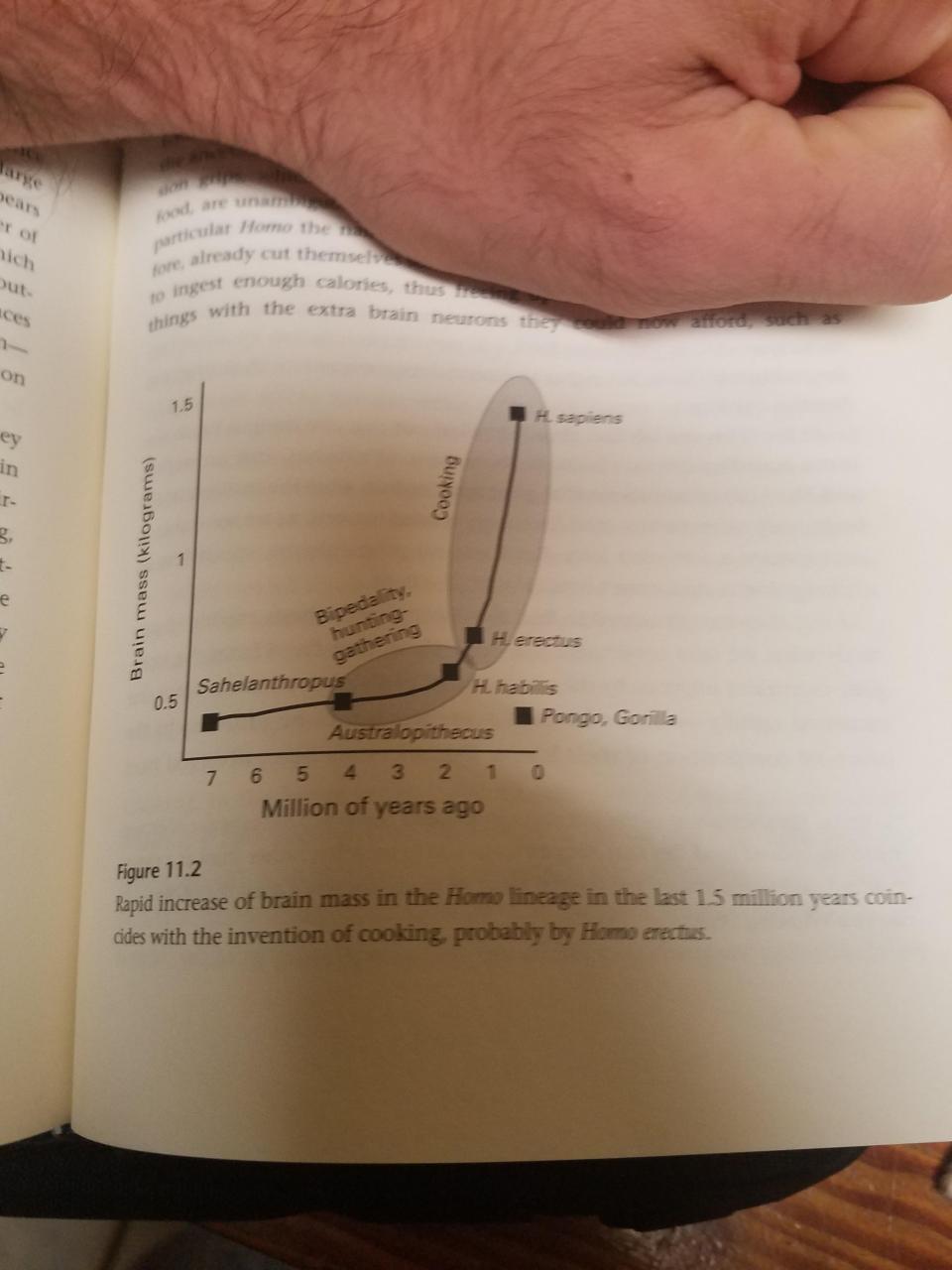
This graph from her book shows that bipedality preceded cooking which increased our brain size (I will write on that soon).
More neurons in the cerebral cortex is the cause for our amazing brains. But we are NOT unique!! This kcal increase led to more neurons in our cerebral cortex which then allowed for reasoning, finding patterns, developing technology and passing it on through culture. Cooking is why we are so ‘unique’ in comparison to other animals. As shown in the graph above, the increase in brain size happened around the time of H. Erectus. They show smaller teeth at that period, which shows that the selection was already occurring. The smaller teeth to break down food more to extract nutrients from the food they gathered shows that bipedalism evolved alongside the evolution of smaller teeth.
In sum, the ultimate cause of bipedality is still climate change, but the proximate cause, in part, was wading in the water which led to our ancestors to find more food. And, over time, we were selected for bipedalism as I wrote in my previous article on the matter. We can see that bipedalism slightly predated cooking, which the ultimate cause of which was to find more food. This is seen in the records we have. I will write more on this in the future as I read into this more.
Australasians are Not Negroid So Stop Saying It!!
850 words
PumpkinPerson STILL doesn’t want to admit that Australasians aren’t Negroid. No matter how many people, studies or books I cite, he still wants to hold on to this Afrocentric belief of a “large pan-African race“. This is not true. I don’t know how many times I need to type it. Maybe if I type it until my fingers become stubs he will get it?
In fact, Friedlaender et al (2008) agree with me:
Our Structure and tree analyses of the combined microsatellite datasets indicate that Melanesians are quite far removed from Africans, in spite of their superficial similarities in hair form and skin pigmentation [38]. In the initial analysis of the HGDP-CEPH dataset, the placement of the two Melanesian (“Oceanic”) groups was different. There, they split from Eurasia before Asians and Native Americans [39]. This also differed from the result of a genome-wide SNP study [40] on a very small world-wide dataset. The extreme positioning of Melanesians in our tree was not due to our over sampling. Rather, our extensive coverage of Melanesian variation has enabled a clearer resolution of their relationships with populations outside the region.
They cluster nowhere near the vicinity of Africans.
To say that Australasians are Negroid based on phenotypic similarity means the one in question is basically treating race as a “social construct“. Just because two genetically isolated populations look similar doesn’t mean that they are of the same racial grouping.
Since Australoids “look African” as PP claims, would he claim that Middle Eastern people such as the Kalash who look European to be European? I’m sure he would.
But I’ve already quoted Razib Khan as saying:
The final issue is that a lot of the phenotypes that we racially code are recent. This probably explains why groups like the Kalash and Nuristanis can look more like Europeans than South Asians, but they’re genetically more like South Asians.
And when asked the three theories that he thinks falls into the unsupportable category:
“that phylogeny and phenotype track closely. just because you can’t tell the physical difference between two pops (e.g., solomon islanders and sub-saharan africans) they must be phylogenetically close. this is not the case.”
Robert Lindsay gets it and says:
We can also do phenotypes, but the Australoid phenotype is not the same as the African phenotype. There are African phenotypes and Australoid phenotypes, and they plot into separate areas on skull charts with no overlap. On a skull chart, a given skull is either obviously Australoid or obviously Negroid, but in both groups or in an unclear group, and it is always clear which group one is in.
Surface similarities are just that; they mean virtually nothing. In terms of selected DNA, Australoids have selected furthest away from Blacks. As it turns out, features that were selected for in Africa such as non-straight hair, wide noses and dark skin were all adaptive in tropical Australasia also, so these meaningless surface traits were retained.
Are you kidding? You look at an Aborigine and a Nigerian, and to you, they are “just a couple of niggers?” Aborigines do not look like Black people at all. In fact, they do not look like anyone.”
There were 5 principal clusters of CA repeats, formed by people living in 5 of the continental regions of Africa, Europe, East Asia, the Americas, and Australasia. (Wade, 2015: 97) Peoples of the Pacific cluster into their own category. Nicholas Wade reported in 2002:
Scientists studying the DNA of 52 human groups from around the world have concluded that people belong to five principal groups corresponding to the major geographical regions of the world: Africa, Europe, Asia, Melanesia and the Americas.
The study, based on scans of the whole human genome, is the most thorough to look for patterns corresponding to major geographical regions. These regions broadly correspond with popular notions of race, the researchers said in interviews.
This ends it right there. If they even still showed a genotypic resemblance to Africans, they’d still cluster in the vicinity of them. They don’t.
PP then goes on to say that Fst is on “neutral DNA, so they are classifying largely on chronological distance, not genetically preserved phenotype. I’m not saying they’re necessarily wrong, only that we’re talking about two different types of classification systems.” I challenge him to find a study showing that Australoids and Melanesians are anywhere close to Negroids genotypically.
I asked Professor Greg Cochran, co-author of the book The 10,000 Year Explosion with Henry Harpending if Australoids and Melanesians were Negroid and this is what he said:
East Asians, Europeans and ‘Native Americans’ aren’t closely related to Africans either. Just because they “look African” does not mean they are African!
The Kalash people look European, but are they? No. They show similarity to South Asians. They, like Australasians, look similar to other populations because the phenotypes we code are recent. “Phenotypically similar” people are not genotypically similar nor the same racial/ethnic category. I also covered this here last month. Why doesn’t he get it yet?
Stop saying they are Negroid, they are not. They are Melanesian.
Agriculture and Evolution: A Reply to The Alternative Hypothesis
2050 words
I love nutrition science. So much so that I read a new book on it every week. The Alternative Hypothesis has a pretty old video on agriculture and evolution. I strongly disagree with his main thesis. I strongly disagree with his denigration of Gary Taubes. Most of all, I strongly disagree with what he says about the East Asian rice eaters because since that video has been made, the carbohydrate/insulin hypothesis of obesity has changed to the insulin hypothesis of obesity.
In the very beginning of the video he brings up Gary Taubes’s research on low-carb diets and how people tend to be healthier than those who eat higher carb diets. He brings up the East Asians who eat a lot of rice. However, it’s clear he doesn’t know that the percent of carbohydrate intake is nowhere near as important as the absolute amount of carbohydrate consumed:
- They consume a fraction of the sugar we do. More sugar consumption leads to greater insulin resistance, more fat creation, less fat breakdown, and more fat accumulation.
- They consume less total glucose, AND the glucose they consume is accompanied by less sugar (and less omega-6 PUFA, if it matters).
- They consume a ratio of omega-6 to omega-3 PUFA that is much lower than we do. This mayfurther reduce any insulin resistance brought on by the glucose they do consume (in smaller doses and with less sugar).
The fact that East Asians didn’t have high rates of diabesity (diabetes and obesity) was a big blow to the carbohydrate insulin hypothesis. However, the East Asian rice paradox is simply explained by low, if non-existent, consumption of refined carbohydrates. Those populations actually consume fewer total carbohydrates than Western diets, and have lower levels of glycemic load as a result. To quote Mark Sisson:
Before recently, Asians ate less refined sugar and used animal fats for cooking. Sugar intake is rising now, of course, and cooking oils made from corn and soybean have largely replaced lard and tallow, but rice in the context of a low-sugar, no-HFCS (remember, the oft-cited 55/45 fructose/glucose breakdown for HFCS is highly misleading and actually quite often incorrect), low-vegetable oil, nose-to-tail nutrient-dense diet is (or was) acceptable. You can’t reduce a food down to its constituent parts and focus on, say, the bit of fructose in a blueberry and then condemn the entire berry because of it. Similarly, you can’t reduce a diet down to a single constituent food and condemn – or praise – it based on that single food. You have to look at the entire picture, and the Asian diet is largely a nutritious one.
These paradoxes where one population seems to disprove a certain hypothesis are pretty easily explainable with the existing data. There are numerous reasons why East Asian rice eaters have lower rates of diabesity. Dr. Jason Fung also explains why:
Wheat, particularly in the modern iteration may be particularly fattening for numerous reasons. The high level of amylopectin means that most of the starch contained in flour is efficiently converted to glucose. This deadly combination of wheat and sugar has been introduced into the Chinese diet. The result is a Chinese diabetes catastrophe. The prevalence of diabetes in China has now even outstripped the USA.
This is the answer to the paradox of the Asian Rice eater puzzle. Why didn’t the Chinese have a diabetes epidemic in 1990 with all their white rice? Well, because they didn’t eat any sugar (fructose), they were not developing insulin resistance. Because they were not snacking all the time, they had periods of low insulin level that helped prevent the development of insulin resistance. So the high rice intake by itself was not enough to cause either of diabetes or obesity.
Then he says that whites intake more total carbs in comparison to blacks and ‘Hispanics’ (1:32 in the video). This is wrong.
Diaz et al (2005) showed that minority populations are more likely to be affected by diabetes mellitus which may be due to less healthy diets and/or genetic factors. Using the National Health and Nutrition Survey for 1999-2000, they analyzed overweight, healthy adults, calculating dietary intake variables and insulin sensitivity by ethnicity. They characterized insulin resistance with fasted insulin, as those who are more likely to become insulin resistant have higher fasted insulin levels (levels taken after waking, with the subject being told not to eat the night before as to get a better reading of fasted insulin levels). Non-‘Hispanic’ whites had higher energy and fat intake while ‘Hispanics’ had higher carb intake with blacks having lower fiber intake. Blacks and ‘Hispanics’ were more likely to have lower insulin sensitivity. However, ‘Hispanics’ were more likely to have lower insulin sensitivity even after controlling for diet, showing that metabolic differences exist between ethnicities that affect carbohydrate metabolism which leads to higher rates of diabetes in those populations.
Diaz et al state in the results of the study:
Dietary differences are seen by ethnicity, with non-Hispanic whites having higherenergy, saturated fat and total fat intake, while Hispanics had higher carbohydrate intake and African-Americans had lower fibre intake.Both African-Americans and Hispanics had higher levels of fasting insulin, demonstrating lower insulin sensitivity in comparison with non-Hispanic whites.
So now that I’ve established that blacks and ‘Hispanics’ consume more total carbohydrates from refined foods, now I’ll show the physiologic effects of insulin.
Insulin inhibits the breakdown of fat in the adipose tissue by inhibiting the lipase that hydrolyzes (the chemical breakdown of a compound due to a reaction with water) the fat out of the cell. Since insulin facilitates the entry of glucose into the cell, when this occurs, the glucose is synthesized into glycerol. Along with the fatty acids in the liver, they both are synthesized into triglycerides in the liver. Due to these mechanisms, insulin is directly involved with the shuttling of more fat into the adipocyte. Since insulin has this effect on fat metabolism in the body, it has a fat-sparing effect. Insulin drives most cells to prefer carbohydrates for energy. Putting it all together, insulin indirectly stimulates the accumulation of fat into the adipose tissue.
Do you see why blacks and ‘Hispanics’ are more susceptible to obesity?
Another glaring error he commits is not separating refined carb consumption with natural carb consumption. Refined carbs spike insulin much more than those foods with natural carbohydrates. East Asians do not have a “higher carbohydrate tolerance than Europeans” (2:06 in the video). This one huge error he commits completely discredits his hypothesis.
He then goes on to talk about India’s diabetes rates. But why is it increasing? Because of Western diets. It’s not about a “lower carbohydrate tolerance” as he says at 3:07, it’s about consuming more refined carbohydrates.
Then at 5:05, he says that he’s “solved Gary Taubes’s race problem in regards to diet”. He did nothing of the sort.
I, of course, have no problem with his IQ data. I have a problem with the conclusions he jumps to in regards to carbohydrates and diabetes. He clearly didn’t look at other factors that would explain why East Asians have lower rates of diabesity (which is increasing as they adopt a Western lifestyle… Weird…). The same thing explains it with the Australian Aborigines.
I have absolutely no problem with the second half of his video. My problem is the first half of it–his denigration of Taubes, non-understanding of insulin spikes in comparison to the quality of carbohydrate ingested and not controlling for refined carbs– as it’s clear he didn’t do extensive research into these populations (which Taubes and others have) to show why they don’t have higher rates of diabesity.
What he doesn’t touch on are “obesogenic environments” which is defined as “the sum of influences that the surroundings, opportunities, or conditions of life have on promoting obesity in individuals or populations”. What a huge coincidence that most of the populations he cited today with higher rates of diabesity live in first-world nations, otherwise known as obesogenic environments.
He should have spoken about the Pima Indians and their rates of diabesity. They didn’t have rates of diabesity as high 100 years ago. Why? The introduction of the obesogenic environment. Prisancho (2003) in his study on the Pima and reduced fat oxidation in first-world countries showed how the Pima preferentially burn carbs and not body fat for energy. Fat-burning would account for 9 kcal lost and CHO for 4. Since they preferentially burn carbs for energy and not fat, this shows why they have higher rates of diabesity. It’s not that it’s a genetic susceptibility to burn CHO for energy over fat (there may be a small genetic component, but it doesn’t override the effects of the actual diet). I’ve shown insulin’s role in fat storage above, do you see why the Pima have this diabesity epidemic after the introduction of refined carbohydrates and the obesogenic environment?
Added sugars and salts in foods causes us to want more of those foods. As I alluded to above, food scientists continuously work to find out which combinations of sugar, salt and fat will be more hyperpalatable to us and make us eat them more. Whites nor East Asians have a ‘higher carb tolerance’, they just eat different types of carbs (mostly unrefined, in comparison to blacks and ‘Hispanics’ anyway). If any individual were to overeat on high carb foods they would become diabetic and obese. Whites nor East Asians are exempt from that.
In sum, he didn’t look at where the carbs came from, only total carb intake. Refined carbs and unrefined carbs do different things in the body. The whiter a processed food is, the more it is refined. The more a food is processed, the more its natural nutrients such as fiber are taken out. These low-fat refined foods are one cause of obesity. However, it’s way too complicated to say that only refined carbohydrates cause diabesity.
I strongly recommend he read Taubes’s and Fung’s books. If he did, he wouldn’t have said what he said about Taubes’s theory and completely disregard the absolute total amount of carb intake and not the total amount of carbohydrates ingested.
Race and Body Odor
1600 words
I’m currently reading Nicholas Wade’s A Troublesome Inheritance: Genes, Race and Human History, and it’s an outstanding read. He succinctly puts the science of racial differences so it’s easy for the lay person to understand. I’ve come across a part in the book where he talks about race and body odor. In the past, I’ve gotten into discussions on how and why different races have different body odors. My article Gene Expression by Race is great to get up to speed on the differences I’ve already written on in regards to the races of man.
Robert Lindsay has a good post on race and body odor, but I thought I’d add more information to how and why these differences exist.
East Asians have thicker hair than do Africans and Europeans. The gene, called ‘EDAR‘, is present in both Africans and Europeans, however a different type of this allele is widespread in East Asian populations (Han Chinese, 93 percent; Japan and Thailand about 70 percent and 60 to 90 percent in ‘Native’ Americans [which makes sense since we know that they branched off of Siberians around 10kya]). This allele is called “EDAR-V370A” since the V (valine) and A (alanine) switched on the “370th codon” (Wade, 2015: 88).
East Asians who carry this allele have thick and shiny hair. However, correlation is not causation, blah blah blah. So researchers genetically modified a strain of mice whose EDAR gene was converted into the form that East Asians carry. The results were shocking. The mice with the East Asian EDAR variant had thicker fur, and more eccrine glands in their footpads. Sweat glands come in two forms–eccrine glands which secrete water to cool the body and apocrine glands which secrete proteins and hormones (Wade, 2015: 89). Looking at the Chinese, we can see that they do carry significantly more eccrine glands!! Moreover, the mice also had smaller breasts. If East Asians had this EDAR variant then, logically speaking, they would have smaller breasts and what do you know: they do! This is, most likely, the reason why East Asians have smaller breasts than Africans and Europeans.
Another prominent effect of the EDAR variant that East Asians carry is the proclivity for shoveled teeth. When viewed from the back, East Asian teeth look ‘shovel-shaped’. The reason that this single gene is able to effect a lot of the phenotype is because this gene is active early in development. “EDAR has a great influence on the body because it’s switched on so early in embryonic development and helps shape organs such as the skin, teeth, hair and breasts” (Wade, 2015: 89).
Why does this singular gene have so many effects? One posited reason is thick hair and small breasts were admired by men (and thick hair for women) and this is what drove the selection (sexual selection). Another possibility, says Wade “is that many or all of the effects of EDAR-V370A were advantageous at one time or another, and that natural selection favored each in turn” (Wade, 2015: 90).
Turning our attention to Africans, they have more eccrine sweat glands, and, in comparison to East Asians, Africans have wider pores in their skin. Due to this, blacks have a stronger scent when sweating than East Asians. Conversely, East Asians have smaller pores.
I no longer have access to the source of this next quote, however, I have parts of the text saved:
There are fewer apocrine glands in Orientals and Native American Indians than in Blacks and Whites. Apocrine glands excrete fat and protein along with water (Poirier et al p 567).
The amount of chloride excreted by sweat glands varies by race: Blacks have more chloride in sweat than do whites. Acclimatized Whites excrete less chloride than unacclimatized whites– a useful adaptation (text 452). Water loss can be considerable: in extreme temperatures young males can loose 4 liters per hour. Thus, human ancestors in tropics must have always had ready access to water (see Overfield for many details).
So since apocrine sweat glands excrete more fats and proteins along with water, this explains why the two races differ in smell in comparison to East Asians. It also makes sense that ‘Native’ Americans would have fewer apocrine glands than Caucasians and Africans since they split off of East Asians around 10-15 kya. You can also see that blacks have more chloride in their sweat. Now, I’ve never encountered this myself, but I’ve seen numerous people say that blacks smell worse than whites or East Asians. This does have a biological basis, and it has to do with pore size, pore type and amount of chloride excreted by the sweat glands.
Of course, like with a lot of traits (not all), whites fall in the middle.
“Almost all Europeans have and all Africans have the wet earwax allele of the ABCC11 gene. The sharp differentiation of the two alleles implies a strong selection pressure.” (Wade, 2015: 90) The function of earwax is to prevent bugs from flying in the ear. Obviously, if the wax is wet (like Africans and Caucasians), the bug won’t be able to get too far into the ear before it gets stopped by the wet earwax. And as luck would have it, the two alleles of the ABCC11 gene are involved in the apocrine sweat glands (Wade, 2015: 90).
The apocrine sweat glands, unlike the eccrine glands, are restricted to the nipples, eyelids, armpits and other special areas on the body. These glands make slightly oil secretions, the specialty of which is to secrete earwax. The glands are odorless, but begin to cause a smell after bacteria begins decomposing dead skin cells(Wade, 2015: 90-91).
East Asians, having the dry earwax allele produce fewer excretions from their apocrine glands and, thusly, have less body odor. “Among people spending many months in confined spaces to escape the cold, lack of body odor would have been an attractive trait and one perhaps favored by sexual selection.” (Wade, 2015: 91) I love this!! It makes so much sense. East Asians were already selected for smaller sweat glands which, along with their dry earwax, produce less of a strong smell when they are perspiring.
Wade further goes into the earwax/body odor relationship and states that the dry earwax allele is almost universal in north China “but yields to the wet allele toward the south.” (Wade, 2015: 91) Most, but not all East Asians have the dry earwax allele, as well as the EDAR-V370A allele.
For a final point, it is assumed that all races have roughly the same skin structure. HOWEVER, morphological differences exist between the races. To quote Ruche and Cesarini (1992):
Under the microscope skin structure is roughly the same in all races, but morphological differences exist, particularly within the epidermis, with potential practical consequences. In comparison with white skin, the black skin stratum corneum is equal in thickness but more compact: about twenty cell layers are observed in blacks versus sixteen layers in whites. The lipid content of black epidermis is also somewhat higher, and this perhaps explains the greater cellular cohesion, hence the difficulty in stripping off the black horny layer. These findings could also explain a slightly inferior permeability of black skin to certain chemicals. The hair of blacks in naturally more brittle and more susceptible to breakage and spontaneous knotting than that of whites. The kinky or wooly form of black hair, the weak intercellular cohesion between cortical cells and the specific hair grooming practices among black people account for these effects. The higher electrical resistance of black skin suggests that the black epidermis would be less hydrated than white epidermis. Anatomically, the amount of sweat glands in black and white skins is identical and varies with climatic changes but not with racial factors. Likewise, sweating is thought to be similar in both races, taking into account the contradictory results from studies, but black subjects withstand humid heat better while whites cope better with dry heat.
So racial factors have no bearing on this, but climatic changes do. Generally, Africans come from humid climates nearer to the equator while Europeans come from cooler places farther from the equator. So we can say that, technically, there is a racial variation between the two.
And from this website on body odor:
Excessive sweating is a more common problem for Caucasians and Africans, who tend to have more hair follicles to which the apocrine glands are attached. East Asian people appear to have less and smaller apocrine glands, which explains why they might not need to use deodorants as often as populations of Africa and Europe (see paragraph below). As a matter of fact the deodorant/antiperspirant market in Asia is much smaller than in the western world. Surely, though, there may be many exceptions since body odour is obviously influenced by many factors, for example by one’s personal diet (spicy asiatic food etc.).
Below this section, the article talks about earwax and body odor, which I have covered above.
Differing allele frequencies between the races of man produce differing phenotypes based on where that groups’ ancestors evolved. Changes in certain alleles and not in others clearly led to differences in phenotype that did not occur because the environment was different between the races. These pheno and genotypic differences *prove the existence of race*, along with modern-day genomic testing. The fact that the races differ, albeit subtly, on numerous traits proves the existence of race, population, whatever you want to call it. It doesn’t change race’s reality.
If you have not read it, buy it!!! You’ll be a better and sharper race-realist as Nicholas Wade is an outstanding researcher and can explain complex concepts very simply.
 NotPoliticallyCorrect
They are not closely related to Africans.