Home » 2024 (Page 2)
Yearly Archives: 2024
Racism Disguised as Science: Why the HBD Movement is Racist
2600 words
Introduction
Over the last 10 years or so, claims from the human biodiversity (HBD) movement have been gaining more and more traction. Proponents of HBD may say something like “we’re not racists, we’re ‘Noticers'” (to use Steve Sailer terminology – more on him below). The thing is, the HBD movement is a racist movement for the following reasons: it promotes and justifies racial hierarchies, inequities, is justified by pseudoscience, and it’s historical connections to the eugenics movement which sought to use pseudoscientific theories of racial superiority to justify oppression and discrimination.
But ever since 1969, Arthur Jensen and others have tried to intellectualize such a position, the discussion around racism has moved on to things like not only overt examples of racism but to systemic inequities along with unconscious biases which perpetuate racial hierarchies. But despite a veneer of scientific objectivity, the underlying motivation appears to be that of upholding some groups as “better” and others “worse.” This is like when hereditarians like Rushton tried to argue in the 90s that they can’t be racist since they say Asians (who are a selected population) are better than whites who are better than blacks on trait X. We know that views on Asians have changed over the years, for example with the use of the term “Mongoloid idiot.” Nonetheless, it’s obvious that the HBD movement purports a racial hierarchy. Knowing this, I will show how HBD is a racist movement.
Why HBD is racist
I have previously provided 6 definitions of racism. In that article I discussed how racism “gets into the body” and causes negative health outcomes for black women. I have since written more about why racism and stereotypes are bad since they cause the black-white crime gap through the perpetuation of self-fulfilling prophecies and they also cause psychological and physiological harm.
One of the definitions of “racism” I gave came from John Lovchik in his book Racism: Reality Built on a Myth (2018: 12), where he wrote that “racism is a system of ranking human beings for the purpose of gaining and justifying an unequal distribution of political and economic power.” Using this definition, it is clear that the HBD movement is a racist movement since it attempts to justify this ranking or human beings to justify and gain different kinds of power. This definition from Lovchik encompasses both systemic racism and overt acts of discrimination.
HBD proponents believe they we can delineate races not only based on physical appearance but also genetic differences. This is inherent in their system of ranking. But I think the same. Spencer’s (2014, 2021) OMB race theory (to which I hold to) states that race is a referent denoting a proper name to population groups. But that’s where the similarities end; OMB race theory is nothing like HBD. The key distinction between the two is in the interpretation of said differences. While both perspectives hold that population groups can be sorted into distinct groups, there is a divergence in their intentions and conclusions regarding the significance of said racial categorization.
Spencer’s OMB race theory emphasizes the declination of races based on physical differences as well as genetic ones using K=5 and how the OMB defines race in America—as a proper name for population groups. But Spencer (2014: 1036) explicitly states that his theory has no normative conclusion in it, since “the genetic evidence that supports the theory comes from noncoding DNA sequences. Thus, if individuals wish to make claims about one race being superior to another in some respect, they will have to look elsewhere for that evidence.” So the theory focuses solely on genetic ancestry without any normative judgements or hierarchical ranking of the races.
Conversely, the HBD movement, despite also genetically delineating races, differs in the application and interpretation of the evidence. Unlike Spencer’s OMB race theory, HBD states that genetic differences between groups contribute to differences in intelligence, social outcomes and behavior. HBD proponents use genetic analyses like GWAS to show that a trait has some kind of genetic influence and that, since there is a phenotypic difference in the trait between certain racial groups that it then follows that there is a genetic difference between certain racial groups when it comes to the phenotypic trait in question.
So this distinction that I have outlined shows the principle ways in which OMB race theory is nothing like HBD theory. So while both ideas involve genetic delineation of races, Spencer’s doesn’t support racist ideologies or hierarchical rankings among the races while the HBD movement does. Thus, the distinction shows the relationship between genetic analysis, racism and racial categorization is nuanced and that, just because one believes that human races exist, it doesn’t necessarily follow that they are a racist.
Furthermore, the attribution of social outcomes/inequality to biological/genetic differences is yet another reason why HBD is racist. They argue that most differences (read: outcomes/inequalities) between groups can come down mostly to genes, still leaving room for an environmental component. (This is also one of Bailey’s 1997 hereditarian fallacies.) It is this claim that socially-valued differences between groups are genetic in nature which then leads to systemic discrimination. So by attributing differences in outcome and resources, to biological differences, HBD attempts to perpetuate and legitimate systemic discrimination against certain racial groups. “It’s in their genes, nothing can be done.” Therefore, by ranking humans based on race and attributing differences in outcomes between groups—in part—to biological differences, the HBD movement justifies and perpetuates systemic discrimination against certain races, making HBD a racist movement.
Eugenic thinking arose in the late 1800s and began to be put into action in the 1900s. From sterilization to certain people deemed inferior, to advocating the enhancement of humanity through selective breeding of certain groups of people, some of the ideas from the eugenics movement are inherent in HBD-type thinking. The HBD movement then emerged as a more “respectable” iteration of the eugenics movement and they draw on similar themes. But why does this connection matter? It matters since the historical connection between the two shows how such pernicious thinking can penetrate social thought.
Lastly the HBD movement relies on pseudoscience. They often distort or misrepresent scientific findings. Most obvious is J. P. Rushton. In his discussion of Gould’s (1978) reanalysis of Morton’s skull collection, Rushton miscited Gould’s results in a way that jived with Rushton’s racial hierarchies (Cain and Vanderwolf, 1990). Rushton also misrepresented the skull data from Beals et al (1984). Rushton is the perfect example of this, since he misrepresented and ignored a ton of contrary data so that his theory could be more important. Rushton’s cherry-picking, misrepresentation of data, and ignoring contrary evidence while not responding to devestating critiques (Anderson, 1991; Graves 2002a, b) show this perfectly. This is the perfect example of confirmation bias.
They also rely on simplistic and reductionist interpretation of genetic research. By doing this, they also perpetuate stereotypes which can then have real-world consequences, like people committing horrific mass murder (the Buffalo shooter made reference to such genetic studies, which is why science communication is so important).
In his 2020 book Human Diversity the infamous Charles Murray made a statement about inferiority and superiority in reference to classes, races, and sexes, writing:
To say that groups of people differ genetically in ways that bear on cognitive repertoires (as this book does) guarantees accusations that I am misusing science in the service of bigotry and oppression. Let me therefore state explicitly that I reject claims that groups of people, be they sexes or races or classes, can be ranked from superior to inferior. I reject claims that differences among groups have any relevance to human worth or dignity.
Seeing as Chuck is most famous for his book The Bell Curve, this passage needs to be taken in context. So although he claims to reject such claims of inferiority and superiority, his previous work has contributed to such notions, and thus, it is implicit in his work. Furthermore, the language he used in the passage also implies hierarchical distinctions. When he made reference to “groups of people [who] differ genetically in ways that bear on cognitive repertoires“, there is a subtle suggestion that groups may possess inherent advantages or disadvantages in cognitive ability, thusly implying a form of hierarchy.
Murray’s work has been used by alt-right and white nationalist groups, and we know that white nationalist groups use such information for their own gain (Panofsky, Dasgupta, and Iturriaga, 2020; Bird, Jackson, and Winston, 2023). Panofsky and his coauthors write that “the claims that genetics defines racial groups and makes them different, that IQ and cultural differences among racial groups are caused by genes, and that racial inequalities within and between nations are the inevitable outcome of long evolutionary processes are neither new nor supported by science (either old or new). They’re the basic, tired evergreens of ancient racist thought.“
Next we have Steve Sailer. He may claim that he is merely observing (or as he says “Noticing”) and discussing empirical data. So his focus on racial differences and how they are driven mainly by genetic differences aligns with Lovchik’s definition of racism, since it involves the ranking of races based on perceived genetic differences, in both IQ and crime. Therefore, by emphasizing these differences and their purported implications for socially-relevant traits and their so-called implications for social hierarchies, Sailer’s work can be seen as justifying social inequalities and therefore justifying systemic discrimination.
Lastly, we have Bo Winegard’s Aporia Magazine essay titled What is a racist? In the article he forwards 5 definitions (while giving a 10-point scale, I will bracket the score he gives each):
Flawed:
1: Somebody who believes that race is a real, biological phenomenon and that races are different from each other. [1/10]
2: Somebody who believes that some races have higher average socially desirable traits such as intelligence and self-control than others. [3/10]3: Somebody who treats members of one race differently from members of another race. [5/10]
Plausible:
4: Somebody who dislikes members of other races. [8/10]
5: Somebody who advocates for differential treatment under the law for different races. [10/10]
Note that the first 2 encompass what, for the purposes of this article, I call racist in the HBD parlance. Nonetheless, I have tried to sufficiently argue that those 2 do constitute racism and I think I have shown how. In the first, if it is used to justify and legitimate social hierarchies, it is indeed racist. For the second, if someone holds the belief that races differ on socially values traits and that it is genetically caused, then it could perpetuate racist stereotypes and the continuation of racist ideologies. The third and fourth constitute racial discrimination. These 2 could also be known as hearts and minds racism, which operate at the level of individual beliefs, attitudes, and behavior. But the fifth definition that Bo forwarded is the most interesting one, since it has certain implications.
About the fifth definition, Bo wrote that (my emphasis) “a racist is somebody who advocates for differential treatment under the law for different races, [it] is the most incontrovertible and therefore paradigmatic definition of racist that I can imagine.” This is interesting. If it is not able to be denied, disputed, and serves as a typical example of the referent of racism, then this has implications for the views of certain hereditarians and the people they ran with.
We know that Jensen ran with actual racists and that he lent his name to their cause. (Jackson, 2022; see also Jackson and Winston, 2020 for a discussion). We know that hereditarians, despite their protestations, ignore evolutionary theory (Roseman and Bird, 2023). Nonetheless, we know that there is no support for the hereditarian hypothesis (Bird, 2021). But the issue here is the fifth definition that Bo said isn’t indisputable.
In his 2020 article Research on group differences in intelligence: A defense of free inquiry, philosopher Nathan Cofnas noted that hereditarians call for a kind of “tailored training program“, which John Jackson took to be “a two-tiered education system.” Although Cofnas didn’t say it, he cited hereditarians who DID say it. Thus, he showed how they ARE racists. And Cofnas states that we can’t know what would happen if race differences in intelligence would be found to have a genetic basis. But I argued before that since the hereditarian hypothesis is false and if we believe it is true then it could—and has—caused harm, so we should thusly ban IQ tests. Nonetheless, Cofnas’ passage in his article can be seen as racist under Lovchik’s definition, since he advocates for tailored training programs, which could result in unequal distribution of resources and further entrench inequities based on genetic differences between groups in their so-called intelligence which hereditarians argue is partly genetic in nature.
Prominent hereditarians Shockley and Cattell said some overtly racist things, Cattell even creating a religion called “Beyondism” (Tucker, 2009). Shockley called for the voluntary sterilization of black women (Thorp, 2022) and proposed a sterilization plan to pay anyone with an IQ a sum of money to get sterilized. I have also further documented the eugenic thinking of IQists and criminologists. It seems that this field is and has been a hole for racists ever since it’s inception.
Conclusion
Throughout this discussion, I have argued that the HBD movement is a racist one. Most importantly, a lot of their research was bankrolled by the Nazi Pioneer Fund. So financial support from a racist organization is pivotal in this matter, since these researchers were doing work that would justify the conclusions of the racist Fund (see Tucker 1996, 2002). So since the Fund had a history of funding research into eugenics, and of promoting research which could—implicitly—be seen as justification for racial superiorityp and inferiority, and therefore attempting to justify existing inequities.
Relying on John Lovchik’s definition of racism, I’ve shown how the HBD movement is a racist movement since it seeks to justify existing inequalities between racial groups and since it is a system of ranking human beings. I’ve also shown that mere belief in the existence of race isn’t enough for one to be rightly called a racist, since theories of race like Spencer’s (2014) OMB race theory is nothing like HBD theory since it doesn’t rank the races, nor does it argue that the genetic differences between races are causal for the socially important differences that hereditarians discuss. Racism isn’t only about individual attitudes, but also about systemic structures and institutional practices which perpetuate racial hierarchies and inequities.
I showed how, despite his protestations, Murray believes that races, classes, and sexes can be ranked—which is a form of hierarchy. I also showed how Steve “The Noticer” Sailer is a racist. Both of these men’s views are racist. I then discussed Winegard’s definitions, showing that they are all good definitions of the term under discussion. I then turned to how Jensen ran with racist Nazis and how Cofnas cited researchers who called for tailored training programs.
That the HBD movement promotes the idea that differences in socially valued traits are genetic in nature through pseudoscientific theories along with the fact that it quite obviously is an attempt at justifying a human hierarchy of socially valued traits means that there is no question about it—the HBD movement is a racist movement.
(P1) If the HBD movement promotes and justifies racial hierarchies and inequities, then it is a racist movement.
(P2) The HBD movement promotes and justifies racial hierarchies and inequities.
(C) So the HBD movement is a racist movement.
Strategies for Achieving Racial Health Equity: An Argument for When Health Inequalities are Health Inequities
2100 words
Introduction
Health can be defined as “a relative state in which one is able to function well physically, mentally, socially, and spiritually to express the full range of one’s unique potentialities within the environment in which one lives” (Svalastog et al, 2017). Health, clearly, is a multi-dimensional concept (Barr, 2014). Since there are many kinds of referents to the word “health”, it is therefore essential to understand and consider the context and perspective of each person and group when discussing health-related issues and also while implementing healthcare policies and practices.
Inequality exists everywhere on earth and it manifests in numerous forms like in income, health, education, and healthcare access. So the existence of inequality is undeniable, since we can see it with our own eyes, but understanding the mechanisms that lead to inequality should be multifaceted. Central to the understanding of inequality is the relationship between inequality, unfairness and the role of empirical investigations in uncovering not only the implications for societal outcomes, but also in discerning what is an inequity (which is a kind of inequality that is avoidable, unfair and unjust). According to Braveman, (2003: 182):
Health inequities are disparities in health or its social determinants that favour the social groups that were already more advantaged. Inequity does not refer generically to just any inequalities between any population groups, but very specifically to disparities between groups of people categorized a priori according to some important features of their underlying social position.
Talking about health is the best way to understand what inequity actually is. The issue is, true equality of health is impossible, but what is possible is addressing the actual social determinants of health (SDoH). What is also important is understanding what equity is and what equity isn’t, as I have argued in the past. Grifters like James Lindsay and Chris Rufo (along with well-meaning but still wrong institutions) believe that equity is ensuring equal outcomes. This is incorrect. What equity means—in the health sphere—is when “the opportunity to ‘attain their full health potential’ and no one is ‘disadvantaged from achieving this potential because of their social position or other socially determined circumstance’” (Braveman, quoted by the CDC).Therefore, health equity is when everyone has the chance to reach their fill potential, unabated by social determinants. Social conditions and policies strongly influence the health of both individuals and groups and it’s the result of unequal distribution of resources and opportunities. Empirical investigation is pivotal in understanding if a certain inequality is an inequity. And although inequities are a kind of inequality, “inequality” and “inequity” are conceptually distinct (Braveman, 2003).
In this article I will discuss the SDoH, give my argument that we can identify inequity (a kind of inequality) through empirical investigations (meaning that they are avoidable, unfair and unjust). I will then pivot to a real-world example of my argument—that of low birth weight in black American newborns and argue that racism and historical injustices can explain that since non-American black women have children with higher mean birth weights. I will then discuss how blacks who have doctors of of the same race report better care and have higher life expectancies. I will then discuss what can be done about this—and the answer is to educate people on genetic essentialism which leads to racism and racist attitudes.
On SDoH
SDoH include the lack of education, racism, lack of access to health care and poverty. Barr (2011: 64) had a helpful flow chart to understand this issue.
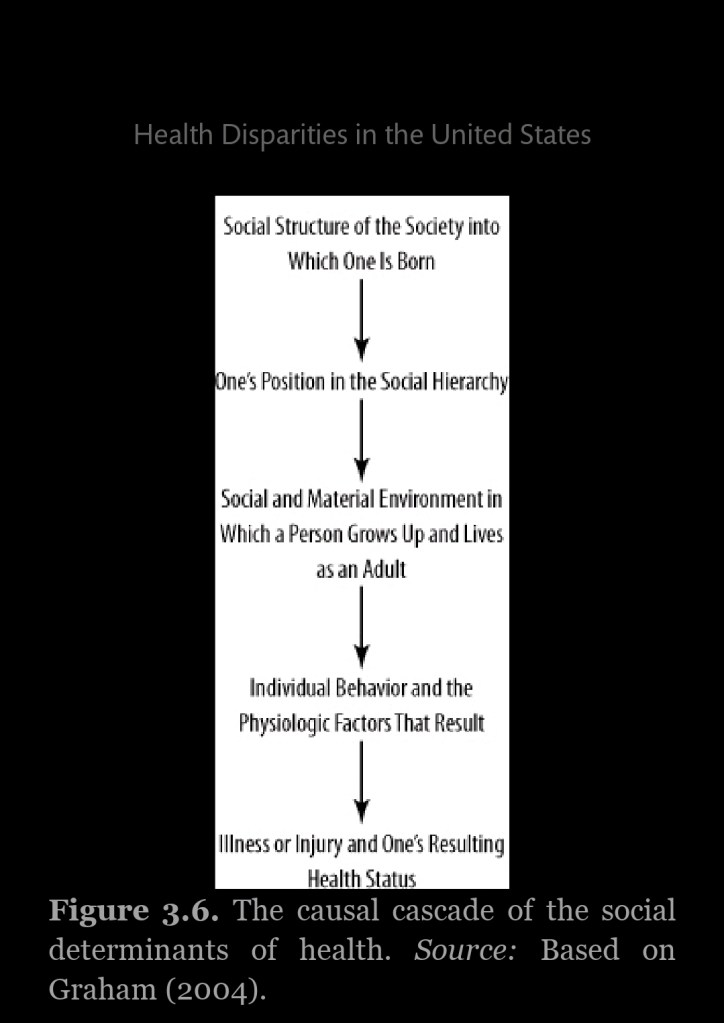
So when it comes to variation in health outcomes, we know that only 20 percent can be attributed to access to medical care, while a whooping 80 percent is attributable to the SDoH:
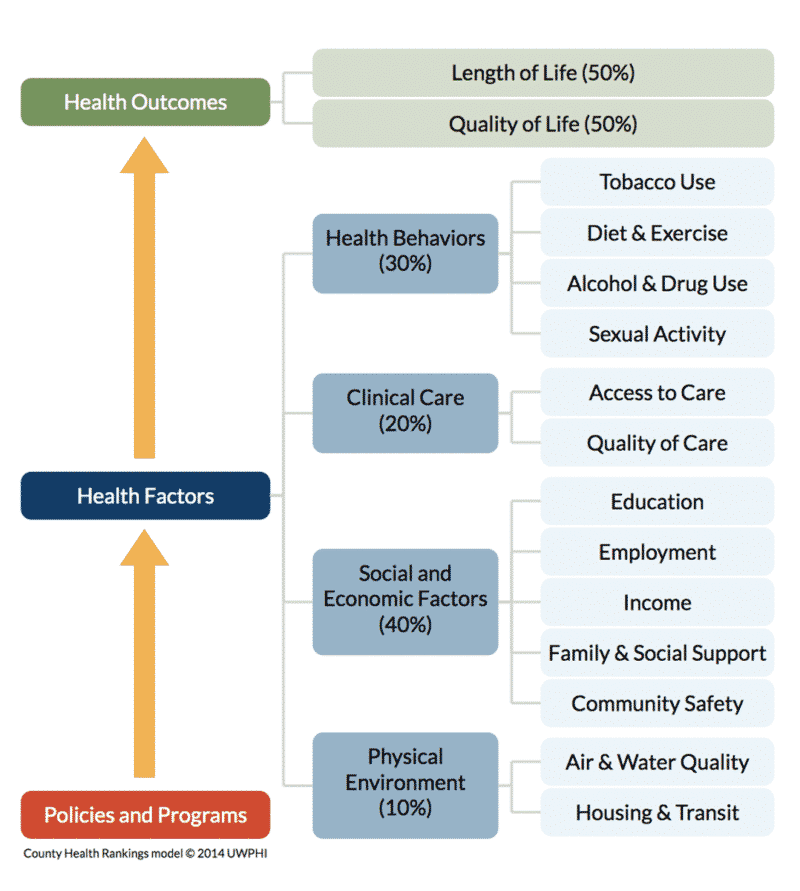
(Ratcliffe, 2017 also states that about 20 percent of the health of nation is attributed to medical care, 5 percent the result of biology and genes, 20 percent the result of individual action, and 50 percent due to the SDoH.)
The WHO (2010) also has a Commission on the Social Determinants of Health (CSDH) with a conceptual framework:
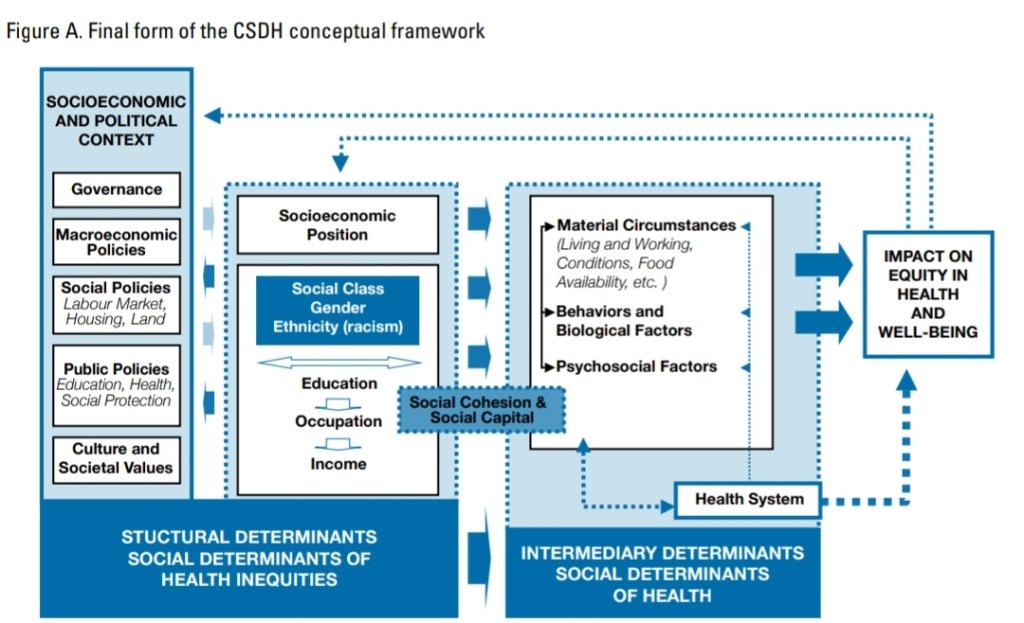
This is staggering. For if the social determinants of health are causal for health outcomes, then it comes down to how society is structured along with how we treat certain people and groups. This also could come down to environmental racism—which is the disproportionate exposure of minority groups to environmental hazards. One pertinent example is lead in paint uses in houses in the 80s, where groups actually used blacks as a kind of experiment in seeing the effects of lead. The issue was further exacerbated by Big Lead in trying to argue that the families had a “history of low intelligence” and that it couldn’t be proven that lead had the damaging effects on the children. Not only does environmental racism cause negative health effects, but so does individual racism which is known to have a negative effect on black women. (Racism and stereotypes which lead to self-fulfilling prophecies also cause the black-white crime gap.)
So empirical research—grounded in data and evidence—can help us in understanding whether a given inequality is an inequity. Certain disparities could reflect historical disadvantages which then perpetuate cycles of disadvantage which then reinforce existing power structures and further continue to marginalize certain communities.
The argument
I have constructed an argument that shows what I am talking about:
UO: Unequal outcome
I: Inequality
A: Avoidable
F: Unfair
J: Unjust
E: Empirical investigation
I involves A, F, J. E may reveal instances where I leads to UO and I is associated with F, J, and A.
Premise 1: E -> (A^F^J)
Premise 2: I -> (A^F^J)
Conclusion: E -> ((I -> UO) ^ (A^F^J))
(P1) If empirical investigations (E) reveal instances where avoidable factors (A), unfairness (F) and injustice (J) are present, and (P2) if inequality (I) leads to conditions involving avoidability (A), unfairness (F) and injustice (J), then (Conclusion) empirical investigations (E) could reveal instances where inequality leads to unequal outcomes (UO), and whether or not they are avoidable (A), unfair (F) or unjust (J). Effectively, since inequities are a kind of inequality, then this can identify inequities where they are, and then we can work to fix them.
For instance, birth weight has decreased recently and the effect is more pronounced for black women (Catov et al, 2016) and racism could as well be a culprit (Collins Jr., et al, 2004). There is also evidence that structural racism in the workplace can and has attributed to this (Chantarat et al, 2022). It’s quite clear that racism can explain birth outcome disparities (Dominguez et al, 2010; Alhusen et al, 2016; Dreyer, 2021). Not only does racism contribute to adverse birth outcomes but so too do factors related to environmental racism (Burris and Hacker, 2018). This also has a historical precedent: slavery (Jasienska, 2009). Hereditarians may try to argue that (as always) this difference has a genetic basis. But we know that African women born in Africa are heavier than African American women; black women born in Africa have children with higher mean birth weights than African American women (David and Collins, 1997). Cabral et al (1991) also found the same—non-American black women birthed children that weighed 135 more grams than American black women. Thus, the difference isn’t genetic in nature—it is environmentally caused and it partly stems from slavery. Clearly this discussion shows that my argument has a real-world basis.
How do we reverse these inequities?
Clearly, racism has societal consequences not only for crime and mental illness, but also low birth weight in black American women. The difference can’t be genetic in nature, so it’s obviously environmental/social in nature due to racism, environmental racism. So how can we alleviate this? There are a few ways.
We can improve access to pre-natal care. By ensuring equitable access to pre-natal care, and by expanding Medicaid coverage, we can the begin to address the issue of low black birth weight. We know that when black newborns are cared for by black doctors, they have a better survival rate (Greenwood et al, 2020). We also have an RCT showing that black doctors could reduce the black-white cardiovascular mortality rate by 19 percent (Alsan, Garrick, and Grasiani, 2019). We also know that a higher percentage of black doctors leads to lower mortality rate and better life expectancy (Peek, 2023; Snyder et al, 2023). This isn’t a new finding—we’ve known this since the 90s (Komaramy et al, 1996; Saha et al, 1999). We also know that people who have same-race doctors are more likely to accept much-needed preventative care (LaVeist, Nuru-Jeter, and Jones, 2003). This could then lead to less systemic bias in healthcare, since we know that some of the difference is systemic in nature (Reschovsky and O’Malley 2008: 229, 230). We also know that bias, stereotyping, and prejudice also play a part (Smedley et al, 2003). Such stereotypes are also sometimes unconscious (Williams and Rucker, 2000). The medical system contributes to said disparities (Bird and Clinton, 2001). Blacks who perceived more racism in healthcare felt more comfortable with a black doctor (Chen et al, 2005)—minorities also trust the healthcare system less than whites (Boulware et al, 2003). Lastly, black and white doctors agree that race is a medically relevant data point, but they don’t agree on why (Bonham et al, 2009).
We know that systemic and structural racism exists and that it impacts health outcomes (Braveman et al, 2022). Some may say that systemic and structural racism don’t exist, but this claim is clearly false. They are “are forms of racism that are pervasively and deeply embedded in and throughout systems, laws, written or unwritten policies, entrenched practices, and established beliefs and attitudes that produce, condone, and perpetuate widespread unfair treatment of people of color. They reflect both ongoing and historical injustices” (Braveman et al, 2022). Perhaps the most important way that systemic racism can harm health is through placing people at an economic disadvantage and stress. Environmental racism then compounds this, and then unfair treatment then leads to higher levels of stress which then leads to negative health outcomes.
Lastly a key issue here is the prevalence of racism. We know that it has a slew of negative health effects and that it affects the incidence of the black-white crime gap. But what can be done to alleviate racist attitudes?
Since many racist ideas have a genetically essentialist tilt, then we can use education to ameliorate racist attitudes (Donovan, 2022). We also know that racial essentialist attitudes are related to the belief that evolution has an intentional tilt and that it’s negatively correlated with biology grades (Donovan, 2015). Much of Donovan’s work shows that education can ameliorate racist attitudes which are due to genetic essentialism. We also know that such essentialist thinking is related to misconceptions about heredity and evolution and is correlated with low grades at the end of the semester in beginner biology course (Donovan, 2016). Thus, by providing accurate and understandable education on race, genetics, and evolution, people may be less likely to hold racial essentialist attitudes and more likely to reject racist ideologies. So there are actionable things we can do to combat racism which leads to crime and negative health outcomes for minority groups.
Conclusion
The SDoH play a pivotal role in shaping the health outcomes while perpetuating health inequities. We can, through empirical investigations, ascertain when an inequality is avoidable, unfair and unjust (meaning, when it is an inequity). We can then understand how historical injustices like racism impact marginalized communities which then contribute to negative health outcomes like low birth weight of black American babies. We know that it’s not a genetic difference since non-American black women have children with higher mean birth weights than black American women, and this suggests thar historical injustices and racism are a cause (as Jasienska argues). Further, studies show that when black patients have black doctors, they report better care and have higher life expectancies. Research has also shown that education can play a role in ameliorating genetic essentialist and racist attitudes which then, as I’ve shown, lead to negative health outcomes. The argument I’ve made here has a real-world basis in the case of low birth weight of black American babies.
In sum, committing to social and racial justice can help to change these inequities, and for that, we will have a better and more inclusive society where people’s negative health outcomes aren’t caused by social goings-on. To achieve racial health equity, we must address the avoidable, unfair and unjust factors that contribute to these inequities.
The “Great Replacement Theory”
2550 words
Introduction
The “Great Replacement Theory” (GRT hereafter) is a white nationalist conspiracy theory (conceptualized by French philosopher Renaud Camus) where there is an intentional effort by some shadowy group (i.e., Jews and global elites) to bring mass amounts of immigrants with high TFRs to countries with whites where whites have low TFRs in order to displace and replace whites in those countries (Beirich, 2021). Vague statements have been made about their “IQs” in that they would be easier to “control” and that they would then intermix with whites to further decrease the IQ of the nation and then be more controllable, all the while the main goal of the GRT—the destruction of the white race—would come to fruition. Here, I will go through the logic of what I think the two premises of the GRT are, and then I will show how the two premises (which I hold to obviously be true) don’t guarantee the conclusion that the GRT is true and that there is an intentional demographic replacement. I will discuss precursors of this that are or almost are 100 years old. I will then discuss what “theory” and “conspiracy theory” means and how, by definition, the GRT is both a theory (an attempted explanation of observed facts) and a conspiracy theory (suggesting a secret plan for the destruction and replacement of the white race).
The genesis of the GRT
The idea of the GRT is older than what spurred it’s discussion in the new millennium, but it can be traced in its modern usage to French political commentator Renaud Camus in his book Le Grand Remplacement.
But one of the earliest iterations of the GRT is the so-called “Kalergi plan.” Kalergi was also one of the founders of the pan-European union (Wiedemer, 1993). Kalergi, in his 1925 book Practical Idealism, wrote that “The man of the future will be of mixed race. Today’s races and classes will gradually disappear owing to the vanishing of space, time, and prejudice. The Eurasian-Negroid race of the future will replace the diversity of peoples with a diversity of individuals.” Which is similar to what Grant (1922: 110) wrote in The Passing of the Great Race:
All historians are familiar with the phenomenon of a rise and decline in civilization such as has oc- curred time and again in the history of the world but we have here in the disappearance of the Cro-Magnon race the earliest example of the replacement of a very superior race by an inferior one. There is great danger of a similar replacement of a higher by a lower type here in America unless the native American uses his superior intelligence to protect himself and his children from competition with intrusive peoples drained from the lowest races of eastern Europe and western Asia.
The idea of a great replacement is obviously much older than what spurred it on today. Movement was much tougher back then as the technology for mass migrations was just beginning to become more mainstream (think of the mass migrations from the 1860s up until the 1930s in America from European groups). Even the migration of other whites from Europe was used as a kind of “replacement” of protestant Anglo-Saxon ways of life. Nonetheless, these ideas of a great replacement are not new, and these two men (one of which—Kalergi—wasn’t using the quote in a nefarious way, contra the white nationalists who use this quote as evidence of the GRT and the plan for it in the modern day) are used as evidence that it is occurring.
Kalergi envisioned a positive blending of the races, whereas Grant expressed concerns of replacement by so-called “inferior” groups replacing so-called “superior” groups. Grant—in trying to argue that Cro-Magnon man was the superior race, replaced by the inferior one—expressed worry of intentional demographic replacement, which is the basis of the GRT today and what the GRT essentially reduces to. The combination of these opposing perspectives of the mixing of races (the positive one from Kalergi and the negative one from Grant) show that the idea of a great replacement is much older than Camus’ worry in his book. (And, as I will argue, the fact that the 2 below premises are true doesn’t guarantee the conclusion of the GRT.)
The concept of the GRT
The GRT has two premises:
(1) Whites have fewer children below TFR
(2) Immigrants have more children above TFR
Which then should get us to:
(C) Therefore, the GRT is true.
But how does (C) follow from (1) and (2)? The GRT suggests not only a demographic shift in which the majority (whites) are replaced and displaced by minorities (in this case mostly “Hispanics” in America), but that this is intentional—that is, it is one man or group’s intention for this to occur. The two premises above refer to factual, verifiable instances: Whites have fewer children; immigrants coming into America have more children. BUT just because those two premises are true, this does NOT mean that the conclusion—GRT is true—follows from the two premises. The two premises focus on the fertility rates of two groups (American whites and immigrants to America), but acceptance of both of those premises does not mean that there is an act of intentional displacement occurring. We can allow the truth of both premises, but that doesn’t lead to the truth of the GRT. Because that change is intentionally driven by some super secret, shadowy and sinister group (the Jews or some other kind of amalgamation of elites who want easy “slave labor”).
The GRT was even endorsed by the Buffalo shooter who heniously shot and killed people in a Tops supermarket. He was driven by claims of the GRT. (The US Congress condemned the GRT as a “White supremacist conspiracy theory“, and I will show how it is a theory and even a conspiracy theory below.) The shooter even plagiarized the “rationale section” of his manifesto (Peterka-Benton and Benton, 2023). This shows that such conspiracy theories like the GRT can indeed lead to radicalization of people.
Even ex-presidential hopeful Vivek Ramaswamy made reference to the GRT, stating that “great replacement theory is not some grand right-wing conspiracy theory, but a basic statement of the Democratic Party’s platform.” Even former Fox News political commentator Tucker Carlson has espoused these beliefs on his former show on Fox News. The belief in such conspiratorial thinking can quite obviously—as seen with the Buffalo shooter—have devestating negative consequences (Adam-Troian et al, 2023). Thus, these views have hit the mainstream as something that’s “plausible” on the minds of many Americans.
Such thinking obviously can be used for both Europe and America—where the Islamization/Africanization of Europe and the browning of America with “Hispanics” and other groups—where there is a nefarious plot to replace the white population of both locations, and these mostly derive on places like 4chan where they try to “meme” what they want into reality (Aguilar, 2023).
On theories and conspiracy theories
Some may say that the GRT isn’t a theory nor is it even a conspiracy theory—it’s a mere observation. I’ve already allowed that both premises of the argument—whites have fewer children below TFR while immigrants have more children above TFR—is true. But that doesn’t mean that the conclusion follows that the GRT is true. Because, as argued above, it is intentional demographic replacement. Intentional by whom? Well the Jews and other global elites who want a “dumb” slave population that just listens, produces and has more children so as to continue the so-called enslavement of the lower populations.
But, by definition, the GRT is a theory and even a conspiracy theory. The GRT is a theory in virtue of it being an explanation for observed demographic changes and the 2 premises I stated above. It is a conspiracy theory because it suggests a deliberate, intentional plan by the so-called global elite to replace whites with immigrants. Of course labeling something as a conspiracy theory doesn’t imply that it’s inaccurate nor invalid, but I would say that the acceptance of both premises DO NOT guarantee the conclusion that those who push the GRT want it to.
The acceptance of both premises doesn’t mean that the GRT is true. The differential fertility of two groups, where one group (the high fertility group) is migrating into the country of another group (the low fertility group) doesn’t mean that there is some nefarious plot by some group to spur race mixing and the destruction and replacement of one group over another.
As shown above, people may interpret and respond to the GRT in different ways. Some may use it in a way to interpret and understand demographic changes while not committing henious actions, while others—like the Buffalo shooter—may use the information in a negative way and take many innocent lives on the basis of belief in the theory. Extreme interpretations of the GRT can lead to the shaping of beliefs which then contribute to negative actions based on the belief that their group is being replaced (Obaidi et al, 2021). Conspiracy theories also rely on the intent to certain events, of which the proponents of the GRT do.
Some white nationalists who hold to the GRT state that the Jews are behind this for a few reasons—one of which I stated above (that they want dumber people to come in who have higher TFRs to replace the native white population in the country)—and another reason which has even less support (if that’s even possible) which is that the Jews are orchestrating the great migration of non-whites into European countries as revenge and retaliation for Europeans expelling Jews from European countries during the middle ages (109 countries). This is the so-called “white genocide” conspiracy theory. This is the kind of hate that Trump ran with in his presidential run and in his time in office as president of the United States (Wilson, 2018). This can also be seen with the phrase “Jews/You will not replace us!” during the Charlottesville protests of 2017 (Wilson, 2021). “You” in the phrase “You will not replace us!” could refer to Jews, or it could refer to the people that the Jews are having migrate into white countries to replace the white population. Beliefs in such baseless conspiracy theories gave led to mass murder in America, Australia, and Norway (Davis, 2024).
One of the main actors in shaping the view that Jews are planning to replace (that is, genocide) Whites is white nationalist and evolutionary psychologist Kevin MacDonald, more specifically in his book series on the origin of Jewish evolutionary group strategies, with A People that Shall Dwell Alone (1994), Separation and it’s Discontents (1998a), and The Culture of Critique (1998b). It is a main argument in this book series that the Jews have an evolved evolutionary group strategy that has them try to undermine and destroy white societies (see Blutinger, 2021 and also Nathan Cofnas’ responses to MacDonald ‘s theory). MacDonald’s theory of a group evolutionary strategy is nothing more than a just-so story. Such baseless views have been the “rationale” of many mass killings in the 2010s (eg Fekete, 2011; Nilsson, 2022). Basically it’s “white genocide is happening and the Jews are behind it so we need to kill those who the Jews are using to enact their plan and we need to kill Jews.” (Note that this isn’t a call for any kind of violence it’s just a simplified version of what many of these mass killers imply in their writings and motivations for carrying out their henious attacks.) One thing driving these beliefs and that jd the GRT is that of anti-Semitism (Allington, Buarque, and Flores, 2020). Overall, such claims of a GRT or “white genocide” flourish online (Keulennar and Reuters, 2023). In this instance, it is claimed that Jews are using their ethnic genetic interests and nepotism to spur these events.
Conclusion
I have discussed the GRT argument and with it so-called “white genocide” (since the two are linked). The 2 premises of the GRT are tru—that American whites have low TFR and those who are emigrating have high TFR—but but that the premises are true doesn’t guarantee the conclusion that there is some great replacement occurring, since it reduces to a kind of intentional demographic replacement by some group (say, the Jews and other elites in society who want cheap, dumb, easily controllable labor who have more children). The GRT is happening, it is claimed, since the Jews want revenge on whites for kicking them out of so many countries. That is, the GRT is an intentional demographic replacement. Those who push the GRT take the two true premises and then incorrectly conclude that there is some kind of plan to eradicate whites through both the mixing of races and bringing in groups of people who have more children than whites do.
I have scrutinized what I take to be the main argument of GRT proponents and have shown that the conclusion they want doesn’t logically follow. Inherent in this is a hasty generalization fallacy and fallacy of composition (in the argument as I have formalized it). This shows the disconnect between both premises and the desired conclusion. Further, the classification of the GRT as a conspiracy theory comes from the attribution of intention to eliminate and eradicate white through the mass migration of non-white immigrant groups who have more children than whites along with racial mixing.
The Buffalo shooting in a Tops supermarket in 2022 shows the impact of these beliefs on people who want there to be some kind of plan or theory for the GRT. Even mainstream pundits and a political candidate have pushed the GRT to a wider audience. And as can be seen, belief in such a false theory can, does, and has led to the harm and murder of innocent people.
Lastly, I showed how the GRT is a theory (since it is an attempt at an explanation for an observed trend) and a conspiracy theory (since the GRT holds that there is a secret plan, with people behind the scenes in the shadows orchestrating the events of the GRT). Such a shift in demographics need not be the result of some conspiracy theory with the intention to wipe out one race of people. Of course some may use the GRT to try to understand how and why the demographics are changing in the West, but it is mostly used as a way to pin blame on why whites aren’t having more children and why mass immigration is occurring.
All in all, my goal here was to show that the GRT has true premises but the conclusion doesn’t follow, and that it is indeed a theory and a conspiracy theory. I have also shown how such beliefs can and have led to despicable actions. Clearly the impact of beliefs on society can have negative effects. But by rationally thinking about and analyzing such claims, we can show that not only are they baseless, but that it’s not merely an observation of observed trends. Evidence and logic should be valued here, while we reject unwanted, centuries-old stereotypes of the purported plan of racial domination of certain groups.
Race, Racism, Stereotypes, and Crime: An Argument for Why Racism is Morally Wrong
2300 words
Introduction
(1) Crime is bad. (2) Racism causes crime. (C) Thus, racism is morally wrong. (1) is self-evident based on people not wanting to be harmed. (2) is known upon empirical examination, like the TAAO and it’s successful novel predictions. (C) then logically follows. In this article, I will give the argument in formal notation and show its validity while defending the premises and then show how the conclusion follows from the premises. I will then discuss two possible counter arguments and then show how they would fail. I will show that you can derive normative conclusions from ethical and factual statements (which then bypasses the naturalistic fallacy), and then I will give the general argument I am giving here. I will discuss other reasons why racism is bad (since it leads to negative physiological and mental health outcomes), and then conclude that the argument is valid and sound and I will discuss how stereotypes and self-fulfilling prophecies also contribute to black crime.
Defending the argument
This argument is obviously valid and I will show how.
B stands for “crime is bad”, C stands for “racism causes crime”, D stands for racism is objectively incorrect, so from B and C we derive D (if C causes B and B is bad, then D is morally wrong). So the argument is “(B ^ C) -> D”. B and C lead to D, proving validity.
Saying “crime is bad” is an ethical judgement. The term “bad” is used as a moral or ethical judgment. “Bad” implies a negative ethical assessment which suggests that engaging in criminal actions is morally undesirable or ethically wrong. The premise asserts a moral viewpoint, claiming that actions that cause harm—including crime—are inherently bad. It implies a normative stance which implies that criminal behavior is wrong or morally undesirable. So it aligns with the idea that causing harm, violating laws or infringing upon others is morally undesirable.
When it comes to the premise “racism causes crime”, this needs to be centered on the theory of African American offending (TAAO). It’s been established that blacks experiencing racism is causal for crime. So the premise implies that racism is a factor in or contributes to criminal behavior amongst blacks who experience racism. Discriminatory practices based on race (racism) could lead to social inequalities, marginalization and frustration which would then contribute to criminal behavior among the affected person. This could also highlight systemic issues where racist policies or structures create an environment conducive to crime. And on the individual level, experiences of racism could influence certain individuals to engage in criminal activity as a response or coping mechanism (Unnever, 2014; Unnever, Cullen, and Barnes, 2016). Perceived racial discrimination “indirectly predicted arrest, and directly predicted both illegal behavior and jail” (Gibbons et al, 2021). Racists propose that what causes the gap is a slew of psychological traits, genetic factors, and physiological variables, but even in the 1960s, criminologists and geneticists rejected the genetic hypothesis of crime (Wolfgang,1964). However we do know there is a protective effect when parents prepare their children for bias (Burt, Simons, and Gibbons, 2013). Even the role of institutions exacerbates the issue (Hetey and Eberhardt, 2014). And in my article on the Unnever-Gabbidon theory of African American offending, I wrote about one of the predictions that follows from the theory which was borne out when it was tested.
So it’s quite obvious that the premise “racism causes crime” has empirical support.
So if B and C are true then D follows. The logical connection between B and C leads to the conclusion that “racism is morally wrong”, expressed by (B ^ C) -> D. Now I can express this argument using modus ponens.
(1) If (B ^ C) then D. (Expressed as (B ^ C) -> D).
(2) (B ^ C) is true.
(3) Thus, D is true.
When it comes to the argument as a whole it can be generalized to harm is bad and racism causes harm so racism is bad.
Furthermore, I can generalize the argument further and state that not only that crime is bad, but that racism leads to psychological harm and harm is bad, so racism is morally wrong. We know that racism can lead to “weathering” (Geronimus et al, 2006, 2011; Simons, 2021) and increased allostatic load (Barr 2014: 71-72). So racism leads to a slew of unwanted physiological issues (of which microaggressions are a species of; Williams, 2021).
Racism leads to negative physiological and mental health outcomes (P), and negative physiological and mental health outcomes are undesirable (Q), so racism is morally objectionable (R). So the factual statement (P) establishes a link between negative health outcomes, providing evidence that racism leads to these negative health outcomes. The ethical statement (Q) asserts that negative health outcomes are morally undesirable which aligns with a common ethical principle that causing harm is morally objectionable. Then the logical connection (Q ^ P) combines the factual observation of harm caused by racism with the ethical judgment that harm is morally undesirable. Then the normative conclusion (R) follows, which asserts that racial is morally objectionable since it leads to negative health outcomes. So this argument is (Q ^ P) -> R.
Racism can lead to stereotyping of certain groups as more prone to criminal behavior, and this stereotype can be internalized and perpetuated which would then contribute to biased law enforcement and along with it unjust profiling. It can also lead to systemic inequalities like in education, employment and housing which are then linked to higher crime rates (in this instance, racism and stereotyping causes the black-white crime gap, as predicted by Unnever and Gabbidon, 2011 and then verified by numerous authors). Further, as I’ve shown, racism can negatively affect mental health leading to stress, anxiety and trauma and people facing these challenges would be more vulnerable to engage in criminal acts.
Stereotypes and self-fulfilling prophecies
In his book Concepts and Theories of Human Development, Lerner (2018: 298) discusses how stereotyping and self-fulfilling prophecies would arise from said stereotyping. He says that people, based on their skin color, are placed into an unfavorable category. Then negative behaviors were attributed to the group. Then these behaviors were associated with different experience in comparison to other skin color groups. These different behaviors then delimit the range of possible behaviors that could develop. So the group was forced into a limited number of possible behaviors, the same behaviors they were stereotyped to have. So the group finally develops the behavior due to being “channeled” (to use Lerner’s word) which is then “the end result of the physically cued social stereotype was a self-fulfilling prophecy” (Lerner, 2018: 298).
From the analysis of the example I provided and, as well, from empirical literature in support of it (e.g., Spencer, 2006; Spencer et al., 2015), a strong argument can be made that the people of color in the United States have perhaps experienced the most unfortunate effects of this most indirect type of hereditary contribution to behavior–social stereotypes. Thus, it may be that African Americans for many years have been involved in an educational and intellectual self-fulfilling prophecy in the United States. (Lerner, 2018: 299)
This is an argument about how social stereotypes can spur behavioral development, and it has empirical support. Lerner’s claim that perception influences behavior is backed by Spencer, Swanson and Harpalani’s (2015) article on the development of the self and Spencer, Dupree, and Hartman’s (1997) phenomenological variant of ecological systems theory (PVEST). (Also see Cunningham et al, 2023). Spencer, Swanson and Harpalani (2015: 764) write:
Whether it is with images of the super-athlete, criminal, gangster, or hypersexed male, it seems that most of society’s views of African Americans are defined by these stereotypes. The Black male has, in one way or another, captured the imagination of the media to such a wide extent that media representations create his image far more than reality does. Most of the images of the Black male denote physical prowess or aggression and downplay other characteristics. For example, stereotypes of Black athletic prowess can be used to promote the notion that Blacks are unintelligent (Harpalani, 2005). These societal stereotypes, in conjunction with numerous social, political, and economic forces, interact to place African American males at extreme risk for adverse outcomes and behaviors.
A -> B—So stereotypes can lead to self-fulfilling prophecies (if there are stereotypes, then they can result in self-fulfilling prophecies). B -> C—Self-fulfilling prophecies can increase the chance of crime for blacks (if there are self-fulfilling prophecies, then they can increase the chance of crime for blacks. So A -> C—Stereotypes can increase the chance of crime for blacks (if there are stereotypes, then they can increase the chance of crime for blacks). Going back to the empirical studies on the TAAO, we know that racism and stereotypes cause the black-white crime gap (Unnever, 2014; Unnever, Cullen, and Barnes, 2016; Herda, 2016, 2018; Scott and Seal, 2019), and so the argument by Spencer et al and Lerner is yet more evidence that racism and stereotypes lead to self-fulfilling prophecies which then cause black crime. Behavior can quite clearly be shaped by stereotypes and self-fulfilling prophecies.
Responses to possible counters
I think there are 3 ways that one could try to refute the argument—(1) Argue that B is false, (2) argue that C is false, or (3) argue that the argument commits the is-ought fallacy.
(1) Counter premise: B’: “Not all crimes are morally bad, some may be morally justifiable or necessary in certain contexts. So if not all crimes are morally bad, then the conclusion that racism is morally wrong based on the premises (B ^ C) isn’t universally valid.”
Premise B reflects a broad ethical judgment which is based on social norms that generally view actions that cause harm morally undesirable. My argument is based on consequences—that racism causes crime. The legal systems of numerous societies categorize certain actions as crimes since they are deemed morally reprehensible and harmful to individuals and communities. Thus, there is a broad moral stance against actions that cause harm which is reflected in the societal normative stance against actions which cause harm.
(2) Counter premise: C’: “Racism does not necessarily cause crime. Since racism does not necessarily cause crime, then the conclusion that racism is objectively wrong isn’t valid.”
Premise C states that racism causes crime. When I say that, it doesn’t mean that every instance of racism leads to an instance of crime. Numerous social factors contribute to criminal actions, but there is a relationship between racial discrimination (racism) and crime:
Experiencing racial discrimination increases the likelihood of black Americans engaging in criminal actions. How does this follow from the theory? TAAO posits that racial discrimination can lead to feelings of frustration and marginalization, and to cope with these stressors, some individuals may resort to commuting criminal acts as a way to exert power or control in response to their experiences of racial discrimination. (Unnever, 2014; Unnever, Cullen, and Barnes, 2016; Herda, 2016, 2018; Scott and Seal, 2019)
(3) “The argument commits the naturalistic fallacy by inferring an “ought” from an “is.” It appears to derive a normative conclusion from factual and ethical statements. So the transition from descriptive premises to moral judgments lacks a clear ethical justification which violates the naturalistic fallacy.” So this possible counter contends that normative statement B and the ethical statement C isn’t enough to justify the normative conclusion D. Therefore it questions whether the argument has good justification for an ethical transition to the conclusion D.”
I can simply show this. Observe X causing Y (C). Y is morally undesirable (B). Y is morally undesirable and X causes Y (B ^ C). So X is morally objectionable (D). So C begins with an empirical finding. B then is the ethical premise. The logical connection is then established with B ^ C (which can be reduced to “Harm is morally objectionable and racism causes harm”). This then allows me to infer the normative conclusion—D—allowing me to bypass the charge of committing the naturalistic fallacy. Thus, the ethical principle that harm is morally undesirable and that racism causes harm allows me to derive the conclusion that racism is objectively wrong. So factual statements can be combined with ethical statements to derive ethical conclusions, bypassing the naturalistic fallacy.
Conclusion
This discussion centered on my argument (B ^ C) -> D. The argument was:
(P1) Crime is bad (whatever causes harm is bad). (B)
(P2) Racism causes crime. (C)
(C) Racism is morally wrong. (D)
I defended the truth of both premises, and then I answered two possible objections, both rejecting B and C. I then defended my argument against the charge of it committing the naturalistic fallacy by stating that ethical statements can be combined with factual statements to derive normative conclusions. Addressing possible counters (C’ and B’), I argued that there is evidence that racism leads to crime (and other negative health outcomes, generalized as “harm”) in black Americans, and that harm is generally seen as bad, so it then follows that C’ and B’ fail. Spencer’s and Lerner’s arguments, furthermore, show how stereotypes can spur behavioral development, meaning that social stereotypes increase the chance of adverse behavior—meaning crime. It is quite obvious that the TAAO has strong empirical support, and so since crime is bad and racism causes crime then racism is morally wrong. So to decrease the rate of black crime we—as a society—need to change our negative attitudes toward certain groups of people.
Thus, my argument builds a logical connection between harm being bad, racism causing harm and moral undesirability. In addressing potential objections and clarifying the ethical framework I ren, So the general argument is: Harm is bad, racism causes harm, so racism is morally wrong.
The Rockefeller Foundation’s Failure in Finding a General Intelligence Factor in Dogs
2000 words
Introduction
Hereditarians have been trying to prove the existence of a genetic basis of intelligence for over 100 years. In this time frame, they have used everything from twin, family and adoption studies to tools from the molecular genetics era like GCTA and GWAS. Using heritability estimates, behavior geneticists claim that since intelligence is highly heritable, that there must thusly be a genetic basis to intelligence controlled by many genes of small effect, meaning it’s highly polygenic.
In his outstanding book Misbehaving Science, Panofsky (2014) discusses an attempt funded by the Rockefeller Foundation (RF) at showing a genetic basis to dog intelligence to prove that intelligence had a genetic basis. But it didn’t end up working out for them—in fact, it showed the opposite. The investigation which was funded by the RF showed quite the opposite result that they were looking for—while they did find evidence of some genetic differences between the dog breeds studied, they didn’t find evidence for the existence of a “general factor of intelligence” in the dogs. This issue was explored in Scott and Fuller’s 1965 book Genetics and the Social Behavior of the Dog. These researchers, though, outright failed in their task to discover a “general intelligence” in dogs. Modern-day research also corroborates this notion.
The genetic basis of dog intelligence?
This push to breed a dog that was highly intelligent was funded by the Rockefeller Foundation for ten years at the Jackson Laboratory. Panofsky (2014: 55) explains:
Over the next twenty years many scientists did stints at Jackson Laboratory working on its projects or attending its short courses and training programs. These projects and researchers produced dozens of papers, mostly concerning dogs and mice, that would form much of the empirical base of the emerging field. In 1965 Scott and John Fuller, his research partner, published Genetics and the Social Behavior of the Dog. It was the most important publication to come out of the Jackson Lab program. Scott and Fuller found many genetic differences between dog breeds; they did not find evidence for general intelligence or temperament. Dogs would exhibit different degrees of intelligence or temperamental characteristics depending on the situation. This evidence of interaction led them to question the high heritability of human intelligence—thus undermining a goal of the Rockefeller Foundation sponsors who had hoped to discredit the idea that intelligence was the product of education. Although the behavioral program at Jackson Laboratory declined after this point, it had been the first important base for the new field.
Quite obviously this was the opposite result of what they wanted—dog intelligence was based on the situation and therefore context-dependent.
Scott and Fuller (1965) discuss how they used to call their tests “intelligence tests” but then switched to calling them “performance tests”, “since the animals
seemed to solve their problems in many ways other than through pure thought or
intellect” (Scott and Fuller 1965: 37), while also writing that “no evidence was found for a general factor of intelligence which would produce good performance on all tests” (1965, 328). They also stated that they found nothing like the general intelligence factor in dogs like that is found in humans (1965: 472) while also stating that it’s a “mistaken notion” to believe in the general intelligence factor (1965: 512). They then conclude, basically, that situationism is valid for dogs, writing that their “general impression is that an individual from any dog breed will perform well in a situation in which he can be highly motivated and for which he has the necessary physical capacities” (1965: 512). Indeed, Scott noted that due to the heritability estimates of dog intelligence Scott came to the conclusion that human heritability estimates “are far too high” (quoted in Paul, 1998: 279). This is something that even Schonemann (1997) noted—and it’s “too high” due to the inflation of heritability due to the false assumptions of twin studies, which lead to the missing heritability crisis. One principle finding was that genetic differences didn’t appear early in development, which were then molded by further experience in the world. Behavior was highly variable between individuals and similar within breeds.
The results were quite unexpected but scientifically exciting. During the very early stages of development there was so little behavior observed that there was little opportunity for genetic differences to be expressed. When the complex patterns of behavior did appear, they did not show pure and uncontaminated effects of heredity. Instead, they were extraordinarily variable within an individual and surprisingly similar between individuals. In short, the evidence supported the conclusion that genetic differences in behavior do not appear all at once early in development, to be modified by later experience, but are themselves developed under the influence of environmental factors and may appear in full flower only relatively late in life. (Scott and Fuller, 1965)
The whole goal of this study by the Jackson Lab was to show that there was a genetic basis to intelligence in dogs and that they therefore could breed a dog that was intelligent and friendly (Paul, 1998). They also noted that there was no breed which was far and above the best at the task in question. Scott and Fuller found that performance on their tests was strongly affected by motivational and emotional factors. They also found that breed differences were strongly influenced by the environment, where two dogs from different breeds became similar when raised together. We know that dogs raised with cats showed more favorable disposition towards them (Fox, 1958; cf Feuerstein and Terkel, 2008, Menchetti et al, 2020). Scott and Fuller (1965: 333) then concluded that:
On the basis of the information we now have, we can conclude that all breeds show about the same average level of performance in problem solving, provided they can be adequately motivated, provided physical differences and handicaps do not affect the tests, and provided interfering emotional reactions such as fear can be eliminated. In short, all the breeds appear quite similar in pure intelligence.
The issue is that by believing that heritability shows anything about how “genetic” a trait is, one then inters that there has to be a genetic basis to the trait in question, and that the higher the estimate, the more strongly controlled by genes the trait in question is. However, we now know this claim to be false (Moore and Shenk, 2016). More to the point, the simple fact that IQ shows higher heritability than traits in the animal kingdom should have given behavioral geneticists pause. Nonetheless, it is interesting that this study that was carried out in the 1940s showed a negative result in the quest to show a genetic basis to intelligence using dogs, since dogs and humans quite obviously are different. Panofsky (2014: 65) also framed these results with that of rats that were selectively bred to be “smart” and “dumb”:
Further, many animal studies showed that strain differences in behavior were not independent of environment. R. M. Cooper and J. P. Zubek’s study of rats selectively bred to be “dull” and “bright” in maze-running ability showed dramatic differences between the strains in the “normal” environment. But in the “enriched” and especially the “restricted” developmental environments, both strains’ performance were quite similar. Scott and Fuller made a similar finding in their comparative study of dog breeds: “The behavior traits do not appear to be preorganized by heredity. Rather a dog inherits a number of abilities which can be organized in different ways to meet different situations.” Thus even creatures that had been explicitly engineered to embody racial superiority and inferiority could not demonstrate the idea in any simple way
Psychologist Robert Tryon (1940) devised a series of mazes, ran rats through them and then selected rats that learned quicker and slower (Innis, 1992). These differences then seemed to persists across these rat generations. Then Searle (1949) discovered that the so-called “dumb” rats were merely afraid of the mechanical noise of the maze, showing that Tryon selected for—unknowingly—emotional capacity. Marlowitz (1969) then concluded “that the labels “maze-bright” and “maze-dull” are inexplicit and inappropriate for use with these strains.”
Dogs and human races are sometimes said to be similar, in which a dog breed can be likened to a human race (see Norton et al, 2019). However, dog breeds are the result of conscious human selection for certain traits which then creates the breed. So while Scott and Fuller did find evidence for a good amount of genetic differences between the breeds they studied, they did not find any evidence of a genetic basis of intelligence or temperament. This is also good evidence for the claim that a trait can be heritable (have high heritability) but have no genetic basis. Moreover, we know that high levels of training improve dog’s problem solving ability (Marshall-Pescini et al, 2008, 2016). Further, perceived differences in trainability are due to physical capabilities and not cognitive ones (Helton, 2008). And in Labrador Retrievers, post-play training also improved training performance (Affenzeller, Palme, and Zulch, 2017; Affenzeller, 2020). Dogs’ body language during operant conditioning was also related to their success rate in learning (Hasegawa, Ohtani, and Ohta, 2014). We also know that dogs performed tasks better and faster the more experience they had with them, not being able to solve the task before seeing it demonstrated by the human administering the task (Albuquerque et al, 2021). Gnanadesikan et al (2020) state that cognitive phenotypes seem to vary by breed, and that these phenotypes have strong potential to be artificially selected, but we have seen that this is an error. Morrill et al (2022) found no evidence that the behavioral tendencies of certain breeds reflected intentional selection by humans but could not discount the possibility.
Conclusion
Dog breeds have been used by hereditarians for decades as a model for that of intelligence differences between human races. The analogy that dog breeds and human races are also similar has been used to show that there is a genetic basis for human race, and that human races are thusly a biological reality. (Note that I am a pluralist about race.) But we have seen that in the 40s the study which was undertaken to prove a hereditary basis to dog intelligence and then liken it to human intelligence quite obviously failed. This then led one of the authors to conclude—correctly—that human heritability estimates are inflated (which has led to the missing heritability problem of the 2000s).
Upon studying the dogs in their study, they found that there was no general factor of intelligence in these dogs, and that the situation was paramount in how the dog would perform on the task in question. This then led Scott to conclude that human heritability estimates are too high, a conclusion echoed by modern day researchers like Schonemann. The issue is, if dogs with their numerous breeds and genetic variation defy a single general factor, what would that mean for humans? This is just more evidence that “general intelligence” is a mere myth, a statistical abstraction. There was also no evidence for a general temperament, since breeds that were scared in one situation were confident in another (showing yet again that situationism held here). The failure of the study carried out by the RF then led to the questioning of the high heritability of human intelligence (IQ), which wasn’t forgotten as the decades progressed. Nonetheless, this study casted doubt on the claim that intelligence had a genetic basis.
Why, though, would a study of dogs be informative here? Well, the goal was to show that intelligence in dogs had a hereditary component and that thusly a kind of designer dog could be created that was friendly and intelligent, and this could then be likened to humans. But when the results were the opposite of what they desired, the project was quickly abandoned. If only modern-day behavioral geneticists would get the memo that heritability isn’t useful for what they want it to be useful for (Moore and Shenk, 2016)
 NotPoliticallyCorrect