Home » HBD (Page 4)
Category Archives: HBD
The Racial Identity Thesis: Why Race is a Social Construct of a Biological Reality
2250 words
Introduction
“Race” is a heavy topic. It influences many aspects of our daily lives, and in some cases, it even influences people to carry out heinous acts on groups of people deemed “inferior.” Such thoughts of “inferiority” of groups deemed (racialized as) races comes from horribly interpreting scientific studies, and in some cases, it is outright stated by the authors themselves, albeit using flowery language (eg Rushton, 2000). People that believe in the reality of race are called “race realists”, whether or not they hold a biological or social view of race.
On the socialrace side, social groups are racialized as races. “Social identities are contextual to historical and cultural elements.” “Racialization” is “the process through which groups come to be understood as major biological entities and human lineages, formed due to reproductive isolation, in which membership is transmitted through biological descent” (Hochman, 2019). Thinking about the root words for “racialization”, the two words are “racial formation.” Thus, when a group becomes racialized, it becomes a race based on societal expectations and thought.
“Hispanics” are an easy example to illustrate this case. In daily American discourse, people speak of “Hispanics”, “Spanish” people, and “Latinos/Latin Americans.” There are 33 Latin American countries to which this designation can be assigned to. In any case, what I term the “HLS distinction” (Hispanic, Latin American, Spanish distinction) is clearly a social designation and not a biological one. The group is an amalgamation of different peoples with differing amount ancestry to different countries of the world. “Hispanics” in some studies (eg Risch et al, 2002) don’t cluster in their own cluster (which would be taken to be a race, given that one has an argument for the claim), since they are an amalgam of different racial groups, it makes sense that they “clustered variously with the other groups.” Thus, “HLSs” are a social, not biological, kind.
Race concepts
Since “HBDers” call themselves “race realists” too, there needs to be a distinction between those who believe what I term “psychological race realism”—the claim that the psychological differences between the races are genetically transmitted and reduced to physical things—and regular old race realism—the claim that race exists as a social construct of a biological reality. Kaplan and Winther (2014) distinguish between bio-genomic/cluster race realism (the claim that race is real on the basis of genomic clusters from studies using programs like STRUCTURE); biological race realism affirms a kind of one-to-one mapping between social groups and clusters in DNA studies (though this not need be the case); and social race realism which is the racialization of social groups. They are anti-realists about biological race, but conventionalists about bio-genomic/cluster race. I think this is a good avenue to take, since the main program that psychological hereditarians push cannot ever be logically viable due to the irreducibility of the mental. (The “HBD” (Human Biological Diversity type racial realism is what I term psychological racial realism, while the type of racial realism I push is bio-genomic/cluster realism.)
In 2017, philosopher of race Michael Hardimon published his Rethinking Race: The Case for Deflationary Realism. In the book, Hardimon distinguishes between four race concepts: racialist races, in which it’s proponents attempt to rank-order racialized groups in socially-valued traits. Racialist races are socially constructed groups which then purport to pick out biological kinds. However, the concept of racialist race does not refer to any group in the world, genetic variation in Homo sapiens is nonconcordant, human variation is clinal, that is human groups aren’t sharply distinguished between one another on the basis of genomic data. Socialraces are groups taken to be racialist races, the social position taken by a group said to be a socialrace, or the system of positions that are social races (Hardimon, 2017: 131). So these two concepts need to be grouped together since they are hierarchical, though they need not be correlated with each other that strongly—one can be an anti-realist about biological races but be a realist about social races. This is why there is no contradiction in saying that biological race isn’t real but socialraces are. Socialraces also have a biological correlate, and these are what Hardimon terms “minimalist races”, which I will describe below.
Hardimon (2017: 69) has what he calls “an argument from the minimalist biological phenomenon of race” (Hardimon, 2017: 70):
Step 1. Recognize that there are differences in patterns of visible physical features of human beings that correspond to their differences in geographic ancestry.
Step 2. Observe that these patterns are exhibited by groups (that is, real existing groups).
Step 3. Note that the groups that exhibit these patterns of visible physical features correspond to differences in geographical ancestry satisfy the conditions of the minimalist concept of race.
Step 4. Infer that minimalist race exists.
Basically, if minimalist races exist then races exist because minimalist races are races. Contrast this argument (and Spencer’s newest argument arguing for the existence of OMB races) with hereditarian reasoning on race—basically just assume it’s existence.
The minimalist race concept does not state which populations are races, it just states that race exists. Hardimon’s populationist race concept (PRC) does, though. Although we don’t need genes to delineate race, using new technologies can and does help us to elucidate the existence of races. However, if minimalist races are populationist races, then the kind minimalist race equals populationist race. So if minimalist races are real, then so are populationist races.
Since 2014 in his paper A Radical Solution to the Race Problem, philosopher of race and science Quayshawn Spencer has been tinkering with an argument he now calls “the identity argument” (which I will provide below). The Office of Management and Budget has guidelines for the classification of people on the US census, being White, Black, Native American, Pacific Islander and Asian. The OMB never calls race a kind or a category, but they do refer to races as a set of categories or a proper name for population groups (Spencer, 2014). Spencer (2019a: 113) makes and defends 3 claims in regard to his OMB race theory:
(3.7) The set of races in OMB race talk is one meaning of ‘race’ in US race talk.
(3.8) The set of races in OMB race talk is the set of human continental populations.
(3.9) The set of human continental populations is biologically real.
In Spencer’s (2022) chapter in Remapping Race in a Global Context, A metaphysical mapping problem for race theorists and human population geneticists, Spencer has—in my opinion—articulated the best version of his OMB race argument.
Spencer’s identity argument
Of course, in the discussion of STRUCTURE and how many clusters it is told to construct from genomic data, the program is merely doing whag the human tells it to do. However, the five populations that come out in K= 5 “are genetically structured … which is to say, meaningfully demarcated solely on the basis of genetic markers” (Hardimon, 2017: 88). Hardimon (2017: 85) calls these clusters” continental-level minimalist races” whereas Spencer (2022: 278) calls these “the human continental populations” or “Blumenbachian partitions” (Spencer, 2014: 1026).
K = 5 shows 5 human continental populations which are robust and have been replicated numerous times. The 5 human continental populations are Africans, Caucasians, East Asians, Native Americans, and Oceanians. K = 5 corresponds to the racial scheme used by the OMB, and by scientists and Americans in daily life. Human continental populations and OMB races correspond one-to-one in the following way: African, black; Caucasian, white; East Asian, Asian; Native American, American Indian; and Oceanian, Pacific Islander. So there is a metaphysical relation between the human continental populations in K = 5 and the OMB races. Spencer states that “identity” is what is exemplified between K = 5 and OMB races, and he then constructed this argument he calls “the identity thesis”:
(2.1) The identity thesis is true if, in OMB race talk, ‘American Indian,’ ‘Asian’, ‘Black’, ‘Pacific Islander,’ and ‘White’ are singular terms, and ‘American Indian’ means Native American, ‘Asian’ means East Asian, ‘Black’ means African, ‘Pacific Islander’ means Oceanian, and ‘White’ means Caucasian.
(2.2) In OMB race talk, the first conjunct in (2.1)’s antecedent is true.
(2.3) In OMB race talk, the second conjunct in (2.1)’s antecedent is true.
(2.4) So, the identity thesis is true.
(2.1) is true since the antecedent analytically entails the consequent; (2.2) is true based on the OMB’s intentions when coining the race terms, that is to provide a common language across US agencies; (2.3) is true since human continental populations are the best choices for the meanings of the OMB race terms—they posit referents which are part of the semantic content of the OMB race terms; it therefore follows that the conclusion (2.4) logically follows so the argument is deductively valid and I think it is sound.
Spencer (2019a) professes to be a radical pluralist about race—that is, there are many different race concepts for certain contexts based on American race talk. The referent “race” is merely a proper name for a set of human population groups. Race is therefore a social construct of a biological reality.
Conclusion
Race is meaningful in American social discourse—call it race talk. We should not be eliminativist about race, since there is medical relevance for certain groups deemed races. That is, we shouldn’t eliminate the concept RACE from our vocabulary, since it has a referent. RACE is a social construct of a biological reality. It must be said, though, that many people believe that since X is a social construct then X is therefore not real or doesn’t exist. But this line of thinking can be easily countered. Money is a social construct, so does that mean that money doesn’t exist so money isn’t real? No—the example perfectly shows the fallacious thinking of those who think that social constructivists are claiming that since X is socially constructed then X is not real. This couldn’t be further from the truth since social constructivists about race are realists about race. Pluralism about race is true—that is, there are many natures and realities for race based on the relevant context (Spencer, 2019: 27).
Lastly, these theories of race I have shown here do not license the claims that realists about racialist races or biological racial realists (as termed by Kaplan and Winther) have about these groups. While Hardimon distinguishes between the four concepts of race, Spencer’s concept and then argument tried to argue that race is a social construct of a biological reality.
Spencer even worries that those—like Charles Murray who don’t even have a coherent concept of race—may try to use his research for their own purposes:
Nevertheless, I do worry that politically right-winged people—for example, Charles Murray—might try to misuse my research for their own purposes. I’m also worried about the educational research that shows learning about human genetic differences in racial terms—for instance, lactase persistence alleles—increases racist attitudes among the learners.
Spencer took care of the first part as early as his 2014 paper and has reiterated it since—the DNA evidence that elucidates the reality of human races are on noncoding DNA, so Spencer (2014: 1036) states:
Nothing in Blumenbachian race theory entails that socially important differences exist among US races. This means that the theory does not entail that there are aesthetic, intellectual, or moral differences among US races. Nor does it entail that US races differ in drug metabolizing enzymes or genetic disorders. This is not political correctness either. Rather, the genetic evidence that supports the theory comes from noncoding DNA sequences. Thus, if individuals wish to make claims about one race being superior to another in some respect, they will have to look elsewhere for that evidence.
As for Spencer’s second worry, since racism is borne of ignorance, education can ameliorate racist attitudes (Hughes et al, 2007; Kuppens et al, 2014; Donovan, 2019, 2022).
Although I am a pluralist about race, the race concept I think best shows the reality of race is Spencer’s as he holds race to be a social construct of a biological reality in his OMB race theory. And we can easily see that RACE is a social construct of a biological reality with Spencer’s identity thesis by looking at the mapping between K = 5 and the OMB—the social part is the OMB designations of races, whereas the biological part are the clusters that appear in K = 5.
My thinking on race has changed a lot over the years. I used to be against the claim that race is a social construct. Though, if you know that being a social constructivist about race means that you don’t need to be an antirealist about the concept RACE as a whole, then you can state “Race is a social construct of a biological reality”, where “biological reality” means the concept RACE has some biological grounding, as seen in K = 5 STRUCTURE studies. RACE is an idea invented by people, which is the “social construct” claim. Thus, we impute racial categories onto people (the social construct part of the argument) and the racial categories we impute onto people have a biological grounding (as seen by K = 5).
P1: If RACE is a social construct of a biological reality, then RACE is not an inherent characteristic of the individual.
P2: If RACE is not an inherent characteristic of the individual, then one’s RACE is designated by the society they live in.
C: Thus, if RACE is a social construct of a biological reality, then one’s RACE is designated by the society they live in.
Why a Science of the Mind is Impossible
6450 words
P1: Dualism is the belief that the mind is a nonphysical entity that is distinct from the body.
P2: If dualism is true, then the mind cannot be studied by science since science can only study physical processes and phenomena.
C: Thus, since dualism is true, the mind cannot be studied by science. (modus tollens, P1, P2)
P1 defines what dualism is. P2 states that if dualism is true then it cannot be studied by science since science can only study what is physical and it’s processes. So the conclusion follows from P1 and P2 using modus tollens, since dualism is true then the mind cannot be studied by science. Evidence and reasons for each premise will be given in the body of this article.
Introduction
The relationship between the mind and body—termed “the mind-body problem”—has puzzled us for many millennia. Over this time period, many philosophical theories/arguments have been made claiming to solve the problem. From physicalist, to dualist, to eliminativist, to idealist, and everything in between, many arguments have been mounted that claim to have solved the problem. The solution (or lack thereof) to the problem has implications on what we think of the mind and how—if it is indeed possible—to study the mind using the principles of science. In this article, I will review some arguments for physicalism of the mind, some hereditarian thoughts on the mind (since hereditarianism is a form of mind-brain identity theory), and finally, I will argue that if the mind is not a physical object then it cannot be (1) selected for by the environmental filter that “selects for/against” deleterious/advantageous traits and (2) an object of scientific study. Mind is distinct from body, making it outside the realm of scientific explanation. Psychology is said to be the scientific study of the mind, but if what I argue here is true, then there cannot be a science of the mind as the mind is immaterial.
The nature of mind
What is the mind? The mind is, very simply, what allows our mental life—it’s a set of mental faculties which allow our mental life. Concepts of the mind are similar cross-culturally in 5 different cultures and these concepts are present by mid-childhood but there were differences in how the social-emotional concepts were thought of (Weisman et al, 2021). Physicalists claim that since the mind is just the brain, then if we study the brain then we can study the mind—what allows our mental life.
On functionalism about the mind, the mind is what the brain does just like digestion is what the stomach does. That is, digestion is just the result of physical processes that occur when one is hungry and then eats so then the mind is what the brain does and this mental activity arises when the agent sees physical things. However, minds are intentionally constituted, and digestion is not so this analogy fails.
So the implicit claim here is that there can basically be a physiology of the mind on functionalism. Functionalist accounts of the mind suggest that mental particulars could be physical and so by studying the physiological states of the brain, we can then study the mind. Since physiology is a result of the interactions between mental life and what the agent experiences/sees then we can study this process scientifically. But there are problems with the functionalist account of mind.
The two main issues are (1) functionalism can be seen to be a type of mind-brain identity (which is the claim that mental states are merely brain states and so the mind is identical to the brain and its physiological processes; Smart, 2007) and (2) since all formal thinking is determinate and no physical process can be determinate then formal thinking cannot be physical or a result of physical processes, which then refutes functionalism of the mind (Ross, 1992; see also Feser, 2013). The argument can be formulated like this:
1) All formal thinking is incompossibly determinate
2) No physical process or functions of physical processes are incompossibly determinate
∴Thoughts aren’t a physical or functional process; no physical process is formal thinking; therefore functionalism and physicalism are false
The claim that the mind is what the brain does entails that mind reduces to brain and so the brain is the thing that thinks and feels and decides. This, however, is an example of the mereological fallacy (Kitchen, 2015). This kind of conceptual confusion arises when one imputes psychological predicates to the part (in this case the brain) when they actually apply to the whole (the self, “I”, the person). Brains don’t think, humans think. Brains don’t get sad, happy, or angry. Humans do. Brains are needed to think, to be happy, sad or angry. But this does not entail that brains are “feeling” the emotions or thinking. Psychologist Richard Haier has a lecture titled The Intelligent Brain, and this shows that he falls prey to the mereological fallacy. The brain is the thing that allows us to think, this is true. But to IQ-ists like Haier, it is the “quality” of the brain (whatever that would mean) that would dictate IQ scores. (This claim can be evidenced by looking at Haier’s brain imaging studies and attempts to correlate/localize aspects of cognition to fMRI readings and similar technologies along with his 2016 book—The Neuroscience of Intelligence. But we cannot localize parts of the brain to aspects of our cognition using meta-analyses of fMRI and IQ studies, see Uttal, 2012, 2014.) Hereditarians fall into this same conceptual confusion about the relationship to the mind and the brain, which I will review below.
Cognitive scientists, it is said, have been “implicit” dualists; that is, what they write can be construed as having dualist sympathies and that they are guilty of the mereological fallacy (Bennett and Hacker, 2004; Smit and Hacker, 2014; Kitchen, 2015; Boyles and Garrison, 2017). The mind is NOT merely the brain, as many have claimed. And if one does make that claim then they are guilty of the mereological fallacy.
The physicalist argument for mind-brain identity and functionalism is therefore refuted on a priori grounds. Since physical states are indeterminate, that means that there is nothing about a particular physical state that would tell you exactly what it would/could be and it could in fact be many incompossible forms. The argument shows that the mind is non-physical and if it is non-physical then it cannot be studied by physical sciences.
Dualism is true
If dualism is true, then attempts at a science of the mind are impossible. The immateriality of the mind can be proven a priori. Empirical evidence, then, is irrelevant to a priori, conceptual arguments. Conceptual arguments are based on logical coherence and not empirical evidence.
Thomas Nagel (2012), with the publication of his Mind and Cosmos: Why the Materialist Neo-Darwinian Conception of Nature is Almost Certainly False, set off a firestorm with his arguments against Darwinism (as did Fodor and Piattelli-Palmarini, 2009; see Evan, 2014). Nagel argues that the natural and social sciences cannot explain the existence of the mind and so we must revise our conception of nature. Nagel’s (2012: 23) argument is:
But if the mental is not itself merely physical, it cannot be fully explained by physical science. And then, as I shall argue, it is difficult to avoid the conclusion that those aspects of our physical constitution that bring with them the mental cannot fully be explained by physical science either. If evolutionary biology is a physical theory—as it is generally taken to be—then it cannot account for the appearance of consciousness and other phenomena that are not physically reducible. So if mind is a product of biological evolution—if organisms with mental life are not miraculous anomalies but an integral part of nature—then biology cannot be a purely physical science.
Mind is not a product of biological evolution since it is not physical, but if we accept physicalist premises then biology is something more than a physical science. I don’t think many physicalists would accept this. The first argument in this passage is sound and it establishes the fact that what is not physically reducible (consciousness) cannot be explained by science. If science cannot study what is immaterial, then it cannot explain what is immaterial. So science therefore cannot explain the mind. Since (some forms of) materialism requires reductionism and reductionism is false, then materialism cannot explain the mind. The argument has force against, of course, evolutionary psychology as well. Along with being a field full of just-so stories, even if we disregard that, since the object of their “study” isn’t physical, then we cannot explain it using scientific principles and so, natural selection about the mind fails which then refutes neo-Darwinian hereditarian theories of the mind and the evolution of racial differences in mind, as well.
Of course, the physical being a necessary pre-condition for human mindedness matters, but it is not a sufficient condition to explain our mental life (Gabriel, 2017). The claim that the mind can be explained scientifically is, also, basically scientism, which is the claim that we can only derive knowledge from our 5 senses. Some arguments that argue for the physicality of mind state that if brain damage occurs then the mind is, too, affected and this proves that the mind has a physical basis. This, however, is expected on a dualist account as well. Scientists (physiologists) can study physiological states, but since the mind isn’t simply the brain’s physiology—that is, since the mind is not identical to physical or functional states (i.e., the mind is not simply what the brain does just like digestion is what the stomach does)—then since the arguments given above prove the immateriality of mind, mind is outside of the realm of scientific study.
Scott Brisbane argues a case against physicalism and for a form of substance dualism. Using modus ponens, he argues that a physicalist would try to argue that: If we are the result of natural evolutionary forces, then physicalism is true. However on the modus ponens form, if we are the result of natural evolutionary forces, then physicalism is true.
Yet, placing talks of biological origins aside, consider this evolutionary argument framed in the modus ponens form:
1. If we are the result of naturalistic, evolutionary forces, then physicalism is true.
2. Humans are merely the result of naturalistic, evolutionary processes.
3. Therefore, physicalism is true.Despite differing words, physicalism is assumed for both sides in the first premise, which clearly begs the question. Yet the dualist could turn the argument around to be more favourable:
1. If we are the result of naturalistic, evolutionary forces, then physicalism is true.
2. Physicalism is not true.
3. Therefore, we are not the result of naturalistic evolutionary processes.If evidence for a non-physical mind is good, then perhaps the latter modus tollens form of the argument should be embraced?
Now, the thing is, we are not simply just bodies or just brains (which is why Markus Gabriel’s (2017) book I am not a Brain is important reading here). If we are not simply bodies or brains, then there is an aspect of our constitution that is not physical. If there is an aspect of our constitution that is not physical, then physicalism is false. If physicalism is false, then science cannot study the mind since the mind is immaterial.
Robledo-Cardona (2021) argues for what he terms “biological materialism”—which is an attempt to naturalize/biologicize the mind. The claim is that consciousness is an evolved biological mechanism that was naturally selected for. He argues that consciousness is a biological mechanism that is composed of parts and organizations—neurons and wiring, respectively. (This is like what Bennett and Hacker call “neural materialism.”) Reading this paper, the author assumes that there is something “it is like” to be certain animals (it is true that there is something that “it is like” to be certain animals) and that this “what-it’s-likeness” is selected-for by natural selection. This assumption is false, since only physical things can be selected, “what-it’s-likeness” isn’t physical, and no argument the author made undercuts any argument made by Fodor and Piatteli-Palmarini (2009). He assumes that natural selection causes biological mechanisms.
Under Robledo-Cardona’s (2021) biological materialism, “a man is a sum of physical objects that is more than an aggregate of parts since these parts are organized. The same would apply to consciousness: a biological mechanism that consists of both parts (neurons) and organization (wiring).” But if we take “Man” to mean a “self”, if we take the self to be “I”, if we take “I” to be simple and not composed of proper parts, and if our brain contains proper parts, then “I” am not my brain and by studying the brain science is not studying “I”, it is only studying a part of “I” that cannot be reduced. “I” cannot be reduced, nor can it be divisible into parts since it is simple (Barnett, 2010). Barnett’s argument from simplicity can be formualted like this:
I am simple; I contain no proper parts (there is no such thing as half an “I”); but my brain contains proper parts (that is, my brain is divisible, there is such a thing as half a brain); therefore “I” am not my brain.
This argument is like Descartes argument from divisibility: My brain can be divided but my mind cannot. If my brain can be divided and my mind cannot, then it follows that my mind is not identical to my brain; the mind is distinct from the brain (that is it is a distinct subtance). “I”—that is, the bearer of mental states—cannot be divided even though my body and its parts can.
Adults are intuitive mind-brain dualists (Forstmann et al, 2015) and people—including children—are overwhelmingly mind-brain dualists (Joubert, 2016). Although this isn’t evidence that dualism is true, I think it is quite suggestive that dualism is intuitive to humans.
The self is not identical to the brain, the body, the central nervous system, nor any part of the body. If the self is not identical to any part of the body, then the self is sui generis—it is unique. The self is an immaterial substance, as shown by Lund (2005: 176-177).
(1) Whatever is secunda facie conceivable for me is something I am secunda facie warranted in believing to be metaphysically possible.
(2) I can clearly and distinctly conceive of myself with exactly my thought properties existing in isolation from all material things (i.e., this state of affairs is secunda facie conceivable for me).(3) Therefore, I am secunda facie warranted in believing that my existing in isolation from all material things (i.e., as disembodied or even in the absence of all material things) is metaphysically possible.
(4) It is not metaphysically possible for a material thing to become immaterial and exist in isolation from all material things;which, along with (1)–(3), yields:
(5) Therefore, I am secunda facie warranted in believing that I am not a material thing.”
Premise (7) of Hasker’s (2010: 215) Unity of Consciousness argument also establishes that the subject of experience (“I“) isn’t the brain or nervous system:
If the subject is not the brain or the nervous system then it is (or contains as a proper part) a non-physical mind or soul; that is, a mind that is not ontologically reducible to the sorts of entities studied in the physical sciences.
“I” and not any part of my body or its physiological processes is the subject of experience. E. J. Lowe’s Unity argument (Lowe, 2010: 481) further establishes the claim that “I” am not identical with my body or its physiological processes:
I am the subject of all and only my own mental states.
Neither my body as a whole nor any part of it can be the subject of all and only my own mental states.
I am not identical with my body or any part of it.
Morch’s argument in Phenomenal Knowledge Why: The Explanatory Knowledge Argument Against Physicalism (2019: 274) in The Knowledge Argument (2019, ed. by Sam Coleman) establishes that some facts are non-physical and so if some facts are non-physical then it follows that physicalism is false and dualism is true.
1. All physical facts are knowable without experience.
2. Some explanatory facts are no knowable without experience.
3. Therefore, some facts are non-physical.
These arguments establish the claim that the self isn’t identical with anything physical and that some facts are non-physical. So if what I argue here is true—that science can only study what is physical—then the self cannot be studied by science.
Hereditarianism
Before I begin, I need to make a distinction: one between what I call “psychological hereditarianism” and “racial hereditarianism.” Psychological hereditarianism is the claim that mental states/abilities can be genetically transmitted. Racial hereditarianism is the claim that natural selection molded the minds of different racial groups, and that mental differences between racial groups are genetically heritable and so genetically transmitted. As can be seen from the overall argument I’ve been mounting, psychological hereditarianism is false, therefore racial hereditarianism is false.
I personally don’t discount the claims from racial hereditarians on the basis that race doesn’t exist—since I am a pluralist about race. I discount the claim for a variety of reasons. Mainly the facts that (1) IQ tests aren’t construct valid, and so IQ isn’t real; (2) IQ tests are mere knowledge tests and the item content on them are class-specific; (3) the irreducibility of mind to anything physical and (4) natural selection isn’t an explanatory mechanism so it can’t select-for traits, not least psychological traits which are immaterial.
Michael Egnor is a pediatric neuroscientist/professor of neurological surgery, intelligent design advocate and a blogger for the Discovery Institute. Using the long-dead, outdated concept of “heritability” (Moore and Shenk, 2016), Egnor argues that the capacity for abstract thought is material since intellectual activity is passed genetically from generation to generation:
The widely accepted heritability of IQ…is strong evidence for the materiality of the intellect.If intellectual activity is passed from generation to generation by DNA, then the capacity for abstract thought would seem to be material,and not immaterial nor spiritual.
Egnor claims that “What is heritable about IQ is not intellect and will but the capacity for perception, imagination, memory and emotion“—these make up “the material powers of the soul.” He is assuming here that the capacity for perception, imagination, memory, and emotion are physical—material—“powers.” But this claim fails. It fails because the aforementioned things are immaterial, not material. We of course need our organs to function properly in order to be capable of experience—meaning that they are necessary. But this does not license the claim that the “powers” are physical in nature.
This is quite obviously a ridiculous claim. The concept of “heritability” has been scrutinized for decades as an invalid concept (Layzer, 1974; Richardson, 2012, 2022; Joseph, 2014, 2022; Moore and Shenk, 2016; Charney, 2012, 2017, 2020). “Heritability” estimates for IQ are said to range from .5-.8, based on a range of twin, adoption, and family studies. However, the actual—unreported—“heritability” of IQ in the MISTRA was 0% (Joseph, 2022)! The fact of the matter is, the methods that hereditarians use are highly confounded and do not license the conclusions they make from the data they have. Further, their newest attempt at proving that psychological traits reduce to genes is polygenic scores (PGS). However, PGS, too, has similar pitfalls as GWAS (since they are derived from GWAS data). The hereditarian must construct an valid deductive argument in which the conclusion is the phenomena to be explained; they must provide an explanans that has a law-like generalization; and they need to show that the preceeding premises have empirical content and are true. In absence of an answer to this challenge, the claims hereditarians make about PGS fail. Moreover, the larger a dataset is, the higher chance of spurious correlations (Calude and Longo, 2016), and there are nothing but spurious correlations that arise from GWAS and PGS (Richardson and Jones, 2019).
Back in 2019, I published an article with 4 sections with arguments against hereditarianism. One of the arguments I provided was one that showed that anything that cannot be described in physical terms using words that only refer to material properties is immaterial. And since the mind cannot be explained in that way, it is therefore immaterial. The other argument I provided stated that if physicalism is true then all facts can be stated using a physical vocabulary but facts about the mind cannot so the mind must not be physical. Philosopher of mind William Jaworski provided a similar argument against materialism and why it has nothing to do with the mind since not everything can be explained using a physical vocabulary and that since explanations of biology appeal to biological organization/structure, and there are good reasons to believe that such descriptions and explanations cannot be eliminated, reduced or paraphrased in physical terms, then materialism must be false (Jaworski, 2016).
Hereditarianism, in my view, assumes a form of mind-brain identity as I have argued in the past. And because of this, hereditarianism falls prey to the mereological fallacy—which is when one ascribes psychological predicates to the brain when they are predicates of the whole human. This is seen in hereditarian neuroimaging studies, for example. Contemporary hereditarians aren’t using phrenological methods anymore, nor are they really measuring skulls anymore and ascertaining “qualities” of the person from the skull. But there is a “new phrenology” and this new phrenology is cognitive neuroimaging.
Recall how above I stated that minds are intentionally constituted. If mind-body reduction is possible, then there must be functional definitions of mental properties in terms of lower-level properties. But, drawing on Kripke’s normativity argument, Heikinheimo argues that such definitions are not attainable for mental properties and this, then, has implications for the attempted explanations of intentional states in terms of brain states. There must be causal-functional analyses of meaning and this is just not possible. Bilgrami (2006) in Self-Knowledge and Resentment argued that we have privileged access to our intentional states and that human agency and the intentional states of human agents are irreducibly normative. One reason why is the simple fact that science is third-personal and cannot possibly study first-personal states (Nagel, 1974). Another reason is that intentional states don’t reduce to physical states. And so, if minds are intentionally constituted, then it follows that minds are irreducible and therefore non-physical.
We have fMRI machines. Using these machines, we can measure small changes in blood flow in the brain—we can basically see which parts of the brain are active during certain tasks. Physicalists may then claim that if you do a task and a certain part of the brain lights up, the identity between the two shows that we can either read minds (a dubious claim) or we know which part of the brain is responsible for carrying out the task in question. The use of fMRI has been used by hereditarian researchers to attempt to localize cognition to certain aspects of the brain and outlandish claims have been made that one’s “intelligence” can be gleaned by just resting in an fMRI machine. Unfortunately for these theorists (eg, Jung and Haier, 2007), conceptual arguments undercut the claim that cognition can be localized to certain parts of the brain (Uttal, 2012). In my view, newer forms of hereditarianism have begun to lean toward a type of mind-brain identity—hereditarians assume physicalism is true and either attempt to reduce mind to genes, brain states, or neural states. But the falsity of mind-brain identity and the conceptual errors in attempting to localize cognition to parts of the brain means that this research program is a conceptual failure.
It is impossible to localize cognitive processes in the brain—effectively “pinpointing” where in the brain a certain cognitive task is occurring. This is due to many conceptual and methodological issues that Uttal (2001; 2012) brings up. There is neurophysiological variability in subjects and we can’t just pool neuroimaging studies together to get “a look” at an active brain and then correlate cognitive processes to it. Therefore, the attempts of hereditarians who use this research fail—conceptually—as well as empirically. Such follys like this arise since the assumption is the mind is what the brain does—basically, that the mind is merely the brain’s physiology at work. But such a claim needs to be rejected, since physicalism is false. And if physicalism is false, as has been successfully argued, then hereditarianism is false.
Speculative claims of “brain-based mind reading” have been made stating that we could use this technique to read the brains—and therefore minds—of, say, prisoners and see if they have or would have done something under a certain condition (Glannon, 2017). As Glannon rightly notes, fMRI detects brain function but not mental function so mind reading wouldn’t be possible. Since the mind refers to mental states, and we can correlate brain states with mental states, then there has to be a material basis of the mind and it must be able to be studied by science (Rainey et al, 2021).
The fact of the matter is, claims such as these are assuming that thought has determinate content. But going back to Ross’ (1992) argument above, we cannot ever “read minds” in a way that a physicalist wants to. Fortunately, mind privacy is different from brain privacy in that we can scan brains but we cannot scan minds. External access to one’s mind does not exist—it is completely internal. So mental privacy cannot be breached (Gilead, 2015).
But what [further knowledge of the brain] cannot do even in principle is fix a single determinate interpretation of those thoughts, or reduce them entirely to neural activity. So, no entirely empirical methods could, even in principle, allow us to “read” someone’s thoughts in anything more than the loose and familiar sense in which we can already do so. — Ed Feser, Mindreading?
Anything material can be studied by science. The brain is material. So the brain can be studied by science. Thoughts are immaterial. So thoughts cannot be studied by science. The only way for scientists to be able to study the mind is if the mind is the brain—if the mind reduces to or is identical to the brain—but this is impossible due to what is argued above. So a science of the mind is impossible and hereditarianism fails.
The failure of psychometrics in measuring the mind
Psychometrics has been touted as giving us the ability to measure the human mind. There are many baked-in assumptions, though, that make the claim that psychometry is a measurement enterprise fail.
Most important for the claim that psychometrics is a science and that the mind is a measurable object is that we can therefore “number” and “rank” the minds of people using psychological tests. There are many types of measurement tools we can use to understand human bodies, like a scale and a ruler to measure height, and these are physical measures. For instance, when one steps on a scale they then see a number in a few seconds. What this number means is their weight—it is basically their mass. A unit of measurement is a magnitude of a quantity—that is, a physical quantity. Meters measure length, kilograms measure weight, and seconds measure time. Thus, weight is a measure since it satisfies the basic tenets of metrication.
Take the example of length. If we want to know how long, say, a stick was, then we need to satisfy three properties: (1) The measured object is the stick; (2) the length of the stick is the object of measurement; and (3) the measurement unit would be inches, centimeters, feet, etc.
Now that I have given some examples on what we claim to measure and how we know it is measured, I will now turn to how psychological measurement fails.
When it comes to psychiatric and psychological tests, it needs to be stated that they get a lot of their “data” from questionnaires that give numerical values which then gives the illusion of the ability of psychologists/psychiatrists to measure human mental states and put a number to them. This issue is put well by Berka (1983: 202-203):
…the methodologists of extraphysical measurement are very well aware that, unlike in physical measurement, it is here often not at all clear which properties are the actual object of measurement, more precisely, the object of scaling or counting, and what conclusions can be meaningfully derived from the numerical data concerning the assumed subject matter of investigation.
Put another way, psychometricians don’t actually conceptualize an object of measurement that meets the minimal requirements of measurement. The point is, argues Berka (1983) and Nash (1990), that there is no measurement unit for psychological kinds, and so if there is no measurement unit for psychological kinds, then the claim that mental “measurement” is possible fails.
In his recent book In the Know: Debunking 35 Myths about Human Intelligence, Warne (2020:12) argues that just as kg and lbs are measurements of weight, so too is IQ a measurement of intelligence:
IQ, or an IQ score, is not the same as intelligence or g. Instead, IQ is a measure of general intelligence. To use an analogy, just as kilograms and pounds are measures of weight, IQ is a measure of intelligence. IQ is not intelligence itself any more than the number on a scale is a person’s weight. In both cases, the number is a measurement and not the real topic of interest.
How strange that Warne does not discuss measurement units, specified measured objects or objects of measurement for the “trait” that the book is about. It’s because he—quite obviously—CAN’T. This is in stark contrast to Richard Haier’s (2011: 463) article The Biological Basis of Intelligence in The Cambridge Handbook of Intelligence where he claims that “Even polygenetic scores or DNA profiles might provide new definitions of intelligence.” Haier (2018), in his article A View from the Brain in the book The Nature of Human Intelligence, admits that there is “no measurement of intelligence comparable to a unit of distance or weight.” This fact means that the “measurement” of psychological traits is impossible because they aren’t physical and lack physical properties. Dario de Judicibus (2015) tries to argue that “intelligence” “is the ability to develop and manage relational schemas“, which of course depend on being exposed to the item content, which is class-specific. This, contrary to his claims, is NOT an “operational definition.” There is a list of 71 different “definitions” of “intelligence“, and they all have intentional content/mentalistic wordings in them, so my argument above about being able to describe psychological traits in words that refer only to physical properties still holds. The hereditarian has to give a definition without using mental phrases, and if they cannot describe the mental in words that refer only to material properties then it is immaterial and therefore immeasurable. In any case, the definitions that hereditarians have given over the years fail, since it does not refer to a single measurable property. And attempting an analogy between temperature and IQ and height and weight
Construct validity is the degree to which a test or measure assesses what the measurement tool is supposed to measure. In this case, construct validity refers to how well IQ tests “measure” “intelligence.” But, as we know from the arguments above, psychological traits are immaterial and what is immaterial is immeasurable so IQ tests can’t possibly be a measure of anything psychological. I made an argument using modus tollens back in 2019 arguing against the claim that IQ tests are construct valid:
Premise 1: If the claim “IQ tests test intelligence” is true, then IQ tests must be construct valid.
Premise 2: IQ tests are not construct valid.
Conclusion: Therefore, the claim “IQ tests test intelligence” is false. (modus tollens, P1, P2)
If IQ is real, then IQ is measurable. If IQ is measurable then IQ is physical. So if IQ is real, then IQ is physical. The main aspect of IQ test-taking is thinking, which is irreducible. If thinking is irreducible, then it cannot be physical. If thinking isn’t physical, then IQ can’t be physical. So IQ can’t be measured. Therefore IQ isn’t real.
What IQ tests are are mere class-specific knowledge tests:
If IQ tests are merely class-specific knowledge tests, then they include class-specific item content. IQ tests include class-specific item content. Therefore, IQ tests are merely class-specific knowledge tests.
Over the past 100 years such tests have been used for malicious reasons, like to sterilize those who score low on the test (see the story of Carrie Buck). Who is or is not “intelligent” was decided a priori, by the test’s constructors, and so they designed the test to fit their desires. This means that IQ is arbitrary. In any case, as I have successfully argued here, hereditarianism is false. And if it is false and we believe it to be true, then that could cause bad outcomes policy-wise for certain groups. See the argument for banning IQ tests below:
(P1) The Hereditarian Hypothesis is false
(P2) If the Hereditarian Hypothesis is false and we believed it to be true, then policy A could be enacted.
(P3) If Policy A is enacted, then it will do harm to group G.
(C1) If the Hereditarian Hypothesis is false and we believed it to be true and policy A is enacted, then it will do harm to group G (Hypothetical Syllogism, P2, P3).
(P4) If the Hereditarian Hypothesis is false and we believed it to be true and it would harm group G, then we should ban whatever led to policy A.
(P5) If Policy A is derived from IQ tests, then IQ tests must be banned.
(C2) Therefore, we should ban IQ tests (Modus Ponens, P4, P5).
IQ tests aren’t construct valid, they aren’t true measures, they are mere class-specific knowledge tests, and so putting this all together, we must ban the use of IQ tests, since they don’t measure what they purport to and, due to the biased nature of the tests, we could harm certain groups on the basis of their test scores.
Thus, what psychometrics is isn’t a measurement enterprise, it is merely a political ring (Garrison, 2009). Standardized tests (which IQ tests are as well) “exist to assess social function” (Garrison, 2009: 5). Psychometricians render “mere application of number systems to objects” (Garrison, 2004: 63), so they just assume that their object of measurement is quantitative, without showing that it actually is.
Uher (2021) states that “psychometrics does not establish systematic relations to individuals’ minds as needed for measurement and that, consequently, psychometric results should not be used to make decisions about persons.” It is not a fundamental measurement, and analogies to physical measurement are false. Psychometricians just assume, without argument or showing how, that psychological traits are measurable and thusly quantitative. The claim that psychology is measurable is a “highly questionable idea” (Franz, 2022). Thus, according to Michell (2008), psychometrics is a pathological science, where a pathological science is when a hypothesis is accepted as true without testing it, and as so happened with psychometrics, it is assumed to be quantitative without it being shown that it is indeed the case.
Conclusion
The falsity of physicalism has been argued by many authors (eg., Chalmers, 1996, 2010; Koons and Bealer, 2010; Hasker, 2001; Lowe; Lavazza and Robinson, 2014 ; Robinson, 2016; Swinburne, 2019). As I have successfully argued here, if there are 2 kinds of substances—that is, if there is mental stuff and physical stuff—then a science of the mind is impossible since the mental stuff isn’t the same stuff as the physical stuff which is the object of scientific investigation.
A science of the mind is possible if, and only if, the mind is a physical object. If the mind is an immaterial object, then it cannot be studied by science, since science only studies the physical. This also has implications for AI, since AI (computers) are made up of a suite of physical parts and a mind isn’t made up of a suite of physical parts. Knowing this, this allows me to make this argument against the possibility of AI ever being able to think.
Only things with minds can think. Purely physical things lack minds. So purely physical things can’t think. Thinking is an action and machines don’t act so machines don’t think.
So now, after laying out the evidence and arguments, I can now make this argument:
If dualism is true, then it follows that the mind is not physical. If the mind is not physical (and if the mind is not a mere product of the brain), then it cannot be studied by science, since science studies what is a part of the natural world, that is it studies what is physical. Though it could be said that mind is part of the natural world, that doesn’t mean that it is physical and if it isn’t physical then it’s not amenable to scientific investigation. This means that the ultimate aim of psychometry and psychology (and by consequence, hereditarianism) is simply impossible. Mind-brain monism is an unconfirmed hypothesis (Joubert, 2016)—it is merely assumed that physicalism is true by people like psychologists and that, for example, that psychology can be reduced to the physical.
Indeed, even ignoring the arguments for the irreducibility of mind, it would still be impossible for psychology to be an empirical science (Smedslund, 2016). Moreover, psychological phenomena aren’t manipulable nor controllable, so they are immeasurable and a Galliean revolution in psychology isn’t possible if the quantification problem isn’t solved (and I claim that it’s a logical impossibility for them to be quantified) (Trendler, 2009). This also has implications for “general intelligence” or “g” theory and other hypothetical constructs—for if psychological traits are immeasurable, then claims that “g” is measurable fail, too. And there is the fact that there are no psychophysical or psychological laws, and that the mental is irreducible to the physical, which also mean that attempts to measure the mind will fail.
Although I have come to my conclusion that psychological traits are immeasurable from different avenues, other authors have (rightly) argued the claim that psychometrics isn’t measurement since psychology isn’t physical. And if it’s not physical—as I have successfully argued here—then dualism is true and psychology can’t be amenable to scientific investigation.
Reductionism, Natural Selection, and Hereditarianism
3400 words
Assertions derived from genetic reductionist ideas also ignore the abundant and burgeoning evidence that genes are outcomes of evolutionary processes and not bases of them. (Lerner, 2021: 449)
Genetic reductionism places (social) problems “in the genes” and so if these problems are “in the genes” then we can either (1) use gene therapy, (2) reduce the frequency of “the bad genes” in the population (eugenics) or (3) just live with these genetically caused problems. Social groups differ materially and they also differ genetically. To the gene-determinists, social positioning is genetically determined and it is due to a genetically determined intelligence. (See here for arguments against the claim.)
On the basis of heritability estimates derived from flawed methodologies like twin and adoption studies (Richardson and Norgate, 2005; Joseph, 2014; Burt and Simons, 2015; Moore and Shenk, 2016), hereditarians claim that traits like “IQ” (“intelligence”) are strongly genetically determined and if a trait is strongly genetically determined, then environmental interventions are doomed to fail (Jensen, 1969). Since IQ is said to have a heritability of .8, it is then claimed by the reductionist that environmental interventions are useless or near useless. Indeed, this was the conclusion of Jensen’s (1969) (infamous) paper—compensatory education has failed (an environmental intervention) and so the differences are genetic in nature.
Arguments like those have been forwarded for the better part of 100 years—and the arguments are false because they rely on false assumptions. The false assumptions are (1) that natural selection has caused trait differences between populations and (2) that genes are active—not passive—causes. (1) and (2) here can be combined for (3): genes that cause differences between groups were naturally selected and eventually fixed in the populations. This article will review some hereditarian thinking on natural selection and human variation, show how the theorizing is false, show how the theory of natural selection itself cannot possibly be true (Fodor and Piatteli-Palmarini, 2010) and finally will show that by accepting genetic reductionism we cannot achieve social justice since the causes of the social problems reduce to genes.
The ultimate claim from hereditarians is that human behavior, social life, and development can be reduced to—and explained by—genes. Social inequities are the target for social justice. Inequities refer to differences between groups that are avoidable and unjust. So the hereditarian attempts to reduce social ills to genes, thereby getting around what social justice activists want. They just reduce it to genes leading to possibilities (1)-(3) above. This has the possibility of being disastrous, for if we can fix the problems the hereditarians deem as “genetic”, then countless lives will not be made better.
Hereditarianism and natural selection
The crucial selection pressure responsible for the evolution of race differences in intelligence is identified as the temperate and cold environments of the northern hemisphere, imposing greater cognitive demands for survival and acting as selection pressures for greater intelligence. (Lynn, 2006: 135)
Hereditarians are neo-Darwininans and since they are neo-Darwinians, they hold that natural selection is the most powerful “mechanism” of evolution, causing trait changes by culling organisms with “bad” traits which then decreaes the frequency of the genes that supposedly cause the trait. But (1) natural selection cannot possibly be a mechanism as there is no agent of selection (that is, no mind selecting organisms with fitness-enhancing traits for a certain environment), nor are there laws of selection for trait fixation that hold across all ecologies (Fodor and Piattelli-Palmarini, 2010); and (2) genes aren’t causes of traits on their own—they are caused to give the information in them by and for the physiological system (Noble, 2011).
In his article Epistemological Objections to Materialism, in The Waning of Materialism, Koons (2010: 338) has an argument against natural selection with the same force as Fodor and Piattelli-Palmarini (2010):
The materialist must suppose that natural selection and operant conditioning work on a purely physical basis (without presupposing any prior designer or any prior intentionality of any kind). According to anti-Humean materialism, only microphysical properties can be causally efficacious. Nature cannot select a property unless that property is causally efficacious (in particular, it must causally contribute to survival and reproduction). However, few, if any, of the biological features that we all suppose to have functions (wings for flying, hearts for pumping bloods) constitute microphysical properties in a strict sense. All biological features (at least, all features above the molecular level) are physically realized in multiple ways (they consist of extensive disjunctions of exact physical properties). Such biological features, in the world of the anti-Humean materialist, don’t have effects—only their physical realizations do. Hence, the biological features can’t be selected. Since the exact physical realizations are rarely, if ever repeated in nature, they too cannot be selected. If the materialist responds by insisting that macrophysical properties can, in some loose and pragmatically useful way of speaking, be said to have real effects, the materialist has thereby returned to the Humean account, with the attendant difficulties described in the last sub-section. Hence, the materialist is caught in the dilemma.
We can grant that “nature” cannot select a trait if it isn’t causally efficacious. But combining Fodor’s argument with Koons’, if traits are linked then the fitness-enhancing trait cannot be directly selected-for since when you have one, you have the other. In any case, “natural selection” is part of the bedrock of hereditarian theorizing. It was natural selection—according to the hereditarian—that caused racial differences in behavior and “intelligence.” And so, if the hereditarian has no response to these two arguments against natural selection, then they cannot logically claim that the differences they describe are due to “natural selection.”
So the hereditarian theorist asserts that those with genes that conferred a fitness advantage had more children than those that didn’t which led to the selection of the genes that became fixed in certain populations. This is a familiar story—and the hereditarian uses this as a basis for the claim that racial differences in traits are the outcome of natural selection. These views are noted in Rushton (2000: 228-231), Jensen (1998: 170, 434-436) and Lynn (2006: Chapters 15, 16, and 17). But as Noble (2012) noted, there is no privileged level of causation—that is, before performing the relevant experiments, we cannot state that genes are causes of traits so this, too, refutes the hereditarian claim.
Rushton’s “Differential K” theory—where Mongoloids, Caucasians, and Africans differ on a suite of traits, which is influenced by their life histories and whether or not they are r- or K-strategists. Rushton (2000: 27) also claimed that “different environments cause, via natural selection, biological differences“, and by this he means that the environment acts as a filter. But the claim that the environment is the filter that causes variation in traits due to genes being “selected against” fails, too. When traits are correlated, the environmental filters (the mechanism by which selection theory purportedly works) cannot distinguish between causes of fitness and mere correlates of causes of fitness. So appealing to environments causing biological differences fails.
But unfortunately for hereditarians, a new analysis by Kevin Bird refutes the claim that natural selection is responsible for racial differences in “IQ” (Bird, 2021). So now, even assuming that genes can be selected-for their contribution to fitness and assuming that psychological traits can be genetically transmitted (which is false), hereditarianism still fails.
Hereditarianism and genetic reductionism
The ideology of IQ-ism is inherently reductionist. Behavioral geneticists, although they claim to be able to partition the relative contributions of genes and environment into nest little percentages, are also reductionists about “traits”—such as “IQ.” Further, if one is an IQ-ist then there is a good chance that they would fall into the reductionist camp of attempting to explain “intelligence” as being reducible to physiological brain states, and parts of the brain (such as Deary, 1996; Deary, Penke and Johnson, 2010; Jung and Haier, 2007; Haier, 2016; Deary, Cox, and Hill, 2021).
Reductionism can be simply stated as the parts have a sort of causal primacy over the whole. When it comes to psychological reduction, it is often assumed that genes would be the ultimate thing that it is reduced to, thereby, explaining how and why psychological traits differ between individuals—most importantly to the IQ-ist, “intelligence.” Behavioral geneticists have been reductionists since the field’s inception which has carried over to the present day (Panofsky, 2014). Even now, in the 3rd decade of the 2020s, reductionist accounts of behavior and psychology are still being pushed and the attempted reduction is reduction to genes. Now, this does not mean that environmental reduction has primacy—although we can and have identified environmental insults that do impede the ontogeny of certain traits.
Deary, Cox, and Hill (2021) argue for a “systems biology” approach to the study of “intelligence.” They review GWAS studies, neuroimaging studies and attempt a to lay the groundwork for a “mechanistic account” of intelligence, attempting to pick up where Jung and Haier (2007) left off. Unfortunately, the claims they make about GWAS fail (Richardson and Jones, 2020; Richardson, 2017b, 2021) and so do the claims they make about neuroreduction (Uttal, 2012).
This kind of genetic reductionism for psychological traits—along social ills such as addiction, violence, etc—then becomes ideological, in thinking that genes can explain how and why we have these kinds of problems. Indeed, this was why the first “IQ” tests were translated and brought to America—to screen and bar immigrants the IQ-ists saw as “feebleminded” (Richardson, 2003, 2011; Allen, 2006; Dolmage, 2018). Such tests were also used to sterilize people in the name of a eugenic ideology that was said to be for the betterment of society (Wilson, 2017). Thus, when such kinds of reductionism are applied to society and become an ideology, we definitely can see how such pseudoscientific beliefs can manifest itself in negative outcomes for the populace.
Ladner (2020:10) “constructed an economic analysis grounded in evolutionary biology.” Ladner claims that “Natural Selection is the main force that determines economic behavior.” Ladner claims that socialism will always fail since authoritarian regimes stifle our selfish proclivities while capitalism is grounded in selfishness and greed and so will always prevail over socialism. This is quite the unique argument… Of course Dawkins gets cited since Ladner is talking about selfishness, and these selfish genes are what cause the selfish behavior that allow capitalism to flourish. But the claim that genes are selfish is not a physiologically testable hypothesis (Noble, 2011) and DNA can’t be regarded as a replicator that’s independent from the cell (Noble, 2018). In any case, the argument in this book is that inequality is due to natural selection and there isn’t much we can do about capitalism since genes make us selfish and capitalism is all about selfishness. But being too selfish leads to such huge wealth inequalities we see in America today. The argument is pretty novel but it fails since it is a just-so story and the claims about “natural selection” are false.
(See Kampourakis, 2017 and Richardson, 2017a for a great overview on what genes are and what they really do.)
Hereditarianism and mind-brain identity
Pairing hereditarianism with physicalism about the brain is an implicit assumption of the theory. Ever since our the power of our neuroimaging methods have increased since the beginning of the new millennium, many studies have come out correlating different psychological traits with different brain states. Processes of the mind, to the mind-brain identity theorist, are identical to states and processes of the brain (Smart, 2000). And in the past two decades, studies correlating physiological brain states and psychological traits have increased in number.
The leading theorists here are Haier and Jung with their P-FIT model. P-FIT stands for the Parieto-Frontal Integration Theory which first proposed by Jung and Haier (2007) who analyzed 37 neuroimaging studies. This, they claim, will “articulate a biology of intelligence.” (Also see Colom et al, 2009.) Again, correlations are expected but we can’t then claim that the brain states cause the trait (in this case, “IQ.” (See Klein, 2009 for a primer on the philosophical issues in neuroimaging.)
But in 2012 psychologist William Uttal published his book Reliability in Cognitive Neuroscience: A Meta-meta Analysis where he argues that pooling these kinds of studies for a meta-analysis (exactly what Jung and Haier (2007) did) “could lead to grossly distorted interpretations that could deviate greatly from the actual biological function of an individual brain.” Pooling multiple studies from different individuals taken at different times of the day under different conditions would lead to a wide variation in physiologies, nevermind the fact that motion artifacts can influence neuroimages, and it emotion and cognition are intertwined (Richardson, 2017a: 193).
The point is, we cannot pool together these types of studies in attempt to localize cognitive processes to states of the brain. This is exactly what P-FIT does (or attempts to do). In any case, the correlations found by Jung and Haier (2007) can be explained by experience. IQ tests are experience-dependent (that is, one must be exposed to the knowledge on the test and they must be familiar with test-taking), and so too are parts of the brain that change based on what the person experiences. We cannot say that the physiological states are the cause of the IQ score—since the items on the test are more likely to be found in the middle-class, they would then be more prepared for test-taking.
Socially disastrous claims
Views from the likes of Robert Plomin—that there’s “not much we can do” about “environmental effects” (Plomin, 2018: 174)—are socially disastrous. If such ideas become mainstream then we may desist with programs that actually help people, on the basis that “it doesn’t work.” But this claim, that environmental effects are “unsystematic and unstable” are derived from conclusions based largely on twin studies. So whatever variance is left is attributed to the environment. (Do note, though, the Plomin’s claim that DNA is a blueprint is false.)
Hereditarians like Plomin then claim that environmental effects derive from one’s genotype so in actuality environmental effects are genetic effects—this is called “genetic nurture.” By using this new concept, the reductionist can skirt around environmental effects and claim that the effect itself is genetic even though it’s environmental in nature. Genes, in this concept, are active causes, actively causing parental behavior. So genes cause parental behavior which then influences how parents treat/parent their children. In this way, behavioral geneticists can claim that environmental effects are genetic effects too. (This is like Joseph’s (2014) Argument A in its circularity.)
By applying and accepting genetic reductionist claims, we rob people of certain life chances and we don’t commit ourselves to social justice. Of course, to the hereditarian, since the environment doesn’t matter then genes do. So we need to look at society from the gene-view. But this view betrays how and why our current social structures are the way they are. “IQ” tests were originally created to show that the current social hierarchy is the “right one” and the hereditarian believes to have shown that the hierarchy is “genetic” and so each group has their place on the social hierarchy on the basis of IQ scores which reduce to genes (Mensh and Mensh, 1991).
But humans are social creatures and although hereditarians attempt to reduce human social life to genes (in a circular manner), they fail. And their failing has led to the destruction of thousands of lives (see the sterilizations in America during the 1900s and around the world eg in Cohen, 2016 and Wilson, 2017). Reductionist attempts of social behavior to genes have been tried over the past 20 years (e.g., Jensen, 1998; Rushton, 2000, Lynn, 2006; Hart, 2007) but they all fail (Lerner, 2018, 2021). Social (environmental) changes cannot undo what the genes have “set” in individuals and so, we need not pour money into social programs.
For instance, many hereditarians and criminologists have espoused eugenic views, like Jensen’s claim that welfare could lead to the genetic enslavement of a part of the population (Jensen, 1969: 95) and that we can “estimate a person’s genetic standing on intelligence” based on their IQ score (Jensen, 1970: 13) to name two things. It is no surprise to me that people who hold such reductionist views of genes and society that they would also hold eugenic views like these. It is, in fact, a logical endpoint of hereditarianism—“phasing out” populations, as Lynn described in his review of Cattell’s Beyondism (see Tucker, 2009).
The answer to hereditarianism
Since we have to reject hereditarianism, then the answer to hereditarian dogma is relational developmental systems (RDS) theory which emphasizes the actions of all developmental resources, not reducing development to one primary developmental resource as hereditarians do. Similar things have been noted by other developmental systems theorists, most notably Oyama (1985/2000). What is selected aren’t genes, or behaviors. What is actually selected are the whole developmental system. Genes aren’t active causes. So if we look at development as a dance with music, as Noble (2006, 2016) does, there are no sufficient causes for development, but there are necessary causes of which genes are but one part of the whole system.
The answer to hereditarianism is to simply show that it fails conceptually, it’s “causal” framework for explaining the differences is unsound (“natural selection”) and to show that multiple interacting factors are responsible for human development in the womb and throughout the life course. “Theories derived from RDS meta-theory focus on the “rules,” the processes that govern, or regulate, exchanges between (the functioning of) individuals and their contexts” (Lerner, 2021: 457). Hereditarianism relies on gene-selectionism. But genes are not leaders in evolution; development is inherently holistic, not reductonist.
Conclusion
The hereditarian program has its beginnings with Francis Galton and then after the first “IQ” test was made (Binet’s), American eugenicists used it to “show” who was a “moron” (meaning, who had a low “IQ” meaning “intelligence”). Tens of thousands of sterilizations were soon carried out since the causes of these problems were in these people’s genes and so, negative eugenics needed to be practiced in order to cull the population of these genes that lead to socially undesirable traits.
The hereditarian hypothesis is, therefore, a racist hypothesis, contra Carl (2019) who argued the hereditarian hypothesis is not racist while citing many arguments from critics. I won’t get into that here, as I have many articles on the matter that Carl (2019) discusses. But what I will say is that the hereditarian hypothesis is racist in virtue of (1) not being logically plausible (reductionism about the mind and physicalism are both false) and (2) the hypothesis ranks races on a scale of “higher to lower” (that is, a hierarchy). Racism “is a system of ranking human beings for the purpose of gaining and justifying an unequal distribution of political and economic power” (Lovechik, 2018). Therefore, the hereditarian hypothesis is a racist hypothesis, contra Carl’s protestations. Hereditarians may claim that their claims are stifled in the public debate, but for behavioral genetics at large, this is false (see Kampourakis, 2017). Carl (2018) claims that “stifling” the debate around race, genes, and IQ can do harm but he is sadly mistaken! By believing that differences that can be changed are “genetic”, they are deemed to be unfixable and the groups who have a higher frequency of which ever genes that are causally efficacious (supposedly) for IQ will then be treated differently.
If neuroreduction (mind-brain reduction) is false, if genetic reduction is false, and if natural selection isn’t a mechanism, then hereditarianism cannot possibly be true, and if heritability . The arguments given here go well with my conceptual arguments against hereditarianism for more force against the hereditarian hypothesis. Just like with my argument to ban IQ tests, we must ban hereditarian research too, since the outcomes can be socially disastrous (Lerner, 2021 part VI, Developmental Theory and the Promotion of Social Justice). By now, these kinds of “theories” and claims have been refuted to hell and back, and so, the only reason to hold these kinds of beliefs is due to racist attitudes (combined with some mental gymnastics).
So for these, and many more, reasons, we must outright reject genetic reductionism (not least because these claims derive from flawed studies with false assumptions like twin studies) along with its partner “natural selection.” We therefore must commit ourselves to social justice to ameliorate the effects of racist attitudes and views.
Polygenic Scores and Causation
1400 words
The use of polygenic scores has caused much excitement in the field of socio-genomics. A polygenic score is derived from statistical gene associations using what is known as a genome-wide association study (GWAS). Using genes that are associated with many traits, they propose, they will be able to unlock the genomic causes of diseases and socially-valued traits. The methods of GWA studies also assume that the ‘information’ that is ‘encoded’ in the DNA sequence is “causal in terms of cellular phenotype” (Baverstock, 2019).
For instance it is claimed by Robert Plomin that “predictions from polygenic scores have unique causal status. Usually correlations do not imply causation, but correlations involving polygenic scores imply causation in the sense that these correlations are not subject to reverse causation because nothing changes the inherited DNA sequence variation.”
Take the stronger claim from Plomin and Stumm (2018):
GPS are unique predictors in the behavioural sciences. They are an exception to the rule that correlations do not imply causation in the sense that there can be no backward causation when GPS are correlated with traits. That is, nothing in our brains, behaviour or environment changes inherited differences in DNA sequence. A related advantage of GPS as predictors is that they are exceptionally stable throughout the life span because they index inherited differences in DNA sequence. Although mutations can accrue in the cells used to obtain DNA, like any cells in the body these mutations would not be expected to change systematically the thousands of inherited SNPs that contribute to a GPS.
This is a strange claim for two reasons.
(1) They do not, in fact, imply causation since the scores derived from GWA studies which are associational and therefore cannot show causes—GWA studies are pretty much giant correlational studies that scan the genomes of hundreds of thousands of people and look for genes that are more likely to be in the sample population for the disease/”trait” in question. These studies are also heavily skewed to European populations and, even if they were valid for European populations (which they are not), they would not be valid for non-European ethnic groups (Martin et al, 2017; Curtis, 2018; Haworth et al, 2018).
(2) The claim that “nothing changes inherited DNA sequence variation” is patently false; what one experiences throughout their lives can most definitely change their inherited DNA sequence variation (Baedke, 2018; Meloni, 2019).
But, as pointed out by Turkheimer, Plomin and Stumm are assuming that no top-down causation exists (see, e.g., Ellis, Noble, and O’Connor, 2011). We know that both top-down (downward) and bottom-up (upward) causation exists (e.g., Noble, 2012; see Noble 2017 for a review). Plomin, it seems, is coming from a very hardline view of genes and how they work. A view, it looks like to me, that derives from the Darwinian view of genes and how they ‘work.’
Such work also is carried out under the assumption that ‘nature’ and ‘nurture’ are independent and can therefore be separated. Indeed, the title of Plomin’s 2018 book Blueprint implies that DNA is a blueprint. In the book he has made the claim that DNA is a “fortune-teller” and that things like PGSs are “fortune-telling devices” (Plomin, 2018: 6). PGSs are also carried out based on the assumption that the heritability estimates derived from twin/family/adoption studies tell us anything about how “genetic” a trait is. But, since the EEA is false (Joseph, 2014; Joseph et al, 2015) then we should outright reject any and all genetic interpretations of these kinds of studies. PGS studies are premised on the assumption that the aforementioned twin/adoption/family studies show the “genetic variation” in traits. But if the main assumptions are false, then their conclusions crumble.
Indeed, lifestyle factors are better indicators of one’s disease risk compared to polygenic scores, and so “This means that a person with a “high” gene score risk but a healthy lifestyle is at lower risk than a person with a “low” gene score risk and an unhealthy lifestyle” (Joyner, 2019). Janssens (2019) argues that PRSs (polygenic risk scores) “do not ‘exist’ in the same way that blood pressure does … [nor do they] ‘exist’ in the same way clinical risk models do …” Janssens and Joyner (2019) also note that “Most [SNP] hits have no demonstrated mechanistic linkage to the biological property of interest. By showing mechanistic relations between the proposed gene(s) and the disease phenotype, researchers would, then, be on their way to show “causation” for PGS/PRS.
Nevertheless, Sexton et al (2018) argue that “While research has shown that height is a polygenic trait heavily influenced by common SNPs [7–12], a polygenic score that quantifies common SNP effect is generally insufficient for successful individual phenotype prediction.” Smith-Wooley et al (2018) write that “… a genome-wide polygenic score … predicts up to 5% of the variance in each university success variable.” But think about the words “predicts up to”—this is a meaningless phrase. Such language is, of course, causal when they—nor anyone else—has shown that such scores are indeed casual (mechanistically).
Spurious correlations
What these studies are indexing are not causal genic variants for disease and other “traits”, they are showing the population structure of the population sampled in question (Richardson, 2017; Richardson and Jones, 2019). Furthermore, the demographic history of the sample in question can also mediate the stratification in the population (Zaidi and Mathieson, 2020). Therefore, claims that PGSs are causal are unfounded—indeed, GWA studies cannot show causation. GWA studies survive on the correlational model—but, as has been shown by many authors, the studies show spurious correlations, not the “genetics” of any studied “trait” and they, therefore, do not show causation.
One further nail-in-the-coffin for hereditarian claims for PGS/PRS and GWA studies is due to the fact that the larger the dataset (the larger the number of datapoints), there will be many more spurious correlations found (Calude and Longo, 2017). When it comes to hereditarian claims, this is relevant to twin studies (e.g., Polderman et al, 2015) and GWA studies for “intelligence” (e.g., Sniekers et al, 2017). It is entirely possible, as is argued by Richardson and Jones (2019) that the results from GWA studies “for intelligence” are entirely spurious, since the correlations may appear due to the size of the dataset, not the nature of it (Calude and Longo, 2017). Zhou and Zao (2019) argue that “For complex polygenic traits, spurious correlation makes the separation of causal and null SNPs difficult, leading to a doomed failure of PRS.” This is troubling for hereditarian claims when it comes to “genes for” “intelligence” and other socially-valued traits.
How can hereditarians show PGS/PRS causation?
This is a hard question to answer, but I think I have one. The hereditarian must:
(1) provide a valid deductive argument, in that the conclusion is the phenomena to be explained; (2) provide an explanans (the sentences adduced as the explanation for the phenomenon) that has one lawlike generalization; and (3) show the remaining premises which state the preceding conditions have to have empirical content and they have to be true.
An explanandum is a description of the events that need explaining (in this case, PGS/PRS) while an explanans does the explaining—meaning that the sentences are adduced as explanations of the explanans. Garson (2018: 30) gives the example of zebra stripes and flies. The explanans is Stripes deter flies while the explanandum is Zebras have stripes. So we can then say that zebras have stripes because stripes deter flies.
Causation for PGS would not be shown, for example, by showing that certain races/ethnies have higher PGSs for “intelligence”. The claim is that since Jews have higher PGSs for “intelligence” then it follows that PGSs can show causation (e.g., Dunkel et al, 2019; see Freese et al, 2019 for a response). But this just shows how ideology can and does color one’s conclusions they glean from certain data. That is NOT sufficient to show causation for PGS.
Conclusion
PGSs cannot, currently, show causation. The studies that such scores are derived from fall prey to the fact that spurious correlations are inevitable in large datasets, which also is a problem for other hereditarian claims (about twins and GWA studies for “intelligence”). Thus, PGSs do not show causation and the fact that large datasets lead to spurious correlations means that even by increasing the number of subjects in the study, this would still not elucidate “genetic causation.”
Binet and Simon’s “Ideal City”
1500 words
Ranking human worth on the basis of how well one compares in academic contests, with the effect that high ranks are associated with privilege, status, and power, does suggest that psychometry is best explored as a form of vertical classification and attending rankings of social value. (Garrison, 2009: 36)
Binet and Simon’s (1916) book The Development of Intelligence in Children is somewhat of a Bible for IQ-ists. The book chronicles the methods Binet and Simon used to construct their tests for children to identify those children who needed more help at school. In the book, they describe the anatomic measures they used. Indeed, before becoming a self-taught psychologist, Binet measured skulls and concluded that skull measurements did not correlate with teacher’s assessment of their students’ “intelligence” (Gould, 1995, chapter 5).
In any case, despite Binet’s protestations that Gould discusses, he wanted to use his tests to create what Binet and Simon (1916: 262) called an “ideal city.”
It now remains to explain the use of our measuring scale which we consider a standard of the child’s intelligence. Of what use is a measure of intelligence? Without doubt one could conceive many possible applications of the process, in dreaming of a future where the social sphere would be better organized than ours; where every one would work according to his own aptitudes in such a way that no particle force should be lost for society. That would be the ideal city. It is indeed far from us. But we have to remain among the sterner and matter-of-fact realities of life, since we here deal with practical experiments which are the most commonplace realities.
Binet disregarded his skull measurements as a correlate of ‘intelligence’ since they did not agree with teacher’s ratings. But then Binet and Simon (1916: 309) discuss how teachers assessed students (and gave an example). This is then how Binet made sure that the new psychological ‘measure’ that he devised related to how teachers assessed their students. Binet and Simon’s “theory” grouped certain children as “superior” and others as “inferior” in ‘intelligence’ (whatever that is), but did not pinpoint biology as the cause of the differences between the children. These groupings, though, corresponded to the social class of the children.
Thus, in effect, what Binet and Simon wanted to do was to organize society along a system of class social class lines while using his ‘intelligence tests’ to place the individual where they “belonged” on the hierarchy on the basis of their “intelligence”—whether or not this “intelligence” was “innate” or “learned.” Indeed, Binet and Simon did originally develop their scales to distinguish children who needed more help in school than others. They assumed that individuals had certain (intellectual) properties which then related to their class position. And that by using their scales, they can identify certain children and then place them into certain classes for remedial help. But a closer reading of Binet and Simon shows two hereditarians who wanted to use their tests for similar reasons that they were originally brought to America for!
Binet and Simon’s test was created to “separate natural intelligence and instruction” since they attempted to ‘measure’ the “natural intelligence” (Mensh and Mensh, 1991). Mensh and Mensh (1991: 23) continue:
Although Binet’s original aim was to construct an instrument for classifying unsuccessful school performers inferior in intelligence, it was impossible for him to create one that would do only that, i.e., function at only one extreme. Because his test was a projection of the relationship between concepts of inferiority and superiority—each of which requires the other—it was intrinsically a device for universal ranking according to alleged mental worth.
This “ideal city” that Binet and Simon imagine would have individuals work to their “known aptitudes”—meaning that individuals would work where their social class dictated they would work. This was, in fact, eerily similar to the uses of the test that Goddard translated and the test—the Stanford-Binet—that Terman developed in 1916.
Binet and Simon (1916: 92) also discuss further uses for their tests, irrespective of job placement for individuals:
When the work, which is here only begun, shall have taken its definite character, it will doubtless permit the solution of many pending questions, since we are aiming at nothing less than the measure of intelligence; one will this know how to compare the different intellectual levels not only according to age, but according to sex, social condition, and to race; applications of our method will be found useful to normal anthropology, and also to criminal anthropology, which touches closely upon the study of the subnormal, and will receive the principle conclusion of our study.
Binet, therefore, had similar views to Goddard and Terman, regarding “tests of intelligence” and Binet wanted to stratify society by ‘intelligence’ using his own tests (which were culturally biased against certain classes). Binet’s writings on the uses of his tests, ironically, mirrored what the creators of the Army Alpha and Beta tests believed. Binet believed that his tests could select individuals that were right for the role they would be designated to work. Binet, nevertheless, contradicted himself numerous times (Spring, 1972; Mensh and Mensh, 1991).
This dream of an “ideal city” was taken a step further when Binet’s test was brought and translated to America by Goddard and used for selecting military recruits (call it an “ideal country”). They would construct the test in order to “ensure” the right percentages of “the right” people who would be in their spot that was designated to them on the basis of their intelligence.
What Binet was attempting to do was to mark individual social value with his test. He claimed that we can use his (practical) test to select people for certain social roles. Thus, Binet’s dream for what his tests would do—and were then further developed by Goddard, Yerkes, Terman, et al—is inherent in what the IQ-ists of today want to do. They believe that there are “IQ cutoffs”, meaning that people with an IQ above or below a certain threshold won’t be able to do job X. However, the causal efficacy of IQ is what is in question along with the fact that IQ-ists have certain biases that they construct into their tests that they believe are ‘objective.’ But where Binet shifted from the IQ-ists of today and his contemporaries was that he believed that ‘intelligence’ is relative to one’s social situation (Binet and Simon, 1916: 266-267).
It is ironic that Gould believed that we could use Binet’s test (along with contemporary tests constructed and ‘validated’—correlated—with Terman’s Stanford-Binet test) for ‘good’; this is what Binet thought he would be done. But then, when the hereditarians had Binet’s test, they took Binet’s arguments to a logical conclusion. This also has to do with the fact that the test was constructed AND THEN they attempted to ‘see’ what was ‘measured’ with correlational studies. The ‘meaning’ of test scores, thusly, is seen after the fact with—wait for it—correlations with other tests that were ‘validated’ with other (unvalidated) tests.
This comes back to the claim that the mental can be ‘measured’ at all. If physicalism is false—and there are dozens of (a priori) arguments that establish this fact— and the mental is therefore irreducible to the physical, then psychological traits—and with it the mind—cannot be measured. It then follows that the mind cannot be measured. Further, rankings are not measures (Nash, 1990: 63), therefore, ability and achievement tests cannot be ‘measures’ of any property of individuals or groups—the object of measurement is the human and this was inherent in Binet’s original conception of his test that the IQ-ists in America attempted with their restrictions on immigration in the early 1900s.
This speaks to the fatalism that is inherent in IQ-ism—and was inherent since the creation of the first standardized tests (of which IQ tests are). These tests are—and have been since their inception—attempting to measure human worth and the differences and value between persons. The IQ-ist claims that “IQ tests must measure something.” And this ‘measurement’, it is claimed, is inherent in the fact that the tests have ‘predictive validity.’ But such claims of that a ‘property’ inherent in individuals and groups fails. The real ‘function’ of standardized testing is for assessment, and not measurement.
The “ideal city”, it seems, is just a city of IQ-ism—where one’s social roles are delegated by where they score on a test that is constructed to get the results the constructors want. Therefore, what Binet wanted his tests to do was (and some may ever argue it still is) being used to mark social worth (Garrison, 2004, 2009). Psychometry is therefore a political ring. It is inherently political and not “value-free.” Psychologists/psychometricians do not have an ‘objective science’, as the object of study (the human) can reflexively change their behavior when they know they are being studied. Their field is inherently political and they mark individuals and groups—whether they admit it or not. “Ideal cities” can lead to eugenic thinking, in any case, and to strive for “ideality” can lead to social harms—even if the intentions are ‘good.’
Conceptual Arguments Against Heredetarianism
3300 words
Introduction
Hereditarianism is the theory that differences in psychology between individuals and groups have a ‘genetic’ or ‘innate’ (to capture the thought before the ‘gene’ was conceptualized) cause to them—which therefore would explain the hows and whys of, for example, the current social hierarchy. The term ‘racism’ has many referents—and using one of the many definitions of ‘racism’, one could say that the hereditarian theory is racist since it attempts to justify and naturalize the current social hierarchy.
In what I hope is my last word on the IQ/hereditarian debate, I will provide three conceptual arguments against hereditarianism: (1) psychologists don’t ‘measure’ any’thing’ with their psychological tests since there is no object of measurement, no specified measured object, and measurement unit for any specific trait; only physical things can be measured and psychological ‘traits’ are not physical so they cannot be measured (Berka, 1983; Nash, 1990; Garrison, 2009); (2) there is no theory or definition of “intelligence” (Lanz, 2000; Richardson, 2002; Richardson and Norgate, 2015; Richardson, 2017) so there can be no ‘measure’ of it, the example of temperature and thermometers will be briefly mentioned; (3) the logical impossibility of psychophysical reduction entails that mental abilities/psychological traits cannot be genetically inherited/transmitted; and (4) psychological theories are influenced by the current problems/going-on in society as well as society influencing psychological theories. These four objections are lethal to hereditarianism, the final showing that psychology is not an ‘objective science.’
(i) The Berka/Nash measurement objection
The Berka/Nash measurement objection is simply: if there is no specified measured object, object of measurement or measuring unit for the ‘trait’, then no ‘thing’ is truly being ‘measured’ as only physical things can be measured. Nash gives the example of a stick—the stick is the measured object, the length of the stick is the object of measurement (the property being measured) and inches, centimeters etc are the measuring units. Being that the stick is in physical space, its property can be measured—its length. Since psychological traits are not physical (this will also come into play for (ii) as well) nor do they have a physical basis, there can be no ‘measuring’ of psychological traits. Indeed, since scaling is accepted by fiat to be a ‘measure’ of something. This, though, leads to confusion, especially to psychologists.
The most obvious problem with the theory of IQ measurement is that although a scale of items held to test ‘intelligence’ can be constructed, there are no fixed points of reference. If the ice point of water at one atmosphere fixes 276.16 K, what fixes 140 points of IQ? Fellows of the Royal Society? Ordinal scales are perfectly adequate for certain measurements. Moh’s scale of scratch hardness consists of ten fixed points from talc to diamond, and is good enough for certain practical purposes. IQ scales (like attainment test scales) are ordinal scales, but this is not really to the point, for whatever the nature of the scale it could not provide evidence for the property IQ or, therefore, that IQ has been measured. (Nash, 1990: 131)
In first constructing its scales and only then preceding to induce what they ‘measure’ from correlational studies, psychometry has got into the habit of trying to do what cannot be done and doing it the wrong way round anyway. (Nash, 1990: 133)
The fact of the matter is, IQ tests don’t even meet the minimal theory of measurement since there is no—non-circular—definition of what this ‘general cognitive ability’ even is.
(ii) No theory or definition of intelligence
This also goes back to Nash’s critique of IQ (since there can be no non-circular definition of what “IQ tests” purport to measure): There is no theory or definition of intelligence therefore there CAN BE no ‘measure’ of it. Imagine saying that you have measured temperature without a theory behind it. Indeed, I have explained in another article that although IQ-ists like Jensen and Eysenck emphatically state that the ‘measuring’ of ‘intelligence’ with “IQ tests” is “just like” the measuring of temperature with thermometers, this claim fails as there is no physical basis to psychological traits/mental abilities so they, therefore, cannot be measured. If “intelligence” is not like height or weight, then “intelligence”‘ cannot be measured. “Intelligence” is not like height or weight. Therefore, “intelligence” cannot be measured.
We had a theory and definition of temperature and then the measuring tool was constructed to measure our new construct. The construct of temperature was then verified independently of the instrument used to originally measure it, with the thermoscope which then was verified with human sensation. Thus, temperature was verified in a non-circular way. On the other hand, “intelligence tests” are “validated” circularly, if the tests correlate highly with other older tests (like Terman’s Stanford-Binet), it is held that the new test ‘measures’ the construct of ‘intelligence’—even if none of the previous tests have themselves been validated!
Therefore, this too is a problem for IQ-ists—their scale was first constructed (to agree with the social hierarchy, no less; Mensh and Mensh, 1991) and then they set about trying to see what their scales ‘measure’ with correlational studies. But we know that since two things are correlated that doesn’t mean that one causes the other—there could be some unknown third variable causing the relationship or the relationship could be spurious. In any case, this conceptual problem, too, is a problem for the IQ-ist. IQ is nothing like temperature since temperature is an actual physical measure that was verified independently of the instrument constructed to measure the construct in the first place.
Claims of individuals as ‘intelligent’ (whatever that means) or not are descriptive, not explanatory—it is the reflection of one’s current “ability” (used loosely) in relation to their current age norms (Anastasi; Howe, 1997).
(iii) The logical impossibility of psychophysical reduction
I will start this section off with two (a priori) arguments:
Anything that cannot be described in material terms using words that only refer to material properties is immaterial.
The mind cannot be described in material terms using words that only refer to material properties.
Therefore the mind is immaterial; materialism is false.
and
If physicalism is true then all facts can be stated using a physical vocabulary.
But facts about the mind cannot be stated using a physical vocabulary.
So physicalism is false.
(Note that the arguments provided are valid, and I hold them to be sound thus an objector would need to reject then refute a premise.)
Therefore, if all facts cannot be stated using a physical vocabulary and if the mind cannot be described in material terms using words that only refer to material properties, then there can, logically, be no such thing as ‘mental measurement’—no matter what IQ-ists try to tell you.
Different physical systems can give rise to different mental phenomena—what is known as the argument from multiple realizability. Thus, since psychological traits/mental states are multiply realizable, then it is impossible for psychology to reduce to mental kinds to reduce to physical kinds—the mental kind can be realized by multiple physical states. Psychological states are either multiply realizable or they are type identical to the physio-chemical states of the brain. That is a kind of mind-brain identity thesis—that the mind is identical to the states of the brain. Although they are correlated, this does not mean that the mind is the brain or that the mind can be reduced to physio-chemical states, as Putnam’s argument from multiple realizability concludes. If type-physicalism is true, then it must be true that every and all mental properties can be realized in the same exact way. But, empirically, it is highly plausible that mental properties can be realized in multiple ways. Therefore, type-identity theory is false.
Psychophysical laws are laws connnecting mental abilities/psychological traits with physical states. But, as Davidson famously argued in his defense of Anomalous Monism, there can be no such laws linking mental and physical events. There are no mental laws therefore there can be no scientific theory of mental states. Science studies the physical. The mental is not physical. Thus, science cannot study the mental. Indeed, since there are no bridge laws that link the mental and physical and the mental is irreducible to and underdetermined by the physical, it then follows that science cannot study the mental. Therefore, a science of the mind is impossible.
Further note that the claim “IQ is heritable” reduces to “thinking is heritable”, since the main aspect of test-taking is thinking. Thinking is a mental activity which results in a thought. If thinking is a mental activity which results in a thought, then what is a thought? A thought is a mental state of considering a particular idea or answer to a question or committing oneself to an idea or an answer. These mental states are, or are related to, beliefs. When one considers a particular answer to a question, they are paving the way to holding a certain belief. So when they have committed themselves to an answer, they have committed themselves to a new belief. Since beliefs are propositional attitudes, believing p means adopting the belief attitude that p. So, since cognition is thinking, then thinking is a mental process that results in the formation of a propositional belief. Thus, since thinking is related to beliefs and desires (without beliefs and desires we would not be able to think), then thinking (cognition) is irreducible to physical/functional states, meaning that the main aspect of test-taking (thinking) is irreducible to the physical thus physical states don’t explain thinking which means the main aspect of (IQ) test-taking is irreducible to the physical.
(iv) Reflexivity in psychology
In this last section, I will discuss the reflexivity—circularity—problem for psychology. This is important for psychological theorizing since, to its practitioners, psychology is seen to be an ‘objective science.’ If you think about psychology (and science) and how it is practiced, it (they) investigates third-personal, not first-personal, states. Thus, there can be no science of the mind (what psychology purports to be) and psychology can, therefore, not be an ‘objective science’ as the hard sciences are. The ‘knowledge’ that we attain from psychology comes from, obviously, the study of people. As Wade (2010: 5) notes, the knowledge that people and society are the object of study “creates a reflexivity, or circular process of cause and effect, whereby the ‘objects’ of study can and do change their behavior and ideas according to the conclusions that their observers draw about their behavior and ideas.”
It is quite clear that such academic concepts do not arise independently—in the history of psychology, it has been used in an attempt to justify the current social hierarchy of the time (as seen in 1900s America, Germany, and Britain). Psychological theories are influenced by current social goings-on. Thus, it is influenced by the bias of the psychologists in question. “The views, attitudes, and values of psychologists influence the claims they make” (Jones, Elcock, and Tyson, 2011: 29).
… scientific ideas did not develop in a vacuum but rather reflected underlying political or economic trends. 15
The current social context influences the psychological discourse and the psychological discourse influences the current social context. The a priori beliefs that one holds will influence what they choose to study. An obvious example being, hereditarian psychologists who believe there are innate differences in ‘IQ’ (they use ‘IQ’ and ‘intelligence’ interchangeably as if there is an identity relation) will undertake certain studies in order to ‘prove’ that the relationship they believe to be true holds and that there is indeed a biological cause to mental abilities within and between groups and individuals. Do note, however, that we have the data (blacks score lower on IQ tests) and one must then make an interpretation. So we have three possible scenarios: (1) differences in biology cause differences in IQ; (2) differences in experience cause differences in IQ; or (3) the tests are constructed to get the results the IQ-ists want in order to justify the current social hierarchy. Mensh and Mensh (1991) have succinctly argued for (3) while hereditarians argue for (1) and environmentalists argue for (2). While it is indeed true that one’s life experiences can influence their IQ scores, we have seen that it is logically impossible for genes to influence/cause mental abilities/psychological traits.
The only tenable answer is (3). Such relationships, as noted by Mensh and Mensh (1991), Gould (1996), and Garrison (2009), between test scores and the social hierarchy are interpreted by the hereditarian psychologist thusly: (1) our tests measure an innate mental ability; (2) if our tests measure an innate mental ability, then differences in the social hierarchy are due to biology, not environment; (3) thus, environmental differences cannot account for what is innate between individuals so our tests measure innate biological potential for intelligence.
The [IQ] tests do what their construction dictates; they correlate a group’s mental worth with its place in the social hierarchy. (Mensh and Mensh, 1991)
Richards (1997) in his book on racism in the history of psychology, identified 331 psychology articles published between 1909 (the first conceptualization of the ‘gene’, no less) and 1940 which argued for biology as a difference-maker for psychological traits while noting that 176 articles for the ‘environment’ side were published in that same time period.
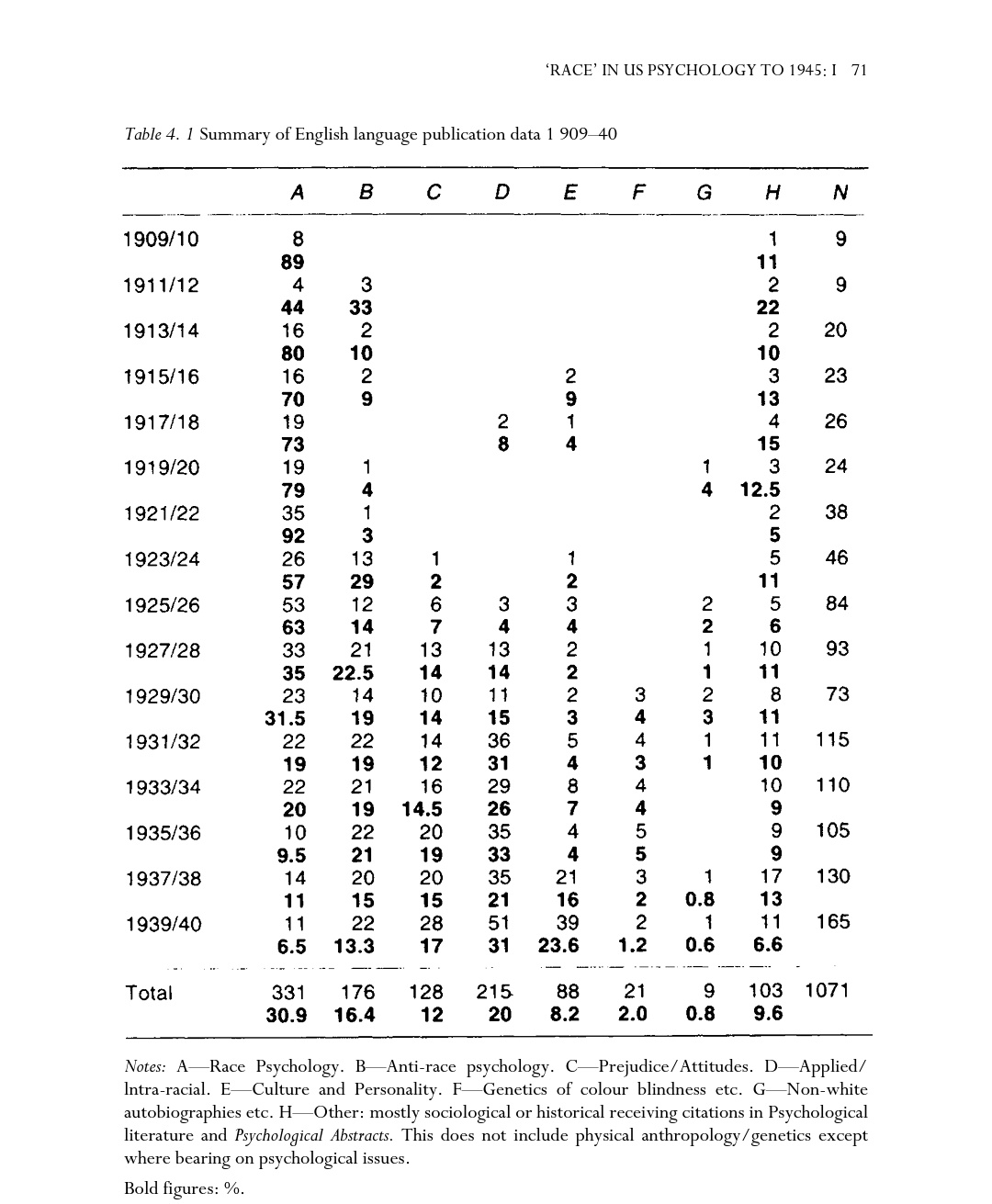
Note that the racist views of the psychologists in question more than likely influenced their research interests—they set out to ‘prove’ their a priori biases. Indeed, they even modeled their tests after such biases. Tests that were constructed that agreed with their a priori pre-suppositions on who was or was not intelligence was kept whereas those that did not agree with those notions were thrown out (as noted by Hilliard, 2012). This is just as Jones, Elcock, and Tyson (2011: 67) note with the ‘positive manifold’ (‘general intelligence’):
Subtests within a battery of intelligence tests are included n the basis of them showing a substantial correlation with the test as a whole, and tests which do not show such correlations are excluded.
From this, it directly follows that psychometry (and psychology) are not sciences and do not ‘measure’ anything (returning to (i) above). What psychometrics (and psychology) do is attempt to use their biased tests in order to sort individuals into where they ‘belong’ on the social hierarchy. Standardized testing (IQ tests were one of the first standardized tests, along with the SAT)—and by proxy psychometrics—is NOT a form of measurement. The hierarchy that the tests ‘find’ is presupposed to exist and then constructed into existence using the test to ‘prove’ their biases ‘right.’
Indeed, Hilliard (2012) noted that in South Africa in the 1950s that there was a 15-point difference in IQ between two white cultural groups. Rather than fan flames of political tension between the groups, the test was changed in order to eliminate the difference between the two groups. The same, she notes, was the case regarding IQ differences between men and women—Terman eliminated such differences by picking and choosing certain items that favored one group and balanced them out so that they scored near-equally. These are two great examples from the 20th century that demonstrate the reflexivity in psychology—how one’s a priori biases influence what they study and the types of conclusions they draw from data.
Psychology, at least when it comes to racial differences in ‘IQ’, is being used to confirm pre-existing prejudices and not find any ‘new objective facts.’ “… psychology [puts] a scientific gloss on the accepted social wisdom of the day” (Christian, 2008: 5). This can be seen with a reading into the history of “IQ tests” themselves. The point is, that psychology and society influence each other in a reflexive—circular—manner. Thus, psychology is not and cannot be an ‘objective science’ and when it comes to ‘IQ’ the biases that led to the bringing of the tests to America and concurrently social policy are still—albeit implicitly—believed today.
Psychology originally developed in the US in the 19th century in order to attempt to fix societal problems—there needed to be a science of the mind and psychology purported to be just that. They, thusly, needed a science of ‘human nature’, and it was for this reason that psychology developed in the US. The first US psychologists were trained in Germany and then returned to the US and developed an American psychology. Though, do note that in Germany psychology was seen as the science of the mind while in America it would then turn out to be the science of behavior (Jones, Elcock, and Tyson, 2011). This also does speak to the eugenic views held by certain IQ-ists in the 20th and into the 21st century.
In Nazi Germany, Jewish psychologists were purged since their views did not line-up with the Nazi regime.
Psychology appealed to the Nazi Party for two reasons: because psychological theory could be used to support Nazi ideology, and because psychology could be applied in service to the state apparatus. Those psychologists who remained adapted their theories to suit Nazi ideology, and developed theories that demonstrated the necessary inferiority of non-Aryan groups (Jones and Elcock, 2001). These helped to justify actions by the state in discriminating against, and ultimately attempting to eradicate, thse other groups. (Jones, Elcock, and Tyson (2011: 38-39)
These examples show that psychology is influenced by society but also that society influences psychological theorizing. Clearly, what psychologists choose to study, since society influences psychology, is a reflection of a society’s social concerns. In the case of IQ, crime, etc, the psychologist attempts to naturalize and biologicize such differences in order to explain them as ‘innate’ or ‘genetic’. The rise of IQ tests in America, too, also coincided with the worry that ‘national intelligence’ was declining and so, the IQ test would need to be used to ‘screen’ prospective immigrants. (See Richardson, 2011 for an in-depth consideration on the tests and conditions that the testees were exposed to on Ellis Island; also see Gould, 1996.)
Conclusion
(i) The Berka/Nash measurement objection is one of the most lethal arguments for IQ-ists. If they cannot state the specified measured object, the object of measurement, and the measuring unit for IQ then they cannot say that any’thing’ is being ‘measured’ by ‘IQ tests.’ This then brings us to (ii). Since there is no theory or definition of what is being ‘measured’, and if the tests were constructed first before the theory, then there will necessarily be a built-in bias to what is being ‘measured’ (namely, so-called ‘innnate mental potential’). (iii) Since it is logically impossible for psychology to reduce to physical structure, and since all facts cannot be stated using a physical vocabulary nor can the mind be described using material terms that only refer to material properties, then this is another blow to the claim that psychology is an ‘objective science’ and that some’thing’ is being ‘measured’ by their tests (constructed to agree with their a priori biases). And (iv) The bias that is inherent in psychology (for both the right and the left) influences the practitioners’ theorizing and how they interpret data. Society has influenced psychology (and psychology has influenced the society) and we only need to look at America and Nazi Germany in the 20th century to see that this holds.
The relationship between psychology and society is inseparable—it is a truism that what psychologists choose to study and how and why they formulate their conclusions will be influenced by the biases they already hold about society and how and why it is the way it is. For these reasons, psychology/psychometry are not ‘sciences’ and hereditarianism is not a logically sound position. Hereditarianism, then, stays what it was when it was formulated—a racist theory that attempts to bilogicize and justify the current social hierarchy. Thus, one should not accept that psychologists ‘measure’ any’thing’ with their tests; one should not accept the claim that mental abilities can be genetically transmitted/inherited; one should not accept the claim that psychology is an objective ‘science’ due to the reflexive relationship between psychology and society.
The arguments given show why hereditarianism should be abandoned—it is not a scientific theory, it just attempts to naturalize biological inequalities between individuals and groups (Mensh and Mensh, 1991; Gould, 1996; Garrison, 2009). Psychometrics (what hereditarians use to attempt to justify their claims) is, then, nothing more than a political ring.
What Happens When a Physiologist Looks into “HBD” Claims? A Case Study
1350 words
The Bajau spleen size and better-living-through-evolution story is also a reminder that since the dawn of the theory of evolution, humans have been incredibly creative in coming up with evolutionary and hence genetic narratives and explanations for just about every human trait that can be measured. This effort recycles from time to time and is again reaching a peak in an era when it is possible to quickly and cheaply “genotype” human populations. (Joyner, Boros, and Fink, 2018: 524-525)
Yesterday on Twitter Matt Yglesias—Vox blogger—tweeted out a 2018 paper in which the authors argue that ‘natural selection’ explained the bigger spleens of the Bajau and, consequently, how they could hold their breaths for such a long time (Ilardo et al, 2018). The main claim of the paper is that ‘natural selection’ ‘selected-for’ larger spleens which then increases how much oxygen can be stored. The point of the study was to find out if their exceptional diving abilities had a ‘genetic basis.’ Thankfully, though, a group of physiologists looked into the claims of Ilardo et al (2018) and found their main claims wanting (Joyner, Boros, and Fink, 2018). That’s how easy it is for selectionists: Notice a trait; then work backward and attempt to formulate the best story you can (see Smith, 2016).
These diving capabilities are similar to high-altitude hypoxia—indeed the authors assume that there was an adaptation for breath-hold diving. They compared some Bajau people (n=59) and close neighbors who did not—the Saluan (n=34)—really interact with the water environment. So, using a portable ultrasound machine, they photographed the spleens of the two groups and noted a “clear visual difference” between Bajau spleens and Saluan spleens. The Bajau had spleens about 40-50 cc bigger than the Saluan.
These results suggest a physiological difference between the Bajau and the Saluan that is not solely attributable to a plastic response of the spleen to diving activity. While other unknown environmental factors could potentially explain the observed difference between the groups, genetic factors remain a possibility.
So big spleens mean big breath-diving ability. And big spleens were an object of selection. So breath-diving was therefore selected for—so the just-so story goes. But, “a slightly larger spleen is almost certainly not the most important [part of diving] from a physiological perspective” (Joyner, Boros, and Fink, 2018: 524). They then found ‘genes for’ big spleens and they then formulated their just-so story. Accompanying evidence was the fact that deep-diving animals have bigger spleens, so since the Bajau have bigger spleens, this then would mean that the bigger spleens then allows for better breath-diving. Joyner, Boros, and Fink (2018: 525) write:
The general idea is that, like blood doping in cyclists, bigger spleens that contract would give the Bajau divers a boost of oxygen-carrying red cells that would make them more successful at underwater-based hunting and gathering. Thus, spleen size was selected for via evolution over the last 1,000 years or so. A few simple back-of-the-envelope calculations about oxygen stores are instructive. A 40 cc bigger spleen that was all red cells and contracted completely with diving might give the Bajau 20 milliliters of extra oxygen. That is about 1% or less of the oxygen stored in the body and lungs of healthy humans.
Joyner and colleagues then go on to note other ethnies who perform similar breath-dives, while also noting that the Bajau routinely perform dives at 5-10 meters for 30 seconds, which while impressive, is something that fit people can do if they train their lung capacity.
Of note, in the famous Japanese and Korean breath-hold divers who have been studied for decades, repeated descents of this depth and duration don’t cause oxygen levels in the blood to fall much (Schagatay, Lodin-Sundstrom, and Abrahamsson 2011; Stanek et al. 1993). Second, repeated dives of this duration with brief periods of rest only cause whole-body oxygen consumption to rise to the level seen during a brisk walk or slow jog (Craig and Medd 1968). This is hardly the sort of maximum efforts made by deep-diving seals, competitive breath-hold divers, and blood-doping cyclists. The extra oxygen from a slightly larger spleen could easily be generated by a slightly larger breath prior to starting the dive.
It is incredibly easy to think up just-so stories for anything you notice (e.g., my just-so story on Mesoamerican human sacrifices). The Bajau learn to do breath-dive like that—it is an acquired ability. ALL human traits are experience-dependent and plastic, but obviously not to the same degrees.
The spleen is a blood filter. Being a blood filter, if it can filter MORE blood by being bigger, then it will give the individual whose spleen it is an advantage at certain tasks. It sits upper-left part of the abdomen and is protected by the rib cage while also being a place for blood cell storage (Pernar and Tavakkoli, 2019). The spleen acts as a reservoir of oxygen storing “‘thick blood’ rich in cells” so that when the diving animal the oxygen levels are stressed, the body has the reservoir of extra oxygen (Milton, 2004). Esperson et al (2002) also note how the spleen acts as a reservoir of red blood cells, while the contraction of the spleen causes extra hemoglobin production after exposure to diving events.
When a diver submerges their body in the water, two things happen: bradycardia—slower heart rate and vasoconstriction—the narrowing of arteries. The increase in water pressure further causes blood shift—an extension of vasoconstriction which allows us to dive deeply and the spleen effect—meaning that the spleen of divers shrinks which then releases the stored RBCs into the body, allowing for prolonged diving. So, if we look at this in regard to the Bajau, their large spleen shrinks and since their spleen is large due to the number of RBCs it has, it would then follow that as they deep-dive the spleen would shrink (known as splenic contraction) causing the release of the RBCs into the body, allowing for the deep-diving phenotype. Thus, without the blood shift and spleen effect, divers would not be able to dive to such deep depths. (See Gooden, 1994.) The mammalian dive response has, also, been hypothesized to be a reflex to preserve life (Panneton, 2013).
Bajau and, for example, Tibetan environments are similar in that the Bajau spend time in low-oxygen environments (the water) and so do the Tibetans (the mountains). But the Tibetans are constantly exposed to this effect; the Bajau need to be in the water for this effect to occur.
Lastly, the “HBDers” in the comments on Yglesias’ tweet said the same ol’ predictable things. Such as “human spleen growth is complex and due to what the stereotypes of a group’s spleen size are”; “of course it’s true!”; “variation in spleen size within groups is greater than variation in spleen size within groups”; “spleens are a social construct”; “evolution only happened in humans below the neck”; etc. These are the same ol’ sayings that come out from “HBDers” whenever a finding like this comes out. And, you can tell that they are ignorant to the anatomy/physiology of this stuff. They just jump on anything that they can say “HBD is real!!” as if anyone denies that humans are biologically diverse (like when the Rushton retraction came ‘it doesn’t mean that HBD isn’t true!). They move and weave different definitions of ‘HBD’ to fit their needs.
Such storytelling can be done for any trait, as noted by Smith (2016). One can think up selectionist stories and competing ideas for the evolution of traits, but without a way of ajudicating between two stories. One of the best definitions of just-so stories I am aware of is from Not in Our Genes (Lewontin, Rose, and Kamin, 1984: 258-262) cited in Smith (2016). Just-so stories:
predicate a genetically determined contrast in the past…unstated assumption that genes may arise with any arbitrarily complicated action needed by the theory…insulated from any possibility of being contradicted by fact…. If one is allowed to invent genes with arbitrary complicated effects on phenotype and then to invent adaptive stories about the unrecoverable past of human history, all phenomena, real and imaginary, can be explained.
So what happens when a physiologist looks into “HBD” claims? They are found very, very wanting.
A Bad Week for “HBD”: Retractions
1350 words
I’ve been writing on this blog since June 15th, 2015. Back then, I held staunch hereditarian beliefs. Rushton’s views on testosterone were enticing to me, especially his theoretical article with Templer (Rushton and Templer, 2012). When I first read it I thought “Oh, justification for my prior beliefs about blacks and crime.” Then, when I started studying anatomy and physiology, I reread the paper and thought “Wow who gave the OK to publish this mess?”
So in February of 2018 I published a critique of the article, Do pigmentation and the melanocortin system modulate aggression and sexuality in humans as they do in other animals? A Response to Rushton and Templer (2012). I critiqued many of the claims in their article; its biggest weakness completely handwaving the warnings of Ducrest et al (2008) that human populations “are therefore not expected to consistently exhibit the associations between melaninbased coloration and the physiological and behavioural traits reported in our study.” Rushton and Templer dodged this by saying that we should compare African and European crime rates and that we do, indeed, see that Africans commit more crimes than whites and Africans have darker skin than whites so this is sort of “preliminary evidence” for the relationship in human races.
However, unfortunately for Rushton, Cernovsky and Litmann (2019) reanlyzed the INTERPOL crime data:
When all data from the same two Interpol Yearbooks are re-calculated, most of the statistically significant trends in the data are in the direction opposite to Rushton’s beliefs: Negroids had lower crime rates than Caucasoids with respect to sexual offenses, rapes, theft, and violent theft or robbery, with most correlation coefficients exceeding .60. While we do not place much credence in such Interpol statistics as they only reproduce information provided by government officials of different countries, our re-analysis indicated that Rushton excluded data that would discredit his theory.
So, if we accept the INTERPOL data—as Rushton did—then we would be justified in saying that the proposed relationships and causal pathways do not hold.
Then at the end of October the Twitter account @evopsychgoogle wrote a long thread with a strong, in-depth critique of the arguments and sources in Rushton and Templer (2012). He then published his critique as a letter to the editor of Personality and Individual Differences (PaID). In the letter, he exposes the shoddy logic of Rushton and Templer, while showing their misreadings of sources and misunderstanding of pleiotropy. Their main point in the paper is that LHT may explain why dark-skinned individuals are more violent, mature faster, etc while they also argue that the melanocortin system is a physiological coordinator of LH traits and skin color.
Testosterone production is a simple bodily process—to quote myself from November, 2017:
There are five simple steps to testosterone production: 1) DNA codes for mRNA; 2) mRNA codes for the synthesis of an enzyme in the cytoplasm; 3) luteinizing hormone stimulates the production of another messenger in the cell when testosterone is needed; 4) this second messenger activates the enzyme; 5) the enzyme then converts cholesterol to testosterone (Leydig cells produce testosterone in the presence of luteinizing hormone) (Saladin, 2010: 137). Testosterone is a steroid and so there are no ‘genes for’ testosterone.
Cells in the testes need to take cholesterol and then convert it into testosterone with the luteinizing hormone. According to Rushton and Templer, the result of this bodily process is part of the reason why blacks are more violent than whites—they have higher levels of testosterone and testosterone causes aggression/violence. Surely, Rushton and Templer were aware of Rohrmann et al (2007) who showed no difference in testosterone between blacks and whites. Surely Rushton and Templer were aware of all of the research that I cited in what I would call my ‘master article’ on race, testosterone, prostate cancer, and aggression. Rushton and Templer, quite obviously on a review of the literature, are misleading their readers.
Thankfully this paper has only been cited 15 times in the past 8 years since it was published. Evolution, presumably, accounts for the differences in death, AIDS rate, testosterone, lower life expectancy, etc. One recent citation can be found in the textbook Race and Crime (Gabiddon and Greene, 2018, 5th edition) in a discussion about Rushton’s r/K selection theory and causes for Rushton’s proposed relationship. They write (pg 122-123):
As with all theories, there have been several criticisms of the r/K selection theory. First, Rushton generally underemphasizes sociological factors. Most of his cross-national comparisons point strictly to numbers, without taking into account variables such as socioeconomic status, and other important sociological variables (Whihte, 2018). Second, in the 21st century, there are few “pure” races, especially in the United States, as noted in Chapter 1. White sexual aggression against Black females during the slave era produces countless mixed-race offspring. Therefore, the rigorous adherence to the Black-White-Asian split is problematic. Finally, if Rushton;s theory were true, what would explain White aggression as early colonizers and their current involvement in wars and violence across the globe? In contrast to Rushton’s theory, Bradley (1978) argued that, as a result of migration to colder regions, since the beginning of humanity, Whites have been the global aggressors.
So, testosterone does not cause aggression and it does not cause crime; the melanocortin system does not work in such a way that works for Rushton and Templer’s theory (Cone, 2006).
Hilliard (2012: 73) stated that “No evidence shows that racism motivated Rushton” while Dutton (2018) stated the same, interviewing Rushton’s ex-wife (whom he had an illegitimate black son with). But, knowing what we know about testosterone and Rushton’s views on blacks and whites, knowing about his (false) views on testosterone and race (while citing old, flawed studies like Ross et al) we can call into question the claim that Rushton had no racial animus. @evopsychgoogle also brought up the fact that COIs and funding sources were not brought up (this being Rushton’s final paper before his death and the fact that he was the head of the Pioneer Fund at the time means we don’t have to ask where the funding came from). Rushton and Templer should have never been published in the first place.
Lastly, Clark et al (2020) argued that ‘intelligence’ as ‘measured‘ by ‘IQ tests’ modulates the relationship between religiosity and crime at a country-wide level. They, of course, used Lynn’s global ‘IQ’ data. Though, there were many critiques of the paper and the data used in it (see here, here, and here) and Clark et al decided to finally retract their paper due to the problems of Lynn’s dataset. So, if they retracted due to the problems with Lynn’s dataset, does that mean that other papers that relied on Lynn’s shoddy work (e.g., Richardson, 2004; Morse, 2008) should be retracted too? Ebbeson (2020) notes the flawed ‘IQ estimates’ used in Clark (2020), noting the small, unrepresentative child samples used, along with showing that their dataset leads to “notions” which “are incompatible with psychological science” so “all conclusions drawn from these data are invalid.”
Clark et al “lost confidence in their findings” since “the homicide data have limitations that call [their] findings into question” while “The IQ data … have much more serious issues.” “Serious” is an understatement. To quote Ebbeson (2020)
For example, in the ‘NIQ_QNWSAS’ dataset, several African, South Asian and Central American countries have an average IQ below 50, such as Nepal (national IQ: 43.0), Sierra Leone (national IQ: 45.1), Guatemala (national IQ: 47.7) and Gambia (national IQ: 49.8) These estimates would seem to suggest that a majority of the population in these countries are moderately, severely, or profoundly cognitively impaired. (cf. Table 1). This notion is incompatible with psychological science and there is no doubt that these estimates are wrong.
All in all, this is not a good week for “HBD”—Rushton is being exposed for the know-nothing about physiology that he is, and Lynn’s ‘national IQ’ numbers are getting the scrutiny they finally deserve. So, I hold, if Clark et al was retracted for those reasons, we need to retract ALL papers that relied on Lynn’s ‘national IQ data.’ People may cry ‘censorship! HBD is dead!’, but ‘HBD’ (what I would term psychological hereditarianism) has been long dead. Rushton and Templer’s paper should have never been published but it’s better late than never that it is finally getting retracted. If you’re saying that Rushton and Templer got retracted for “political reasons” then it’s clear that you did not read either of the two existing critiques of the paper.
Sudden Infant Death Syndrome (SIDS): How A Genetic Determinist Theory Cost Infant Lives
3000 words
Sudden Infant Death Syndrome (SIDS) has a long history—almost as long as human civilization (Raven, 2018). The term was coined in 1969 to bring attention to children who died in the postnatal period (Kinney and Thach, 2012; Duncan and Byard, 2018). About 95 percent of SIDS cases occur within the first 6 months of life, happening around the 4-6 months mark (Fleming, Blair, and Pease, 2015). The syndrome is associated with the sleep period, presumed to have begun with the transition from sleep to waking (Kinney and Thach, 2012) The prone sleeping position, along with smoking, is said to increase the incidence of SIDS (Ramirez, Ramirez, and Anderson, 2018). Due to a campaign in the mid-90s, though (called the back-to-sleep campaign), it has been estimated that SIDS deaths have decreased by 50 percent, saving thousands of infant lives (Kinney and Thach, 2012).
But, those infants who die from SIDS may also have a problem with the part of their brain that controls waking/sleeping:
Infants who die from SIDS may have a problem with the part of the brain that helps control breathing and waking during sleep. If a baby is breathing stale air and not getting enough oxygen, the brain usually triggers the baby to wake up and cry to get more oxygen.
So, if a baby’s brain is not getting enough oxygen, its brain will have it wake up and cry in an attempt to rid itself of “stale oxygen”—this is one other purpose that crying serves—which then gets the baby more oxygen to its brain.
Buchanan (2019) hypothesizes that reduced Co2 is a cause for SIDS—being that Co2 induces arousal from sleep. Buchanan (2019: 4-5) writes:
As can be imagined, acute rises in CO2 levels occur when an individual is unable to expel CO2, such as in the setting of an airway obstruction that might occur when an individual is lying prone in a crib or bed perhaps with a pillow and bedclothes covering the nose and mouth. It has been proposed that such a rise in CO2 would activate arousal circuitry in a normal baby to wake the baby up, cause them to cry out, summoning a caregiver who would come to their aid, and ostensibly correct the airway blockage to allow resumption of normal breathing [16,20,31]. It has been proposed, among other possibilities, that there is an impaired CO2-arousal system in SIDS-susceptible babies such that when they rebreathe CO2 as described above, they do not arouse, and thus do not cry out, and the blockage is not corrected [16,32]. They thus become acidotic and hypoxic and ultimately succumb.
So, if a babe’s airway gets blocked, for instance by a pillow or toy, they wake, cry out for attention and their caregiver comes to solve the problem or they change their laying position. But in SIDS cases, this does not occur. Why? Buchanan argues that those who succumb to sudden deaths like SIDS have screwy serotonin receptors—they ensure that blood oxygen and CO2 levels are healthy. But some of these infants may have brains that don’t allow them to detect the CO2 and blood oxygen levels—when the body may be suffocating. SIDS victims are usually found face-down in their cribs. But, there are no biomarkers for SIDS (Haynes, 2018). The SIDS diagnosis is only given after all other causes of death are ruled out—this is why SIDS is so mysterious. Genetic mutations have been posited as a cause (Männikkö et al, 2018), as has a pregnant mother smoking during pregancy, leading to a doubled risk of SIDS (Anderson et al, 2019).
But the best prevention against SIDS is nonprone sleeping—having the baby sleep on its back. The efficacy of this approach since the 1990ss has been noted (Gibson et al, 1992; de Luca and Hinide, 2016) while “Achieving recommended prenatal care and infant vaccinations, as well as reductions in maternal tobacco and substance use, has the potential to further reduce rates of SIDS and should be given as much attention as safe sleep advice in SIDS risk reduction campaigns” (Hauck and Tanabe, 2017: e289). The back-to-sleep program, though, has been associated with a decrease in motor development from the infant sending time in the supine position along with the strong possibility of developing plagiocephaly—which causes a “flat head” due to being placed in similar positions while the infant’s skull is soft and still developing (Miller et al, 2011). It has also been estimated that if it was known that the advice to place infants on their stomachs to sleep led to SIDS, then we “might have prevented over 10 000 infant deaths in the UK and at least 50 000 in Europe, the USA, and Australasia” (Gilbert et al, 2005: 884).
But the history of SIDS in America is a lot more sinister—rather than children dying from ‘natural causes’ (SIDS), in the 1970s, it was hypothesized by one SIDS researcher that SIDS was ‘genetic’ and ‘transmissible’ on the basis of one family who, unfortunately, had experienced this tragedy more than once.
This leads us to the story of Waneta Hoyt, who is the subject of this article.
Hoyt and Steinschneider: Genes vs environment
Horrible tragedies befell a woman from New York named Waneta Hoyt—five of her children had mysteriously died due to SIDS between the years of 1965-1971.
Waneta killed her first child, Eric who was three-months-old. SIDS is a diagnosis that is arrived at through a process of elimination—rule out all other causes at a young age (under 1) and the cause is then SIDS. But, the thing is, when an autopsy is performed on the infant, there is no difference between what would be said to be SIDS deaths and a light smothering.
After Waneta murdered her first child, she was cold and distant but it was not noticed. It was reported that she would never hold her children as a loving mother would, keeping them quite far from her. But it wasn’t until three years later that she, again, murdered. But this time it was two of her children—her two-year-old son and six-week-old daughter. The murders that Waneta were committing were wrongfully diagnosed as being due to SIDS.
This caught the attention of renowned SIDS researcher Alfred Steinschneider who had a clinic in which he specialized in caring for infants who were thought to be high-risk for SIDS. Steinschneider wanted to watch Waneta’s fourth child in his sleeping ward, in an attempt to prevent what he thought was due to SIDS. So, when he heard of Waneta’s story, he reached out to her to monitor her daughter, Molly.
The nurses at Steinschneider’s clinic, though, became suspicious of Waneta when she was at the clinic since she was cold and distant to Molly—she would not show her any affection. Steinschneider’s nurses emphatically told Steinschneider that it was Waneta who was murdering her children. Steinschneider shot back, and sent Molly home anyway. In an interview on the television program Deadly Women called Mothers Who Kill, one of the nurses who watched Molly before she was discharged by Steinschneider said:
And then about a quarter to eleven when we were getting ready to go off duty I said ‘Joyce, what do you think, do you think she’s still alive?’ Of course when I came on duty the next day she was dead.
This is wonderfully noted by Firstman and Talman in their book on Waneta’s case The Death of Innocents (1996):
Forty-eight hours later, on Thursday, June 4, Steinschneider scheduled Molly for her third discharge. By now, the nurses were speaking more openly about their suspicions. “I just know something’s going to happen,” Corrine Dower said to Thelma. “One of these times she’s going to do it.” Corrine was scornful of Steinschneider. “If he had any brains at all he would have seen that she didn’t want the baby,” she would say years later. “You can tell in the grocery store if a person cares about their child. We were just disgusted with Steinschneider.” (book excerpt from How Two Baby Deaths Led to a Misguided SIDS Theory)
Presumably, since this was Waneta’s fourth time experiencing the tragedy of SIDS, Steinschneider did not think that Waneta could be involved—but his nurses knew the truth. It was when Waneta had her fifth child that Steinschneider thought he would make his breakthrough in his research. Steinschneider was so convinced that the baby’s were dying due to SIDS, and he thought that if he could monitor Waneta’s new baby as much as possible, that he may figure out why babies die from SIDS.
Steinschneider believes that SIDS is hereditary—passed on through genes. The fifth child was watched at Steinschneider’s clinic and when Steinschneider discharged him—in an attempt to prove his theory—his nurses protested. Then, shortly after, Waneta called Steinschneider saying that it had happened again—her fifth child had mysteriously died.
After the death of Waneta’s fifth child, Steinschneider published his paper Prolonged Apnea and the Sudden Infant Death Syndrome: Clinical and Laboratory Observations arguing that SIDS was caused largely by hereditary sleep apnea (Steinschneider, 1972). By 1997, Steinschneider’s paper was the most-cited paper in the SIDS literature (Bergman, 1997). It was due to Steinschneider’s research, though, that parents began using sleep monitors to monitor their children’s sleep so they could be alerted in case their child had sleep apnea.
Steinschneider cared more about his research and theory of SIDS and sleep apnea over what was striking him right in the face—Waneta was responsible for the deaths of her five children. Steinschneider’s 1972 paper was cited and used for 22 years, until it was found upon an in-depth look into Steinschneider’s paper that what was clear to Steinschneider’s nurses and not him was true—Waneta was responsible for the deaths of her children. Steinschneider’s paper, in any case, concluded that SIDS is a genetic disorder and it was thusly inherited. And Waneta’s case, it seems, lent credence to his hypothesis. Steinschneider gave Waneta the perfect alibi—her woes were caused by a genetic disease and there was nothing that could have been done to prevent it.
Waneta was convicted in 1995 of five counts of murder and sentenced to 75 years in prison—therefore refuting Steinschneider’s theory. Three years after her sentence, though, Waneta died in prison of cancer. The case of Waneta Hoyt allowed mothers to kill their children in this specific way (a light smothering) for almost a quarter of a century.
Hickey, O’Brien, and Lighty (1996) write:
Norton saw history repeating itself in the reluctance of many factors to face the fact that some deaths attributed to SIDS were homicides. She agreed with the bulk of SIDS research, which pointed to apnea, or the cessation of breathing, as the final pathway to death. But there were many causes of apnea, not all of them natural. An adult could place a hand or a pillow over an infant’s nose and mouth and stop the child from breathing. The pressure needed to smother an infant often left no telltale signs, Norton explained.
“There is no way for the pathologist at autopsy to distinguish between homicidal smothering and SIDS,” she concluded.
Norton worried that homicides were being passed off as SIDS because many doctors held the erroneous belief that SIDS ran in families. They ignored large-scale studies that had shown no genetic tendency toward SIDS. Flouting conventional wisdom, Norton warned that the sudden, unexplained death of a SIDS victim’s sibling should be treated as a possible homicide.
When Waneta was convicted, letters to the editor were sent about Steinschneider’s paper. The short correction to the paper chronicles, interestingly, a letter to the editor of the journal Pediatrics, who published the Steinschneider paper
“But the paper indicated a more sinister possibility to Dr. John F. Hick of Minnesota. In a letter to the journal, he wrote that the case offered “circumstantial evidence suggesting a critical role for the mother in the death of her children.” (See below.)
But his warning was dismissed, until Mr. Fitzpatrick read the paper 15 years later.
“The medical records described two happy, healthy, perfectly normal kids,” he said. “It convinced me that these children were murdered.”
Hick’s letter to Pediatrics says:
In reporting two siblings who succumbed to “sudden infant death syndrome,” Steinschneider exposes an unparalleled family chronicle of infant death.’ Of five children, four died in early infancy and the other died without explanation at age 28 months. Prolonged apnea is proposed as the common denominator in the deaths, yet the author leaves many questions relevant to the fate of these children unanswered.
In her signed confession, Waneta said that she smothered her five children because their screaming made her “feel useless”, though Waneta later stated that she only said that to stop the police from questioning her. Steinschneider, like another motivated-reasoner J.P. Rushton, ignored data that did not fit his theory of sleep-apnea-induced-SIDS—specifically how Waneta acted around her children while at his clinic and the thoughts of his own nursing staff telling him not to discharge the Hoyt infants.
Waneta recalled her strangling of her children—specifically Julie:
”They just kept crying and crying. . . . I just picked up Julie and I put her into my arm, in between my arm and my neck like this . . . and I just kept squeezing and squeezing and squeezing.”
Steinschneider’s testimony during Waneta’s trial, however, is very interesting. Reported by the New York Times, Steinschneider attempted to defend his patient Waneta against claims that she had murdered her children:
Autopsies were done,” he said, speaking of Molly. “They could not find a known cause of death.”
This, Dr. Steinschneider said, “by definition” is SIDS.
But under intense cross-examination. Dr. Steinschneider conceded that he could not remember — and did not record — crucial details from the medical histories of the two infants, whom he had hospitalized for observation soon after birth. In each case, the parents had reported that the baby was having difficulty breathing and that its older siblings had died mysteriously.
The doctor also acknowledged concluding that Molly and Noah had died of SIDS without knowing how thoroughly the authorities had probed the “death scene” for evidence of other causes, including murder.
It is said—even by the prosecutor on her case—that Waneta suffered from Munchausen by proxy (Firstman and Talan, 1996)—which is the intentional cause of illness, usually on children, in order for the mother to elicit sympathy for others (Gehlawat et al, 2015). In cases like this, mothers who have the Munchausen syndrome will suffocate their children and then rush them to the hospital—they get the satisfaction of inflicting pain and then the satisfaction of getting cared for for the so-called mysterious death of their baby. One study of 51 sleep apnea monitorings found that about 40 percent of the program treated infants who had apnea that seemed to be induced by the parent; this was inferred from the fact that once the infants were admitted to the hospital, the doctors found no signs of apnea (Light and Sheridan, 1990).
One doctor even took it upon himself to place cameras in his practice in order to monitor parents that were suspected of abusing their children. Thirty-nine infants were monitored—thirty-three infants were being abused by their parents, what’s more is that some of the infants in this study who were identified in the video also had a sibling who mysteriously died from SIDS (Southall et al, 1997). What the study shows is that these parents were suffocating their children, causing their breathing problems and that they most likely have gotten away with infanticide before. Another case involved a mother taking her daughter to eleven different hospitals, but none of them found anything wrong with the girl and she ended up dying under suspicious circumstances (Hassler, Zamorski, and Weirich, 2007).
Conclusion
We now know that Steinschneider ignored contrary evidence to his theory of genetically-induced sleep apnea causing SIDS which apparently ran in families, and since he brushed off his nursing staff telling him that Waneta was acting strangely around her two children that he had admitted into his clinic, he could have saved their lives. But Steinschneider’s genetic determinist theory was more important than seeing what was clear as day to his staff and even others who read his 1972 paper—a mother was strangling her own infants.
SIDS has a long history, dating back to biblical times. But, in the modern-era, erroneous theories on the causes of SIDS were pushed while other, more obvious causes were disregarded in favor of a grand genetic theory of SIDS causation. Waneta and Steinschneider both helped each other out: Steinschneider (unknowingly) helped Waneta evade detection for 22 years while Waneta lent credence to the hypothesis that Steinschneider was developing. The fact that, at the time of their first meeting, three of Waneta’s children had died in almost the same fashion pointed to a genetic, inherited cause in Steinschneider’s eyes.
At the time of publication of The Death of Innocents, Steinschneider still continues to defend his now-discredited theory and still lobbies for the use of infant sleep monitors. Of course, since he testified FOR Waneta, despite the mounting evidence against her, he could be seen as an accomplice, however weakly. But this case shows one thing that should be well-known—researchers become attached to their pet hypotheses/theories and will ignore contrary evidence if it is brought to their attention. Firstman and Talman estimate that between 5 and 10 percent of SIDS cases are actually homicides. (But see Milroy and Kepron, 2017.)
Steinschneider created the SIDS disease on the basis of Waneta’s story—and a multi-million dollar industry then appeared due to his paper—it’s all to save infants, buy these sleep apnea monitors. But there were two children that Steinschneider did not—could not—save: He could have saved those babies, if not for his genetic determinist beliefs on SIDS causation. Had Steinshneider looked at the more obvious answer to the problem which was right in front of his face, he may have seen that Waneta suffered from Munchausen by Proxy, and, as evidenced from the references above, those who suffer from the disease act out exactly how Waneta did—by strangling their children with the cause of death being blamed on SIDS.
The Hoyt-Steinschneider case is a warning—don’t jump so quickly to implicate heredity in the ontology of X, especially when other, more obvious, tells are right there in front of you.
A History of the “Race” Concept
2550 words
The concept of “race” stretches back as long as human civilization. The concept of “racism” also stretches back just as far with it—they seem to be intertwined. There is a consensus, though, the term was constructed during the European Age of Exploration. This claim though, is false. The concept actually goes back at least 5,000 years. By looking at the art and reading the myths of these ancient civilizations, we can see that the social constructivist claim about race—that it is a recent creation—is false. They also described their physical features and also attempted to explain behavioral differences between races based on the limited knowledge they had in their day.
Sarich and Miele (2004) state that the PBS documentary on race—which is largely the main reason why they wrote their book Race: The Reality of Human Difference—claimed that race is a human invention and that since we create it we can then “unmake it.” We can look at art from ancient civilizations and see that they did sort people into groups based on their skin color and other physical characters. Each civilization, of course, thought itself and its racial features to be ‘superior’ to the others they encountered. The ancients used the set of observable features to describe what we now call “races.”
India
Our first trip on this long journey to understand the history of race is India. The earliest hints of what would become the caste system were written around 5kya. In the Rig Veda, a description of the Arya(n) invasion in the Indus valley where a dark-skinned people lived. The god of the Arya(n)s Indra “is described as “blowing away with supernatural might from earth and from the heavens the black skin which Indra hates” (Gossett, 1997: 3-4). They also called these dark-skinned people “Anasahs” which meant “the noseless people.” They then describe Indra killing all of the dark-skinned people and conquering the Indus for the Arya.
Sarich and Miele (2004: 47-48) note that the peoples that Indra hated were called Dasas—broad-nosed worshippers of the phallus. Even when Alexander the Great’s army reached India and described the Indians in the south of the country as some of the darkest people they have seen, they still made the distinction between Indians and Africans—by their hair type—so this tells us that race is more than ‘skin deep’ to the Greeks. Race, then, was known for thousands of years BEFORE the Age of Exploration.
Ancient China
We can look to ancient China, too, to see instances of racial descriptions and then racism along with it. For instance, a Chinese writer described yellow-haired, blue-eyed people from a distant province, “who greatly resembeled monkeys from whom they are descended” (Gossett, 1997: 4). Another Chinese legend describes differences between themselves and a brabarian tribe. A Chinese emperor stated that he would give his daughter to whomever slayed the chieftan he was having problems with. Then, the palace dog comes back with the head of the chieftan. The emperor did not go back on his word; he gave the dog his daughter and the resulting children were “fond of living in high altitudes and averse to plains” (Gossett, 1997: 4).
Like other civilizations, the ancient Han Chinese regarded other groups they came into contact with as barbarians. They were especially taken aback by the odd appearance of one group, the Yuehzi, because of their hairy, white, ruddy skin and their prominent noses, which the Chinese likened to those of monkeys.
[…]
The Han Chinese applied the term “Hu” to barbarians like the Yuehzi who had “deep eye sockets, prominent noses, and beards.” But they did not apply it to the Qiang, another barbarian group, who had a Mongoloid appearance and among whom some of the Yuezhi lived. Both groups were denigrated as uncivilized and inferior to the Chinese, but the Qiang were deemed to belong to the same racial stock, whereas the Yuezhi were viewed as being part of a very different stock, not only barbarian but ugly and monkey-like to boot.
Egypt
The Egyptians used a color-coding system—red (themselves), yellow (for their eastern enemies), black (Africans), and white (those from the north). The Eygptians also accurately depicted Africans as early as the third century BCE, describing them exactly how 19th-century European anthropologists would. Below is a picture of how the Egyptians depicted these groups.
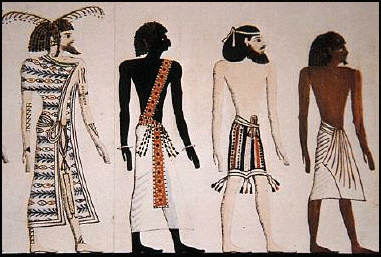
There is, also, an interesting bit about colorism—discrimination based on skin color—here:
Color prejudice, says one writer, depended on which ethnic group held sway. When the lighter-skinned Egyptians were dominant they referred to the darker group as “the evil race of Ish.” On the other hand, when the darker-skinned Egyptians were in power, they resorted to calling the lighter-skinned people “the pale, degraded race of Arvad.” (Gossett, 1997: 4)
Jews
The Jews are some of the oldest peoples on earth, so they should then have some stories about their encounters with different races. One of the oldest, thought to be first, racist sayings was asked by the prophet Jeremiah who said “Can the Ethiopian change his skin or the leopard his spots?” The Jews are said to have ‘invented’ anti-black racism (Gossett, 1997: 5; Sarich and Miele, 2004), but this has been contested (Goldenberg, 1998). Take the full text from Gossett on Ham:
The most famous example of racism among the Jews is found in the legends which greew up concerning Ham, the son of Noah. The account in Genesis tells us of Ham’s expressing contempt for his father because Noah had become drunk and was lying in a naked stupor. Noah’s other sons had covered their father’s nakedness, averting their eyes. Noah blessed the descendants of Shem and Japeth, his other sons, but cursed the descendants of Ham. There is some confusion in the account in Genesis because it is not clear whether the curse was to be visited upon Ham or upon Canaan, Ham being a later insertion. Nothng is said in Genesis about the descendants of either Ham or Canaan being Negroes. This idea is not found untl the oral traditions of the Jews were collected in the Babylonian Talmud from the second century to the sixth centry A.D. In this source, the descendants of Ham are said to be cursed by being black. In the Talmud, there are several contradictory legends concerning Ham—onoe that God forbade anyone to have sexual relations on the Ark and Ham disobeyed this command. Another story is that Ham was cursed with blackness because he resented the fact that his father desired to have a fourth son. To prevent the birth of a rival heir, Ham is said to have castrated his father. Elsewhere in the Talmud, Ham’s descendants are depicted as being led into captivity with their buttocks uncovered as a sign of degredation.
Greeks and Romans
The Greeks and the Romans are really interesting. Being near the intersection of the Medditerranean, they would have seen many different races of people—and this is reflected in their art and legends. The Greek myth of Phaethon, for example, shows that the Greeks knew that skin color was a function of climate.
In the story, Phaethon asked his father to drive the sun chariot, using it only for the day. He could not control the chariot so it came to close to the earth in some regions, burning the people there while for the people in the north he drove too far away from the earth, ligtening their skin. Greek and Roman myths, in fact, show exactly how things change and that if we had a different reference point—like the Greeks and Romans did—we would then create different theories of ‘intelligence’:
“The nations inhabiting the cold places and those of Europe are full of spirit but somewhat deficient in intelligence and skill, so that they continue comparatively free, but lacking in political organization and the capacity to rule their neighbors. The peoples of Asia on the other hand are intelligent and skillful in temperament, but lack spirit, so that they are in continuous subjection and slavery. But the Greek race participates in both characters, just as it occupies the middle position geographically, for it is both spirited and intelligent; hence it continues to be free and to have very good political institutions, and to be capable of ruling all mankind if it attains constitutional unity.” (Pol. 1327b23-33, my italics)
Views of direct environmental influence and the porosity of bodies to these effects also entered the military machines of ancient empires, like that of the Romans. Offices such as Vegetius (De re militari, I/2) suggested avoiding recruiting troops from cold climates as they had too much blood and, hence, inadequate intelligence. Instead, he argued, troops from temperate climates be recruited, as they possess the right amount of blood, ensuring their fitness for camp discipline (Irby, 2016). Delicate and effemenizing land was also to be abandoned as soon as possible, according Manilius and Caesar (ibid). Probably the most famous geopolitical dictum of antiquity reflects exactly this plastic power of laces: “soft lands breed soft men”, according to the claim that Herodotus attributed to Cyrus. (Meloni, 2017: 41-42)
The Roman historian Vitruvius “attributed the keen intelligence of his countrymen to the rarity of the atmosphere and to the heat. The less fortunate northern peoples, “being enveloped in a dense atmosphere, and chilled by moisture from the obstructing air … have but a sluggish intelligence”” (Gossett, 1997: 7). How convenient—people at the time thought they were ‘superior’ to others and then attempted to justify it on the basis of environmental—eventually evolutionary—differences. However, the Greek theory of humors. Such accounts, though, only speak to how the Greeks thought that the environment shaped individuals, not shared traits of the group. Such differences were thought to be almost immediately reversible. They believed that one could take a person who grew up in another environment who, therefore, had a different temperment which could be changed by switching his environment.
Thus if there were, say, a microregion of Germany where “Asiatic” environmental conditions prevailed, a person who settled in that microregion would end up with Asian attributes. Thus, humoral accounts of human diversity focused on the way environments shape individuals, rather than the way populations share traits. (Smith, 2016: 85)
The Greeks and the Romans, ironically, seemed to be really big on environmentalism—the thesis that environment drives the proliferation of traits and that changing the environment can change ones phenotypic traits. While this is not wholly true, there is a kernel of truth here.
Sarich and Miele (2004: 51) describe different ancient scholar’s writings on their observations of racial differences:
The most detailed surviving description of the racially denning characteristics of black Africans from the classical world appears in The Moretum, a poem attributed to Virgil (circa 1st century AD). A female character named Scybale. is described as “African in race—her hair tightly curled, lips thick, color dark, chest broad, breasts pendulous, belly somewhat pinched, legs thick, and feet broad and ample.” In his book Blacks in Antiquity: Ethiopians in the Greco-Roman Experience, Frank M. Snowden comared the description with portrayls by twentieth-century anthropologists E. A Hootn and M. J Herskovits. For example, Hootn described the “outstanding features of the ancient specialized Negro division of manking” as “narrow heads and wide noses, thick lips and thin legs, protruding jaws and receding chins, integument rich in pigment but poor in hairy growth, flat feet and round foreheads, tiny curls and big smiles.”
Snowden concluded: “While the author of The Moretum was writing poetry, not anthropology,” his description of the distinguishing racial characteristics of black Africans “is good anthropology; in fact, the ancient and modern phraseology is so similar that the modern might be considered a translation of the ancient” (emphasis added).
Native Americans
I’m sure most have heard the popular ‘myth’ that God burnt blacks by cooking them too long. Come to find out, there is a real basis for this myth. The Native Americans thought that white people weren’t baked enough, blacks were baked too much and they were—like Goldilocks—juuuuust right:
Earthmaker made the world with trees and fields, with rivers, lakes, and springs, and with hills and valleys. It was beautiful. However, there weren’t any humans, and so one day he decided to make some.
He scooped out a hole in a stream bank and lined the hole with stones to make a hearth, and he built a fire there. Then he took some clay and made a small figure that he put in the hearth. While it baked, he took some twigs and made tongs. When he pulled the figure out of the fire and had let it cool, he moved its limbs and breathed life into it, and it walked away. Earthmaker nonetheless realized that it was only half-baked. That figure became the white people.
Earthmaker decided to try again, and so he made another figure and put it on the hearth. This time he took a nap under a tree while the figure baked, and he slept longer than he intended. When he pulled the second figure out of the fire and had let it cool, he moved its limbs and breathed life into it, and it walked away. Earthmaker realized that this figure was overbaked, and it became the black people.
Earthmaker decided to try one more time. He cleaned the ashes out of the hearth and built a new fire. Then he scooped up some clay and cleaned it of any twigs or leaves, so that it was pure. He made a little figure and put it on the hearth, and this time he sat by the hearth and watched carefully as the figure baked. When this figure was done, he pulled it out of the fire and let it cool. Then he moved its limbs and breathed life into it, and it walked away. This figure was baked just right, and it became the red people. (A Potawatomi Story)
Islam
The first peoples to describe Africans in a racist manner was not Europeans, it was the Arabs—Islamics. They held slaves long before Europeans; they even castrated their slaves. Jahiz of Basra described Africans as “people of black color, flat noses, kinky hair.”…despite their dimness, their boundless stupidity, their crude prceptions and their evil dispositions” is how Jahiz of Basra described Africans. Ibn Khaldun stated “The only people who accept slavery are the Negroes, owing to their low degree of humanity and their proximity to the animal stage.” Nasir al-Din Tusi stated “Many have observed that the ape is more teachable than the Zanji [African].” (All quotes from Sarich and Miele, 2004: 60).
Conclusion
What this little tour of the concept of race throughout history tells us one thing: The concept ‘race’ is not a European invention—races were not socially constructed in 1492. They were constructed thousands of years in the past by many different peoples who had different explanations for the racial differences they had observed. While some of them, for their time, are great explanations for the observed differences, there was an element of racial prejudice, even all of those thousands of years ago. Yes, race is partly socially constructed (as evidenced here) but that social construction has a real, biological basis behind it.
It is obvious that the concept of ‘race’ and ‘racism’ went hand-in-hand all throughout antiquity. It is only today, it seems, that we can attempt to use the concept of race without having any ‘racist’ undertones. Though, the tour we went on proves one thing: race exists and was known to have existed for thousands of years.
 NotPoliticallyCorrect