Home » Posts tagged 'Evolution' (Page 7)
Tag Archives: Evolution
Complexity, Walls, 0.400 Hitting and Evolutionary “Progress”
2550 words
What do complexity, baseball and evolutionary “progress” have to do with each other? A lot. Stephen Jay Gould, in his book Full House he eloquently weaves these seemingly unrelated things into a coherent attack on so-called “progressive” evolution. Most people assume that the disappearance of 0.400 hitting is due to a decline in ability, however Gould argues that we didn’t get worse at baseball, we got better. The average stayed the same (around 0.260 a year) but the variation in the curve decreased substantially. He shows that complexity is a forgone conclusion since the simplest organisms, bacteria, are at the left side of the wall of complexity, that is the simplest organism there can be. Thusly, complex organisms aren’t driven by “progress” to become complex; the left wall of minimal complexity is “followed by successful expansion thereafter with retention of an unvarying bacterial mode.” (Gould, 1996: 196-7). Complexity is an incidental occurrence due to life’s beginnings at this left wall; no organism can become less complex than this. Complexity is not driven by “progress”.
0.400 Hitting
Most people assume that 0.400 hitting has disappeared from baseball because we have gotten worse at the game. However, an alternate way of looking at it is there have been no 0.400 hitters since 1941 because we have gotten better at the game and the variation on the bell curve shrunk due to the average players getting better. A batting average between .260 and .275 has been the average for each year since the conception of the game. This shows that since the average didn’t change, the variation got smaller due to the average player becoming better.
With the right tail shrinking, this meant that the average player then became closer to the right wall, that is the wall of how good one can become (i.e., 0.400 hitting) and since the variation shrunk, both bad and good (the 0.400) batting averages disappeared due to the average player getting better and getting closer to the right wall. Since the SD of batting averages for regular players decreases steadily over time, this shows that a disappearance of 0.400 hitting is “a consequence of shrinkage at the right tail of the distribution.”(Gould, 1996: 107)
Gould sums up as follows:
In quick summary of a long and detailed argument, symmetrically shrinking deviations in batting averages must record general improvement of play (including hitting, of course) for two reasons—the first (expressed in terms of the history of the institutions) because systems manned by best performers in competition, and working under the same rules through time, slowly discover optimal procedures and reduce their variation as all personnel learn and master the best ways; the second (expressed in terms of performers and human limits) because the mean moves toward the right wall, thus leaving less space for the spread of variation. Hitting 0.400 is not a thing, but the right tail of the full house for variation in batting averages. As variation shrinks because general play improves, 0.400 hitting disappears as a consequence of increasing excellance in play. (Gould, 1996: 127-8)
The explanation of the disappearance of 0.400 hitting sets the stage for the purpose of this article: “progressive” evolution. It’s important to know that I’m not saying that organisms don’t become more “complex”, the point is, evolution is not “going” anywhere; and that there is a passive and not driven trend in the complexity of organisms. Since bacteria, the modal bacter rules the earth, can we really say that there is any “drive” towards progress? Or is complexity driven by the consequence of the simplest organisms being at the left wall, with the only way to go being “right”?
Complexity, Walls, and “Progressive” Evolution
The assumption that there is a “march of progress”, a “scala naturae”, an “evolutionary ladder of progress” for all organisms on earth is a pervasive idea. But does the fossil record show any march to “progress”? No. People assume that evolution is “progressing” and the end result is a “better” organism. However, that’s a gross misunderstanding of natural selection and what it does. Natural selection is not “progress”, but local change. Let’s take a population of 100 brown bears. Half of them split off and head north and spend 100,000 years evolving near the North Pole. Would the new species that arises be “more progressed” or “more evolved” than the brown bear? No. It has incurred local adaptations to better survive in that new environment.
Bacteria is the most abundant life form on the planet. Bacteria, which is at the very left wall of complexity, is the most simple organism that can be. Due to this, there is nowhere to go but right, to the right wall. So any organism that’s caught up in the middle of the left and right walls of complexity can go in either direction. They can become less complex or more complex depending on what the environment calls for.
Darwin himself had contradictory views on “progressive” evolution. On the one hand, Darwin stated at the end of On the Origin of Species:
There is grandeur in this view of life, with its several powers, having been originally breathed into a few forms or into one; and that, whilst this planet has gone cycling on according to the fixed law of gravity, from so simple a beginning endless forms most beautiful and most wonderful have been, and are being, evolved.
Darwin did write in one of his notebooks to “Never call a species higher or lower”. This shows that even the man who originated the concept of natural selection didn’t believe in “higher” and “lower” organisms. Quoting page 135 of Full House by Gould on a conversation between Huxley and Darwin (their descendants) held in 1959:
Huxley: I once tried to define evolution in an overall way, somewhat along these lines: a one way process, irreversible in time, producing apparent novelties and greater variety leading and leading to higher degrees of organization.
Darwin: What is “higher”?
Huxley: More differentiated, more complex but at the same time more integrated.
Darwin: But parasites are also produced.
Huxley: I mean a higher degree of orginization in general, as shown by the upper level attained.
Darwin asked a good question about what constitutes “higher”. Huxley gave a non-answer, an answer that confirms what he said (which isn’t true).
Any so-called “progress” would have been stymied by the five mass extinction events that have occurred throughout earth’s history. The history of life has been punctuated with mass extinction events. It was, after all, the mass extinction event at the Cretaceous period that killed off the dinosaurs that gave mammals the chance to evolve into what we did today. It was fish that mutated the beginnings of arms and wings; the precursors to what more complex organisms would use in the future. Our fish ancestor evolved that way most likely due to the fact that it could have pushed itself onto land to avoid predators. Examinations of the fossil record show that certain fishes have the precursors to arms and wings. This shows that we evolved from fish that eventually came on to land. The ONLY REASON why we are around today is because of the mass extinction event 65 mya. Without that, disnosaurs would still rule the earth. Basically, if our ancestors swam up instead of down, left instead of right, they’d have been eaten and we wouldn’t be here today. That’s not to say that there would be no right wall of complexity; there always will be, but they wouldn’t turn into us as there is no evolutionary trend in organismal design.
Numerous studies have been done on ammonites, plankton, and other small, less complex organisms. No line of “progress” was found in none of the organisms tested. There was no bias in increasing complexity from ancestor-descendant pairs in ammonites (that is, the range of variation for complexity increased, not just a drive to become more complex) (Boyajian and Lutz, 1992), nor was there any correlation for sutural complexity and geological longevity. No bias for increasing complexity was found in these organisms, that is no bias to go towards this right wall of complexity.
McShea (1994) uses this “left wall of minimal complexity”, in which there is only one way to go: right. McShea proposes three tests for seeing whether or not there is a driven or passive drive for evolution:
- Test the Minimum: In passive systems, minimal values of complexity should be preserved by some species throughout the expanding history of their evolutionary timespan because no preference for evolutionary complexity exists and most species would do better by simply staying as they are. In systems that are driven, both minimal and maximal complexity should increase because higher complexity confers general advantages that the evolution of all species should be biased in this direction (they aren’t). The preservation and continuing enhancement of the modal bacter strongly points to the passive mode for life as a whole.
- Testing Ancestor-Descendant Pairings: This test identifies ancestral lineages for an expanding lineage and then tabulates whether each concurrent species stayed the same, got simpler or got more complex. However we cannot use this test because the fossil record is so incomplete.
- Test of the Skewing: Life as a whole can produce right-skewed trends no matter if evolution is passive or driven. So the same overall result of right distribution with a maximum complexity can still occur whether or not evolution is passive or driven. In driven systems, the new lineages should show a right skew towards complexity since all species favor the right skew of “progress” as a favored direction, and should have more species towards the right wall of complexity, stretching the entire distribution to the right. But in the passive systems, there should be no skew in increases and decreases should be just as common as increases. Many species move leftward in complexity as they do rightward. If one organism is in between the right and left wall of complexity, it can go either get more or less complex, with least complex being a bacteria, that being the “left wall” of complexity.
McShea did these tests on veterbral columns. You would say “Of course there was an increase in complexity!!” But is this increase driven or passive? According to McShea (1994), vertebrates began at a minimal level of complexity, so the only way to go was UP!
Quoting Gould (1996: 207):
All the tests provide evidence for a passive trend and no drive to complexity. McShea found twenty-four cases of significant increases or decreases in comparing the range of modern descendants with an ancestor (out of a potential sample of ninety comparisons, or five groups of mammals, each with six variables measured in each of three ways; for the other comparison, average descendants did not differ significantly from ancestors). Interestingly, thirteen of these significant changes led to decreases in complexity, while only nine showed an increase. (The difference between thirteen and nine is not statistically significant, but I am wryly amused, given all traditional expectation in the other direction, that more comparisons show increasing rather than decreasing complexity.
McShea summarizes his entire study as follows (1994: 1762):
The minimal complexity of vertebral columns probably did not change (indeed, the actual minimum seems to have remained close to the theoretical minimum), ancestor-descendant comparisons in subclades of mammals reveals no branching bias, and the mean subclade skew was negative, all pointing to a passive system.
This can be summed up as follows: Looking at the “full house” of variation, there is no general trend in “progress” for organisms or evolution as a whole. The example of the disappearance of 0.400 hitting is the perfect metaphor that shows there is a left and right wall of both minimum and maximum skill (complexity) and that the variation shrunk which is the cause for the disappearance of 0.400 hitting, not us getting “worse” at the game. This same metaphor of skill walls can be used for evolution as well, replacing skill walls with complexity walls. Bacteria inhabit the very left wall of complexity, that is, the least simple organism possible; no other organism can become more simple than bacteria. On the other side, you have the more complex organisms, those that arise at the very right tail end of the distribution, but arose there due to no inherent drive for “progress”, but due to the fact of moving towards the right tail of complexity was the only thing possible to do. Any organism that is in between the left and right walls of complexity can go in either direction, and the fossil record shows more organisms going left than right.
Looking at certain variables, we may be able to say “Look!! Evolutionary progress!!” But that’s only a small snapshot in time. People may point to the brain size increase as a driven increase towards complexity, however, the assumption that there is a “relative enlargement and differentiation of brains reflect a progressive evolutionary trend toward greater intelligence is a major impediment to the study of brain evolution.” I will cover this in the future and goes against what believers of evolutionary “progress” believe. When looking at one snapshot in the huge picture of evolutionary time, we may be able to “pin point” a “progression” towards “something”, but when looking at the fossil record as a whole (which is not possible due to there being huge gaps due to punctuated equilibria, we cannot study the whole record) there is no “drive” towards complexity, it is “passive”, that is organisms become less and more complex due to variation in environments. THAT is what natural selection is and does for organisms. Natural selection is local adaptation, not evolutionary progress.
The notion of “progressive” evolution needs to be put to rest. It doesn’t allow us to fully appreciate the beauty of evolution through natural selection, mutation, genetic drift and migration. No species is “better” or “more progressed” or “more evolved” than another; on the contrary. Each oragnism is unique to its environment and will incur both genotypic and phenotypic changes that respond to what’s occurring in the environment as to better reproduce to the next generation. I will end with a quote from Gould that perfectly sums up this argument:
I hate to think that an intellectual position, hopefully well worked out in the pages of this book, might end up as a shill for one of the great fuzzinesses of our age—so-called “political correctness” as a doctrine that celebrates all indigenous practice, and therefore permits no distinctions, judgements or analyses.
Looking at the whole “full house” of variation shows there to be no trends of “progress”. Organisms are just as likely to become less complex (towards the left wall) than they are to become more complex (towards the right wall). Once we get this “scala naturae” paradigm out of our heads and understanding of evolution, only then can we appreciate the beauty and randomness of evolution and all of the differences it brings about. There IS a drive towards the right wall of complexity, however, it is not driven, it is passive and is only a result of there being a minimum wall of complexity that no other organism can get less complex than. Looking at evolution in this way shows that there is no inherent “progress” to evolution as a whole, only local adaptations, the true definition of “natural selection”.
“Progressive” Evolution: Part III
1950 words
PumpkinPerson seems to be making his blog “more politically correct“. So he seems to be removing his posts that he may deem “insensitive” to certain people. You run a (mostly) HBD blog. People who go to a HBD blog must know that they may come across certain truths that they may find uncomfortable–and even ‘offensive’. This seems like it’ll be my last reply to PP on this matter as he has removed the thread we were conversing about this matter in. Now that PP is becoming more ‘PC’, is he going to disavow his views on “progressive” evolution, “superiority and inferiority” when speaking about organisms and human races and “the concept of ‘more evolved'”?
RR: You’ve stated numerous times that evolution is progressive. Which is why I assume you’re equating “progress” with “more evolved”. Do you believe that more evolved implies progress or that progress implies more evolved?
PP: I PERSONALLY believe more evolved life is on average, superior to less evolved life, but there is nothing intrinsically progressive about being more evolved, and there’s no reasons for opponents of progress to avoid the term. In some cases, the more evolved form is clearly inferior such as when a dog evolved into a cancer.
That’s the point. The ‘more evolved’ organism is more often than not ‘inferior’ compared to its predecessor. This shows that there is no ‘progress’ to evolution. And the “more evolved” form became “inferior” to its predecessor due to changes in environment. If those environmental pressures were different, a whole slew of phenotypic changes would have occurred to have the “less evolved, inferior” organism be “superior” to its predecessor. This line of reasoning shows how idiotic of a concept “progress” in evolution is.
RR: Moreover, ancestral state reconstructions of absolute brain mass, body mass and EQ revealed patterns of increase and decrease in EQ within anthropoid primates and cetaceans.
PP: But the OVERALL pattern has been one of increase. The average brain size of ALL living mammals has TRIPPLED in 65 million years.
I just showed that there are increases AND decreases in the fossil record. No one denies that there has been an upward trend in brain size. However, as I’ve said to you previously, our brains have been shrinking for 20ky, with there being evidence that it’s been decreasing for 20ky. Sure, the trend over the past few million years shows an increase, but the trends for the past 30k years or so show a decrease and this is due to agriculture.
RR: Just showed this is wrong. (On morphology being an indicator of speciation)
PP: No you just cited a paper that agrees with your definition of species. That’s not an argument.
I cited this paper by Ernst May, What is a Species, and What is Not? where he says:
I analyze a number of widespread misconceptions concerning species. The species category, defined by a concept, denotes the rank of a species taxon in the Linnaean hierarchy. Biological species are reproducing isolated from each other, which protects the integrity of their genotypes. Degree of morphological difference is not an appropriate species definition. Unequal rates of evolution of different characters and lack of information on the mating potential of isolated populations are the major difficulties in the demarcation of species taxa.
Just because you believe that speciation is based on morphology doesn’t make it true, PP.
RR: Sure they are CORRELATED, but it doesn’t imply a cause. A relationship is not a cause. I just showed you a paper that shows you’re wrong but whatever.
PP: But a correlation is enough to show that evolution is progressive. Evolution correlates with progress = evolution is progressive.
Now he explicitly says that evolution is progressive. No matter how many times I point this out to him, he still wants to believe this idiotic notion that has no basis in evolutionary biology.
RR: How would this be gauged? Would you say to look at the LCA and gauge morphological changes?
PP: That’s one way.
Well, now the onus on you is to provide evidence for your claim that there was no–or ‘hardly’–any morphological changes in equatorial populations. You have to prove that they stayed similar to the LCA. Good luck!
PP: No I’m arguing that FEWER changes occurred in Africa because there were fewer splits in the African branch (at least as conceptualized by Cavalli-Sforza)”
This is MEANINGLESS. This is a HUGE intuitive misconception on how people read phylogenies. Just because Africans didn’t ‘split’ based on phylogenies DOESN’T MEAN that they had little to no morphological changes. The racial phenotypes we code are recent, so this throws a wrench into your intuitive misconceptions on phylogenies.
RR: Prove it!
PP: The proof is that those humans who scientists believe have preserved the phenotype of the earliest modern humans (i.e. Andaman islanders, Papua New Guineans) all look very Negroid, as do those forensic reconstructions of ancient skulls you reject.
This isn’t proof. Just because scientists (like who?) ‘believe’ that Andaman Islanders and Papuans (no, no and no!!) “preserved the phenotypes of ancient humans” doesn’t mean that they are in any way, shape, or form SIMILAR to the original populations who migrated out of Africa 70kya!!!
Ancient skull reconstructions are meaningless. You cannot infer what type of lips an ancient human had. There are numerous problems with facial reconstructions, most specifically for this conversation, you cannot gauge certain things JUST from a skull:
The finished product only approximates actual appearance because the cranium does not reflect soft-tissue details (eye, hair, and skin color; facial hair; the shape of the lips; or how much fat tissue covers the bone). Yet a facial reconstruction can put a name on an unidentified body in a modern forensic case—or, in an archaeological investigation, a face on history.
It can ‘put a face to history’, however this reconstruction of, for instance, Mitochondrial Eve DOES NOT show what she actually looked like, specifically her lips, as seen above.
RR: I fully understand what you’re saying. Except I’ve shown how it’s wrong! You can’t say one branch means morphological change AND EVEN THEN, morphological change does not equal speciation as shown in the Mayr paper.
PP: You can say that if one branch has lots of splits, it implies environmental changes and pressures (since generally speaking, that’s what causes splits) and environmental changes generally cause morphological changes, which is one definition of species.
But this definition of species is wrong as I’ve just shown. Ernst Mayr shows, in the paper of his linked above, that morphology is not enough to denote speciation.
RR:Do you know better than people who do this for a living? There are multiple papers on misconceptions of cladograms and the like. I get its original nd I respect that. You’re a smart mother fucker pp. But that doesn’t mean you’re right here.
PP: I understand why you think I’m reading the trees wrong. I used to think the exact same way as you, and the sources you cite. Laymen shouldn’t make the simplistic assumption that higher branches = more evolved and that’s why scientists try to dispel that notion. Because the tree is just there to show relatedness, and evolution can happen or not happen at any point in the tree, no matter how many splits or non-splits occur.
Now you’re getting it!
PP: However once we understand all that, we have to ask ourselves, even though IN THEORY, any branch on the tree can evolve in any direction, and there’s nothing about the tree that implies a hierarchy, IN REALITY, is there a correlation between tree position and brain size and other measures of “progress”? I’ve provided evidence that there is. You can either ignore the evidence because it doesn’t fit the theory that branch placement is irrelevant, or you can realize that evolution is a little more nuanced than some simplistic introductory Berkeley paper implied.
Now you’re not. First off, the Berkely paper is not ‘simplistic’, nor is one of the papers that the Berkely papers cites, Understanding Evolutionary Trees by Gregory (2008). He shows the most common misconceptions one has on reading phylogenies. And most–if not all–of your misconceptions on phylogenies are brought up in the paper with great detail into the misconceptions as well as how to correct the misconceptions that one has while reading phylogenies. I’ve said to you, time and time again, that brain size is PREDICATED on the amount of kcal that one consumes. If were to eat 1000 kcal a day for, say, 2000 years, what would happen to our brain size as well as our body size? Would they stay the same, grow bigger or get smaller? Adequate kcal–as well as adequate nutrients–are the driver of brain size. Without those two variables, brain size wouldn’t have been increasing. Moreover, as I’ve documented two weeks ago, H. floresiensis showed a decrease in brain size as well as body size, having evolved from either H. erectus or H. habilis. This directly shows that brain size is dependent on the surrounding environment as well as the quality and quantity of the food that the organism consumes. Branch placement IS irrelevant. You can rotate the branches all around and that would throw your theory out the window. This is what you don’t understand.
Evolution IS NOT PROGRESSIVE. However, this scala naturae belief is still with us today, as documented by Rigatto and Minelli (2013). They say:
Background
Professional papers in evolutionary biology continue to host expressions in agreement with the pre-evolutionary metaphor of the scala naturae (the great chain of being), when contrasting ‘lower’ to ‘higher’ representatives of a given branch of the tree of life. How pervasive is the persistence of progressionist, pre-evolutionary language in contemporary papers?
Results
We document here the prevalence of this unexpected linguistic survival in papers published between 2005 and 2010 by 16 top scientific journals, including generalist magazines and specialist journals in evolutionary biology. Out of a total of 67,413 papers, the unexpectedly high figure of 1,287 (1.91%) returned positive hits from our search for scala naturae language.
Conclusions
A quantitative appreciation of the survival of progressionist language in scientific papers is the first step towards its eradication. This will obtain by improving skills in tree thinking as well as by more careful editorial policy.
Wow! 1.91 percent, 1,287 papers returned positive hits for ‘great chain of being’ language. These terms need to be removed from evolutionary biology as they don’t allow the appreciation of the randomness in the evolutionary processes.
Evolution is a random process. It’s an unconscious, non-linear event as I have documented extensively over the past month.
I’ll end with a quote from Ernst May’s book What Evolution Is:
Another widespread erroneous view of natural selection must also be refuted: Selection is not teleological (goal-directed). Indeed, how could an elimination process be teleological? Selection does not have a long-term goal. It is a process repeated anew in every generation. The frequency of extinction of evolutionary lineages, as well as frequent changes in direction, is inconsistent with the mistaken claim that evolution is a teleological process. Also, there is no known genetic mechanism that could produce goal-directed evolutionary processes. Orthogenesis and other proposed teleological processes have been thoroughly refuted (see Chapter 4).
To say it in other words, evolution is not deterministic. The evolutionary process consists of a large number of interactions. Different genotypes within a single population may respond differently to the same change of the environment. These changes, in turn, are unpredictable, particularly when caused by the arrival at a locality of a new predator or competitor. Survival during a mass extinction may strongly be affected by chance. (Mayr, 1964: 121)
Evolution is *NOT* Progressive: Part Two
3800 words
Previous articles here, here, here, here, and here.
PP is moderating my comments again, posting response here.
When exploring such intuitive reasoning, it’s important to note first that the idea of evolutionary “advancement” is not a particularly scientific idea. It is tempting to view organisms that are more similar to humans as more “advanced”; however, this is a biased and invalid perspective. There is no universal scale for “advancement” that favors human-like traits over spider-like, whale-like, or fir-like traits.
“Postmodernist egalitarian propaganda has even spread to zoology.”
Strawman.
You damn well know my politics, so you can’t say that I hold this view because I’m a postmodernist egalitarian spreading this to zoology.
Good comeback.
You can use those words all you want, that doesn’t say anything to what is written. You’re just politicizing this conversation when I’ve brought no politics into it.
I guess Darwin was one of those too since he wrote a note to himself to never call species “higher” or “lower” than one another; but what does he know?
“When you’re comparing life forms of equivalent taxa, you can not arbitrary reorient the tree. You have a common ancestor A. A splits into branches B and C. If B does not split, but C splits into D and E, then D and E are typically more evolved than B, because each split typically (not always) represents an evolutionary development like speciation.”
Still repeating the same garbage.
This is so funny and so wrong. An organism may have “more advanced” (whatever arbitrary trait you want to use) than another and be “lower” on the tree.
A population splitting off from another and becoming a founder population for a new species don’t mean that the new species is “more evolved”; it just means a gross misunderstanding of reading evolutionary trees and thinking about evolution.
The tree doesn’t equal “A < B < C < D”. This is what you don’t understand.
“I thought you said there was no such thing as “more evolved”. So you now admit you were wrong.”
No no. I still used “quotes” for “more evolved”. Just showing what the article said. Of course popular science articles use shitty, attention-grabbing titles; that’s how they get clicks.
“Your Berkeley quotes are way too sophomoric for a blog as advanced as this one. You need to step your game big time if you wan to continue this discussion.”
I laughed. I love your blog and there’s great conversation and you have good ideas, but you’re wrong on somethings and progressive evolution is one of them. You can say I “need to step my game up if I want to continue discussion”, but I’m bringing up good points. I’m directly showing how you’re wrong in reading these trees. Read the papers they cite, surveys were taken on how people read these trees and many people, like you, read them the completely wrong way. The biologists corrected it. You calling it postmodernist egalitarian propaganda is meaningless because I’m not pushing an egalitarian argument, I don’t believe in egalitarianism at all. I believe each organism is “good enough” for its environment and when the environment changes for good, it will change and develop new phenotypic traits. That doesn’t mean that the new species is “more evolved”, it means that evolution occurred to better survive. That’s it. Any reading into trees like you do is wrong and has been pointed out. You’re just repeating the same tired things that have been rebutted. But I need to step my game up. OK.
“Chimps could be more evolved than humans but it’s pretty unlikely, given their inferiority. I would have to examine their taxonomical history to be sure though, to see which lineage has travelled through more equivalent level taxa.”
Chimps are suited to their environment. That’s not an ‘egalitarian statement”, that’s the truth. The term has no biological basis. It’s ‘good enough’ for its environment. You’re just rehashing the great chain of being which is garbage.
“We hate things we can’t understand.”
I completely understand it. I’ve shown there’s no unidirectional trends in evolution due to the frequency of environmental change, the multitude of factors underlying fitness, the possibility of frequency-dependant epistatic interactions amongst features, and selection occurring within population. But I don’t “understand” it.
“Actually it’s brilliant conjecture. I’m sorry if it’s just too subtle for you.”
Too subtle? I just showed you how to read it and you’re saying it’s “too subtle” for me? You’re the one with fantasies of evolution being progressive and “more evolved” organisms. This has no evolutionary basis. I’ve established that. Rushton=psychologist. Not evolutionary biologist. I love Rushton, but of course by going outside of his field he’d make wrong conjectures. Do you believe everything that Rushton ever wrote? Do you think he was wrong on anything?
“Duh! But the concept you can’t seem to grasp is equal time evolving != equal amount of evolving.”
No way to quantify this. Any traits chosen will be arbitrary. This is what you don’t seem to grasp. Which of Darwin’s Finches are ‘more evolved’? You read trees so horribly wrong. Please go tell Razib how you read these trees. I want to see what he says.
“It’s like saying, Usain Bolt and I both spent an hour running. We must have travelled the same amount of distance. Don’t be stupid, RaceRealist!”
Wow, you win. sarcasm
Read up on muscle fiber typing and get back to me.
“he runs faster than me for a short amount of time; this proves that there are ‘more evolved’ organisms than others”. How stupid does that sound? Don’t be stupid, PumpkinPerson!
“Good comeback.”
I showed how you’re wrong the evolutionary tree.
An organisms placement on the tree is arbitrary, the trees branches can be rotated, blah blah blah. There’s so much information for you to read about this out there. Here.
Let me Google that for you, PP.
“You continue to miss the point. See my Usain Bolt analogy above. Two people can run for the same amount of time but when can have traveled through more spatial distance. Similarly, two lineages can evolve for an equal amount of time, but one has evolved through more taxonomical distance.”
I do not miss the point. Your Usain Bolt analogy is garbage. Just because one “evolves through more taxonomical distance” doesn’t mean that it’s “more evolved”. Email any evolutionary biologist or stop by Razib and tell him what you think on this matter.
There is one species. One small subset of that one species diverges 500 miles away into a completely different environment. Selection only occurs on heritable alleles. Over time since this species isn’t adapted to that environment, those who can’t survive die. Those who survived incurred mutations to help them survive and through natural selection they passed on the heritable gene variants to help them survive. They turn into a new species. The same thing happens again. The third species is not “more evolved” than the two previous ones. It went through different selection pressures and thus different heritable phenotypic traits occurred in that organism so it could survive. Just because an organism goes through different selection pressures doesn’t mean it’s “more evolved” because of differing selection pressures.
Let’s say that whites and East Asians died out one day, only leaving the equatorial races. Are they still “more evolved”. Do you see how retarded that is now?
“More evolved only means superior or more complex if you believe evolution is progressive, the very assertion you deny.”
I do deny. I said that as “more evolved means superior or more complex” because they would logically follow. That’s the logical progression. As I’ve said, you’re rehashing the great chain of being.
“But without the assumption of progress, more evolved simply means having undergone more evolutionary change.”
Not quantifiable. I’ve written at least 20,000 words on this on why you’re wrong.
The ‘more evolutionary change’ occurred due to a different environment. ‘More change’ isn’t ‘more time’ evolving. This isn’t scientifically quantifiable.
“No you’ve misunderstood my argument. If H floresiens evolved from H erectus, then by definition it is more evolved because it has evolved into one extra taxa then its ancestor.”
This is baseless in biology. It’s ‘more evolved’ yet smaller in stature and with a smaller brain; the thing that “more evolved” organisms don’t have. You just said that brain size and intelligence correlate with the tree branches, which is implying brain size and intelligence to be the traits you’ve chosen. Well, I choose the ability to breath underwater naturally. Who’s ‘most evolved’ then? Ask any biologist about this, see what they say.
“My argument is (1) some extant organisms are more evolved than others”
This is a premise, not an argument.
“More evolved organisms are ON AVERAGE superior to less evolved organisms, but there are lots of exceptions to this general trend.”
This is a premise, not an argument.
“You keep conflating argument 1 with argument 2. Please read more carefully before belabouring this point.”
Those are premises, not arguments. Please learn the difference between premises and arguments. They are wrong.
“Yes, I’m well aware of that theory.”
This is one reason why it occurred, the ‘devolution’ of H. floresiensis, AKA evolving to adapt to its environment.
“My definition is having undergone more evolution, full stop. So a monkey that evolves into a human and then evolves back into a monkey is more evolved than a monkey that merely evolves into a human. But as far as I know, examples of backwards evolution are relatively rare (homo florensis is the only documented case among primates, and even it is extremely controversial) but Mugabe has implied it’s common in simpler organisms. But perhaps once you get beyond a basic threshold of complexity, it becomes very unlikely to go backwards.”
Monkeys don’t “evolve” into humans!!! You have a Pokemon-like understanding of evolution. It’s pretty concrete. They had to have come from somewhere and I documented great evidence that shows it’s true. It is ‘common’ in ‘simpler organisms’. And it’d be common for humans too, the ‘most evolved’ ‘most adaptable’ species. We will respond to our environment.
An asteroid crashes into earth and blocks out the sun. Then what? We’d evolve differently. We wouldn’t be ‘more evolved’ if we changed into a new species if that pressure was long enough. ‘Complexity’ is not definable!
“The latter. If an organism has to evolve into a new species to adapt to its environment, then obviously the original species was not very adaptable. Humans are arguably the most adaptable organism precisely because we’re one of the few organisms that doesn’t have to evolve in order to adapt. We don’t need to change our genes because we can change our behavior, and now we’ve even learned how to change our behavior to change our genes.”
What do you mean? The founding population of the new species was the same as the old species. But through natural selection (and even when NS is weak as I’ve shown), changes occur. But that doesn’t mean “more evolved” or “more adaptable”. It means an organism survived because it was “good enough”.
When humans die out for good and other organisms are still here, will we still be ‘more evolved’?
I’ve shown 6 million times that we aren’t as ‘complex’ as you think we are.
He approved it, replied, and I gave him this reply.
The people you are citing are brainwashed by postmodernist views and you accept their interpretations uncritically.
Not an argument. I can say that Rushton is brain washed. Where does that get us?
Of course. But generally speaking, the more splits on the evolutionary tree you’re descended from, the more evolved you are.
Not quantifiable. Any trait chosen is arbitrary.
Of course. But generally speaking, the more splits on the evolutionary tree you’re descended from, the more evolved you are.
No one looks, except laymen, look at a tree like that and see what you’re seeing. Email Cavalli about that.
Of course it does. More evolved means having undergone more evolution. How do you know when you’ve undergone more evolution? When you’ve evolved into something new.
RaceRealist is saying “just because we ran a mile, and you split off and ran another mile, doesn’t mean you’ve run more miles than me!”
Yes it does.
Evolving into something new, speciation, occurs due to pressures from the environment. You’re trying to throw a mask of evolutionary progress there, but it doesn’t work like that.
Splitting off means nothing.
But ‘progress to adapt’ doesn’t always mean ‘gets better’, in the grand, anthropomorphic scheme of things. Cave animals for example have evolved to lose their sense of sight (because mutations that negatively disrupted vision were not detrimental, and actually allowed them to save energy that otherwise would be spent towards maintaining vision systems). They’re better fit for living in caves, but I think one could easily argue that that adaptation significantly reduced their ability to survive elsewhere. Similarly, a polar bear putting on extra padding and thicker fur makes it better suited for the arctic, but strikingly less suited for further south ranges, and not surprisingly, you don’t see polar bears in the US.
Evolution pressures organisms to become better fit to the environment they’re currently in, because those organisms that are better suited than their competitors are the one’s that produce yet more competitive progeny to continue the process. Evolution doesn’t care about more evolved Zorn progress, or your masked great chain of being. It’s an ongoing process, whether there is speciation or not. That’s what you don’t understand.
No, RaceRealist, I’m not merely reading from left to right. What I’m saying is A < B = C < D = E
Splits on a tree typically indicate speciation. So whatever species is descended from the greatest number of splits, typically has the most species in its ancestry. Since evolving into a new species reflects evolutionary change, whoever is the descendent of the most species (within a given taxa) has experienced the most evolutionary change. Most evolutionary changed = most evolved.
Trees are read in terms of most recent common ancestors. The ancestor before is not more or less evolved. And when you bring this argument to human races you’re most definitely applying superiority here which I’ve shown doesn’t exist in biology. You’ve basically just read left to right. You’re saying a is better than b who’s better than c who’s better than d who’s better than e. Each one is set for their environment. Saying one is more evolved is a stealth way to say “superior” and “progressive” evolution.
When the biologist say it doesn’t matter which species is on the left or right of the tree, they are correct. However my point is that whichever species is descended from the most SPLITS on the tree is TYPCALLY the most evolved. If you don’t like the term most evolved, then can we at least agree they’ve generally undergone the most evolutionary change?
And other times you’d be wrong. Because trees aren’t just not typically read like that, they are never read kkk that. It’s in terms of common ancestors.
Yes actually that’s exactly what it means. Undergoing more evolutionary change makes you more evolved. It doesn’t matter WHY you’re more evolved.
This is such a 5th grade understanding of an ultra complex concept. Evolution is an ongoing process. So one species isn’t more evolved than its predecessor. This is where your misconceptions are huge.
If they’ve been rebutted, explain the high correlation between number of splits each of these populations is descended from, and brain size/IQ. If number of splits is completely meaningless, no such correlation should exist:
This is an utterly ridiculous claim, because ‘number of splits’ has literally nothing to do with ‘duration of separation’, and everything to do with A ) resolution used to depict the tree, and B ) number of offshoots. For example, monotremes are one of the three original mammal offshoots, and there have been very few offshoots from that lineage relative to marsupials or eutherians. Explain the high correlation? Because those groups went to colder climates. Simple.
More evolved is quantified by the number of taxa you’re descended from within a given taxa. The traits favoured are not arbitrary, they’re decided by examining the most evolved specimens.
But they would be arbitrary. Because organisms survive with the traits they have. Natural selection selects from the current heritable variations already in that species. Therefore any traits you choose will be arbitrary. You can’t say E is more evolved than A because it comes from more splits. Please ask Razib Khan if that’s correct. Or email a biologist. I’d love to see the response.
Yes they are, until the equatorial races catch up to where the Eurasians left off.
Evolution is not a linear line. It won’t happen the same for others. What do t you get about that? Evolution isn’t linear.
Correlation != PERFECT correlation
If it happened once it’ll happen again. The fact that it happened to H. erectus, one with a bigger brain, it throws a wrench in your theory. Island dwarfism is also another reason why they changed that abruptly. That doesn’t mean more evolved. It mean different selection pressure.
But according to you evolution is not progressive so why would more evolved imply superior? If evolution is completely directionless as you imply, then more evolved organisms would be just as likely to be inferior as inferior.
RaceRealist logic: “people don’t walk in any direction, but the people who’ve walked most have walked most North”
“More evolved” implies “superior”. If the “more evolved” organism is “more evolved” than the “less evolved” organism, that means its “higher” than the other organism. That’s “superiority”. It doesn’t exist in biology. Yes more “evolved organisms” are just as likely to be “inferior” than “less evolved” organisms. Because evolution has no direction. No organism is worse or better than another. No organism is “more or less evolved” than another.
Whoever has gone through the most evolutionary change since the shared common ancestor.
Whoever goes through evolutionary change has to to to survive. Evolutionary trees are read in terms of most common ancestors. That’s it.
You have a concrete definition of a monkey. Broadly speaking, a monkey is any sub-human higher primate, including the anthropoid apes
They still don’t evolve into humans.
Under extreme cases we’d evolve drastically, but unlike other animals, we went from sub-Saharan Africa to the arctic without evolving into a new species. That’s an incredible accomplishment.
Sewall Wright believed the Fst value to be great enough between the races to call them separate species. He would know because he kinda invented the concept. Of course we’d evolve drastically, because we’d have a new change to the environment. That’s what happens. It doesn’t mean more evolved. That more evolved organism will die in an environment where its no suited. It’s that simple.
Yes we would because in order to evolve into something new, you have to do MORE EVOLVING!
In order to evolve into a new species, new selection pressures are needed. Why you’re using these terms, I don’t know why.
Sure it is. Most people would agree that angiosperms are more complex than slime molds and that multicellular organisms are more complex that prokaryotes with no nucleus, and that the human mind is more complex than a snake’s brain.
Who is “most people”? Average Joe and Jane? Why should I care what a layperson thinks? Read the paper I linked and get back to me.
If the founding population were able to adapt as it was, changes would not have needed to occur.
Where do you get these ideas about evolution?
The founding population adapted genotypically which obviously after that occurs the phenotype is affected. Then speciation occurs after long enough. Remember Punctuated Equilibria. Long time in stasis, quick jump to a new species. Most fossils have been in stasis. When an organism moves into an area, it either adapts or dies. Those traits are already in the population, natural selection selects for alleles that are beneficial to that organism. If the founding population can’t adapt, it wouldn’t have turned into the new species anyway. This is where you’re confused.
Yes, but maybe in another few million years, something else will have experienced even more evolution than we have.
Why should I care about “maybe”? I care about what’s quantifiable. From what I’m seeing, you’re attempting to revive the great chain of being. It’s a junk argument. Time matters, not amount of splits, for evolution. You looking at a tree, seeing more splits and saying aha!! More evolved! Shows a rudimentary understanding of evolution.
The human mind is the most complex known object in the universe.
The universe is the most complex known object in the universe
Why PP doesn’t grasp this yet is beyond me. Maybe it’s Rushton hero worship. Maybe it’s because he doesn’t want to be wrong on something he’s so invested in. Whatever the case may be, he’s persistence in repeating the same things that have been shown to be false is pretty damn annoying. It shows he doesn’t care about the actual data and how trees are read, for one, and call it Marxist propaganda that I’m pushing on zoology. As if I’m a Marxist. I’m the direct antithesis of Marxist. His strawmen don’t mean anything, I’ve more than made a good enough case that what he’s saying has no basis in evolutionary biology but he continues to push it. Hopefully one day he understands how wrong he is here.
Most people become blind and have tunnel vision with their beliefs. No matter how many times they’re shown that they’re wrong and here is why they still hold on to their beliefs. People don’t like to hear that they are wrong. When people are presented with contrary information, they gather support for their beliefs with “paradoxical enthusiasm”.This is because people have become so invested in their worldview that when provided contradictory evidence they lack the self-esteem to admit they were wrong and change their view. There is also something called “the backfire effect“, in which correcting of a wrong perception actually increases misperceptions. The tunnel vision that people with huge misconceptions have, in this case progressive evolution and “more evolved” organisms, leads to them attempting to find anything they can to substantiate their claims, even if they’re objectively false. This is the perfect example of that in effect in action. People don’t want know that their worldview is wrong. They don’t want to alter it, even when shown factual information that directly refutes what they say.
Misconceptions on Evolutionary Trees and More on Evolutionary “Progress”
3300 words
There are numerous misconceptions on evolutionary trees, and they all, of course, go back to this notion of “progressive” evolution and people may believe these trees show that one organism is “more evolved”. However, these false notions from looking at evolutionary trees intuitively show how one may misinterpret these evolutionary trees. I’ve shown PumpkinPerson numerous times that he’s reading the trees wrong and interpreting it to fit Rushton’s 3-way race model. He, however, doesn’t want to listen to the data and continuously attempts to salvage his position that have been continuously broken apart.
These notions that PP is espousing are common misconceptions on evolutionary trees. He doesn’t realize that he’s not scientifically reading the trees correctly and is using his intuition on what the trees mean (where he’s extremely wrong).
Intuitive Interpretation: Taxa (diferent groups of living thinigs) are organized into a Great Chain of Being, which some taxa (e.g., humans) are higher or more advanced than others. 1, 2, 3, 4
Scientific Interpretation: The relationships among taxa are best represented by a branching tree-like structure (a phylogeny), in white taxa appear at the tips of the phylogeny, visually reinforcing the idea that no taxon has a higher or lower status than others.
The way that PP reads these trees is, in a way, attempting to interpret it as a “great chain of being”, which evolutionary biologists do not believe anymore. I’ve said numerous times that evolution is a branching tree, not a linear line. A branching tree makes more sense than slow and gradual change; basically the difference between Punctuated Equilibria and phyletic gradualism. And here is Berkeley’s explanation for how to really read it:
Explanation: The idea of “higher” and “lower” organisms is intuitively appealing and has many antedents in the history of science; however, this idea refelcts a human-centered, biased perspective on the biological world in which other organisms are measured by their similarity to humans. Taking an unbiased view, it is clear there is no universal yardstick against which we can measure species. For example, we could focuse on photosynthetic ability (which would make plants the “higher” beings), sheer number of indviduals (which would pick out bacteria and microorganisms as special),or any number of other traits. Each trait would suggest a very different group of “higher” organisms. Diagrams that represent relationships using a central trunk with side branches reinforce the incorrect idea that evolution is directional and progressive. Phylogenetic trees are preffered because they convey information about evolutionary relationships without reinforcing intuitive ideas about evolutionary progress by placing some taxa above or below others. A similar intuitive idea is that some living species are more evolved than others; this idea is explored in the section about time.
Perfectly comprehensible that it doesn’t mean that one organism is “more evolved” than another.
I don’t even know any serious evolutionary biologist who would read a tree like that. It’s ridiculous and it in no way fits the data on how an actual tree will be read.
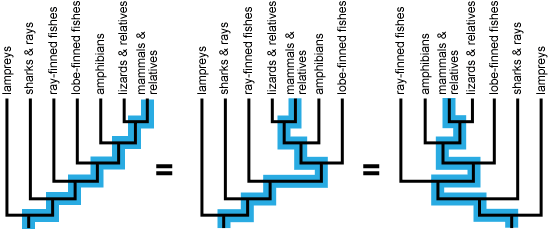
These differing trees show that it’s easy to see how one may say that there is a sort of “progression” to evolution, however there is no “progress” to evolution so in reading the tree in this way, one would have these misconceptions that PP has.
Another popular intuitive way to reduce a tree is stating that a branch that’s further away from the beginning of the lineage is “more evolved” or has “progressed more” than the common ancestor. However, a taxon’s relationship on phylogeny is a function of its relationship to other taxa and how the branches are rotated. The position of an organism on the tree is not any type of specialization, adaptation or any extreme traits in comparison to other organisms “lower” on the tree. Thusly, an organism’s placement on the tree is meaningless.
One of the biggest misconceptions PP has is not just on evolutionary trees, but the fact that organism have been “evolving” more than other organisms.
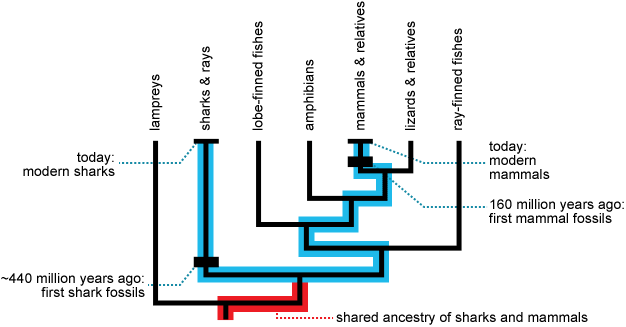
The above graph shows that since all species alive today share a common ancestor, that they all have had the same time evolving.
In most evolutionary trees, branch length doesn’t indicate anything about amount of evolutionary change. All though, when branch length is used to depict evolutionary change, branch length is then used. But this doesn’t mean that the organism at the end of that branch is ‘more evolved’ or has ‘progressed’ more than another; it just shows that more selective pressures had species adapt genotypically, which led to phenotypic changes over time to better survive in that environment. That’s it.
Now, here is the kicker (which goes with the previous picture from Berkely) and this is what directly refutes his rudimentary understanding of phylogenetic trees:
Intuitive Interpretation: Some living (i.e., extant) species have longer evolutionary histories than others (i.e., have been evolving for a longer time), and so some species are more or less “evolved” than other extant species.
Scientific Interpretation: Since all extant species are alive today and share a common ancestor (one that lived more than 3.5 billion years ago!), all extant species have been evolving the same amount of time.
Explanation: Some living organisms such as mosses and sharks represent clades that appear early in the geological record. Others (such as grasses and birds) represent clades that appear more recently. It is tempting to think of living members of a clade that appeared 160 million years ago (such as the mammals) as having a shorter history than members of a clade that appeared 440 million years ago (such as the cartilaginous fishes, sharks and rays). However, this intuition does not apply because of all living clades trace their evolutionary history back to shared ancestors among the earliest forms of life. For example, the fact that the clade that includes sharks appears early in the fossil record does not mean that modern sharks have had a longer evolutionary history than any other modern species.
What is really so hard to grasp about this?
While on this subject, PP has moderated my comments on his blog since “I’m repeating arguements he’s already responded to”, so I’ll post it here:
“You haven’t shown anything. As the above tree shows, among members of the same taxonomical level, there’s a high correlation between the degree of branching and (1) brain size, and (2) intelligence. I’ve demonstrated at least one measure of evolutionary progress that can be empirically tested.”
Haha. And now brain size is decreasing. Even then, as I said last night, there is no accepted definition and there is no accepted of these traits, and even terms like progression through fitness and the like don’t have an accepted definition, because, as I’ve shown again, the environment is ever changing. I’m sorry this is hard for you to grasp. There is no way to quantify more evolved superior and progressive evolution. I don’t know how to make you get it.
PP do me a favor. Go to Razib’s blog and post on his open thread and ask him how to read an evolutionary tree and then tell him how you read it. I would love to see his response.
“Politically correct platitudes are not science. Calling something primitive is not a value judgement, it’s a description. Replacing it with the more politically correct term “ancestral” doesn’t change anything, it’s just playing word games.”
You’re the one playing word games. You don’t have to agree that primitive and advanced mean nothing in evolutionary terms, you’d be extremely wrong though. You’re the one playing word games. I showed that there is no unidirectional line of progress and you’re still going on with this:
Because of the frequency of environmental change, the multiplicity of factors underlying fitness, the possibility of frequency-dependent and epistatic interactions among features, and the consequent possibility of nontransitive fitness relations between phenotypes, selection acting within populations frequently, though not inevitably, fails to produce unidirectional trends. The extent to which unidirectional trends dominate, or fail to dominate, the fossil record is therefore not a measure of the adequacy of neo-Darwinian mechanisms as causes of large-scale patterns in evolution.”
Simple enough to grasp. Directly refutes your notion too.
Saying that an organism is more advanced is not quantifiable. Each one is adapted to its environment. You’re the one playing word games to show your crackpot hypothesis, continually quoting pages 292 to 294 of Race, Evolution, and Behavior. But that doesn’t make it true. It’s not true.
“Yawn. I’ve debunked this stupid quote back in 2014. Splits on an evolutionary tree typically reflect periods of evolutionary growth after long periods of stasis. So if you’re a descendent of many splits, you’re typically a descendent of more evolution.”
You’ve debunked nothing. Ask Razib how to read an evolutionary tree then tell him how do and come back and show me his reaction. Please do this. I know what he’ll say. I directly proves your misconception wrong and you’re still going with it. It is true that when people are shown they’re wrong they attempt to gather any information to try to fix their shattered worldview. PP you’re just rehashing the great chain of being garbage and evolutionary theorists have abandoned that archaic notion. Join us in the year 2016, and ask actual experts how to read those trees instead of your misunderstanding. And a blog writing one sentence means…. What exact? It means nothing. I’ve shown my argument is stronger than yours and that you are reading evolutionary trees wrong, provided exact quotations from a respected authority and you still say it’s wrong. Too funny. Rushton isn’t the be all end all of evolution. He was wrong on a lot he was not perfect. And even then, he only implied this. The fact that he cited Aristotle and the great chain of being is laughable as people don’t even believe that anymore.
Please join us in the present PP, and stop living in the past.
Since PP is using Rushton as a reference, I’ll directly quote Race, Evolution, and Behavior (pg. 292-4) for Rushton’s exact words:
Progress in Evolution?
In their reviews, Lynn (1996a) and Peters (1995) both referred to my ranking of species on evolutionary scales. For Peters, this was a highly contentious idea but in Lynn’s positive review, he described me as proposing that the K-strategy was “evolutionarily more advanced” and that the Oriental race was “the most evolved.” In fact, I did not use either of these phrases in the book, although I had alluded to similar ideas in previous writing. Regardless, the topic of evolutionary progress provides an intellectual challenge of the first order and needs to be addressed. Figure 10.2 (p. 202) does imply a move from simple r-type animals producing thousands of eggs but providing no parental care to more complex K-type animals producing very few offspring.
The question of progress in nature has fascinated since Aristotle. Aristotle suggested that organisms could be hierarchically graded along ascala naturae marked by minute continuous steps from the inanimate, through plants, to the animals. He offered overlapping criteria for ranking along this scale including “perfectibility” (closeness to a Platonic God), “soul” (capacity for rational discourse), and method of reproduction. For example, regarding reproduction, he wrote in the History of Animals:
“Now some simply like plants accomplish their own reproduction according to the seasons; others take trouble as well to complete the nourishing of their young, but once accomplished they separate from them and have no further association; but those that have more understanding and possess some memory continue the association, and have a more social relationship with their offspring.”
The Greek philosopher’s biology is remarkably current. Based on detailed observation, Aristotle noted many of the principles that lie at the heart of the r-K analysis undertaken in this book including the inverse relations between seed output, parental care, and intelligence. The historian Arthur Lovejoy, in his 1936 book The Great Chain of Being, concluded that Aristotle’s arrangement of all things in a single order of magnitude was one of the most important ideas in Western thought.
Darwin (1859) referred frequently to evolutionary progress in the Origin of Species. This was necessary not only to refute concepts of a steady-state world but also to counter a newly developed school that denied any difference in perfection between the simplest and the most complex organisms, which would be an implicit denial of improvement through natural selection. In his book Sociobiology (1975), E. O. Wilson also promoted the idea of biological progression, outlining four pinnacles in the history of life on Earth: first, the beginning of life itself in the form of primitive prokaryotes, with no nucleus; then the origin of eukaryotes, with nucleus and mitochondria; next the evolution of large, multicellular organisms, which could evolve complex organs such as eyes and brains; and finally the beginnings of the human mind.
John Bonner (1980), in his book The Evolution of Culture in Animals, showed that the later an animal emerged in earth history the larger was its brain and the greater was its culture. Pursuing the issue in a subsequent book, The Evolution of Complexity (1988), he asked “Why has there been an evolution from the primitive bacteria of billions of years ago to the large and complex organisms of today?” Bonner held that it was quite permissible for paleontologists to refer to strata as upper and lower, for they are literally above and below each other and, because the fossils in the lower strata will, in general, be more primitive in structure as well as belong to a fauna or flora of earlier times, so “lower” and “higher” were acceptable terms. Bonner (1988: 6) noted that it was even acceptable to refer to lower and higher plants, slime molds versus angiosperms for example. It only became a “sin” when a worm was classified as a lower animal and a vertebrate a higher one, even though their fossils too will be found in lower and higher strata.
Paleontologist Dale Russell (1983,1989) quantified increasing neurological complexity through 700 million years of Earth history in invertebrates and vertebrates alike. The trend was increasing encephalization among the dinosaurs that existed for 140 million years and vanished 65 million years ago. Russell (1989) proposed that if they had not gone extinct, dinosaurs would have progressed to a large-brained, bipedal descendent. For living mammals he set the mean encephalization, the ratio of brain size to body size, at 1.00, and calculated that 65 million years ago it was only about 0.30. Encephalization quotients for living molluscs vary between 0.043 and 0.31, and for living insects between 0.008 and 0.045 but in these groups the less encephalized living species resemble forms that appeared relatively early in the geologic record, and the more encephalized species resemble those that appeared later.
The hominid brain has nearly tripled in size over the last 4 million years. Australopithecenes averaged a brain size of about 500 cm3 , the size of a chimpanzee. Homo habilis averaged about 800 cm3 , Homo erectus about 1,000 cm3 , and modern Homo sapiens about 1,350 cm3 . In Figure 10.3 of this book (p. 205) Homo sapiens is to be found at the end of a scala naturae of characteristics. The once traditional view that man is the “most developed” of species, gains novel support from the perspective of an r-K dimension. As E. O. Wilson (1975) put it: “In general, higher forms of social evolution should be favored by K selection” (p. 101)
Darwin had contradictory notions on the concept of ‘progress’ in evolution:
THE SECOND RIDDLE
Gould’s second riddle asks why Darwin never used the word “evolution”. In short, it is because “evolution” means progress and Darwin’s theory was uniquely non-progressive. Darwin was well aware that natural selection as a mechanism describes only adaptation within local environments. He wrote a marginal note to himself “Never say higher or lower in referring to organisms”.
So why do we call the process evolution? Herbert Spencer, an eminent Victorian, was tremendously influential in Darwin’s age. His writings were explicitly progressive, not only with regard to biological change, but economic, artistic, human, ad infinitum.
Gould notes “Since 19th century thinkers wouldn’t accept Darwin’s radicalism anymore than we would today, they were very comfortable with Spencer’s notion that you ought to use a word that means inherent progress…because that’s how they wanted to see it.”
Wow! He wrote a note to himself to “never say higher or lower in referring to organism”. What does that mean….? It seems to mean that he didn’t take to “progressive” evolution and he didn’t think that organisms were “higher” or “lower” than others.
On E.O. Wilson’s prokaryote argument: he’s just describing different lifeforms, not that they’re “more evolved” than any organisms that came previously. This notion, as I’ve documented over the past month here, is baseless in evolutionary biology and these terms don’t let us see evolution for what it really is: ongoing change, not progress. With our notion of “progress” we may think that things are “reversing”, but that’s just our perception and evolution through natural selection just happens, with no end goal in sight.
On what Rushton says about dinosaurs possibly developing an intelligence similar to our own: evolution isn’t linear, as I’ve been saying for months now. Let’s say that one thing was different in a rewind of life on earth, and everything else that led up to us arriving here occurred as is. That ONE difference may possibly have us not be here. That’s not too hard to grasp.
On his citing Bonner: a worm isn’t “lower” than flora or fauna; it’s just adapted to its specific niche. This, once again, is basic evolutionary biology.
Homo erectus and others were adapted to their environment and still persisted after Homo sapiens appeared on the scene.
Dr. John Bonner, professor emeritus of ecology and evolutionary biology at Princeton University and author of “The Evolution of Complexity” (Princeton University Press), said the newest findings were perfectly in line with the idea that he has continued to press that increases in complexity need not be explained as the result of any drive or force in any particular direction.
“Bacteria still exist today,” he said. “There hasn’t been a trend just toward more complex things, there’s been that trend but others have gotten simpler and less complex and smaller. But if things keep getting both more and less complex, the upper limit is going to keep rising.”
According to Dr. McShea, the perception of drives toward complexity may be more a reflection of scientists’ desires to see some sort of progress in evolution rather than a reflection of any biological reality. As Dr. Maynard Smith, explained: “If there’s going to be any change, there will have to be increases in complexity. Moreover, there will also be some decreases. It’s inevitable. There’s a poem by a chap that goes: ‘Nowhere to go but out, Nowhere to come but back.’”
I’ve cited Daniel McShea in these series of articles. What he’s saying is correct; we just look for notions of so-called “progress”. We have an implicit bias that we are the so-called “top of the ladder” in this “Great Chain of Being”. However, this term was discontinued by biologists in the 19th century.
PP is living in the past. He should join us in current year, because what he’s saying is old and debunked. Moreover, he really should learn how to read an evolutionary tree properly, because every single misconception that he has on the trees is included in the Berkely link above. This information is freely accessible to anyone; you’d just have to be willingly ignorant to a) not read it or b) read it and still hold these views. Moreover, the Great Chain of Being nonsense hasn’t been taken serious by evolutionary biologists since the 19th century. Yet PP still holds on to these notions. Saying that one is “more complex” than another is still a holdover from the GCoB days.
Evolution is NOT progressive, and PLEASE learn how to read phylogenetic trees correctly! That, or ask Razib how to read them then tell him how you read them. I’d love to see his reaction.
The Final Nail in the Coffin for “More Evolved” and “Progressive” Evolution
900 words
I’ve been on a recent tangent against this ridiculous notion of “more evolved” and “progressive” evolution. The two statements go hand-in-hand; mainly that if one organism is “more evolved” than another that they must have “progressed” further than a previous ancestor. But “progressing” where? A lion is adapted to African woodlands and grasslands, a penguin is adapted to life in the polar regions. Now imagine comparing two other organisms and what they need to do to pass their genes in that habitat, can you really infer if one organism is “more evolved” than another? The ultimate cause of these adaptations between these two species are migration, natural selection, mutation and genetic drift. Over time, an organism evolves traits (both phenotypic and genotypic) to better survive in that habitat. Knowing that evolution is a random process and that changes happen based on environment, can we really say that one organism is “more evolved” or “progressed” more than the organism in question? Tonight, I’ll put the final nail in the coffin for this hypothesis using Homo floresiensis as an example.
Homo floresiensis is an extinct hominid that lived on the island of Flores in Indonesia. He stood around 3 feet 6 inches tall and weight about 75 pounds, on average. Just this year, researchers from the journal Nature went to look for the oldest hominin occupation in Indonesia on an island between the Asian mainland and the island Flores, where H. floresiensis lived. Van den bergh et al found that the oldest evidence for stone tools on the island was between 118 and 194 kya, showing that there was a hominid on the island which predated H. floresiensis.
One possibility is that the older hominid was Homo erectus got to Flores around 800 kya and, over time, evolved into H. floresiensis. Though many researchers argue against this, saying that if H. floresiensis were a dwarfed erectus, then the expected brain size would have been between 500 to 600 cc (Lieberman, 2013: 124). Nevertheless, with careful examination between H. sapiens (African pygmies and Andaman islanders), Australopithecus and Paranthropus, Argue et al (2006) showed that diseases such as microcephaly are not the cause for their smaller brain, it is attributed to being a new species, Homo floresiensis. In 2009, Falk et al showed that the LB1 specimen did not have Laron syndrome, which is a rare form of dwarfism that occurs due to the body’s inability to use growth hormones (GH). The GH is secreted by the brain’s pituitary gland that promotes growth. So it was hypothesized that these diseases were the cause for their smaller stature, and in turn, smaller brains. But it seems that the cause for their smaller brains (around 400 cc) is due to the environment they evolved in, specifically a hot climate with low amounts of food.
There is amazing evidence for dwarfism and gigantism on islands. This is also shown to be effect hunter-gatherers. What is known is that H. floriensis’s skull and brain most closely resemble H. erectus, even after correcting for size (Falk et al, 2005; Baab and McNulty 2009; and Gordon, Neville and Wood 2008). (Lieberman, 2013: 123) Knowing that H. floresiensis didn’t suffer from any diseases that shrank both its body and brain, the only other explanation is that he evolved from either H. erectus, or as posited by primitive hand bones discovered on Flores, that Homo habilis, (literally handy man) somehow made it to Indonesia and swam to Flores. Either way, what we’re worried about here is how the selection for smaller body size occurred from whatever species of hominid predated floriensis, whether it be habilis or erectus.
As shown in the previous paragraph, there is evidence for island gigantism and dwarfism. So a plausible hypothesis is that either habilis or erectus swam or somehow rafted to Flores and over time due to less kcal on the island combined with the hotter climate and the dwarfism effect from the island, over time floresiensis evolved. Weston and Lister (2009) showed that island dwarfism could more than account for the depressed brain size in floresiensis. They showed that it was mechanistically possible for mammals to evolve smaller brains when compared to a mainland ancestor. This is huge. This makes the hypothesis that floresiensis is either habilis or erectus that evolved isolated on Flores.
Floresiensis shows how important energy was in human evolution. It’s thought that they survived on around 1200 kcal a day and 1400 when nursing, in comparison to erectus who survived on 1800 kcal per day and 2500 when nursing (Lieberman, 2013: 125). This is definitive proof that adequate calories are needed to drive brain growth as well as other bodily systems. Based on the energy requirements of floresiensis and erectus, it is 100 percent likely that fewer kcal was part of the reason why floresiensis evolved a smaller stature, along with island dwarfism and the climate as a whole.
The study of floresiensis and its possible precursors shows how and why the terms of “more evolved“, “progressive” evolution and “superiority” should be discontinued from evolutionary biology. Evolution acts to have an organism to be fit enough for its environment. Gauging any so-called “progressive” evolution and who’s “more evolved” than who has no basis in evolutionary biology. People who use these terms should stop saying it, as it’s been debunked. The final nail in the coffin has been put into this hypothesis. The evolution of H. florensiensis proves that selection occurs based on environment (which doesn’t even need any more proving). The final nails in the coffin have been put into the hypotheses of “more evolved“, superiority, and “progressive” evolution.
More On Evolutionary “Progress” and “More Evolved”
2700 words
Another reply to PumpkinPerson on evolution:
Wrong! Agriculture caused malnutrition:
Following the recession of the ice age people evolved a new life style living in permanent village settlements with domestic animals and cereal agriculture. But although the new life style was more convenient the quality of nutrition fell and many skeletal remains show signs of rickets and other malformations caused by suboptimal nutrition (Festinger, 1983).
I just ordered the book Lynn cited and will return to this after I finish it. I can’t really infer anything from one sentence.
It’s a combination of warming + malnutrition caused by agriculture.
The agriculture theory makes sense when you think that it’ll mostly be a grain based diet–however most anthropologists reject the theory because the Agricultural Revolution didn’t reach South Africa and Australia until modern times and brain size has been steadily decreasing since the Stone Age.
Rushton hinted at it, but I’ve developed the theory much further. Scientists avoid the term “more evolved” but they use terms like more primitive and more advanced which mean the exact same thing.
Lynn was the one who said it; he’s wrong. Brain size shrinking runs exactly parallel to any so-called ‘evolutionary progress’. Primitive=old. Not ‘less evolved’. Could humans survive on early Earth? Or could only organisms that evolved to survive on early Earth do so?
And what do you know? Brain size was in stasis from 1.8 million to 600,000 ya. It increased a bit then started to decrease again.
This shows how evolution isn’t progressive either, ironically enough.
But the point is race realist, if the environment doesn’t change, the organism wont evolve, causing some organisms to be less evolved than others. Some organisms haven’t evolved for 2 billion years according to the following:
That proves my point. Organisms only change phenotypically if there is a corresponding environmental pressure. The article says that this is an extreme act of stasis, because the environment hasn’t changed for it so it doesn’t have any reason to change. Evolution only occurs when it needs to, when the environment consistently/constantly changed. More complex=/=more evolved. Organisms are fit enough for that environment to reproduce. That’s it.
This is an extreme example of stasis, and obviously, if the environment changes they will change. That doesn’t mean they’re ‘less evolved’.
But the AVERAGE organism today is more complex than the AVERAGE organism 2 billion years ago. So overall, there is a progressive trend.
McShea (1996) says saying “humans are more complex than other organisms” is not warranted by the data. Of course, evolutionary theorists agree about local changes in brain size, but what is not agreed upon is whether or not this is constant. The evidence is not decisive on whether or not there is complexity in metazoans, I lean towards there being none. Because the so-called ‘direction’ will change in response to environmental pressures, therefore, making ‘progress’ not quantifiable.
Greater complexity occurs when NS is weak or nonexistent. But more complex doesn’t equal ‘more evolved’. This proves the mutation and genetic drift cause for phenotypic and genotypic differences between species.
Again, it’s a branch and you can’t say that one organism is more evolved.
Primate brain size tripled in Africa. Then when we left Africa for the totally opposite environment of Norther ice age Europe, brain size increased again. Only in the last 20,000 years has brain size shrunk, but it’s not clear intelligence has. Further, the average encephalization of all mammals has tripled in the last 65 million years, showing a long-term progress trend across a huge number of changing environments. Not only that, but the trend of increased encephalization is replicated in the dinosaurs over their 140 million year span. If there were no long-term progressive trends in evolution, this wouldn’t happen.
Brain size has tripled in the past 7 million years you’re right about that. Intelligence is seeing a downward trend as the less intelligent have more children. Average IQ for the planet is 90 I believe. It’s only going to get lower. With this a decrease in head size and brain size.
“Because of the frequency of environmental change, the multiplicity of factors underlying fitness, the possibility of frequency-dependent and epistatic interactions among features, and the consequent possibility of nontransitive fitness relations between phenotypes, selection acting within populations frequently, though not inevitably, fails to produce unidirectional trends. The extent to which unidirectional trends dominate, or fail to dominate, the fossil record is therefore not a measure of the adequacy of neo-Darwinian mechanisms as causes of large-scale patterns in evolution.”
Different environments cause different variables that need to be overcome so an organism is able to survive in that particular ecosystem. Hence needing a bigger brain is not always key to survival. You of all people know that higher intelligence isn’t needed in the equatorial parts of the world, this is evolution at work. It occurs due to the environment. Brain size for humans has gotten smaller in the past 7000 years:
“A recent study carried out by Chinese researchers looked at 500 endocasts from the past 7,000 years. They also confirmed that our brains are getting smaller. However, they found that while the whole brain has been getting smaller, the frontal lobe, the region of the brain responsible for speaking, comprehending others’ speech, reading and writing is actually increasing in size as we do more of that now compared to our ancient past.”
This is in line with what Herculano-Houzel says in her book, that the frontal lobes increased in size, which gave us an intelligence advantage over other hominids due to meat eating. The advent of cooking in Africa by H. erectus was the cause of the increase in brain size in Africa, as well as grinding down plants which allowed more nutrients to be extracted by the body upon ingestion.
You just admitted there are traits that are good for all environments, which means natural selection would tend to favour them in all environments. Of course there are always exceptions, but over billions of years of trial and error, evolution will progress towards the most universally useful traits
There are numerous blind and semi-blind species. Why? Because of their environment. They don’t need to see well, or even to see, to survive to pass their genes, When the environment changes, traits change. That’s not ‘progress’.
I’m not confused about a FUCKING thing. There’s no question that some Australoid types have genetically preserved the phenotype of the Negroids in Africa from which all humans evolved. Papua New Guineans for example.
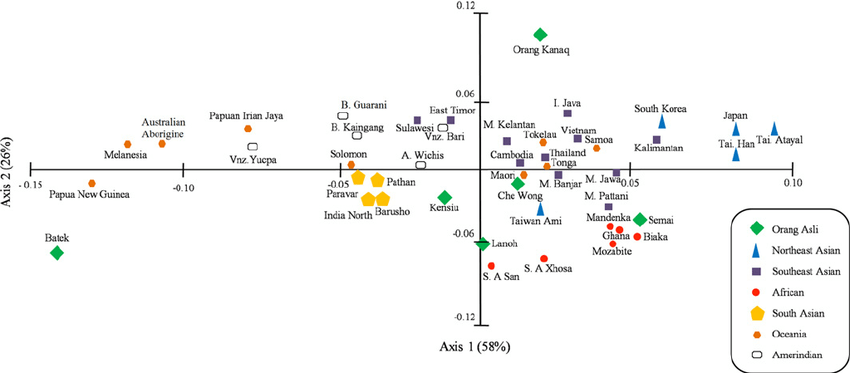
Australasians are Not Negroid So Stop Saying It!!
They aren’t Negroid.
Whether you want to call them Negroid or not is just semantics.
Saying that it’s “just semantics” is treating race just as a social construct. It’s a biological reality and biologically, they are not near Africans. Just because they ‘look African’ doesn’t mean they are.
Humans can’t survive everywhere, but scientists like Rick Potts believe we’re the single most adaptable species on Earth because unlike most other living things, we can live in rainforests, deserts, high mountains, ice, outer space, and underwater. We’re certainly one of the most adaptable and we’re certainly one of the most evolved, suggesting more evolved organisms are more adaptable.
Bone loss for astronauts is real. We can live in those areas because of natural selection as well as mutations that allow us to survive there. It’s nothing special; it’s just evolution in action.
“More evolved” organisms are not ‘more adaptable’. Each organism is suited well enough for its environment, any organism will adapt to its surroundings to better survive. That’s it.
Brain size in humans has been shrinking for 10,000 years. It was increasing for 2 million. Across the entire mammal class it’s been increasing, relative to body size for 65 million years. So the overall trend is progressive.
Brain size will continue to decrease for humans. It’s been increasing (for humans and for our ancestors it remained in stasis as I’ve shown above) due to environmental changes. When the environment changes, things can and will change. So you can’t say one organism is ‘more evolved’ than another.
IQ is increasing: the Flynn effect. Of course that’s an environmental effect and is largely spurious but perhaps you mean genetic IQ is decreasing. That theory is far from proven, and even if it’s true, it’s only a small exception to the overall trend of rising mammal intelligence over 65 million years and rising dinosaur intelligence over 140 million years.
It’s decreasing in France; it’s part environmental mostly dysgenic.
Dysgenics is occurring. This is what happens when peoples IQ drops: they can’t adequately nourish themselves because they lack the mental faculties. Combined with lower earning power due to their low IQ, they can only afford refined trash making nutrient deficiencies more common.
Human adaptability has been verified by all the environments we’ve lived in. Evolutionary progress has been verified by increased encephalization for tens of millions of years in both mammals and dinosaurs.
You know a good comparison? The polar bear. The polar bear diverged from the common ancestor with the brown bear 350 kya to 6 mya.
It evolved for its environment, the same as the brown bear. The white fur occurred due to the environment, proving (what is obvious) that selection for traits to have an organism better survive occur, and with changing environments over time traits will continue to change from common ancestors and previous organisms in that lineage. This is where PE has great explanatory power.
Humans evolve based on their environment. There is no ‘progress’ there. There is no overarching trend of ‘progress’ nor complexity for metazoans.
Encephalization and metabolic rate are the primary determinants in directing mammalian longevity and may explain other life history traits. Obviously, bigger organisms have slower metabolic rates and bigger brains. But that doesn’t mean ‘more evolved’ It’s from long-term evolution in any given environment.
Humans evolved in Africa by growing bigger brains. They then left Africa for Europe and evolved even bigger brains. Some whites have since returned to their ancestral Africa and had no trouble adapting, indeed colonizing, their ancestral land. That answers your question.
That doesn’t mean that they have resistance to malaria that Africans have from constant exposure to malaria-infected mosquitoes (Sickle Cell Anemia protects against malaria and is related to climate, not race but it’s most prevalent in Africans for obvous reasons). My question was as follows:
“Are you saying that if an organism survives somewhere and incurs phenotypic changes to have it bigger survive in that environment for 10 K years then moves on to another environment for 10 K years and incurs other phenotypic changes that 1) they’d be able to go back to the original environment and survive the same way they did before and 2) that the phenotypic changes incurred in the previous environment wouldn’t go away when they migrated to the new environment and stayed and evolved there for 10 k years?
Clearly, the answer is no. Moreover, as I said above, Europeans don’t have the disease resistance that Africans have due to evolving in that environment, which proves my point.
Bigger brains occurred due to cooking and acquiring more nutrients out of the meat. Other than that, tropical climes negatively correlate with brain size due to parasitic load, worse nutrition and more diseases that affect brain size (among the obvious ancestral component).
Yes you can. If you have one population that splits into three, and population A evolves into a different race from the parent population, while population B evolves into a different species from the parent population, and population C evolves into a different genus from the parent species, then C is more evolved than B who is more evolved than A, because a new genus is a higher taxonomical level, thus represents more evolutionary change, then a new species, which represents more evolutionary change than a new race.
No all that means is that differing selective pressures in the differing environment forced different phenotypic changes. Just because there are branches off of a parent population and LCA doesn’t mean that later organisms are ‘more evolved’, it just means that different environments call for different phenotypic traits so that organism can better survive in that environment. Just because one organism becomes a new genus from a parent population doesn’t mean that organism is ‘more evolved’. More evolutionary change does not equal ‘more evolved‘ or ‘superior’ nor does it mean that ‘evolution is progressive‘. All that means is that different selection pressures occurred to incur differing phenotypic traits to that organism. Anything else he says is just conjecture.
But if the environment doesn’t change, then the organism doesn’t have to evolve much to survive, hence those bacteria that didn’t evolve for 2 billion years.
That’s the point. This shows that evolution is not progressive. Moreover, there is no unidirectional line that evolution is going in. I’ve shown countless times that evolution is just as likely to make organisms less complex as it is to make organisms more complex. We may even find that organisms become less complex more than they become more complex through evolution, natural selection, mutation and genetic drift. That will prove definitively that evolution is not progressive nor are different organisms ‘more evolved’ than others. Those bacteria didn’t have to change much as their environment hardly changed, so they remained in stasis for 2 billion years (however with a change in environment will come evolutionary change, no organism is resistant to this).
Although interesting and portentous events have occurred since, from the flowering of dinosaurs to the origin of human consciousness, we do not exaggerate greatly in stating that the subsequent history of animal life amounts to little more than variations on anatomical themes established during the Cambrian explosion within five million years. Three billion years of unicellularity, followed by five million years of intense creativity and then capped by more than 500 million years of variation on set anatomical themes can scarcely be read as a predictable, inexorable or continuous trend toward progress or increasing complexity.
PP is wrong on evolutionary progress. Organisms evolve based on pressures in their environment and will continue to evolve based on any changes in environmental pressures to continue their genetic lineage. It’s that simple. It’s not a scientifically testable hypothesis. Here’s yet another article on ‘evolutionary progress’ that echoes the same sentiments as me:
The two main components that lead to the process of evolution—random variation and differential reproductive success—do not combine to create an ordered progression that improves with change. The former depends on randomness, and the latter on the environment, which is constantly in flux. Hence evolutionary change leads to continual difference, but no variation is better than any other one. The words “progress” and “better” should be abandoned in evolutionary discourse, because they refer to processes that do not occur in nature.
Scientifically, no species can be viewed as “better” than any other. Each species adapts to fit into a certain niche, and its success depends on a variety of factors, such as environmental conditions, relations to other species, and so on, many of which have little to do with whether the species is “better” than others
Words like “progress,” “improvement” and “better” are carried over from the old notions of the Great Chain of Being and the idea that evolution strives for perfection. These ideas are no longer accepted by evolutionists, so the terms associated with them should be removed from evolutionary discourse. This old terminology hinders our understanding of the randomness of evolutionary processes. Darwin’s theory itself did not deal specifically with the idea of evolutionary progress (Taylor) and I don’t believe that it should be part of the story of evolution that is told today. Even when limited and qualified, progress is not an appropriate or useful term to use in the discussion of evolution. Evolution is constant change, not improvement.
Evolution is not progressive, and saying it is is ignoring how amazing the evolutionary process is, which is constant and ongoing change. THAT is what evolution is, not ‘progress’.
Punctuated Equilibria
1000 words
I am Rushtonian and Jensenist on many, if not most things. However, when it comes to whether or not evolution is progressive or not, I believe it’s not progressive. It makes no evolutionary sense for evolution to be ‘progressing’ anywhere. As I’ve said millions of times previously and I will still need to say millions of times more, each organism is suited for its environment with Darwin’s Finches being the perfect example of the non-linear, non-progressiveness of evolution. I’ve also had some choice words for Gould and his theories on race, race and IQ and IQ in general. However, just because someone is monumentally wrong on most things, doesn’t mean they are wrong on all things. Punctuated Equilibrium (PE) is a great theory and explains, in my opinion, why there are so few transitional fossils in the fossil record.
Eldredge and Gould (1972) put forth a new theory of evolution called “Punctuated Equilibrium”. In this theory, species are generally stable and only go through swift speciation changes in bursts of time. Since species changed very little, if at all, over millions of years this would leave behind fewer fossils of phenotypic changes in the species.
Charles Darwin understood that evolution was a slow and gradual process. By gradual, Darwin did not mean “perfectly smooth,” but rather, “stepwise,” with a species evolving and accumulating small variations over long periods of time until a new species was born. He did not assume that the pace of change was constant, however, and recognized that many species retained the same form for long periods.
But if evolution were gradual then there would still be transitional fossils. This is one notion that troubled Darwin; if there were no–or hardly any–transitional fossils, is evolution falsified?
The answer is clearly no. This is where Eldredge and Gould’s Punctuated Equilibrium comes in. PE states that species are generally in stasis and hardly go through any phenotypic change over a large amount of time. Species go through little change, according to Gould and Eldredge, over millions of years. “This leisurely pace is “punctuated” by a rapid burst of change that results in a new species and that leaves few fossils behind.” Gould and Eldredge propose that Darwin’s gradualism is nonexistent in the fossil record with stasis dominating the history of most fossils.
This is, in my opinion, one of the best theories for explaining why there are hardly any transitional fossils in the fossil record. Since most species remain in stasis for a long while, phenotypic changes won’t occur and thus we won’t be able to see the speciation in the fossil record because of the long time in stasis. Basically, one an organism appears in the fossil record it remains in stasis for millions of years until it goes through a quick, gradual change. Benton and Pearson (2001) in their paper Speciation in the fossil record state:
An analysis of the results of 58 studies on speciation patterns in the fossil record, published between 1972 and 1995, demonstrates the widespread occurrence of stasis in the fossil record25. Organisms ranged from radiolaria and foraminifera to ammonites and mammals, and stratigraphic ages ranged from the Cambrian to the Neogene, with the majority concentrating in the Neogene, the past 25 million years (My) of the history of the earth. Of the 58 studies, 41 (71%) showed stasis, associated either with anagenesis (15 cases; 37%) or with punctuated patterns (26 cases; 63%). It therefore seems clear that stasis is common and had not been predicted from modern genetic studies. (pg. 408)
That’s pretty amazing. 63 percent of the studies showed punctuated patterns. Clearly, stasis is common in the fossil record. This, in my opinion, answers Darwin’s question as to why there are hardly any transitional fossils. For an example showing the PE in pictures, see Berkely.
Scientists think that species with a shorter evolution evolved mostly by PE while those with a longer evolution evolved by mostly phyletic gradualism. On page 96 of their paper, Eldredge and Gould write:
“In summary, we contrast the tenets and predictions of allopatric speciation with the corresponding statements of phyletic gradualism previously given:
(1) New species arise by the splitting of lineages.
(2) New species develop rapidly.
(3) A small sub-population of the ancestral form gives rise to the new species.
(4) The new species originates in a very small part of the ancestral species’ geographic extent – in an isolated area at the periphery of the range.
These four statements again entail two important consequences:
(1) In any local section containing ancestral species, the fossil record for the descendant’s origin should consist of a sharp morphological break between the two forms. …. we will rarely discover the actual event in the fossil record.
(2) Many breaks in the fossil record are real; they express the way in which evolution occurs, not the fragments of an imperfect record.”
Most of the claims put forth by Eldredge and Gould were controversial to evolutionary biologists when they put their paper forth. However, PE is 100 percent Darwinian and does not contradict Darwinism at all.
The 3 conclusions Eldredge and Gould came to are as follows:
- Species generally remain in stasis.
- All adaptive changes usually correspond with speciation
- NS at the species level has important macroevolutionary changes
In sum, PE was formulated to explain discontinuities between species and not major taxa. This also answers Darwin’s question on why there were hardly any transitional fossils.
Here is a nice picture to show how PE works in contrast to phyletic gradualism (PG):
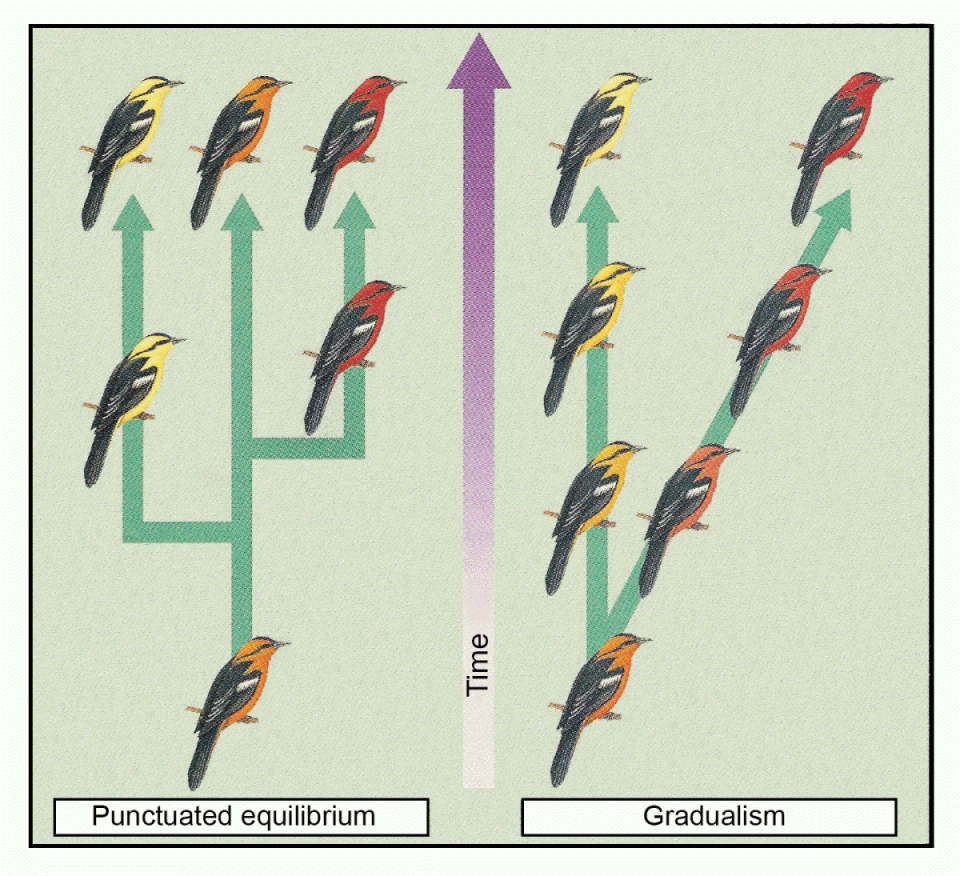
PE vs PG
You can see that in the PE model, a species remains in stasis while in the PG model a species is constantly changing. Looking at the fossil record, as I’ve shown previously, we will see that a great majority of species remained in stasis before a sudden phenotypic change (probably a change in environment forcing this). This is why, in my opinion, there are hardly any transitional fossils. This is the best theory to answer Darwin’s question.
Evolution is *NOT* Progressive
4200 words
PumpkinPerson still believes that evolution is progressive. What exactly is evolution through natural selection ‘progressing towards’? Some, like PP, may say it’s progressing towards a better organism for that specific environment. However, there is no end game. That organism will still continue to change based on whatever changes in its environment. One of the most common misconceptions about evolution is that it’s progressive. One assumes that by looking at the progression from the earliest forms of life to today, that humans must be at the top of this ‘evolutionary ladder’ so to speak. However, evolution has no end game, nor is it conscious to be able to have humans be at the top of this ‘evolutionary ladder’. I’ll take the last thing that PP said to me on his blog and reply to it here as well.
Evolution can happen in four ways: migration, mutation, genetic drift, and natural selection (NS). Evolution is a non-conscious, non-linear event that occurs to make an organism more fit for its environment. Progressive evolution assumes that it’s linear and so evolution is a straight line from ‘more evolved to less evolved’. Would that make sense? For evolution to be in a straight line? Or would a branching tree make more sense? PP knows this fact, yet still attempts to say that the ‘newest species are the “most evolved”‘. We can take 2 genetically similar organisms and put them into one cold environment and the other a hotter environment. Will one of them be “more evolved” than the other in a few generations? Or does evolution dictate what changes occur and there is no “more evolved” because each organism is suited to its environment?
PP says:
No that’s not the point. If two populations are both descended from a common ancestor, and population A remains more similar to that common ancestor than population B, then population A is less evolved, because it’s done less evolving from the common ancestor. Why can’t you grasp this concept, RR?
I do grasp it, it just makes no sense. Because even that organism that “stayed close to the common ancestor” is still markedly different than the common ancestor.
Actually that’s not true. Humans are close to reaching the point where we no longer evolving in the conventional sense. Any further genetic change will be self-directed, via genetic engineering, and not the product of natural selection and genetic drift. And progress needn’t imply an end point, it only implies more recent forms will on average be more adaptable than life from millions of years ago.
This was in response to me saying that evolution would continue until all organisms die out or the Sun explodes. Even the with the genetic change we bring about ourself with CRISPR, we would still be evolving genetically. Umm progress DOES imply an end point. Progress means progression, what is an organism progressing towards? Being more efficient? No. Progression denotes an end game. There IS NO endgame with evolution. Evolution just happens to increase fitness for an organism and population.
I don’t have any misconceptions when it comes to evolution RR. It’s you who is confused. And I’ve seen Dawkins talk about evolutionary progress. He shows some understanding of the concept, but it’s not complete.
Yes you do have misconceptions when it comes to evolution, PP. There is no way to quantify progress in regards to evolution. You can choose some arbitrary traits, but that’s just our perception of it. You cannot objectively say that one organism is “more evolved” than another based on those traits.
I forgot that Dawkins believes in evolutionary progress. That doesn’t change my mind on this matter. I’m sure that Dawkins of all people knows that each organism is suited for its environment, not perfectly, but good enough. Evolution makes organisms good enough in order to transmit its genes to the next generation. How can you say that there is progress when each organism is fit for its environment? How can you believe in this notion when evolution through NS, migration, mutation and genetic drift make each organism unique in order to survive in its own specialized niche? As I will say below, Darwin’s Finches are the perfect example of how evolution is not progressive. They are fit for each environment. The tree finch has a blunt beak for tearing vegetation, the ground finch has a broad beak for crushing seeds, and Warbler finch’s small beak makes it good for eating insects. Each bird evolved from the same ancestor, each evolved in different ecosystems on the same island, but they evolved to do different things based on what they had to do to survive in that ecosystem. This very simple example shows that evolution is not progressive, and that these mutations occur to better help an organism in that niche in the ecosystem.
Next PP quotes Rushton from Race, Evolution, and Behavior where he says:
In their reviews, Lynn (1996a) and Peters (1995) both referred to my ranking of species on evolutionary scales. For Peters, this was a highly contentious idea but in Lynn’s positive review, he described me as proposing that the K-strategy was “evolutionarily more advanced” and that the Oriental race was “the most evolved.” In fact, I did not use either of these phrases in the book, although I had alluded to similar ideas in previous writing. Regardless, the topic of evolutionary progress provides an intellectual challenge of the first order and needs to be addressed. Figure 10.2 (p. 202) does imply a move from simple r-type animals producing thousands of eggs but providing no parental care to more complex K-type animals producing very few offspring.
In his book Sociobiology (1975), E. O. Wilson also promoted the idea of biological progression, outlining four pinnacles in the history of life on Earth: first, the beginning of life itself in the form of primitive prokaryotes, with no nucleus; then the origin of eukaryotes, with nucleus and mitochondria; next the evolution of large, multicellular organisms, which could evolve complex organs such as eyes and brains; and finally the beginnings of the human mind. (Rushton, 1997: 292-3)
I still don’t see how it’s “progressive and more evolved”. Each organism is suited for its environment to make sure that it breeds and continues its genetic lineage. I see how one could say that newer organisms are “more evolved”, however, each organism is suited for its environment.
You have no idea what you’re talking about. Humans who left Africa 60,000 years ago looked like Andaman islanders who clearly look like modern Africans today. Further, facial reconstructions of the African Eve from 125,000 years ago also looks like modern Africans. The notion that modern looking Africans are only 10,000 years old is INSANE. Did they look EXACTLY like Africans today? No. Were they close enough that no one would think twice if they walked down the street in modern clothing? Yes.
I HAVE NO IDEA WHAT I’M TALKING ABOUT, yet PP thinks that damn reconstructions mean ANYTHING!! Forensic facial reconstruction is one of the most subjective techniques in forensic anthropology. The skin thickness is subjective to the forensic artist, but I’m sure that that means that the facial reconstruction of Mitochondrial Eve is even a close representation of what she actually looked like. The fact of the matter is, facial reconstructions are highly subjective to the individual forensics artist. There is a great example in the link about how facial reconstruction isn’t anywhere near perfect:
A second problem is the lack of a methodological standardization in approximating facial features. A single, official method for reconstructing the face has yet to be recognized. This also presents major setback in facial approximation because facial features like the eyes and nose and individuating characteristics like hairstyle – the features most likely to be recalled by witnesses – lack a standard way of being reconstructed. Recent research on computer-assisted methods, which take advantage of digital image processing, pattern recognition, promises to overcome current limitations in facial reconstruction and linkage.
Keep in mind that PP believes that Australasians are Negroid, despite the fact that I’ve shown him wrong on that time and time again. Phenotype does not always equal genotype. Just because one group is phenotypically similar to another DOES NOT MEAN that they are genetically similar. It’s PP that doesn’t know what he’s talking about.
How is the notion that modern-looking Africans are 10k years old insane? I see PP doesn’t keep up with the latest studies. Is the notion that modern-day Europeans are 6500 years old insane as well?
It shows that there are lineages that become very adaptable despite not being very evolved, and some that don’t need to be adaptable because they lucked into a fixed ecological niche. But generally speaking, across all lineages, more recent forms of life are more adaptable than more ancient forms of life.
This was in response to what I said to him about there being mosses and fungi who’ve stayed pretty similar. This SHOWS that evolution is not progressive. More recent forms of life are more adaptable? You mean that more recent forms of life incurred more mutations to be more adaptable.** Evolution through NS is about being good enough to pass on your genes, that’s it. Whether or not one species is “more evolved” (whatever that means) over another is meaningless as all that’s occurring is genes passing to the next generation. Break down all of these processes to the simplest possible level and this is what we are left with.
Then I cited two links which said:
“There is no ‘progress’ in evolution. No living thing is trying to get anywhere,” Zuk said. “And humans are not at the pinnacle of the evolutionary ladder.”
…
Evolution, she said, is no engineer, building the perfect organism from scratch every time the environment changes. Rather, evolution is the ultimate tinkerer, always having to make do with the parts on hand. Its creations tend to be imperfect, just fit enough to survive.
To which PP replied:
WRONG! Humans are the highest branch within the homo evolutionary tree which is the highest branch within the primate evolutionary tree which is perhaps the highest branch of the mammal evolutionary tree, which is perhaps the highest branch within the animal evolutionary tree etc. This can be seen in phylogenetic diagrams.
PP, it specifically said evolutionary ladder. Phylogenetic diagrams prove that evolution is non-linear and does NOT go in a straight line. Phylogenetic diagrams prove that evolution is a tree and not just a straight line of ‘progress’.
And yet evolution has created the human brain, the most complex known object in the universe.
That doesn’t say anything to the fact that evolution is not an engineer making perfect organisms for their environment. All an organism needs is to be “good enough”. It’s not survival of the fittest as much as survival of the good enough. Sure evolution ‘created’ the human brain. But that doesn’t make evolution, a non-conscious event, an engineer. Why do so many atheists have so much faith in evolution, putting human qualities into it when evolution through natural selection is just a process of making sure that an organism passes its genes on? It is one hundred percent correct that evolution is the “ultimate tinkerer”, making organisms “just fit enough to survive”.
And the other link I cited, which uses Darwin’s finches as an example of the non-linearity of evolution says:
A study of the DNA of Darwin’s finches on the Galapagos Islands (Petren et al. 1999) provides a good example of why the idea of progress makes no sense in evolution. The study’s findings suggest that the first finches to arrive on the islands were the Warbler finches (Certhidea olivacea), whose pointy beaks made them good insect eaters. A number of other finches evolved later from the Warbler finches. One of these is the Geospiza ground finch, whose broad beak is good for crushing seeds, and another is the Camarhynchus tree finch with its blunt beak which is well adapted for tearing vegetation.
..
Even though biologists reject the Great Chain of Being or any similar ladder-of-progress explanation of evolution, the idea still persists in popular culture. A more accurate analogy would be that of a bush that branches in many directions. If we think of evolution over time in this way, we’re less likely to be confused by notions of progress because the branches of a bush can grow in various directions in three dimensions, and new branches can sprout off of older branches without implying that those farther from the trunk are better or more advanced than those closer to the trunk. A more recent branch that has split off from an earlier branch-like a species that has evolved from an ancestral species-does not indicate greater progress or advancement. Rather, it is simply a new and different growth on the bush, or more specifically, a new species that is sufficiently adapted to its environment to survive.
To which PP replied:
The idea of progress makes sense when you look at the grand sweep of evolution across BILLIONS OF YEARS. We’ve gone from simple, restricted life forms that could only survive in the ocean, to complex adaptable GOd-like life-forms like humans, that can live in virtually any environment, and travel to space.
This doesn’t say anything to what was quoted, PP. The fact that Darwin’s Finches each evolved on the same island, yet have completely different phenotypes depending on what they have to do to survive shows that evolution is not progressive and that there is no “more evolved” life form, just life forms surviving. Love how you sidestepped that quote.
This is the same tired nonsense. In evolution, almost every time one branch splits into two, it means evolutionary growth has occurred. So if you’re the first branch, and you don’t do anymore branching, you’re less evolved, and typically less complex and versatile than branches that split off after much branching occurred.
Yes PP. Keep repeating the “if you’re the first branch and you don’t do any more branching than you’re less evolved” canard. PP is confusing “more evolved” for more complex.
Let me repeat this quote again because it’s perfect for this discussion:
If we think of evolution over time in this way, we’re less likely to be confused by notions of progress because the branches of a bush can grow in various directions in three dimensions, and new branches can sprout off of older branches without implying that those farther from the trunk are better or more advanced than those closer to the trunk.
But I’M the one who doesn’t get it. Just because changes occur to make new species does not mean that the common ancestor is “less evolved”, it just means that there were different selection pressures that forced these changes to happen!! That’s it!
Just because your teacher told you something years ago doesn’t make it true, PP. It doesn’t mean that your teacher “got it” while everyone else is blinded to the fact of “organisms being more evolved than others”.
Level 1: People who don’t believe in evolution
Level 2: People who think evolution is progressive because they don’t understand the random nature of natural selection (most secular non-scientists fit in this category)
Level 3: People who think evolution is NOT progressive because they understand natural selection is random and geared to specific environments(most scientists and science writers and bloggers fit in this category)
Level 4: People who realize that even random processes will eventually show progress through billions of years of trial and error, and no environment is 100% specific (many of the greatest minds in history reached this stage: E.O. Wilson, Darwin, Rushton)
You’re stuck on Level 3, RR, and so are all the people you quote. I hope your mind can one day make the leap to Level 4.
This is hilarious. The fact that NS is random SHOWS that evolution is not progressive. PP may say “over billions of years through trial and error it made ‘more evolved’ organisms”. I love how PP’s speculations are the final word and what I say and who I quote are conveniently a level below his little hierarchy.
On PP’s “Level 4”:
NS, migration, mutation and genetic drift are how organisms evolve. Changing the mix of the 4 will lead to different outcomes each time. What PP is trying to say here is that I’m conveniently below the level that he’s at because he recognizes evolution as being “progressive” “progressing to be the ultimate organism in that environment”.
On the non-linearity of evolution:
“The idea of sharing a common ancestor leads to the second major misunderstanding inherent in the question,” says Dr Willis, “that evolution is a linear process where one species evolves into another.”
Evolution is really a branching process where one species can give rise to two or more species.
“The fallacy of linear evolution is most clearly illustrated by the analogy of asking; how can I share common grandparents with my cousins if my cousins and my grandparents are still alive?,” says Dr Willis.
“The answer is of course that your grandparents had more than one child and they each went off and started their own families creating new branches of your own family tree.”
The same thing happens in evolutionary families. A species can split into two or more descendant species and they can split again and again across the generations.
But PP would say that the organism who branched into the new one that stayed the same is “less evolved” than the other, when the only difference is that the newer organism faced different pressures which led to different changes!
Let me repeat: evolution is not progressive. Each organism is suited for its environment so that it can pass its genetic code to the next generation. Even an earlier organism is not “less evolved” than one that came after it, because it still has to survive in that ecosystem. The process of evolution leads to a branching pattern of relationships amongst similar organisms.
Ever since Aristotle, people have had an inclination to rank living things in a single dimension of “lower to higher” or “primitive to advanced”. Such rankings have a name, “the Great Chain of Being” or “the Ladder of Life”. But such rankings have no basis in evolutionary biology. All living organisms occupy equivalent positions on the tips of the latest twigs in phylogeny. The “lowliest” worm or microbe is just as “advanced” (i.e., has been just as successful at adaptation and reproduction throughout its lineage) as is the ‘highest” primate or social insect. “Progress” was an essential feature of some pre-Darwinian evolutionary theories, notably Lamarck’s believe in evolution driven by inward striving toward improvement. But modern evolutionary theory supports no clear expectation of progress, at least not in any dimension that has yet been explored.
Isn’t there an obvious sense in which evolution MUST be progressive? Doesn’t natural selection assure that species are always becoming better adapted, so that degree of adaptedness must be increasing over time? Doesn’t the fossil record document continuing advancement toward improved design and complexity? Doesn’t the process of adaptative radiation (continuing speciation with adaptation) guarantee that the ecological world will be ever more precisely subdivided into niches occupied by ever-increasing numbers of species?
In short, no. No one has yet demonstrated any measureable parameter that shows a consistent, reliable increase over time as evolution proceeds. This is an important point. Belief that evolution is always necessarily “improving” something can interfere with clear appreciation of the actual mechanism of evolution, which is simply the replacement of one heritable variant by another because, in specific conditions which include the presence of both variants, one does better than the other.
Concepts and Questions in Evolutionary Biology. Is evolution progressive?
As I keep saying to PP, each organism is fit for its environment. You can use some arbitrary things to say “this more evolved than that”, but evolutionarily speaking it doesn’t make sense, as I keep saying, because each organism is perfectly suited to its environment.
Yes, bacteria is simpler than a hawk, but that doesn’t mean that it’s any less adapted to its environment than a hawk is.
Evolution arises from mutation, genetic drift, migration and finally natural selection. This leads to large random variations amongst individual organisms. Natural selection then acts upon those random variations and over time this leads to differences between organisms which lead to them eventually becoming different species. How one can then make the leap in logic to say that evolution is progressive due to that is beyond me.
We only ASSUME that evolution is progressive because we look at traits that have been selected for and we don’t look at the traits that have been made negative due to the positive selection. Another point that PP likes to bring up is that the increasing complexity and increase in brain size shows how it’s progressive. However, our brains are shrinking. So if evolution was ONLY PROGRESS, why is the “most complex thing in the known universe” getting smaller? And with a decrease in brain size comes a decrease in intelligence. Such progress PP!!! Evolutions has no direction so it CANNOT be progressive. Most people want to assume that evolution is linear and thusly we were here BECAUSE we’d have been here regardless of what happened. This is not true. The fact of the matter is, evolution is a random process. The only reason there is a belief that evolution is progressive is because we strive to make meaning in everything in our lives even when there is nothing there.
Now with the thought that evolution is progressive, comes the thought of more evolved and less evolved races. As I have shown early in this article, Rushton believed that Mongoloids were “more evolved” because they came last. This then assumes that Africans are “less evolved” because they came first. This, however, makes no evolutionary sense. I love Rushton and all he did to bring racial differences to the mainstream, but evolutionary biologist he was not. The assumption here is that East Asians and Caucasians are the newest races, and thusly would have to be more advanced than the Africans. However, these notions are baseless. They are extremely subjective and one cannot say that one race is “more evolved” or “more superior” than another.
As the story is untangled, it will also become obvious how inappropriate it is to talk in terms of the “inferiority” or “superiority” of groups. Consider, for example, the Big Five personality traits: openness, conscientiousness, extraversion, agreeableness and neuroticism. What are the ideal points on these continua? They will differ depending on whether you’re looking for the paragon of, say, a parent or an entrepreneur.
Nicholas Wade says:
From an evolutionary perspective, African populations were just as well adapted to their environment as were those of Europe and Asia to theirs. Small. loosely organized populations were the appropriate response to the difficult conditions of the African continent. But they were not necessarily well suited to high efficiency economies to which European and East Asian populations had become adapted. From this perspective, if valid, it would be unsurprising that African countries should take longer to make the transition into modern economies. (Wade, 2015: 181-2)
And finally I asked Razib Khan what he thought about this back in August. He said:
people who talk in those terms about population genetics are inferior and less evolved. sabine’s statement in my other posts applies: you’re not a serious thinker and label yourself as stupid or ignorant.
This notion of “superiority” when discussing human races, or even organisms as a whole is baseless. When looking at subjective traits then we can say that. BUT objectively, there is no way to quantify this.
Some people in the HBD-sphere, as well as the Alt-right, may say that Eurasians are ‘superior’ to Africans. On what traits? Because looking at a completely different set of traits would have you come to the opposite conclusion. Like with r/K Selection Theory (now known as the CLASH model). People assume that Africans and others who live nearer to the equator are inferior due to how many children they conceive. However, from an evolutionary perspective, the ultimate measure of human success is not production, but reproduction (van den Berghe, 1981). When that single variable is looked at, they are “more evolved” and if PP were to be believed, evolution is going backward for Eurasians since they have fewer children than Africans.
In sum, evolution is NOT progressive. Mutation, migration, and genetic drift set the stage for differences between organisms, then natural selection selects for those advantageous alleles which then get passed on to the next generation. This notion of progressive evolution is ridiculous. Evolution is a branching tree, not a straight line as is commonly thought. Progressive evolution assumes that we are progressing towards something. This is not the case. Evolution just happens, it’s not attempting to “progress” anywhere as these differences between organisms just happen and thusly you cannot say that one organism is “more evolved” than another nor can you say that this organism showed more “evolutionary progress” over another as changes are random.
More Thoughts on Bipedalism
1050 words
I wrote about bipedalism last week, however, in a conversation with a commented on PumpkinPerson’s blog, I came to a slightly different conclusion than I did in my previous article on the matter.
I quoted Daniel Liberman, author of the book The Story of the Human Body: Evolution, Health, and Disease:
As one might expect, other selective pressures are hypothesized to have favored bipedalism in the first hominins. Additional suggested advantages of being upright include improved abilities to make and use tools, to see over tall grass, to wade across streams, and even to swim. None of these hypotheses bear up under scrutiny. The oldest stone tools appear millions of years after bipedalism evolved.(Lieberman, 2013: 43)
However, after being linked to this journal article Shallow-water habitats as sources of fallback foods for hominins, I began to rethink my position on this matter.
Now, the climate change when humans and chimps diverged is still the primary cause of bipedalism, but after reading this abstract, I came to think that the climate change (getting warmer) rose the sea levels which then drove Man to walk on two legs, gather food, and, eventually, wade in water to find more food which led to some selection for bipedalism in our ancestors. Humans needed to become bipedal to find more food as the climate change made their primary food more scarce. This then drove early Man into shallow waters to look for food.
As the climate was getting warmer, the same foodstuffs we ate were not as readily available. So what drove us to be bipedal was 1) the need for immediate food, i.e., looking for food on the forest floors and 2) when adequate food could not be found on the floors of the forests, Man then had to go into the water. This had multiple advantages. One could escape from predators, find more food with adequate nutrients which, in turn, had as evolve bigger brains, and the most important aspect, it’s much easier to be bipedal in water as it’s easier to stand in water.
This paper, The evolution of the upright posture and gait—a review and a new synthesis, concludes:
Wading was an appropriate trigger not only to stand up but also forced the primate to walk on. It seems likely that habitual bipedalism began not long after the separation from the gorilla and chimpanzee clade(s). From that time onwards, throwing could be evolved with free upper extremities much more successfully than before. Selective factors related to the reduction of incoming solar radiation became effective. Endurance running and adaptations to carry tools (like weapons) started their evolutionary improvements. If these processes took about 4 Ma, the wading hypothesis is consistent with a rather perfect bipedal anatomy as shown, e.g., in Homo ergaster (WT 15000), about 1.6 Ma ago. In this way, many of the hypotheses competing in the past may be harmonised, as some of them have yielded important contributions to the understanding of the evolution of the human habitual upright gait.
The first sentence corroborates what Lieberman says in The Story of the Human Body. The final sentence brings together all of the theories that drove bipedalism in humans into a ‘new synthesis’.
Now, climate change (the earth getting warmer) is still the ultimate cause, but a proximate cause of bipedalism is wading in the water to 1) find more food and 2) escape predators.
This ‘new synthesis’ of how Man became bipedal is a great way to unify a lot of theories of bipedalism that gave us great understanding of human evolution in regards to bipedalism. In that vain, it’s like E.O. Wilson’s Sociobiology: A New Synthesis in which he sought to unify the evolutionary mechanics of altruism, aggression, and nurturance– our main social behaviors. This ‘new synthesis’ in the study of how we became bipedal unifies competing theories into a more understandable theory.
Moreover, bipedalism made it easier to consume more kcal which led to bigger brains. To quote Suzana Herculano-Houzel from her book The Human Advantage: A New Understanding of How Our Brain Became Remarkable:
“The remaining way to work around an energetic constraint to the number of neurons in the brain involves dietary changes that would allow for more calories to be obtained in the same amount of time, or even less. Some first changes in that direction probably took place 4 million years ago when our australopithecine ancestors stood upright and became habitual bipeds. As Daniel Lieberman explores in detail in The Story of the Human Body, bipedality potentially increases the amount of calories that can be amassed in a day by extending the range of food picking, for it is much easier and costs four times fewer kilocalories to walk on two feet, as humans do, than on all fours, as modern great apes do and the ancestor from which australopithecines originated must have done. Roaming away from home to find food, is the definition of a food gatherer, as opposed to a food picker, which is what great apes remain to this day. Bipedality made food gatherers of our ancestors.” (Herculano-Houzel, 2016: 189)
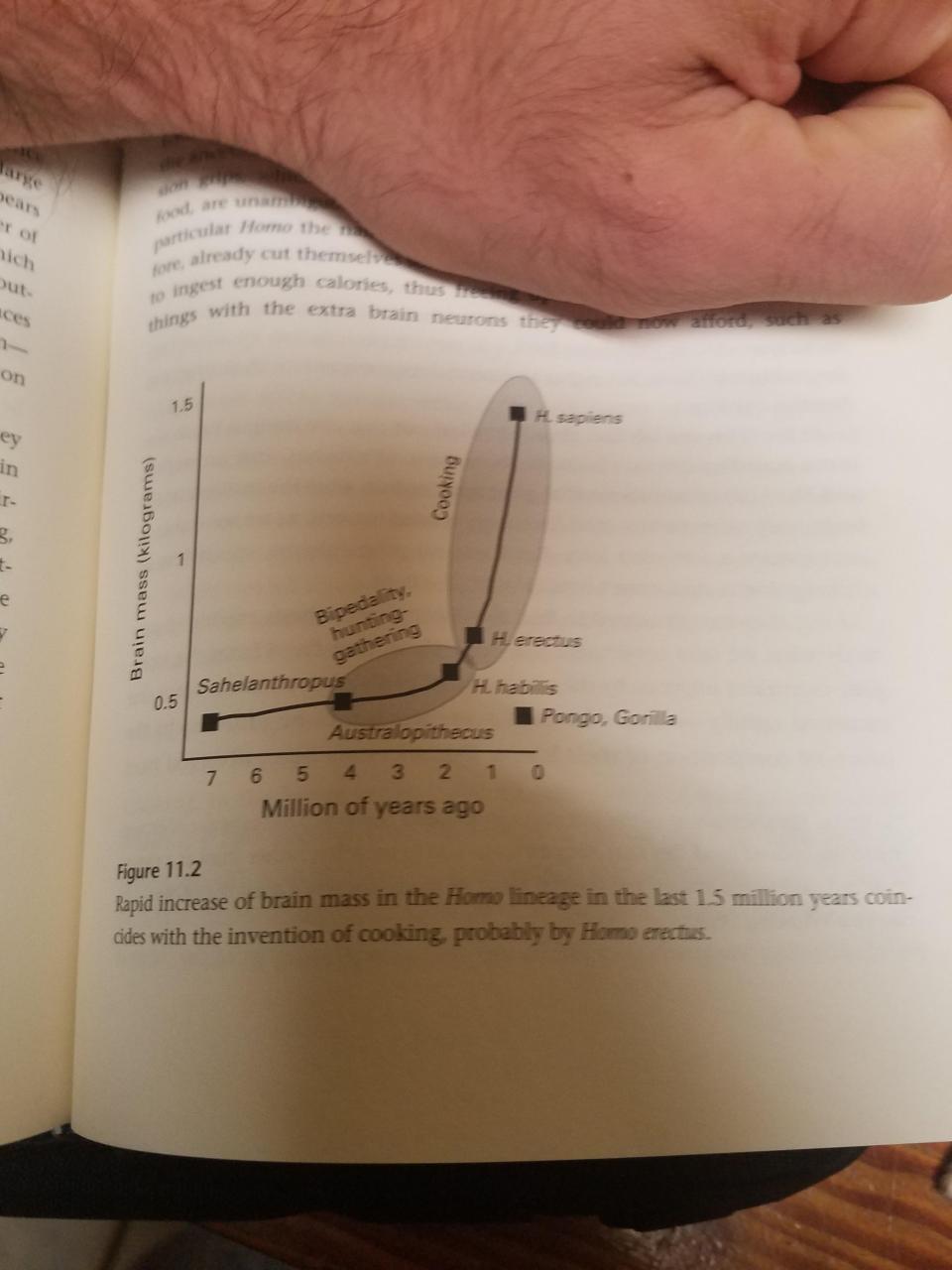
This graph from her book shows that bipedality preceded cooking which increased our brain size (I will write on that soon).
More neurons in the cerebral cortex is the cause for our amazing brains. But we are NOT unique!! This kcal increase led to more neurons in our cerebral cortex which then allowed for reasoning, finding patterns, developing technology and passing it on through culture. Cooking is why we are so ‘unique’ in comparison to other animals. As shown in the graph above, the increase in brain size happened around the time of H. Erectus. They show smaller teeth at that period, which shows that the selection was already occurring. The smaller teeth to break down food more to extract nutrients from the food they gathered shows that bipedalism evolved alongside the evolution of smaller teeth.
In sum, the ultimate cause of bipedality is still climate change, but the proximate cause, in part, was wading in the water which led to our ancestors to find more food. And, over time, we were selected for bipedalism as I wrote in my previous article on the matter. We can see that bipedalism slightly predated cooking, which the ultimate cause of which was to find more food. This is seen in the records we have. I will write more on this in the future as I read into this more.
Guns, Germs, and Steel: A Refutation
Of course the allegations of “racism” arise, as usual when in discussions of racial differences in intelligence and level of civilizational achievement. Rushton also says:
Racial differences in brain size and IQ map very closely to the same cultural histories Diamond explains. Although Diamond dismisses such research as "loathsome", he fails to tell his readers what, if anything, might be scientifically wrong with any of it. One hundred years of research has
established that East Asians and Europeans average higher IQs than do Africans. East Asians, measured in North America and in Pacific Rim
countries, typically average IQs in the range of 101 to 111. Caucasoid populations in North America, Europe, and Australasia typically average
IQs from 85 to 115 with an overall mean of 100. African populations living south of the Sahara, in North America, in the Caribbean, and in Britain
typically have mean IQs from 70 to 90.Racial differences in brain size and IQ map very closely to the same cultural histories Diamond explains. Although Diamond dismisses such research as
"loathsome", he fails to tell his readers what, if anything, might be scientifically wrong with any of it. One hundred years of research has established that East Asians and Europeans average higher IQs than do Africans. East Asians, measured in North America and in Pacific Rim
countries, typically average IQs in the range of 101 to 111.  Caucasoid populations in North America, Europe, and Australasia typically average IQs from 85 to 115 with an overall mean of 100. African populations living south of the Sahara, in North America, in the Caribbean, and in Britain typically have mean IQs from 70 to 90.
 NotPoliticallyCorrect
2650 words
I first heard of Guns, Germs, and Steel (GGS) a few years ago while in a discussion about racial differences and their causes. The person linked me to the Wikipedia page on GGS. I then looked into it and it seemed to be an OK hypothesis. However, after reading the book myself and then reading critiques he got on it, it’s clear that Jared Diamond was attempting to pick and choose what to put into the book to come to the conclusions he already has come to. There are some interesting tidbits in the books, my favorite being only 14 beasts of burden have been tamed for human use out of 148 large wild creatures that can be tamed. Other than that, he spins facts and data from hereditarians to suit his own agenda.
Jared Diamond started wondering about the reasons for human inequalities after his New Guinean friend, Yali, asked Diamond why Westerners had so much more “cargo” (material possessions) than the New Guineans. Diamond then set forth to find out why human inequality existed. Diamond attempts to say that immediate environment and only environment is the cause of racial inequalities. However, what Diamond fails to say is that genetic isolation over thousands of years is the cause of racial differences in intelligence, muscle fiber typings, crime differences, age of first period, sleep, obesity and metabolic differences, racial/sex differences in testosterone, differences in climate which, over tens of thousands of years cause distinct phenotypic/genotypic differences, child rearing and age of first birth, slow and fast life history (r/K selection), etc. He also fails to bring up brain size differences between races/ethnicities. All of these factors are responsible for racial/ethnic inequalities.
Diamond’s main thesis in GGS is that human inequalities all boil down to amount of resources in the land and how they are able to be used with the geography of the area. He never brings up brain size as it pertains to modern-day humans, EXCEPT in regards to New Guineans and how they are more intelligent than Europeans: (Diamond, 1997: 20, 36, 38, 40, 159, 198, 260):
This is laughable. To say that a tropical people, pretty much isolated from the rest of the world is more intelligent than Europeans is not true at all. Just as Robert Sternberg’s Triarchic Theory of Intelligence fails to explain away racial/ethnic differences in intelligence, so does Diamond’s. Jared Diamond clearly, by his own admission, wants to prove that these differences between humans only come down to immediate environment and are not genetic in nature. The fact that Diamond says that New Guineans are “probably superior to Westerners” … “escaping the devastating developmental damages under which most children in industrialized societies now grow up” shows how biased he is with this whole entire book. IQ tests are great predictors of g, general intelligence, and Westerners clearly are superior in terms of intelligence in comparison to New Guineans. Yea, you can’t build a shelter like they can and you look stupid to them because you can’t do what they can in their society. Duh, of course. The fact that he uses that as any type of evidence or revelation that New Guineans are smarter than Westerners is a wrong and 100 percent ideologically driven statement.
Rushton had some nice words for Diamond on brain size, intelligence: