Home » Posts tagged 'IQ' (Page 7)
Tag Archives: IQ
Race, Obesity, Poverty, and IQ
2100 words
America has a current and ongoing obesity epidemic. Some ethnicities are more likely to be obese or overweight than others due to lower intelligence which means a lack of ability to delay gratification, lack of ability to think into the future, lower funds which translates to eating more refined carbohydrates which means more blood glucose spikes which then leads to obesity as I will show. Insulin has a causal relationship with obesity so those who lack funds to buy healthier food then turn to refined foods high in carbohydrates as they are cheaper and more abundant in low-income neighborhoods.
Adult obesity rate by State (top 5) is: 1) Louisiana (36.2 percent), 2) Alabama (35.6), West Virginia (35.6), and Mississippi (35.6), and 5) Kentucky (34.6) with the 5 least obese States being 51) Colorado (20.2), 49) Hawaii (20.7), 48) Montana (23.6), 47) California (23.2), and 46) Massachusetts (24.3). Notice how the States with higher rates of obesity are in the South and the States with the lower rates are in the North, give or take. The average IQ for these States as follows: Lousiana: 95.3, Alabama: 95.7, West Virginia 98.7, Mississippi 94.2 (lowest IQ State in the country, largest black population at 37 percent), and Kentucky at 99.4. The average IQ for those States is 96.66. The average IQs for the States with the lowest obesity rates are: Colorado 101.6, Hawaii 95.6, Montana 103.4, California 95.5, and Massachusets 104.3 (highest IQ State). The average for these States being 100.08. So there is a 4 point IQ difference between the top 5 States with the highest and lowest percentage of obese people, which goes with the North/South gradient of higher IQ people living in the North and lower IQ people living in the South. Back in 2014, a California real estate group took 500,000 Tweets using a computer algorithm and estimated intelligence based on spelling, grammar, and word choice and found a difference in State by State intelligence. Notice how the further North you go the higher the average intelligence is, which is then correlated with the obesity levels in that State.
With poverty rates by State, we can see how the States in the South have less intelligent people in them which then correlates to the amount of obesity in the State. Though, there are some anomalies. West Virginia and Kentucky have a super majority of whites. This is easily explained by the fact that less intelligent whites live in those States, and since both the poverty rates and obesity rates are high, it follows that the State will be less intelligent than States that have more intelligent people and less obesity.
It is known that intelligence is correlated with obesity at around -.25 (Kanazawa, 2014). The negative correlation between intelligence and obesity means that they are inversely related so, on average, one with higher intelligence has less of a chance of being obese than one with lower intelligence. The States with the lowest IQ people having those with the highest BMIs corroborates this. In America, obesity rates by ethnicity are as follows: 67.3% for whites, 75.6% for blacks, and 77.9% for ‘Hispanics’.
Now that we know the average intelligence rates by State, the percentage of obese by State and the demographics by State, we can get into why obesity rates correlate with intelligence and race.
Diaz et al (2005) showed that minority populations are more likely to be affected by diabetes mellitus which may be due to less healthy diets and/or genetic factors. Using the National Health and Nutrition Survey for 1999-2000, they analyzed overweight, healthy adults, calculating dietary intake variables and insulin sensitivity by ethnicity. They characterized insulin resistance with fasted insulin, as those who are more likely to become insulin resistant have higher fasted insulin levels (levels taken after waking, with the subject being told not to eat the night before as to get a better reading of fasted insulin levels). Non-‘Hispanic’ whites had higher energy and fat intake while ‘Hispanics’ had higher carb intake with blacks having lower fiber intake. Blacks and ‘Hispanics’ were more likely to have lower insulin sensitivity. However, ‘Hispanics’ were more likely to have lower insulin sensitivity even after controlling for diet, showing that metabolic differences exist between ethnicities that affect carbohydrate metabolism which leads to higher rates of diabetes in those populations.
Drewnowski and Specter (2004) showed that 1) the highest rates of obesity are found in populations with the lowest incomes and education (correlated with IQ), 2) an inverse relationship between energy density and energy cost, 3) sweets and fats have higher energy density and are more palatable (food scientists work feverishly in labs to find out different combinations of foods to make them more palatable so we will eat more of them), and 4) poverty and food insecurity are associated with lower food expenditures, lower fruit and vegetable intake, and lower-quality diet. All of these data points show that those who are poor are more likely to be obese due to more energy-dense food being cheaper and fats and sugars being more palatable.
Now that I’ve shown the relationship between race and IQ by state, obesity rates by state, insulin sensitivity by race, and that those in poverty are more likely to be obese, I can now talk about the actual CAUSE of obesity: insulin.
The conventional wisdom is that if you consume more kcal than you expend, you will gain weight, whereas if you consume less than your daily needs you will lose weight. This has been unchallenged for 50 years. Also known as Calories In and Calories Out (CICO), this mantra “eat less and move more!!!” has been bleated over and over with horrendous results. The CICO model only concerns itself with calories and not insulin which is a causal factor in obesity.
In this study, participants in the basal insulin group which received the lowest average insulin dose gained the least average amount of weight at 4.2 pounds. Those on prandial insulin gained the most weight at 12.5 pounds. The intermediate group gained 10.3 pounds. More insulin, more weight gain. Moderate insulin, moderate weight gain. Low insulin, low weight gain.
Researchers compared a standard dose of insulin to tightly control blood sugars in type 1 diabetic patients. At the end of the 6 years, the study proved that intensive control of blood sugars resulted in fewer complications for those patients.
Though, in the high dose group, they gained on average 9.8 pounds more than those in the standard group.
More than 30 percent experienced major weight gain! Prior to the study, both groups were equal in weight. But the only difference was the amount of insulin administered. Were the ones given high levels of insulin all of a sudden more lazy? Were those who gained weight suddenly lacking in willpower? Were they lazier before the study? We’re they more gluttonous? No, no, and no!!
(source)
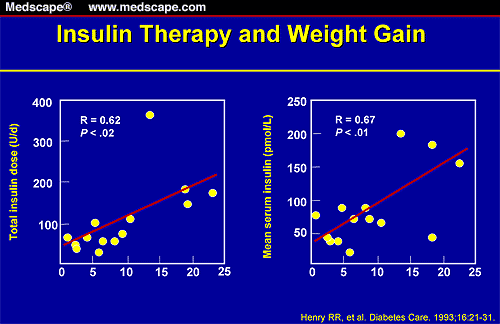
Finally, Henry et al (1993) took Type II diabetics and started them off with no insulin. They went from 0 units of insulin a day to 100 units at 6 months. As higher rates of insulin were administered, weight rose in the subjects. Insulin was given, people gained weight. A direct causal relationship (see figure above). However, what’s interesting about this study is that the researchers measured the amount of kcal ingested, the number of kcal ingested was reduced to 300 per day. Even as they took in less kcal, they gained 20 pounds! What’s going on here? Well, insulin is being administered and if you know anything about insulin it’s one of the hormones in the body that tells the body to either store fat or not burn it for energy. So what is occurring is the body is ramping down its metabolism in order for the subject to store more fat due to the exogenous insulin administered. Their TDEE dropped to about 1400 kcal, while they should have been losing weight on 1700 kcal! The CICO model predicts they should have lost weight, however, adaptive thermogenesis, better known as metabolic slow down, occurred which dropped the TDEE in order for the body to gain fat, as insulin directly causes obesity by signaling the body to store fat, so the body drops its metabolism in an attempt to do so.
Putting this all together, blacks and ‘Hispanics’ are more likely to be in poverty, have lower intelligence, and have higher rates of obesity and diabetes. Furthermore, blacks are more likely to have metabolic diseases (adaptive thermogenesis aka metabolic slowdown is a metabolic disease) which are related with obesity due to their muscle fiber typing which leads to lower maximal aerobic capacity (less blood and oxygen get around the body). Type II skeletal muscle fibers’ metabolic profile contributes to lower average aerobic capacity in blacks. It also is related to cardiometabolic diseases, in my opinion because they don’t have the muscle fiber typing to run long distances, thus increasing their aerobic capacity and VO2 max.
Due to the diets they consume, which, due to being in poverty and having lower intelligence, they consume more carbohydrates than whites, which jacks their blood glucose levels up and the body then releases insulin to drive the levels glucose in the body down. As insulin levels are spiked, the body becomes insulin resistant due to the low-quality diet. Over time, even a change in diet won’t fix the insulin resistance in the body. This is because since the body is insulin resistant it created more insulin which causes insulin resistance, a vicious cycle.
Poverty, intelligence and race both correlate with obesity, with the main factor being lower intelligence. Since those with lower IQs have a lack of foresight into the future, as well as a lower ability to delay gratification which also correlates with obesity, they cannot resist low-quality, high-carb food the same way one with a higher IQ can. This is seen with the Diaz et al study I linked, showing that whites have higher levels of fat intake, which means lower levels of carbohydrate intake in comparison to blacks and ‘Hispanics’. As I’ve shown, those in poverty (code word for low intelligence) ingest more refined carbohydrates, they have higher levels of obesity due to the constant spiking of their insulin, as I have shown with the 3 aforementioned studies. Since blacks and ‘Hispanics’ have lower levels of intelligence, they have lower levels of income which they then can only afford cheap, refined carbs. This leads to insulin being constantly spiked, and with how Americans eat nowadays (6 times a day, 3 meals and snacks in between), insulin is being spiked constantly with it only dipping down as the body goes into the fasted state while sleeping. This is why these populations are more likely to be obese, because they spike their insulin more. The main factor here, of course, is intelligence.
Another non-CICO cause for obesity is exposure to BPA in the womb. Researchers carried out BPA testing in three differing subjects: 375 babies invitro, (3rd trimester) children aged 3 (n=408) and aged 5 (n=518) (Hoepner, et al, 2016). They measured the children’s bodies as well as measuring body fat levels with bioelectrical impedance scales.Prenatal urinary BPA was positively associated with waist circumference as well as fat mass index, which was sex-specific. When analyzed separately, it was found that there were no associated outcomes in body fat for boys (however it does have an effect on testosterone), but there was for girls (this has to do with early onset puberty as well). They found that after controlling for SES and other environmental factors there was a positive correlation with fat mass index – a measure of body fat mass adjusted for height, body fat percentage and waist circumference. The researchers say that since there was no correlation between BPA and increased obesity, that prenatal exposure to BPA indicates greater vulnerability in that period. The sample was of blacks and Dominicans from New York City. Whites drink less bottled water, which has higher levels of BPA. Blacks and ‘Hispanics’ consume more, and thus have higher levels of obesity.
In conclusion, blacks and ‘Hispanics’ are more likely to be in poverty, have lower intelligence, higher rates of obesity and lower incomes. Due to lower incomes, cheap, refined carbohydrates is what they can afford in bulk as that’s mostly what’s around poor neighborhoods. Ingesting refined carbohydrates more often consistently jacks up blood glucose which the body then releases insulin to lower the levels. Over time, insulin resistance occurs, which then leads to obesity. As I’ve shown, there is a direct causal relationship between the amount of insulin administered and weight gain. With the aforementioned factors with these two populations, we can see how the hormonal theory of obesity fits in perfectly with what we know about these ethnic groups and the obesity rates within them. Since people in poverty gravitate more towards cheap and refined carbohydrates, they’re constantly spiking their insulin which, over time, leads to insulin resistance and obesity.
Myopia, IQ, and Race
1200 words
We’ve all heard of the nerd stereotype. One of the main ones is that nerds wear glasses. However, as most of my readers may know, stereotypes are based on fact more often than not. From the black criminal and sprinter, to the hyper-intelligent East Asian, to the intelligent and creative Europeans, we see that these so-called ‘stereotypes’ arise because stereotypes are actually average traits. Therefore, this ‘nerd stereotype’ that they always wear glasses is based on averages, so there must be a genetic component behind it. In this article I will talk about the genetics of myopia, reasons why researchers believe it arises, and racial differences in the prevalence of myopia.
Myopia, better known as nearsightedness, has a pleiotropic relationship with intelligence. Pleiotropy is the single gene or set of genes controlling multiple, possibly unrelated, phenotypic traits. So if the two traits are correlated, then there is a good chance that if one wears glasses they may have higher average intelligence.
Rosner and Belkin (1987) found that the prevalence of myopia was higher in more intelligent and educated groups. They found a strong association between the rate of myopia, years of schooling and intelligence level. Schooling and intelligence weigh equally with myopia, showing that those who are myopic tend to stay in school longer and are more intelligent than average.
Saw et al (2004) show that there may be similar genes associated with eye growth or size (myopia) and neocortical size (*possibly* correlated with IQ, we know it is). This is exactly what Cohn, Cohn, and Jensen found in 1987; that there was a pleiotropic relationship between IQ and myopia. One set of genes controls one or multiple phenotypic traits. They also say that nonverbal IQ is correlated with myopia in the Singaporean cohort independent of near work from the children (such as reading). Nonverbal IQ may be an independent risk factor of myopia independent of books read per week. They conclude that more research needs to be taken out to untangle the cause and effect of the myopia/intelligence/reading relationship.
Mirashi et al (2014) show in a sample of 4600 myopia-inflicted Germans between the ages of 35 and 74 that about 53 percent of the sample had graduated from college compared to 24 percent of the sample who didn’t go to school past high school. They, too, conclude that higher levels of myopia are associated with higher educational achievement and post-school professional achievement and that those who were myopic had higher levels of educational achievement than those in the sample who weren’t myopic.
More recently, Verma and Verma (2015) state that there is evidence that both genetic and environmental factors play a role in the prevalence of myopia. Moreover, Czepida, Lodykowska, and Czepita (2008) come to the same conclusion; that children with myopia have higher IQs and was verified in other countries (the USA, the Czech Republic, Denmark, Israel, New Zealand).
The correlation between myopia and IQ is between .2 and .25 (Jensen, 1998 b; 149). Jensen writes on page 150:
. . .the degree of myopia was measured as a continuous variable (refraction error) by means of optical techniques in a group of sixty adolescents selected only for high IQs (Raven matrices) and their less gifted full siblings, who averaged fourteen IQ points lower, a difference equivalent to 0.92o. The high-IQ subjects differed significantly from their lower-IQ siblings in myopia by an average of 0.39a on the measure of refraction error.1161 In other words, since there is a within-families correlation between myopia and IQ, the relationship is intrinsic. However, it is hard to think of any directly functional relationship between myopia and IQ. The data are most consistent with there being a pleiotropic relationship. The causal pathway through which the genetic factor that causes myopia also to some extent elevates g (or vice versa) is unknown. Because the within-family relationship of myopia and IQ was found with Raven’s matrices, which in factor analyses is found to have nearly all of its common factor variance on g ,n it leaves virtually no doubt that the IQ score in this case represents g almost exclusively. (emphasis his)
Therefore, as noted earlier, we would see a slight variation in the general population between those with high IQs and those who wear glasses and are myopic.
Jensen also talks about race and myopia. He says that Asians have the highest rates of myopia, while blacks have the lowest rate and whites have a rate slightly higher than blacks.
In a tribute to Arthur Jensen, edited by Helmuth Nyborg, it states that East Asians have the highest rates of myopia, with blacks having the lowest rate and whites being intermediate (Rushton’s Rule of Three). Ashkenazi Jews have a rate of myopia two times higher than that of gentiles, on par with East Asians. These are yet other biological correlates with the g factor that also lend credence to the hereditarian hypothesis.
Certain types of visual disturbances affect some races more frequently. Asian-Americans, for example, are more likely to be near-sighted than Caucasians or African-Americans. African-Americans have the lowest incidence of near-sightedness, but are more prone to cataracts and some other eye diseases. Eye problems, including the need to wear glasses, also can run in families.
Of course, if myopia is a pleiotropic trait (there is good evidence that there is), and wearing glasses runs in families as well as high intelligence, it can be safely hypothesized that the two indeed do have a relationship with each other. The biological correlates show enough that these traits, too, follow Rushton’s Rule.
Finally, Au, Tay and Kim (1993) present data that shows the prevalence and severity of myopia is associated with higher education. They also report on data that Rosner and Belkin reported the prevalence of myopia in males with and IQ of 80 or less was 8 percent while the rate increased up to 27.3 among those with an IQ of 128 or higher. Reported separately, it was concluded that the myopia rates in the cohort of 110,236 young Singaporean males correlated with race (Au, Tay, and Lim, 1993). The myopia rate for the Chinese was 48.5 (IQ 105), for Eurasians it was 34.7, for Indians it was 30.4 (IQ 82), and for Malays it was 24.5 (IQ 92). It’s worth noting that India’s IQ is depressed by disease and bad nutrition, and if this were to be ratified their IQ would be around 94. So this, again, shows the biological correlate with IQ and myopia as it’s showing on the Indians’ genotype.
The association between myopia and intelligence isn’t definite yet, however with more studies looking into the relationship between these variables I believe it will be concrete that those who are more myopic tend to have higher IQs due to the pleiotropic nature of IQ and myopia. Since reading is heritable, those with higher IQs as children tend to read more as adults, and the racial gradient is noticed in children, it’s pretty safe to say that myopia and IQ are linked pleiotropically and give more credence to the hereditarian hypothesis. Most studies find a statisically positive correlation between myopia and intelligence. Along with the racial disparities in myopia as well as intelligence, it’s pretty safe to say that the relationship is genetic and pleiotropic in nature since the races also differ in these variables.
Dysgenic Fertility and America’s Obesity Crisis
1050 words
The dysgenic trend currently occurring in America has implications for obesity as well. Since intelligence is negatively correlated with obesity, as America’s average IQ decreases, the rates of obesity in our country will increase. This is due to the high correlation between intelligence and obesity. As we continue to allow unfettered immigration into America, the average IQ of the country will decrease, while the amount of people that are overweight and obese will increase.
The ethnic differences in obesity rates lead more credence to what I am saying. As the demographics shift, more people will be overweight or obese due to having a lower IQ. Whites, too, are experiencing this dysgenic effect, as intelligent people of all ethnicities are not reproducing. As more and more genetically less fit individuals continue to have a higher rate of reproduction in comparison to intelligent individuals, this crisis will continue to persist.
Those with lower intelligence have less of an ability to delay gratification, which has a strong genetic component. As more people breed who cannot delay their gratification, the rates of obesity will increase in the country. Of course, the lack of ability to delay gratification comes with a lowered IQ. This is what we see in regards to sex. Those with higher IQs lose their virginities at a later age in comparison to those with lower IQs. Along with the data from Kanazawa that shows that more intelligent people have a lower BMI than those with lower intelligence, this study gives more credence to the theory that those with higher levels of intelligence can better delay their gratification.
JayMan says that there is evidence for an increased genetic load for those with lower IQs, which we can then reason that this also leads to a higher prevalence for obesity in low IQ populations. JayMan then says that many of the genes found to influence obesity seem to operate in the brain and that they have a pleiotropic effect, meaning that multiple genes affect one or more traits. With the increased genetic load comes with an increased chance to have a lower IQ and become obese, as these two things correlate with the lack of ability to delay gratification.
Of course, these problems persist due to modern medicine. With the advent of better medicine, it allowed us to beat diseases that formerly would have been devastating to the population at large. This led to an increase of alleles with negative effects in the population that continue to pass down through the generations. Along with these advances in medical technology, welfare and other government-funded programs also enable those that are less genetically fit. Since intelligence is correlated with ability to care for offspring, as well as r- and K-selected traits, those with lower intelligence exhibit more r-selected traits. This is why America is facing a dysgenic fertility crisis. Welfare props up those with less intelligence, giving them more incentives to breed. They then breed more low IQ children who then will live off of the government. This vicious cycle then continues unfettered due to how America’s dysgenic welfare structure is implemented.
Before the advent of modern technology, those who were less genetically fit didn’t survive to pass on their genes. But, in the modern day with all of our superior technology, this allows the less intelligent to breed when in the past they would have been selected out of the gene pool due to being less biologically fit.
Another variable that is involved with the dysgenic fertility of America is Mexican immigration. With the influx of illegal (and legal) peoples from the South of the Border, this is having both dysgenic effect on both the average intelligence of our country along with the average BMI. The average BMI for the average American male is 28.6. In the 1950s, 10 percent of American adults were obese compared to 35 percent of American adults today. Now, this has to do with ability to access food, as well as the effect of the media on children has a huge effect on obesity, due in part to not getting a full nights sleep, as that is correlated with obesity. However, an increase in genetic load, which also comes with a decrease in intelligence, has a lot to do with this as well. The increase in the BMI of the average American has to do with immigration as well. The rates of obesity for different ethnicities in America are as follows: 67.3% for whites, 75.6% for blacks, and 77.9% for ‘Hispanics’. So of course, with more immigration from the South of the Border, the average IQ for America is decreasing while obesity rates are increasing, due mostly to this illegal immigration.
Height and intelligence are both correlated. Ever since the advent of the industrial revolution, we have had an excess surplus of food. As Gina Kolata says in her book Rethinking Thin, an increase in obesity is inevitable. She says this since the increase in genetic height and IQ has occurred, so the increase in obesity follows with it. We need to influence those with higher IQs to have more children. Further, we also need to restrict immigration to only high-skilled immigrants (only when necessary) to reverse this trend that has been occurring since the 1960s. Though, with higher levels of intelligence one can forgo their urges and live a healthier lifestyle due to having higher cognition which leads to a better ability to delay gratification than one with lower intelligence.
Those with higher IQs make better choices on what to eat than those with lower IQs. This is shown in the BMIs of the intelligent and non-intelligent population. As more and more people with lower genotypic IQ come into the country, the quality of life will decrease as will the average intelligence of the country. In turn, the BMI of the average American will increase along with the decrease of our country’s average intelligence. To ameliorate this, we need to have extremely stringent criteria on who we allow into the country. An IQ test, to start, would be a good idea. As those with higher intelligence have less of a genetic load and have less of a chance of becoming obese than one with a lower IQ, the current dysgenic effect that this unfettered immigration is having on America can be lessened.
Climate, Violence, r/K Selection Theory and the Vindication of JP Rushton
1850 words
Why do violent crimes increase as temperatures increase? Why do violent crimes decrease as the temperatures decrease? These phenomena are noticed every year, and criminologists set out to find the relationship between climate and violence and whether or not there is a curvilinear hypothesis, which crime increases as the temperature increases, but at extremely high temperatures the crime rate begins to dip down.
When the weather gets colder, crime decreases. All though crime does decrease in the Winter months, crimes that take more planning, such as property crime and robbery increase. This is due, obviously, to the fact that people don’t want to spend too much time outside so they plan their crimes ahead to minimize the time spent outside whereas in hotter temperatures this does not occur. It is known that when it’s colder, resulting criminal actions are less random than those committed in hotter temperatures.
The two trains of thought for the temperature/crime theory are the curvilinear hypothesis, as noted above, and the linear hypothesis, which argues for that as the temperature increases, so does crime without a drop in extremely high temperatures.
Mishra (2014) showed that the relationship is not a curvilinear one, but that crime rises steadily as the temperature increases. Looking at Allahabad city, India from a 62 year period from the years 1952 to 2013 with the variables being temperature, humidity and rainfall, the results of the analysis shows that temperature has a significant effect on the proclivity to commit crime, as well as murder. Relative to the temperature, humidity shows a strong correlation with crime with rainfall showing a negative correlation.
Mishra took annual data from the National Crime Record Bureau with monthly data taken from the various police stations of Allahabad city. The temperature and rainfall data was taken from local news stations and the Indian Meteorological Department.
Results of his analysis showed significant correlations with violent crime and temperature (r=.75) with murders increasing as temperatures increase. The relationship between relative humidity and crime was strong as well (r=.68) with rainfall having a negative correlation (r=-.14). Out of all three of these variables, the average temperature has more of an effect on crime than relative humidity. Using a regression model, Mishra discovered a correlation of .56, showing that temperature alone accounts for 56 percent of the variation in crime pattern. Including all three variables in the regression model shows a correlation of .61. This confirms that among the climate elements tested that temperature itself had the highest effect on crime.
Figure 2 of the paper shows that as temperatures rise (starting at about 25 degrees celsius), that the crime rate increases.Since very high temperatures are associated with rainfall, there is a reduction in crime when this occurs, thermal stress is reduced. However, when rainfall and humidity were both unchanged, higher temperatures would not cause a decrease in violence. This result is inconsistent with the curvilinear hypothesis and does not support the claim that extremely high temperatures cause decreased violence.
Van Lange, Rinderu, and Bushmen (2016) thought of the model CLASH (CLimate, Aggression, and Self-control in Humans) which shows differences within and between countries and their proclivities for aggression and criminal behavior. With lower temperatures, along with seasonal variation like what is seen in Northern Europe, peoples had to adopt a slower life history strategy with more focus on planning for the future as well as a need for self-control due to the differing variations in climate and how that has an effect on acquiring food. The CLASH model further shows that slow life history strategy, thinking into the future and self-control are important determinants in predicting violence.
As I have discussed here before, r/K Selection Theory (Life History Theory) shows that those who live in colder temperatures adopt slower strategies which lead to more future planning along with more self-control along with more altruistic behaviors shown. In a more harsh environment, such as Africa, Latin America and other locations situated near the equator, faster life history strategies are needed to offset the harsh environment, which leads to evolutionary causes for earlier menarche in black and Mexican-American girls. Faster life history strategies are needed in locations near the equator due to the harshness of the environment. This is why Africans and other peoples located at or near the equator have more children, to offset the harsher environment. No planning ahead was needed, as most likely populations near the equator wouldn’t have lived long enough to see the delayed payoff. Conversely, those in northerly climes live longer due to the need to plan ahead, and along with this ability to plan ahead came higher intelligence, which leads to yet another selector for high intellect in populations that evolved further from the equator, earlier childbirth. On top of that selector, deleterious Neanderthal alleles decreased historic fitness levels 1 percent in non-African populations, which further lead to evolution of the ability to think into the future due to less children beared. Since the future becomes more predictable the further you travel away from the equator, it becomes adaptive for peoples to adopt a slower life history strategy out of necessity, as that’s the only way to survive and they will see the fruits of their self-control due to having a longer life expectancy due to superior future time orientation in comparison to those in southerly climes.
Since a faster life history strategy is correlated with threats of harshness and higher morbidity and mortality, from the life history perspective we would reason that those with lower SES would have to adopt a faster life history strategy in order to offset the fact that they are more likely to suffer premature disability or death. Lower SES is also correlated with other r-selected strategies such as earlier sexual activity (a variable correlated with lower IQ), higher rates of childhood pregnancy and childbearing, greater number of offspring and less care and attention shown to those offspring, this study. For the third time this month, proves Rushton right with his application of r/K Selection Theory on the three races of humanity.
Van Lange, Rinderu, and Bushmen state that neighborhood deterioration, assaults, muggings, drug addicts, and presence of gangs are associated with earlier and higher rates of sexual activity. Not coincidentally, this is seen in many majority black and ‘Hispanic’-majority cities in America. They also say that as resources become scarce that women gravitate towards men with more access to resources and those that will invest in their children’s reproductive values. Though this is hardly seen in low-income communities around America, you do see a lot of black women who gravitate towards the drug dealer or another black male who is involved with illegal activities who then acquire mass amounts of capital. This is an evolutionary strategy for all women, since money is correlated with intelligence and therefore a mate with more money has better means to take care of any offspring conceived.
The CLASH model extends r/K Selection Theory, particularly where r/K Selection Theory emphasizes unpredictability and harshness as a source of environmental stress, the CLASH model emphasizes predictability over environmental stress. That is, those who evolved in northerly climes can deal with stress better than those who evolved near the equator, therefore lessening the amount of crime in those populations due to them being able to constrain themselves more. The CLASH model proposes that the combination of predictability and control shape a slow life history strategy, future time orientation, with a focus on self-control. Moreover, in an analysis of 40 work-related values in 40 countries, it was found that the countries located the furthest from the equator tended to place a greater value on future rewards, such as perseverance and thrift.
In countries closer to the equator, according to the 2014 World Fact Book, the average age of first birth for a female was 20 years of age (the countries were the Gaza strip, Liberia, Bangladesh, Kenya, Mali, Tanzania, Uganda and various other middle African countries). Conversely, for countries further away from the equator, the average age of first birth was 28 years of age (Japan, Canada, and most European countries). Those populations that evolved in warmer climates where the changes in season are minimal with unpredictable harshness tend to enact faster life history strategies than those in colder climates.
The researchers state on page 31:
One standard deviation increase in temperature was associated with a 11.3% increase in intergroup conflict and a 2.1% increase in interpersonal conflict. Examples of interpersonal conflict include spikes in domestic violence in India and Australia, greater likelihood of assaults and murders in the USA and Tanzania, ethnic violence in Europe and South Asia, and civil conflicts throughout tropical climates. Hence, we conclude that it is both differences in average temperature and differences in seasonal variation in temperature that help explain cross-national differences in aggression and violence around the world.
And on page 41:
Assuming CLASH is accurate, it is interesting to consider that people’s thoughts and behaviors may be quite different, based on the physical circumstances their ancestors faced and that they face themselves. The world is getting smaller and smaller. Electronic and social media (e.g., WhatsApp, Twitter, Facebook, email) connect us to people all over the world. Yet, people coming from differing ancestral histories and living in different locations face challenges of self-control in a variety of ways. A businessperson from London may expect a response the next day, but the alliance in Nairobi may want to take at least an extra day. If CLASH is correct, the same pattern should hold for within-country differences between a businessperson working in Chicago and the alliance working in New Orleans, or between a businessperson working in Melbourne and the alliance in Brisbane or Cairns (with London, Chicago, and Melbourne being relatively more remote from the equator, and facing greater variation in climate).
The correlation between temperature, crime and life history strategies is shockingly high. JP Rushton is now vindicated from all of the derision he experienced in the 30 plus years he was pushing his r/K Theory. This shows implications for the European ‘refugee’ crisis as well, due to the higher rates of all violent crime occurring ever since this mass exodus from MENA (Middle Eastern North African) countries.
The CLASH model is a great compliment to r/K Selection Theory and goes deeper into why behaviors differ in human populations based where ancestral evolution occurred. As temperatures increase, so does crime starting at 76 degrees Fahrenheit, with there being a negative correlation for crime committed during rainfall. The CLASH model vindicates Rushton’s supposedly ‘wacky theories’ on race, evolution and behavior. Further, the CLASH model also shows another cause for the current situation occurring in Europe. The people flooding into the continent have ancestral ties to hotter climes. They then bring their genetic proclivity to commit crimes with them to the new area, which then increases crime. This is one of many reasons for the cucking of Europe. As we look more into evolutionary causes for behavior and those behaviors that lead to more crime committed, Rushton and others will be further vindicated and when this occurs, with ample data, of course, sensible immigration policy can be had to quell the amount of crime committed by ‘migrants’ and other immigrants into our countries.
Marriage, Divorce and Genetic Similarity Theory
1100 words
Genetic Similarity Theory states that we seek out similar others in order to give our genes the best chance to produce copies of themselves. As Richard Dawkins says in The Selfish Gene, it is genes that survive to the next generation with more copies being found in siblings and related co-ethnics. Therefore, the theory goes, by benefitting genetically similar others, we are benefitting copies of our genes. Speed daters match on genotype, which shows evidence for ability to detect genetically similar others. On a subconscious level, we have the ability to detect genetically similar others.
Assortative mating is a form of sexual selection in which those with similar genotypes and phenotypes mate with each other more often than in would be expected under a random breeding model. One of the numerous ways we match by genetic similarity is phenotype. If the phenotype is similar, more often than not, the genotype is as well. This is what drives friendships and marriages, as well as being the cause for ethnocentrism.
Rushton (1987) showed that humans are able to detect degrees of genetic similarity in others, and prefer those most similar to themselves for friends and spouses than less genetically similar individuals, which is the basis for ethnocentrism. A husband and wife are, on average, as close as fourth cousins. Due to matching by GST, spouses should also match on heritable traits such as IQ, body measurements and personality traits. As McCrae et al (2008) write:
Altruism, Modesty, and Tender-Mindedness are characteristics that most people desire in a spouse (cf. Buss, 1986), but people are most likely to find a mate with these characteristics if they have them themselves. This is an instance of the principle that people with desirable qualities have more options in seeking a desirable mate. At the same time, it seems likely that there is a sense in which disagreeable people may actually prefer the company of their own kind, like the haughty Duke in Robert Browning’s “My Last Duchess,” who disposed of his wife because she was too indiscriminately nice.
Everyone has the perfect spouse in their head that they dream of. However, the type of spouse we end up with will, more often than not, be genetically similar to ourselves. Even spouses who are not of the same race or ethnicity match up on heritable traits such as The Big Five, IQ and physiological measurements.
Divorce is also influenced by genetic factors. Jockin, Mcgue and Lykken (1996) found that 40 percent of the variability in the heritability of divorce comes from genetic factors that affect the personality of one spouse. Traditionalism, extraversion and neuroticism (2 of the Big 5 Personality Traits) are causes for divorce. A few reasons I can think of for neuroticism and extraversion being personality traits correlated with divorce is highly neurotic people are more likely to be stressed, anxious, have hypochondria (the worry of contracting an illness) and obsessive behavior. This can put extra strain on a marriage, leading to both of the spouses not being happy in their marriage, leading to divorce. With extraversion, more extraverted people are more open to meeting others and are more social and talkative. This will lead to feelings of jealousy, causing a strain on the marriage.
The genetic and environmental influences responsible for marriage are different from those that are responsible for divorce. Evidence exists that after mate selection, there may be some protective factors for the couple, such as religion. While other factors that place couples at risk for divorce, such as alcoholism, are also genetic in nature.
Trumbetta and Gottesman (2000) suggested endophenotypes with one being oriented to pair bonding and the other to mate diversification. Pair bonding, obviously, leads to a happier marriage as both spouses are monogamous, whereas mate diversification is associated with multiple marriages. It sounds to me like those who pair bond are more introverted whereas those who have diversity in marriage partners are more extraverted, leading to high divorce rates due to jealousy and cheating. The conclude that there are significant genetic influences on both endophenotypes with unique environmental factors accounting for the rest of the variance,
Spouses, as well as friends, sort on characterisitics such as race, socioeconomics, physical attractiveness, level of education, family size and structure, IQ and longevity. This is the Selfish Gene in action. By seeking out copies of itself (which would be in co-ethnics in higher frequencies), the gene is able to ensure its survival onto the next generation.
Even in couples who are not the same race or ethnicity match on other heritable characteristics. Rushton and Nicholson (1988), tested predictions from genetic similarity theory and found that spouses select each other on the basis of more genetically influenced cognitive tests. It’s known since The Bell Curve came out in 1994 that spouses select each other based on IQ. What Rushton and Nicholson noted in the study was that estimates of genetic influence calculated on Koreans and Canadians predicted assortative mating in European Americans in Hawaii and California. Americans of mixed ancestry made up for ethnic dissimilarity by matching up on the more heritable traits, whereas the correlation is lower for those traits that are more influenced by the environment. The observations on genetic selection were weaker but still had a positive correlation, when the g factor was taken out of the equation. This suggests that we choose mates based on the general intelligence factor. This effect is seen in, for instance, white women who date black men. They, more often than not, have lower average IQs than the mean (100).
Pan and Wang (2011) showed that spouses are similar in academic achievement as well as IQ. 6 out of the 8 traits tested (reading, spelling, arithmetic, vocabulary, verbal and full-scale IQ) showing evidence of spousal correlations.
Humans have a natural instinct to marry genetically similar others. Whether the traits are environmentally or genetically influenced, spouses will match on traits with the highest correlations (BMI, waist size, arm size). Genetic Similarity Theory proposes that these phenomena is not by chance, but was how we evolved. Sexual selection, which is natural selection arising through preference by one sex for certain traits in individuals of the other sex, is the driving factor here. Through sexual selection, we humans were able to gain higer intelligence (for men) and gain higher verbal abilties that allowed to care for children (women). These differences remained even when controlling for geographic location. Spouses and friends being as similar as 4th cousins is no accident, in fact, it is evolution in action.
Chinese IQ
1100 words
The Chinese have one of the highest IQs in the world. Their 100 and 108 in Hong Kong give them an average of 104. Chinese intelligence has been increasing from the 1940s all the way to today. This is the ‘Flynn Effect’ in action. Lui and Lynn (2013) reported that IQ scores are improving for 12-year-old Chinese children. The increases are as follows: 6.19 points for full-scale IQ, 6.55 points for performance IQ, and 1.91 points for verbal IQ. The Jintan Child Study is an ongoing longitudinal study to show the effects of health and cognitive ability.
They used 1656 6th graders (55.5 percent boys and 45.5 percent girls, “consisting of 24.3% of all children in this age range in the Jintan city region born in 1999.”) who either graduated or currently were in the grade with an average age of 12.2 years. The study from 86-87 used only individuals from urban areas, so Liu and Lynn did the same. They conclude that over the 26 years from the original study, between the two data sets that increases of 2.38 points on full-scale IQ, .73 points on verbal, and 2.52 points on performance IQ per decade. They theorize that economic development is a cause of rising IQ scores due to better nutrition. The study concludes a 105.89 IQ for the 12-year-olds in the study.
Liu and Lynn (2015) also observed the same sex differences in the same magnitude in Chinese and American boys and girls. In a study of 788 children aged 12 years old, boys obtained a higher IQ by 3.75 points on average. This exactly mirrors what Rushton and Jackson (2005) say about American men and women who are college aged. They state that males score 3.63 points higher than women. Liu and Lynn state that boys obtained 4.20 points higher in performance IQ, and 2.40 points higher in verbal IQ. This is what we would expect, evolutionarily speaking. The men need to be more intelligent to provide food, whereas women need to have a higher verbal IQ to be able to talk to and take care of children. The fact that the magnitude of sex differences in IQ between men and women has been noticed in the U.S. and China shows that sex differences in the brain do exist.
Better nutrition is a definite cause for the rise in IQ for the Chinese. Richard Lynn says that better nutrition is critical for increased cognitive functioning. This is one reason why Africa’s IQ is so low. Due to more Chinese getting better jobs and making more money, they were getting higher quality foods in order to be adequately nourished. Better nutrition explains most, if not all of the Flynn Effect. It’s what to expect if this phenomenon was not on g (it’s not), it’s on the intelligence that is affected by the environment, hence, bigger increases on that type of intelligence in comparison to the intelligence highly correlated with g.
The Chinese have the largest cranial capacity at 1492 ml. The bigger one’s brain, the more cortical neurons it has which allows for better cognitive processing. Piantadosi and Kidd (2016) corroborated one of Rushton’s theories on brain size and child rearing. Mainly that r/K selection theory explains Piantadosi and Kidd’s theory of earlier births being correlated with higher intelligence due to greater necessity to care for the more vulnerable child in comparison to those with smaller brains. Moreover, since East Asians have more myelin in the brain, this too adds to their higher cognition. Since the correlation between brain size and IQ is .35, a good amount of the variance in IQ can be explained by brain size.
We can also look at Chinese outside of China. Singapore, for instance, has an IQ of 108, the highest in the world. They’re also 74.4 percent Chinese. This is then mirrored in their IQ as well as their economy. Anywhere the Chinese go they are high achievers in both IQ as well as wealth attainment.
There are other measures to show that Chinese have higher IQs. In tests of reaction times, Rushton and Jensen (2005) say that East Asians beat whites while whites beat blacks. Since faster reaction times are associated with a more efficient brain, East Asians have a higher IQ as a result of that. Though, they are weak on verbal IQ, average 99 for Chinese in America and China, they are superior in visio-spatial IQ. This is due to their ancestors evolving in the harsh winters of Siberia which lead to being more K-selected and selecting for bigger brains which lead to children being born earlier and higher intelligence evolving to better care for defenseless children. Bigger brains also evolved due to colder temperatures, which is another cause for earlier childbirth and an even bigger increase in general intelligence to adapt.
IQ in China is higher in urban areas than in rural areas, which is seen in America as well. This is due to those with higher intelligence having the ability to be able to live in the city due to a better ability to attain wealth due to higher IQ. Those in rural areas have lower IQ, some having a lower IQ genetically, while others are depressed by bad nutrition. So with better nutrition, a lot of the rural Chinese would get an IQ boost. Nutrition is critical for brain development in vitro as well as in early childhood leading into young adulthood. This ensures the brain has adequate nutrients for growth and in turn grows to its full potential.
The Chinese are the best example of Rushton’s theory of intelligence and brain size. No matter where they go, if they have adequate nutrition, they have the biggest brains and highest IQs which shows in scholastic achievement as well as wealth attainment. The increase in full-scale IQ for China in the past 30 years is due to better nutrition as well as economic growth. Singapore has one of the world’s best economies and is 74.4 percent Chinese.
This extreme K-selection, though, is causing the Chinese birth rate to drop. This is the curse for high IQ peoples. They have a lower birth rate in comparison to those with lower IQs who have a higher birth rate. The current birth rate in China is 1.66. That is devastatingly low, almost as low as Germany and Japan (both at 1.3) and they have similar IQs as well. It seems that this intelligence increase is coming with a lower birth rate. Higher intelligence is correlated with a lower sex drive so this is another cause for the lower birth rate in East Asian countries as these slight IQ increases continue to occur. The same sex differences as seen in America were also seen in China, giving more evidence to the sexual selection theory of intelligence.
Individual and Racial Differences in IQ and Allele Frequencies
1300 words
In the past 100 years since the inception of the IQ test there have been racial differences in test scores. What causes these score differences? Genetics? Environment? Both? Recently it has come out that populations do differ in allele frequencies that affect intelligence. David Piffer’s “forbidden paper on population genetics and IQ” was rejected by the new editor of the journal Intelligence. In the paper, he shows how IQ alleles vary in frequency by population. One reviewer even said it should not be put up for review, which Piffer believes there was a hidden agenda or a closed minded attitude. He even puts reviewers comments and responds to them. He says science should be transparent, which is why he’s showing the researchers’ comments on his paper.
His December, 2015 paper titled: A review of intelligence GWAS hits: Their relationship to country IQ and the issue of spatial autocorrelation shows that there are differing allele frequencies in which IQ between populations that affect IQ which are then correlated highly with average IQ by country (r=.92, factor analysis showed a correlation of .86). There was also a “positive and significant correlation between the 9 SNPs metagene and IQ”(pg. 45). However, Piffer does conclude that since the 9 alleles are present within all populations (Africans, Latin Americans, Europeans, South Asians, and East Asians) that the intelligence polymorphisms don’t appear to be race-specific, but were already present in Homo Sapiens before the migration out of Africa. He then goes on to say that it’s extremely likely that the vast majority of alleles were subject do differential selection pressure which lead increases in cognitive abilities at different rates rates in different geographical areas (pg. 49). It’s of course known that differing populations faced differing selection pressures which then lead to genotypic changes which then affected the phenotype. It’s not surprising that genes that correlate strongly with intelligence have differing frequencies in different geographical populations; it’s to be expected with what we know about evolution and natural selection. Below is the scatter plot showing the relationship between polygenic score GWAS (Genome Wide Association Studies) hits and IQ:
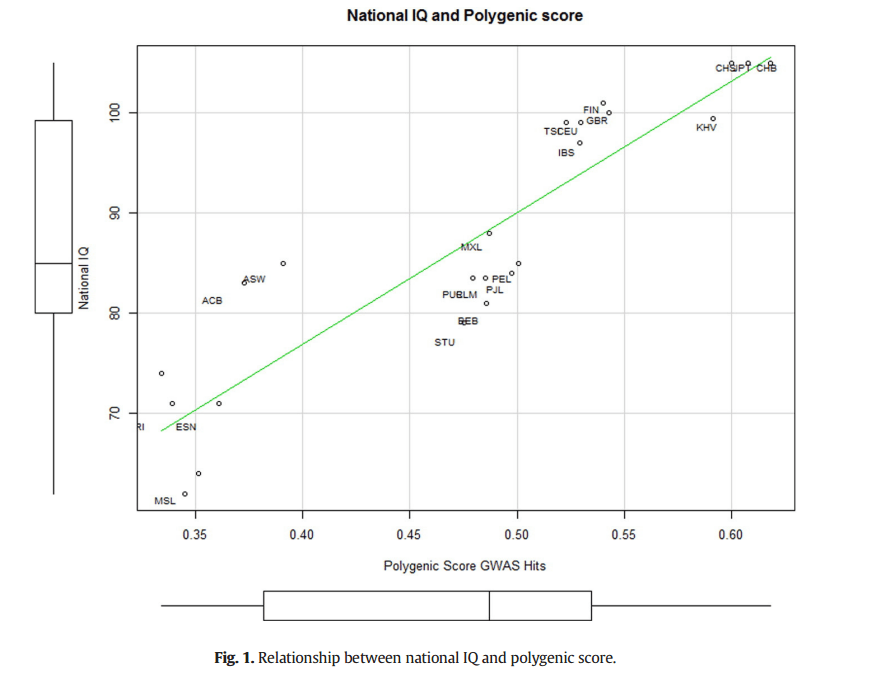
The fact that these differences exist should not come as a shock to those who want to seek the truth, but as seen with how David Piffer didn’t even get consideration for a revision, this shows the bias in science to studies such as this that show racial differences in intelligence exist.
Piffer’s data also corroborates Lynn and Meisenberg’s (2010) finding of a correlation of .907 with measured and estimated IQ. This shows that the differing allele frequencies affect IQ, which then affect a countries GDP, GNP, and over all quality of life.
With a sample with a huge n (over 100,000 subjects) cognitive abilities tests were performed on verbal-numerical reasoning, memory and reaction time (a huge correlate for IQ itself, see Rushton and Jensen, 2005). Davies et al (2016) discovered that there were significant genome-wide SNP based associations in 20 genomic regions, with significant gene-based regions on 46 loci!! Once we find definitive proof that intelligence differences vary between individuals, as well as the loci and genomic regions responsible, we can then move on to difference in allele frequency in depth (which Piffer 2015 was one of the starts to this project).
Moreover, genes that influence intelligence determine how well axons are encased in myelin, which is the fatty insulation that coats our axons, allowing for fast signaling to the brain. Thicker myelin also means faster nerve impulses. The researchers used HARDI to measure water diffusion in the brain. If the water diffuses rapidly in one direction, that shows the brain has very fast connections. Whereas a more broad diffusion would indicate slower signaling, thus lower intelligence. It basically gives us a picture of an individuals mental speed. Thinking of reaction time tests where Asians beat whites who beat blacks, this could possibly show how differing process times between populations manifest itself in reaction time. Since myelin is correlated with fast connections, we can make the inference that Asians have more than whites who have more than blacks, on average. The researchers also say that it’s a long time from now, but we may be able to increase intelligence by manipulating the genes responsible for myelin. This leads me to believe that there must be racial differences in myelin as well, following Rushton’s Rule of Three.
Since the mother’s IQ is the best predictor of the child’s IQ, this should really end the debate on its own. Sure on average, intelligent black mothers would birth intelligent children, but due to regression to the mean, the children would be less intelligent than the mother. JP Rushton also says that regression works in the opposite way. Both blacks and whites who fall below their racial means will have children who regress to the means of 85 and 100 respectively, showing the reality of the genetic mean in IQ between the races.
Why would differing allele frequencies lead to the same cognitive processes in the brain in genetically isolated populations? I’ve shown that brain circuits vary by IQ genes, and populations do differ in this aspect, like all other differing genotypic/phenotypic traits.
East Asians have bigger brains, as shown by MRI studies. Rushton and Rushton (2001) showed that the three races differ in IQ, brain size, and 37 different musculoskeletal traits. We know that West Africans and West African-descended people have genes for fast twitch muscle fibers (Type II) (Nielson and Christenson, 2001). Europeans and East Asians have slow twitch muscle fibers (Type I) for strength and endurance. (East Africans have this as well, which allows for ability to run for distance, which fast twitch fibers do not allow for. The same is true for slow twitch fibers and sprinting events.) Bengt Saltin showed that European distance runners have up to 90 percent slow twitch fibers (see Entine, 2000)! So are genetic IQ differentials really that hard to believe? With all of these differing variables in regards to intelligence that all point to a strong genetic cause for individual differences in other genes that lead to stark phenotypic differences between the races, is it really not plausible that populations differ in intelligence, which is largely inherited?
Is it really plausible that differing populations would be the same cognitvely? That they would have the same capacity for intelligence? Even when evolution occurred in differing climates? The races/ethnicities differ on so many different variables with differing genes being responsible for it. Would IQ genes really be out of the question? Evolution didn’t stop from the neck up. Different populations faced different selection pressures, so different human traits then evolved for better adaption in that environment. Different traits clearly developed in genetically isolated populations that had no gene flow with each other for tens of thousands of years. These differing evolutionary environments for the races put different pressures on them, selecting some for high IQ alleles and others for low IQ alleles.
We are coming to a time where intelligence differences between populations will become an irrefutable fact. With better technology to see how differing genes or sets of genes affect our mind as well as physiology, we will see that most all human differences will come down to differing allele frequencies along with differing gene expression. Following Rushton’s simple rule based on over 60 variables, East Asians will have the most high IQ alleles followed by Europeans and then blacks. The whole battery of different cognitive abilities tests that have been conducted over the past 100 years show us that there are differences, yet we haven’t been able to fully explain it by GWAS and other similar techniques. Charles Murray says within the next 5 to 10 years we will have definitive proof that IQ genes exist. After that, it’s only a matter of time before it comes out that racial differences in IQ are due to differing allele frequency as well as gene expression.
Islam, Suicide Bombings, IQ and Consanguinity
1650 words
A lot of people seem to confuse causes between ‘Islam’ and behavior that’s just ‘low IQ’. Whenever these attacks like shootings, sexual assaults and rapes happen, that’s due to their low IQ; not religion. I wrote about this in IQ, Inbreeding and Clannishness. All of the behavior you see is due to low IQ. 1) being in an area with a hot climate and 2) cousin marriage has been going on there ever since Jews from the Levant introduced it to them around 200 BC. To quote myself:
Those innate behaviors which result in the favoring in all areas of life, themselves and their family, is a result of genetic similarity because of the closely related genes they share (the father’s brother’s daughter type is the most common in the Muslim world). Also, first and second cousin marriages are more common, which also result in increased altruism for their own family because of the close genetic similarity, but also those in their own group, which is mediated by the brain hormone oxytocin.
In a paper on the mean IQ of Muslims and non-Muslim countries, Donald Templer states that the Muslim world, which used to be have great intellectual achievements from the 7th to 12th centuries, has seen an underrepresentation in highly creative contributions in science journals. This is because of the inbreeding effect (2.5 to 10 point drop in IQ) of close cousin marriage. He ends up saying that genetic factors are more important than social/cultural/religious values (back to the inbreeding, causing defects and lowering IQ) in regards to IQ.
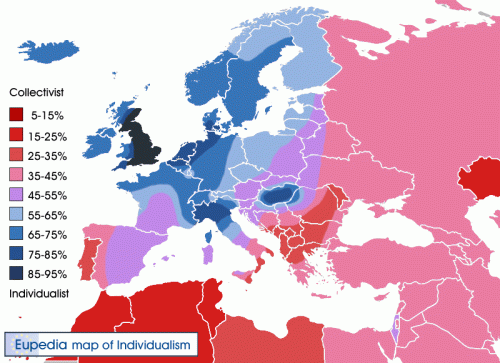
I also put a map of individualism and collectivism in Europe here. You can see that the collectivist countries are fighting back more. The countries/regions where it’s more red roughly matches up to the situation. You can see how in Central, Northern and Northwestern Europe they’re more individualistic, as well as more atheist, than those collectivist countries. So that leads to what we see with this ‘welcome refugees’ signs, as well as, I would assume, more oxytocin in the brain for Europeans, which leads to more altruism towards other peoples. Of course, 1000 years ago, the high altruism was fine due to being a mostly homogeneous society. But when others move in who are not from the area, and who do not have the same biology as you due to certain selection pressures, that’s when the ‘clash of cultures’ commences. Which it’s not really a clash of culture, more like a clash of biology, because 2 groups who shouldn’t live together are being forced to live together.
This also brings me to people who confuse the causality between Islam and blacks. As I said, it’s a low IQ religion (which I have provided enough evidence for my case). So blacks who become Muslim do so because of low IQ. Anything after that doesn’t mean that being a Muslim had them do it. Lets say that Islam never popped up and the same peoples were still there, continuing such close inbreeding, would that be Islam doing it? No. It’s their biology. **
Using environmental factors (Islam, culture) is what leftists do. In my post on behavior not equaling genes plus environment, I showed how people create their own environments based on their own genetics. The environment we put ourselves in is based on our genetics. We can clearly see that Islam is bringing their culture (genetics) to Europe and are incompatible with Europe as well as all Western societies around the world. Due to this, we can see that wherever any population goes, it will be the same from the original place they emigrated from if migration in large enough numbers occurs. A country is only as good as its majority population.
In Non-Western People are Abnormal to Our Societies, I showed how due to differing cultures (genetics), these third-world immigrants coming into our countries cannot readily assimilate due to differing average IQs and other hormones that lead to crime differentials with the native population. Though Arabs are Caucasian, evolving closer to the equator lead to higher levels of testosterone as more exposure to the sun increases vitamin D levels, which is not a vitamin but actually a steroid hormone. These differences in testosterone then lead to more sex attacks with high testosterone combined with low IQ. Lower IQ people are less likely to be virgins than higher IQ people. This shows that higher IQ people have less testosterone and can also hold back urges more than lower IQ people. This then translates over to an increase of sexual assaults by ‘migrants’ to European women. These ‘abnormalities’, though, would be abnormal anywhere. Putting differing cultures (genetics) in a place with a completely different culture will lead to strife due to genetic distance between the two populations.
I wrote in Evolutionary Reasons for Suicide Bombings that Muslims who suicide bomb do so to increase inclusive fitness. The increase in inclusive fitness comes about due to the suicide bomber having no prospects as well as no kids, so he/she is just taking up resources. By committing suicide, they are freeing resources for others who have a better chance to spread their genes. Many suicide bombers come from middle-class backgrounds, which further proves the case for genetic interests being the cause for this. The majority of Al-Qaeda members come from educated, middle-class backgrounds. Even for Palestinian suicide bombers, none of them were poor, uneducated, simple minded nor depressed.
The average IQ for a criminal is 85 adult offenders, 92 for juvenile offenders. What’s the average IQ in the Middle East? 81, around 1.3 SD lower than average, and 4 points lower for chronic adult offenders in America. The lower IQ comes from being more inbred, which then manifests itself in the crime rate. The strife in the middle east can also be traced back to IQ and consanguinity rates in those populations. How inbred a population is predicts IQ as well as how much strife occurs in those populations.
Germany has said they will begin IQ testing their ‘migrants’. If it works well (I highly doubt it will, and if it is, it won’t be implemented well) this could curb some attacks that happen. Since IQ differences between populations are one of the biggest causes for crime differentials (lower IQ is also correlated with higher testosterone) between them, screening for and only allowing high IQ ‘migrants’ in would curb some violent crime and sex attacks if implemented on a wide enough scale. IQ differences between populations are one of the biggest reasons for differences between any population you can think of.
For a comparison, we can use Christian Arabs. Christian Arabs are less inbred than Muslim Arabs, which shows in the amount of terror attacks committed by Christian Arabs, which I can’t find any data for. If anyone has found any, leave a comment. hbdchick then says this about consanguinity between Christian Arabs and Muslim Arabs:
so, the rate of cousin-marriage amongst lebanese christians was 16.5% while the rate for muslims approached double that at 29.6%.
christians married cousins more distant than first cousins at a slightly higher rate than they did first cousins: 8.6% (>1C) versus 7.9% (1C). muslims, on the other hand, favored first cousin marriage: 17.3% (1C) versus 12.3% (>1C). this is a similar pattern found elsewhere in the middle east/arab world. in egypt, for instance, copts tend to marry second cousins while muslims tend to marry first cousins (no, i can’t find the reference!).
there was also more fbd marriage amongst muslims (6.4%) versus christians (3%).
This is directly mirrored in how often we hear about Christian Arab attacks and crime (I haven’t heard of this), showing that consanguinity rates can predict crime rates. Due to this extreme inbreeding, they are more genetically similar, which leads to higher amounts of altruism for their own group, in turn leading to derogation of the out-group. Europeans are, on average, less inbred than Muslims. This is why it’s said that Muslims are incompatible with our societies. They are more clannish and altruistic for their own. Like JP Rushton said, groups will proliferate ideas that are good for their genetic interests.
Even more evidence can be shown with Chechen inbreeding. I can’t find any data on Chechen IQ, so lets use the closest country to Chechnya, which is Georgia with an average of 94. Since inbreeding can depress IQ 2.5 to 10 points, Chechnya’s average IQ should be somewhere around the mid-80s. This shows similarity with the consanguinity rate. hbdchick then concludes:
it’s no wonder, then, that they still engage in blood feuds (just like the albanians). you’d half expect them to build tower houses for protection during clan disputes like the albanians or the maniots.
oh, wait.
Muslim (Arab) populations are incompatible to Western societies due to how inbred they are. Their own societies are built on their genetics, which they then bring to the West and attempt to bring what they’re running from to their new host country.
In conclusion, whenever people say “it’s Islam doing it”, it’s low IQ behavior. Those with lower IQ are more likely to be drawn to Islam. Islam developed after 1300 years after the start of Arab inbreeding. We can draw, from IQ from American criminals, that 85 is the sweet spot for criminality, and since criminality is correlated with low IQ more so than any other variable you can think of. A good example of this is a low IQ person coaxed into committing a crime. It’s an obvious biological difference, the sociopolitical garbage is just that, garbage. The biology drives the politics. Consanguinity rates are one of the biggest factors. You should be concerned with the biology aspect.
Note: When I say “Muslim” I mean Arab. I am also not attempting to “apologize” for terror attacks. I’m simply looking at it through the lens of evolutionary psychology. Most people who read this blog know why Africans act the way they act, and African “migrants” are no different.
How to Use Current Knowledge to Effectively Treat the Symptoms of PWS Patients
2550 words
Abstract
Researchers have tried to manage those with Prader-Willi’s Syndrome for multiple decades. Though they have greatly curbed some of the implications of the disease, there are still numerous ways in which we can better use our knowledge of how the disease manifests in order to better help those suffering from PWS. Looking at research into how the extra chromosome 15 is linked to low IQ; IQ and its relationship to obesity; how the ability to delay gratification leads to obesity; growth hormone treatment to better treat low muscle mass and higher body fat; and finally using reinforcement theory to punish a response, where doing so will greatly diminish the probability of that response occurring again in the future; all of these factors can be used in conjunction to better mitigate problems from the disease. By examining all of these variables and thinking of better ways to handle them, we can then think of other, better ways to manage those with PWS. In doing so, we can better increase the quality of life of those suffering from PWS, as well as have less of a strain on healthcare workers who care for them. With new advances in technology with CRISPR Cas9, we can then edit the genomes and chromosomes of those suffering from this disease.
How to Use Current Knowledge to Effectively Treat and Manage the Symptoms of PWS Patients
How can we use the research on chromosomal differences, research on their IQ differences and their lack of ability to delay gratification that, in turn, would help those individuals with the disease? Seventy percent of PWS cases are attributed to the deletion of chromosome 15 (Ledbetter et al, 1981). Maternal uniparental disomy, which involves receiving an extra chromosome 15 from the mother, is yet another cause of PWS (Wang, 2004).
Whittington, Holland and Webb (2009) found that there was variation between families in deletion of chromosome 15. They found that the PWS and sibling IQ correlation was .3, a modest correlation. What was also noticed was that there were subtype differences which manifested itself in the familial differences in IQ. As they expected, the correlation with normal siblings and those with PWS was .5 in those who suffered from PWS due to unilateral disomy. But in the second subset (the chromosomal deletion subset), the correlation was negative at -0.07. Their research shows great promise in the role of chromosome 15 and IQ. They end up concluding that there needs to be an explanation for the small genetic differences between them. How can we use these differences in IQ to help people with PWS and what does this suggest for other symptoms of their disease?
Kanazawa (2014), reviewed the data on the research between obesity and IQ. What he found was that those studies that concluded that obesity causes lowered intelligence only observed cross-sectional studies. Longitudinal studies that looked into the link between obesity and intelligence found that those who had low IQs since childhood then became obese later in life and that obesity does not lead to low IQ. The average IQ for an individual suffering from PWS is 65 (Butler, Lee and Whitman 2006, p. 13), so that is one reason they have a tendency to be obese. He states that those with IQs below 74 gained 5.19 BMI points, whereas those with IQs over above 126 gained 3.73 BMI points in 22 years, which is a statistically significant difference. Also noted, was that those at age 7 who had IQs above 125 had a 13.5 percent chance of being obese at age 51, whereas those with IQs below 74 at age 7 had a 31.9 percent chance of being obese. This data makes it clear: low IQ is correlated with obesity, so we, therefore, need to find sufficient measures to help those with lower IQs who also suffer from PWS to better maintain their good health. Since we can better identify those PWS individuals who have lower IQs based on how they got the disease, we can then show them more attention in an effort to have them manage their gratification better. Moreover, the lack of ability to delay gratification is also correlated with low IQ (Mischel, Ebbeson, and Zeiss, 1972).
Schlam et al. (2013) observed in a follow-up study to the Marshmallow Experiment that found in a longitudinal study of individuals they found forty years later from the original Marshmallow Experiment, due to inability to delay gratification forty years previously, that was one cause of becoming obese forty years later. Due to PWS sufferers having lower average IQs, and, therefore, a lack of ability to delay their gratification, this is direct evidence that those PWS sufferers with low IQs need more stringent measures to be taken on them, which would then be helpful to those individuals who have a hard time delaying their gratification, which is partially caused by the drop in IQ due to the additional chromosome 15. We can see how those with PWS act; they want their gratification now and do not want to wait for it. This is why, when unsupervised, that those with PWS gorge on the food they understand they should not have, but do so, nevertheless, since their low IQ is correlated with lack of ability to delay gratification, which manifests itself in their obesity. We clearly need to find better methods in which to help those with low ability to delay gratification, which would strongly help those suffering from PWS.
Dykens et al (1997) note that those with PWS have hyperphagia, which correlates with their insatiable want for food. They state that the lack of fullness is due to an altered function of the hypothalamus, which is the part of the brain that is in control of feelings of satiety. Certain States gave restrictions to homes that take care of those with PWS and have come under fire because of this, mainly due to human rights violations. We must ask, then, should we limit their access to food if it will prolong their lives? Will doing so inhibit their freedom to do as they choose? PWS sufferers also have coronary heart problems; one could argue that given their free ability to choose what they want to do unfettered will lead to premature death due to obesity-related complications. Does their disease truly not allow them to learn the consequences of their behavior? Do they have the intellect to really understand the consequences of their actions of consuming too much food? There is no established or known way to control those with insatiable eating habits due to hyperphagia. So would the best course of action to take with those with PWS actually be to constantly monitor them and to lock access to easily attainable food? My answer is yes, however, there is a clear fine line in whether restricting access to food and constantly monitoring those with PWS infringes on their human rights, or that doing so actually will help them live better, healthier lives since they would have the constant supervision around them to better control their out of control eating habits. When negative actions occur, one idea that can be shown to them is constant positive reinforcement so that they may be better able to understand that what they are doing is harmful to their bodies. We can then use positive reinforcement when they do reach a healthy weight, so, in turn, they will have a higher chance of keeping a healthy weight. They may reap the benefits of positive reinforcement, and stick more closely to their program, and therefore, stay healthy.
The hormone ghrelin is secreted from the hypothalamus. With an altered hypothalamus, this would cause ghrelin levels to overload; then the individual suffering from PWS would feel the need to insatiably gorge on food due to this chemical imbalance in the brain. Ghrelin increased feeding in rats and ghrelin is the physiological mediator of feeding and probably has a function in growth regulation by stimulating feeding and release of growth hormone (Nakazato et al, 2001). There is a correlation between want of food, ghrelin release and growth hormone production. By attempting to mediate these variables, those who suffer from PWS will be able to better control their eating habits through positive reinforcement and better, more sustainable habits. Since whenever we eat we get a release of ghrelin that makes us hungry, people pretty much set their own eating times by eating multiple times a day. This affects PWS patients the same way. They can’t stop eating, due in part to constantly eating which constantly releases ghrelin in their body.
PWS sufferers have low muscle tone and, conversely, more body fat. Growth hormones may be a valid way of alleviating that problem, which in turn will give them a slightly higher resting metabolic rate so that they may burn slightly more calories, in an effort to stay healthier. Growth hormone therapy is great for those with PWS though they are largely inactive and lead a sedentary lifestyle, the growth hormone will allow them to have less body fat and more muscle mass. As noted earlier in my paper, those suffering from PWS have altered function in their hypothalamus, which is also where growth hormone is secreted. Aycan and Bas (2014) state that treatment with growth hormones should be strongly considered for those with PWS.
PWS sufferers are also quick to anger, which can be correlated with their sub-average IQ. They may, for instance, become irate at the fact that they do not have constant access to food, and may turn to emotional, angry and infantile outbursts in an attempt to receive what they want. This is one way that it’s tricky to treat those with the disease. How do you tell an individual with PWS who wants something “No”? Measures should be taken to show those with the disease what they are doing to their bodies in the simplest way possible as to better get the point across to them. We can help those sufferers of PWS who are quick to anger with by allowing them to discern between right and wrong ways to handle times when they don’t get what they want with positive reinforcement.
Since those who suffer from PWS have behavioral problems, there are better measures we can take to assure that they don’t have their violent outbursts. When positive reinforcement is consistently shown to an individual who has PWS, he will have more success with his program. When they do something wrong, they can then be shown positive reinforcement, and through being shown positive things with reinforcement theory, they can better learn that certain actions they take are dangerous and shouldn’t be done again, as Rushton (1980) states: “If one rewards a response, it will increase the probability of the future occurrence of that response. If one punishes a response, it will decrease the future probability of the occurrence of that response.” (p. 90).
Discussion
In this paper, I have presented causes for PWS as well as effective ways to manage the disease. To look at how IQ affects individuals in regards to obesity and because it is highly correlated with other measures as well, we can then better help those with the disease. By seeing which individuals have the parental disomy version of PWS, we can then monitor them and give them better care because of their lowered IQ and make sure they stay at a healthy weight. One of the best measures to take is to heavily restrict food, i.e., make sure ability to access food at all hours of the day is restricted along with constant supervision. Though, there are rights groups fighting for them saying that their human rights are being infringed on. In allowing them to have free reign over what, how and when they eat, they will gorge themselves to obesity, as well as lead themselves to horrible complications that come along with increased food consumption. When one is caught consuming food he or she shouldn’t be consuming, punishing them and letting them understand that the behavior they took was wrong will lead to better choices and outcomes from those choices, due in part to the main facet of reinforcement theory, that punishing a response will lead to a reduced outcome in that response that was punished happening in the future. Also, with the advent of CRISPR Cas9, we will be able to edit genomes, and therefore, eventually, put an end to PWS. It will enable us to fix the chromosomal deletion and uniparental disomy, which will eradicate this disease.
Conclusion
There are better, more helpful ways in which to help those suffering from PWS. By identifying and attempting to correct these abnormalities, those who suffer from the disease can, therefore, have a better quality of life due in part to the extra measures taken. By understanding that their lower average IQs lead to a lot of the problems associated with the disease, we can better structure methods for them to keep on a healthy track and reinforce positive behavior through reinforcement theory. Since obesity is correlated highly with low IQ, we can, therefore, use this information to better help those who suffer from PWS that have low IQs. Locking up food instead of providing free access, as well as understanding they do not have the ability to delay gratification, would be a big start to find better ways to treat sufferers of PWS. Treating negative actions with positive reinforcement through reinforcement theory will lead to better and increased prosocial behavior. It’s been shown that if you punish a response, then it will decrease the future probability of that response occurring. The advent of CRISPR Cas9 will then allow us to edit the chromosomes of those with this disease in the future. Should we use genome editing on individuals with this disease, as well as several other chromosomal/genetic diseases? I believe we should, in doing so, we will greatly increase the quality of life of those with the disease.
References
Aycan, Z., & Baş, V. N. (2014). Prader-Willi Syndrome and Growth Hormone Deficiency. Journal of Clinical Research in Pediatric Endocrinology Jcrpe, 62-67.
Butler, M. G., Lee, P. D., & Whitman, B. Y. (2006). Management of Prader-Willi syndrome (3rd ed.). New York: Springer-Verlag.
Dykens, E. M., Goff, B. J., Hodapp, R. M., Davis, L., Devanzo P., Moss, F. . . King, B. (1997). Eating Themselves to Death: Have “Personal Rights” Gone Too Far in Treating People With Prader-Willi Syndrome? Mental Retardation, 35(4), 312-314.
Kanazawa, S. (2014). Intelligence and obesity. Current Opinion in Endocrinology & Diabetes and Obesity, 21(5), 339-344.
Ledbetter, D. H., Riccardi, V. M., Airhart, S. D., Strobel, R. J., Keenan, B. S., & Crawford, J. D. (1981). Deletions of Chromosome 15 as a Cause of the Prader–Willi Syndrome. New England Journal of Medicine N Engl J Med, 304(6), 325-329.
Mischel, W., Ebbesen, E. B., & Zeiss, A. R. (1972). Cognitive and attentional mechanisms in delay of gratification. Journal of Personality and Social Psychology, 21(2), 204-218.
Nakazato, M., Murakami, N., Date, Y, et al (2001). A role for ghrelin in the central regulation of feeding Nature 409, 194-198
Rushton, J. P. (1980). Altruism, socialization, and society. Englewood Cliffs, NJ: Prentice-Hall.
Schlam, T. R., Wilson, N. L., Shoda, Y., Mischel, W., & Ayduk, O. (2013). Preschoolers’ Delay of Gratification Predicts their Body Mass 30 Years Later. The Journal of Pediatrics, 162(1), 90-93.
Whittington, J., Holland, A., & Webb, T. (2009). Relationship between the IQ of people with Prader-Willi syndrome and that of their siblings: Evidence for imprinted gene effects. Journal of Intellectual Disability Research, 53(5), 411-418.
YM Wang, L Chuang, BT Wang, et al. Maternal uniparental disomy in a patient with Prader-Willi syndrome with an additional small inv dup(15) chromosome. J Formos Med Assoc, 103 (2004), pp. 943–947
Even More Evidence for GST: Speed Daters Match on Genotype
850 words
Your success at speed-dating might be influenced by your genetic make-up and your potential partner’s ability to detect so-called ‘good genes.’ The research team found that participants who were more likely to be asked on a second date had genotypes consistent with personal traits that people often desire in a romantic partner.
Coming off of a successful refutation of JayMan (check comments too), more evidence for our claim came out the other day. Us humans can match on genotype, which we, of course, match with people with other similar heritable characteristics. Since humans match on these traits that are more heritable than the ones that are more influenced by environment, then we can say that we are seeking out partners who are like us, therefore matching on genetic similarity.
Wu, et al (2016) examined 262 Asian Americans in a speed-dating setting. The researchers predicted that there would be considerable matching by genotype between the genders. They found that the gene A118G, which is linked to submissiveness and social sensitivity, whereas for the men, the minor variant with the -1438 A/G allele, which is linked to social dominance and leadership, were shown to have greater success. They also discovered that men and women with genotypes consistent with “prevailing gender norms were more likely to receive second date offers”
The researchers say that “These results suggest that personal attributes corresponding to A118G and −1438 A/G can be detected in brief social interactions, and that having a specific genetic variant or not plays a tangible role in dating success,” Those with the A118G polymorphism had greater capacity for experiencing social pleasure and pain as well as their need to have social contact. This also shows how Men and women with the opposite of each allele (men having the A118G allele and women having the -1438 A/G allele) were seen as less desirable mates, showing good evidence that each allele is gender-specific. Wu also believes this effect could also expand to other social interactions, such as job interviews.
This study shows more evidence for Rushton’s theory of spouses matching phenotypically by genotype. Spouses are as similar as 4th cousins. Spousal genetic similarity is a significant driving force for human civilization, as it selected for certain traits over others that then lead to things such as higher IQ in Eurasian men to beauty in Eurasian women, vice versa for Africans. In Eurasian societies, men hunted and while women took care of the children. Higher intelligence then evolved in men due to needing to strategize, among other things such as surviving the frigid temperatures. Women took care of the children, and thus developed a higher verbal IQ as a result of this. In Africa, women gathered food, selecting them for slightly higher intelligence than their male counterparts. Conversely, the African males were selected for attractiveness (Fuerle, 2008).
Those K-selected have lower birth rates, and thus, must be more rigorous in choosing a mate. Choosing a mate based on intelligence showed that the male could provide food as well as protect the family against predators and other bands of humans. R selected humans have more children and show less care, so they have higher birth rates to counter this. They are less rigorous in mate selection due to need to have more children due to a higher death rate. This is mirrored still, even today in modern society. Human sexual selection is one of the reasons why human evolution progressed to the point is has, with the driver being evolution in harsher climates. Eurasian women needed to be more stringent in choosing mates due to a higher chance of death in choosing the wrong mate. Over time, this lead to a ‘genotype sensor’ if you will, which by matching by certain phenotypic traits (facial symmetry, skin color, height, health, etc), chances for intelligent children, better care and more food will come as a result of this stringent selection by women, which in turn lead to evolution of certain traits in Eurasian men and women.
This shows that these human differences in how we select our spouses to how our civilizations ultimately end up is due to a) climate, b) sexual selection and c) genetics. Passing on the best genes lead to an ultimately better society, and as a result, this lead to those genes that were more successful having a chance to produce more copies of themselves, assuring that society would be run well in the future. This is also why government systems such as monarchies have hereditary rulers.
I have said numerous times that the tendency to favor co-ethnics is the tendency to favor shared genes. Benefiting those similar to yourself ensures that you’re benefiting copies of your genes, ensuring your genetic legacy for the future. Matching with those who appear similar to us by genotype when there is such phenotypic similarity shows that this is a trait we humans have to seek out those co-ethnics genetically similar to ourselves.
 NotPoliticallyCorrect