Home » Evolution (Page 9)
Category Archives: Evolution
Evolution is *NOT* Progressive
4200 words
PumpkinPerson still believes that evolution is progressive. What exactly is evolution through natural selection ‘progressing towards’? Some, like PP, may say it’s progressing towards a better organism for that specific environment. However, there is no end game. That organism will still continue to change based on whatever changes in its environment. One of the most common misconceptions about evolution is that it’s progressive. One assumes that by looking at the progression from the earliest forms of life to today, that humans must be at the top of this ‘evolutionary ladder’ so to speak. However, evolution has no end game, nor is it conscious to be able to have humans be at the top of this ‘evolutionary ladder’. I’ll take the last thing that PP said to me on his blog and reply to it here as well.
Evolution can happen in four ways: migration, mutation, genetic drift, and natural selection (NS). Evolution is a non-conscious, non-linear event that occurs to make an organism more fit for its environment. Progressive evolution assumes that it’s linear and so evolution is a straight line from ‘more evolved to less evolved’. Would that make sense? For evolution to be in a straight line? Or would a branching tree make more sense? PP knows this fact, yet still attempts to say that the ‘newest species are the “most evolved”‘. We can take 2 genetically similar organisms and put them into one cold environment and the other a hotter environment. Will one of them be “more evolved” than the other in a few generations? Or does evolution dictate what changes occur and there is no “more evolved” because each organism is suited to its environment?
PP says:
No that’s not the point. If two populations are both descended from a common ancestor, and population A remains more similar to that common ancestor than population B, then population A is less evolved, because it’s done less evolving from the common ancestor. Why can’t you grasp this concept, RR?
I do grasp it, it just makes no sense. Because even that organism that “stayed close to the common ancestor” is still markedly different than the common ancestor.
Actually that’s not true. Humans are close to reaching the point where we no longer evolving in the conventional sense. Any further genetic change will be self-directed, via genetic engineering, and not the product of natural selection and genetic drift. And progress needn’t imply an end point, it only implies more recent forms will on average be more adaptable than life from millions of years ago.
This was in response to me saying that evolution would continue until all organisms die out or the Sun explodes. Even the with the genetic change we bring about ourself with CRISPR, we would still be evolving genetically. Umm progress DOES imply an end point. Progress means progression, what is an organism progressing towards? Being more efficient? No. Progression denotes an end game. There IS NO endgame with evolution. Evolution just happens to increase fitness for an organism and population.
I don’t have any misconceptions when it comes to evolution RR. It’s you who is confused. And I’ve seen Dawkins talk about evolutionary progress. He shows some understanding of the concept, but it’s not complete.
Yes you do have misconceptions when it comes to evolution, PP. There is no way to quantify progress in regards to evolution. You can choose some arbitrary traits, but that’s just our perception of it. You cannot objectively say that one organism is “more evolved” than another based on those traits.
I forgot that Dawkins believes in evolutionary progress. That doesn’t change my mind on this matter. I’m sure that Dawkins of all people knows that each organism is suited for its environment, not perfectly, but good enough. Evolution makes organisms good enough in order to transmit its genes to the next generation. How can you say that there is progress when each organism is fit for its environment? How can you believe in this notion when evolution through NS, migration, mutation and genetic drift make each organism unique in order to survive in its own specialized niche? As I will say below, Darwin’s Finches are the perfect example of how evolution is not progressive. They are fit for each environment. The tree finch has a blunt beak for tearing vegetation, the ground finch has a broad beak for crushing seeds, and Warbler finch’s small beak makes it good for eating insects. Each bird evolved from the same ancestor, each evolved in different ecosystems on the same island, but they evolved to do different things based on what they had to do to survive in that ecosystem. This very simple example shows that evolution is not progressive, and that these mutations occur to better help an organism in that niche in the ecosystem.
Next PP quotes Rushton from Race, Evolution, and Behavior where he says:
In their reviews, Lynn (1996a) and Peters (1995) both referred to my ranking of species on evolutionary scales. For Peters, this was a highly contentious idea but in Lynn’s positive review, he described me as proposing that the K-strategy was “evolutionarily more advanced” and that the Oriental race was “the most evolved.” In fact, I did not use either of these phrases in the book, although I had alluded to similar ideas in previous writing. Regardless, the topic of evolutionary progress provides an intellectual challenge of the first order and needs to be addressed. Figure 10.2 (p. 202) does imply a move from simple r-type animals producing thousands of eggs but providing no parental care to more complex K-type animals producing very few offspring.
In his book Sociobiology (1975), E. O. Wilson also promoted the idea of biological progression, outlining four pinnacles in the history of life on Earth: first, the beginning of life itself in the form of primitive prokaryotes, with no nucleus; then the origin of eukaryotes, with nucleus and mitochondria; next the evolution of large, multicellular organisms, which could evolve complex organs such as eyes and brains; and finally the beginnings of the human mind. (Rushton, 1997: 292-3)
I still don’t see how it’s “progressive and more evolved”. Each organism is suited for its environment to make sure that it breeds and continues its genetic lineage. I see how one could say that newer organisms are “more evolved”, however, each organism is suited for its environment.
You have no idea what you’re talking about. Humans who left Africa 60,000 years ago looked like Andaman islanders who clearly look like modern Africans today. Further, facial reconstructions of the African Eve from 125,000 years ago also looks like modern Africans. The notion that modern looking Africans are only 10,000 years old is INSANE. Did they look EXACTLY like Africans today? No. Were they close enough that no one would think twice if they walked down the street in modern clothing? Yes.
I HAVE NO IDEA WHAT I’M TALKING ABOUT, yet PP thinks that damn reconstructions mean ANYTHING!! Forensic facial reconstruction is one of the most subjective techniques in forensic anthropology. The skin thickness is subjective to the forensic artist, but I’m sure that that means that the facial reconstruction of Mitochondrial Eve is even a close representation of what she actually looked like. The fact of the matter is, facial reconstructions are highly subjective to the individual forensics artist. There is a great example in the link about how facial reconstruction isn’t anywhere near perfect:
A second problem is the lack of a methodological standardization in approximating facial features. A single, official method for reconstructing the face has yet to be recognized. This also presents major setback in facial approximation because facial features like the eyes and nose and individuating characteristics like hairstyle – the features most likely to be recalled by witnesses – lack a standard way of being reconstructed. Recent research on computer-assisted methods, which take advantage of digital image processing, pattern recognition, promises to overcome current limitations in facial reconstruction and linkage.
Keep in mind that PP believes that Australasians are Negroid, despite the fact that I’ve shown him wrong on that time and time again. Phenotype does not always equal genotype. Just because one group is phenotypically similar to another DOES NOT MEAN that they are genetically similar. It’s PP that doesn’t know what he’s talking about.
How is the notion that modern-looking Africans are 10k years old insane? I see PP doesn’t keep up with the latest studies. Is the notion that modern-day Europeans are 6500 years old insane as well?
It shows that there are lineages that become very adaptable despite not being very evolved, and some that don’t need to be adaptable because they lucked into a fixed ecological niche. But generally speaking, across all lineages, more recent forms of life are more adaptable than more ancient forms of life.
This was in response to what I said to him about there being mosses and fungi who’ve stayed pretty similar. This SHOWS that evolution is not progressive. More recent forms of life are more adaptable? You mean that more recent forms of life incurred more mutations to be more adaptable.** Evolution through NS is about being good enough to pass on your genes, that’s it. Whether or not one species is “more evolved” (whatever that means) over another is meaningless as all that’s occurring is genes passing to the next generation. Break down all of these processes to the simplest possible level and this is what we are left with.
Then I cited two links which said:
“There is no ‘progress’ in evolution. No living thing is trying to get anywhere,” Zuk said. “And humans are not at the pinnacle of the evolutionary ladder.”
…
Evolution, she said, is no engineer, building the perfect organism from scratch every time the environment changes. Rather, evolution is the ultimate tinkerer, always having to make do with the parts on hand. Its creations tend to be imperfect, just fit enough to survive.
To which PP replied:
WRONG! Humans are the highest branch within the homo evolutionary tree which is the highest branch within the primate evolutionary tree which is perhaps the highest branch of the mammal evolutionary tree, which is perhaps the highest branch within the animal evolutionary tree etc. This can be seen in phylogenetic diagrams.
PP, it specifically said evolutionary ladder. Phylogenetic diagrams prove that evolution is non-linear and does NOT go in a straight line. Phylogenetic diagrams prove that evolution is a tree and not just a straight line of ‘progress’.
And yet evolution has created the human brain, the most complex known object in the universe.
That doesn’t say anything to the fact that evolution is not an engineer making perfect organisms for their environment. All an organism needs is to be “good enough”. It’s not survival of the fittest as much as survival of the good enough. Sure evolution ‘created’ the human brain. But that doesn’t make evolution, a non-conscious event, an engineer. Why do so many atheists have so much faith in evolution, putting human qualities into it when evolution through natural selection is just a process of making sure that an organism passes its genes on? It is one hundred percent correct that evolution is the “ultimate tinkerer”, making organisms “just fit enough to survive”.
And the other link I cited, which uses Darwin’s finches as an example of the non-linearity of evolution says:
A study of the DNA of Darwin’s finches on the Galapagos Islands (Petren et al. 1999) provides a good example of why the idea of progress makes no sense in evolution. The study’s findings suggest that the first finches to arrive on the islands were the Warbler finches (Certhidea olivacea), whose pointy beaks made them good insect eaters. A number of other finches evolved later from the Warbler finches. One of these is the Geospiza ground finch, whose broad beak is good for crushing seeds, and another is the Camarhynchus tree finch with its blunt beak which is well adapted for tearing vegetation.
..
Even though biologists reject the Great Chain of Being or any similar ladder-of-progress explanation of evolution, the idea still persists in popular culture. A more accurate analogy would be that of a bush that branches in many directions. If we think of evolution over time in this way, we’re less likely to be confused by notions of progress because the branches of a bush can grow in various directions in three dimensions, and new branches can sprout off of older branches without implying that those farther from the trunk are better or more advanced than those closer to the trunk. A more recent branch that has split off from an earlier branch-like a species that has evolved from an ancestral species-does not indicate greater progress or advancement. Rather, it is simply a new and different growth on the bush, or more specifically, a new species that is sufficiently adapted to its environment to survive.
To which PP replied:
The idea of progress makes sense when you look at the grand sweep of evolution across BILLIONS OF YEARS. We’ve gone from simple, restricted life forms that could only survive in the ocean, to complex adaptable GOd-like life-forms like humans, that can live in virtually any environment, and travel to space.
This doesn’t say anything to what was quoted, PP. The fact that Darwin’s Finches each evolved on the same island, yet have completely different phenotypes depending on what they have to do to survive shows that evolution is not progressive and that there is no “more evolved” life form, just life forms surviving. Love how you sidestepped that quote.
This is the same tired nonsense. In evolution, almost every time one branch splits into two, it means evolutionary growth has occurred. So if you’re the first branch, and you don’t do anymore branching, you’re less evolved, and typically less complex and versatile than branches that split off after much branching occurred.
Yes PP. Keep repeating the “if you’re the first branch and you don’t do any more branching than you’re less evolved” canard. PP is confusing “more evolved” for more complex.
Let me repeat this quote again because it’s perfect for this discussion:
If we think of evolution over time in this way, we’re less likely to be confused by notions of progress because the branches of a bush can grow in various directions in three dimensions, and new branches can sprout off of older branches without implying that those farther from the trunk are better or more advanced than those closer to the trunk.
But I’M the one who doesn’t get it. Just because changes occur to make new species does not mean that the common ancestor is “less evolved”, it just means that there were different selection pressures that forced these changes to happen!! That’s it!
Just because your teacher told you something years ago doesn’t make it true, PP. It doesn’t mean that your teacher “got it” while everyone else is blinded to the fact of “organisms being more evolved than others”.
Level 1: People who don’t believe in evolution
Level 2: People who think evolution is progressive because they don’t understand the random nature of natural selection (most secular non-scientists fit in this category)
Level 3: People who think evolution is NOT progressive because they understand natural selection is random and geared to specific environments(most scientists and science writers and bloggers fit in this category)
Level 4: People who realize that even random processes will eventually show progress through billions of years of trial and error, and no environment is 100% specific (many of the greatest minds in history reached this stage: E.O. Wilson, Darwin, Rushton)
You’re stuck on Level 3, RR, and so are all the people you quote. I hope your mind can one day make the leap to Level 4.
This is hilarious. The fact that NS is random SHOWS that evolution is not progressive. PP may say “over billions of years through trial and error it made ‘more evolved’ organisms”. I love how PP’s speculations are the final word and what I say and who I quote are conveniently a level below his little hierarchy.
On PP’s “Level 4”:
NS, migration, mutation and genetic drift are how organisms evolve. Changing the mix of the 4 will lead to different outcomes each time. What PP is trying to say here is that I’m conveniently below the level that he’s at because he recognizes evolution as being “progressive” “progressing to be the ultimate organism in that environment”.
On the non-linearity of evolution:
“The idea of sharing a common ancestor leads to the second major misunderstanding inherent in the question,” says Dr Willis, “that evolution is a linear process where one species evolves into another.”
Evolution is really a branching process where one species can give rise to two or more species.
“The fallacy of linear evolution is most clearly illustrated by the analogy of asking; how can I share common grandparents with my cousins if my cousins and my grandparents are still alive?,” says Dr Willis.
“The answer is of course that your grandparents had more than one child and they each went off and started their own families creating new branches of your own family tree.”
The same thing happens in evolutionary families. A species can split into two or more descendant species and they can split again and again across the generations.
But PP would say that the organism who branched into the new one that stayed the same is “less evolved” than the other, when the only difference is that the newer organism faced different pressures which led to different changes!
Let me repeat: evolution is not progressive. Each organism is suited for its environment so that it can pass its genetic code to the next generation. Even an earlier organism is not “less evolved” than one that came after it, because it still has to survive in that ecosystem. The process of evolution leads to a branching pattern of relationships amongst similar organisms.
Ever since Aristotle, people have had an inclination to rank living things in a single dimension of “lower to higher” or “primitive to advanced”. Such rankings have a name, “the Great Chain of Being” or “the Ladder of Life”. But such rankings have no basis in evolutionary biology. All living organisms occupy equivalent positions on the tips of the latest twigs in phylogeny. The “lowliest” worm or microbe is just as “advanced” (i.e., has been just as successful at adaptation and reproduction throughout its lineage) as is the ‘highest” primate or social insect. “Progress” was an essential feature of some pre-Darwinian evolutionary theories, notably Lamarck’s believe in evolution driven by inward striving toward improvement. But modern evolutionary theory supports no clear expectation of progress, at least not in any dimension that has yet been explored.
Isn’t there an obvious sense in which evolution MUST be progressive? Doesn’t natural selection assure that species are always becoming better adapted, so that degree of adaptedness must be increasing over time? Doesn’t the fossil record document continuing advancement toward improved design and complexity? Doesn’t the process of adaptative radiation (continuing speciation with adaptation) guarantee that the ecological world will be ever more precisely subdivided into niches occupied by ever-increasing numbers of species?
In short, no. No one has yet demonstrated any measureable parameter that shows a consistent, reliable increase over time as evolution proceeds. This is an important point. Belief that evolution is always necessarily “improving” something can interfere with clear appreciation of the actual mechanism of evolution, which is simply the replacement of one heritable variant by another because, in specific conditions which include the presence of both variants, one does better than the other.
Concepts and Questions in Evolutionary Biology. Is evolution progressive?
As I keep saying to PP, each organism is fit for its environment. You can use some arbitrary things to say “this more evolved than that”, but evolutionarily speaking it doesn’t make sense, as I keep saying, because each organism is perfectly suited to its environment.
Yes, bacteria is simpler than a hawk, but that doesn’t mean that it’s any less adapted to its environment than a hawk is.
Evolution arises from mutation, genetic drift, migration and finally natural selection. This leads to large random variations amongst individual organisms. Natural selection then acts upon those random variations and over time this leads to differences between organisms which lead to them eventually becoming different species. How one can then make the leap in logic to say that evolution is progressive due to that is beyond me.
We only ASSUME that evolution is progressive because we look at traits that have been selected for and we don’t look at the traits that have been made negative due to the positive selection. Another point that PP likes to bring up is that the increasing complexity and increase in brain size shows how it’s progressive. However, our brains are shrinking. So if evolution was ONLY PROGRESS, why is the “most complex thing in the known universe” getting smaller? And with a decrease in brain size comes a decrease in intelligence. Such progress PP!!! Evolutions has no direction so it CANNOT be progressive. Most people want to assume that evolution is linear and thusly we were here BECAUSE we’d have been here regardless of what happened. This is not true. The fact of the matter is, evolution is a random process. The only reason there is a belief that evolution is progressive is because we strive to make meaning in everything in our lives even when there is nothing there.
Now with the thought that evolution is progressive, comes the thought of more evolved and less evolved races. As I have shown early in this article, Rushton believed that Mongoloids were “more evolved” because they came last. This then assumes that Africans are “less evolved” because they came first. This, however, makes no evolutionary sense. I love Rushton and all he did to bring racial differences to the mainstream, but evolutionary biologist he was not. The assumption here is that East Asians and Caucasians are the newest races, and thusly would have to be more advanced than the Africans. However, these notions are baseless. They are extremely subjective and one cannot say that one race is “more evolved” or “more superior” than another.
As the story is untangled, it will also become obvious how inappropriate it is to talk in terms of the “inferiority” or “superiority” of groups. Consider, for example, the Big Five personality traits: openness, conscientiousness, extraversion, agreeableness and neuroticism. What are the ideal points on these continua? They will differ depending on whether you’re looking for the paragon of, say, a parent or an entrepreneur.
Nicholas Wade says:
From an evolutionary perspective, African populations were just as well adapted to their environment as were those of Europe and Asia to theirs. Small. loosely organized populations were the appropriate response to the difficult conditions of the African continent. But they were not necessarily well suited to high efficiency economies to which European and East Asian populations had become adapted. From this perspective, if valid, it would be unsurprising that African countries should take longer to make the transition into modern economies. (Wade, 2015: 181-2)
And finally I asked Razib Khan what he thought about this back in August. He said:
people who talk in those terms about population genetics are inferior and less evolved. sabine’s statement in my other posts applies: you’re not a serious thinker and label yourself as stupid or ignorant.
This notion of “superiority” when discussing human races, or even organisms as a whole is baseless. When looking at subjective traits then we can say that. BUT objectively, there is no way to quantify this.
Some people in the HBD-sphere, as well as the Alt-right, may say that Eurasians are ‘superior’ to Africans. On what traits? Because looking at a completely different set of traits would have you come to the opposite conclusion. Like with r/K Selection Theory (now known as the CLASH model). People assume that Africans and others who live nearer to the equator are inferior due to how many children they conceive. However, from an evolutionary perspective, the ultimate measure of human success is not production, but reproduction (van den Berghe, 1981). When that single variable is looked at, they are “more evolved” and if PP were to be believed, evolution is going backward for Eurasians since they have fewer children than Africans.
In sum, evolution is NOT progressive. Mutation, migration, and genetic drift set the stage for differences between organisms, then natural selection selects for those advantageous alleles which then get passed on to the next generation. This notion of progressive evolution is ridiculous. Evolution is a branching tree, not a straight line as is commonly thought. Progressive evolution assumes that we are progressing towards something. This is not the case. Evolution just happens, it’s not attempting to “progress” anywhere as these differences between organisms just happen and thusly you cannot say that one organism is “more evolved” than another nor can you say that this organism showed more “evolutionary progress” over another as changes are random.
More Thoughts on Bipedalism
1050 words
I wrote about bipedalism last week, however, in a conversation with a commented on PumpkinPerson’s blog, I came to a slightly different conclusion than I did in my previous article on the matter.
I quoted Daniel Liberman, author of the book The Story of the Human Body: Evolution, Health, and Disease:
As one might expect, other selective pressures are hypothesized to have favored bipedalism in the first hominins. Additional suggested advantages of being upright include improved abilities to make and use tools, to see over tall grass, to wade across streams, and even to swim. None of these hypotheses bear up under scrutiny. The oldest stone tools appear millions of years after bipedalism evolved.(Lieberman, 2013: 43)
However, after being linked to this journal article Shallow-water habitats as sources of fallback foods for hominins, I began to rethink my position on this matter.
Now, the climate change when humans and chimps diverged is still the primary cause of bipedalism, but after reading this abstract, I came to think that the climate change (getting warmer) rose the sea levels which then drove Man to walk on two legs, gather food, and, eventually, wade in water to find more food which led to some selection for bipedalism in our ancestors. Humans needed to become bipedal to find more food as the climate change made their primary food more scarce. This then drove early Man into shallow waters to look for food.
As the climate was getting warmer, the same foodstuffs we ate were not as readily available. So what drove us to be bipedal was 1) the need for immediate food, i.e., looking for food on the forest floors and 2) when adequate food could not be found on the floors of the forests, Man then had to go into the water. This had multiple advantages. One could escape from predators, find more food with adequate nutrients which, in turn, had as evolve bigger brains, and the most important aspect, it’s much easier to be bipedal in water as it’s easier to stand in water.
This paper, The evolution of the upright posture and gait—a review and a new synthesis, concludes:
Wading was an appropriate trigger not only to stand up but also forced the primate to walk on. It seems likely that habitual bipedalism began not long after the separation from the gorilla and chimpanzee clade(s). From that time onwards, throwing could be evolved with free upper extremities much more successfully than before. Selective factors related to the reduction of incoming solar radiation became effective. Endurance running and adaptations to carry tools (like weapons) started their evolutionary improvements. If these processes took about 4 Ma, the wading hypothesis is consistent with a rather perfect bipedal anatomy as shown, e.g., in Homo ergaster (WT 15000), about 1.6 Ma ago. In this way, many of the hypotheses competing in the past may be harmonised, as some of them have yielded important contributions to the understanding of the evolution of the human habitual upright gait.
The first sentence corroborates what Lieberman says in The Story of the Human Body. The final sentence brings together all of the theories that drove bipedalism in humans into a ‘new synthesis’.
Now, climate change (the earth getting warmer) is still the ultimate cause, but a proximate cause of bipedalism is wading in the water to 1) find more food and 2) escape predators.
This ‘new synthesis’ of how Man became bipedal is a great way to unify a lot of theories of bipedalism that gave us great understanding of human evolution in regards to bipedalism. In that vain, it’s like E.O. Wilson’s Sociobiology: A New Synthesis in which he sought to unify the evolutionary mechanics of altruism, aggression, and nurturance– our main social behaviors. This ‘new synthesis’ in the study of how we became bipedal unifies competing theories into a more understandable theory.
Moreover, bipedalism made it easier to consume more kcal which led to bigger brains. To quote Suzana Herculano-Houzel from her book The Human Advantage: A New Understanding of How Our Brain Became Remarkable:
“The remaining way to work around an energetic constraint to the number of neurons in the brain involves dietary changes that would allow for more calories to be obtained in the same amount of time, or even less. Some first changes in that direction probably took place 4 million years ago when our australopithecine ancestors stood upright and became habitual bipeds. As Daniel Lieberman explores in detail in The Story of the Human Body, bipedality potentially increases the amount of calories that can be amassed in a day by extending the range of food picking, for it is much easier and costs four times fewer kilocalories to walk on two feet, as humans do, than on all fours, as modern great apes do and the ancestor from which australopithecines originated must have done. Roaming away from home to find food, is the definition of a food gatherer, as opposed to a food picker, which is what great apes remain to this day. Bipedality made food gatherers of our ancestors.” (Herculano-Houzel, 2016: 189)
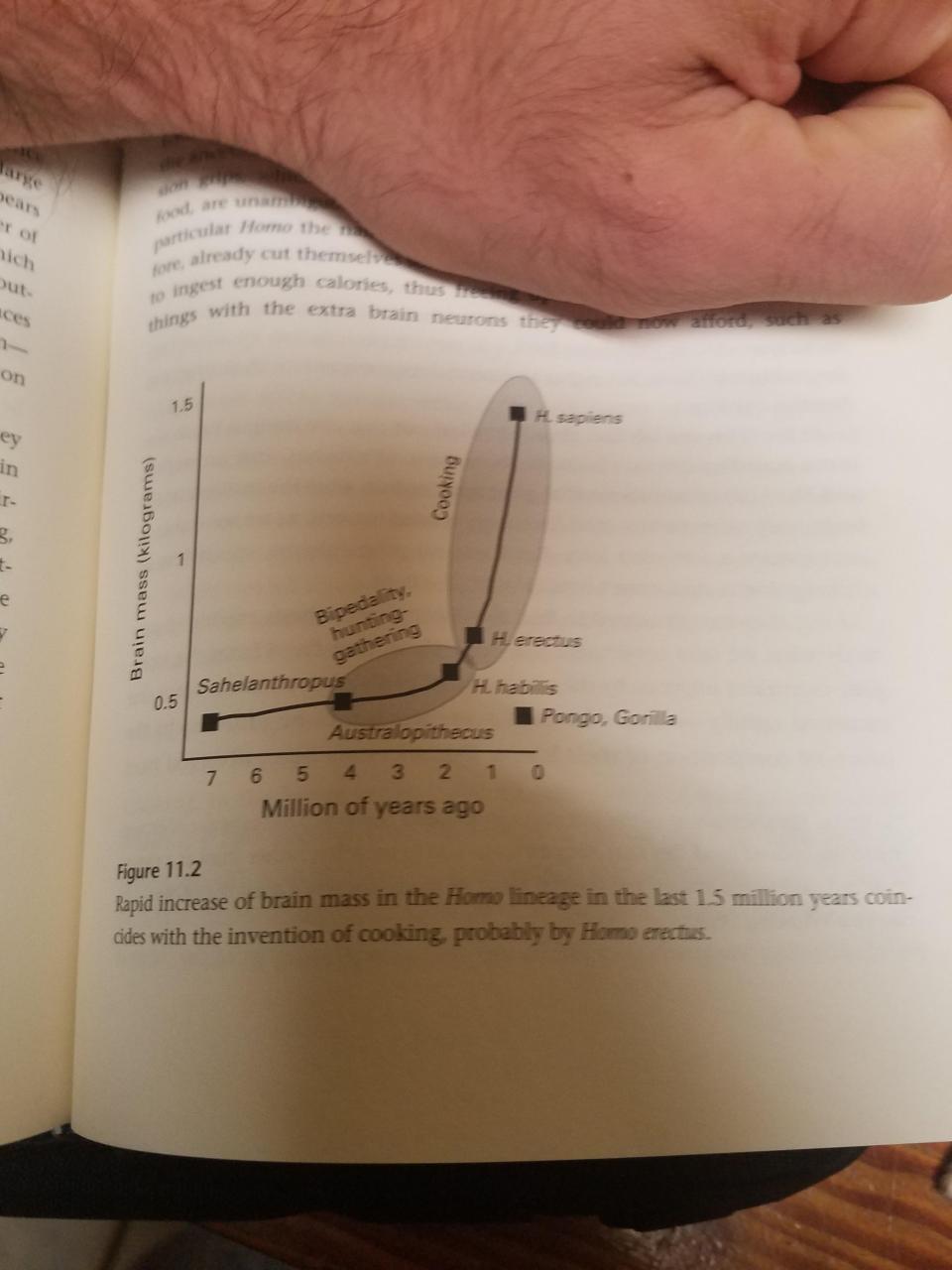
This graph from her book shows that bipedality preceded cooking which increased our brain size (I will write on that soon).
More neurons in the cerebral cortex is the cause for our amazing brains. But we are NOT unique!! This kcal increase led to more neurons in our cerebral cortex which then allowed for reasoning, finding patterns, developing technology and passing it on through culture. Cooking is why we are so ‘unique’ in comparison to other animals. As shown in the graph above, the increase in brain size happened around the time of H. Erectus. They show smaller teeth at that period, which shows that the selection was already occurring. The smaller teeth to break down food more to extract nutrients from the food they gathered shows that bipedalism evolved alongside the evolution of smaller teeth.
In sum, the ultimate cause of bipedality is still climate change, but the proximate cause, in part, was wading in the water which led to our ancestors to find more food. And, over time, we were selected for bipedalism as I wrote in my previous article on the matter. We can see that bipedalism slightly predated cooking, which the ultimate cause of which was to find more food. This is seen in the records we have. I will write more on this in the future as I read into this more.
The Rise of Bipedalism
1350 words
What caused the rise of bipedalism? The need for food? Tools? Advantage of seeing over tall grass? There are many posited reasons why bipedalism evolved in humans, but there’s no way to really know how this occurred. However, we can infer what caused bipedalism from what was occurring around the time that humans and chimps split.
There is no way for us to know exactly how and why bipedalism evolved in humans, but we can make inferences based on what we know was occurring around the time that humans and chimpanzees split. At that time, there was a major climate shift occurring. To better understand how the rise of bipedalism occurred, we have to have a better understanding of the elusive Last Common Ancestor (LCA) between humans and apes.
Since the elusive LCA lived in an African rainforest as Darwin inferred, all traces of the LCA probably rotted away on the forest floor. Since gorillas and chimps walk on their knuckles, the LCA of chimps and gorillas must have knuckle-walked as well (Lieberman, 2013: 36). So the LCA of the two must have been similar to them. Using this same logic, we can say the same about the human/chimpanzee LCA.
Looking at chimps and gorillas when they walk on two legs, you can see that they lurch forward, while humans don’t do so. When you look at how chimps walk, for instance, they have their legs far apart and their body sways from side-to-side like a drunk human. Conversely, when a human walks, they imperceptibly sway their torsos meaning we can expend more energy moving forward than stabilizing the upper body. The large bone that makes up the pelvis, the illium, is tall and faces backward in apes but sideways in humans. This was crucial for the rise of bipedalism in humans as it allowed the small gluteal muscles on the side of the hip to stabilize the upper body over each leg while walking when only one leg is on the ground.
Of course another important adaption for bipedal walking is an S-shaped spine.Apes, like other quadrupeds, have spines that slightly curve forward, so when standing upright, their bodies tilt naturally forward. Due to this, when standing upright, an apes’ torso is positioned unstably in front of its hips. In contrast to an apes’ spine, human spines have two pairs of curves. The lower curve in the lumbar is made possible by having more vertebrae than apes (5 for humans, 3 or 4 for apes). Several of these vertebrae have a wedge shape in which the top and bottom surfaces are not parallel. Just like architects use wedge-shaped stones to make arches, the wedge-shaped vertebrae curve the lower spine inward above the pelvis positioning the torso stably above the hips. Human chest and neck vertebrae make another softer curve at the top of the spine which orients the head downward.
The final skeletal difference that allowed for bipedalism is the human feet. As we walk, we land first on the heel then as the rest of the foot makes contact with the ground we stiffen the foot’s arch which enables us to push the body upward and forward mostly with the big toe. The shape of our feet is due to the shape of the foot’s bones as well as numerous bones and ligaments that secure the bones in place.
Since it’s impossible to know exactly what selected for bipedalism, we have to make inferences. But most evidence supports the idea that regularly standing upright and walking made it easier for early humans to find food more effectively due to the scarcity of food due to the climate shift that was occurring at the time that humans and chimps diverged (Lieberman, 2013: 40).
We don’t know what the LCA looked like nor how it lived or moved, but by making inferences to what we know, we can say that it was big. The LCA probably was most likely a fruit eater as well. So some walking on two legs would help it find food better.
Another reason why bipedalism got selected for was because walking on two legs conserved energy while traveling. The LCA most likely walked on its knuckles which expends more energy. Human walking conserves 75 percent more energy than walking on all fours. (Lieberman, 2013: 42) Basically, we could walk further with using less energy. I don’t even need to say what that means.
As one might expect, other selective pressures are hypothesized to have favored bipedalism in the first hominins. Additional suggested advantages of being upright include improved abilities to make and use tools, to see over tall grass, to wade across streams, and even to swim. None of these hypotheses bear up under scrutiny. The oldest stone tools appear millions of years after bipedalism evolved.(Lieberman, 2013: 43)
The best evidence we have suggests that bipedalism evolved during the climate change so early hominins could acquire ‘fallback foods’ like fibrous plant roots and the like. At the time of the climate change as chimps and humans split, food became harder to find and so early Man needed to subsist on fibrous plant roots. Smaller canines were critical here, and this is seen in the dental records we have from this time.
Stone tools appear millions of years after bipedalism evolved. Bipedalism evolved, in my opinion, as a postural adaptation as well as to better find these ‘fallback foods’ when early Man couldn’t eat his regular diet.
Bipedalism didn’t occur to get us on our feet to free our hands. Rather, it occurred so we could forage more efficiently and expend less energy as bipedal walking expends 75 percent more energy than knuckle walking (as the LCA is thought to have walked).
Consider lumbar regions. In any population of chimps, you’d find that about half of them have three lumbar vertebrae, the other half have four, and a very tiny number have five, thanks to heritable genetic variations. If having five lumbar vertebrae gave some apes a few million years ago a slight advantage when standing and walking, they would have been more likely to pass that variation off to their offspring. The same selective processes must have applied to other features that must have improved the LCA’s ability to be bipedal, such as how wedged its lumbar vetebrae were, the orientation of its hips , and the stiffness of its feet (Lieberman, 2013: 45).
A drawback of becoming bipedal is coping with pregnancy. As any pregnant woman tells you, the further she is in her term, the harder it becomes to stand upright. This requires the mother to contract her back muscles more or lean backward, which shifts her center of mass back over her hips. Though this pose saves energy, it places extra stress on the lumbar vertebrae of the lower back as the vertebrae attempt to slide away from one another. Thus, back pain is common in mothers. However, we can see how natural selection helped human mothers by increasing the number of wedged vertebrae, over which women arch their lower spines: three in females versus two in males (Lieberman, 2013: 46). The extra curving from the vertebrae reduces the sheer force on the spine.
Another disadvantage of becoming bipedal is speed. According to Lieberman, early humans’ inability to gallop limited our early ancestors to being about half as fast as a typical ape when sprinting (Lieberman, 2013: 46). Two limbs are also much less stable than four which makes it harder to make sharp turns when running. Another thing that bipedalism hindered was climbing up trees. It’s much easier and faster to climb up trees as a quadruped than biped. Becoming bipedal also lead to the ailments we have today such as ankle, back, and knee problems.
We can never really know exactly how and why bipedalism evolved. However, we have enough information on how ancient human ancestors lived and walked to make inferences on how and why bipedalism evolved. With a basic understanding of kinesiology, one can begin to know how and why bipedalism evolved in humans. Clearly, it was way more advantageous for our early ancestors to become bipeds than stay quadrapeds.
Ethnic Differences in Sleep, Obesity, and Metabolic Syndromes
2300 words
Ethnic differences in the prevalence of obesity occur, majorly in part due to differences in the rates of metabolic syndrome (which is actually a few variables including high blood pressure, high blood sugar which leads to insulin resistance, excess visceral fat around the waist which is the ‘skinny fat‘ phenomenon, and abnormal blood pressure levels) and obesity. Ethnic differences in these variables do, in part, show how the three ethnies differ in rates of obesity. I will discuss the differences between each ethny in regards to metabolic syndrome and sleep and how it leads to the differences in ethnic obesity rates.
Sleep Differences
There is a ‘missing hour of sleep‘ when comparing blacks and whites. On average, blacks get 6.05 hours of sleep while whites get 6.85 hours of sleep. Of course, the same old racism argument comes up, which, if one ‘percieves’ discrimination, I wouldn’t doubt that it would have an effect on sleep due to a rise in cortisol, which affects sleep due to the raised levels making you restless and not able to fall asleep. Insulin levels then rise due to the rise in cortisol, which is the cause of obesity.
Some studies may try to say that racism and other forms of discrimination are a factor, without even thinking of genetic factors. Another study that Frost cites says that duration of deep sleep and duration of stage 2 (light sleep) is correlated correlated in African Americans with perceived discrimination. The authors defined ‘perceived discrimination’ as the extent to which one believes that their ethnic group have been discriminated against by society. Still even when controlling for discrimination, there were still marked differences between blacks and whites and how long they slept.
Frost then talks about how sleep patterns are heritable and cites studies done on Africans in Africa. One study found that there was an hour sleep difference between Ghanaians and Norwegians on the week days and between a quarter to half hour less on weekends. He shows another study showing that Nigerian college students sleep 6.2 hours a day while getting 70-minute naps in the afternoon.
Frost concludes that the African sleep patterns is normal on Africa. Africans are more active during the cooler times of the day and sleep during the bitter periods. Frost says those who evolved in more northerly climes are particularly adapted to a certain sleep pattern with the same holding true for Africans.
However, these sleep patterns in first world countries have negative effects on metabolism and rates of obesity.
Here are some more studies showing that blacks sleep less than whites:
The sleep of African Americans: a comparative review: The researchers found that blacks take longer to fall asleep than whites, report poorer sleep quality, have more light and less deep sleep, and nap more often and longer. This is a huge recipe for risk factors for obesity, and it shows in their demographics.
Unfair Treatment is associated with Poor Sleep in African American and Caucasian Adults: Pittsburgh SleepSCORE Project: This is one of the studies spoken about above that show that discrimination leads to less sleep. Though, it holds for both black and white adults. The researchers conclude:
Taken together, the confluence of perceived unfair treatment as a chronic stressor and poor sleep and the interplay between the two may have critical roles in long-term health problems.
African Genetic Ancestry is Associated with Sleep Depth in Older African Americans: The researchers hypothesized that “racial differences in sleep phenotypes would show an association with objectively measured individual genetic ancestry in AAs.” They conclude that the slow wave sleep may have genetic underpinnings.
Mexican Americans sleep less than do Mexican immigrants. US-born Mexicans are 40 percent more likely to be short sleepers. This is attenuated by environmental factors such as smoking and stress, which shorten the duration of sleep (smoking decreases the Body Set Weight, whereas cortisol along with insulin in tandem increase it).
Also, in this study by Roane et al (2014) looked at the link between sleep disturbances and stress in Mexican Americans (average age 55) and non-‘Hispanic’ whites (average age 66). Mexicans reported higher levels of sleep disturbance (25 percent) compared to whites (17 percent). They conclude that disturbed sleep was positively correlated with depression.
So both blacks and Mexicans sleep less than whites. These differences in sleep between these three ethnies also affect the prevalence of obesity in these populations.
Obesity and Sleep
It’s long been known that poor sleep habits make people fat. This is due to the effects of insulin and cortisol. Increased insulin comes before increased cortisol–increased insulin is the cause for obesity. Sleeping less is linked to obesity. Since, as described above, the three ethnies differ in sleep patterns, the same also holds true for obesity rates (Ogden at al, 2014). The trends are as follows: 67.3% for whites, 75.6% for blacks, and 77.9% for Hispanics. Though, sleep is only one factor involved with obesity.
Getting adequate sleep is extremely important. Not doing so can lead to a myriad of negative health implications:
Sleep is an important modulator of neuroendocrine function and glucose metabolism and sleep loss has been shown to result in metabolic and endocrine alterations, including decreased glucose tolerance, decreased insulin sensitivity, increased evening concentrations of cortisol, increased levels of ghrelin, decreased levels of leptin, and increased hunger and appetite. Recent epidemiological and laboratory evidence confirm previous findings of an association between sleep loss and increased risk of obesity.
So a lack of sleep leads to an increase in ghrelin levels, decreased levels of leptin (the same effects as caloric restriction over time), increased appetite and hunger, increased evening cortisol (which insulin spikes then follow), decreased insulin sensitivity (the cortisol brings it back up and most people are insulin resistant independent of diet), decreased glucose tolerance, etc. We can see that these ethnic differences in sleep, which are partly genetic in nature, can and would have great effects on metabolism, contributing to the ethnic differences in obesity rates.
And from Harvard:
For example, in the Nurses’ Health Study, researchers followed roughly 60,000 women for 16 years, asking them about their weight, sleep habits, diet, and other aspects of their lifestyle. (2) At the start of the study, all of the women were healthy, and none were obese; 16 years later,women who slept 5 hours or less per night had a 15 percent higher risk of becoming obese, compared to women who slept 7 hours per night. Short sleepers also had 30 percent higher risk of gaining 30 pounds over the course of the study, compared to women who got 7 hours of sleep per night.
Damn!! This, pretty much, mirrors the black-white difference. I’d love to see a racial breakdown of this cohort and will keep an eye out for one, but in the meantime, those who were short sleepers had a 30 percent higher risk of gaining 30 pounds over the course of the study in comparison to women who got 7 hours of sleep per night. Blacks are the most likely group to be overweight and obese in the US, and this data from the Nurses Health Study (which tons of data can be drawn from this study) shows one reason why, however the driver is cortisol > insulin > processed carbs > increased insulin > insulin resistance > increased insulin > vicious cycle > obesity. These differences in sleep almost perfectly mirror the ethnic differences in obesity.
There are several possible ways that sleep deprivation could increase the chances of becoming obese. (1) Sleep-deprived people may be too tired to exercise, decreasing the “calories burned” side of the weight-change equation. Or people who don’t get enough sleep may take in more calories than those who do, simply because they are awake longer and have more opportunities to eat; lack of sleep also disrupts the balance of key hormones that control appetite, so sleep-deprived people may be hungrier than those who get enough rest each night.
Ah the old ‘exercise to increase the Calories Out part of the equation’. however, Calories Out does not stay constant. This also rebuts the ‘Eat Less and Move More’ CICO (Calories In/Calories Out) model of obesity, showing that because it doesn’t take insulin into account, it’s doomed to fail.
Speaking of insulin, it’s about time I focused on metabolic syndrome.
Metabolic Syndrome
As I discussed in a previous post, Race, Obesity, Poverty, and IQ, metabolic differences exist between race/ethnicity. ‘Hispanics’ metabolize carbohydrates differently, blacks have a lower fiber intake (increased fiber protects against obesity, another correlate) while whites have a more high fat diet. Contrary to popular belief, dietary fat doesn’t make you fat as it’s the macro that spikes your insulin the least.
Diaz et al (2005) showed that minority populations are more likely to be affected by diabetes mellitus which may be due to less healthy diets and/or genetic factors. Using the National Health and Nutrition Survey for 1999-2000, they analyzed overweight, healthy adults, calculating dietary intake variables and insulin sensitivity by ethnicity. They characterized insulin resistance with fasted insulin, as those who are more likely to become insulin resistant have higher fasted insulin levels (levels taken after waking, with the subject being told not to eat the night before as to get a better reading of fasted insulin levels). Non-‘Hispanic’ whites had higher energy and fat intake while ‘Hispanics’ had higher carb intake with blacks having lower fiber intake. Blacks and ‘Hispanics’ were more likely to have lower insulin sensitivity. However, ‘Hispanics’ were more likely to have lower insulin sensitivity even after controlling for diet, showing that metabolic differences exist between ethnicities that affect carbohydrate metabolism which leads to higher rates of diabetes in those populations.
In ‘Hispanics’, several loci were discovered that play a role in hepatic (relating to the liver) fat content. Along with showing that ‘Hispanics’ have lower insulin (which due to low insulin, blood glucose builds up in the blood stream leading to diabetes) and showing that they metabolize glucose in the liver differently due to differing loci leading to more cases of fatty liver, this shows how and why ‘Hispanics’ have higher rates of Type II Diabetes Mellitus (TIIDM).
Since TIIDM affects Mexican Americans more, better measures to address their differences in carbohydrate metabolism need to be taken. Racial and ethnic differences in TIIDM are as follows:
7.6% of non-Hispanic whites
9.0% of Asian Americans
12.8% of Hispanics
13.2% of non-Hispanic blacks
15.9% of American Indians/Alaskan Natives
Whites eat a higher fat diet, which means a decrease in carbs. Asians eat white rice which spikes blood glucose eliciting a high insulin response leading to TIIDM, ‘Hispanics’, non-‘Hispanic’ blacks, and Indians and Alaskan Natives (I wish they separated Indians and Alaskan Natives as I’m almost positive that Alaskan natives have a lower rate) all eat high carb, low fat, low protein diets. Carbohydrates are a main staple, and since they spike insulin the most, they are the cause for obesity and TIIDM rates in these populations.
Turning my attention over to metabolic syndrome and blacks and whites, we can see that black women with PCOS have an increased risk for cardiovascular disease and metabolic syndrome in comparison to white women with PCOS. The researchers say that after controlling for age and body mass index (BMI) “black women with PCOS had a significantly increased prevalence of low high-density lipoprotein and high glucose. The general CVD risk was significantly increased in black adults with PCOS.” Though, a longitudinal study needs to be carried out to assess the independent impact of race and PCOS with CVD (Cardiovascular Disease).
Blacks have a higher chance to be diagnosed with metabolic syndrome since they are also at increased risk to have elevated blood pressure (hypertension), become obese, and be diabetic. This is due to their diet, which is due to their low IQ (obesity is correlated with intelligence), and different metabolism in comparison to whites.
There are also metabolic differences between race and sex. Fat oxidation is lower in black than white men and in African American men/women and white men/women, they have a lower metabolic rate!!! 24-hour energy expenditure is lower in black women in comparison to white women, whereas physical activity energy expenditure (PAEE) is the same as whites. Contrasted with women, black men had higher PAEE than white men. The authors conclude:
In conclusion, this comparative study of 24-h energy metabolism in African Americans and whites with use of a respiratory chamber not only confirms the previous findings from ventilated-hood studies of a lower resting metabolic rate, but also suggests a lower 24EE in African American women than in white women. Although only marginal ethnic differences in metabolic rate were found in men, African American men seem to have a lower rate of fat oxidation than do white men. The underlying mechanisms for these sex differences and the significance of these findings with respect to the development and maintenance of obesity remains to be investigated in longitudinal studies.
Metabolic Syndrome and Obesity
Japan’s Population Decline and r/K Selection Theory
Edit, 7/18/17: r/K selection theory has been rebutted.
r/K Selection Theory: A Response to Rushton
E.O. Wilson on Rushton’s r/K Theory and More on Endemic Disease
r/K Selection Theory: A Response to Anonymous Conservative
r/K Selection Theory: A Response to Truth-Justice
r/K theory doesn’t apply to humans and if it did, Mongoloids would be r and Africans would be K. Cold with is an agent of r selection while endemic disease is an agent of K selection. Rushton used a debunked “continuum” for the basis for his theory and completely changed r and K. However it’s wrong. Rushton was wrong. Anonymous Conservative is wrong. Anyone who uses those two in reference to r/K is wrong by proxy since r/K is a debunked paradigm.
Japan has had a population crisis for a few years. Japan’s fertility rate was 1.4 in 2014. To have enough children to keep the population stable, the Total Fertility Rate (TFR) needs to be 2.1. As a country industrializes and becomes more prosperous, the TFR drops as higher IQ follows better nutrition. As a nation industrializes and becomes more complex, the attention of the populace shifts from one of having children and a family to one of success and intellectualism. As this occurs, the birth rate drops because the more intelligent a population is, the more likely it is for them to pursue higher education or monetary achievement. Clearly, the main reason Japan has concerns with their TFR is due to their high intelligence.
The Japan Times reported yesterday that almost half of single young men and women were virgins. A survey of Japanese men and women aged 18-34 found that 70 percent of unmarried men and 60 percent of unmarried women were not in a relationship. Also discovered, 42 percent of the men and 42.4 percent of the women admitted to being virgins. The survey was taken before in 2010, with 36.2 percent of men and 38.7 percent of women admitting to being virgins.
These surveys have been carried out every 5 years since 1987. Then, the rate of men who said they had no partner was 48.6 percent and for women it was 39.5 percent. The survey, which was conducted last June and accounted for 8,754 single people and 6,598 married couples across Japan, also found that 90 percent of the respondents wanted to get married “sometime in the future”, but for some people, this turns out to be a mistake. Moreover, 30 percent of the 2,760 men and 26 percent of the 2,570 women polled said they were not currently looking for a relationship. The increase in singles was most noted in the 20s, when women are the most fertile. The Prime Minister of Japan, Shinzo Abe also said he wants to increase the birthrate from 1.4 to 1.8 by 2025.
Lastly, the study found that the number of children for couples marries for 15 to 19 years was 1.94, a record low. This study did not ask questions about same-sex partners, but what we are concerned about is the TFR and how it’s driven by evolution, so this is a non-factor.
Japan’s population is dramatically shrinking. In 2010, they had a population of 128 million but by their 2015 census, they had a population of 127 million. This is due to the increase in virgins and an aging population. Why is this happening?
This is, of course, driven by r/K Selection Theory. Rushton thought of r/K Selection Theory, also known as Differential K theory, in 1985 with a paper titled Differential K Theory: The Sociobiology of Individual and Group Differences. Organisms can be r-selected, K-selected or somewhere in between. Humans as a species are K-selected, but some human races and ethnies are more K-selected than others.
Africans are r-selected, meaning that they have many children while not investing too much time in their offspring. They evolved to be r-selected to offset the high mortality rate due to the harshness of Sub-Saharan Africa. Due to this, black girls have an earlier menarche (period) so they can reproduce more to a) offset the high mortality rate and b) have a chance to reproduce more due to the high mortality rate. This is driven by disease, malnutrition, and parasitic load, which also drop IQ and contribute to the high birth rate since lower IQ populations have more children.
Caucasians are in the middle of r and K, and have fewer children and put more energy into caring for each one. This goes back to evolving in the Ice Age where cooperation and altruism were needed. More attention to children was needed for Eurasians evolving back then due to the harsh conditions of the Ice Age. So, a higher IQ evolved, and along with the higher IQ came a bigger brain. The bigger brains of Eurasians led to children being born earlier, and a bigger brain allowed for better care for the children along with numerous other positive variables to help survive in the harsh weather. Moreover, genes from Neanderthals are responsible for a 1 percent decrease in historic fitness (biological fitness) in Eurasian populations.
Orientals (Japanese, Chinese, Koreans) are further K than Caucasians are. This is reflected in brain size, where more K-selected populations have bigger brains, thus they can think further into the future and maximize care for their children. The opposite holds true for blacks. This is reflected in modern-day, first-world life where blacks have too many children to care for on their own accord and whites and Orientals have fewer children and put more investment into their children .
It’s not only Japan that’s having this problem with birthrates. It’s all of the West and East Asia. Higher IQ societies do have a longer life expectancy, while lower IQ societies have a lower one. Then, as described above, the lower IQ populations have more children to offset the mortality rate.
Japan’s birthrate concerns are due largely in part to genetic factors. This is currently occurring in all high IQ populations. Those populations have a large elderly population, with the young demographic quickly shrinking. Seeing this gradient throughout the world with IQ and fertility rates, we can make some general conclusions:
- Low IQ populations have more children while high IQ populations have less children.
- High IQ populations are more likely to have a large subset of virgins, as seen with this article. Lower IQ populations lose their virginity earlier.
This can be seen with the CLASH (CLimate, Aggression and Self-control in Humans) model (Van Lange, Rinderu, and Bushmen 2016). According the the CIA World Fact book 2014, in countries closer to the equator, the average age of first birth for a female was 20 years of age (the countries were the Gaza strip, Liberia, Bangladesh, Kenya, Mali, Tanzania, Uganda and various other middle African countries). Conversely, for countries further away from the equator, the average age of first birth was 28 years of age (Japan, Canada, and most European countries). Those populations that evolved in warmer climates where the changes in season are minimal with unpredictable harshness tend to enact faster life history strategies than those in colder climates.
Moreover, a slower life history strategy (K-selection), under a predictable environment would be better to enhance inclusive fitness. There is a growing body of evidence that predictable environments promote K-selection “in terms of lower mortality, morbidity, delayed reproduction, and a higher contribution towards one’s social capital.” This can be seen with the trends in Western and East Asian countries.
The trend that Japan is facing can be reversed with incentives for reproduction. However, the more intelligent a society is, the fewer children it will have due to evolutionary pressures. Is there a happy medium between IQ and fertility rates, where the population isn’t too dumb and the fertility rates aren’t too low? I’ll explore that in the future.
Muscle Fiber Typing, HBD, and Sports
1850 words
With the Olympics currently happening, I figured I’d talk about muscle fiber typing and how it plays a factor in who wins what competition. First I’ll go through both fiber typings and what they mean for each sport. Then I will go through some of the most well-known sports and show how and why certain races dominate in different sports.
Muscle fiber typing
There are two types of muscle fibers: Type I fibers (slow twitch) and Type II fibers (fast twitch). Each fiber fires off through different pathways, whether they be anaerobic or aerobic. The body uses two types of energy systems, aerobic or anaerobic, which then generate Adenosine Triphosphate, better known as ATP, which causes the muscles to contract. Depending on the type of fibers an individual has dictates which pathway muscles use to contract which then, ultimately, dictate if there is high muscular endurance or if the fibers will fire off faster for more speed.
Type I fibers lead to more strength and muscular endurance as they are slow to fire off, while Type II fibers fire quicker and tire faster. Slow twitch fibers use oxygen more efficiently, while fast twitch fibers do not burn oxygen to create energy. Slow twitch muscles delay firing which is why the endurance is so high in individuals with these fibers whereas for those with fast twitch fibers have their muscles fire more explosively. Slow twitch fibers don’t tire as easily while fast twitch fibers tire quickly. This is why West African blacks and their descendants dominate in sprinting and other competitions where fast twitch muscle fibers dominate in comparison to slow twitch.
Usain Bolt, who just won the 100m dash the other day, has fast twitch fibers (Type II) due to a gene called ACTN3 which is associated with elite athletic performance. West African blacks and their descendants have this gene. For example, 70 percent of Jamaicans have the ACTN3 gene, and this gene is why Usain Bolt is the world’s fastest man.
Though at the same time, West Africans and their descendants suffer in competitions where muscular endurance is needed (swimming is one of them). Caucasians Asians and East Africans have more slow twitch fibers (Type I fibers) which allows them to dominate in competitions where endurance is needed (weightlifting, Strong Man, distance running, swimming).
There are physiological differences found in the winners of these competitions, and like most things, there is a racial basis to them.
Sports
As noted above, West Africans and their descendants dominate competitions in which their muscle fibers are best put to use (sprinting, football, basketball, etc) while they suffer in competitions in which Caucasians and Asians dominate in which muscular endurance is needed (weightlifting, powerlifting, distance running).
World’s Strongest Man
Muscle fiber typings play a major part in the winners of these competitions as does limb length. Generally, the winners of the World’s Strongest Man (WSM) are more stocky and have shorter limbs which translates into more power generated since the distance is shorter.
A white man has won the WSM competition every year since its inception. It’s always a Northern or Easter European who wins these competitions. The Russians and Slavs are known for their crazy squat programs, and muscle fiber typing is the reason why. They are able to generate more power than those with fast twitch fibers which translates into domination in strength-based competitions.
The same thing is noticed in powerlifting. Caucasians and Asians dominate. I’ve seen some incredibly strong East Asian powerlifters, and the reason is they are shorter and stockier with shorter limbs. More power is able to be generated with the shorter distance and Type II fibers which allow these populations to excel in these types of competitions.
I hypothesize that just like West Africans and their descendants consistently win sprinting competitions due to their genes and fiber typing, this is the same reason why Europeans consistently win WSM. Though, PumpkinPerson thinks differently about this.
PP believes that since Africans have higher testosterone, then they, therefore, should dominate in these types of competitions. His reasoning is based on Rushton’s Rule of Three, which all though it holds well for a wide variety of variables, it doesn’t hold with more complex traits such as muscle fiber typing.
PP cites a study stating that blacks out benched whites in the beginning and end of the study. However, it seems this is anomalous. The researchers say this is the only study looking at this, and from what I can tell, they didn’t ask about dietary and or exercise habits. They also say that blacks were heavier in BMI at the onset, but not in the follow-up.
I’d like to see another study like this before any conclusions are drawn. Because what I see in actual powerlifting competitions from people who go above and beyond their genetic potential when everyone is using, Caucasians (whites, MENA people) and East Asians are consistently always stronger than blacks. From what we see from actual competitions, Caucasians and Asians dominate these competitions. Africans are really nowhere to be found. In fact, Kenya is the only sub-Saharan African country to place in the top 3 in the WSM, which strengthens my theory on muscle fiber typing and strength-based competitions since they have slow twitch fibers.
PP then writes another article saying that from 1938 to 1953 the WSM was a black man named John Henry Davis. He was known as the WSM from those years, but as we know, exceptions don’t prove rules.
Mark Henry is a better example. Genetic freak of nature. World record total in squat, bench and deadlift; he was a squatting 600 pounds as a freshman; as a teenager, he had the 8th best total regardless of age group.
He’s a genetic freak of nature. He’s way stronger than the guy you cited. Mark Henry is one of the strongest people to ever live. He is a freak of nature. I can’t emphasize that enough.
Sprinting
West Africans and their descendants excel at sports where their muscle fiber typing is put to good use. The ACTN3 gene, as noted above, has a lot to do with their success in these competitions but it doesn’t tell the whole story. Sprinters have long limbs, which allow them to cover a greater distance with each stride in comparison to another with shorter limbs. Sprinters also have lower levels of body fat which translates to more speed. Where these lower levels of body fat make have them suffer in swimming competitions since fat floats, this helps in sprinting competitions due to less fat mass.
Swimming
For those of you who are keeping up with the Olympics, you may have heard of Robel Kiros Habte. He finished with the worst time out of the 59 contestants and was only there due to an invitation extended to him by the International Swimming Federation who chooses people from countries that are underrepresented in the Games. This invitation shows that even the ‘best’ in their country is nowhere near good enough versus the best in the world.
But on the other hand, for the first time in history, swimmer Simone Manuel became the first black American to win gold in the 100m freestyle. There’s a first time for everything and exceptions don’t disprove rules.
Of course, Michael Phelps speaks for himself, with his 23rd gold medal win which broke a record that was standing for 2168 years.
Bodybuilding
Blacks dominate in American bodybuilding. This is due to them having lower fat-free body (FFB) and being more mesomorphic on average.
The winner of Mr. Olympia for the five years in a row is Phil Heath (who will win a sixth title next month during the Olympia). Blacks have consistently been in the top running in the IFBB (International Federation of Bodybuilding). This is due to their muscle insertions and lower average fat-free body that allows a high percentage of blacks to compete. Moreover, I’d say that genetically speaking, blacks have a better chance to win over whites since they have a more sculpted physique naturally, which comes down to evolutionary selection
Some people may say that the above sports are tainted due to performance enhancing drug (PED) use. Though what they fail to realize is that drugs take you above and beyond your genetic limit. These people are already genetic freaks of nature and taking drugs just makes them that much better. You can’t take someone with garbage genetics, have him shoot up for years and bust his ass in the gym to be Mr. Olympia. Just like you can’t take someone with garbage genetics and the wrong proportions, inject them with PEDs and expect them to do well in powerlifting and Strongman competitions. The genetic potential is already there in these athletes and PEDs take them above and beyond what is naturally possible.
Strength and Mortality
Finally, to round this up, there is a correlation between strength and mortality. With a sample of 8762 men between the ages of 20 and 80, it was found that muscular strength was inversely and independently associated with death from all causes and cancer in men even after adjusting for cardiorespiratory fitness and other possible confounders. From the discussion of the paper:
The analysis on the combined effects of muscular strength and cardiorespiratory fitness with all cause mortality showed that the age adjusted death rate in men with high levels of both muscular strength and cardiorespiratory fitness was 60% lower (P<0.001) than the death rate in the group of unfit men with the lowest levels of muscular strength. These results highlight the importance of having at least moderate levels of both muscular strength and cardiorespiratory fitness to reduce risk of death from all causes and cancer in this population of men.
The point of bringing this paper up is that Caucasians and Asians are stronger than blacks, and also live longer. This is just like the correlation between IQ and life expectancy. Since men with higher levels of strength live longer than men with lower levels of strength, this strengthens my hypothesis for strength-based competitions and the racial mix of the competitions. Caucasians and East Asians, who have higher IQs than blacks, are also stronger than them on average, which also correlates with life expectancy.
(For more information see Steve Sailer’s post on West African and East Africans in sprinting and distance running as well as Razib Khan’s post on West Africans and their domination of sprinting competitions.)
Conclusion
HBD is evident in all of our lives. Though many of us don’t bring it up, it’s evident in the sports we watch to everyday life. The reason why there are racial disparities in the upper echelons of professional sports has to do with muscle fiber typing as well as those who are genetically predisposed to do well in these competitions. West Africans dominate in sprinting competitions and others where they are able to use their longer limbs and fast twitch fibers whereas Caucasians and Asians dominate in strength sports due to their limb length and slow twitch fibers. Professional sports proves what is evident in our everyday lives and, subconsciously at least, the average person sees this.
The Concept of “More Evolved”: A Reply to Pumpkin Person
1000 words
Recently, PumpkinPerson has been stating that one population can be ‘more evolved‘ than another which doesn’t make any biological sense. PP’s basic thesis is that since we are the last branch on the tree in comparison to the lifeforms that came before Homo Sapiens, that due to that, we are ‘more evolved’ than other organisms on the planet. I get where he’s coming from; he’s just extremely wrong.
Organisms evolve to better adapt to their environment through Natural Selection (NS). NS does select for positive traits, however, evolution is not a linear process. PP also claims that “evolution is progressive“. That couldn’t be further from the truth. Stating that evolution is “progressive” means that evolution through NS is progressing to an “endgame”. Though, we know there is no “endgame” with evolution, as evolution just happens.
Evolution is not progressive. NS may select for traits not suitable for that environment, as NS is “not all-powerful”. Selecting for one advantageous trait may change another trait for the worse. (See “Misconceptions on Evolutionary Trees“, which is what PP did, from Berkely).
PP asks “Who is most evolved?”
No organism is “more evolved” than another. NS selects for traits that are advantageous to that current environment (it selects for negative traits as well). Due to this, the word “superior”, the phrase “more evolved” is meaningless comparing human races to one another and humanity as a whole to the other lifeforms on the planet.
PP quotes Rushton as saying
“One theoretical possibility is that evolution is progressive, and that some populations are more advanced than others.” J.P. Rushton, 1989
We know that evolution is not progressive, so due to this, some populations are not more advanced than others. Genetic superiority can be measured subjectively, but not objectively, as each organism has different strengths and weaknesses due to its environment.
PP then implies that bacteria are “less evolved” than we are. However, with recent breakthroughs in the HMP (Human Microbiome Project) we see the huge role that gut microbiota play when it comes to communicating with the brain, how antibiotics that kill gut microbiota also stop the growth of new brain cells, and how altered gut microbiota cause obesity. With more amazing uses and benefits we find involving gut microbiota and human health, can we really say that we’re “more evolved” than these organisms when they account for a huge amount of positive benefits for as a whole.
For another example, cows using their own genes wouldn’t be able to extract the fiber out of the food they eat. They would need special enzymes to break down the cell wall to extract the nutrients from the food. Though, evolving the genes to do this would take an extremely long time. This is where gut microbiota come in. Trillions of microbiomes live in the cows’ 4 stomachs. The microbiomes living in the cows’ gut processes the food back and forth through the mechanical grinding of the cows’ mouth and thus, the nutrients are extracted by the microbiomes that way.
In this instance, is a cow superior to its microbiomes if a cow’s microbiomes make it possible for it to digest its food?
PP then asks “Does more evolved mean superior?”
No, it doesn’t. There is no way to quantify this, as evolution is not progressive. Furthermore, saying that one organism is “more evolved” than another doesn’t make any sense since, as noted earlier in this article, each organism is suited to the environment it evolved in through NS.
PP then says that he prefers a 3 race model, when a 5 race model makes more sense. These populations are “Africa, Europe, Asia, Melanesia and the Americas.”
I assume he would put ‘Natives’ with Asian Mongoloids, but ‘Natives’ have been genetically isolated in the Americas for so long that they formed their own distinct clade away from other populations due to no introgression between them, when other populations have admixture from other parts of the world:
Significant genetic input from outside is not noticed in Meso and South American Amerindians according to the phylogenetic analyses; while all world populations (including Africans, Europeans, Asians, Australians, Polynesians, North American Na-Dene Indians and Eskimos) are genetically related. Meso and South American Amerindians tend to remain isolated in the Neighbor-Joining, correspondence and plane genetic distance analyses.
Hence, a 5 race model makes more sense as these populations show genetic differentiation between each other.
Still, others may take the concept of “more evolved” and believe that one race is “more evolved” than another. That’s another wrong statement.
The assumption here is that populations that evolved closer to the equator had evolution “stop” for them due to “ease of lifestyle” (life is easy nowhere). That too makes no evolutionary sense. If that were so, how did Africans evolve the sickle cell trait? Evolution is a constant, ongoing process and does not ‘speed up or slow down’ based on the environments in which ancestral evolution has occurred.
Moreover, r/K selection theory does dictate fast and slow life history strategies, but it has nothing to do with ‘fast or slow evolution within human populations’.
To state that evolution ‘is faster or slower’ in certain populations of humans is like saying ‘evolution has slowed for man since 50kya’ as anti-human-evolutionists have said:
“Something must have happened to weaken the selective pressure drastically. We cannot escape the conclusion that man’s evolution towards manness has suddenly come to a halt.” – Ernst Mayr
“There’s been no biological change in humans in 40,000 or 50,000 years. Everything we call culture and civilization we’ve built with the same body and brain.” – Stephen Jay Gould
Stating that evolution occurs faster in certain populations is on the complete opposite of the “evolution stopped for humans 50kya” camp, which we know is not true and evolution has sped up in the last 10kya.
To say that one organism, or population for that matter, is more evolved than another makes no biological sense. Each organism is suited to its own environment and where it evolved. Even then, different organisms evolve different traits depending on what they have to do in that ecosystem to survive. Darwin’s finches are a perfect example of that.
The Evolution of Violence: A Look at Infanticide and Rape
1700 words
The pioneer of criminology was a man named Cesare Lombroso, an Italian Jew (a leftover remnant from the Roman days), who had two central theories: 1) that criminal behavior originated in the brain and 2) criminals were an evolutionary throwback, a more primitive type of human. Lombroso felt strongly about the rehabilitation of criminals, at the same time believing in the death penalty for “born criminals”. Though, with new advances in criminology and new insights to the brain, it looks like Lombroso was right with his theory of born criminals.
Why are you 100 times more likely to be killed on your birthday? Why are children 50 times more likely to be murdered by their stepfather than biological one? Why do some parents kill their children? Finally, why do men rape not only strangers, but also rape their wives? All of these questions can be answered with evolutionary psychology.
Evolutionarily speaking, antisocial and violent behavior wasn’t a random occurrence. When these actions occurred tens of thousands of years ago, they were because resources were being acquired from these actions. Thus, we can see some modern criminal acts as resource competition. The more resources one has, the easier it is for him to pass his genes on to the next generation (a big driver for violence). In turn, women are more attracted to males who can provide resources and protection (those who were more antisocial and violent). This also explains these prison romances, in which women get into romances with murderous criminals since they are attracted to the violence (protection) and resources (theft).
The mugger who robs for a small amount of money is increasing his odds of resource acquisition. Drive-by shootings in violent neighborhoods increase the status of those who survive the shootout. What looks like a simple brawl over nothing may be one attempting to increase social dominance. All of these actions have evolutionary causes. What drive these actions are our ‘Selfish Genes’.
The more successful genes are more ruthlessly selfish in their struggle for survival, which then drives individual behavior. The individual behaviors that occur due to our selfish genes may be antisocial and violent in nature, which in our modern society is frowned upon. The name of the game is ‘fitness’. The amount of children you can have in your time allotted on Earth. This is all that matters to our genes. Even those accomplishments you think of, such as completing college or attaining mass amounts of capital all fall back to fitness. With that, increasing your fitness and ensuring your genetic lineage passes on to the next generation is greatly enhanced.
Biological fitness can be enhanced in one of two ways. You can have as many children as possible, giving little parental care to each, or you can have fewer children but show more attention and care to them. This is known as r/K Selection Theory. Rushton’s r/K Selection Theory compliments Dawkins Selfish Gene theory in that the r-strategist is maximizing his fitness by having as many children as possible, while the K-strategist increases his fitness by having fewer children in comparison to the r-strategist but showing more parental attention. There are, however, instances in which humans kill children, whether it’s a mother killing a newborn baby or a stepfather killing a child. What are the reasons for this?
Killing Kids
The risk of being a homicide victim in the first year of life is highest in the first year of life. Why? Canadian Psychologists Daly and Wilson demonstrated in inverse relationship between degree of genetic relatedness and being a victim of homicide. Daly and Wilson discovered that the offender and victim are genetically related in only 1.8 percent of all homicides. Therefore, 98 percent of all murders are killings of people who do not share the killer’s genes.
Many stories have been told about ‘wicked stepparents’ in numerous myths and fairytales. But, as we know, a lot of stories have some basis in reality. Children of stepparents are 40 times more likely to suffer abuse at the hands of a stepparent. People who are living together who are unrelated to one another are more likely to kill one another. Even adoptions are more successful when the adopting parents view the child as genetically similar to themselves.
In this study carried out by Maillart, et al, it was discovered that for mothers, the average age of offense for filicide was 29.5 years for the mother and 3.5 years for the babe. Bourget, Grace, and Whitehurst, 2007 showed that a risk factor for infanticide was a second child born to a mother under 20-years of age. The reasoning for this is simple: at a younger age the mother is more fertile, and thus, more attractive to potential mates. The older the woman is the more sense it makes to hold on to the genetic investment since it’s harder to make up for the genetic loss late in her reproductive life.
Genetic relatedness, fitness, and parental investment show, in part, why filicides and infanticides occur.
Raping Your Wife
There are evolutionary reasons for rape as well. The rape of a non-relative can be looked at as the ultimate form of ‘cheating’ in this selfish game of life. One who rapes doesn’t have to acquire resources in order to attract a mate, he can just go and ‘take what he wants’ and attempt to spread his genes to the next generation through non-consensual sex. It’s known that rape victims have a higher chance of getting pregnant, with 7.98 percent of rape victims becoming pregnant. (News article) One explanation for this is that the rapist may be able to possibly detect how fertile a woman is. Moreover, rapists are more likely to rape fertile women rather than infertile women.
One rapist that author of the book The Anatomy of Violence, Adrian Raine interviewed said that he specifically chose ugly women to rape (Raine, 2013: 28). He says that he’s giving ugly women ‘what they want’, which is sex. There is a belief that women actually enjoy sex, and even orgasm during the rape, even though they strongly resist and fight back during the attack. Reports of orgasm during rape are around 5 to 6 percent (Raine, 2013: 29), but the true number may be higher since most women are embarrassed to say that they orgasmed during a rape.
Men, as we all know, are more likely to engage in no-strings-attached sex more than women. This is due to the ‘burden’ of sex: children. Women are more likely to carefully select a partner who has numerous resources and the ability to protect the family. Men don’t have the burden of sticking around to raise the child.
Men are more likely to find a sexual relationship more upsetting in comparison to women who are more likely to find an emotional infidelity as more distressing. This data on Americans still held true for South Korea, Germany, Japan, and the Netherlands. Men are better than women at detecting infidelity, and are more likely to suspect cheating in their spouses (Raine, 2013: 32). Unconscious reason being, a man doesn’t want to raise a child who is not genetically similar to themselves.
But this begs another question: why would a man rape his wife? One reason is that when a man discovers his spouse has been unfaithful, he would want to inseminate her as quickly as possible.
There has never in the history of humankind been one example of women banding together to wage war on another society to gain territory, resources or power. Think about it. It is always men. There are about nine male murderers for every one female murderer. When it comes to same-sex homicides, data from twenty studies show that 97 percent of the perpetrators are male. Men are murderers. The simple evolutionary reason is that women are worth fighting for. (Raine, 2013: 32)
A feminist may look at this stat and say “MEN cause all of the violence, MEN hurt women” and attempt to use this data as ‘proof’ that men are violent. Yes, we men are violent, and there is an evolutionary basis for it. However, what feminists who push the ‘all sexes are equal’ card don’t know, is that when they say ‘men are more likely to be murderers’ (which is true), they are actively accepting biological differences between men and women. Most of these differences in crime come down to testosterone. I would also assume that men would be more likely to have the ‘warrior gene’, otherwise known as the MAOA-L gene, which ups the propensity for violence.
The sociobiological model suggests that poorer people kill due to lack of resources. And one reason that men are way more likely to be victims of homicide is because men are in competition with other men for resources.
Going back to the violence on stepchildren that I alluded to earlier, aggression towards stepchildren can be seen as a strategic way of motivating unwanted, genetically dissimilar others out of the home and not take up precious resources for the next generation bred by the stepfather (Raine, 2013: 34).
Women also have a way to increase their fitness, which a brunt of it is through sexual selection. Women are known to be ‘worriers’. That is, they rate dangerous and aggressive acts higher than men. Women are also more fearful of bodily injury and more likely to develop phobias of animals. In these situations, women are protecting themselves and their unborn (or born) children by maximizing their chances for survival by being more fearful of things. This can help explain why women are less physically violent than men and why those murder stats are so heavily skewed towards men: biology.
Women compete for their genetic interests with beauty and childbearing. The more beautiful the woman, the better resources a woman can acquire from a male and this will ensure a healthy life for the offspring.
Evolutionary psychology can help explain the differences in murder between men and women. It can also explain why young mothers kill their children and why stepparents are so abusive to, and are more likely to murder stepchildren. Of course, a social context is involved but we need to look at evolutionary causes for what we think we may be able to simply explain. Because it’s, more often than not, more complex than we could imagine. And that complexity is our Selfish Genes doing anything possible to reproduce more copies of itself through its vehicle: the human body.
The Evolution of Morality
Summary: Moral reasoning is just a post hoc search for reasons to justify the judgments people have already made. When people are asked why, for certain questions, they find things morally wrong, they say they cannot think of a reason but they still think it is wrong. This has been verified by numerous studies. Moral reasoning evolved as a skill to further social cohesiveness and to further our social agendas. Even in different cultures, those with matching socioeconomic levels have the same moral reasoning. Morality cannot be entirely constructed by children based on their own understanding of harm. Thus, cultural learning must play a bigger role than the rationalists had given it. Larger and more complex brains also show more cognitive sophistication in making choices and judgments, confirming a theory of mine that larger brains are the cause of making correct choices as well as making moral judgments.
The evolution of morality is a much-debated subject in the field of evolutionary psychology. Is it, as the nativists say, innate? Or is it as the empiricists say, learned? Empiricists, better known as Blank Slatists, believe that we are born with a ‘blank slate’ and thus acquire our behaviors through culture and experience. In 1987 when John Haidt was studying moral psychology (now known as evolutionary psychology), moral psychology was focused on the third answer: rationalism. Rationalism dictates that children learn morality through social learning and interacting with other children to learn right from wrong.
Developmental psychologist Jean Piaget focused on the type of mistakes that children would make when seeing water moved from different shape glasses. He would, for example, put water into the same size glasses and ask children which one had more water. They all said they held the same amount of water. He then poured water from one glass into a taller glass and then asked the children which glass held more water. Children aged 6 and 7 say that the water level changed since the water was now in a taller glass. The children don’t understand that just because the water was moved to a taller glass doesn’t mean that there is now more water in the glass. Even when parents attempt to explain to their children why there is the same amount of water in the glass, they don’t understand it because they are not ready cognitively. It’s only when they reach an age and cognitive stage that they are ready to understand that the water level doesn’t change, just by playing around with cups of water themselves.
Basically, the understanding of the conservation of volume isn’t innate, nor is it learned by parents. Children figure it out for themselves only when their minds are cognitively ready and they are given the right experiences.
Piaget then applied his rules from the water experiment with the development of children’s morality. He played a marble game with them where he would break the rules and play dumb. The children the responded to his mistakes, correcting him, showing that they had the ability to settle disputes and respect and change rules. The growing knowledge progressed as children’s cognitive abilities matured.
Thus, Piaget argued that like children’s understanding of water conservation is like children’s understanding of morality. He concludes that children’s reasoning is self-constructed. You can’t teach 3-year-old children the concept of fairness or water conservation, no matter how hard you try. They will figure it out on their own through dispute and do things themselves, better than any parent could teach them, Piaget argued.
Piaget’s insights were then expanded by Lawrence Kohlberg who revolutionized the field of moral psychology with two innovations: developing a set of moral dilemmas that were presented to children of various ages. One example given was that a man broke into a drug store to steal medication for his ill wife. Is that a morally wrong act? Kohlberg wasn’t interested in whether the children said yes or no, but rather, their reasoning they gave when explaining their answers.
Kohlberg found a six-stage progression in children’s reasoning of the social world that matched up with what Piaget observed in children’s reasoning about the physical world. Young children judged right and wrong, for instance, on whether or not a child was punished for their actions, since if they were punished for their actions by an adult then they must be wrong. Kohlberg then called the first two stages the “pre-conventional level of moral judgment”, which corresponded to Piaget’s stage at which children judge the physical world by superficial features.
During elementary school, most children move on from the pre-conventional level and understand and manipulate rules and social conventions. Kids in this stage care more about social conformity, hardly ever questioning authority.
Kohlberg then discovered that after puberty, which is right when Piaget found that children had become capable of abstract thought, he found that some children begin to think for themselves about the nature of authority, the meaning of justice and the reasoning behind rules and laws. Kohlberg considered children “‘moral philosophers’ who are trying to work out coherent ethical systems for themselves”, which was the rationalist reasoning at the time behind morality. Kohlberg’s most influential finding was that the children who were more morally advanced frequently were those who had more opportunities for role-taking, putting themselves into another person’s shoes and attempting to feel how the other feels through their perspective.
We can see how Kohlberg and Piaget’s work can be used to support and egalitarian and leftist, individualistic worldview.
Kohlberg’s student, Elliot Turiel, then came along. He developed a technique to test for moral reasoning that doesn’t require verbal skill. His innovation was to tell children stories about children who break rules and then give them a series of yes or no questions. Turiel discovered that children as young as five normally say that the child was wrong to break the rule, but it would be fine if the teacher gave the child permission, or occurred in another school with no such rule.
But when children were asked about actions that harmed people, they were given a different set of responses. They were asked if a girl pushes a boy off of a swing because she wants to use it, is that OK? Nearly all of the children said that it was wrong, even when they were told that a teacher said it was fine; even if this occurred in a school with no such rule. Thus, Turiel concluded, children recognize that rules that prevent harm are moral rules related to “justice, rights, and welfare pertaining to how people ought to relate to one another” (Haidt, 2012, pg. 11). All though children can’t speak like moral philosophers, they were busy sorting information in a sophisticated way. Turiel realized that was the foundation of all moral development.
There are many rules and social conventions that have no moral reasoning behind them. For instance, the numerous laws of the Jews in the Old Testament in regards to eating or touching the swarming insects of the earth, to many Christians and Jews who believe that cleanliness is next to Godliness, to Westerners who believe that food and sex have a moral significance. If Piaget is right then why do so many Westerners moralize actions that don’t harm people?
Due to this, it is argued that there must be more to moral development than children constructing roles as they take the perspectives of others and feel their pain. There MUST be something beyond rationalism (Haidt, 2012, pg. 16).
Richard Shweder then came along and offered the idea that all societies must resolve a small set of questions about how to order society with the most important being how to balance the needs of the individual and group (Haidt, 2012, pg. 17).
Most societies choose a sociocentric, or collectivist model while individualistic societies choose a more individualist model. There is a direct relationship between consanguinity rates, IQ, and genetic similarity and whether or not a society is collectivist or individualistic.
Shweder thought that the concepts developed by Kohlberg and Turiel were made by and for those from individualistic societies. He doubted that the same results would occur in Orissa where morality was sociocentric and there was no line separating moral rules from social conventions. Shweder and two collaborators came up with 39 short stories in which someone does something that would violate a commonly held rule in the US or Orissa. They interviewed 180 children ranging from age 5 to 13 and 60 adults from Chicago and a matched sample of Brahmin children and adults from Orissa along with 120 people from lower Indian castes (Haidt, 2012, pg. 17).
In Chicago, Shweder found very little evidence for socially conventional thinking. Plenty of stories said that no harm or injustice occurred, and Americans said that those instances were fine. Basically, if something doesn’t protect an individual from harm, then it can’t be morally justified, which makes just a social convention.
Though Turiel wrote a long rebuttal essay to Shweder pointing out that most of the study that Shweder and his two collaborators proposed to the sample were trick questions. He brought up how, for instance, that in India eating fish is will stimulate a person’s sexual appetite and is thus forbidden to eat, with a widow eating hot foods she will be more likely to have sex, which would anger the spirit of her dead husband and prevent her from reincarnating on a higher plane. Turiel then argued that if you take into account the ‘informational assumptions’ about the way the world works, most of Shweder’s stories were really moral violations to the Indians, harming people in ways that Americans couldn’t see (Haidt, 2012, pg. 20).
Jonathan Haidt then traveled to Brazil to test which force was stronger: gut feelings about important cultural norms or reasoning about harmlessness. Haidt and one of his colleagues worked for two weeks to translate Haidt’s short stories to Portuguese, which he called ‘Harmless Taboo Violations’.
Haidt then returned to Philadelphia and trained his own team of interviewers and supervised the data collection for the four subjects in Philadelphia. He used three cities, using two levels of social class (high and low) and within each social class was two groups of children aged 10 to 12 and adults aged 18 to 28.
Haidt found that the harmless taboo stories could not be attributed to some way about the way he posed the questions or trained his interviewers, since he used two questions directly from Turiel’s experiment and found the same exact conclusions. Upper-class Brazilians looked like Americans on these stories (I would assume since Upper-class Brazilians have more European ancestry). Though in one example about breaking the dress-code of a school and wearing normal clothes, most middle-class children thought that it was morally wrong to do this. The pattern supported Shweder showing that the size of the moral-conventional distinction varied across cultural groups (Haidt, 2012, pg. 25).
The second thing that Haidt found was that people responded to harmless taboo stories just as Shweder predicted: upper-class Philadelphians judged them to be violations of social conventions while lower-class Brazilians judged them to be moral violations. Basically, well-educated people in all of the areas Haidt tested were more similar to each other in their response to harmless taboo stories than to their lower-class neighbors.
Haidt’s third finding was all differences stayed even when controlling for perceptions of harm. That is, he included a probe question at the end of each story asking: “Do you think anyone was harmed by what [the person in the story] did?” If Shweder’s findings were caused by perceptions of hidden victims, as was proposed by Turiel, then Haidt’s cross-cultural differences should have disappeared when he removed the subjects who said yes to the aforementioned question. But when he filtered out those who said yes, he found that the cultural differences got BIGGER, not smaller. This ended up being very strong evidence for Shweder’s claim that morality goes beyond harm. Most of Haidt’s subjects said that the taboos that were harmless were universally wrong, even though they harmed nobody.
Shweder had won the debate. Turiel’s findings had been replicated by Haidt using Turiel’s methods showing that the methods worked on people like himself, educated Westerners who grew up in an individualistic culture. He showed that morality varied across cultures and that for most people, morality extended beyond the issues of harm and fairness.
It was hard, Haidt argued, for a rationalist to explain these findings. How could children self-construct moral knowledge from disgust and disrespect from their private analyses of harmlessness (Haidt, 2012, pg. 26)? There must be other sources of moral knowledge, such as cultural learning, or innate moral intuitions about disgust and disrespect which Haidt argued years later.
Yet, surprises were found in the data. Haidt had written the stories carefully to remove all conceivable harm to other people. But, in 38 percent of the 1620 times people heard the harmless offensive story, they said that somebody was harmed.
Haidt found that it was obvious in his sample of Philadelphians that it was obvious that the subjects had invented post hoc fabrications. People normally condemned the action very quickly, but didn’t need a long time to decide what they thought, as well as taking a long time to think up a victim in the story.
He also taught his interviewers to correct people when they made claims that contradicted the story. Even when the subjects realized that the victim they constructed in their head was fake, they still refused to say that the act was fine. They, instead, continued to search for other victims. They just could not think of a reason why it was wrong, even though they intuitively knew it was wrong (Haidt, 2012, pg. 29).
The subjects were reasoning, but they weren’t reasoning in search for moral truth. They were reasoning in support of their emotional reactions. Haidt had found evidence for philosopher David Hume’s claim that moral reasoning was often a servant of moral emotions. Hume wrote in 1739: “reason is, and ought to be only the slave of the passions, and can never pretend to any other office than to serve and obey them.”
Judgment and justification are separate processes. Moral reasoning is just a post hoc search for reasons to justify the judgments people have already made.
The two most common answers of where morality came from are that it’s innate (nativists) or comes from childhood learning (empiricists), also known as “social learning theory”. Though the empiricist position is incorrect.
- The moral domain varies by culture. It is unusually narrow in western education and individualistic cultures. Sociocentric cultures broaden moral domain to encompass and regulate more aspects of life.
- People sometimes have gut feelings – particularly about disgust – that can drive their reasoning. Moral reasoning is sometimes a post hoc fabrication.
- Morality can’t be entirely self-constructed by children based on their understanding of harm. Cultural learning (social learning theory, Rushton, 1981) not guidance must play a larger role than rationalist had given it.
(Haidt, 2012, pg 30 to 31)
If morality doesn’t come primarily from reasoning, then that leaves a combination of innateness and social learning. Basically, intuitions come first, strategic reasoning second.
If you think that moral reasoning is something we do to figure out truth, you’ll be constantly frustrated by how foolish, biased, and illogical people become when they disagree with you. But if you think about moral reasoning as a skill we humans evolved to further our social agendas – to justify our own actions and to defend the teams we belong to – then things will make a lot more sense. Keep your eye on the intuitions, and don’t take people’s moral arguments at face value. They’re mostly post hoc constructions made up on the fly crafted to advance one or more strategic objectives (Haidt, 2012, pg XX to XXI).
Haidt also writes on page 50:
As brains get larger and more complex, animals begin to show more cognitive sophistication – choices (such as where to forage today, or when to fly south) and judgments (such as whether a subordinate chimpanzee showed proper differential behavior). But in all cases, the basic psychology is pattern matching.
…
It’s the sort of rapid, automatic and effortless processing that drives our perceptions in the Muller-Lyer Illusion. You can’t choose whether or not to see the illusion, you’re just “seeing that” one line is longer than the other. Margolis also called this kind of thinking “intuitive”.
This shows that moral reasoning came about due to a bigger brain and that the choices and judgments we make evolved because they better ensured our fitness, not due to ethics.
Moral reasoning evolved for us to increase our fitness on this earth. The field of ethics justifies what benefits group and kin selection with minimal harm to the individual. That is, the explanations people make through moral reasoning are just post hoc searches for people to justify their gut feelings, which they cannot think of a reason why they have them.
Source: The Righteous Mind: Why Good People Are Divided By Politics and Religion
Climate, Violence, r/K Selection Theory and the Vindication of JP Rushton
1850 words
Why do violent crimes increase as temperatures increase? Why do violent crimes decrease as the temperatures decrease? These phenomena are noticed every year, and criminologists set out to find the relationship between climate and violence and whether or not there is a curvilinear hypothesis, which crime increases as the temperature increases, but at extremely high temperatures the crime rate begins to dip down.
When the weather gets colder, crime decreases. All though crime does decrease in the Winter months, crimes that take more planning, such as property crime and robbery increase. This is due, obviously, to the fact that people don’t want to spend too much time outside so they plan their crimes ahead to minimize the time spent outside whereas in hotter temperatures this does not occur. It is known that when it’s colder, resulting criminal actions are less random than those committed in hotter temperatures.
The two trains of thought for the temperature/crime theory are the curvilinear hypothesis, as noted above, and the linear hypothesis, which argues for that as the temperature increases, so does crime without a drop in extremely high temperatures.
Mishra (2014) showed that the relationship is not a curvilinear one, but that crime rises steadily as the temperature increases. Looking at Allahabad city, India from a 62 year period from the years 1952 to 2013 with the variables being temperature, humidity and rainfall, the results of the analysis shows that temperature has a significant effect on the proclivity to commit crime, as well as murder. Relative to the temperature, humidity shows a strong correlation with crime with rainfall showing a negative correlation.
Mishra took annual data from the National Crime Record Bureau with monthly data taken from the various police stations of Allahabad city. The temperature and rainfall data was taken from local news stations and the Indian Meteorological Department.
Results of his analysis showed significant correlations with violent crime and temperature (r=.75) with murders increasing as temperatures increase. The relationship between relative humidity and crime was strong as well (r=.68) with rainfall having a negative correlation (r=-.14). Out of all three of these variables, the average temperature has more of an effect on crime than relative humidity. Using a regression model, Mishra discovered a correlation of .56, showing that temperature alone accounts for 56 percent of the variation in crime pattern. Including all three variables in the regression model shows a correlation of .61. This confirms that among the climate elements tested that temperature itself had the highest effect on crime.
Figure 2 of the paper shows that as temperatures rise (starting at about 25 degrees celsius), that the crime rate increases.Since very high temperatures are associated with rainfall, there is a reduction in crime when this occurs, thermal stress is reduced. However, when rainfall and humidity were both unchanged, higher temperatures would not cause a decrease in violence. This result is inconsistent with the curvilinear hypothesis and does not support the claim that extremely high temperatures cause decreased violence.
Van Lange, Rinderu, and Bushmen (2016) thought of the model CLASH (CLimate, Aggression, and Self-control in Humans) which shows differences within and between countries and their proclivities for aggression and criminal behavior. With lower temperatures, along with seasonal variation like what is seen in Northern Europe, peoples had to adopt a slower life history strategy with more focus on planning for the future as well as a need for self-control due to the differing variations in climate and how that has an effect on acquiring food. The CLASH model further shows that slow life history strategy, thinking into the future and self-control are important determinants in predicting violence.
As I have discussed here before, r/K Selection Theory (Life History Theory) shows that those who live in colder temperatures adopt slower strategies which lead to more future planning along with more self-control along with more altruistic behaviors shown. In a more harsh environment, such as Africa, Latin America and other locations situated near the equator, faster life history strategies are needed to offset the harsh environment, which leads to evolutionary causes for earlier menarche in black and Mexican-American girls. Faster life history strategies are needed in locations near the equator due to the harshness of the environment. This is why Africans and other peoples located at or near the equator have more children, to offset the harsher environment. No planning ahead was needed, as most likely populations near the equator wouldn’t have lived long enough to see the delayed payoff. Conversely, those in northerly climes live longer due to the need to plan ahead, and along with this ability to plan ahead came higher intelligence, which leads to yet another selector for high intellect in populations that evolved further from the equator, earlier childbirth. On top of that selector, deleterious Neanderthal alleles decreased historic fitness levels 1 percent in non-African populations, which further lead to evolution of the ability to think into the future due to less children beared. Since the future becomes more predictable the further you travel away from the equator, it becomes adaptive for peoples to adopt a slower life history strategy out of necessity, as that’s the only way to survive and they will see the fruits of their self-control due to having a longer life expectancy due to superior future time orientation in comparison to those in southerly climes.
Since a faster life history strategy is correlated with threats of harshness and higher morbidity and mortality, from the life history perspective we would reason that those with lower SES would have to adopt a faster life history strategy in order to offset the fact that they are more likely to suffer premature disability or death. Lower SES is also correlated with other r-selected strategies such as earlier sexual activity (a variable correlated with lower IQ), higher rates of childhood pregnancy and childbearing, greater number of offspring and less care and attention shown to those offspring, this study. For the third time this month, proves Rushton right with his application of r/K Selection Theory on the three races of humanity.
Van Lange, Rinderu, and Bushmen state that neighborhood deterioration, assaults, muggings, drug addicts, and presence of gangs are associated with earlier and higher rates of sexual activity. Not coincidentally, this is seen in many majority black and ‘Hispanic’-majority cities in America. They also say that as resources become scarce that women gravitate towards men with more access to resources and those that will invest in their children’s reproductive values. Though this is hardly seen in low-income communities around America, you do see a lot of black women who gravitate towards the drug dealer or another black male who is involved with illegal activities who then acquire mass amounts of capital. This is an evolutionary strategy for all women, since money is correlated with intelligence and therefore a mate with more money has better means to take care of any offspring conceived.
The CLASH model extends r/K Selection Theory, particularly where r/K Selection Theory emphasizes unpredictability and harshness as a source of environmental stress, the CLASH model emphasizes predictability over environmental stress. That is, those who evolved in northerly climes can deal with stress better than those who evolved near the equator, therefore lessening the amount of crime in those populations due to them being able to constrain themselves more. The CLASH model proposes that the combination of predictability and control shape a slow life history strategy, future time orientation, with a focus on self-control. Moreover, in an analysis of 40 work-related values in 40 countries, it was found that the countries located the furthest from the equator tended to place a greater value on future rewards, such as perseverance and thrift.
In countries closer to the equator, according to the 2014 World Fact Book, the average age of first birth for a female was 20 years of age (the countries were the Gaza strip, Liberia, Bangladesh, Kenya, Mali, Tanzania, Uganda and various other middle African countries). Conversely, for countries further away from the equator, the average age of first birth was 28 years of age (Japan, Canada, and most European countries). Those populations that evolved in warmer climates where the changes in season are minimal with unpredictable harshness tend to enact faster life history strategies than those in colder climates.
The researchers state on page 31:
One standard deviation increase in temperature was associated with a 11.3% increase in intergroup conflict and a 2.1% increase in interpersonal conflict. Examples of interpersonal conflict include spikes in domestic violence in India and Australia, greater likelihood of assaults and murders in the USA and Tanzania, ethnic violence in Europe and South Asia, and civil conflicts throughout tropical climates. Hence, we conclude that it is both differences in average temperature and differences in seasonal variation in temperature that help explain cross-national differences in aggression and violence around the world.
And on page 41:
Assuming CLASH is accurate, it is interesting to consider that people’s thoughts and behaviors may be quite different, based on the physical circumstances their ancestors faced and that they face themselves. The world is getting smaller and smaller. Electronic and social media (e.g., WhatsApp, Twitter, Facebook, email) connect us to people all over the world. Yet, people coming from differing ancestral histories and living in different locations face challenges of self-control in a variety of ways. A businessperson from London may expect a response the next day, but the alliance in Nairobi may want to take at least an extra day. If CLASH is correct, the same pattern should hold for within-country differences between a businessperson working in Chicago and the alliance working in New Orleans, or between a businessperson working in Melbourne and the alliance in Brisbane or Cairns (with London, Chicago, and Melbourne being relatively more remote from the equator, and facing greater variation in climate).
The correlation between temperature, crime and life history strategies is shockingly high. JP Rushton is now vindicated from all of the derision he experienced in the 30 plus years he was pushing his r/K Theory. This shows implications for the European ‘refugee’ crisis as well, due to the higher rates of all violent crime occurring ever since this mass exodus from MENA (Middle Eastern North African) countries.
The CLASH model is a great compliment to r/K Selection Theory and goes deeper into why behaviors differ in human populations based where ancestral evolution occurred. As temperatures increase, so does crime starting at 76 degrees Fahrenheit, with there being a negative correlation for crime committed during rainfall. The CLASH model vindicates Rushton’s supposedly ‘wacky theories’ on race, evolution and behavior. Further, the CLASH model also shows another cause for the current situation occurring in Europe. The people flooding into the continent have ancestral ties to hotter climes. They then bring their genetic proclivity to commit crimes with them to the new area, which then increases crime. This is one of many reasons for the cucking of Europe. As we look more into evolutionary causes for behavior and those behaviors that lead to more crime committed, Rushton and others will be further vindicated and when this occurs, with ample data, of course, sensible immigration policy can be had to quell the amount of crime committed by ‘migrants’ and other immigrants into our countries.
 NotPoliticallyCorrect