Home » Posts tagged 'Refutation' (Page 2)
Tag Archives: Refutation
Misconceptions on Evolutionary Trees and More on Evolutionary “Progress”
3300 words
There are numerous misconceptions on evolutionary trees, and they all, of course, go back to this notion of “progressive” evolution and people may believe these trees show that one organism is “more evolved”. However, these false notions from looking at evolutionary trees intuitively show how one may misinterpret these evolutionary trees. I’ve shown PumpkinPerson numerous times that he’s reading the trees wrong and interpreting it to fit Rushton’s 3-way race model. He, however, doesn’t want to listen to the data and continuously attempts to salvage his position that have been continuously broken apart.
These notions that PP is espousing are common misconceptions on evolutionary trees. He doesn’t realize that he’s not scientifically reading the trees correctly and is using his intuition on what the trees mean (where he’s extremely wrong).
Intuitive Interpretation: Taxa (diferent groups of living thinigs) are organized into a Great Chain of Being, which some taxa (e.g., humans) are higher or more advanced than others. 1, 2, 3, 4
Scientific Interpretation: The relationships among taxa are best represented by a branching tree-like structure (a phylogeny), in white taxa appear at the tips of the phylogeny, visually reinforcing the idea that no taxon has a higher or lower status than others.
The way that PP reads these trees is, in a way, attempting to interpret it as a “great chain of being”, which evolutionary biologists do not believe anymore. I’ve said numerous times that evolution is a branching tree, not a linear line. A branching tree makes more sense than slow and gradual change; basically the difference between Punctuated Equilibria and phyletic gradualism. And here is Berkeley’s explanation for how to really read it:
Explanation: The idea of “higher” and “lower” organisms is intuitively appealing and has many antedents in the history of science; however, this idea refelcts a human-centered, biased perspective on the biological world in which other organisms are measured by their similarity to humans. Taking an unbiased view, it is clear there is no universal yardstick against which we can measure species. For example, we could focuse on photosynthetic ability (which would make plants the “higher” beings), sheer number of indviduals (which would pick out bacteria and microorganisms as special),or any number of other traits. Each trait would suggest a very different group of “higher” organisms. Diagrams that represent relationships using a central trunk with side branches reinforce the incorrect idea that evolution is directional and progressive. Phylogenetic trees are preffered because they convey information about evolutionary relationships without reinforcing intuitive ideas about evolutionary progress by placing some taxa above or below others. A similar intuitive idea is that some living species are more evolved than others; this idea is explored in the section about time.
Perfectly comprehensible that it doesn’t mean that one organism is “more evolved” than another.
I don’t even know any serious evolutionary biologist who would read a tree like that. It’s ridiculous and it in no way fits the data on how an actual tree will be read.
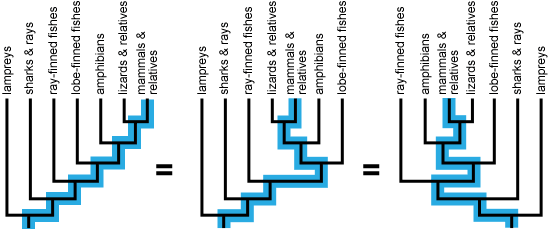
These differing trees show that it’s easy to see how one may say that there is a sort of “progression” to evolution, however there is no “progress” to evolution so in reading the tree in this way, one would have these misconceptions that PP has.
Another popular intuitive way to reduce a tree is stating that a branch that’s further away from the beginning of the lineage is “more evolved” or has “progressed more” than the common ancestor. However, a taxon’s relationship on phylogeny is a function of its relationship to other taxa and how the branches are rotated. The position of an organism on the tree is not any type of specialization, adaptation or any extreme traits in comparison to other organisms “lower” on the tree. Thusly, an organism’s placement on the tree is meaningless.
One of the biggest misconceptions PP has is not just on evolutionary trees, but the fact that organism have been “evolving” more than other organisms.
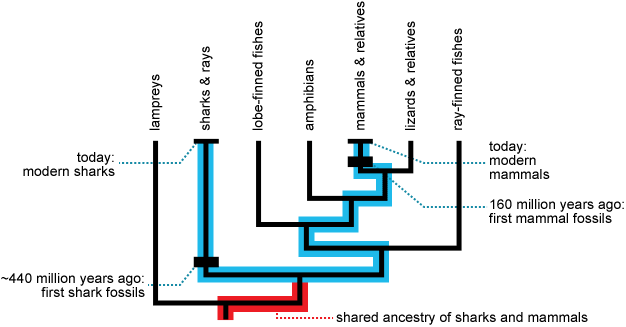
The above graph shows that since all species alive today share a common ancestor, that they all have had the same time evolving.
In most evolutionary trees, branch length doesn’t indicate anything about amount of evolutionary change. All though, when branch length is used to depict evolutionary change, branch length is then used. But this doesn’t mean that the organism at the end of that branch is ‘more evolved’ or has ‘progressed’ more than another; it just shows that more selective pressures had species adapt genotypically, which led to phenotypic changes over time to better survive in that environment. That’s it.
Now, here is the kicker (which goes with the previous picture from Berkely) and this is what directly refutes his rudimentary understanding of phylogenetic trees:
Intuitive Interpretation: Some living (i.e., extant) species have longer evolutionary histories than others (i.e., have been evolving for a longer time), and so some species are more or less “evolved” than other extant species.
Scientific Interpretation: Since all extant species are alive today and share a common ancestor (one that lived more than 3.5 billion years ago!), all extant species have been evolving the same amount of time.
Explanation: Some living organisms such as mosses and sharks represent clades that appear early in the geological record. Others (such as grasses and birds) represent clades that appear more recently. It is tempting to think of living members of a clade that appeared 160 million years ago (such as the mammals) as having a shorter history than members of a clade that appeared 440 million years ago (such as the cartilaginous fishes, sharks and rays). However, this intuition does not apply because of all living clades trace their evolutionary history back to shared ancestors among the earliest forms of life. For example, the fact that the clade that includes sharks appears early in the fossil record does not mean that modern sharks have had a longer evolutionary history than any other modern species.
What is really so hard to grasp about this?
While on this subject, PP has moderated my comments on his blog since “I’m repeating arguements he’s already responded to”, so I’ll post it here:
“You haven’t shown anything. As the above tree shows, among members of the same taxonomical level, there’s a high correlation between the degree of branching and (1) brain size, and (2) intelligence. I’ve demonstrated at least one measure of evolutionary progress that can be empirically tested.”
Haha. And now brain size is decreasing. Even then, as I said last night, there is no accepted definition and there is no accepted of these traits, and even terms like progression through fitness and the like don’t have an accepted definition, because, as I’ve shown again, the environment is ever changing. I’m sorry this is hard for you to grasp. There is no way to quantify more evolved superior and progressive evolution. I don’t know how to make you get it.
PP do me a favor. Go to Razib’s blog and post on his open thread and ask him how to read an evolutionary tree and then tell him how you read it. I would love to see his response.
“Politically correct platitudes are not science. Calling something primitive is not a value judgement, it’s a description. Replacing it with the more politically correct term “ancestral” doesn’t change anything, it’s just playing word games.”
You’re the one playing word games. You don’t have to agree that primitive and advanced mean nothing in evolutionary terms, you’d be extremely wrong though. You’re the one playing word games. I showed that there is no unidirectional line of progress and you’re still going on with this:
Because of the frequency of environmental change, the multiplicity of factors underlying fitness, the possibility of frequency-dependent and epistatic interactions among features, and the consequent possibility of nontransitive fitness relations between phenotypes, selection acting within populations frequently, though not inevitably, fails to produce unidirectional trends. The extent to which unidirectional trends dominate, or fail to dominate, the fossil record is therefore not a measure of the adequacy of neo-Darwinian mechanisms as causes of large-scale patterns in evolution.”
Simple enough to grasp. Directly refutes your notion too.
Saying that an organism is more advanced is not quantifiable. Each one is adapted to its environment. You’re the one playing word games to show your crackpot hypothesis, continually quoting pages 292 to 294 of Race, Evolution, and Behavior. But that doesn’t make it true. It’s not true.
“Yawn. I’ve debunked this stupid quote back in 2014. Splits on an evolutionary tree typically reflect periods of evolutionary growth after long periods of stasis. So if you’re a descendent of many splits, you’re typically a descendent of more evolution.”
You’ve debunked nothing. Ask Razib how to read an evolutionary tree then tell him how do and come back and show me his reaction. Please do this. I know what he’ll say. I directly proves your misconception wrong and you’re still going with it. It is true that when people are shown they’re wrong they attempt to gather any information to try to fix their shattered worldview. PP you’re just rehashing the great chain of being garbage and evolutionary theorists have abandoned that archaic notion. Join us in the year 2016, and ask actual experts how to read those trees instead of your misunderstanding. And a blog writing one sentence means…. What exact? It means nothing. I’ve shown my argument is stronger than yours and that you are reading evolutionary trees wrong, provided exact quotations from a respected authority and you still say it’s wrong. Too funny. Rushton isn’t the be all end all of evolution. He was wrong on a lot he was not perfect. And even then, he only implied this. The fact that he cited Aristotle and the great chain of being is laughable as people don’t even believe that anymore.
Please join us in the present PP, and stop living in the past.
Since PP is using Rushton as a reference, I’ll directly quote Race, Evolution, and Behavior (pg. 292-4) for Rushton’s exact words:
Progress in Evolution?
In their reviews, Lynn (1996a) and Peters (1995) both referred to my ranking of species on evolutionary scales. For Peters, this was a highly contentious idea but in Lynn’s positive review, he described me as proposing that the K-strategy was “evolutionarily more advanced” and that the Oriental race was “the most evolved.” In fact, I did not use either of these phrases in the book, although I had alluded to similar ideas in previous writing. Regardless, the topic of evolutionary progress provides an intellectual challenge of the first order and needs to be addressed. Figure 10.2 (p. 202) does imply a move from simple r-type animals producing thousands of eggs but providing no parental care to more complex K-type animals producing very few offspring.
The question of progress in nature has fascinated since Aristotle. Aristotle suggested that organisms could be hierarchically graded along ascala naturae marked by minute continuous steps from the inanimate, through plants, to the animals. He offered overlapping criteria for ranking along this scale including “perfectibility” (closeness to a Platonic God), “soul” (capacity for rational discourse), and method of reproduction. For example, regarding reproduction, he wrote in the History of Animals:
“Now some simply like plants accomplish their own reproduction according to the seasons; others take trouble as well to complete the nourishing of their young, but once accomplished they separate from them and have no further association; but those that have more understanding and possess some memory continue the association, and have a more social relationship with their offspring.”
The Greek philosopher’s biology is remarkably current. Based on detailed observation, Aristotle noted many of the principles that lie at the heart of the r-K analysis undertaken in this book including the inverse relations between seed output, parental care, and intelligence. The historian Arthur Lovejoy, in his 1936 book The Great Chain of Being, concluded that Aristotle’s arrangement of all things in a single order of magnitude was one of the most important ideas in Western thought.
Darwin (1859) referred frequently to evolutionary progress in the Origin of Species. This was necessary not only to refute concepts of a steady-state world but also to counter a newly developed school that denied any difference in perfection between the simplest and the most complex organisms, which would be an implicit denial of improvement through natural selection. In his book Sociobiology (1975), E. O. Wilson also promoted the idea of biological progression, outlining four pinnacles in the history of life on Earth: first, the beginning of life itself in the form of primitive prokaryotes, with no nucleus; then the origin of eukaryotes, with nucleus and mitochondria; next the evolution of large, multicellular organisms, which could evolve complex organs such as eyes and brains; and finally the beginnings of the human mind.
John Bonner (1980), in his book The Evolution of Culture in Animals, showed that the later an animal emerged in earth history the larger was its brain and the greater was its culture. Pursuing the issue in a subsequent book, The Evolution of Complexity (1988), he asked “Why has there been an evolution from the primitive bacteria of billions of years ago to the large and complex organisms of today?” Bonner held that it was quite permissible for paleontologists to refer to strata as upper and lower, for they are literally above and below each other and, because the fossils in the lower strata will, in general, be more primitive in structure as well as belong to a fauna or flora of earlier times, so “lower” and “higher” were acceptable terms. Bonner (1988: 6) noted that it was even acceptable to refer to lower and higher plants, slime molds versus angiosperms for example. It only became a “sin” when a worm was classified as a lower animal and a vertebrate a higher one, even though their fossils too will be found in lower and higher strata.
Paleontologist Dale Russell (1983,1989) quantified increasing neurological complexity through 700 million years of Earth history in invertebrates and vertebrates alike. The trend was increasing encephalization among the dinosaurs that existed for 140 million years and vanished 65 million years ago. Russell (1989) proposed that if they had not gone extinct, dinosaurs would have progressed to a large-brained, bipedal descendent. For living mammals he set the mean encephalization, the ratio of brain size to body size, at 1.00, and calculated that 65 million years ago it was only about 0.30. Encephalization quotients for living molluscs vary between 0.043 and 0.31, and for living insects between 0.008 and 0.045 but in these groups the less encephalized living species resemble forms that appeared relatively early in the geologic record, and the more encephalized species resemble those that appeared later.
The hominid brain has nearly tripled in size over the last 4 million years. Australopithecenes averaged a brain size of about 500 cm3 , the size of a chimpanzee. Homo habilis averaged about 800 cm3 , Homo erectus about 1,000 cm3 , and modern Homo sapiens about 1,350 cm3 . In Figure 10.3 of this book (p. 205) Homo sapiens is to be found at the end of a scala naturae of characteristics. The once traditional view that man is the “most developed” of species, gains novel support from the perspective of an r-K dimension. As E. O. Wilson (1975) put it: “In general, higher forms of social evolution should be favored by K selection” (p. 101)
Darwin had contradictory notions on the concept of ‘progress’ in evolution:
THE SECOND RIDDLE
Gould’s second riddle asks why Darwin never used the word “evolution”. In short, it is because “evolution” means progress and Darwin’s theory was uniquely non-progressive. Darwin was well aware that natural selection as a mechanism describes only adaptation within local environments. He wrote a marginal note to himself “Never say higher or lower in referring to organisms”.
So why do we call the process evolution? Herbert Spencer, an eminent Victorian, was tremendously influential in Darwin’s age. His writings were explicitly progressive, not only with regard to biological change, but economic, artistic, human, ad infinitum.
Gould notes “Since 19th century thinkers wouldn’t accept Darwin’s radicalism anymore than we would today, they were very comfortable with Spencer’s notion that you ought to use a word that means inherent progress…because that’s how they wanted to see it.”
Wow! He wrote a note to himself to “never say higher or lower in referring to organism”. What does that mean….? It seems to mean that he didn’t take to “progressive” evolution and he didn’t think that organisms were “higher” or “lower” than others.
On E.O. Wilson’s prokaryote argument: he’s just describing different lifeforms, not that they’re “more evolved” than any organisms that came previously. This notion, as I’ve documented over the past month here, is baseless in evolutionary biology and these terms don’t let us see evolution for what it really is: ongoing change, not progress. With our notion of “progress” we may think that things are “reversing”, but that’s just our perception and evolution through natural selection just happens, with no end goal in sight.
On what Rushton says about dinosaurs possibly developing an intelligence similar to our own: evolution isn’t linear, as I’ve been saying for months now. Let’s say that one thing was different in a rewind of life on earth, and everything else that led up to us arriving here occurred as is. That ONE difference may possibly have us not be here. That’s not too hard to grasp.
On his citing Bonner: a worm isn’t “lower” than flora or fauna; it’s just adapted to its specific niche. This, once again, is basic evolutionary biology.
Homo erectus and others were adapted to their environment and still persisted after Homo sapiens appeared on the scene.
Dr. John Bonner, professor emeritus of ecology and evolutionary biology at Princeton University and author of “The Evolution of Complexity” (Princeton University Press), said the newest findings were perfectly in line with the idea that he has continued to press that increases in complexity need not be explained as the result of any drive or force in any particular direction.
“Bacteria still exist today,” he said. “There hasn’t been a trend just toward more complex things, there’s been that trend but others have gotten simpler and less complex and smaller. But if things keep getting both more and less complex, the upper limit is going to keep rising.”
According to Dr. McShea, the perception of drives toward complexity may be more a reflection of scientists’ desires to see some sort of progress in evolution rather than a reflection of any biological reality. As Dr. Maynard Smith, explained: “If there’s going to be any change, there will have to be increases in complexity. Moreover, there will also be some decreases. It’s inevitable. There’s a poem by a chap that goes: ‘Nowhere to go but out, Nowhere to come but back.’”
I’ve cited Daniel McShea in these series of articles. What he’s saying is correct; we just look for notions of so-called “progress”. We have an implicit bias that we are the so-called “top of the ladder” in this “Great Chain of Being”. However, this term was discontinued by biologists in the 19th century.
PP is living in the past. He should join us in current year, because what he’s saying is old and debunked. Moreover, he really should learn how to read an evolutionary tree properly, because every single misconception that he has on the trees is included in the Berkely link above. This information is freely accessible to anyone; you’d just have to be willingly ignorant to a) not read it or b) read it and still hold these views. Moreover, the Great Chain of Being nonsense hasn’t been taken serious by evolutionary biologists since the 19th century. Yet PP still holds on to these notions. Saying that one is “more complex” than another is still a holdover from the GCoB days.
Evolution is NOT progressive, and PLEASE learn how to read phylogenetic trees correctly! That, or ask Razib how to read them then tell him how you read them. I’d love to see his reaction.
Are Australoids and Pacific Islanders Negroid? A Reply to PumpkinPerson
1600 words
I’ve been in a few discussion with PumpkinPerson on phenotype and if the similar phenotype found in Australoids and Pacific Islanders meant they were Negroid. However, just because two *dissimilar groups* look *phenotypically similar*, that doesn’t mean that they are *genotypically similar*. Afrocentrists have also latched on to this ridiculous theory, saying that blacks are ‘all over the world, displaced by whites yada yada yada’. Today, I’ll show that just because those two groups look similar to Africans doesn’t mean that they are similar on the genotype.
PP wrote an article last week, The importance of leaving Africa, which I will be quoting from for the remainder of this article.
The root of this debate is not so much genuine scientific disagreement, but ethnic genetic interests. The black Afrocentrists believe it’s good for black people to be seen as part of this larger, global black community, thus dispelling the claim that blacks only left Africa in chains. For leaving Africa was one of the milestones that separates humans from our closest living relatives (chimpanzees), so the claim that blacks never left Africa is seen as racist indeed.
I agree here that Ethnic Genetic Interests is the main driver of the dispute.
But if the mere leaving of Africa did indeed screen for IQ, why do the Australoids score even lower on IQ tests than sub-Saharan Africans do, and have somewhat smaller brains
Because the environment is similar it would select for similar phenotypes, but just because the environment is extremely similar doesn’t mean that no genetic change occurred in the 70 ky that Australoids left Africa in.
By contrast, the non-black HBDers think it elevates their racial status to promote the idea that their ancestors did something that blacks couldn’t accomplish: leaving Africa.
Well, as I’ve covered here last year (time flys), those who left Africa had specific alleles, the DRD7 and DRD4 alleles, which are absent from SSA populations. This ‘wanderlust’, due to the DRD7 allele, is the *cause* of the migration OoA. It has nothing to do with being more intelligent than those who stayed, it has to do with the genetic mutation that arose from a common ancestor around the time of the OoA migration. The cause of the migration does come down to genetic differences in the founder population (s), but not intelligence differences.
Two notes on the DRD4 allele: populations with a history of migration have a higher chance of having the allele in comparison to sedentary populations. And: a correlation of .85 was found between km traveled and the rate of DRDR4 allele frequency distributions. These alleles are more prevalent in South America, which is not surprising since they had to travel the furthest.
PP then starts talking about why Australoids have lower IQs, saying:
With agriculture/civilization, the dark caucasoids traveled the World, spreading their high IQ mutation to every corner of the globe except those that are most isolated. So the mean genetic IQ of the entire World increased by 13 points, with the exception of places that were too hard to get to, such as Australia and Papua New Guineas, the Congo rain forest, the Southern tip of Africa, and the Americas. Since most of sub-Saharan Africa got the genes, they suddenly leaped from having lower IQs than the Austaloids, to being smarter (only the bushmen and pygmies, who like the Australoids, were too isolated to get the genes, remained behind the Australoids).
This is a great hypothesis. It makes a lot of sense. The ‘Dark Caucasoids’ as PP calls them, better known as Anatolian/Neolithic Farmers could have had a higher chance for more high IQ mutations due to the fact that they could farm and thus have a higher population giving more of a chance for higher IQs.
The downfall for the dark caucasoids was spreading these genes to whites and East Asians. Because of cold winters, East Asians and whites were smarter than pre-mutation dark caucasoids, and now with these mutations, they were smarter once again.
I’m confused here. What we call whites today did not exist that far back in the past. Europeans are an amalgamation of four different ancient populations, basically are an amalgamation of ‘Dark Caucasoids’. Is he also saying that the Neolithic Farmers were more intelligent than East Asians?
Eurasians didn’t become a distinct breeding group until the end of the last Glacial Maximum. This is why there is ‘genetic similarity’ to modern-day Europeans with some old, 10k year plus peoples in the Americas. Because the two groups didn’t split into distinct populations, they show a similar genotype. This is what proponents of the Solutrean Hypothesis need to get through their heads. (I recently got into a nice discussion over at The Alternative Hypothesis, scroll down for comments. I’m going to make a more comprehensive post on the SH in the near future as I have come across even better data on it.)
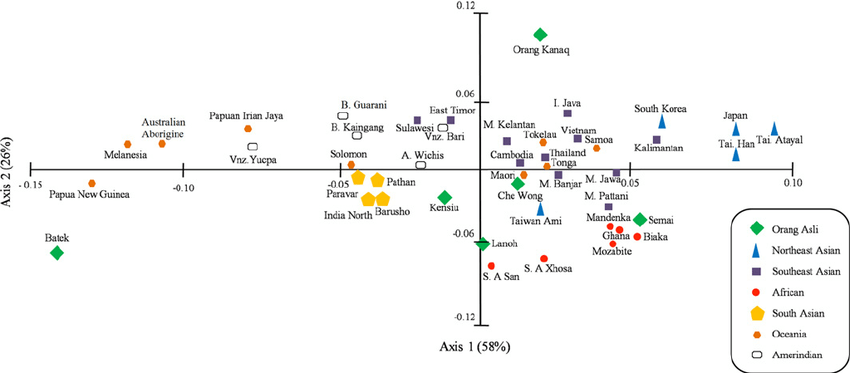
We can see from this PCA graph (from Zainel Abidin et al) that Australoids don’t even cluster in the vicinity of Africans. They are on the complete other side of the graph, showing how great of a genetic distance there is between these two populations. You can see the other Oceanic peoples (the orange dots, who Afrocentrists and others say are Negroid, Abos, Papuans, Melanesians, etc) are also clustered away from Africans. PCA graphs show that the three populations are not genetically similar and that phenotype, sometimes, isn’t enough to show who belongs to what racial grouping. PCA analysis refutes peoples ‘feelz’ on what they believe with their eyes. Even with this data, their ‘feelz’ still overrides the truth and they still believe lies.
While on this subject of similar phenotype not meaning one population is racially the same as another, people use this same fallacious reasoning for ‘white-looking’ peoples in the ME.
Quoting Razib Khan:
The final issue is that a lot of the phenotypes that we racially code are recent. This probably explains why groups like the Kalash and Nuristanis can look more like Europeans than South Asians, but they’re genetically more like South Asians.
What does any of this have to do with non-scientific things? I don’t really know. My interest in population structure is intellectual, not personal. But a certain type of person should probably stop talking about how white people have been in Europe for 40,000 years. First, the ancestors of modern Europeans 40,000 years ago were almost all residing outside of Europe. An assertion that holds until 15,000 years ago. And most would still be resident outside of Europe 8,000 years ago as depending on how you count/calculate. *** And, perhaps more importantly, the typical phenotype of Northern Europeans probably really coalesced only around ~5,000 years ago. ***
How can there be such phenotypic similarity in two populations separated by thousands of miles?
Easy. The Kalash and other ME ‘white-looking’ populations have ancient Siberian ancestry. As shown in my linked article, modern-day Europeans have a great deal of Siberian ancestry, mostly from the true Aryans, the Yamnaya peoples.
And in the comments Razib was asked:
“Could I bother you to list the top three theories/positions that you see falling into this unsupportable category?”
To which he responded:
“that phylogeny and phenotype track closely. just because you can’t tell the physical difference between two pops (e.g., solomon islanders and sub-saharan africans) they must be phylogenetically close. this is not the case.”
Pretty much seals the deal.
Just because populations look similar on the outside doesn’t mean they are genetically similar. As shown from Razib’s post, the phenotypes that we code are relatively recent, which is why there are some populations separated by thousands of miles yet look extremely similar.
Bonus:
This was said in the comments:
I can’t really tell about the genetics since I don’t have the scientific background, but my impression is a lot of those white identity guys have an extremely mythologised view of the past. This seems to be true even of the smarter ones; e.g. I recently read a bit of Richard Spencer’s twitter account (out of interest in the alt right phenomenon) and he throws out such totally retarded comments as “Europe has always been unified, even before Christianity” (totally ignoring what is known about the ancient Greeks’ intimate links to the Near East, the Greeks’ and Romans’ unflattering view of the northern barbarians, the emergence of Latin Christendom in the middle ages and the fairly late rise of the concept of Europe etc.) or “Europe is a nation”. There seems to be little awareness of the complexities of historical change because everything is reduced to some supposedly unchanging racial essence reaching back into the mists of prehistoric times. Now I’m pretty far right and “racist” myself, but a lot of this really seems pretty stupid…like myth-making for identity politics.
i knew the pre-WN richard spencer (we lost touch after his ideological changes ~2010). he’s smart. i have a hard time believing he doesn’t know the latest research, which was evening starting to be evident back then. so i think it’s myth-making.
p.s. a friend of mine sent me a link to a richard spencer interview with kevin macdonald last year i think, pointing to a specific segment of the podcast talking about ancient genetics. kevin was telling richard how europeans 40,000 years ago were white, and those are the ancestors of europeans. that’s wrong.
Europeans 40kya were not white those in the area at that time are *not* the ancestors of today’s Europeans.
Both Afrocentrists and Nordicists need to keep up with the new information that’s constantly coming out. Because what they say in regards to genetics and/or anything else is mostly wrong.
The Concept of “More Evolved”: A Reply to Pumpkin Person
1000 words
Recently, PumpkinPerson has been stating that one population can be ‘more evolved‘ than another which doesn’t make any biological sense. PP’s basic thesis is that since we are the last branch on the tree in comparison to the lifeforms that came before Homo Sapiens, that due to that, we are ‘more evolved’ than other organisms on the planet. I get where he’s coming from; he’s just extremely wrong.
Organisms evolve to better adapt to their environment through Natural Selection (NS). NS does select for positive traits, however, evolution is not a linear process. PP also claims that “evolution is progressive“. That couldn’t be further from the truth. Stating that evolution is “progressive” means that evolution through NS is progressing to an “endgame”. Though, we know there is no “endgame” with evolution, as evolution just happens.
Evolution is not progressive. NS may select for traits not suitable for that environment, as NS is “not all-powerful”. Selecting for one advantageous trait may change another trait for the worse. (See “Misconceptions on Evolutionary Trees“, which is what PP did, from Berkely).
PP asks “Who is most evolved?”
No organism is “more evolved” than another. NS selects for traits that are advantageous to that current environment (it selects for negative traits as well). Due to this, the word “superior”, the phrase “more evolved” is meaningless comparing human races to one another and humanity as a whole to the other lifeforms on the planet.
PP quotes Rushton as saying
“One theoretical possibility is that evolution is progressive, and that some populations are more advanced than others.” J.P. Rushton, 1989
We know that evolution is not progressive, so due to this, some populations are not more advanced than others. Genetic superiority can be measured subjectively, but not objectively, as each organism has different strengths and weaknesses due to its environment.
PP then implies that bacteria are “less evolved” than we are. However, with recent breakthroughs in the HMP (Human Microbiome Project) we see the huge role that gut microbiota play when it comes to communicating with the brain, how antibiotics that kill gut microbiota also stop the growth of new brain cells, and how altered gut microbiota cause obesity. With more amazing uses and benefits we find involving gut microbiota and human health, can we really say that we’re “more evolved” than these organisms when they account for a huge amount of positive benefits for as a whole.
For another example, cows using their own genes wouldn’t be able to extract the fiber out of the food they eat. They would need special enzymes to break down the cell wall to extract the nutrients from the food. Though, evolving the genes to do this would take an extremely long time. This is where gut microbiota come in. Trillions of microbiomes live in the cows’ 4 stomachs. The microbiomes living in the cows’ gut processes the food back and forth through the mechanical grinding of the cows’ mouth and thus, the nutrients are extracted by the microbiomes that way.
In this instance, is a cow superior to its microbiomes if a cow’s microbiomes make it possible for it to digest its food?
PP then asks “Does more evolved mean superior?”
No, it doesn’t. There is no way to quantify this, as evolution is not progressive. Furthermore, saying that one organism is “more evolved” than another doesn’t make any sense since, as noted earlier in this article, each organism is suited to the environment it evolved in through NS.
PP then says that he prefers a 3 race model, when a 5 race model makes more sense. These populations are “Africa, Europe, Asia, Melanesia and the Americas.”
I assume he would put ‘Natives’ with Asian Mongoloids, but ‘Natives’ have been genetically isolated in the Americas for so long that they formed their own distinct clade away from other populations due to no introgression between them, when other populations have admixture from other parts of the world:
Significant genetic input from outside is not noticed in Meso and South American Amerindians according to the phylogenetic analyses; while all world populations (including Africans, Europeans, Asians, Australians, Polynesians, North American Na-Dene Indians and Eskimos) are genetically related. Meso and South American Amerindians tend to remain isolated in the Neighbor-Joining, correspondence and plane genetic distance analyses.
Hence, a 5 race model makes more sense as these populations show genetic differentiation between each other.
Still, others may take the concept of “more evolved” and believe that one race is “more evolved” than another. That’s another wrong statement.
The assumption here is that populations that evolved closer to the equator had evolution “stop” for them due to “ease of lifestyle” (life is easy nowhere). That too makes no evolutionary sense. If that were so, how did Africans evolve the sickle cell trait? Evolution is a constant, ongoing process and does not ‘speed up or slow down’ based on the environments in which ancestral evolution has occurred.
Moreover, r/K selection theory does dictate fast and slow life history strategies, but it has nothing to do with ‘fast or slow evolution within human populations’.
To state that evolution ‘is faster or slower’ in certain populations of humans is like saying ‘evolution has slowed for man since 50kya’ as anti-human-evolutionists have said:
“Something must have happened to weaken the selective pressure drastically. We cannot escape the conclusion that man’s evolution towards manness has suddenly come to a halt.” – Ernst Mayr
“There’s been no biological change in humans in 40,000 or 50,000 years. Everything we call culture and civilization we’ve built with the same body and brain.” – Stephen Jay Gould
Stating that evolution occurs faster in certain populations is on the complete opposite of the “evolution stopped for humans 50kya” camp, which we know is not true and evolution has sped up in the last 10kya.
To say that one organism, or population for that matter, is more evolved than another makes no biological sense. Each organism is suited to its own environment and where it evolved. Even then, different organisms evolve different traits depending on what they have to do in that ecosystem to survive. Darwin’s finches are a perfect example of that.
Misconceptions on Calories In and Calories Out
2550 words
(To those from “myproana.com”, DO NOT misconstrue what I wrote here. What I wrote here is perfectly understandable. I am NOT saying that “you have no metabolism”. My point is, low kcal dieting CAN and WILL destroy your metabolism. The literature is vast on this subject and it’s waiting for you to read it. Any further confusions, please comment and I will answer your questions.)
“Eat Less and move more!!! That’s how you lose weight!” What people who don’t understand about human metabolism and homeostasis is that when caloric reduction occurs, the body drops the metabolism to match the amount of kilocalories (kcal) it is receiving. Thus, weight will plateau and you will need to further decrease caloric consumption to lose more weight. In this article, I will go through what a calorie is, common misconceptions of Calories In and Calories Out, the reasons for metabolic slow down, the process of thermodynamics that people who don’t understand this research cry out whenever it’s said, and finally starvation experiments that prove metabolic slow down occurs during a decrease in caloric intake and how this metabolic slow down persists after the diet is over.
A kilocalorie is the heat required to raise 1 kilogram of water 1 degree celsius. This definition is used whenever people say ‘Calorie’.
Misconceptions on kcal in/kcal out
- One of the biggest misconceptions people have on Calories In/Calories out is that these variables are independent of each other. However, they are extremely dependent variables. When you decrease Calories In, your body decreases Calories Out. Basically, a 20 percent reduction in kcal will result in a 20 percent reduction in metabolism which the end result ends up being minimal weight loss.
- The next big assumption people have about Calories In and Calories Out is the assumption that the Basal Metabolic Rate (BMR) remains stable. Of course, measuring the caloric intake is simple. However, measuring caloric outtake is a much more complicated process. When ever the Total Daily Energy Expidenture (TDEE) is spoken of, that involves the BMR, thermic effect of food, nonexercise activity thermogenesis (the energy expidenture of all activities sans sports), excess post-exercise consumption (EPOC, a measurably increased rate of oxygen intake following increased oxygen depletion), as well as exercise. the TDEE can increase or decrease by as much as 50 percent depending on caloric intake as well as the aforementioned variables.
- The third misconception people have is that we have conscious control over what we eat. We decide to eat when we are hungry (obviously). But numerous hormonal factors dictate the decision on when to eat or when to stop. We stop eating when we are full, which is hormonally mediated. Like breathing, the regulation of body fat is under automatic control. Just like we don’t have to remind ourselves to breath or remind our heart to beat, we don’t need to remind ourselves to eat. Thus, since hormones control both Calories In and Calories Out, obesity is a hormonal, not caloric disorder.
- The fourth misconception is that fat stores are essentially unregulated. However, every single system in the body is regulated. Height increases come from growth hormones; blood sugar is regulated by insulin, glucagon, and numerous other hormones; sexual maturation is regulated by testosterone and estrogen (as well as the hormone leptin which I will return to later); body temperature is mediated by a thyroid-stimulating hormone, among numerous other biologic factors. Though, we are told that the production of fat cells is unregulated. This is false. The best researched hormone on the storage of fat cells that we know of is the hormone leptin which was discovered in 1994. So if hormones dictate fat gain, obesity is a hormonal, not caloric disorder.
- And the final misconception is that a calorie is a calorie. This implies that the only important variable on weight gain is caloric intake and thus all foods can be reduced to how much caloric energy they have. But a calorie of potatoes doesn’t have the same effect on the body as a calorie of olive oil. The potatoes will increase the blood glucose level, provoking a response from the pancreas, which olive oil will not. Olive oil is immediately transported to the liver and has no chance to induce an insulin response and so there is no increase in insulin or glucose.
All five of these assumptions have been proven false.
[9/21/16 edit:]
Calories in/out implies that during extended caloric restriction no matter the type of kcal (fat, CHO, protein, alcohol, except when alcohol is ingested your body puts fat storage on hold until all alcohol is metabolized from the body. You can see how wiith chronic drinkers as they are obese a lot of the time, with there being a strong link between alcoholism and obesity as there are nunmerous pathways related with each other that lead to excessive eating as well as dependance on alcohol and other drugs) ingested, as long as caloric restriction is continued that weight (fat) loss will be achieved. CICO adherents say that “a calorie is a calorie”, but what’s funny with that statement is that is violates the Second Law of Thermodynamics. Naturally, to CICO adherents since “a calorie is a calorie”, kcal would be restricted from fat since it’s the most calorie dense macro (alcohol coming in second at 7 kcal per gram). By doing this, CHO will be increased, as is recommended by all of the ‘experts’. “Increase CHO, fat leads to CD!!!” This isn’t true, that’s another reason for cutting fat, the supposed ‘increased risk of heart disease”. However, when this occurs, insulin is spiked and when insulin is spiked the body doesn’t use the fat stores for energy it uses the glucose from the carbs.
Putting this all together, let’s say someone’s TDEE is 2000 kcal per day (for a 14k kcal per week average) and they reduce it to 1200 kcal and go on a LFHC diet like is commonly recommended. Insulin remains high and therefore fat cannot be tapped into. This is due to the CICO mantra (which violates the 2nd LoT) “a calorie is a calorie” that leads people to believe that all calories are ‘equal’ in terms of hormonal responses in the body. Let’s take a piece of bread and a teaspoon of olive oil. When you eat the piece of bread, insulin is spiked in response to the glucose from the carbohydrate. When you drink the olive oil, it’s immediately absorbed by the liver eliciting no insulin spike. Clearly, with a long term LFHC diet, this will consistently occur and the body will be continuously using CHO for energy and not the fat stores as insulin is continuously spiked in the body. Insulin either tells the body to store fat or not burn it for energy. Eventually, over time, this leads to insulin resistance (however, insulin resistance may precede obesity and diabetes) and more metabolic problems amongst a myriad of other variables.
As kcal is reduced to 1200 per day, the body is forced to match its metabolism to what your intaking as it can’t get energy from anywhere else since “a calorie is a calorie”. This happens during any calorie restricted diet and is why diets are doomed to fail. This same thing happened with The Biggest Loser contestants. Notice how The First Law of Thermodynamics isn’t broken? It’s irrelevant.
See how the mantra “a calorie is a calorie” violates the Second law of thermodynamics and fails because the CICO model doesn’t take insulin into the equation, which is a causal factor with obesity?
[End edit]
The correlation between weight gain and caloric consumption has recently been discovered. Ladabaum, et al (2014) examined trends in obesity from 1988 to 2010. The trends they observed were: obesity, abdominal obesity, physical activity and caloric consumption in US adults. They discovered that the obesity rate increased at .37 percent per year while caloric intake remained virtually the same.
The Law of Thermodynamics
The first law of thermodynamics states that energy can not be created nor destroyed in an isolated system (this is important). People often invoke the LoT to support the Calories In and Calories Out model. Dr. Jules Hirsch says in this NYT article:
There is an inflexible law of physics – energy taken in must exactly equal the number of calories leaving the system when fat storage is unchanged. Calories leave the system when food is used to fuel the body. To lower fat content – reduce obesity – one must reduce calories taken in, or increase output by increasing activity, or both. This is true whether the calories come from pumpkins or peanuts or pâtés de foie gras.
To quote MD Jason Fung, author of The Obesity Code:
But thermodynamics, a law of physics, has minimal relevance to human biology for the simple reason that the human body is not an isolated system. Energy is constantly entering and leaving. In fact, the very act we are most concerned about-eating-puts energy into the system. Food energy is also excreted from the system in the form of stool Having studied a full year of thermodynamics in university, I can assure you that neither calories nor weight gain were mentioned even a single time. (Fung, 2016: 33)
We assume with the model of the calorie-balancing scale that fat gain or fat loss is unregulated, however, no system in the body is unregulated like that. Hormones tightly regulate all bodily functions. Body fat is no exception. The body actually has numerous ways in which to control body fat. Distribution of energy is the problem with fat accumulation. Too much energy is diverted to fat creation as opposed to body-heat production. Most of this is under automatic control, except exercise (which even then, there is a genetic basis for motivated exercise). We can’t decide whether or not to allocate calories to nail production or increase stroke volume. These metabolic processes are almost impossible to measure, and thus most assume that it’s relatively constant. Particularly, Calories In is not assumed to change in response to Calories Out. We assume these are independent variables. Reducing calories in only works if calories out remains constant. However what we find is that a sudden reduction of Calories In leads to a similar reduction of Calories Out and no weight is lost as the body balances its energy budget.
Starvation experiments
In 1919, a landmark study was carried out by Francis Benedict. The volunteers in the study agreed to a semi-starvation diet ranging from 1400 to 2100 kcal, approximately 30 percent of the subject’s bodyweight. The question was whether or not decreased caloric intake lead to a decrease in metabolism. The results were shocking.
The subjects experienced a 30 percent reduction in metabolism, with their initial caloric expidenture being 3000 kcal dropping to 1950 kcal. A 30 percent reduction in kcal resulted in a 30 percent decrease in metabolism. The First Law of Thermodynamics is not broken.
Towards the end of WWII, Dr. Ancel Keys wanted to improve understanding of starvation and better help Europe after the War. With an average height of 5 feet 10 inches and an average weight of 153 pounds, these were normal men, which Dr. Keys wanted to see the effects of a semi-starvation diet on those with a normal weight. For the first three months of the study, they were given slightly over 3000 kcal. Though over the next six months, they were given 1570 kcal. Eventually, some men were decreased to less than 1000 kcal a day. They were given a diet of foods high in carbs and low to no animal meat as that was the condition in Europe at the time. Moreover, they also had to walk 22 miles a week as exercise. Again, the results were shocking.
Dr. Keys showed that they had a 40 percent decrease in metabolic rate. The body decreased its metabolism to match the amount of calories consumed. They showed a 20 percent decrease in strength, a significant decrease in heart rate (55 to 35 beats per minute), stroke volume decreased by 20 percent, body temperature dropped to 95.8 degrees Fahrenheit (which makes sense since less caloric consumption means less energy for the body to convert into heat), physical endurance dropped by half, blood pressure dropped, they became tired and dizzy and finally their hair and nails grew extremely brittle. They couldn’t stop thinking about food. Some of them wrote cookbooks, others dreamed about food. They became obsessed with eating. All of these causes go directly back to decreased caloric consumption as the amount of heat produced by the body decreased due to an increase in caloric consumption. In sum, the body responds to a decrease in caloric intake by dropping metabolism.
Metabolic slow down
Recent data has come out on decreased energy expidenture due to dieting from contestants on the show The Biggest Loser. The contestants were followed for six years after the show ended. Fothergill, et al (2016) showed that after six years, most contestants gained back the original weight they lost, but their metabolism was still decreased by 600 kcal.
The mean metabolic adaptation had increased to 500 kcal per day, which explains why RMR remained 700 kcal per day below the baseline level despite a 90 lb body weight regain. The researchers even said that this large metabolic difference couldn’t be explained by the different calirometer used at the end of the six year period.
Substantial weight loss induces biological changes that promote weight gain.
Moreover, after a period of dieting, your brain panics and thinks it’s starving. During this time, the the production of the hunger hormone ghrelin increases. Levels of this hormone increase right before a meal and steadily decrease after. This is one of the many hormones that control when we’re hungry and this is one of the many reasons why diets fail and do not work long term.
Our bodies have homeostatic mechanisms that cause us to gain back or lose weight whenever caloric consumption is increased or decreased. The main cause is the body weight set-point which I will cover in a future article.
And a quote from Sandra Aamodt’s book “Why Diets Make Us Fat“:
“Leibel finds that metabolic suppression persists in dieters who have kept weight off for one to six years, so he scoffs at claims that the successful weight loss story disproves his ideas. “If you talk to people who’ve done it – not the studies, but people who actually manage to lose weight and keep it off – they’ll tell you what I’m telling you,” he says: that the only way to achieve this goal was to allow themselves to be hungry all the time while increasing their physical activity substantially. Indeed, his point is supported by data on the eating and exercise habits of people listed in the National Weight Control Registry, who have lost at least thirty pounds and kept it off for one year. A calorie calculator says that Dennis Asbury should have needed 2,100 calories to maintain his weight at 150 pounds, but instead he found that he needed to eat 400 to 500 calories less than that. Such metabolic suppression is the difference between being within the defended range and being below it. Many people blame others for eating too much or exercising too little, assuming incorrectly that both are under voluntary control, but it’s much harder to justify holding people responsible for diet-induced changes in the way the body burns energy.” (Aamodt, 2016, pg. 68)
Conclusion
The fact of the matter is, kcal in and out is completely misunderstood due to a non-understanding of human metabolism. As we decrease our caloric intake, our body adjusts its metabolism down to match the amount of kcal we are currently consuming. This is why Calories In and Calories Out does not tell the whole story. Our body constantly fights to maintain what is normal, its set-point. When thrown out of what the brain considers ‘normal’ the brain through the hypothalamus does whatever it can to get us back to its set-point. Thus, obesity is a hormonal, not a caloric disorder.
Nordicist Fantasies: The Myth of the Blonde-Haired, Blue-Eyed Aryans and the Origins of the Indo-Europeans
750 words
Nordicists say that the Aryans, the Indo-Europeans, had blonde hair and blue eyes. Though, recent genetic evidence shows that the origin of the Indo-European language is from the Russian steppe, originating from the Yamnaya people. The originators of the Indo-European languages weren’t blonde-haired and blue-eyed, but dark-haired and dark-eyed. Better known as the ‘Kurgan Hypothesis’, this is now the leading theory for the origin of Indo-European people.
Haak et al (2016) showed that at the beginning of the Neolithic period in Europe (approximately 7 to 8 kya) that a closely related group of farmers appeared in Germany, Hungary, and Spain. These ancient populations were different from the indigenous peoples from the Russian steppe, the Yamnaya, who showed high affinity with a 24000-year-old Siberian sample. Approximately 5 to 6 kya, farmers throughout Europe had more hunter-gatherer ancestry than their predecessors from the early Neolithic, but the Yamnaya from the Russian steppe were descended from the Eastern European hunter-gatherers, but also from a population with Near East ancestry (Ancient North Eurasians, ANE). Further, the migration of haplotypes R1b and R1a traveled into Europe 5000 years ago.
The Late Neolithic Corded Ware culture from Germany trace approximately 75 percent of their ancestry to the Yamnaya, which confirms a massive migration from Eastern Europe to the heartland of the continent 4500 years ago. This ancestry from the Yamnaya persisted in all of the Europeans sampled up until approximately 3000 years ago, and is common in all modern-day Europeans. The researchers then conclude that this provides evidence for a steppe origin for some of the Indo-European languages from Europe.
As mentioned above, Haber et al (2016) show how, as I alluded to above, that the Yamnaya people share distant ancestry with the Siberians, which is probably the source of one of the three ancient populations that contributed to the modern-day European gene pool (Ancient North Eurasians, West European hunter-gatherers, and Early European farmers from Western Asia with the fourth population being the Yamnaya people).
Olade et al (2015) show that since the Basque people speak a pre-Indo-European language that this indicates that the expansion of Indo-European languages is unlikely to have begun during the early Neolithic (7 to 8 kya). They, like Haak et al, conclude that it’s in agreement with the hypothesis of the Indo-European languages coming out of the East, the Russian steppe, around 4500 years ago which is associated with the spread of Indo-European languages into Western Europe.
Finally, it is known that the Yamnaya people had dark skin (relative to today’s Europeans), dark hair, and dark eyes. Knowing what is presented in this article, this directly goes against the Nordicist fantasy of the blue-eyed, blonde-haired Indo-Europeans. Nordicists also like to claim that the Indo-Europeans had blonde hair and blue eyes, when genetic evidence goes directly against this claim:
For rs12913832, a major determinant of blue versus brown eyes in humans, our results indicate the presence of blue eyes already in Mesolithic hunter-gatherers as previously described. We find it at intermediate frequency in Bronze Age Europeans, but it is notably absent from the Pontic-Caspian steppe populations, suggesting a high prevalence of brown eyes in these individuals.
Further, the Yamnaya were a tall population. Since the Yamnaya had a greater genotypic height, it stands to reason that Northern European populations have more Yamnaya ancestry.
The Yamnaya herded cattle and other animals, buried their dead in mounds called kurgans, and may have created some of the world’s first wheeled vehicles. They were a nomadic population that, some linguists say, had a word for wheel. The massive migration into Western Europe from the Russian steppe contributed large amounts of North Asian ancestry in today’s Europeans. The Yamnaya are also shown to be the fourth ancient population that is responsible for modern-day Europeans.
Modern-day genetic testing is shattering all of these myths that are told about the origins of Europeans and Proto-Indo-European peoples and languages. The ACTUAL basis for most PIE languages is from the Russian steppe, from a relatively (to modern Europe) dark-skinned, dark-haired, and dark-eyed people who then spread into Europe 4500 years ago.
The Nordicist fantasies of the Aryans, the originators of Proto-Indo-European languages has been put to rest. It was originally proposed based off of myths and stories, mostly from ancient Indo-European cultures who were situated thousands of miles away from the original Indo-Europeans (the Yamnaya).
The Kurgan Hypothesis is now the theory that’s largely accepted by the scientific community as being the homeland of the Proto-Indo-Europeans. The Yamnaya people now make a fourth founding population for Europeans, with the other three being West European hunter-gatherers, Ancient North Eurasians, and Early European Farmers.
Blacks Are Less Violent Than Whites?
1850 words
I’ve read a lot of crazy things in my life, though this must be the craziest. Someone really believes that “blacks are less violent than whites“. To believe such a claim, you would have to close your eyes to all of the relevant data. From naming outright falsities to obscuring data to fit his narritive, this article will show and refute a distorted reality, one that the Left wishes to show, to one simply looking for the truth to interracial crime.
Don’t be modest, Caucasians. The Holocaust
The Holocaust is really beyond the scope of this blog, but check out the CODOH Library for the truth on this matter.
This is not unique to Europeans. The Rwandan Genocide (which was due to ethnocentrism) and the ethnic cleansing currently occurring in Central Africa aren’t real? Fact of the matter is, is that every ethnicity has participated in ‘ethnic cleansing’, which is really just protecting genetic interests. This is a non-factor as this has gone on before European colonialism.
Colonialism was good for the native inhabitants of Africa. Speaking of the Caribbean, how well did it end for the Haitians after they defeated Napolean?
Oh? You mean how a majority of the slaveholders were Sephardic Jews? Or how there are reports from New Orleans from their 1860 census that showed 3000 freed blacks owned slaves, accounting for 28 percent of the city’s population? In 1860 Louisiana, at least 6 blacks owned more than 65 slaves, with the biggest number of slaves being 165 slaves who worked on a sugar plantation. How about the Jews’ role in American slavery? Moreover, at the height of slavery, a paltry 6 percent of Southern whites owned slaves, when combined with the North it was 1.4 percent. An estimated 3000 blacks had about 20000 slaves in 1860. But tall is only about the whites who did slavery, and not about the Arabs and how they started enslaving Africans FIRST, in 650 AD.
The Alternative Hypothesis just had a post the other day about the non-genocide of American Indians. Basically, their population was anywhere between 1.5 and 2 million people. Population reduction for the Native Americans was only 0.22 percent!! Doesn’t seem like such a ‘genocide’ to me. If so, that’s the slowest genocide I’ve ever heard of.
People segregate naturally. We’re more segregated now than we were 50 years ago! Must be those residual effects from Jim Crow huh?
But somehow in the media it’s the black man who is portrayed as the savage.
It’s just not fair. We white folks are so much better at race-based aggression than our darker complected brothers.
More intelligent than them, that’s why.
Just this Wednesday a white guy walked into a historic African American Church in South Carolina, was accepted as part of the service, stayed for about an hour before shouting a spiteful message and gunning down several parishioners!
Now that’s some hate right there!
One person does something and that means….what exactly? It shows one person is hateful! Look at averages, not singular events.
Whenever anyone brings up race and violence, the first thing people mention is crime.
Because they are linked to each other. Why wouldn’t the two things be mentioned in the same breath?
There is more black-on-black crime than white-on-black crime, they say. And they’re correct!
According to a 2013 FBI Uniform Crime Report, when it comes to murder, 90 percent of black victims were killed by black offenders.
However, what people fail to mention is that according to the very same report, 83 percent of white victims were killed by white offenders, too.
These numbers don’t show black people are more violent than white people. They show that BOTH white and black people would rather kill within their own race.
Yea they show that both would rather kill within race, however you miss something very important here: Interracial crime!
First, we find that during the 2012/2013 period, blacks committed an average of 560,600 violent crimes against whites, whereas whites committed only 99,403 such crimes against blacks. This means blacks were the attackers in 84.9 percent of the violent crimes involving blacks and whites. This figure is consistent with reports from 2008, the last year DOJ released similar statistics. Perhaps not coincidentally, that was the year Mr. Obama was elected president.
In terms of raw numbers, black people and white people actually commit about the same number of murders. But you wouldn’t know that from the media.
Not really. Per capita rates are more important than raw numbers, luckily we have data on that!
As of 2008, young black men kill at a rate of 7 times higher than white men.
Homicide Trends in the United States, 1980-2008 Annual Rates for 2009 and 2010 pg 11
Is that the same number of murders?? I’m looking at the same stat in a completely different way than you are.
The FBI is charged under the Hate Crime Statistics Act with compiling statistics on spite-based legal transgressions. In its most recent report, for 2013, hate crimes based on race are far more numerous than any other kind.
- The FBI is biased towards blacks and ‘hate crimes’. How about all of the countless times we here about blacks attacking whites using racial epithets during the attack? Too many to count. They are, however, not counted as hate crimes by the FBI because it doesn’t fit their narritive.
- I wonder how those numbers would look if actual hate crimes were included in this data (black on white included).
According to the FBI statistics, 54.5 percent of the reported single-bias hate crimes that were racially motivated in 2013 targeted blacks. Only 16.3% target whites.
Want to talk bias? The amount of black on white hate crimes that are NOT categorized as such. This skews the statistics considerably.
Would our economy really have been so robust without the free labor of all those slaves?
Yes. Whites could have done it, but getting blacks to do it was cheaper and more efficient. Using brains to get ahead is what life is all about. Whites build great societies anywhere. Our economy would have been as robust as it is now without America never having a history of slavery.
Heck! Would we even have a country at all if we hadn’t murdered all those indigenous peoples in the first place?
Is a population decline of 0.22 percent per year ‘murdering all those indigenous peoples’?
So let’s put it to rest. When it comes to hate crimes, white folks kill! But don’t feel too bad, black folks. There are things you’re good at, too. Like nonviolent resistance.
This guy is delusional. Just because MLK preached non-violence doesn’t mean that blacks as a whole are non-violent. Look at crime stats from anywhere in the world.
After all this time, black people have very rarely used violence as a means to achieve their ends, to try to secure the rights and freedoms white America guards so jealously.
Is this guy living in the same America as I am?
In just the past year or so, unarmed black folks have been assaulted or killed for holding toy guns
Go ahead and pick out the real one, then do it from a distance when you get a phone call that there is a kid walking around while waving a gun.
He died due to asthma, obesity, and heart disease, that’s why he couldn’t breathe; he was 350 pounds. He also did not comply with the officers’ orders, which is why he needed to be taken down in such a fashion.
listening to music at a gas station
Dunn did say that Davis said he was going to kill him with a shotgun and that’s when he grabbed his gun out of his glove box.
asking for help after a car accident
Freak accidents happen that get blown up? Damn, that proves whites are more violent huh!?!?
Yea, people still believe that Trayvon got killed for ‘wearing a hoody’. We have jurys for a reason. We have trials for a reason. We have laws like Stand Your Ground for a reason. Trayvon was killed because if Zimmerman hadn’t of protected his life, he would be dead. All of these people complaining about the verdict, if you were put into that same situation, would you allow yourself to be killed for fear of being called ‘racist’?
Listen to police when they tell you to do something. Especially during an investigation. This shouldn’t even need to be said.
1) The Baltimore Six are going to get off for it. They caused no harm. 2) He threw himself around in the back of the van causing his own death.
and now just going to church!
Right. They were killed just for going to Church. eyeroll
And the response from the black community has been pretty darn nonviolent. Yeah there’s been some shouting and looting, but very little beating or killing.
‘Pretty darn non-violent. Which is why immediately after, blacks began false flagging Church burnings in an attempt to pin them on whites. So ‘peaceful’, right?
White folks, can you imagine having to undergo such indignity on a daily basis and NOT responding in kind!?
Can’t tell if serious. Just recently, a beta Trump supporter was thrown down on the ground by a ‘young black male’ and did not retaliate.
No wonder a blonde white girl from a Christian fundamentalist home darkened her skin, curled her hair and tried to pass as black! Sometimes – often really – it’s darn embarrassing to be white! Black folks have the moral high ground.
Because Dolezal is a moron. Blacks have the moral high ground? Please show me where this occurs.
Somehow they live in an American society that heaps hatred on their every move and they respond with dignity and perseverance.
There’s no reason at all for this right? Just good old fashioned ‘racism’?
So why are black people so nonviolent?
They aren’t. See the whole of sub-Saharan Africa to see how ‘non-violent’ they are.
Damned if I know! But I wish us white folks would take a lesson from them.
Yes!! The white man has tons to learn from the criminal black man! Much to learn about taking welfare and not working!!
Blacks have 2.5 to 4.9 percent higher testosterone than whites, which is causes more violence and crime. Beaver (2014) states that blacks who have the MAOA-L 2 repeat allele have significantly highier chances of being shot, stabbed or reporting shootings and stabbings than other genotypes. Blacks also have the highest rate of the 3 repeat allele (53 percent compared to 37 percent for whites) and 2 repeat allele (5 percent compared to .1 percent for whites). Moreover, he didn’t speak about how black violent crime is genetic in nature. This is mirrored in the crime rate and how violent blacks really are.
This is the age of the Internet where we have amassed tons of human knowledge which is readily available with a few hits of a few buttons. If people still want to be ignorant spewing falsities, it’s on them. But the truth is out there for those who seek it.
Blacks are not ‘non-violent’. Go to the nearest ghetto and see how ‘non-violent’ blacks are.
“Philosophers of Science” and Race/IQ
1500 words
“Philosophers of Science” attempt to stick their heads into the race/IQ debate to give their field more credence than it should get with the hard sciences. They use bad arguments like saying that “gene-environment interactions are widespread and hard to entangle” (Block, 1995), not knowing that identical twins reared apart grow up to be so similar (Rushton and Jensen, 2005, p. 279). The only time they should stick their heads in this debate is when they’re affirming that the methodology used to test IQ as well as racial differences in IQ are sound; otherwise, they do not have the training to assess this. Most “Philosophers of Science” defend claims that disintegrate when presented with the relevant scientific evidence (Sesarardic, 2000). I will be referencing this paper for the length of this article.
Half of the paper analyzes Lewontin’s argument to Jensen in which he uses his now famous “seed argument” in which he says you can take two seeds from the same heterogeneous population and plant them in rich and poor soil and “. . . as a result, the phenotypic differences within each of the two groups of plants will be 100 percent heritable, but the difference between the two groups will be entirely due to differences in two environments (zero heritability).” The fact of the matter is, this argument is parroted by “Philosophers of Science” when Jensen never made that argument.
Jensen then systemically dismantled every environmental argument with empirical evidence that they don’t hold up.
Other researchers then made accusations of “racism” the reason for Jensen’s overlooking of this. James Flynn, a big opponent of the hereditarian hypothesis and Rushton and Jensen in general, say that Jensen is not a “racist”. There is also something called the “X-Factor”, which is when phenotypic differences between two groups can be explained by an environmental factor that has no within-group variation at all, a 0 heritability. Racism, however, is a poor excuse for the “X-Factor”. Both Flynn and Jensen rule out discrimination as being the cause for the “X-Factor” as well.
Simply put, Jensen doesn’t make inferences that the black-white IQ gap is genetically based on one or a few variables on their own, but everything put together, that’s where the remaining evidence put. “Philosophers of Science” don’t understand heritability coefficients to be saying what they do; they wouldn’t be saying that if they knew how they worked.
Sesardic brings up how Block (1995) only mentions three pieces of empirical evidence: The “Flynn Effect”, “data about caste-like minorities”, and the small amount of genetic variation between races.
- The Flynn Effect happens uniformly in all populations at a rate of 3 points per decade but has slowed considerably. This increase began starting around 1880, coinciding with the industrial revolution. Better nutrition increased brain size in all populations, which lead to an increase in IQ. The Flynn Effect is not on g, so to make any claims that the differences in IQ between blacks and whites, or global differences in IQ for that matter, can be changed with more favoring towards environmentalist positions are not consistent with the scientific literature. In 1945, the average white IQ in America was 85, the same as the average American black IQ today. Since the differences in IQ have stayed consistent despite better nutrition in all groups, this proves that the gap is genetic in origin. Just because a change in one group over time is due to an environmental change, doesn’t mean, or even make it probable, that a difference between 2 groups at the same time is due to an environmental change. Since the Flynn Effect does not occur on g, it should be a non-factor.
- Minorities are only “caste-like” because differences in IQ are heritable, leading to racial disparities in social class differences. We can see when we match blacks, whites, and “Hispanics” for IQ (100), that some differences disappear, other differences decrease dramatically, and even blacks and “Hispanics” beat out whites in a couple of variables. Through multiple IQ tests averaged over time as well as seeing that test differences between races stay mostly the same, we can then make the inference, with all of the other evidence, that racial and ethnic differences in IQ are mostly genetic in origin with the environment having very little effect. To say that “racism” or “stereotype threat” has any bearing on these racial differences in IQ is laughable because 1) stereotype threat is only replicable in the lab and 2) racism as a variable does not exist in IQ testing.
- The small amount of genetic variation between races as an argument for the non-existence of race is meaningless. There are around 3 billion base pairs in the human genome. The human races differ on around .1 percent of the genome, or around 3 million base pairs. This is more than enough genetic difference to show phenotypic differences (obviously) as well as genotypic differences (again, obviously). Richard Dawkins in the Ancestor’s Tale writes: “What is not correct is the inferene that race is therefore a meaningless concept.” Race is a perfectly valid concept, anyone who denies it has doesn’t know of all of the studies that show the existence of race and how it’s a scientifically taxonomic concept.
Sesardic then brings up how “Philosophers of Science” continuously cite The Mismeasure of Man and Steven Jay Gould in an attempt to denigrate scientists long dead. A few “glowing reviews” from two “Philosophers of Science”:
No one has done as much as Stephen J. Gould to expose race and intelligence studies for the garbage that they often are. (Brown 1998, 5)
Stephen Jay Gould has lucidly analyzed how filling the skulls with lead shot, and comparing the weights of the lead, could easily be infected with unconscious biases. (Kitcher 1997, 171)
The garbage that they often are? Steven Jay Gould is a long discredited ideologue who put his politics before actual science, ironically giving HIM the same bias he falsely accused Samuel Morton of having. James Flynn even says that Gould’s book evades all of Jensen’s best arguments (as most always happens with this debate) with his false belief that g is “reified” therefore leading to the study of race and IQ being meaningless since he has “rebutted the g factor”. I proved the existence of Spearman’s hypothesis the other day using Jensen’s writings that he empirically verified that Spearman’s hypothesis exists in 25 independent samples of blacks and whites along with the study by Dragt (2010) who used the method of correlated vectors to empirically prove the existence of Spearman’s hypothesis. In meta-analyses of Spearman’s hypothesis, he found that differences in intelligence between groups are largely based on cognitive complexity and any so-called “biases in mental testing” cannot account for these racial differences in cognitive ability.
In the definitive refutation of Steven Jay Gould’s “reanalysis” of Morton’s skulls, Lewis, et al definitively prove by remeasuring 308 of the 670 skulls that he had no implicit biases. They also found that if Morton’s biases were true, then there would be considerable overestimates of white skulls while there would be considerable underestiamates of non-white skulls. Ironincally enough, he considered his Egyptian skulls “Negroid” and overmeasured by 12 percent. He overmeasured three of those skulls, along with Seminole (by 8 percent) and native African Nergro (by 7 percent), falsifying the claim that Morton had a bias in measuring his skulls!! As I have brought up here numerous times, as Rushton has refuted him (and defended Morton’s results) as well as Jensen giving Gould a definitive rebuttal to his book. Gould should not be being cited seriously anymore. He should only be brought up as an example of extreme bias in the context of race as well as racial differences and a whole slew of other things that are politically motivated.
He finally rounds up the paper by bringing up how TJ Bouchard, showing that the Big Five Personality Traits have a high heritabilty, gets told that they are traits that carry a social judgment. However, we now know that 40-60 percent of the variation the Big Five is heritable, so this is a meaningless claim.
Sesardic ends the paper as follows:
Why is this small segment of contemporary philosophy of science in such a sorry state? On reflection, I prefer to leave this question as an exercise for the reader. My aim in this paper is to criticize a deviant philosophical trend, not to explain how it came about or why it spread.
My answer to this question is that most philosophers seem to be leftists. We can see with the vehement race denial that they want to believe so strongly that racial differences, as well as race as whole, does not exist. The fact that they attempt to say that these things are not a reality and based on faulty methodologies shows that they do not know what they are talking about. They show large misconceptions about heritability, and continuously cite Steven Jay Gould, even when Gould has been refuted numerous times as well it being shown that they don’t correctly understand heritability. They show large misconceptions of what is understood in the field of psychometrics and heritabilities and make faulty claims about the hereditarian hypothesis.
If the hereditarian hypothesis is to be refuted (it won’t), it will be from science and not philosophy or “Philosophers of Science”.
Ethnic Genetic Interests and Group Selection Does Exist: A Reply to JayMan
6350 words
JayMan has said that ““Ethnic Genetic Interests” Do Not Exist (Neither Does Group Selection)“. It’s clear from what he says towards the end that he has some sort of bias to attempt to disprove Ethnic Genetic Interests and Group Selection. This will be a definitive refutation of JayMan’s belief of the non-existence of GST and GS. Along with Dr. Swaggins from the CoonU Blog, both of us today will prove that EGI and GS do in fact exist and that JayMan has an implicit bias in the denial of EGI and GS. I will also address JayMan’s comment to me in that same article that I never responded to save it for this article.
I first wrote an article, Genetic Similarity Theory, in reply to his denial of EGI. It was short, but I got my point across with the Price Equation. JayMan then comments:
Ethnic altruism can’t evolve through genetic similarity because the coefficient of relationship between co-ethnics (who aren’t close family) is pretty small. Even kin selection itself is pretty weak in general. How much time do you spend with your second and third cousins?
In-group favoritism likely evolved through individual selection for reciprocal altruism. Overall similarity simply allowed individuals to recognize likely partners for trading favors (shared language and customs may help). This may have even co-opted systems designed to act towards close kin – misfiring kin altruism, if you will.
Rebutting Jayman’s denial of the ethnic kinship coefficient requires an explanation of the concept of relatedness as a whole. How, for example, can I be 50% identical to my father if I’m 99.8% identical to all living humans? The answer is that I am not 50% identical to my father; rather, I am 50% identical to my father by comparison to the baseline level of relatedness of all living humans. If all living humans are 99.8% genetically identical then I’m 99.9% identical to my father. Jayman’s argument that two random co-ethnics aren’t related fails to factor this into account: a calculation of relation needs a baseline level of relatedness for comparison. So he’s correct in stating that two co-ethnics are not similar to one another- but only by comparison to the baseline level of relatedness of their entire population.
Since the ethnic kinship coefficient has been worked out to the equivalent of half siblings, it may be useful to frame the issue in those terms. If I am 25% identical to my half sibling by comparison to any other co-ethnic, it is because there is a quarter of my genome that I share with my half sibling due to our common descent. Specifically, our mutual descent from our mutual parent gives us a specific combination of genes that nobody else is likely to have. 25% of my genome is 100% identical to his alleles of the same genes and the other 75% is as similar to his as it is to any other co-ethnic, but taken as an average across my entire genome, any given allele is 25% more likely to be shared with him than it is everyone else in our race.
The ethnic kinship coefficient works in an uncannily similar way. Instead of inheriting those 25% identical genes from recent common ancestors, the two co-ethnics inherit the same genes due to the fact that people of their race usually have those genes (think melanin, keratin, microcephalin, EDAR, HERC2, or any other gene for which the frequency of alleles differs overpopulation). In spite of that difference in the origin of ethnic vs familial similarity, the mathematics are shockingly similar: according to Henry Harpending in his review paper Kinship and Population Subdivision, “Many studies agree that Fst [genetic distance between populations] in world samples of human populations is between ten and fifteen percent,” with “a conservative general figure” being 12.5%. What’s more, Fst “is computed for each allele at each locus, then averaged over all loci.” In other words, 1/8th of human genetic diversity is at the between-group level.
To put things into perspective, a 1/8th reduction in diversity within a family occurs when two half siblings (25% identical) have a child. There is a 1/16th chance that the common parent will pass a given allele to both children and that both children will pass that allele to their child, and a 1/16th chance for the same to occur for the other allele of the same gene; when computed allele for allele, “diversity” (odds of heterozygosity) goes down by 1/8th among a population that is 25% identical by descent.
One such calculation finds, for example, that a Frenchman is 24% identical to another Frenchman if your baseline for comparison is the genetic similarity between the French and Japanese.
This is the inevitable implication of the central tenet of HBD: that the various races of the world are genetically different from one another. It is also the inevitable implication of Lewontin’s famous finding that 15% of all human genetic variation is racial; if it were 100% then all co-ethnics would be identical and it were 0% then race wouldn’t exist at all. If it were 15%, though, then that 15% would be composed of genes whose alleles vary in frequency across populations; these are genes you share with co-ethnics much more often than you share with anyone else. If you’re more likely to share a lot of genes with co-ethnics than you are with anyone else, then you’re more genetically similar to co-ethnics than you are anyone else. When they sequence the genes of people of different races and compute the odds of similarity locus for locus, you’re much more likely to share some genes (ABCC11, MC1R, etc) with co-ethnics than you are others, but taken as an average across both copies of the entire genome, it’s about 25%. Apply those odds to the 20,000 or so genes in the human genome and the result will be consistent with the data that members of a given race are about 25% identical by comparison to members of other races.
We are not the first people to predict that these genetic differences would result in kin selection expressed as altruism towards co-ethnics and discrimination towards others; to quote an article by the late Henry Harpending posted in March 2012, “In the new diverse community the average person can find someone related as f~0.06, corresponding roughly to a great-grandchild at f=1/16. Suddenly there is a fitness payoff to discrimination.” (In this hypothetical population, an individual is 1/8th more related to a co-ethnic than to the average and 1/8th less related to some of a different race than to the average.) In an ethnically homogeneous population, discrimination of this kind will not occur because the fitness payoff of benefiting one co-ethnic or the other is the same, but in a heterogeneous population, you suddenly have people in whom you have comparatively more or less genetic interest. In December 2012, Harpending and Salter published “JP Rushton’s Theory of Ethnic Nepotism,” a paper predicting that the Fst data would support Rushton’s theory of ethnic genetic interest, by providing evidence for kin selection. Towards the end of this article, I will provide evidence for human altruistic behavior fitting the patterns predicted by kin selection, and I will present a likely animal model for subspecies competition over resources. In the meantime, however, there are more misconceptions to clear up.
JayMan says:
I suppose a key misunderstanding in the matter is the failure to realize that each individual gene contributes to fitness independently. Each gene is “out for itself”, so to speak. It just so happens that in any given organism, genes achieve success by working together (most of the time). As sucheach individual gene’s “aim” is to make more copies of itself. What’s going on in the rest of the genome is tangential to this. ((—>Each gene would be just as happy to mix with any other gene, so long as its own fitness is increased in the process.<—)) (Additions in last sentence for emphasis are mine)
Individual genes don’t always contribute to fitness independent of one another; the venerable Nicholas Wade has pointed out that there is at least one gene which confers different levels of selective disadvantage depending on the other genes they’re mixed up with: an allele that slightly increased risk of heart problems in Europeans causes big problems whenever it introgresses into Africans. Naturally, the population which has had this allele for longer has more genes elsewhere in the genome compensating for its negative effects, meaning that said allele will cause fitness problems after it introgresses into another population. Introgression is just a fancy word for race mixing, though, and there are other problems with it, as follows:
In a study of 100,000 mixed-race adolescent school children, those who identified themselves as such had higher health and behavior instances than those of one race. The effect was still observed even when SES and other factors were controlled for. A problem with an obvious genetic component.
Yet another study done on white-Asian mixes notes that they have a two times higher rate to be diagnosed with psychological problems such as anxiety, depression and substance abuse.
It was found, in agreement that black-white mixes engaged in more risky behavior than did monoracial children. They also observe that mixed-race adolescents are stark outliers in comparison to whites and blacks, which still holds true despite being raised in similar environments to monoracial children.
Fitness doesn’t look increased in that process, seeing how mulatto children show more health problems and negative behavior than monoracial children. And given the data relating to the allele mentioned above, we can’t rule out the possibility that health problems in biracial children arise because their parents’ genes don’t necessarily work together.
There is no impact on one’s fitness from the race of one’s mate (or an offspring’s mate) so long as close relatives are off the table as mates (aside from the fitness impact of the particular genes such mates were bringing in the environment in question). The fitness impact to a White man’s genes if his daughter marries a Black man is the same as if she married an unrelated White man (again, fitness from gene function notwithstanding).
Do you really believe that? As shown above, mixed-race children show more health and behavior problems than do monoracial children. Africans were not selected for resistance to the negative effects of certain European genes as Europeans were, and we have no reason to believe that any race is selected to compensate for the negative effects of genes they don’t even have.
Just the same, the inclusive fitness impact to a White American is the same whether he focuses his altruistic act on an unrelated White American or on a Namibian; it is zero in both cases. If you adopt children rather than have your own, the fitness hit to you is the same whether your adopted children are White, Black, Chinese, or Venezuelan.
Again, this assumes that there are no genetic differences between populations, but there are, so your fitness is probably higher if you adopt a co-ethnic than if you adopt someone else.
Hence, there is no human ethnic group that exhibits ethnic nepotism. This includes Ashkenazi Jews. But these have nothing to do with ethnic nepotism, didn’t arise via kin selection, and don’t depend on genetic relatedness per se. This includes Ashkenazi Jews.
Ashkenazi Jews evolved their nepotism through thousands of years of getting driven out of countries. Along with being barred from certain jobs, this led to them being only able to do banking jobs and those jobs that took more intellect, which they then evolved their higher IQ as well as more group favoritism to help them in societies where they are the minority. This is clearly evident today with Jewish overrepresentation at elite universities; their average IQ of 110 suggests that they shouldn’t be that much of the student body since they’re six times as likely to be geniuses but many more times likely to make it into the top institutions. Odds are pretty good that that’s ethnic nepotism in action. We’re talking about a group of people 38% likely to consider themselves religious but 70% likely to believe the old mythos that the omnipotent, omniscient creator of everything that ever existed prefers them to literally everyone else, and judge whether someone is worthy of this inconceivably lofty status purely on the basis of their genetics; before they had handy-dandy PCR machines and enzymes, Jews determined someone to be Jewish by matrilineal descent, not cultural custom. If the Ashkenazim lacked any ingroup preferences of any kind during their time in Europe, they would’ve literally copulated themselves to death by marrying Gentiles until their population was totally absorbed by ours. What would you call it then, JayMan, if not EGI? They’re one of the best examples FOR the existence of EGI. See, the thing is, if someone is an Ashkenazi Jew, more often than not, they will be more related to each other than some other random person from another population.
This particular fact – that co-ethnics share genes – is why they have a genetic interest in one another.
The Ethnic Kinship Coefficient has been corroborated literally every time anybody calculated Fst values between different human races, and by JayMan’s understanding of kin selection it disproves his assertion that ethnic genetic interests do not exist:
This [relatedness] is the probability that a given relative of an individual possesses a copy of an allele the individual possesses.
Co-ethnics are about 25% more likely to share the statistically average allele than people of different races are, so the Hamiltonian drive to confer benefit on co-ethnics is comparable to the drive to confer benefit on secondary relations (half siblings, grandchildren, etc). In other words, it doesn’t matter that the frequency of altruistic alleles is unaffected by the presence of outsiders, because people have a genetic imperative to assist the genes they share with their co-ethnics either way (and are therefore selected for altruism/ethnic nepotism either way); since they are related to their co-ethnics regardless of context, they are selected for the desire to confer benefit on co-ethnics regardless of context, and they only have a genetic interest in derogating an outgroup if doing so will increase the fitness of the ingroup. This is why Harpending and Salter observe, in the paper linked above, that racial solidarity “strengthens in response to attacks perceived to be aimed at group identity, especially invasion of the homeland and physical harm done to co-ethnics.” Observe Donald Trump or Marine Le Pen excoriating the bureaucrats they deem responsible for an alleged invasion, or Black Lives Matter being more enraged about a Hispanic killing a black than by thousands of blacks killing thousands of other blacks. A supposed shift in altruistic allele frequencies was never the point, and to argue against it is to battle with strawmen.
If altruism is the result of kin selection, then an organism will confer benefit on the criterion of relatedness. If a European man saves a daycare with 8 Asian babies in it from some freak accident, then he saves as much of his own genes as were shared by those babies. If he saves a daycare with 8 European babies in it, he just saved a collection of his own copies of HERC2 or ABCC11 or EDAR or some other such gene which he previously failed to save as well. If he saves 8 of his co-ethnic first cousins, the proportion again goes up, this time by 12.5%. By the same mathematical model we use to explain kin selection (Hamilton’s Rule), we predict and observe that altruism will be expressed to various degrees depending on the degree of relatedness.
The adaptation to this would have nothing to do with magical altruism genes which change in frequency when Japanese people arrive in France. Rather, the selection pressures predicted by the kin selection model would select for organisms that exhibited compassion and cooperation in proportion to relatedness.
The fact that co-ethnics share so many genes means that they do have a genetic interest in one another, if kin selection is real. I personally believe that kin selection is a clearer and more likely explanation for altruism than group selection in most cases, but due to the difficulty of determining causality in processes that occurred thousands if not millions of years ago (namely the original evolution of altruistic behavior), I doubt that the scientific community can put this one to bed yet. For the purposes of this issue, however, JayMan has already professed his belief that group selection has never occurred, meaning that one of a few different things must be true.
- Humans are not altruistic at all. Untrue.
- Humans are altruistic, but not due to kin selection or group selection. Unlikely; we can talk about mutual back-scratching all we want but the fact that people take bullets and jump on grenades for one another means that mutual benefit cannot be our only reason to confer benefit upon others.
- Humans are altruistic due to kin selection. This explanation is consistent with genetics and evolutionary theory; evolution holds that survival is a matter of passing on genes and genetics show that related organisms have many of the same genes. It also has pretty good predictive power (it predicts familial love, racism, and other real phenomena). For these reasons, I’m going to be arguing from the assumption that kin selection is a primary reason for human altruism, and that it, therefore, must exist in humans.
Due to the genetic similarity between co-ethnics, there is a genetic interest between them. Each has a Darwinian interest in the other comparable to roughly 25% of their own survival. Operating from the assumption that kin selection is the reason for human altruism, one would predict one of the following possibilities:
- Humans will prefer to confer benefit to their co-ethnics over others due to the fitness advantage gained by doing so,
- That humans cannot perceive genetic similarity and have therefore been selected to benefit one another regardless of genetic similarity in hopes that they hit the mark by accident,
- Humans do prefer those who are genetically similar but are incapable of perceiving the genetic differences between the various human subspecies, or
- Humans understand the genetic differences between themselves and others but for whatever reason will not take the 25% fitness advantage. I’m going to go ahead and throw this one out.
We know that humans prefer others on the basis of genetic similarity, and we know that nearly all human cultures have considered those of different ethnicities to be “the other,” or at least different in some significant way. We know that people can determine someone’s biological race based on their appearance, in any case, and in his 1996 book Race in the Making: Cognition, culture, and the child’s construction of human kinds, Lawrence Hirschfeld found that even children could do so. All of which means that humans can get a rough idea of genomic similarity (or difference) using phenotype and family history as a proxy, and that race is among the types of genetic difference that humans are capable of perceiving. If humans prefer one another based on the criterion of genetic similarity (they do), and race is a genetic difference that humans can perceive (it is), then we expect humans to generally prefer those of their own race (they do).
Even in studies of bereavement, Littlefield and Rushton (1986) put forth ten hypotheses (I will only bring the ones up that prove the case for EGI) to make the case for Genetic Similarity Theory:
- A mother will grieve more than the father: this is due to the mother having finite number of ova, have a more limited reproductive potential than do men and also bear the burden of bearing children, this shows that each offspring of a mother is more important to the overall success to her genes than the are to the father’s.
- Male children will be grieved for more intensely than female children. This is due to a male having a higher chance to have more children and spread his genes to more progeny.
- Similar children will be grieved for more intensely than dissimilar children. GST explains the phenomenon of assortative mating, the phenomenon that spouses will be genetically similar on those traits more influenced by genetics. One consequence of assortative mating is that one parent may be more similar to the child than the other. This can be illustrated as follows: Rushton and Littlefield: “If a father gives his child 50% of his genes, 10% of which are shared with the mother, and the mother gives the child 50% of her genes, 20% of which are shared with the father, the child would be 60% similar to the mother and 70% similar to the father (Rushton et al., 1984)”. So we can see that depending on the amount of genes a child gets from his parent will infer whether or not they are genetically similar to which parent, and in the case of a possible surprise death, the parent who believes the child looks (shares more alleles in common with) like their selves, will grieve longer and more intensely due to having a greater fitness hit due to the increased GST.
This study shows good evidence that the more genetically similar the child is to the grieving parent, the more strong and intense the grieving process will be. How mothers and fathers will risk their lives for their children, their genetic endowment, shows another truth to this phenomenon: altruism. Altruism for those who are genetically similar to yourself. We can then take this and show that since co-ethnics are closer to each other than they are to distant populations, and that since they are more genetically similar to themselves, the same kind of derogation and suspicion that parents give strangers who come around their children, co-ethnics will give to non-co-ethnics when they appear in their homeland. Robert Putnam’s research corroborates this.
Altruism/nepotism does increase when out-groups come to the land. When this occurs, the native population of the country will, in theory, become more altruistic to co-ethnics since their genetic interests are at stake. This is currently occurring in Eastern and Southern Europe in countries like Hungary, Poland, Spain, and Italy.
The model has pretty good predictive power since it predicts racism and other phenomena, which I’ll dive into now. Applying the kin selection model to humanity we expect that altruism will not only be doled out proportionally with respect to genetic similarity, but also to the number of babies the recipient is likely to have. I wouldn’t do as much for my DNA by saving the residents of a retirement home as I would by saving a daycare. And saving women is smarter than saving men. Hence, when the Titanic sinks, the rallying cry of the day is literally “save the women and children!” (Because the people who didn’t do that throughout our biological history had less of an impact on our gene pool than the ones who did.)
So you’re going to see innumerable charities for the benefit of children, and comparatively, nobody trying to solve the conundrum of how terrible life is in nursing homes for the elderly. On the Forbes list of top US charities, numbers 1-4 all frequently work with children (as do many others) and numbers 5, 6, 12, and 14 are specifically for children. None of them are specifically for the elderly; making sure that Grandpa isn’t miserable and alone registers nowhere in the top 50 items of our society’s to-do list.
And you’re going to see things like this, in spite of the fact that men are equally likely if not a hair more likely to get lung cancer and it’s a big killer in both sexes because people care more about “women” than they do about “people.” And I’m not joking or cherry-picking: Lung Force’s blog is seemingly more about women’s feelings than about lung cancer, no doubt because these people are aware that breast cancer research receives way more funding than prostate cancer research does in spite of similar death rates . In other words, it’s a well-known fact among people whose jobs are to stir up altruism that people will give more resources for the well-being of women than for the well-being of men.
All of which is just another case of altruism that “just so happens” to confer group and/or kin benefit, and does so proportionally to the expected increase in fitness, precisely as kin selection would predict. I would expect people to donate more to co-ethnics as well, were it not for the facts that:
a) It’s fashionable in our society to virtue signal niceness to swarthier folks, and
b-z) Haitian children literally eat dirt for breakfast.
In any case, you can look at where rich nonwhites send their donation dollars, be it the fitness benefit gained by JayZ when he donates to clean water causes in Africa, or by George Lopez in his “contributions to the Latino community“. This isn’t a cherry-picked trend of statistically irrelevant anecdotes: Blacks donate to other Blacks, “Identity-based giving is gaining momentum in the Latino, Asian American, Arab American, and Native American communities,” and “Latino’s motivation to give is embedded in a sense of responsibility and desire to give back to their community.” Much of the work of such people may end up benefiting Whites who happen to be there when a catastrophe hits a bunch of the donor’s co-ethnics (observe a Black donating to Hurricane Katrina; New Orleans is majority black, but not devoid of Whites), or occasionally they’ll donate to other nonwhites. But I’m not holding my breath for the day they raise awareness for the White squatter camps in South Africa.
Basically, any time that a person does a nice thing for another person, it will be proportional to any combination of three factors: genetic similarity, assumed number of offspring, and/or how bad the recipient needs help. All three of these are predicted by kin selection since all three are factors which predict the fitness gained by engaging in an altruistic act.
Importantly, virtually every culture on Earth preferred co-ethnics to others prior to the Communist subversion of the West, at which point accusations of racism became something of a social death sentence. (You don’t believe me on the Communist subversion thing- think it’s a conspiracy? Google up where all of this “social construct” ideology we keep encountering ultimately came from, and look up who’s promoting it today.) One could claim that whether a culture is “racist” or not depends on “culture” rather than biology, and point to the modern West as an example of an “anti-racist” culture, but in that case, it’s one hell of a coincidence that every race on Earth generally preferred themselves to everyone else, and did so for 10,000 years or more if you count prehistory. Considerably more likely is that populations with no ingroup preference are subsumed by other populations who gain a fitness advantage by doing so (they mounted no defense because they didn’t understand the need to do so) and that the majority of modern humans are therefore descended mostly from passionate racists.
Co-ethnics have a real genetic interest in one another due to large amounts of shared DNA, meaning that ethnic genetic interest is real. Humans do act on genetic interests in general, as the family studies show, and they are capable of perceiving racial genetic differences, as the ethnicity studies show; it is, therefore, likely that they will act on these ethnic genetic interests as they do with other genetic interests, because racism is caused by the innate preference for genetically similar people. In other words, racism is a biological phenomenon instead of a cultural one.
That, or nearly every culture ever in the history of forever was racist by pure coincidence.
To put subspecies competition into perspective, I will point out that wolves and coyotes have a Fst value between 0.056 and 0.121 and can interbreed. We can call subspecies and other taxonomic classification a social construct if we like; technically we’d be correct in the case of canids, to whom the words “species” and “subspecies” are doled out in a pretty arbitrary fashion. We can say that the admixture is proof that the wolf and coyote DNA doesn’t care about which other genes it’s combined with, if we like. But everything we say about it does absolutely nothing to change the fact that the biological fitness of coyotes massively drops when they share territory with wolves.
Understatement of the week: the implications of having to compete for the same resources is probably why canids fight for territory. Wolf packs, being direct family, would no doubt have a high Fst with other wolf packs, no different from how I’m more similar to my grandpa than I am my housemates. They fight for territory on a familial level because of genetic interest, and they have been observed fighting for territory on the level of subspecies as well, with a clear genetic interest in doing so. The only difference between them and us in this respect is that our method of acquiring resources relies on commerce rather than hunting, and so we weren’t selected for the propensity to wander around a given territory fighting off other families who intrude. That’s not good for business; in fact, I’d be willing to bet that warfare usually occurs in humans when the profit incentive for conquest is greater than the profit incentive for trade. Humans who don’t engage in a lot of commerce and belong to inbred populations, though, have fewer incentives towards peace and higher Fst values relative to others- and they aren’t above killing the guys from the next tribe over. What a surprise that these village’s conflicts had to do with territory and breeding, both of which have to do with fitness. In any case, humans from populations selected for agriculture and commerce engaging in this sort of behavior is the exception that proves the rule, because the only reason anybody knows about the interfamilial warfare of the Hatfields and McCoys is that it falls under the “man bites dog” rule.
I have this radical view that biological rules still apply to humans, and that we are therefore self-replicating bags of meat smart enough to understand that we are self-replicating bags of meat. I see little difference between wolves reclaiming their old hunting grounds and the Reconquista movement. Coyotes had taken over when the wolves kept getting killed by men; Spaniards took over when a storm of viruses killed off most of the Natives. Even after the Spanish admixture, the Fst values between Whites and the now-mestizos likely falls within the range of coyote-wolf Fst values. Wolves feed their kind with elk and we feed ours ultimately with money; the distribution of elk meat to wolves isn’t good for coyotes and I’m willing to bet that the distribution of money and jobs to other nations and their peoples explains much of our abysmal birth rates in the West (with birth control technologies being another primary factor). We had lots of kids back when there were blue collar jobs you could get fresh out of high school which instantaneously elevated you to the middle class. We could afford to have them, no different from the fact that European nobles had more kids on average than us commoners. If current economic, cultural, and political trends continue, though, then ethnic Europeans might go out roughly 50x faster than the Neanderthals did.
Biological organisms show preference of those who are similar at the level of self (me), family (the Kennedys), tribe or nation (Papuan tribes or Mexico), race or subspecies (Native Americans), and species (I eat pork and kill spiders more often than I eat aboriginal Australians and kill Sentinelese people). All are the same phenomenon (attempts to increase the odds of self-replication at the genetic level), all are predicted with Fst values and Hamilton’s Rule, all are observed in animals to whom “culture” doesn’t apply, and all are observed in mankind.
Now, the question is this: how would GST be detected? Numerous ways. Location, for one. Since up until around 50 years ago, most countries were monoracial, those in your general proximity will, more often than not, be more genetically similar to you than a group that’s 50 miles away. Culture, which is an expression of genetics, is yet another way that GST can be detected. Since culture is an expression of genetics, when that culture is expressed, this shows other genetically similar co-ethnics that this individual shares more genes in common than those who don’t share their culture. There is also matching by phenotype, which goes along with the location aspect. But, as I stated in my article Genetic Similarity Theory as a Cause for Ethnocentrism:
It’s clear that we are more altruistic to people who look more phenotypically similar to ourselves, to pass on and benefit copies of our genes. This evolved in spite of the negative impact on behalf of the altruist. The altruist is helping copies of his shared genes survive so that they may be copied into the next generation of progeny. The tendency to favor co-ethnics is the tendency to attempt to help pass on shared genes, as if the phenotype is similar, more often than not, the genotype is as well. This is the basis for ethnocentrism.
There is also what is called the “Grandmother’s hypothesis” in which the researchers theorize that women live past menopause to help take care of their grandchildren. In doing so, they can then make sure their grandchildren are well-fed and nourished. The researchers state that by using Hamilton’s relation coefficients (what we have been using in this article), that a grandmother should share 25 percent of genes with her grandchildren. Ted Sallis says:
Therefore (and this is the important point), a paternal grandmother, all else being equal, is genetically less related to a grandson than to a granddaughter, and less related to a grandson than is a maternal grandmother. Conversely, a paternal grandmother likely is more genetically related to a granddaughter than is a maternal grandmother, given the certainty that the granddaughter possesses an X chromosome from the paternal grandmother.
The researchers hypothesized that the grandmother’s investment in grandchildren will be directly mirrored by how genetically similar they are to each other. The authors conclude that women live past menopause to help care for their children’s offspring. Since they share 25 percent of their genes with their grandchildren, they too, have a genetic investment in making sure they get adequate nutrition and are well cared for. They found that in 7 previously studied populations that “separating grandchild survivorship rates by sex reveals that X-chromosome relatedness correlates with grandchild survival in the presences of MGMs and PGMs. In all seven populations, boys survive better in the presence of their MGM than PGM. In all bar one population, the PGM has a more beneficial effect on girls than on boys. Our X-linked grandmother hypothesis demonstrates how the effects of grandmothers could be sex-specific because of the unusual inheritance pattern of the X-chromosome.”
This is what this whole debate is about: ability to detect genetic similarity in co-ethnics. Matching by phenotype, culture, and general proximity will, with good chance, bring you together with someone who shares more alleles in common with you and someone who you would feel more altruistic towards since you have a genetic interest in ensuring that some of your genes survive to the next generation.
Mixed-race relationships don’t discredit the existence of EGI/GST, in fact, it helps to strengthen it. Americans of mixed ancestry made up for ethnic dissimilarity by matching up on the more heritable traits, whereas the correlation is lower for those traits that are more influenced by the environment. Since the correlation is higher for heritable traits, i.e., BMI, personality, alcoholism, aggressiveness, criminality, psychiatric disorders and so on. Since the correlations are higher than in the environmentally mediated traits and since mixed-race couples match on more heritable traits than on the traits more influenced by the environment, this shows us that even though they are marrying outside of their race/ethnicity, they still match up on the more heritable traits and not the traits more influenced by the environment.
JayMan brings up the concept of reciprocal altruism as if it negates the effect of racial/ethnic altruism as a whole. It does not. Reciprocal altruism and Genetic Similarity Theory go hand-in-hand as genetic similarity eliminates the need for the reciprocation to occur again. Since two related individuals share more genes in common with each other than two unrelated individuals, this then caused reciprocation and GST to evolve hand-in-hand with each other. To quote Rushton:
Thiessen and Gregg (1980) make the same point. Thiessen and Gregg state that “cooperation among `nonrelatives’ (`reciprocal altruism’) may be based in large part on genetic and phenotypic similarity” (p. 133).
Another reason that GST and reciprocal altruism go hand in hand is that genetic similarity at certain important loci can predict the efficacy of a reciprocal altruistic relationship; Fowler & Christakis find that close friends are as similar as 4th cousins, and Guo et al find the same for spouses. Selecting for phenotypic compatibility means selecting for genetic similarity at the loci which determine the relevant phenotypes (height, IQ, personality and so on). For example, different races of the world differ in Big Five personality traits, and the reason for these differences is likely genetic. If a statistically normal, introverted East Asian prefers to associate with fellow introverts, what are his odds of becoming best friends with a comparatively gregarious Black man? A gregarious Asian or an introverted Black may become fast friends with those of other races, but most of their kinsmen are more stereotypical.
Ultimately, however, what it comes down to is this: if a gene can better ensure its own survival by bringing about the reproduction of family members with whom it shares copies with, then it can also do so by bringing about the reproduction of any organism that it shares genes with. Meaning altruistic self-sacrifice. But, if there is a fitness gain for the altruist, then how is it altruism? Simple. The altruist is just protecting genetic interests. The altruist is just being driven by his genes to save copies of itself. This is basically what we humans are: organisms that only attempt to bring about those with similar genetics to ourselves.
Strong Evidence, Strong Argument: Race IQ and Adoption
2450 words
Commenter Salger brought this article to my attention, Weak Evidence, Weak Argument: Race, IQ, Adoption in which an environmentalist in the B-W IQ debate regurgitates the same old and boring long-refuted studies and the same long-refuted researchers, to attempt to prove that the gap in IQ is purely environmental in nature. I have written on this before, so his reasoning that there is “weak evidence” and “a weak argument on race and IQ” is clearly wrong, as we know the studies and researchers he cites have been disproven. Steele then references another discussion he had on the black-white IQ gap, speaking about people being “uninformed” about a position while arguing it.
My problem with this kind of data is as follows. It isn’t overly useful data in proving much of anything: small sample sizes, lack of effective controls and control groups, abundance of confounding factors, difficulty of replicability, etc.
Since he’s saying that there is a “difficulty of replicability” with IQ tests in transracial adoption studies, he hasn’t read the ones for the hereditarian argument and seeing how they show the biological origin of IQ or he’s just being willfully ignorant. I’ll go with the first one.
We know through other research that racial biases are immense in our society, and this other research tends to be of a higher quality than the adoption (and twin) research. Studies have found various forms of racial biases in a wide variety of areas, from education to policing. It’s well supported that this is systemic and institutional.
There are no racial biases in education nor policing. Police arrest less black offenders than are reported by the NCVS and affirmative action getting blacks ahead shows that the racial bias is for them, not whites. Saying that it’s “systemic and institutional” is a cop out since you know he doesn’t want to even entertain the idea of the hereditarian hypothesis.
It is also well supported that it is often internalized, and typically unconscious. Studies have shown that even minorities show prejudice against other minorities and that this is worse toward those with darker skin. Plus, studies show an internalized racial bias by way of stereotype threat, where the framing of a situation apparently causes the person to in a sense unintentionally sabotage themselves (because of added stress and cognitive load).
Stereotype threat, my favorite. ST can only be replicated in the lab. “Prejudice” doesn’t matter.
For any of these adoption (and twin) studies to be useful, it would require taking into account all the known confounding factors. I don’t know of a single study that does this or even attempts to come close to doing this. It would be ludicrously counterintuitive to presume that these endemic and internalized racial biases weren’t effecting the results.
All this leaves us is to speculate based on weak and probably misleading data. This means interpretation inevitably will follow ideology, as long as we limit ourselves to this data and ignore the larger context of data.
What other confounders could be controlled for that you think had a negative impact on the mean IQ of blacks at adolescence throughout adulthood? “Internalized racial biases” don’t matter since blacks have a higher self-esteeem about their physical attractiveness (Kanazawa, 2011), so “internalized racial biases” (which includes things such as one’s thoughts of one’s self physically) do not matter as they are more confident than are whites. This is due to testosterone, which makes blacks more extroverted than whites who are more extroverted than Asians (Rushton’s Differential-K Theory). If these racial biases were really to manifest themselves to actually sap 15 to 18 (1 to 1.2 SDs) IQ points from blacks, this would show in their self-confidence about themselves. Yet they are more confident, on average, than the other two major races.
All this leaves us is to speculate based on weak and probably misleading data. This means interpretation inevitably will follow ideology, as long as we limit ourselves to this data and ignore the larger context of data.
It’s been discussed ad nasueam. The data attempting to say that blacks are just as intelligent are whites are wrong, as I will show below. The data for the hereditarian hypothesis is not weak, as I have detailed on this blog extensively.
This is highly problematic, for the issues involved are complex. That is just the way reality is. If you want to deal with complex reality, you better find sophisticated ways of dealing with it. On that account, these studies fail in various ways. Still, they give us some possible insights in new directions to take with better research.
IQ has been tested for 100 years, and every time, whites outscore blacks 1 to 1.2 SDs.THAT is reality, not some made up, contorted view of reality for some egalitarian dogma.
In conclusion, my basic point is that all of this demonstrates how weak is the argument being made by hereditarians. As for those who prefer environmental explanations, they don’t need this data at all, since there is already plenty of other data that supports their position. Given what we know, all of the racial disparities, IQ or otherwise, can be explained without recourse to genetic determinism.
My basic point is that all of this demonstrates how weak the argument being made by environmentalists really is. What other data supports the environmentalist position that “they don’t need any data at all”? I’d love to see it. The gap is 80/20 genetics and environment respectively. From averaged correlations on subtests that correlate highest with g, we can say that the gap is around 80 percent genetic and 20 percent environment. Genetic determinism in terms of IQ, save extreme environmental factors, will always beat any environmental model.
This is an obvious statment, for the simple reason that race itself is a social construct, not a scientific fact. Social constructs and their social consequences need social explanations of social causes. The debate of the racial IQ gap is about as meaningful as attempting to compare the average magical intelligence of those sorted into each Hogwarts Houses by the magical sorting hat, if one were to base a society on such strange notions.
Race is not a social construct, but a biological reality. If this debate is “about as meaningful as attempting to compare the average magical intelligence of those sorted into each Hogwarts Houses by the magical sorting hat”, why waste youre time writing this post with tons of misinformation?
Steele cites Block (2005), a “philosopher of science”. Rushton and Jensen (2005, p. 279) say that those (Block) who say that gene-environment interactions are so hard to entangle, why then, do identical twins raised apart show identical signs of intelligence (among many other heritable items)?
Eyferth comes out, of course, which the study has been discredited. To be breif, 20 to 25 percent of the fathers to German women’s children weren’t sub-Saharan African, but French North Africans. 30 percent of blacks got refused in military service in comparison to 3 percent of whites due to rigorous testing for IQ in 70 years ago. One-third of the children were between the ages of 5 and 10 and two-thirds were between the ages of 10 and 13. Heritability estiamtes really begin to increase around puberty as well, so if the Eyferth study would have retested in the following 5 to 8 years to see IQ scores then, the scores would have dropped as that’s when genetic effects start to dominate and environments effects are close to 0.
He then cites Richard Nisbett, who I have discussed here, on the Moore study.
The study conducted by Elise Moore (1986) compared IQ scores of 23 7 to 10-year-old black children raised by middle-class white families and the same number of black children but raised in black families (normal adoption).The findings indicated that traditionally adopted black children raised by black parents had normal IQ scores (85), whereas those black children who were adopted by white families had IQs 1 standard deviation (100) above the black mean. Moore states that multivariate analysis indicates that the behaviors of black and white mothers were different in regards to how the black children were treated. She states that white adoptive mothers reduced stress by joking, laughing, and grinning. Whereas black adoptive mothers reduced stress in less positive ways including coughing, scowling and frowning. She also says that white adoptive mothers gave more positive reinforcement to their adoptive child’s problem solving whereas black adoptive mothers gave less (as I am arguing here, these traits are mostly genetic in origin, driven by IQ). She concludes that the ethnicity of the rearing environment exerts a significant influence on intellectual ability as well as standardized test scores. The sample sizes, however, are extremely small and to infer that the black-white IQ gap is environmental in origin because of a study with a small sample size is intellectually dishonest.
He cites a study of black children in the UK, but this is a case of super-selection, as only the most intelligent Africans emigrate.
Steele then cites this article:
These results make some common sense. We know that intelligent people tend to have intelligent children— but not always. Some studies have also suggested that intensive programs may make a large difference in disadvantaged children’s intelligence quotient (IQ) scores.
Headstart gains are temporary, and there is a fadeout over time.. Arthur Jensen was writing about this 50 years ago. IQ and scholastic achievement gains only last for a few years after Headstart, then genetics starts to take effect as the child grows older.
The article then mentions how European ancestry can be measured in American black populations. However, the studies fail to choose genetic markers with large allele frequencies between Europeans and African Americans (Jensen, 1998, p. 480).
He cites Lee Willerman and his colleagues who found that children with white mothers and black fathers scored higher on IQ tests than children with black mothers and white fathers. This is due to the mother being the best predictor of intelligence of the child. White mothers have a better prenatal environment than do black mothers.
He cites the Wikipedia article on Race and Intelligence, which brings up all the usual, Moore, Tizard (will address below) and Eyferth. The article cites Nisbett (2009) as claiming that Rushton and Jensen’s (2005) claim that the three aforementioned studies did not retest at adulthood, and that “heritability between ages 7 and 17 are quite small, and that consequently this is no reason to disregard Moore’s findings.”
That’s a lie. IQ heritability jumps from 40 percent at age 7 to 82 percent at age 18, with some studies showing heritabilities up to 90 percent.
From the same Wikipedia article:
Another study cited by Rushton & Jensen (2005), and by Nisbett et al. (2012), was Moore (1986) study which found that adopted mixed-race children’s has test scores identical to children with two black parents – receiving no apparent “benefit” from their white ancestry
As shown above, since the mother’s IQ is the best predictor of intelligence and the black-white IQ gap being 80 percent heritable, this means that the amount of white ancestry an American black has, the higher his IQ score will be.
Tizard (1972) observed 2 to 5-year-old black and white children in a nursery setting. The white and black children both had IQs at 102.6 and 106.3 respectively. She found no significant gap in the three groups tested (white, black and West Indian). However, she did note that the single significant difference was in that of non-white children. But that doesn’t mean anything as genetics doesn’t take full effect until around 18, where the IQ gap will be the largest.
Levin and Lynn (1994) disputed Weinberg et al’s conclusion with a hereditarian alternative. That the average IQ and school achievement scores of the black children directly reflected their amount of African ancestry. At both age 7 and 17, the adopted children with 2 black parents had lower average IQs and worse school achievement tests than those with one black parent and one white parent. So right here, in the MTAS, it shows that mixed-race people DO score better than just blacks, which is attributed to their white ancestry.
He then cites a bunch of quotes from Nisbett’s book Intelligence and How to Get It, yet Ruhston and Jensen have refuted this too.
Even with equalized environments these gaps still persist. Your allegations of supposed racism or any other factor you want to bring up for the racial gap in intelligence are unfounded. Environmental differences do not account for the 1.2 SD gap between blacks and whites; environment accounts for, at best, 3 IQ points, so you’ll need to explain what environmental effects cause that kind of IQ drop. In America, blacks don’t have the same environmental factors, i.e., parasitic load, bad nutrition and the high disease rate, so they can hit their phenotypic IQ, plus a bit more due to 22 percent white ancestry on average. Why you cite discredited studies and researchers to help prove your point is beyond me.
Stereotype Threat is false. Non-replicable studies outside of a lab setting, as well as a meta-analysis that looked at 55 published and unpublished studies that showed that Stereotype Threat is discredited. As shown above, blacks have higher self-confidence than do whites, so this imaginary “stereotype threat” doesn’t affect blacks taking real tests; it only affects them in a lab setting. Steve Sailer has covered stereotype threat as well.
This debate is meaningful, and environmentalist who thinks that they can attempt to explain everything away by environmental factors are being extremely disingenuous. Even giving blacks everything they want in a school system with having one of the highest budgets at 430 million dollars did nothing to close the IQ gap or do anything for integration. Why do we have to deny reality, all for egalitarian dogma based off of philosophical musings then taken by Franz Boas to deny the biological validity of race?
To quote the concluding paragraph in Rushton and Jensen’s refutation to Nisbett:
There is no value in denying reality. While improving opportunities and removing arbitrary barriers is a worthy ethical goal, we must realize that equal opportunity will result in equitable, though unequal outcomes. Expanding on the application of his “default hypothesis” that group differences are based on aggregated individual differences, themselves based on both genetic and environmental contributions, Jensen proposed “two laws of individual differences”—(1) individual differences in learning and performance increase as task complexity increases, and (2) individual differences in performance increase with practice and experience (unless there is a low ceiling on proficiency). We must recognize that the more environmental barriers are ameliorated and everybody’s intellectual performance is improved, the greater will be the relative influence of genetic factors (because the environmental variance is being removed). This means that equal opportunity will result in unequal outcomes, within-families, between-families, and between population groups. The fact that we have learned to live with the first, and to a lesser degree the second, offers some hope we can learn to do so for the third.
In Defense of Jason Richwine
3900 words
I came across two articles today, one from The Atlantic and the other from judgybitch.com. Both have attacked Jason Richwine’s dissertation in which he calls for a change to the US immigration policy to turn away low IQ immigrants and only accept high IQ ones. I agree fully with this (if it’s completely controlled, of course). This would drop crime as well as save us more money in welfare and other government programs that low IQ peoples take.
By 2050, 9 out of 10 people in the US will be obese or overweight and by 2020 80 percent of US men will be obese or overweight. This is due, in part, to an influx of those with lower IQs from South of the Border. Jason Richwine’s argument for testing immigrants will, in turn, lower obesity rates in America.
Dr. James Thompson noted how continued mass immigration from the South of the Border would decrease IQ, this is a real and pressing issue. A country is only as good as its majority population and by allowing all of these low IQ people into the country, our country will transform into theirs, which is ironic since that’s the exact thing they’re running away from. You cannot run away from genetics. The overall ‘Hispanic’-white gap is 10.2 points or .72 SDs. That will lower the average IQ of the country even more, and in turn, give us all a lowered quality of life. The average IQ of Mexico is 88 (Lynn and Vanhanen, 2002) so by allowing unfettered mass immigration without checking average IQs to see if they’ll be of any use to us as a country will lead to eventual irreversible effects if this isn’t stopped soon.
The first article I’ll look at is the one from The Atlantic:
Let’s start with the fact that there is no such thing as a direct test of general mental ability. What IQ tests measure directly is the test-taker’s display of particular cognitive skills: size of vocabulary, degree of reading comprehension, facility with analogies, and so on. Any conclusions about general mental ability are inferences drawn from the test-taker’s relative mastery of those various skills.
IQ tests test g or the general intelligence factor which encompasses all mental abilities. I guess the author of this piece has never heard of Raven’s Progressive Matrices. It’s a ‘culture free’ IQ test where the test is based on pattern recognition. No bias there.
Even then, if they don’t speak English and speak Spanish, they can get tests in their native language which are not biased. Gottfredson (1994) and 51 other eminent intelligence researchers signed a 25 point statement in which one of the statements was:
Intelligence tests are not culturally biased against American blacks or other native-born, English-speaking peoples in the U.S. Rather, IQ scores predict equally accurately for all such Americans, regardless of race and social class. Individuals who do not understand English well can be given either a nonverbal test or one in their native language.
They will be given the nonverbal test (RPM, see below) or one in their native language, which still test the same underlying concept of the general intelligence factor.
They found that being raised by high-SES (socioeconomic status) parents led to an IQ boost of between 12 and 16 points – a huge improvement that testifies to the powerful influence that upbringing can have.
False. See below.
A study of twins by psychologist Eric Turkheimer and colleagues that similarly tracked parents’ education, occupation, and income yielded especially striking results. Specifically, they found that the “heritability” of IQ – the degree to which IQ variations can be explained by genes – varies dramatically by socioeconomic class. Heritability among high-SES (socioeconomic status) kids was 0.72; in other words, genetic factors accounted for 72 percent of the variations in IQ, while shared environment accounted for only 15 percent. For low-SES kids, on the other hand, the relative influence of genes and environment was inverted: Estimated heritability was only 0.10, while shared environment explained 58 percent of IQ variations.
Turkheimer was right that he did find gene x environment interactions that made genetic influences weaker and shared environment stronger for those from poorer homes in comparison to those from more affluent homes. Though most studies show no interaction effects, or interactions vary significantly.
Other studies have shown that heritabilities are the same both within as well as between white and black samples. That led Jensen to label this the ‘default hypothesis’. Researchers analyzed full and half siblings from the NLSY on three Peabody Achievement Tests. 161 black full siblings, 106 pairs of black half siblings, 314 pairs of full white siblings and 53 pairs of white half-siblings. with measures in math and reading. The best fitting model for all of the data was by which the sources of the sources of the differences between those within race and the differences between races were the same, at 50 percent genetic and environmental. The combined model (50/50) best explains it, whereas the culture-only and genetics-only models are inadequate.
IQ tests are good measures of innate intelligence–if all other factors are held steady.
This is wrong. IQ tests are fine all around the world. RPM is one of the best out there and correlates with g between .8 and .9.
But if IQ tests are being used to compare individuals of wildly different backgrounds, then the variable of innate intelligence is not being tested in isolation. Instead, the scores will reflect some impossible-to-sort-out combination of ability and differences in opportunities and motivations. Let’s take a look at why that might be the case.
Intelligence – g – is the same across every population in the world.
Comparisons of IQ scores across ethnic groups, cultures, countries, or time periods founder on this basic problem: The cognitive skills that IQ tests assess are not used or valued to the same extent in all times and places
This is why they get re-standardized.
Indeed, the widespread usefulness of these skills is emphatically not the norm in human history. After all, IQ tests put great stress on reading ability and vocabulary, yet writing was invented only about 6,000 years ago – rather late in the day given that anatomically modern humans have been around for over 100,000 years. And as recently as two hundred years ago, only about 15 percent of people could read or write at all.
Doesn’t matter. See Raven’s Progressive Matrices above. The general intelligence factor is the same in all populations around the world. There are ways to give intelligence tests, such as RPM, to those who don’t read or write.
More generally, IQ tests reward the possession of abstract theoretical knowledge and a facility for formal analytical rigor.
Abstract thought is linked with intelligence. Those with higher IQs are more analytical than those with lower IQs.
To grasp how culturally contingent our current conception of intelligence is, just imagine how well you might do on an IQ test devised by Amazonian hunter-gatherers or medieval European peasants.
I touched on this in my refutation of Robert Sternberg. The concept of g does not change over time. The more intelligent you are, the better chance you’ll have to survive in those places.
Such skills are used more intensively in the most advanced economies than they are in the rest of the world. And within advanced societies, they are put to much greater use by the managers and professionals of the socioeconomic elite than by everybody else. As a result, American kids generally will have better opportunities to develop these skills than kids in, say, Mexico or Guatemala. And in America, the children of college-educated parents will have much better opportunities than working-class kids.
Those skills are used much more in advanced economies because of higher average innate intelligence. The children of college-educated parents have much better opportunities than working-class kids because intelligence is strongly linked to socioeconomics status.
Among the strongest evidence that IQ tests are testing not just innate ability, but the extent to which that innate ability has been put to work developing specific skills, is the remarkable “Flynn effect”: In the United States and many other countries, raw IQ scores have been rising about three points a decade. This rise is far too rapid to have a genetic cause. The best explanation for what’s going on is that increasing social complexity is expanding the use of the cognitive skills in question – and thus improving the opportunities for honing those skills.
Let’s say Flynn is right. The average black now is as intelligent as the average white in 1945. That’s supposed to show that the race difference in IQ is environmentally caused because there hasn’t been that much genetic change in the white population and the IQ has allegedly gone up 15 points. So, you can have a 15 point difference created by just an environmental change, no one knows why. Some think better nutrition or malnourished brain, etc. That’s also a fallacy. Just because a change in one group over time is due to an environmental change, doesn’t mean, or even make it probable, that a difference between 2 groups at the same time is due to an environmental change. The Flynn Effect make’s that highly unlikely and here’s why.
The Flynn Effect, assuming it’s real, has been acting completely uniformly in every population. Any country you ask, the rate of increase is 3 per decade. That means it’s an environmental factor that affects whites and blacks the same way as well as the whole world. And as a result of this uniform environmental factor, you have a difference in IQ that’s being preserved. That would suggest that the response on the parts of blacks and whites is due to some non-environment factors, a genetic factor, which is making the difference in IQ remain constant as the Flynn Effect goes into effect.
What makes it even more unlikely, in the last 60 years, their environments have become very similar since segregation. These differences don’t exist now, they go to the same schools by court order, same TV shows, same movies, basically same environment for both, and yet, that increasing similarity in the environment, the Flynn Effect, the IQ gap has remained intact. Which means whatever counts for the gap is genetic and not environmental. The more and more similar the environment, the less and less of the difference can be due to the environment and the more and more it must be due to genes. So this 15 point gap surviving these changes in the environment, seems more and more likely to be genetic in origin.
So because this ‘Effect’ is the same across all populations and the gap didn’t close, that means it’s genetic. If the gap persisted even when IQs were rising 3 points per year, the B-W gap has still persisted, proving that it’s genetic.
That is why the Flynn Effect is irrelevant. This “Effect”, has been a slight upward trend in IQ, around 3 points per decade, which, in my opinion, has to do with the advent of better nutrition and an industrialized society. The rise in IQ started around 1880, almost perfectly coinciding with the industrial revolution in America. Along with a more industrialized society, it’s possible to give most citizens in the country good enough nutrition to where they are not iodine deficient (adding iodine to our salt boosted Americans IQs), as well as being deficient in zinc, iron, protein and certain B vitamins which the effects of not getting enough leads to the brain not growing to its full potential, which in turn leads to a lower IQ.
One more point on the Flynn Effect. The Flynn Effect does not occur on g, as it is not a Jensen Effect. Rushton defines Jensen Effect as follows:
Significant correlations occurring between g-factor loadings and other variables have been dubbed “The Jensen effect”.
…
Thus the secular increase in test scores (the “Lynn±Flynn effect”) is not a “Jensen effect” nor is this the first time the discriminating power of the Jensen effect has been shown.
The Flynn effect is acutely embarrassing to those who leap from IQ score differences to claims of genetic differences in intelligence.
Not at all, since it’s easily explainable by better nutrition since the beginning of the industrial revolution. It’s also not even on g so why this gets discussed is beyond me.
Specifically, it is based on the ahistorical and ethnocentric assumption of a fixed relationship between the development of certain cognitive skills and raw mental ability. In truth, the skills associated with intelligence have changed over time–and unevenly through social space–as society evolves.
The relationship exists and there is a strong correlation between cognitive skills and raw mental ability. More intelligent people have better functioning societies than less intelligent people. This is an objective fact.
But contrary to the counsel of despair from hereditarians like Richwine, those deficits aren’t hard-wired. Progress in reducing achievement gaps will certainly not be easy, but a full review of the IQ evidence shows that it is possible. And it will be aided by policies, like immigration reform, that encourage the full integration of Hispanics into the American economic and cultural mainstream.
Jason Richwine is correct. Progress in achievement gaps will not close, barring the continued dysgenesis that America is facing. Immigration reform will not change anything. They don’t want to assimilate; they want to come and leech off of our Welfare State. The denial of genetics and scholastic achievement won’t be able to be held for long. In this study in which Robert Plomin was one of the researchers, it was found that 60 percent of the difference between individual 16-year-old students in the UK could be attributed to genetic factors. We know that IQ is linked to academic achievement and since that’s heritable as well, we will soon see that race and ethnic differences in IQ and academic achievement are, without a shadow of a doubt, are real and do not exist because of any economic deprivation or some other kind of non-biologic factors.
For the second article, from judgybitch.com, in which she only says one correct thing in it and it’s:
Here’s a little pet theory of mine I’d like to throw out, just for the hell of it. I think humans prefer lighter skin and hair and eye colors because those tend to be the result of recessive genes. A man with darker tones who has a child with a woman of lighter tones will almost always see his genes expressed in the children. Dark tones tend to be dominant. The preference for lighter skin is a natural paternity test.
This is called sexual selection, which is natural selection which arises for selection of traits in the opposite sex. Selecting for certain traits which the opposite sex found appealing, for example, is how long hair got sexually selected for outside of Africa along with selection for hair, eye, and skin color. Selecting for these traits had them become more prevalent and they eventually stayed due to intense selection for them.
For example, Eurasian women got selected for beauty and Eurasian men who got selected for intelligence as men had to be more intelligent in order to hunt for food. Conversely, African women gathered and hunted for food and became slightly more intelligent than African men who became the more attractive sex (Fuerle, 2008).
But other than this she is wrong.
You know what IS linked very strongly to lower IQs?
Malnutrition.
http://www.sciencedaily.com/releases/2004/11/041117005027.htm
http://www.ncbi.nlm.nih.gov/pubmed/2628311
http://www.nature.com/pr/journal/v5/n11/abs/pr1971371a.html
The idea is not even the slightest bit controversial. Children who are starved, especially in the earliest years of life, perform very poorly on IQ tests compared to peers who received adequate nutrition. Like, really poorly. IQ’s down around 60 (100 is average).
Let’s look at this world hunger map, shall we?
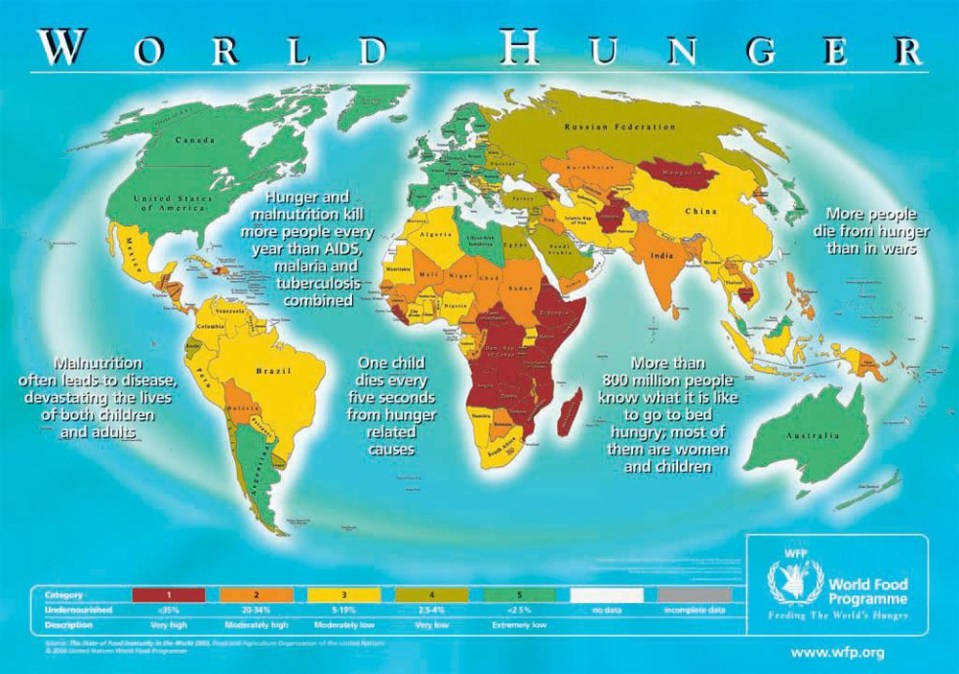
http://www.geographictravels.com/2008/07/world-hunger-map.html
Oh well now, would you look at that. Looks like it’s mostly black and Hispanic folks who are starving. And all those white folks are living life to the hilt, with full bellies and bright futures.
Must be a coincidence.
It’s not a coincidence. There is no coincidence that if you superimpose an IQ map over the world hunger map, that a super majority of the low IQ countries would have bad nutrition and be starving, whereas those higher IQ populations would have better nutrition and, therefore, higher IQs and lack of malnutrition and starvation. There are environmental factors involved in this, which I have gone through in my article IQ, Nutrition, Disease and Parasitic Load. Yes, those environmental variables decrease IQ; but in the case of Africa, if their full genotypic IQ were expressed in their phenotype, they would have an average IQ of 80, 9 points away from the lowest average European country which is Serbia at 89. They would then be able to have better functioning societies and not have to rely on outside aid. Though, their low IQs are the cause of evolution, those factors only cause about 10 points of difference (depending which of the variables I mentioned exist in those areas).
Let’s look at this map of food insecurity in the United States:
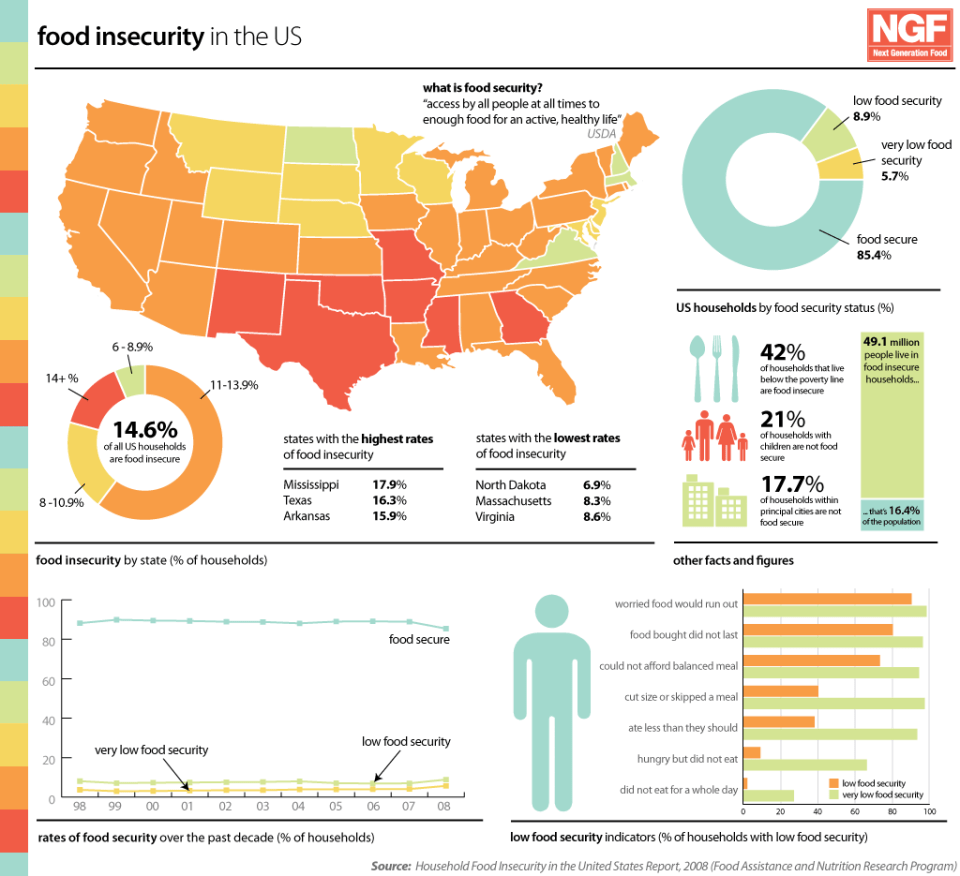
http://www.nextgenerationfood.com/news/food-insecurity-in-the-us/
Highest rates of food insecurity:
Mississippi
Texas
Arkansas
Lowest rates of food insecurity:
North Dakota
Massachusetts
Virginia
Gosh, I wonder where all the black and Hispanic people are? North Dakota, right?
According to the USDA, in a report titled Household Food Security in the United States in 2011, black and Hispanic families are more than twice as likely to experience food insecurity as white families (p. 11).
White 11.4% of families food insecure
Black 25.1%
Hispanic 26.2%
Gosh, I wonder where black and ‘Hispanic’ people are? Mississippi, Texas, and Arkansas right? What is the cause of the food insecurity? Lower intelligence. What is lower intelligence highly correlated with? Obesity.
If you keep in mind the fact that obesity (especially as the result of heavily processed, nutrient deficient junk foods) is also a form of malnutrition, it seems to me that there is an entirely different explanation for why certain racial groups might tend to perform lower on IQ tests.
Sure it is. A big cause for obesity is lowered intelligence (Kanazawa 2007). What he found was that those studies that concluded that obesity causes lowered intelligence only observed cross-sectional studies. Longitudinal studies that looked into the link between obesity and intelligence found that those who had low IQs since childhood then became obese later in life and that obesity does not lead to low IQ. The average IQ for an individual suffering from PWS is 65 (Butler, Lee and Whitman 2006, p. 13), so that is one reason they have a tendency to be obese. He states that those with IQs below 74 gained 5.19 BMI points, whereas those with IQs over above 126 gained 3.73 BMI points in 22 years, which is a statistically significant difference. Also noted, was that those at age 7 who had IQs above 125 had a 13.5 percent chance of being obese at age 51, whereas those with IQs below 74 at age 7 had a 31.9 percent chance of being obese. This clearly shows that those obese individuals who score low on IQ tests, more often than not, are obese because of their intelligence. The lack of ability to delay gratification is also correlated with low IQ (Mischel and Metzner, 1982).
Becoming obese is largely in part related to environmental factors, but there are correlates with obesity and genetic factors, as well as racial and ethnic differences in obesity, which are due, in part, to environmental as well as genetic factors. All of these factors fall back to a) lower intelligence, b) differing physiology and c) differing nutritional habits. Lower IQ is the main reason, though, for these differences which manifest itself as differences in scores of cognitive ability. Those with lower scores than have higher chances of having negative effects in life, such as low SES, higher chance of becoming obese and so on.
Correlation is not causation.
This is the liberals word phrase they use when they cannot contest data and know it so use the same old boring phrase. When you get the same result over and over using the scientific method, then it’s safe to say that the same results and conclusions that get brought up time and time again are real and cannot be explained away by the correlation does not mean causation line.
And furthermore, I haven’t read Richwine’s dissertation, nor do I plan to, so I don’t know if he offered any tentative explanations for his findings.
Didn’t even read it and is giving a critique of it. How does that work?
It looks to me like Richwine is a gigantic racist asshole, because he is using his findings to try and limit the opportunities for Hispanic people to come to the United States, because dumb spics.
Lower IQ people commit more crimes than do higher IQ people. This phenomenon is well-noted that those with lower intelligence commit crime, as the average IQ of a criminal in America, is 85, whereas the average IQ for a juvenile is 92. The average juvenile IQ is higher because more often than not, those who are habitual offenders in childhood become habitual offenders in adulthood, and at adulthood IQ drops from childhood where the environment was able to artificially boost their IQs.
What if I’m right? What if IQ differences are traceable to malnutrition? That would indicate a whole different set of interventions and policies than just turn them away.
You are part right, but that won’t put any big dent in any genetic/phenotypic IQ differences and still, mass immigration from South of the Border still wouldn’t be OK in the first place.
In shutting down the conversation about race and IQ, Harvard students are explicitly saying they don’t WANT to find a reason behind low performance on IQ tests amongst certain racial groups. They don’t CARE why some groups are not reaching their full human potential. They don’t give ONE SINGLE FUCK about anyone other than themselves. It could be as simple as making certain children have access to proper food and nutrition.
I at least give her credit for acknowledging the biological reality of race and the reality of IQ. But she thinks that malnutrition plays too big a part in the ethnic IQ gap than it does in reality.
As I have covered here before, people will do anything they can to deny the validity of IQ tests. However, their explanations cut it.
People who attempt to deny biological differences in intelligence because they strongly predict positive life outcomes will do anything to deny their validity. But that doesn’t change how strong a predictor they are in regards to predicting both positive and negative successes in life.
Those who attempt to deny any differences between races, like Chanda Chisala (I know you can see this Chanda, still waiting for a response to the criticism of your horrible article that “redneck genes” are the cause for the black-white IQ gap), who are wrong in their premises on the cause as well as how to fix the gap. They will do anything to attempt to explain away a gap which is, at least, 50 percent genetic in origin.
The attack on Jason Richwine is because, of course, he’s right. They don’t want to admit he is right so they do whatever they can to discredit his argument, by calling him a ‘racist’. But that doesn’t negate his data, and as seen above, any arguments against Richwine’s dissertation are unfounded.
Germany is going to begin IQ testing their immigrants, why can’t we?
 NotPoliticallyCorrect
