
Home » Posts tagged 'IQ' (Page 6)
Tag Archives: IQ
White People Not 100 Percent Human? Afrocentrist Debunked
850 words
I just came across this video on YouTube published yesterday called “White people are not 100% human (Race differences) (I.Q debunked)“, with, of course, outrageous claims (the usual from Afrocentrists). I already left a comment proving his nonsense incorrect, but I thought I’d further expound on it here.
His first ‘evidence’ that whites aren’t 100 percent human is showing some individuals who are born with tails. Outliers are meaningless, of course. The cause of the human tail is due to the unsuccessful inhibition of the Wnt3-a gene. When this gene isn’t successful in signaling the cell death of the tail in early embryonic development, a person is then born with a small vestigial tail. This doesn’t prove anything.
His next assertion is that since “94 percent of whites test positive for Rh blood type” and that “as a result, they are born with a tail”, then whites must have interbred with rhesus monkeys in the past. This is ridiculous. This blood type was named in error. The book Blood Groups and Red Cell Antigens sums it up nicely:
The Rh blood group is one of the most complex blood groups known in humans. From its discovery 60 years ago where it was named (in error) after the Rhesus monkey, it has become second in importance only to the ABO blood group in the field of transfusion medicine. It has remained of primary importance in obstetrics, being the main cause of hemolytic disease of the newborn (HDN).
…
It was wrongly thought that the agglutinating antibodies produced in the mother’s serum in response to her husbands RBCs were the same specificity as antibodies produced in various animals’ serum in response to RBCs from the Rhesus monkey. In error, the paternal antigen was named the Rhesus factor. By the time it was discovered that the mother’s antibodies were produced against a different antigen, the rhesus blood group terminology was being widely used. Therefore, instead of changing the name, it was abbreviated to the Rh blood group.
As you can see, this is another ridiculous and easily debunked claim. One only needs to do a bit of non-biased reading into something to get the truth, which some people are not capable of.
What he says next, I don’t really have a problem with. He just shows articles stating that Neanderthals had big brains to control their bodies and that they had a larger, elongated visual cortex. However, there is archeological evidence that our cognitive superiority over Neanderthals is a myth (Villa and Roebroeks, 2014). What he shows in this section is the truest thing he’ll say, though.
Then he shows how African immigrants to America have a higher educational achievement than whites and immigrant East Asians. However, it’s clear he’s not heard of super-selection. The people with the means to leave will, and, most likely, those with the means are the more intelligent ones in the group. We also can’t forget about ‘preferential treatment’, AKA Affirmative Action.
The concept of ‘multiple intelligences’ is then brought up. The originator of the theory, Howard Gardner, rejects general intelligence, dismisses factor analysis, doesn’t defend his theory with quantitative data, instead, drawing on anthropology to zoology findings for his claims, being completely devoid of any psychometric or quantitative data (Herrnstein and Murray, 1994: 18). The Alternative Hypothesis also has a thorough debunking of this claim.
He then makes the claim that hereditarians assume that environment/experience play no factor in performance on IQ tests/life success. We know that both the individual heritability is 80/20 genetics and environment, with the black-white gap being the same (Rushton and Jensen 2005: 279). Another easily refuted claim.
The term ‘inferior’ is brought up due to whites’ supposed ‘inferiority’, though we know that terms such as those have no basis in evolutionary biology.
He claims that a black man named Jesse Russel invented the cell phone, when in reality a white man named Martin Cooper did. He claims that Lewis Latimer invented the filament lightbulb, when a man named Joseph Swan obtained the patent in the UK in 1860. Of course, individual outliers are meaningless to group success, as they don’t reflect the group average as a whole, so these discussions are meaningless.
He finally claims that the “black Moors civilized Europe”. Europeans didn’t need to “be civilized”, I guess people don’t understand that empires/kingdoms rise and fall and go through highs and lows. That doesn’t stop people from pushing a narrative, though. Further, the Moors were not black. People love attempting to create their own fantasy history in which their biases are a reality.
I don’t know why people have to make these idiotic and easily refuted videos. Lies that push people further from the truth of racial differences, genetics, and history as a whole. Biases such as these just cloud people’s minds to the truth, and when the truth is shown to them, refuting their biases and twisting of history, genetics, and IQ, they then look at it as an attack on what they deem to be true despite all of the conflicting, non-biased evidence shown to them. Afrocentric loons need to be refuted, lest people believe their lies, misconceptions and twistings of history.
Is General Intelligence Domain-Specific?
1600 words
Is the human brain ‘special’? Not according to Herculano-Houzel; our brains are just linearly scaled-up primate brains. We have the number of neurons predicted for a primate of our body size. But what does this have to do with general intelligence? Evolutionary psychologists also contend that the human brain is not ‘special’; that it is an evolved organ just like the rest of our body. Satoshi Kanazawa (2003) proposed the ‘Savanna Hypothesis‘ which states that more intelligent people are better able to deal with ‘evolutionary novel’ situations (situations that we didn’t have to deal with in our ancestral African environment, for example) whereas he purports that general intelligence does not affect an individuals’ ability to deal with evolutionarily familiar entities and situations. I don’t really have a stance on it yet, though I do find it extremely interesting, with it making (intuitive) sense.
Kanazawa (2010) suggests that general intelligence may both be an evolved adaptation and an ‘individual-difference variable’. Evolutionary psychologists contend that evolved psychological adaptations are for the ancestral environment which was evolved in, not in any modern-day environment. Kanazawa (2010) writes:
The human brain has difficulty comprehending and dealing with entities and situations that did not exist in the ancestral environment. Burnham and Johnson (2005, pp. 130–131) referred to the same observation as the evolutionary legacy hypothesis, whereas Hagen and Hammerstein (2006, pp. 341–343) called it the mismatch hypothesis.
From an evolutionary perspective, this does make sense. A perfect example is Eurasian societies vs. African ones. you can see the evolutionary novelty in Eurasian civilizations, while African societies are much closer (though obviously not fully) to our ancestral environment. Thusly, since the situations found in Africa are not evolutionarily novel, it does not take high levels of g to survive in, while Eurasian societies (which are evolutionarily novel) take much higher levels of g to live and survive in.
Kanazawa rightly states that most evolutionary psychologists and biologists contend that there have been no changes to the human brain in the last 10,000 years, in line with his Savanna Hypothesis. However, as I’m sure all readers of my blog know, there were sweeping changes in the last 10,000 years in the human genome due to the advent of agriculture, and, obviously, new alleles have appeared in our genome, however “it is not clear whether these new alleles have led to the emergence of new evolved psychological mechanisms in the last 10,000 years.”
General intelligence poses a problem for evo psych since evolutionary psychologists contend that “the human brain consists of domain-specific evolved psychological mechanisms” which evolved specifically to solve adaptive problems such as survival and fitness. Thusly, Kanazawa proposes in contrast to other evolutionary psychologists that general intelligence evolved as a domain-specific adaptation to deal with evolutionary novel problems. So, Kanazawa says, our ancestors didn’t really need to think inorder to solve recurring problems. However, he talks about three major evolutionarily novel situations that needed reasoning and higher intelligence to solve:
1. Lightning has struck a tree near the camp and set it on fire. The fire is now spreading to the dry underbrush. What should I do? How can I stop the spread of the fire? How can I and my family escape it? (Since lightning never strikes the same place twice, this is guaranteed to be a nonrecurrent problem.)
2. We are in the middle of the severest drought in a hundred years. Nuts and berries at our normal places of gathering, which are usually plentiful, are not growing at all, and animals are scarce as well. We are running out of food because none of our normal sources of food are working. What else can we eat? What else is safe to eat? How else can we procure food?
3. A flash flood has caused the river to swell to several times its normal width, and I am trapped on one side of it while my entire band is on the other side. It is imperative that I rejoin them soon. How can I cross the rapid river? Should I walk across it? Or should I construct some sort of buoyant vehicle to use to get across it? If so, what kind of material should I use? Wood? Stones?
These are great examples of ‘novel’ situations that may have arisen, in which our ancestors needed to ‘think outside of the box’ in order to survive. Situations such as this may be why general intelligence evolved as a domain-specific adaptation for ‘evolutionarily novel’ situations. Clearly, when such situations arose, our ancestors who could reason better at the time these unfamiliar events happened would survive and pass on their genes while the ones who could not die and got selected out of the gene pool. So general intelligence may have evolved to solve these new and unfamiliar problems that plagued out ancestors. What this suggests is that intelligent people are better than less intelligent people at solving problems only if they are evolutionarily novel. On the other hand, situations that are evolutionarily familiar to us do not take higher levels of g to solve.
For example, more intelligent individuals are no better than less intelligent individuals in finding and keeping mates, but they may be better at using computer dating services. Three recent studies, employing widely varied methods, have all shown that the average intelligence of a population appears to be a strong function of the evolutionary novelty of its environment (Ash & Gallup, 2007; D. H. Bailey & Geary, 2009; Kanazawa, 2008).
Who is more successful, on average, over another in modern society? I don’t even need to say it, the more intelligent person. However, if there was an evolutionarily familiar problem there would be no difference in figuring out how to solve the problem, because evolution has already ‘outfitted’ a way to deal with them, without logical reasoning.
Kanazawa then talks about evolutionary adaptations such as bipedalism (we all walk, but some of us are better runners than others); vision (we can all see, but some have better vision than others); and language (we all speak, but some people are more proficient in their language and learn it earlier than others). These are all adaptations, but there is extensive individual variation between them. Furthermore, the first evolved psychological mechanism to be discovered was cheater detection, to know if you got cheated while in a ‘social contract’ with another individual. Another evolved adaptation is theory of mind. People with Asperger’s syndrome, for instance, differ in the capacity of their theory of mind. Kanazawa asks:
If so, can such individual differences in the evolved psychological mechanism of theory of mind be heritable, since we already know that autism and Asperger’s syndrome may be heritable (A. Bailey et al., 1995; Folstein & Rutter, 1988)?
A very interesting question. Of course, since it’s #2017, we have made great strides in these fields and we know these two conditions to be highly heritable. Can the same be said for theory of mind? That is a question that I will return to in the future.
Kanazawa’s hypothesis does make a lot of sense, and there is empirical evidence to back his assertions. His hypothesis proposes that evolutionarily familair situations do noot take any higher levels of general intelligence to solve, whereas novel situations do. Think about that. Society is the ultimate evolutionary novelty. Who succeeds the most, on average, in society? The more intelligent.
Go outside. Look around you. Can you tell me which things were in our ancestral environment? Trees? Grass? Not really, as they aren’t the same exact kinds as we know from the savanna. The only thing that is constant is: men, women, boys and girls.
This can, however, be said in another way. Our current environment is an evolutionary mismatch. We are evolved for our past environments, and as we all know, evolution is non-teleological—meaning there is no direction. So we are not selected for possible future environments, as there is no knowledge for what the future holds due to contingencies of ‘just history’. Anything can happen in the future, we don’t have any knowledge of any future occurences. These can be said to be mismatches, or novelties, and those who are more intelligent reason more logically due to the fact that they are more adept at surviving evolutionary novel situations. Kanazawa’s theory provides a wealth of information and evidence to back his assertion that general intelligence is domain-specific.
This is yet another piece of evidence that our brain is not special. Why continue believing that our brain is special, even when there is evidence mounting against it? Our brains evolved and were selected for just like any other organ in our body, just like it was for every single organism on earth. Race-realists like to say “How can egalitarians believe that we stopped evolving at the neck for 50,000 years?” Well to those race-realists who contend that our brains are ‘special’, I say to them: “How can our brain be ‘special’ when it’s an evolved organ just like any other in our body and was subject to the same (or similar) evolutionary selective pressures?”
In sum, the brain has problems dealing with things that were not in its ancestral environment. However, those who are more intelligent will have an easier time dealing with evolutionarily novel situations in comparison to people with lower intelligence. Look at places in Africa where development is still low. They clearly don’t need high levels of g to survive, as it’s pretty close to the ancestral environment. Conversely, Eurasian societies are much more complex and thus, evolutionarily novel. This may be one reason that explains societal differences between these populations. It is an interesting question to consider, which I will return to in the future.
Fatty Acids and PISA Math Performance
1800 words
There are much more interesting theories of the evolution of hominin intelligence other than the tiring (yawn) cold winter theory. Last month I wrote on why men are attracted to a low waist-to-hip ratio in women. However, the relationship between gluteofemoral fat (fat in the thighs and buttocks) is only part of the story on how DHA and fatty acids (FAs) drove our brain growth and our evolution as a whole. Tonight I will talk about how fatty acids predict ‘cognitive performance’ (it’s PISA, ugh) in a sample of 28 countries, particularly the positive relationship between n-3 (Omega-3s) and intelligence and the negative relationship between n-6 and intelligence. I will then talk about the traditional Standard American Diet (the SAD diet [apt name]) and how it affects American intelligence on a nation-wide level. Finally, I will talk about the best diet to maximize cognition in growing babes and women.
Lassek and Gaulin (2013) used the 2009 PISA data to infer cognitive abilities for 28 countries (ugh, I’d like to see a study like this done with actual IQ tests). They also searched for studies that showed data providing “maternal milk DHA DHA values as percentages of total fatty acids in 50 countries”. Further, to control for SES influences on cognitive performance, they controlled for GDP/PC (gross domestic product per country) and “educational expenditures per pupil.” They further controlled for the possible effect of macronutrients on maternal milk DHA levels, they included estimates for each country of the average amount of kcal consumed from protein, fat, and carbohydrates. To explore the relationship between DHA and cognitive ability, they included foodstuffs high in n-3—fish, eggs, poultry, red meat, and milk which also contain DPA depending on the type of feed the animal is given. There is also a ‘metabolic competition’ between n-3 and n-6 fatty acids, so they also included total animal and vegetable fat as well as vegetable oils.
Lassek and Gaulin (2013) found that GDP/PC, expenditures per student and DHA were significant predictors of (PISA) math scores, whereas macronutrient content showed no correlation.
The predictive value of milk DHA on cognitive ability is only weak when either two of the SES variables are added in the multiple regression. When milk arachidonic (a type of Omega-6 fatty acid) is added to the regression, it is negatively correlated with math scores but not significantly (so it wasn’t added to the table below).
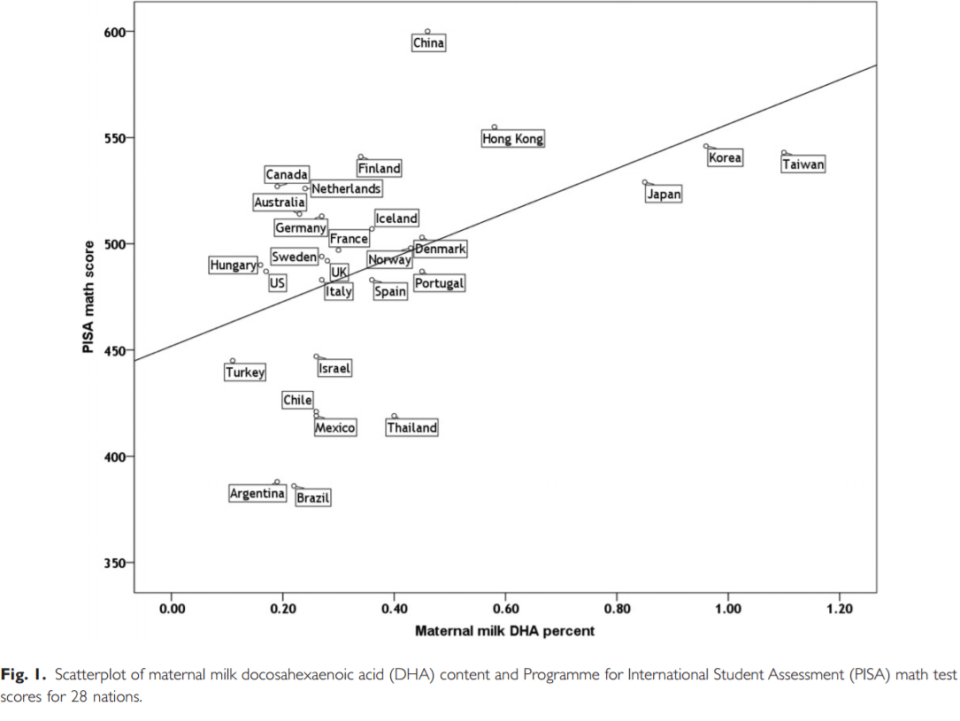
So countries with lower maternal milk levels of DHA score lower on the maths section of the PISA exam (not an IQ test, but it’s ‘good enough’). Knowing what is known about the effects of DHA on cognitive abilities, countries who have higher maternal milk levels of DPA do score higher on the maths section of the PISA exam.
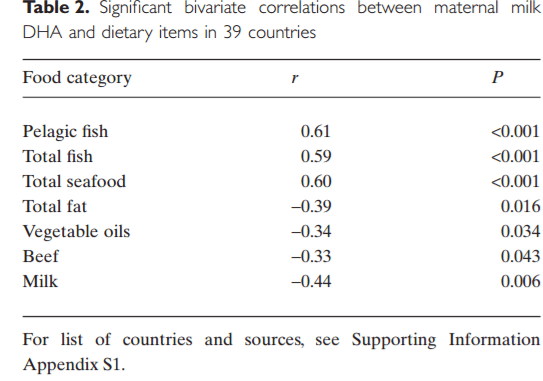
Table 2 shows the correlations between grams per capita per day of food consumption in the data set they used and maternal milk DHA. As you can see, total fish and seafood consumption are substantially correlated with total milk DHA, while foods that are high in n-6 show medium negative correlations with maternal milk DHA. The combination of foods that explain the most of the variance in maternal milk DHA is total fat consumed and total fish consumed. This explained 61 percent of the variance in maternal milk DHA across countries.
Not surprisingly, foodstuffs high in n-6 showed significant negative correlations on maternal milk DHA. “Any regression including total fish or seafood, and vegetable oils, animal fat or milk consistently explains at least half of the variance in milk DHA, with fish or seafood having positive beta coefficients and the remainder having negative beta coefficients.”
The study showed that a country’s balance of n-3 and n-6 was strongly related to the students’ math performance on the PISA. This relationship between milk DHA and cognitive performance remains sufficient even after controlling for national wealth, macro intake and investment in education. The availability of DHA in populations is a better predictor of test scores than are SES factors (which I’ve covered here on Italian IQ), though SES explains a considerable portion of the variance, it’s not as much as the overall DHA levels by country. Furthermore, maternal DHA levels are strongly correlated to per capita fish and seafood consumption while a negative correlation was noticed with the intake of more vegetable oils, fat, and beef, which suggests ‘metabolic competition’ between the n-3 and n-6 fatty acids.
There are, of course, many possible errors with the study such as maternal milk DHA values not reflecting the total DHA in that population as a whole; measures of extracting milk fatty acids differed between studies; test results being due to sampling error; and finally the per capita consumption of foods is based on food disappearance, not amount of food consumed. However, even with the faults of the study, it’s still very interesting and I hope they do further work with actual measures of cognitive ability. Despite the pitfalls of the study (the main one being the use of PISA to test ‘cognitive abilities’), this is a very interesting study. I eventually hope that a study similar to this one is undertaken with actual measures of cognitive ability and not PISA scores.
We now know that n-6 is negatively linked with brain performance, and that n-3 is positively linked. What does this say about America?
As I’m sure all of you are aware of, America is one of the fattest nations in the world. Not surprisingly, Americans consume extremely low levels of seafood (very high in DPA) and more foods high in n-6 (Papanikolaou et al, 2014). High levels of n-3 (which we do not get enough of in America) and n-6 are correlated with obesity (Simopoulos, 2016). So not only do we have a current dysgenic effect in America due to decreased fertility of the more intelligent (which is also part of the reason why we have the effect of dysgenic fertility in America), obesity is also driven by high levels of n-6 in the Western diet, which then causes obesity down the generations (Massiera et al, 2010).
I also previously wrote on agriculture and diseases of civilization. Our hunter-gatherer ancestors were all around healthier than we were. This, clearly, is due to the fact that they ate a more natural diet and not one full of processed, insulin-spiking carbohydrates, among other things. Our hunter-gatherer ancestors consumed n-3 and n-6 at equal amounts (1:1) (Kris-Etherson, et al 2000). As I documented in my article on agriculture and disease, HGs had low to nonexistent rates of the diseases that plague us in our modern societies today. However, around 140 years ago, we entered the Industrial Revolution. The paradigm shift that this caused was huge. We began consuming less n-3 (fish and other assorted seafood and nuts among other foods) while n-6 intake increased (beef, grains, carbohydrates) (Kris-Etherson, et al 2000). Moreover, the ratio of n-6 to n-3 from the years 1935 to 1939 were 8.4 to 1, whereas from the years 1935 to 1985, the ratio increased to about 10 percent (Raper et al, 2013). We Americans also consume 20 percent of our daily kcal from one ‘food’ source—soybean oil—with almost 9 percent of the total kcal coming from n-6 linoleic acids (United States Department of Agriculture, 2007). The typical American diet contains about 26 percent more n-6 than n-3, and people wonder why we are slowly getting dumber (which is, obviously, a side effect of civilization). So our n-6 consumption is about 26 percent higher than it was when we were still hunter-gatherers. Does anyone still wonder why diseases of civilization exist and why hunter-gatherers have low to nonexistent rates of the diseases that plague us?
The bioavailability of n-6 is dependent on the amount of n-3 in fatty tissue (Hibbeln et al, 2006). This goes back to the ‘metabolic competition’ mentioned earlier. N-3 also makes up 10 percent of the overall brain weight since the first neurons evolved in an environment high in n-3. N-3 fatty acids were positively related to test scores in both men and women, while n-6 showed the reverse relationship (with a stronger effect in females). Furthermore, in female children, the effect of n-3 intake were twice as strong in comparison to male children, which also exceeded the negative effects of lead exposure, suggesting that higher consumption of foods rich in n-3 while consuming fewer foods rich in n-6 will improve cognitive abilities (Lassek and Gaulin, 2011).
The preponderance of evidence suggests that if parents want to have the healthiest and smartest babes that a pregnant woman should consume a lot of seafood while avoiding vegetable oils, total fat and milk (fat, milk and beef moreso from animals that are grain-fed) Grassfed beef has higher levels of n-3, which will balance out the levels of n-6 in the beef. So if you want your family to have the highest cognition possible, eat more fish and less grain-fed beef and animal products.
In sum, if you want the healthiest, most intelligent family you can possibly have, the most important factor is…diet. Diets high in n-3 and low in n-6 are extremely solid predictors of cognitive performance. Due to the ‘meatbolic competition’ between the two fatty acids. This is because n-6 accumulates in the blood and tissue lipids exacerbating the competiiton between linolic acid (the most common form of n-6) and n-3 for metabolism and acylation into tissue lipds (Innis, 2014). Our HG ancestors had lower rates of n-6 in their diets than we do today, along with low to nonexistent disease rates. This is due to the availability of n-6 in the modern diet, which was unknown to our ancestors. Yes, seafood intake had the biggest effect on the PISA math scores, which, in my opinion (I need to look at the data), is due in part to poverty. I’m very critical of PISA, especially as a measure of cognitive abilities, but this study is solid, even though it has pitfalls. I hope a study using an actual IQ test is done (and not Richard Lynn IQ tests that use children, a robust adult sample is the only thing that will satisfy me) to see if the results will be replicated.
I also think it’d be extremely interesting to get a representative sample from each country studied and somehow make it so that all maternal DHA levels are the same and then administer the tests. This way, we can see how all groups perform with the same amounts of DHA (and to see how much of an effect that DHA really does have). Furthermore, nutritonally impoverished countries will not have access to the high-quality foods with more DHA and healthy fatty acids that lead to higher cognitive function.
It’s clear: if you want the healthiest family you could possibly have, consume more seafood.
Neurons By Race
1100 words
With all of my recent articles on neurons and brain size, I’m now asking the following question: do neurons differ by race? The races of man differ on most all other variables, why not this one?
As we would have it, there are racial differences in total brain neurons.In 1970, an anti-hereditarian (Tobias) estimated the number of “excess neurons” available to different populations for processing bodily information, which Rushton (1988; 1997: 114) averaged to find: 8,550 for blacks, 8,660 for whites and 8,900 for Asians (in millions of excess neurons). A difference of 100-200 million neurons would be enough to explain away racial differences in achievement, for one. Two, these differences could also explain differences in intelligence. Rushton (1997: 133) writes:
This means that on this estimate, Mongoloids, who average 1,364 cm3 have 13.767 billion cortical neurons (13.767 x 10⁹ ). Caucasoids who average 1,347 cm3 have 13.665 billion such neurons, 102 million less than Mongoloids. Negroids who average 1,267 cm3 , have 13.185 billion cerebral neurons, 582 million less than Mongoloids and 480 million less than Caucasoids.
Of course, Rushton’s citation of Jerison, I will leave alone now that we know that encephilazation quotient has problems. Rushton (1997: 133) writes:
The half-billion neuron difference between Mongoloids and Negroids are probably all “excess neurons” because, as mentioned, Mongoloids are often shorter in height and lighter in weight than Negroids. The Mongoloid-Negroid difference in brain size across so many estimation procedures is striking
Of course, small differences in brain size would translate to differences differences neuronal count (in the hundreds of millions), which would then affect intelligence.
Moreover, since whites have a greater volume in their prefrontal cortex (Vint, 1934). Using Herculano-Houzel’s favorite definition for intelligence, from MIT physicist Alex Wissner-Gross:
The ability to plan for the future, a significant function of prefrontal regions of the cortex, may be key indeed. According to the best definition I have come across so far, put forward by MIT physicist Alex Wissner-Gross, intelligence is the ability to make decisions that maximize future freedom of action—that is, decisions that keep most doors open for the future. (Herculano-Houzel, 2016: 122-123)
You can see the difference in behavior and action in the races; how one race has the ability to make decisions to maximize future ability of action—and those peoples with a smaller prefrontal cortex won’t have this ability (or it will be greatly hampered due to its small size and amount of neurons it has).
With a smaller, less developed frontal lobe and less overall neurons in it than a brain belonging to a European or Asian, this may then account for overall racial differences in intelligence. The few hundred million difference in neurons may be the missing piece to the puzzle here.Neurons transmit information to other nerves and muscle cells. Neurons have cell bodies, axons and dendrites. The more neurons (that’s also packed into a smaller brain, neuron packing density) in the brain, the better connectivity you have between different areas of the brain, allowing for fast reaction times (Asians beat whites who beat blacks, Rushton and Jensen, 2005: 240).
Remember how I said that the brain uses a certain amount of watts; well I’d assume that the different races would use differing amount of power for their brain due to differing number of neurons in them. Their brain is not as metabolically expensive. Larger brains are more intelligent than smaller brains ONLY BECAUSE there is a higher chance for there to be more neurons in the larger brain than the smaller one. With the average cranial capacity (blacks: 1267 cc, 13,185 million neurons; whites: 1347 cc, 13,665 million neurons, and Asians: 1,364, 13,767 million neurons). (Rushton and Jensen, 2005: 265, table 3) So as you can see, these differences are enough to account for racial differences in achievement.
A bigger brain would mean, more likely, more neurons which would then be able to power the brain and the body more efficiently. The more neurons one has, the more likely it it that they are intelligent as they have more neuronal pathways. The average cranial capcities of the races show that there are neuronal differences between them, which these neuronal differences then are the cause for racial differences, with the brain size itself being only a proxy, not an actual indicator of intelligence. The brain size doesn’t matter as much as the amount of neurons in the brain.
A difference in the brain of 100 grams is enough to account for 550 million cortical neurons (!!) (Jensen, 1998b: 438). But that ignores sex differences and neuronal density. However, I’d assume that there will be at least small differences in neuron count, especially from Rushton’s data from Race, Evolution and Behavior. Jensen (1998) also writes on page 439:
I have not found any investigation of racial differences in neuron density that, as in the case of sex differences, would offset the racial difference in brain weight or volume.
So neuronal density by brain weight is a great proxy.
Racial differences in intelligence don’t come down to brain size; they come down to total neuron amount in the brain; differences in size in certain parts of the brain critical to intelligence and amount of neurons in those critical portions of the brain. I’ve yet to come across a source talking about the different number of neurons in the brain by race, but when I do I will update this article. From what we know, we can make the assumption that blacks have less packing density as well as a smaller number of neurons in their PFC and cerebral cortex. Psychopathy is associated with abnormalities in the PFC; maybe, along with less intelligence, blacks would be more likely to be psychopathic? This also echoes what Richard Lynn says about Race and Psychopathic Personality:
There is a difference between blacks and whites—analogous to the difference in intelligence—in psychopathic personality considered as a personality trait. Both psychopathic personality and intelligence are bell curves with different means and distributions among blacks and whites. For intelligence, the mean and distribution are both lower among blacks. For psychopathic personality, the mean and distribution are higher among blacks. The effect of this is that there are more black psychopaths and more psychopathic behavior among blacks.
Neuronal differences and size of the PFC more than account for differences in psychopathy rates as well as differences in intelligence and scholastic achievement. This could, in part, explain the black-white IQ gap. Since the total number of neurons in the brain dictates, theoretically speaking, how well an organism can process information, and blacks have a smaller PFC (related to future time preference); and since blacks have less cortical neurons than Whites or Asians, this is one large reason why black are less intelligent, on average, than the other races of Man.
What If the Hereditarian Hypothesis Is True?
1800 words
In 2005, Linda Gottfredson published What If the Hereditarian Hypothesis Is True? in the journal Psychology, Public Policy, and Law defending Rushton and Jensen’s (2005) conclusions on the black-white IQ gap. This gap in intelligence between the races has been noticed since the IQ test’s inception 100 years ago. What if the hereditarian hypothesis is true—what if there are genetic differences in intelligence between races? How should society handle such a ‘discovery’ if one were to occur?
In Rushton and Jensen’s opus paper, they didn’t set out to prove that the hereditarian hypothesis is true, rather they set out to prove that the hereditarian hypothesis—which states that 50 percent of racial differences in intelligence come down to genetic factors with environment dictating the other 50 percent—is more tenable the culture-only hypothesis—0 percent genetics 100 percent environment. Gottfredson states that the hereditarian hypothesis becomes scientifically plausible “only after five evidentiary requisites have been met”: “IQ differences among same-race individuals represent (a) real, (b) functionally important, and (c) substantially genetic differences in general intelligence (the g factor), and mean IQ differences between the races likewise reflect (d) real and (e) functionally important differences on the same g factor.” (Gottfredson, 2005: 311) The past one hundred years of intelligence testing has proven all of this. The black-white differences in intelligence are on subtests that are more heritable, proving a genetic component.
The hereditarian hypothesis has been proven by adoption studies such as the Minnesota Transracial Adoption Study, to differences overall in IQ tests, to differences in life success etc. Environmentalists believe it’s ‘racism’ or ‘classism’ that’s the cause for racial/ethnic/class differences in achievement, when a genetic explanation makes a lot more sense.
The Denial of the Hereditarian Hypothesis
The denial of the hereditarian hypothesis has greatly harmed American society. Before the push for multiculturalism in the 60s, a genetic reason for racial/class differences was widely accepted. Minorities couldn’t perform well in school in comparison to whites because they had lower innate g. The difference in g causes differences in wealth attainment, salary, mortality, fitness, educational attainment, and other pertinent achievements. This then leads to programs with an abysmal ‘success rate’, such as Head Start. Head Start does not work, its gains fade away in a few years after the program. It’s time to stop Head Start, because it makes people believe that parental intervention can have any kind of effect on a young child, when it’s shown that these so-called gains fade away in a few years as the heritability of intelligence increases. Individuals differ on g, races differ on g, there are differences in achievement and more people in one SES bracket and other people in another SES bracket and it’s down to g. Denying the hereditarian hypothesis wastes taxpayer money as more and more money goes towards programs like Head Start that don’t do anything to close any of the gaps they promise to close.
Academic achievement in math, science, art, humanities, and second language were all shared by the same genes. They found that 60 percent of the results in GCSE scores were attributed to genetic factors. Genes and not upbringing had more of an effect on the scores one receives on the GCSE.
Moreover, other behavioral traits such as psychopathology and personality also account for genetic influence on GCSE scores beyond that predicted by intelligence. This shows that ‘nature’ wins out in the nature-nurture debate. If individual differences in test scores are largely determined by genetics, why not the black-white difference?
Individuals nor groups are ever ‘equal’ in terms of any capacity. One will be better at something than someone else, and that will largely be determined by genetic factors. Training and repetition brings out the best in one that’s genetically inclined to excel. We accept genetic differences for differences in sports, such as sprinting and distance running. They are genetically inclined to excel at those competitions due to fast and slow twitch muscle fibers. Take Usain Bolt. Do you think anyone can train to get to that level? Do you think random Joe can just wake up one day and decide to try to be the fastest man in the world? If you say no, you’re a hereditarian. Of course Bolt’s training makes him better, but without his genetics, he wouldn’t be the fastest man in the world.
Now take the genetic differences from sports (that any sane person would recognize), and think about that in regards to brain power. We are talking about 2 groups that have been genetically isolated for tens of thousands of years. They had to do different things to survive and both faced different selective pressures that would have an effect on intelligence.
The worldwide differences in IQ between East Asians, Europeans and Africans; an inverse correlation between the race differences and brain attributes and black-white-East Asian differences in body maturation; . 2 and .4 correlations with skull size and in vivo brain volume, moderately high correlation of .6 to .7 of different IQ test’s g loadings on the magnitude of the black-white-East Asian differences as well as the measures of the subtests being rooted in biological and genetic processes; rising heritability of IQ; differences in crime, gestation, and sex ratio at birth, law-abidingness, marital stability; and a genetic divergence of world population groups during evolution. The most telling one is the last one, genetic divergence of world population groups during evolution. These differences in the brain are rooted in genetic factors. The hereditarian hypothesis fully explains within and between group differences in achievement and intelligence. No “culture-only” hypothesis could ever convince me otherwise.
Richard Nisbett has attempted to say that the hereditarian hypothesis is wrong and that culture-only theory is the only game in town. He couldn’t be more wrong. Citing studies like Moore and Eyferth to make your case against the hereditarian hypothesis won’t get you anywhere. They had a smaller sample size, and some of the subjects were extremely young. Environmentalists use these studies to say that the difference in IQ comes down to a type of ‘ghetto’ environment that saps American blacks’ intellect and that raised away from that type of environment, they’d be able to score on par with whites. Except that’s not what was found in the Minnesota Transracial Adoption Study. This is the only study to test the children again at age 17, when genetics would be taking its full effect. The racial gap in intelligence still stayed the same (Rushton and Jensen, 2005: 258). I’ve written about the strong evidence for the hereditarian hypothesis in regards to adoption studies and how they support the hypothesis that genetics, and not culture, are the cause for differences in intelligence.
If the Hereditarian Hypothesis is Accepted What Policies Should Change?
If the general public were to ever accept a genetic hypothesis for individual and group differences as a whole, then affirmative action and other such programs that shoehorn kids with lower ability into schools should be abolished and these spots should be filled on merit. Sure there would be fewer blacks and more whites, Jews, Asians, than blacks, ‘Hispanics’ and others but that’s how a merit-based society looks, not one based on feelings and imaginary causes of racism as the culprit for any types of intellectual downfalls. When we come to our senses with genetics and educational achievement and intelligence—which should be coming soon due to the advent of CRISPR—then America can start to become less polarized, in my opinion, on the so-called ‘racist system’ ‘holding down’ minorities. Maybe if people/groups accepted they were less intelligent and it was due majorly to genetic factors, then some of this racial animosity between groups in America will die down. That’s an extremely far reach, though, and I can see them then arguing that accepting by accepting the hereditarian hypothesis then we should continue these programs.
That’s an extremely far reach, though, and I can see them then arguing that accepting by accepting the hereditarian hypothesis then we should continue these programs due to genetic differences. They would say “Well, as a group, we are less inclined to make it into higher areas of learning so we, therefore, should continue to receive these benefits.” To that I would say you’ve been taking advantage of these benefits for 50 years and what’s changed? Billions of dollars have been spent on affirmative action and related cases since the 60s and what has changed? These groups still complain and talk about being oppressed by ‘the man’ not getting what they want. Yet there is an ongoing racial preference for blacks and ‘Hispanics’ over whites and Asians in US medical schools. This is all an effect of affirmative action and the policies it brings to American institutions. Admission into places of higher learning should be completely merit-based, not based on what racial/ethnic group you belong to. That in and of itself is continuing the so-called ‘racism’ and ‘prejudiced attitudes’ that people complain about since they insist on having special privileges based on their ancestral background.
If we were to accept the hereditarian hypothesis as a country, I’d hope to see an abolishment of affirmative action, Head Start, and related programs that do not work. The acceptance of the hereditarian hypothesis would only be a net gain over time, as people would learn to not blame ‘the man’ on their problems, but would look to better themselves in ways that accentuate their strengths. Since any attempt at raising scholastic achievement has failed due to the heritability of intelligence and how it increases as one ages (which is why Head Start doesn’t work and should be abolished) once this is accepted then other avenues can be taken to address these issues that don’t focus on attempting to raise scores. Gottfredson states at the end of her paper that we should have targeted intellectual support for those with an IQ below 80. She also says we should make some jobs less complex, ie “inadequate or overly complex labeling, instructions, and forms”, target training and education towards people with that level of intelligence, and provide more assistance in daily living matters, This can increase their QoL and ability to attain meaningful employment.
She sees a more positive outlook in the future than I do. I see things become more stratified as automation rolls out. This will have the lower IQ people out of work, while the higher IQ people still are sitting well at the top due to the increasingly complex society that we make for ourselves. Accepting the hereditarian hypothesis can ease this slightly by targeting programs at the less intellectually inclined as well as attempt to soften the claims of ‘racism’ when this starts to really become noticeable. The only way to explain such a disparity is with a genetic hypothesis, at least 50/50 genetics culture. The culture-only theory has no leg to stand on. Once we accept that individual and group differences are due to genetics, then we can begin to accept some of the differences in our society in terms of class and race.
A Reversal of the FLynn Effect?
2600 words
As I showed back in September, FLynn (“FLynn” to give Richard Lynn the credit of noticing it as well) losses were not due to immigration, but due to dysgenic effects (and partly to do with nutrition). One must wonder: When will the FLynn Effect stop—and reverse? It looks like it will happen sooner, rather than later. A new paper just released today, Survey of expert opinion on intelligence: The FLynn effect and the future of intelligence by Rindermann, Becker and Coyle (2016) talks about the future of this FLynn Effect. What did they find?
The FLynn Effect is a slight increase in IQ scores—about .3 points per decade—and is due to better nutrition (the biggest cause in my opinion), health, living standards and education. Contrary to popular belief, education DOES have an effect on intelligence. If one is educated, they are able to reach their genetic max. The authors state:
The decline of the FLynn effect in developed countries, and its increase in developing regions with currently lower than average ability levels (e.g., Africa), may lead to a narrowing of international gaps (Meisenberg and Woodley, 2013 and Rindermann, 2013).
Now, I didn’t need a scientific paper to tell me this, it’s just common knowledge. I do believe that the gap will obviously close between countries, as a lot of the countries with lower average IQs are near the equator and have to deal with inadequate nutrition, diseases and parasitic load, and as these geographic areas come go from third-world to first-world countries, their IQ scores will increase as well. The genetic IQs of peoples in the equatorial localities around the world will increase as their standard of living increases, and as dysgenic fertility continues in first-world countries, these populations will close the gap a bit, but barring some extraordinary circumstances, I don’t see this occurring.
Going to quote this whole paragraph as it has huge implications (and I’m sure the full paper will get taken down eventually so I’m saving this in my files on my computer):
Future IQ changes are linked to past cognitive development and expected demographic changes, which permit predictions of future development at the country level (e.g., + 0.45 to + 0.76 IQ points per decade in the US; Rindermann & Pichelmann, 2015). Demographic changes may be linked to genetic effects, which are influenced by asymmetric birth rates in modern populations (e.g., Lynn, 2011 and Nyborg, 2012). Negative genetic effects on intergenerational changes in ability are plausibly linked to: (a) parent-children correlations in intelligence (for individuals about r = 0.40 to 0.50; Plomin, DeFries, Knopik, & Neiderhiser, 2013, p. 76), (b) the well established theory that intelligence is not only transmitted via family environment but also via genes (backed by twin research; Plomin et al., 2013) and (c) better educated and more intelligent adults having fewer children (e.g., Loehlin, 1997). If these three statements are correct, negative genetic effects on intergenerational intelligence development are a logically compelling consequence. Such negative effects may be aggravated, if migration produces brain drain in developing countries, which occurs when high ability people in developing countries immigrate to developed countries (e.g., Kapur & McHale, 2005), or if low ability people (relative to the level in destination countries) immigrate to developed countries, a pattern observed in the West over the last decades (e.g., Rindermann & Thompson, 2016).
There is no doubt in my mind that immigration from MENA countries WILL have a negative effect, but as I showed back in September, the alarm bells shouldn’t be ringing yet because they didn’t even put a dent in the scores yet.
So we have better educated and more intelligent adults having fewer children (CLASH AKA r/K selection theory in action), intelligence being transmitted through genes (well known by now) and parent children correlations that show that the negative generational effects on intelligence for the native population is due to the differential birth rate between lower and higher IQ (educated) people. Of course these effects can be heightened by mass immigration (as is currently happening in the West at the moment), but I’ve shown, at least with the case of France, that mass immigration is not a cause, YET, of decreasing IQ scores and that dysgenics is a better explanation.
The authors state why they did a survey of expert opinion:
An expert survey has three advantages. First, according to the Spearman-Brown prediction formula, increases in the items being analyzed (here expert ratings) will increase the reliability of the final averaged result. Second, the average result of an expert survey may be closer to the truth than the average result of a non-expert survey (e.g., Rindermann et al., 2016). Third, in the current study, data collection procedures were designed to ensure anonymity, which reduced pressure for socially desirable responses and increased the likelihood of obtaining honest opinions about controversial issues.
Expert surveys are great ways to get information—especially on such a controversial topic such as intelligence. With an anonymized survey, people won’t have to worry about losing their careers or have hecklers attempt to ruin their careers and make life a living hell for them as happened to Rushton and Jensen during their heyday.
Question 1 is:
“In your opinion, what are the most plausible scientific theories about the Flynn-effect (FLynn-effect) in 20th century?” Predetermined answers were presented in the following order: (1) rising standard of living (wealth), (2) decline of group-inequality, (3) genetic changes, (4) better education and school-systems, (5) longer education for more people, (6) better education in families, (7) better nutrition, (8) better health, (9) smaller families, (10) TV and media, (11) computer (and similar as smartphones), (12) immigration, (13) more test experience, (14) more educated parents, and (15) more intelligent social environment. Respondents rated each factor on a scale of 1 (“not important/not true”) to 9 (“important/true”).
A dearth of answers, I’ll answer what I think.
I believe that the most plausible theories on the rise in IQ across the globe have to do with better nutrition (in my opinion, the most important variable), better health (goes back to my disease and parasitic load post), and better education and school systems. I rank these as 9,9, and 6 respectively.
The second question:
The second question concerned a possible end of the FLynn effect: “In your opinion, if there is an end or retrograde of the FLynn-effect in industrial nations, what are the most plausible scientific theories to explain this development?” The following options were presented: (1) decline in educational values, (2) worse education and school-systems, (3) worse education in families, (4) worse nutrition, (5) worse health, (6) low intelligent adults have more children than others (genetic effect), (7) low intelligent adults have more children than others (socialization effect), (8) TV and media, and (9) migration.” The rating scale varied between 1 (“not important/not true”) to 9 (“important/true”).
In my opinion, if there is an end (there is) or retrograde to the FLynn effect, the causes are low intelligent adults haveing more children than others (genetic effect), worse health (partly), worse nutrition, and migration (a small effect as I’ve documented—so far). I rate these 9, 5, 7, and 2 respectively.
The third and final question:
Finally, we asked participants about the future development of intelligence in different world regions. The question was: “What is your opinion on the future development of intelligence up to 2100 in listed regions? Please mark the IQ points how much average cognitive ability will increase (right side) or decrease (left side) or remain stable (0) (in today’s norms).” The predetermined scale of IQ changes consisted of 19 levels, from “− 29 or less” to “+ 29 or more”. The world regions comprised: (1) Western countries in general, (2) Scandinavia, (3) West-Middle Europe, (4) Southern Europe, (5) Eastern Europe, (6) USA, (7) Canada, (8) Latin America, (9) Australia (10) East Asia (China, Japan, Korea), (11) Africa, (12) Arabian and Muslim countries, (13) India, and (14) Israel.
Western countries in general will get less intelligent with more illegal (and legal) immigration); Scandinavia I’d say will not get less intelligent as the US as quickly, but with more immigrants going to these countries the IQ scores will decrease further (along with dysgenic fertility); West-Middle Europe I’d say they both will continue to get less intelligent as the birth rates are seriously below replacement in these countries (1.3 TFR in Germany, for example); Southern Europe I can see getting less intelligent due to more immigration along with dysgenic fertility but they will fight back against immigration more than other Western countries; Eastern Europe is the same as Southern Europe; As more and more immigration from the South of the border occurs and as our ‘Presidents’ allow more MENA immigration into our country, our IQ as a whole will fall sooner rather than later; Canada has the same situation as the US; I can see it staying stable in Latin America, Australia I see as being just like the US and Canada; East Asia I see staying the same and allowing no immigration as the West does and will conserve their IQ; Africa is on the rise mostly due to the Chinese and along with better infrastructure and nutrition, some of their woes will be ameliorated, not enough to ‘bridge the IQ gap’, however; Arabian and Muslim countries I see decreasing sightly; the more they inbreed, they will become slightly less intelligent (as well as the factor of nutrition) I see India on the rise as they are showing a lot of development in the South of the country as well as getting better nutrition; and finally Israel I see getting slightly more intelligent due to them disallowing immigration (or being strongly selective) and as the Ashkenazi population increases, the country as a whole will get more intelligent.
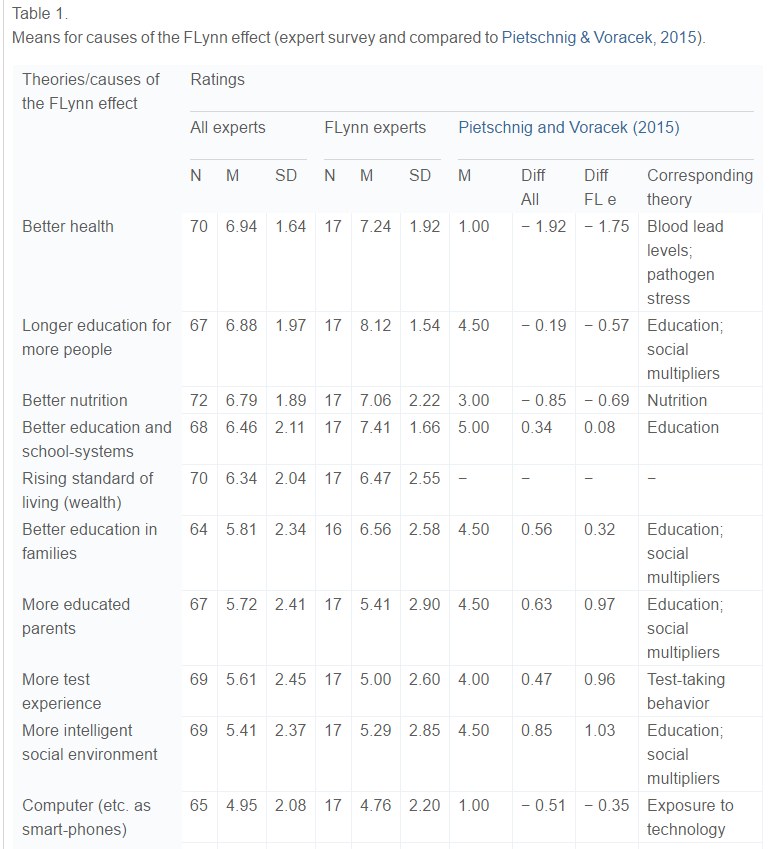
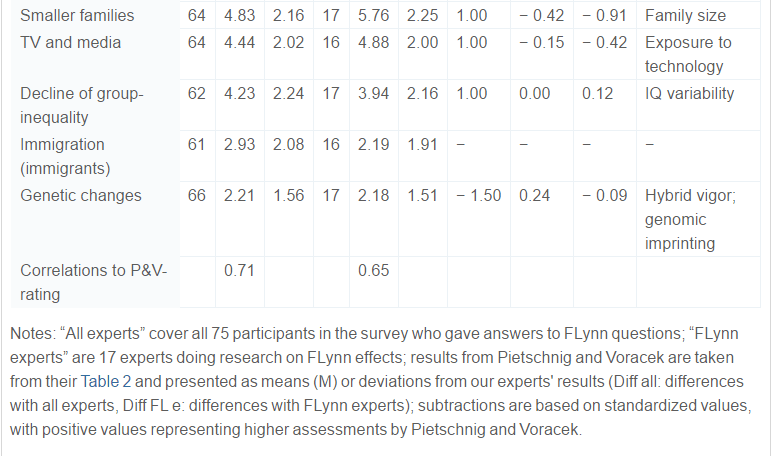
Table 1 shows the experts’ ratings in what the causes for the FLynn effect are. Better health, longer education, improved schooling and better nutrition were the main causes the experts thought were enough to explain the FLynn gains. These variables, in concert, definitely would cause this secular increase in intelligence scores over the past 100 years. Do note that the gains we see in IQ scores have started around the industrial revolution, which better nutrition and institutions (schools) happened in these industrialized countries. Now, think to the third-world countries that are ‘coming up’, basically their own ‘industrial revolution’, they will have their own IQ increases as seen in Africa currently BUT, this will not close any GENETIC gaps in intelligence.
Then this comment:
In the comments, one expert mentioned that the FLynn effect is mostly on non-g factors, suggesting that the increases are not general and therefore less relevant for everyday life achievement.
Echoes what JP Rushton (who was not mentioned in this paper, dissapointed at that, however Jensen was) said back in 2000: “Flynn Effects Not Genetic and Unrelated to Race Differences“. Rushton and Jensen had a long back-and-forth with Dickens and Flynn on the nature of the black-white IQ gap, which I will cover eventually. I love how someone echoed Rushton’s sentiments on the FE, since Rushton was not cited in the paper.
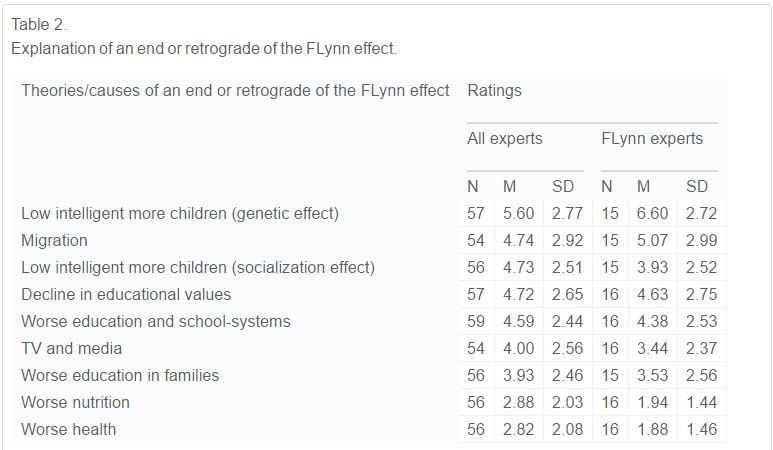
Table 2 shows less intelligent adults having more children along with migration. This explanation is two-fold here. Migrants, more often than not, are super-selected. That is, they are a highly selected immigrant sample and are not representative of their native population. But as more and more migration occurs, the super-selected sample will no longer be migrating and the low IQ peoples then flood the countries and lower the average IQ (this will decrease QoL as well, among numerous other variables). The next explanation was low intelligence, more children. This is a huge cause for FLynn loses, as I’ve covered already. Health and nutrition showed less support, all though I slightly disagree with health not being a factor. If there were no health/parasite/disease problem, they’d reach their genetic IQ. I’d love to see a huge study one day on a representative sample of people from all geographic locations across the world and see what they would look like in first-world conditions.
The authors state:
The correlation between the ratings of all experts and FLynn experts was very high (r = 0.97, N = 9 categories, p < 0.001), as was the correlation between FLynn experts (N = 16) and the other cognitive ability researchers (N = 43) (r = 0.91, N = 9 categories, p = 0.001). The high correlations indicate that the pattern of ratings was consistent across different groups of experts.
And some comments:
In the comments, two raters noted that education, nutrition and health have not become worse but that their benefits are diminishing and have reached a ceiling, comparable to other trends in post World War II development. One person mentioned that dysgenic changes are accumulating across generations.
The dysgenic changes across generations are the culprit in my opinion.
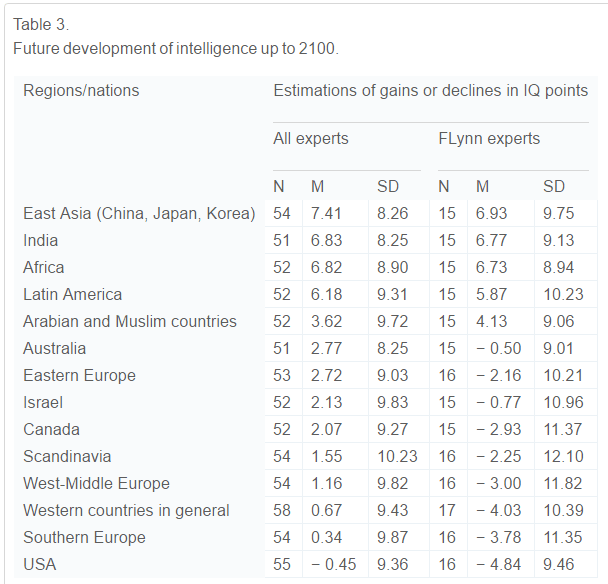
Finally, in table 3 the FLynn experts and the rest of the experts thought that East Asia, India, Africa, Latin America and Muslim/Arab countries will show the largest gains in IQ by 2100. You may be wondering “Why East Asia?” Because a lot of the East Asian population does live in poverty (especially in rural China), and better nutrition among other factors that occur in urban environments. The FLynn experts also expect huge decreases in Israel, Canada, Australia, all parts of Europe and all Western countries in general. I agree with this trend (except for Israel, I see nothing that’s occurring there to drop their IQ in the next 84 years).
Quoting the last paragraph of the discussion:
However, such an outlook may be moderated by country-level policies. Such policies may include incentives that increase birth rates among well educated people, incentives that attract high ability immigrants, and improved environmental conditions for cognitive development at all levels of the ability spectrum, including for the gifted and less advantaged. Improved environmental conditions may have especially large effects on less educated and lower ability people, who are more likely to benefit from improvements in health, sanitation, and education (e.g., Glewwe & Kremer, 2006).
I fully agree with this. We do need incentives for the more intelligent, more educated people to need to have children so we can offset the current trend towards idiocracy that America and the West as a whole is currently observing.
The truth about genetics and IQ is slowly coming out, and with this paper coming out today (November 14, 2016) I hope to see more talk about intelligence as a whole and what mass immigration will do to the overall intelligence of a country as well as stopping (or doing extremely limited) immigration as I have proposed here).
Taking back our countries’ spirit—i.e., halting mass immigration—is not only important for the preservation of people and culture, but is important for the average IQ of the nation, as mass immigration from less intelligent countries is a net negative for the richer and more intelligent countries that get emigrated to (I mean, would you go anywhere else?). Eventually, not too far off in the near future, I see our countries in the West getting more sensible, HBD-aware politicians and activists that understand the truth of this research. Once that occurs, immigration can be halted and we can take care of that one problem for declining national IQs. After that, we need policies that encourage the intelligent and educated to have more children, maybe giving them a tax break on the number of children they conceive. There are numerous ways to go about these problems and differing solutions to help tide them. I just hope that we get people in power who actually realize this and are actually for preservation of people and country. Remember, that the environments we live in are products of our genetics. “Race is not a socal construct, society is a racial construct. Society and culture derive from race/biology.”—Douglas Whitman
To top it off, not surprisingly, when the researchers had anonymity, many (unsurprisingly) said that the cause for the retrograde of the FLynn effect was genetic (people with lower intelligence conceiving more children). It’s sad that people have to say these things anonymously, but one day we’ll be able to talk about these real things in society, I just hope it’s soon before it can’t be reversed.
North/South Differences in Italian IQ: Is Richard Lynn Right? Part II
1500 words
In my first article on this matter, I showed how Richard Lynn claims the average IQ in Italy is around “89-92” for Sicily and the South and around 103 for the North. I showed how he was wrong and what data he overlooked to fit his hypothesis. Lynn’s 2011 article IQs in Italy are higher in the north: A reply to Felice and Giugliano was a reply to Myth and reality: A response to Lynn on the determinants of Italy’s North–South imbalances. Felice and Giugliano brought up Lynn’s four main theses: a) the South’s “economic backwardness” in terms of economics ‘throughout history’; b) the evidence provided by Lynn wasn’t enough to ‘prove’ a cause of lower IQ for S. Italians; c) the evidence provided by Lynn wasn’t enough to show that S. Italians score lower than N. Italians; and d) the supposed ‘high rates of MENA admixture’ in S. Italians. I blew up all of these claims in the beginning of the year, more specifically I blew up up the claims about MENA admixture back in January. I’ll be going through Lynn’s 2010b article correcting any discrepancies. It’s worth noting that he still pushes the so-called ‘MENA admixture’ as being a substantial CAUSAL factor when there is NO evidence for this big of a ‘gap’ between the North and the South. The Lynn quotes will be from his 2010 paper linked above. I had also thought that ‘migrants’ from MENA countries could have contributed to the gap between the North and South, but since this isn’t the case for France then it shouldn’t be so for Italy. However, since Italy is a hub for these people when they first illegally enter Europe, they may stay and get counted as citizens and the children of these immigrants grow up and get accounted in the data. This is plausible, since a lot of ‘migrants’ may stay where they first get which is Southern Europe, mainly Sicily and Southern Italy.
We now present new data showing that IQs are higher in the north of Italy than in the south. In the previous study, data were presented for 12 Italian regions from the PISA (Program for International Student Assessment) 2006 study of the reading comprehension, mathematics and science performance of 15 year olds, regarded as measures of intelligence. We are now able to give similar data on the reading comprehension, mathematics and science performance of 15 year olds in 20 Italian regions obtained in the 2009 PISA study (OECD, 2010). These are given in Table 1. This shows, reading from left to right, the latitude of the Italian regions, the mean PISA scores for 12 regions for 2006 given in Lynn (2010a), the mean scores of 15 year olds on reading comprehension, mathematics and science understanding for the 20 Italian regions obtained in the 2009 PISA study, and the averages of the three 2009 PISA scores given because it provides a convenient summary of the scores on the three tests.
I already went through this in my previous article, but for clarity, I’ll go through this again.
Cornoldi, Giofrè, and Martini (2013) showed how there are problems inferring Italian IQ from the very PISA data that Lynn cites. There was a relevant decrease between the North and South. If the PISA test showed genetic proclivities between the North and South, why was there a relevant decrease in the three-year period? Because it is not an intelligence test, but a test of educational achievement. D’Amico et al (2011) conclude:
Our examination of intelligence test score differences between the north and south of Italy led to results that are very different from those reached by Lynn (2010a). Our results demonstrate that by using intelligence tests to assess differences in ability rather than using achievement scores as a proxy for intelligence, children from the south of Italy did not earn lower scores than those from the north of Italy. Rather, they were even higher in Raven’s CPM. However, we see no advantage in claiming that children in the south are “more intelligent” than children in the north, because these groups are different on a number of variables (e.g., environmental factors, educational influences, composition of the samples) that influence differences in test scores.
Either no difference or Southern Italians scored higher. When using purer measures of intelligence (Raven’s Progressive Matrices) so-called “differences” in “intelligence” disappear.
Lynn says:
It will be noted that the regional differences in both language and math ability increase with age. For example, in language ability the regional differences in the youngest children (P2) range between 1.6 and −3.8, a difference of 5.4, while the differences in the oldest children (2S) range between 3.6 and −4.4, a difference of 8.0. Similarly, in math ability the regional differences in the youngest children (P2) range between 0.8 and −1.0, a difference of 1.8, while the differences in the oldest children (2S) range between 4.3 and −5.4, a difference of 9.7. These age differences would be predicted from the thesis that the regional differences have a genetic basis, because the heritability of intelligence increases during childhood (Plomin, DeFries, & McClearn, 1980, p. 334).
On other measures of achievement, such as the INVALSI examinations, Southern Italians do not score lower, and in some cases may even score higher (Robinson, Saggino, and Tommasi (2011). Moreover, the N/S differences in ‘cognitive ability’ don’t exist at age 7, the IQ/income relationship didn’t exist in the past, and the MENA admixture in Southern Italians is minute (Daniel and Malanima, 2011). The so-called MENA admixture that Nordicists and Lynn like to say is the subject of my next point.
Lynn says:
Further data for the proportion of North African ancestry in the Italian regions are available in the frequency of the haplogroup E1b1b allele. This is a marker for North African ancestry, where it reaches frequencies above 50% and peaks at around 82% in Tunisia (Zalloua et al., 2008). The frequencies of the haplogroup xR1 and the E1b1b alleles are taken from Capelli et al. (2006), Capelli et al. (2007), Di Giacomo et al. (2003), Balaresque et al. (2010), Scozzari et al. (2001), and Semino et al. (2000). These data are given in columns 11 and 12 of Table 1 and the correlations between these and the other variables are given in Table 2.
As said and cited above, the so-called admixture from MENA populations in Southern Italians accounts for an extremely small fraction of the overall Southern Italian genome. The cause for lower achievement (“IQ” according to Lynn) in Southern Italians rests on this very pertinent point. And it’s wrong. Furthermore, and this is for Sicilians, the contribution of their genome by the Greeks is 37 percent, with the North African contribution being 6 percent. Daniel and Malanima (2011) ask ” Can the Greek heritage to the Western culture really be associated to a lower IQ?” The answer is, clearly, no. Moreover, a Central Italian province has the highest amount of MENA admixture, yet they have higher scores than Southern Italy. What does that tell you?
Richard Lynn’s Italian IQ data is garbage. Purer measures of intelligence such as Raven’s Colored Progressive Matrices show a decrease in the “intelligence gap” and in some cases, Southern Italians score higher than Northern Italians. When using measures of “IQ” from PISA data, these so-called differences disappear. Lynn’s data he cites in his 2010a paper don’t control for socio-cultural differences and school quality. There is numerous data that suggests the school quality in Southern Italy is worse than that of the North; this difference in school quality then affects educational achievement. Since PISA is a test of educational achievement and not intelligence (D’Amico et al, 2011), what accounts for these differences in achievement in the various studies may (and in my opinion, does) account for the differences in educational achievement between Northern and Southern Italians. The measurements in various studies may be influenced by the larger between-schools variability that is present in the South (Cornoldi et al, 2010; Daniel and Malanima 2011).
Finally, some people may point to the GDP differences between North and South Italy as proof of genetic/intelligence differences between them. However, the Mafia accounts for around a 20 percent drop in GDP in Southern Italy. To say that any differences in GDP can be accounted for without first controlling for things like this is dishonest. The presence of Mafia in areas shows lower growth and a sharper increase in murders. Each time homicides rise, GDP falls between 16-20 percent (Pinolli 2012). The presence of the Mafia had a devastating effect on the economies in that area between the 70s and 00s.
In sum, PISA is garbage to infer intelligence from as they are tests of achievement and not intelligence. Other tests of achievement show a decrease in the gap and/or Southern Italians scoring higher. Moreover, no substantial genetic differences exist between the North and the South, falsifying Lynn’s thesis for the causality of the differences between the North and the South. The oft-cited GDP difference between Northern and Southern Italy can be accounted for by the presence of the Mafia. Whenever the murder rate rises (due to Mafia activity), the GDP decreases. None of these factors have been taken into account and they explain the difference between the North and the South. It is environmental in nature–not genetic. Lynn’s Italian IQ data is garbage and should not be cited. It’s just a Nordicist fantasy that Southern Italians score lower than Nothern Italians.
Is HBD an Ideology of Hatred and Racism?: A Reply to Robert Lindsay
1900 words
100 posts!! A nice special post today, Robert Lindsay’s accusation of HBD being ‘racist’ is on the table today. As always, I want to hear what you want me to write on so send me an email, address is in the sidebar.
Robert Lindsay asks “Is HBD an Ideology of Hatred and Racism?” It, of course, isn’t. Today I’ll rebut his piece saying that it is “hatred and ‘racism’ (whatever that means)”. He says that HBDers who resist ‘racism’ (which I will address later) are “swimming against the tide” and “probably have to exercise a bit of self-control to not go over to the dark side.” What is he even talking about? What “dark side” is there? Being ‘racist’?
This is because HBD facts tend to lend pretty regularly to quite a bit of racism and the hatred that goes along with it. And if you notice, the more hardcore the HBD’er is, the more racist they tend to sound.
Of course these facts lead to ‘racism’, however, these ‘racists’ will be ‘racist’ with or without the facts of HBD. I will touch more on that later. In the meantime, he says “the more hardcore the HBD’er is, the more racist they tend to sound.” Robert, are you just making broad generalizations? Do you have anything to back your claim on this statement? Or are you just talking out of your ass?
HBD in and of itself is not racist of course, not in any sane sense of the word.
I agree with him saying that the Left has destroyed any “meaning” that the word “racist” has. However, even without the overstating of the word “racist”, HBD itself would not be a racist ideology. It is, however, racist to the average person who doesn’t know the science involved in racial differences. The Merriam-Webster Dictionary has two definitions for ‘racism’. It defines ‘racism’ as:
a belief that race is the primary determinant of human traits and capacities and that racial differences produce an inherent superiority of a particular race
- Racial prejudice or discrimination
Well, “superiority” is meaningless. Race is not a primary determinant of human traits as there is a lot of crossover. However, there are racial/ethnic differences in phenotype which of course are caused by differences in genotype. That is not up for discussion, but the term ‘inherent superiority’ is.
Of course to the average person, HBD is seen as ‘racist’. But is researching/reading about human differences and being interested in their causes and what they mean today really ‘racist’ or a want to learn more about human evolution and how and why we got here?
But the ones who are very deep into it and talk about it all the time, well, it’s quite clear that they have a pretty low opinion of NAM’s. Even worse, a lot of them are just out and out racists. Some are even vicious racists. And almost all of them have the worst rightwing politics, usually Libertarian, that you could imagine.
‘Racists.’ There’s that word again. I did say at the beginning of the year that we should petition to have ‘racist’ changed to ‘ethnocentrist’, as what is being described when one cries ‘racist’ is actually ethnocentrism in action. This is mediated by the brain hormone oxytocin. I would wager that ‘racists’ and other, closely related people (ie Arab Muslims with high consang rates) would have higher levels of this brain hormone. This would be the reason why these groups stick to those who are phenotypically to themselves; it’s hormonally driven, like most, if not all things in life. Stop using the word ‘racist’ and use ‘ethnocentrist’ as it makes much more sense.
More importantly, HBD is a profoundly pessimistic doctrine. Just to give you an idea, they hate the idea that the environment or even free will has any role to play human affairs. Look at how furious they get about the Flynn Effect. Look at all the bending over, twisting themselves into weird yoga positions, hand waving, magic wand waving, “Don’t look over there”, and “just-so” explanations they have come up for to deny what is an obvious rise in human intelligence. The idea that the environment could actually increase intelligence fills them with rage because they are all wrapped up in this “intelligence is purely genetic” argument. (Bold is my emphasis)
Yes HBD is pessimistic, as is life, Robert. Who hates the idea that environment has any role in intelligence? Any sensible individual would acknowledge that environment does play a role, but would also know that intelligence is highly heritable. I’m pretty sure he’s just talking about the average ‘racist’, as I’ve never seen an HBD blogger every state that intelligence is fully genetic. Sure there are some intelligence researchers (a minority) who believe that intelligence is fully genetic but just like extreme environmentalism in regards to causes for IQ, extreme hereditarianism is also a stupid view to hold. Genes and environment interact to give the phenotype. We can take an African from, say, South Africa and place him in America. Due to better nutrition and better schooling among other things (like lessened parasitic load and disease), in my opinion African IQ would be about 10 points higher, give or take a few points. We know that environment and genetics (GxE) affects all phenotypic traits, but those like Robert like to play up Flynn gains as if they are on actual g – they aren’t. Flynn Effects are not genetic and are UNRELATED to race differences (Rushton, 2000).
On another note, I seem to have been wrong with my statement that Flynn gains were 3 points per decade in every country. I would wager that since intelligence is affected by nutrition that those countries with lower Flynn gains that showed the least improvement with nutrition would show the lowest IQ gains. I will write on this in the future.
Of course, that argument is a death knell for Blacks and other NAM’s. These people have enough problems as it is, but HBD just drives a stake through their heart to make sure the Black man (or other NAM’s) never rises again. It pretty much condemns them forever as genetic inferiors in sense.
They have enough problems as it is because of their biology which HBD speaks about, the supposed ‘racist ideology’. It pretty much does ‘condemn them’ as ‘genetic ‘inferiors” (whatever that means), but that’s Nature! Nature is not a kind Mistress. Nature is harsh, nature doesn’t care about feelings.
Intelligence isn’t either fully genetic nor fully environmental, but shifted considerably over to the hereditarian position.
It says “niggers ain’t got no brains,” and while that may be true in a very ugly and racist sense that most us don’t want to think about, instead, the HBD’er is overjoyed at this fact. “Black people are stupid!” he hollers to the sky with joy. “And they will stay that way forever!” he yells gleefully. “Environment can’t help them. They are condemned!” At this point, he is nearly gleeful and ready to party.
I laughed out loud at this. Environment can help, to a point (if they come from Africa or some other down-and-out place), but mainly, as seen in the Minnesota Transracial Adoption Study, blacks didn’t end up doing better than whites when environments were equalized.
And most of them are racist lousy people, but they are quite smug about their racism because now their racism is given the imprimatur of science. “If science says it’s true, I can’t be racist,” he chortles.
Idiotic. Everyone is ‘ethnocentric’ to a degree, whether consciously or subconsciously. Robert, you are an HBDer yourself whether you admit it or not since you recognize racial differences, so I guess you are ‘racist’.
After all, science isn’t racist. I agree, but distortion of science for racist means sure is, and delighting in the disturbing “racist truths” of science is doubly so.
Sure, gay men are at very high risk of HIV, and up to 20% are infected. That’s a fact of science. So does that make you want to get up and party for 30 days and 30 nights? I hope not, and if so, you are one ugly homophobe.
Science is not racist. But, as Leftists love saying ‘Data isn’t racist, interpretation of it is!!!’ is idiotic. Of course a lot of people distort racial science, but that doesn’t mean that it’s ‘wrong’. Like with making myths on how Europeans were always in Europe 40kya (not true) or how Europeans were always white (not true) he is right here. Most people do not keep up to date on the newest data that comes out so they still hold to these ‘mythologies’ and ‘identity politics’ and push out outdated and straight untrue statements. But all that means is that they are extremely misinformed.
What would I do with that stat of gay men and HIV? Be cautious around gays, just like I’d be cautious around blacks knowing how much crime and murder they committ as a group. This is a sane position to hold. One group is overrepresented in a certain (negative) stat? Keep an eye out while around those of that demographic. That makes sense. Self-preservation always wins out. Robert is of course using the Leftist playbook on ‘racist’ namecalling. Most everything in this article I’ve seen around countless times being spewed to any HBDer who went against conventional wisdom. The term ‘racist’ is just used as a silencing tactic. Robert, you are a Leftist HBDer. You do know that a lot people you align yourself with politically consider you ‘racist’ right?
This notion that anyone who believes HBD is ‘racist’ or any other buzzword is used to shut down any and all discussions on matters. Something that, it seems, flew over his head. When one cannot rebut something an HBDer puts out, they get called ‘racist’. However, the term is pretty much close to meaningless nowadays as it’s been so overused by the Left. All of the HBD bloggers I follow are not racist (hell, one who is most certainly not racist is PumpkinPerson who has a very unhealthy obsession with Oprah. =^) You know it’s true, PP). Others like Razib Khan, JayMan, hbd chick, and Cochran and Harpending, just to name a few, have gotten numerous accusations of being racist. Hell, Razib Khan was hired and fired the same day by the NYT after going on board as a science writer when someone discovered his ‘racist’ writings.
Whether or not people believe HBD doesn’t change how true it is. Racial and ethnic differences still persist, so by just disregarding it we completely go over causes of it other than ‘systemic racism’!!! HBD is true and a valid, non-racist (whatever that means) ideology. We segregate with people like us. Hell, even you, Robert, prefer whites over others (oh no, racist!!!!). Once we start understanding how and why people are ethnocentric (with oxytocin playing the main role), then we can have a more peaceful society as we understand causes for actions, both negative and positive, and better curb violence.
HBD itself is not a hateful ideology, it’s just one based on facts and solid reasoning. Just because people use HBD to justify their own preconceived notions or to use ‘hate facts’ doesn’t mean that it’s a racist ideology. Nice job using the word ‘racist’ as invented by Trotsky. But knowing your political leanings, Robert, that’s AOK, right?
It’s worth noting that Robert banned me for my politics. He claims his comments are ‘free speech’, yet when I said the truth about socialism and the amount of deaths it caused (way more than National Socialism), I got an immediate ban. Truth hurts, huh?
Guns, Germs, and Steel: A Refutation
Of course the allegations of “racism” arise, as usual when in discussions of racial differences in intelligence and level of civilizational achievement. Rushton also says:
Racial differences in brain size and IQ map very closely to the same cultural histories Diamond explains. Although Diamond dismisses such research as "loathsome", he fails to tell his readers what, if anything, might be scientifically wrong with any of it. One hundred years of research has
established that East Asians and Europeans average higher IQs than do Africans. East Asians, measured in North America and in Pacific Rim
countries, typically average IQs in the range of 101 to 111. Caucasoid populations in North America, Europe, and Australasia typically average
IQs from 85 to 115 with an overall mean of 100. African populations living south of the Sahara, in North America, in the Caribbean, and in Britain
typically have mean IQs from 70 to 90.Racial differences in brain size and IQ map very closely to the same cultural histories Diamond explains. Although Diamond dismisses such research as
"loathsome", he fails to tell his readers what, if anything, might be scientifically wrong with any of it. One hundred years of research has established that East Asians and Europeans average higher IQs than do Africans. East Asians, measured in North America and in Pacific Rim
countries, typically average IQs in the range of 101 to 111.  Caucasoid populations in North America, Europe, and Australasia typically average IQs from 85 to 115 with an overall mean of 100. African populations living south of the Sahara, in North America, in the Caribbean, and in Britain typically have mean IQs from 70 to 90.
Japan’s Population Decline and r/K Selection Theory
Edit, 7/18/17: r/K selection theory has been rebutted.
r/K Selection Theory: A Response to Rushton
E.O. Wilson on Rushton’s r/K Theory and More on Endemic Disease
r/K Selection Theory: A Response to Anonymous Conservative
r/K Selection Theory: A Response to Truth-Justice
r/K theory doesn’t apply to humans and if it did, Mongoloids would be r and Africans would be K. Cold with is an agent of r selection while endemic disease is an agent of K selection. Rushton used a debunked “continuum” for the basis for his theory and completely changed r and K. However it’s wrong. Rushton was wrong. Anonymous Conservative is wrong. Anyone who uses those two in reference to r/K is wrong by proxy since r/K is a debunked paradigm.
Japan has had a population crisis for a few years. Japan’s fertility rate was 1.4 in 2014. To have enough children to keep the population stable, the Total Fertility Rate (TFR) needs to be 2.1. As a country industrializes and becomes more prosperous, the TFR drops as higher IQ follows better nutrition. As a nation industrializes and becomes more complex, the attention of the populace shifts from one of having children and a family to one of success and intellectualism. As this occurs, the birth rate drops because the more intelligent a population is, the more likely it is for them to pursue higher education or monetary achievement. Clearly, the main reason Japan has concerns with their TFR is due to their high intelligence.
The Japan Times reported yesterday that almost half of single young men and women were virgins. A survey of Japanese men and women aged 18-34 found that 70 percent of unmarried men and 60 percent of unmarried women were not in a relationship. Also discovered, 42 percent of the men and 42.4 percent of the women admitted to being virgins. The survey was taken before in 2010, with 36.2 percent of men and 38.7 percent of women admitting to being virgins.
These surveys have been carried out every 5 years since 1987. Then, the rate of men who said they had no partner was 48.6 percent and for women it was 39.5 percent. The survey, which was conducted last June and accounted for 8,754 single people and 6,598 married couples across Japan, also found that 90 percent of the respondents wanted to get married “sometime in the future”, but for some people, this turns out to be a mistake. Moreover, 30 percent of the 2,760 men and 26 percent of the 2,570 women polled said they were not currently looking for a relationship. The increase in singles was most noted in the 20s, when women are the most fertile. The Prime Minister of Japan, Shinzo Abe also said he wants to increase the birthrate from 1.4 to 1.8 by 2025.
Lastly, the study found that the number of children for couples marries for 15 to 19 years was 1.94, a record low. This study did not ask questions about same-sex partners, but what we are concerned about is the TFR and how it’s driven by evolution, so this is a non-factor.
Japan’s population is dramatically shrinking. In 2010, they had a population of 128 million but by their 2015 census, they had a population of 127 million. This is due to the increase in virgins and an aging population. Why is this happening?
This is, of course, driven by r/K Selection Theory. Rushton thought of r/K Selection Theory, also known as Differential K theory, in 1985 with a paper titled Differential K Theory: The Sociobiology of Individual and Group Differences. Organisms can be r-selected, K-selected or somewhere in between. Humans as a species are K-selected, but some human races and ethnies are more K-selected than others.
Africans are r-selected, meaning that they have many children while not investing too much time in their offspring. They evolved to be r-selected to offset the high mortality rate due to the harshness of Sub-Saharan Africa. Due to this, black girls have an earlier menarche (period) so they can reproduce more to a) offset the high mortality rate and b) have a chance to reproduce more due to the high mortality rate. This is driven by disease, malnutrition, and parasitic load, which also drop IQ and contribute to the high birth rate since lower IQ populations have more children.
Caucasians are in the middle of r and K, and have fewer children and put more energy into caring for each one. This goes back to evolving in the Ice Age where cooperation and altruism were needed. More attention to children was needed for Eurasians evolving back then due to the harsh conditions of the Ice Age. So, a higher IQ evolved, and along with the higher IQ came a bigger brain. The bigger brains of Eurasians led to children being born earlier, and a bigger brain allowed for better care for the children along with numerous other positive variables to help survive in the harsh weather. Moreover, genes from Neanderthals are responsible for a 1 percent decrease in historic fitness (biological fitness) in Eurasian populations.
Orientals (Japanese, Chinese, Koreans) are further K than Caucasians are. This is reflected in brain size, where more K-selected populations have bigger brains, thus they can think further into the future and maximize care for their children. The opposite holds true for blacks. This is reflected in modern-day, first-world life where blacks have too many children to care for on their own accord and whites and Orientals have fewer children and put more investment into their children .
It’s not only Japan that’s having this problem with birthrates. It’s all of the West and East Asia. Higher IQ societies do have a longer life expectancy, while lower IQ societies have a lower one. Then, as described above, the lower IQ populations have more children to offset the mortality rate.
Japan’s birthrate concerns are due largely in part to genetic factors. This is currently occurring in all high IQ populations. Those populations have a large elderly population, with the young demographic quickly shrinking. Seeing this gradient throughout the world with IQ and fertility rates, we can make some general conclusions:
- Low IQ populations have more children while high IQ populations have less children.
- High IQ populations are more likely to have a large subset of virgins, as seen with this article. Lower IQ populations lose their virginity earlier.
This can be seen with the CLASH (CLimate, Aggression and Self-control in Humans) model (Van Lange, Rinderu, and Bushmen 2016). According the the CIA World Fact book 2014, in countries closer to the equator, the average age of first birth for a female was 20 years of age (the countries were the Gaza strip, Liberia, Bangladesh, Kenya, Mali, Tanzania, Uganda and various other middle African countries). Conversely, for countries further away from the equator, the average age of first birth was 28 years of age (Japan, Canada, and most European countries). Those populations that evolved in warmer climates where the changes in season are minimal with unpredictable harshness tend to enact faster life history strategies than those in colder climates.
Moreover, a slower life history strategy (K-selection), under a predictable environment would be better to enhance inclusive fitness. There is a growing body of evidence that predictable environments promote K-selection “in terms of lower mortality, morbidity, delayed reproduction, and a higher contribution towards one’s social capital.” This can be seen with the trends in Western and East Asian countries.
The trend that Japan is facing can be reversed with incentives for reproduction. However, the more intelligent a society is, the fewer children it will have due to evolutionary pressures. Is there a happy medium between IQ and fertility rates, where the population isn’t too dumb and the fertility rates aren’t too low? I’ll explore that in the future.
 NotPoliticallyCorrect
2650 words
I first heard of Guns, Germs, and Steel (GGS) a few years ago while in a discussion about racial differences and their causes. The person linked me to the Wikipedia page on GGS. I then looked into it and it seemed to be an OK hypothesis. However, after reading the book myself and then reading critiques he got on it, it’s clear that Jared Diamond was attempting to pick and choose what to put into the book to come to the conclusions he already has come to. There are some interesting tidbits in the books, my favorite being only 14 beasts of burden have been tamed for human use out of 148 large wild creatures that can be tamed. Other than that, he spins facts and data from hereditarians to suit his own agenda.
Jared Diamond started wondering about the reasons for human inequalities after his New Guinean friend, Yali, asked Diamond why Westerners had so much more “cargo” (material possessions) than the New Guineans. Diamond then set forth to find out why human inequality existed. Diamond attempts to say that immediate environment and only environment is the cause of racial inequalities. However, what Diamond fails to say is that genetic isolation over thousands of years is the cause of racial differences in intelligence, muscle fiber typings, crime differences, age of first period, sleep, obesity and metabolic differences, racial/sex differences in testosterone, differences in climate which, over tens of thousands of years cause distinct phenotypic/genotypic differences, child rearing and age of first birth, slow and fast life history (r/K selection), etc. He also fails to bring up brain size differences between races/ethnicities. All of these factors are responsible for racial/ethnic inequalities.
Diamond’s main thesis in GGS is that human inequalities all boil down to amount of resources in the land and how they are able to be used with the geography of the area. He never brings up brain size as it pertains to modern-day humans, EXCEPT in regards to New Guineans and how they are more intelligent than Europeans: (Diamond, 1997: 20, 36, 38, 40, 159, 198, 260):
This is laughable. To say that a tropical people, pretty much isolated from the rest of the world is more intelligent than Europeans is not true at all. Just as Robert Sternberg’s Triarchic Theory of Intelligence fails to explain away racial/ethnic differences in intelligence, so does Diamond’s. Jared Diamond clearly, by his own admission, wants to prove that these differences between humans only come down to immediate environment and are not genetic in nature. The fact that Diamond says that New Guineans are “probably superior to Westerners” … “escaping the devastating developmental damages under which most children in industrialized societies now grow up” shows how biased he is with this whole entire book. IQ tests are great predictors of g, general intelligence, and Westerners clearly are superior in terms of intelligence in comparison to New Guineans. Yea, you can’t build a shelter like they can and you look stupid to them because you can’t do what they can in their society. Duh, of course. The fact that he uses that as any type of evidence or revelation that New Guineans are smarter than Westerners is a wrong and 100 percent ideologically driven statement.
Rushton had some nice words for Diamond on brain size, intelligence: