Recent Comments


Why Do Blacks Dominate Bodybuilding?
1150 words
If you look at the winners of the Mr. Olympia contest over the past ten years you will see a trend. Although there were only three winners in this time period, 2 were black while one was white. Dexter Jackson, a black man, won in 2008, with the apt nickname “The Blade” due to his body type and how sliced and diced he is. Jay Cutler then won in 2009 and 2010, with previous wins in 2006 and 2007. Then Phil Heath came along and has dominated for the past 7 years while it looks like no one will dethrone him for a while (I personally think that Shaun Rhoden has a chance). So why do blacks dominate this sport?
A few things come into play here: somatype, fat-free body mass, grit, determination, and of course mass amounts of steroids. However, everyone uses steroids when it comes to these elite competitions so that’s a non-factor. What comes into play is how bad you want it, along with, of course, outstanding genetics.
When talking about bodybuilding, discussions on fat-free mass almost always pop up. Blacks have lower fat-free mass than whites, with thinner skin folds (Vickery, Cureton, and Collins, 1988; Wagner and Heyward, 2000). So taking an elite white and black bodybuilder at similar body fat levels, the black bodybuilder will show more cuts and thusly, in theory, place better than the white bodybuilder, all things being equal.
The reigning Mr. Olympia (seven years in a row) states that “I definitely had the genetics on my side – no question about it – because without that, you’re only gonna go so far in bodybuilding.” And he is right. He has some crazy genetics, especially to get and maintain that level of leanness he does. Of course, his training regimen comes into play here. He, for instance, trains at latitude since he lives in Denver, Colorado which is called altitude training where he gets certain physiological advantages compared to those who do not train at altitude.
You can even see this in tribes like the Kalenjin, the subgroup in Kenya that pumps out the most long-distance runners. The highest point in Kenya is 5,197 meters. You’d need certain physiological advantages to be able to live and work at that high of an altitude. These trends are noticed in America too, even. For instance, Colorado is one of the leanest states whereas near the Gulf of Mexico—basically at sea level—obesity rates are higher. Now I’m aware that correlation doesn’t equal causation, however, people that live in Colorado are more likely to be active and partake in activities such as hiking, whereas there are large amounts of physical inactivity near the Gulf.
Living and training at altitude may cause other pertinent changes in the body and how it uses energy. For instance, fatty acid oxidation may be higher while there is evidence that appetite is suppressed at altitude. In Denver, there are physiological changes that lead to fat loss:
Denver has seasonal variations that range from tolerably cold but freezing lows for five months of the year, to pleasantly warm highs in the mid-60s to upper 80s the remainder of the year. Temperatures thst for not impede outdoor activities but rouse the body to react to thermal change. The thermoneutral temperature for humans is about 82 degrees Fahrenheit, so Denver residents are forced to maintain body temperature through activity, brown fat activation (which burns fat for heat instead of energy) or wearing more insulated clothing.
This is something I touched on in my article Human Physiological Adaptations to Climate. Our physiology is homeodynamic, not homeostatic as is commonly stated (Lloyd, 2001). Due to this, our physiology can change to match the environment, and thus is due to our intelligent physiological systems which is driven by intelligent cells.
Nevertheless, altitude training is at least part of the reason why Phil Heath is the best of the best in bodybuilding. Though, what other advantages do blacks have other than thinner skin folds which gives them a more ‘3d’ look, on average?
Training is why bodybuilders look different from powerlifters. It has also been reported that bodybuilders have “unusually high values of type IIx fibers” while other studies show no difference while there may be a difference between type IIa and type IIx fibers between strength and power athletes. Nevertheless, there are somatypic differences between bodybuilders and weightlifters (I’ll provide the cite here later, I’m typing this on my phone; for the time being, the paper is titled A Comparative Study of Body Builders and Weight Lifters on Somatotypes):
The result of the study showed that there was a significant difference between body builders and weight lifters of their endomorph. Weightlifters are tend to have more fat percentage as compared to bodybuilders. There was not much difference found in the mesomorphy status of the bodybuilders and weightlifters but the bodybuilders showed slightly more musculature than the weightlifters and in the ectomorphy status bodybuilders tend to be more ectomorph than weightlifters.
…
On the basis of obtained results it is concluded that there was a statistical significant difference between body builders and weight lifters in their Endomorph and Ectomorph. Insignificant difference found in Ectomorph of Body Builders and Weight Lifters.
This makes sense. In the study, bodybuilders skewed more meso whereas weightlifters skewed more endo, with bodybuilders skewing more ecto than weightlifters. (For an overview of somatypes read my article Racial Differences in Somatype.) Champion bodybuilders skew extremely meso with little skew in endomorphy. Again, knowing about the average proportions of a somatype will tell you a lot about someone and which things, on average, they will excel at due to levers, bone density, body proportions etc. The same proportions are seen in Brazilian bodybuilders (Silva et al, 2003).
In conclusion, why do blacks dominate bodybuilding? Well, it may possibly be due to fiber type distribution, but that is contested by other studies. Their main advantage seems to be—and that is why they dominate other sports as well—their somatype. Another reason is thinner skin folds (Vickery, Cureton, and Collins, 1988; Wagner and Heyward, 2000) gives a more ‘3D look’. Look at champion bodybuilders and their levers and overall body frame. They differ widely from weightlifters and powerlifters. Some—or most—of the difference in look between bodybuilders and weightlifters is due to differences in training.
In regards to the current best in the world with seven straight wins at the Olympia, Phil Heath, he does a special type of training, but he also has ridiculous genetics. Now, I’m not saying that genetics is the be-all-end-all here because training and intensity set the men apart from the boys. But, as is the case in a lot of areas in life, if you don’t have the right genetics you won’t excel in certain areas. Phil Heath’s nickname is “The Gift”, and it’s a very apt one at that.
I will cover why whites dominate powerlifting and strength competitions later, and the same holds there: somatype (along with muscle fiber differences) is one of the main predictive variables that cause differences in these sports.
It Makes Logical Sense for Santa Claus to Be a White Man
1100 words
Of course, with Christmas just around the corner, it is getting attacked like it does every year. The song ‘White Christmas‘ got attacked a few years back (a personal favorite of mine during the Holiday season). I recall the attacks on the song a few years back, I used to live in the NYC metro area and I remember very clearly that the song would get strongly attacked by ‘PoCs’ because it was ‘racist’ because it was talking about a ‘white Christmas’. Well, there has been even more crazy attacks against Christmas and this time, it’s against Santa!
This attack on ol’ Saint Nick leads to him having homosexual relations with a black man, which brings me to the point of this article: Santa is being attacked now for being white and it’s clear that people don’t know a thing about skin color and cold adaptations when it comes to skin color. Of course, people choose ideology before science. It’s ridiculous that I have to write an article like this but in #2017 I’m not too surprised.
A writer for Slate, Aisha Harris, published an article back in 2013 titled “Santa Claus Should Not Be a White Man Anymore: It’s time to give St. Nick his long overdue makeover“. In the article, Harris states that she saw two Santas while growing up: one black and the other white. Her father stated that Santa came in every color. She states that decades later America is “less and less white” and that “a melanin-deficient Santa remains the default in commercials, mall castings, and movies”. The author goes on to state that we should replace white Santa with a penguin, and call it penguin Claus. But penguins live in the South Pole, not the North Pole, so the author’s contention here, again, doesn’t make sense.
Megyn Kelly discussed this article where she brings up good points that just because white Santa makes you uncomfortable that doesn’t mean that it has to change. She’s right. Your feelings don’t really matter to a long-standing tradition; if you want to make Santa black, that’s your right to do so in your household just know that 1) it doesn’t make logical sense and 2) you can’t impose your will on what you believe Christmas should or should not be like based on your feelings. I know the world is beginning to work like that today (changes based on people’s feelings), but people need to really grow up and accept certain things, especially if these things are sound and logical.
Talking about illogical statements, Andy Ostroy in HuffPo (low-hanging fruit, I know) writes an article in response to Megyn’s small tirade and states: “Yes it does, Megyn. Just because white people have concluded that Santa is white doesn’t make it right, a fact or a status that’s immune from change. It doesn’t matter what he’s ‘always been.’ I’m sure prior to 1865 there were a lot of white folks who said about slaves, “but they’ve always been slaves!”” Here’s another guy who doesn’t logic. Sure, it ‘may not matter what he’s ‘always been”, howeber if you’re looking for logical consistency with what we know about human skin variation then you will see that, even though ‘white people have concluded that Santa is white’ literally makes logical sense due to how human skin variation has evolved. We have scientific evidence for that, as you say in your piece in regard to one of Megyn’s contributors saying that it wouldn’t work because penguins live in the South Pole.
So, sorry Andy Ostroy, but Santa Claus is white.
However, you have articles like this one from The Atlantic titled “Megyn Kelly Assures Everyone That Santa Is White Even Though Santa Does Not Exist“, well I’m here to tell you that I assure everyone that Santa is white even though he doesn’t exist because logical deductions can be made based on where he lives.
This article talks about where to find black Santas that are ‘peppered’ all over the country (do you think the author of this article realizes what he wrote there?). Even former NBA all-star Baron Davis states that “his eyes see no color”. A man was teaching that “Santa comes in all colors“. People need to be logical when talking about skin color and Santa Claus, because by making ol’ St. Nick have dark skin, they’re really showing absolutely no logical thought at all.
In my article The Evolution of Human Skin Variation, I discussed how and why those people who migrated out of Africa evolved lighter skin due to migrating into high latitudes: vitamin D production. People with lighter skin can synthesize the steroid whereas people with darker skin, for instance, get diseases like rickets from not having much vitamin D. Though, logical thought such as this escapes people when they assert that Santa should be black or a ‘PoC’, they show that they do not have any knowledge of latitude, UV rays and skin color which evolves due to the intensity of UV rays.
Santa is based on St. Nicholas, a man who lived during the third century from the village Patara, which is now modern-day Turkey. This is the basis for the Santa Claus we all know and love today, and he was a white man. Santa Claus has his origins being brought to the New World by the first European settlers. Others have claimed that Santa borrows ideas from the Germanic god Wodan and other Pagan figures. Whatever the case may be, we have a few lines of evidence that he is white: 1) the man he was based off was European; 2) he was based on European legends and gods; and perhaps most importantly, 3) he lives at the damn North Pole where it makes sense to be white and have light skin to better produce vitamin D! This attack on Santa being white literally makes no sense at all.
Santa being white is logical, if a human lives at the North Pole for an extended amount of time, he will definitely be a white man due to how skin evolves in those latitudes. If you want to create a black Santa, that’s you’re right to do so. People really should stop letting their shitty ideologies permeate into everything we as a society do in America. The people who push a black Santa should know that if this version of Santa lives at the North Pole he’d quickly die due to lack of vitamin D production. Can’t let logic get in the way of a feel-good story though! Logic and reason is a white male construct anyway!
Rebutting Ross et al (1986) on Testosterone
1300 words
Ross et al (1986) is one of the most oft-cited papers that HBDers use to attempt to show that blacks have higher levels of testosterone than whites, which then—supposedly—goes on to explain higher rates of crime, aggression, and prostate cancer. However, people 1) say this only from reading the abstract (and not reading the full paper) and 2) even if they could read the paper they would not know where the flaws were to point them out and discredit the study based on flawed methodology. I see this study getting cited every now-and-then and I’m sick of seeing it.
Ross et al (1986: 45) state that they “recently reviewed the evidence that endogenous levels of certain steroid and polypeptide hormones are causally related to a group of human cancers, including cancer of the prostate gland.” I’ve shown how even injecting a man with exogenous testosterone does not worsen his prostate cancer (Eisenberg et al, 2015; Boyle et al, 2016) and testosterone doesn’t cause prostate cancer (Stattin et al, 2003; Michaud, Billups, and Partin, 2015). So this has been falsified. Even if blacks had the testosterone levels that they claimed it still would not cause higher rates of PCa (prostate cancer) incidence.
They solicited study participants from two colleges around the Los Angeles metro area. The two universities they got their sample from were the University of Southern California and California State University of Los Angeles. They recruited individuals through postings on the school bulletin board in in the school newspaper. They got 50 blacks and 50 whites. They then write something that’s troubling to me: “A convenient time for blood collection was arranged, and students were met by a nurse epidemiologist (R. H.) at either the Student Health Center or another mutually convenient location” (Ross et al, 1986: 45). This is dumb. The students were assayed at all times between 10 am and 3 pm; testosterone levels are highest at 8 am though one study on older men shows that assaying between 8 am and 2 pm doesn’t matter (Crawford et al, 2015). However, for the purposes of discussing this paper this is irrelevant.
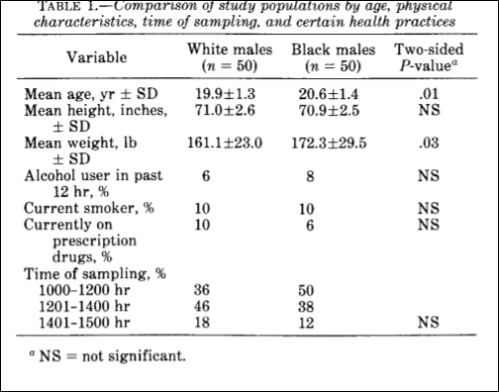
Table 1 from Ross et al (1986) tells us a lot about the flaws in the study—most importantly, the assay times. A majority were assayed between 10 am and 2 pm—which would depress testosterone though people assayed nearer to 10 am would have higher levels than people assayed nearer to 2 pm. Alcohol consumption only decreases testosterone while drunk, and a majority of the cohort did not consume alcohol within 12 hours of being assayed.
They come to the conclusion that the mean total testosterone level was 19 percent higher than whites whereas free testosterone was 21 percent higher. In regard to the assay collection times, Ross et al (1986: 47) write:
There was a negative correlation between time of sampling (No. of min elapsed since 0600 hr) and testosterone levels for whites (r=-O.4I) but not for blacks (r = -0.08). Adjustment for this variable caused a small reduction in geometric mean differences in levels of testosterone and free testosterone between blacks and whites. After simultaneous adjustment by analysis of covariance for time of sampling and age, weight, alcohol use, smoking, and use of prescription drugs, there
remained a 15% difference in total testosterone levels and a 13% difference in free testosterone levels between blacks and whites.
Even though they ‘adjusted for this variable’, it’s still a huge confound. Testosterone assays must be taken nearer to 8 am; the fact that people were assayed all over the place in the span of a 5 hour time period while testosterone levels decrease throughout the day is a huge red flag.
They then say that they are “uncertain why young black men have higher levels of circulating testosterone than white men“, though small sample sizes, a large range of variation in assay time, and a nonrepresentative sample is why. Other, more robust, analyses show a smaller ‘gap’, about 2.5 to 4.9 percent, favoring blacks (Richard et al, 2014). All in all, this study has huge flaws and should not be pointed to—especially today in 2017—because much larger analyses with much better methodologies have been carried out and some studies show no difference while others show a small difference favoring blacks but that still would not explain higher rates of testosterone, aggression and crime.
Ross et al (1986) is used by hereditarians such as Lynn (1990), Rushton (1997) and Hart (2007). Lynn (1990) states that these large testosterone differences discovered by Ross et al (1986) lend credence to Rushton’s r/K selection theory in which blacks have more children than whites who have more children than East Asians. Evidence for this assertion, states Lynn (1990) is the fact that blacks have higher rates of prostate cancer than whites who have higher levels of testosterone than East Asians, however this has been disproven by ethnicmuse.
Rushton (1997: 170) states that blacks had 19 percent higher levels of testosterone citing Ross et al (1986), however, Rushton didn’t cite the adjusted level which ended up being 15 percent, and, again, doesn’t mean anything to their hypothesis.
And Hart (2007) yet still repeats the same old stuff that “these differences in sexual behavior may be a consequence of the fact that blacks, on average, have higher levels of testosterone than whites“. These three researchers, clearly, are citing this study uncritically because it fits with their ‘racial hierarchy’. In fact, Rushton (1999) asked if testosterone was a ‘master switch’. In this paper, he cites Ellis and Nyborg (1992) who find that blacks had 3 percent higher levels of testosterone than whites. They gave the following values:
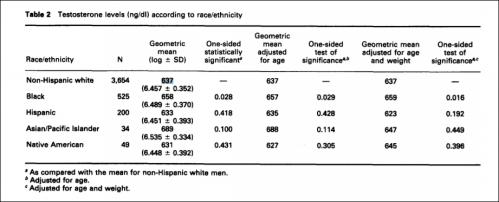
For the purposes of Rushton’s interpretation, writes Fish (2013), “These uncorrected figures are, of course, not consistent with their racial r- and K-continuum.” This, of course, is a big deal. Rushton cites this study as if it lends credence to his claims but it actually found the same result as Richard et al (2014). Thirty years after Ross et al (1986) we have numerous other studies showing a small gap between the races or no gap at all. We have numerous other studies showing that testosterone does not cause aggression, crime or violent behavior. However, people will still point to the abstract of Ross et al (1986) and think that they have proven that blacks have higher levels of testosterone than whites which proves how and why they have higher levels of testosterone, commit more crime and are all around more violent.
Though, as I have written about before, what Ross et al (1986) set out find the answer for (testosterone influencing higher levels of prostate cancer) can most definitely be explained by diet and lack of certain vitamins such as vitamin D, since low levels of this steroid hormone (it’s not a vitamin) cause prostate cancer (Schwartz and Hulka, 1990; Zhao and Feldman, 2001; Khan and Partin, 2004; Garland et al, 2006). Diet can explain a lot of the variation, as I have argued in the past.
In sum, Ross et al (1986) is the only study that I’ve found on racial testosterone differences that shows that extreme directionality favoring blacks over whites. This should set off some alarms in some people’s heads. People—psychologists included—need to learn about these hormones, how they’re produced in the body, and what they’re used for. Hormones don’t cause behavior, hormones influence behavior.
This fear of testosterone is largely overblown. We need testosterone for proper normal functioning. We need testosterone to be socially dominant; if you have lower levels you’ll be less socially dominant. This fear of testosterone—especially when it comes to race and it’s so-called causes—is largely pushed by Lynn, Rushton, Hart, and Ellis. I have spent a lot of time and thousands of words showing that they are wrong and testosterone is not a hormone to fear. It does not cause crime. It does not cause aggression. It does not cause prostate cancer. I’ve rebutted quite a few hereditarians on testosterone as well as testosterone and race, and if I come across more I will rebut them as well.
“MtF” Transgenders Should Not Compete with Women
1600 words
The other day the ‘MtF’ transgender weightlifter “Laurel” Hubbard won two silver medals in the 90 kg plus category (198 plus pounds in freedom numbers) at the New Zealand weightlifting world championships. Now, I’ve left my thoughts on this travesty back in August, but I feel the need to discuss this more because this should not have happened. (Yes, there is anecdotal evidence of transgender MtFs who go on HRT who lose strength at a great rate, which does lend credence to the fact that testosterone does influence sports performance, however, “Laurel’s” levels were at the high end of women and, although he had lower levels he still had inherent biological advantages.)
“Laurel” (I will be referring to “Laurel” as he, as is standard for me) won two silver medals on Wednesday in Anaheim, California. He wasn’t “at his best” at this competition since his clean and snatch was 7 kg lower than his win back in August, though the numbers he put up on Wednesday were enough to give him two silver medals.
Back in April he “shattered records“, is this a surprise to anyone? When a biological male claims to be a woman, then competes with women in a weightlifting competition and blows away old, long-standing records? It most definitely isn’t. The coach for New Zealand even called his outing “magnificent”, what is “magnificent” about a biological male literally walking on stage and dominating women? Yes, he showed his testosterone levels were low enough to compete with women per the IOC’s rules:
The athlete must demonstrate that her total testosterone level in serum has been below 10 nmol/L for at least 12 months prior to her first competition (with the requirement for any longer period to be based on a confidential case-by-case evaluation, considering whether or not 12 months is a sufficient length of time to minimize any advantage in women’s competition).
The athlete’s total testosterone level in serum must remain below 10 nmol/L throughout the period of desired eligibility to compete in the female category.
Compliance with these conditions may be monitored by testing. In the event of non-compliance, the athlete’s eligibility for female competition will be suspended for 12 months.
However, as I noted, the IOC’s recommendations for MtFs is at the high end for a ‘real woman’. That would have an effect, though I have no way of knowing the other competitor’s testosterone levels (which i assume would be skewed towards the high end since they do rigorous training), other factors come into play here, testosterone is not the only biological advantage that males have over females. People spoke out and stated that “… in my humble opinion this is not fair“, and that guy is right; this is not fair.
You have women who bust their ass year in and year out who stick to a rigorous schedule to be the best they can be and just because some guy lowers his testosterone levels and satisfies the IOC’s recommendations, that’s supposed to make it ‘fair’? No, that’s bullshit.
Despite all of this, an American woman named Sarah Robles who won a bronze medal at the Olympics, beat “Laurel” Hubbard, and I commend her for winning the competition, even with the odds stacked against her, competing against a biological male. Robles had a 284 kg total (626 pounds in freedom numbers) to “Laurel’s” 275 kg (606 pounds in freedom numbers).
On top of this controversy, he asks his detractors to “keep an open mind“. An open mind? This has nothing at all to do with an open mind. To attempt damage control, he said:
”I would ask people to keep an open mind and perhaps look to the fact that I didn’t win as evidence that any advantage I may hold is not as great as they may think,
This is literally irrelevant. Oh his advantage is there alright, however without knowing anything about the courageous woman who beat him, I cannot assess this anymore. All I can say is that Sarah Robles is to be commended for overcoming such great odds and this proves her worth as an outstanding athlete.
This man is so literally delusional that he says “there is no difference between him and the women he beat“. Anyone with a basic understanding of anatomy and physiology knows that this is literally note true. Sure, being on HRT (hormone replacement therapy) decreases bone mineral density and strength, but he still went through a male puberty, his SRY gene was activated in the womb which masculinized him; you literally cannot say there is “no difference” between him and the women he beat. The world is going to hell, especially when a man can walk on to a stage and blow away the competition (he did back in April, not on Wesneday however).
“I don’t believe there is any fundamental difference between me and the other athletes, and to suggest there is is slightly demeaning to them,” he said, according to Newshub. “I think it’s incredibly disrespectful to the other competitors.”
It’s alright if you ‘don’t believe there is any fundamental difference between you and other athletes’, that’s your right to ‘believe it’. However, reality is different than the fantasy world you have constructed in your head. It is not disrespectful to the other competitors to imply that there is a fundamental difference between you and them. What is disrespectful is the fact that you were allowed to compete with them while calling yourself ‘a woman’.
The AWF chief executive Michael Keelan has some great commentary here:
AWF chief executive Michael Keelan said Hubbard’s inclusion in the women’s open class would create an “uneven playing field” on the Gold Coast. “We’re in a power sport which is normally related to masculine tendencies … where you’ve got that aggression, you’ve got the right hormones, then you can lift bigger weights,” he said.
“If you’ve been a male and you’ve lifted certain weights, then you suddenly transition to a female, psychologically you know you’ve lifted those weights before.” Hubbard had to demonstrate her testosterone levels were below a certain threshold for 12 months before representing New Zealand.
A Samoan weightlifter in the 90 kg class, Iuniarra Sipaia, stated:
“I felt that it was unfair … It only changed the physical side but her emotions, her strength and everything is still a male.”
Women lost weight to shift down a weight class or two just so they wouldn’t have to compete against “Laurel”, and I do not blame them. Tim Swords, the coach of the winner Sara Robles, also stated that this was not fair.
Personally, if I was training a woman for a weightlifting/powerlifting competition and I had prior knowledge that a man who believes he is a woman is going to compete I would pull my athlete out of the competition and state why I did so. It’s literally not fair that he is able to compete—his testosterone level be damned—with women who have lived their whole lives as women, went through a woman’s puberty and have the bodily proportions of women.
I mean look at his somatype! It looks like he would tower over all of the other competitors ‘he beat’. Somatype is extremely important when it comes to weightlifting and by looking at his somatype you can tell that all of these weak women (compared to “Laurel”) basically did not stand a chance. I wonder what was going through Sarah Robles’ mind while competing against a biological male? If I were her coach, words cannot describe how proud I would be of her that she beat a biological male in a competition when he had natural, inherent advantages since he went through a male puberty. This is something that I believe that bodies like the IOC and AWF fail to take into account: there are other advantages that males have over females other than testosterone. Believing anything else is delusional.
Just because someone satisfies the IOC’s testosterone cut-off does not mean that they do not have any other inherent biological advantages just from being male. I’m sure some would argue that all of these women and even all athletes have inherent biological advantages and that someone would argue that you’d need to segregate competitions based on certain differences in anthropometric measures (however these competitions select people with certain anthropometric measures as certain somatypes can lift more weight and have an easier time on certain exercises than others due to levers). However, these advantages that “Laurel” has are literally due to being born a male.
In sum, this is a travesty. Biological women who bust their ass every day of the week to be in top competition shape have to then compete against someone who has all of the underpinnings of a male, while only getting to compete because ‘he claims to be a woman’? That’s bullshit and I’m sure that organizations like the IOC know this, they just have to be politically correct due to backlash from people. Well, I’m not a politically correct person and I call it how I see it: “Laurel” Hubbard should barred from competing in these world championships. He is not a woman, he is a man. Maybe they should create transgender weightlifting world championships and let women and men compete with actual, biological women and men? No, that’d make too much sense though. This is a man, through and through, and no amount of hormones or surgery will do anything to change that. The fact that he is so cocky and says that he has no inherent advantage due to being biologically male is bullshit and I’m sure that in the back of his mind he knows it.
More r/K Selection Theory Rebuttals
2000 words
I was alerted to a response to my article r/K Selection Theory Rebuttals on Twitter. I enjoy when people write responses to my pieces as I can better build my arguments. It’s also fun defending what I wrote.
This Pastebin is where the response is. He states that he disagrees with AC (Anonymous Conservative) on two things: calling them liberals when he would call then progressives and his clear conservative bias.
First it refers to a criticism of Ruston’s application of r/K to humans:
https://notpoliticallycorrect.me/2017/06/24/rk-selection-theory-a-response-to rushton/
This article applies r/K selection to differences between races, I don’t see how this is relevant. AC never discusses race and I’m only interested in how r/K selection applies to individuals within a civilization too.
It is very apt when rebutting AC’s ‘theory’. Human races are not local populations therefore it doesn’t apply to human races. To then bring this wrong theory to individual differences is stupid. Hell, I agree more with Rushton’s application than AC’s application and that’s saying something. The point of bringing up Rushton’s r/K theory is that he was the one who repopularized the theory and you have to give credit where it is due (I’m certain he heard of r/K from Rushton; the fact that he doesn’t give him credit there is dishonest, but AC is a dishonest guy so this is no surprise to me).
r/K selection applies to almost all life forms, next to other selection mechanisms. So it goes much deeper than the specific situation a specific race may have lived in. Even if people in races now commonly express more r-selected or K-selected behavior, I’d expect that to change if their children grew up in a different environment.
You only say that because organisms have offspring and at different rates. I won’t even go through the different cites that show that r/K theory is bunk, but I will cite one that shows that it’s been dead for years. Reznick et al, (2002: 1518) write: “The distinguishing feature of the r- and K-selection paradigm was the focus on density-dependent selection as the important agent of selection on organisms’ life histories. This paradigm was challenged as it became clear that other factors, such as age-specific mortality, could provide a more mechanistic causative link between an environment and an optimal life history (Wilbur et al. 1974, Stearns 1976, 1977). The r- and K-selection paradigm was replaced by new paradigm that focused on age-specific mortality (Stearns 1976, Charlesworth 1980).” This is simple. Age-specific mortality replaced r/K theory. People like AC attempt to ‘show’ their ‘hypothesis’ is true. They notice something in this snapshot in time then say oh this this and that make sense therefore this! It doesn’t work like that.
On his point that ‘he’d expect that to change if their children grew up in a different environment’, to say that one race is ‘r’ or ‘K’ over another, you must study the population in question in the location where the adaptations were hypothesized to have occurred (Anderson, 1991).
RR: “It is erroneously assumed that living in colder temperatures is somehow ‘harder’ than it is in Africa”
Yes, there is much less biomass available in colder temperatures. Of course Africans would still compete with each other for resources. The idea is also that there’s more requirement to think ahead, in order to prepare for the winter. Requiring more deferral of gratification.
The idea is dumb. Africa is harsher than Eurasia (Dobzhansky, 1950: 221). Did people in Africa not have to plan ahead? This is the same old rebutted cold winter garbage in terms of ‘selection for higher IQ;.
The article generally asserts that r/K selection is a simple model:
RR: “One of the main reasons that Rushton’s r/K continuum gets pushed is because it’s a ‘simple model’ that so ‘parsimoniously’ explains racial differences … But ecological systems are never simple”:
Where was an implication that any ecological system is simple? I’d say the tropics are way more complicated than cold area’s. The relevant aspect here is that a cold area is more difficult to live in, has less resources and thus supports fewer individuals. Which is a K-selected pressure.
It is a simple model. “Simple models will be successful only if their simplifying assumptions either match reality or are unimportant” (Anderson, 1991: 57). This does neither. It is surely not easy to live in the tropics. This canard that those in Africa had an easy life in comparison to the people who migrated out of Africa doesn’t make any sense. It’s like people think that food just dropped on their laps from the trees, they didn’t have to deal with predators or heat, etc. It’s an extremely simple model which is why it doesn’t work. Africans are ‘K-selected’ if Rushton is to be believed, not r-selected (Anderson, 1991).
AC’s book is for the public, not to be the bleeding edge of science. Most people have no idea about these theories. I think it would greatly improve their understanding of reality if they knew about it, it did mine. This seems like the situation with Newton’s theory of gravity. It’s been proven wrong, but we still use it when useful.
I get that, but his premises are wrong which means his theory is false. What ‘reality’? It’s just stories, fables. Whatever sounds good to AC, whatever he thinks will buttress his theory he’ll write. Anything about the ‘rabbits’ or ‘wolves’ (so-called r- and K-selected organisms respectively). r/K has been proven wrong and it’s still not useful so we should not use it.
RR: ‘So “the actual adaptation they have” is to “wear thick clothing“? This is bullshit and you know it’
No it’s not. The clothing is far thicker and thus harder to make with a higher required investment. It requires more quality of the individuals. The writer assumes a binary difference here, where none was asserted. Of course these things are on a spectrum.
Yes it is. Sorry, you didn’t understand what I meant here. The actual adaptation is not ‘to wear thick clothing’. What is ‘more quality’, is that a scientific term? What does that even mean?
RR: “The preparation does work.” (Preparation of anti-malarial remedies as seen in Wilcox and Bodecker, 2004)
Maybe it helps, much of traditional remedy use is based in tradition and superstition. Europeans where slaughtered by all kinds of diseases. It probably depends on the situation. If you can find a cure for the disease, then maybe it is a K-selected pressure.
It’s irrelevant that ‘much of the traditional remedy use is based in tradition and superstition‘, because these remedies are proven to work (Wilcox and Bodecker, 2004). “If you can find a cure for disease, then maybe it is a K-selected pressure“, you’re clueless and don’t know what you’re talking about.
RR: “Here is what people like Samuel Skinner and AC don’t get: r/K selection theory WAS discarded; it is no longer in use. Age-specific mortality better explains these trends than r/K selection”
But age-specific mortality doesn’t apply to humans and doesn’t explain differences between individuals within a species or population.
Are you saying that we can’t apply this theory to humans at all?
Yes it does apply to humans. Why talk about something when you don’t know about it? Should I care that it doesn’t explain differences between individuals within a species or population? Not everything needs to be some grand, overarching theory to explain everything so perfectly.
RR: “We found that high K scores were related to earlier sexual debut and unrelated to either pubertal onset or number of sexual partners.”
In humans that correlation is broken because of advanced society. However, we can still find that correlation in progressive or conservative politics.
Yet Rushton et al assert that Africans are r, for instance, and have more children but as you can see from Copping, Campbell and Muncer, (2014), earlier sexual debuts were seen in the so-called K dimension, completely against Rushtonian r/K theory and against whatever theory AC cooked up in his head.
There are several links to scientific papers, several of which are no longer working, but fails to summarize how they support his position.
They don’t work because sci-hub is down. I need to fix the broken links and I did summarize how they support me which is why I did “claim then (citation)”.
RR: “Individuals WITHIN A SPECIES are not R OR K”
Since environments can change, why would species not be able to adapt to the new situation?
That’s not even what the original theory spoke about. If the liberals environment changed, would they become K (according to AC)? You’re completely missing the r/K dynamic.
A Jelly fish has several reproductive strategies available and chooses based on available resources.
Humans are much more complicated, but we could still have that ability.
This doesn’t mean that r/K selection has any utility.
RR: “Something AC doesn’t get is that using the discredited r/K continuum, conservatives would be r”
I don’t get that either.
Because the continuum comes from Pianka (1970) and Rushton adapted it to show that lower IQ peoples who had more children were r-selected. Therefore, if this did apply to individuals within the human species then conservatives would be r while liberals would be K (they have fewer children and higher IQs).
RR: “women who reported being religious stated that having children was more important to them”
And are in favor of investing in those children through their mother staying home to take care of them. Where progressives are more likely to be in favor of the mother working and putting the children in day-care. Progressives are also in favor of birth control and abortion. Allowing them to maintain the r-selected sexual life style, without having the burden of a child. r/K selection is about the underlying psychology, not surface level attributes like total number of children.
Liberals still have fewer children than conservatives who have more. What you’re saying is largely irrelevant. “r-selected sexual lifestyle”, this is dumb. r/K selection is predicated on number of children which conceived, supposedly, differs on the basis of differential psychology, supposedly, between two human groups. It doesn’t, it’s wrong.
“I’ve already covered that libs are more intelligent than cons (Kanazawa, 2010; Kanazawa, 2014), and that conservative countries have lower IQs”
I don’t think we should expect a correlation between IQ and r or K in modern human societies. What happens is that high IQ people raise their children in abundance, which makes them more likely to be r-selected. Availability of resources is a trigger for r-selected psychology.
Riiiiight. But you would expect a correlation between other so-called r/K measures in modern societies? You don’t even make sense.
“Conservatives are more likely to be religious”
Yes because religions like Christianity are viewed as tradition. And progressives oppose tradition where conservatives favor it.
Right, and they have more children than liberals, which is r-selected behavior (supposedly).
This guy tried, but clearly, this wasn’t good enough. r/K is dead when speaking about race and the differences between human individuals. For anyone who believes AC’s bullshit, where did liberals and conservatives evolve these different behaviors? Are they local populations? People like AC ignoring the continuum by Pianka, yet use that same hierarchy are dishonest. They’re using a discredited continuum and attempt to prove their political biases. “The other team has X, Y, and Z bad while we have A, B, and C good! The other side does X and Y while we do A and B, therefore, we are better!” AC has a huge bias; he will never admit he’s wrong because he has a book to sell that pushes this discredited garbage. (Don’t worry, I’ll review it and pick it apart soon enough.)
To conclude, people really need to stop letting their biases get in the way of rational thought. If they did, they’d be able to look at these dumb theories for what they are: pseudoscience, cherry-picking and pigeon-holing the other group, the “enemy” with all of the bad qualities while their side has all of the good ones. However, as I’ve shown countless times, real life is completely different from the fantasy world AC and his followers live in.
Testosterone, Physical Aggression and Social Dominance in Adolesence
1300 words
Testosterone and social dominance are linked, that is, when one is socially dominant then they will have higher levels of testosterone. But does this necessarily translate into violent behavior? No it does not. One longitudinal study looked at the effect of testosterone in children from kindergarten to the end of primary school (ages 6 to 13). Were high levels of testosterone associated with physical aggression and/or social dominance?
Schaal et al (1996) followed 178 boys from kindergarten to the end of primary school. To attempt to control for certain variables, they “were recruited according to the following criteria: (1) attending school in low socioeconomic areas of Montreal; (2) born from Caucasian, French-speaking parents themselves born in Canada; and (3) living with parents having medium to low educational status” (Schaal et al 1996).
They collected behavioral assessments at age 6, 10 and 13 through teacher and peer ratings. They asked questions such as “Who would you choose as a leader?” and “Who is the toughest?” To assess this, the authors made a game where they had to toss sandbags at targets to win money, with the only rules being they had to be a certain distance away from the targets. At the end of the game, the winner received 2 dollars while the others received 1 dollar. Each individual received a ‘toughness’ and ‘dominance’ score. Schaal et al (1996) write:
The crossing of both toughness and leadership scores, using the median, yielded four groups defined as follows: (1) tough-leader (n = 52); (2) toughnot leader (n = 27); (3) not tough-leader (n = 44); and (4) not tough -not leader (n = 48).

The groups did not differ on demographic or socioeconomic status, however, they showed differing ratings than they did at school in the previous year. Those rated tough by peers unfamiliar to them had also been rated more aggressive by peers who knew them than those who were rated ‘not tough’.
They assessed behavior and anxiety levels using a social behavior questionnaire. They write:
Boys were entered into the following categories according to their behavior rating scores on at least three of four assessments: (1) stable high fighter/stable high anxious (SH F-SHA; n = 20): fighting and anxiety scores at the 70th percentile or greater; (2) stable high fighter/ stable low anxious (SHF-SLA; n = 11): fighting score equaled or exceeded the 70th percentile and anxiety score was equal to or below the 50th percentile; (3) stable low fighter/stable high anxious (SLF-SHA; n = 10): equal to or less than the 50th percentile on the fighting scale and greater than the 70th percentile on the anxiety scale; and (4) stable low fighter/stable low anxious (SLFSLA; n = 25): equal to or lower than the 50th percentile on both fighting and anxiety scores.

Children who were noted by teachers to be more physically aggressive compared with children noted not to be physically aggressive were rated higher on “proactive aggression.” These children were also rated less popular.
They collected saliva to assay for testosterone at 8:30 am (yay), 10 am, 11 am, and 3:30 pm. There is a direct correlation between salivary testosterone levels and free testosterone levels in the body (Wang et al, 1981; Johnson, Joplin, and Burrin, 1987), and since it’s easier and way less of a biohazard to assay saliva for testosterone levels than to assay blood, it’s only logical to assay saliva since it’s easier and less of a chance for contaminated samples.
Now comes the fun part: did the socially dominant, tough leaders who were to have higher levels of testosterone more physically aggressive? To make it short: NO. The children who had LOWER testosterone were seen to be more physically aggressive. The ‘tough-not’ leaders were seen to be more aggressive; they had lower testosterone than both tough-not groups and lower than the tough leaders. Is this not ironic? This completely flys in the face of numerous theories on how and why grade-school children fight: it’s not high testosterone that causes this phenomenon, clearly.
It’s also interesting to note that those boys who were “stable high fighters” had lower testosterone levels compared to boys that were “stable low fighters” at age 13. Forty-one percent of the “stable high fighters “were in a regular classroom at the level appropriate for their age (age 13) compared with 91% of the stable low fighters” (Schaal et al 1996: 1327). The first analysis they conducted showed that, after only having met for three hours, the boys with high salivary testosterone were rated as “tough” and a “leader”. However—and this is where things get good—boys who were consistently rated as having higher levels of aggression between the ages of 6 and 12 had lower levels of testosterone at age 13.
Though, boys with high testosterone at age 13 “appear to be individuals who quickly succeed in imposing their will on peers, sometimes by aggressive behavior, but remain socially attractive over time” (Schaal et al, 1996: 1328). And, of course, boys who were rated as physically aggressive from kindergarten to age 12 (who had lower testosterone levels) were not seen as socially dominant. These children were seen as less popular and also were failing in school.
Elevated testosterone levels at age 13 were seen to be associated with social dominance when assessed after the game and three hour meet discussed above. Further, lower levels of testosterone between the ages of 6 to 12 (and assayed at 13) were associated with higher levels of aggression and more fighting. They state that higher levels of testosterone are only associated with aggression “only if the latter confers a dominant status” (Schaal et al, 1996: 1329). Higher testosterone is, of course, associated with better social well-being whereas lower levels of testosterone was associated with more violence which may be due to social isolation, stable anxiety throughout childhood or both influences influencing the aggressive behavior along with the low testosterone. High testosterone levels in adolescence is not related to antisocial disorder, but it is related to social dominance—as I have stated countless times.
Now for some comments.
I like this study. How they used behavioral questionnaires to assess children’s behavior, as well as using teacher and peer ratings to assess behavior is a great method. It’s even better that they followed them throughout their adolescent life to see any patterns that arose. I hope that there is more data on these children (I will look for any other data on this one point) because this could elucidate so many testosterone relationships with behavior. This study shows that higher testosterone levels were not associated with antisocial behavior but it was, however, associated with greater social well-being.
Clearly, we need higher-ish levels of testosterone—especially since lower levels are correlated with numerous maladies. So, it seems, that the testosterone=crime aggression myth (and in my opinion, crime) is busted. Testosterone is an extremely important hormone for proper endocrine functioning and having levels that are too low. They also state at the end of the paper that “From the perspective of the present study, it can be hypothesized that in a sample of normal adolescent males, those who dominate will tend to react to provocation and to show relatively low frustration tolerance. The results from the Olweus and colleagues’ study might then be interpreted as showing the relationship between dominance and T, rather than between antisocial behavior and T.”
So, again, testosterone is related to dominance; if you have lower testosterone you will be less socially dominant while if you have more you will be more socially dominant (this holds for adults as well). It’s interesting to note that boys perceived as dominant when around people they did not know had higher levels of testosterone than boys who were not. This shows that boys with lower levels of testosterone were seen as less popular, they were failing in school and they had higher levels of aggression. Testosterone levels in children are associated with social success and popularity, rather than antisocial behavior and violent outbursts as other studies have reported.
Testosterone=the dominance hormone—more specifically, the social dominance hormone. It does not lead to social maladjustment.
Sexual Selection and Intelligence
By meLo, 1340 words
Introduction
Usually within the HBD community, discussions regarding the main mechanism(s) that drove the expressions of particular phenotypes is centered around natural selection or ecological(in the strictest, most traditional sense) factors. Sexual selection is unfairly sidelined, even though sex is the base of all multicellular evolution. The point of this article is to provide a logical argument for Sexual selections tremendous involvement, and to provide examples of how these pressures have shaped neolithic and modern Homo sapiens. I excluded Australoids but for good reason. Even though the population does have sexual selected traits, like blonde and culry hair, they are an incredibly diverse group and with the amount of pocket isolation I don’t think it’s fair without breaking this group into more categories. I kept this paper short, because it’s my first one and I wanted to use this as a “prototype” for future posts. Again all criticism is more than welcome because I myself am still learning about this topic.
First, it is important to note that traits which evolved from sexual selection are not the same thing as traits that serve reproductive purposes. Reproductive organs are usually the product of sexual selection, but sexual selection does not always act upon genitalia. Sexual selection favors any trait that allows an organism to attract the opposite mate more effectively, competitively or not.
The general trend
Before I explain the respective pressures and phenotypes between subpopulations of the neolithic, it is essential to begin with a summary of the temporal trend that persisted before the aforementioned groups. This begins with a breakdown of definitions and the repair of misconceptions. Human development is extremely complicated, so this explanation will have oversimplifications for the sake of efficiency. Any questions or discussions on the matter are more than welcome. If you don’t know anything about heterochronies I suggest you read this.
Paedomorphosis=/= Neoteny. Neoteny is a heterochronic process, paedomorphism is a type of heterochrony. One of the largest or most noticeable differences between Homo sapiens and Chimpanzees is the increase in paedomorphic and peramorphic traits of the former. All heterochronic mechanisms affect the developmental outcome of homo sapiens this is mostly to do with developmental trade offs and creates a mosaic pattern of our evolution. Humans have accelerated brain growth which reaches full size before most of the other limbs and organs are finished, even though this is achieved through peramorphic heterochronies it coincides with the deceleration of the body which actually produces a more paedomorphic appearance in the population. This acceleration ends(progenesis) and is subsequently followed by a strong deceleration(neoteny) of the skulls growth (Penin, 2002). Neoteny and acceleration define growth rate, but the actual duration of the growth period is hypermorphic, meaning the duration of Human growth is delayed or extended so that our legs and brains can continue to grow. Even though the brain is not paedomorphic its still enlarged to retain its childlike plasticity.These processes underlie the “direction” of our evolution, and while a lot of important traits are a result of peramorphic processes, it would be foolish to disregard the obviously paedomorphic traits we exhibit. It doesn’t take long to see how sexual selection can favor peramorphic or paedomorphic traits. Peramorphosis tends to create exaggerated features(think Irish Elk, Peacocks or the human brain) while paedomorphosis tends to appeal to sexual selection by producing “fragile” traits associated with infants of the species, in theory members of the opposite sex should associate these traits with “cuteness” and possibly even better parental skills.
Macro races
Most don’t realize, but all races have undergone sexual selection. Each race has its own unique combination of peramorphic and paedomorphic traits as well as superficial ones that don’t relate to heterochrony. I will briefly go over each race and describe the varying degrees of pressures and the resulting phenotypes.
Caucasoids
Caucasoids have the largest concentration of hypermorphic traits. They are the tallest race, and have the most color variation, this heavily implies sexual selection is involved. While height only has a small correlation with IQ, taller specimens will generally have larger brains, because they also have larger bodies. It also been documented that taller individuals tend to be seen as more attractive. Blue eyes are disproportionately present in the scientific community and they are a recessive trait, it’s speculative but very possible that blue eyes coincides with increased intelligence. Peter frost already did most of the work for me, you can read his piece on European sexual selection here. Mate competition becomes the obvious reason for these phenotypic expressions.
Negroids
Unfortunately there isn’t much data on penis size, as a result this description will be lackluster. Which is usually the go to trait that HBDers look for when defining the sexuality of Africans. Things like Breast and buttocks size are ill defined, and studies on them are rifled with misconceptions. What we do know though, is that blacks are around the same height as Europeans but the majority of groups tend to have smaller brain sizes. It is interesting to point out that Africans display more paedomorphic facial features(except for prognathism). This makes a lot of sense, Africans are more r selected than Caucasoids, so it is expected that they display more paedomorphic traits. Because of a lack of data, I can’t make a reasonable assessment on the pressures that could of caused these expressions, however I do not think it would be far fetched to assume that it is also mate competition.
Capoids/Pygmies
Pygmies, are a result of what Shea 1984 calls “rate hypomorphosis” Essentially it is a truncation of allometric scaling. Pygmies should therefore be one of the least intelligent and most r selected races. Their body and brain size decreased from the ancestral one, and they are almost entirely paedomorphic. More than likely their body size has to do with their adaptation to fewer resources. Capoids can confuse a lot of people. At first I thought they must be intelligent because of their paedomorphosis, but their brains are only a measly 1270cc and according to the Shea and Penin studies(cited earlier) a lot of traits considered to be paedomorphic(flat nose, reduced prognathism) are actually just the result of functional innovations and are independent of developmental growth. Specimen like Homo sapien Idaltu then begin to make more sense. The pressure involved here is more than likely an increased need of childcare(or at least a decrease in aggression) but not necessarily and increased need of Intellectual faculties.
Mongoloids
Along with pygmies they are the most Paedomorphic race, and one of the most r selected. East asians have proportionally short limbs, very baby like faces, and the largest brains of any race. More than likely this is due to shape retardation following neoteny(deceleration of growth). It is necessary to define why Capoids and Mongoloids share similar facial traits yet do not share the same body proportions or absolute brain size. In this situation it is reasonable to assume that both populations had similar pressures for childcare and decreased aggression the main difference is hypothesized to lie in the varying survival pressures each group faced, I believe the ecological factors in East asia were more cognitively demanding than in Southern Africa, not in the sense that Africa is an easier place to survive but that Eurasia had a higher demand for Neuroplasticity. This is for two main reasons 1) in a novel environment there is more that you are required to learn and 2) The founder effect makes recessive genes easier to be expressed.
In Summary
Intelligence can arise from a multitude of factors and no factor is completely necessary. Caucasoids seem to have developed their intellect from mate competition and K selection. Negroids are similar but to a lesser degree. Mongoloids seem to have evolved their cranial capacity for primarily docility and cooperation. All are forms of sexual selection, just for different preferences in attraction. Europeans and Africans tend to gravitate to more masculine features while Capoids, and Mongoloids are more for feminine ones.
Musings on Testosterone and Race
1500 words
People don’t understand the relationship between testosterone, aggression, and crime. People hear the sensational media stating that testosterone causes crime, aggression, and anger. However, I have written numerous articles on this blog on the true nature of testosterone, what it’s really needed for and why we need it in high amounts. I’ve mused a lot on this hormone, which is one of my favorites to discuss due to the numerous misconceptions surrounding it.
Which way does causation run in regard to prisoners and their testosterone level?: heightened testosterone > aggression > violence or aggression > heightened testosterone > dominance > possibility (not necessarily, as I have written myself in the past) of violence.
People may use animal studies in support of their contention that testosterone causes aggressive behavior. However, for reasons I have discussed in the past, animal models only show avenues for future research and do not necessarily mean that this is the case for humans (as Mazur, 2006 point out). I don’t use animal studies. They’re good for future research, but to use them as evidence for causation in humans doesn’t make sense.
People may cite Dabbs et al showing that the more violent prisoners had higher levels of testosterone and therefore conclude that higher levels of testosterone drive the violent crime that they commit, however it is much more nuanced than that.
Does being a violent criminal raise testosterone or are violent people more likely to have high testosterone? Dabbs never untangles this; they just showed a correlation, which is small as evidenced by my other citations.
Testosterone is, as evidenced by numerous studies, related to dominance and dominance contests, however, during these dominance contests “a killing is rarely the outcome of a violent dominance contest” (Mazur, 2006: 25). Therefore, this throws a wrench in the testosterone-causes-crime hypothesis.
Some individuals may state that these dominance contests then lead to violence, however, as Mazur (2006) puts it: “Heightened testosterone is not a direct cause of male violence.”
Other animals assert dominance violently but we, necessarily, do not.
Mazur (2006) states that dominance contests rarely escalate to murder. Mazur also states that dominance contests also lead to increased T for the winners and decreased T for the losers, and these contests also don’t necessarily lead to murder/violent behavior. There is a feedback loop with high T causing behavior and behavior causing high T (Mazur, 2006) while this feedback loop may lead to “lethal effects” (Mazur and Booth, 2008).
It’s worth noting that Mazur seems to advocate for ‘testosterone-depressing drugs’. He concludes:
There are strong linkages between macro-level culture and the physiology of
individuals. We may find solutions to some of our social problems by altering these linkage.
Macro-level culture being white culture, black culture, Asian culture, etc.
The physiological differences are due to the preparation for dominance contests. So, his hypothesis goes, the culture of dominance among young black men with no education is why their T is so high. That low education was also associated with low education lends credence to the claim that this is changeable.
However, in his newer article on education, low testosterone and blacks he advocates for more sensible solutions (attempting an environmental change). I don’t know about you but I have big problems with using FDA/Big Pharma drugs to ‘reduce societal problems’, and it seems that Mazur has changed his view there. Mazur (2016) writes:
If high T does facilitate the high violence rate among young black men, there would be a troubling policy question of what, if anything, to do about it. Any notion of a medical or pharmaceutical fix, rather like prescribing Ritalin for hyperactivity, would reek of race-based chemical castration and should be regarded as outside the pale. However, social interventions might be workable and ethically acceptable.
I have railed against measures like this in the past, since proposing measures to attempt to ‘decrease crime through supposedly decreasing one of the main “causes”‘ is very Brave New World-ish, and I am highly against those measures. Social interventions are, in my view, the more sensible measures to undertake.
In regard to low education and testosterone, this same relationship was noticed by Assari, Caldwell, and Zimmerman (2014) where they note that testosterone was not associated with aggression in men, but low education was, which Mazur (2016) replicates, showing that blacks of the same age group with more education had lower levels of testosterone when compared to age-matched blacks. Mazur (2016) cites one study in support for his contention that education can decrease aggressive behavior (Carre et al, 2014)
The correlation is there, I agree. let’s take the middle value of .11 between Archer, Graham-Kevan, and Davies, 2005 at .08; and Book, Starzyk, and Quinsey, 2001 .14. So testosterone explains 3 percent of the the relationship with aggression. Not high at all.
Great evidence against the testosterone-causes-aggressive-behavior hypothesis are data on the Yanomami. About 50 percent of Yanomami men meet their deaths by other Yanomami men. So the Yanomami must have testosterone levels through the roof, right? Wrong. De Lima et al (2015) write:
We observed that Yanomamis present lower levels of testosterone (414 ng/dL) in relation to other ethnic groups (502/512 ng/dL), but still within normal limits (350-1000 ng/dL).
(Note that these values for “normal limits” changed, going into effect at the end of July.)
The Yanomami with an extremely high murder rate with nowhere near a modern society have T levels on the lower end of our range. So….. The Yanomami example is direct evidence against the assertion of testosterone directly causing crime, as some people assert (it is even evidence against an indirect cause). The evidence of the Yanomami having testosterone levels near our lower range is direct evidence against the testosterone/crime hypothesis. Clearly, other variables drive the high violence rate in this society that are not testosterone. More interestingly, these people have had little contact with Western societies, and their T levels are still low compared to ours despite constantly being vigilant for threats from other Yanomami.
Most dominance contests do not end violently in the first-world, there is numerous evidence to attest to this fact. So with the low correlation between testosterone and aggression (Book, Starzyk, and Quinsey, 2001; Archer, Graham-Kevan and Davies, 2005; Book and Quinsey, 2005), along with dominance contests rarely ending in murder/violent crime, then there are way more factors influencing these phenomena.
So the feedback loop goes: Testosterone rises in expectation of a challenge which then, after the dominance contest (which doesn’t always necessarily lead to violence), it affects both individuals differently depending on whether or not they won or lost that dominance contest and these values then persist over time if the dominance contests continuously end up the same.
Let’s say, for argument’s sake, that testosterone is a large cause for aggressive behavior in lower-educated blacks, what should be done about it? Mazur cites evidence that behavioral interventions seem to work to decrease violent behavior during certain circumstances (Carre et al, 2014), so that is a good way to lower violence in populations that have low education.
So heightened testosterone does lead to dominance which then facilitates a dominance contest between two individuals which does not necessarily lead to crime and aggressive, violent behavior (this outcome is rare in dominance contests among “higher primates” [Mazur’s words]) so, therefore, while testosterone does facilitate dominance contests, it rarely leads to violence in our species. Therefore, testosterone does not cause aggressive behavior and crime, but it does cause dominance which, for the most part, do not always result in violent, aggressive, murderous behavior.
I’ve shown that Mazur replicated other analyses that show that testosterone and aggressive behavior are related to lower education. Testosterone wasn’t associated with aggressive behavior in Assari, Caldwell, and Zimmerman’s (2014) study, and, as Mazur (2016) replicates, low education was. So one way to end this relationship is to educate people, as shown by Carre et al (2014), and with this education, crime will begin to fall. Heightened testosterone is not a direct cause of male violence.
(Note: I also believe that other factors such as sleep and depressed nutrition play a factor in crime, as well as racial differences in it. See Birch, 1972; Liu et al, 2003; Liu et al, 2004; Walker et al, 2007; Galler et al, 2011, 2012a, 2012b; Spratt et al, 2012; Gesch, 2013; Kuratko et al, 2013; Waber et al, 2014; Raine et al, 2015; Thompson et al, 2017 for more information, I will cover this in the future. I’m of course not daft enough to believe that no genetic differences between individuals/populations are the cause of a lot of crime between them, however, as I have laid out the case in regard to testosterone and MAOA numerous times, these two explanations for both individual differences in crime as well as racial differences in crime leave a lot to be desired. Other genetic factors, of course, influence these differences, however, I am only worried about refuting the popular notions of ‘testosterone and MAOA, the ‘warrior gene” cause crime. The relationship is a lot more nuanced as I have provided mountains of evidence for.)
Comments on Batrinos (2012)
850 words
Batrinos (2012) is a paper titled Testosterone and Aggressive Behavior in Man. Section 2 reviews studies on prisoners. Small ns, no controls, prison isn’t a natural environment. Similar data was reported, but it has the same problems as above. Studies of sexual offenders are contradictory, with blood T not being associated, then being associated with aggression. An investigation of veterans showed T to raise aggression, again, non-representative sample (and you also have to think of PTSD and other illnesses). Then the money quote:
It is of interest, however, that supraphysiological doses of testosterone in the order of 200 mg weekly (20), or even 600 mg weekly (21), which were administered to normal men had no effect on their aggression or anger levels.
Dominance is related to testosterone increases, and dominance can lead to aggressive behavior then to violent acts, but this is not always true. Mazur and Booth’s (1997) reciprocal model shows a feedback loop on dominance and testosterone:
Ehrenkranz et al. (1974) showed that socially dominant but unaggressive prisoners had relatively high T, not significantly different from the T levels of aggressive prisoners (who may have been dominant too). Nearly all primate studies that have been interpreted as linking T to aggression (Dixson 1980) may as easily be interpreted as liking T with dominance (Mazur 1976). Recent reviewers have questioned whether, among humans, T is related to aggressiveness per se (Archer 1991; Albert et al. 1994).
Testosterone and Dominance in Men
And:
Heightened testosterone is not a direct cause of male violence.
The Role of Testosterone in Male Dominance Contests that Turn Violent
(Much more on this paper soon.)
Small studies have shown that T increases during sports (duh because it’s competition) and that watching your favorite sports team win a game increases T (has been replicated).
Batrinos then cites a study talking about circadian rhythm and testosterone/aggression here:
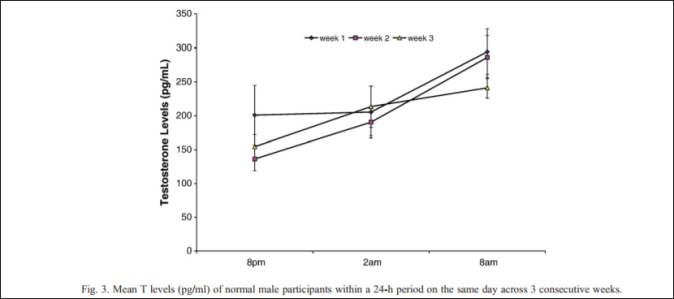
Interestingly enough, Brown et al (2007) lends credence to my hypothesis that I have discussed in the past. Testosterone decreases at 8pm (most crime is comitted at 10 pm for adults) with increases in testosterone at night:
It is not surprising that T levels at 2000 h and 0800 h would be important for TS-IAB relationships because the 2000 h and 0800 h values represent the evening nadir and morning zenith.
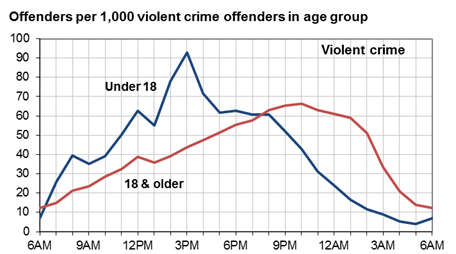
But most crime is not comitted in the morning, for both adults and children (as seen below):
Now, anyone who has read my article on why testosterone doesn’t cause crime knows where I’m going with this:
Look at the times most crimes are committed then think about when T levels are highest (8 am).
Why Testosterone Does Not Cause Crime
This does seem to show a relationship with when most crimes are comitted, a sharp decrease in crime occurs as testosterone levels hit their highest in the day, which is evidence against the testosterone-causes-crime hypothesis.
In regard to the crime chart from the OJJDP, they write:
- In general, the number of violent crimes committed by adults increases hourly from 6 a.m. through the afternoon and evening hours, peaks at 10 p.m., and then drops to a low point at 6 a.m. In contrast, violent crimes by juveniles peak in the afternoon between 3 p.m. and 4 p.m., the hour at the end of the school day.
Using what I gave, what do you draw from the line graph? It’s clear that, since testosterone is highest in the morning aand at its lowest at 8 pm (when most violent crime is being comitted) that testosterone is not directly related to crime, since, as evidenced by Brown et al (2007), testosterone levels are lowest at 8 am with a sharp rise as the night/ morning progresses. Looking at their testosterone chart for the hours between 8 pm and 8 am, testosterone did increase at 8pm and into the night. However, as testosterone levels continued increasing into the night, crime does not linearly increase with the rise in testosterone (see fig. 3 in Brown et al, 2007).
Now, finally, in regards to the claim about “locally produced testosterone”, it is true that the brain can produce testosterone de novo from cholesterol; but wait! Luteinizing hormone signaling in the neurons promotes the secretion and production of steroids (Liu et al, 2007), along with the de novo production of testosterone through cholesterol (literally the only way testosterone can be produced).
Good paper, shaky claims (the prisoner claims suck, circadian rhythm claims suck). The only novel thing in this paper is saying how the brain can produce testosterone de novo from cholesterol (though luteinizing hormones are still involved, see above cite). Injecting a man with supraphysiologic doses of testosterone does not increase aggression nor anger levels. It’s definitive that testosterone does not directly cause crime, as evidenced by the low correlation between testosterone and aggression. Numerous other studies (which I have reviewed in the past), however, show that aggression precedes the testosterone increase which is only seen in certain social situations. These specific situations, by themselves, drive the production of the hormone.
Race and Nutrition
2600 words
What we eat is important. What we eat can increase or decrease our lifespan. But do different races digest and metabolize different macro and micronutrients differently? On a racial level in terms of individual diet, would one individual benefit from adopting the diet of their ancestors over another diet? Many claims have been made like this in the past few years, such as Europeans evolving to eat plants and grains. This, some people would presume, implies that if you have a certain ancestry then you must eat a certain diet or take different steps in regard to nutrition. I will show this is wrong and that, at least in regard to health and nutrition, individual variation matters more than racial variation (don’t call Lewontin’s fallacy on me. This is not a fallacy).
Different genetically isolated breeding populations evolved eating different diets based on what they had in their environment. Over time, humans eventually developed agriculture and then changed the course of human evolution forever (Cochran and Harpending, 2009). This then leads to large changes in how our genes are expressed and how our microbiome metabolizes nutrients and food we ingest. The advent of farming was, obviously, pivotal to human evolution (Cochran and Harpending, 2009). This then lead to heritable changes in the genome brought on by new foods the farmers ate. This also started the environmental mismatches we now have in our modern world, which is the cause for rising obesity rates and a large part of the cause of so-called diseases of civilization (for a discussion of these matters, see Taubes, 2008, chapter 5; see also page 8 in this summary of his book on diseases of civilization and also see Burkitt, 1973; Cordain, Eades, and Eades, 2003; Sharma and Majumdar, 2009; Sikter, Rihmer, and Guevara, 2017. For an outstanding review on the subject, read Daniel Lieberman’s 2013 book The Story of the Human Body: Evolution, Health, and Disease for in-depth discussions on this point and more in regard to nutrition and our evolutionary history).
Studies come out all the time saying that X population evolved eating Y food therefore Z. Then, people not privy to nutrition science, jump to large sweeping conclusions (mostly laymen and journalists, who are also laymen). These assumptions imply that people’s metabolic systems aren’t, first and foremost, based on an individual level with individual variation in physiologic and metabolic traits. This, I will show, is the reason why these studies don’t mean you should change your diet to what your ancestors supposedly ate based on these studies (though as I have argued in the past, high consumption of processed foods lead to obesity, insulin resistance, diabetes etc which is the cause of a lot of the modern-day maladies currently present in our population today). This assumption is wrong on numerous levels.
Buckley et al (2017), using data from the 1000 Genomes Project (see also Via, Gignoux, and Burchard, 2010), identified novel potential selections in the FADs region. The 1000 Genomes Project tested the genomes of 101 Bronze Age Europeans. They show that SNPs which are associated with arachidonic acid and eicosapentaenoic acid has been favored in Europeans since the Bronze Age (the selection for arachidonic acid being due to milk consumption which is a form of niche construction; see Laland, Odling-Smee, and Feldman, 1999; Laland, Odling-Smee, and Feldman, 2001; Laland and Brown, 2006; Rendell, Fogarty, and Laland, 2011; Laland, et al, 2016; but see Gupta et al, 2017 for a different view which will be covered in the future). They also hypothesize that differences in the selection of these regions is different in different population, implying different epigenetic changes brought on by diet (more on this later).
The FADS1 gene codes for an enzyme called fatty acid desaturase 1 which desaturates n3 and n6 which then catalyzes eicosapentaenoic and Arachidonic acid (Park et al, 2009). These genes code for enzymes that then aid in the breakdown of fatty acids. So, by testing Bronze Age Europeans and comparing their genomes with modern-day Europeans, researchers can see how the expression of genes changed and then work backward and hypothesize how and why the differing gene expression occurred.
The regions selected for are involved in processing n3 and n6 fatty acids. We need a certain ratio of them, and if either is thrown out of whack then deleterious effects occur. This, of course, can be seen by comparing our ratio of n3 to n6 fatty acid consumption with our ancestors’, who ate a 1:1 ratio of n3 to n6 (Kris-Etherson et al, 2000) which you can then compare to our n3 to n6 ratio, which is 14 to 25 times higher than it should be. The authors state that n6 is important, but it’s only important to have the correct ratio, having too much n6 is not a good thing (as I have covered here).
Twenty percent of the dry weight of the brain is made up of long-chain polyunsaturated fatty acids (Lassek and Gaulin, 2009). Therefore it is pivotal we get the correct amount of n3 fatty acids for brain development both in vitro and during infancy, the best bet being to breastfeed the babe as the mother packs on fat during pregnancy so the babe can have PUfAs during its time on the womb as well as during infancy through breastfeeding.
About 85kya selective sweeping occurred in Africa on the FADs genes. Buckley et al (2017) write: “Humans migrating out of Africa putatively carried mostly the ancestral haplotype, which remained in high frequency in non-African populations, while the derived haplotype came close to fixation in Africa. It is unclear why positive selection for the derived haplotype appears to be restricted to Africa. Mathias et al. (2012) suggested that the emergence of regular hunting of large animals, dated to ∼50 kya, might have diminished the pressure for humans to endogenously synthesize LC-PUFAs.” This is true. There is a wealth of important fatty acids in the fatty and muscle tissue of animals, which we need for proper brain functioning and development.
They also write about a study on the Inuit that proves that certain alleles have been selected for that have to do with fatty acid metabolism, which I have also covered in the past in a response to Steve Sailer. Nevertheless, on a population level, this is worth it, but individual variation in metabolism matters more than population. In the article, Sailer implied—with a quote from New York Times science editor Carl Zimmer—that the Inuit have certain gene variants that influence fatty acid metabolism in that population. Sailer goes on to write “So maybe you should try different diets and see if one works better for you.” Of course, you should. However individual variation is more important than racial variation. (It’s also interesting to note that these genes that are expressed on the Inuit are also related to height.)
Nevertheless, it is true that selection occurred on these parts of the genome in these populations studied by Buckley et al (2017), but to claim that all populations wouldn’t benefit from a low carb, high fat diet is not true. I do agree with Sailer on, in the future, the scanning of individual genomes to see which diet would have a better effect. Though I would insist that most, if not all, humans should eat a higher fat lower carb diet.
Buckley et al (2017) cite a study (Mathieson et al, 2015) which “provides strong evidence of selection in the FADSregion in Europe over the past 4,000 years, in addition to the patterns of selection already reported in Africans, South Asians, and the Inuit.” Buckley et al (2017) also cite a study (Pan et al, 2017) which shows an SNP, rs174557, regulates FADS1.
In their analysis, they showed that “this variation is largely attributable to high differentiation between two haplotype clusters: a cluster widespread in Africa, largely containing derived alleles and possibly subject to a selective sweep (Mathias et al. 2011,, 2012), and an ancestral cluster, which is present across Eurasia.” They also showed that Neanderthal genomes cluster with the derived cluster, which is present in Africans, while Denisovans cluster with the ancestral cluster, which Eurasians also have.
Buckley et al (2017) write: “Thus the derived alleles appear to promote expression of FADS1 while simultaneously abating the expression of FADS2.” This is important to keep in mind for the end of this article when I talk about nutrition and how it affects the epigenome which can then become heritable in a certain population.
Buckley et al (2017) also confirm the results of the European sample using the Nurses Health Study and the Health Professionals follow-up study GWASs: “These results reinforce the associations with cholesterol from the GLGC GWAS. This confirms the hypothesized phenotypic effect of the selected variants in terms of increased EPA and ARA levels of the putatively positively selected variants in the European population.”
Selective (dietary) pressures on the three populations tested (Africans, Europeans and South Asians) have “have driven allele frequency changes in different FADS SNPs that are only in weak LD with each other [LD is linkage disequilibrium which is the nonrandom associations of alleles at different loci in a given population]” (Buckley et al, 2017). Further, the alleles (FADS1 and FADS2) that were under selection in Europeans were strongly associated with lipid metabolism, specifically reduced linoleic acid levels. An opposite pattern was noticed in the Inuit, where selection acted to “decrease conversion of SC-PUFAs to LC-PUFAs to compensate for the relative high dietary intake of LC-PUFAs.” The allele under selection was associated with a decrease in linoleic acid levels and an increase in eicosapentaenoic acid, which may possibly be due to improved metabolism in converting LC-PUFAs from SC-PUFAs.
Buckley et al (2017) hypothesize that the cause is eating a more plant-based diet which is rich in fatty acids (n6 and n3) while a subsequent decrease in fatty animal meats occurred. Of course, relative to hunter-gatherer populations, the increased plant consumption brought on by agriculture caused different methylation on the genome which then eventually became part of the heritable variation. So, of course, farmers would have eaten more plants and the like, which one then select for the production of SC-PUFAs to LC-PUFAs. This of course began at the dawn of agriculture (Cochran and Harpending, 2009).
Of course, this can help guide individual diets as we better map the human genome. These studies, for instance, can be used as guides for individual diets based on ancestral evolution. More studies, of course, are needed.
Also, in an email with correspondence with Arstechnica, one of the authors, Nelson Rasmussen, stated: “Of course, within the last century there have been drastic changes in the diets in many areas of Europe. Diets have typically become more caloric with a higher intake of simple sugars, and perhaps also more rich in proteins and fat from animals. So selection is unlikely to be working in exactly the same way now.”
Though the strong claim from Arstechnica that “This is another nail in the coffin for the scientific validity of paleo diets” is a strong claim which needs much more evidence because low carb high-fat diets are mostly best for people since their insulin levels aren’t spiked too much which then leads to obesity, diabetes and along with it hyperinsulinemia.
Now I need to talk about how epigenetics is involved here. Nutrition can alter the genome and epigenome (Niculescu and Lupu, 2011; Niculescu, 2012; Anderson, Sant, and Dolinoy, 2012) and cause permanent heritable variation in a population if a certain allele reaches fixation, since there is evidence that maternal and paternal dietary changes possibly affecting multiple generations (Rosenfeld, 2017; though see Burggren, 2016 for the view that there is no evidence for heritable epigenetic phenotype in the genome. I will return to this in the future; see also the Dutch Famine Study showing heritable epigenetic change from famine; Lumey et al, 1993; Heijmans, 2008; Stein et al, 2009; Tobi et al, 2009; Schulz, 2010; Lumey, Stein, and Susser, 2011; Hajj et al, 2014; Jang and Serra, 2014; Tobi et al, 2014). Of course, based on what a population eats (or does not eat), epigenetic changes can and will occur. This not only affects the expression of genes in the body, but also the trillions of gut microbiota in our microbiome that partly drive our metabolic functions. Diet can change the composition of the microbiome, diet can change the epigenome and gene expression, and the microbiome can also up- and down-regulate genes (Hullar and Fu, 2014) Lipid metabolism is also related to developmental epigenetic programming (Marchlewicz et al, 2016). They showed that circulating fatty lipids in the mother during pregnancy are associated with DNA methylation in the genomes of the child. This can also, of course, contribute to health and disease risk in the future for the affected infant. FADS1 is also involved here.
Nutritional factors also come into play in regards to epigenetic inheritance (Alam et al, 2015). The n3 PUFAs also affect gene expression and DNA methylation (Hussey, Lindley, and Mastana, 2017). Further, DNA methylation is also associated with FADS1 and, to a lesser extent, FADS2 (Howard et al, 2014). This is strong evidence that, of course, that what was reviewed above in regards to selection for certain alleles for fatty acid metabolism in certain populations was strongly driven by the consumption of certain foods. Epigenetic changes that occur both in the womb and previous generations like the grandparents’, for instance, also have an effect in regard to which genes are expressed in the baby in vitro as well as consequences for future generations. The study of epigenetics, along with transgenerational epigenetic inheritance, of course, will be very important for our future understanding of both the evolution of humans and the evolution of the human diet.
Finally, I need to touch on why this doesn’t really matter in terms of individual diet choice. The fact of the matter is, anatomic, physiologic, and metabolic variation within race trumps variation between it. Two different randomly selected individuals will have different anatomy, along with different organs missing (Saladin, 2010). This implies that the individual differences in these traits trump whatever racial selection occurred since the dawn of agriculture 10kya. This is why, in my opinion, one should not look to just their ancestry when choosing a diet and should always choose a diet based that’s good for them, individually. Now, I’m not saying that this research is useless in regards to healthy diets, however, increased consumption of processed foods is the cause of obesity since processed foods (high in carbs) spike insulin which lead to obesity and diabetes (insulin causes weight gain). So, obviously, full-on plant-based diets will lead to these maladies. Contrary to the Alternative Hypothesis’ thesis on race and nutrition, this doesn’t really matter, not at the individual level, anyway. This could have small implications in regard to the population as a whole, but as an effect on the diet of individuals? No. Individual variation in traits matters much more than racial variation here (again, don’t call Lewontin’s fallacy because I’ve explained my reasoning which is logically sound).
In sum, the SNPs associated with the increased expression of FADs1 and increased the production of eicosapentaenoic and Arachidonic acid in Europeans occurred around 5kya. These studies are interesting to see how diet and how we construct our niches leads to changes in the genome based on those changes that we enact ourselves. However, laypersons who read these popular science articles on the evolution of diet in human populations will then assume that since they have X ancestry then they must eat how their immediate ancestors ate. The Arstechnica article makes some strong claims that Buckley et al (2017) prove that the paleo diet is not a viable solution for diseases of civilization. Do not make sweeping claims about eating X and Y because your ancestors evolved in Z environment, because individual variation in metabolic and physiologic functioning is greater and matters way more than racial variation
[Note: Diet changes under Doctor’s supervision only.]


 NotPoliticallyCorrect