Recent Comments


Agriculture and Evolution: A Reply to The Alternative Hypothesis
2050 words
I love nutrition science. So much so that I read a new book on it every week. The Alternative Hypothesis has a pretty old video on agriculture and evolution. I strongly disagree with his main thesis. I strongly disagree with his denigration of Gary Taubes. Most of all, I strongly disagree with what he says about the East Asian rice eaters because since that video has been made, the carbohydrate/insulin hypothesis of obesity has changed to the insulin hypothesis of obesity.
In the very beginning of the video he brings up Gary Taubes’s research on low-carb diets and how people tend to be healthier than those who eat higher carb diets. He brings up the East Asians who eat a lot of rice. However, it’s clear he doesn’t know that the percent of carbohydrate intake is nowhere near as important as the absolute amount of carbohydrate consumed:
- They consume a fraction of the sugar we do. More sugar consumption leads to greater insulin resistance, more fat creation, less fat breakdown, and more fat accumulation.
- They consume less total glucose, AND the glucose they consume is accompanied by less sugar (and less omega-6 PUFA, if it matters).
- They consume a ratio of omega-6 to omega-3 PUFA that is much lower than we do. This mayfurther reduce any insulin resistance brought on by the glucose they do consume (in smaller doses and with less sugar).
The fact that East Asians didn’t have high rates of diabesity (diabetes and obesity) was a big blow to the carbohydrate insulin hypothesis. However, the East Asian rice paradox is simply explained by low, if non-existent, consumption of refined carbohydrates. Those populations actually consume fewer total carbohydrates than Western diets, and have lower levels of glycemic load as a result. To quote Mark Sisson:
Before recently, Asians ate less refined sugar and used animal fats for cooking. Sugar intake is rising now, of course, and cooking oils made from corn and soybean have largely replaced lard and tallow, but rice in the context of a low-sugar, no-HFCS (remember, the oft-cited 55/45 fructose/glucose breakdown for HFCS is highly misleading and actually quite often incorrect), low-vegetable oil, nose-to-tail nutrient-dense diet is (or was) acceptable. You can’t reduce a food down to its constituent parts and focus on, say, the bit of fructose in a blueberry and then condemn the entire berry because of it. Similarly, you can’t reduce a diet down to a single constituent food and condemn – or praise – it based on that single food. You have to look at the entire picture, and the Asian diet is largely a nutritious one.
These paradoxes where one population seems to disprove a certain hypothesis are pretty easily explainable with the existing data. There are numerous reasons why East Asian rice eaters have lower rates of diabesity. Dr. Jason Fung also explains why:
Wheat, particularly in the modern iteration may be particularly fattening for numerous reasons. The high level of amylopectin means that most of the starch contained in flour is efficiently converted to glucose. This deadly combination of wheat and sugar has been introduced into the Chinese diet. The result is a Chinese diabetes catastrophe. The prevalence of diabetes in China has now even outstripped the USA.
This is the answer to the paradox of the Asian Rice eater puzzle. Why didn’t the Chinese have a diabetes epidemic in 1990 with all their white rice? Well, because they didn’t eat any sugar (fructose), they were not developing insulin resistance. Because they were not snacking all the time, they had periods of low insulin level that helped prevent the development of insulin resistance. So the high rice intake by itself was not enough to cause either of diabetes or obesity.
Then he says that whites intake more total carbs in comparison to blacks and ‘Hispanics’ (1:32 in the video). This is wrong.
Diaz et al (2005) showed that minority populations are more likely to be affected by diabetes mellitus which may be due to less healthy diets and/or genetic factors. Using the National Health and Nutrition Survey for 1999-2000, they analyzed overweight, healthy adults, calculating dietary intake variables and insulin sensitivity by ethnicity. They characterized insulin resistance with fasted insulin, as those who are more likely to become insulin resistant have higher fasted insulin levels (levels taken after waking, with the subject being told not to eat the night before as to get a better reading of fasted insulin levels). Non-‘Hispanic’ whites had higher energy and fat intake while ‘Hispanics’ had higher carb intake with blacks having lower fiber intake. Blacks and ‘Hispanics’ were more likely to have lower insulin sensitivity. However, ‘Hispanics’ were more likely to have lower insulin sensitivity even after controlling for diet, showing that metabolic differences exist between ethnicities that affect carbohydrate metabolism which leads to higher rates of diabetes in those populations.
Diaz et al state in the results of the study:
Dietary differences are seen by ethnicity, with non-Hispanic whites having higherenergy, saturated fat and total fat intake, while Hispanics had higher carbohydrate intake and African-Americans had lower fibre intake.Both African-Americans and Hispanics had higher levels of fasting insulin, demonstrating lower insulin sensitivity in comparison with non-Hispanic whites.
So now that I’ve established that blacks and ‘Hispanics’ consume more total carbohydrates from refined foods, now I’ll show the physiologic effects of insulin.
Insulin inhibits the breakdown of fat in the adipose tissue by inhibiting the lipase that hydrolyzes (the chemical breakdown of a compound due to a reaction with water) the fat out of the cell. Since insulin facilitates the entry of glucose into the cell, when this occurs, the glucose is synthesized into glycerol. Along with the fatty acids in the liver, they both are synthesized into triglycerides in the liver. Due to these mechanisms, insulin is directly involved with the shuttling of more fat into the adipocyte. Since insulin has this effect on fat metabolism in the body, it has a fat-sparing effect. Insulin drives most cells to prefer carbohydrates for energy. Putting it all together, insulin indirectly stimulates the accumulation of fat into the adipose tissue.
Do you see why blacks and ‘Hispanics’ are more susceptible to obesity?
Another glaring error he commits is not separating refined carb consumption with natural carb consumption. Refined carbs spike insulin much more than those foods with natural carbohydrates. East Asians do not have a “higher carbohydrate tolerance than Europeans” (2:06 in the video). This one huge error he commits completely discredits his hypothesis.
He then goes on to talk about India’s diabetes rates. But why is it increasing? Because of Western diets. It’s not about a “lower carbohydrate tolerance” as he says at 3:07, it’s about consuming more refined carbohydrates.
Then at 5:05, he says that he’s “solved Gary Taubes’s race problem in regards to diet”. He did nothing of the sort.
I, of course, have no problem with his IQ data. I have a problem with the conclusions he jumps to in regards to carbohydrates and diabetes. He clearly didn’t look at other factors that would explain why East Asians have lower rates of diabesity (which is increasing as they adopt a Western lifestyle… Weird…). The same thing explains it with the Australian Aborigines.
I have absolutely no problem with the second half of his video. My problem is the first half of it–his denigration of Taubes, non-understanding of insulin spikes in comparison to the quality of carbohydrate ingested and not controlling for refined carbs– as it’s clear he didn’t do extensive research into these populations (which Taubes and others have) to show why they don’t have higher rates of diabesity.
What he doesn’t touch on are “obesogenic environments” which is defined as “the sum of influences that the surroundings, opportunities, or conditions of life have on promoting obesity in individuals or populations”. What a huge coincidence that most of the populations he cited today with higher rates of diabesity live in first-world nations, otherwise known as obesogenic environments.
He should have spoken about the Pima Indians and their rates of diabesity. They didn’t have rates of diabesity as high 100 years ago. Why? The introduction of the obesogenic environment. Prisancho (2003) in his study on the Pima and reduced fat oxidation in first-world countries showed how the Pima preferentially burn carbs and not body fat for energy. Fat-burning would account for 9 kcal lost and CHO for 4. Since they preferentially burn carbs for energy and not fat, this shows why they have higher rates of diabesity. It’s not that it’s a genetic susceptibility to burn CHO for energy over fat (there may be a small genetic component, but it doesn’t override the effects of the actual diet). I’ve shown insulin’s role in fat storage above, do you see why the Pima have this diabesity epidemic after the introduction of refined carbohydrates and the obesogenic environment?
Added sugars and salts in foods causes us to want more of those foods. As I alluded to above, food scientists continuously work to find out which combinations of sugar, salt and fat will be more hyperpalatable to us and make us eat them more. Whites nor East Asians have a ‘higher carb tolerance’, they just eat different types of carbs (mostly unrefined, in comparison to blacks and ‘Hispanics’ anyway). If any individual were to overeat on high carb foods they would become diabetic and obese. Whites nor East Asians are exempt from that.
In sum, he didn’t look at where the carbs came from, only total carb intake. Refined carbs and unrefined carbs do different things in the body. The whiter a processed food is, the more it is refined. The more a food is processed, the more its natural nutrients such as fiber are taken out. These low-fat refined foods are one cause of obesity. However, it’s way too complicated to say that only refined carbohydrates cause diabesity.
I strongly recommend he read Taubes’s and Fung’s books. If he did, he wouldn’t have said what he said about Taubes’s theory and completely disregard the absolute total amount of carb intake and not the total amount of carbohydrates ingested.
Race and Body Odor
1600 words
I’m currently reading Nicholas Wade’s A Troublesome Inheritance: Genes, Race and Human History, and it’s an outstanding read. He succinctly puts the science of racial differences so it’s easy for the lay person to understand. I’ve come across a part in the book where he talks about race and body odor. In the past, I’ve gotten into discussions on how and why different races have different body odors. My article Gene Expression by Race is great to get up to speed on the differences I’ve already written on in regards to the races of man.
Robert Lindsay has a good post on race and body odor, but I thought I’d add more information to how and why these differences exist.
East Asians have thicker hair than do Africans and Europeans. The gene, called ‘EDAR‘, is present in both Africans and Europeans, however a different type of this allele is widespread in East Asian populations (Han Chinese, 93 percent; Japan and Thailand about 70 percent and 60 to 90 percent in ‘Native’ Americans [which makes sense since we know that they branched off of Siberians around 10kya]). This allele is called “EDAR-V370A” since the V (valine) and A (alanine) switched on the “370th codon” (Wade, 2015: 88).
East Asians who carry this allele have thick and shiny hair. However, correlation is not causation, blah blah blah. So researchers genetically modified a strain of mice whose EDAR gene was converted into the form that East Asians carry. The results were shocking. The mice with the East Asian EDAR variant had thicker fur, and more eccrine glands in their footpads. Sweat glands come in two forms–eccrine glands which secrete water to cool the body and apocrine glands which secrete proteins and hormones (Wade, 2015: 89). Looking at the Chinese, we can see that they do carry significantly more eccrine glands!! Moreover, the mice also had smaller breasts. If East Asians had this EDAR variant then, logically speaking, they would have smaller breasts and what do you know: they do! This is, most likely, the reason why East Asians have smaller breasts than Africans and Europeans.
Another prominent effect of the EDAR variant that East Asians carry is the proclivity for shoveled teeth. When viewed from the back, East Asian teeth look ‘shovel-shaped’. The reason that this single gene is able to effect a lot of the phenotype is because this gene is active early in development. “EDAR has a great influence on the body because it’s switched on so early in embryonic development and helps shape organs such as the skin, teeth, hair and breasts” (Wade, 2015: 89).
Why does this singular gene have so many effects? One posited reason is thick hair and small breasts were admired by men (and thick hair for women) and this is what drove the selection (sexual selection). Another possibility, says Wade “is that many or all of the effects of EDAR-V370A were advantageous at one time or another, and that natural selection favored each in turn” (Wade, 2015: 90).
Turning our attention to Africans, they have more eccrine sweat glands, and, in comparison to East Asians, Africans have wider pores in their skin. Due to this, blacks have a stronger scent when sweating than East Asians. Conversely, East Asians have smaller pores.
I no longer have access to the source of this next quote, however, I have parts of the text saved:
There are fewer apocrine glands in Orientals and Native American Indians than in Blacks and Whites. Apocrine glands excrete fat and protein along with water (Poirier et al p 567).
The amount of chloride excreted by sweat glands varies by race: Blacks have more chloride in sweat than do whites. Acclimatized Whites excrete less chloride than unacclimatized whites– a useful adaptation (text 452). Water loss can be considerable: in extreme temperatures young males can loose 4 liters per hour. Thus, human ancestors in tropics must have always had ready access to water (see Overfield for many details).
So since apocrine sweat glands excrete more fats and proteins along with water, this explains why the two races differ in smell in comparison to East Asians. It also makes sense that ‘Native’ Americans would have fewer apocrine glands than Caucasians and Africans since they split off of East Asians around 10-15 kya. You can also see that blacks have more chloride in their sweat. Now, I’ve never encountered this myself, but I’ve seen numerous people say that blacks smell worse than whites or East Asians. This does have a biological basis, and it has to do with pore size, pore type and amount of chloride excreted by the sweat glands.
Of course, like with a lot of traits (not all), whites fall in the middle.
“Almost all Europeans have and all Africans have the wet earwax allele of the ABCC11 gene. The sharp differentiation of the two alleles implies a strong selection pressure.” (Wade, 2015: 90) The function of earwax is to prevent bugs from flying in the ear. Obviously, if the wax is wet (like Africans and Caucasians), the bug won’t be able to get too far into the ear before it gets stopped by the wet earwax. And as luck would have it, the two alleles of the ABCC11 gene are involved in the apocrine sweat glands (Wade, 2015: 90).
The apocrine sweat glands, unlike the eccrine glands, are restricted to the nipples, eyelids, armpits and other special areas on the body. These glands make slightly oil secretions, the specialty of which is to secrete earwax. The glands are odorless, but begin to cause a smell after bacteria begins decomposing dead skin cells(Wade, 2015: 90-91).
East Asians, having the dry earwax allele produce fewer excretions from their apocrine glands and, thusly, have less body odor. “Among people spending many months in confined spaces to escape the cold, lack of body odor would have been an attractive trait and one perhaps favored by sexual selection.” (Wade, 2015: 91) I love this!! It makes so much sense. East Asians were already selected for smaller sweat glands which, along with their dry earwax, produce less of a strong smell when they are perspiring.
Wade further goes into the earwax/body odor relationship and states that the dry earwax allele is almost universal in north China “but yields to the wet allele toward the south.” (Wade, 2015: 91) Most, but not all East Asians have the dry earwax allele, as well as the EDAR-V370A allele.
For a final point, it is assumed that all races have roughly the same skin structure. HOWEVER, morphological differences exist between the races. To quote Ruche and Cesarini (1992):
Under the microscope skin structure is roughly the same in all races, but morphological differences exist, particularly within the epidermis, with potential practical consequences. In comparison with white skin, the black skin stratum corneum is equal in thickness but more compact: about twenty cell layers are observed in blacks versus sixteen layers in whites. The lipid content of black epidermis is also somewhat higher, and this perhaps explains the greater cellular cohesion, hence the difficulty in stripping off the black horny layer. These findings could also explain a slightly inferior permeability of black skin to certain chemicals. The hair of blacks in naturally more brittle and more susceptible to breakage and spontaneous knotting than that of whites. The kinky or wooly form of black hair, the weak intercellular cohesion between cortical cells and the specific hair grooming practices among black people account for these effects. The higher electrical resistance of black skin suggests that the black epidermis would be less hydrated than white epidermis. Anatomically, the amount of sweat glands in black and white skins is identical and varies with climatic changes but not with racial factors. Likewise, sweating is thought to be similar in both races, taking into account the contradictory results from studies, but black subjects withstand humid heat better while whites cope better with dry heat.
So racial factors have no bearing on this, but climatic changes do. Generally, Africans come from humid climates nearer to the equator while Europeans come from cooler places farther from the equator. So we can say that, technically, there is a racial variation between the two.
And from this website on body odor:
Excessive sweating is a more common problem for Caucasians and Africans, who tend to have more hair follicles to which the apocrine glands are attached. East Asian people appear to have less and smaller apocrine glands, which explains why they might not need to use deodorants as often as populations of Africa and Europe (see paragraph below). As a matter of fact the deodorant/antiperspirant market in Asia is much smaller than in the western world. Surely, though, there may be many exceptions since body odour is obviously influenced by many factors, for example by one’s personal diet (spicy asiatic food etc.).
Below this section, the article talks about earwax and body odor, which I have covered above.
Differing allele frequencies between the races of man produce differing phenotypes based on where that groups’ ancestors evolved. Changes in certain alleles and not in others clearly led to differences in phenotype that did not occur because the environment was different between the races. These pheno and genotypic differences *prove the existence of race*, along with modern-day genomic testing. The fact that the races differ, albeit subtly, on numerous traits proves the existence of race, population, whatever you want to call it. It doesn’t change race’s reality.
If you have not read it, buy it!!! You’ll be a better and sharper race-realist as Nicholas Wade is an outstanding researcher and can explain complex concepts very simply.
The Rise of Bipedalism
1350 words
What caused the rise of bipedalism? The need for food? Tools? Advantage of seeing over tall grass? There are many posited reasons why bipedalism evolved in humans, but there’s no way to really know how this occurred. However, we can infer what caused bipedalism from what was occurring around the time that humans and chimps split.
There is no way for us to know exactly how and why bipedalism evolved in humans, but we can make inferences based on what we know was occurring around the time that humans and chimpanzees split. At that time, there was a major climate shift occurring. To better understand how the rise of bipedalism occurred, we have to have a better understanding of the elusive Last Common Ancestor (LCA) between humans and apes.
Since the elusive LCA lived in an African rainforest as Darwin inferred, all traces of the LCA probably rotted away on the forest floor. Since gorillas and chimps walk on their knuckles, the LCA of chimps and gorillas must have knuckle-walked as well (Lieberman, 2013: 36). So the LCA of the two must have been similar to them. Using this same logic, we can say the same about the human/chimpanzee LCA.
Looking at chimps and gorillas when they walk on two legs, you can see that they lurch forward, while humans don’t do so. When you look at how chimps walk, for instance, they have their legs far apart and their body sways from side-to-side like a drunk human. Conversely, when a human walks, they imperceptibly sway their torsos meaning we can expend more energy moving forward than stabilizing the upper body. The large bone that makes up the pelvis, the illium, is tall and faces backward in apes but sideways in humans. This was crucial for the rise of bipedalism in humans as it allowed the small gluteal muscles on the side of the hip to stabilize the upper body over each leg while walking when only one leg is on the ground.
Of course another important adaption for bipedal walking is an S-shaped spine.Apes, like other quadrupeds, have spines that slightly curve forward, so when standing upright, their bodies tilt naturally forward. Due to this, when standing upright, an apes’ torso is positioned unstably in front of its hips. In contrast to an apes’ spine, human spines have two pairs of curves. The lower curve in the lumbar is made possible by having more vertebrae than apes (5 for humans, 3 or 4 for apes). Several of these vertebrae have a wedge shape in which the top and bottom surfaces are not parallel. Just like architects use wedge-shaped stones to make arches, the wedge-shaped vertebrae curve the lower spine inward above the pelvis positioning the torso stably above the hips. Human chest and neck vertebrae make another softer curve at the top of the spine which orients the head downward.
The final skeletal difference that allowed for bipedalism is the human feet. As we walk, we land first on the heel then as the rest of the foot makes contact with the ground we stiffen the foot’s arch which enables us to push the body upward and forward mostly with the big toe. The shape of our feet is due to the shape of the foot’s bones as well as numerous bones and ligaments that secure the bones in place.
Since it’s impossible to know exactly what selected for bipedalism, we have to make inferences. But most evidence supports the idea that regularly standing upright and walking made it easier for early humans to find food more effectively due to the scarcity of food due to the climate shift that was occurring at the time that humans and chimps diverged (Lieberman, 2013: 40).
We don’t know what the LCA looked like nor how it lived or moved, but by making inferences to what we know, we can say that it was big. The LCA probably was most likely a fruit eater as well. So some walking on two legs would help it find food better.
Another reason why bipedalism got selected for was because walking on two legs conserved energy while traveling. The LCA most likely walked on its knuckles which expends more energy. Human walking conserves 75 percent more energy than walking on all fours. (Lieberman, 2013: 42) Basically, we could walk further with using less energy. I don’t even need to say what that means.
As one might expect, other selective pressures are hypothesized to have favored bipedalism in the first hominins. Additional suggested advantages of being upright include improved abilities to make and use tools, to see over tall grass, to wade across streams, and even to swim. None of these hypotheses bear up under scrutiny. The oldest stone tools appear millions of years after bipedalism evolved.(Lieberman, 2013: 43)
The best evidence we have suggests that bipedalism evolved during the climate change so early hominins could acquire ‘fallback foods’ like fibrous plant roots and the like. At the time of the climate change as chimps and humans split, food became harder to find and so early Man needed to subsist on fibrous plant roots. Smaller canines were critical here, and this is seen in the dental records we have from this time.
Stone tools appear millions of years after bipedalism evolved. Bipedalism evolved, in my opinion, as a postural adaptation as well as to better find these ‘fallback foods’ when early Man couldn’t eat his regular diet.
Bipedalism didn’t occur to get us on our feet to free our hands. Rather, it occurred so we could forage more efficiently and expend less energy as bipedal walking expends 75 percent more energy than knuckle walking (as the LCA is thought to have walked).
Consider lumbar regions. In any population of chimps, you’d find that about half of them have three lumbar vertebrae, the other half have four, and a very tiny number have five, thanks to heritable genetic variations. If having five lumbar vertebrae gave some apes a few million years ago a slight advantage when standing and walking, they would have been more likely to pass that variation off to their offspring. The same selective processes must have applied to other features that must have improved the LCA’s ability to be bipedal, such as how wedged its lumbar vetebrae were, the orientation of its hips , and the stiffness of its feet (Lieberman, 2013: 45).
A drawback of becoming bipedal is coping with pregnancy. As any pregnant woman tells you, the further she is in her term, the harder it becomes to stand upright. This requires the mother to contract her back muscles more or lean backward, which shifts her center of mass back over her hips. Though this pose saves energy, it places extra stress on the lumbar vertebrae of the lower back as the vertebrae attempt to slide away from one another. Thus, back pain is common in mothers. However, we can see how natural selection helped human mothers by increasing the number of wedged vertebrae, over which women arch their lower spines: three in females versus two in males (Lieberman, 2013: 46). The extra curving from the vertebrae reduces the sheer force on the spine.
Another disadvantage of becoming bipedal is speed. According to Lieberman, early humans’ inability to gallop limited our early ancestors to being about half as fast as a typical ape when sprinting (Lieberman, 2013: 46). Two limbs are also much less stable than four which makes it harder to make sharp turns when running. Another thing that bipedalism hindered was climbing up trees. It’s much easier and faster to climb up trees as a quadruped than biped. Becoming bipedal also lead to the ailments we have today such as ankle, back, and knee problems.
We can never really know exactly how and why bipedalism evolved. However, we have enough information on how ancient human ancestors lived and walked to make inferences on how and why bipedalism evolved. With a basic understanding of kinesiology, one can begin to know how and why bipedalism evolved in humans. Clearly, it was way more advantageous for our early ancestors to become bipeds than stay quadrapeds.
Are Flynn Losses in France Due to Immigration?
1850 words
Over a ten year period in France, from 1999 to 2008-9, IQ has declined in France by almost 4 points. What is the cause? Immigration? Dysgenics? A reversal of the Flynn Effect? No doubt that numerous people would attribute the decline in intelligence in France due to MENA and SSA immigration. But is this true?
Lynn and Dutton (2015) show how differing studies show both positive and negative gains in IQ. To prevent further evidence of these negative Flynn gains, they looked to the IQ of France from 1999-2009.
The WAIS-III was standardized in France in 1999 while the WAIS-IV was standardized in 2009. This was a great opportunity to see if the intelligence of the French dropped using the new WAIS-IV. The sample was of 79 people who were of a different sample than that of the broader WAIS-IV French standardization. The average age of the sample was 45, ranging between 30 and 63 years of age. Half of this sample took the WAIS-IV first while the other half took the WAIS-III first to control for practice effects. They used a separate sample to compare the norms of generated by the two standardizes samples.
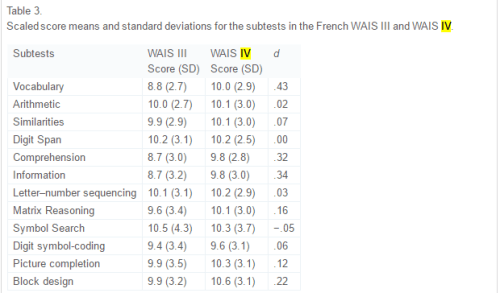
The above table from the paper, table 3, shows the comparison between the two WAIS tests. Positive ds indicate lower scaled scores on the III in comparison to the IV and thusly higher scores. What these data show is that the IV is harder than the III and IQ declined because the test got ‘tougher’ (because full-scale intelligence declined). As noted above, this phenomenon of decreasing IQ scores has been noticed for about 20 years now. The symbol search showed the smallest decline while there was no change in digit span. The biggest gain was in vocabulary.
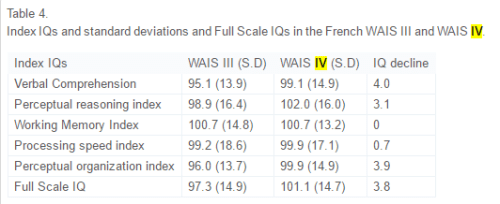
This is pretty shocking. In ten years, verbal comp decreased by 4 points, perceptual reasoning index by 3.1 points, no change in working memory index, processing speed index decreased by .7 points, perceptual organization index decreased by 3.9 and the whole full-scale IQ decreased by 3.8 points. Lynn and Dutton discuss the results:
In addition, the Full Scale IQ on the WAIS IV sample of 79 subjects was calculated based on a comparison with the WAIS IV sample of 876 subjects, which was representative of the French population on key variables such as education and region. The scores of this sample of 876 subjects were set at 100 and a comparison made with the sample of 79 subjects. As can be seen in Table 4, on this basis the IQ of the sample of 79 subjects was 101.1 with an SD of 14.7, where the French norm would be 100 and the SD 15. As such, the smaller sample can be regarded as representative of the French population in terms of intelligence.
So this small sample can be regarded as representative of the French population. Lynn and Dutton say that the digit span showing no increase corroborates findings from another researcher that showed that there was no change in forward or backward digit span in 85 years. They then say:
. . .improvements in the quality of nutrition during the twentieth century made a major contribution to increasing IQs. But it seems improbable that the quality of nutrition declined in recent years in France and in the other economically developed countries in which declining IQs have been reported.
So one possible cause is that nutrition has declined in France. From Dubuisson et al, 2010:
These repeated surveys highlighted the fact that trends in French food habits have moved towards an average European diet at the crossroads between Mediterranean and Northern diets, and that food consumption changes impacted, to a lesser extent, nutritional intake.
It shows that the French diet is in between Med and Nord diets. Really, as Lynn and Dutton asserted, there was no decline in nutritional quality for the French.
Another possible cause is a decrease in quality of schools. Flynn says a part of the reason for the rise in IQ was due to the advent of scientific thinking. However, this is not a good explanation either since school quality seems to not have been affected.
Flynn also talks about the media and its role. Lynn and Dutton say:
However, this would not explain declines in other forms of intelligence and, moreover, it might be argued that the desire and ability to read such literature would be underpinned by general intelligence and so a decline in the consumption of such literature would partly reflect a decline in general intelligence, as vocabulary is a measure of intelligence.
It is also worth noting that, apparently, reading may actually increase general intelligence (post coming on that soon).
Now, finally, the theory we’ve all been waiting for: Is it increased immigration?
Lynn and Dutton state:
This increase has occurred throughout western Europe and a number of studies have shown that immigrants from North Africa and south-west Asia typically have an average IQ of around 85 to 90 (Lynn, 2006, Lynn, 2008, Lynn and Vanhanen, 2012 and Rindermann and Thompson, 2014; for a large meta-analysis see te Nijenhuis, de Jong, Evers, & van der Flier, 2004). This conclusion has been confirmed by Kirkegaard (2013) who has shown that in Denmark the number of non-European immigrants increased from approximately 50,000 in 1980 to 400,000 in 2012 and the IQ of non-European immigrants in 18–19 year old military conscripts was 86.3, relative to 100 for indigenous Danes. These immigrants are likely to have had some impact on reducing the average IQ of the populations, but it is doubtful whether the increase in the number of immigrants with lower IQs has been sufficiently great to have had a major effect.
I personally don’t think that migration into Europe from MENA and SSA countries has been enough to put that big of a dent (over 1/3rd of an SD) in average IQ in France, and Europe as a whole. Since people are coming from areas closer to the equator and have higher rates of children since they are r-selected, could this be why France has seen a decrease in intelligence?
No.
Woodley of Menie and Dunkel (2015) reviewed Lynn and Dutton’s paper and said:
Replacement migration in France involving populations exhibiting lower means of IQ and higher rates of total fertility, such as Algerians, Moroccans, Tunisians and Roma (Čvorić, 2014 and Lynn and Vanhanen, 2012) may be increasing the rate of secular losses at the level of g, consistent with speculations advanced in Dutton and Lynn (2015), however the additional loss in g due to this process is anticipated to be very small. Based on a simulation, Nyborg (2012) estimates that in Denmark, replacement migration may be reducing heritable g by .28 points per decade, which would increase the overall loss in g to 1.51 points per decade ( Woodley of Menie, 2015), this still being only 37.75% of the loss observed in the French cohort.
An Environmental Explanation?
Since we still need an explanation for 62.25 percent of the 3.8 decrease in full-scale IQ other than dysgenic fertility, are there any environmental explanations? Environmental explanations can be anything from child abuse, to poor schooling, to poor nutrition, etc. Was there an increase in any of these or other variables that negatively affect IQ which would explain the 3.8 point decline in IQ?
One of the most likely candidates is nutrition. Lack of certain vitamins, especially in childhood, would prevent the brain from receiving the proper nourishment to grow.
The INCA study took record of food consumption from 2,373 people aged 4 to 92 from a 7-week period and from that they saw which nutrients they were deficient in (Touvier et al 2006). To measure if and how much they were nutrient deficient, they used the Estimated Average Requirement (EAR). The vitamins used were calcium, magnesium, iron, vitamins C, A, B6, and B12, thiamin, riboflavin, niacin, pantothenic acid, and folate. A lot of these have to do with proper brain functioning and ability to reach its full-size potential. For instance like the B vitamins and iron. Being deficient in those nutrients depresses brain size and with it IQ. For instance, being deficient in vitamin B 12 and folate leads to decreased brain size in childhood. The negative effects of being deficient in these nutrients may partially explain some of the 3.8 point decrease in full-scale IQ.
Regarding the prevalence of the aforementioned nutrient deficiencies in these populations, the authors state:
We also calculated daily consumption of 44 food groups by age and gender. This paper shows how the combination of both data sets, i.e., inadequacy and food consumption data, allows a preliminary screening of potential food vehicles in order to optimize fortification. The prevalence of inadequacy was particularly high for the following groups: for calcium, females aged 10-19 years (73.5%) or aged 55-90 years (67.8%), and males aged 15-19 years (62.4%) or aged 65-92 years (65.4%); for magnesium, males aged 15-92 years (71.7%) and females aged 10-90 years (82.5%); for iron, females aged 15-54 years (71.1%); and for vitamin C, females aged 15-54 years (66.2%). Two examples are provided to illustrate the proposed method for the optimization of fortification.
Most vitamins and minerals have positive effects on brain functioning, some more than others, but notice the prevalence of iron defieciency in the females aged 15-54 years (71.1 percent). With the cohort cited by Lynn and Dutton (2015) and Woodley of Menie and Dunkel (2015) being aged 30 to 63 with an average age of 45, the prevalence of iron deficiencies in the INCA study, along with the other deficiencies in the cohort, may partially be responsible for the decline in IQ.
The Flynn Effect
PumpkinPerson describes it well here:
One of the biggest mysteries in psychology is the Flynn Effect; the fact that over the 20th century, people have been performing better and better on IQ tests. Of course, the average IQ in Western countries by definition is always about 100, however because people keep scoring higher every decade, the tests routinely have to be made more difficult and the norms must be regularly updated to keep the mean IQ from rising far above 100.
However, in first-world countries, in the past 20 or so years, it has been in decline, particularly in France. It’s due to a mix of dysgenic fertility and nutrient deficiencies. Since Flynn gains are largely due to advancements in better nutrition, Flynn loses would then be attributed in part to nutrient deficiencies as well as dysgenic fertility.
The cause for the 3.8 decrease in IQ in France is low fertility rates amongst the French population as well as nutrient deficiencies. Clearly, ameliorating this decrease in IQ can be reversed by the K-selected having more children and healthier eating habits. Drops in IQ won’t be attributed to MENA and SSA populations until the future, but for now, the cause for the decrease is the French themselves.
Is HBD an Ideology of Hatred and Racism?: A Reply to Robert Lindsay
1900 words
100 posts!! A nice special post today, Robert Lindsay’s accusation of HBD being ‘racist’ is on the table today. As always, I want to hear what you want me to write on so send me an email, address is in the sidebar.
Robert Lindsay asks “Is HBD an Ideology of Hatred and Racism?” It, of course, isn’t. Today I’ll rebut his piece saying that it is “hatred and ‘racism’ (whatever that means)”. He says that HBDers who resist ‘racism’ (which I will address later) are “swimming against the tide” and “probably have to exercise a bit of self-control to not go over to the dark side.” What is he even talking about? What “dark side” is there? Being ‘racist’?
This is because HBD facts tend to lend pretty regularly to quite a bit of racism and the hatred that goes along with it. And if you notice, the more hardcore the HBD’er is, the more racist they tend to sound.
Of course these facts lead to ‘racism’, however, these ‘racists’ will be ‘racist’ with or without the facts of HBD. I will touch more on that later. In the meantime, he says “the more hardcore the HBD’er is, the more racist they tend to sound.” Robert, are you just making broad generalizations? Do you have anything to back your claim on this statement? Or are you just talking out of your ass?
HBD in and of itself is not racist of course, not in any sane sense of the word.
I agree with him saying that the Left has destroyed any “meaning” that the word “racist” has. However, even without the overstating of the word “racist”, HBD itself would not be a racist ideology. It is, however, racist to the average person who doesn’t know the science involved in racial differences. The Merriam-Webster Dictionary has two definitions for ‘racism’. It defines ‘racism’ as:
a belief that race is the primary determinant of human traits and capacities and that racial differences produce an inherent superiority of a particular race
- Racial prejudice or discrimination
Well, “superiority” is meaningless. Race is not a primary determinant of human traits as there is a lot of crossover. However, there are racial/ethnic differences in phenotype which of course are caused by differences in genotype. That is not up for discussion, but the term ‘inherent superiority’ is.
Of course to the average person, HBD is seen as ‘racist’. But is researching/reading about human differences and being interested in their causes and what they mean today really ‘racist’ or a want to learn more about human evolution and how and why we got here?
But the ones who are very deep into it and talk about it all the time, well, it’s quite clear that they have a pretty low opinion of NAM’s. Even worse, a lot of them are just out and out racists. Some are even vicious racists. And almost all of them have the worst rightwing politics, usually Libertarian, that you could imagine.
‘Racists.’ There’s that word again. I did say at the beginning of the year that we should petition to have ‘racist’ changed to ‘ethnocentrist’, as what is being described when one cries ‘racist’ is actually ethnocentrism in action. This is mediated by the brain hormone oxytocin. I would wager that ‘racists’ and other, closely related people (ie Arab Muslims with high consang rates) would have higher levels of this brain hormone. This would be the reason why these groups stick to those who are phenotypically to themselves; it’s hormonally driven, like most, if not all things in life. Stop using the word ‘racist’ and use ‘ethnocentrist’ as it makes much more sense.
More importantly, HBD is a profoundly pessimistic doctrine. Just to give you an idea, they hate the idea that the environment or even free will has any role to play human affairs. Look at how furious they get about the Flynn Effect. Look at all the bending over, twisting themselves into weird yoga positions, hand waving, magic wand waving, “Don’t look over there”, and “just-so” explanations they have come up for to deny what is an obvious rise in human intelligence. The idea that the environment could actually increase intelligence fills them with rage because they are all wrapped up in this “intelligence is purely genetic” argument. (Bold is my emphasis)
Yes HBD is pessimistic, as is life, Robert. Who hates the idea that environment has any role in intelligence? Any sensible individual would acknowledge that environment does play a role, but would also know that intelligence is highly heritable. I’m pretty sure he’s just talking about the average ‘racist’, as I’ve never seen an HBD blogger every state that intelligence is fully genetic. Sure there are some intelligence researchers (a minority) who believe that intelligence is fully genetic but just like extreme environmentalism in regards to causes for IQ, extreme hereditarianism is also a stupid view to hold. Genes and environment interact to give the phenotype. We can take an African from, say, South Africa and place him in America. Due to better nutrition and better schooling among other things (like lessened parasitic load and disease), in my opinion African IQ would be about 10 points higher, give or take a few points. We know that environment and genetics (GxE) affects all phenotypic traits, but those like Robert like to play up Flynn gains as if they are on actual g – they aren’t. Flynn Effects are not genetic and are UNRELATED to race differences (Rushton, 2000).
On another note, I seem to have been wrong with my statement that Flynn gains were 3 points per decade in every country. I would wager that since intelligence is affected by nutrition that those countries with lower Flynn gains that showed the least improvement with nutrition would show the lowest IQ gains. I will write on this in the future.
Of course, that argument is a death knell for Blacks and other NAM’s. These people have enough problems as it is, but HBD just drives a stake through their heart to make sure the Black man (or other NAM’s) never rises again. It pretty much condemns them forever as genetic inferiors in sense.
They have enough problems as it is because of their biology which HBD speaks about, the supposed ‘racist ideology’. It pretty much does ‘condemn them’ as ‘genetic ‘inferiors” (whatever that means), but that’s Nature! Nature is not a kind Mistress. Nature is harsh, nature doesn’t care about feelings.
Intelligence isn’t either fully genetic nor fully environmental, but shifted considerably over to the hereditarian position.
It says “niggers ain’t got no brains,” and while that may be true in a very ugly and racist sense that most us don’t want to think about, instead, the HBD’er is overjoyed at this fact. “Black people are stupid!” he hollers to the sky with joy. “And they will stay that way forever!” he yells gleefully. “Environment can’t help them. They are condemned!” At this point, he is nearly gleeful and ready to party.
I laughed out loud at this. Environment can help, to a point (if they come from Africa or some other down-and-out place), but mainly, as seen in the Minnesota Transracial Adoption Study, blacks didn’t end up doing better than whites when environments were equalized.
And most of them are racist lousy people, but they are quite smug about their racism because now their racism is given the imprimatur of science. “If science says it’s true, I can’t be racist,” he chortles.
Idiotic. Everyone is ‘ethnocentric’ to a degree, whether consciously or subconsciously. Robert, you are an HBDer yourself whether you admit it or not since you recognize racial differences, so I guess you are ‘racist’.
After all, science isn’t racist. I agree, but distortion of science for racist means sure is, and delighting in the disturbing “racist truths” of science is doubly so.
Sure, gay men are at very high risk of HIV, and up to 20% are infected. That’s a fact of science. So does that make you want to get up and party for 30 days and 30 nights? I hope not, and if so, you are one ugly homophobe.
Science is not racist. But, as Leftists love saying ‘Data isn’t racist, interpretation of it is!!!’ is idiotic. Of course a lot of people distort racial science, but that doesn’t mean that it’s ‘wrong’. Like with making myths on how Europeans were always in Europe 40kya (not true) or how Europeans were always white (not true) he is right here. Most people do not keep up to date on the newest data that comes out so they still hold to these ‘mythologies’ and ‘identity politics’ and push out outdated and straight untrue statements. But all that means is that they are extremely misinformed.
What would I do with that stat of gay men and HIV? Be cautious around gays, just like I’d be cautious around blacks knowing how much crime and murder they committ as a group. This is a sane position to hold. One group is overrepresented in a certain (negative) stat? Keep an eye out while around those of that demographic. That makes sense. Self-preservation always wins out. Robert is of course using the Leftist playbook on ‘racist’ namecalling. Most everything in this article I’ve seen around countless times being spewed to any HBDer who went against conventional wisdom. The term ‘racist’ is just used as a silencing tactic. Robert, you are a Leftist HBDer. You do know that a lot people you align yourself with politically consider you ‘racist’ right?
This notion that anyone who believes HBD is ‘racist’ or any other buzzword is used to shut down any and all discussions on matters. Something that, it seems, flew over his head. When one cannot rebut something an HBDer puts out, they get called ‘racist’. However, the term is pretty much close to meaningless nowadays as it’s been so overused by the Left. All of the HBD bloggers I follow are not racist (hell, one who is most certainly not racist is PumpkinPerson who has a very unhealthy obsession with Oprah. =^) You know it’s true, PP). Others like Razib Khan, JayMan, hbd chick, and Cochran and Harpending, just to name a few, have gotten numerous accusations of being racist. Hell, Razib Khan was hired and fired the same day by the NYT after going on board as a science writer when someone discovered his ‘racist’ writings.
Whether or not people believe HBD doesn’t change how true it is. Racial and ethnic differences still persist, so by just disregarding it we completely go over causes of it other than ‘systemic racism’!!! HBD is true and a valid, non-racist (whatever that means) ideology. We segregate with people like us. Hell, even you, Robert, prefer whites over others (oh no, racist!!!!). Once we start understanding how and why people are ethnocentric (with oxytocin playing the main role), then we can have a more peaceful society as we understand causes for actions, both negative and positive, and better curb violence.
HBD itself is not a hateful ideology, it’s just one based on facts and solid reasoning. Just because people use HBD to justify their own preconceived notions or to use ‘hate facts’ doesn’t mean that it’s a racist ideology. Nice job using the word ‘racist’ as invented by Trotsky. But knowing your political leanings, Robert, that’s AOK, right?
It’s worth noting that Robert banned me for my politics. He claims his comments are ‘free speech’, yet when I said the truth about socialism and the amount of deaths it caused (way more than National Socialism), I got an immediate ban. Truth hurts, huh?
Guns, Germs, and Steel: A Refutation
Of course the allegations of “racism” arise, as usual when in discussions of racial differences in intelligence and level of civilizational achievement. Rushton also says:
Racial differences in brain size and IQ map very closely to the same cultural histories Diamond explains. Although Diamond dismisses such research as "loathsome", he fails to tell his readers what, if anything, might be scientifically wrong with any of it. One hundred years of research has
established that East Asians and Europeans average higher IQs than do Africans. East Asians, measured in North America and in Pacific Rim
countries, typically average IQs in the range of 101 to 111. Caucasoid populations in North America, Europe, and Australasia typically average
IQs from 85 to 115 with an overall mean of 100. African populations living south of the Sahara, in North America, in the Caribbean, and in Britain
typically have mean IQs from 70 to 90.Racial differences in brain size and IQ map very closely to the same cultural histories Diamond explains. Although Diamond dismisses such research as
"loathsome", he fails to tell his readers what, if anything, might be scientifically wrong with any of it. One hundred years of research has established that East Asians and Europeans average higher IQs than do Africans. East Asians, measured in North America and in Pacific Rim
countries, typically average IQs in the range of 101 to 111.  Caucasoid populations in North America, Europe, and Australasia typically average IQs from 85 to 115 with an overall mean of 100. African populations living south of the Sahara, in North America, in the Caribbean, and in Britain typically have mean IQs from 70 to 90.
Ethnic Differences in Sleep, Obesity, and Metabolic Syndromes
2300 words
Ethnic differences in the prevalence of obesity occur, majorly in part due to differences in the rates of metabolic syndrome (which is actually a few variables including high blood pressure, high blood sugar which leads to insulin resistance, excess visceral fat around the waist which is the ‘skinny fat‘ phenomenon, and abnormal blood pressure levels) and obesity. Ethnic differences in these variables do, in part, show how the three ethnies differ in rates of obesity. I will discuss the differences between each ethny in regards to metabolic syndrome and sleep and how it leads to the differences in ethnic obesity rates.
Sleep Differences
There is a ‘missing hour of sleep‘ when comparing blacks and whites. On average, blacks get 6.05 hours of sleep while whites get 6.85 hours of sleep. Of course, the same old racism argument comes up, which, if one ‘percieves’ discrimination, I wouldn’t doubt that it would have an effect on sleep due to a rise in cortisol, which affects sleep due to the raised levels making you restless and not able to fall asleep. Insulin levels then rise due to the rise in cortisol, which is the cause of obesity.
Some studies may try to say that racism and other forms of discrimination are a factor, without even thinking of genetic factors. Another study that Frost cites says that duration of deep sleep and duration of stage 2 (light sleep) is correlated correlated in African Americans with perceived discrimination. The authors defined ‘perceived discrimination’ as the extent to which one believes that their ethnic group have been discriminated against by society. Still even when controlling for discrimination, there were still marked differences between blacks and whites and how long they slept.
Frost then talks about how sleep patterns are heritable and cites studies done on Africans in Africa. One study found that there was an hour sleep difference between Ghanaians and Norwegians on the week days and between a quarter to half hour less on weekends. He shows another study showing that Nigerian college students sleep 6.2 hours a day while getting 70-minute naps in the afternoon.
Frost concludes that the African sleep patterns is normal on Africa. Africans are more active during the cooler times of the day and sleep during the bitter periods. Frost says those who evolved in more northerly climes are particularly adapted to a certain sleep pattern with the same holding true for Africans.
However, these sleep patterns in first world countries have negative effects on metabolism and rates of obesity.
Here are some more studies showing that blacks sleep less than whites:
The sleep of African Americans: a comparative review: The researchers found that blacks take longer to fall asleep than whites, report poorer sleep quality, have more light and less deep sleep, and nap more often and longer. This is a huge recipe for risk factors for obesity, and it shows in their demographics.
Unfair Treatment is associated with Poor Sleep in African American and Caucasian Adults: Pittsburgh SleepSCORE Project: This is one of the studies spoken about above that show that discrimination leads to less sleep. Though, it holds for both black and white adults. The researchers conclude:
Taken together, the confluence of perceived unfair treatment as a chronic stressor and poor sleep and the interplay between the two may have critical roles in long-term health problems.
African Genetic Ancestry is Associated with Sleep Depth in Older African Americans: The researchers hypothesized that “racial differences in sleep phenotypes would show an association with objectively measured individual genetic ancestry in AAs.” They conclude that the slow wave sleep may have genetic underpinnings.
Mexican Americans sleep less than do Mexican immigrants. US-born Mexicans are 40 percent more likely to be short sleepers. This is attenuated by environmental factors such as smoking and stress, which shorten the duration of sleep (smoking decreases the Body Set Weight, whereas cortisol along with insulin in tandem increase it).
Also, in this study by Roane et al (2014) looked at the link between sleep disturbances and stress in Mexican Americans (average age 55) and non-‘Hispanic’ whites (average age 66). Mexicans reported higher levels of sleep disturbance (25 percent) compared to whites (17 percent). They conclude that disturbed sleep was positively correlated with depression.
So both blacks and Mexicans sleep less than whites. These differences in sleep between these three ethnies also affect the prevalence of obesity in these populations.
Obesity and Sleep
It’s long been known that poor sleep habits make people fat. This is due to the effects of insulin and cortisol. Increased insulin comes before increased cortisol–increased insulin is the cause for obesity. Sleeping less is linked to obesity. Since, as described above, the three ethnies differ in sleep patterns, the same also holds true for obesity rates (Ogden at al, 2014). The trends are as follows: 67.3% for whites, 75.6% for blacks, and 77.9% for Hispanics. Though, sleep is only one factor involved with obesity.
Getting adequate sleep is extremely important. Not doing so can lead to a myriad of negative health implications:
Sleep is an important modulator of neuroendocrine function and glucose metabolism and sleep loss has been shown to result in metabolic and endocrine alterations, including decreased glucose tolerance, decreased insulin sensitivity, increased evening concentrations of cortisol, increased levels of ghrelin, decreased levels of leptin, and increased hunger and appetite. Recent epidemiological and laboratory evidence confirm previous findings of an association between sleep loss and increased risk of obesity.
So a lack of sleep leads to an increase in ghrelin levels, decreased levels of leptin (the same effects as caloric restriction over time), increased appetite and hunger, increased evening cortisol (which insulin spikes then follow), decreased insulin sensitivity (the cortisol brings it back up and most people are insulin resistant independent of diet), decreased glucose tolerance, etc. We can see that these ethnic differences in sleep, which are partly genetic in nature, can and would have great effects on metabolism, contributing to the ethnic differences in obesity rates.
And from Harvard:
For example, in the Nurses’ Health Study, researchers followed roughly 60,000 women for 16 years, asking them about their weight, sleep habits, diet, and other aspects of their lifestyle. (2) At the start of the study, all of the women were healthy, and none were obese; 16 years later,women who slept 5 hours or less per night had a 15 percent higher risk of becoming obese, compared to women who slept 7 hours per night. Short sleepers also had 30 percent higher risk of gaining 30 pounds over the course of the study, compared to women who got 7 hours of sleep per night.
Damn!! This, pretty much, mirrors the black-white difference. I’d love to see a racial breakdown of this cohort and will keep an eye out for one, but in the meantime, those who were short sleepers had a 30 percent higher risk of gaining 30 pounds over the course of the study in comparison to women who got 7 hours of sleep per night. Blacks are the most likely group to be overweight and obese in the US, and this data from the Nurses Health Study (which tons of data can be drawn from this study) shows one reason why, however the driver is cortisol > insulin > processed carbs > increased insulin > insulin resistance > increased insulin > vicious cycle > obesity. These differences in sleep almost perfectly mirror the ethnic differences in obesity.
There are several possible ways that sleep deprivation could increase the chances of becoming obese. (1) Sleep-deprived people may be too tired to exercise, decreasing the “calories burned” side of the weight-change equation. Or people who don’t get enough sleep may take in more calories than those who do, simply because they are awake longer and have more opportunities to eat; lack of sleep also disrupts the balance of key hormones that control appetite, so sleep-deprived people may be hungrier than those who get enough rest each night.
Ah the old ‘exercise to increase the Calories Out part of the equation’. however, Calories Out does not stay constant. This also rebuts the ‘Eat Less and Move More’ CICO (Calories In/Calories Out) model of obesity, showing that because it doesn’t take insulin into account, it’s doomed to fail.
Speaking of insulin, it’s about time I focused on metabolic syndrome.
Metabolic Syndrome
As I discussed in a previous post, Race, Obesity, Poverty, and IQ, metabolic differences exist between race/ethnicity. ‘Hispanics’ metabolize carbohydrates differently, blacks have a lower fiber intake (increased fiber protects against obesity, another correlate) while whites have a more high fat diet. Contrary to popular belief, dietary fat doesn’t make you fat as it’s the macro that spikes your insulin the least.
Diaz et al (2005) showed that minority populations are more likely to be affected by diabetes mellitus which may be due to less healthy diets and/or genetic factors. Using the National Health and Nutrition Survey for 1999-2000, they analyzed overweight, healthy adults, calculating dietary intake variables and insulin sensitivity by ethnicity. They characterized insulin resistance with fasted insulin, as those who are more likely to become insulin resistant have higher fasted insulin levels (levels taken after waking, with the subject being told not to eat the night before as to get a better reading of fasted insulin levels). Non-‘Hispanic’ whites had higher energy and fat intake while ‘Hispanics’ had higher carb intake with blacks having lower fiber intake. Blacks and ‘Hispanics’ were more likely to have lower insulin sensitivity. However, ‘Hispanics’ were more likely to have lower insulin sensitivity even after controlling for diet, showing that metabolic differences exist between ethnicities that affect carbohydrate metabolism which leads to higher rates of diabetes in those populations.
In ‘Hispanics’, several loci were discovered that play a role in hepatic (relating to the liver) fat content. Along with showing that ‘Hispanics’ have lower insulin (which due to low insulin, blood glucose builds up in the blood stream leading to diabetes) and showing that they metabolize glucose in the liver differently due to differing loci leading to more cases of fatty liver, this shows how and why ‘Hispanics’ have higher rates of Type II Diabetes Mellitus (TIIDM).
Since TIIDM affects Mexican Americans more, better measures to address their differences in carbohydrate metabolism need to be taken. Racial and ethnic differences in TIIDM are as follows:
7.6% of non-Hispanic whites
9.0% of Asian Americans
12.8% of Hispanics
13.2% of non-Hispanic blacks
15.9% of American Indians/Alaskan Natives
Whites eat a higher fat diet, which means a decrease in carbs. Asians eat white rice which spikes blood glucose eliciting a high insulin response leading to TIIDM, ‘Hispanics’, non-‘Hispanic’ blacks, and Indians and Alaskan Natives (I wish they separated Indians and Alaskan Natives as I’m almost positive that Alaskan natives have a lower rate) all eat high carb, low fat, low protein diets. Carbohydrates are a main staple, and since they spike insulin the most, they are the cause for obesity and TIIDM rates in these populations.
Turning my attention over to metabolic syndrome and blacks and whites, we can see that black women with PCOS have an increased risk for cardiovascular disease and metabolic syndrome in comparison to white women with PCOS. The researchers say that after controlling for age and body mass index (BMI) “black women with PCOS had a significantly increased prevalence of low high-density lipoprotein and high glucose. The general CVD risk was significantly increased in black adults with PCOS.” Though, a longitudinal study needs to be carried out to assess the independent impact of race and PCOS with CVD (Cardiovascular Disease).
Blacks have a higher chance to be diagnosed with metabolic syndrome since they are also at increased risk to have elevated blood pressure (hypertension), become obese, and be diabetic. This is due to their diet, which is due to their low IQ (obesity is correlated with intelligence), and different metabolism in comparison to whites.
There are also metabolic differences between race and sex. Fat oxidation is lower in black than white men and in African American men/women and white men/women, they have a lower metabolic rate!!! 24-hour energy expenditure is lower in black women in comparison to white women, whereas physical activity energy expenditure (PAEE) is the same as whites. Contrasted with women, black men had higher PAEE than white men. The authors conclude:
In conclusion, this comparative study of 24-h energy metabolism in African Americans and whites with use of a respiratory chamber not only confirms the previous findings from ventilated-hood studies of a lower resting metabolic rate, but also suggests a lower 24EE in African American women than in white women. Although only marginal ethnic differences in metabolic rate were found in men, African American men seem to have a lower rate of fat oxidation than do white men. The underlying mechanisms for these sex differences and the significance of these findings with respect to the development and maintenance of obesity remains to be investigated in longitudinal studies.
Metabolic Syndrome and Obesity
Are Australoids and Pacific Islanders Negroid? A Reply to PumpkinPerson
1600 words
I’ve been in a few discussion with PumpkinPerson on phenotype and if the similar phenotype found in Australoids and Pacific Islanders meant they were Negroid. However, just because two *dissimilar groups* look *phenotypically similar*, that doesn’t mean that they are *genotypically similar*. Afrocentrists have also latched on to this ridiculous theory, saying that blacks are ‘all over the world, displaced by whites yada yada yada’. Today, I’ll show that just because those two groups look similar to Africans doesn’t mean that they are similar on the genotype.
PP wrote an article last week, The importance of leaving Africa, which I will be quoting from for the remainder of this article.
The root of this debate is not so much genuine scientific disagreement, but ethnic genetic interests. The black Afrocentrists believe it’s good for black people to be seen as part of this larger, global black community, thus dispelling the claim that blacks only left Africa in chains. For leaving Africa was one of the milestones that separates humans from our closest living relatives (chimpanzees), so the claim that blacks never left Africa is seen as racist indeed.
I agree here that Ethnic Genetic Interests is the main driver of the dispute.
But if the mere leaving of Africa did indeed screen for IQ, why do the Australoids score even lower on IQ tests than sub-Saharan Africans do, and have somewhat smaller brains
Because the environment is similar it would select for similar phenotypes, but just because the environment is extremely similar doesn’t mean that no genetic change occurred in the 70 ky that Australoids left Africa in.
By contrast, the non-black HBDers think it elevates their racial status to promote the idea that their ancestors did something that blacks couldn’t accomplish: leaving Africa.
Well, as I’ve covered here last year (time flys), those who left Africa had specific alleles, the DRD7 and DRD4 alleles, which are absent from SSA populations. This ‘wanderlust’, due to the DRD7 allele, is the *cause* of the migration OoA. It has nothing to do with being more intelligent than those who stayed, it has to do with the genetic mutation that arose from a common ancestor around the time of the OoA migration. The cause of the migration does come down to genetic differences in the founder population (s), but not intelligence differences.
Two notes on the DRD4 allele: populations with a history of migration have a higher chance of having the allele in comparison to sedentary populations. And: a correlation of .85 was found between km traveled and the rate of DRDR4 allele frequency distributions. These alleles are more prevalent in South America, which is not surprising since they had to travel the furthest.
PP then starts talking about why Australoids have lower IQs, saying:
With agriculture/civilization, the dark caucasoids traveled the World, spreading their high IQ mutation to every corner of the globe except those that are most isolated. So the mean genetic IQ of the entire World increased by 13 points, with the exception of places that were too hard to get to, such as Australia and Papua New Guineas, the Congo rain forest, the Southern tip of Africa, and the Americas. Since most of sub-Saharan Africa got the genes, they suddenly leaped from having lower IQs than the Austaloids, to being smarter (only the bushmen and pygmies, who like the Australoids, were too isolated to get the genes, remained behind the Australoids).
This is a great hypothesis. It makes a lot of sense. The ‘Dark Caucasoids’ as PP calls them, better known as Anatolian/Neolithic Farmers could have had a higher chance for more high IQ mutations due to the fact that they could farm and thus have a higher population giving more of a chance for higher IQs.
The downfall for the dark caucasoids was spreading these genes to whites and East Asians. Because of cold winters, East Asians and whites were smarter than pre-mutation dark caucasoids, and now with these mutations, they were smarter once again.
I’m confused here. What we call whites today did not exist that far back in the past. Europeans are an amalgamation of four different ancient populations, basically are an amalgamation of ‘Dark Caucasoids’. Is he also saying that the Neolithic Farmers were more intelligent than East Asians?
Eurasians didn’t become a distinct breeding group until the end of the last Glacial Maximum. This is why there is ‘genetic similarity’ to modern-day Europeans with some old, 10k year plus peoples in the Americas. Because the two groups didn’t split into distinct populations, they show a similar genotype. This is what proponents of the Solutrean Hypothesis need to get through their heads. (I recently got into a nice discussion over at The Alternative Hypothesis, scroll down for comments. I’m going to make a more comprehensive post on the SH in the near future as I have come across even better data on it.)
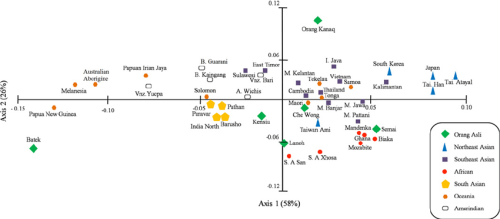
We can see from this PCA graph (from Zainel Abidin et al) that Australoids don’t even cluster in the vicinity of Africans. They are on the complete other side of the graph, showing how great of a genetic distance there is between these two populations. You can see the other Oceanic peoples (the orange dots, who Afrocentrists and others say are Negroid, Abos, Papuans, Melanesians, etc) are also clustered away from Africans. PCA graphs show that the three populations are not genetically similar and that phenotype, sometimes, isn’t enough to show who belongs to what racial grouping. PCA analysis refutes peoples ‘feelz’ on what they believe with their eyes. Even with this data, their ‘feelz’ still overrides the truth and they still believe lies.
While on this subject of similar phenotype not meaning one population is racially the same as another, people use this same fallacious reasoning for ‘white-looking’ peoples in the ME.
Quoting Razib Khan:
The final issue is that a lot of the phenotypes that we racially code are recent. This probably explains why groups like the Kalash and Nuristanis can look more like Europeans than South Asians, but they’re genetically more like South Asians.
What does any of this have to do with non-scientific things? I don’t really know. My interest in population structure is intellectual, not personal. But a certain type of person should probably stop talking about how white people have been in Europe for 40,000 years. First, the ancestors of modern Europeans 40,000 years ago were almost all residing outside of Europe. An assertion that holds until 15,000 years ago. And most would still be resident outside of Europe 8,000 years ago as depending on how you count/calculate. *** And, perhaps more importantly, the typical phenotype of Northern Europeans probably really coalesced only around ~5,000 years ago. ***
How can there be such phenotypic similarity in two populations separated by thousands of miles?
Easy. The Kalash and other ME ‘white-looking’ populations have ancient Siberian ancestry. As shown in my linked article, modern-day Europeans have a great deal of Siberian ancestry, mostly from the true Aryans, the Yamnaya peoples.
And in the comments Razib was asked:
“Could I bother you to list the top three theories/positions that you see falling into this unsupportable category?”
To which he responded:
“that phylogeny and phenotype track closely. just because you can’t tell the physical difference between two pops (e.g., solomon islanders and sub-saharan africans) they must be phylogenetically close. this is not the case.”
Pretty much seals the deal.
Just because populations look similar on the outside doesn’t mean they are genetically similar. As shown from Razib’s post, the phenotypes that we code are relatively recent, which is why there are some populations separated by thousands of miles yet look extremely similar.
Bonus:
This was said in the comments:
I can’t really tell about the genetics since I don’t have the scientific background, but my impression is a lot of those white identity guys have an extremely mythologised view of the past. This seems to be true even of the smarter ones; e.g. I recently read a bit of Richard Spencer’s twitter account (out of interest in the alt right phenomenon) and he throws out such totally retarded comments as “Europe has always been unified, even before Christianity” (totally ignoring what is known about the ancient Greeks’ intimate links to the Near East, the Greeks’ and Romans’ unflattering view of the northern barbarians, the emergence of Latin Christendom in the middle ages and the fairly late rise of the concept of Europe etc.) or “Europe is a nation”. There seems to be little awareness of the complexities of historical change because everything is reduced to some supposedly unchanging racial essence reaching back into the mists of prehistoric times. Now I’m pretty far right and “racist” myself, but a lot of this really seems pretty stupid…like myth-making for identity politics.
i knew the pre-WN richard spencer (we lost touch after his ideological changes ~2010). he’s smart. i have a hard time believing he doesn’t know the latest research, which was evening starting to be evident back then. so i think it’s myth-making.
p.s. a friend of mine sent me a link to a richard spencer interview with kevin macdonald last year i think, pointing to a specific segment of the podcast talking about ancient genetics. kevin was telling richard how europeans 40,000 years ago were white, and those are the ancestors of europeans. that’s wrong.
Europeans 40kya were not white those in the area at that time are *not* the ancestors of today’s Europeans.
Both Afrocentrists and Nordicists need to keep up with the new information that’s constantly coming out. Because what they say in regards to genetics and/or anything else is mostly wrong.
Japan’s Population Decline and r/K Selection Theory
Edit, 7/18/17: r/K selection theory has been rebutted.
r/K Selection Theory: A Response to Rushton
E.O. Wilson on Rushton’s r/K Theory and More on Endemic Disease
r/K Selection Theory: A Response to Anonymous Conservative
r/K Selection Theory: A Response to Truth-Justice
r/K theory doesn’t apply to humans and if it did, Mongoloids would be r and Africans would be K. Cold with is an agent of r selection while endemic disease is an agent of K selection. Rushton used a debunked “continuum” for the basis for his theory and completely changed r and K. However it’s wrong. Rushton was wrong. Anonymous Conservative is wrong. Anyone who uses those two in reference to r/K is wrong by proxy since r/K is a debunked paradigm.
Japan has had a population crisis for a few years. Japan’s fertility rate was 1.4 in 2014. To have enough children to keep the population stable, the Total Fertility Rate (TFR) needs to be 2.1. As a country industrializes and becomes more prosperous, the TFR drops as higher IQ follows better nutrition. As a nation industrializes and becomes more complex, the attention of the populace shifts from one of having children and a family to one of success and intellectualism. As this occurs, the birth rate drops because the more intelligent a population is, the more likely it is for them to pursue higher education or monetary achievement. Clearly, the main reason Japan has concerns with their TFR is due to their high intelligence.
The Japan Times reported yesterday that almost half of single young men and women were virgins. A survey of Japanese men and women aged 18-34 found that 70 percent of unmarried men and 60 percent of unmarried women were not in a relationship. Also discovered, 42 percent of the men and 42.4 percent of the women admitted to being virgins. The survey was taken before in 2010, with 36.2 percent of men and 38.7 percent of women admitting to being virgins.
These surveys have been carried out every 5 years since 1987. Then, the rate of men who said they had no partner was 48.6 percent and for women it was 39.5 percent. The survey, which was conducted last June and accounted for 8,754 single people and 6,598 married couples across Japan, also found that 90 percent of the respondents wanted to get married “sometime in the future”, but for some people, this turns out to be a mistake. Moreover, 30 percent of the 2,760 men and 26 percent of the 2,570 women polled said they were not currently looking for a relationship. The increase in singles was most noted in the 20s, when women are the most fertile. The Prime Minister of Japan, Shinzo Abe also said he wants to increase the birthrate from 1.4 to 1.8 by 2025.
Lastly, the study found that the number of children for couples marries for 15 to 19 years was 1.94, a record low. This study did not ask questions about same-sex partners, but what we are concerned about is the TFR and how it’s driven by evolution, so this is a non-factor.
Japan’s population is dramatically shrinking. In 2010, they had a population of 128 million but by their 2015 census, they had a population of 127 million. This is due to the increase in virgins and an aging population. Why is this happening?
This is, of course, driven by r/K Selection Theory. Rushton thought of r/K Selection Theory, also known as Differential K theory, in 1985 with a paper titled Differential K Theory: The Sociobiology of Individual and Group Differences. Organisms can be r-selected, K-selected or somewhere in between. Humans as a species are K-selected, but some human races and ethnies are more K-selected than others.
Africans are r-selected, meaning that they have many children while not investing too much time in their offspring. They evolved to be r-selected to offset the high mortality rate due to the harshness of Sub-Saharan Africa. Due to this, black girls have an earlier menarche (period) so they can reproduce more to a) offset the high mortality rate and b) have a chance to reproduce more due to the high mortality rate. This is driven by disease, malnutrition, and parasitic load, which also drop IQ and contribute to the high birth rate since lower IQ populations have more children.
Caucasians are in the middle of r and K, and have fewer children and put more energy into caring for each one. This goes back to evolving in the Ice Age where cooperation and altruism were needed. More attention to children was needed for Eurasians evolving back then due to the harsh conditions of the Ice Age. So, a higher IQ evolved, and along with the higher IQ came a bigger brain. The bigger brains of Eurasians led to children being born earlier, and a bigger brain allowed for better care for the children along with numerous other positive variables to help survive in the harsh weather. Moreover, genes from Neanderthals are responsible for a 1 percent decrease in historic fitness (biological fitness) in Eurasian populations.
Orientals (Japanese, Chinese, Koreans) are further K than Caucasians are. This is reflected in brain size, where more K-selected populations have bigger brains, thus they can think further into the future and maximize care for their children. The opposite holds true for blacks. This is reflected in modern-day, first-world life where blacks have too many children to care for on their own accord and whites and Orientals have fewer children and put more investment into their children .
It’s not only Japan that’s having this problem with birthrates. It’s all of the West and East Asia. Higher IQ societies do have a longer life expectancy, while lower IQ societies have a lower one. Then, as described above, the lower IQ populations have more children to offset the mortality rate.
Japan’s birthrate concerns are due largely in part to genetic factors. This is currently occurring in all high IQ populations. Those populations have a large elderly population, with the young demographic quickly shrinking. Seeing this gradient throughout the world with IQ and fertility rates, we can make some general conclusions:
- Low IQ populations have more children while high IQ populations have less children.
- High IQ populations are more likely to have a large subset of virgins, as seen with this article. Lower IQ populations lose their virginity earlier.
This can be seen with the CLASH (CLimate, Aggression and Self-control in Humans) model (Van Lange, Rinderu, and Bushmen 2016). According the the CIA World Fact book 2014, in countries closer to the equator, the average age of first birth for a female was 20 years of age (the countries were the Gaza strip, Liberia, Bangladesh, Kenya, Mali, Tanzania, Uganda and various other middle African countries). Conversely, for countries further away from the equator, the average age of first birth was 28 years of age (Japan, Canada, and most European countries). Those populations that evolved in warmer climates where the changes in season are minimal with unpredictable harshness tend to enact faster life history strategies than those in colder climates.
Moreover, a slower life history strategy (K-selection), under a predictable environment would be better to enhance inclusive fitness. There is a growing body of evidence that predictable environments promote K-selection “in terms of lower mortality, morbidity, delayed reproduction, and a higher contribution towards one’s social capital.” This can be seen with the trends in Western and East Asian countries.
The trend that Japan is facing can be reversed with incentives for reproduction. However, the more intelligent a society is, the fewer children it will have due to evolutionary pressures. Is there a happy medium between IQ and fertility rates, where the population isn’t too dumb and the fertility rates aren’t too low? I’ll explore that in the future.
Black Women and Testosterone
1350 words
(Note: Testosterone differences between the rates are negligible, not high enough to account for differences in prostate cancer mortality. Black males have 2.5 to 4.9 times higher testosterone than white males (see Richard et al, 2014) and my article on the cause for the difference in prostate cancer mortality. The difference in testosterone between the races is not too high, as is commonly believed. Old studies with small ns get cited, when bigger, more robust analyses show the opposite, with a smaller difference. A difference that cannot be attributed to racial differences in prostate cancer.)
(Note 2, 6/23/17: This post is getting a ton of traffic so I need to clarify some things.
Here is a quote from Mazur (2016):
The pattern [high testosterone] is not seen among teenage boys or among females.
…
There is no indication of inordinately high T among young black women with low education.
I cringed pretty hard reading the comments below; I was just like PumpkinPerson arguing something that is not true. However, I am more then capable of admitting that I am wrong with suffcient evidence. Read the most recent posts on testosterone on this blog for more information. End Edit)
The ENA Theory: On Testosterone and Aggressive Behavior by Race/Ethnicity
Why Testosterone Does Not Cause Crime
Testosterone and Aggressive Behavior
Race, Testosterone, and Prostate Cancer
Race, Testosterone, and Honor Culture
It is known that blacks have the highest levels of testosterone out of the major races of humanity. However, what’s not known is that black women have higher rates than white women. The same evolutionary factors that make it possible for black men to have high testosterone make it possible for women as well.
Most people don’t know this, but vitamin D isn’t really a vitamin; it’s a steroid hormone. Higher levels of testosterone occur due to increased exposure to the sun. Of course, the Middle East gets more sunlight than does Europe, so their levels of testosterone will be higher due to increased vitamin D, which in turn increases testosterone, causing more acts of aggression. Vitamin D supplementation could possibly (we know it does) raise testosterone levels. Of course, this is the case, seeing as vitamin D comes from the sun, and the more sun you get, the more Vitamin D you get, which increases testosterone levels. Those populations closer to the equator get more vitamin D from the sun’s rays, and thusly have higher levels of testosterone, on average.
Black women are more androgynous (personal observation, you can’t tell if they’re a man or woman from further away), and are more prone to get in to shouting matches/fights with other men or women. This is the high testosterone at work. Those with higher levels of test are more aggressive and have a more manly look as a result.
Moreover, the higher natural levels of testosterone found in black women are directly responsible for the reason why black men have higher levels of testosterone. Since circulating hormones matter for a woman’s child invitro, it would stand to reason that since black babes are in a woman with higher natural levels of testosterone, that this would pass on to the babe. This is exactly what is observed. One study showed that black women had 50 percent higher testosterone than white women in early pregnancy!! Ross, the head researcher of the study, speculates that “this increased hormonal exposure in utero might reset the so-called “gonadostat feed-back loop,” which regulates testosterone secretion, to a higher level.” With what we know about hormones and babes in the womb, this is a viable hypothesis.
Finally, Satoshi Kanazawa noted in this study that black women were not seen as attractive as women from other races. He says women, on average, are more attractive than men: EXCEPT BLACK WOMEN. The data shows black women as not being statistically different from the average, and far less attractive than whites, Asians, and Native American women.
The cause is higher testosterone. Kanazawa says that the cause for this is due to the mean BMI of black women being 28.5 among black women and 26.1 among non-black women. Though he says that’s not the reason why black women are less physically attractive. Black women have lower levels of intellect net of BMI. Even the racial differences in intelligence don’t account for these differences. Black women are STILL less physically attractive, net of BMI and intelligence. Kanazawa says: “Net of intelligence, black men are significantly more physically attractive than nonblack men.”
Why is that? To be blunt, black women look more like men than women due to their higher levels of testosterone. The amount of crying all throughout the Internet after Kanazawa published his paper says it all: Racist!! Sexist!! Except, they couldn’t respond to the data so of course, as is usually the case with racial/sex differences, bury it, forget about it and proclaim the one who said these uncomfortable truths is a “racist”. Kanazawa ends up concluding that testosterone differences are the only cause for these differences. With blacks having the highest testosterone out of all the races, black women obviously have higher rates of testosterone than white women. Those women with higher levels of testosterone have more masculine features, therefore making them less attractive.
My personal answer as to why black women are less attractive is due to testosterone obviously. But, we as humans can subconsciously detect things such as this. Since high levels of testosterone are correlated with numerous variables that then become masculinzied in black women, this is one very huge reason in my opinion.
Lewis (2010) says in his study Who is the fairest of them all? Race, attractiveness and skin color sexual dimorphism:
Previous research has suggested that perceived attractiveness and personality are affected by the race such that White faces are more attractive but less masculine than Black faces. Such studies, however, have been based on very small stimulus sets. The current study investigated perceived attractiveness and personality for 600 Black, White and mixed-race faces. Many of the investigated personality traits were correlated with race when rated by White participants. Attractiveness specifically was greater for Black male faces than White male faces and among mixed-race faces. Blackness correlated with increased attractiveness. A reverse pattern was found for female faces with Whiteness being associated with attractiveness. The results are discussed in terms of the sexual dimorphism demonstrated in skin color.


 NotPoliticallyCorrect
2650 words
I first heard of Guns, Germs, and Steel (GGS) a few years ago while in a discussion about racial differences and their causes. The person linked me to the Wikipedia page on GGS. I then looked into it and it seemed to be an OK hypothesis. However, after reading the book myself and then reading critiques he got on it, it’s clear that Jared Diamond was attempting to pick and choose what to put into the book to come to the conclusions he already has come to. There are some interesting tidbits in the books, my favorite being only 14 beasts of burden have been tamed for human use out of 148 large wild creatures that can be tamed. Other than that, he spins facts and data from hereditarians to suit his own agenda.
Jared Diamond started wondering about the reasons for human inequalities after his New Guinean friend, Yali, asked Diamond why Westerners had so much more “cargo” (material possessions) than the New Guineans. Diamond then set forth to find out why human inequality existed. Diamond attempts to say that immediate environment and only environment is the cause of racial inequalities. However, what Diamond fails to say is that genetic isolation over thousands of years is the cause of racial differences in intelligence, muscle fiber typings, crime differences, age of first period, sleep, obesity and metabolic differences, racial/sex differences in testosterone, differences in climate which, over tens of thousands of years cause distinct phenotypic/genotypic differences, child rearing and age of first birth, slow and fast life history (r/K selection), etc. He also fails to bring up brain size differences between races/ethnicities. All of these factors are responsible for racial/ethnic inequalities.
Diamond’s main thesis in GGS is that human inequalities all boil down to amount of resources in the land and how they are able to be used with the geography of the area. He never brings up brain size as it pertains to modern-day humans, EXCEPT in regards to New Guineans and how they are more intelligent than Europeans: (Diamond, 1997: 20, 36, 38, 40, 159, 198, 260):
This is laughable. To say that a tropical people, pretty much isolated from the rest of the world is more intelligent than Europeans is not true at all. Just as Robert Sternberg’s Triarchic Theory of Intelligence fails to explain away racial/ethnic differences in intelligence, so does Diamond’s. Jared Diamond clearly, by his own admission, wants to prove that these differences between humans only come down to immediate environment and are not genetic in nature. The fact that Diamond says that New Guineans are “probably superior to Westerners” … “escaping the devastating developmental damages under which most children in industrialized societies now grow up” shows how biased he is with this whole entire book. IQ tests are great predictors of g, general intelligence, and Westerners clearly are superior in terms of intelligence in comparison to New Guineans. Yea, you can’t build a shelter like they can and you look stupid to them because you can’t do what they can in their society. Duh, of course. The fact that he uses that as any type of evidence or revelation that New Guineans are smarter than Westerners is a wrong and 100 percent ideologically driven statement.
Rushton had some nice words for Diamond on brain size, intelligence: