Recent Comments


Diversity in the Social Context
1950 words
Diversity is, supposedly, “something that is our strength“. How ever, a lot of people who live in ethnically and racially diverse communities don’t seem to think that way. “White flight“—that is, fleeing an area once it becomes diverse—is prevalent in America. If “diversity is our strength”, then why do whites “flight” out of neighborhoods that become ethnically diverse? Diversity is only good insofar as minorities get better social programs and societal structure. When whites move in, blacks move in then whites move out. Blacks then follow whites to their new areas and the process begins anew.
From the article cited above:
“People know what is a white suburb and what is a black suburb,” Lichter says. “Whites are still attracted to those suburbs that are white.”
Why are whites still attracted to suburbs that are white? Because we want to congregate around others that are like ourselves, genetically similar others. When diversity increases, crime increases; when diversity increases, social trust decreases. This phenomenon is the focus of this article.
Diversity in the Social Context
The purpose of this tonight is to talk about diversity in the social context. Diversity can be anything from diversity in politics, to diversity at school, diversity in the workplace, and diversity in the neighborhood, to diversity at Church etc. Robert Putnam analyzes neighborhoods (keep that in mind before extrapolating this to other settings, research is only applicable to what is studied) to discover the side effects of diversity—including race and ethnicity.
From the abstract of his paper:
Ethnic diversity is increasing in most advanced countries, driven mostly by sharp increases in immigration. In the long run immigration and diversity are likely to have important cultural, economic, fiscal, and developmental benefits. In the short run, however, immigration and ethnic diversity tend to reduce social solidarity and social capital. New evidence from the US suggests that in ethnically diverse neighbourhoods residents of all races tend to ‘hunker down’. Trust (even of one’s own race) is lower, altruism and community cooperation rarer, friends fewer. In the long run, however, successful immigrant societies have overcome such fragmentation by creating new, cross-cutting forms of social solidarity and more encompassing identities. Illustrations of becoming comfortable with diversity are drawn from the US military, religious institutions, and earlier waves of American immigration.
Diversity is shown to not be conducive to a strong, trusting, altruistic and cooperative society both scientifically and the real world. However, Putnam does say that creativity, economic growth, “young immigrant workers (both documented and undocumented) (pg. 140-1) and:
New research from the World Bank has highlighted yet another benefit from immigration, one of special relevance to the Nordic countries that have long played a disproportionate role on issues of global development. This new research suggests that immigration from the global South to the richer North greatly enhances development in the South, partly because of remittances from immigrants to their families back home and partly because of the transfer of technology and new ideas through immigrant networks. So powerful is this effect that despite ‘brain drain’ costs, increasing annual northward immigration by only three percentage points might produce net benefits greater than meeting all our national targets for development assistance plus cancelling all Third World debt plus abolishing all barriers to Third World trade (World Bank 2005; Pritchett 2006).
So economically and creatively speaking, he says, diversity “immigration and multicultural diversity have powerful effects for both sending and receiving countries” (pg. 141). What about the effects of diversity on social capital?
Putnam says:
Across workgroups in the United States, as well as in Europe, internal heterogeneity (in terms of age, professional background, ethnicity, tenure and other factors) is generally associated with lower group cohesion, lower satisfaction and higher turnover (Jackson et al. 1991; Cohen & Bailey 1997; Keller 2001; Webber & Donahue 2001).
• Across countries, greater ethnic heterogeneity seems to be associated with lower social trust (Newton & Delhey 2005; Anderson & Paskeviciute 2006; but see also Hooghe et al. 2006).
• Across local areas in the United States, Australia, Sweden, Canada and Britain, greater ethnic diversity is associated with lower social trust and, at least in some cases, lower investment in public goods (Poterba 1997; Alesina et al. 1999; Alesina & La Ferrara 2000, 2002; Costa & Kahn 2003b; Vigdor 2004; Glaeser & Alesina 2004; Leigh 2006; Jordahl & Gustavsson 2006; Soroka et al. 2007; Pennant 2005; but see also Letki forthcoming).
He also shows that within experimental game settings such as the prisoner’s dilemma, people who are dissimilar from one another defect more with this being seen from Uganda to America. Across companies in the Union army, the greater the internal homogeneity of the group, the higher the desertion rate.
Why does this occur? Because we tend to favor people who are genetically similar to ourselves; even, of course for things like marriage and divorce, to speed-dating. This is Rushton’s genetic similarity theory in action, developed from Dawkins’s (1976) book The Selfish Gene.
In the book, he talks about “replicators and vehicles“; a replicator is “anything in the known universe of which copies are made”, while a vehicle is the organism itself. Basically, we’re just meat, bones, genes trying to replicate. We’re only 10 percent human (great book) and 90 percent bacteria!!! We’re driven by our genes to reproduce copies of said genes since against the worldwide variance, the average similarity between people within a single population is on the magnitude of second cousins.
This is how ethnic genetic interests arises and why some people are more ‘racist’—that is, ethnocentric than others. Ethnic genetic interests causes people to congregate in neighborhoods with genetically similar others. Putnam’s work corroborates Rushton’s genetic similarity and shows the cause for white flight and less social trust within and between groups/ethnies/races.
Replicators, vehicles, genes, and EGIs/GST, is why Putnam found negative social consequences with diversity in the social context in regards to social trust in neighborhoods.
However, Putnam then says:
Diversity itself can only be conceived in terms of socially constructed identities. We saw that earlier when we were forced to define ‘diversity’ in our research in terms of the currently canonical four ethno-racial categories in the United States Census. However, how people are assigned by others to racial and ethnic categories has varied greatly over time and space. Thus, adapting over time, dynamically, to immigration and diversity requires the reconstruction of social identities, not merely of the immigrants themselves (though assimilation is important), but also of the newly more diverse society as a whole (including the native born). (159-60)
He then gives several personal anecdotes in which “races are socially constructed“. Just because people have misconceptions on race and what constitutes a race doesn’t mean that what matters—the underlying genetics which drives social distrust and other variables—aren’t the cause for lower social trust in genetically heterogeneous neighborhoods.
Putnam then said that his research was “twisted” to give a negative context for diversity, thus giving ‘racists’ ammo for their views. Showing the benefits to his research, he says that people have misconstrued what he said in his paper. However, Steve Sailer then says:
The story of how Putnam shelved his findings for five years while he tried to think up a pro-diversity spin to put on them is documented here:
Why would you wait 5 years to publish something that was positive? Even then, why would he attempt to derive a pro-diversity conclusion off of his work if it was so positive? Because ethnic/racial diversity, despite the positive variables he cites, has a negative impact on the neighborhood as a whole.
Dr. James Thompson posted today about the accuracy of stereotypes, citing a paper from physicist and HBDer Emil Kirkegaard and Julius Bjerrekær titled Country of origin and use of social benefits: A large, preregistered study of stereotype accuracy in Denmark in which they asked a nationally representative sample of the Danish population to estimate the amount of benefits people who were from 70 other countries were receiving. They state:
After extensive quality control procedures, a sample of 484 persons were available for analysis. Stereotypes were scored by accuracy by comparing the estimates values to values obtained from an official source. Individual stereotypes were found to be fairly accurate (median/mean correlation with criterion values = .48/.43), while the aggregate stereotype was found to be very accurate (r = .70). Both individual and aggregate-level stereotypes tended to underestimate the percentages of persons receiving social benefits and underestimate real group differences. In bivariate analysis, stereotype correlational accuracy was found to be predicted by a variety of predictors at above chance levels, including conservatism (r = .13), nationalism (r = .11), some immigration critical beliefs/preferences, agreement with a few political parties, educational attainment (r = .20), being male (d = .19) and cognitive ability (r = .22). Agreement with most political parties, experience with ghettos, age, and policy positions on immigrant questions had little or no predictive validity. In multivariate predictive analysis using LASSO regression, correlational accuracy was found to be predicted only by cognitive ability and educational attainment with even moderate level of reliability. In general, stereotype accuracy was not easy to predict, even using 24 predictors (k-fold cross-validated R2 = 4%). We examined whether stereotype accuracy was related to the proportion of Muslims in the groups. Stereotypes were found to be less accurate for the groups with higher proportions of Muslims in that participants underestimated the percentages of persons receiving social benefits (mean estimation error for Muslim groups relative to overall elevation error = -8.09 %points). The study was preregistered with most analyses being specified before data collection began.
Seems like this is what the propaganda of “diversity being our strength does”, have us lower our expectations for things that are obvious. This shows that ‘stereotypes’ are, more often than not, based on fact. Stereotypes arise because people of a certain group may be overrepresented in crimes and people’s negative average experience around others. They are clearly based on fact.This notion of stereotypes being wrong because they’re just prejudiced assumptions is wrong. Stereotypic thinking arises as a natural defense mechanism—a defense mechanism to keep the vehicle safe so the replicator can replicate. Everything we strive to accomplish, everything we do to have a good life is to attract a mate, have children and then take care of those who you are genetically similar to.
Western politicians should take note of this research and attempt to work immigration policy around the structure of the research (and ‘stereotypes’). The denial of human nature that has permeated the West has caused this nonsensical immigration policy. The denial of human nature, believing we are “blank slates” is another cause for this as well. Better known as “pathological morality and altruism“, this is the cause for the current cucking of Europe.
Everything we strive to accomplish, everything we do to have a good life is to attract a mate, have children and then take care of those who you are genetically similar to. Racial/ethnic diversity impedes this from occurring.
Robert Putnam waited years to publish his study, thinking of a way to spin it to show diversity being good, to show it as “our strength”. However, he published it (as any good scientist should do, regardless if they agree with their findings or not) and proved that, at least in the neighborhood context, diversity decreased social trust even showing desertion rates to be higher in heterogeneous groups. Kierkegaard’s paper shows that stereotypes are accurate (though the amount of benefits Muslims received was underestimated), confirming what is already known from general experience. Replicators are what drives ethnocentrism, “selfish genes” are the cause for people wanting to be around genetically similar others since genetically similar others share the numerous amounts of copies of the same gene. This gene-centered view of evolution is one of the many reasons why diversity is negative in the social context. Diversity is clearly not our strength, in fact, it negatively enhances our strength. Diversity in the social context is a net-negative for all races/ethnies in the long run.
Racial and Ethnic Differences That Prevented Colonial America from Becoming a United Empire
900 words
Numerous factors prevented Colonial America from becoming a united empire. The main reason was that it was not a homogeneous nation. Looking back at history united empires were racially homogeneous. IQ differences both within and between races also play a factor. When a country is homogenous, all (or most) of the people living within the boundaries of the country all have the same interests, which is not seen when a land is non-homogeneous.
The first and most important factor preventing America from becoming a united empire was that America was not a racially homogenous land. All of the races currently in the country at the time had their own motivations and how they wanted to get them done. When countries are not racially homogenous, they don’t have the same goals and thusly cannot work together for common goals. The African slaves wouldn’t work together with Europeans as the Europeans held them as slaves. The Natives in the country had their own goals as well (such as protecting their land), and would not work together either.
The Colonial settlers did conduct trade with the ‘Natives’, however, we had quite a few wars with them and the great Andrew Jackson isn’t looked at too highly amongst ‘Native Americans’. However, this is just what occurs when a land is so racially/ethnically divided. When a country is homogeneous, there is less of a chance for wars and strife to break out (that is, if they’re not as inbred as Arab Muslims are).
Contrary to popular belief, a paltry amount of slaves came to America, around 2 to 3 percent (with the rest going to the Carribean and Latin America) of slaves from West Africa were transported to what is now America. However, with the ‘Natives’ also being in what is now America, when Europeans settled America there were now three ethnies in one land who all had their own separate ethnic genetic interests. This small amount of slaves had large negative effects on the QoL of the American citizens at the time. The African slaves rebelled a lot; these rebellions killed a lot of people, both black and white. This also
Another reason for this was that between the North and South, there was a difference between the ethnic demographics of the area. The South had more slaves while the North had less. Another factor was, for instance with regards to Chesapeake and New England, they both had differing amounts of men and women, and the biggest factor was that both regions had differing amounts of slaves. With two such distinct areas of the country both with peoples from differing parts of the world, this is yet another reason why Colonial America would not become a united empire.
Lastly, the ethnic demographic differences between the North and the South prevented America from realizing its true potential. The North had a much more complex economy with farming, trading ship building, and related matters. The differences from both regions of the country greatly contributed to why the new country never became a superpower.
The Southern part of the Colonies was more Scots-Irish, while the Northern ones, like the New England territories, were more English. Along with these ethnic differences (they will have differing ideas of ethnic interests), there were also differences in death rates (in the South, the average age of death was 43, due in part to the amount of slaves). Moreover, in the North the male/female ratio was 3 males for 2 females where in the South it was 6 males to every one female.
I could also see IQ differences playing a factor here. Scots-Irish are less intelligent today; and if you look at their current descendants in Appalachia today, they’re what is called ‘white trash’. The English had a much better environment, encouraged family life, and they also developed their own hierarchy. Looking at America in the American South and New England, we can see these intelligence differences still exist today. I wouldn’t doubt that these IQ differences DO go back to Colonial America, and if so, it is a great explanation for economic as well as life differences between the two different parts of the Colony with peoples from different countries.
The reasons Colonial America never became a superpower are numerous, however, the main reason is that it was not racially/ethnically homogenous. When a land is homogeneous, the people can work towards a common goal and feel safer. The differences in lifestyle and economy between the North and the South were also two other contributing factors. Intelligence differences played a huge factor in life outcomes and how each part of the country conducted day-to-day life. Other things such as inequalities between classes can be (somewhat) ameliorated, however, if a country is not racially/ethnically homogeneous, they will never become a world power as too much in-country strife will ensue. The story of why Colonial America never became a United Empire is imperative to show that races and ethnies have differing ways of life and when they live together in the same area, ethnic strife occurs. The main difference, I believe, that there was no united empire was due to the huge intelligence differences both between races and within them. As we can see today, intelligence differences both within and between countries and peoples are a huge reason for the readily apparent differences between them.
A Reversal of the FLynn Effect?
2600 words
As I showed back in September, FLynn (“FLynn” to give Richard Lynn the credit of noticing it as well) losses were not due to immigration, but due to dysgenic effects (and partly to do with nutrition). One must wonder: When will the FLynn Effect stop—and reverse? It looks like it will happen sooner, rather than later. A new paper just released today, Survey of expert opinion on intelligence: The FLynn effect and the future of intelligence by Rindermann, Becker and Coyle (2016) talks about the future of this FLynn Effect. What did they find?
The FLynn Effect is a slight increase in IQ scores—about .3 points per decade—and is due to better nutrition (the biggest cause in my opinion), health, living standards and education. Contrary to popular belief, education DOES have an effect on intelligence. If one is educated, they are able to reach their genetic max. The authors state:
The decline of the FLynn effect in developed countries, and its increase in developing regions with currently lower than average ability levels (e.g., Africa), may lead to a narrowing of international gaps (Meisenberg and Woodley, 2013 and Rindermann, 2013).
Now, I didn’t need a scientific paper to tell me this, it’s just common knowledge. I do believe that the gap will obviously close between countries, as a lot of the countries with lower average IQs are near the equator and have to deal with inadequate nutrition, diseases and parasitic load, and as these geographic areas come go from third-world to first-world countries, their IQ scores will increase as well. The genetic IQs of peoples in the equatorial localities around the world will increase as their standard of living increases, and as dysgenic fertility continues in first-world countries, these populations will close the gap a bit, but barring some extraordinary circumstances, I don’t see this occurring.
Going to quote this whole paragraph as it has huge implications (and I’m sure the full paper will get taken down eventually so I’m saving this in my files on my computer):
Future IQ changes are linked to past cognitive development and expected demographic changes, which permit predictions of future development at the country level (e.g., + 0.45 to + 0.76 IQ points per decade in the US; Rindermann & Pichelmann, 2015). Demographic changes may be linked to genetic effects, which are influenced by asymmetric birth rates in modern populations (e.g., Lynn, 2011 and Nyborg, 2012). Negative genetic effects on intergenerational changes in ability are plausibly linked to: (a) parent-children correlations in intelligence (for individuals about r = 0.40 to 0.50; Plomin, DeFries, Knopik, & Neiderhiser, 2013, p. 76), (b) the well established theory that intelligence is not only transmitted via family environment but also via genes (backed by twin research; Plomin et al., 2013) and (c) better educated and more intelligent adults having fewer children (e.g., Loehlin, 1997). If these three statements are correct, negative genetic effects on intergenerational intelligence development are a logically compelling consequence. Such negative effects may be aggravated, if migration produces brain drain in developing countries, which occurs when high ability people in developing countries immigrate to developed countries (e.g., Kapur & McHale, 2005), or if low ability people (relative to the level in destination countries) immigrate to developed countries, a pattern observed in the West over the last decades (e.g., Rindermann & Thompson, 2016).
There is no doubt in my mind that immigration from MENA countries WILL have a negative effect, but as I showed back in September, the alarm bells shouldn’t be ringing yet because they didn’t even put a dent in the scores yet.
So we have better educated and more intelligent adults having fewer children (CLASH AKA r/K selection theory in action), intelligence being transmitted through genes (well known by now) and parent children correlations that show that the negative generational effects on intelligence for the native population is due to the differential birth rate between lower and higher IQ (educated) people. Of course these effects can be heightened by mass immigration (as is currently happening in the West at the moment), but I’ve shown, at least with the case of France, that mass immigration is not a cause, YET, of decreasing IQ scores and that dysgenics is a better explanation.
The authors state why they did a survey of expert opinion:
An expert survey has three advantages. First, according to the Spearman-Brown prediction formula, increases in the items being analyzed (here expert ratings) will increase the reliability of the final averaged result. Second, the average result of an expert survey may be closer to the truth than the average result of a non-expert survey (e.g., Rindermann et al., 2016). Third, in the current study, data collection procedures were designed to ensure anonymity, which reduced pressure for socially desirable responses and increased the likelihood of obtaining honest opinions about controversial issues.
Expert surveys are great ways to get information—especially on such a controversial topic such as intelligence. With an anonymized survey, people won’t have to worry about losing their careers or have hecklers attempt to ruin their careers and make life a living hell for them as happened to Rushton and Jensen during their heyday.
Question 1 is:
“In your opinion, what are the most plausible scientific theories about the Flynn-effect (FLynn-effect) in 20th century?” Predetermined answers were presented in the following order: (1) rising standard of living (wealth), (2) decline of group-inequality, (3) genetic changes, (4) better education and school-systems, (5) longer education for more people, (6) better education in families, (7) better nutrition, (8) better health, (9) smaller families, (10) TV and media, (11) computer (and similar as smartphones), (12) immigration, (13) more test experience, (14) more educated parents, and (15) more intelligent social environment. Respondents rated each factor on a scale of 1 (“not important/not true”) to 9 (“important/true”).
A dearth of answers, I’ll answer what I think.
I believe that the most plausible theories on the rise in IQ across the globe have to do with better nutrition (in my opinion, the most important variable), better health (goes back to my disease and parasitic load post), and better education and school systems. I rank these as 9,9, and 6 respectively.
The second question:
The second question concerned a possible end of the FLynn effect: “In your opinion, if there is an end or retrograde of the FLynn-effect in industrial nations, what are the most plausible scientific theories to explain this development?” The following options were presented: (1) decline in educational values, (2) worse education and school-systems, (3) worse education in families, (4) worse nutrition, (5) worse health, (6) low intelligent adults have more children than others (genetic effect), (7) low intelligent adults have more children than others (socialization effect), (8) TV and media, and (9) migration.” The rating scale varied between 1 (“not important/not true”) to 9 (“important/true”).
In my opinion, if there is an end (there is) or retrograde to the FLynn effect, the causes are low intelligent adults haveing more children than others (genetic effect), worse health (partly), worse nutrition, and migration (a small effect as I’ve documented—so far). I rate these 9, 5, 7, and 2 respectively.
The third and final question:
Finally, we asked participants about the future development of intelligence in different world regions. The question was: “What is your opinion on the future development of intelligence up to 2100 in listed regions? Please mark the IQ points how much average cognitive ability will increase (right side) or decrease (left side) or remain stable (0) (in today’s norms).” The predetermined scale of IQ changes consisted of 19 levels, from “− 29 or less” to “+ 29 or more”. The world regions comprised: (1) Western countries in general, (2) Scandinavia, (3) West-Middle Europe, (4) Southern Europe, (5) Eastern Europe, (6) USA, (7) Canada, (8) Latin America, (9) Australia (10) East Asia (China, Japan, Korea), (11) Africa, (12) Arabian and Muslim countries, (13) India, and (14) Israel.
Western countries in general will get less intelligent with more illegal (and legal) immigration); Scandinavia I’d say will not get less intelligent as the US as quickly, but with more immigrants going to these countries the IQ scores will decrease further (along with dysgenic fertility); West-Middle Europe I’d say they both will continue to get less intelligent as the birth rates are seriously below replacement in these countries (1.3 TFR in Germany, for example); Southern Europe I can see getting less intelligent due to more immigration along with dysgenic fertility but they will fight back against immigration more than other Western countries; Eastern Europe is the same as Southern Europe; As more and more immigration from the South of the border occurs and as our ‘Presidents’ allow more MENA immigration into our country, our IQ as a whole will fall sooner rather than later; Canada has the same situation as the US; I can see it staying stable in Latin America, Australia I see as being just like the US and Canada; East Asia I see staying the same and allowing no immigration as the West does and will conserve their IQ; Africa is on the rise mostly due to the Chinese and along with better infrastructure and nutrition, some of their woes will be ameliorated, not enough to ‘bridge the IQ gap’, however; Arabian and Muslim countries I see decreasing sightly; the more they inbreed, they will become slightly less intelligent (as well as the factor of nutrition) I see India on the rise as they are showing a lot of development in the South of the country as well as getting better nutrition; and finally Israel I see getting slightly more intelligent due to them disallowing immigration (or being strongly selective) and as the Ashkenazi population increases, the country as a whole will get more intelligent.

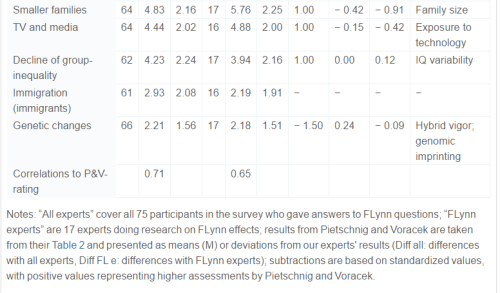
Table 1 shows the experts’ ratings in what the causes for the FLynn effect are. Better health, longer education, improved schooling and better nutrition were the main causes the experts thought were enough to explain the FLynn gains. These variables, in concert, definitely would cause this secular increase in intelligence scores over the past 100 years. Do note that the gains we see in IQ scores have started around the industrial revolution, which better nutrition and institutions (schools) happened in these industrialized countries. Now, think to the third-world countries that are ‘coming up’, basically their own ‘industrial revolution’, they will have their own IQ increases as seen in Africa currently BUT, this will not close any GENETIC gaps in intelligence.
Then this comment:
In the comments, one expert mentioned that the FLynn effect is mostly on non-g factors, suggesting that the increases are not general and therefore less relevant for everyday life achievement.
Echoes what JP Rushton (who was not mentioned in this paper, dissapointed at that, however Jensen was) said back in 2000: “Flynn Effects Not Genetic and Unrelated to Race Differences“. Rushton and Jensen had a long back-and-forth with Dickens and Flynn on the nature of the black-white IQ gap, which I will cover eventually. I love how someone echoed Rushton’s sentiments on the FE, since Rushton was not cited in the paper.
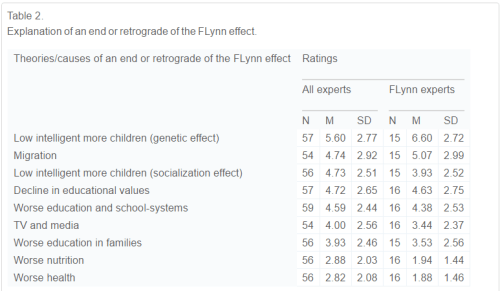
Table 2 shows less intelligent adults having more children along with migration. This explanation is two-fold here. Migrants, more often than not, are super-selected. That is, they are a highly selected immigrant sample and are not representative of their native population. But as more and more migration occurs, the super-selected sample will no longer be migrating and the low IQ peoples then flood the countries and lower the average IQ (this will decrease QoL as well, among numerous other variables). The next explanation was low intelligence, more children. This is a huge cause for FLynn loses, as I’ve covered already. Health and nutrition showed less support, all though I slightly disagree with health not being a factor. If there were no health/parasite/disease problem, they’d reach their genetic IQ. I’d love to see a huge study one day on a representative sample of people from all geographic locations across the world and see what they would look like in first-world conditions.
The authors state:
The correlation between the ratings of all experts and FLynn experts was very high (r = 0.97, N = 9 categories, p < 0.001), as was the correlation between FLynn experts (N = 16) and the other cognitive ability researchers (N = 43) (r = 0.91, N = 9 categories, p = 0.001). The high correlations indicate that the pattern of ratings was consistent across different groups of experts.
And some comments:
In the comments, two raters noted that education, nutrition and health have not become worse but that their benefits are diminishing and have reached a ceiling, comparable to other trends in post World War II development. One person mentioned that dysgenic changes are accumulating across generations.
The dysgenic changes across generations are the culprit in my opinion.
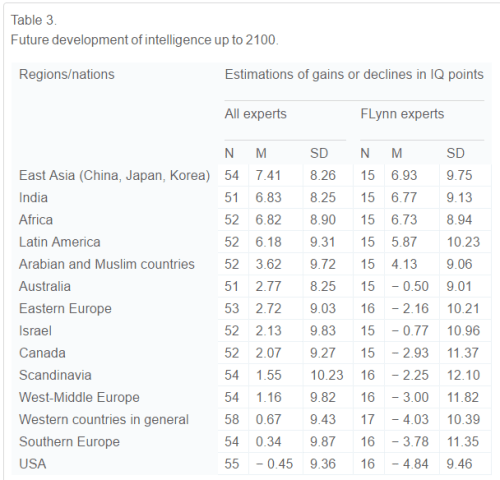
Finally, in table 3 the FLynn experts and the rest of the experts thought that East Asia, India, Africa, Latin America and Muslim/Arab countries will show the largest gains in IQ by 2100. You may be wondering “Why East Asia?” Because a lot of the East Asian population does live in poverty (especially in rural China), and better nutrition among other factors that occur in urban environments. The FLynn experts also expect huge decreases in Israel, Canada, Australia, all parts of Europe and all Western countries in general. I agree with this trend (except for Israel, I see nothing that’s occurring there to drop their IQ in the next 84 years).
Quoting the last paragraph of the discussion:
However, such an outlook may be moderated by country-level policies. Such policies may include incentives that increase birth rates among well educated people, incentives that attract high ability immigrants, and improved environmental conditions for cognitive development at all levels of the ability spectrum, including for the gifted and less advantaged. Improved environmental conditions may have especially large effects on less educated and lower ability people, who are more likely to benefit from improvements in health, sanitation, and education (e.g., Glewwe & Kremer, 2006).
I fully agree with this. We do need incentives for the more intelligent, more educated people to need to have children so we can offset the current trend towards idiocracy that America and the West as a whole is currently observing.
The truth about genetics and IQ is slowly coming out, and with this paper coming out today (November 14, 2016) I hope to see more talk about intelligence as a whole and what mass immigration will do to the overall intelligence of a country as well as stopping (or doing extremely limited) immigration as I have proposed here).
Taking back our countries’ spirit—i.e., halting mass immigration—is not only important for the preservation of people and culture, but is important for the average IQ of the nation, as mass immigration from less intelligent countries is a net negative for the richer and more intelligent countries that get emigrated to (I mean, would you go anywhere else?). Eventually, not too far off in the near future, I see our countries in the West getting more sensible, HBD-aware politicians and activists that understand the truth of this research. Once that occurs, immigration can be halted and we can take care of that one problem for declining national IQs. After that, we need policies that encourage the intelligent and educated to have more children, maybe giving them a tax break on the number of children they conceive. There are numerous ways to go about these problems and differing solutions to help tide them. I just hope that we get people in power who actually realize this and are actually for preservation of people and country. Remember, that the environments we live in are products of our genetics. “Race is not a socal construct, society is a racial construct. Society and culture derive from race/biology.”—Douglas Whitman
To top it off, not surprisingly, when the researchers had anonymity, many (unsurprisingly) said that the cause for the retrograde of the FLynn effect was genetic (people with lower intelligence conceiving more children). It’s sad that people have to say these things anonymously, but one day we’ll be able to talk about these real things in society, I just hope it’s soon before it can’t be reversed.
Stephen Jay Gould and Anti-Hereditarianism
2000 words
Stephen Jay Gould was one of the biggest opponents of hereditarianism, one of Rushton and Jensens’s biggest opponents. He is the author of The Mismeasure of Man, which is still given to college students to read as a “definitive refutation of The Bell Curve” and an all out attack on factor analysis, IQ testing and the whole hereditarian position at large. A passage from the very end of his book Full House perfectly explains his thought process on this matter:
“The most impressive contrast between natural evolution and cultural evolution lies embedded in the major fact of our history. We have no evidence that the modal form of human bodies or brains has changed at all in the past 100,000 years—a standard phenomenon of stasis for successful and widespread species, and not (as popularly misconceived) an odd exception to an expectation of continuous and progressive change. The Cro-Magnon people who painted the caves of the Lascaux and Altamira some fifteen thousand years ago are us—and one look at the incredible richness and beauty of this work convinces us, in the most immediate and visceral way, that Picasso held no edge in mental sophistication over these ancestors with identical brains. And yet, fifteen thousand years ago no human social grouping had produced anything that would conform with our standard definition of civilization. No society had yet invented agriculture; none had built permanent cities. Everything that we have accomplished in the unmeasurable geological moment of the last ten thousand years—from the origin of agriculture to the Sears building in Chicago, the entire panoply of human civilization for better or for worse—has been built upon the capacities of an unaltered brain. Clearly, cultural change can vastly outstrip the maximal rate of natural Darwinian evolution.” (Gould, 1996: 220)
He wrote Full House as a sequel of sorts to his book Wonderful Life: The Burgess Shale and the Nature of History (currently on the way to my home which I will read in a few days of getting it), where he argues that progress is not the driver to evolution and that complexity does not rule as bacteria rule the planet. He argues that we are not in the “Age of Mammals”, but the “Age of Bacteria”. But how could you argue that there was no change in humanity from our most recent ancestors to today?
Eldredge and Gould pioneered the theory of punctuated equilibria in 1972. The theory states that species lie in a state of stasis (that is, a period of inactivity or equilibrium) and there is little morphological change before there is a rapid burst of change, which perfectly explains why there are few transitional fossils to be found. Punctuated equilibria is the missing piece to Darwin’s theory of evolution. But what does it have to do wth the evolution of Man?
As you can see, Eldredge and Gould’s theory states that all species spend an extremely long time in stasis, and for any phenotypic change to be noticed in the fossil record, the rapid burst in change had to occur.
Quoting Gould on culture and evolution (1996, page 219-20):
But human cultural change is an entirely distinct process operating under radically different principals that do allow for the strong possibility of a driven trend for what we may legitamately call “progress” (at least in a technological sense, whether or not the changes ultimately do us any good in a practical or moral way). In this sense, I deeply regret that common usage refers to the history of our artifacts and social orginizations as “cultural evolution.” Using the same term—evolution—for both natural and cultural history obfuscates far more than it enlightens. Of course, some aspects of the two phenomena must be similar, for all processes of genealogicallt constrained historical change must share some features in common. But the differences far outweigh the similarities in this case. Unfortunately, when we speak of “cultural evolution,” we unwittingly imply that this process shares essential similarity with the phenomenon most widely described by the same name—natural, or Darwinian, change. The common designation of “evolution” then leads to one of the most frequent and portentious errors in our analysis of human life and history—the overly reductionist assumption that the Darwinian natural paradigm will fully encompass our social and technological history as well. I do wish that the term “cultural evolution” would drop from use. Why not speak of something more neutral and descriptive—“cultural change,” for example?
From the two passages I cited above, to his work on punctuated equilibria, I can definitely see how and why he would believe that there has been no relevant human evolution in the past 50,000 years. These two quotes, one from Stephen Jay Gould and the other from evolutionist Ernst Mayr show the “conventional wisdom” about human evolution:
There’a been no biological changes in humans in 40,000 or 50,000 years. Everything we call culture we’ve built with the same body and brain
—Stephen Jay Gould
Something must have happened to weaken the selective pressure drastically. We cannot escape the conclusion that man’s evolution towards manness suddenly came to a halt.
—Ernst Mayr
These quotes are from page 1 of The Ten Thousand Year explosion. Many great thinkers have suggested that human evolution has halted ever since the emergence of behavioral modernity, however, this couldn’t be further from the truth. I fully understand why such great evolutionists like Gould and Mayr believe that human evolution has halted and their arguments make complete sense based on the data (punctuated equilibria for one). But to any knowledgeable race-realist, they know that these claims are bunk and that human evolution has most definitely accelerated within the last 10,000 years (due to agriculture, the advent of farming) that made it possible for a bigger population and, along with it, a higher chance for high IQ alleles and other positive traits to spread throughout the population as it increased fitness in the environment.
HOWEVER, agriculture was good and bad for us. The good increased our population size that made it possible for high IQ alleles to spread throughout the population. The bad was along with an increase in population size, living in one spot with large groups of people upped the chances for disease acquisition, that of which are not found in hunter-gatherer populations (because they’re constantly moving, not staying in one place). According to John Hawks, our brain size has decreased, going from 1500 cc on average to 1350 cc on average, and the cause is, and this is hard to believe with the advent of agriculture (and thus, supposedly better nutrition) worse nutrition due to the advent of agriculture. Another reason I can posit is that due to more group behavior and social cohesion, we could work together with others and that, over time, would shrink our brains since we wouldn’t have to “do all the thinking”, a type of “self-domestication”, if you will.
The denial of any human change over the past 50,000 years is clearly ridiculous, however it is grounded in solid science. But with the advent of The Ten Thousand Year Explosion by Cochran and Harpending, they blasted all of the misconceptions away about no genetic change in humanity over the past 50,000 years. But, to the dismay of those who believe in “progressive evolution”, the same agriculture that was responsible for this boom—this explosion—over the past ten thousand years is also the cause of our decreasing brain size and stature. I’ve documented the change of erectus or habilis into floresiensis, this is proof enough that evolution can “work backward” (whatever that means) and have an organism become “less complex” (going back to left and right walls of complexity, which I just wrote on last night). Floresiensis is the perfect example that an organism can become less complex than a predecessor and the cause, in this context, is due to less energy on the island which led to a decrease in caloric consumption and along with it a decrease in brain size since that was what was best for that environment (due to less caloric energy being available).
While Gould makes a compelling argument in arguing against the explosion of Man in the past 50,000 years, modern data tells us otherwise. This explosion was due, in part, to agriculture which led to more social cohesion (both of those variables are also leading to a decrease in brain size). With the understanding of Eldredge and Gould’s punctuated equilibria theory, you can then see how and why Gould denied the genetic change in anatomically modern humans over the last 50,000 years. He, however, is wrong here.
I fully agree with Gould that cultural change can outstrip Darwinian evolution—he is right there. But, to make the leap and then say that there is no basis for genetic change in AMH (anatomically modern humans) is clearly wrong. I know that Gould was driven by his politics, partly, to deny any change in human nature and genetics in the past 50,000 years. Though, I don’t care about that. I care about looking at one’s perspective through a scientific lens. While Gould is wrong on his views of hereditarianism, he is 100 percent correct on “progressive” evolution and that there is no so-called “drive to complexity”. It’s his views on human evolution as a whole that are wrong. We know that faster evolution gives rise to more racial differences, and, obviously, more “differences” can either be “good” or “bad” depending on the environmental context. In my tirades over the past 6 weeks on the non-progressiveness and non-linearity of evolution, I’ve shown that these differences can either go to the “left wall” or “right wall” of complexity.
To deny the speed of evolution ever since modern behavior, and even the agricultural revolution is wrong. Too much evidence has piled up for that position. I do, after reading a lot of Gould’s work recently, understand how and where he came from with that argument, all though he was clearly wrong. Culture is learned—not biologically inherited. The cultural norms we know well are learned behaviors.
Finally, and what it seems Gould didn’t realize, is that there is gene-culture coevolution. Learned social information is central to our adaptations as humans. New cultural tendencies may force a novel and new evolutionary selection pressure that may incur new phenotypic changes. In this sense, genes and culture simultaneously evolve side-by-side with each other. Again, stressing that there is no “unilateral direction” in which these changes go, they just occur based on new environmental pressures. Thusly, to say that there is any “progress” or any inherent “drive” in evolution makes no sense. Due to which cultures we “inherit” that will drive which changes occur in that population but not another, they’d be different (as we know all genetically isolated humans are), but none would be “better” than another since they have incurred new traits to better survive in that environment; each different culture will further gain a different phenotype due to the differing culture which puts a differing selective pressure on that population.
The notion of no change in humans over the last 50,000 years is wrong. It has been driven by the rise in agriculture (giving us both positive and negative traits) along with each culture that each population adopted due to the differing selection pressures and environments over the course of their evolution genetically isolated from every other human culture. These differing cultural tendencies also gave rise to slightly faster evolution and different and novel environments in comparison to other populations. With these variables working in harmony with each other, these then accelerated human evolution (for better or worse). That same advent of behavioral modernity 50,000 years ago gave rise to the Out of Africa event. Humans then spread across the planet. In time, after being differing “founding populations” for the current races/ethnies today, differing cultures were adopted due to the differing evolutionary pressures. This is the main reason why genetically isolated human populations show such stark differences between them: Because evolution has sped up since the advent of behavioral modernity, agriculture and the adoption of culture by humans that have all contributed to making Man so different compared to the rest of the Animal Kingdom.
Complexity, Walls, 0.400 Hitting and Evolutionary “Progress”
2550 words
What do complexity, baseball and evolutionary “progress” have to do with each other? A lot. Stephen Jay Gould, in his book Full House he eloquently weaves these seemingly unrelated things into a coherent attack on so-called “progressive” evolution. Most people assume that the disappearance of 0.400 hitting is due to a decline in ability, however Gould argues that we didn’t get worse at baseball, we got better. The average stayed the same (around 0.260 a year) but the variation in the curve decreased substantially. He shows that complexity is a forgone conclusion since the simplest organisms, bacteria, are at the left side of the wall of complexity, that is the simplest organism there can be. Thusly, complex organisms aren’t driven by “progress” to become complex; the left wall of minimal complexity is “followed by successful expansion thereafter with retention of an unvarying bacterial mode.” (Gould, 1996: 196-7). Complexity is an incidental occurrence due to life’s beginnings at this left wall; no organism can become less complex than this. Complexity is not driven by “progress”.
0.400 Hitting
Most people assume that 0.400 hitting has disappeared from baseball because we have gotten worse at the game. However, an alternate way of looking at it is there have been no 0.400 hitters since 1941 because we have gotten better at the game and the variation on the bell curve shrunk due to the average players getting better. A batting average between .260 and .275 has been the average for each year since the conception of the game. This shows that since the average didn’t change, the variation got smaller due to the average player becoming better.
With the right tail shrinking, this meant that the average player then became closer to the right wall, that is the wall of how good one can become (i.e., 0.400 hitting) and since the variation shrunk, both bad and good (the 0.400) batting averages disappeared due to the average player getting better and getting closer to the right wall. Since the SD of batting averages for regular players decreases steadily over time, this shows that a disappearance of 0.400 hitting is “a consequence of shrinkage at the right tail of the distribution.”(Gould, 1996: 107)
Gould sums up as follows:
In quick summary of a long and detailed argument, symmetrically shrinking deviations in batting averages must record general improvement of play (including hitting, of course) for two reasons—the first (expressed in terms of the history of the institutions) because systems manned by best performers in competition, and working under the same rules through time, slowly discover optimal procedures and reduce their variation as all personnel learn and master the best ways; the second (expressed in terms of performers and human limits) because the mean moves toward the right wall, thus leaving less space for the spread of variation. Hitting 0.400 is not a thing, but the right tail of the full house for variation in batting averages. As variation shrinks because general play improves, 0.400 hitting disappears as a consequence of increasing excellance in play. (Gould, 1996: 127-8)
The explanation of the disappearance of 0.400 hitting sets the stage for the purpose of this article: “progressive” evolution. It’s important to know that I’m not saying that organisms don’t become more “complex”, the point is, evolution is not “going” anywhere; and that there is a passive and not driven trend in the complexity of organisms. Since bacteria, the modal bacter rules the earth, can we really say that there is any “drive” towards progress? Or is complexity driven by the consequence of the simplest organisms being at the left wall, with the only way to go being “right”?
Complexity, Walls, and “Progressive” Evolution
The assumption that there is a “march of progress”, a “scala naturae”, an “evolutionary ladder of progress” for all organisms on earth is a pervasive idea. But does the fossil record show any march to “progress”? No. People assume that evolution is “progressing” and the end result is a “better” organism. However, that’s a gross misunderstanding of natural selection and what it does. Natural selection is not “progress”, but local change. Let’s take a population of 100 brown bears. Half of them split off and head north and spend 100,000 years evolving near the North Pole. Would the new species that arises be “more progressed” or “more evolved” than the brown bear? No. It has incurred local adaptations to better survive in that new environment.
Bacteria is the most abundant life form on the planet. Bacteria, which is at the very left wall of complexity, is the most simple organism that can be. Due to this, there is nowhere to go but right, to the right wall. So any organism that’s caught up in the middle of the left and right walls of complexity can go in either direction. They can become less complex or more complex depending on what the environment calls for.
Darwin himself had contradictory views on “progressive” evolution. On the one hand, Darwin stated at the end of On the Origin of Species:
There is grandeur in this view of life, with its several powers, having been originally breathed into a few forms or into one; and that, whilst this planet has gone cycling on according to the fixed law of gravity, from so simple a beginning endless forms most beautiful and most wonderful have been, and are being, evolved.
Darwin did write in one of his notebooks to “Never call a species higher or lower”. This shows that even the man who originated the concept of natural selection didn’t believe in “higher” and “lower” organisms. Quoting page 135 of Full House by Gould on a conversation between Huxley and Darwin (their descendants) held in 1959:
Huxley: I once tried to define evolution in an overall way, somewhat along these lines: a one way process, irreversible in time, producing apparent novelties and greater variety leading and leading to higher degrees of organization.
Darwin: What is “higher”?
Huxley: More differentiated, more complex but at the same time more integrated.
Darwin: But parasites are also produced.
Huxley: I mean a higher degree of orginization in general, as shown by the upper level attained.
Darwin asked a good question about what constitutes “higher”. Huxley gave a non-answer, an answer that confirms what he said (which isn’t true).
Any so-called “progress” would have been stymied by the five mass extinction events that have occurred throughout earth’s history. The history of life has been punctuated with mass extinction events. It was, after all, the mass extinction event at the Cretaceous period that killed off the dinosaurs that gave mammals the chance to evolve into what we did today. It was fish that mutated the beginnings of arms and wings; the precursors to what more complex organisms would use in the future. Our fish ancestor evolved that way most likely due to the fact that it could have pushed itself onto land to avoid predators. Examinations of the fossil record show that certain fishes have the precursors to arms and wings. This shows that we evolved from fish that eventually came on to land. The ONLY REASON why we are around today is because of the mass extinction event 65 mya. Without that, disnosaurs would still rule the earth. Basically, if our ancestors swam up instead of down, left instead of right, they’d have been eaten and we wouldn’t be here today. That’s not to say that there would be no right wall of complexity; there always will be, but they wouldn’t turn into us as there is no evolutionary trend in organismal design.
Numerous studies have been done on ammonites, plankton, and other small, less complex organisms. No line of “progress” was found in none of the organisms tested. There was no bias in increasing complexity from ancestor-descendant pairs in ammonites (that is, the range of variation for complexity increased, not just a drive to become more complex) (Boyajian and Lutz, 1992), nor was there any correlation for sutural complexity and geological longevity. No bias for increasing complexity was found in these organisms, that is no bias to go towards this right wall of complexity.
McShea (1994) uses this “left wall of minimal complexity”, in which there is only one way to go: right. McShea proposes three tests for seeing whether or not there is a driven or passive drive for evolution:
- Test the Minimum: In passive systems, minimal values of complexity should be preserved by some species throughout the expanding history of their evolutionary timespan because no preference for evolutionary complexity exists and most species would do better by simply staying as they are. In systems that are driven, both minimal and maximal complexity should increase because higher complexity confers general advantages that the evolution of all species should be biased in this direction (they aren’t). The preservation and continuing enhancement of the modal bacter strongly points to the passive mode for life as a whole.
- Testing Ancestor-Descendant Pairings: This test identifies ancestral lineages for an expanding lineage and then tabulates whether each concurrent species stayed the same, got simpler or got more complex. However we cannot use this test because the fossil record is so incomplete.
- Test of the Skewing: Life as a whole can produce right-skewed trends no matter if evolution is passive or driven. So the same overall result of right distribution with a maximum complexity can still occur whether or not evolution is passive or driven. In driven systems, the new lineages should show a right skew towards complexity since all species favor the right skew of “progress” as a favored direction, and should have more species towards the right wall of complexity, stretching the entire distribution to the right. But in the passive systems, there should be no skew in increases and decreases should be just as common as increases. Many species move leftward in complexity as they do rightward. If one organism is in between the right and left wall of complexity, it can go either get more or less complex, with least complex being a bacteria, that being the “left wall” of complexity.
McShea did these tests on veterbral columns. You would say “Of course there was an increase in complexity!!” But is this increase driven or passive? According to McShea (1994), vertebrates began at a minimal level of complexity, so the only way to go was UP!
Quoting Gould (1996: 207):
All the tests provide evidence for a passive trend and no drive to complexity. McShea found twenty-four cases of significant increases or decreases in comparing the range of modern descendants with an ancestor (out of a potential sample of ninety comparisons, or five groups of mammals, each with six variables measured in each of three ways; for the other comparison, average descendants did not differ significantly from ancestors). Interestingly, thirteen of these significant changes led to decreases in complexity, while only nine showed an increase. (The difference between thirteen and nine is not statistically significant, but I am wryly amused, given all traditional expectation in the other direction, that more comparisons show increasing rather than decreasing complexity.
McShea summarizes his entire study as follows (1994: 1762):
The minimal complexity of vertebral columns probably did not change (indeed, the actual minimum seems to have remained close to the theoretical minimum), ancestor-descendant comparisons in subclades of mammals reveals no branching bias, and the mean subclade skew was negative, all pointing to a passive system.
This can be summed up as follows: Looking at the “full house” of variation, there is no general trend in “progress” for organisms or evolution as a whole. The example of the disappearance of 0.400 hitting is the perfect metaphor that shows there is a left and right wall of both minimum and maximum skill (complexity) and that the variation shrunk which is the cause for the disappearance of 0.400 hitting, not us getting “worse” at the game. This same metaphor of skill walls can be used for evolution as well, replacing skill walls with complexity walls. Bacteria inhabit the very left wall of complexity, that is, the least simple organism possible; no other organism can become more simple than bacteria. On the other side, you have the more complex organisms, those that arise at the very right tail end of the distribution, but arose there due to no inherent drive for “progress”, but due to the fact of moving towards the right tail of complexity was the only thing possible to do. Any organism that is in between the left and right walls of complexity can go in either direction, and the fossil record shows more organisms going left than right.
Looking at certain variables, we may be able to say “Look!! Evolutionary progress!!” But that’s only a small snapshot in time. People may point to the brain size increase as a driven increase towards complexity, however, the assumption that there is a “relative enlargement and differentiation of brains reflect a progressive evolutionary trend toward greater intelligence is a major impediment to the study of brain evolution.” I will cover this in the future and goes against what believers of evolutionary “progress” believe. When looking at one snapshot in the huge picture of evolutionary time, we may be able to “pin point” a “progression” towards “something”, but when looking at the fossil record as a whole (which is not possible due to there being huge gaps due to punctuated equilibria, we cannot study the whole record) there is no “drive” towards complexity, it is “passive”, that is organisms become less and more complex due to variation in environments. THAT is what natural selection is and does for organisms. Natural selection is local adaptation, not evolutionary progress.
The notion of “progressive” evolution needs to be put to rest. It doesn’t allow us to fully appreciate the beauty of evolution through natural selection, mutation, genetic drift and migration. No species is “better” or “more progressed” or “more evolved” than another; on the contrary. Each oragnism is unique to its environment and will incur both genotypic and phenotypic changes that respond to what’s occurring in the environment as to better reproduce to the next generation. I will end with a quote from Gould that perfectly sums up this argument:
I hate to think that an intellectual position, hopefully well worked out in the pages of this book, might end up as a shill for one of the great fuzzinesses of our age—so-called “political correctness” as a doctrine that celebrates all indigenous practice, and therefore permits no distinctions, judgements or analyses.
Looking at the whole “full house” of variation shows there to be no trends of “progress”. Organisms are just as likely to become less complex (towards the left wall) than they are to become more complex (towards the right wall). Once we get this “scala naturae” paradigm out of our heads and understanding of evolution, only then can we appreciate the beauty and randomness of evolution and all of the differences it brings about. There IS a drive towards the right wall of complexity, however, it is not driven, it is passive and is only a result of there being a minimum wall of complexity that no other organism can get less complex than. Looking at evolution in this way shows that there is no inherent “progress” to evolution as a whole, only local adaptations, the true definition of “natural selection”.
Donald Trump and Ethnic Genetic Interests
1300 words
I don’t post about politics here because this is a HBD and evolution blog, but I figured I’d weigh in on Trump and ethnic genetic interests (EGIs) since the election is today. My co-writer and I proved the existence of EGIs back in May (see comments for discussion) so we know that EGIs exist. Does Trump exhibit EGIs? Yes, he does. But for who?
Donald Trump, in his own words, “is a big fan of Israel” and boasted about being the first celebrity to endorse Bibi Netanyahu. This is very telling for his EGIs, however, he isn’t Jewish so how does this help his EGIs?
Easy. His daughter converted to Judaism back in 2009, and had a child by Jew Jared Kushner. Most Jews don’t look at converts the same as those who were born Jewish, i.e., those who have a bloodline to Israel. However, in a generation or two, no one will know that Kushner’s child is a non-Jew genetically.
Donald Trump has been very critical of Obama who is very anti-Netanyahu. Trump says about Obama:
“I think President Obama is one of the worst things that’s ever happened to Israel. I think he’s set back [Israeli] relations with the United States terribly, and for people and friends of mine who are Jewish, I don’t know how they can support President Obama. He has been very bad for Israel.”
Yes, very bad for Israel. This was said last September before he knew he was going to run. Trump loves Israel and the Jewish people. In his own words:
“I know so many people from Israel. I have so many friends in Israel. First of all, the Israelis are great businesspeople. They have a natural instinct for business and their start-ups are fantastic. I deal with the Israelis all the time, and I deal with people who are Jewish all the time, whether they are Israeli or not.”
Now, you have his daughter who converted to Judaism and married a Jew. Judaism is passed down through the mother, so the fact that she converted before she had her babe means that the kid is officially a Jew.
Moreover, his son, Eric Trump, married a Jewish woman back in 2014. Knowing this—that his adult-aged children have wed Jews—would you say that he has EGIs for his people (Scots-Irish/Germans) or for Jews?
Trump has had contradictory statements regarding the German Chancellor Angel Merkel. A month and a half ago he compared Hillary Clinton, his opponent tonight, to Angela Merkel. However, he recently said that Angela Merkel is “his favorite leader”. But back in August, Trump said “Germany will never be the same again“, alluding to this ‘migration’ crisis.
Back in March, Trump assured that his election would be “good news for Israel“. So knowing all of his comments on Israel as well as his children’s marriage choices, where do Trump’s EGI loyalties lie?
With Israel. I’ve shown that he loves Jews; that two of his children have married Jews; and I’ve shown that, while having contradictory statements against Jews (telling Jewish donors that he doesn’t want their money), can you say that Trump has EGIs for his ethnicity OR his family’s new ethnicity—Jewish?
Finally, back in July, his son-in-law Jared Kushner wrote an op-ed in the Observer, the online webzine that he owns, called “The Donald Trump I Know“, in which he says:
My father-in-law is not an anti-Semite.
…
This is not idle philosophy to me. I am the grandson of Holocaust survivors. On December 7, 1941—Pearl Harbor Day—the Nazis surrounded the ghetto of Novogroduk, and sorted the residents into two lines: those selected to die were put on the right; those who would live were put on the left. My grandmother’s sister, Esther, raced into a building to hide. A boy who had seen her running dragged her out and she was one of about 5100 Jews to be killed during this first slaughter of the Jews in Novogrudok. On the night before Rosh Hashana 1943, the 250 Jews who remained of the town’s 20,000 plotted an escape through a tunnel they had painstakingly dug beneath the fence. The searchlights were disabled and the Jews removed nails from the metal roof so that it would rattle in the wind and hopefully mask the sounds of the escaping prisoners.
My grandmother and her sister didn’t want to leave their father behind. They went to the back of the line to be near him. When the first Jews emerged from the tunnel, the Nazis were waiting for them and began shooting. My grandmother’s brother Chanon, for whom my father is named, was killed along with about 50 others. My grandmother made it to the woods, where she joined the Bielski Brigade of partisan resistance fighters. There she met my grandfather, who had escaped from a labor camp called Voritz. He had lived in a hole in the woods—a literal hole that he had dug—for three years, foraging for food, staying out of sight and sleeping in that hole for the duration of the brutal Russian winter.
…
The fact is that my father in law is an incredibly loving and tolerant person who has embraced my family and our Judaism since I began dating my wife. His support has been unwavering and from the heart. I have personally seen him embrace people of all racial and religious backgrounds, at his companies and in his personal life. This caricature that some want to paint as someone who has “allowed” or encouraged intolerance just doesn’t reflect the Donald Trump I know. The from-the-heart reactions of this man are instinctively pro-Jewish and pro-Israel. Just last week, at an event in New Hampshire, an audience member asked about wasting money on “Zionist Israel.” My father-in-law didn’t miss a beat in replying that “Israel is a very, important ally of the United States and we are going to protect them 100 percent.” No script, no handlers, no TelePrompter—just a strong opinion from the heart.
It seems that every Jew has a Holocaust story that “they’ve never told before.” The Holocaust is really beyond the scope of this blog, however, you can check this out from CODOH on the Novogroduk “graves”. Moreover, here’s a nice thread from CODOH that talks about another “Holocaust miracle” where Trump’s son-in-law says that his Grandfather “lived in a hole in the ground in Russia for three years“. This is all I will say on the matter and I hope you do your own research into these claims from Jared Kushner.
The video that Kushner alludes to is here. The man spoke the truth about Israel. We DO waste our military on behalf of the “Zionist” Israelis. Trump shoots back and says “We will protect them 100 percent.” He calls them “our true friend.” It was just announced back in September that we will be giving Israel 38 billion dollars over the next ten years. OF COURSE they think of us as a “true friend”. We send our people to the Middle East so they can die for Israel in their quest to expand for Greater Israel—war is realizing the Israelization of the world.
Now, PumpkinPerson believes that Trump shows his EGIs through wanting to build a wall and keep out illegal Mexican immigrants. However, I’ve shown above that while he “”MAY”” have the best interests of the American people in mind, he has far more loyalty and allegiance to Israel and the Jewish State.
Does Donald Trump show EGIs? YES! But while he does show EGIs towards his own people, he clearly shows his EGIs more towards the people who his children have chosen to marry. Also, Lion of the Blogosphere, who is a Jew, is voting for Donald Trump, which is protecting his EGIs.
And before anyone asks—yes I voted for Trump. I just hope he does what he says for us and doesn’t pull an Obama and be Hope and Change 2.0 on us.
“Racial Realities of Southern Europe”: Nordicist Fantasies Redux
2000 words
I came across this garbage from the DailyStormer the other day, Racial Realities of Southern Europe that has, of course, huge misconceptions on the genetic history of Southern Europe. This “Sven” guy–like most Nordicists–cherry-picks to prove his idiotic and untrue points, like most Nordicists. I won’t be going through the garbage video on the site (since it’s too boring and his fake voice irritates me) but I’ll go through the comments section.
Italy once contained Rome, but Rome lost its racial purity when it made citizens of all races, only later to be rescued by the invasion of new and vigorous barbarian stocks.
Stupid. No basis in reality–only has a basis in Nordicist fantasies.
The crazies in the comments ramble on and on about “blonde-haired Jesus”, the founding Romans having blonde hair, Spartans and Macedonians had blonde hair (wut?), Iberians were blonde (as if they don’t have a sizeable population that is blonde today). All idiotic garbage that no serious person who has ever read any serious genetic studies takes seriously.
“His Name is YHVH” says:
And I’m not going to debate this. I’ve read meticulous translations of Homer, and Arthur Kemp, and the viking invasion of Greece after the volcanic eruption.
Who in the hell cites March of the Titans seriously for genetics or anything else for that matter? He has such a warped view of history, muh Nordics was Egyptians, muh Nordics was Native Indians, muh Solutrean Hypothesis, muh blonde-haired, blue-eyed Greeks and Romans. Idiocy with no basis in reality. It’s funny. Nordicists get on Afrocentrists for attempting to steal European history, yet Nordicists DO THE SAME THING. Nordicists and Afrocentrists are two sides of the same coin. Yet neither of them realize that. Come on guys, #its2016 don’t cite trash like MotT and expect to get taken seriously by anyone who knows what they’re talking about.
So, you want to be superior to the niggers and the mestizzos and the chinamen but then you don’t want to be inferior to anything above you, thus acknowledging superior and inferior exist on the one hand when it suits you conveniently and then arguing against it when it does not. Now which is it?
These things don’t exist in in evolutionary biology.
This “Sven” guy thinks that the Nordic race originate in North Africa. But what do genetic studies tell us? I’ll quote Razib here:
read this paper: http://arxiv.org/pdf/1502.02783.pdf i have blogged extensively on this, i’m not going to repeat myself at length. #becauseIts2016 and the data is out there.
One may say “The Nordic traits are recessive so it’s impossible for us to have been a result of mongrelization”.
one may say that if you are retarded. i can name two “nordic traits,” lactase persistence and skin color, which are not recessive. the former is mostly dominant (h ~ 1) while the latter exhibits midparent parent values closer to light than dark (h > 0.5). others, like eye and hair color are more recessive (h < 0.5). but one can not say that an individual is mostly recessive or dominant, as that is not even wrong.
if you are a “racerealist” you should know these basic facts of human population genetics in 2016. otherwise you are a racemythist.
(of course, anyone who has seen my son would laugh at the idea that “nordic traits” are recessive
like ~20% of northern europeans he is a het. on KITLG locus with one loss of function allele)
(oh, and also, nordic traits are recent anyway, so ancestry is less important than you think: http://www.nature.com/nature/journal/v528/n7583/abs/nature16152.html)
Nordicists et al, it’s #2016, please get up to speed on the latest studies and data. If you won’t get up to speed on the matter, don’t even call yourself a ‘race-realist’, you’d be better off calling yourself a ‘race-mythist’ as Razib says.
“Menhir” says:
No, I believe Aryan originated in central asia, and migrated to Europe.
Nope. Originated in the Caspian steppe.
“Wesley Lysander” says:
Combined data from two large mtDNA studies provides an estimate of non-Caucasoid maternal ancestry in Italians. The first study sampled 411 Italians from all over the country and found five South Asian M and East Asian D sequences (1.2%) and eight sub-Saharan African L sequences (1.9%). The second study sampled 465 Sicilians and detected ten M sequences (2.2%) and three L sequences (0.65%). This makes a total of 3% non-white maternal admixture (1.3% Asian and 1.7% African), which is very low and typical for European populations, since Pliss et al. 2005, e.g., observed 1.8% Asian admixture in Poles and 1.2% African admixture in Germans. (Plaza et al. 2003; Romano et al. 2003)
Similar data from the Y-chromosome reveals Italians’ even lower non-Caucasoid paternal admixture. Both studies obtained samples from all over the mainland and islands. No Asian DNA was detected anywhere, but a single sub-Saharan African E(xE3b) sequence was found in the first study’s sample of 416 (0.2%), and six were observed in the second study’s sample of 746 (0.8%). The total is therefore a minuscule 0.6%, which decreases to 0.4% if only Southern Italians are considered and 0% if only Sicilians are considered.Again, these are normal levels of admixture for European populations (e.g. Austrians were found to have 0.8% E(xE3b) by Brion et al. 2004). (Semino et al. 2004; Cruciani et al. 2004)
An analysis of 10 autosomal allele frequencies in Southern Europeans (including Italians, Sicilians and Sardinians) and various Middle Eastern/North African populations revealed a “line of sharp genetic change [that] runs from Gibraltar to Lebanon,” which has divided the Mediterranean into distinct northern and southern clusters since at least the Neolithic period. The authors conclude that “gene flow [across the sea] was more the exception than the rule,” attributing this result to “a joint product of initial geographic isolation and successive cultural divergence, leading to the origin of cultural barriers to population admixture.” (Simoni et al. 1999)
More Nordicist idiocy with no basis in reality.
“Crowley” says:
Science proves Mediterranean people are exposed to sun radiation more often, and that’s it. Scandinavian people get their pale features from being exposed to colder climates more often. Any pan-Nordic theory that all other Europeans are icky tainted negroes has long been debunked.
So you need science to tell you that Meds are exposed to more sun from being closer to the equator? ….I see.
“Sven” says:
Right at the beginning of the chapter he explains that the only true Mediterraneans left are the Welsh and the Irish.
This guy is such an idiot. I guess the Germans are negro because they have 1.2 percent negro admixture. “Through DNA research”. He doesn’t keep up on the latest studies. Dumb prole. Moreover, Mediterranean peoples stretch from Southern Europe to North Africa to the Middle East; they are all Mediterranean people. Though, people who don’t keep up on the latest studies and only retarded dogma think otherwise.
“Eric Stryker” says:
Another weird thing is that Stoddard himself looks almost textbook Mediterranean.
Then “Sven” says:
What he looks like bears no relevance to his work at all.
I see you are now reduced to ad hominem equivalent in your quest to discredit his work.
This is GOLD coming from someone like him. I wouldn’t doubt that this guy is one of those people to throw away a source because it comes from a leftist magazine or throw something away and disregard it because a Jew wrote it. Such hypocrisy.
“Sven” then says:
We dont all seek to bend the truth to try and make it suit ourselves.
I can’t stop laughing! This is coming from the prole moron who says all of these lies SEEKING TO BEND THE TRUTH TO TRY AND MAKE IT SUIT HIMSELF. People’s idiocy and lack of introspection into their views never ceases to amaze me.
Soooooo why should any other sources be thrown away for where they come from? People say “H-he’s a Jew don’t listen!!!” But that has “no relevance to his work at all.”
“Eric Stryker” says:
Obviously Sven, you are a person with a very low IQ, so I think continuing to debate your Biblically Nordic Spartans is a waste of time. Good luck in your self-esteem rehabilitation and guidance from vile trecherous little Jew rats like Josephus, Sven Jones. I can’t get angry at you, you’re too stupid to hate.
Truest thing said in that thread. Biblical Nordic Spartans? Who the hell believes this garbage?
“Sven” says:
Just like a Jew you try to smear White racial researchers like Stoddard and claim Josephus as one of yours.
Hey, let’s go of some old book and not modern-day genetic studies! You’re a Jew because you disagreed with me.
This Sven moron thinks that Nords originated in North Africa!! My sides!!!
Anyone reading this, to see the true origin of the Nords, read this.
“Sven” says:
Nordics were not in pre-historic Germania in large numbers when Rome was being built, they were mainly in the Levant, North Africa and southern Europe.
I am convinced that this guy is retarded. Nordics came from North Africa, the Levant and Southern Europe? CITATION NEEDED. I already showed that Nordic traits are recent, so how the hell could they originate in MENA countries and South Europe?
“Sven” then says:
I guess you must think Nordics were sitting in the ice, freezing their asses off doing nothing and leaving no trace until they suddenly discovered civilisation in Europe in the first millennium.
This is one of the only things he said that’s true in this thread. That’s pretty much how it went down. What’s funny is that your ideological brethre–the Afrocentrists– call whites “cave beasts”. Who were these “cave beasts”? Nords! They were “living in caves” before Rome cultured and civilized them. Both the Romans and Greeks had pretty unkind words for the barbarians to the North.
Then “Sven” cites all of his garbage “Radio Stormer” podcasts as proof. Where are the genetic studies from Pubmed and PLOS Genetics? The fact that this guy had to link to his garbage and untrue radio show speaks volumes.
“Sven” then says that Copts and Berbers were Nordic. Ha! These Nordicists, man. They’ll say anything to grab others’ history, just like their cousins the Afrocentrists.
“His Name Is YHVH” comes back and says:
Correction, my uneducated friend, Nordics DID build Rome. They also built the pyramids, or didn’t you know, didn’t you see the blond hair mummies?
Why don’t you go read March of the Titans and learn about it?
“Go read MotT bro!! It’s the truth of European history and the white race!!” No serious person takes that book seriously. Hey didn’t you see the blonde hair mummies!!?? It’s not like the racial phenotypes we code aren’t recent or anything!!
I LOVE how these morons link to backwater websites and not Pubmed or PLOS Genetics for their information. Shows what they read!!!
“Sven” says:
The Bible itself tells you Jesus ancestors were White, fair, ruddy and blue eyed. It also tells you that the Spartans were descended from Judah in the book of Maccabees and Flavius Josephus Histories.
“Believe the Bible about genetics.” I wonder if these people read what Biblical scholars say on interpretations of the Bible. You know they don’t so, like their cousins the Afrocentrists and “black Israelites”, they take Bible verses and warp them to suit their needs. Isn’t it funny how these groups all hate each other but they’re cut from the same ideological cloth?
People like this guy just push anything that affirms their ideology. It’s not based in science–it’s based in fantasy. To see the true origin of the Nordics, see here, here, and here. Most of what Nordicists say–just like their ideological cousins the Afrocentrists–is not based in reality but based in fantasies.
This article from the Unz Review, What Race Were the Greek and Romans? harps on and on about the same things that “Sven” does. However, the author gets summarily dismantled in the comments.
“Progressive” Evolution: Part III
1950 words
PumpkinPerson seems to be making his blog “more politically correct“. So he seems to be removing his posts that he may deem “insensitive” to certain people. You run a (mostly) HBD blog. People who go to a HBD blog must know that they may come across certain truths that they may find uncomfortable–and even ‘offensive’. This seems like it’ll be my last reply to PP on this matter as he has removed the thread we were conversing about this matter in. Now that PP is becoming more ‘PC’, is he going to disavow his views on “progressive” evolution, “superiority and inferiority” when speaking about organisms and human races and “the concept of ‘more evolved'”?
RR: You’ve stated numerous times that evolution is progressive. Which is why I assume you’re equating “progress” with “more evolved”. Do you believe that more evolved implies progress or that progress implies more evolved?
PP: I PERSONALLY believe more evolved life is on average, superior to less evolved life, but there is nothing intrinsically progressive about being more evolved, and there’s no reasons for opponents of progress to avoid the term. In some cases, the more evolved form is clearly inferior such as when a dog evolved into a cancer.
That’s the point. The ‘more evolved’ organism is more often than not ‘inferior’ compared to its predecessor. This shows that there is no ‘progress’ to evolution. And the “more evolved” form became “inferior” to its predecessor due to changes in environment. If those environmental pressures were different, a whole slew of phenotypic changes would have occurred to have the “less evolved, inferior” organism be “superior” to its predecessor. This line of reasoning shows how idiotic of a concept “progress” in evolution is.
RR: Moreover, ancestral state reconstructions of absolute brain mass, body mass and EQ revealed patterns of increase and decrease in EQ within anthropoid primates and cetaceans.
PP: But the OVERALL pattern has been one of increase. The average brain size of ALL living mammals has TRIPPLED in 65 million years.
I just showed that there are increases AND decreases in the fossil record. No one denies that there has been an upward trend in brain size. However, as I’ve said to you previously, our brains have been shrinking for 20ky, with there being evidence that it’s been decreasing for 20ky. Sure, the trend over the past few million years shows an increase, but the trends for the past 30k years or so show a decrease and this is due to agriculture.
RR: Just showed this is wrong. (On morphology being an indicator of speciation)
PP: No you just cited a paper that agrees with your definition of species. That’s not an argument.
I cited this paper by Ernst May, What is a Species, and What is Not? where he says:
I analyze a number of widespread misconceptions concerning species. The species category, defined by a concept, denotes the rank of a species taxon in the Linnaean hierarchy. Biological species are reproducing isolated from each other, which protects the integrity of their genotypes. Degree of morphological difference is not an appropriate species definition. Unequal rates of evolution of different characters and lack of information on the mating potential of isolated populations are the major difficulties in the demarcation of species taxa.
Just because you believe that speciation is based on morphology doesn’t make it true, PP.
RR: Sure they are CORRELATED, but it doesn’t imply a cause. A relationship is not a cause. I just showed you a paper that shows you’re wrong but whatever.
PP: But a correlation is enough to show that evolution is progressive. Evolution correlates with progress = evolution is progressive.
Now he explicitly says that evolution is progressive. No matter how many times I point this out to him, he still wants to believe this idiotic notion that has no basis in evolutionary biology.
RR: How would this be gauged? Would you say to look at the LCA and gauge morphological changes?
PP: That’s one way.
Well, now the onus on you is to provide evidence for your claim that there was no–or ‘hardly’–any morphological changes in equatorial populations. You have to prove that they stayed similar to the LCA. Good luck!
PP: No I’m arguing that FEWER changes occurred in Africa because there were fewer splits in the African branch (at least as conceptualized by Cavalli-Sforza)”
This is MEANINGLESS. This is a HUGE intuitive misconception on how people read phylogenies. Just because Africans didn’t ‘split’ based on phylogenies DOESN’T MEAN that they had little to no morphological changes. The racial phenotypes we code are recent, so this throws a wrench into your intuitive misconceptions on phylogenies.
RR: Prove it!
PP: The proof is that those humans who scientists believe have preserved the phenotype of the earliest modern humans (i.e. Andaman islanders, Papua New Guineans) all look very Negroid, as do those forensic reconstructions of ancient skulls you reject.
This isn’t proof. Just because scientists (like who?) ‘believe’ that Andaman Islanders and Papuans (no, no and no!!) “preserved the phenotypes of ancient humans” doesn’t mean that they are in any way, shape, or form SIMILAR to the original populations who migrated out of Africa 70kya!!!
Ancient skull reconstructions are meaningless. You cannot infer what type of lips an ancient human had. There are numerous problems with facial reconstructions, most specifically for this conversation, you cannot gauge certain things JUST from a skull:
The finished product only approximates actual appearance because the cranium does not reflect soft-tissue details (eye, hair, and skin color; facial hair; the shape of the lips; or how much fat tissue covers the bone). Yet a facial reconstruction can put a name on an unidentified body in a modern forensic case—or, in an archaeological investigation, a face on history.
It can ‘put a face to history’, however this reconstruction of, for instance, Mitochondrial Eve DOES NOT show what she actually looked like, specifically her lips, as seen above.
RR: I fully understand what you’re saying. Except I’ve shown how it’s wrong! You can’t say one branch means morphological change AND EVEN THEN, morphological change does not equal speciation as shown in the Mayr paper.
PP: You can say that if one branch has lots of splits, it implies environmental changes and pressures (since generally speaking, that’s what causes splits) and environmental changes generally cause morphological changes, which is one definition of species.
But this definition of species is wrong as I’ve just shown. Ernst Mayr shows, in the paper of his linked above, that morphology is not enough to denote speciation.
RR:Do you know better than people who do this for a living? There are multiple papers on misconceptions of cladograms and the like. I get its original nd I respect that. You’re a smart mother fucker pp. But that doesn’t mean you’re right here.
PP: I understand why you think I’m reading the trees wrong. I used to think the exact same way as you, and the sources you cite. Laymen shouldn’t make the simplistic assumption that higher branches = more evolved and that’s why scientists try to dispel that notion. Because the tree is just there to show relatedness, and evolution can happen or not happen at any point in the tree, no matter how many splits or non-splits occur.
Now you’re getting it!
PP: However once we understand all that, we have to ask ourselves, even though IN THEORY, any branch on the tree can evolve in any direction, and there’s nothing about the tree that implies a hierarchy, IN REALITY, is there a correlation between tree position and brain size and other measures of “progress”? I’ve provided evidence that there is. You can either ignore the evidence because it doesn’t fit the theory that branch placement is irrelevant, or you can realize that evolution is a little more nuanced than some simplistic introductory Berkeley paper implied.
Now you’re not. First off, the Berkely paper is not ‘simplistic’, nor is one of the papers that the Berkely papers cites, Understanding Evolutionary Trees by Gregory (2008). He shows the most common misconceptions one has on reading phylogenies. And most–if not all–of your misconceptions on phylogenies are brought up in the paper with great detail into the misconceptions as well as how to correct the misconceptions that one has while reading phylogenies. I’ve said to you, time and time again, that brain size is PREDICATED on the amount of kcal that one consumes. If were to eat 1000 kcal a day for, say, 2000 years, what would happen to our brain size as well as our body size? Would they stay the same, grow bigger or get smaller? Adequate kcal–as well as adequate nutrients–are the driver of brain size. Without those two variables, brain size wouldn’t have been increasing. Moreover, as I’ve documented two weeks ago, H. floresiensis showed a decrease in brain size as well as body size, having evolved from either H. erectus or H. habilis. This directly shows that brain size is dependent on the surrounding environment as well as the quality and quantity of the food that the organism consumes. Branch placement IS irrelevant. You can rotate the branches all around and that would throw your theory out the window. This is what you don’t understand.
Evolution IS NOT PROGRESSIVE. However, this scala naturae belief is still with us today, as documented by Rigatto and Minelli (2013). They say:
Background
Professional papers in evolutionary biology continue to host expressions in agreement with the pre-evolutionary metaphor of the scala naturae (the great chain of being), when contrasting ‘lower’ to ‘higher’ representatives of a given branch of the tree of life. How pervasive is the persistence of progressionist, pre-evolutionary language in contemporary papers?
Results
We document here the prevalence of this unexpected linguistic survival in papers published between 2005 and 2010 by 16 top scientific journals, including generalist magazines and specialist journals in evolutionary biology. Out of a total of 67,413 papers, the unexpectedly high figure of 1,287 (1.91%) returned positive hits from our search for scala naturae language.
Conclusions
A quantitative appreciation of the survival of progressionist language in scientific papers is the first step towards its eradication. This will obtain by improving skills in tree thinking as well as by more careful editorial policy.
Wow! 1.91 percent, 1,287 papers returned positive hits for ‘great chain of being’ language. These terms need to be removed from evolutionary biology as they don’t allow the appreciation of the randomness in the evolutionary processes.
Evolution is a random process. It’s an unconscious, non-linear event as I have documented extensively over the past month.
I’ll end with a quote from Ernst May’s book What Evolution Is:
Another widespread erroneous view of natural selection must also be refuted: Selection is not teleological (goal-directed). Indeed, how could an elimination process be teleological? Selection does not have a long-term goal. It is a process repeated anew in every generation. The frequency of extinction of evolutionary lineages, as well as frequent changes in direction, is inconsistent with the mistaken claim that evolution is a teleological process. Also, there is no known genetic mechanism that could produce goal-directed evolutionary processes. Orthogenesis and other proposed teleological processes have been thoroughly refuted (see Chapter 4).
To say it in other words, evolution is not deterministic. The evolutionary process consists of a large number of interactions. Different genotypes within a single population may respond differently to the same change of the environment. These changes, in turn, are unpredictable, particularly when caused by the arrival at a locality of a new predator or competitor. Survival during a mass extinction may strongly be affected by chance. (Mayr, 1964: 121)
North/South Differences in Italian IQ: Is Richard Lynn Right? Part II
1500 words
In my first article on this matter, I showed how Richard Lynn claims the average IQ in Italy is around “89-92” for Sicily and the South and around 103 for the North. I showed how he was wrong and what data he overlooked to fit his hypothesis. Lynn’s 2011 article IQs in Italy are higher in the north: A reply to Felice and Giugliano was a reply to Myth and reality: A response to Lynn on the determinants of Italy’s North–South imbalances. Felice and Giugliano brought up Lynn’s four main theses: a) the South’s “economic backwardness” in terms of economics ‘throughout history’; b) the evidence provided by Lynn wasn’t enough to ‘prove’ a cause of lower IQ for S. Italians; c) the evidence provided by Lynn wasn’t enough to show that S. Italians score lower than N. Italians; and d) the supposed ‘high rates of MENA admixture’ in S. Italians. I blew up all of these claims in the beginning of the year, more specifically I blew up up the claims about MENA admixture back in January. I’ll be going through Lynn’s 2010b article correcting any discrepancies. It’s worth noting that he still pushes the so-called ‘MENA admixture’ as being a substantial CAUSAL factor when there is NO evidence for this big of a ‘gap’ between the North and the South. The Lynn quotes will be from his 2010 paper linked above. I had also thought that ‘migrants’ from MENA countries could have contributed to the gap between the North and South, but since this isn’t the case for France then it shouldn’t be so for Italy. However, since Italy is a hub for these people when they first illegally enter Europe, they may stay and get counted as citizens and the children of these immigrants grow up and get accounted in the data. This is plausible, since a lot of ‘migrants’ may stay where they first get which is Southern Europe, mainly Sicily and Southern Italy.
We now present new data showing that IQs are higher in the north of Italy than in the south. In the previous study, data were presented for 12 Italian regions from the PISA (Program for International Student Assessment) 2006 study of the reading comprehension, mathematics and science performance of 15 year olds, regarded as measures of intelligence. We are now able to give similar data on the reading comprehension, mathematics and science performance of 15 year olds in 20 Italian regions obtained in the 2009 PISA study (OECD, 2010). These are given in Table 1. This shows, reading from left to right, the latitude of the Italian regions, the mean PISA scores for 12 regions for 2006 given in Lynn (2010a), the mean scores of 15 year olds on reading comprehension, mathematics and science understanding for the 20 Italian regions obtained in the 2009 PISA study, and the averages of the three 2009 PISA scores given because it provides a convenient summary of the scores on the three tests.
I already went through this in my previous article, but for clarity, I’ll go through this again.
Cornoldi, Giofrè, and Martini (2013) showed how there are problems inferring Italian IQ from the very PISA data that Lynn cites. There was a relevant decrease between the North and South. If the PISA test showed genetic proclivities between the North and South, why was there a relevant decrease in the three-year period? Because it is not an intelligence test, but a test of educational achievement. D’Amico et al (2011) conclude:
Our examination of intelligence test score differences between the north and south of Italy led to results that are very different from those reached by Lynn (2010a). Our results demonstrate that by using intelligence tests to assess differences in ability rather than using achievement scores as a proxy for intelligence, children from the south of Italy did not earn lower scores than those from the north of Italy. Rather, they were even higher in Raven’s CPM. However, we see no advantage in claiming that children in the south are “more intelligent” than children in the north, because these groups are different on a number of variables (e.g., environmental factors, educational influences, composition of the samples) that influence differences in test scores.
Either no difference or Southern Italians scored higher. When using purer measures of intelligence (Raven’s Progressive Matrices) so-called “differences” in “intelligence” disappear.
Lynn says:
It will be noted that the regional differences in both language and math ability increase with age. For example, in language ability the regional differences in the youngest children (P2) range between 1.6 and −3.8, a difference of 5.4, while the differences in the oldest children (2S) range between 3.6 and −4.4, a difference of 8.0. Similarly, in math ability the regional differences in the youngest children (P2) range between 0.8 and −1.0, a difference of 1.8, while the differences in the oldest children (2S) range between 4.3 and −5.4, a difference of 9.7. These age differences would be predicted from the thesis that the regional differences have a genetic basis, because the heritability of intelligence increases during childhood (Plomin, DeFries, & McClearn, 1980, p. 334).
On other measures of achievement, such as the INVALSI examinations, Southern Italians do not score lower, and in some cases may even score higher (Robinson, Saggino, and Tommasi (2011). Moreover, the N/S differences in ‘cognitive ability’ don’t exist at age 7, the IQ/income relationship didn’t exist in the past, and the MENA admixture in Southern Italians is minute (Daniel and Malanima, 2011). The so-called MENA admixture that Nordicists and Lynn like to say is the subject of my next point.
Lynn says:
Further data for the proportion of North African ancestry in the Italian regions are available in the frequency of the haplogroup E1b1b allele. This is a marker for North African ancestry, where it reaches frequencies above 50% and peaks at around 82% in Tunisia (Zalloua et al., 2008). The frequencies of the haplogroup xR1 and the E1b1b alleles are taken from Capelli et al. (2006), Capelli et al. (2007), Di Giacomo et al. (2003), Balaresque et al. (2010), Scozzari et al. (2001), and Semino et al. (2000). These data are given in columns 11 and 12 of Table 1 and the correlations between these and the other variables are given in Table 2.
As said and cited above, the so-called admixture from MENA populations in Southern Italians accounts for an extremely small fraction of the overall Southern Italian genome. The cause for lower achievement (“IQ” according to Lynn) in Southern Italians rests on this very pertinent point. And it’s wrong. Furthermore, and this is for Sicilians, the contribution of their genome by the Greeks is 37 percent, with the North African contribution being 6 percent. Daniel and Malanima (2011) ask ” Can the Greek heritage to the Western culture really be associated to a lower IQ?” The answer is, clearly, no. Moreover, a Central Italian province has the highest amount of MENA admixture, yet they have higher scores than Southern Italy. What does that tell you?
Richard Lynn’s Italian IQ data is garbage. Purer measures of intelligence such as Raven’s Colored Progressive Matrices show a decrease in the “intelligence gap” and in some cases, Southern Italians score higher than Northern Italians. When using measures of “IQ” from PISA data, these so-called differences disappear. Lynn’s data he cites in his 2010a paper don’t control for socio-cultural differences and school quality. There is numerous data that suggests the school quality in Southern Italy is worse than that of the North; this difference in school quality then affects educational achievement. Since PISA is a test of educational achievement and not intelligence (D’Amico et al, 2011), what accounts for these differences in achievement in the various studies may (and in my opinion, does) account for the differences in educational achievement between Northern and Southern Italians. The measurements in various studies may be influenced by the larger between-schools variability that is present in the South (Cornoldi et al, 2010; Daniel and Malanima 2011).
Finally, some people may point to the GDP differences between North and South Italy as proof of genetic/intelligence differences between them. However, the Mafia accounts for around a 20 percent drop in GDP in Southern Italy. To say that any differences in GDP can be accounted for without first controlling for things like this is dishonest. The presence of Mafia in areas shows lower growth and a sharper increase in murders. Each time homicides rise, GDP falls between 16-20 percent (Pinolli 2012). The presence of the Mafia had a devastating effect on the economies in that area between the 70s and 00s.
In sum, PISA is garbage to infer intelligence from as they are tests of achievement and not intelligence. Other tests of achievement show a decrease in the gap and/or Southern Italians scoring higher. Moreover, no substantial genetic differences exist between the North and the South, falsifying Lynn’s thesis for the causality of the differences between the North and the South. The oft-cited GDP difference between Northern and Southern Italy can be accounted for by the presence of the Mafia. Whenever the murder rate rises (due to Mafia activity), the GDP decreases. None of these factors have been taken into account and they explain the difference between the North and the South. It is environmental in nature–not genetic. Lynn’s Italian IQ data is garbage and should not be cited. It’s just a Nordicist fantasy that Southern Italians score lower than Nothern Italians.
Progressive Evolution Makes No Evolutionary Sense
“It’s possible to believe some are “more evolved” without believing evolution is progressive. In fact that’s probably the position of most biologists.”
See, more evolved IMPLIES progress which I’ve said numerous times.
“I think it’s perfectly valid to describe some animals as “superior” to others though I concede it’s a difficult thing to prove.”
If it’s difficult to prove (re: impossible), how is it perfectly valid? You agree that organisms evolved bases on their environment, so what kind of unbiased metric would there be to denote “superior organisms”?
“No purpose means the progress happened because someone or something INTENDED it to happen. Progress in evolution is the ultimate example of UNINTENDED consequences.”
Progress implies that an organism or set of organisms are “progressing” somewhere or to some ultimate form. There is NO progress in evolution. I have three articles on that in the past week. Progress in evolution implies a “great chain of being”. You’re attempting to rehash this which has no basis in biology. You may not be saying “great chain of being” word for word, yet that’s what you are implying.
“I’m simply using species as a unit for measuring morphological change. Yes it’s arbitrary but so are all units of measurement. Why are there 12 inches in a foot instead of 20? An arbitrary decision, but once the decision is made, it’s a valid measurement as long as it’s applied consistently.”
Differing morphological traits come about due to differing environments. Your definition of species is kinda weak compared to Wright’s Fst. Degree of morphological difference is not an appropriate species definition.
“Frequently fails to produce unidirectional trends != never produces unidirectional trends.”
Showing all the variables on how you can’t show an evolutionary trend was the meaning.
“This is an implied concession that evolution DOES have large scale patterns (i.e. progressive trends), only the cause is disputed.”
There are local changes, such as changes in brain size and the like, but there are no large-scale patterns. Moreover, complexity can’t be defined scientifically. The ’cause’ is natural selection, mutation, genetic drift and migration. That’s what causes evolution, however it is NOT progressive.
“The non-African branch has many splits and the African branch has none. This suggests there was more morphological changes over the duration of separation in the non-African branch because splits are a good proxy for evolutionary activity. This is because some environmental pressure or environmental change is usually what CAUSED the splits in the first place, though not always.”
All of your misconceptions are addressed in this paper.
1) The placement of a taxon is not an indication of how specialized, advanced or extreme its traits are.
2) Evolutionary change may occur during any part in the line; the offshoot isn’t always phenotypic change.
3) Morphological change still occurred in Africa. If you say no you’re fooling yourself.
4) Environmental pressures always don’t mean changes in the visible phenotype; it may mean something like better oxygen absorption in the Tibetan, which is caused by the introgression of Denisova-like DNA.
5) Morphological changes occur in Africa due to long-term selection from the environment. For example, the Pygmy. Their short stature is due to the CISH gene, which is linked to resistance from malaria and tuberculosis. Mice that are engineered to produce more of the CISH protein are smaller in stature. CISH regulates height and since it helped them survive better they became shorter due to the malarial resistance.
You’re acting as if absolutely no changes occurred in Africans after the split.
“You ARE a layman. I’m reading the trees correctly, you simply don’t understand the inferences I’m making from them.”
I won’t be a layman soon. You’re reading them wrong and I’ve shown you how multiple times. I understand the inferences you’re making from them, and they’re common intuitive misconceptons reading phylogenetic trees.
“But why would so many environments so consistently select for increased encephalization unless intelligence was an unusually versatile trait? This proves my point that some traits are useful in many different kinds of environments than others, and the long-term selection of said traits creates progressive trends in evolution.”
One of the biggest reasons we have big brains is due to how many kcal we ingest. If that were to drop definitively, like say we go from eating 2300 kcal a day to 1100 kcal average per day, both brain size and stature would decrease. That’s a selection response due to the environment. Without the amount of kcal we consume, we wouldn’t be able to support our brains as they consume at least 25 percent of our daily energy.
Selection against eyesight has happened. This happened in the cave fish and other organisms I brought up. Eyesight is only needed where it’s an advantage; without that, like in pitch black environments, it’s not a useful trait so it gets selected against. One good reason is energy doesn’t have to be diverted to eyesight and it can use what energy it does consume for other pertinent functions.
“There’s no strong evidence that brain size decreased before 10,000 years ago. Indeed John Hawks’s chart showed brain size INCREASING from 15,000 to 10,000 years ago.”
Your buddy John Hawks says that human brain size started decreasing 20 kya going from 1500 cc to 1350 cc.
“You shouldn’t BELIEVE anyone. You should think about it logically and come to your own conclusion, independent of what others say.”
Believe people whose job it is to read them and teach them how to be read correctly. The people who draw them up. Or an intuitive interpretation of the trees. Hmm…
I am thinking logically. I know how to think logically. You’re reading trees wrong and I’m showing you how.
Natural selection is local adaptation; not progress.
I wish people would learn how to read trees correctly and not use their intuition on how to read it. He’s committing a very common mistake, so common that papers have been written on the exact matter. Yet he seems to think that he, a layman, knows how to read a tree better than biologists who make them and teach about them for a living. I’m sure that’s it. You must know all the answers and they must be trying to lead the public astray from the truth of “more evolved”, “more superior”, and “more progressed” organisms. I’ve documented more than enough evidence the last week and a half to disprove PP’s crazy belief that evolution is “progress” or that species can be “more evolved” or that organisms are “superior” to one another is not warranted by the data. He has flaws flimsy understanding of the word “species” (thinks morphology defines species when it doesn’t) and basic evolution as a whole (more evolved, superior and progressive evolution).
Maybe one day he can join us in the real world.


 NotPoliticallyCorrect
“eh this seems like more of the usual genetic science which proves that Italians aren’t Caucasian”